Chulha stories October 2011
Chulha stories About chulha partners and co-creators Chulha stories touch upon some of the organizations and individuals who have been instrumental in shaping the Low Smoke Chulha as we see it today, and have been key players in taking the Chulha solution to various communities in India and elsewhere.
Development partners ARTI ( Appropriate Rural Technology Institute)  ARTI was the initial development partner the Chulha was developed with. There were 3 stove iterations made and the stoves were installed and tested in 3 test villages. ARTI has it’s own development center and was an active partner in organizing the stove co-creation sessions with end users.
Junglescapes is a very active NGO, working in the Bandipur region in Karnataka, India. Junglescapes has been instrumental in bringing and disseminating the Chulha solution to this region. The team has been responsible for identifying and enabling stove-makers as well as organizing finance for buyers. Junglescapes has also been involved in helping set-up and conduct an impact study for the stove. Currently the organization is involved in a self initiated project to study the actual fuel savings made by using the Chulha. Implementation partners Junglescapes
In Kenya, Alfan a construction worker was given a mold set by a Dutch NGO. Three days later he was ready with an assembled Chulha. A month down the line, Alfan had made about 60 Chulhas.  Post this, Praveen from Ohilips Design visited Kenya to study the local food and cooking habits. Based on that he made some attachments to make the Chulha fit the local context better.  Today, Alfan can produce, transport, install a chulha (it’s called a Jiko in kenya) for 20 euro’s. Part of it is sponsored by the NGO 50%, 25% is paid via a microcredit and 25% is paid on delivery. Contextual adaptation  Kenya
Contextual adaptation  Kenya: rural home scenario
Contextual adaptation  Kenya: analysis and adaptation Solution: An add on Pot holder helps in gripping the pot while stirring, cater to carious pot sizes and does not leaks smoke.
An experiment conducted independently by an NGO in Peru, the alternate stove design is based on the 2D and 3D drawings available in the Chulha start-up kit. The stove material is ceramic and the design has been adapted to the use of this material.  They now have 10 stoves installed for testing, success in which will give stove users even more options to choose from! Contextual adaptation  Peru
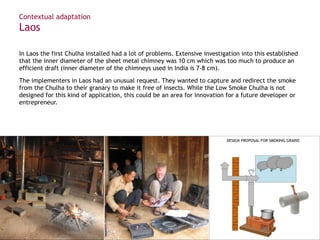
In Laos the first Chulha installed had a lot of problems. Extensive investigation into this established that the inner diameter of the sheet metal chimney was 10 cm which was too much to produce an efficient draft (inner diameter of the chimneys used in India is 7-8 cm).  The implementers in Laos had an unusual request. They wanted to capture and redirect the smoke from the Chulha to their granary to make it free of insects. While the Low Smoke Chulha is not designed for this kind of application, this could be an area for innovation for a future developer or entrepreneur. Contextual adaptation  Laos DESIGN PROPOSAL FOR SMOKING GRAINS
 

Chulha stories

  • 1.
  • 2.
    Chulha stories Aboutchulha partners and co-creators Chulha stories touch upon some of the organizations and individuals who have been instrumental in shaping the Low Smoke Chulha as we see it today, and have been key players in taking the Chulha solution to various communities in India and elsewhere.
  • 3.
    Development partners ARTI( Appropriate Rural Technology Institute) ARTI was the initial development partner the Chulha was developed with. There were 3 stove iterations made and the stoves were installed and tested in 3 test villages. ARTI has it’s own development center and was an active partner in organizing the stove co-creation sessions with end users.
  • 4.
    Junglescapes is avery active NGO, working in the Bandipur region in Karnataka, India. Junglescapes has been instrumental in bringing and disseminating the Chulha solution to this region. The team has been responsible for identifying and enabling stove-makers as well as organizing finance for buyers. Junglescapes has also been involved in helping set-up and conduct an impact study for the stove. Currently the organization is involved in a self initiated project to study the actual fuel savings made by using the Chulha. Implementation partners Junglescapes
  • 5.
    In Kenya, Alfana construction worker was given a mold set by a Dutch NGO. Three days later he was ready with an assembled Chulha. A month down the line, Alfan had made about 60 Chulhas. Post this, Praveen from Ohilips Design visited Kenya to study the local food and cooking habits. Based on that he made some attachments to make the Chulha fit the local context better. Today, Alfan can produce, transport, install a chulha (it’s called a Jiko in kenya) for 20 euro’s. Part of it is sponsored by the NGO 50%, 25% is paid via a microcredit and 25% is paid on delivery. Contextual adaptation Kenya
  • 6.
    Contextual adaptation Kenya: rural home scenario
  • 7.
    Contextual adaptation Kenya: analysis and adaptation Solution: An add on Pot holder helps in gripping the pot while stirring, cater to carious pot sizes and does not leaks smoke.
  • 8.
    An experiment conductedindependently by an NGO in Peru, the alternate stove design is based on the 2D and 3D drawings available in the Chulha start-up kit. The stove material is ceramic and the design has been adapted to the use of this material. They now have 10 stoves installed for testing, success in which will give stove users even more options to choose from! Contextual adaptation Peru
  • 9.
    In Laos thefirst Chulha installed had a lot of problems. Extensive investigation into this established that the inner diameter of the sheet metal chimney was 10 cm which was too much to produce an efficient draft (inner diameter of the chimneys used in India is 7-8 cm). The implementers in Laos had an unusual request. They wanted to capture and redirect the smoke from the Chulha to their granary to make it free of insects. While the Low Smoke Chulha is not designed for this kind of application, this could be an area for innovation for a future developer or entrepreneur. Contextual adaptation Laos DESIGN PROPOSAL FOR SMOKING GRAINS
  • 10.