Master Programme in Economic Growth,
Innovation and Spatial Dynamics
Greek and British Merchant Fleets.
Patterns of Investment in the Shipping Industry.
Evidence from the Tanker Sector
Christos Vassis
christos.vassis.967@student.lu.se
August 2010
Abstract
Shipping has played a significant role in the development of the contemporary world,
as it has served us with the vessel of trade. After the second World War, however, shipping
saw a major change, as the then leading British fleet was steadily surpassed by several
others. This process resulted in the contemporary leading position of the Greek owned
fleet. This study has as its purpose to provide an insight in the most recent developments of
the two fleets. One area of interest is the investment decision of the respective shipowners,
as they are depicted in the patterns of investment in response to changes in the business
environment of perhaps the most important commodity that ships transport, oil. This study
tries to understand how changes in the shipping market affects investment decisions upon
the relative national fleets. The major findings of the thesis are that the Greek shipowners
are more market oriented than the British ones, and that the British tax reform can be
considered as a success in revitalizing British shipownership.
Keywords:maritime, shipping, Greek, British, oil, tanker, investment, decision-making, elas-
ticities
Website: www.ekh.lu
EKHR 21
Master Thesis (15 Credits ECTS)
August 2010
Supervisor:Jonas Ljungberg
Examiner:H˚akan Lobell
i
Contents
1 Introduction 1
1.1 Scope of the Research . . . . . . . . . . . . . . . . . . . . . . . . . . . . . . . 2
1.2 The Research Question . . . . . . . . . . . . . . . . . . . . . . . . . . . . . . 2
1.3 The Period Under Examination . . . . . . . . . . . . . . . . . . . . . . . . . . 2
1.4 Literature Review . . . . . . . . . . . . . . . . . . . . . . . . . . . . . . . . . 2
1.5 Structure of the Thesis . . . . . . . . . . . . . . . . . . . . . . . . . . . . . . 4
2 The Nature of Shipping Industry 5
2.1 The Importance of Ships in Contemporary Trade . . . . . . . . . . . . . . . . 5
2.1.1 The International Nature of Shipping Industry . . . . . . . . . . . . . . 6
2.1.2 International Organizational Model of Shipping . . . . . . . . . . . . . 7
2.1.3 How National are National Fleets? . . . . . . . . . . . . . . . . . . . . 8
2.2 Investment in Shipping . . . . . . . . . . . . . . . . . . . . . . . . . . . . . . 9
2.2.1 Freight Rates . . . . . . . . . . . . . . . . . . . . . . . . . . . . . . . 9
2.2.2 The Market for New-built Ships . . . . . . . . . . . . . . . . . . . . . 10
2.2.3 Sale and Purchase of Secondhand Ships . . . . . . . . . . . . . . . . . 11
2.2.4 The Demolition Market for Ships . . . . . . . . . . . . . . . . . . . . 11
2.2.5 Entrance to the Market . . . . . . . . . . . . . . . . . . . . . . . . . . 12
2.2.6 Financing Shipping Investments . . . . . . . . . . . . . . . . . . . . . 12
2.3 The Oil Trade and Tanker Ships . . . . . . . . . . . . . . . . . . . . . . . . . 14
2.3.1 Business Cycle and Freight Development . . . . . . . . . . . . . . . . 15
2.3.2 Major Sources of Oil . . . . . . . . . . . . . . . . . . . . . . . . . . . 15
2.3.3 Major Consumers of Oil . . . . . . . . . . . . . . . . . . . . . . . . . 16
2.3.4 Seasonality of Oil Trade . . . . . . . . . . . . . . . . . . . . . . . . . 16
2.3.5 Major Developments and Events in Oil Trade after the second World
War.Their Impact upon Shipping Industry. . . . . . . . . . . . . . . . . 17
2.3.6 Tanker Ships in the Post War Era . . . . . . . . . . . . . . . . . . . . . 18
2.4 Preliminary Comparison of Greek and British Shipping Industries.
Differences and Common Characteristics. . . . . . . . . . . . . . . . . . . . . 19
2.4.1 Common Characteristics of the Shipping Communities of Greece and
Britain . . . . . . . . . . . . . . . . . . . . . . . . . . . . . . . . . . 19
2.5 Structure of the Relative Business Units . . . . . . . . . . . . . . . . . . . . . 21
2.5.1 Modes of Greek Shipping Ownership . . . . . . . . . . . . . . . . . . 21
2.5.2 Second and Third Generation Greek Shipowners . . . . . . . . . . . . 21
2.5.3 Professional Managers in Greek Shipping . . . . . . . . . . . . . . . . 22
2.5.4 Choice of Flag . . . . . . . . . . . . . . . . . . . . . . . . . . . . . . 22
2.5.5 The British Case . . . . . . . . . . . . . . . . . . . . . . . . . . . . . 25
3 Data 27
3.1 Sources of Data for the Shipping Industry . . . . . . . . . . . . . . . . . . . . 27
3.1.1 The Lloyd’s Registry of Ships . . . . . . . . . . . . . . . . . . . . . . 27
3.2 Sources of Data for the Oil Industry . . . . . . . . . . . . . . . . . . . . . . . 28
3.2.1 The BP Review of World Energy . . . . . . . . . . . . . . . . . . . . . 28
3.3 Indices and Time Series of The Dataset . . . . . . . . . . . . . . . . . . . . . 28
ii
3.3.1 The Worldscale Index . . . . . . . . . . . . . . . . . . . . . . . . . . 28
3.3.2 Total DWT Supply . . . . . . . . . . . . . . . . . . . . . . . . . . . . 29
3.3.3 Laid Up and Idle . . . . . . . . . . . . . . . . . . . . . . . . . . . . . 30
3.3.4 Fleet Ownership . . . . . . . . . . . . . . . . . . . . . . . . . . . . . 30
3.3.5 The LIBOR Interest Rate . . . . . . . . . . . . . . . . . . . . . . . . . 31
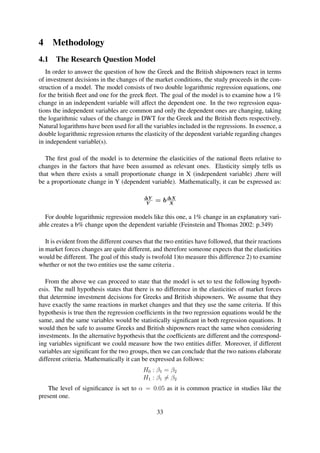
4 Methodology 33
4.1 The Research Question Model . . . . . . . . . . . . . . . . . . . . . . . . . . 33
4.2 Regression Analyses . . . . . . . . . . . . . . . . . . . . . . . . . . . . . . . 34
4.3 Variables included in the Model . . . . . . . . . . . . . . . . . . . . . . . . . 34
4.3.1 National Fleet Development . . . . . . . . . . . . . . . . . . . . . . . 34
4.3.2 Freight Rates . . . . . . . . . . . . . . . . . . . . . . . . . . . . . . . 34
4.3.3 Annual Tanker Ton-miles . . . . . . . . . . . . . . . . . . . . . . . . . 35
4.3.4 Price of Second Hand Vessel . . . . . . . . . . . . . . . . . . . . . . . 36
4.3.5 Price of New Built Tankers . . . . . . . . . . . . . . . . . . . . . . . . 36
4.3.6 Current Fleet . . . . . . . . . . . . . . . . . . . . . . . . . . . . . . . 37
4.3.7 Expansion of the Fleet . . . . . . . . . . . . . . . . . . . . . . . . . . 37
4.3.8 World Gross Domestic Product . . . . . . . . . . . . . . . . . . . . . 38
4.3.9 The Model Equations . . . . . . . . . . . . . . . . . . . . . . . . . . . 39
4.4 Limitations of the Model . . . . . . . . . . . . . . . . . . . . . . . . . . . . . 39
4.4.1 Multicollinearity . . . . . . . . . . . . . . . . . . . . . . . . . . . . . 39
4.4.2 Autocorrelation . . . . . . . . . . . . . . . . . . . . . . . . . . . . . . 39
4.4.3 Unit Root . . . . . . . . . . . . . . . . . . . . . . . . . . . . . . . . . 40
4.4.4 Heteroscedasticity . . . . . . . . . . . . . . . . . . . . . . . . . . . . 40
5 Results 41
5.1 The Greek Fleet . . . . . . . . . . . . . . . . . . . . . . . . . . . . . . . . . . 41
5.1.1 Interpretation of the results for the Greek fleet . . . . . . . . . . . . . . 42
5.2 The British Fleet . . . . . . . . . . . . . . . . . . . . . . . . . . . . . . . . . 44
5.2.1 Interpretation of the results for the British fleet . . . . . . . . . . . . . 44
6 Conclusion 45
6.1 Proposals for Further Research . . . . . . . . . . . . . . . . . . . . . . . . . . 45
7 Appendix 46
Appendix 48
References 48
List of Figures
1 Trend in Flagging Out,Greece . . . . . . . . . . . . . . . . . . . . . . . . . . 23
2 Trend in Flagging Out,Greece . . . . . . . . . . . . . . . . . . . . . . . . . . 24
3 Employment of Foreign Seafarers,Greek Fleet. 1996-2004 . . . . . . . . . . . 24
4 World Fleet Development, Tankerships. 1992-2006 . . . . . . . . . . . . . . . 29
iii
5 Laid Up Tankerships, 1992-2006 . . . . . . . . . . . . . . . . . . . . . . . . . 30
6 Greek Tankership Fleet Development, 1992-2006 . . . . . . . . . . . . . . . . 31
7 British Tankership Fleet Development, 1992-2006 . . . . . . . . . . . . . . . . 31
8 Cost of Capital,Libor. 1992-2006 . . . . . . . . . . . . . . . . . . . . . . . . . 32
9 Freight Rates Tankerships, 1992-2006 . . . . . . . . . . . . . . . . . . . . . . 35
10 Annual Ton-Miles,Tankers. 1992-2006 . . . . . . . . . . . . . . . . . . . . . . 35
11 Price of Second Hand Tankership, 1992-2006 . . . . . . . . . . . . . . . . . . 36
12 Price of Newbuilt Tankership, 1992-2006 . . . . . . . . . . . . . . . . . . . . 37
13 Order Book Development, Tankerships. 1992-2006 . . . . . . . . . . . . . . . 38
14 World GDP Development, 1992-2006 . . . . . . . . . . . . . . . . . . . . . . 38
15 Correlation Matrices . . . . . . . . . . . . . . . . . . . . . . . . . . . . . . . 46
List of Tables
1 World Oil Production by Region,Million Tonnes . . . . . . . . . . . . . . . . . 16
2 World Oil Consumption by Region,Million Tonnes . . . . . . . . . . . . . . . 16
3 World Oil Trade,Selected Years.Million Tons . . . . . . . . . . . . . . . . . . 17
4 Size of Greek owned Shipping Companies . . . . . . . . . . . . . . . . . . . . 22
5 Multivariate Analysis for the Greek Fleet . . . . . . . . . . . . . . . . . . . . 41
6 Multivariate Analysis for the British Fleet . . . . . . . . . . . . . . . . . . . . 44
7 Correlation Table,level data . . . . . . . . . . . . . . . . . . . . . . . . . . . . 47
iv
1 Introduction
This thesis tries to examine the differences in reactions in the shipping investment decisions
between Greek and British shipowners. The study will try to analyze, by looking the develop-
ments of the shipping industry in the 1990’s, how the national merchant fleets of Greece and
Britain reacted in changes occurred in the trade of oil, in an effort to provide an insight of the
behavior of the two entities in the more recent and stable context that this later period provide.
The leading motivation for looking into that matter is the change of primacy that occurred be-
tween the two nations in the second half of the 20th
century. A major development in postwar
shipping was the prolonged decay of Britain as the leading nation in merchant fleet and the as-
cendancy of Greece into the leading position. This change of primacy occurred approximately
in the 1970’s. This thesis wants to take into consideration the most recent developments and
trends that occurred in the industry and to look at the respective industries from a more recent
point in time.
Many reasons have been proposed as the dominant factor that contributed to this change
in primacy. Most researchers seem to agree that the main reason for the Greek advance was
the abundant, experienced and relatively cheap pool of labor that could be drawn from the
Greek islands (M.Serafetinidis et al. 1981; Tzannatos 2010; Theotokas and Progoulaki 2007;
Sambracos and Tsiaparikou 2001). The abundant labor supply helped Greek shipowners to
substitute for the initial lack of capital in the early postwar decades by investing in older ships.
Another factor that has been proposed and certainly has played a major role is the different
investment mentalities of the two nations. While the Greeks, especially in the aftermath of the
second world war, were quite aggressive investors the British ones had adopted a more con-
servative approach towards shipping (Sturmsey 1962). This development and the shifting of
shipbuilding activities towards initially Scandinavia and later on towards Asia, removed from
the British shipping the advantage of technological innovation. Additionally, British shipown-
ers are thought to have been slow to make the transition from steamships to modern ships a
development that left them further behind not only the Greeks, but others as well.
However, the target of this study is not to analyze the factors that led to that development,
but rather an attempt to quantify the differences between the two nations regarding the patterns
of investment in the more recent period 1992-2006. There will be an attempt to explore how
the two nations reacted regarding similar stimuli from the market of tanker ships. The main
hypothesis is that the two fleets differ not only in their reactions, but they also elaborate different
criteria when it comes to investment decisions. The study will try to analyze the recent patterns
in investment decision of the two nations in their recent historical context.
Although it might be impossible for someone to identify all the factors that differentiate
Greece and Britain in terms of maritime investments, it might be possible to locate certain
factors that can have produce significant contributions. The target of this thesis is to locate
most of those factors and to examine how the two nationalities differed.
1
1.1 Scope of the Research
The scope of the research is to examine the broader economic context in which Greek and
British shipowners make investment decisions. It will try to locate the economic parameters
that affect those decisions and examine if those two groups differ in their criteria, how they
differ and how much they differ. Acquiring knowledge of those differences can perhaps help
us to understand more clearly the reasons and the dynamics that shaped the different courses
that the two entities followed in the long run and will provide us with an insight of how the two
entities differentiated from each other. Moreover, it might reveal us some of the reasons that
may have played a significant role in the current (2008-2010) shipping crisis which followed
the lucrative years of the 1990’s and most of the current decade, and might provide us with
indications about their future course.
1.2 The Research Question
It is evident from the different courses that those two groups of shipowners have take, that
there must be quite large differences in the ways they perceive and anticipate market forces.
In order to test the validity of this statement, the study hypothesizes that the same parameters
that affect Greek tanker owners in their investment decisions affect also the British ones. The
study provides an overview of the developments in shipping in the post war era and with the
use of quantitative tools like regression analysis, the study seeks to investigate whether or not
this hypothesis is valid and moreover to analyze any differences that may arise.
1.3 The Period Under Examination
The period under examination (1992-2006) was selected because it has the particular char-
acteristics of being one with a relatively steady, healthy growth for the industry and the world
economy as a whole, especially in the last decade of the 20th
century. Additionally, the early
years of the 21st
century have been considered as the best years for shipping in many decades,
since the high growth rates of China and India have boosted the demand for oil transport.
Shipowners active in the tanker sector reported return on equity of 80% or even 130%(The
Platou Review 2005). Similar patterns of stellar growth were widely evident in every sector of
the shipping industry.
1.4 Literature Review
Literature of comparative studies in maritime history is quite limited, especially in the field
of merchant navies. Most of the existent literature, like the one provided by Harlaftis and
Theotokas (2004), which is the only one dealing exclusively with those two navies in the
knowledge of the author, focus mainly on the qualitative characteristics of the two nations
and examine their course in a long-term point of view. Subsequent quantitative analysis has a
secondary role. Specifically, Harlaftis and Theotokas support the notion that Greek and British
shipping enterprises have many things in common. Their findings are that those firms have kept
the qualities of family organization and networking at the core of their business model. Most
of the researchers in the field of maritime economics and entrepreneurial studies follow the
same qualitative approach when examining the various shipowners’ communities around the
2
globe, and focus their analysis in matters like the organizational culture, regional and national
networks, forms of ownership and patterns of firms’ organization giving too little weight to the
quantitative differences.
A study that examines exclusively the cultural characteristics of the Greek shipowner’s com-
munity, and more specifically of how they achieve an advantage regarding clustering and net-
working is provided to us by Mourdoukoutas et al. (2007). The findings of this article can
be said that underline the importance of those cultural and entrepreneurial characteristics and
their role into the business life of the Greek shipowner’s community. On the British side of
our interest, a study by Rowlinson and Leek (1997) demonstrates how a group of regionally
based British shipping companies that did not manage to participate in synergies and network
economies were doomed to perish. Boyce (2010) looks at the intrafamily culture and relations
of a shipping family (Bates) as well as their differentiation among generations by examining a
number of their correspondence letter. Although the era covered in his study is different that
the one we are interested in, it provides us with a valuable insight of the traditional British
shipowners’ mentality. In a paper that goes rather beyond the interests of this study, Evange-
lista and Morvillo (1998) conducts a firm-specific survey of shipping companies in Italy that
finds some common cultural elements among Italian, British and Greek shipowners as well.
Those common elements are the centralized management style, the family organization and a
high recognition for training obtained by practice.
One study that takes one step further from the qualitative analysis norm is the one produced
by Thanopoulou (1994). Thanopoulou performs a survey analysis and suggests that the in-
vestment policy of shipowners is influenced primarily by changes in freight rates. It should be
mentioned however, that subject to her analysis was the world fleet of containerships, a market
with significant differences than the market of tanker ships. She further suggests that shipping
investments are reinforced by the policy of banks that willingly provide the funds necessary
for the investments when the freight rates are high, but are also quick to remove the funding
of investment projects as soon as the freight rates show signs of retreat. Findings from the
present study however suggest that freight rates are not the parameter with the highest impact
upon investment decisions, therefore suggesting a more secondary role for banks in the decision
process than Thanopoulou suggests.
Another study conducted by Mitroussi (2004) seeks to exploit how Greek and British ship-
ping firms regard the employment of professional managers. The study seeks to examine
whether specific characteristics of a shipping company relate with the employment of pro-
fessional managers. The selected characteristics are age, size and type of shipping company.
The study did not find distinct differences between the two nations. Although not a compar-
ative study, it can provide us with a useful insight of the perceptions regarding professional
managers in the two nations. The study does not provide the reader with a comparison between
the two nations but rather with a comparison between shipping companies and shipowners.
Some quantitative studies try to answer quite specific questions, for example a study by
Merikas et al. (2008) examines whether or not a shipowner should invest in a new or second
hand tanker using as criterion the second hand over newbuild price ratio. Another study by
3
Poulakidas and Joutz (2009) seeks to examine the dynamics of the link between oil prices and
tanker rates. Another one, by Alizadeh and Nomikos (2009) investigates the price-volume
relationship regarding the transactions of ships that participate in the dry bulk market. Other
studies focus on the different treatments of shipping in several nations and jurisdictions like
the one by Gardner and Marlow (1983). Many more studies have focus on similar issues, but
quantitative comparisons of investment traits across nations are largely missing.
From the above short analysis of the topic’s literature, we can divide research in shipping into
two broad categories. The qualitative approach used in the research mentioned above is suitable
to analyze why nations, companies or shipping sectors differ, as it provides us with useful
insights in their entrepreneurial culture, environment and development path. The quantitative
research has focus on the answer of several specific questions, mainly technical ones, which
focus on different interactions insight the shipping industry.
The quantitative approach of this study has its aim to look into the elements that differen-
tiate Greek and British shipowners and to quantify those differences. It will try to shed light
at the magnitude of those differences although one has to keep in mind that a quantitative ap-
proach such as this cannot take into account every aspect that differ and therefore is subject to
limitations.
1.5 Structure of the Thesis
The thesis has been organized in several parts. Section 2 provides a more detailed view of the
nature of shipping industry and reviews the developments in shipping after the second world
war. it has as an aim to familiarize the reader with the history and the main facts that shape
the course of the industry, and to illustrate how the industry reacted under each circumstance.
Section 3 of the thesis is devoted to a discussion of the data that have been used in the conduct
of the research. Section 4 is devoted to a discussion of the methodology that was selected for
the thesis follows. This part includes a detailed discussion of the model specifications and the
variables that were used in the model. An analysis of the results that the model produced comes
next in section 5, and finally a conclusion with the findings and proposals for further research
is presented in section 6.
4
2 The Nature of Shipping Industry
2.1 The Importance of Ships in Contemporary Trade
Shipping is one of the world’s most international industries and it reflects developments of
the world economy. It is said that shipping as part of the transport sector can be held responsible
for the emergence of the world as a global economy instead of a sum of small, local, national
economies (Stopford 1997: 3). Transport of goods by ships is particularly heavy between the
industrialized regions of Europe, North America and Asia. Ships have been for millenia the
vessels of trade. Their ability to transfer large amounts of products has made them a vital
characteristic of almost every empire in history. Today ships continue to play the same, if not
an even more significant, role in trade as they have done in the past.
One characteristic of the industry is that it is very adaptive to change. Every major techno-
logical development has found its applications in shipping, since the size of the business can
render the early adoption of innovations quite lucrative. Satellites and GPS are only two of the
technologies that have found their early applications upon shipping. Shipping has the power to
even change the landscape, isthmuses and canals have been built in order to elaborate a more
efficient movement of goods between countries and continents.
Numerous commodities are subject to sea transfer, from grain to cars and from toys to chemi-
cals. This need for such diversified transport services has led the shipping industry to specialize
in several commodities. Therefore ships have undergone several changes and have adapt crit-
ical innovations in their struggle to become more and more efficient. The ability to adapt to
changes of the external environment has become critical. Most researchers agree that the most
significant innovation in shipping in the post-war period is containerization. It has offset some
of the increased fueling cost and facilitated greater intermodal transportation without the need
of repackaging the product from mode to mode,and has significantly reduce transportation and
transaction costs(Hummels 2007).
One of the most significant characteristics of the shipping industry is that it is perhaps the
activity closer to perfect competition since it fulfills most of the theoretical criteria.
1. Lots of Buyers and Sellers
2. Easy Market Entry and Exit
3. Access to market information
4. Homogeneous products
5. The firms are price takers1
1
As it will be explained later, shipping companies seldom decide the price for their services themselves
5
2.1.1 The International Nature of Shipping Industry
This internationalization and specialization of the shipping industry, has create the need for
institutions capable to deal with the numerous small but important details that are vital for the
correct functioning of the world’s marine transport networks. There are particular types of
institutions that regulate and affect the shipping industry. Each one of those institutions have a
distinct feature but limited interaction with the others.
Classification Societies
Classification societies are responsible for the technical standards of the ship. They make
rules about technical aspects like rule of construction and maintenance and issue class
certificates for ships upon inspection. Such societies are Lloyd’s London, Bureau Veritas,
ABS, Germanischer Lloyd etc. Classification societies evolved as an effort of underwrit-
ers to know if the ships under question were sound. They are non-profit organizations
who depend their survivals on the fees paid by shipowners. This leads to a significant
distortion since societies have to impose financial penalties in the same people that are
responsible for their survival. They also undertake technical inspections on behalf of
governments, and this contributes to the perception that they are governmental bodies.
Their governing body is the International Association of Classification Societies (IACS).
The Flag State
The flag state is the primary authority that regulates the commercial and operational as-
pects of the ships in its register. It usually has distinctive rules regarding taxation and
manning. Flags of Convenience, which offer reduced taxation and loose labor and safety
regulations have been very popular among shipowners. According to the 1982 UN Con-
vention of the Law of Sea any state can register ships as long as a “genuine“ link between
state and ship exists. There are two types of flag states, those with national registers(often
called close registers) and those with open registers. Most national registers treat ship-
ping in the same way as any other business in the country. Closed registers usually restrict
ownership to the respective nationals e.g. the US flag can be flown only on vessels owned
by American citizens. Open registers provide specific provisions for the shipping indus-
try, regarding taxation, crews and in many cases safety standards and non-nationals are
free to register their vessels regardless of owner’s nationality. The Greek and British
registers are considered open ones. Flag of Convenience states fall in the open registries
category. However, seamen have been opposed to the practice of flags of convenience
since it has a significant impact upon their incomes and safety, and seamen unions have
taken measures to alleviate those impacts. The most active international union in ship-
ping is the International Transportworkers Federation (ITF) that has been quite active in
opposing the lousy labor regulations of Flags of Convenience states. Despite its constant
efforts however, its success remains limited due mostly to the different targets of the na-
tional labor unions that consist it and only 29% of the tonnage under flags of convenience
has become subject to its regulation (Koch-Baumgarten 1998: 369)
Some nations like, Norway, Denmark and France to name a few have developed special
registers that are a hybrid between open and national registries. Those registers are often
called quasi-FOC. Usually, those registers seek to enforce their jurisdiction upon matters
of safety and pollution while provide a more flexible regime regarding manning and
6
taxation. The Isle of Man register is sometimes consider as the de facto Quasi-FOC
register of United Kingdom while many past and current colonial British possessions and
Commonwealth members are, or had been, subjects to British regulations on manning
and safety. (Toh and Phang 1993)
At the end of 2006, Panama was the largest register of ships with 7,199 vessels ac-
counting for 22.2% of the worlds capacity flying the Panama flag. The Greek Flag was
present in 1,459 vessels and the British Red Ensign was present in 1,596 ships.(UN Re-
view of Maritime Transport 2007)
The Coastal State
A coastal state is one in whose waters trade is taking place. The UN Convention of the
Law of Sea recognizes three types of jurisdiction for coastal states, territorial waters,
contiguous zone and exclusive economic zone. Coastal states usually have regulations
regarding environmental issues, safe navigation, or cabotage restrictions which are en-
forceable only in territorial waters. Such regulation are e.g. the Oil Pollution Act2
of the
United States, which created a new code of conduct regarding oil spills (it was enacted as
a response to the Exxon Valdez accident) or the cabotage restrictions of the same nation.
Coastal states that are large participants in the world trade can and have influence the
course of the industry. While in the past it was quite common for coastal states to apply
restrictions on foreign fleets and actively protect their own, this is not so common any-
more and the only major state that still has that kind of protection are the United States
with the aim to protect the employment of American seamen. Most coastal states have
successfully press to implement higher environmental standards for the industry with the
adaptation of Double Hull tankers to be considered as a landmark development.
International Organizations
International organizations can occasionally play a significant role in industry. They is-
sue directives and standards that could have a significant impact upon shipping. Such
organizations are the IMO (International Maritime Organization) and the ILO (Interna-
tional Labor Organization), to name just the two that are consider the most significant.
An example of intervention is the directive of IMO that made the use of Double Hull
tankers mandatory, in a response to the accidents of Exxon Valdez and Erika and the con-
tinuous pressures of the ILO for better employment terms on board, especially regarding
ships registered under Flags of Convenience.
From all of the above, flag state and classification societies are of significant importance for
the shipping industry since they govern the everyday function of the industry.
2.1.2 International Organizational Model of Shipping
From the above analysis it is obvious that in order for a shipowner to reap the benefits of
Flags of Convenience, he or she has to organize carefully his/her business. This organization
2
After the Exxon Valdez accident the government of the United States, unilaterally required shipowners who
trade within the US navigable waters to to show evidence of their ability to pay up to the maximum of their limited
liability in the form of proof of insurance, guarantees and letters of credit.(Grammenos and Choi 1999: 42)
7
is done in most cases as follows. A single-ship company is incorporated, usually under the
jurisdiction of a Flag of Convenience state. its sole purpose is to own one ship and usually
there are no other assets. A holding company is then incorporated, preferably in a tax heaven
environment, which bears the stocks of a number of single ship companies. The management
of the above companies is handed to a managing company located in a shipping center like
London,Hong Kong or Singapore. At the top of this scheme is the shipowner.
2.1.3 How National are National Fleets?
There is considerable debate as to whether or not shipping can be characterized as a national
industry in the same way e.g. automakers are considered. There are several propositions that
contribute to that debate. Is a fleet that its major business is contacted outside the Greek state,
seldom flies the Greek flag and only 5% of it engages in the transport of Greek cargos and
from its tremendous profits ony 11% flows in Greece (Harlaftis and Theotokas 2009: 93) really
Greek?
The two main gains of the Greek economy from shipping are the transfer of foreign ex-
change from remittances and the transfer of shipping activities to the port of Peireaus. Foreign
exchange inflows were of significant importance for the Greek economy, since it ran always a
negative balance of payments. Flagging out and a series of legislation changes led to a signifi-
cant reduction of that inflow during 1980’s3
Although the Greek shipowners started their postwar adventures in London and New York,
there is a tendency to transfer their core activities in Piraeus, Greece. This tendency was rein-
forced by their desire to create a base located under an institutional framework that they could
easily influence. That institutional framework was initially created by the Greek military junta
during the years 1967-1974 and was subsequently continued and reinforced by the democratic
governments that followed (Harlaftis and Theotokas 2009).Actually, it is nothing more than a
special tax regime along with the creation of special maritime schools that are partially funded
by the shipowners (Goulielmos 1997). A similar policy was followed in the 1990’s by the UK
government and managed successfully to attract tonnage to the UK flag and to revitalize the
British shipping sector. This institutional framework was accompanied by improvements in
physical infrastructure and with proximity to the sources of labor (mainly Greek officers), and
with lower running costs due to lower wages. This led to the establishment of approximately
800 companies in the years between 1968-1975, many of them were branches of companies
already established in New York or London whether others were new companies (Harlaftis and
Theotokas 2009: 96) .
The establishment of a base in Greek soil helped significantly the renewal of Greek shipown-
ers as it created a concentration of services and know-how in a small area. The establishment
of major international banks in Greece and advantages in communication did the rest. It should
3
According to a study by A.Goulielmos, the basic reasons that contributed to the reduction of inflow of foreign
exchange from shipping into the Greek economy were: The substitution of the British Pound with the Greek
Drachma as the currency of seafarers’ wage payment; the increase of the percentage of foreign citizens employed
in the Greek fleet, and their payment according to the prevailing wages in the country of origin; devaluation of
Drachma; reduction of ship taxation and reduction of positions on board (Goulielmos 1997)
8
be noted that there was no financing institution specialized in shipping in Greece before the
founding of the state run ETBA (Greek Bank of Industrial Development).Up to this point,
Greek banks were almost absent from the portfolio of Greek shipowners, but afterwards ETBA
by providing credit for ships built in Greece it managed to become a vital source of capital for
the Greek shipping. In the period under question several banks were providing credit to Greek
shipowners. Foreign banks were dominant, holding a portfolio of 23 billion dollars in 2003
while the portfolio of Greek banks were slightly over 5 billion dollars (Orfanidis 2004: 79)
The major contribution of the Greek state to the Greek shipping industry was that it acted as
a guarantor for the purchase of 100 Liberty type ships from the US government. Liberties were
cargo ships that the American shipyards produced during the war. The price of the ships were
agreed to be $545,000 but only 25% of that price was paid immediately by the shipowners,the
rest was to be paid in monthly installments spanning 15 years. With the outbreak of the Ko-
rean War those ships became tremendously profitable creating liquidity for further investment
(M.Serafetinidis et al. 1981: 295).
The British economy has benefited significantly from shipping, even though Britain is no
longer the nation with the larger fleet as it used to be. The major contributions of shipping to
the British economy is the establishment of London as perhaps the major shipping center of the
world. Services that are auxiliary to shipping such as insurances and banking have developed
significantly in London. British banks have been a major source of credit for shipowners world
wide.
Shipowners in Greece and in Britain alike have shown a preference of investments like oil
refinement, metallurgy, chemicals and paper industries, transport and mining non-metallic min-
erals as well as banks, real estate, construction and insurances (Harlaftis and Theotokas 2009:
92-96).
2.2 Investment in Shipping
A ship can be traded in four markets, and it is expected that it will participate in all of
them in its economic life. The four markets are the market for new-built vessels, the freight
rates market, the secondhand vessel’s market and the demolition market (Stopford 1997). Even
though those four markets are self-explanatory regarding their activities, a short analysis will
be provided here.
2.2.1 Freight Rates
The freight rates market is the core market of the shipping industry as it is the main source
of cash inflow. The other secondary source of cash is the demolition market. There are two
different transaction methods of hiring a ship. The first method is the so called freight contract
when the shipper agrees with the shipowner for a fixed price per ton of cargo. This method
leaves the management of the transportation to the shipowner and it is preferred by shippers
that do not conduct business in regular time intervals. The second method is time chartering.
With this method the shipper basically rents the ship by the day and for a fixed amount of time.
This leaves the management of the transport to the shipper and it is preferable by shippers that
9
can determine their future transportation needs. Variations from those two common forms have
evolved through time. There are separate markets for each type of ship and the price is different
according to the route. There are also regional markets that address irregular cargo needs and
where in general ships that are in a specific area and ready to load cargo participate, (on the
spot markets) but this behavior is quite rare in the oil tanker sector because of the nature of the
trade.
Shipping industry does seldom determine its revenues. They are determined in markets
similar to those of stocks. Most significant market is that of the Baltic index, based in London
were freight rates are traded. The freight rates that determine return on investment in shipping
are subject to heavy fluctuations and demonstrate a cyclical nature. There are many freight
rates according to the type of ship and the route that it is to follow (Stopford 1997: 81-95).
There are three groups of people that help the previously mentioned market to function.
The shipowners, who have a ship available;the charterers, who have a cargo that needs to be
transfered;the ship-brokers whose job is to match efficiently charterers and shipowners. The
market may initiate by the shipowner or by the charterer who will give ship-broker the order to
make a match. Since ship-broking is all about having the right information in the right time,
ship-brokers have been concentrated in several cities around the globe with London being the
largest shipping center and cities like New York, Tokyo, Oslo, Hong Kong, Singapore and
Piraeus to follow.
2.2.2 The Market for New-built Ships
The market of new-built ships is the one that posses the most dangers for the future buyer
of a vessel. This is so because they invest in an asset that does not exist and it will take two
or three and sometimes even more years to be built. In the meanwhile the conditions in the
market might have change considerably. Specifications of a ship vary considerably. Only a
small number of shipbuilders can standardize their production. However, standard ships were
quite common in the aftermath of the second World War as during the war effort shipyards
produced a large number of standard ships. The Liberty cargo ships are the most prominent
example of a mass produced ship. Today,shipyards will bid in an effort to secure orders for
almost any type of ship from tugboats to war frigates, and only a small number of shipyards are
considered fairly specialized in a specific type of ship.
The reason for a shipowner to chose a new-built instead of a secondhand vary significantly.
Many shipowners have a policy of renewing their fleets when they reach some age, others
are obliged to invest in new ships because of new regulations (e.g. double hull tankers) or a
new market may be emerging that requires ships with a specific design that does not yet exists
(Liquid Natural Gas carriers are a good example of that). Economic factors also play a leading
role in those decisions as in many cases a new-built might be cheaper than a secondhand due
to high freight rates. The shipowner might have secure a good offer from the shipyard or can
secure charters that will last well into the future which might make the investment in a new-built
desirable and economically viable.
10
Investment in a new-built is a decision that has to be made with considerable cost since
the amount of money involved and the complexity of the project do not leave any room for
mistakes. The contracts needed to be signed and the details of the design of a specific ship
are vital stages of the purchasing procedure and the amounts of money involved are quite large
(Stopford 1997: 107-110).
2.2.3 Sale and Purchase of Secondhand Ships
The second hand vessels market is a crucial one. It is a market that is subject to considerable
amount of speculation from all the parties that are involved. The shipowner usually initiates
the procedure by authorizing a broker to sell a specific ship. Ship-broker’s role in the market of
second hand vessels is to match the seller of a specific ship with the potential buyer. Usually,
the ship under sale is free of obligations and occasion of ships sold while chartered are rare.
One should remember although that charters are not always profitable. Freight rates, inflation,
age of a ship and expectations about the future course of the industry, and price of new-builds
are the main factors that affect the price of a ship in the second hand market, although different
sizes of ships behave considerably different(Merikas et al. 2008). High volatility is the main
characteristic of the market and that high volatility creates the setting for extraordinary gains
or losses. This market also attracts the majority of the asset players since the high volatility
occasionally offers lucrative gains.
Many companies, especially non-traditional ones, can be seen to treat ships the same manner
as one treats stocks. They buy cheap when freight rates are low or when they can obtain a good
deal with a shipyard and sell when freight rates are high, thus acquiring considerable capital
gains. This strategy had been very popular in the 1980’s and has been the formula of capital
creation for a number of shipowners. Moreover, it has been a measure to secure liquidity for the
business and allow to run the company even in times of crises. Nevertheless, this practice has
never been the rule for Greek and British shipowners, although there are cases where companies
sold their entire fleet in a point in time and reentered the market later(Stopford 1997: 96-106).
2.2.4 The Demolition Market for Ships
The sale of a ship for demolition is the final and the least glamorous market that a ship par-
ticipates. The market essentially addresses ships that have reach the end of their economic life
and are not considered seaworthy anymore. It also addresses ships that cannot find employment
and therefore their owners has decided to sell them for scrap metal.
The sale of a ship in the demolition market is arranged by ship-brokers. Almost every major
ship-broking company has a department that specializes in this market. Once a ship-broker
receives an order to place a ship for demolition, he circulates the details of the ship to potential
buyers. Quite often the buyers are not the demolition yards themselves, but speculators who
perceive that the market for metals will go up in the foreseeable future and decide to invest in
scrap metals.
Finally, at some point the ship will reach the demolition yard. The major demolition yards
are located in South Asia and particularly in Pakistan, India, Bangladesh and some of them
11
in China. The price is determined by two main characteristics of the ship. Its weight is one
characteristic and the type and suitability of the metal contained in the ship is the second.
Perhaps the most significant feature of the demolition market is that it is used as a ”safety
valve” when there is oversupply of ships in the market. In the occurrence of such a situation
when freight rates are too low and ships remain idle or underemployed, shipowners prefer to
sell their ships for demolition and by that pressing freight rates up. In extreme situations ships
had gone from the shipyard directly to the demolition yard(Stopford 1997: 110).
2.2.5 Entrance to the Market
Investment in ships can be made by acquiring either a new-built vessel or a secondhand
one. Both options have their pros and cons. A new-built vessel is more expensive and not
immediately available as it takes considerable time from order to delivery and in the mean-
while conditions in market might change radically. On the other hand a new-built has better
technology, will be in service for a longer time and it has a lower operating cost than an older
vessel.
A secondhand vessel on the other hand is quite cheaper than a new-built, and as such it
minimizes the risk of the investment and requires less capital which makes it the preferable
choice for new entrants in the market. Additionally, it is possible to exploit it immediately.
On the other hand it has a higher operating cost and incorporates inferior technology than a
new-built, pressing operation costs higher.
Another factor that influences the decision of purchasing a new-built or a secondhand is the
availability of capital. Since shipping is a capital intensive business that requires huge amounts
of capital to be employed, secondhand vessels are preferred for new shipowners that cannot
secure financing for a new-built. Another factor in favor of second-hands is the respective
source of income. If the nature of the trade the ship participate in permits the employment of
low cost labor then an investment in a secondhand might be viable despite the higher operating
costs.
Purchasing a number of shares of a company’s ship is another method investing in shipping
and it is quite popular among former captains and officers with on-board experience. Loans
from seller of a ship to its buyer is another form of securing the acquisition of a ship. Seller
can dispose a no longer profitable ship for more than its scrap value and the buyer has the
opportunity to enter the market as well as to create connection with the seller, basically because
the latter wants to secure the payback of the loan.
2.2.6 Financing Shipping Investments
The financial sources of the shipping activities have been through changes in the course
of history. Shipping activities have historically be financed either with equity or with debt
issuance. Leasing has only recently being part of shipping finance.
12
In the early years of modern shipping, both Greek and British shipowners were financing
their investments through joint capital schemes or through individual owners equity, if it was
considered enough to cover the investment. Participants in those schemes were mainly friends
and relatives of the owner and rarely individuals without any connection to the owner. This
form of capital raising was dominant since at least the 19th
century(Harlaftis and Theotokas
2009).
Equity has been another major instrument of shipping investments. The basic idea behind
equity financing is the issue of stock that can be traded privately or listed in stock exchanges
around the world. Although shipowners generally hesitated to list their companies in stock
exchanges, it is not uncommon for them to raise capital by the issue of stock placed in the hands
of a limited number of carefully scrutinized individuals without public listing. There are several
advantages in this tactic, mainly that the investor partners with people that he or she already
knows, the regulatory framework is less strict than that of a public listing, information spread
regarding the company is limited and fees for registering and selling the stock are considerably
less. The main disadvantages are that the amount of capital raised that way is rather limited and
that large investors in a company are likely to monitor it more closely (Orfanidis 2004: 53).
Stock exchanges have traditionally played a limited role as the source of capital for the ship-
ping business. This was mainly a result of the hesitation of shipowners to share company
control, the family nature of the business and the unwillingness of shipping companies to dis-
close sensitive informations. Furthermore the volatility of the cash-flow in shipping made their
stocks unattractive to institutional investors. Only after 2000, when high freight rates due to the
emergence of China and in combination with bullish stock markets made investing in shipping
stocks attractive. In the London Stock Exchange only one shipping company was listed before
2000, but that number increased to 6 afterwards. The relative numbers for NASDAQ is three
companies before 2000 and twenty-two afterwards. Globally, there were only thirty-eight ship-
ping issues listed in stock exchanges before the year 2000, but that number increased to 105 at
the end of 2007 (Merikas et al. 2009: 486).
With the industrialization that followed the end of the second world war, the interconnection
between shipowners and their clients became even more vital as more and more ships were
needed to carry the increased cargo. Moreover, the rate of growth of the world economy cre-
ated capital that needed to be invested. That development made debt-financing of shipping
investments a vital option. This led to the development of another instrument of financing, the
time-charter collateral agreement. The scheme can be explained as follows. A shipowner had
signed an agreement with a company, let us assume an oil company, to carry its cargo. That
agreement which secured him steady and known cash-flows was then presented to a bank in
order to secure finance. This method faded in importance after the 1970’s since shippers were
not interested in making long-term commitments regarding shipping due to the oil crisis and
the oversupply of tankers. This initiated a great expansion for the Greek and the Norwegian
fleets (Stopford 1997: 197).
Another method, that became more important in the early 1970’s was the asset-backed fi-
nancing. This change in financing had a significant impact upon the shipping industry. The
13
scheme in essence can be told to treat ships in a manner similar to real estate (Stopford 1997:
198), as it issues mortgages with the (not yet built) ship as collateral. With this development,
the link between demand (charters) and supply (shipbuilding) was removed. During the charter
backed finance shipbuilding was bounded to the availability of charters. Now, with only the
ship as collateral and with a large supply of petrodollars eager to be invested elsewhere, ship-
ping seemed a good investment. This led to a frenzy of orders with 105 millions deadweight
tons of tanker capacity to be ordered in 1973 alone, or a 55% increase in a single year (Stopford
1997: 199).
One more method of financing shipbuilding was by shipyards themselves. In periods of re-
cessions, when shipyards were underemployed, they would provide a reliable shipowner with
credit that could have been equal up to 50% of the ship value. As shipbuilding is consid-
ered a highly strategic business, governments were eager to promote it and provided loans
through specialized government schemes, like ECGD for UK, ETBA for Greece, Exim for
Japan, KEXIM for Korea, Hermes for Germany and many more (Orfanidis 2004: 42).
In addition to the financial tools mentioned above, some countries have developed special
financial schemes that have been overwhelmingly used to finance shipping investments. Most
popular are the K/S market in Norway, KG-market in Germany, JLL-JOL in Japan. In essence,
the above schemes are limited liability companies or partnerships with special tax regimes that
have been most favored by shipowners (Orfanidis 2004: 63-70).
2.3 The Oil Trade and Tanker Ships
Oil Trade has been subject to several changes in the period after the second World War.
Traditionally, the post war period is divided into two parts regarding oil trade. The first pe-
riod that started in the early 1950’s is characterized by a ninefold growth in the amount of oil
transfered. It ended with the oil crises of the 1970’s (Harlaftis and Theotokas 2009: 13). The
second one started after the second oil crisis and is characterized by a collapse of the tanker
freight rates and a slow recovery of the oil trade (ibid). One early result of the 1970’s oil crises
which affected the tanker sector was the decision of oil companies to transfer crude oil closer
to the markets and refine it there, rather the up to then common practice of refining oil near the
source and then transporting its products to the markets (Stopford 1997: 310). This tendency
were further reinforced by the political instability that arose in several oil producing countries
like Iran and Iraq. Before the crises the markets of oil were quite structured and oil companies
knew their transport needs and could program to charter tankers or to built their own. Minor
misjudgments or unforeseen developments were addressed by the spot market. With the oil
crises and the subsequent fall of demand, the trade of oil became much more volatile and com-
panies lost their ability to program transportation well into the future. This development let to
the withdrawal of oil companies from the shipping of oil, leaving room to new suppliers and
leading to an increased role for the spot market.
Another development was the increase of importance of oil sources that are close to the mar-
ket. Mexico, Venezuela, Alaska, the North Sea and Indonesia to name the most significant ones
are sources of oil considerably closer to the markets than the Middle-East region and this prox-
imity affected negatively the demand for oil transfer. As transport time shortened, availability
14
of ships increased and that contributed further to the prolonged recession in shipping that fol-
lowed the oil crises. The closing of the Suez canal in 1956 can demonstrate the opposite effect
as it diverted shipping routes around the Cape of Good Hope therefore increasing transportation
time and the demand for tankers.
2.3.1 Business Cycle and Freight Development
The business cycle is the major force that determines the behavior of the freight rates. Eco-
nomic growth is what makes ships a necessity and drives freight rates up. Economic growth
is subject to two types of factors that affect it. Internal factors and external factors. Internal
factors are characteristics of the economy and the economic structure while external factors are
events not directly connected to the economic activity per se but that affect it heavily, like wars,
embargos, policy restrictions or unusual changes in some core commodity prices that affect
their demand.
One internal reason for the business cycle is the so-called multiplier and accelerator ef-
fects. This effect can be illustrated briefly to work as follows. Income can be spent either on
consumption or on investment goods. An increase in investment spending, let us assume the
building of a port facility, creates also demand for consumer goods for those who work on the
port construction and the spending of their wages creates even more demand for investment
(investment multiplier). The additional consumer spending now circulates in the economy and
demand for investments (to address the excess consumption) continues to rise. Eventually, la-
bor and capital reach a state of full utilization when further expansion is impossible. Investment
orders fall, employees are laid off and the whole process goes into reverse.
Time-lags between a business decision and its implementation. In the shipping industry
this phenomenon can be vital since developments between those two points in time can turn a
market upside down. When one considers the sums that change hands in shipping transactions,
time lags can make the difference between an extraordinary loss or gain.
Stockbuilding is another phenomenon that has the potential to create considerable impacts
upon shipping industry. Stockbuilding is fueled by the desire of industry to adjust its inventories
when the economy begins to recover. This creates a sudden surge in demand. Some examples
of this in the tanker sector are the mini-tanker boom in 1979 and 1986 which were initiated by
temporarily stockbuilding of the world oil industry.
Random shocks can also affect the demand and availability for shipping services. As random
shocks one can count wars, commodity price changes, weather conditions, piracy. They differ
from cycles since they are not an endogenous economic result but their impact upon shipping
can be extremely severe. Examples might be the two oil crises that set the environment for a
prolonged shipping crises.
2.3.2 Major Sources of Oil
The majority of the oil is thought to be in the Middle-East region which is thought to posses
approximately 60% (6: BP Statistical Review of World Energy 2009)of the world’s known
15
reserves. Other major production areas are located in the Atlantic Ocean and the Americas,
with the US Gulf, Mexico, Alaska, Venezuela, North Sea, West Africa and North Africa to be
the main sources of oil and in great proximity to the main markets. In Asia, Indonesia and
China are considered only minor producers.
Table 1: World Oil Production by Region,Million Tonnes
Region Year
1965 1970 1975 1980 1985 1990 1995 2000 2005
North America 489,6 627,7 591,5 670,7 730,2 655,6 646,0 650,8 645,3
S. & Cent. America 225,6 250,9 190,9 193,4 189,8 230,3 295,7 345,3 347,1
Europe & Eurasia 281,9 395,0 543,1 746,6 807,2 788,3 669,4 724,7 844,8
Middle East 418,7 692,4 980,3 934,5 516,6 851,7 979,2 1141,2 1210,8
Africa 106,5 292,3 242,5 300,6 260,9 320,9 339,3 370,9 467,2
Asia Pacific 44,9 98,3 187,8 243,6 288,1 324,9 353,6 379,2 376,4
World 1567,3 2356,6 2736,0 3089,3 2792,8 3171,7 3283,1 3612,1 3891,6
Source:BP,Statistical Review of the World Energy 2009.p 9
2.3.3 Major Consumers of Oil
Oil and its products are the major fuels of the world economy today. Therefore, oil is con-
sumed in every part of the globe. The majority of oil is consumed by the industrialized and
industrializing regions of the world namely North America, Europe and Asia that have a com-
bined consumption of more than 83% of the total world consumption.(Table 2)
Table 2: World Oil Consumption by Region,Million Tonnes
Region Year
1965 1970 1975 1980 1985 1990 1995 2000 2005
North America 617.00 785.81 879.00 932.88 849.14 929.38 960.75 1071.37 1139.39
S.& Central America 83.19 106.16 132.56 165.25 152.05 173.14 200.77 225.86 234.83
Europe & Eurasia 591.92 930.14 1095.61 1197.38 1079.10 1128.94 937.01 928.09 958.28
Middle East 47.69 57.97 71.49 101.70 143.51 163.37 196.62 222.33 268.73
Africa 25.52 34.83 45.79 65.72 82.01 93.26 103.60 115.15 127.98
Asia Pacific 165.00 339.22 454.05 516.92 501.07 661.43 859.50 988.43 1132.60
World 1530.32 2254.13 2678.49 2979.84 2806.88 3149.52 3258.25 3551.23 3861.81
Source:BP,Statistical Review of the World Energy 2009.p 11
2.3.4 Seasonality of Oil Trade
Oil does not flow at the same amount every given season of a year. A number of factors can
create seasonal variations in its flow and therefore to affect demand for its transportation. En-
ergy and oil consumption is quite larger in the northern hemisphere during autumn and winter
and this causes oil transports to rise about that season and to fall during spring and summer.
Freight rates for tankers are subjects to seasonal variations that can affect transportation deci-
sions and the cashflows of shipowners(Kavussanos and Alizadeh 2002). Cargos of agricultural
products are even more subjects to such developments.
16
2.3.5 Major Developments and Events in Oil Trade after the second World War.Their
Impact upon Shipping Industry.
The pattern of oil trade in the post war period was fairly uneven as we have seen. It begun
with a period of significant increase that lasted until the mid-1970’s, followed by a protracted
fall in demand that lasted until the late 1980’s.
Table 3: World Oil Trade,Selected Years.Million Tons
Year 1960 1978 1983 1995
Volume of Trade 300 mt 1530 mt 960 mt 1480 mt
Source:Fairnley Review,Various Issues
During the Korean War, there was a notion that supply of ships will dry up as a conse-
quence of the war effort and shipowners were placing orders as the rates were climbing high
(M.Serafetinidis et al. 1981; Harlaftis and Theotokas 2009; Stopford 1997) . However this
scarcity of ships never materialized and this fact led to the plummeting of freight rates in the
following years due to excess shipping capacity.
The next turning point that affected the tanker sector heavily and had a tremendous impact
on the rest of the shipping industry was the closure of the Suez canal in 1956. With the closure
of the canal a scarcity of ships occurred since oil now had to be transferred through the Cape
of Good Hope, thus requiring more days in transit. Oil companies thought that this situation
will prevail well into the 1960’s and that the Egyptians could not efficiently run the canal, and
proceed to make agreements not only to employ tanker ships immediately, but also to employ
tanker ships that have not yet been built in order to secure the flow of oil. When the Suez
canal was again available, rates for tankers plummeted but the oil companies were stuck with
the high rates contracts they had signed(Tugendhat 1968).This development however left the
shipowners with an excess capacity of tankers that it was not up until the second Suez closure
in 1967 that the tanker sector returned to profitability(Stopford 1997).
Seaborne trade declined only in 1958 in the pre-1973 post war period. This was the result
of the simultaneous occurrence of a number of events and had considerable impact upon the
freight rates. Industrial production fell in the OECD countries by 4% caused primarily from
the monetary policy of the USA (Gamble 1959). The reopening of the Suez canal, restriction
on trade from several countries because of foreign exchange shortages and the construction
of national fleets by a number of countries, most importantly Japan, resulted in significant
pressures upon freight rates. In addition, shipbuilding output more than doubled and since
production now favored large vessels, it further moved rates down.
In 1973 a series of events set the prerequisites for the most lasting crises in the tanker sector.
One reason was the existence of a large fleet of tankers combined with a large backlog of
orders fueled by speculative investment in the late 60’s and early 70’s, which were reinforced
17
by the extraordinary growth of oil trade and by the strong freight rates. A second reason was
the capability of shipyards to deliver ships faster than before. Those two reasons created an
oversupply of transporting capacity (Stopford 1997: 130). At the demand side, the oil crises in
1973 and 1979 reduced the demand for oil and the tonnage transfered was drastically reduced.
The demand for tanker ships fell almost 60% (ibid). It took up to 1988 for the tanker sector
to recover. This incident in the tanker market, and in shipping in general, is considered to be
one of the major reasons for the absolute decline of the British shipping industry. Up to that
point the British shipping industry was growing, albeit with a lower pace than other nations.
This growth trend peaked up in 1975 and afterwards a continuous downward trend has follow
(Gardner et al. 1996)
Three were the main reasons for the market to expect a recovery after 1989. The aging tanker
fleet that was built in the early 1970’s construction frenzy was about the end of its useful life,
oil demand was recovering and shipbuilding capacity was lower since the pro-longed recession
caused new orders to freeze and led many shipbuilding industries out of the market. None of
this conditions finally materialized, mainly because shipowners kept the old vessels in service
and Middle East oil exports never recovered as new technology made it economically efficient
to exploit sources of oil closer to the consumer centers. As a result, another recession hit the
tanker sector that lasted until 1995.
It is more than evident from the above analysis that predicting the shipping cycles is a very
risky task. Many factors contribute to the developments of the industry, and economic factors
are seldom alone in determining the courses of the industry, as political reasons seem to play a
very large role indeed. Moreover, because shipping industry directly reflects developments in
the world economy, makes the task of forecasting its future a daunting task.
2.3.6 Tanker Ships in the Post War Era
Tanker ships play the most significant role in the transportation of liquid cargos. In addi-
tion to oil, tanker ships may as well carry oil products, vegetable oils, liquid chemicals and
wine. The size of ships in the post war era has increased considerably in an effort to take
advantage of the economies of scale, and fueled by developments like the increase in the vol-
ume of world trade as well as to political reasons, such as the close of the Suez canal between
1967 and 1975.Verticalization had take place in the oil industry especially in the early post war
decades fueled by the ongoing industrialization in Europe and Japan and the increased need
for oil. As a result oil companies owned enough fleet to cover one or two thirds of their needs
but this strategy was abandoned gradually as freights became cheaper and time charters were
widely available and in 1995 the major oil companies owned approximately 8.5% of the total
tanker tonnage(Stopford 1997: 306). Lessening their reliance to factors out of their influence
was another reason for oil companies, and companies in other sectors like metals, to invest in
shipping. The introduction of time charters for as much as ten or even fifteen years made that
reason invalid. BP is an exception to this rule as it employees a considerable fleet consisting
of 42 ships as of 2004 (BP Shipping Website 2010). This type of verticalization is commonly
called “Industrial Shipping”.
18
A third category of tanker shipping companies that one can find around the world are those
owned by governments. Those have been introduced to create self reliance in oil transport
for states that are thought to have specific interest in oil both as producers and as consumers.
The most significant of those national tanker companies are the National Shipping Company
of Saudi Arabia;Shipping Corporation of India;COSCO;Kuwait Oil Tanker Co (The Platou
Report, Various Issues).
2.4 Preliminary Comparison of Greek and British Shipping Industries.
Differences and Common Characteristics.
2.4.1 Common Characteristics of the Shipping Communities of Greece and Britain
Despite the so different courses that the two nations took in the later half of the 20 th century,
there were some interesting common characteristics. Both entities are organized mainly as
family businesses, especially in the period up to 1973. British shipping was transformed to
larger companies in the mid 1970’s (Harlaftis and Theotokas 2004).
British shipowners traditionally originated from northeast England and Scotland as the lead-
ing regions while Wales followed (ibid). This development was largely a result of the location
of coal mines in those areas that enable early British ship-owners to create synergies with the
owners of the coal mines. In many cases coal mine owners engaged to shipping and vice versa
(Rowlinson and Leek 1997). London and Liverpool became shipping centers afterwards. Greek
shipowners originate mainly from the islands, with Chios island to be the leading one. The ge-
ography of the islands and their constant need for supplies as well as their location between
major commercial centers of the Ottoman empire, has played a crucial role in the development
of the Greek shipping industry.
Another common characteristic is that both have been considered as major capitalists in their
countries and they can heavily affect matters of policy through their position in the economy
and through their participation in political and other organizations (M.Serafetinidis et al. 1981;
Harlaftis and Theotokas 2004). In Britain some of them have acquired honorary titles for
their services and many were elected MP’s. Both Greeks and British established a network of
offices and representatives for their interest around the world. Nevertheless the timing and the
reasoning was quite different. The British network developed along with the British Empire and
was in large responsible for the provision of British coal to every corner of the Empire or even
beyond. Therefore they had considerable control on both the production and the consumption
of the commodity they transported. This development of network was a slow process that took
place in the end of 19th century and was fully developed well before the second World War. On
the other hand the Greeks had their representatives concentrated in the eastern Mediterranean
and the Black Sea regions with activities focused around the trade of Russian grains (Harlaftis
2007), with only a minority of representatives and offices located in Northern Europe, mainly
London, and with seldom connections to other regions like the Atlantic or the Indian ocean.
Attaching their business with the British colonial interests, Greeks managed to expand their
network further, initially in the North Atlantic region (ibid). Greek networks in the rest of the
world were rare in the interwar years, but became prevalent after the end of the second World
19
War and were largely the result of the massive entrance of Greek shipowners into the tanker
sector (Miller 2003).
One interesting notion is that the two national fleets were using essentially the same ships,
at least up .to a point in time. British shipowners had the advantage of technological inno-
vations that originated in the British shipyards which made it possible for them to built ships
specifically designed for the cargo they were transporting. Greeks on the other hand had not
such a technological advantage and were buying secondhand ships initially from the British,
and later from the Norwegians (especially tankerships). This advantage was possible as long
as the British shipyards were at the edge of technological innovation and was largely lost in
the interwar period as the British were reluctant to abandon steamships for new technologies.
Moreover, British shipyards seemed to fail to make the transformation from manual skills to
a more integrated production technology (Stopford 1997: 459). The advance of shipyards
elsewhere, initially Scandinavia, and afterwards Asia with Japan and later S.Korea to become
the countries with the most shipbuilding activity and those that develop cutting edge shipping
technology (Lorenz 1991).
Another interesting similarity is that both British and Greek shipowners were preferring
seafarers from their places of origin for crews upon their ships (Theotokas and Progoulaki
2007; Harlaftis and Theotokas 2004). This was also largely true for the personnel in their offices
regardless whether or not they managed their own fleet or had it managed by a third party. This
tendency however diminishes as the fleets participate more and more in international trade and
the British first took advantage of the abundant cheap labor that could be drawn from the vast
British Empire. Indians and other Asians were employed in the British ships as lower crew
since the preference for British officers remains strong to those days (Cage 1997). The Greek
shipowners on the other hand were using almost exclusively Greek seafarers on their ships up
until the 1960’s. Afterwards the employment of lower cost crews became gradually the norm
although as in the British case the preference for Greek officers remains strong (95,30% of the
officers on board Greek flagged vessels,80,7% of the officers on board Greek owned vessels
were Greek nationals in 1996 according to the National Statistics Service of Greece).
Nevertheless, a shortage of seafarer’s skills are quite likely to happen in the future, due to
the low replenishment of marine labor in the two countries. This shortage is thought to be of
much importance for Britain since it will lead to not only a shortage of British officers, cadets
and ratings on board, but also to lack of individuals with the skills and seafaring experience
needed for certain duties on shore (Gardner et al. 2001).The surge in tertiary institutions with
programs focusing on maritime studies, seem not to be sufficient since those programs cannot
compensate for the lack of the hard skills needed by the industry. Therefore, it is likely to lead
to a situation with oversupply of employees with university degrees in shipping and a scarcity
of those with seafaring experience (Smith and Lalwani 1999). In the case of Greece the lack of
the needed number of seamen as well as the perceived deterioration of their skills can threaten
the very core of the comparative advantage that led the country to its dominant position in the
world maritime industry (Sambracos and Tsiaparikou 2001).
20
2.5 Structure of the Relative Business Units
2.5.1 Modes of Greek Shipping Ownership
Greek shipowners can be categorized in two broad categories. The first category is that of the
traditional shipowners, while the second one is that of the non-traditional ones (Harlaftis and
Theotokas 2009). Traditional shipowners are consider those that shipping is a family tradition
for at least three generations. Non-traditional shipowners are those that have enter in shipping
at the post war era (ibid).
Early Greek entrants in shipping were based on co-ownership built usually upon family ties.
The forms of the business unit were essentially variants of the familiar nature of the business.
Those variants can be essentially described as the “controlling owner” form, the “sibling part-
nership” form, and the “cousin consortium” form (Harlaftis and Theotokas 2009: 7). They
were highly centralized and close organizations, with low or not at all sharing of power and de-
cision making. It is still the way of doing business in some traditional shipping families, with
the business going from father to son(s). For the most part, at least until the 1970s, these tra-
ditional shipping families originated from the islands and the mainland harbors of the Aegean
and Ionian seas. Shipping families that originate from mainland Greece were, and largely still
are, rare.
This pattern was about to change after the second world war. In the decades that followed, the
rapid growth of the Greek economy gave the opportunity to individuals with no prior connection
to shipping to participate in the market (Harlaftis and Theotokas 2009: 41-44). For many in the
postwar Greece, shipping was considered the only internationally oriented investment option
for capitalists, since the Greek state either owned or heavily regulated the largest sectors in the
the Greek economy, like telecommunications, banking and transportation.
2.5.2 Second and Third Generation Greek Shipowners
Company fragmentation has extensively took place in the Greek owned shipping companies
and can be held partially responsible for the large number of companies. It occurs for various
reasons and in various times in the course of a company. Nevertheless ,the most common
timing for company fragmentation is when the transition from the first to second generation
takes place. It should be noted that family firms are not the only ones that fragment. Co-
ownership schemes are the most prominent to this practice. The practice of fragmentation has
both positive and negative impacts (Harlaftis and Theotokas 2009: 38) .
Quite often the split of family businesses happens to avoid conflicts about management and
elaborate the full managerial capabilities of their members. This has the positive effect of
allowing underdeveloped managerial talent to flourish when moved to a entrepreneurial envi-
ronment less hierarchical than the traditional shipping company. Specialization is the other
major positive impact. Loss of the ability to exploit economies of scale is the major negative
outcome along with possible conflicts, especially in the case of family businesses.
21
Table 4: Size of Greek owned Shipping Companies
Year Small (1-4) Medium (5-15) Large (16+) Total
Number % Number % Number %
1969 268 72.6 78 21.1 23 6.3 369
1975 488 76.1 107 16.7 46 7.2 641
1981 522 73.5 124 17.5 64 9 710
1985 346 67 113 21.9 57 11.1 516
1990 361 65.9 131 23.9 56 10.2 548
2000 565 67.6 225 27 45 5.4 835
2005 445 64.5 183 26.5 62 9 690
Number of Ships in Brackets,Source:Theotokas J.,Greek Shipping Companies Organization
and Management(2007)
2.5.3 Professional Managers in Greek Shipping
Professional managers are present almost exclusively in large enterprises or in companies
where shipping is not the core activity. Their presence is more widespread in companies with
offices in many places around the world. In most small and medium size Greek shipping com-
panies, the owner is heavily involved. Delegation of authority by shipowners to professional
managers is heavily avoided in general. This absence of professional managers has a result of
lower cost (Harlaftis and Theotokas 2009: 45) . Many shipowners had handed the management
of their fleet in relatives or compatriots established in London and in some cases kept for them-
selves only some aspects of the business like the selection of the crews. After the mid-1960’s
however this pattern of giving management to London offices loses in popularity as Piraeus
rising as a shipping center. Additionally, with the developing scarcity of Greek crews in the
1990’s the tendency of the shipowners to choose their crews have been reversed and the con-
temporary trend is to outsource crewing in specialized companies (Theotokas 2007). Lately, the
appearance of companies that specialize in shipping management has make the practice more
suitable even for small shipowners as they can gain for the economies of scale, and the greater
access to information that such a company usually posses (Panayides and Cullinane 2002).
2.5.4 Choice of Flag
The choice of flag was and still is heavily influenced from the conditions on the market.
Others than the shipowner were also influential on the decision with financiers being the most
influential group. Initially the choice of flag was a matter of corporate strategy but at the begin-
ning of 1980’s when cost reduction became a significant and vital target flag choice became a
defensive instrument. As a consequence ships flying the Greek flag in 1981 constituted 77.8%
of the Greek owned fleet but only 44.2% in 1987 (Harlaftis and Theotokas 2009: 58). This
percentage continued its downward trend and in 2006 the percentage of Greek-owned vessels
flying a foreign flag was 70.75% (UN Maritime Transport Review 2007).
Choosing a flag of registration is of significant importance as it determines largely the terms
and conditions under which a ship operates. Taxation is one of the major reasons that favor
flags of convenience. Generally, a shipping company can easily avoid taxation and the only
companies that pay taxes are in fact those that have specific reasons to do so. Investment
22
incentives for local businesses might be one of those reasons, cabotage regulations, like in the
USA, might as well be another or a company might want to adopt a more transparent profile
and therefore reject flag of convenience. Quality of labour is the major operational factor
that shipowners hesitate to adopt flags of convenience, since well qualified seafarers avoid
employment in such ships.
1991 1995 1999 2003
% Greek Flagged to Greek Owned
Source:Shipping Statistical Yearbook,Various Years
Year
Percentage%
01020304050
Figure 1: Trend in Flagging Out,Greece
The above presented graphs can really shed light in the different courses of the two registers,
the Greek and the British. We can see that the British although they are weaker in terms of
ownership, they have managed to attract a significant number of ships in their register and to
overcompensate for the loss of ships to flags of convenience. This is mainly the result of a
more friendly policy towards shipowners and shipping activities from the British government
that was accompanied with a favorable change in their taxation regime. Greece on the other
hand has follow a different course with a continuous outflow of ships towards other registers.
It is worth noting that the British register does not seem to attract those fled the Greek one, at
least not in the first place, since the great influx towards the British register occurs after the
vast majority of ships has left the Greek one. The notion is that for the large outflow from
the Greek register, one of the main determinants was the substitution of Greek seafarers with
cheaper, foreign labor (Tsamourgelis 2007) and the reduction of labor needed on board due to
technological progress. Another approach suggests that while the taxation of ship ownership
in Greece is quite favorable, the rest of the shipping activity is taxed the same way as any other
commercial activity. This difference in taxation policy has been held accountable for the low
position of Piraeus as a shipping metropolis (Corres 2007).
Flag choice and changes is not a contemporary phenomenon. Greek shipowners have used
numerous flags since the mid-18 th century in a way to take advantage of the provision of
the Kioutsouk-Kainartzi Convention. Additionally, many others like the Maltese, the French
23
1991 1995 1999 2003
% British Flagged to British Owned
Source:Shipping Statistical Yearbook,Various Years
Year
Percentage%
02060100
Figure 2: Trend in Flagging Out,Greece
1996 1998 2000 2002 2004
Percentage of Foreign Seafarers
Greek National labor Statistics
Year
PercentageshareofForeignSeafarers
010203040
Figure 3: Employment of Foreign Seafarers,Greek Fleet. 1996-2004
24
and the British flight upon Greek ships since then (Harlaftis 2007: 244). The British have
historically used a smaller array of flags since they were trading predominantly within the
British empire and changing flags was virtually unnecessary. Nevertheless, there are examples
of British ships flying other flags in order to compete with in ports and with fleets that did not
belong to the British Empire like the Dutch.
The main difference between past shipowners and contemporary ones, in respect to flag
states, are the reasons that determine their decision(Metaxas 1981). Particularly for the Greek
shipowners the British flag had some advantages over others, especially during the decades
after the second world war. Those advantages were the better legal framework, the experienced
state apparatus in the the maritime sector, priority in ports located in certain parts of the world
(mostly the former British Empire), increased ability to loans and charters especially in the
liner’s market.
2.5.5 The British Case
There are striking similarities between the British and Greek forms of ship-ownership. Both
relying heavily in the network connections based on kinship, friendship and common origin
to facilitate entrance in the market and employment for their ships. In addition, both made
heavy use of common tools of financing like the sixty-four shares company4
and the single ship
company5
. It is evident that the Greek shipowners have follow suit the steps of their British
colleagues in that matter. One of the main differences is that during especially the 1970’s and
the early 1980’s, British shipping interests transformed from family businesses to corporations
while the Greeks never took that step. One possible reason for that might be the different
environments since British administration had a positive attitude towards corporate capitalists,
while in Greece the socialist governments of most of the 1980’s were of the opposite mentality.
The major step that the British government took in order to revitalized shipping industry
was the creation of a special tax regime for shipping companies. Prior to this reform shipping
companies were taxed as any other sector in UK. The tax reform that took place in 2000 had
multiple goals. It was aiming not only to attract ships in the British flag, but also to create a
labor pool that could secure the prominence of London as the maritime center of the world. The
arguments presented by the government in support of the reform were that Britain as an island
nation depends heavily upon international trade, that a British maritime skill base is essential
for maintaining UK’s leading position as a maritime center and the last argument was that a
large and well trained pool of seafarers can play a critical role in the defence of the country.
The reform achieved the goal of attracting ships in the British register, but it is regarded as a
failure due to its inability to create a sufficient pool of labor. It is largely believed that it failed to
reverse the ability of shipowners to hire cheap labor from developing countries (Gekara 2010).
4
Sixty Fourths company is a traditional form of shipping company which has only 64 shares. It is not listed in
any stock exchange, the shipowner holds the majority of the stocks and the rest is sold in his/her discretion. The
limited number of stocks make them easy to be controlled (Harlaftis and Theotokas 2004: 236). The practice was
so widespread that evolved into law in 1894 (Stopford 1997: 432) .
5
The single ship company is a fairly straightforward business scheme. It owns only one ship, although the
shipowner might posses many more vessels. It allows for maneuvering as the fleet is made up by several legal
entities that connect to each other via a common management office. Events and developments in one ship does
not affect the rest of the fleet. Issue of shares is possible (ibid)
25
British shipping seemed to be less efficient than it should. During the 1950’s and 1960’s the
average return of a British shipping company was 6% when the average rate of return in the
shipping industry was 15% (Stopford 1997: 197)
26
3 Data
Getting data about the shipping industry occasionally can be proved too be very difficult.
This is a characteristic of the industry as a whole, since the familiar organization does not make
necessary, and in some cases actively discourage, the inclusion of information. This becomes
especially evident if one is looking for data from the early post war period, when regulation
and scrutiny of the industry was the exception rather than the rule. Another potential obstacle
is that whenever there are available information, it is included in proprietary databases like
the Lloyd’s Register or the Clarksons Shipping database. Access costs in those databases can
deter a researcher from accessing them. However, the author was fortunate enough to be in the
proximity of the World Maritime University, located in Malm¨o, and to obtain access in their
library from where all of the datasets used in this thesis are from.
A vast array of information is depicted in the collection of data that follows. The majority of
the data shown here, however, were not included in the model. Nevertheless, they are presented
here to provide the reader with a more accurate picture of the industry.
3.1 Sources of Data for the Shipping Industry
There are various resources that one can use to study the shipping industry. National registers
for particular countries can be a valuable source of data, especially if the researcher is interested
in particular countries, albeit national registers contain information for ships that fly the flag
of the particular state and do not reveal the owner’s nationality and in many cases, like in
many open registers ,information about the true owner(s) are not included. This makes national
registers less desirable for comparisons across nationalities, but they might well reflect changes
of policy of a flag state towards shipping. Another problem with national registers is that they
might not count the same characteristics of a ship.
3.1.1 The Lloyd’s Registry of Ships
One of the main sources of data for the shipping industry is the Lloyd’s Register of Ships.
The Lloyd’s Register, as well as the other publications of Lloyd’s, is a register of ships. It
begun in the late 18th
century as a source of information for insurer underwriters who wanted
to know if the ship under question was seaworthy. Subsequently, it transformed itself to an
insurance company and specialized at insuring ships active in the slave trade(Williams 1981).
Through the years, Lloyd’s acquired expertise and knowledge about the shipping industry and
proceeded to the publication of periodicals about the industry. The main periodical used in
the present study was the Lloyd’s Shipping Economist. The Shipping Economist provides a
thorough insight in the industry and gathers relevant data for the major sectors of the shipping
industry like tankers, LNG, LPG, Container-ships etc. For the present study, it has been the
source of the majority of the time-series. More specifically all the information about the rate
freights, new-build and second hand prices, active supply and orderbook were retrieved from
the tanker section of the Lloyd’s Shipping Economist.
The ISL Shipping Statistics Yearbook is another source that have been extensively used in
the conduction of the present study. The Shipping Statistics Yearbook is an annual publication
27
of the Institute of Shipping and Logistics located in Bremen, Germany. It provides a thorough
analyses of the world’s fleet, shipbuilding activities, ports and canals and provide trade data for
the most widely traded commodities. Data and information about the world and national fleets
were heavily drawn from this publication.
The United Nations Review of Maritime Transport is another publication that was heavily
used in the process of this study. It is an annual report that provides the reader with a detailed
snapshot of the developments of the world fleet as well as the trends in the maritime industry,
and it is produced by the United Nations Conference of Trade and Development. Although
no data were retrieved from that publication, it provides a useful insight as how international
organizations regard shipping. It was used as a comparison for the rest of the sources as it is a
publication that is external to the industry and not internal as it is the case of the Lloyd’s and
the ISL.
3.2 Sources of Data for the Oil Industry
Due to its significance to the world economy, statistics for the oil industry have been in abun-
dance. Many sources are available to the researcher and most of them have maintain stable the
methods of their measurement.
3.2.1 The BP Review of World Energy
The BP Review of the World Energy is an annual publication by British Petroleum, one of the
world’s leading oil companies. It contains a vast amount of data that spans in time well into the
past and contains thorough analyses for the major trends in the trade of oil as well as for other
energy commodities(gas, coal etc). Oil prices for the period were retrieved from this source as
well as other relevant information.
3.3 Indices and Time Series of The Dataset
3.3.1 The Worldscale Index
The World Scale index is a major tool in tanker rates negotiation. It was initially introduced
in the war period when governments of Britain and the USA were requisitioning ships and
compensated the owners on the basis of a daily hire rate. The rate was calculated in a matter
that after allowing for port costs, bunker costs and canal expenses, the net daily revenue was the
same for every voyage. The basic concept behind the index is that shipowners should receive
the same net daily revenue for the same type of ship, irrespective of the trip under consideration.
Two committees are responsible for the updates of the index, one located in New York and one
located in London. Members of those committees are senior brokers of the respective cities.
During its lifespan the specifications of the World Scale index have been updated numerous
time. Namely, for the period up to 1988 the World Scale Index was updated regularly for bunker
and port costs but its fixed hire element was held constant at $1800. In 1989 the so called “New
World Scale” was introduced that brought the specifications up to date. The standard vessel
was changed to be a ship with 75,000 tons of carrying capacity and the daily hire element was
28
updated to $12,000. The scale is computed for a large amount of routes around the world and
includes in the computation the return trip to the port of departure.
It has become a norm in the shipping industry to express the market levels of freight rates in
terms of direct percentage of the WS Index.
Therefore, “WS100”means 100% of the published freight rate, “WS80” means 80% of the
published rate and so forth (Laulajainen and Johansson 2006).
In the course of the present study, time series for three categories of ships at specific routes
were constructed from the Shipping Economist periodical, but were not used in the model since
an all routes equivalent was preferred. Those were the spot WS index for a Handymax ship (up
to 37,000DWT) on the route from the Caribean sea to US East Coast;an Aframax ship (up to
130,000DWT) on the route West Africa to US East coast and for a VLCC (up to 300,000DWT).
Time series for time charters with a duration of one year for the same ships on the same routes
were also constructed. According to the Lloyd’s Shipping Economist the regions are defined
as follows: East Coast is from Eastport,Maine to Miami,Florida inclusive, North West Europe
refers to all non Mediterranean European shores, West Africa is the region from Mauritania
to Angola inclusive, Caribbean refers to the region from Mexico to Venezuela inclusive and
Arabian Golf stretches from Basra,Iraq to the Golf of Oman.
3.3.2 Total DWT Supply
This time series was constructed in order to examine the development of the world tanker
fleet. It measures the total DWT of all vessels above a minimum size of 10,000 DWT that
are trading in the market or available for trade and as such it includes laid up and idle vessels.
Relevant data have been gathered also for the fleets under national ownership. The significant
rise in the available world tonnage is evident from the graph in Figure 5.
1992 1996 2000 2004
260000300000340000
World Total Fleet,000s DWT
Source:Lloyd’s Shipping Economist
Year
ThousandsofDWT
Figure 4: World Fleet Development, Tankerships. 1992-2006
29
3.3.3 Laid Up and Idle
The term Laid Up refers to all those vessels that have been reported to the Lloyd’s of London
as being laid up because of lack of employment but excludes those that have been involved in
casualty. The term Idle refers to those vessels that are neither in trading nor laid up and it is use
to refer to ships that are used for storage, under repairs or in casualty. Both those time-series
are measured in million of DWT.
1992 1996 2000 2004
5101520
Annual Laid Up Percentage
Lloyd’s Shipping Economist
Year
LaidUp%
Figure 5: Laid Up Tankerships, 1992-2006
3.3.4 Fleet Ownership
Data for fleet ownership for the nations under question have been gathered as well as the total
world tonnage. Fleet ownership can occasionally be very difficult to assess since the complex
networks of companies that surround a ship do not disclose the true owners and their nationality.
In order to overcome this situation, many institutions and organizations use the concept of
country of domicile as a tool to assess the nationality of a ship. Country of domicile indicates
where the controlling interest, which is the parent company of a ship, is located. In some cases,
some assessments have to be made. Although this method is far from perfect, it produces
results that are not far from reality and are generally accepted from the industry and academia
as accurate. The next two figures depict the development of the fleets under question.
30
1992 1996 2000 2004
500006000070000
Greek Owned Fleet,000s DWT
Source:Lloyd’s Shipping Economist
Year
ThousandsofDWT
Figure 6: Greek Tankership Fleet Development, 1992-2006
1992 1996 2000 2004
7000900011000
British Owned Fleet,000s DWT
Source:Lloyd’s Shipping Economist
Year
ThousandsofDWT
Figure 7: British Tankership Fleet Development, 1992-2006
3.3.5 The LIBOR Interest Rate
The LIBOR Interest Rate is presented in this study as a proxy to the cost of capital. The 3-
Month LIBOR dollar denominated interest rate was chosen, on the basis that in the period
under consideration most of the shipping transactions were in US dollars and most of the major
banks involved in shipping financing were in London. LIBOR stands for London InterBank
Offered Rate, and is the rate that a bank seeks in order to loan unsecured funds to another bank.
31
A better proxy could have been the aggregated loans offered to shipowners but relevant data
were impossible to be found. In general, the author expects the interest rates to be negatively
correlated with the development of the fleet since when they are high the cost of money rises
and makes investments more expensive.
1992 1996 2000 2004
123456
Libor Interest Rates
Source:International Monetary Fund
Year
Percentage
Figure 8: Cost of Capital,Libor. 1992-2006
32
4 Methodology
4.1 The Research Question Model
In order to answer the question of how the Greek and the British shipowners react in terms
of investment decisions in the changes of the market conditions, the study proceeds in the con-
struction of a model. The model consists of two double logarithmic regression equations, one
for the british fleet and one for the greek fleet. The goal of the model is to examine how a 1%
change in an independent variable will affect the dependent one. In the two regression equa-
tions the independent variables are common and only the dependent ones are changing, taking
the logarithmic values of the change in DWT for the Greek and the British fleets respectively.
Natural logarithms have been used for all the variables included in the regressions. In essence, a
double logarithmic regression returns the elasticity of the dependent variable regarding changes
in independent variable(s).
The first goal of the model is to determine the elasticities of the national fleets relative to
changes in the factors that have been assumed as relevant ones. Elasticity simply tells us
that when there exists a small proportionate change in X (independent variable) ,there will
be a proportionate change in Y (dependent variable). Mathematically, it can be expressed as:
∆Y
Y
= b∆X
X
For double logarithmic regression models like this one, a 1% change in an explanatory vari-
able creates a b% change upon the dependent variable (Feinstein and Thomas 2002: p.349)
It is evident from the different courses that the two entities have followed, that their reactions
in market forces changes are quite different, and therefore someone expects that the elasticities
would be different. The goal of this study is twofold 1)to measure this difference 2) to examine
whether or not the two entities use the same criteria .
From the above we can proceed to state that the model is set to test the following hypoth-
esis. The null hypothesis states that there is no difference in the elasticities of market forces
that determine investment decisions for Greeks and British shipowners. We assume that they
have exactly the same reactions in market changes and that they use the same criteria. If this
hypothesis is true then the regression coefficients in the two regression equations would be the
same, and the same variables would be statistically significant in both regression equations. It
would then be safe to assume Greeks and British shipowners react the same when considering
investments. In the alternative hypothesis that the coefficients are different and the correspond-
ing variables significant we could measure how the two entities differ. Moreover, if different
variables are significant for the two groups, then we can conclude that the two nations elaborate
different criteria. Mathematically it can be expressed as follows:
H0 : β1 = β2
H1 : β1 = β2
The level of significance is set to α = 0.05 as it is common practice in studies like the
present one.
33
4.2 Regression Analyses
Regression analyses is a statistical tool that is concerned with the description and evaluation
of the relationship between a given variable, usually called dependent variable, and one or more
other variables known as explanatory variable(s). The general form of a regression analyses that
describes the relation among a dependent variable y and one or more explanatory variable(s)
has the following form6
y = α + β1χ1 + β2χ2....βkχk +
4.3 Variables included in the Model
4.3.1 National Fleet Development
The development of the national fleets of Greece and Britain and the way it is dependent upon
several factors is the main question that this study seeks to examine. Therefore, the changes
in the amount of DWT owned by the relative nationals have been chosen as the dependent
variable of the model. Figure 6 and 7 depict how the tanker shipping sector of the two nations
has behave (level data).
4.3.2 Freight Rates
The first independent variable of the model should be the freight rates. Freight rates, as
a price mechanism, signify the amount an oil shipper is willing to pay in order to have its
oil transported from point A to point B. Accordingly shipowners provide the service if they
perceive that the price offered is adequate to cover their expenses and to provide them with a
profit. For the current study, the “All Routes Worldscale Equivalent” was used. It is a weighted
index that the Fearnley review publishes and contains a large collection of the main oil routes
around the world and their Worldscale. It is logical to assume that the changes in freight rates
would be positively correlated with changes in the size of the national fleets. Nevertheless,
freight level is subject to significant fluctuations throughout the period as is evident from the
graph below, although the course of the the freight is rather positive from the shipowners point
of view.
6
Two books have been used as guides in the statistical analyses in this thesis,Making History Count by Feinstein
and Thomas and Introduction to the Practice of Statistics by Moore and McCabe.
34
1992 1996 2000 2004
80100140
Freight Rates,All Routes Worldscale Equivalent
Source:Fairnley Review
Year
WorldscaleEquivalent
Figure 9: Freight Rates Tankerships, 1992-2006
4.3.3 Annual Tanker Ton-miles
Annual tanker ton-miles is the main variable that would be used in the model in order to
include how productive the world’s tanker fleet is. This figure actually counts how much oil
and how far the world’s tanker fleet moves annually. One should expect that changes in this
variable would have a negative impact upon the development of the national fleets of Greece
and Britain, since if productivity increases, the needs in tanker capacity decreases.
1992 1996 2000 2004
850095001050012000
Annual Tanker Ton−Miles,in Billions
Source:UNCTAD
Year
BillionsofTon−Miles
Figure 10: Annual Ton-Miles,Tankers. 1992-2006
35
4.3.4 Price of Second Hand Vessel
The price of the secondhand vessel is actually the price one investor has to pay in order to
participate in the market. In this study the price depicts the cost of the smaller class of ships
available and of the older age cohort. This was done on the basis that someone who wanted to
take advantage of a bull market with the lowest cost possible would have prefer this category
of ships. The variable is expected to have a strong, negative correlation with the depended
one, since empirical studies and common sense suggest that a positive change in the price of a
secondhand vessel would affect negatively the willingness and ability of a shipowner to expand
its fleet and might become profitable for a shipowner to sell ships. Since the size of what is
regarded as the smaller ship class varied during the period under examination the price per
DWT have been used.
1992 1996 2000 2004
60100140180
Price of Second Hand Tanker,$ per DWT
Source:Lloyd’s Shipping Economist
Year
PriceinUSDollars
Figure 11: Price of Second Hand Tankership, 1992-2006
4.3.5 Price of New Built Tankers
The price of the new-built ships is another element that can affect the course of the national
fleets. This is so since new-built ships are those that really add capacity to the world tanker fleet
while second hand ships simply transfer capacity from one owner to another. This variable
is expected to have also a negative correlation since when ship prices are high, shipowners
are disencouraged to invest. In order to facilitate the variable into the model,the price of the
Suezmax tanker class has been chosen. One Suezmax tanker equals at max 200,000 DWT and
it is an upper medium size class of tanker ships. It is the vessel used in the majority of routes
around the world, it can pass through the Suez canal but not the Panama canal and it satisfies
the port restriction on size that several states (especially non OPEC oil Exporters) have.
36
1992 1996 2000 2004
400500600700800
Price of Newbuilt Tanker,$ per DWT
Source:Lloyd’s Shipping Economist
Year
PriceinUSDollars
Figure 12: Price of Newbuilt Tankership, 1992-2006
4.3.6 Current Fleet
The capacity of the current world tanker fleet is another independent variable of the model
that it is assumed to play a significant role in the investment decisions. Its foremost property is
that it provides us with an accurate level of the supply of tonnage in the market. The world’s
total tanker capacity has been used on the grounds that such information is readily available
in periodicals and magazines specialized in shipping and therefore easy for the shipowner to
posses or to have access to. In order to model better a real world situation where information
such this is not readily available, but it becomes so with a delay, changes in world tonnage
of the previous year has been used. The expectation is that this variable will have a negative
but small impact upon the development of the national fleets since a large current fleet means
increased competition and subsequently a pressure towards lower profits. The development of
the variable can be seen in Figure 4.
4.3.7 Expansion of the Fleet
Expansion of the fleet plays a significant role in the decision making process of investing in
shipping since it is a solid indicator of the future supply level of the market, but also it indicates
the perception of the market for future demand. This variable might has a twofold effect on the
model. A large increases (decreases) of orderbook might deter (motivate) some investors to put
their money in shipping, and therefore the sign of the impact is expected to be negative.
37
1992 1996 2000 2004
200004000060000
Order Book,000s DWT
Source:Lloyd’s Shipping Economist
Year
ThousandsofDWT
Figure 13: Order Book Development, Tankerships. 1992-2006
4.3.8 World Gross Domestic Product
Changes in world Gross Domestic Product are thought to be of significant importance when
it comes to shipping investment decisions (Stopford 1997: 115). Essentially, an increase in the
world economy will lead to an increased demand for oil and subsequently for oil transporta-
tion. Therefore it is expected that this variable will have a significant positive impact upon the
investment decisions of shipowners.
1992 1996 2000 2004
242628303234
World GDP,Trillion of 1990 Dollars
Source:UN Statistical Databases
Year
Trillionof1990Dollars
Figure 14: World GDP Development, 1992-2006
38
4.3.9 The Model Equations
The model constructed from the above mentioned variables will have the following form, for
the British fleet (in log first differences):
UKFLEET=b0+b1TOTAL WORLD SUPPLY+b2ORDERBOOK+
b3BILLION TON-MILES+b4SECONDHAND PRICE+b5NEWBUILD PRICE+b6FREIGHT
RATES+b7WGDP
For the Greek Fleet(in log first differences):
GRFLEET=b0+b1TOTAL WORLD SUPPLY+b2ORDERBOOK+
b3BILLION TON-MILES+b4SECONDHAND PRICE++b5NEWBUILD PRICE+b6FREIGHT
RATES+b7WGDP
4.4 Limitations of the Model
Perfect models are impossible to construct. It is likely that when someone is attempting to
model an industry, she or he is quite possible not to take into consideration all of the aspects
that may affect that industry. This model is hardly an exception to that rule. Therefore the
main limitation of the model is the fact that it is not a deterministic one but rather a stochastic
one. This means simply that not all the factors affecting the market can be included and the
error element can become large. Also, since group and individuals often differ in their reaction,
there are surely reactions that the model cannot depict. Additional factors might affect the
development of the fleets like changes in taxation or cabotage policies just to name a few,
which the model is not taking into consideration. Moreover, it is subject to all the limitations
of the Linear Regressions Models that will be analyzed in the following section.
4.4.1 Multicollinearity
Multicollinearity is a problem that is quite common in multivariate analysis models like
the present one. Multicollinearity occurs when two or more variables in a model are highly
correlated with each other. This means that we cannot make accurate predictions assuming that
we keep all the other predictor variables present in the model constant. Multicollinearity does
not affect the model and its predictive capability as a whole but it might create erratic behavior
regarding the multicollinear variables of the model.
4.4.2 Autocorrelation
Autocorrelation is another possible problem that can be present in linear models. Autocorre-
lation means that the error in one period is influenced by the error in the previous period and so
on, creating a situation with no randomly distributed errors. This systemic pattern of errors can
39
have a significant impact upon a variable, creating large alterations upon it and consequently
changing its impact upon a model.
4.4.3 Unit Root
The unit root problem occurs quite often in econometric models like the present one. It implies
that parameters in the variables of a model, like mean and variance for example, change when
shifted over time and produce so called “spurious results”. It is caused because of the existence
of trend in the time-series. The common solution to this problem is to take the first difference
of the logged data, and this solution had been selected for the present study.
4.4.4 Heteroscedasticity
Heteroscedasticity is present if the errors of a regression model do not have constant variance.
In the presence of heteroscedasticity the standard errors of the model are inappropriate and any
inferences made from that model may be misleading.
40
5 Results
Applying the model to the data, creates very interesting results. Apparently, it seems that
the model has a great success to explain the development of the Greek tanker fleet, but fails
heavily to produce statistically significant results for the British one. Moreover, the model for
the Greek fleet has a high F-statistic with a low p-value which suggest that the model itself it
is statistically significant. Additionally, the coefficient of determination (R2
) suggests that the
the independent variables can explain almost 90% of the variation of the dependent variable.
5.1 The Greek Fleet
Table 5: Multivariate Analysis for the Greek Fleet
Estimate Std. Error t value Pr(>|t|)
(Intercept) 0.0665 0.0307 2.17 0.0735 .
TOTALSUP 2.4389 0.7410 3.29 0.0166 *
ORDBOOK 0.0408 0.0304 1.34 0.2279
BTONMILES -0.9382 0.3775 -2.48 0.0475 *
SECHAND 0.1058 0.0388 2.72 0.0344 *
NEWBUILD -0.3422 0.1022 -3.35 0.0155 *
FREIGHT 0.2563 0.0591 4.34 0.0049 **
WGDP -2.2793 1.2690 -1.80 0.1226
Signif. codes:*** 0.001 ** 0.01 * 0.05 . 0.1
Residual standard error: 0.02069 on 6 degrees of freedom
Multiple R-squared: 0.8988, Adjusted R-squared: 0.7807
F-statistic: 7.61 on 7 and 6 DF, p-value: 0.01231
The analysis indicates that only five out of the seven variables are statistically significant
for the Greek fleet, and those variables are the existing fleet (represented by the TOTALSUP
variable) which has the higher elasticity and a positive sign contrary to our expectations, the
BTONMILES which is a measurement of fleet productivity and has a negative sign as expected,
the price of second hand ships (SECHAND) which has the lowest impact of all the indepen-
dent variables and moves to the same direction with the dependent one, contrary to theory
expectations. The price of new-built(NEWBUILD) tankers with a negative sign as it was ex-
pected. Freight rates(FREIGHT) with a positive impact as it was also expected. Orderbook
(ORDBOOK) is not a significant variable, and contrary to the expectations world GDP growth
(WGDP) is also a non-significant variable according to the model.
The R Statistical Package was used for all the computations and statistical analysis of the
present paper
41
5.1.1 Interpretation of the results for the Greek fleet
Total Supply
The first variable that the model examines is the one with the largest elasticity. The interpre-
tation of the result for total supply suggests that an increase in the capacity of the world fleet by
1% will create a 2.43% increase in the capacity of the Greek tanker fleet. Initially, this result
might seem contradictory and it is the exact opposite from the theoretical expectations. One
suggestion that possibly explains this irregular result might be a further expansion of the Greek
tanker fleet itself, relative to the other national fleets, meaning that Greek shipowners are among
those that lead the development of the world’s tanker fleet. Whether or not this is a trait present
only in the period under examination has to be answered by future research. Another possible
explanation for this overreaction might lay in the role of the banks. If we accept the role of
banking in shipping as it is suggested by Thanopoulou (1994), we can assume that banks lend
to shipowners once freights are rising and withdraw their liquidity when freights begin to fall,
using as collateral their existing ships. This means that shipowners with excessive access to
capital take advantage of that and invest more, but on the other hand when banks demand their
loans back shipowners have to sell tanker capacity to settle their loans. One more explanation
might be that Greek shipowners believe that they can beat the market, thus contributing further
in oversupply. It would be interesting for future research to examine whether or not a similar
trait is present in other industries also. One last reason might be competition. During the period,
the world saw also the expansion of the Chinese fleet. A large Chinese fleet, combined with
a possible adaptation of industrial shipping and verticalization by the Chinese industry might
create an environment where Chinese could affect heavily the course of the freight rates. By
holding the leading position, Greek shipowners might think they can offset the Chinese impact.
Billion Ton-Miles
Billion ton-miles, as a proxy for productivity of the fleet, came back with the expected sign.
The coefficient of -0.93 suggests that for 1% of increase in productivity, the Greek shipowners
decrease their tanker capacity by 0.93%. This is consistent with the theory, since that increase
in productivity can substitute tanker capacity (capital), and provide shipowners with liquidity.
It should be mentioned that gains in shipping productivity usually are a positive externalities
for the shipowners. This happens because those gains do not come exclusively from better
technology incorporated in the ships, but they also come from better port facilities.
Price of Second Hand Ships
The price of second hand tankers is another statistically significant factor in the investment
decision model of the Greek shipowners. Contrary to the theoretical expectations, the price
of second hand vessels and the capacity of the Greek tanker fleet move in the same and not
in the opposite direction. According to the model, an increase of 1% in the price of second
hand ships would induce an increase of 0.1% in the capacity of the Greek tanker fleet. One
possible explanation might be that a small change in second hand prices is not sufficient to
dictate a change in long term investment decisions. It also suggests that Greek shipowners
42
are resistant to sell capacity. A second interpretation might be that the traditional preference
of Greek shipowners for secondhand ships is persistent well into the 1990’s and in the first
decade of the new millennium. This reaction of the shipowners might also be an indication
of speculative ship purchases. If we assumed speculative nature in those purchases, an initial
increase in the price of second hand might induce shipowners to buy used ships with the hope
of selling them later on with a profit.
Price of New Ships
The price of new ships is the next significant variable of the regression. The regression
suggests that the variable behaves according to theory. When an increase of 1% in the price
of new ships occurs, it results in 0.34% less investment in tanker capacity from the Greek
shipowners. One interesting finding so far is that Greek shipowners have different reactions in
price fluctuations regarding new ships and second hand ships. This might further reinforce the
notion that they prefer second hand ships.
The Freight Rates
Freight rates are the most significant determinant of investments according to our regression.
This finding is consistent with the theory and suggests that for a 1% increase in the freight rates,
Greek shipowners increase their investments in tanker capacity by 0.25%.
From the above analysis of the results we can conclude that the regression equation for the
Greek fleet is as follows:
∆%GRF LEET = 2.43∆%T OT ALSUP − 0.93∆%BT ONMILES
+0.1∆%SECHAND − 0.34∆%NEW BUILD + 0.25∆%F REIGHT
43
5.2 The British Fleet
The regression analysis for the British fleet provide us with very interesting implications.
It does not return any significant results. The regression as a whole, as well as the individual
variables fail to meet the criteria for statistical significance. This suggests that we should reject
the null hypothesis that the two fleets have the same investment criteria.
Table 6: Multivariate Analysis for the British Fleet
Estimate Std. Error t value Pr(>|t|)
(Intercept) -0.1107 0.2264 -0.49 0.6423
TOTALSUP 1.1978 5.4668 0.22 0.8338
ORDBOOK -0.0013 0.2243 -0.01 0.9957
BTONMILES 1.1811 2.7852 0.42 0.6863
SECHAND 0.0358 0.2864 0.12 0.9046
NEWBUILD 0.0860 0.7542 0.11 0.9130
FREIGHT -0.0273 0.4356 -0.06 0.9521
WGDP 1.8477 9.3618 0.20 0.8501
Signif. codes:*** 0.001 ** 0.01 * 0.05 . 0.1
Residual standard error: 0.1526 on 6 degrees of freedom
Multiple R-squared: 0.354, Adjusted R-squared: -0.3997
F-statistic: 0.4697 on 7 and 6 DF, p-value: 0.8272
5.2.1 Interpretation of the results for the British fleet
The analysis for the British fleet creates a very interesting notion. Namely,it suggests that
Greek and British shipowners do not use the same criteria when they make investment deci-
sions. As we can see none of the independent variables of the model, neither the model as
a whole seem to have any significant explanatory power upon the development of the British
fleet. The model as a whole has a very small F-statistic suggesting limited explanatory power.
Moreover, and perhaps more importantly, none of the predictive variables is statistically sig-
nificant, suggesting that British shipowners do not take into consideration any of the variables
that are proposed from the theory and included in the model.
This finding suggests that the criteria of British and Greek shipowners when deciding invest-
ments are quite distinct. While Greek shipowners take heavily into consideration the market
forces, British shipowners seem that they do not take market conditions into account. There-
fore, one should look for the reasons that affect British shipowners decisions away from market
forces. One possible answer to what affects British shipowners might be the policy towards
shipping of the British government. Tax regimes, subsidies or any form of preferential policy
towards British shipowners from the British government may be adequate to offset the impact
of market forces upon them. This finding therefore reinforces the notion that the shipping tax
reform that the UK undergo in 2000 had the result of revitalizing its shipping sector (Gekara
2010), but it goes the question one step further as it suggests that the above mentioned tax
reform offset the impact of market forces.
44
6 Conclusion
This study has provide us with interesting findings and insights regarding the entities under
question. Through the course of the research we have seen how the two entities reacted in the
period. From the findings we can conclude that it is evident that there is a clear difference in the
way that shipowners from Greece and Britain make investment decisions. Through the model
we were able to answer the research question. The two fleets differ significantly in the way
they react to the signals of the market as well as in the criteria they use. Moreover, we have
determine the factors that affect the investment decisions of the Greek tanker shipowners.
The main conclusions from the study is that the Greek shipowners are more market oriented
when they consider to invest in shipping, while the same is not true for their British colleagues.
Our findings suggest that the reasons and dynamics of British tanker investments should be
found elsewhere and not in pure market reasons.
6.1 Proposals for Further Research
There are two very interesting findings in this study that might be worth of further research.
A first research topic could be a further analyses of the British tanker fleet in order to discover
what are the forces that make British shipowners to decide investments. Are taxes, or other
policies capable of offsetting market forces or perhaps there are other reasons that this study
has not take into consideration that affect British investments in tanker ships? One second field
of study could be the reaction of Greek shipowners to changes in total supply. There is the
question of whether it is a reaction to competition or an expansion caused by perceived market
opportunities. Its role in the current shipping crisis might as well be examined.
45
7 Appendix
Figure 15: Correlation Matrices
46
Table7:CorrelationTable,leveldata
TOTALSUPORDBOOKBTONMILESNEWBUILDSECHANDFREIGHTGRFLEETUKFLEET
TOTALSUP1.000.870.970.69-0.190.830.96-0.36
ORDBOOK0.871.000.770.41-0.310.630.90-0.48
BTONMILES0.970.771.000.73-0.140.890.92-0.30
NEWBUILD0.690.410.731.000.520.610.520.34
SECHAND-0.19-0.31-0.140.521.00-0.20-0.360.86
FREIGHT0.830.630.890.61-0.201.000.85-0.33
GRFLEET0.960.900.920.52-0.360.851.00-0.52
UKFLEET-0.36-0.48-0.300.340.86-0.33-0.521.00
47
References
Alizadeh, A. and Nomikos, N. (2009). Shipping Derivatives and Risk Management. Palgrave
Macmillan.
Boyce, G. (2010). Language and Culture in a Liverpool Merchant Family Firm, 1870-1950.
Business History Review, 84:1–27.
BP Shipping Website (2010). www.bp.com/iframe.do?categoryId=9019848&contentId=706377.
BP,Statistical Review of the World Energy (various years).
Cage, R. (1997). A Tramp Shipping Dynasty-Burrell & Sons of Glascow,1850-1939.A History
of Ownership,Finance and Profit. Greenwood Press.
Corres, A. J. (2007). Greek Maritime Policy and the Discreet Role of Shipowner’s Association.
Research in Transportation Economics, 21:221–255.
Evangelista, P. and Morvillo, A. (1998). The Role of Training in Developing Entrepreneurship:
The case of Shipping in Italy. Maritime Policy and Management, 25:81–69.
Feinstein, C. and Thomas, M. (2002). Making History Count. A Primer in Quantitative Meth-
ods for Historians. Cambridge University Press.
Gamble, R. (1959). The Politics and Economics of the 1957-1958 Recession. The Western
Political Quarterly, 12:557–559.
Gardner, B. and Marlow, P. (1983). An International Comparison of the Fiscal Treatment of
Shipping. The Journal of Industrial Economics, 31(4):397–415.
Gardner, B., Naim, M., Obando-Rojas, B., and Pettit, S. (2001). Maintaining the Maritime
Skills Base:Does the Government have a Realistic Strategy? Maritime Policy and Manage-
ment, 28(4):347–360.
Gardner, B., Pettit, S., and Thanopoulou, H. (1996). Shifting Challenges for British Maritime
Policy.A Post-War Review. Marine Policy, 20:517–524.
Gekara, V. O. (2010). The Stamp of Neoliberalism on the UK Tonnage Tax and the Implications
of British Seafaring. Marine Policy, 34:487–494.
Goulielmos, A. (1997). A Critical Review of Contemporary Greek Shipping Policy. Transport
Policy, 4:247–255.
Grammenos, C. and Choi, C. J. (1999). The Greek Shipping Industry,Regulatory Change
and Evolving Operational Forms. International Studies of Management and Organization,
29:34–52.
Harlaftis, G. (2007). From Diaspora Traders to Shipping Tycoons:The Vagliano Bros. Business
History, 81:237–298.
Harlaftis, G. and Theotokas, J. (2004). European Family firms in International Business:British
and Greek Tramp-Shipping Firms. Business History, 46(2):219–255.
48
Harlaftis, G. and Theotokas, J. (2009). Leadership in World Shipping Greek Family Firms in
International Business. Palgrave Macmillan.
Hummels, D. (2007). Transportation Costs and International Trade in the Second Era of Glob-
alization. Journal of Economic Perspectives, 21:131–154.
Institute of Shipping and Logistics(ISL) (Various Years). Shipping Statistical Yearbook.
International Monetary Fund (2010). Various Sources. http://www.imf.org/external/data.htm.
Kavussanos, M. and Alizadeh, A. H. (2002). Seasonality Patterns in Tanker Spot Freight Rate
Markets. Economic Modelling, 19:747–782.
Koch-Baumgarten, S. (1998). Trade Union Regime Formation Under the Conditions of Glob-
alization in the Transport Sector.Attempts at Transnational Trade Union Regulation of Flag-
of-Convenience Shipping. International Review of Social History, 4:369–402.
Laulajainen, R. and Johansson, J. (2006). Worldscale:What Does it Actually Measure? Mar-
itime Policy and Management, 33:477–495.
Lloyd’s Shipping Economist (Various issues).
Lorenz, E. (1991). An Evolutionary Explanation for Competitive Decline: The British Ship-
building Industry. 1890-1970. The Journal of Economic History, 51:911–935.
Merikas, A., Gounopoulos, D., and Nounis, C. (2009). Global Shipping IPO’s Performance.
Maritime Policy and Management, 36(6):481–505.
Merikas, A., Merika, A., and Koutroubousis, G. (2008). Modelling the Investment Decision of
the Entrepreneur in the Tanker Sector:Choosing between a second-hand Vessel and a Newly
built one. Maritime Policy and Management, 35(5):433–447.
Metaxas, B. (1981). Flags of Convenience. Maritime Policy, 5:52–66.
Miller, M. (2003). The Business Trip:Maritime Networks in the Twentieth Century. Business
History Review, 77:1–32.
Mitroussi, K. (2004). The Role of Organizational Characteristics of Ship Owning Firms in the
Use of Third Party Ship Management. Marine Policy, 28:325–333.
Moore, D. and McCabe, G. (2006). Introduction to the Practice of Statistics. Freeman and
Company.
Mourdoukoutas, P., Ioannidis, A., and Stefanidis, A. (2007). Entrepreneurial Networks in
Highly Globalized Industries: The Case of the Greek Shipping Industry. International Jour-
nal of Networking and Virtual Organizations, 4:189–200.
M.Serafetinidis, G.Serafetinidis, Lambrinides, M., and Demathas, Z. (1981). The Develop-
ment of Greek Shipping Capital and its Implications for the Political Economy of Greece.
Cambridge Journal of Economics, 5:289–310.
49
Orfanidis, A. (2004). Shipping Finance,Approach to the Hellenic Market. PhD thesis, National
Technical University of Athens.
Panayides, P. and Cullinane, K. (2002). The Vertical Disintegration of Ship Manage-
ment:Choice Criteria for Third-Party Selection and Evaluation. Maritime Policy and Man-
agement, 29(1):45–64.
Poulakidas, A. and Joutz, F. (2009). Exploring the link between oil prices and tanker rates.
Maritime Policy and Management, 36(3):215–233.
R Development Core Team (2010). R:A Language and Environment for Statistical Computing.
R foundation for Statistical Computing, Vienna,Austria.
Rowlinson, M. P. and Leek, B. M. (1997). The Decline of the Regionally based UK Deepsea
Tramp Shipping Industry. Journal of Transpot Geography, 5:277–290.
Sambracos, E. and Tsiaparikou, J. (2001). Sea-Going Labour and Greek Owned Fleet:A Major
Aspect of Fleet Competitiveness. Maritime Policy and Management, 28:55–69.
Smith, H. and Lalwani, C. (1999). the Call of the Sea:The Marine Knowledge Industry in the
UK. Marine Policy, 23 23 23:397–412.
Stopford, M. (1997). Maritime Economics. Routledge, 2nd edition.
Sturmsey, S. (1962). British Shipping and World Competition. Athlone Press,London.
Thanopoulou, H. (1994). Greek and International Shipping. Papazisis Publications.
The Platou Report (Various Years).
Theotokas, J. (2007). Greek Shipping Companies’ Organization and Management. Research
in Transportation Economics, 21:63–93.
Theotokas, J. and Progoulaki, M. (2007). Cultural Diversity,Manning Strategies and Manage-
ment Practices in Greek Shipping. Maritime Policy and Management, 34(4):383–403.
Toh, R. and Phang, S.-Y. (1993). Quasi-Flag of Convenience Shipping:The Wave of the Future.
Transportation Journal, 33:31–40.
Tsamourgelis, I. (2007). Employment Practices and Greek Shipping Competitiveness. Re-
search in Transportation Economics, 21:121–70.
Tugendhat, C. (1968). Oil:The Biggest Business. Eyre and Spottiswoode, 2nd edition.
Tzannatos, E. (2010). Human Element in Greek Shipping. Journal of Navigation, 63:119–127.
United Nations Review of Maritime Transport (Various Years).
United Nations Statistical Databases (2010). National Accounts Main Aggregates Database.
http://unstats.un.org/unsd/snaama/introduction.asp.
Williams, E. (1981). Capitalism and Slavery. University of North Carolina Press.
50

christos_vassis2010

  • 1.
    Master Programme inEconomic Growth, Innovation and Spatial Dynamics Greek and British Merchant Fleets. Patterns of Investment in the Shipping Industry. Evidence from the Tanker Sector Christos Vassis christos.vassis.967@student.lu.se August 2010 Abstract Shipping has played a significant role in the development of the contemporary world, as it has served us with the vessel of trade. After the second World War, however, shipping saw a major change, as the then leading British fleet was steadily surpassed by several others. This process resulted in the contemporary leading position of the Greek owned fleet. This study has as its purpose to provide an insight in the most recent developments of the two fleets. One area of interest is the investment decision of the respective shipowners, as they are depicted in the patterns of investment in response to changes in the business environment of perhaps the most important commodity that ships transport, oil. This study tries to understand how changes in the shipping market affects investment decisions upon the relative national fleets. The major findings of the thesis are that the Greek shipowners are more market oriented than the British ones, and that the British tax reform can be considered as a success in revitalizing British shipownership. Keywords:maritime, shipping, Greek, British, oil, tanker, investment, decision-making, elas- ticities Website: www.ekh.lu
  • 2.
    EKHR 21 Master Thesis(15 Credits ECTS) August 2010 Supervisor:Jonas Ljungberg Examiner:H˚akan Lobell i
  • 3.
    Contents 1 Introduction 1 1.1Scope of the Research . . . . . . . . . . . . . . . . . . . . . . . . . . . . . . . 2 1.2 The Research Question . . . . . . . . . . . . . . . . . . . . . . . . . . . . . . 2 1.3 The Period Under Examination . . . . . . . . . . . . . . . . . . . . . . . . . . 2 1.4 Literature Review . . . . . . . . . . . . . . . . . . . . . . . . . . . . . . . . . 2 1.5 Structure of the Thesis . . . . . . . . . . . . . . . . . . . . . . . . . . . . . . 4 2 The Nature of Shipping Industry 5 2.1 The Importance of Ships in Contemporary Trade . . . . . . . . . . . . . . . . 5 2.1.1 The International Nature of Shipping Industry . . . . . . . . . . . . . . 6 2.1.2 International Organizational Model of Shipping . . . . . . . . . . . . . 7 2.1.3 How National are National Fleets? . . . . . . . . . . . . . . . . . . . . 8 2.2 Investment in Shipping . . . . . . . . . . . . . . . . . . . . . . . . . . . . . . 9 2.2.1 Freight Rates . . . . . . . . . . . . . . . . . . . . . . . . . . . . . . . 9 2.2.2 The Market for New-built Ships . . . . . . . . . . . . . . . . . . . . . 10 2.2.3 Sale and Purchase of Secondhand Ships . . . . . . . . . . . . . . . . . 11 2.2.4 The Demolition Market for Ships . . . . . . . . . . . . . . . . . . . . 11 2.2.5 Entrance to the Market . . . . . . . . . . . . . . . . . . . . . . . . . . 12 2.2.6 Financing Shipping Investments . . . . . . . . . . . . . . . . . . . . . 12 2.3 The Oil Trade and Tanker Ships . . . . . . . . . . . . . . . . . . . . . . . . . 14 2.3.1 Business Cycle and Freight Development . . . . . . . . . . . . . . . . 15 2.3.2 Major Sources of Oil . . . . . . . . . . . . . . . . . . . . . . . . . . . 15 2.3.3 Major Consumers of Oil . . . . . . . . . . . . . . . . . . . . . . . . . 16 2.3.4 Seasonality of Oil Trade . . . . . . . . . . . . . . . . . . . . . . . . . 16 2.3.5 Major Developments and Events in Oil Trade after the second World War.Their Impact upon Shipping Industry. . . . . . . . . . . . . . . . . 17 2.3.6 Tanker Ships in the Post War Era . . . . . . . . . . . . . . . . . . . . . 18 2.4 Preliminary Comparison of Greek and British Shipping Industries. Differences and Common Characteristics. . . . . . . . . . . . . . . . . . . . . 19 2.4.1 Common Characteristics of the Shipping Communities of Greece and Britain . . . . . . . . . . . . . . . . . . . . . . . . . . . . . . . . . . 19 2.5 Structure of the Relative Business Units . . . . . . . . . . . . . . . . . . . . . 21 2.5.1 Modes of Greek Shipping Ownership . . . . . . . . . . . . . . . . . . 21 2.5.2 Second and Third Generation Greek Shipowners . . . . . . . . . . . . 21 2.5.3 Professional Managers in Greek Shipping . . . . . . . . . . . . . . . . 22 2.5.4 Choice of Flag . . . . . . . . . . . . . . . . . . . . . . . . . . . . . . 22 2.5.5 The British Case . . . . . . . . . . . . . . . . . . . . . . . . . . . . . 25 3 Data 27 3.1 Sources of Data for the Shipping Industry . . . . . . . . . . . . . . . . . . . . 27 3.1.1 The Lloyd’s Registry of Ships . . . . . . . . . . . . . . . . . . . . . . 27 3.2 Sources of Data for the Oil Industry . . . . . . . . . . . . . . . . . . . . . . . 28 3.2.1 The BP Review of World Energy . . . . . . . . . . . . . . . . . . . . . 28 3.3 Indices and Time Series of The Dataset . . . . . . . . . . . . . . . . . . . . . 28 ii
  • 4.
    3.3.1 The WorldscaleIndex . . . . . . . . . . . . . . . . . . . . . . . . . . 28 3.3.2 Total DWT Supply . . . . . . . . . . . . . . . . . . . . . . . . . . . . 29 3.3.3 Laid Up and Idle . . . . . . . . . . . . . . . . . . . . . . . . . . . . . 30 3.3.4 Fleet Ownership . . . . . . . . . . . . . . . . . . . . . . . . . . . . . 30 3.3.5 The LIBOR Interest Rate . . . . . . . . . . . . . . . . . . . . . . . . . 31 4 Methodology 33 4.1 The Research Question Model . . . . . . . . . . . . . . . . . . . . . . . . . . 33 4.2 Regression Analyses . . . . . . . . . . . . . . . . . . . . . . . . . . . . . . . 34 4.3 Variables included in the Model . . . . . . . . . . . . . . . . . . . . . . . . . 34 4.3.1 National Fleet Development . . . . . . . . . . . . . . . . . . . . . . . 34 4.3.2 Freight Rates . . . . . . . . . . . . . . . . . . . . . . . . . . . . . . . 34 4.3.3 Annual Tanker Ton-miles . . . . . . . . . . . . . . . . . . . . . . . . . 35 4.3.4 Price of Second Hand Vessel . . . . . . . . . . . . . . . . . . . . . . . 36 4.3.5 Price of New Built Tankers . . . . . . . . . . . . . . . . . . . . . . . . 36 4.3.6 Current Fleet . . . . . . . . . . . . . . . . . . . . . . . . . . . . . . . 37 4.3.7 Expansion of the Fleet . . . . . . . . . . . . . . . . . . . . . . . . . . 37 4.3.8 World Gross Domestic Product . . . . . . . . . . . . . . . . . . . . . 38 4.3.9 The Model Equations . . . . . . . . . . . . . . . . . . . . . . . . . . . 39 4.4 Limitations of the Model . . . . . . . . . . . . . . . . . . . . . . . . . . . . . 39 4.4.1 Multicollinearity . . . . . . . . . . . . . . . . . . . . . . . . . . . . . 39 4.4.2 Autocorrelation . . . . . . . . . . . . . . . . . . . . . . . . . . . . . . 39 4.4.3 Unit Root . . . . . . . . . . . . . . . . . . . . . . . . . . . . . . . . . 40 4.4.4 Heteroscedasticity . . . . . . . . . . . . . . . . . . . . . . . . . . . . 40 5 Results 41 5.1 The Greek Fleet . . . . . . . . . . . . . . . . . . . . . . . . . . . . . . . . . . 41 5.1.1 Interpretation of the results for the Greek fleet . . . . . . . . . . . . . . 42 5.2 The British Fleet . . . . . . . . . . . . . . . . . . . . . . . . . . . . . . . . . 44 5.2.1 Interpretation of the results for the British fleet . . . . . . . . . . . . . 44 6 Conclusion 45 6.1 Proposals for Further Research . . . . . . . . . . . . . . . . . . . . . . . . . . 45 7 Appendix 46 Appendix 48 References 48 List of Figures 1 Trend in Flagging Out,Greece . . . . . . . . . . . . . . . . . . . . . . . . . . 23 2 Trend in Flagging Out,Greece . . . . . . . . . . . . . . . . . . . . . . . . . . 24 3 Employment of Foreign Seafarers,Greek Fleet. 1996-2004 . . . . . . . . . . . 24 4 World Fleet Development, Tankerships. 1992-2006 . . . . . . . . . . . . . . . 29 iii
  • 5.
    5 Laid UpTankerships, 1992-2006 . . . . . . . . . . . . . . . . . . . . . . . . . 30 6 Greek Tankership Fleet Development, 1992-2006 . . . . . . . . . . . . . . . . 31 7 British Tankership Fleet Development, 1992-2006 . . . . . . . . . . . . . . . . 31 8 Cost of Capital,Libor. 1992-2006 . . . . . . . . . . . . . . . . . . . . . . . . . 32 9 Freight Rates Tankerships, 1992-2006 . . . . . . . . . . . . . . . . . . . . . . 35 10 Annual Ton-Miles,Tankers. 1992-2006 . . . . . . . . . . . . . . . . . . . . . . 35 11 Price of Second Hand Tankership, 1992-2006 . . . . . . . . . . . . . . . . . . 36 12 Price of Newbuilt Tankership, 1992-2006 . . . . . . . . . . . . . . . . . . . . 37 13 Order Book Development, Tankerships. 1992-2006 . . . . . . . . . . . . . . . 38 14 World GDP Development, 1992-2006 . . . . . . . . . . . . . . . . . . . . . . 38 15 Correlation Matrices . . . . . . . . . . . . . . . . . . . . . . . . . . . . . . . 46 List of Tables 1 World Oil Production by Region,Million Tonnes . . . . . . . . . . . . . . . . . 16 2 World Oil Consumption by Region,Million Tonnes . . . . . . . . . . . . . . . 16 3 World Oil Trade,Selected Years.Million Tons . . . . . . . . . . . . . . . . . . 17 4 Size of Greek owned Shipping Companies . . . . . . . . . . . . . . . . . . . . 22 5 Multivariate Analysis for the Greek Fleet . . . . . . . . . . . . . . . . . . . . 41 6 Multivariate Analysis for the British Fleet . . . . . . . . . . . . . . . . . . . . 44 7 Correlation Table,level data . . . . . . . . . . . . . . . . . . . . . . . . . . . . 47 iv
  • 6.
    1 Introduction This thesistries to examine the differences in reactions in the shipping investment decisions between Greek and British shipowners. The study will try to analyze, by looking the develop- ments of the shipping industry in the 1990’s, how the national merchant fleets of Greece and Britain reacted in changes occurred in the trade of oil, in an effort to provide an insight of the behavior of the two entities in the more recent and stable context that this later period provide. The leading motivation for looking into that matter is the change of primacy that occurred be- tween the two nations in the second half of the 20th century. A major development in postwar shipping was the prolonged decay of Britain as the leading nation in merchant fleet and the as- cendancy of Greece into the leading position. This change of primacy occurred approximately in the 1970’s. This thesis wants to take into consideration the most recent developments and trends that occurred in the industry and to look at the respective industries from a more recent point in time. Many reasons have been proposed as the dominant factor that contributed to this change in primacy. Most researchers seem to agree that the main reason for the Greek advance was the abundant, experienced and relatively cheap pool of labor that could be drawn from the Greek islands (M.Serafetinidis et al. 1981; Tzannatos 2010; Theotokas and Progoulaki 2007; Sambracos and Tsiaparikou 2001). The abundant labor supply helped Greek shipowners to substitute for the initial lack of capital in the early postwar decades by investing in older ships. Another factor that has been proposed and certainly has played a major role is the different investment mentalities of the two nations. While the Greeks, especially in the aftermath of the second world war, were quite aggressive investors the British ones had adopted a more con- servative approach towards shipping (Sturmsey 1962). This development and the shifting of shipbuilding activities towards initially Scandinavia and later on towards Asia, removed from the British shipping the advantage of technological innovation. Additionally, British shipown- ers are thought to have been slow to make the transition from steamships to modern ships a development that left them further behind not only the Greeks, but others as well. However, the target of this study is not to analyze the factors that led to that development, but rather an attempt to quantify the differences between the two nations regarding the patterns of investment in the more recent period 1992-2006. There will be an attempt to explore how the two nations reacted regarding similar stimuli from the market of tanker ships. The main hypothesis is that the two fleets differ not only in their reactions, but they also elaborate different criteria when it comes to investment decisions. The study will try to analyze the recent patterns in investment decision of the two nations in their recent historical context. Although it might be impossible for someone to identify all the factors that differentiate Greece and Britain in terms of maritime investments, it might be possible to locate certain factors that can have produce significant contributions. The target of this thesis is to locate most of those factors and to examine how the two nationalities differed. 1
  • 7.
    1.1 Scope ofthe Research The scope of the research is to examine the broader economic context in which Greek and British shipowners make investment decisions. It will try to locate the economic parameters that affect those decisions and examine if those two groups differ in their criteria, how they differ and how much they differ. Acquiring knowledge of those differences can perhaps help us to understand more clearly the reasons and the dynamics that shaped the different courses that the two entities followed in the long run and will provide us with an insight of how the two entities differentiated from each other. Moreover, it might reveal us some of the reasons that may have played a significant role in the current (2008-2010) shipping crisis which followed the lucrative years of the 1990’s and most of the current decade, and might provide us with indications about their future course. 1.2 The Research Question It is evident from the different courses that those two groups of shipowners have take, that there must be quite large differences in the ways they perceive and anticipate market forces. In order to test the validity of this statement, the study hypothesizes that the same parameters that affect Greek tanker owners in their investment decisions affect also the British ones. The study provides an overview of the developments in shipping in the post war era and with the use of quantitative tools like regression analysis, the study seeks to investigate whether or not this hypothesis is valid and moreover to analyze any differences that may arise. 1.3 The Period Under Examination The period under examination (1992-2006) was selected because it has the particular char- acteristics of being one with a relatively steady, healthy growth for the industry and the world economy as a whole, especially in the last decade of the 20th century. Additionally, the early years of the 21st century have been considered as the best years for shipping in many decades, since the high growth rates of China and India have boosted the demand for oil transport. Shipowners active in the tanker sector reported return on equity of 80% or even 130%(The Platou Review 2005). Similar patterns of stellar growth were widely evident in every sector of the shipping industry. 1.4 Literature Review Literature of comparative studies in maritime history is quite limited, especially in the field of merchant navies. Most of the existent literature, like the one provided by Harlaftis and Theotokas (2004), which is the only one dealing exclusively with those two navies in the knowledge of the author, focus mainly on the qualitative characteristics of the two nations and examine their course in a long-term point of view. Subsequent quantitative analysis has a secondary role. Specifically, Harlaftis and Theotokas support the notion that Greek and British shipping enterprises have many things in common. Their findings are that those firms have kept the qualities of family organization and networking at the core of their business model. Most of the researchers in the field of maritime economics and entrepreneurial studies follow the same qualitative approach when examining the various shipowners’ communities around the 2
  • 8.
    globe, and focustheir analysis in matters like the organizational culture, regional and national networks, forms of ownership and patterns of firms’ organization giving too little weight to the quantitative differences. A study that examines exclusively the cultural characteristics of the Greek shipowner’s com- munity, and more specifically of how they achieve an advantage regarding clustering and net- working is provided to us by Mourdoukoutas et al. (2007). The findings of this article can be said that underline the importance of those cultural and entrepreneurial characteristics and their role into the business life of the Greek shipowner’s community. On the British side of our interest, a study by Rowlinson and Leek (1997) demonstrates how a group of regionally based British shipping companies that did not manage to participate in synergies and network economies were doomed to perish. Boyce (2010) looks at the intrafamily culture and relations of a shipping family (Bates) as well as their differentiation among generations by examining a number of their correspondence letter. Although the era covered in his study is different that the one we are interested in, it provides us with a valuable insight of the traditional British shipowners’ mentality. In a paper that goes rather beyond the interests of this study, Evange- lista and Morvillo (1998) conducts a firm-specific survey of shipping companies in Italy that finds some common cultural elements among Italian, British and Greek shipowners as well. Those common elements are the centralized management style, the family organization and a high recognition for training obtained by practice. One study that takes one step further from the qualitative analysis norm is the one produced by Thanopoulou (1994). Thanopoulou performs a survey analysis and suggests that the in- vestment policy of shipowners is influenced primarily by changes in freight rates. It should be mentioned however, that subject to her analysis was the world fleet of containerships, a market with significant differences than the market of tanker ships. She further suggests that shipping investments are reinforced by the policy of banks that willingly provide the funds necessary for the investments when the freight rates are high, but are also quick to remove the funding of investment projects as soon as the freight rates show signs of retreat. Findings from the present study however suggest that freight rates are not the parameter with the highest impact upon investment decisions, therefore suggesting a more secondary role for banks in the decision process than Thanopoulou suggests. Another study conducted by Mitroussi (2004) seeks to exploit how Greek and British ship- ping firms regard the employment of professional managers. The study seeks to examine whether specific characteristics of a shipping company relate with the employment of pro- fessional managers. The selected characteristics are age, size and type of shipping company. The study did not find distinct differences between the two nations. Although not a compar- ative study, it can provide us with a useful insight of the perceptions regarding professional managers in the two nations. The study does not provide the reader with a comparison between the two nations but rather with a comparison between shipping companies and shipowners. Some quantitative studies try to answer quite specific questions, for example a study by Merikas et al. (2008) examines whether or not a shipowner should invest in a new or second hand tanker using as criterion the second hand over newbuild price ratio. Another study by 3
  • 9.
    Poulakidas and Joutz(2009) seeks to examine the dynamics of the link between oil prices and tanker rates. Another one, by Alizadeh and Nomikos (2009) investigates the price-volume relationship regarding the transactions of ships that participate in the dry bulk market. Other studies focus on the different treatments of shipping in several nations and jurisdictions like the one by Gardner and Marlow (1983). Many more studies have focus on similar issues, but quantitative comparisons of investment traits across nations are largely missing. From the above short analysis of the topic’s literature, we can divide research in shipping into two broad categories. The qualitative approach used in the research mentioned above is suitable to analyze why nations, companies or shipping sectors differ, as it provides us with useful insights in their entrepreneurial culture, environment and development path. The quantitative research has focus on the answer of several specific questions, mainly technical ones, which focus on different interactions insight the shipping industry. The quantitative approach of this study has its aim to look into the elements that differen- tiate Greek and British shipowners and to quantify those differences. It will try to shed light at the magnitude of those differences although one has to keep in mind that a quantitative ap- proach such as this cannot take into account every aspect that differ and therefore is subject to limitations. 1.5 Structure of the Thesis The thesis has been organized in several parts. Section 2 provides a more detailed view of the nature of shipping industry and reviews the developments in shipping after the second world war. it has as an aim to familiarize the reader with the history and the main facts that shape the course of the industry, and to illustrate how the industry reacted under each circumstance. Section 3 of the thesis is devoted to a discussion of the data that have been used in the conduct of the research. Section 4 is devoted to a discussion of the methodology that was selected for the thesis follows. This part includes a detailed discussion of the model specifications and the variables that were used in the model. An analysis of the results that the model produced comes next in section 5, and finally a conclusion with the findings and proposals for further research is presented in section 6. 4
  • 10.
    2 The Natureof Shipping Industry 2.1 The Importance of Ships in Contemporary Trade Shipping is one of the world’s most international industries and it reflects developments of the world economy. It is said that shipping as part of the transport sector can be held responsible for the emergence of the world as a global economy instead of a sum of small, local, national economies (Stopford 1997: 3). Transport of goods by ships is particularly heavy between the industrialized regions of Europe, North America and Asia. Ships have been for millenia the vessels of trade. Their ability to transfer large amounts of products has made them a vital characteristic of almost every empire in history. Today ships continue to play the same, if not an even more significant, role in trade as they have done in the past. One characteristic of the industry is that it is very adaptive to change. Every major techno- logical development has found its applications in shipping, since the size of the business can render the early adoption of innovations quite lucrative. Satellites and GPS are only two of the technologies that have found their early applications upon shipping. Shipping has the power to even change the landscape, isthmuses and canals have been built in order to elaborate a more efficient movement of goods between countries and continents. Numerous commodities are subject to sea transfer, from grain to cars and from toys to chemi- cals. This need for such diversified transport services has led the shipping industry to specialize in several commodities. Therefore ships have undergone several changes and have adapt crit- ical innovations in their struggle to become more and more efficient. The ability to adapt to changes of the external environment has become critical. Most researchers agree that the most significant innovation in shipping in the post-war period is containerization. It has offset some of the increased fueling cost and facilitated greater intermodal transportation without the need of repackaging the product from mode to mode,and has significantly reduce transportation and transaction costs(Hummels 2007). One of the most significant characteristics of the shipping industry is that it is perhaps the activity closer to perfect competition since it fulfills most of the theoretical criteria. 1. Lots of Buyers and Sellers 2. Easy Market Entry and Exit 3. Access to market information 4. Homogeneous products 5. The firms are price takers1 1 As it will be explained later, shipping companies seldom decide the price for their services themselves 5
  • 11.
    2.1.1 The InternationalNature of Shipping Industry This internationalization and specialization of the shipping industry, has create the need for institutions capable to deal with the numerous small but important details that are vital for the correct functioning of the world’s marine transport networks. There are particular types of institutions that regulate and affect the shipping industry. Each one of those institutions have a distinct feature but limited interaction with the others. Classification Societies Classification societies are responsible for the technical standards of the ship. They make rules about technical aspects like rule of construction and maintenance and issue class certificates for ships upon inspection. Such societies are Lloyd’s London, Bureau Veritas, ABS, Germanischer Lloyd etc. Classification societies evolved as an effort of underwrit- ers to know if the ships under question were sound. They are non-profit organizations who depend their survivals on the fees paid by shipowners. This leads to a significant distortion since societies have to impose financial penalties in the same people that are responsible for their survival. They also undertake technical inspections on behalf of governments, and this contributes to the perception that they are governmental bodies. Their governing body is the International Association of Classification Societies (IACS). The Flag State The flag state is the primary authority that regulates the commercial and operational as- pects of the ships in its register. It usually has distinctive rules regarding taxation and manning. Flags of Convenience, which offer reduced taxation and loose labor and safety regulations have been very popular among shipowners. According to the 1982 UN Con- vention of the Law of Sea any state can register ships as long as a “genuine“ link between state and ship exists. There are two types of flag states, those with national registers(often called close registers) and those with open registers. Most national registers treat ship- ping in the same way as any other business in the country. Closed registers usually restrict ownership to the respective nationals e.g. the US flag can be flown only on vessels owned by American citizens. Open registers provide specific provisions for the shipping indus- try, regarding taxation, crews and in many cases safety standards and non-nationals are free to register their vessels regardless of owner’s nationality. The Greek and British registers are considered open ones. Flag of Convenience states fall in the open registries category. However, seamen have been opposed to the practice of flags of convenience since it has a significant impact upon their incomes and safety, and seamen unions have taken measures to alleviate those impacts. The most active international union in ship- ping is the International Transportworkers Federation (ITF) that has been quite active in opposing the lousy labor regulations of Flags of Convenience states. Despite its constant efforts however, its success remains limited due mostly to the different targets of the na- tional labor unions that consist it and only 29% of the tonnage under flags of convenience has become subject to its regulation (Koch-Baumgarten 1998: 369) Some nations like, Norway, Denmark and France to name a few have developed special registers that are a hybrid between open and national registries. Those registers are often called quasi-FOC. Usually, those registers seek to enforce their jurisdiction upon matters of safety and pollution while provide a more flexible regime regarding manning and 6
  • 12.
    taxation. The Isleof Man register is sometimes consider as the de facto Quasi-FOC register of United Kingdom while many past and current colonial British possessions and Commonwealth members are, or had been, subjects to British regulations on manning and safety. (Toh and Phang 1993) At the end of 2006, Panama was the largest register of ships with 7,199 vessels ac- counting for 22.2% of the worlds capacity flying the Panama flag. The Greek Flag was present in 1,459 vessels and the British Red Ensign was present in 1,596 ships.(UN Re- view of Maritime Transport 2007) The Coastal State A coastal state is one in whose waters trade is taking place. The UN Convention of the Law of Sea recognizes three types of jurisdiction for coastal states, territorial waters, contiguous zone and exclusive economic zone. Coastal states usually have regulations regarding environmental issues, safe navigation, or cabotage restrictions which are en- forceable only in territorial waters. Such regulation are e.g. the Oil Pollution Act2 of the United States, which created a new code of conduct regarding oil spills (it was enacted as a response to the Exxon Valdez accident) or the cabotage restrictions of the same nation. Coastal states that are large participants in the world trade can and have influence the course of the industry. While in the past it was quite common for coastal states to apply restrictions on foreign fleets and actively protect their own, this is not so common any- more and the only major state that still has that kind of protection are the United States with the aim to protect the employment of American seamen. Most coastal states have successfully press to implement higher environmental standards for the industry with the adaptation of Double Hull tankers to be considered as a landmark development. International Organizations International organizations can occasionally play a significant role in industry. They is- sue directives and standards that could have a significant impact upon shipping. Such organizations are the IMO (International Maritime Organization) and the ILO (Interna- tional Labor Organization), to name just the two that are consider the most significant. An example of intervention is the directive of IMO that made the use of Double Hull tankers mandatory, in a response to the accidents of Exxon Valdez and Erika and the con- tinuous pressures of the ILO for better employment terms on board, especially regarding ships registered under Flags of Convenience. From all of the above, flag state and classification societies are of significant importance for the shipping industry since they govern the everyday function of the industry. 2.1.2 International Organizational Model of Shipping From the above analysis it is obvious that in order for a shipowner to reap the benefits of Flags of Convenience, he or she has to organize carefully his/her business. This organization 2 After the Exxon Valdez accident the government of the United States, unilaterally required shipowners who trade within the US navigable waters to to show evidence of their ability to pay up to the maximum of their limited liability in the form of proof of insurance, guarantees and letters of credit.(Grammenos and Choi 1999: 42) 7
  • 13.
    is done inmost cases as follows. A single-ship company is incorporated, usually under the jurisdiction of a Flag of Convenience state. its sole purpose is to own one ship and usually there are no other assets. A holding company is then incorporated, preferably in a tax heaven environment, which bears the stocks of a number of single ship companies. The management of the above companies is handed to a managing company located in a shipping center like London,Hong Kong or Singapore. At the top of this scheme is the shipowner. 2.1.3 How National are National Fleets? There is considerable debate as to whether or not shipping can be characterized as a national industry in the same way e.g. automakers are considered. There are several propositions that contribute to that debate. Is a fleet that its major business is contacted outside the Greek state, seldom flies the Greek flag and only 5% of it engages in the transport of Greek cargos and from its tremendous profits ony 11% flows in Greece (Harlaftis and Theotokas 2009: 93) really Greek? The two main gains of the Greek economy from shipping are the transfer of foreign ex- change from remittances and the transfer of shipping activities to the port of Peireaus. Foreign exchange inflows were of significant importance for the Greek economy, since it ran always a negative balance of payments. Flagging out and a series of legislation changes led to a signifi- cant reduction of that inflow during 1980’s3 Although the Greek shipowners started their postwar adventures in London and New York, there is a tendency to transfer their core activities in Piraeus, Greece. This tendency was rein- forced by their desire to create a base located under an institutional framework that they could easily influence. That institutional framework was initially created by the Greek military junta during the years 1967-1974 and was subsequently continued and reinforced by the democratic governments that followed (Harlaftis and Theotokas 2009).Actually, it is nothing more than a special tax regime along with the creation of special maritime schools that are partially funded by the shipowners (Goulielmos 1997). A similar policy was followed in the 1990’s by the UK government and managed successfully to attract tonnage to the UK flag and to revitalize the British shipping sector. This institutional framework was accompanied by improvements in physical infrastructure and with proximity to the sources of labor (mainly Greek officers), and with lower running costs due to lower wages. This led to the establishment of approximately 800 companies in the years between 1968-1975, many of them were branches of companies already established in New York or London whether others were new companies (Harlaftis and Theotokas 2009: 96) . The establishment of a base in Greek soil helped significantly the renewal of Greek shipown- ers as it created a concentration of services and know-how in a small area. The establishment of major international banks in Greece and advantages in communication did the rest. It should 3 According to a study by A.Goulielmos, the basic reasons that contributed to the reduction of inflow of foreign exchange from shipping into the Greek economy were: The substitution of the British Pound with the Greek Drachma as the currency of seafarers’ wage payment; the increase of the percentage of foreign citizens employed in the Greek fleet, and their payment according to the prevailing wages in the country of origin; devaluation of Drachma; reduction of ship taxation and reduction of positions on board (Goulielmos 1997) 8
  • 14.
    be noted thatthere was no financing institution specialized in shipping in Greece before the founding of the state run ETBA (Greek Bank of Industrial Development).Up to this point, Greek banks were almost absent from the portfolio of Greek shipowners, but afterwards ETBA by providing credit for ships built in Greece it managed to become a vital source of capital for the Greek shipping. In the period under question several banks were providing credit to Greek shipowners. Foreign banks were dominant, holding a portfolio of 23 billion dollars in 2003 while the portfolio of Greek banks were slightly over 5 billion dollars (Orfanidis 2004: 79) The major contribution of the Greek state to the Greek shipping industry was that it acted as a guarantor for the purchase of 100 Liberty type ships from the US government. Liberties were cargo ships that the American shipyards produced during the war. The price of the ships were agreed to be $545,000 but only 25% of that price was paid immediately by the shipowners,the rest was to be paid in monthly installments spanning 15 years. With the outbreak of the Ko- rean War those ships became tremendously profitable creating liquidity for further investment (M.Serafetinidis et al. 1981: 295). The British economy has benefited significantly from shipping, even though Britain is no longer the nation with the larger fleet as it used to be. The major contributions of shipping to the British economy is the establishment of London as perhaps the major shipping center of the world. Services that are auxiliary to shipping such as insurances and banking have developed significantly in London. British banks have been a major source of credit for shipowners world wide. Shipowners in Greece and in Britain alike have shown a preference of investments like oil refinement, metallurgy, chemicals and paper industries, transport and mining non-metallic min- erals as well as banks, real estate, construction and insurances (Harlaftis and Theotokas 2009: 92-96). 2.2 Investment in Shipping A ship can be traded in four markets, and it is expected that it will participate in all of them in its economic life. The four markets are the market for new-built vessels, the freight rates market, the secondhand vessel’s market and the demolition market (Stopford 1997). Even though those four markets are self-explanatory regarding their activities, a short analysis will be provided here. 2.2.1 Freight Rates The freight rates market is the core market of the shipping industry as it is the main source of cash inflow. The other secondary source of cash is the demolition market. There are two different transaction methods of hiring a ship. The first method is the so called freight contract when the shipper agrees with the shipowner for a fixed price per ton of cargo. This method leaves the management of the transportation to the shipowner and it is preferred by shippers that do not conduct business in regular time intervals. The second method is time chartering. With this method the shipper basically rents the ship by the day and for a fixed amount of time. This leaves the management of the transport to the shipper and it is preferable by shippers that 9
  • 15.
    can determine theirfuture transportation needs. Variations from those two common forms have evolved through time. There are separate markets for each type of ship and the price is different according to the route. There are also regional markets that address irregular cargo needs and where in general ships that are in a specific area and ready to load cargo participate, (on the spot markets) but this behavior is quite rare in the oil tanker sector because of the nature of the trade. Shipping industry does seldom determine its revenues. They are determined in markets similar to those of stocks. Most significant market is that of the Baltic index, based in London were freight rates are traded. The freight rates that determine return on investment in shipping are subject to heavy fluctuations and demonstrate a cyclical nature. There are many freight rates according to the type of ship and the route that it is to follow (Stopford 1997: 81-95). There are three groups of people that help the previously mentioned market to function. The shipowners, who have a ship available;the charterers, who have a cargo that needs to be transfered;the ship-brokers whose job is to match efficiently charterers and shipowners. The market may initiate by the shipowner or by the charterer who will give ship-broker the order to make a match. Since ship-broking is all about having the right information in the right time, ship-brokers have been concentrated in several cities around the globe with London being the largest shipping center and cities like New York, Tokyo, Oslo, Hong Kong, Singapore and Piraeus to follow. 2.2.2 The Market for New-built Ships The market of new-built ships is the one that posses the most dangers for the future buyer of a vessel. This is so because they invest in an asset that does not exist and it will take two or three and sometimes even more years to be built. In the meanwhile the conditions in the market might have change considerably. Specifications of a ship vary considerably. Only a small number of shipbuilders can standardize their production. However, standard ships were quite common in the aftermath of the second World War as during the war effort shipyards produced a large number of standard ships. The Liberty cargo ships are the most prominent example of a mass produced ship. Today,shipyards will bid in an effort to secure orders for almost any type of ship from tugboats to war frigates, and only a small number of shipyards are considered fairly specialized in a specific type of ship. The reason for a shipowner to chose a new-built instead of a secondhand vary significantly. Many shipowners have a policy of renewing their fleets when they reach some age, others are obliged to invest in new ships because of new regulations (e.g. double hull tankers) or a new market may be emerging that requires ships with a specific design that does not yet exists (Liquid Natural Gas carriers are a good example of that). Economic factors also play a leading role in those decisions as in many cases a new-built might be cheaper than a secondhand due to high freight rates. The shipowner might have secure a good offer from the shipyard or can secure charters that will last well into the future which might make the investment in a new-built desirable and economically viable. 10
  • 16.
    Investment in anew-built is a decision that has to be made with considerable cost since the amount of money involved and the complexity of the project do not leave any room for mistakes. The contracts needed to be signed and the details of the design of a specific ship are vital stages of the purchasing procedure and the amounts of money involved are quite large (Stopford 1997: 107-110). 2.2.3 Sale and Purchase of Secondhand Ships The second hand vessels market is a crucial one. It is a market that is subject to considerable amount of speculation from all the parties that are involved. The shipowner usually initiates the procedure by authorizing a broker to sell a specific ship. Ship-broker’s role in the market of second hand vessels is to match the seller of a specific ship with the potential buyer. Usually, the ship under sale is free of obligations and occasion of ships sold while chartered are rare. One should remember although that charters are not always profitable. Freight rates, inflation, age of a ship and expectations about the future course of the industry, and price of new-builds are the main factors that affect the price of a ship in the second hand market, although different sizes of ships behave considerably different(Merikas et al. 2008). High volatility is the main characteristic of the market and that high volatility creates the setting for extraordinary gains or losses. This market also attracts the majority of the asset players since the high volatility occasionally offers lucrative gains. Many companies, especially non-traditional ones, can be seen to treat ships the same manner as one treats stocks. They buy cheap when freight rates are low or when they can obtain a good deal with a shipyard and sell when freight rates are high, thus acquiring considerable capital gains. This strategy had been very popular in the 1980’s and has been the formula of capital creation for a number of shipowners. Moreover, it has been a measure to secure liquidity for the business and allow to run the company even in times of crises. Nevertheless, this practice has never been the rule for Greek and British shipowners, although there are cases where companies sold their entire fleet in a point in time and reentered the market later(Stopford 1997: 96-106). 2.2.4 The Demolition Market for Ships The sale of a ship for demolition is the final and the least glamorous market that a ship par- ticipates. The market essentially addresses ships that have reach the end of their economic life and are not considered seaworthy anymore. It also addresses ships that cannot find employment and therefore their owners has decided to sell them for scrap metal. The sale of a ship in the demolition market is arranged by ship-brokers. Almost every major ship-broking company has a department that specializes in this market. Once a ship-broker receives an order to place a ship for demolition, he circulates the details of the ship to potential buyers. Quite often the buyers are not the demolition yards themselves, but speculators who perceive that the market for metals will go up in the foreseeable future and decide to invest in scrap metals. Finally, at some point the ship will reach the demolition yard. The major demolition yards are located in South Asia and particularly in Pakistan, India, Bangladesh and some of them 11
  • 17.
    in China. Theprice is determined by two main characteristics of the ship. Its weight is one characteristic and the type and suitability of the metal contained in the ship is the second. Perhaps the most significant feature of the demolition market is that it is used as a ”safety valve” when there is oversupply of ships in the market. In the occurrence of such a situation when freight rates are too low and ships remain idle or underemployed, shipowners prefer to sell their ships for demolition and by that pressing freight rates up. In extreme situations ships had gone from the shipyard directly to the demolition yard(Stopford 1997: 110). 2.2.5 Entrance to the Market Investment in ships can be made by acquiring either a new-built vessel or a secondhand one. Both options have their pros and cons. A new-built vessel is more expensive and not immediately available as it takes considerable time from order to delivery and in the mean- while conditions in market might change radically. On the other hand a new-built has better technology, will be in service for a longer time and it has a lower operating cost than an older vessel. A secondhand vessel on the other hand is quite cheaper than a new-built, and as such it minimizes the risk of the investment and requires less capital which makes it the preferable choice for new entrants in the market. Additionally, it is possible to exploit it immediately. On the other hand it has a higher operating cost and incorporates inferior technology than a new-built, pressing operation costs higher. Another factor that influences the decision of purchasing a new-built or a secondhand is the availability of capital. Since shipping is a capital intensive business that requires huge amounts of capital to be employed, secondhand vessels are preferred for new shipowners that cannot secure financing for a new-built. Another factor in favor of second-hands is the respective source of income. If the nature of the trade the ship participate in permits the employment of low cost labor then an investment in a secondhand might be viable despite the higher operating costs. Purchasing a number of shares of a company’s ship is another method investing in shipping and it is quite popular among former captains and officers with on-board experience. Loans from seller of a ship to its buyer is another form of securing the acquisition of a ship. Seller can dispose a no longer profitable ship for more than its scrap value and the buyer has the opportunity to enter the market as well as to create connection with the seller, basically because the latter wants to secure the payback of the loan. 2.2.6 Financing Shipping Investments The financial sources of the shipping activities have been through changes in the course of history. Shipping activities have historically be financed either with equity or with debt issuance. Leasing has only recently being part of shipping finance. 12
  • 18.
    In the earlyyears of modern shipping, both Greek and British shipowners were financing their investments through joint capital schemes or through individual owners equity, if it was considered enough to cover the investment. Participants in those schemes were mainly friends and relatives of the owner and rarely individuals without any connection to the owner. This form of capital raising was dominant since at least the 19th century(Harlaftis and Theotokas 2009). Equity has been another major instrument of shipping investments. The basic idea behind equity financing is the issue of stock that can be traded privately or listed in stock exchanges around the world. Although shipowners generally hesitated to list their companies in stock exchanges, it is not uncommon for them to raise capital by the issue of stock placed in the hands of a limited number of carefully scrutinized individuals without public listing. There are several advantages in this tactic, mainly that the investor partners with people that he or she already knows, the regulatory framework is less strict than that of a public listing, information spread regarding the company is limited and fees for registering and selling the stock are considerably less. The main disadvantages are that the amount of capital raised that way is rather limited and that large investors in a company are likely to monitor it more closely (Orfanidis 2004: 53). Stock exchanges have traditionally played a limited role as the source of capital for the ship- ping business. This was mainly a result of the hesitation of shipowners to share company control, the family nature of the business and the unwillingness of shipping companies to dis- close sensitive informations. Furthermore the volatility of the cash-flow in shipping made their stocks unattractive to institutional investors. Only after 2000, when high freight rates due to the emergence of China and in combination with bullish stock markets made investing in shipping stocks attractive. In the London Stock Exchange only one shipping company was listed before 2000, but that number increased to 6 afterwards. The relative numbers for NASDAQ is three companies before 2000 and twenty-two afterwards. Globally, there were only thirty-eight ship- ping issues listed in stock exchanges before the year 2000, but that number increased to 105 at the end of 2007 (Merikas et al. 2009: 486). With the industrialization that followed the end of the second world war, the interconnection between shipowners and their clients became even more vital as more and more ships were needed to carry the increased cargo. Moreover, the rate of growth of the world economy cre- ated capital that needed to be invested. That development made debt-financing of shipping investments a vital option. This led to the development of another instrument of financing, the time-charter collateral agreement. The scheme can be explained as follows. A shipowner had signed an agreement with a company, let us assume an oil company, to carry its cargo. That agreement which secured him steady and known cash-flows was then presented to a bank in order to secure finance. This method faded in importance after the 1970’s since shippers were not interested in making long-term commitments regarding shipping due to the oil crisis and the oversupply of tankers. This initiated a great expansion for the Greek and the Norwegian fleets (Stopford 1997: 197). Another method, that became more important in the early 1970’s was the asset-backed fi- nancing. This change in financing had a significant impact upon the shipping industry. The 13
  • 19.
    scheme in essencecan be told to treat ships in a manner similar to real estate (Stopford 1997: 198), as it issues mortgages with the (not yet built) ship as collateral. With this development, the link between demand (charters) and supply (shipbuilding) was removed. During the charter backed finance shipbuilding was bounded to the availability of charters. Now, with only the ship as collateral and with a large supply of petrodollars eager to be invested elsewhere, ship- ping seemed a good investment. This led to a frenzy of orders with 105 millions deadweight tons of tanker capacity to be ordered in 1973 alone, or a 55% increase in a single year (Stopford 1997: 199). One more method of financing shipbuilding was by shipyards themselves. In periods of re- cessions, when shipyards were underemployed, they would provide a reliable shipowner with credit that could have been equal up to 50% of the ship value. As shipbuilding is consid- ered a highly strategic business, governments were eager to promote it and provided loans through specialized government schemes, like ECGD for UK, ETBA for Greece, Exim for Japan, KEXIM for Korea, Hermes for Germany and many more (Orfanidis 2004: 42). In addition to the financial tools mentioned above, some countries have developed special financial schemes that have been overwhelmingly used to finance shipping investments. Most popular are the K/S market in Norway, KG-market in Germany, JLL-JOL in Japan. In essence, the above schemes are limited liability companies or partnerships with special tax regimes that have been most favored by shipowners (Orfanidis 2004: 63-70). 2.3 The Oil Trade and Tanker Ships Oil Trade has been subject to several changes in the period after the second World War. Traditionally, the post war period is divided into two parts regarding oil trade. The first pe- riod that started in the early 1950’s is characterized by a ninefold growth in the amount of oil transfered. It ended with the oil crises of the 1970’s (Harlaftis and Theotokas 2009: 13). The second one started after the second oil crisis and is characterized by a collapse of the tanker freight rates and a slow recovery of the oil trade (ibid). One early result of the 1970’s oil crises which affected the tanker sector was the decision of oil companies to transfer crude oil closer to the markets and refine it there, rather the up to then common practice of refining oil near the source and then transporting its products to the markets (Stopford 1997: 310). This tendency were further reinforced by the political instability that arose in several oil producing countries like Iran and Iraq. Before the crises the markets of oil were quite structured and oil companies knew their transport needs and could program to charter tankers or to built their own. Minor misjudgments or unforeseen developments were addressed by the spot market. With the oil crises and the subsequent fall of demand, the trade of oil became much more volatile and com- panies lost their ability to program transportation well into the future. This development let to the withdrawal of oil companies from the shipping of oil, leaving room to new suppliers and leading to an increased role for the spot market. Another development was the increase of importance of oil sources that are close to the mar- ket. Mexico, Venezuela, Alaska, the North Sea and Indonesia to name the most significant ones are sources of oil considerably closer to the markets than the Middle-East region and this prox- imity affected negatively the demand for oil transfer. As transport time shortened, availability 14
  • 20.
    of ships increasedand that contributed further to the prolonged recession in shipping that fol- lowed the oil crises. The closing of the Suez canal in 1956 can demonstrate the opposite effect as it diverted shipping routes around the Cape of Good Hope therefore increasing transportation time and the demand for tankers. 2.3.1 Business Cycle and Freight Development The business cycle is the major force that determines the behavior of the freight rates. Eco- nomic growth is what makes ships a necessity and drives freight rates up. Economic growth is subject to two types of factors that affect it. Internal factors and external factors. Internal factors are characteristics of the economy and the economic structure while external factors are events not directly connected to the economic activity per se but that affect it heavily, like wars, embargos, policy restrictions or unusual changes in some core commodity prices that affect their demand. One internal reason for the business cycle is the so-called multiplier and accelerator ef- fects. This effect can be illustrated briefly to work as follows. Income can be spent either on consumption or on investment goods. An increase in investment spending, let us assume the building of a port facility, creates also demand for consumer goods for those who work on the port construction and the spending of their wages creates even more demand for investment (investment multiplier). The additional consumer spending now circulates in the economy and demand for investments (to address the excess consumption) continues to rise. Eventually, la- bor and capital reach a state of full utilization when further expansion is impossible. Investment orders fall, employees are laid off and the whole process goes into reverse. Time-lags between a business decision and its implementation. In the shipping industry this phenomenon can be vital since developments between those two points in time can turn a market upside down. When one considers the sums that change hands in shipping transactions, time lags can make the difference between an extraordinary loss or gain. Stockbuilding is another phenomenon that has the potential to create considerable impacts upon shipping industry. Stockbuilding is fueled by the desire of industry to adjust its inventories when the economy begins to recover. This creates a sudden surge in demand. Some examples of this in the tanker sector are the mini-tanker boom in 1979 and 1986 which were initiated by temporarily stockbuilding of the world oil industry. Random shocks can also affect the demand and availability for shipping services. As random shocks one can count wars, commodity price changes, weather conditions, piracy. They differ from cycles since they are not an endogenous economic result but their impact upon shipping can be extremely severe. Examples might be the two oil crises that set the environment for a prolonged shipping crises. 2.3.2 Major Sources of Oil The majority of the oil is thought to be in the Middle-East region which is thought to posses approximately 60% (6: BP Statistical Review of World Energy 2009)of the world’s known 15
  • 21.
    reserves. Other majorproduction areas are located in the Atlantic Ocean and the Americas, with the US Gulf, Mexico, Alaska, Venezuela, North Sea, West Africa and North Africa to be the main sources of oil and in great proximity to the main markets. In Asia, Indonesia and China are considered only minor producers. Table 1: World Oil Production by Region,Million Tonnes Region Year 1965 1970 1975 1980 1985 1990 1995 2000 2005 North America 489,6 627,7 591,5 670,7 730,2 655,6 646,0 650,8 645,3 S. & Cent. America 225,6 250,9 190,9 193,4 189,8 230,3 295,7 345,3 347,1 Europe & Eurasia 281,9 395,0 543,1 746,6 807,2 788,3 669,4 724,7 844,8 Middle East 418,7 692,4 980,3 934,5 516,6 851,7 979,2 1141,2 1210,8 Africa 106,5 292,3 242,5 300,6 260,9 320,9 339,3 370,9 467,2 Asia Pacific 44,9 98,3 187,8 243,6 288,1 324,9 353,6 379,2 376,4 World 1567,3 2356,6 2736,0 3089,3 2792,8 3171,7 3283,1 3612,1 3891,6 Source:BP,Statistical Review of the World Energy 2009.p 9 2.3.3 Major Consumers of Oil Oil and its products are the major fuels of the world economy today. Therefore, oil is con- sumed in every part of the globe. The majority of oil is consumed by the industrialized and industrializing regions of the world namely North America, Europe and Asia that have a com- bined consumption of more than 83% of the total world consumption.(Table 2) Table 2: World Oil Consumption by Region,Million Tonnes Region Year 1965 1970 1975 1980 1985 1990 1995 2000 2005 North America 617.00 785.81 879.00 932.88 849.14 929.38 960.75 1071.37 1139.39 S.& Central America 83.19 106.16 132.56 165.25 152.05 173.14 200.77 225.86 234.83 Europe & Eurasia 591.92 930.14 1095.61 1197.38 1079.10 1128.94 937.01 928.09 958.28 Middle East 47.69 57.97 71.49 101.70 143.51 163.37 196.62 222.33 268.73 Africa 25.52 34.83 45.79 65.72 82.01 93.26 103.60 115.15 127.98 Asia Pacific 165.00 339.22 454.05 516.92 501.07 661.43 859.50 988.43 1132.60 World 1530.32 2254.13 2678.49 2979.84 2806.88 3149.52 3258.25 3551.23 3861.81 Source:BP,Statistical Review of the World Energy 2009.p 11 2.3.4 Seasonality of Oil Trade Oil does not flow at the same amount every given season of a year. A number of factors can create seasonal variations in its flow and therefore to affect demand for its transportation. En- ergy and oil consumption is quite larger in the northern hemisphere during autumn and winter and this causes oil transports to rise about that season and to fall during spring and summer. Freight rates for tankers are subjects to seasonal variations that can affect transportation deci- sions and the cashflows of shipowners(Kavussanos and Alizadeh 2002). Cargos of agricultural products are even more subjects to such developments. 16
  • 22.
    2.3.5 Major Developmentsand Events in Oil Trade after the second World War.Their Impact upon Shipping Industry. The pattern of oil trade in the post war period was fairly uneven as we have seen. It begun with a period of significant increase that lasted until the mid-1970’s, followed by a protracted fall in demand that lasted until the late 1980’s. Table 3: World Oil Trade,Selected Years.Million Tons Year 1960 1978 1983 1995 Volume of Trade 300 mt 1530 mt 960 mt 1480 mt Source:Fairnley Review,Various Issues During the Korean War, there was a notion that supply of ships will dry up as a conse- quence of the war effort and shipowners were placing orders as the rates were climbing high (M.Serafetinidis et al. 1981; Harlaftis and Theotokas 2009; Stopford 1997) . However this scarcity of ships never materialized and this fact led to the plummeting of freight rates in the following years due to excess shipping capacity. The next turning point that affected the tanker sector heavily and had a tremendous impact on the rest of the shipping industry was the closure of the Suez canal in 1956. With the closure of the canal a scarcity of ships occurred since oil now had to be transferred through the Cape of Good Hope, thus requiring more days in transit. Oil companies thought that this situation will prevail well into the 1960’s and that the Egyptians could not efficiently run the canal, and proceed to make agreements not only to employ tanker ships immediately, but also to employ tanker ships that have not yet been built in order to secure the flow of oil. When the Suez canal was again available, rates for tankers plummeted but the oil companies were stuck with the high rates contracts they had signed(Tugendhat 1968).This development however left the shipowners with an excess capacity of tankers that it was not up until the second Suez closure in 1967 that the tanker sector returned to profitability(Stopford 1997). Seaborne trade declined only in 1958 in the pre-1973 post war period. This was the result of the simultaneous occurrence of a number of events and had considerable impact upon the freight rates. Industrial production fell in the OECD countries by 4% caused primarily from the monetary policy of the USA (Gamble 1959). The reopening of the Suez canal, restriction on trade from several countries because of foreign exchange shortages and the construction of national fleets by a number of countries, most importantly Japan, resulted in significant pressures upon freight rates. In addition, shipbuilding output more than doubled and since production now favored large vessels, it further moved rates down. In 1973 a series of events set the prerequisites for the most lasting crises in the tanker sector. One reason was the existence of a large fleet of tankers combined with a large backlog of orders fueled by speculative investment in the late 60’s and early 70’s, which were reinforced 17
  • 23.
    by the extraordinarygrowth of oil trade and by the strong freight rates. A second reason was the capability of shipyards to deliver ships faster than before. Those two reasons created an oversupply of transporting capacity (Stopford 1997: 130). At the demand side, the oil crises in 1973 and 1979 reduced the demand for oil and the tonnage transfered was drastically reduced. The demand for tanker ships fell almost 60% (ibid). It took up to 1988 for the tanker sector to recover. This incident in the tanker market, and in shipping in general, is considered to be one of the major reasons for the absolute decline of the British shipping industry. Up to that point the British shipping industry was growing, albeit with a lower pace than other nations. This growth trend peaked up in 1975 and afterwards a continuous downward trend has follow (Gardner et al. 1996) Three were the main reasons for the market to expect a recovery after 1989. The aging tanker fleet that was built in the early 1970’s construction frenzy was about the end of its useful life, oil demand was recovering and shipbuilding capacity was lower since the pro-longed recession caused new orders to freeze and led many shipbuilding industries out of the market. None of this conditions finally materialized, mainly because shipowners kept the old vessels in service and Middle East oil exports never recovered as new technology made it economically efficient to exploit sources of oil closer to the consumer centers. As a result, another recession hit the tanker sector that lasted until 1995. It is more than evident from the above analysis that predicting the shipping cycles is a very risky task. Many factors contribute to the developments of the industry, and economic factors are seldom alone in determining the courses of the industry, as political reasons seem to play a very large role indeed. Moreover, because shipping industry directly reflects developments in the world economy, makes the task of forecasting its future a daunting task. 2.3.6 Tanker Ships in the Post War Era Tanker ships play the most significant role in the transportation of liquid cargos. In addi- tion to oil, tanker ships may as well carry oil products, vegetable oils, liquid chemicals and wine. The size of ships in the post war era has increased considerably in an effort to take advantage of the economies of scale, and fueled by developments like the increase in the vol- ume of world trade as well as to political reasons, such as the close of the Suez canal between 1967 and 1975.Verticalization had take place in the oil industry especially in the early post war decades fueled by the ongoing industrialization in Europe and Japan and the increased need for oil. As a result oil companies owned enough fleet to cover one or two thirds of their needs but this strategy was abandoned gradually as freights became cheaper and time charters were widely available and in 1995 the major oil companies owned approximately 8.5% of the total tanker tonnage(Stopford 1997: 306). Lessening their reliance to factors out of their influence was another reason for oil companies, and companies in other sectors like metals, to invest in shipping. The introduction of time charters for as much as ten or even fifteen years made that reason invalid. BP is an exception to this rule as it employees a considerable fleet consisting of 42 ships as of 2004 (BP Shipping Website 2010). This type of verticalization is commonly called “Industrial Shipping”. 18
  • 24.
    A third categoryof tanker shipping companies that one can find around the world are those owned by governments. Those have been introduced to create self reliance in oil transport for states that are thought to have specific interest in oil both as producers and as consumers. The most significant of those national tanker companies are the National Shipping Company of Saudi Arabia;Shipping Corporation of India;COSCO;Kuwait Oil Tanker Co (The Platou Report, Various Issues). 2.4 Preliminary Comparison of Greek and British Shipping Industries. Differences and Common Characteristics. 2.4.1 Common Characteristics of the Shipping Communities of Greece and Britain Despite the so different courses that the two nations took in the later half of the 20 th century, there were some interesting common characteristics. Both entities are organized mainly as family businesses, especially in the period up to 1973. British shipping was transformed to larger companies in the mid 1970’s (Harlaftis and Theotokas 2004). British shipowners traditionally originated from northeast England and Scotland as the lead- ing regions while Wales followed (ibid). This development was largely a result of the location of coal mines in those areas that enable early British ship-owners to create synergies with the owners of the coal mines. In many cases coal mine owners engaged to shipping and vice versa (Rowlinson and Leek 1997). London and Liverpool became shipping centers afterwards. Greek shipowners originate mainly from the islands, with Chios island to be the leading one. The ge- ography of the islands and their constant need for supplies as well as their location between major commercial centers of the Ottoman empire, has played a crucial role in the development of the Greek shipping industry. Another common characteristic is that both have been considered as major capitalists in their countries and they can heavily affect matters of policy through their position in the economy and through their participation in political and other organizations (M.Serafetinidis et al. 1981; Harlaftis and Theotokas 2004). In Britain some of them have acquired honorary titles for their services and many were elected MP’s. Both Greeks and British established a network of offices and representatives for their interest around the world. Nevertheless the timing and the reasoning was quite different. The British network developed along with the British Empire and was in large responsible for the provision of British coal to every corner of the Empire or even beyond. Therefore they had considerable control on both the production and the consumption of the commodity they transported. This development of network was a slow process that took place in the end of 19th century and was fully developed well before the second World War. On the other hand the Greeks had their representatives concentrated in the eastern Mediterranean and the Black Sea regions with activities focused around the trade of Russian grains (Harlaftis 2007), with only a minority of representatives and offices located in Northern Europe, mainly London, and with seldom connections to other regions like the Atlantic or the Indian ocean. Attaching their business with the British colonial interests, Greeks managed to expand their network further, initially in the North Atlantic region (ibid). Greek networks in the rest of the world were rare in the interwar years, but became prevalent after the end of the second World 19
  • 25.
    War and werelargely the result of the massive entrance of Greek shipowners into the tanker sector (Miller 2003). One interesting notion is that the two national fleets were using essentially the same ships, at least up .to a point in time. British shipowners had the advantage of technological inno- vations that originated in the British shipyards which made it possible for them to built ships specifically designed for the cargo they were transporting. Greeks on the other hand had not such a technological advantage and were buying secondhand ships initially from the British, and later from the Norwegians (especially tankerships). This advantage was possible as long as the British shipyards were at the edge of technological innovation and was largely lost in the interwar period as the British were reluctant to abandon steamships for new technologies. Moreover, British shipyards seemed to fail to make the transformation from manual skills to a more integrated production technology (Stopford 1997: 459). The advance of shipyards elsewhere, initially Scandinavia, and afterwards Asia with Japan and later S.Korea to become the countries with the most shipbuilding activity and those that develop cutting edge shipping technology (Lorenz 1991). Another interesting similarity is that both British and Greek shipowners were preferring seafarers from their places of origin for crews upon their ships (Theotokas and Progoulaki 2007; Harlaftis and Theotokas 2004). This was also largely true for the personnel in their offices regardless whether or not they managed their own fleet or had it managed by a third party. This tendency however diminishes as the fleets participate more and more in international trade and the British first took advantage of the abundant cheap labor that could be drawn from the vast British Empire. Indians and other Asians were employed in the British ships as lower crew since the preference for British officers remains strong to those days (Cage 1997). The Greek shipowners on the other hand were using almost exclusively Greek seafarers on their ships up until the 1960’s. Afterwards the employment of lower cost crews became gradually the norm although as in the British case the preference for Greek officers remains strong (95,30% of the officers on board Greek flagged vessels,80,7% of the officers on board Greek owned vessels were Greek nationals in 1996 according to the National Statistics Service of Greece). Nevertheless, a shortage of seafarer’s skills are quite likely to happen in the future, due to the low replenishment of marine labor in the two countries. This shortage is thought to be of much importance for Britain since it will lead to not only a shortage of British officers, cadets and ratings on board, but also to lack of individuals with the skills and seafaring experience needed for certain duties on shore (Gardner et al. 2001).The surge in tertiary institutions with programs focusing on maritime studies, seem not to be sufficient since those programs cannot compensate for the lack of the hard skills needed by the industry. Therefore, it is likely to lead to a situation with oversupply of employees with university degrees in shipping and a scarcity of those with seafaring experience (Smith and Lalwani 1999). In the case of Greece the lack of the needed number of seamen as well as the perceived deterioration of their skills can threaten the very core of the comparative advantage that led the country to its dominant position in the world maritime industry (Sambracos and Tsiaparikou 2001). 20
  • 26.
    2.5 Structure ofthe Relative Business Units 2.5.1 Modes of Greek Shipping Ownership Greek shipowners can be categorized in two broad categories. The first category is that of the traditional shipowners, while the second one is that of the non-traditional ones (Harlaftis and Theotokas 2009). Traditional shipowners are consider those that shipping is a family tradition for at least three generations. Non-traditional shipowners are those that have enter in shipping at the post war era (ibid). Early Greek entrants in shipping were based on co-ownership built usually upon family ties. The forms of the business unit were essentially variants of the familiar nature of the business. Those variants can be essentially described as the “controlling owner” form, the “sibling part- nership” form, and the “cousin consortium” form (Harlaftis and Theotokas 2009: 7). They were highly centralized and close organizations, with low or not at all sharing of power and de- cision making. It is still the way of doing business in some traditional shipping families, with the business going from father to son(s). For the most part, at least until the 1970s, these tra- ditional shipping families originated from the islands and the mainland harbors of the Aegean and Ionian seas. Shipping families that originate from mainland Greece were, and largely still are, rare. This pattern was about to change after the second world war. In the decades that followed, the rapid growth of the Greek economy gave the opportunity to individuals with no prior connection to shipping to participate in the market (Harlaftis and Theotokas 2009: 41-44). For many in the postwar Greece, shipping was considered the only internationally oriented investment option for capitalists, since the Greek state either owned or heavily regulated the largest sectors in the the Greek economy, like telecommunications, banking and transportation. 2.5.2 Second and Third Generation Greek Shipowners Company fragmentation has extensively took place in the Greek owned shipping companies and can be held partially responsible for the large number of companies. It occurs for various reasons and in various times in the course of a company. Nevertheless ,the most common timing for company fragmentation is when the transition from the first to second generation takes place. It should be noted that family firms are not the only ones that fragment. Co- ownership schemes are the most prominent to this practice. The practice of fragmentation has both positive and negative impacts (Harlaftis and Theotokas 2009: 38) . Quite often the split of family businesses happens to avoid conflicts about management and elaborate the full managerial capabilities of their members. This has the positive effect of allowing underdeveloped managerial talent to flourish when moved to a entrepreneurial envi- ronment less hierarchical than the traditional shipping company. Specialization is the other major positive impact. Loss of the ability to exploit economies of scale is the major negative outcome along with possible conflicts, especially in the case of family businesses. 21
  • 27.
    Table 4: Sizeof Greek owned Shipping Companies Year Small (1-4) Medium (5-15) Large (16+) Total Number % Number % Number % 1969 268 72.6 78 21.1 23 6.3 369 1975 488 76.1 107 16.7 46 7.2 641 1981 522 73.5 124 17.5 64 9 710 1985 346 67 113 21.9 57 11.1 516 1990 361 65.9 131 23.9 56 10.2 548 2000 565 67.6 225 27 45 5.4 835 2005 445 64.5 183 26.5 62 9 690 Number of Ships in Brackets,Source:Theotokas J.,Greek Shipping Companies Organization and Management(2007) 2.5.3 Professional Managers in Greek Shipping Professional managers are present almost exclusively in large enterprises or in companies where shipping is not the core activity. Their presence is more widespread in companies with offices in many places around the world. In most small and medium size Greek shipping com- panies, the owner is heavily involved. Delegation of authority by shipowners to professional managers is heavily avoided in general. This absence of professional managers has a result of lower cost (Harlaftis and Theotokas 2009: 45) . Many shipowners had handed the management of their fleet in relatives or compatriots established in London and in some cases kept for them- selves only some aspects of the business like the selection of the crews. After the mid-1960’s however this pattern of giving management to London offices loses in popularity as Piraeus rising as a shipping center. Additionally, with the developing scarcity of Greek crews in the 1990’s the tendency of the shipowners to choose their crews have been reversed and the con- temporary trend is to outsource crewing in specialized companies (Theotokas 2007). Lately, the appearance of companies that specialize in shipping management has make the practice more suitable even for small shipowners as they can gain for the economies of scale, and the greater access to information that such a company usually posses (Panayides and Cullinane 2002). 2.5.4 Choice of Flag The choice of flag was and still is heavily influenced from the conditions on the market. Others than the shipowner were also influential on the decision with financiers being the most influential group. Initially the choice of flag was a matter of corporate strategy but at the begin- ning of 1980’s when cost reduction became a significant and vital target flag choice became a defensive instrument. As a consequence ships flying the Greek flag in 1981 constituted 77.8% of the Greek owned fleet but only 44.2% in 1987 (Harlaftis and Theotokas 2009: 58). This percentage continued its downward trend and in 2006 the percentage of Greek-owned vessels flying a foreign flag was 70.75% (UN Maritime Transport Review 2007). Choosing a flag of registration is of significant importance as it determines largely the terms and conditions under which a ship operates. Taxation is one of the major reasons that favor flags of convenience. Generally, a shipping company can easily avoid taxation and the only companies that pay taxes are in fact those that have specific reasons to do so. Investment 22
  • 28.
    incentives for localbusinesses might be one of those reasons, cabotage regulations, like in the USA, might as well be another or a company might want to adopt a more transparent profile and therefore reject flag of convenience. Quality of labour is the major operational factor that shipowners hesitate to adopt flags of convenience, since well qualified seafarers avoid employment in such ships. 1991 1995 1999 2003 % Greek Flagged to Greek Owned Source:Shipping Statistical Yearbook,Various Years Year Percentage% 01020304050 Figure 1: Trend in Flagging Out,Greece The above presented graphs can really shed light in the different courses of the two registers, the Greek and the British. We can see that the British although they are weaker in terms of ownership, they have managed to attract a significant number of ships in their register and to overcompensate for the loss of ships to flags of convenience. This is mainly the result of a more friendly policy towards shipowners and shipping activities from the British government that was accompanied with a favorable change in their taxation regime. Greece on the other hand has follow a different course with a continuous outflow of ships towards other registers. It is worth noting that the British register does not seem to attract those fled the Greek one, at least not in the first place, since the great influx towards the British register occurs after the vast majority of ships has left the Greek one. The notion is that for the large outflow from the Greek register, one of the main determinants was the substitution of Greek seafarers with cheaper, foreign labor (Tsamourgelis 2007) and the reduction of labor needed on board due to technological progress. Another approach suggests that while the taxation of ship ownership in Greece is quite favorable, the rest of the shipping activity is taxed the same way as any other commercial activity. This difference in taxation policy has been held accountable for the low position of Piraeus as a shipping metropolis (Corres 2007). Flag choice and changes is not a contemporary phenomenon. Greek shipowners have used numerous flags since the mid-18 th century in a way to take advantage of the provision of the Kioutsouk-Kainartzi Convention. Additionally, many others like the Maltese, the French 23
  • 29.
    1991 1995 19992003 % British Flagged to British Owned Source:Shipping Statistical Yearbook,Various Years Year Percentage% 02060100 Figure 2: Trend in Flagging Out,Greece 1996 1998 2000 2002 2004 Percentage of Foreign Seafarers Greek National labor Statistics Year PercentageshareofForeignSeafarers 010203040 Figure 3: Employment of Foreign Seafarers,Greek Fleet. 1996-2004 24
  • 30.
    and the Britishflight upon Greek ships since then (Harlaftis 2007: 244). The British have historically used a smaller array of flags since they were trading predominantly within the British empire and changing flags was virtually unnecessary. Nevertheless, there are examples of British ships flying other flags in order to compete with in ports and with fleets that did not belong to the British Empire like the Dutch. The main difference between past shipowners and contemporary ones, in respect to flag states, are the reasons that determine their decision(Metaxas 1981). Particularly for the Greek shipowners the British flag had some advantages over others, especially during the decades after the second world war. Those advantages were the better legal framework, the experienced state apparatus in the the maritime sector, priority in ports located in certain parts of the world (mostly the former British Empire), increased ability to loans and charters especially in the liner’s market. 2.5.5 The British Case There are striking similarities between the British and Greek forms of ship-ownership. Both relying heavily in the network connections based on kinship, friendship and common origin to facilitate entrance in the market and employment for their ships. In addition, both made heavy use of common tools of financing like the sixty-four shares company4 and the single ship company5 . It is evident that the Greek shipowners have follow suit the steps of their British colleagues in that matter. One of the main differences is that during especially the 1970’s and the early 1980’s, British shipping interests transformed from family businesses to corporations while the Greeks never took that step. One possible reason for that might be the different environments since British administration had a positive attitude towards corporate capitalists, while in Greece the socialist governments of most of the 1980’s were of the opposite mentality. The major step that the British government took in order to revitalized shipping industry was the creation of a special tax regime for shipping companies. Prior to this reform shipping companies were taxed as any other sector in UK. The tax reform that took place in 2000 had multiple goals. It was aiming not only to attract ships in the British flag, but also to create a labor pool that could secure the prominence of London as the maritime center of the world. The arguments presented by the government in support of the reform were that Britain as an island nation depends heavily upon international trade, that a British maritime skill base is essential for maintaining UK’s leading position as a maritime center and the last argument was that a large and well trained pool of seafarers can play a critical role in the defence of the country. The reform achieved the goal of attracting ships in the British register, but it is regarded as a failure due to its inability to create a sufficient pool of labor. It is largely believed that it failed to reverse the ability of shipowners to hire cheap labor from developing countries (Gekara 2010). 4 Sixty Fourths company is a traditional form of shipping company which has only 64 shares. It is not listed in any stock exchange, the shipowner holds the majority of the stocks and the rest is sold in his/her discretion. The limited number of stocks make them easy to be controlled (Harlaftis and Theotokas 2004: 236). The practice was so widespread that evolved into law in 1894 (Stopford 1997: 432) . 5 The single ship company is a fairly straightforward business scheme. It owns only one ship, although the shipowner might posses many more vessels. It allows for maneuvering as the fleet is made up by several legal entities that connect to each other via a common management office. Events and developments in one ship does not affect the rest of the fleet. Issue of shares is possible (ibid) 25
  • 31.
    British shipping seemedto be less efficient than it should. During the 1950’s and 1960’s the average return of a British shipping company was 6% when the average rate of return in the shipping industry was 15% (Stopford 1997: 197) 26
  • 32.
    3 Data Getting dataabout the shipping industry occasionally can be proved too be very difficult. This is a characteristic of the industry as a whole, since the familiar organization does not make necessary, and in some cases actively discourage, the inclusion of information. This becomes especially evident if one is looking for data from the early post war period, when regulation and scrutiny of the industry was the exception rather than the rule. Another potential obstacle is that whenever there are available information, it is included in proprietary databases like the Lloyd’s Register or the Clarksons Shipping database. Access costs in those databases can deter a researcher from accessing them. However, the author was fortunate enough to be in the proximity of the World Maritime University, located in Malm¨o, and to obtain access in their library from where all of the datasets used in this thesis are from. A vast array of information is depicted in the collection of data that follows. The majority of the data shown here, however, were not included in the model. Nevertheless, they are presented here to provide the reader with a more accurate picture of the industry. 3.1 Sources of Data for the Shipping Industry There are various resources that one can use to study the shipping industry. National registers for particular countries can be a valuable source of data, especially if the researcher is interested in particular countries, albeit national registers contain information for ships that fly the flag of the particular state and do not reveal the owner’s nationality and in many cases, like in many open registers ,information about the true owner(s) are not included. This makes national registers less desirable for comparisons across nationalities, but they might well reflect changes of policy of a flag state towards shipping. Another problem with national registers is that they might not count the same characteristics of a ship. 3.1.1 The Lloyd’s Registry of Ships One of the main sources of data for the shipping industry is the Lloyd’s Register of Ships. The Lloyd’s Register, as well as the other publications of Lloyd’s, is a register of ships. It begun in the late 18th century as a source of information for insurer underwriters who wanted to know if the ship under question was seaworthy. Subsequently, it transformed itself to an insurance company and specialized at insuring ships active in the slave trade(Williams 1981). Through the years, Lloyd’s acquired expertise and knowledge about the shipping industry and proceeded to the publication of periodicals about the industry. The main periodical used in the present study was the Lloyd’s Shipping Economist. The Shipping Economist provides a thorough insight in the industry and gathers relevant data for the major sectors of the shipping industry like tankers, LNG, LPG, Container-ships etc. For the present study, it has been the source of the majority of the time-series. More specifically all the information about the rate freights, new-build and second hand prices, active supply and orderbook were retrieved from the tanker section of the Lloyd’s Shipping Economist. The ISL Shipping Statistics Yearbook is another source that have been extensively used in the conduction of the present study. The Shipping Statistics Yearbook is an annual publication 27
  • 33.
    of the Instituteof Shipping and Logistics located in Bremen, Germany. It provides a thorough analyses of the world’s fleet, shipbuilding activities, ports and canals and provide trade data for the most widely traded commodities. Data and information about the world and national fleets were heavily drawn from this publication. The United Nations Review of Maritime Transport is another publication that was heavily used in the process of this study. It is an annual report that provides the reader with a detailed snapshot of the developments of the world fleet as well as the trends in the maritime industry, and it is produced by the United Nations Conference of Trade and Development. Although no data were retrieved from that publication, it provides a useful insight as how international organizations regard shipping. It was used as a comparison for the rest of the sources as it is a publication that is external to the industry and not internal as it is the case of the Lloyd’s and the ISL. 3.2 Sources of Data for the Oil Industry Due to its significance to the world economy, statistics for the oil industry have been in abun- dance. Many sources are available to the researcher and most of them have maintain stable the methods of their measurement. 3.2.1 The BP Review of World Energy The BP Review of the World Energy is an annual publication by British Petroleum, one of the world’s leading oil companies. It contains a vast amount of data that spans in time well into the past and contains thorough analyses for the major trends in the trade of oil as well as for other energy commodities(gas, coal etc). Oil prices for the period were retrieved from this source as well as other relevant information. 3.3 Indices and Time Series of The Dataset 3.3.1 The Worldscale Index The World Scale index is a major tool in tanker rates negotiation. It was initially introduced in the war period when governments of Britain and the USA were requisitioning ships and compensated the owners on the basis of a daily hire rate. The rate was calculated in a matter that after allowing for port costs, bunker costs and canal expenses, the net daily revenue was the same for every voyage. The basic concept behind the index is that shipowners should receive the same net daily revenue for the same type of ship, irrespective of the trip under consideration. Two committees are responsible for the updates of the index, one located in New York and one located in London. Members of those committees are senior brokers of the respective cities. During its lifespan the specifications of the World Scale index have been updated numerous time. Namely, for the period up to 1988 the World Scale Index was updated regularly for bunker and port costs but its fixed hire element was held constant at $1800. In 1989 the so called “New World Scale” was introduced that brought the specifications up to date. The standard vessel was changed to be a ship with 75,000 tons of carrying capacity and the daily hire element was 28
  • 34.
    updated to $12,000.The scale is computed for a large amount of routes around the world and includes in the computation the return trip to the port of departure. It has become a norm in the shipping industry to express the market levels of freight rates in terms of direct percentage of the WS Index. Therefore, “WS100”means 100% of the published freight rate, “WS80” means 80% of the published rate and so forth (Laulajainen and Johansson 2006). In the course of the present study, time series for three categories of ships at specific routes were constructed from the Shipping Economist periodical, but were not used in the model since an all routes equivalent was preferred. Those were the spot WS index for a Handymax ship (up to 37,000DWT) on the route from the Caribean sea to US East Coast;an Aframax ship (up to 130,000DWT) on the route West Africa to US East coast and for a VLCC (up to 300,000DWT). Time series for time charters with a duration of one year for the same ships on the same routes were also constructed. According to the Lloyd’s Shipping Economist the regions are defined as follows: East Coast is from Eastport,Maine to Miami,Florida inclusive, North West Europe refers to all non Mediterranean European shores, West Africa is the region from Mauritania to Angola inclusive, Caribbean refers to the region from Mexico to Venezuela inclusive and Arabian Golf stretches from Basra,Iraq to the Golf of Oman. 3.3.2 Total DWT Supply This time series was constructed in order to examine the development of the world tanker fleet. It measures the total DWT of all vessels above a minimum size of 10,000 DWT that are trading in the market or available for trade and as such it includes laid up and idle vessels. Relevant data have been gathered also for the fleets under national ownership. The significant rise in the available world tonnage is evident from the graph in Figure 5. 1992 1996 2000 2004 260000300000340000 World Total Fleet,000s DWT Source:Lloyd’s Shipping Economist Year ThousandsofDWT Figure 4: World Fleet Development, Tankerships. 1992-2006 29
  • 35.
    3.3.3 Laid Upand Idle The term Laid Up refers to all those vessels that have been reported to the Lloyd’s of London as being laid up because of lack of employment but excludes those that have been involved in casualty. The term Idle refers to those vessels that are neither in trading nor laid up and it is use to refer to ships that are used for storage, under repairs or in casualty. Both those time-series are measured in million of DWT. 1992 1996 2000 2004 5101520 Annual Laid Up Percentage Lloyd’s Shipping Economist Year LaidUp% Figure 5: Laid Up Tankerships, 1992-2006 3.3.4 Fleet Ownership Data for fleet ownership for the nations under question have been gathered as well as the total world tonnage. Fleet ownership can occasionally be very difficult to assess since the complex networks of companies that surround a ship do not disclose the true owners and their nationality. In order to overcome this situation, many institutions and organizations use the concept of country of domicile as a tool to assess the nationality of a ship. Country of domicile indicates where the controlling interest, which is the parent company of a ship, is located. In some cases, some assessments have to be made. Although this method is far from perfect, it produces results that are not far from reality and are generally accepted from the industry and academia as accurate. The next two figures depict the development of the fleets under question. 30
  • 36.
    1992 1996 20002004 500006000070000 Greek Owned Fleet,000s DWT Source:Lloyd’s Shipping Economist Year ThousandsofDWT Figure 6: Greek Tankership Fleet Development, 1992-2006 1992 1996 2000 2004 7000900011000 British Owned Fleet,000s DWT Source:Lloyd’s Shipping Economist Year ThousandsofDWT Figure 7: British Tankership Fleet Development, 1992-2006 3.3.5 The LIBOR Interest Rate The LIBOR Interest Rate is presented in this study as a proxy to the cost of capital. The 3- Month LIBOR dollar denominated interest rate was chosen, on the basis that in the period under consideration most of the shipping transactions were in US dollars and most of the major banks involved in shipping financing were in London. LIBOR stands for London InterBank Offered Rate, and is the rate that a bank seeks in order to loan unsecured funds to another bank. 31
  • 37.
    A better proxycould have been the aggregated loans offered to shipowners but relevant data were impossible to be found. In general, the author expects the interest rates to be negatively correlated with the development of the fleet since when they are high the cost of money rises and makes investments more expensive. 1992 1996 2000 2004 123456 Libor Interest Rates Source:International Monetary Fund Year Percentage Figure 8: Cost of Capital,Libor. 1992-2006 32
  • 38.
    4 Methodology 4.1 TheResearch Question Model In order to answer the question of how the Greek and the British shipowners react in terms of investment decisions in the changes of the market conditions, the study proceeds in the con- struction of a model. The model consists of two double logarithmic regression equations, one for the british fleet and one for the greek fleet. The goal of the model is to examine how a 1% change in an independent variable will affect the dependent one. In the two regression equa- tions the independent variables are common and only the dependent ones are changing, taking the logarithmic values of the change in DWT for the Greek and the British fleets respectively. Natural logarithms have been used for all the variables included in the regressions. In essence, a double logarithmic regression returns the elasticity of the dependent variable regarding changes in independent variable(s). The first goal of the model is to determine the elasticities of the national fleets relative to changes in the factors that have been assumed as relevant ones. Elasticity simply tells us that when there exists a small proportionate change in X (independent variable) ,there will be a proportionate change in Y (dependent variable). Mathematically, it can be expressed as: ∆Y Y = b∆X X For double logarithmic regression models like this one, a 1% change in an explanatory vari- able creates a b% change upon the dependent variable (Feinstein and Thomas 2002: p.349) It is evident from the different courses that the two entities have followed, that their reactions in market forces changes are quite different, and therefore someone expects that the elasticities would be different. The goal of this study is twofold 1)to measure this difference 2) to examine whether or not the two entities use the same criteria . From the above we can proceed to state that the model is set to test the following hypoth- esis. The null hypothesis states that there is no difference in the elasticities of market forces that determine investment decisions for Greeks and British shipowners. We assume that they have exactly the same reactions in market changes and that they use the same criteria. If this hypothesis is true then the regression coefficients in the two regression equations would be the same, and the same variables would be statistically significant in both regression equations. It would then be safe to assume Greeks and British shipowners react the same when considering investments. In the alternative hypothesis that the coefficients are different and the correspond- ing variables significant we could measure how the two entities differ. Moreover, if different variables are significant for the two groups, then we can conclude that the two nations elaborate different criteria. Mathematically it can be expressed as follows: H0 : β1 = β2 H1 : β1 = β2 The level of significance is set to α = 0.05 as it is common practice in studies like the present one. 33
  • 39.
    4.2 Regression Analyses Regressionanalyses is a statistical tool that is concerned with the description and evaluation of the relationship between a given variable, usually called dependent variable, and one or more other variables known as explanatory variable(s). The general form of a regression analyses that describes the relation among a dependent variable y and one or more explanatory variable(s) has the following form6 y = α + β1χ1 + β2χ2....βkχk + 4.3 Variables included in the Model 4.3.1 National Fleet Development The development of the national fleets of Greece and Britain and the way it is dependent upon several factors is the main question that this study seeks to examine. Therefore, the changes in the amount of DWT owned by the relative nationals have been chosen as the dependent variable of the model. Figure 6 and 7 depict how the tanker shipping sector of the two nations has behave (level data). 4.3.2 Freight Rates The first independent variable of the model should be the freight rates. Freight rates, as a price mechanism, signify the amount an oil shipper is willing to pay in order to have its oil transported from point A to point B. Accordingly shipowners provide the service if they perceive that the price offered is adequate to cover their expenses and to provide them with a profit. For the current study, the “All Routes Worldscale Equivalent” was used. It is a weighted index that the Fearnley review publishes and contains a large collection of the main oil routes around the world and their Worldscale. It is logical to assume that the changes in freight rates would be positively correlated with changes in the size of the national fleets. Nevertheless, freight level is subject to significant fluctuations throughout the period as is evident from the graph below, although the course of the the freight is rather positive from the shipowners point of view. 6 Two books have been used as guides in the statistical analyses in this thesis,Making History Count by Feinstein and Thomas and Introduction to the Practice of Statistics by Moore and McCabe. 34
  • 40.
    1992 1996 20002004 80100140 Freight Rates,All Routes Worldscale Equivalent Source:Fairnley Review Year WorldscaleEquivalent Figure 9: Freight Rates Tankerships, 1992-2006 4.3.3 Annual Tanker Ton-miles Annual tanker ton-miles is the main variable that would be used in the model in order to include how productive the world’s tanker fleet is. This figure actually counts how much oil and how far the world’s tanker fleet moves annually. One should expect that changes in this variable would have a negative impact upon the development of the national fleets of Greece and Britain, since if productivity increases, the needs in tanker capacity decreases. 1992 1996 2000 2004 850095001050012000 Annual Tanker Ton−Miles,in Billions Source:UNCTAD Year BillionsofTon−Miles Figure 10: Annual Ton-Miles,Tankers. 1992-2006 35
  • 41.
    4.3.4 Price ofSecond Hand Vessel The price of the secondhand vessel is actually the price one investor has to pay in order to participate in the market. In this study the price depicts the cost of the smaller class of ships available and of the older age cohort. This was done on the basis that someone who wanted to take advantage of a bull market with the lowest cost possible would have prefer this category of ships. The variable is expected to have a strong, negative correlation with the depended one, since empirical studies and common sense suggest that a positive change in the price of a secondhand vessel would affect negatively the willingness and ability of a shipowner to expand its fleet and might become profitable for a shipowner to sell ships. Since the size of what is regarded as the smaller ship class varied during the period under examination the price per DWT have been used. 1992 1996 2000 2004 60100140180 Price of Second Hand Tanker,$ per DWT Source:Lloyd’s Shipping Economist Year PriceinUSDollars Figure 11: Price of Second Hand Tankership, 1992-2006 4.3.5 Price of New Built Tankers The price of the new-built ships is another element that can affect the course of the national fleets. This is so since new-built ships are those that really add capacity to the world tanker fleet while second hand ships simply transfer capacity from one owner to another. This variable is expected to have also a negative correlation since when ship prices are high, shipowners are disencouraged to invest. In order to facilitate the variable into the model,the price of the Suezmax tanker class has been chosen. One Suezmax tanker equals at max 200,000 DWT and it is an upper medium size class of tanker ships. It is the vessel used in the majority of routes around the world, it can pass through the Suez canal but not the Panama canal and it satisfies the port restriction on size that several states (especially non OPEC oil Exporters) have. 36
  • 42.
    1992 1996 20002004 400500600700800 Price of Newbuilt Tanker,$ per DWT Source:Lloyd’s Shipping Economist Year PriceinUSDollars Figure 12: Price of Newbuilt Tankership, 1992-2006 4.3.6 Current Fleet The capacity of the current world tanker fleet is another independent variable of the model that it is assumed to play a significant role in the investment decisions. Its foremost property is that it provides us with an accurate level of the supply of tonnage in the market. The world’s total tanker capacity has been used on the grounds that such information is readily available in periodicals and magazines specialized in shipping and therefore easy for the shipowner to posses or to have access to. In order to model better a real world situation where information such this is not readily available, but it becomes so with a delay, changes in world tonnage of the previous year has been used. The expectation is that this variable will have a negative but small impact upon the development of the national fleets since a large current fleet means increased competition and subsequently a pressure towards lower profits. The development of the variable can be seen in Figure 4. 4.3.7 Expansion of the Fleet Expansion of the fleet plays a significant role in the decision making process of investing in shipping since it is a solid indicator of the future supply level of the market, but also it indicates the perception of the market for future demand. This variable might has a twofold effect on the model. A large increases (decreases) of orderbook might deter (motivate) some investors to put their money in shipping, and therefore the sign of the impact is expected to be negative. 37
  • 43.
    1992 1996 20002004 200004000060000 Order Book,000s DWT Source:Lloyd’s Shipping Economist Year ThousandsofDWT Figure 13: Order Book Development, Tankerships. 1992-2006 4.3.8 World Gross Domestic Product Changes in world Gross Domestic Product are thought to be of significant importance when it comes to shipping investment decisions (Stopford 1997: 115). Essentially, an increase in the world economy will lead to an increased demand for oil and subsequently for oil transporta- tion. Therefore it is expected that this variable will have a significant positive impact upon the investment decisions of shipowners. 1992 1996 2000 2004 242628303234 World GDP,Trillion of 1990 Dollars Source:UN Statistical Databases Year Trillionof1990Dollars Figure 14: World GDP Development, 1992-2006 38
  • 44.
    4.3.9 The ModelEquations The model constructed from the above mentioned variables will have the following form, for the British fleet (in log first differences): UKFLEET=b0+b1TOTAL WORLD SUPPLY+b2ORDERBOOK+ b3BILLION TON-MILES+b4SECONDHAND PRICE+b5NEWBUILD PRICE+b6FREIGHT RATES+b7WGDP For the Greek Fleet(in log first differences): GRFLEET=b0+b1TOTAL WORLD SUPPLY+b2ORDERBOOK+ b3BILLION TON-MILES+b4SECONDHAND PRICE++b5NEWBUILD PRICE+b6FREIGHT RATES+b7WGDP 4.4 Limitations of the Model Perfect models are impossible to construct. It is likely that when someone is attempting to model an industry, she or he is quite possible not to take into consideration all of the aspects that may affect that industry. This model is hardly an exception to that rule. Therefore the main limitation of the model is the fact that it is not a deterministic one but rather a stochastic one. This means simply that not all the factors affecting the market can be included and the error element can become large. Also, since group and individuals often differ in their reaction, there are surely reactions that the model cannot depict. Additional factors might affect the development of the fleets like changes in taxation or cabotage policies just to name a few, which the model is not taking into consideration. Moreover, it is subject to all the limitations of the Linear Regressions Models that will be analyzed in the following section. 4.4.1 Multicollinearity Multicollinearity is a problem that is quite common in multivariate analysis models like the present one. Multicollinearity occurs when two or more variables in a model are highly correlated with each other. This means that we cannot make accurate predictions assuming that we keep all the other predictor variables present in the model constant. Multicollinearity does not affect the model and its predictive capability as a whole but it might create erratic behavior regarding the multicollinear variables of the model. 4.4.2 Autocorrelation Autocorrelation is another possible problem that can be present in linear models. Autocorre- lation means that the error in one period is influenced by the error in the previous period and so on, creating a situation with no randomly distributed errors. This systemic pattern of errors can 39
  • 45.
    have a significantimpact upon a variable, creating large alterations upon it and consequently changing its impact upon a model. 4.4.3 Unit Root The unit root problem occurs quite often in econometric models like the present one. It implies that parameters in the variables of a model, like mean and variance for example, change when shifted over time and produce so called “spurious results”. It is caused because of the existence of trend in the time-series. The common solution to this problem is to take the first difference of the logged data, and this solution had been selected for the present study. 4.4.4 Heteroscedasticity Heteroscedasticity is present if the errors of a regression model do not have constant variance. In the presence of heteroscedasticity the standard errors of the model are inappropriate and any inferences made from that model may be misleading. 40
  • 46.
    5 Results Applying themodel to the data, creates very interesting results. Apparently, it seems that the model has a great success to explain the development of the Greek tanker fleet, but fails heavily to produce statistically significant results for the British one. Moreover, the model for the Greek fleet has a high F-statistic with a low p-value which suggest that the model itself it is statistically significant. Additionally, the coefficient of determination (R2 ) suggests that the the independent variables can explain almost 90% of the variation of the dependent variable. 5.1 The Greek Fleet Table 5: Multivariate Analysis for the Greek Fleet Estimate Std. Error t value Pr(>|t|) (Intercept) 0.0665 0.0307 2.17 0.0735 . TOTALSUP 2.4389 0.7410 3.29 0.0166 * ORDBOOK 0.0408 0.0304 1.34 0.2279 BTONMILES -0.9382 0.3775 -2.48 0.0475 * SECHAND 0.1058 0.0388 2.72 0.0344 * NEWBUILD -0.3422 0.1022 -3.35 0.0155 * FREIGHT 0.2563 0.0591 4.34 0.0049 ** WGDP -2.2793 1.2690 -1.80 0.1226 Signif. codes:*** 0.001 ** 0.01 * 0.05 . 0.1 Residual standard error: 0.02069 on 6 degrees of freedom Multiple R-squared: 0.8988, Adjusted R-squared: 0.7807 F-statistic: 7.61 on 7 and 6 DF, p-value: 0.01231 The analysis indicates that only five out of the seven variables are statistically significant for the Greek fleet, and those variables are the existing fleet (represented by the TOTALSUP variable) which has the higher elasticity and a positive sign contrary to our expectations, the BTONMILES which is a measurement of fleet productivity and has a negative sign as expected, the price of second hand ships (SECHAND) which has the lowest impact of all the indepen- dent variables and moves to the same direction with the dependent one, contrary to theory expectations. The price of new-built(NEWBUILD) tankers with a negative sign as it was ex- pected. Freight rates(FREIGHT) with a positive impact as it was also expected. Orderbook (ORDBOOK) is not a significant variable, and contrary to the expectations world GDP growth (WGDP) is also a non-significant variable according to the model. The R Statistical Package was used for all the computations and statistical analysis of the present paper 41
  • 47.
    5.1.1 Interpretation ofthe results for the Greek fleet Total Supply The first variable that the model examines is the one with the largest elasticity. The interpre- tation of the result for total supply suggests that an increase in the capacity of the world fleet by 1% will create a 2.43% increase in the capacity of the Greek tanker fleet. Initially, this result might seem contradictory and it is the exact opposite from the theoretical expectations. One suggestion that possibly explains this irregular result might be a further expansion of the Greek tanker fleet itself, relative to the other national fleets, meaning that Greek shipowners are among those that lead the development of the world’s tanker fleet. Whether or not this is a trait present only in the period under examination has to be answered by future research. Another possible explanation for this overreaction might lay in the role of the banks. If we accept the role of banking in shipping as it is suggested by Thanopoulou (1994), we can assume that banks lend to shipowners once freights are rising and withdraw their liquidity when freights begin to fall, using as collateral their existing ships. This means that shipowners with excessive access to capital take advantage of that and invest more, but on the other hand when banks demand their loans back shipowners have to sell tanker capacity to settle their loans. One more explanation might be that Greek shipowners believe that they can beat the market, thus contributing further in oversupply. It would be interesting for future research to examine whether or not a similar trait is present in other industries also. One last reason might be competition. During the period, the world saw also the expansion of the Chinese fleet. A large Chinese fleet, combined with a possible adaptation of industrial shipping and verticalization by the Chinese industry might create an environment where Chinese could affect heavily the course of the freight rates. By holding the leading position, Greek shipowners might think they can offset the Chinese impact. Billion Ton-Miles Billion ton-miles, as a proxy for productivity of the fleet, came back with the expected sign. The coefficient of -0.93 suggests that for 1% of increase in productivity, the Greek shipowners decrease their tanker capacity by 0.93%. This is consistent with the theory, since that increase in productivity can substitute tanker capacity (capital), and provide shipowners with liquidity. It should be mentioned that gains in shipping productivity usually are a positive externalities for the shipowners. This happens because those gains do not come exclusively from better technology incorporated in the ships, but they also come from better port facilities. Price of Second Hand Ships The price of second hand tankers is another statistically significant factor in the investment decision model of the Greek shipowners. Contrary to the theoretical expectations, the price of second hand vessels and the capacity of the Greek tanker fleet move in the same and not in the opposite direction. According to the model, an increase of 1% in the price of second hand ships would induce an increase of 0.1% in the capacity of the Greek tanker fleet. One possible explanation might be that a small change in second hand prices is not sufficient to dictate a change in long term investment decisions. It also suggests that Greek shipowners 42
  • 48.
    are resistant tosell capacity. A second interpretation might be that the traditional preference of Greek shipowners for secondhand ships is persistent well into the 1990’s and in the first decade of the new millennium. This reaction of the shipowners might also be an indication of speculative ship purchases. If we assumed speculative nature in those purchases, an initial increase in the price of second hand might induce shipowners to buy used ships with the hope of selling them later on with a profit. Price of New Ships The price of new ships is the next significant variable of the regression. The regression suggests that the variable behaves according to theory. When an increase of 1% in the price of new ships occurs, it results in 0.34% less investment in tanker capacity from the Greek shipowners. One interesting finding so far is that Greek shipowners have different reactions in price fluctuations regarding new ships and second hand ships. This might further reinforce the notion that they prefer second hand ships. The Freight Rates Freight rates are the most significant determinant of investments according to our regression. This finding is consistent with the theory and suggests that for a 1% increase in the freight rates, Greek shipowners increase their investments in tanker capacity by 0.25%. From the above analysis of the results we can conclude that the regression equation for the Greek fleet is as follows: ∆%GRF LEET = 2.43∆%T OT ALSUP − 0.93∆%BT ONMILES +0.1∆%SECHAND − 0.34∆%NEW BUILD + 0.25∆%F REIGHT 43
  • 49.
    5.2 The BritishFleet The regression analysis for the British fleet provide us with very interesting implications. It does not return any significant results. The regression as a whole, as well as the individual variables fail to meet the criteria for statistical significance. This suggests that we should reject the null hypothesis that the two fleets have the same investment criteria. Table 6: Multivariate Analysis for the British Fleet Estimate Std. Error t value Pr(>|t|) (Intercept) -0.1107 0.2264 -0.49 0.6423 TOTALSUP 1.1978 5.4668 0.22 0.8338 ORDBOOK -0.0013 0.2243 -0.01 0.9957 BTONMILES 1.1811 2.7852 0.42 0.6863 SECHAND 0.0358 0.2864 0.12 0.9046 NEWBUILD 0.0860 0.7542 0.11 0.9130 FREIGHT -0.0273 0.4356 -0.06 0.9521 WGDP 1.8477 9.3618 0.20 0.8501 Signif. codes:*** 0.001 ** 0.01 * 0.05 . 0.1 Residual standard error: 0.1526 on 6 degrees of freedom Multiple R-squared: 0.354, Adjusted R-squared: -0.3997 F-statistic: 0.4697 on 7 and 6 DF, p-value: 0.8272 5.2.1 Interpretation of the results for the British fleet The analysis for the British fleet creates a very interesting notion. Namely,it suggests that Greek and British shipowners do not use the same criteria when they make investment deci- sions. As we can see none of the independent variables of the model, neither the model as a whole seem to have any significant explanatory power upon the development of the British fleet. The model as a whole has a very small F-statistic suggesting limited explanatory power. Moreover, and perhaps more importantly, none of the predictive variables is statistically sig- nificant, suggesting that British shipowners do not take into consideration any of the variables that are proposed from the theory and included in the model. This finding suggests that the criteria of British and Greek shipowners when deciding invest- ments are quite distinct. While Greek shipowners take heavily into consideration the market forces, British shipowners seem that they do not take market conditions into account. There- fore, one should look for the reasons that affect British shipowners decisions away from market forces. One possible answer to what affects British shipowners might be the policy towards shipping of the British government. Tax regimes, subsidies or any form of preferential policy towards British shipowners from the British government may be adequate to offset the impact of market forces upon them. This finding therefore reinforces the notion that the shipping tax reform that the UK undergo in 2000 had the result of revitalizing its shipping sector (Gekara 2010), but it goes the question one step further as it suggests that the above mentioned tax reform offset the impact of market forces. 44
  • 50.
    6 Conclusion This studyhas provide us with interesting findings and insights regarding the entities under question. Through the course of the research we have seen how the two entities reacted in the period. From the findings we can conclude that it is evident that there is a clear difference in the way that shipowners from Greece and Britain make investment decisions. Through the model we were able to answer the research question. The two fleets differ significantly in the way they react to the signals of the market as well as in the criteria they use. Moreover, we have determine the factors that affect the investment decisions of the Greek tanker shipowners. The main conclusions from the study is that the Greek shipowners are more market oriented when they consider to invest in shipping, while the same is not true for their British colleagues. Our findings suggest that the reasons and dynamics of British tanker investments should be found elsewhere and not in pure market reasons. 6.1 Proposals for Further Research There are two very interesting findings in this study that might be worth of further research. A first research topic could be a further analyses of the British tanker fleet in order to discover what are the forces that make British shipowners to decide investments. Are taxes, or other policies capable of offsetting market forces or perhaps there are other reasons that this study has not take into consideration that affect British investments in tanker ships? One second field of study could be the reaction of Greek shipowners to changes in total supply. There is the question of whether it is a reaction to competition or an expansion caused by perceived market opportunities. Its role in the current shipping crisis might as well be examined. 45
  • 51.
    7 Appendix Figure 15:Correlation Matrices 46
  • 52.
  • 53.
    References Alizadeh, A. andNomikos, N. (2009). Shipping Derivatives and Risk Management. Palgrave Macmillan. Boyce, G. (2010). Language and Culture in a Liverpool Merchant Family Firm, 1870-1950. Business History Review, 84:1–27. BP Shipping Website (2010). www.bp.com/iframe.do?categoryId=9019848&contentId=706377. BP,Statistical Review of the World Energy (various years). Cage, R. (1997). A Tramp Shipping Dynasty-Burrell & Sons of Glascow,1850-1939.A History of Ownership,Finance and Profit. Greenwood Press. Corres, A. J. (2007). Greek Maritime Policy and the Discreet Role of Shipowner’s Association. Research in Transportation Economics, 21:221–255. Evangelista, P. and Morvillo, A. (1998). The Role of Training in Developing Entrepreneurship: The case of Shipping in Italy. Maritime Policy and Management, 25:81–69. Feinstein, C. and Thomas, M. (2002). Making History Count. A Primer in Quantitative Meth- ods for Historians. Cambridge University Press. Gamble, R. (1959). The Politics and Economics of the 1957-1958 Recession. The Western Political Quarterly, 12:557–559. Gardner, B. and Marlow, P. (1983). An International Comparison of the Fiscal Treatment of Shipping. The Journal of Industrial Economics, 31(4):397–415. Gardner, B., Naim, M., Obando-Rojas, B., and Pettit, S. (2001). Maintaining the Maritime Skills Base:Does the Government have a Realistic Strategy? Maritime Policy and Manage- ment, 28(4):347–360. Gardner, B., Pettit, S., and Thanopoulou, H. (1996). Shifting Challenges for British Maritime Policy.A Post-War Review. Marine Policy, 20:517–524. Gekara, V. O. (2010). The Stamp of Neoliberalism on the UK Tonnage Tax and the Implications of British Seafaring. Marine Policy, 34:487–494. Goulielmos, A. (1997). A Critical Review of Contemporary Greek Shipping Policy. Transport Policy, 4:247–255. Grammenos, C. and Choi, C. J. (1999). The Greek Shipping Industry,Regulatory Change and Evolving Operational Forms. International Studies of Management and Organization, 29:34–52. Harlaftis, G. (2007). From Diaspora Traders to Shipping Tycoons:The Vagliano Bros. Business History, 81:237–298. Harlaftis, G. and Theotokas, J. (2004). European Family firms in International Business:British and Greek Tramp-Shipping Firms. Business History, 46(2):219–255. 48
  • 54.
    Harlaftis, G. andTheotokas, J. (2009). Leadership in World Shipping Greek Family Firms in International Business. Palgrave Macmillan. Hummels, D. (2007). Transportation Costs and International Trade in the Second Era of Glob- alization. Journal of Economic Perspectives, 21:131–154. Institute of Shipping and Logistics(ISL) (Various Years). Shipping Statistical Yearbook. International Monetary Fund (2010). Various Sources. http://www.imf.org/external/data.htm. Kavussanos, M. and Alizadeh, A. H. (2002). Seasonality Patterns in Tanker Spot Freight Rate Markets. Economic Modelling, 19:747–782. Koch-Baumgarten, S. (1998). Trade Union Regime Formation Under the Conditions of Glob- alization in the Transport Sector.Attempts at Transnational Trade Union Regulation of Flag- of-Convenience Shipping. International Review of Social History, 4:369–402. Laulajainen, R. and Johansson, J. (2006). Worldscale:What Does it Actually Measure? Mar- itime Policy and Management, 33:477–495. Lloyd’s Shipping Economist (Various issues). Lorenz, E. (1991). An Evolutionary Explanation for Competitive Decline: The British Ship- building Industry. 1890-1970. The Journal of Economic History, 51:911–935. Merikas, A., Gounopoulos, D., and Nounis, C. (2009). Global Shipping IPO’s Performance. Maritime Policy and Management, 36(6):481–505. Merikas, A., Merika, A., and Koutroubousis, G. (2008). Modelling the Investment Decision of the Entrepreneur in the Tanker Sector:Choosing between a second-hand Vessel and a Newly built one. Maritime Policy and Management, 35(5):433–447. Metaxas, B. (1981). Flags of Convenience. Maritime Policy, 5:52–66. Miller, M. (2003). The Business Trip:Maritime Networks in the Twentieth Century. Business History Review, 77:1–32. Mitroussi, K. (2004). The Role of Organizational Characteristics of Ship Owning Firms in the Use of Third Party Ship Management. Marine Policy, 28:325–333. Moore, D. and McCabe, G. (2006). Introduction to the Practice of Statistics. Freeman and Company. Mourdoukoutas, P., Ioannidis, A., and Stefanidis, A. (2007). Entrepreneurial Networks in Highly Globalized Industries: The Case of the Greek Shipping Industry. International Jour- nal of Networking and Virtual Organizations, 4:189–200. M.Serafetinidis, G.Serafetinidis, Lambrinides, M., and Demathas, Z. (1981). The Develop- ment of Greek Shipping Capital and its Implications for the Political Economy of Greece. Cambridge Journal of Economics, 5:289–310. 49
  • 55.
    Orfanidis, A. (2004).Shipping Finance,Approach to the Hellenic Market. PhD thesis, National Technical University of Athens. Panayides, P. and Cullinane, K. (2002). The Vertical Disintegration of Ship Manage- ment:Choice Criteria for Third-Party Selection and Evaluation. Maritime Policy and Man- agement, 29(1):45–64. Poulakidas, A. and Joutz, F. (2009). Exploring the link between oil prices and tanker rates. Maritime Policy and Management, 36(3):215–233. R Development Core Team (2010). R:A Language and Environment for Statistical Computing. R foundation for Statistical Computing, Vienna,Austria. Rowlinson, M. P. and Leek, B. M. (1997). The Decline of the Regionally based UK Deepsea Tramp Shipping Industry. Journal of Transpot Geography, 5:277–290. Sambracos, E. and Tsiaparikou, J. (2001). Sea-Going Labour and Greek Owned Fleet:A Major Aspect of Fleet Competitiveness. Maritime Policy and Management, 28:55–69. Smith, H. and Lalwani, C. (1999). the Call of the Sea:The Marine Knowledge Industry in the UK. Marine Policy, 23 23 23:397–412. Stopford, M. (1997). Maritime Economics. Routledge, 2nd edition. Sturmsey, S. (1962). British Shipping and World Competition. Athlone Press,London. Thanopoulou, H. (1994). Greek and International Shipping. Papazisis Publications. The Platou Report (Various Years). Theotokas, J. (2007). Greek Shipping Companies’ Organization and Management. Research in Transportation Economics, 21:63–93. Theotokas, J. and Progoulaki, M. (2007). Cultural Diversity,Manning Strategies and Manage- ment Practices in Greek Shipping. Maritime Policy and Management, 34(4):383–403. Toh, R. and Phang, S.-Y. (1993). Quasi-Flag of Convenience Shipping:The Wave of the Future. Transportation Journal, 33:31–40. Tsamourgelis, I. (2007). Employment Practices and Greek Shipping Competitiveness. Re- search in Transportation Economics, 21:121–70. Tugendhat, C. (1968). Oil:The Biggest Business. Eyre and Spottiswoode, 2nd edition. Tzannatos, E. (2010). Human Element in Greek Shipping. Journal of Navigation, 63:119–127. United Nations Review of Maritime Transport (Various Years). United Nations Statistical Databases (2010). National Accounts Main Aggregates Database. http://unstats.un.org/unsd/snaama/introduction.asp. Williams, E. (1981). Capitalism and Slavery. University of North Carolina Press. 50