Developing a playing style
in youth basketball
Set Plays vs. “Creative Motion”
Set Plays
Offensive plays with predetermined movements & actions which are
designed to create a scoring opportunity for a specific player
“Creative Motion”
An offensive concept based on basic principles which gives all players
freedom to read & react to the defense AND their teammates.
Set Play Advantages
• Easier to teach
• Potentially less practice time required
• Players strengths/weaknesses can be more easily emphasized/minimized
• Coach can more easily dictate the offensive actions & direct possessions to go
through specific players
• Ability to dicate offensive at the end of games or critical situations
• Can help teach players the concept of roles on offense
• Prepares players for the predominate style of play at higher levels
Set Play Disadvantages
• Players only learn predetermined movements and not how to “read” the game
• Players become robotic and struggle when these movements are taken away
or don’t create scoring chances
• Set play skills don’t nessecarily transfer into the next season or with a new
coach/team
• Players who are considered “role” players or offensively not important can easily
get discouraged
• Danger of stunting each players individuality
• Players may be afraid to “try something”
• Potentailly easier for opponents to scout
• Oppenent knows exactly what will happen, who will get the ball, and who
each play is designed for
“Creative Motion” Advantages
• Players gain a broader understanding of basic basketball concepts
• spacing, movment, timing, etc…
• Creativity & decision making is promoted
• Players learn how to “read” situations & ”react” accordingly
• Players are pushed to find solutions on their own & with teammates
• Players derive more joy and have a greater sense of empowerment in the
game and teams overall success… all players feel important in the outcome
• Creative Motion skills & concepts will transfer to all other styles of basketball
• Harder for opponents to scout
• In theory the offense is “unscripted” and no two possessions are alike
“Creative Motion” Disadvantages
• More difficult to teach
• Potentially more practice time is needed
• More mistakes will be made, requiring more patience from coach/players
• Differentiating learning curves for each player
• Some players will understand the concepts quicker than others
• Possible short term failures while players learn the offensive reads
• Harder to get shots or ball touches for specific players
• Offense can get chaotic if the players make the wrong reads or they try to do too much,
which can lead to frustration
So which is the better?
• Advantages & Disadvantages to both
• What are your goals as a coach?
• What are the goals of your players/team/club?
My Opinion
• The younger the group of players you are coaching, the more your
offensive style should lean towards creative motion based concepts.
• U14 & younger -> skill development + mostly creative motion concepts
• U16 & older -> skill development + the combination creative motion concepts
with some set play ideas
• Effective set play offense requires basic motion concepts
• Skills Development should be the main priority in all youth basketball
teams/programs!!!
The role of skills development
• Regardless of style of play, the development of player skills should be
the main priority.
• If your players can’t dribble, pass, shoot, defend, pivot, etc… then it
doesn’t matter what you play.
• The better your players can execute basic basketball skills, the better
any system will be!
• When players feel they are improving, then they will derive more joy
from the game & be more motivated to practice
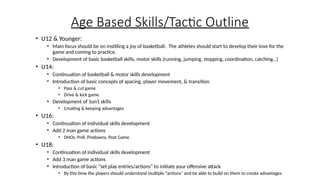
Age Based Skills/Tactic Outline
• U12 & Younger:
• Main focus should be on instilling a joy of basketball. The athletes should start to develop their love for the
game and coming to practice.
• Development of basic basketball skills, motor skills (running, jumping, stopping, coordination, catching…)
• U14:
• Continuation of basketball & motor skills development
• Introduction of basic concepts of spacing, player movement, & transition
• Pass & cut game
• Drive & kick game
• Development of 1on1 skills
• Creating & keeping advantages
• U16:
• Continuation of individual skills development
• Add 2 man game actions
• DHOs, PnR, Pindowns, Post Game
• U18:
• Continuation of individual skills development
• Add 3 man game actions
• Introduction of basic “set play entries/actions” to initiate your offensive attack
• By this time the players should understand multiple “actions” and be able to build on them to create advantages
Effectively Planning &
Running Practice
“Failure to prepare is preparing to fail”
- John Wooden
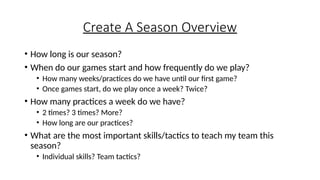
Create A Season Overview
• How long is our season?
• When do our games start and how frequently do we play?
• How many weeks/practices do we have until our first game?
• Once games start, do we play once a week? Twice?
• How many practices a week do we have?
• 2 times? 3 times? More?
• How long are our practices?
• What are the most important skills/tactics to teach my team this
season?
• Individual skills? Team tactics?
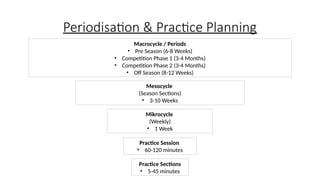
Periodisation & Practice Planning
Macrocycle / Periods
• Pre Season (6-8 Weeks)
• Competition Phase 1 (3-4 Months)
• Competition Phase 2 (3-4 Months)
• Off Season (8-12 Weeks)
Mesocycle
(Season Sections)
• 3-10 Weeks
Mikrocycle
(Weekly)
• 1 Week
Practice Session
• 60-120 minutes
Practice Sections
• 5-45 minutes
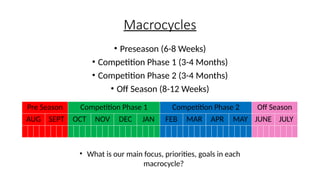
Macrocycles
• Preseason (6-8 Weeks)
• Competition Phase 1 (3-4 Months)
• Competition Phase 2 (3-4 Months)
• Off Season (8-12 Weeks)
Pre Season Competition Phase 1 Competition Phase 2 Off Season
AUG SEPT OCT NOV DEC JAN FEB MAR APR MAY JUNE JULY
• What is our main focus, priorities, goals in each
macrocycle?
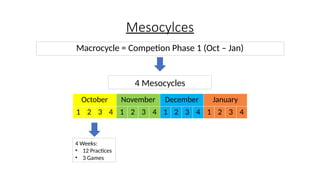
Mesocylces
Macrocycle = Competion Phase 1 (Oct – Jan)
4 Mesocycles
October November December January
1 2 3 4 1 2 3 4 1 2 3 4 1 2 3 4
4 Weeks:
• 12 Practices
• 3 Games
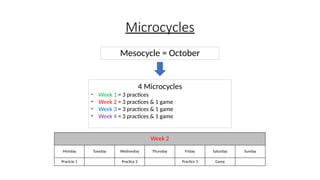
Microcycles
Mesocycle = October
4 Microcycles
• Week 1 = 3 practices
• Week 2 = 3 practices & 1 game
• Week 3 = 3 practices & 1 game
• Week 4 = 3 practices & 1 game
Week 2
Monday Tuesday Wednesday Thursday Friday Saturday Sunday
Practcie 1 Practice 2 Practice 3 Game
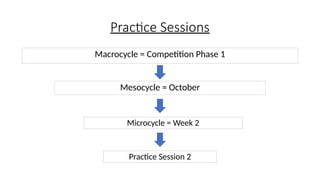
Practice Sessions
Macrocycle = Competition Phase 1
Mesocycle = October
Microcycle = Week 2
Practice Session 2
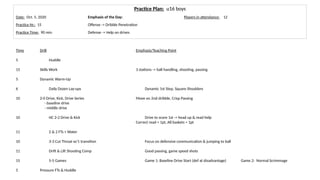
Practice Plan: u16 boys
Date: Oct. 5, 2020 Emphasis of the Day: Players in attendance: 12
Practice Nr.: 15 Offense -> Dribble Penetration
Practice Time: 90 min Defense -> Help on drives
Time Drill Emphasis/Teaching Point
5 Huddle
15 Skills Work 3 stations -> ball handling, shooting, passing
5 Dynamic Warm-Up
6 Daily Dozen Lay-ups Dynamic 1st Step, Square Shoulders
10 2-0 Drive, Kick, Drive Series Move on 2nd dribble, Crisp Passing
- baseline drive
- middle drive
10 HC 2-2 Drive & Kick Drive to score 1st -> head up & read help
Correct read = 1pt, All baskets = 1pt
11 2 & 2 FTs + Water
10 3-3 Cut Throat w/1 transition Focus on defensive communication & jumping to ball
11 Drift & Lift Shooting Comp Good passing, game speed shots
15 5-5 Games Game 1: Baseline Drive Start (def at disadvantage) Game 2: Normal Scrimmage
5 Pressure FTs & Huddle
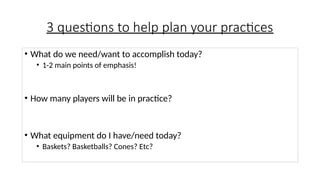
3 questions to help plan your practices
• What do we need/want to accomplish today?
• 1-2 main points of emphasis!
• How many players will be in practice?
• What equipment do I have/need today?
• Baskets? Basketballs? Cones? Etc?
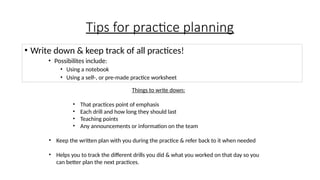
Tips for practice planning
• Write down & keep track of all practices!
• Possibilites include:
• Using a notebook
• Using a self-, or pre-made practice worksheet
Things to write down:
• That practices point of emphasis
• Each drill and how long they should last
• Teaching points
• Any announcements or information on the team
• Keep the written plan with you during the practice & refer back to it when needed
• Helps you to track the different drills you did & what you worked on that day so you
can better plan the next practices.
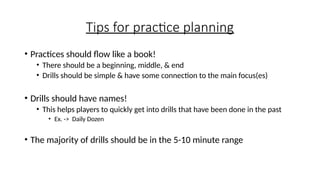
Tips for practice planning
• Practices should flow like a book!
• There should be a beginning, middle, & end
• Drills should be simple & have some connection to the main focus(es)
• Drills should have names!
• This helps players to quickly get into drills that have been done in the past
• Ex. -> Daily Dozen
• The majority of drills should be in the 5-10 minute range
• Use practice time efficiently
• Create a 15 minute rule
• Players should arrive at least 15 minutes before the start of practice
• Talk to players (idividually or as a group), let them stretch individually, let them know which drills the practice will start
with, etc…
• Do your drills flow logically or build upon each other?
• Do you spend more time talking & explaining drills than the players do executing them?
• Are the drills too complicated for the players? K.I.S.S
• Use the “plus 1” method when planning your drills/practices
• Ex.: 1-0 lay-ups -> 2-0 drive & kick -> 2-1 drive & kick
• Do your drills allow for the maximum amount player involvement?
• Are players consistenly engaged and invloved in drills or standing in lines waiting?
• Can you improve your drills by including more basketballs or the number of players involved?
• Do your drills allow for a maximum amount of repitions?
• Do the drills connect to the practices point of emphasis?
• Are you doing a drill just to do a drill or does it have a purpose?
Online Coaching Resourses
• basketballforcoaches.com
• coachesclipboard.net
• coachingtoolbox.net
• coachtube.com/courses/basketball
• team.fastmodelsports.com
• coach.basketball.net.au

Chris Oshea - Playing Style and Practice Planning.pptx

  • 1.
    Developing a playingstyle in youth basketball Set Plays vs. “Creative Motion”
  • 2.
    Set Plays vs.“Creative Motion” Set Plays Offensive plays with predetermined movements & actions which are designed to create a scoring opportunity for a specific player “Creative Motion” An offensive concept based on basic principles which gives all players freedom to read & react to the defense AND their teammates.
  • 3.
    Set Play Advantages •Easier to teach • Potentially less practice time required • Players strengths/weaknesses can be more easily emphasized/minimized • Coach can more easily dictate the offensive actions & direct possessions to go through specific players • Ability to dicate offensive at the end of games or critical situations • Can help teach players the concept of roles on offense • Prepares players for the predominate style of play at higher levels
  • 4.
    Set Play Disadvantages •Players only learn predetermined movements and not how to “read” the game • Players become robotic and struggle when these movements are taken away or don’t create scoring chances • Set play skills don’t nessecarily transfer into the next season or with a new coach/team • Players who are considered “role” players or offensively not important can easily get discouraged • Danger of stunting each players individuality • Players may be afraid to “try something” • Potentailly easier for opponents to scout • Oppenent knows exactly what will happen, who will get the ball, and who each play is designed for
  • 5.
    “Creative Motion” Advantages •Players gain a broader understanding of basic basketball concepts • spacing, movment, timing, etc… • Creativity & decision making is promoted • Players learn how to “read” situations & ”react” accordingly • Players are pushed to find solutions on their own & with teammates • Players derive more joy and have a greater sense of empowerment in the game and teams overall success… all players feel important in the outcome • Creative Motion skills & concepts will transfer to all other styles of basketball • Harder for opponents to scout • In theory the offense is “unscripted” and no two possessions are alike
  • 6.
    “Creative Motion” Disadvantages •More difficult to teach • Potentially more practice time is needed • More mistakes will be made, requiring more patience from coach/players • Differentiating learning curves for each player • Some players will understand the concepts quicker than others • Possible short term failures while players learn the offensive reads • Harder to get shots or ball touches for specific players • Offense can get chaotic if the players make the wrong reads or they try to do too much, which can lead to frustration
  • 7.
    So which isthe better? • Advantages & Disadvantages to both • What are your goals as a coach? • What are the goals of your players/team/club?
  • 8.
    My Opinion • Theyounger the group of players you are coaching, the more your offensive style should lean towards creative motion based concepts. • U14 & younger -> skill development + mostly creative motion concepts • U16 & older -> skill development + the combination creative motion concepts with some set play ideas • Effective set play offense requires basic motion concepts • Skills Development should be the main priority in all youth basketball teams/programs!!!
  • 9.
    The role ofskills development • Regardless of style of play, the development of player skills should be the main priority. • If your players can’t dribble, pass, shoot, defend, pivot, etc… then it doesn’t matter what you play. • The better your players can execute basic basketball skills, the better any system will be! • When players feel they are improving, then they will derive more joy from the game & be more motivated to practice
  • 10.
    Age Based Skills/TacticOutline • U12 & Younger: • Main focus should be on instilling a joy of basketball. The athletes should start to develop their love for the game and coming to practice. • Development of basic basketball skills, motor skills (running, jumping, stopping, coordination, catching…) • U14: • Continuation of basketball & motor skills development • Introduction of basic concepts of spacing, player movement, & transition • Pass & cut game • Drive & kick game • Development of 1on1 skills • Creating & keeping advantages • U16: • Continuation of individual skills development • Add 2 man game actions • DHOs, PnR, Pindowns, Post Game • U18: • Continuation of individual skills development • Add 3 man game actions • Introduction of basic “set play entries/actions” to initiate your offensive attack • By this time the players should understand multiple “actions” and be able to build on them to create advantages
  • 11.
    Effectively Planning & RunningPractice “Failure to prepare is preparing to fail” - John Wooden
  • 12.
    Create A SeasonOverview • How long is our season? • When do our games start and how frequently do we play? • How many weeks/practices do we have until our first game? • Once games start, do we play once a week? Twice? • How many practices a week do we have? • 2 times? 3 times? More? • How long are our practices? • What are the most important skills/tactics to teach my team this season? • Individual skills? Team tactics?
  • 13.
    Periodisation & PracticePlanning Macrocycle / Periods • Pre Season (6-8 Weeks) • Competition Phase 1 (3-4 Months) • Competition Phase 2 (3-4 Months) • Off Season (8-12 Weeks) Mesocycle (Season Sections) • 3-10 Weeks Mikrocycle (Weekly) • 1 Week Practice Session • 60-120 minutes Practice Sections • 5-45 minutes
  • 14.
    Macrocycles • Preseason (6-8Weeks) • Competition Phase 1 (3-4 Months) • Competition Phase 2 (3-4 Months) • Off Season (8-12 Weeks) Pre Season Competition Phase 1 Competition Phase 2 Off Season AUG SEPT OCT NOV DEC JAN FEB MAR APR MAY JUNE JULY • What is our main focus, priorities, goals in each macrocycle?
  • 15.
    Mesocylces Macrocycle = CompetionPhase 1 (Oct – Jan) 4 Mesocycles October November December January 1 2 3 4 1 2 3 4 1 2 3 4 1 2 3 4 4 Weeks: • 12 Practices • 3 Games
  • 16.
    Microcycles Mesocycle = October 4Microcycles • Week 1 = 3 practices • Week 2 = 3 practices & 1 game • Week 3 = 3 practices & 1 game • Week 4 = 3 practices & 1 game Week 2 Monday Tuesday Wednesday Thursday Friday Saturday Sunday Practcie 1 Practice 2 Practice 3 Game
  • 17.
    Practice Sessions Macrocycle =Competition Phase 1 Mesocycle = October Microcycle = Week 2 Practice Session 2
  • 18.
    Practice Plan: u16boys Date: Oct. 5, 2020 Emphasis of the Day: Players in attendance: 12 Practice Nr.: 15 Offense -> Dribble Penetration Practice Time: 90 min Defense -> Help on drives Time Drill Emphasis/Teaching Point 5 Huddle 15 Skills Work 3 stations -> ball handling, shooting, passing 5 Dynamic Warm-Up 6 Daily Dozen Lay-ups Dynamic 1st Step, Square Shoulders 10 2-0 Drive, Kick, Drive Series Move on 2nd dribble, Crisp Passing - baseline drive - middle drive 10 HC 2-2 Drive & Kick Drive to score 1st -> head up & read help Correct read = 1pt, All baskets = 1pt 11 2 & 2 FTs + Water 10 3-3 Cut Throat w/1 transition Focus on defensive communication & jumping to ball 11 Drift & Lift Shooting Comp Good passing, game speed shots 15 5-5 Games Game 1: Baseline Drive Start (def at disadvantage) Game 2: Normal Scrimmage 5 Pressure FTs & Huddle
  • 19.
    3 questions tohelp plan your practices • What do we need/want to accomplish today? • 1-2 main points of emphasis! • How many players will be in practice? • What equipment do I have/need today? • Baskets? Basketballs? Cones? Etc?
  • 20.
    Tips for practiceplanning • Write down & keep track of all practices! • Possibilites include: • Using a notebook • Using a self-, or pre-made practice worksheet Things to write down: • That practices point of emphasis • Each drill and how long they should last • Teaching points • Any announcements or information on the team • Keep the written plan with you during the practice & refer back to it when needed • Helps you to track the different drills you did & what you worked on that day so you can better plan the next practices.
  • 21.
    Tips for practiceplanning • Practices should flow like a book! • There should be a beginning, middle, & end • Drills should be simple & have some connection to the main focus(es) • Drills should have names! • This helps players to quickly get into drills that have been done in the past • Ex. -> Daily Dozen • The majority of drills should be in the 5-10 minute range
  • 22.
    • Use practicetime efficiently • Create a 15 minute rule • Players should arrive at least 15 minutes before the start of practice • Talk to players (idividually or as a group), let them stretch individually, let them know which drills the practice will start with, etc… • Do your drills flow logically or build upon each other? • Do you spend more time talking & explaining drills than the players do executing them? • Are the drills too complicated for the players? K.I.S.S • Use the “plus 1” method when planning your drills/practices • Ex.: 1-0 lay-ups -> 2-0 drive & kick -> 2-1 drive & kick • Do your drills allow for the maximum amount player involvement? • Are players consistenly engaged and invloved in drills or standing in lines waiting? • Can you improve your drills by including more basketballs or the number of players involved? • Do your drills allow for a maximum amount of repitions? • Do the drills connect to the practices point of emphasis? • Are you doing a drill just to do a drill or does it have a purpose?
  • 23.
    Online Coaching Resourses •basketballforcoaches.com • coachesclipboard.net • coachingtoolbox.net • coachtube.com/courses/basketball • team.fastmodelsports.com • coach.basketball.net.au