CHOQUE CARDIOGENICO
DEFINICION
• Acute cardiac hemodynamic instability may result from disorders that
impair function of the myocardium, valves, conduction system, or
pericardium, either in isolation or in combination.
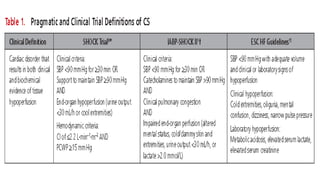
• CS is pragmatically defined as a state in which ineffective cardiac
output caused by a primary cardiac disorder results in both clinical
and biochemical manifestations of inadequate tissue perfusion.
• Before the routine use of early revascularization, MI associated CS
had an in-hospital mortality exceeding 80%
EPIDEMIOLOGIA Y PRONOSTICO
• An analysis of the Nationwide Inpatient Sample Database between
2003 and 2010 reported an increase in the prevalence of CS from 6%
to 10% in the overall population and from 7% to 12% among patients
>75 years of age presenting with STEMI.4 In-hospital mortality
decreased from 45% to 34% over the same time frame, although
mortality rates remained high (55%) in patients >75 years of age.
• A small study comparing the APACHE-II, APACHE-III, SAPS-II, and SOFA
scoring systems in CS reported that APACHE-III and SAPS-II had the
best mortality discrimination
• Limitations of available models included the lack of a CS-specific
derivation population, external validation, dynamic application (ie,
single point in time only), applicability to all CS types, and capture of
all potentially prognostic clinical, laboratory, hemodynamic,imaging,
and biomarker data
• Among patients with ACS-associated CS who had revascularization
and who survived to hospital discharge, long-term follow-up of the
SHOCK trial suggests that the majority (62%) were alive 6 years later.
• Despite favorable longer-term survival, CS may be associated with
considerable morbidity.
• The SHOCK and IABP-SHOCK II trials have reported modest quality of
life among 1-year survivors, with New York Heart Association class II
to IV symptoms in 43% and self-care, physical, or psychological
impairments in ≈20% to 30%.
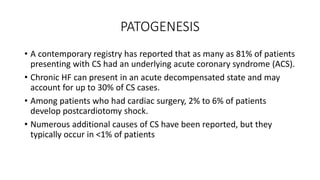
PATOGENESIS
• A contemporary registry has reported that as many as 81% of patients
presenting with CS had an underlying acute coronary syndrome (ACS).
• Chronic HF can present in an acute decompensated state and may
account for up to 30% of CS cases.
• Among patients who had cardiac surgery, 2% to 6% of patients
develop postcardiotomy shock.
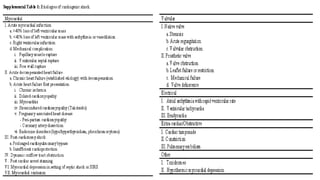
• Numerous additional causes of CS have been reported, but they
typically occur in <1% of patients
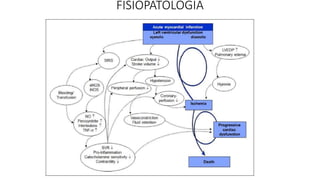
FISIOPATOLOGIA
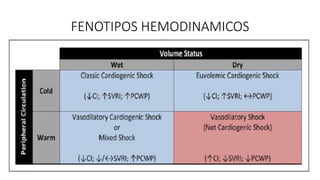
FENOTIPOS HEMODINAMICOS
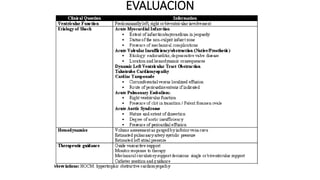
EVALUACION
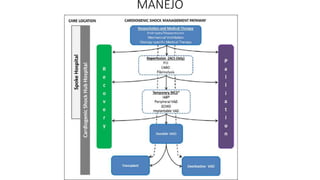
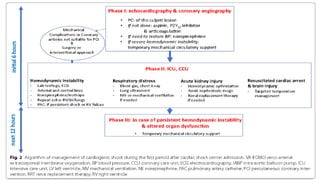
MANEJO
Choque cardiogenico
Choque cardiogenico
Choque cardiogenico
Choque cardiogenico
Choque cardiogenico
Choque cardiogenico
Choque cardiogenico

Choque cardiogenico

  • 1.
  • 2.
    DEFINICION • Acute cardiachemodynamic instability may result from disorders that impair function of the myocardium, valves, conduction system, or pericardium, either in isolation or in combination. • CS is pragmatically defined as a state in which ineffective cardiac output caused by a primary cardiac disorder results in both clinical and biochemical manifestations of inadequate tissue perfusion. • Before the routine use of early revascularization, MI associated CS had an in-hospital mortality exceeding 80%
  • 4.
    EPIDEMIOLOGIA Y PRONOSTICO •An analysis of the Nationwide Inpatient Sample Database between 2003 and 2010 reported an increase in the prevalence of CS from 6% to 10% in the overall population and from 7% to 12% among patients >75 years of age presenting with STEMI.4 In-hospital mortality decreased from 45% to 34% over the same time frame, although mortality rates remained high (55%) in patients >75 years of age. • A small study comparing the APACHE-II, APACHE-III, SAPS-II, and SOFA scoring systems in CS reported that APACHE-III and SAPS-II had the best mortality discrimination • Limitations of available models included the lack of a CS-specific derivation population, external validation, dynamic application (ie, single point in time only), applicability to all CS types, and capture of all potentially prognostic clinical, laboratory, hemodynamic,imaging, and biomarker data
  • 5.
    • Among patientswith ACS-associated CS who had revascularization and who survived to hospital discharge, long-term follow-up of the SHOCK trial suggests that the majority (62%) were alive 6 years later. • Despite favorable longer-term survival, CS may be associated with considerable morbidity. • The SHOCK and IABP-SHOCK II trials have reported modest quality of life among 1-year survivors, with New York Heart Association class II to IV symptoms in 43% and self-care, physical, or psychological impairments in ≈20% to 30%.
  • 6.
    PATOGENESIS • A contemporaryregistry has reported that as many as 81% of patients presenting with CS had an underlying acute coronary syndrome (ACS). • Chronic HF can present in an acute decompensated state and may account for up to 30% of CS cases. • Among patients who had cardiac surgery, 2% to 6% of patients develop postcardiotomy shock. • Numerous additional causes of CS have been reported, but they typically occur in <1% of patients
  • 8.
  • 9.
  • 10.
  • 11.