Honoring our strengths 2014 National Conference
Ottawa, ON, June 24-25, 2014
Designing a Culturally Safe Land-
Based Wellness Model in Chisasibi
Context
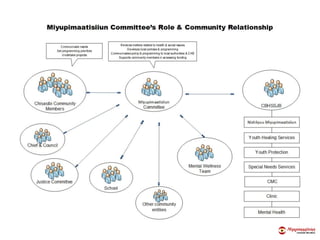
The Cree Nation of Chisasibi, under the guidance of the Miyupimaatisiun (Wellness)
Committee has initiated a process of implementing Iiyiyiu (Cree) healing and
knowledge in the delivery and management of health and social services since 2009.
Community members deem Cree healing methods as a complementary dimension to
an integrated model of wellbeing and living a good life. Therefore, the work focused
on expanding Iiyiyiu healing programming in Chisasibi and establishing a structured
process for implementing Iiyiyiu healing in service provision in the community.
The Chisasibi Miyupimaatisiun Committee’s close collaboration with the newly
established Nishiiyuu Miyupimaatisiun Department of the Cree Board of Health and
Social Services James Bay (CBHSSJB) has led to the development of the present
Land-Based Healing Program as a community-based approach to service delivery.
Objectives of the workshop
The objectives of the workshop are as follows:
 Connect historical and cultural factors with present day health outcomes
 Present a model of integrated services as envisioned in Chisasibi
 Explore the process of implementation of a Land-based program
 Discuss the implications of cultural safety for service provision in community
contexts
Outline of the workshop
1. ‘Did you know’ session (20min)
2. Creative potential & cultural revitalization in Chisasibi (10min)
3. The Chisasibi Land-based healing model (15min)
4. Integrated service delivery though Mental Wellness Team & CBHSSJB (15min)
5. Exploring opportunities and challenges in the context of cultural safety
(10min)
Honoring our strengths 2014 National Conference
Ottawa, ON, June 24-25, 2014
Presenters
Larry House, Coordinator Chisasibi Mental Wellness Team
Larry is a member of the Cree community of Chisasibi, Quebec. He advocates for the
integration of Iiyiyiu (Cree) healing models within the institutions that serve his
community. His work has been to bring into the mainstream the knowledge and
wisdom that his people hold sacred and to apply it in all facets of community daily
life. Like in many indigenous communities worldwide, he experienced the abuses that
his people endured during the worst exercises of assimilation in the colonial history
of Canada. His resilience is a testament to the healing inherent in his peoples’
worldview.
Eddie Pashagumskum, Chisasibi Miyupimaatisiun Committee
Eddie is the elder who developed the Land-based program and who delivers it on the
land. He will explain the philosophy that guides his healing practice as well as answer
any questions related to the land-based program.
Gloria Ann Cozier, Assistant to the AED (Executive Director), CBHSSJB
Gloria Ann Cozier is the Assistant to the AED (Executive Director) of Region 18Th
Cree Health Board & Social Service of James Bay (CBHSSJB). A three time graduate
of McGill University in Social work and psychology she was involved in managing the
Best Practice Family Strengthening Program first implemented in the city of Montreal
which graduated the highest number of families and shared the Kaiser award in
2007. She is the first African Canadian recipient of the Moulin’s D’or award in 2008
for her humanitarian work to enhance the lives of Marginalized families in Montreal
community. In the same year she also received another honorable humanitarian
award from the SPVM for her service to bridge race relations between Montreal police
and the African Canadian community. In 2011 she received another distinguish
award from the Black History Round Table of Quebec. Gloria Ann Cozier has a history
of work in cross cultural perspective, Youth protection, and psychotherapy and is a
columnist and inspiring presenter and lecturer.
Ioana Radu, Independent researcher
Ioana is an independent researcher with over a decade experience in Aboriginal
contexts. Her areas of expertise include knowledge mobilization, cultural safety, oral
history and integrated community development. She is finishing her Humanities PhD
at Concordia University, Montreal.
Honoring our strengths 2014 National Conference
Ottawa, ON, June 24-25, 2014
Chisasibi Model of Miyupimaatisiun – Being alive well
Decolonization
Creative
potential
Hoslistic
approach
Community-
based
Relational
Cultural
revitalization
Language Wisdom Spirituality
Social justice
Meaningful
engagement
Respect Safety
Honoring our strengths 2014 National Conference
Ottawa, ON, June 24-25, 2014
‘Did you know’ session
Participants split into small groups of 10 or less. Each group receives an envelope
containing a ‘Did you know’ about Chisasibi. The participants open their envelope
and read the ‘Did you know’ statement. The groups consider at least three ways
similar historical and cultural factors might still influence Aboriginal health and
healthcare today.
This activity simply aims to inspire participants to connect historical and cultural
factors with present day health outcomes.
‘Did you know handout’
In the 1930s the beaver population in Iiyiyiu Istchee (Cree ancestral territory in
eastern James Bay) collapsed, due to overharvesting by non-Cree hunters and
pressures from the Hudson Bay Company managers for increased harvest.
That on the island of Fort George (Chisasibi) there were two residential schools that
operated between 1907 and 1975. There are 600 former students living in Chisasibi.
In 1980 the Fort George iiyiyiu (Cree) were relocated across the bay due to the La
Grande hydroelectric project which flooded 11,500 km2
(approximate size of
Belgium) of traditional hunting territories.
In the early 18th
Century Missionaries banned the Shake Tent, the sweats, drumming
and dances, practices that the iiyiyiwich (Cree) had used for guidance and
maintaining wellbeing for generations.
In 1975 the iiyiyiwich (Cree) signed the first contemporary land claim agreement in
Canada that included an extinguishment clause. For the following 30 years both
governments failed to honor the agreement and its implementation.
During the court case against the La Grande hydroelectric project the government
lawyers tried to prove that because the iiyiyiwich (Cree) ate buttered toast for
breakfast, lived in houses, and used skidoos to hunt they were white men,
assimilated and devoid of any claims to their ancestral territories.
Designing a Culturally Safe Land-Based
Wellness Model in Chisasibi (Quebec)
Presented by Larry House & Eddie Pashagumskum
Chisasibi Mental Wellness Team
Honouring Our Strengths 2014 National Conference
Ottawa, Ontario, June 24-25, 2014
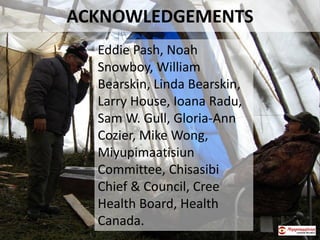
ACKNOWLEDGEMENTS
Eddie Pash, Noah
Snowboy, William
Bearskin, Linda Bearskin,
Larry House, Ioana Radu,
Sam W. Gull, Gloria-Ann
Cozier, Mike Wong,
Miyupimaatisiun
Committee, Chisasibi
Chief & Council, Cree
Health Board, Health
Canada.
CREATIVE POTENTIAL AND CULTURAL
REVITALIZATION
Creative
Potential
Desire for
Cultural
Revitalization
Quest for
Social Justice
Dr. Charles Royal, New Zealand
INTRODUCTION
• Implementing Iiyiyiu healing and
knowledge in the delivery and
management of health and
social services as a local
initiative
• Community members deem
Cree healing methods as a
complementary dimension to an
integrated model of wellbeing
and living a good life
• To expand Iiyiyiu healing
programming in Chisasibi and
establish a structured process
for implementing Iiyiyiu healing
in service provision in the
community
INTRODUCTION
• 2009
– Miyupimaatisiun Committee
established by the Cree Nation of
Chisasibi: mental health nurse, 2
social worker, teacher, principal, 4
elders, and 2 youth
– Chisasibi Traditional Knowledge
and wellness – 9 month program
of traditional healing/counselling
activities and ceremonies
• 2010
– 1st Symposium on health and social
issues
– Throughout the year – traditional
counselling:
• Intergenerational Systems of Trauma
• Substance Abuse
• PTSD (Post-Traumatic Stress Disorder)
• Other Mental Health Issues
INTRODUCTION
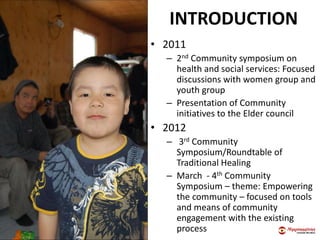
• 2011
– 2nd Community symposium on
health and social services: Focused
discussions with women group and
youth group
– Presentation of Community
initiatives to the Elder council
• 2012
– 3rd Community
Symposium/Roundtable of
Traditional Healing
– March - 4th Community
Symposium – theme: Empowering
the community – focused on tools
and means of community
engagement with the existing
process
INTRODUCTION
• 2013
– Finalized 5-Year Community
Wellness Plan (Strategic Plan)
– Developed Land-Based Healing
Program curriculum, including
case management and aftercare
procedures with Nishiiyuu
– Video recording of the land-
based program with Eddie Pash
and Noah Snowboy at LG4
– Secured Health Canada funding
for Mental Wellness Team
5-YEAR STRATEGIC PLAN
• Vision
– Enhancing wellbeing for healthy
Self, healthy Families, healthy
Community and healthy Nation
• Values
– Respect – All beings are important
– Equality – All beings are valued
– Responsibility – We are all
interconnected, what one does
affects the others
– Openness – Building meaningful
relations irrespective of the healing
method the individual may choose
– Transparency - Outcomes are
measured, assessed and publicly
reported
5-YEAR STRATEGIC PLAN
• Guiding principles
– Holistic approach – address the physical,
mental, spiritual, emotional, economic,
environmental and cultural well-being of the
individuals, families and communities
– Iiyiyiu knowledge – guided by Iiyiyiu
language, culture and spirituality
– Meaningful engagement – create respectful
and open dialogue with community members
and increase their input on health and social
service matters affecting their community
• Mission
– Mobilize community participation in
programming and increase the appropriation
of service delivery in a way that directly
responds to local needs and long-term vision
of care and well-being
– Develop and implement effective policies and
strategies to promote the health and social
welfare of the residents of Chisasibi
– Promote closer collaboration and joint
activities with relevant agencies and entities
in the Community of Chisasibi
LAND-BASED PROGRAM
• The Chisasibi Miyupimaatisiun
Committee in collaboration
with Nishiiyuu
Miyupimaatisuiin Department
has led to the development of
the present Land-Based
Healing Program as a
community-based approach
to service delivery.
• There have been 4 land-based
trips to date: Summer 2012,
Fall 2012, Winter 2013, Spring
2014.
LAND-BASED PROGRAM
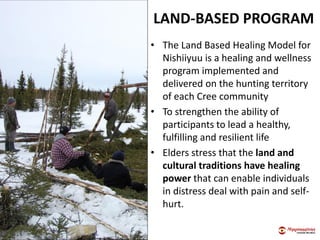
• The Land Based Healing Model for
Nishiiyuu is a healing and wellness
program implemented and
delivered on the hunting territory
of each Cree community
• To strengthen the ability of
participants to lead a healthy,
fulfilling and resilient life
• Elders stress that the land and
cultural traditions have healing
power that can enable individuals
in distress deal with pain and self-
hurt.
LAND-BASED PROGRAM
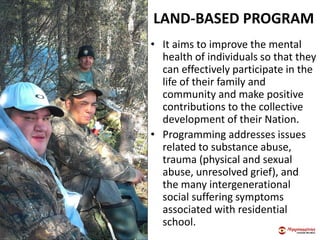
• It aims to improve the mental
health of individuals so that they
can effectively participate in the
life of their family and
community and make positive
contributions to the collective
development of their Nation.
• Programming addresses issues
related to substance abuse,
trauma (physical and sexual
abuse, unresolved grief), and
the many intergenerational
social suffering symptoms
associated with residential
school.
LAND-BASED PROGRAM
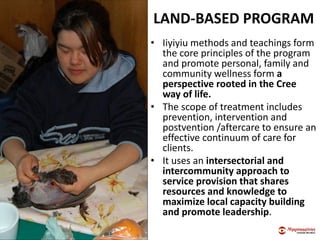
• Iiyiyiu methods and teachings form
the core principles of the program
and promote personal, family and
community wellness form a
perspective rooted in the Cree
way of life.
• The scope of treatment includes
prevention, intervention and
postvention /aftercare to ensure an
effective continuum of care for
clients.
• It uses an intersectorial and
intercommunity approach to
service provision that shares
resources and knowledge to
maximize local capacity building
and promote leadership.
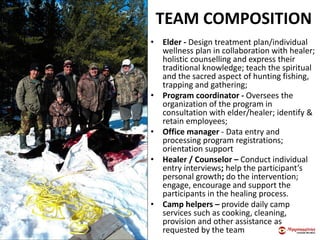
TEAM COMPOSITION
• Elder - Design treatment plan/individual
wellness plan in collaboration with healer;
holistic counselling and express their
traditional knowledge; teach the spiritual
and the sacred aspect of hunting fishing,
trapping and gathering;
• Program coordinator - Oversees the
organization of the program in
consultation with elder/healer; identify &
retain employees;
• Office manager - Data entry and
processing program registrations;
orientation support
• Healer / Counselor – Conduct individual
entry interviews; help the participant’s
personal growth; do the intervention;
engage, encourage and support the
participants in the healing process.
• Camp helpers – provide daily camp
services such as cooking, cleaning,
provision and other assistance as
requested by the team
CMWT
• Year 1 – hiring staff and
complete Nechi training
• The team will be based in
Chisasibi and services will be
extended in surrounding
communities
• Year 2 – Finalize service
provision agreements with other
communities and begin to offer
services in one community
• Year 3 – Fully functioning team
with established collaboration
agreement with other
institutions
CMWT
• Team composition - Core
members: elders, program
coordinator, healer/traditional
counsellor, primary case
manager, community
addictions counsellor, mental
wellness nurse, camp helpers,
office managers
CMWT
• Future directions
– Undertake community
consultation on the 5 Year SRP
– Maintain traditional healing
services in the community
– Expand on the bush programs in
cooperation with the Nishiiyuu
Department and the Council
– Organize Round Dances & other
traditional ceremonial dances
– Research and document
ceremonies, dances & songs
– Increase interagency collaboration
to maximize benefits for
community members
– Identify resource-persons in the
community
CMWT
• Challenges
– Intra/interagency collaboration
at the local level
– Harmonizing local and regional
programming
– Detailed protocols between
entities within the Cree territory
for referral/intake process, for
intervention, and aftercare
– Secure standard bush materials
(canvas, stoves, axes, ect.)
– Capacity & resources to expand
and extend programs to meet
current needs
OPPORTUNITIES
• Intergenerational transfer of
knowledge, Cree values and
way of life from which
individuals can draw strength
and develop a positive
cultural identity
• Creating safe and trustful
spaces for sharing
• Individuals are inspired and
empowered to make good
life-choices and dedicate to
their healing journey
Questions?
Miigwetch
Larry House
Chisasibi Mental Wellness Team – www.chisasibiwellness.ca
houselawm@gmail.com
LAND-BASED
HEALING PROGRAM
Draft curriculum – Cree Nation of Chisasibi
2014
1
Land-based program curriculum – Cree Nation of Chisasibi
Table of Contents
PREAMBLE .................................................................................................................................................2
INTRODUCTION ........................................................................................................................................2
MISSION......................................................................................................................................................3
CHARACTERISTICS OF THE PROGRAM...............................................................................................3
ADMISSION CRITERIA.............................................................................................................................6
CODE OF CONDUCT .................................................................................................................................6
LIST OF CLOTHING AND PERSONAL NEEDS ITEMS .........................................................................................7
CAMP SUPPLIES.............................................................................................................................................7
TEAM COMPOSITION & RESPONSIBILITIES.......................................................................................8
INTAKE PROCEDURE...............................................................................................................................9
PRE-DEPARTURE ORIENTATION ........................................................................................................10
OUTTAKE PROCEDURE.........................................................................................................................10
AFTERCARE .............................................................................................................................................10
PROGRAM SCHEDULE...........................................................................................................................12
EXAMPLES OF PROGRAM CONTENT.................................................................................................18
INTAKE FORM –Agency referral .............................................................................................................19
INTAKE FORM –Self-referral...................................................................................................................20
PARTICIPANT IDENTIFYING INFORMATION ...................................................................................21
TREATMENT PLAN.................................................................................................................................25
CONSENT TO INTAKE/TREATMENT...................................................................................................27
CAMP GUIDELINES AGREEMENT.......................................................................................................28
CONSENT FOR HEALING.......................................................................................................................29
PERMISSION TO USE PHOTOGRAPHS/AUDIO/VIDEO ....................................................................30
CONSENT FOR RELEASE OF INFORMATION....................................................................................31
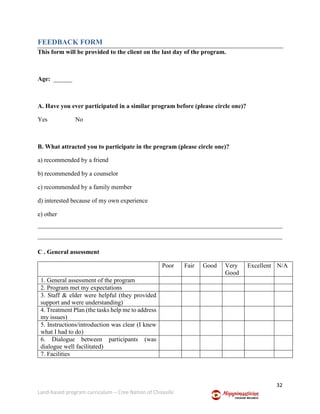
FEEDBACK FORM...................................................................................................................................32
2
Land-based program curriculum – Cree Nation of Chisasibi
PREAMBLE
This document identifies the minimum program requirements for Land-Based Healing Model (LBHM)
programs as well as guidelines to facilitate implementation and ongoing operation of these programs on a
regional basis in Eeyou Istchee. The Land-Based Healing Model presented here has been developed in
consultation with community members and elders from Chisasibi and reflects a culturally appropriate
community based approach to health and social service delivery as envisioned in Section 14 of the JBNQA
as well as in the CBHSSJB strategic plans (2004 and 2012).
First and foremost the LBHM reflects the Cree way of life and knowledge as expressed by the elders
consulted, who stress that the land and cultural traditions have healing power that can enable individuals in
distress deal with pain and self-hurt. Moreover, Land-based programs strengthen and facilitate
intergenerational knowledge mobilization which contributes to positive identity formation, strengthen self-
esteem, and instills pride in the Cree cultural heritage. By linking culture, families and the community, Cree
approaches to health and social service provision such as the Land-Based Healing Model, provide
complementary and holistic models of health and wellbeing.
The information contained in this document reflects the knowledge and evidence at the time of its release.
The standards and guidelines will therefore need to evolve and adapt to ensure that particular needs and
expectations of clients are met, as well as acknowledge the cultural and contextual circumstance of
individual communities throughout Eeyou Istchee (inland and coastal). Opportunities for knowledge
exchange and consultation will be key in ensuring that clients receive services that result in the best possible
outcomes.
INTRODUCTION
The Cree Nation of Chisasibi has been working towards implementing Eeyou healing and knowledge in
the delivery and management of health and social services as a local initiative in response to the 5 Year
Implementation Plan of the Cree Board of Health and Social Services James Bay. For the past 3 years the
community has initiated various local activities towards this goal including Eeyou Healing counselling
services, an Indigenous Knowledge Transfer project, and four (4) community-wide symposiums on health
and social services among others.
The Chisasibi Miyupimaatisiun Committee, established in 2009 pursuant to BY-LAW NO. 2009-001, has
been the main supporter and program developer for the above mentioned initiatives. Its mandate is to review
“all matters referred to the Committee by the Council relating to community health and social issues. The
primary function of the Committee is to assist the Council in implementing effective policies and strategies
to promote the health and social welfare of the residents of Chisasibi.”
Since 2009, the Committee has focused on mobilizing community participation in defining a local vision
and principles for integrated health and social services and to increase the appropriation of service
delivery by community members in a way that directly responds to local needs and long-term vision
of care and well-being. This orientation has led to two community-wide symposiums that aimed to create
a space for dialog between community members and local services providers to:
• determine community needs and priorities in terms of health and wellness,
• suggest how the gap in service provision can be bridged, and
• establish guidelines for the development of a long-term vision for a local wellness plan.
Two Roundtables on Eeyou healing were held in the winter of 2012. The community response has been
very positive and the assessment of Eeyou counselling services provided up to now has shown that
3
Land-based program curriculum – Cree Nation of Chisasibi
community members deem Cree healing methods as a complementary dimension to an integrated
model of wellbeing and living a good life. The Committee was mandated by the participants to expand
Eeyou healing programming in Chisasibi and establish a structured process for implementing Eeyou healing
in service provision in the community in order to diversify services to respond to a variety of needs.
The Committee’s close collaboration with the newly established Nishiiyuu Miyupimaatisiiun Department
has led to the development of the present Land-Based Healing Program as a community-based approach to
service delivery.
MISSION
The Land Based Healing Model for Nishiiyuu is a healing and wellness program implemented and delivered
on the hunting territory of each Cree community. The Chisasibi mission is to strengthen the ability of
participants to lead a healthy, fulfilling and resilient life. Elders stress that the land and cultural traditions
have healing power that can enable individuals in distress deal with pain and self-hurt. Ultimately we aim
to improve the mental health of individuals so that they can effectively participate in the life of their family
and community and make positive contributions to the collective development of their Nation.
Programming will address issues related to substance abuse, trauma (physical and sexual abuse, unresolved
grief), and the many intergenerational social suffering symptoms associated with residential school. Eeyou
methods and teachings form the core principles of the program and promote personal, family and
community wellness form a perspective rooted in the Cree way of life. Moreover, the scope of treatment
includes prevention, intervention and postvention /aftercare to ensure an effective continuum of care for
clients. Therefore, as part of a board community-based approach to service delivery, the LBHM uses an
intersectorial and intercommunity approach to service provision that shares resources and
knowledge to maximize local capacity building and promote leadership.
CHARACTERISTICS OF THE PROGRAM
The characteristics detailed in this section can serve as a standard, nevertheless each community should
adapt it according to local cultural and historical contexts as well as availability of resources.
1. Connection to the land and culture
 The model recognizes the healing power of nature and the ‘return to the land’ as a way of
connecting individuals to Cree culture and language; promote intergenerational knowledge
transfer; and offer a safe space in which individuals can share personal experiences and
detoxify (when necessary).
 As knowledge holders, Elders are the core component of this program and are involved at
every step of the program (prevention, intervention and postvention). Overall they deliver and
guide this culturally-appropriate model of healing by teaching Cree bush skills and values
embedded in them.
 Traditional counsellors/Healers use Cree beliefs and medicines to promote spiritual, physical
and emotional wellbeing. They sometimes use a combination of western and Aboriginal
therapeutic approaches that best suits the individual’s circumstance, including: knowledge of
cultural spiritual practices; knowledge and use of plants and medicines; ceremonial activity
and prayer; sharing circles; energy work, etc.
4
Land-based program curriculum – Cree Nation of Chisasibi
2. Harm reduction
 There is a growing understanding that substance use and abuse is a behavioral and habitual
dependency developed as a coping mechanism to traumatic experiences.
 The LBHM recognizes that substance abuse is never an isolated physical addiction or disease,
thus the program aims to address the trauma that underlies an individual’s particular behavior.
 As such the model focuses on treatment that promotes personal responsibility and rational
behavior. Harm reduction is thus understood as helping clients move from self-harm to a level
of functioning that promotes holistic wellness, which may or may not include total abstinence.
3. Goals for treatment
 In keeping in line with the harm reduction objective, the program only requires that each client
agrees to reachable treatment goals such as: moderating, decreasing or abstaining from alcohol
and drugs; improve relationships with family and/or friends; secure or maintain a current
employment; complete the land-based program; attend at least a monthly support meeting.
Each participant is encouraged to define his/her treatment goals as is relevant to his/her
circumstance
4. Access
 The program is available to all community members irrespective of age, gender, sexual
orientation, religious affiliation or spiritual practice. Nevertheless, groups can be managed
according to a unifying characteristic such as age or gender to ensure effectiveness of treatment
and create a comfortable atmosphere for everyone.
 The program accepts and processes referrals from everyone (self, family, professional,
friends, etc.). Nevertheless, once accepted into the program clients are asked to undertake a
formalized and structured care program that may include specialized services available in the
community (to be stipulated in the aftercare treatment plan).
 In addition the LBHM is cooperating with community agencies to support prevention
strategies that aim to build local capacity and opportunities for designing and developing
relevant programs such as peer leadership, wellness intervention training, monthly support
groups and others. The focus on prevention includes reducing risk factors as well as
strengthening protector factors in the lives of individuals and at the community level.
5. Case management
 The program has designed a systematic and coordinated case management which is undertaken
by the program coordinator. In the case of an agency referral the Program coordinator calls a
case conferencing with all care providers that service the client. For self-referrals the Program
coordinator undertakes the intake interview and depending on the needs and circumstances
may call a case conferencing with other relevant agencies. Details for Intake/Outtake
procedures are detailed in the relevant section below. All clients are required to sign consent
forms to ensure safety and effective treatment.
 Detailed partnership agreements between entities within the Cree territory for referral/intake
process, for intervention, and aftercare are signed to secure continuum of care and the best
possible outcome for the client.
5
Land-based program curriculum – Cree Nation of Chisasibi
6. Mitigation of risk
 Program coordinator and Elder(s) ensure a structured supervision of staff and clients on a
regular basis. While on the land staff meetings will take place at least once a week and group
and individual meetings with clients will take place at least twice a week to ensure safety and
that program guidelines are followed.
 To ensure the safety of clients a pre-admission medical exam is required before the client
departs in the bush. Without this exam the client will not be allowed to depart.
 Part of the partnership agreements includes safety issues where arrangements for medevac
evacuation (built-in system at LG4 or LG1) and mitigating symptologies (post-acute,
withdrawal) are agreed upon before departure in the bush. Agreement with search and
rescue/first responders to be made. When relevant arrangements for nursing care on site will
be made.
7. Continuous service planning
 All Program interventions are contextualized to the individual’s life in the community. We
recognize that even though the program is short, once the individual commits to healing they
will strive to affect change in their life, while the community life may still be unchanged. Thus
interventions maximize the client’s resilience though building capacity to lead a healthy life
for the long-term.
 The Program recognizes that the long-term health and wellness of clients and community
members at large rests on the availability of an array of services and programs in the
community (prevention and postvention). The need to accompany the client on his/her healing
journey is essential and therefore a continuum of care is needed at the community level.
 Significant efforts are placed on aftercare though the development of a postvention treatment
plan for each client. As described in the aftercare section, exit interviews will be conducted in
the last days of the program. Upon arrival in the community the clients take part in a case
conferencing meeting where they will design the aftercare plan in consultation with LBHM
staff (elder, program coordinator, etc.) and other relevant service providers from the
community.
 Document and make available a compendium of services for clients and their family as well
as other self-care and self-directed materials and strategies.
 Make available monthly support groups with either Program coordinator or elder(s) and assign
a primary and secondary contact person that the client can access when needed.
 Upon returning home, a homecoming ceremony with the family is held to commemorate the
participant’s accomplishments and celebrate the beginning of their healing journey.
 The program offers a refresher trip after 6 months to celebrate, solidify and rejuvenate a
participant’s healing journey.
8. Quality assurance
 Since the program is still new, a modification and feedback mechanism is built in both to allow
adaptation and modification while in the bush as well as long-term monitoring, including
weekly staff meetings and client assessment meetings.
6
Land-based program curriculum – Cree Nation of Chisasibi
 Within the program a feedback mechanism takes place, either through verbal or written
feedback, eg. A feedback form is given to the clients to fill out during the last day of the
program.
 Intake forms are designed to collect baseline data on all participants for the purpose of devising
a social determinant of health profile for the clientele.
 Program evaluation report will be published yearly on implementation and operating indicators,
as well as client outcomes, and client and family satisfaction assessments.
ADMISSION CRITERIA
 be emotionally, mentally and physically able to participate in intense counselling situations and
challenging land‐based activities;
 not have consumed illegal drugs or alcohol for a period of at least 3 days prior to admission;
 be aware that any clients arriving intoxicated or with alcohol, psycho active/mood altering
drugs, painkillers, sleeping pills, or tranquilizers may not be accepted into the program
unless their use is pre‐approved by consulting physician;
 express the motivation and desire to change his or her present life‐style, behavior, thinking
or relationships
 All participants must be willing to abide by camp Code of Conduct while on the premises or when
out for scheduled program outings.
 No cell phones, IPods, or other gadgets are allowed
CODE OF CONDUCT
The Code is established to promote an atmosphere of spiritual, emotional, mental and physical safety, as
well regulate its process and preserve the integrity of the program. The following guidelines are central to
our Code of Conduct:
1. All persons are expected to exhibit respect for others in their behaviour, manner and speech.
Accordingly, emotional abuse (i.e. insults, hurtful criticism, or verbal intimidation), physical
violence or intimidation will not be tolerated at any time.
2. All persons are expected to exhibit respectful relations with all of creation while at the lodge.
Accordingly, persons must not hurt or damage plant or animal life or otherwise do anything
destructive to the land or property.
3. Collective personal healing and growth is a central approach to land-based program, therefore all
participants are encouraged to build trustful relationships with each other and help in any way that
they find appropriate their fellow participants.
4. All persons are expected to exhibit respect for all races of humankind and their original teachings
in behaviour, manner and speech. Furthermore, we are expected to exhibit respect and non-
interference with the beliefs and spiritual paths of others.
7
Land-based program curriculum – Cree Nation of Chisasibi
5. All persons are expected to exhibit respect for the property of the Lodge and the personal
belongings of others. The personal belongings of others are not to be used or interfered with without
the permission of the owners.
6. All participants are responsible for all their personal belongings and effects. Program staff accepts
no liability or responsibility for the personal belongings and effects of participants or visitors.
7. The camp is a drug and alcohol free area. Accordingly, no alcohol or non-prescription drugs are to
be brought onto the property at any time.
FAILURE TO ADHERE TO THE ABOVE STATED CODE OF CONDUCT MAY RESULT IN THE
IMMEDIATE REMOUVAL OF PARTICIPANTS FROM THE PROGRAM AND A DETERMINED
TIME DURING WHICH THE PARTICIPANTS HAVING BREACHED THE CODE WILL BE
BARRED FROM PARTICIPATING IN THE LAND-BASED PROGRAM. A DEFINITE APPLICATION
OF COSEQUENCE WILL BE DECIDED BY THE ELDER AND THE PROGRAM COORDINATOR.
LIST OF CLOTHING AND PERSONAL NEEDS ITEMS
Appropriate for the season
Axe
Bedding [blankets, pillow, sheets,
mattress, underlining (bearskin, caribou
hide, carpet)]
Pots (teapot)
Backpack
Nightline (cotton string)
Hunting gear: knife, firearm (unless
prohibited by court), matches, etc.
Boots
Rain gear
Warm jacket
Snowshoes
Flashlight
Teepee Canvas (enough for shelter – 2 to
3 pieces)
Things that you like – musical
instrument, paints, photo camera, etc.
CAMP SUPPLIES
A van
2 drums gas (205L)
100 Lbs propane (or 4X50Lbs propane tanks)
8
Land-based program curriculum – Cree Nation of Chisasibi
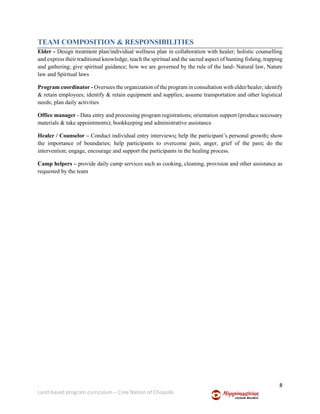
TEAM COMPOSITION & RESPONSIBILITIES
Elder - Design treatment plan/individual wellness plan in collaboration with healer; holistic counselling
and express their traditional knowledge; teach the spiritual and the sacred aspect of hunting fishing, trapping
and gathering; give spiritual guidance; how we are governed by the rule of the land- Natural law, Nature
law and Spiritual laws
Program coordinator - Oversees the organization of the program in consultation with elder/healer; identify
& retain employees; identify & retain equipment and supplies; assume transportation and other logistical
needs; plan daily activities
Office manager - Data entry and processing program registrations; orientation support (produce necessary
materials & take appointments); bookkeeping and administrative assistance
Healer / Counselor – Conduct individual entry interviews; help the participant’s personal growth; show
the importance of boundaries; help participants to overcome pain, anger, grief of the past; do the
intervention; engage, encourage and support the participants in the healing process.
Camp helpers – provide daily camp services such as cooking, cleaning, provision and other assistance as
requested by the team
9
Land-based program curriculum – Cree Nation of Chisasibi
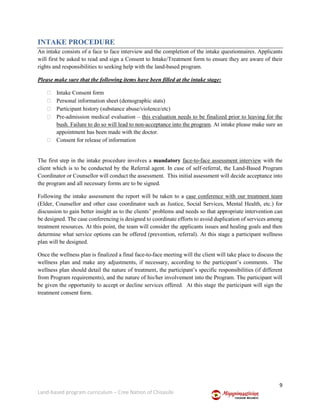
INTAKE PROCEDURE
An intake consists of a face to face interview and the completion of the intake questionnaires. Applicants
will first be asked to read and sign a Consent to Intake/Treatment form to ensure they are aware of their
rights and responsibilities to seeking help with the land-based program.
Please make sure that the following items have been filled at the intake stage:
 Intake Consent form
 Personal information sheet (demographic stats)
 Participant history (substance abuse/violence/etc)
 Pre-admission medical evaluation – this evaluation needs to be finalized prior to leaving for the
bush. Failure to do so will lead to non-acceptance into the program. At intake please make sure an
appointment has been made with the doctor.
 Consent for release of information
The first step in the intake procedure involves a mandatory face-to-face assessment interview with the
client which is to be conducted by the Referral agent. In case of self-referral, the Land-Based Program
Coordinator or Counsellor will conduct the assessment. This initial assessment will decide acceptance into
the program and all necessary forms are to be signed.
Following the intake assessment the report will be taken to a case conference with our treatment team
(Elder, Counsellor and other case coordinator such as Justice, Social Services, Mental Health, etc.) for
discussion to gain better insight as to the clients’ problems and needs so that appropriate intervention can
be designed. The case conferencing is designed to coordinate efforts to avoid duplication of services among
treatment resources. At this point, the team will consider the applicants issues and healing goals and then
determine what service options can be offered (prevention, referral). At this stage a participant wellness
plan will be designed.
Once the wellness plan is finalized a final face-to-face meeting will the client will take place to discuss the
wellness plan and make any adjustments, if necessary, according to the participant’s comments. The
wellness plan should detail the nature of treatment, the participant’s specific responsibilities (if different
from Program requirements), and the nature of his/her involvement into the Program. The participant will
be given the opportunity to accept or decline services offered. At this stage the participant will sign the
treatment consent form.
10
Land-based program curriculum – Cree Nation of Chisasibi
PRE-DEPARTURE ORIENTATION
Three days before departure participants will attend a 1 day orientation session in which the Elder / healer
and/or Program Coordinator explain the following:
• The goal and procedure of the program
• Camp rules and personal items to bring
• Daily activity schedule and the
• Consent forms and agreement regarding program ethics
 Consent for Healing
 Permission to use photographs/video/audio
• Safety rules within the framework of activities schedule (including contingency plan)
Participants fill in necessary forms and clarify issues and concerns.
OUTTAKE PROCEDURE
Prior to return in the community, the Program Coordinator will assist the participants in completing the
Program Feedback Form, which will assist with quality assurance such as relevant program adaptation and
modifications as well as measured client outcomes.
Exit interviews will be conducted with each participant upon completion of the program. An aftercare plan
will be developed in consultation with the participant and/or other case manages (eg. Justice officer,
psychologist, etc); see Aftercare below.
AFTERCARE
Due to the perceived vulnerability of many clients the aftercare treatment will be developed immediately
upon arrival in the community. Preferably, three days after arrival, a case conferencing with individual
participants is undertaken to determine an aftercare plan to provide continuum of care for the client while
in the community. This step is very important as often clients/participants are not followed up by the service
providers. Having an aftercare plan is paramount and pivotal to the individual healing and recovering
process, which, from the perspective of the elders, is a life-long process. Regular follow-up meetings with
the client (by Elder, Program Coordinator, or Referral agency representative/Social worker) will be
undertaken to offer support for healing as well as assessing client outcomes.
An aftercare resource book with journal should also be developed to facilitate client continuous engagement
with healing methods and resources.
Partnerships with the Band, School, CMCs, Justice Committee, and other local entities will be finalized in
order to formalize service provision and increase diversity of services. This process is highly intersectorial
and interdisciplinary in order to offer effective client aftercare and continuum of services to ensure the best
11
Land-based program curriculum – Cree Nation of Chisasibi
possible outcomes for the clients. Ultimately we aim to strengthen individuals’ wellness from a holistic
perspective: healthy mind, healthy body and healthy spirit.
Given the weak programming available we can only recommend aftercare programming, nevertheless we
will work in close cooperation with community entities to design structured aftercare programming with
tangible support for clients, which may include the following:
 Emergency numbers
 Drop-in outreach
 Self-help materials and approaches
 Support groups (AA meetings, parenting, etc.)
 Healing circles
 Traditional counselling
 Sweats and other Cree ceremonies
 Cree medicines (in consultation with clinical practitioner in case the client is under specific
medication)
 Pastoral meetings
 Leadership and empowerment workshops
 Offer Community Addiction Training and/or High school Equivalency program for the
participants.
 Etc.
For this purpose, it is recommended that a database of local resources be developed and updated, which can
then be made available to the clients as a support mechanism.
12
Land-based program curriculum – Cree Nation of Chisasibi
PROGRAM SCHEDULE
This is an example of 10 day schedule as designed by Eddie Pashagumskum. Other proponents may choose to adapt the schedule as they see fit,
although we recommend that main characteristics of the program as well as ethics and consent be kept uniform in order to ensure program
cohesiveness and measure program outcomes.
Time Activity Goals Comments
Day 1
9:00 AM Opening Prayer
Introduction by
Trainer/Facilitator
• What do you want to get out of this program?
• I will share my knowledge from the land.
• It’s up to each individual what they can get out of this program.
10:00
AM
Break
10:15
AM
Clients
Introduction…Why did
you want to take this
program
• Substance Abuse………….Anger Issues
• Relationship problems…Suicidal Thoughts
• Break from Chisasibi…….Make changes for a healthier lifestyle
11:00
AM
Living in Harmony with
Nature
• Traditional teachings on the “mind”
• History of own people before modern transportation
• Identity
• Patience
• Respect
12:00
PM
Lunch
1:00 PM Reflection - How is the
program so far?
• Clients enjoying being away from community for awhile
• Sharing stories of substance abuse (witnessing family violence,
relationship issues, neglect…)
3:15 PM History of Eeyou before
Modern Transportation
• Physically fit
• Healthier
• Living in harmony with nature
4:00 PM Closing Prayer
13
Land-based program curriculum – Cree Nation of Chisasibi
Time Activity Goals Comments
Day 2
9:00 AM Opening Prayer
Living in Harmony with
Nature
(continued until lunch)
• Be grateful what nature has to offer
• It’s important never to complain when you’re unsuccessful on hunting and
fishing
• Ex.: When I’m out on the land, I go home with nothing..I am still grateful
just simply being out there.
• Self-discipline
• Wake up early…go to bed early
• Self respect…learn to respect yourself and others
• Honesty
12:00
PM
Lunch
1:00 PM Activity on the land to be determined according to circumstance (season, etc) – see examples
5:00 PM Review what was
discussed on the last day
and half
• Physically fit
• Healthier
• Living in harmony with nature
6:00 PM Closing Prayer
Time Activity Goals Comments
Day 3
9:00 AM Opening Prayer
Forgiveness  In the mid 1970’s….three people were murdered..the father of one
of the victims was able to forgive the person responsible.
10:00
AM
Break
10:15
AM
The impacts of Hydro
Development
 Social; Loss and grief
 Environment; Loss of Eeyou Istchee
 Water
 After forty years of Hydro development…we’re still affected today
12:00
PM
Lunch
14
Land-based program curriculum – Cree Nation of Chisasibi
1:00 PM Hunting teachings • Survival
• Health
3:00 PM Break
3:15 PM What is hunting got to do
with abuse?
• Killing animals for nothing
• Killing game for more than you need.
• Bragging
• Chasing caribou by ski-doo for the sake of it.
Jealousy (within you and
towards others)
• Laughing at people when they break material possessions like ski-doo,
motor, etc..
5:00 PM Closing Prayer
Time Activity Goals Comments
Day 4
9:00 AM Opening Prayer
Suicide Prevention • It can happen to anyone….young or old person
• Life is precious
• Substance abuse does or sometimes plays a role in this topic
• You can still have fun without alcohol or drugs
• Be involved in gatherings, events, activities or family gatherings
• Talk to someone you trust
12:00
PM
Lunch
1:00 PM One to one with clients
and evaluation
The rest of the clients do
on the land activity (near
the camp)
to be determined according to circumstance (season, etc) – see examples
5:00 PM Closing Prayer
15
Land-based program curriculum – Cree Nation of Chisasibi
Time Activity Goals Comments
Day 5
9:00
AM
Opening Prayer
Canoeing   Safety
 Safe handling of an oar
 How to safely navigate on rapids
 Watch how the currents flow on rapids
10:00
AM
Break
10:15
AM
The activities that are
involved in canoeing
  Portage…lifting….walking….hiking….paddling
11:00
AM
Axe safety tips • Axe is an essential tool in canoeing, hunting, trapping, building shelters,
heating home and cooking
• Be careful when handling and axe to prevent cuts or accidents
• Cover your blade
• Our ancestors were always active that is why they did not have too many
health problems
• Never leave anywhere without the essential tool
12:00
PM
Lunch
1:00 PM Activity on the land Activity – to be determined according to circumstance (season, etc) see examples
4:00 PM Canoeing • Story on how I got my training and experience, being born and brought up by
living off the land
• My knowledge and experience came from my father and living on the land
• It took me many years of practice
5:00 PM Closing Prayer
16
Land-based program curriculum – Cree Nation of Chisasibi
Time Activity Goals Comments
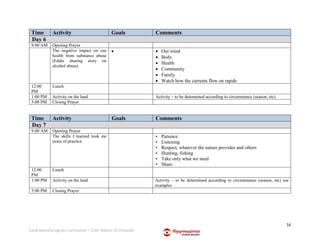
Day 6
9:00 AM Opening Prayer
The negative impact on our
health from substance abuse
(Eddie sharing story on
alcohol abuse)
  Our mind
 Body
 Health
 Community
 Family
 Watch how the currents flow on rapids
12:00
PM
Lunch
1:00 PM Activity on the land Activity – to be determined according to circumstance (season, etc)
5:00 PM Closing Prayer
Time Activity Goals Comments
Day 7
9:00 AM Opening Prayer
The skills I learned took me
years of practice
• Patience
• Listening
• Respect, whatever the nature provides and others
• Hunting, fishing
• Take only what we need
• Share
12:00
PM
Lunch
1:00 PM Activity on the land Activity – to be determined according to circumstance (season, etc) see
examples
5:00 PM Closing Prayer
17
Land-based program curriculum – Cree Nation of Chisasibi
Time Activity Goals Comments
Day 8
9:00 AM Opening Prayer
Native Human Rights Historical context of Native Rights
12:00 PM Lunch
1:00 PM Activity on the land Activity – to be determined according to circumstance (season, etc) see
examples
5:00 PM Closing Prayer
Time Activity Goals Comments
Day 9
9:00 AM Opening Prayer
Navigational Mind
Nature Senses
Weather
12:00 PM Lunch
1:00 PM Activity on the land Activity – to be determined according to circumstance (season, etc) see
examples
5:00 PM Closing Prayer
Time Activity Goals Comments
Day 10
9:00 AM Opening Prayer
Healing is an on-going process Talk to someone you trust
12:00 PM Lunch
1:00 PM One to one with clients and
evaluation
The rest of the clients do on the
land activity (near the camp)
Activity – to be determined according to circumstance (season, etc) see
examples
5:00 PM Closing Prayer
18
Land-based program curriculum – Cree Nation of Chisasibi
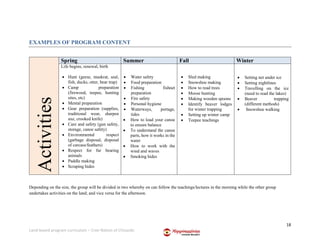
EXAMPLES OF PROGRAM CONTENT
Activities
Spring Summer Fall Winter
Life begins, renewal, birth
 Hunt (geese, muskrat, seal,
fish, ducks, otter, bear trap)
 Camp preparation
(firewood, teepee, hunting
sites, etc)
 Mental preparation
 Gear preparation (supplies,
traditional wear, sharpen
axe, crooked knife)
 Care and safety (gun safety,
storage, canoe safety)
 Environmental respect
(garbage disposal, disposal
of carcass/feathers)
 Respect for fur bearing
animals
 Paddle making
 Scraping hides
 Water safety
 Food preparation
 Fishing fishnet
preparation
 Fire safety
 Personal hygiene
 Waterways, portage,
tides
 How to load your canoe
to ensure balance
 To understand the canoe
parts, how it works in the
water
 How to work with the
wind and waves
 Smoking hides
 Sled making
 Snowshoe making
 How to read trees
 Moose hunting
 Making wooden spoons
 Identify beaver lodges
for winter trapping
 Setting up winter camp
 Teepee teachings
 Setting net under ice
 Setting nightlines
 Travelling on the ice
(need to read the lakes)
 Beaver trapping
(different methods)
 Snowshoe walking
Depending on the size, the group will be divided in two whereby on can follow the teachings/lectures in the morning while the other group
undertakes activities on the land; and vice versa for the afternoon.
19
Land-based program curriculum – Cree Nation of Chisasibi
INTAKE FORM –Agency referral
This form must be completed by the referring professional and paraprofessionals
Referring Agency Information
Referral Contact Person: _________________________________ Position: _______________________
Agency:
______________________________________________________________________________
Address:_____________________________________________________________________________
_
E-Mail: _____________________________________Telephone #: _____________________________
1. In what capacity do you know this client?
_____________________________________________________________________________________
2. How long have you known this client?
_____________________________________________________________________________________
3. Reason for referral:
_____________________________________________________________________________________
4. What are your overall impressions about this participant’s willingness to do the work needed to
complete this program? Are there any areas of behaviour that you are concerned about that would
assist us in being prepared to work with his or her issues? (i.e. rage, grief, personality issues)
_____________________________________________________________________________________
_____________________________________________________________________________________
_____________________________________________________________________________________
_____________________________________________________________________________________
Land-based program requires appropriate aftercare for any person referred in order to provide an adequate
continuum of care. We urge referring agencies to provide support and work in a complementary and
collaborative relationship to ensure clients receive the best possible care.
_____________________________________________________________________________________
Signature of Referring Agent Date
_____________________________________________________________________________________
Signature of the supervisor Date
20
Land-based program curriculum – Cree Nation of Chisasibi
INTAKE FORM –Self-referral
This form must be completed by the potential client or family with the assistance of Program
Coordinator.
Personal Information
Name : _________________________________ Age: _______________________
Address:_____________________________________________________________________________
_
E-Mail: _____________________________________Telephone #: _____________________________
1. Why have you decided to participate in the Land-Based program?
_____________________________________________________________________________________
_____________________________________________________________________________________
_____________________________________________________________________________________
2. How willing are you to do the work needed to complete this program? Are there any areas of
behaviour that you are concerned about that would assist us in being prepared to work with you?
(i.e. rage, grief, personality issues)
_____________________________________________________________________________________
_____________________________________________________________________________________
_____________________________________________________________________________________
_____________________________________________________________________________________
Land-based program requires appropriate aftercare for any person referred in order to provide an adequate
continuum of care. We urge referring agencies to provide support and work in a complementary and
collaborative relationship to ensure clients receive the best possible care.
_____________________________________________________________________________________
Signature of potential client Date
_____________________________________________________________________________________
Signature of Program Coordinator Date
21
Land-based program curriculum – Cree Nation of Chisasibi
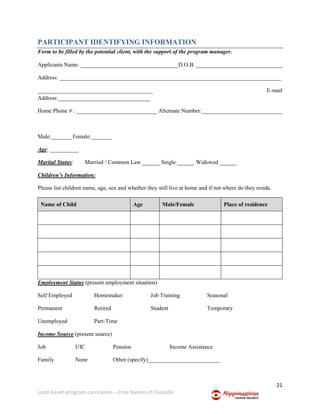
PARTICIPANT IDENTIFYING INFORMATION
Form to be filled by the potential client, with the support of the program manager.
Applicants Name: __________________________________D.O.B. ______________________________
Address: _____________________________________________________________________________
________________________________________ E-mail
Address:________________________________
Home Phone # : ____________________________ Alternate Number:____________________________
Male:_______ Female:_______
Age: __________
Marital Status: Married / Common Law ______ Single ______ Widowed ______
Children’s Information:
Please list children name, age, sex and whether they still live at home and if not where do they reside.
Name of Child Age Male/Female Place of residence
Employment Status (present employment situation)
Self Employed Homemaker Job Training Seasonal
Permanent Retired Student Temporary
Unemployed Part‐Time
Income Source (present source)
Job UIC Pension Income Assistance
Family None Other (specify)_________________________
22
Land-based program curriculum – Cree Nation of Chisasibi
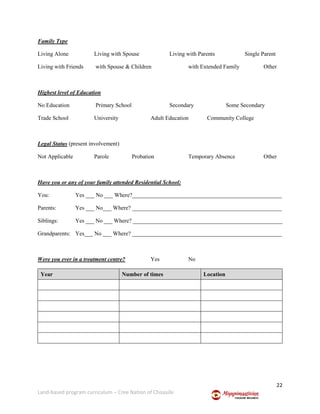
Family Type
Living Alone Living with Spouse Living with Parents Single Parent
Living with Friends with Spouse & Children with Extended Family Other
Highest level of Education
No Education Primary School Secondary Some Secondary
Trade School University Adult Education Community College
Legal Status (present involvement)
Not Applicable Parole Probation Temporary Absence Other
Have you or any of your family attended Residential School:
You: Yes ___ No ___ Where?____________________________________________________
Parents: Yes ___ No___ Where? ____________________________________________________
Siblings: Yes ___ No ___ Where? ____________________________________________________
Grandparents: Yes___ No ___ Where? ____________________________________________________
Were you ever in a treatment centre? Yes No
Year Number of times Location
23
Land-based program curriculum – Cree Nation of Chisasibi
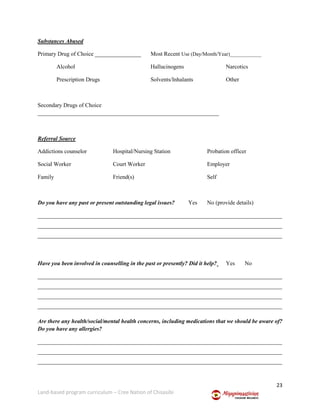
Substances Abused
Primary Drug of Choice ________________ Most Recent Use (Day/Month/Year)____________
Alcohol Hallucinogens Narcotics
Prescription Drugs Solvents/Inhalants Other
Secondary Drugs of Choice
_______________________________________________________________
Referral Source
Addictions counselor Hospital/Nursing Station Probation officer
Social Worker Court Worker Employer
Family Friend(s) Self
Do you have any past or present outstanding legal issues? Yes No (provide details)
_____________________________________________________________________________________
_____________________________________________________________________________________
_____________________________________________________________________________________
Have you been involved in counselling in the past or presently? Did it help? Yes No
_____________________________________________________________________________________
_____________________________________________________________________________________
_____________________________________________________________________________________
_____________________________________________________________________________________
Are there any health/social/mental health concerns, including medications that we should be aware of?
Do you have any allergies?
_____________________________________________________________________________________
_____________________________________________________________________________________
_____________________________________________________________________________________
24
Land-based program curriculum – Cree Nation of Chisasibi
How long has you been involved with your agency and what are their presenting issues for which they
are seeking help?
_____________________________________________________________________________________
_____________________________________________________________________________________
_____________________________________________________________________________________
_____________________________________________________________________________________
_____________________________________________________________________________________
_____________________________________________________________________________________
What are your strengths?-
_____________________________________________________________________________________
_____________________________________________________________________________________
_____________________________________________________________________________________
_____________________________________________________________________________________
_____________________________________________________________________________________
_____________________________________________________________________________________
_____________________________________________________________________________________
_____________________________________________________________________________________
_____________________________________________________________________________________
_____________________________________________________________________________________
25
Land-based program curriculum – Cree Nation of Chisasibi
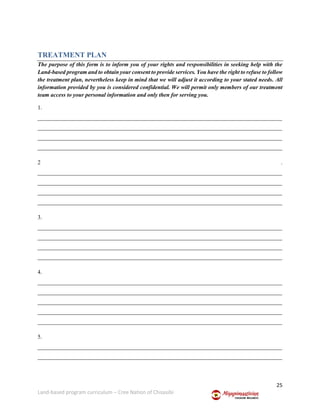
TREATMENT PLAN
The purpose of this form is to inform you of your rights and responsibilities in seeking help with the
Land-based program and to obtain your consent to provide services. You have the right to refuse to follow
the treatment plan, nevertheless keep in mind that we will adjust it according to your stated needs. All
information provided by you is considered confidential. We will permit only members of our treatment
team access to your personal information and only then for serving you.
1.
_____________________________________________________________________________________
_____________________________________________________________________________________
_____________________________________________________________________________________
_____________________________________________________________________________________
2 .
_____________________________________________________________________________________
_____________________________________________________________________________________
_____________________________________________________________________________________
_____________________________________________________________________________________
3.
_____________________________________________________________________________________
_____________________________________________________________________________________
_____________________________________________________________________________________
_____________________________________________________________________________________
4.
_____________________________________________________________________________________
_____________________________________________________________________________________
_____________________________________________________________________________________
_____________________________________________________________________________________
_____________________________________________________________________________________
5.
_____________________________________________________________________________________
_____________________________________________________________________________________
26
Land-based program curriculum – Cree Nation of Chisasibi
_____________________________________________________________________________________
_____________________________________________________________________________________
6.
_____________________________________________________________________________________
_____________________________________________________________________________________
_____________________________________________________________________________________
_____________________________________________________________________________________
7.
_____________________________________________________________________________________
_____________________________________________________________________________________
_____________________________________________________________________________________
_____________________________________________________________________________________
8.
_____________________________________________________________________________________
_____________________________________________________________________________________
_____________________________________________________________________________________
Other comments:
27
Land-based program curriculum – Cree Nation of Chisasibi
CONSENT TO INTAKE/TREATMENT
The purpose of this form is to inform you of your rights and responsibilities in seeking help with the Land-
based program and to obtain your consent to conduct an intake and to provide services. During the intake
interview, we will ask you questions about your past and current life circumstance and about the problems
you seek to address in your healing process. You have the right to refuse to answer any of the questions but
it will help us if you do answer each of them. All information provided by you is considered confidential.
We will permit only members of our treatment team access to your personal information and only then for
serving you.
Sharing this information outside of Land-based program will be done only with your written consent. There
are several limitations to your right to privacy: If we ever come to believe that you are an immediate threat
to yourself or others, we would be obligated to report this to the appropriate authorities for the protection
of all involved. Also, files can sometimes be subpoenaed.
After your intake session, our treatment team will consider your issues and your healing goals and then
determine what service options we can offer you. Both you and the referring agent will be contacted and
you will be given the opportunity to either accept or decline services offered.
The primary obligations that you have in seeking services with the Land-based program are to assume
responsibility for your personal healing and to respect Program rules while at the camp. If you have any
questions about your rights or responsibilities, you can contact us by telephone or ask the assessment
counsellor at the face to face interview.
Statement of Understanding and Consent
I understand that by signing this form I have acknowledged that I have read and understood the information
provided above and that I have given my permission to have an intake interview conducted in order to offer
treatment. (If consent is being given for a minor child, please indicate child’s name on the right)
___________________________________ _________________ For: ____________________
Signature of participant Date Name of minor child if applicable
_________________________________________ __________________________
Signature of witness Date
28
Land-based program curriculum – Cree Nation of Chisasibi
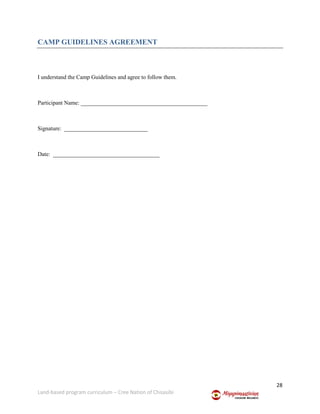
CAMP GUIDELINES AGREEMENT
I understand the Camp Guidelines and agree to follow them.
Participant Name: ____________________________________________
Signature: _____________________________
Date: _____________________________________
29
Land-based program curriculum – Cree Nation of Chisasibi
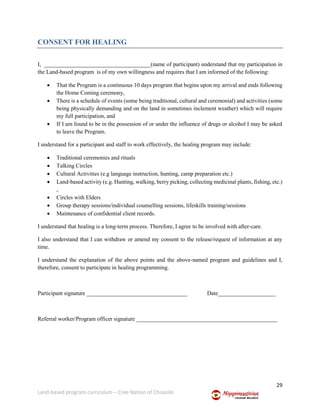
CONSENT FOR HEALING
I, _____________________________________(name of participant) understand that my participation in
the Land-based program is of my own willingness and requires that I am informed of the following:
 That the Program is a continuous 10 days program that begins upon my arrival and ends following
the Home Coming ceremony,
 There is a schedule of events (some being traditional, cultural and ceremonial) and activities (some
being physically demanding and on the land in sometimes inclement weather) which will require
my full participation, and
 If I am found to be in the possession of or under the influence of drugs or alcohol I may be asked
to leave the Program.
I understand for a participant and staff to work effectively, the healing program may include:
 Traditional ceremonies and rituals
 Talking Circles
 Cultural Activities (e.g language instruction, hunting, camp preparation etc.)
 Land‐based activity (e.g. Hunting, walking, berry picking, collecting medicinal plants, fishing, etc.)
,
 Circles with Elders
 Group therapy sessions/individual counselling sessions, lifeskills training/sessions
 Maintenance of confidential client records.
I understand that healing is a long‐term process. Therefore, I agree to be involved with after‐care.
I also understand that I can withdraw or amend my consent to the release/request of information at any
time.
I understand the explanation of the above points and the above‐named program and guidelines and I,
therefore, consent to participate in healing programming.
Participant signature ___________________________________ Date____________________
Referral worker/Program officer signature _________________________________________________
30
Land-based program curriculum – Cree Nation of Chisasibi
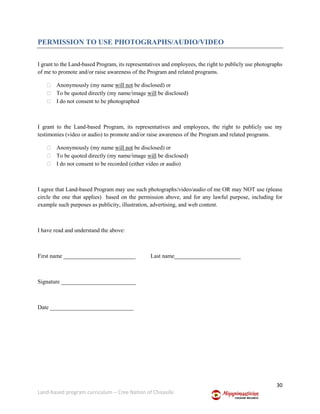
PERMISSION TO USE PHOTOGRAPHS/AUDIO/VIDEO
I grant to the Land-based Program, its representatives and employees, the right to publicly use photographs
of me to promote and/or raise awareness of the Program and related programs.
 Anonymously (my name will not be disclosed) or
 To be quoted directly (my name/image will be disclosed)
 I do not consent to be photographed
I grant to the Land-based Program, its representatives and employees, the right to publicly use my
testimonies (video or audio) to promote and/or raise awareness of the Program and related programs.
 Anonymously (my name will not be disclosed) or
 To be quoted directly (my name/image will be disclosed)
 I do not consent to be recorded (either video or audio)
I agree that Land-based Program may use such photographs/video/audio of me OR may NOT use (please
circle the one that applies) based on the permission above, and for any lawful purpose, including for
example such purposes as publicity, illustration, advertising, and web content.
I have read and understand the above:
First name _________________________ Last name_______________________
Signature __________________________
Date _____________________________
31
Land-based program curriculum – Cree Nation of Chisasibi
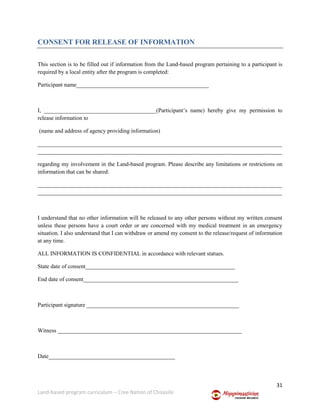
CONSENT FOR RELEASE OF INFORMATION
This section is to be filled out if information from the Land-based program pertaining to a participant is
required by a local entity after the program is completed:
Participant name______________________________________________
I, _______________________________________(Participant’s name) hereby give my permission to
release information to
(name and address of agency providing information)
_____________________________________________________________________________________
_____________________________________________________________________________________
regarding my involvement in the Land-based program. Please describe any limitations or restrictions on
information that can be shared:
_____________________________________________________________________________________
_____________________________________________________________________________________
I understand that no other information will be released to any other persons without my written consent
unless these persons have a court order or are concerned with my medical treatment in an emergency
situation. I also understand that I can withdraw or amend my consent to the release/request of information
at any time.
ALL INFORMATION IS CONFIDENTIAL in accordance with relevant statues.
State date of consent____________________________________________________
End date of consent______________________________________________________
Participant signature _____________________________________________________
Witness ________________________________________________________________
Date____________________________________________
32
Land-based program curriculum – Cree Nation of Chisasibi
FEEDBACK FORM
This form will be provided to the client on the last day of the program.
Age: ______
A. Have you ever participated in a similar program before (please circle one)?
Yes No
B. What attracted you to participate in the program (please circle one)?
a) recommended by a friend
b) recommended by a counselor
c) recommended by a family member
d) interested because of my own experience
e) other
______________________________________________________________________________
______________________________________________________________________________
C . General assessment
Poor Fair Good Very
Good
Excellent N/A
1. General assessment of the program
2. Program met my expectations
3. Staff & elder were helpful (they provided
support and were understanding)
4. Treatment Plan (the tasks help me to address
my issues)
5. Instructions/introduction was clear (I knew
what I had to do)
6. Dialogue between participants (was
dialogue well facilitated)
7. Facilities
33
Land-based program curriculum – Cree Nation of Chisasibi
D. Was the program helpful to you (did it help you address the issues you initially
mentioned)?
Yes
How was it helpful?
______________________________________________________________________________
______________________________________________________________________________
______________________________________________________________________________
No
How was it not helpful?
______________________________________________________________________________
______________________________________________________________________________
______________________________________________________________________________
E. Did the program do enough to motivate you and provide you with enough support to feel
comfortable and confident?
Yes No
Comments: -
______________________________________________________________________________
______________________________________________________________________________
F. Did the program help you find or develop your strengths?
not at all minimally somewhat good very good extremely well
G. Did the program help you move beyond the trauma of your past?
not at all minimally somewhat good very good extremely well
H. Did the program help you to feel good about yourself?
not at all minimally somewhat good very good extremely well
I. How motivated were you to heal before joining the program?
Not motivated Very motivated
1 2 3 4 5
34
Land-based program curriculum – Cree Nation of Chisasibi
J. How motivated are you to heal after completing the program?
Not motivated Very motivated
1 2 3 4 5
K. Did the program motivate you to continue your healing journey?
Yes No
Comments:
______________________________________________________________________________
______________________________________________________________________________
L. Would you recommend the program to others?
Yes No Maybe
N. Were there any negative aspects that you encountered?
______________________________________________________________________________
______________________________________________________________________________
______________________________________________________________________________
______________________________________________________________________________
M. What improvements would you recommend?
______________________________________________________________________________
______________________________________________________________________________
______________________________________________________________________________
______________________________________________________________________________
MEEGWETCH!

Chisasibi hos2014 workshop-materials_chisasibi

  • 1.
    Honoring our strengths2014 National Conference Ottawa, ON, June 24-25, 2014 Designing a Culturally Safe Land- Based Wellness Model in Chisasibi Context The Cree Nation of Chisasibi, under the guidance of the Miyupimaatisiun (Wellness) Committee has initiated a process of implementing Iiyiyiu (Cree) healing and knowledge in the delivery and management of health and social services since 2009. Community members deem Cree healing methods as a complementary dimension to an integrated model of wellbeing and living a good life. Therefore, the work focused on expanding Iiyiyiu healing programming in Chisasibi and establishing a structured process for implementing Iiyiyiu healing in service provision in the community. The Chisasibi Miyupimaatisiun Committee’s close collaboration with the newly established Nishiiyuu Miyupimaatisiun Department of the Cree Board of Health and Social Services James Bay (CBHSSJB) has led to the development of the present Land-Based Healing Program as a community-based approach to service delivery. Objectives of the workshop The objectives of the workshop are as follows:  Connect historical and cultural factors with present day health outcomes  Present a model of integrated services as envisioned in Chisasibi  Explore the process of implementation of a Land-based program  Discuss the implications of cultural safety for service provision in community contexts Outline of the workshop 1. ‘Did you know’ session (20min) 2. Creative potential & cultural revitalization in Chisasibi (10min) 3. The Chisasibi Land-based healing model (15min) 4. Integrated service delivery though Mental Wellness Team & CBHSSJB (15min) 5. Exploring opportunities and challenges in the context of cultural safety (10min)
  • 2.
    Honoring our strengths2014 National Conference Ottawa, ON, June 24-25, 2014 Presenters Larry House, Coordinator Chisasibi Mental Wellness Team Larry is a member of the Cree community of Chisasibi, Quebec. He advocates for the integration of Iiyiyiu (Cree) healing models within the institutions that serve his community. His work has been to bring into the mainstream the knowledge and wisdom that his people hold sacred and to apply it in all facets of community daily life. Like in many indigenous communities worldwide, he experienced the abuses that his people endured during the worst exercises of assimilation in the colonial history of Canada. His resilience is a testament to the healing inherent in his peoples’ worldview. Eddie Pashagumskum, Chisasibi Miyupimaatisiun Committee Eddie is the elder who developed the Land-based program and who delivers it on the land. He will explain the philosophy that guides his healing practice as well as answer any questions related to the land-based program. Gloria Ann Cozier, Assistant to the AED (Executive Director), CBHSSJB Gloria Ann Cozier is the Assistant to the AED (Executive Director) of Region 18Th Cree Health Board & Social Service of James Bay (CBHSSJB). A three time graduate of McGill University in Social work and psychology she was involved in managing the Best Practice Family Strengthening Program first implemented in the city of Montreal which graduated the highest number of families and shared the Kaiser award in 2007. She is the first African Canadian recipient of the Moulin’s D’or award in 2008 for her humanitarian work to enhance the lives of Marginalized families in Montreal community. In the same year she also received another honorable humanitarian award from the SPVM for her service to bridge race relations between Montreal police and the African Canadian community. In 2011 she received another distinguish award from the Black History Round Table of Quebec. Gloria Ann Cozier has a history of work in cross cultural perspective, Youth protection, and psychotherapy and is a columnist and inspiring presenter and lecturer. Ioana Radu, Independent researcher Ioana is an independent researcher with over a decade experience in Aboriginal contexts. Her areas of expertise include knowledge mobilization, cultural safety, oral history and integrated community development. She is finishing her Humanities PhD at Concordia University, Montreal.
  • 3.
    Honoring our strengths2014 National Conference Ottawa, ON, June 24-25, 2014 Chisasibi Model of Miyupimaatisiun – Being alive well Decolonization Creative potential Hoslistic approach Community- based Relational Cultural revitalization Language Wisdom Spirituality Social justice Meaningful engagement Respect Safety
  • 4.
    Honoring our strengths2014 National Conference Ottawa, ON, June 24-25, 2014 ‘Did you know’ session Participants split into small groups of 10 or less. Each group receives an envelope containing a ‘Did you know’ about Chisasibi. The participants open their envelope and read the ‘Did you know’ statement. The groups consider at least three ways similar historical and cultural factors might still influence Aboriginal health and healthcare today. This activity simply aims to inspire participants to connect historical and cultural factors with present day health outcomes. ‘Did you know handout’ In the 1930s the beaver population in Iiyiyiu Istchee (Cree ancestral territory in eastern James Bay) collapsed, due to overharvesting by non-Cree hunters and pressures from the Hudson Bay Company managers for increased harvest. That on the island of Fort George (Chisasibi) there were two residential schools that operated between 1907 and 1975. There are 600 former students living in Chisasibi. In 1980 the Fort George iiyiyiu (Cree) were relocated across the bay due to the La Grande hydroelectric project which flooded 11,500 km2 (approximate size of Belgium) of traditional hunting territories. In the early 18th Century Missionaries banned the Shake Tent, the sweats, drumming and dances, practices that the iiyiyiwich (Cree) had used for guidance and maintaining wellbeing for generations. In 1975 the iiyiyiwich (Cree) signed the first contemporary land claim agreement in Canada that included an extinguishment clause. For the following 30 years both governments failed to honor the agreement and its implementation. During the court case against the La Grande hydroelectric project the government lawyers tried to prove that because the iiyiyiwich (Cree) ate buttered toast for breakfast, lived in houses, and used skidoos to hunt they were white men, assimilated and devoid of any claims to their ancestral territories.
  • 5.
    Designing a CulturallySafe Land-Based Wellness Model in Chisasibi (Quebec) Presented by Larry House & Eddie Pashagumskum Chisasibi Mental Wellness Team Honouring Our Strengths 2014 National Conference Ottawa, Ontario, June 24-25, 2014
  • 6.
    ACKNOWLEDGEMENTS Eddie Pash, Noah Snowboy,William Bearskin, Linda Bearskin, Larry House, Ioana Radu, Sam W. Gull, Gloria-Ann Cozier, Mike Wong, Miyupimaatisiun Committee, Chisasibi Chief & Council, Cree Health Board, Health Canada.
  • 7.
    CREATIVE POTENTIAL ANDCULTURAL REVITALIZATION Creative Potential Desire for Cultural Revitalization Quest for Social Justice Dr. Charles Royal, New Zealand
  • 8.
    INTRODUCTION • Implementing Iiyiyiuhealing and knowledge in the delivery and management of health and social services as a local initiative • Community members deem Cree healing methods as a complementary dimension to an integrated model of wellbeing and living a good life • To expand Iiyiyiu healing programming in Chisasibi and establish a structured process for implementing Iiyiyiu healing in service provision in the community
  • 9.
    INTRODUCTION • 2009 – MiyupimaatisiunCommittee established by the Cree Nation of Chisasibi: mental health nurse, 2 social worker, teacher, principal, 4 elders, and 2 youth – Chisasibi Traditional Knowledge and wellness – 9 month program of traditional healing/counselling activities and ceremonies • 2010 – 1st Symposium on health and social issues – Throughout the year – traditional counselling: • Intergenerational Systems of Trauma • Substance Abuse • PTSD (Post-Traumatic Stress Disorder) • Other Mental Health Issues
  • 10.
    INTRODUCTION • 2011 – 2ndCommunity symposium on health and social services: Focused discussions with women group and youth group – Presentation of Community initiatives to the Elder council • 2012 – 3rd Community Symposium/Roundtable of Traditional Healing – March - 4th Community Symposium – theme: Empowering the community – focused on tools and means of community engagement with the existing process
  • 11.
    INTRODUCTION • 2013 – Finalized5-Year Community Wellness Plan (Strategic Plan) – Developed Land-Based Healing Program curriculum, including case management and aftercare procedures with Nishiiyuu – Video recording of the land- based program with Eddie Pash and Noah Snowboy at LG4 – Secured Health Canada funding for Mental Wellness Team
  • 13.
    5-YEAR STRATEGIC PLAN •Vision – Enhancing wellbeing for healthy Self, healthy Families, healthy Community and healthy Nation • Values – Respect – All beings are important – Equality – All beings are valued – Responsibility – We are all interconnected, what one does affects the others – Openness – Building meaningful relations irrespective of the healing method the individual may choose – Transparency - Outcomes are measured, assessed and publicly reported
  • 14.
    5-YEAR STRATEGIC PLAN •Guiding principles – Holistic approach – address the physical, mental, spiritual, emotional, economic, environmental and cultural well-being of the individuals, families and communities – Iiyiyiu knowledge – guided by Iiyiyiu language, culture and spirituality – Meaningful engagement – create respectful and open dialogue with community members and increase their input on health and social service matters affecting their community • Mission – Mobilize community participation in programming and increase the appropriation of service delivery in a way that directly responds to local needs and long-term vision of care and well-being – Develop and implement effective policies and strategies to promote the health and social welfare of the residents of Chisasibi – Promote closer collaboration and joint activities with relevant agencies and entities in the Community of Chisasibi
  • 15.
    LAND-BASED PROGRAM • TheChisasibi Miyupimaatisiun Committee in collaboration with Nishiiyuu Miyupimaatisuiin Department has led to the development of the present Land-Based Healing Program as a community-based approach to service delivery. • There have been 4 land-based trips to date: Summer 2012, Fall 2012, Winter 2013, Spring 2014.
  • 16.
    LAND-BASED PROGRAM • TheLand Based Healing Model for Nishiiyuu is a healing and wellness program implemented and delivered on the hunting territory of each Cree community • To strengthen the ability of participants to lead a healthy, fulfilling and resilient life • Elders stress that the land and cultural traditions have healing power that can enable individuals in distress deal with pain and self- hurt.
  • 17.
    LAND-BASED PROGRAM • Itaims to improve the mental health of individuals so that they can effectively participate in the life of their family and community and make positive contributions to the collective development of their Nation. • Programming addresses issues related to substance abuse, trauma (physical and sexual abuse, unresolved grief), and the many intergenerational social suffering symptoms associated with residential school.
  • 18.
    LAND-BASED PROGRAM • Iiyiyiumethods and teachings form the core principles of the program and promote personal, family and community wellness form a perspective rooted in the Cree way of life. • The scope of treatment includes prevention, intervention and postvention /aftercare to ensure an effective continuum of care for clients. • It uses an intersectorial and intercommunity approach to service provision that shares resources and knowledge to maximize local capacity building and promote leadership.
  • 19.
    TEAM COMPOSITION • Elder- Design treatment plan/individual wellness plan in collaboration with healer; holistic counselling and express their traditional knowledge; teach the spiritual and the sacred aspect of hunting fishing, trapping and gathering; • Program coordinator - Oversees the organization of the program in consultation with elder/healer; identify & retain employees; • Office manager - Data entry and processing program registrations; orientation support • Healer / Counselor – Conduct individual entry interviews; help the participant’s personal growth; do the intervention; engage, encourage and support the participants in the healing process. • Camp helpers – provide daily camp services such as cooking, cleaning, provision and other assistance as requested by the team
  • 20.
    CMWT • Year 1– hiring staff and complete Nechi training • The team will be based in Chisasibi and services will be extended in surrounding communities • Year 2 – Finalize service provision agreements with other communities and begin to offer services in one community • Year 3 – Fully functioning team with established collaboration agreement with other institutions
  • 21.
    CMWT • Team composition- Core members: elders, program coordinator, healer/traditional counsellor, primary case manager, community addictions counsellor, mental wellness nurse, camp helpers, office managers
  • 22.
    CMWT • Future directions –Undertake community consultation on the 5 Year SRP – Maintain traditional healing services in the community – Expand on the bush programs in cooperation with the Nishiiyuu Department and the Council – Organize Round Dances & other traditional ceremonial dances – Research and document ceremonies, dances & songs – Increase interagency collaboration to maximize benefits for community members – Identify resource-persons in the community
  • 23.
    CMWT • Challenges – Intra/interagencycollaboration at the local level – Harmonizing local and regional programming – Detailed protocols between entities within the Cree territory for referral/intake process, for intervention, and aftercare – Secure standard bush materials (canvas, stoves, axes, ect.) – Capacity & resources to expand and extend programs to meet current needs
  • 24.
    OPPORTUNITIES • Intergenerational transferof knowledge, Cree values and way of life from which individuals can draw strength and develop a positive cultural identity • Creating safe and trustful spaces for sharing • Individuals are inspired and empowered to make good life-choices and dedicate to their healing journey
  • 25.
    Questions? Miigwetch Larry House Chisasibi MentalWellness Team – www.chisasibiwellness.ca houselawm@gmail.com
  • 26.
    LAND-BASED HEALING PROGRAM Draft curriculum– Cree Nation of Chisasibi 2014
  • 27.
    1 Land-based program curriculum– Cree Nation of Chisasibi Table of Contents PREAMBLE .................................................................................................................................................2 INTRODUCTION ........................................................................................................................................2 MISSION......................................................................................................................................................3 CHARACTERISTICS OF THE PROGRAM...............................................................................................3 ADMISSION CRITERIA.............................................................................................................................6 CODE OF CONDUCT .................................................................................................................................6 LIST OF CLOTHING AND PERSONAL NEEDS ITEMS .........................................................................................7 CAMP SUPPLIES.............................................................................................................................................7 TEAM COMPOSITION & RESPONSIBILITIES.......................................................................................8 INTAKE PROCEDURE...............................................................................................................................9 PRE-DEPARTURE ORIENTATION ........................................................................................................10 OUTTAKE PROCEDURE.........................................................................................................................10 AFTERCARE .............................................................................................................................................10 PROGRAM SCHEDULE...........................................................................................................................12 EXAMPLES OF PROGRAM CONTENT.................................................................................................18 INTAKE FORM –Agency referral .............................................................................................................19 INTAKE FORM –Self-referral...................................................................................................................20 PARTICIPANT IDENTIFYING INFORMATION ...................................................................................21 TREATMENT PLAN.................................................................................................................................25 CONSENT TO INTAKE/TREATMENT...................................................................................................27 CAMP GUIDELINES AGREEMENT.......................................................................................................28 CONSENT FOR HEALING.......................................................................................................................29 PERMISSION TO USE PHOTOGRAPHS/AUDIO/VIDEO ....................................................................30 CONSENT FOR RELEASE OF INFORMATION....................................................................................31 FEEDBACK FORM...................................................................................................................................32
  • 28.
    2 Land-based program curriculum– Cree Nation of Chisasibi PREAMBLE This document identifies the minimum program requirements for Land-Based Healing Model (LBHM) programs as well as guidelines to facilitate implementation and ongoing operation of these programs on a regional basis in Eeyou Istchee. The Land-Based Healing Model presented here has been developed in consultation with community members and elders from Chisasibi and reflects a culturally appropriate community based approach to health and social service delivery as envisioned in Section 14 of the JBNQA as well as in the CBHSSJB strategic plans (2004 and 2012). First and foremost the LBHM reflects the Cree way of life and knowledge as expressed by the elders consulted, who stress that the land and cultural traditions have healing power that can enable individuals in distress deal with pain and self-hurt. Moreover, Land-based programs strengthen and facilitate intergenerational knowledge mobilization which contributes to positive identity formation, strengthen self- esteem, and instills pride in the Cree cultural heritage. By linking culture, families and the community, Cree approaches to health and social service provision such as the Land-Based Healing Model, provide complementary and holistic models of health and wellbeing. The information contained in this document reflects the knowledge and evidence at the time of its release. The standards and guidelines will therefore need to evolve and adapt to ensure that particular needs and expectations of clients are met, as well as acknowledge the cultural and contextual circumstance of individual communities throughout Eeyou Istchee (inland and coastal). Opportunities for knowledge exchange and consultation will be key in ensuring that clients receive services that result in the best possible outcomes. INTRODUCTION The Cree Nation of Chisasibi has been working towards implementing Eeyou healing and knowledge in the delivery and management of health and social services as a local initiative in response to the 5 Year Implementation Plan of the Cree Board of Health and Social Services James Bay. For the past 3 years the community has initiated various local activities towards this goal including Eeyou Healing counselling services, an Indigenous Knowledge Transfer project, and four (4) community-wide symposiums on health and social services among others. The Chisasibi Miyupimaatisiun Committee, established in 2009 pursuant to BY-LAW NO. 2009-001, has been the main supporter and program developer for the above mentioned initiatives. Its mandate is to review “all matters referred to the Committee by the Council relating to community health and social issues. The primary function of the Committee is to assist the Council in implementing effective policies and strategies to promote the health and social welfare of the residents of Chisasibi.” Since 2009, the Committee has focused on mobilizing community participation in defining a local vision and principles for integrated health and social services and to increase the appropriation of service delivery by community members in a way that directly responds to local needs and long-term vision of care and well-being. This orientation has led to two community-wide symposiums that aimed to create a space for dialog between community members and local services providers to: • determine community needs and priorities in terms of health and wellness, • suggest how the gap in service provision can be bridged, and • establish guidelines for the development of a long-term vision for a local wellness plan. Two Roundtables on Eeyou healing were held in the winter of 2012. The community response has been very positive and the assessment of Eeyou counselling services provided up to now has shown that
  • 29.
    3 Land-based program curriculum– Cree Nation of Chisasibi community members deem Cree healing methods as a complementary dimension to an integrated model of wellbeing and living a good life. The Committee was mandated by the participants to expand Eeyou healing programming in Chisasibi and establish a structured process for implementing Eeyou healing in service provision in the community in order to diversify services to respond to a variety of needs. The Committee’s close collaboration with the newly established Nishiiyuu Miyupimaatisiiun Department has led to the development of the present Land-Based Healing Program as a community-based approach to service delivery. MISSION The Land Based Healing Model for Nishiiyuu is a healing and wellness program implemented and delivered on the hunting territory of each Cree community. The Chisasibi mission is to strengthen the ability of participants to lead a healthy, fulfilling and resilient life. Elders stress that the land and cultural traditions have healing power that can enable individuals in distress deal with pain and self-hurt. Ultimately we aim to improve the mental health of individuals so that they can effectively participate in the life of their family and community and make positive contributions to the collective development of their Nation. Programming will address issues related to substance abuse, trauma (physical and sexual abuse, unresolved grief), and the many intergenerational social suffering symptoms associated with residential school. Eeyou methods and teachings form the core principles of the program and promote personal, family and community wellness form a perspective rooted in the Cree way of life. Moreover, the scope of treatment includes prevention, intervention and postvention /aftercare to ensure an effective continuum of care for clients. Therefore, as part of a board community-based approach to service delivery, the LBHM uses an intersectorial and intercommunity approach to service provision that shares resources and knowledge to maximize local capacity building and promote leadership. CHARACTERISTICS OF THE PROGRAM The characteristics detailed in this section can serve as a standard, nevertheless each community should adapt it according to local cultural and historical contexts as well as availability of resources. 1. Connection to the land and culture  The model recognizes the healing power of nature and the ‘return to the land’ as a way of connecting individuals to Cree culture and language; promote intergenerational knowledge transfer; and offer a safe space in which individuals can share personal experiences and detoxify (when necessary).  As knowledge holders, Elders are the core component of this program and are involved at every step of the program (prevention, intervention and postvention). Overall they deliver and guide this culturally-appropriate model of healing by teaching Cree bush skills and values embedded in them.  Traditional counsellors/Healers use Cree beliefs and medicines to promote spiritual, physical and emotional wellbeing. They sometimes use a combination of western and Aboriginal therapeutic approaches that best suits the individual’s circumstance, including: knowledge of cultural spiritual practices; knowledge and use of plants and medicines; ceremonial activity and prayer; sharing circles; energy work, etc.
  • 30.
    4 Land-based program curriculum– Cree Nation of Chisasibi 2. Harm reduction  There is a growing understanding that substance use and abuse is a behavioral and habitual dependency developed as a coping mechanism to traumatic experiences.  The LBHM recognizes that substance abuse is never an isolated physical addiction or disease, thus the program aims to address the trauma that underlies an individual’s particular behavior.  As such the model focuses on treatment that promotes personal responsibility and rational behavior. Harm reduction is thus understood as helping clients move from self-harm to a level of functioning that promotes holistic wellness, which may or may not include total abstinence. 3. Goals for treatment  In keeping in line with the harm reduction objective, the program only requires that each client agrees to reachable treatment goals such as: moderating, decreasing or abstaining from alcohol and drugs; improve relationships with family and/or friends; secure or maintain a current employment; complete the land-based program; attend at least a monthly support meeting. Each participant is encouraged to define his/her treatment goals as is relevant to his/her circumstance 4. Access  The program is available to all community members irrespective of age, gender, sexual orientation, religious affiliation or spiritual practice. Nevertheless, groups can be managed according to a unifying characteristic such as age or gender to ensure effectiveness of treatment and create a comfortable atmosphere for everyone.  The program accepts and processes referrals from everyone (self, family, professional, friends, etc.). Nevertheless, once accepted into the program clients are asked to undertake a formalized and structured care program that may include specialized services available in the community (to be stipulated in the aftercare treatment plan).  In addition the LBHM is cooperating with community agencies to support prevention strategies that aim to build local capacity and opportunities for designing and developing relevant programs such as peer leadership, wellness intervention training, monthly support groups and others. The focus on prevention includes reducing risk factors as well as strengthening protector factors in the lives of individuals and at the community level. 5. Case management  The program has designed a systematic and coordinated case management which is undertaken by the program coordinator. In the case of an agency referral the Program coordinator calls a case conferencing with all care providers that service the client. For self-referrals the Program coordinator undertakes the intake interview and depending on the needs and circumstances may call a case conferencing with other relevant agencies. Details for Intake/Outtake procedures are detailed in the relevant section below. All clients are required to sign consent forms to ensure safety and effective treatment.  Detailed partnership agreements between entities within the Cree territory for referral/intake process, for intervention, and aftercare are signed to secure continuum of care and the best possible outcome for the client.
  • 31.
    5 Land-based program curriculum– Cree Nation of Chisasibi 6. Mitigation of risk  Program coordinator and Elder(s) ensure a structured supervision of staff and clients on a regular basis. While on the land staff meetings will take place at least once a week and group and individual meetings with clients will take place at least twice a week to ensure safety and that program guidelines are followed.  To ensure the safety of clients a pre-admission medical exam is required before the client departs in the bush. Without this exam the client will not be allowed to depart.  Part of the partnership agreements includes safety issues where arrangements for medevac evacuation (built-in system at LG4 or LG1) and mitigating symptologies (post-acute, withdrawal) are agreed upon before departure in the bush. Agreement with search and rescue/first responders to be made. When relevant arrangements for nursing care on site will be made. 7. Continuous service planning  All Program interventions are contextualized to the individual’s life in the community. We recognize that even though the program is short, once the individual commits to healing they will strive to affect change in their life, while the community life may still be unchanged. Thus interventions maximize the client’s resilience though building capacity to lead a healthy life for the long-term.  The Program recognizes that the long-term health and wellness of clients and community members at large rests on the availability of an array of services and programs in the community (prevention and postvention). The need to accompany the client on his/her healing journey is essential and therefore a continuum of care is needed at the community level.  Significant efforts are placed on aftercare though the development of a postvention treatment plan for each client. As described in the aftercare section, exit interviews will be conducted in the last days of the program. Upon arrival in the community the clients take part in a case conferencing meeting where they will design the aftercare plan in consultation with LBHM staff (elder, program coordinator, etc.) and other relevant service providers from the community.  Document and make available a compendium of services for clients and their family as well as other self-care and self-directed materials and strategies.  Make available monthly support groups with either Program coordinator or elder(s) and assign a primary and secondary contact person that the client can access when needed.  Upon returning home, a homecoming ceremony with the family is held to commemorate the participant’s accomplishments and celebrate the beginning of their healing journey.  The program offers a refresher trip after 6 months to celebrate, solidify and rejuvenate a participant’s healing journey. 8. Quality assurance  Since the program is still new, a modification and feedback mechanism is built in both to allow adaptation and modification while in the bush as well as long-term monitoring, including weekly staff meetings and client assessment meetings.
  • 32.
    6 Land-based program curriculum– Cree Nation of Chisasibi  Within the program a feedback mechanism takes place, either through verbal or written feedback, eg. A feedback form is given to the clients to fill out during the last day of the program.  Intake forms are designed to collect baseline data on all participants for the purpose of devising a social determinant of health profile for the clientele.  Program evaluation report will be published yearly on implementation and operating indicators, as well as client outcomes, and client and family satisfaction assessments. ADMISSION CRITERIA  be emotionally, mentally and physically able to participate in intense counselling situations and challenging land‐based activities;  not have consumed illegal drugs or alcohol for a period of at least 3 days prior to admission;  be aware that any clients arriving intoxicated or with alcohol, psycho active/mood altering drugs, painkillers, sleeping pills, or tranquilizers may not be accepted into the program unless their use is pre‐approved by consulting physician;  express the motivation and desire to change his or her present life‐style, behavior, thinking or relationships  All participants must be willing to abide by camp Code of Conduct while on the premises or when out for scheduled program outings.  No cell phones, IPods, or other gadgets are allowed CODE OF CONDUCT The Code is established to promote an atmosphere of spiritual, emotional, mental and physical safety, as well regulate its process and preserve the integrity of the program. The following guidelines are central to our Code of Conduct: 1. All persons are expected to exhibit respect for others in their behaviour, manner and speech. Accordingly, emotional abuse (i.e. insults, hurtful criticism, or verbal intimidation), physical violence or intimidation will not be tolerated at any time. 2. All persons are expected to exhibit respectful relations with all of creation while at the lodge. Accordingly, persons must not hurt or damage plant or animal life or otherwise do anything destructive to the land or property. 3. Collective personal healing and growth is a central approach to land-based program, therefore all participants are encouraged to build trustful relationships with each other and help in any way that they find appropriate their fellow participants. 4. All persons are expected to exhibit respect for all races of humankind and their original teachings in behaviour, manner and speech. Furthermore, we are expected to exhibit respect and non- interference with the beliefs and spiritual paths of others.
  • 33.
    7 Land-based program curriculum– Cree Nation of Chisasibi 5. All persons are expected to exhibit respect for the property of the Lodge and the personal belongings of others. The personal belongings of others are not to be used or interfered with without the permission of the owners. 6. All participants are responsible for all their personal belongings and effects. Program staff accepts no liability or responsibility for the personal belongings and effects of participants or visitors. 7. The camp is a drug and alcohol free area. Accordingly, no alcohol or non-prescription drugs are to be brought onto the property at any time. FAILURE TO ADHERE TO THE ABOVE STATED CODE OF CONDUCT MAY RESULT IN THE IMMEDIATE REMOUVAL OF PARTICIPANTS FROM THE PROGRAM AND A DETERMINED TIME DURING WHICH THE PARTICIPANTS HAVING BREACHED THE CODE WILL BE BARRED FROM PARTICIPATING IN THE LAND-BASED PROGRAM. A DEFINITE APPLICATION OF COSEQUENCE WILL BE DECIDED BY THE ELDER AND THE PROGRAM COORDINATOR. LIST OF CLOTHING AND PERSONAL NEEDS ITEMS Appropriate for the season Axe Bedding [blankets, pillow, sheets, mattress, underlining (bearskin, caribou hide, carpet)] Pots (teapot) Backpack Nightline (cotton string) Hunting gear: knife, firearm (unless prohibited by court), matches, etc. Boots Rain gear Warm jacket Snowshoes Flashlight Teepee Canvas (enough for shelter – 2 to 3 pieces) Things that you like – musical instrument, paints, photo camera, etc. CAMP SUPPLIES A van 2 drums gas (205L) 100 Lbs propane (or 4X50Lbs propane tanks)
  • 34.
    8 Land-based program curriculum– Cree Nation of Chisasibi TEAM COMPOSITION & RESPONSIBILITIES Elder - Design treatment plan/individual wellness plan in collaboration with healer; holistic counselling and express their traditional knowledge; teach the spiritual and the sacred aspect of hunting fishing, trapping and gathering; give spiritual guidance; how we are governed by the rule of the land- Natural law, Nature law and Spiritual laws Program coordinator - Oversees the organization of the program in consultation with elder/healer; identify & retain employees; identify & retain equipment and supplies; assume transportation and other logistical needs; plan daily activities Office manager - Data entry and processing program registrations; orientation support (produce necessary materials & take appointments); bookkeeping and administrative assistance Healer / Counselor – Conduct individual entry interviews; help the participant’s personal growth; show the importance of boundaries; help participants to overcome pain, anger, grief of the past; do the intervention; engage, encourage and support the participants in the healing process. Camp helpers – provide daily camp services such as cooking, cleaning, provision and other assistance as requested by the team
  • 35.
    9 Land-based program curriculum– Cree Nation of Chisasibi INTAKE PROCEDURE An intake consists of a face to face interview and the completion of the intake questionnaires. Applicants will first be asked to read and sign a Consent to Intake/Treatment form to ensure they are aware of their rights and responsibilities to seeking help with the land-based program. Please make sure that the following items have been filled at the intake stage:  Intake Consent form  Personal information sheet (demographic stats)  Participant history (substance abuse/violence/etc)  Pre-admission medical evaluation – this evaluation needs to be finalized prior to leaving for the bush. Failure to do so will lead to non-acceptance into the program. At intake please make sure an appointment has been made with the doctor.  Consent for release of information The first step in the intake procedure involves a mandatory face-to-face assessment interview with the client which is to be conducted by the Referral agent. In case of self-referral, the Land-Based Program Coordinator or Counsellor will conduct the assessment. This initial assessment will decide acceptance into the program and all necessary forms are to be signed. Following the intake assessment the report will be taken to a case conference with our treatment team (Elder, Counsellor and other case coordinator such as Justice, Social Services, Mental Health, etc.) for discussion to gain better insight as to the clients’ problems and needs so that appropriate intervention can be designed. The case conferencing is designed to coordinate efforts to avoid duplication of services among treatment resources. At this point, the team will consider the applicants issues and healing goals and then determine what service options can be offered (prevention, referral). At this stage a participant wellness plan will be designed. Once the wellness plan is finalized a final face-to-face meeting will the client will take place to discuss the wellness plan and make any adjustments, if necessary, according to the participant’s comments. The wellness plan should detail the nature of treatment, the participant’s specific responsibilities (if different from Program requirements), and the nature of his/her involvement into the Program. The participant will be given the opportunity to accept or decline services offered. At this stage the participant will sign the treatment consent form.
  • 36.
    10 Land-based program curriculum– Cree Nation of Chisasibi PRE-DEPARTURE ORIENTATION Three days before departure participants will attend a 1 day orientation session in which the Elder / healer and/or Program Coordinator explain the following: • The goal and procedure of the program • Camp rules and personal items to bring • Daily activity schedule and the • Consent forms and agreement regarding program ethics  Consent for Healing  Permission to use photographs/video/audio • Safety rules within the framework of activities schedule (including contingency plan) Participants fill in necessary forms and clarify issues and concerns. OUTTAKE PROCEDURE Prior to return in the community, the Program Coordinator will assist the participants in completing the Program Feedback Form, which will assist with quality assurance such as relevant program adaptation and modifications as well as measured client outcomes. Exit interviews will be conducted with each participant upon completion of the program. An aftercare plan will be developed in consultation with the participant and/or other case manages (eg. Justice officer, psychologist, etc); see Aftercare below. AFTERCARE Due to the perceived vulnerability of many clients the aftercare treatment will be developed immediately upon arrival in the community. Preferably, three days after arrival, a case conferencing with individual participants is undertaken to determine an aftercare plan to provide continuum of care for the client while in the community. This step is very important as often clients/participants are not followed up by the service providers. Having an aftercare plan is paramount and pivotal to the individual healing and recovering process, which, from the perspective of the elders, is a life-long process. Regular follow-up meetings with the client (by Elder, Program Coordinator, or Referral agency representative/Social worker) will be undertaken to offer support for healing as well as assessing client outcomes. An aftercare resource book with journal should also be developed to facilitate client continuous engagement with healing methods and resources. Partnerships with the Band, School, CMCs, Justice Committee, and other local entities will be finalized in order to formalize service provision and increase diversity of services. This process is highly intersectorial and interdisciplinary in order to offer effective client aftercare and continuum of services to ensure the best
  • 37.
    11 Land-based program curriculum– Cree Nation of Chisasibi possible outcomes for the clients. Ultimately we aim to strengthen individuals’ wellness from a holistic perspective: healthy mind, healthy body and healthy spirit. Given the weak programming available we can only recommend aftercare programming, nevertheless we will work in close cooperation with community entities to design structured aftercare programming with tangible support for clients, which may include the following:  Emergency numbers  Drop-in outreach  Self-help materials and approaches  Support groups (AA meetings, parenting, etc.)  Healing circles  Traditional counselling  Sweats and other Cree ceremonies  Cree medicines (in consultation with clinical practitioner in case the client is under specific medication)  Pastoral meetings  Leadership and empowerment workshops  Offer Community Addiction Training and/or High school Equivalency program for the participants.  Etc. For this purpose, it is recommended that a database of local resources be developed and updated, which can then be made available to the clients as a support mechanism.
  • 38.
    12 Land-based program curriculum– Cree Nation of Chisasibi PROGRAM SCHEDULE This is an example of 10 day schedule as designed by Eddie Pashagumskum. Other proponents may choose to adapt the schedule as they see fit, although we recommend that main characteristics of the program as well as ethics and consent be kept uniform in order to ensure program cohesiveness and measure program outcomes. Time Activity Goals Comments Day 1 9:00 AM Opening Prayer Introduction by Trainer/Facilitator • What do you want to get out of this program? • I will share my knowledge from the land. • It’s up to each individual what they can get out of this program. 10:00 AM Break 10:15 AM Clients Introduction…Why did you want to take this program • Substance Abuse………….Anger Issues • Relationship problems…Suicidal Thoughts • Break from Chisasibi…….Make changes for a healthier lifestyle 11:00 AM Living in Harmony with Nature • Traditional teachings on the “mind” • History of own people before modern transportation • Identity • Patience • Respect 12:00 PM Lunch 1:00 PM Reflection - How is the program so far? • Clients enjoying being away from community for awhile • Sharing stories of substance abuse (witnessing family violence, relationship issues, neglect…) 3:15 PM History of Eeyou before Modern Transportation • Physically fit • Healthier • Living in harmony with nature 4:00 PM Closing Prayer
  • 39.
    13 Land-based program curriculum– Cree Nation of Chisasibi Time Activity Goals Comments Day 2 9:00 AM Opening Prayer Living in Harmony with Nature (continued until lunch) • Be grateful what nature has to offer • It’s important never to complain when you’re unsuccessful on hunting and fishing • Ex.: When I’m out on the land, I go home with nothing..I am still grateful just simply being out there. • Self-discipline • Wake up early…go to bed early • Self respect…learn to respect yourself and others • Honesty 12:00 PM Lunch 1:00 PM Activity on the land to be determined according to circumstance (season, etc) – see examples 5:00 PM Review what was discussed on the last day and half • Physically fit • Healthier • Living in harmony with nature 6:00 PM Closing Prayer Time Activity Goals Comments Day 3 9:00 AM Opening Prayer Forgiveness  In the mid 1970’s….three people were murdered..the father of one of the victims was able to forgive the person responsible. 10:00 AM Break 10:15 AM The impacts of Hydro Development  Social; Loss and grief  Environment; Loss of Eeyou Istchee  Water  After forty years of Hydro development…we’re still affected today 12:00 PM Lunch
  • 40.
    14 Land-based program curriculum– Cree Nation of Chisasibi 1:00 PM Hunting teachings • Survival • Health 3:00 PM Break 3:15 PM What is hunting got to do with abuse? • Killing animals for nothing • Killing game for more than you need. • Bragging • Chasing caribou by ski-doo for the sake of it. Jealousy (within you and towards others) • Laughing at people when they break material possessions like ski-doo, motor, etc.. 5:00 PM Closing Prayer Time Activity Goals Comments Day 4 9:00 AM Opening Prayer Suicide Prevention • It can happen to anyone….young or old person • Life is precious • Substance abuse does or sometimes plays a role in this topic • You can still have fun without alcohol or drugs • Be involved in gatherings, events, activities or family gatherings • Talk to someone you trust 12:00 PM Lunch 1:00 PM One to one with clients and evaluation The rest of the clients do on the land activity (near the camp) to be determined according to circumstance (season, etc) – see examples 5:00 PM Closing Prayer
  • 41.
    15 Land-based program curriculum– Cree Nation of Chisasibi Time Activity Goals Comments Day 5 9:00 AM Opening Prayer Canoeing   Safety  Safe handling of an oar  How to safely navigate on rapids  Watch how the currents flow on rapids 10:00 AM Break 10:15 AM The activities that are involved in canoeing   Portage…lifting….walking….hiking….paddling 11:00 AM Axe safety tips • Axe is an essential tool in canoeing, hunting, trapping, building shelters, heating home and cooking • Be careful when handling and axe to prevent cuts or accidents • Cover your blade • Our ancestors were always active that is why they did not have too many health problems • Never leave anywhere without the essential tool 12:00 PM Lunch 1:00 PM Activity on the land Activity – to be determined according to circumstance (season, etc) see examples 4:00 PM Canoeing • Story on how I got my training and experience, being born and brought up by living off the land • My knowledge and experience came from my father and living on the land • It took me many years of practice 5:00 PM Closing Prayer
  • 42.
    16 Land-based program curriculum– Cree Nation of Chisasibi Time Activity Goals Comments Day 6 9:00 AM Opening Prayer The negative impact on our health from substance abuse (Eddie sharing story on alcohol abuse)   Our mind  Body  Health  Community  Family  Watch how the currents flow on rapids 12:00 PM Lunch 1:00 PM Activity on the land Activity – to be determined according to circumstance (season, etc) 5:00 PM Closing Prayer Time Activity Goals Comments Day 7 9:00 AM Opening Prayer The skills I learned took me years of practice • Patience • Listening • Respect, whatever the nature provides and others • Hunting, fishing • Take only what we need • Share 12:00 PM Lunch 1:00 PM Activity on the land Activity – to be determined according to circumstance (season, etc) see examples 5:00 PM Closing Prayer
  • 43.
    17 Land-based program curriculum– Cree Nation of Chisasibi Time Activity Goals Comments Day 8 9:00 AM Opening Prayer Native Human Rights Historical context of Native Rights 12:00 PM Lunch 1:00 PM Activity on the land Activity – to be determined according to circumstance (season, etc) see examples 5:00 PM Closing Prayer Time Activity Goals Comments Day 9 9:00 AM Opening Prayer Navigational Mind Nature Senses Weather 12:00 PM Lunch 1:00 PM Activity on the land Activity – to be determined according to circumstance (season, etc) see examples 5:00 PM Closing Prayer Time Activity Goals Comments Day 10 9:00 AM Opening Prayer Healing is an on-going process Talk to someone you trust 12:00 PM Lunch 1:00 PM One to one with clients and evaluation The rest of the clients do on the land activity (near the camp) Activity – to be determined according to circumstance (season, etc) see examples 5:00 PM Closing Prayer
  • 44.
    18 Land-based program curriculum– Cree Nation of Chisasibi EXAMPLES OF PROGRAM CONTENT Activities Spring Summer Fall Winter Life begins, renewal, birth  Hunt (geese, muskrat, seal, fish, ducks, otter, bear trap)  Camp preparation (firewood, teepee, hunting sites, etc)  Mental preparation  Gear preparation (supplies, traditional wear, sharpen axe, crooked knife)  Care and safety (gun safety, storage, canoe safety)  Environmental respect (garbage disposal, disposal of carcass/feathers)  Respect for fur bearing animals  Paddle making  Scraping hides  Water safety  Food preparation  Fishing fishnet preparation  Fire safety  Personal hygiene  Waterways, portage, tides  How to load your canoe to ensure balance  To understand the canoe parts, how it works in the water  How to work with the wind and waves  Smoking hides  Sled making  Snowshoe making  How to read trees  Moose hunting  Making wooden spoons  Identify beaver lodges for winter trapping  Setting up winter camp  Teepee teachings  Setting net under ice  Setting nightlines  Travelling on the ice (need to read the lakes)  Beaver trapping (different methods)  Snowshoe walking Depending on the size, the group will be divided in two whereby on can follow the teachings/lectures in the morning while the other group undertakes activities on the land; and vice versa for the afternoon.
  • 45.
    19 Land-based program curriculum– Cree Nation of Chisasibi INTAKE FORM –Agency referral This form must be completed by the referring professional and paraprofessionals Referring Agency Information Referral Contact Person: _________________________________ Position: _______________________ Agency: ______________________________________________________________________________ Address:_____________________________________________________________________________ _ E-Mail: _____________________________________Telephone #: _____________________________ 1. In what capacity do you know this client? _____________________________________________________________________________________ 2. How long have you known this client? _____________________________________________________________________________________ 3. Reason for referral: _____________________________________________________________________________________ 4. What are your overall impressions about this participant’s willingness to do the work needed to complete this program? Are there any areas of behaviour that you are concerned about that would assist us in being prepared to work with his or her issues? (i.e. rage, grief, personality issues) _____________________________________________________________________________________ _____________________________________________________________________________________ _____________________________________________________________________________________ _____________________________________________________________________________________ Land-based program requires appropriate aftercare for any person referred in order to provide an adequate continuum of care. We urge referring agencies to provide support and work in a complementary and collaborative relationship to ensure clients receive the best possible care. _____________________________________________________________________________________ Signature of Referring Agent Date _____________________________________________________________________________________ Signature of the supervisor Date
  • 46.
    20 Land-based program curriculum– Cree Nation of Chisasibi INTAKE FORM –Self-referral This form must be completed by the potential client or family with the assistance of Program Coordinator. Personal Information Name : _________________________________ Age: _______________________ Address:_____________________________________________________________________________ _ E-Mail: _____________________________________Telephone #: _____________________________ 1. Why have you decided to participate in the Land-Based program? _____________________________________________________________________________________ _____________________________________________________________________________________ _____________________________________________________________________________________ 2. How willing are you to do the work needed to complete this program? Are there any areas of behaviour that you are concerned about that would assist us in being prepared to work with you? (i.e. rage, grief, personality issues) _____________________________________________________________________________________ _____________________________________________________________________________________ _____________________________________________________________________________________ _____________________________________________________________________________________ Land-based program requires appropriate aftercare for any person referred in order to provide an adequate continuum of care. We urge referring agencies to provide support and work in a complementary and collaborative relationship to ensure clients receive the best possible care. _____________________________________________________________________________________ Signature of potential client Date _____________________________________________________________________________________ Signature of Program Coordinator Date
  • 47.
    21 Land-based program curriculum– Cree Nation of Chisasibi PARTICIPANT IDENTIFYING INFORMATION Form to be filled by the potential client, with the support of the program manager. Applicants Name: __________________________________D.O.B. ______________________________ Address: _____________________________________________________________________________ ________________________________________ E-mail Address:________________________________ Home Phone # : ____________________________ Alternate Number:____________________________ Male:_______ Female:_______ Age: __________ Marital Status: Married / Common Law ______ Single ______ Widowed ______ Children’s Information: Please list children name, age, sex and whether they still live at home and if not where do they reside. Name of Child Age Male/Female Place of residence Employment Status (present employment situation) Self Employed Homemaker Job Training Seasonal Permanent Retired Student Temporary Unemployed Part‐Time Income Source (present source) Job UIC Pension Income Assistance Family None Other (specify)_________________________
  • 48.
    22 Land-based program curriculum– Cree Nation of Chisasibi Family Type Living Alone Living with Spouse Living with Parents Single Parent Living with Friends with Spouse & Children with Extended Family Other Highest level of Education No Education Primary School Secondary Some Secondary Trade School University Adult Education Community College Legal Status (present involvement) Not Applicable Parole Probation Temporary Absence Other Have you or any of your family attended Residential School: You: Yes ___ No ___ Where?____________________________________________________ Parents: Yes ___ No___ Where? ____________________________________________________ Siblings: Yes ___ No ___ Where? ____________________________________________________ Grandparents: Yes___ No ___ Where? ____________________________________________________ Were you ever in a treatment centre? Yes No Year Number of times Location
  • 49.
    23 Land-based program curriculum– Cree Nation of Chisasibi Substances Abused Primary Drug of Choice ________________ Most Recent Use (Day/Month/Year)____________ Alcohol Hallucinogens Narcotics Prescription Drugs Solvents/Inhalants Other Secondary Drugs of Choice _______________________________________________________________ Referral Source Addictions counselor Hospital/Nursing Station Probation officer Social Worker Court Worker Employer Family Friend(s) Self Do you have any past or present outstanding legal issues? Yes No (provide details) _____________________________________________________________________________________ _____________________________________________________________________________________ _____________________________________________________________________________________ Have you been involved in counselling in the past or presently? Did it help? Yes No _____________________________________________________________________________________ _____________________________________________________________________________________ _____________________________________________________________________________________ _____________________________________________________________________________________ Are there any health/social/mental health concerns, including medications that we should be aware of? Do you have any allergies? _____________________________________________________________________________________ _____________________________________________________________________________________ _____________________________________________________________________________________
  • 50.
    24 Land-based program curriculum– Cree Nation of Chisasibi How long has you been involved with your agency and what are their presenting issues for which they are seeking help? _____________________________________________________________________________________ _____________________________________________________________________________________ _____________________________________________________________________________________ _____________________________________________________________________________________ _____________________________________________________________________________________ _____________________________________________________________________________________ What are your strengths?- _____________________________________________________________________________________ _____________________________________________________________________________________ _____________________________________________________________________________________ _____________________________________________________________________________________ _____________________________________________________________________________________ _____________________________________________________________________________________ _____________________________________________________________________________________ _____________________________________________________________________________________ _____________________________________________________________________________________ _____________________________________________________________________________________
  • 51.
    25 Land-based program curriculum– Cree Nation of Chisasibi TREATMENT PLAN The purpose of this form is to inform you of your rights and responsibilities in seeking help with the Land-based program and to obtain your consent to provide services. You have the right to refuse to follow the treatment plan, nevertheless keep in mind that we will adjust it according to your stated needs. All information provided by you is considered confidential. We will permit only members of our treatment team access to your personal information and only then for serving you. 1. _____________________________________________________________________________________ _____________________________________________________________________________________ _____________________________________________________________________________________ _____________________________________________________________________________________ 2 . _____________________________________________________________________________________ _____________________________________________________________________________________ _____________________________________________________________________________________ _____________________________________________________________________________________ 3. _____________________________________________________________________________________ _____________________________________________________________________________________ _____________________________________________________________________________________ _____________________________________________________________________________________ 4. _____________________________________________________________________________________ _____________________________________________________________________________________ _____________________________________________________________________________________ _____________________________________________________________________________________ _____________________________________________________________________________________ 5. _____________________________________________________________________________________ _____________________________________________________________________________________
  • 52.
    26 Land-based program curriculum– Cree Nation of Chisasibi _____________________________________________________________________________________ _____________________________________________________________________________________ 6. _____________________________________________________________________________________ _____________________________________________________________________________________ _____________________________________________________________________________________ _____________________________________________________________________________________ 7. _____________________________________________________________________________________ _____________________________________________________________________________________ _____________________________________________________________________________________ _____________________________________________________________________________________ 8. _____________________________________________________________________________________ _____________________________________________________________________________________ _____________________________________________________________________________________ Other comments:
  • 53.
    27 Land-based program curriculum– Cree Nation of Chisasibi CONSENT TO INTAKE/TREATMENT The purpose of this form is to inform you of your rights and responsibilities in seeking help with the Land- based program and to obtain your consent to conduct an intake and to provide services. During the intake interview, we will ask you questions about your past and current life circumstance and about the problems you seek to address in your healing process. You have the right to refuse to answer any of the questions but it will help us if you do answer each of them. All information provided by you is considered confidential. We will permit only members of our treatment team access to your personal information and only then for serving you. Sharing this information outside of Land-based program will be done only with your written consent. There are several limitations to your right to privacy: If we ever come to believe that you are an immediate threat to yourself or others, we would be obligated to report this to the appropriate authorities for the protection of all involved. Also, files can sometimes be subpoenaed. After your intake session, our treatment team will consider your issues and your healing goals and then determine what service options we can offer you. Both you and the referring agent will be contacted and you will be given the opportunity to either accept or decline services offered. The primary obligations that you have in seeking services with the Land-based program are to assume responsibility for your personal healing and to respect Program rules while at the camp. If you have any questions about your rights or responsibilities, you can contact us by telephone or ask the assessment counsellor at the face to face interview. Statement of Understanding and Consent I understand that by signing this form I have acknowledged that I have read and understood the information provided above and that I have given my permission to have an intake interview conducted in order to offer treatment. (If consent is being given for a minor child, please indicate child’s name on the right) ___________________________________ _________________ For: ____________________ Signature of participant Date Name of minor child if applicable _________________________________________ __________________________ Signature of witness Date
  • 54.
    28 Land-based program curriculum– Cree Nation of Chisasibi CAMP GUIDELINES AGREEMENT I understand the Camp Guidelines and agree to follow them. Participant Name: ____________________________________________ Signature: _____________________________ Date: _____________________________________
  • 55.
    29 Land-based program curriculum– Cree Nation of Chisasibi CONSENT FOR HEALING I, _____________________________________(name of participant) understand that my participation in the Land-based program is of my own willingness and requires that I am informed of the following:  That the Program is a continuous 10 days program that begins upon my arrival and ends following the Home Coming ceremony,  There is a schedule of events (some being traditional, cultural and ceremonial) and activities (some being physically demanding and on the land in sometimes inclement weather) which will require my full participation, and  If I am found to be in the possession of or under the influence of drugs or alcohol I may be asked to leave the Program. I understand for a participant and staff to work effectively, the healing program may include:  Traditional ceremonies and rituals  Talking Circles  Cultural Activities (e.g language instruction, hunting, camp preparation etc.)  Land‐based activity (e.g. Hunting, walking, berry picking, collecting medicinal plants, fishing, etc.) ,  Circles with Elders  Group therapy sessions/individual counselling sessions, lifeskills training/sessions  Maintenance of confidential client records. I understand that healing is a long‐term process. Therefore, I agree to be involved with after‐care. I also understand that I can withdraw or amend my consent to the release/request of information at any time. I understand the explanation of the above points and the above‐named program and guidelines and I, therefore, consent to participate in healing programming. Participant signature ___________________________________ Date____________________ Referral worker/Program officer signature _________________________________________________
  • 56.
    30 Land-based program curriculum– Cree Nation of Chisasibi PERMISSION TO USE PHOTOGRAPHS/AUDIO/VIDEO I grant to the Land-based Program, its representatives and employees, the right to publicly use photographs of me to promote and/or raise awareness of the Program and related programs.  Anonymously (my name will not be disclosed) or  To be quoted directly (my name/image will be disclosed)  I do not consent to be photographed I grant to the Land-based Program, its representatives and employees, the right to publicly use my testimonies (video or audio) to promote and/or raise awareness of the Program and related programs.  Anonymously (my name will not be disclosed) or  To be quoted directly (my name/image will be disclosed)  I do not consent to be recorded (either video or audio) I agree that Land-based Program may use such photographs/video/audio of me OR may NOT use (please circle the one that applies) based on the permission above, and for any lawful purpose, including for example such purposes as publicity, illustration, advertising, and web content. I have read and understand the above: First name _________________________ Last name_______________________ Signature __________________________ Date _____________________________
  • 57.
    31 Land-based program curriculum– Cree Nation of Chisasibi CONSENT FOR RELEASE OF INFORMATION This section is to be filled out if information from the Land-based program pertaining to a participant is required by a local entity after the program is completed: Participant name______________________________________________ I, _______________________________________(Participant’s name) hereby give my permission to release information to (name and address of agency providing information) _____________________________________________________________________________________ _____________________________________________________________________________________ regarding my involvement in the Land-based program. Please describe any limitations or restrictions on information that can be shared: _____________________________________________________________________________________ _____________________________________________________________________________________ I understand that no other information will be released to any other persons without my written consent unless these persons have a court order or are concerned with my medical treatment in an emergency situation. I also understand that I can withdraw or amend my consent to the release/request of information at any time. ALL INFORMATION IS CONFIDENTIAL in accordance with relevant statues. State date of consent____________________________________________________ End date of consent______________________________________________________ Participant signature _____________________________________________________ Witness ________________________________________________________________ Date____________________________________________
  • 58.
    32 Land-based program curriculum– Cree Nation of Chisasibi FEEDBACK FORM This form will be provided to the client on the last day of the program. Age: ______ A. Have you ever participated in a similar program before (please circle one)? Yes No B. What attracted you to participate in the program (please circle one)? a) recommended by a friend b) recommended by a counselor c) recommended by a family member d) interested because of my own experience e) other ______________________________________________________________________________ ______________________________________________________________________________ C . General assessment Poor Fair Good Very Good Excellent N/A 1. General assessment of the program 2. Program met my expectations 3. Staff & elder were helpful (they provided support and were understanding) 4. Treatment Plan (the tasks help me to address my issues) 5. Instructions/introduction was clear (I knew what I had to do) 6. Dialogue between participants (was dialogue well facilitated) 7. Facilities
  • 59.
    33 Land-based program curriculum– Cree Nation of Chisasibi D. Was the program helpful to you (did it help you address the issues you initially mentioned)? Yes How was it helpful? ______________________________________________________________________________ ______________________________________________________________________________ ______________________________________________________________________________ No How was it not helpful? ______________________________________________________________________________ ______________________________________________________________________________ ______________________________________________________________________________ E. Did the program do enough to motivate you and provide you with enough support to feel comfortable and confident? Yes No Comments: - ______________________________________________________________________________ ______________________________________________________________________________ F. Did the program help you find or develop your strengths? not at all minimally somewhat good very good extremely well G. Did the program help you move beyond the trauma of your past? not at all minimally somewhat good very good extremely well H. Did the program help you to feel good about yourself? not at all minimally somewhat good very good extremely well I. How motivated were you to heal before joining the program? Not motivated Very motivated 1 2 3 4 5
  • 60.
    34 Land-based program curriculum– Cree Nation of Chisasibi J. How motivated are you to heal after completing the program? Not motivated Very motivated 1 2 3 4 5 K. Did the program motivate you to continue your healing journey? Yes No Comments: ______________________________________________________________________________ ______________________________________________________________________________ L. Would you recommend the program to others? Yes No Maybe N. Were there any negative aspects that you encountered? ______________________________________________________________________________ ______________________________________________________________________________ ______________________________________________________________________________ ______________________________________________________________________________ M. What improvements would you recommend? ______________________________________________________________________________ ______________________________________________________________________________ ______________________________________________________________________________ ______________________________________________________________________________ MEEGWETCH!