Chinese Art
Chinese Painting
 Landscape painting was regarded as the highest
form of Chinese painting.
 They also consider the three concepts of
their arts: Nature, Heaven and Humankind
(Yin-Yang).
 The Han court eunuch, Cai Lun, invented the
paper in the 1st Century AD it provided not only
a cheap and widespread medium for writing but
painting became more economical.
 Chinese art expresses the human understanding
of the relationship between nature and human.
 This might be called the metaphysical, Daoist
aspect of Chinese painting.
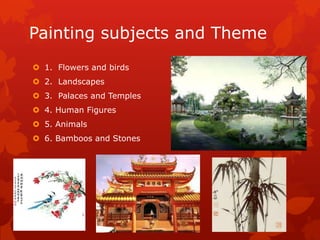
Painting subjects and Theme
 1. Flowers and birds
 2. Landscapes
 3. Palaces and Temples
 4. Human Figures
 5. Animals
 6. Bamboos and Stones
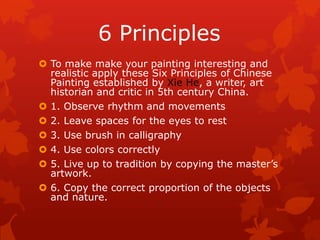
6 Principles
 To make make your painting interesting and
realistic apply these Six Principles of Chinese
Painting established by Xie He, a writer, art
historian and critic in 5th century China.
 1. Observe rhythm and movements
 2. Leave spaces for the eyes to rest
 3. Use brush in calligraphy
 4. Use colors correctly
 5. Live up to tradition by copying the master’s
artwork.
 6. Copy the correct proportion of the objects
and nature.
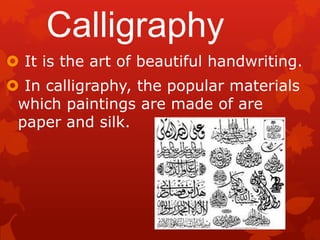
Calligraphy
 It is the art of beautiful handwriting.
 In calligraphy, the popular materials
which paintings are made of are
paper and silk.
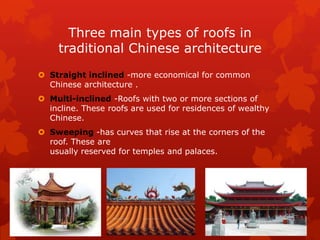
Three main types of roofs in
traditional Chinese architecture
 Straight inclined -more economical for common
Chinese architecture .
 Multi-inclined -Roofs with two or more sections of
incline. These roofs are used for residences of wealthy
Chinese.
 Sweeping -has curves that rise at the corners of the
roof. These are
usually reserved for temples and palaces.
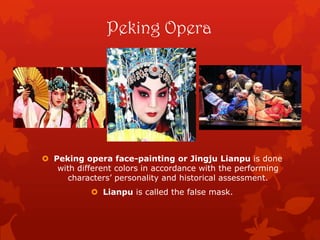
Peking Opera
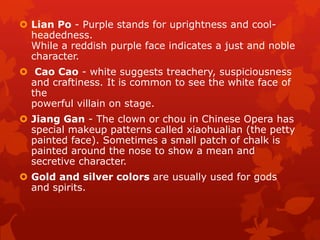
 Peking opera face-painting or Jingju Lianpu is done
with different colors in accordance with the performing
characters’ personality and historical assessment.
 Lianpu is called the false mask.
MEANING OF COLORS FOR FACE
PAINTING
 Guan Ju - Red indicates devotion, courage, bravery,
uprightness and loyalty.
 Huang Pang - Yellow signifies fierceness, ambition and
cool-headedness.
 Zhu Wen - A green face tells the audience that the
character
is not only impulsive and violent, he also lacks self-
restraint.
 Zhang Fei - Black symbolizes roughness and fierceness.
The black face indicates either a rough and bold
character or an impartial and selfless personality.
 Lian Po - Purple stands for uprightness and cool-
headedness.
While a reddish purple face indicates a just and noble
character.
 Cao Cao - white suggests treachery, suspiciousness
and craftiness. It is common to see the white face of
the
powerful villain on stage.
 Jiang Gan - The clown or chou in Chinese Opera has
special makeup patterns called xiaohualian (the petty
painted face). Sometimes a small patch of chalk is
painted around the nose to show a mean and
secretive character.
 Gold and silver colors are usually used for gods
and spirits.
Chinese Folk Art
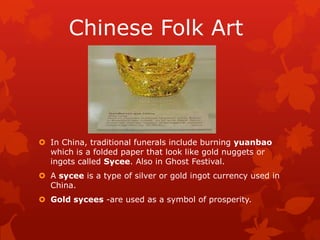
 In China, traditional funerals include burning yuanbao
which is a folded paper that look like gold nuggets or
ingots called Sycee. Also in Ghost Festival.
 A sycee is a type of silver or gold ingot currency used in
China.
 Gold sycees -are used as a symbol of prosperity.
Paper Cutting
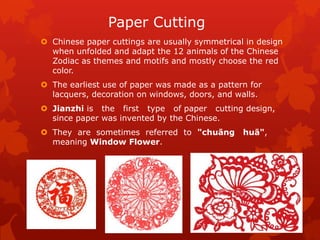
 Chinese paper cuttings are usually symmetrical in design
when unfolded and adapt the 12 animals of the Chinese
Zodiac as themes and motifs and mostly choose the red
color.
 The earliest use of paper was made as a pattern for
lacquers, decoration on windows, doors, and walls.
 Jianzhi is the first type of paper cutting design,
since paper was invented by the Chinese.
 They are sometimes referred to "chuāng huā",
meaning Window Flower.
Chinese Kite
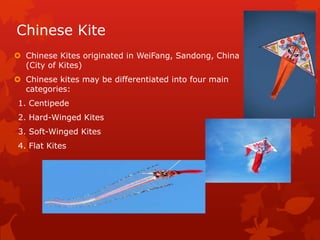
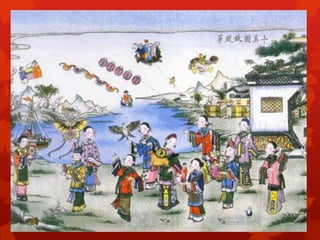
 Chinese Kites originated in WeiFang, Sandong, China
(City of Kites)
 Chinese kites may be differentiated into four main
categories:
1. Centipede
2. Hard-Winged Kites
3. Soft-Winged Kites
4. Flat Kites
Knot Tying
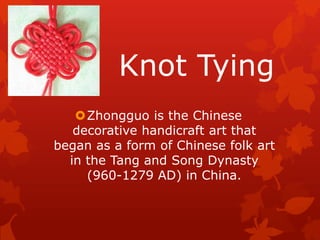
Zhongguo is the Chinese
decorative handicraft art that
began as a form of Chinese folk art
in the Tang and Song Dynasty
(960-1279 AD) in China.

chineseart-130918105916-phpapp01.pdf

  • 1.
  • 2.
    Chinese Painting  Landscapepainting was regarded as the highest form of Chinese painting.  They also consider the three concepts of their arts: Nature, Heaven and Humankind (Yin-Yang).  The Han court eunuch, Cai Lun, invented the paper in the 1st Century AD it provided not only a cheap and widespread medium for writing but painting became more economical.  Chinese art expresses the human understanding of the relationship between nature and human.  This might be called the metaphysical, Daoist aspect of Chinese painting.
  • 3.
    Painting subjects andTheme  1. Flowers and birds  2. Landscapes  3. Palaces and Temples  4. Human Figures  5. Animals  6. Bamboos and Stones
  • 4.
    6 Principles  Tomake make your painting interesting and realistic apply these Six Principles of Chinese Painting established by Xie He, a writer, art historian and critic in 5th century China.  1. Observe rhythm and movements  2. Leave spaces for the eyes to rest  3. Use brush in calligraphy  4. Use colors correctly  5. Live up to tradition by copying the master’s artwork.  6. Copy the correct proportion of the objects and nature.
  • 5.
    Calligraphy  It isthe art of beautiful handwriting.  In calligraphy, the popular materials which paintings are made of are paper and silk.
  • 6.
    Three main typesof roofs in traditional Chinese architecture  Straight inclined -more economical for common Chinese architecture .  Multi-inclined -Roofs with two or more sections of incline. These roofs are used for residences of wealthy Chinese.  Sweeping -has curves that rise at the corners of the roof. These are usually reserved for temples and palaces.
  • 7.
    Peking Opera  Pekingopera face-painting or Jingju Lianpu is done with different colors in accordance with the performing characters’ personality and historical assessment.  Lianpu is called the false mask.
  • 8.
    MEANING OF COLORSFOR FACE PAINTING  Guan Ju - Red indicates devotion, courage, bravery, uprightness and loyalty.  Huang Pang - Yellow signifies fierceness, ambition and cool-headedness.  Zhu Wen - A green face tells the audience that the character is not only impulsive and violent, he also lacks self- restraint.  Zhang Fei - Black symbolizes roughness and fierceness. The black face indicates either a rough and bold character or an impartial and selfless personality.
  • 9.
     Lian Po- Purple stands for uprightness and cool- headedness. While a reddish purple face indicates a just and noble character.  Cao Cao - white suggests treachery, suspiciousness and craftiness. It is common to see the white face of the powerful villain on stage.  Jiang Gan - The clown or chou in Chinese Opera has special makeup patterns called xiaohualian (the petty painted face). Sometimes a small patch of chalk is painted around the nose to show a mean and secretive character.  Gold and silver colors are usually used for gods and spirits.
  • 11.
    Chinese Folk Art In China, traditional funerals include burning yuanbao which is a folded paper that look like gold nuggets or ingots called Sycee. Also in Ghost Festival.  A sycee is a type of silver or gold ingot currency used in China.  Gold sycees -are used as a symbol of prosperity.
  • 12.
    Paper Cutting  Chinesepaper cuttings are usually symmetrical in design when unfolded and adapt the 12 animals of the Chinese Zodiac as themes and motifs and mostly choose the red color.  The earliest use of paper was made as a pattern for lacquers, decoration on windows, doors, and walls.  Jianzhi is the first type of paper cutting design, since paper was invented by the Chinese.  They are sometimes referred to "chuāng huā", meaning Window Flower.
  • 13.
    Chinese Kite  ChineseKites originated in WeiFang, Sandong, China (City of Kites)  Chinese kites may be differentiated into four main categories: 1. Centipede 2. Hard-Winged Kites 3. Soft-Winged Kites 4. Flat Kites
  • 15.
    Knot Tying Zhongguo isthe Chinese decorative handicraft art that began as a form of Chinese folk art in the Tang and Song Dynasty (960-1279 AD) in China.