China and
Los Angeles County
G R O W I N G T O G E T H E R
PREPARED BY:
Ferdinando Guerra, International Economist
Principal Researcher and Author
with special thanks to George Entis, Research Assistant
June, 2014
Los Angeles County Economic Development Corporation
Kyser Center for Economic Research
444 S. Flower St., 37th Floor Los Angeles, CA 90071
Tel: (213) 622-4300 or (888) 4-LAEDC-1
Fax: (213)-622-7100
E-mail: research@laedc.org
Web: http://www.laedc.org
The LAEDC, the region’s premier business leadership organization,
is a private, non-profit 501(c)3 organization established in 1981.
China and
Los Angeles County
G R O W I N G T O G E T H E R
As Southern California’s premier economic development organization, the mission of the LAEDC is to attract, retain,
and grow businesses and jobs for the regions of Los Angeles County. Since 1996, the LAEDC has helped retain or attract
more than 198,000 jobs, providing over $12 billion in direct economic impact from salaries and over $850 million in property
and sales tax revenues to the County of Los Angeles. LAEDC is a private, non-profit 501(c)3 organization established in 1981.
Regional Leadership
The members of the LAEDC are civic leaders and ranking executives of the region’s leading public and private organizations.
Through financial support and direct participation in the mission, programs, and public policy initiatives of the LAEDC, the
members are committed to playing a decisive role in shaping the region’s economic future.
Business Services
The LAEDC’s Business Development and Assistance Program provides essential services to L.A. County businesses at no cost,
including coordinating site searches, securing incentives and permits, and identifying traditional and nontraditional financing
including industrial development bonds. The LAEDC also works with workforce training, transportation, and utility providers.
Economic Information
Through our public information and for-fee research, the LAEDC provides critical economic analysis to business decision
makers, education, media, and government. We publish a wide variety of industry focused and regional analysis, and our
Economic Forecast report, produced by the Kyser Center for Economic Research, has been ranked #1 by the Wall
Street Journal.
Economic Consulting
The LAEDC consulting practice offers thoughtful, highly regarded economic and policy expertise to private- and public-sector
clients. The LAEDC takes a flexible approach to problem solving, supplementing its in-house staff when needed with outside
firms and consultants. Depending on our clients’ needs, the LAEDC will assemble and lead teams for complex, long-term
projects; contribute to other teams as a subcontractor; or act as sole consultant.
Leveraging our Leadership
The LAEDC Center for Economic Development partners with the Southern California Leadership Council to help enable pub-
lic sector officials, policy makers, and other civic leaders to address and solve public policy issues critical to the entire region’s
economic vitality and quality of life.
Global Connections
The World Trade Center Los Angeles-Long Beach works to support the development of international trade and business
opportunities for Southern California companies as the leading international trade association, trade service organization
and trade resource in Los Angeles County. It also promotes the Los Angeles region as a destination for foreign investment.
The World Trade Center Los Angeles-Long Beach is a subsidiary of the Los Angeles County Economic Development Corporation.
For more information, please visit www.wtca-lalb.org.
GROWING TOGETHER China and Los Angeles County
i Los Angeles County Economic Development Corporation
GROWING TOGETHER China and Los Angeles County
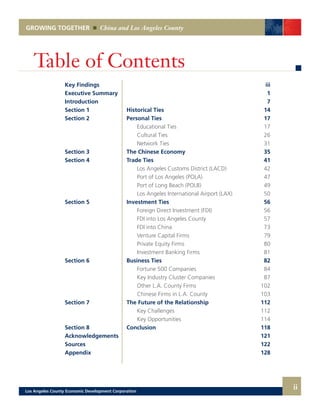
Table of Contents
Key Findings				 iii
Executive Summary				 1
Introduction 				 7
Section 1	 Historical Ties	 14
Section 2	 Personal Ties	 17
		 Educational Ties 	 17
		 Cultural Ties	 26
		 Network Ties	 31
Section 3	 The Chinese Economy	 35
Section 4	 Trade Ties	 41
		 Los Angeles Customs District (LACD) 	 42
		 Port of Los Angeles (POLA)	 47
		 Port of Long Beach (POLB)	 49
		 Los Angeles International Airport (LAX)	 50
Section 5	 Investment Ties	 56
		 Foreign Direct Investment (FDI)	 56
		 FDI into Los Angeles County	 57
		 FDI into China	 73
		 Venture Capital Firms	 79
		 Private Equity Firms	 80
		 Investment Banking Firms	 81
Section 6	 Business Ties	 82
		 Fortune 500 Companies	 84
		 Key Industry Cluster Companies	 87
		 Other L.A. County Firms	 102
		 Chinese Firms in L.A. County	 103
Section 7	 The Future of the Relationship	 112
		 Key Challenges	 112
		 Key Opportunities	 114
Section 8	 Conclusion	 118
Acknowledgements				 121
Sources				 122
Appendix				 128
iiLos Angeles County Economic Development Corporation
GROWING TOGETHER China and Los Angeles County
1
	 	 Investment into Los Angeles County from China has doubled over the past 5 years, with
		 China becoming one of Los Angeles County’s top investors
	 	 China and Los Angeles County continue to increase business and commercial ties and the
		 opportunities for Los Angeles
	 	 Tourism has nearly quadrupled over the past four years alone, from 158,000 Chinese tourists
		 in 2009 to 570,000 in 2013, making China the top overseas market for Los Angeles tourism
	 	 Los Angeles is America’s top international trade gateway to China and China’s top gateway
		 to the U.S., handling nearly 45% of trade between the two countries
	 	 China is the Los Angeles Customs District’s (LACD’s) #1 partner in international trade,
		 accounting for nearly 60% of all activity at the San Pedro Bay ports
	 	LACD exports to China have increased from $23 billion in 2009 to $35 billion in 2013 –
		 less waste and scrap and more consumer and knowledge-intensive goods
	 	 Los Angeles County has the largest Chinese population of any county in the nation, and has
		 grown from 360,000 in 2008 to 413,000 in 2012
	 	 Los Angeles County has the largest number of Chinese students of any county in the nation,
		 increasing from roughly 3,000 Chinese students studying in local universities in 2009 to
		 roughly 10,000 in 2013
	 	Strong cultural and network ties are the foundation of the relationship
	 	 Future business prospects may be found in clean tech, entertainment, aerospace, e-commerce,
		 real estate/property development, tourism, logistics and electronics
iii
Key Findings
Los Angeles County Economic Development Corporation
Executive Summary
In 2009, the LAEDC produced the first in a series
of reports documenting how Los Angeles County’s
economy has grown as a result of certain key trading
and investment relationships with major nations of
the world. This series, entitled “Growing Together”
began with a report that focused on the relationship
between China and Los Angeles County. The LAEDC
is now taking another close look at this long and
mutually beneficial relationship by producing this
second edition of “Growing Together: China and
Los Angeles County” in order to provide updated
information and insights on what has transpired
over the past few years. The main objective is to
properly assess, and identify strategies to efficiently
maximize the benefits of this relationship.
Los Angeles County and China are two regions that
have grown closer together by forging a more than
150-year partnership. The peoples of China and
Overview of the Second Edition
The objective of the report is to describe the long, deep
and growing bonds between the People’s Republic of China
(“China”) and Los Angeles County and how they have
impacted the development of both areas. This report provides
an overview of the scope of the ties between China and Los
Angeles County beginning with the historical ties. Next, the
report highlights the personal connections between China
and Los Angeles County, including the educational, cultural
and network ties. Third, the report takes a close look at the
Chinese economy. Fourth, the analysis presents the economic
links between the two with a focus on the critical trade
links. Fifth, the report explains the significant role played by
Foreign Direct Investment (“FDI”) and cites some investment
prospects for the future. Sixth, the study provides some details
about the business and financial links between the two areas
by profiling firms that are based in Los Angeles County and
active in China (and some not based in L.A. County, but with
China operations closely tied to LA County offices) followed
by profiles of some major Chinese firms with a presence in Los
Angeles County. In the final sections of the report, we describe
some of the challenges and opportunities that lie ahead for
this partnership and present some recommendations to
further solidify the relationship.
GROWING TOGETHER China and Los Angeles County
1
Los Angeles County have a very special relationship
and bond due to this long shared history. China’s
impact on Los Angeles County can be felt both
personally and in business. Indeed, Chinese-
Americans have had a noticeable effect on the
socio-economic fabric of the Los Angeles region.
The futures of Los Angeles and China are inextricably
tied together. The close connections forged in the
past and new possibilities that will open up in the
future are highlighted in this special report.
1 Throughout the entire report when we refer to China we mean Mainland China and the two special administrative regions (Hong Kong and Macau).
Los Angeles County Economic Development Corporation
EXECUTIVE SUMMARY China and Los Angeles County
2
Historical Ties
The Chinese were the first Asian immigrants to come to
the United States. A massive influx of Chinese immigrants
took place in the mid 1800’s due to the California Gold
Rush. In 1850, the U.S. Census showed that there were two
Chinese residents in Los Angeles. The history of the Chinese
in Southern California really began in 1859 when Chinese
fishermen established a presence on Catalina Island. By 1870,
there were almost 6,000 Chinese citizens in Los Angeles,
mostly because Chinese workers were needed to build the
Central Pacific railroad down the San Joaquin Valley to Los
Angeles. However, life was difficult for Chinese-Americans in
Southern California after the railroad was completed and the
local population dwindled. By the turn of the century, there
were only 3,200 Chinese living in Los Angeles.
Conditions improved in the twentieth century, and the
Chinese presence in Los Angeles County increased, especially
after World War II when U.S. immigration laws began to be
relaxed. Successive waves of Chinese immigrants landed and
settled in Los Angeles. Today, the County has more residents
of Chinese descent—estimated at 413,000 persons—than
any other in the U.S.
Personal Ties
The Chinese culture has always emphasized the importance
of education throughout its dynamic history. As the country
opened up its society over the past thirty-five years and with
the advent of globalization, many Chinese students have
taken advantage of the opportunity to study abroad. The U.S.
is the leading destination for Chinese students (with currently
over 235,000 and this is expected to grow to over 365,000
by 2015), and no other state has attracted more of them than
California.
As the leading gateway to the Pacific Rim, Los Angeles County
has emerged at the center of Asian-American economic,
business, educational and cultural exchanges. USC has the
highest number of Chinese students of any university in the
U.S., followed by UCLA. Other colleges and universities such as
the Cal State campuses also enroll many Chinese students and
offer programs that train provincial government professionals.
The report estimates that in total, roughly 10,000 Chinese
students are currently attending universities in Los Angeles
County and when including community colleges that number
rises closer to 20,000. When they become alumni and develop
successful business, professional and government careers,
these students will become important new links between the
two regions in the future.
China and Los Angeles County are tied together in many ways
beside education. The personal connections between the two
regions include many significant cultural ties targeted at the
county’s large Chinese and Chinese-American population. In
addition, Los Angeles County has many useful business and
professional associations for Chinese and Chinese-Americans
along with organizations such as the Asia Society, the
Committee of 100 and the 1990 Institute. These resources
go a long way in strengthening the relationship between Los
Angeles County and China. All of these networks will continue
to provide the leadership needed in order for the partnership
to thrive in the future.
The Chinese Economy
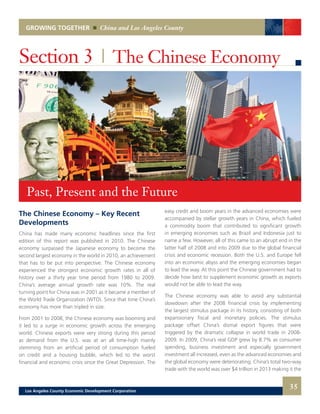
China has made many economic headlines since the first
edition of this report was published in 2010. The Chinese
economy surpassed the Japanese economy to become the
second largest economy in the world in 2010 using market
exchange rates. In addition, China will surpass the U.S. to
become the largest economy in the world by the end of 2014
in purchasing power parity terms according to the World Bank
International Comparison Program (ICP) or by 2016 or 2017
according to the International Monetary Fund (IMF).
The Chinese economy was able to avoid any substantial
slowdown after the 2008 financial crisis by implementing
the largest stimulus package in its history, consisting of
both expansionary fiscal and monetary policies. The key
development during this period was China’s increased
reliance upon fixed investment as a driving force for growth.
Fixed investment (meaning in infrastructure, real estate and
manufacturing) has been roughly 50% of China’s GDP over
the past few years. This is unprecedented in China’s economic
development.
Going forward China fully understands it must transition away
from its export-oriented, investment driven, low-value added
economic model to one based more on domestic consumption,
high-value- added production and services. This is known as
China’s Great Rebalancing Act or the Great Transformation.
In addition, the country began to take on substantial levels of
debt that started during the stimulus period. Both of these
developments (rebalancing and higher levels of debt) have
caused a fundamental shift in the government’s economic
policies.
Los Angeles County Economic Development Corporation
EXECUTIVE SUMMARY China and Los Angeles County
3
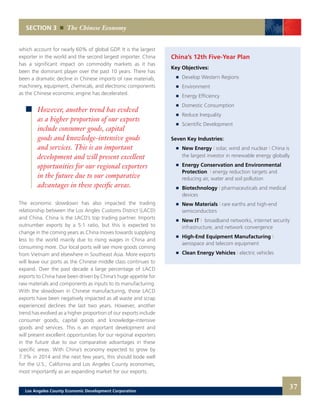
In 2011, China entered into its 12th 5-Year Plan (2011-
2015), which mainly focuses on altering the overall economic
model. The key objectives of the plan are expanding growth
in the western regions, improving the environment and
energy efficiency, growing domestic consumption, reducing
inequality, and furthering scientific development.
The trajectory of the Chinese economy has become a hot topic
in the past few years as the global economy has attempted
to fully recover from the Great Recession. Some economists
predicted a “hard landing” for China, while others like the
LAEDC have correctly projected a “soft landing.”
Another key development for the Chinese economy has
been the transfer of power from one government to the next
which takes place every decade. The new government is led
by President Xi Jinping who actually visited Los Angeles in
February 2012 while he was still Vice President. President Xi
Jinping stated that Los Angeles is the epicenter of the U.S.-
China relationship. As this report attempts to demonstrate, no
other region of the U.S. has a closer relationship with China.
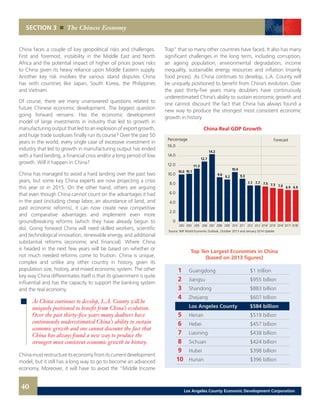
China’s economic performance has suffered over the past
two years, both as a result of internal factors and the global
slowdown (especially the recession in Europe). The Chinese
economy appeared to have turned the corner at the end of
2012, posting a growth rate of 7.9% in the fourth quarter,
but GDP growth continued to decelerate into the 7.5%
range in 2013. The country’s new leaders have attempted to
address key concerns facing the Chinese economy including
finding a balance between quantity and quality of growth.
The slowdown has been detrimental to the global economy,
particularly hitting those economies that have been most
interconnected with the Chinese growth engine. A Chinese
economic deceleration greatly impacts a wide range of
industries and all of its trading partners. China is the first
or second largest trading partner to roughly 80 countries,
which account for nearly 60% of global GDP. It is the largest
exporter in the world and the second largest importer. China
has a significant impact on commodity markets as it has been
the dominant player over the past 10 years.
The economic slowdown has also impacted the trading
relationship between the Los Angles Customs District (LACD)
and China. China is the LACD’s top trading partner. Imports
outnumber exports by roughly a 5:1 ratio, but this is expected
to change in the coming years as China moves towards
supplying less to the world (mainly due to higher wages) and
consuming more. Our local ports will see more goods coming
from Vietnam and elsewhere in Southeast Asia.
More exports will leave our ports as the Chinese middle
class continues to expand (currently estimated to be roughly
350 to 400 million people and projected to increase to
over 600 million by 2022). Over the past decade a large
percentage of LACD exports to China have been driven by
China’s huge appetite for raw materials and components as
inputs to its manufacturing. With the slowdown in Chinese
manufacturing, those LACD exports have been negatively
impacted as all waste and scrap experienced declines the last
two years. However, another trend has evolved as a higher
proportion of our exports include consumer and capital
goods. This is an important development and will present
excellent opportunities for our regional exporters in the
future. With China’s economy expected to grow by 7% to
7.5% in 2014 and the next few years, this should bode well
for the U.S., California and Los Angeles County economies,
most importantly as an expanding market for our exports
(particularly where we have a comparative advantage meaning
in knowledge-intensive goods and services). In addition, it is
critical to understand that China’s income per capita growth
figures are more relevant and significant to China’s future
economic development than China’s GDP growth figures.
Trade Ties
China has transformed its economy into the world’s fastest
growing over the past thirty-five years since its adoption of its
open door policy in 1979. A major factor in this performance
was the nation’s decision in 1979 to open up to international
trade. U.S.-China trade has increased dramatically over the
past thirty-five years jumping from $4.8 billion to $366 billion.
Los Angeles County has established very close economic ties
with China. The Los Angeles Customs District (LACD) handles
over 40% of total U.S., trade with China. Indeed, the ports of
Los Angeles and Long Beach together handle nearly 37% of
total trade between China and the U.S. In fact, roughly 60%
of two-way trade volumes at the Port of LA and the Port of
Long Beach and over 50% of the total two-way trade value at
the Los Angeles Customs District (LACD) are related to trade
with China.
Los Angeles has been referred to as the capital of the Pacific
Rim due to its deep connections with the Asian continent.
Like the personal ties, the economic ties between Los Angeles
County and China are unmatched by any other region of
the United States. In fact, the growth in international trade
links between Los Angeles County and China has contributed
greatly to the economic development of the Los Angeles
Los Angeles County Economic Development Corporation
EXECUTIVE SUMMARY China and Los Angeles County
4
region. The San Pedro port complex, which includes the Ports
of Los Angeles and Long Beach, is the busiest port complex in
the U.S., the largest in the Western Hemisphere and the ninth
busiest in the world (based on 2013 figures). Only Singapore,
three China ports (Shanghai, Hong Kong and Shenzhen), the
South Korean Port of Busan, and another three Chinese ports
(Ningbo, Qingdao and Guangzhou) are ranked ahead of the
San Pedro ports.
Trade between the U.S. and China increased during 2013 due
to the continued economic recovery. China was the LACD’s
largest trading partner in 2013, with total two-way trade
valued at $221.4 billion (based on HS port-level data and
includes general imports and exports). Total Chinese imports
unloaded in the LACD were $186.0 billion (#1), and total U.S.
exports to China through the LACD came to $35.4 billion
(again #1). This gave the LACD a trade deficit with China
of -$150.6 billion (also #1). China’s import-to-export ratio
of 5.2 was by far the highest among the LACD’s top trading
partners.
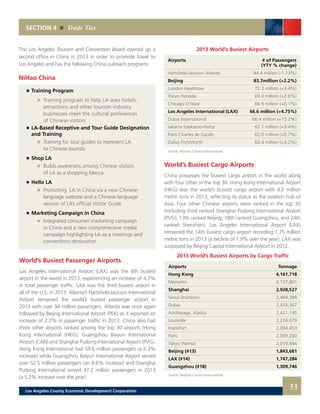
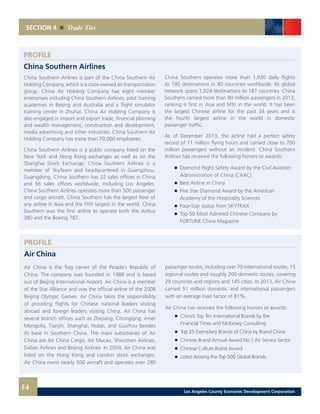
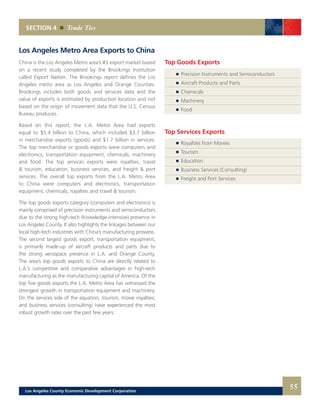
China is the Los Angeles Metro area’s #3 export market based
on a study completed by the Brookings Institution called Export
Nation. The L.A. Metro Area had exports equal to $5.4 billion
to China, which included $3.7 billion in merchandise exports
(goods) and $1.7 billion in services. The top merchandise or
goods exports were computers and electronics, transportation
equipment, chemicals, machinery and food. The top services
exports were royalties, travel & tourism, education, business
services, and freight & port services. The overall top exports
from the L.A. Metro Area to China were computers and
electronics, transportation equipment, chemicals, royalties
and travel & tourism.
Tourism (classified as a services export): In 2012, China
became Los Angeles’s top visitor overseas market when
470,000 Chinese tourists visited Los Angeles, an increase of
nearly 40%. Then in 2013, Chinese tourists to Los Angeles
reached 570,000, a jump of over 21% compared with the
previous year. The number of Chinese tourists visiting Los
Angeles was just 158,000 in 2009. China has gone from
not being in the top 10 ranking of overseas visitors just a
few years ago to the #1 source of overseas visitors to Los
Angeles. As a direct result of this surge in Chinese tourism,
areas like the San Gabriel Valley have been witnessing an
economic transformation as tourism brings spending and
attracts investment. Cities like San Gabriel and Monterey Park
have benefitted greatly as it has a sparked a boom in new
development.
Investment Ties
The U.S. Bureau of Economic Analysis (BEA) defines foreign
direct investment as “ownership or control, directly or
indirectly, by one foreign person, or entity, of 10 percent or
more of the voting securities of an incorporated U.S. business
enterprise or an equivalent interest in an unincorporated U.S.
business enterprise.”
Foreign direct investment (FDI) into China has grown
substantially over the past thirty-five years and has played an
instrumental role along with international trade in propelling
China’s economy to becoming the second largest in the world.
A significant portion of the growth of Chinese exports has
been directly related to the rising number of foreign-owned
and -invested factories, and economic development has been
stronger in the regions that have higher proportions of FDI.
In a comprehensive multi-country study of foreign direct
investment in Los Angeles County that was completed in
2008, the LAEDC identified 127 Chinese-owned business
establishments in 2007-2008. Chinese investment into
Los Angeles County has doubled since 2007-2008 to 254
establishments according to LAEDC research conducted in
2013-2014.
China is one of the ten largest sources of foreign-owned
and -affiliated businesses in Los Angeles County, (estimated
to be the eighth largest) based on a preliminary analysis of
2013 business data by the LAEDC. Out of a total of 254
establishments, the largest industry area for Chinese-owned
companies is wholesale trade with 63 total establishments.
This is followed by retail trade (51 total establishments) and
transportation & warehousing (39 total establishments). Well
known Chinese and Hong Kong companies with operations
in Los Angeles County include the Bank of China, Industrial
and Commercial Bank of China, Air China, China Southern
Airlines, Cathay Pacific Airlines, China Telecom, China Mobile,
China Unicom, COSCO Container Lines, China Shipping,
and BYD.
The LAEDC and its WTC-LA subsidiary have played a pro-active
and significant role in attracting this investment including
conducting and publishing regular research on China and
L.A. County, leading many trade and investment mission trips
to China, hosting dozens of inbound delegations each year,
signing and fulfilling many memoranda of understanding and
mutual cooperation agreements with trade and investment
promotion organizations throughout China, and opening an
office in China to facilitate further trade and investment.
Los Angeles County Economic Development Corporation
5
EXECUTIVE SUMMARY China and Los Angeles County
More direct investment from China is on the way. Chinese
companies see Los Angeles as an attractive investment for
many reasons. First, Los Angeles is a large market, with a
population of 10 million people and over 300,000 business
establishments. The county has an excellent transportation
network, with the ports, an international airport, plus a well-
developednetworkfreewaysystemandrailroadstocarrygoods
to the rest of the U.S. The county has a world-class system
of higher education with three superb research universities.
Also, the Chinese government provides many incentives and
subsidies to Chinese companies looking to invest abroad
as part of the “go global” campaign and recent economic
reforms. Importantly, setting up abroad allows companies to
avoid the obstacles associated with trade disputes. Finally, the
large Chinese population in Los Angeles County (the largest of
any county in the U.S.) provides a “comfort factor” to Chinese
business managers who must move to the area.
The LAEDC believes that future Chinese investments will
be made in the real estate and property development area
along with green/clean technology industries like electric
vehicles and renewable energy (solar and wind). Also, high-
tech consumer electronics will be another core area as this
has been targeted by both the government and the private
sector. Other key industries likely to attract investment range
from e-commerce to the auto industry to construction and
engineering to logistics to biotech. In addition, more and more
Chinese investors are looking for opportunities to acquire
start-ups with brand new technologies or collaborating with
local universities as this has become a new focus for outbound
Chinese investment.
The County of Los Angeles is aggressively pursuing foreign
investment from China and has a very strong interest in
attracting real estate/ property development and green/
clean technology. The World Trade Center – Los Angeles
(WTC-LA) strategy targets Chinese investment in property
development, e-commerce, high-tech, clean technology
automotive industry and the alternative/renewable energy
industry amongst others. The report describes a number
of trade missions and conferences that took place over the
past few years and summarizes the results to date. The latest
effort culminated in Shanghai Greenland’s $1 billion mixed-
use property development investment adjacent to L.A. Live
that will include a hotel designed by LA-based architectural
firm Gensler. This section of the report also includes a list
of trade and investment resources in Los Angeles County for
the benefit of foreign investors along with a parallel listing of
Chinese trade and economic development organizations that
have offices in Los Angeles.
Business Ties
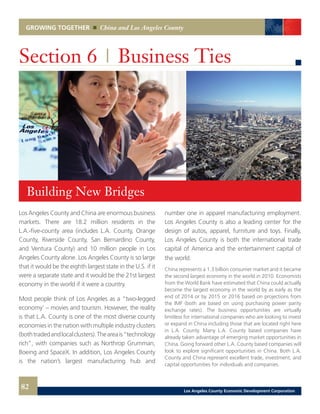
This section of the report presents two annotated lists of
companies involved in foreign direct investment activities
in Los Angeles County and in China. The first consists of
companies headquartered in Los Angeles (Fortune 500
companies, Key Industry Cluster Firms and Others) and having
a physical presence—an office, factory, store, etc.—in China
and companies not headquartered in L.A. County, but with
China operations closely tied to L.A. County offices. This list
includes over 70 companies at present and there are summary
profiles of each firm’s activities in China. The list is surprisingly
diverse—reflecting the wide variety of industry clusters in Los
Angeles County. The companies range from large to small,
in industries ranging from architecture and engineering to
fashion, finance, law, professional services and advanced
technology.
The second list includes some (not all) key Chinese firms with a
presence in Los Angeles County. There are over 40 companies
at present—the number is expected to grow in the future—
including four passenger airlines operating between LAX and
various cities in China. This list includes well known names
like the Bank of China, China Mobile, China Telecom, and
COSCO as well as others perhaps not so well known today
but eager to participate in the Los Angeles economy.
The Future of the Relationship
The report next considers the factors that will influence what
lies ahead for the relationship between China and Los Angeles
County. The Chinese economy is expected to continue growing
(albeit at a slower pace), which suggests that exports to China
and FDI flows from China also will increase. The key issue
going forward is not whether or not Chinese policymakers will
succeed in “re-balancing” the economy so that spending by
China’s consumers for goods and services plays a larger role
and exports and perhaps investment decline in importance
(as a share of the total economy, not in absolute terms) but
at what speed this takes place. Most China experts agree
that it will not happen overnight. However, over the past few
years we have already witnessed the impact of such a shift
as China has become the Los Angeles Metropolitan Area’s
third largest export market by demanding more of our key
goods and services exports. It has already altered the direction
and composition of goods moving through the Los Angeles
Customs District as we are exporting more goods and services
and less waste and scrap. The continuation of this trend along
with continued strength in imports should translate into a very
robust outlook in the coming years for the local ports.
Los Angeles County Economic Development Corporation
6
community and through various programs led by organizations
like the LAEDC, will work to promote trade and investment,
strengthen communications, enhance trust, boost economic
growth and create jobs.
Conclusions and Recommendations
This second edition report demonstrates that China and Los
Angeles County do have a very special relationship based on
cultural and personal ties as well as trade, investment and
business transactions. In addition, this report provides strong
justification for classifying Los Angeles as the epicenter of the
U.S.-China relationship.
While trade, investment and business ties will be even more
important in the future, Los Angeles County’s large Chinese
population, the growing numbers of Chinese students at
area universities and colleges, and the area’s many cultural
organizations will enhance and deepen the relationship even
further as commerce between China and Los Angeles County
does not happen in a vacuum.
The futures of China and Los Angeles County are very bright.
Both locations possess the resources and tools necessary
to reap the benefits of increased globalization. China and
Los Angeles County will continue to play vital roles in the
California economy and for that matter in the U.S. and
global economies. The world will continue to look to China
as a global economic engine that propels the global economy
forward. Together, Los Angeles County and China can take
the lead on pressing global issues such as renewable energy
and climate change. Innovation and new technologies will
come out of Los Angeles area research universities and also
Chinese universities as both places continue to produce some
of the brightest talent.
Los Angeles County is in a unique position to benefit from
China’s continued economic rise and to fortify its position as
the nation’s leading gateway with China. This 2nd edition
report concludes with recommendations for nurturing the
existing relationship to ensure that future ties are stronger still.
With regard to foreign direct investment, there will be strong
competition from other parts of the world as well as other
regions of the U.S. Also, China will be continuing to look
to secure its natural resource requirements (oil, natural gas,
iron ore, etc.) with investments in Africa, South America and
Australia for example. Still, the opportunities for Los Angeles
County are undeniable and worth pursuing. They include not
only increased flows of trade but also increased employment
in Chinese-owned and -operated plants and offices.
The outlook for foreign direct investment from China into
Los Angeles County is very bright. Chinese companies are
especially attracted to the Los Angeles area as the County
has the highest population of Chinese-Americans in the U.S
along with a broad economic base and necessary business
infrastructure to enable profitable returns on their investment.
Los Angeles County offers Chinese companies the following:
a huge market, a well-educated and trained workforce,
outstanding trade infrastructure, excellent access to national
and international markets, technology rich area, first-rate
apparel, auto and engineering design, the nation’s largest
manufacturing base, competitive costs and great weather.
The greatest opportunities for Chinese investment are in
the real estate/property development, green/clean tech,
aerospace, entertainment, e-commerce, electronics, logistics
and apparel industries. Near term, investment will most likely
occur within real estate, electric automobiles, solar energy,
e-commerce, hi-tech electronics and textiles. The investment
will be in the form of manufacturing, distribution, sales &
service, research & development and regional headquarters.
Other relevant opportunities are likely to be in bio-tech and
healthcare, banking and financial services, professional and
business services, materials & machinery, construction &
engineering and creative design.
The governments in both China and California attach great
importance to promoting trade and investment cooperation
between the two business communities. Chinese leader Xi
Jinping visited the Los Angeles area twice in recent years
(2012 and 2013), which also highlights the importance of
the area in bilateral relations. The trade relationship was not
only one of the focal points of President Xi’s visits, but it also
was considered as the propeller and stabilizer for China - U.S.
bilateral relations. After President Xi’s visit, California and
China’s Ministry of Commerce and six provinces established a
Joint Working Group on Trade and Investment Cooperation.
The Working Group, in partnership with the business
EXECUTIVE SUMMARY China and Los Angeles County
Los Angeles County Economic Development Corporation
Overview of Report
The objective of the report is to describe the long, deep
and growing bonds between the People’s Republic of China
(“China”) and Los Angeles County and how they have
impacted the development of both places. This report provides
an overview of the scope of the ties between China and Los
Angeles County beginning with the historical ties. Next, the
report highlights the personal connections between China
and Los Angeles County, including the educational, cultural
and network ties. Third, the report takes a close look at the
Chinese economy. Fourth, the analysis presents the economic
links between the two with a focus on the critical trade
links. Fifth, the report explains the significant role played by
Foreign Direct Investment (“FDI”) and cites some investment
prospects for the future. Sixth, the study provides some details
about the business and financial links between the two areas
by profiling firms that are based in Los Angeles County and
active in China (and some not based in L.A. County, but with
China operations closely tied to LA County offices) followed
by profiles of some major Chinese firms with a presence in Los
Angeles County. In the final sections of the report, we describe
some of the challenges and opportunities that lie ahead for
this partnership and present some recommendations to
further solidify the relationship.
Los Angeles County and China have grown both in
absolute terms and in the interconnected nature of
their economies by forging a more than 150-year
relationship. The people of China and Los Angeles
County have a very special bond due to this long
shared history. China’s impact on Los Angeles
County can be felt both culturally and in business.
Indeed, Chinese-Americans have had a noticeable
effect on the socio-economic fabric of the Los
Angeles region. The futures of Los Angeles and
China are inextricably tied together. These close
connections forged in the past and new possibilities
that will open up in the future are featured in this
second edition.
GROWING TOGETHER China and Los Angeles County
7
Introduction
Los Angeles County Economic Development Corporation
INTRODUCTION China and Los Angeles County
fueled by private enterprises. State-owned enterprises now
contribute approximately 30%-40% to China’s GDP, although
estimates vary. This is a truly extraordinary example of how
much China has evolved over the past thirty-five years.
China’s Unprecedented Economic Rise
Since 1979, China has concentrated on implementing market-
oriented economic reforms which have proven to be extremely
effective and successful. China began to transform its economy
in 1979 by gradually moving from a centrally planned system
to a more liberalized economy, by making very large state
investments in heavy industry & infrastructure and by reforming
prices throughout the economy. In the 1980’s China continued
the reform process by restructuring the agricultural industry,
removing price controls and authorizing more power to the
provinces. In addition, the government allowed for more state-
owned enterprises to become autonomous and established
several small coastal economic zones in order to attract global
investment. The 1990s was the decade in which China moved
towards a more privatized corporate system and where both
credit and investment expanded rapidly.
From 1990-2004, China’s economy grew at an average rate
of 10% per year. By 2000, China’s economic output had
quadrupled from its 1978 level. Beginning in 2001, the Chinese
economy soared to new heights as it entered into the World
Trade Organization (WTO). In fact, from 2001-2007 China
averaged economic growth higher than 10% per year. The
Chinese economy has become a more global market-based
economy since its entry into the WTO.
Many experts attribute China’s remarkable growth rates mainly
to its high investment rates. However, the impact of economic
globalization cannot be understated as international trade
and Foreign Direct Investment (FDI) have been significantly
instrumental in China’s economic development particularly
over the past 10 years. Manufactured exports have contributed
to China becoming the world’s largest industrial producer and
the biggest holder of foreign exchange reserves, which have
grown to roughly $4 trillion.
China has become the second largest economy in the world
(measured in nominal GDP, based on official exchange rates),
and it is expected (according to IMF estimates) to become
the largest as soon as 2025 (based on market exchange
rates). The key driving forces of this growth have been both
government and foreign direct investment, labor and internal
migration, and productivity and globalization. In addition, the
overall market-based reforms that have been implemented
since 1979 have transformed the Chinese economy from one
that was dominated by state-owned enterprises to one now
8
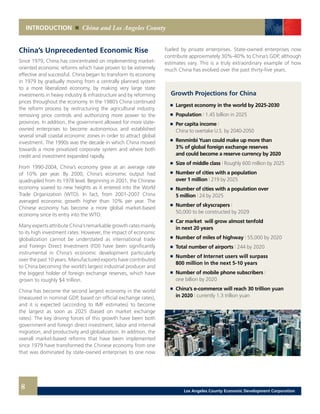
Growth Projections for China
	 	 Largest economy in the world by 2025-2030 	
	 	 Population | 1.45 billion in 2025 	
	 	 Per capita income |
		 China to overtake U.S. by 2040-2050
	 	 Renminbi Yuan could make up more than
		 3% of global foreign exchange reserves
		 and could become a reserve currency by 2020 		
	 	 Size of middle class | Roughly 600 million by 2025 	
	 	 Number of cities with a population
		 over 1 million | 219 by 2025
	 	 Number of cities with a population over
		 5 million | 24 by 2025
	 	 Number of skyscrapers |
		 50,000 to be constructed by 2029 	
	 	 Car market will grow almost tenfold
		 in next 20 years
	 	 Number of miles of highway | 55,000 by 2020 	
	 	 Total number of airports | 244 by 2020
	 	 Number of Internet users will surpass
		 800 million in the next 5-10 years 	
	 	 Number of mobile phone subscribers |
		 one billion by 2020
	 	 China’s e-commerce will reach 30 trillion yuan
		 in 2020 | currently 1.3 trillion yuan
Los Angeles County Economic Development Corporation
9
INTRODUCTION China and Los Angeles County
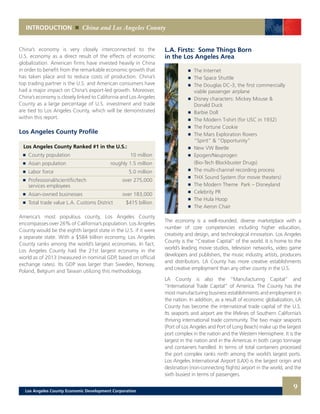
L.A. Firsts: Some Things Born
in the Los Angeles Area
	 	 The Internet
	 	 The Space Shuttle
	 	 The Douglas DC-3, the first commercially
		 viable passenger airplane
	 	 Disney characters: Mickey Mouse &
		 Donald Duck
	 	 Barbie Doll
	 	 The Modern T-shirt (for USC in 1932)
	 	 The Fortune Cookie
	 	 The Mars Exploration Rovers
		 “Spirit” & “Opportunity”
	 	 New VW Beetle
	 	 Epogen/Neuprogen
		 (Bio-Tech Blockbuster Drugs)
	 	 The multi-channel recording process
	 	 THX Sound System (for movie theaters)
	 	 The Modern Theme Park – Disneyland
	 	 Celebrity PR
	 	 The Hula Hoop
	 	 The Aeron Chair
The economy is a well-rounded, diverse marketplace with a
number of core competencies including higher education,
creativity and design, and technological innovation. Los Angeles
County is the “Creative Capital” of the world. It is home to the
world’s leading movie studios, television networks, video game
developers and publishers, the music industry, artists, producers
and distributors. LA County has more creative establishments
and creative employment than any other county in the U.S.
LA County is also the “Manufacturing Capital” and
“International Trade Capital” of America. The County has the
most manufacturing business establishments and employment in
the nation. In addition, as a result of economic globalization, LA
County has become the international trade capital of the U.S.
Its seaports and airport are the lifelines of Southern California’s
thriving international trade community. The two major seaports
(Port of Los Angeles and Port of Long Beach) make up the largest
port complex in the nation and the Western Hemisphere. It is the
largest in the nation and in the Americas in both cargo tonnage
and containers handled. In terms of total containers processed
the port complex ranks ninth among the world’s largest ports.
Los Angeles International Airport (LAX) is the largest origin and
destination (non-connecting flights) airport in the world, and the
sixth busiest in terms of passengers.
Los Angeles County Profile
Los Angeles County Ranked #1 in the U.S.:
	 	 County population	 10 million
	 	 Asian population	 roughly 1.5 million
	 	 Labor force	 5.0 million
	 	 Professional/scientific/tech 	 over 275,000
		 services employees 	
	 	 Asian-owned businesses	 over 183,000
	 	 Total trade value L.A. Customs District	 $415 billion
America’s most populous county, Los Angeles County
encompasses over 26% of California’s population. Los Angeles
County would be the eighth largest state in the U.S. if it were
a separate state. With a $584 billion economy, Los Angeles
County ranks among the world’s largest economies. In fact,
Los Angeles County had the 21st largest economy in the
world as of 2013 (measured in nominal GDP, based on official
exchange rates). Its GDP was larger than Sweden, Norway,
Poland, Belgium and Taiwan utilizing this methodology.
China’s economy is very closely interconnected to the
U.S. economy as a direct result of the effects of economic
globalization. American firms have invested heavily in China
in order to benefit from the remarkable economic growth that
has taken place and to reduce costs of production. China’s
top trading partner is the U.S. and American consumers have
had a major impact on China’s export-led growth. Moreover,
China’s economy is closely linked to California and Los Angeles
County as a large percentage of U.S. investment and trade
are tied to Los Angeles County, which will be demonstrated
within this report.
Los Angeles County Economic Development Corporation
10
INTRODUCTION China and Los Angeles County
Los Angeles County has been a leader in advancing
environmental innovation as well. As the foremost market
for alternative fuel vehicles, energy efficiency and clean air
initiatives, Los Angeles County offers abundant opportunities
for “green” growth. In fact, California was home to 143
venture capital investment deals and invested over $2.2 billion
in clean technologies in 2012 (latest data). It also ranks first
in the nation in new energy patents. California once again
led the nation in green investment in 2012 as it has for many
years. This trend is expected to continue in the coming years.
Los Angeles County has the greenest ports in the world
and has set the standard for other world ports to follow.
In addition, Los Angeles County is a leader in “intelligent
highways” technology.
While it is a major urban area, Los Angeles is competitive cost-
wise. Los Angeles has a larger consular corps (99 nations are
represented) than any other U.S. city outside of Washington
D.C. and New York. In addition, more than 220 languages
and cultures are represented across the County. As a result,
Los Angeles is increasingly being recognized as the “Capital
of the Pacific Rim”. No other area of the U.S. has a stronger
relationship with China. For example, China is the largest
trading partner of the Los Angeles Customs District (LACD)
and there are more Chinese-Americans in LA County than
in any other county in the U.S. (with 413,000) based on the
most recent Census data.
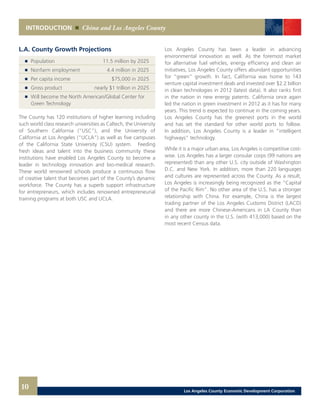
L.A. County Growth Projections
	 	 Population	 11.5 million by 2025 	
	 	 Nonfarm employment 	 4.4 million in 2025 	
	 	 Per capita income 	 $75,000 in 2025 	
	 	 Gross product 	 nearly $1 trillion in 2025 	
	 	 Will become the North American/Global Center for
		 Green Technology
The County has 120 institutions of higher learning including
such world class research universities as Caltech, the University
of Southern California (“USC”), and the University of
California at Los Angeles (“UCLA”) as well as five campuses
of the California State University (CSU) system. Feeding
fresh ideas and talent into the business community these
institutions have enabled Los Angeles County to become a
leader in technology innovation and bio-medical research.
These world renowned schools produce a continuous flow
of creative talent that becomes part of the County’s dynamic
workforce. The County has a superb support infrastructure
for entrepreneurs, which includes renowned entrepreneurial
training programs at both USC and UCLA.
Los Angeles County Economic Development Corporation
11
INTRODUCTION China and Los Angeles County
People’s Republic of China
Los Angeles County Economic Development Corporation
12
INTRODUCTION China and Los Angeles County
Los Angeles County
Los Angeles County Economic Development Corporation
13
INTRODUCTION China and Los Angeles County
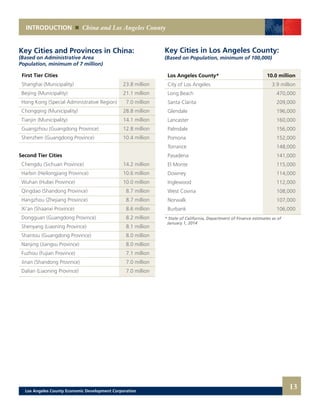
Key Cities and Provinces in China:
(Based on Administrative Area
Population, minimum of 7 million)
First Tier Cities
Shanghai (Municipality)	 23.8 million
	 Beijing (Municipality)	 21.1 million
	 Hong Kong (Special Administrative Region)	 7.0 million
	 Chongqing (Municipality)	 28.8 million
	 Tianjin (Municipality) 	 14.1 million
	 Guangzhou (Guangdong Province)	 12.8 million
	 Shenzhen (Guangdong Province)	 10.4 million
Second Tier Cities	
	 Chengdu (Sichuan Province)	 14.2 million
	 Harbin (Heilongjiang Province)	 10.6 million
	 Wuhan (Hubei Province)	 10.0 million
	 Qingdao (Shandong Province)	 8.7 million
	 Hangzhou (Zhejiang Province)	 8.7 million	
	 Xi’an (Shaanxi Province)	 8.6 million
	 Dongguan (Guangdong Province)	 8.2 million
	 Shenyang (Liaoning Province)	 8.1 million
	 Shantou (Guangdong Province)	 8.0 million
	 Nanjing (Jiangsu Province)	 8.0 million
	 Fuzhou (Fujian Province)	 7.1 million
	 Jinan (Shandong Province)	 7.0 million
	 Dalian (Liaoning Province)	 7.0 million
Key Cities in Los Angeles County:
(Based on Population, minimum of 100,000)
Los Angeles County*	 10.0 million
City of Los Angeles	 3.9 million
Long Beach	 470,000
Santa Clarita	 209,000
Glendale	 196,000
Lancaster	 160,000
Palmdale	 156,000
Pomona	 152,000
Torrance	 148,000
Pasadena	 141,000
El Monte	 115,000
Downey	 114,000
Inglewood	 112,000
West Covina	 108,000	
Norwalk	 107,000
Burbank	 106,000
* State of California, Department of Finance estimates as of
January 1, 2014
Los Angeles County Economic Development Corporation
GROWING TOGETHER China and Los Angeles County
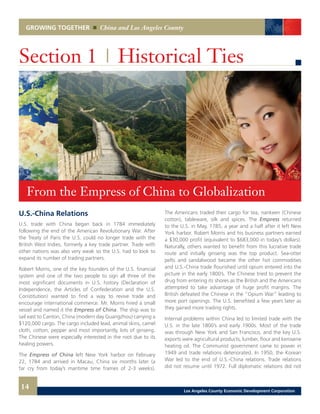
U.S.-China Relations
U.S. trade with China began back in 1784 immediately
following the end of the American Revolutionary War. After
the Treaty of Paris the U.S. could no longer trade with the
British West Indies, formerly a key trade partner. Trade with
other nations was also very weak so the U.S. had to look to
expand its number of trading partners.
Robert Morris, one of the key founders of the U.S. financial
system and one of the two people to sign all three of the
most significant documents in U.S. history (Declaration of
Independence, the Articles of Confederation and the U.S.
Constitution) wanted to find a way to revive trade and
encourage international commerce. Mr. Morris hired a small
vessel and named it the Empress of China. The ship was to
sail east to Canton, China (modern day Guangzhou) carrying a
$120,000 cargo. The cargo included lead, animal skins, camel
cloth, cotton, pepper and most importantly, lots of ginseng.
The Chinese were especially interested in the root due to its
healing powers.
The Empress of China left New York harbor on February
22, 1784 and arrived in Macau, China six months later (a
far cry from today’s maritime time frames of 2-3 weeks).
Section 1 | Historical Ties
The Americans traded their cargo for tea, nankeen (Chinese
cotton), tableware, silk and spices. The Empress returned
to the U.S. in May, 1785, a year and a half after it left New
York harbor. Robert Morris and his business partners earned
a $30,000 profit (equivalent to $683,000 in today’s dollars).
Naturally, others wanted to benefit from this lucrative trade
route and initially ginseng was the top product. Sea-otter
pelts and sandalwood became the other hot commodities
and U.S.-China trade flourished until opium entered into the
picture in the early 1800’s. The Chinese tried to prevent the
drug from entering its shores as the British and the Americans
attempted to take advantage of huge profit margins. The
British defeated the Chinese in the “Opium War” leading to
more port openings. The U.S. benefited a few years later as
they gained more trading rights.
Internal problems within China led to limited trade with the
U.S. in the late 1800’s and early 1900s. Most of the trade
was through New York and San Francisco, and the key U.S.
exports were agricultural products, lumber, flour and kerosene
heating oil. The Communist government came to power in
1949 and trade relations deteriorated. In 1950, the Korean
War led to the end of U.S.-China relations. Trade relations
did not resume until 1972. Full diplomatic relations did not
From the Empress of China to Globalization
14 Los Angeles County Economic Development Corporation
SECTION 1 Historical Ties
Twentieth Century Brings Change
and New Opportunities
The early 1900s saw the establishment of the City Market
Wholesale Produce Terminal at 9th and San Pedro Street in
downtown Los Angeles. Another development included the
formation of the Chinese American Citizens Alliance to defend
the civil rights of American-born Chinese in California. World
War I saw Chinese Americans fight for the U.S. in Europe
which demonstrated an allegiance to the U.S. In 1937, the
Sino-Japanese War led to Chinese Americans protesting at the
San Pedro Harbor as the U.S. was shipping scrap metal to the
Japanese. The construction of Union Station in the late 1930s
displaced many Chinese residents and led to the development
of a new Chinatown. The year 1943 was an important year
in U.S.-China relations as the First Lady of China Madame
Chiang Kai-shek toured the U.S., delivering an address at the
Hollywood Bowl. Later in her trip she persuaded Congress to
repeal the 1892 Chinese Exclusion Act. After World War II,
Chinese American servicemen were granted the right to have
their Chinese brides come to the U.S.
Significant Milestones:
	 	 First Chinese-American Mayor in the United States |
		 Daniel Wong (Chinese Name – Jinbo Huang), was elected
		 as the Mayor of Cerritos in 1983
	 	 First Chinese-American Woman Mayor in the
		 United States | Lily Chen (Chinese Name – Wanruo
		 Chenli), was elected Mayor of Monterey Park in 1983
	 	 First Chinese-American to be appointed as a
		 Federal Judge in the United States | Ronald Lew
		 (Chinese Name – Chengwei Liu), had previously served
		 on both the Municipal Court and Superior Court of
		 Los Angeles
	 	 First Chinese-American Congresswoman |
		 Judy Chu (Chinese name – Meixin Zhao), was elected
		 as the U.S. Representative from California’s 32nd
		 District in 2008, had previously served as Mayor
		 of Monterey Park and a member of the State Board
		 of Equalization
resume until 1979. Since 1979, the U.S. and China have come
closer together, and the advent of globalization has led to very
close economic ties between the two nations. The evolution
of trade between the U.S. and China is a perfect example of
how much the relationship has developed over the years as
the top commodities have gone from ginseng, sea-otter pelts
and sandalwood to electronics, computers and toys. What
once used to take six months to be delivered can now be
transported within two weeks by water or within hours by air.
The Gold Rush
The Chinese were the first Asian immigrants to come to the
United States in large numbers. A massive influx of Chinese
immigrants took place in the mid 1800’s due to the California
Gold Rush. In 1849, the merchant ships participating in the
Canton (modern day Guangzhou) trade route shared word
that gold had been discovered in California leading to many
young men making the journey to the “Gold Mountain”. By
1851, there were approximately 25,000 Chinese working in
the Gold Rush area. The Chinese population grew to almost
50,000 by 1860.
Reaching Southern California
The history of the Chinese in Southern California really began
in the 1850s. In 1850, the U.S. Census reported that there
were two Chinese residents in Los Angeles. In 1859, Chinese
fishermen established a presence on Catalina Island. By 1870,
there were almost 6,000 Chinese residents in Los Angeles.
Many lived in the first Chinatown near what is now downtown
LA. Mostly, Chinese workers were needed to build the Central
Pacific railroad through the San Joaquin Valley from Goshen in
Tulare County to Los Angeles. In fact, the Chinese played an
instrumental role in the enormously difficult task of completing
the 1.25 mile San Fernando tunnel. The tunnel was one of
the line’s most daunting projects, and the conditions were
very dangerous for the 1,500 laborers of which 1,000 were
Chinese. The tunnel was finished in 1876, and it transformed
the development of the area, as Los Angeles was now finally
connected to San Francisco by rail.
Life was difficult for Chinese-Americans in Southern California
after the railroad was completed. Two national laws were
enacted prohibiting further Chinese immigration. Chinese
goods were boycotted and some neighborhoods were
targeted by violence. By the turn of the century, there were
only 3,200 Chinese living in Los Angeles.
15Los Angeles County Economic Development Corporation
SECTION 1 Historical Ties
The 1990s saw the world transform politically, ideologically
and economically. The end of the cold war triggered the
advent of globalization. China has benefited greatly from
these events as trade and foreign direct investment have
produced double digit economic growth rates. China passed
Japan to become the second largest economy in the world
in 2010 (based on $US current prices). Los Angeles has
become known as the “Capital of the Pacific Rim” while the
Sino-Southern California relationship has evolved and grown.
In fact, the President of China Xi Jinping has called Los Angeles
the epicenter of the U.S.-China relationship. Trade between
the U.S. and China has surged over the past twenty years, and
the greatest beneficiary of that two-way trade has been the
San Pedro port complex, consisting of the Ports of Los Angeles
and Long Beach.
In 1949, Mao Tse-tung and the Communists defeated the
Nationalist Chinese government led by Chiang Kai-shek
and formed the People’s Republic of China. This marked a
major turning point for Chinese immigration, as new laws
were enacted in the U.S. easing immigration restrictions. This
was followed by a period of massive migration to Southern
California and throughout the U.S.
The 1950s and 1960s saw Chinese Americans assimilate
themselves into mainstream American culture. The first
Chinese Chamber of Commerce was formed in Los Angeles in
1955 and in 1959 the first Chinese-American judge, Delbert
Wong, was appointed in Los Angeles. The first Chinese-
American bank (Cathay Bank) was created in Los Angeles
in 1962. The U.S. Immigration Act of 1965 was another
major turning point for Chinese immigrants, as it led to an
enormous influx of new immigrants from Hong Kong and
Taiwan. In the 1970s, new groups of Chinese immigrants
settled in Monterey Park and the Chinese Historical Society
of Southern California was formed. By 1986, Monterey Park
became the first suburban Chinese community in the U.S. as
the San Gabriel Valley became the epicenter of the region’s
Chinese population.
16
“In fact, the President of China
Xi Jinping has called Los Angeles
the epicenter of the U.S.-China
relationship.”
Los Angeles County Economic Development Corporation
GROWING TOGETHER China and Los Angeles County
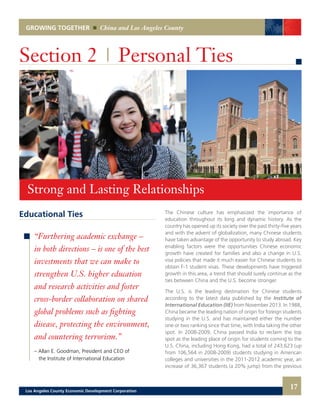
Educational Ties
“Furthering academic exchange –
in both directions – is one of the best
investments that we can make to
strengthen U.S. higher education
and research activities and foster
cross-border collaboration on shared
global problems such as fighting
disease, protecting the environment,
and countering terrorism.”
– Allan E. Goodman, President and CEO of
the Institute of International Education
Section 2 | Personal Ties
The Chinese culture has emphasized the importance of
education throughout its long and dynamic history. As the
country has opened up its society over the past thirty-five years
and with the advent of globalization, many Chinese students
have taken advantage of the opportunity to study abroad. Key
enabling factors were the opportunities Chinese economic
growth have created for families and also a change in U.S.
visa policies that made it much easier for Chinese students to
obtain F-1 student visas. These developments have triggered
growth in this area, a trend that should surely continue as the
ties between China and the U.S. become stronger.
The U.S. is the leading destination for Chinese students
according to the latest data published by the Institute of
International Education (IIE) from November 2013. In 1988,
China became the leading nation of origin for foreign students
studying in the U.S. and has maintained either the number
one or two ranking since that time, with India taking the other
spot. In 2008-2009, China passed India to reclaim the top
spot as the leading place of origin for students coming to the
U.S. China, including Hong Kong, had a total of 243,623 (up
from 106,564 in 2008-2009) students studying in American
colleges and universities in the 2011-2012 academic year, an
increase of 36,367 students (a 20% jump) from the previous
Strong and Lasting Relationships
17Los Angeles County Economic Development Corporation
No other university in the U.S. has invested more time
and resources dedicated to achieving the goal of better
understanding China than the University of Southern
California. USC President C.L. Max Nikias has said, “A deep
understanding of China will be a cornerstone of what will
define excellence in the 21st Century research university.”
Many observers including President Obama have said that
no other relationship will be as critical as the American-
Sino relationship in the 21st Century. As a result, USC has
embarked on a mission to establish the university as the
leader in facilitating U.S.-China research by attracting the best
faculty and students who are dedicated to studying this vital
relationship.
USC has been able to achieve this goal by establishing a
relationship with China that goes back to 1978 after China
implemented revolutionary market-based economic reforms.
It was the first American university to visit Beijing during the
restoration of diplomatic ties between the two nations. Over
the past thirty-six years USC has deepened those ties with top
university officials making multiple visits to China.
In addition, since 1994 USC has made a conscious effort
to expand to the Pacific Rim and make USC the first global
American university. Under the leadership of former President
Stephen B. Sample and current President Nikias, USC has
moved up faster and higher in the national rankings than any
other research university in the U.S. It has emphasized the
geographical importance of Los Angeles within the Pacific
Rim. In the 1990s, former President Sample spoke strongly
about the emergence of the Pacific Rim, how it would be the
most dominant economic region in the 21st Century, and how
Southern California is the American gateway to this region
of the world. In fact, former President Sample was the one
who coined the phrase that Los Angeles is the “Capital of the
Pacific Rim”.
SECTION 2 Personal Ties
academic year. The total number of students has more than
doubled since 2008-2009 and then quintupled since 1995.
This has been extremely helpful for the U.S. economy and for
U.S.-China relations. The economic impact to various regional
economies across the U.S including the L.A. region includes
tuition fees, living expenses and real estate investment by the
parents of these students. In addition, future benefits arise if
alumni decide to work and live in the U.S.
Of all of the states in the U.S. no other state has attracted
more international and Asian students than California. As the
leading gateway to the Pacific Rim, California has emerged
as the natural center of Asian-American economic, business,
educational and cultural exchanges.
Local Educational Ties
Few places in the world offer as rich an academic climate as
Los Angeles County. It is home to three world-class research
universities, Caltech, USC and UCLA, as well as dozens of
other outstanding institutions. These schools graduate tens
of thousands of students each year. By providing the right
combination of educational curriculum, experienced faculty,
and a broad selection of universities, L.A. County is the top
choice for higher learning for international students (numbering
between 20,000 to 30,000). In fact, there are roughly 10,000
Chinese students studying in Los Angeles County universities as
of 2013, up roughly from 3,000 in 2009.
University of Southern California (USC) |
A Truly Global Private University
Of all the universities in the U.S., the University of Southern
California (USC) has enrolled the most international students
for eleven consecutive years and will most likely maintain this
ranking in the current academic year. In the academic year
(“AY”) 2013-2014, USC hosted 9,269 international students
out of a total student body of over 33,000 students. The
number of Chinese students enrolled at USC for AY 2013-
2014 was 3,689. USC has the highest number of Chinese
students of any university in the U.S.
Chinese Students Enrolled at USC
	 Undergraduate Students	 716	
	 Graduate Students	 2,935	
	Other	 38	
			
	 Total Number of Chinese Students at USC	 3,689
Source: Office of the Provost, Global Initiatives Office
18
Many observers including President
Obama have said that no other
relationship will be as critical as the
American-Sino relationship in the
21st Century
Los Angeles County Economic Development Corporation
scholars, policy makers, government officials and journalists
in search of research, trends, and issues regarding China
and its ties with the U.S. The Institute offers publications,
conferences, public events, and professional development.
Also, the Institute hosts resident fellows from USC, visiting
fellows from the U.S., China and the rest of the world, media,
business, and policy fellows and post-doctoral fellows. A major
advantage that the Institute has is its physical location on the
USC campus. The Institute collaborates with the East Asian
Studies Center, the Center for International Business Education
and Research, and the Pacific Council on International Policy.
East Asian Studies Center (EASC)
The East Asian Studies Center (EASC) at USC was founded
in 1975 within the College of Letters, Arts and Sciences. The
EASC has been acknowledged as one of the country’s leading
centers for East Asian Studies. In fact, the EASC is a part of
a small group that has been designated a National Resource
Center for East Asian Studies by the U.S. Department of
Education.
The EASC offers the following programs:
	 	 East Asian Visual Cultures Visitors Program	 	
	 	 Explore East Asia: China, Japan and Korea 	 	
	 	 Teaching East Asia Program (TEAP) 	
	 	 Research Study Abroad 	
	 	 Area Studies Abroad
The center is also the headquarters for the USC/UCLA Joint
East Asian Studies Center, which is funded under Title VI of the
U.S. Department of Education. (Funded as part of the Higher
Education Act, the Title VI programs represent a comprehensive
approach to expanding international education in the U.S.
Through numerous initiatives to strengthen international
teaching and curricula at the K-12 level, Title VI helps to open
students’ eyes to the wider world and engage future area
studies specialists at a young age, increasing the likelihood
that students will pursue internationally-focused studies later.)
In addition, the College of Letters, Arts and Sciences includes
an abundance of China experts in economics, linguistics,
history, international relations, political science, anthropology,
art history and religion. The director of the EASC is world-
renowned political scientist and China expert, Stan Rosen.
Association of Pacific Rim Universities (APRU)
In 1997, former President Sample’s vision of a network of
Pacific Rim universities was realized as the Association of
Pacific Rim Universities (APRU) became a reality. The APRU is
now a consortium of 45 universities from 16 countries in the
Pacific Rim. The Association includes the following LA County
and Chinese universities:
Los Angeles County Member Universities
	 	 University of Southern California (USC)
	 	 University of California, Los Angeles (UCLA)
	 	 California Institute of Technology (Caltech)
Chinese Member Universities
	 	 Fudan University
	 	 Hong Kong University of Science & Technology 	
	 	 University of Hong Kong
	 	 Nanjing University
	 	 Peking University
	 	 Tsinghua University
	 	 University of Science & Technology of China
	 	 Zhejiang University
During the 1990s, USC opened up international offices
throughout the Pacific Rim including Taipei and Hong Kong.
USC later opened up an office in Tokyo and most recently in
Shanghai. The new USC international office in Shanghai is
the second office in China and according to Adam Clayton
Powell III, USC’s former vice provost for globalization, “The
opening of our office in Shanghai is a reflection of USC’s many
and deep connections to China, as well as the city’s rising
international influence. As America’s leader in international
education, it’s essential for USC to have a full-time presence
in China’s largest city and such an important center of finance
and trade.”
USC U.S.-China Institute
In 2006, USC created the USC U.S.-China Institute. The
Institute focuses on policy-relevant social science research
that concentrates on U.S.-China relations. The USC U.S.-
China Institute has made USC a respected global leader in
the area of U.S.-China policy issues. Other universities have
Asia or China centers which emphasize the humanities and
history, but none are solely focused on the social sciences.
The Institute has attempted to become the leading source for
SECTION 2 Personal Ties
19Los Angeles County Economic Development Corporation
USC China Study Abroad Programs
Undergraduate Programs
	 	 Overseas Studies in Beijing, (Peking University) |
		 Office of Overseas Studies
	 	 Overseas Studies in Hong Kong (Chinese University
		 of Hong Kong) | Annenberg School for Communication
	 	 Overseas Studies in Hong Kong (Chinese University
		 of Hong Kong) | Marshall School of Business
	 	 Overseas Studies in Hong Kong (Hong Kong University
		 of Science & Technology) | Marshall School of Business
	 	 Overseas Studies in Hong Kong (Hong Kong University
		 of Science & Technology) | USC Viterbi School
		 of Engineering
	 	 Overseas Studies in Nanjing | Office of Overseas Studies
Graduate Programs
	 	 Graduate Overseas Studies in Hong Kong |
		 Annenberg School of Journalism
	 	 Graduate Overseas Studies in Hong Kong |
		 Gould School of Law
USC offers a wide range of China-related courses in various
departments. Classes are offered within the American Studies
and Ethnicity (AMST), Art History (AHIS), East Asian Language
and Cultures (EALC), East Asian Studies (EASC), Economics
(ECON), Health Promotion and Disease Prevention Studies
(HP), History (HIST), International Relations (IR) and the
Linguistics (LING) departments.
Global Executive MBA
The USC Marshall School of Business offers a Global Executive
MBA in Shanghai in collaboration with Antai College of
Economics and Management at Shanghai Jiao Tong University.
The program is one of the top executive MBA programs in the
world and considered to be Asia’s premier global executive
MBA program. The program includes ten sessions in Shanghai
plus two sessions at the USC campus and one business field
trip to another Asian country over twenty months leading
to the same MBA degree awarded to USC graduates at the
Marshall School of Business in Los Angeles.
East Asian Languages and Cultures
Department (EALC)
The USC College of Letters, Arts and Sciences offers an East
Asian Languages and Cultures Department (EALC). Students
can choose to study either the Chinese, Japanese or Korean
languages and cultures in addition to an array of general
courses on East Asia. The department also offers a Chinese
Summer Program in Beijing.
Other USC Campus Resources related to China
	 	 Internet Mission Photography Collection of Digital Archives
	 	 James Harmon Hoose Library of Philosophy 	
	 	 The Chinese Historical Society of Southern
		 California Collection 	
	 	 USC Center for Active Learning in International
		 Studies: Teaching East Asia Program (TEAP) & USC
		 Center for International Studies 	
	 	 USC Chinese Language Program, School of Social
		 Work China Program
USC China Programs
	 	 Architecture | Summer Program
	 	 Architecture | Traveling Fellowships
	 	 Business | Asia-Pacific Business Outlook
	 	 Business | Center for Global Business Excellence (C-Globe)
	 	 Business | Global Executive MBA
	 	 Business | Pacific Rim Education Program (Hong Kong
		 or Shanghai)
	 	 Business | PM Globe
	 	 Cinema | Summer Exchange Program with
		 Communication University of China
	 	 Communications | Center on Public Diplomacy
	 	 Communications | Graduate Internship Program,
		 Hong Kong
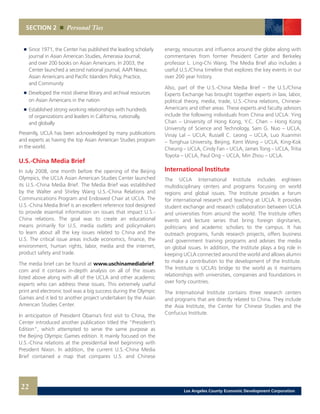
	 	 Communications | Study Abroad: Undergraduate,
		 Hong Kong
	 	 East Asian Languages & Cultures | 2009 USC Chinese
		 Summer Program in Beijing
	 	 East Asian Studies | Provost’s Distinguished Visitors
		Program
	 	 Engineering | The Viterbi Exchange Program with
		 Hong Kong University of Science and Technology
	 	 Humanities | Overseas Studies
	 	 Medicine | China Seven Cities Study (CSCS)
	 	 Policy, Planning, and Development | International
		 Labs – (Beijing)
	 	 Social Work | China Program (Beijing, Tianjin)
SECTION 2 Personal Ties
20 Los Angeles County Economic Development Corporation
University of California, Los Angeles (UCLA) |
A Truly Global Public University
UCLA is another global academic institution located in the City
of Los Angeles. UCLA ranked #6 in the nation in international
student enrollment with a total of 6,703 in 2013-2014. The
number of Chinese students enrolled at UCLA for AY 2013-
2014 was 2,827. With 2,827 Chinese students, UCLA has
one of the highest number of Chinese students of any
university in the U.S. Similarly to USC, UCLA has made a
very deep commitment to China over the years and its
overall programs, centers and institutes demonstrate that
commitment.
Chinese Students Enrolled at UCLA
	 Undergraduate Students	 1,849	
	 Graduate Students	 978	
		
	 Total Number of Chinese Students at UCLA	 2,827	
	 Total Number of Chinese-American
	 Students at UCLA	 5,004
Source: Office of the Analysis and Information Management	
Department of Asian Languages &
Cultures (ALC)
UCLA has a department of Asian Languages and Cultures (ALC)
which is dedicated to the study of Asian civilizations and cultures,
including China. The department provides courses in language,
religion, archaeology, thought and other areas.
Asian American Studies Center
In addition, UCLA has an Asian American Studies Center which
was established in 1969. The founding committee’s goal was to
“enrich the experience of the entire university by contributing
to an understanding of the long neglected history, rich cultural
heritage, and present position of Asian Americans in our society.”
Over the past forty years the Center has achieved the following
milestones:
	 	 Recruited the largest faculty in Asian American Studies in
		 the nation, with 38 professors 	
	 	 Built the largest teaching program, with a B.A. major
		 and minor, and M.A. major, and in 2004, the Department
		 of Asian American Studies 	
USC School of Architecture
Qingyun Ma is one of the most influential architects in China
(born in Xi’an, China). He became dean of the USC School of
Architecture and holder of USC’s Della and Harry MacDonald
Dean’s Chair in Architecture on January 1, 2007. After
practicing architecture with Kohn Pedersen Fox Associates
in New York City, Ma founded the Shanghai architectural
firm MADA s.p.a.m. (for strategy, planning, architecture and
media) in 1996, creating award-winning projects such as the
Longyang Residential complex in Shanghai and the Silk Tower
in Xian. Ma also coordinated Rem Koolhaas’s first Harvard
Project on Cities, which yielded the 1993 book The Great
Leap Forward. The two also worked on the Central China TV
headquarters in Beijing and the Stock Exchange Building in
Shenzhen as well.
Ma’s other buildings include Qingpu Community Island in
Shanghai, Centennial TV and Radio Center in Xian and Tianyi
City Plaza in Ningpo. His work has been exhibited around
the world, and his honors include a Design Vanguard award
from Architectural Record, Phaidon’s Emerging Design Talents
designation and a New Trends of Architecture designation by
the Euro-Asia Foundation.
Alumni Clubs
USC has four China alumni clubs based in Beijing, Hong Kong,
Pearl River Delta and in Shanghai. China represents the fifth
largest country of USC alumni and many of those individuals
have obtained very important positions in both business and
government. USC has a distinguished history of alumni from
China including: You Chung Hong, the first Chinese graduate
from USC’s Law school, Class of 1924, one of the most
famous Chinese attorneys and Lei Jieqiong, MA Class of 1931
was named USC’s International Alumna of the 20th Century.
Prominent alumni include:
	 	 Ronnie C. Chan, Chairman of the Hang Lung Group of
		 Hong Kong and a member of the USC Board of Trustees;
	 	 Ming Hsieh, Entrepreneur and founder of AMAZ
		 Information Technologies and Cogent Systems and a
		 member of the USC Board of Trustees;
	 	 David Harilela, CEO of the Harilela Group;
	 	 Fu Chengyu, President of the China National Offshore
		 Oil Company (CNOOC);
	 	 Lei Jieqiong, Former Vice Chair of the National People’s
		 Congress and Former Vice Mayor of Beijing
SECTION 2 Personal Ties
21Los Angeles County Economic Development Corporation
energy, resources and influence around the globe along with
commentaries from former President Carter and Berkeley
professor L. Ling-Chi Wang. The Media Brief also includes a
useful U.S./China timeline that explores the key events in our
over 200 year history.
Also, part of the U.S.-China Media Brief – the U.S./China
Experts Exchange has brought together experts in law, labor,
political theory, media, trade, U.S.-China relations, Chinese-
Americans and other areas. These experts and faculty advisors
include the following individuals from China and UCLA: Ying
Chan – University of Hong Kong, Y.C. Chen – Hong Kong
University of Science and Technology, Sam G. Nuo – UCLA,
Vinay Lal – UCLA, Russell C. Leong – UCLA, Luo Xuanmin
– Tsinghua University, Beijing, Kent Wong – UCLA, King-Kok
Cheung – UCLA, Cindy Fan – UCLA, James Tong – UCLA, Tritia
Toyota – UCLA, Paul Ong – UCLA, Min Zhou – UCLA.
International Institute
The UCLA International Institute includes eighteen
multidisciplinary centers and programs focusing on world
regions and global issues. The Institute provides a forum
for international research and teaching at UCLA. It provides
student exchange and research collaboration between UCLA
and universities from around the world. The Institute offers
events and lecture series that bring foreign dignitaries,
politicians and academic scholars to the campus. It has
outreach programs, funds research projects, offers business
and government training programs and advises the media
on global issues. In addition, the Institute plays a big role in
keeping UCLA connected around the world and allows alumni
to make a contribution to the development of the Institute.
The Institute is UCLA’s bridge to the world as it maintains
relationships with universities, companies and foundations in
over forty countries.
The International Institute contains three research centers
and programs that are directly related to China. They include
the Asia Institute, the Center for Chinese Studies and the
Confucius Institute.
	 	 Since 1971, the Center has published the leading scholarly
		 journal in Asian American Studies, Amerasia Journal,
		 and over 200 books on Asian Americans. In 2003, the
		 Center launched a second national journal, AAPI Nexus:
		 Asian Americans and Pacific Islanders Policy, Practice,
		 and Community 	
	 	 Developed the most diverse library and archival resources
		 on Asian Americans in the nation 	
	 	 Established strong working relationships with hundreds
		 of organizations and leaders in California, nationally,
		 and globally
Presently, UCLA has been acknowledged by many publications
and experts as having the top Asian American Studies program
in the world.
U.S.-China Media Brief
In July 2008, one month before the opening of the Beijing
Olympics, the UCLA Asian American Studies Center launched
its U.S.-China Media Brief. The Media Brief was established
by the Walter and Shirley Wang U.S.-China Relations and
Communications Program and Endowed Chair at UCLA. The
U.S.-China Media Brief is an excellent reference tool designed
to provide essential information on issues that impact U.S.-
China relations. The goal was to create an educational
means primarily for U.S. media outlets and policymakers
to learn about all the key issues related to China and the
U.S. The critical issue areas include economics, finance, the
environment, human rights, labor, media and the internet,
product safety and trade.
The media brief can be found at www.uschinamediabrief.
com and it contains in-depth analysis on all of the issues
listed above along with all of the UCLA and other academic
experts who can address these issues. This extremely useful
print and electronic tool was a big success during the Olympic
Games and it led to another project undertaken by the Asian
American Studies Center.
In anticipation of President Obama’s first visit to China, the
Center introduced another publication titled the “President’s
Edition”, which attempted to serve the same purpose as
the Beijing Olympic Games edition. It mainly focused on the
U.S.-China relations at the presidential level beginning with
President Nixon. In addition, the current U.S.-China Media
Brief contained a map that compares U.S. and Chinese
SECTION 2 Personal Ties
22 Los Angeles County Economic Development Corporation
The UCLA Center for Chinese Studies offers the following
programs -- Contemporary Studies, Literary and Cultural Studies,
Historical Studies, Religious Studies & Ancient China.
Confucius Institute
The main objective of the UCLA Confucius Institute (UCLA CI) has
been to accentuate an already impressive structure of resources
and programs that UCLA offers with regards to the development
of Chinese educational, cultural and economic links to the Los
Angeles region. The Institute promotes the Chinese language,
culture and history by connecting organizations and developing
new initiatives. In addition, the UCLA CI provides study abroad
opportunities, language training for businesses, training for
language instructors, a support system for translation and
programs in Chinese medicine.
Other UCLA China Related Resources
The Silk Road to the Future
UCLA also participates in a project called the “Silk Road to
the Future”, which enables American and Canadian students,
staff and faculty to visit Beijing and establish relationships with
their counterparts from Chinese universities. An organization
called the Legends of China established this project in order
to better prepare the U.S. and China for the 2008 Olympics.
American students are able to experience Chinese culture
firsthand and visit historical sites from the Forbidden City to
the Great Wall of China. This program has drawn over 10,000
goodwill Ambassadors of Peace from the U.S., Canada
and China.
The China Law Association
The UCLA China Law Association is an organization of students
and lawyers who work with business people, academia and
public policymakers whose primary objective is to further
dialogue and education in Chinese law and areas of U.S.
law and policies related to China such as international trade
and intellectual property rights. The law association provides
a great starting point to locate California attorneys who
concentrate on Chinese law in addition to various Chinese
scholars or institutions that provide Chinese expertise. The
association actively traces the latest developments in Chinese
law, politics and business.
SECTION 2 Personal Ties
Asia Institute
The Asia Institute promotes Asian Studies at UCLA and fosters
greater understanding of Asia through a wide variety of
research support, public programs, and community outreach
on East Asia, Southeast Asia, and South Asia. It promotes
collaboration with institutions in Asia, Europe and North
America to make the study of Asia even more interdisciplinary
and truly international in its content, communication, and
organization through international research exchanges and
graduate and faculty fellowships.
	 	 Asia Institute Programs | Workshops for K-12 Educators,
		 Asia in LA, Asian Voices and the Media and Careers in Asia
	 	 Asia Institute Initiatives | East China Normal University
		 (ECNU) Collaborative Research and Scholarly Exchange
		 Program, Central Asia Initiative: Mobility and Governability
		 and China in Asia Workshop Series
The Asia Institute encompasses three different interdepartmental
programs which include East Asian Studies, South Asian Studies
and Southeast Asian Studies. The East Asian Studies program
is an interdisciplinary studies program divided into three
specializations: China, Japan and Korea. The China specialization
includes courses in Chinese, Anthropology, Art History, Asian,
Communication Studies, Economics, Ethnomusicology, Film
& Television, Geography, History, Philosophy, Political Science,
Sociology, Theater and World Arts & Cultures. The Asia Institute
offers study abroad programs in Beijing and Shanghai which
include a summer in Beijing, Business Chinese in Shanghai and
a summer workshop in scholarly translation at Fudan University
in Shanghai.
Center for Chinese Studies
The UCLA Center for Chinese Studies focuses on the core areas
of research and teaching and has developed some of the best
graduate programs in the nation related to Chinese Studies. The
Center was established in 1986 and has been able to attract the
some of the most prominent faculty and students from around
the world. The program allows students to concentrate on many
different areas of study including Anthropology, Archaeology,
Art History, Geography, History, Law, Linguistics, Literary Studies,
Medicine, Political Science and Sociology. The Center can
leverage the Richard C. Rudolph East Asian Library which holds
260,000 Chinese volumes and maintains subscriptions to over
1,500 Chinese journals and newspapers, the largest collection
of any university in the nation.
23Los Angeles County Economic Development Corporation
UCLA Study Abroad Opportunities in China
Anderson School of Business: Shanghai (Chinese in
International Business)
	 	 Summer in Shanghai studying Chinese Language and
		 Culture for Business
	 	 Beginner and Advanced Courses
	 	 Courses focus on China’s recent cultural, economic
		 and political developments
East Asian Studies: Beijing (Post-Olympics Beijing)
	 	 Program focuses on China’s rise as a global power
	 	 The 2008 Olympic Games serves as a Case Study
	 	 Includes lectures, readings, discussions and field trips
Sociology: Guangzhou (Transformation and
Globalization in Urban China)
	 	 Five-week program encompassing an overview of
		 post-1949 China
	 	 Focus on economic, social and cultural changes in
		Guangzhou
	 	 Applies sociological theories and qualitative models
		 in order to provide a strong understanding of
		 21st Century China
University of California Programs in China
	 	 Beijing Normal University – Full Year
	 	 Economics and Business, Fudan University |
		 Spring Semester
	 	 Elementary Chinese, Beijing Normal University |
		 Summer Program
	 	 International Studies, Joint UC-Fudan University |
		 Summer and Fall
	 	 International Summer School, Peking University
	 	 Language & Culture, Beijing Normal University |
		Summer Program
	 	 Language & Culture, East China Normal University |
		 Summer Program
	 	 Peking University | Full Year
	 	 Business, Hong Kong University of Science & Technology
	 	 Chinese University of Hong Kong
	 	 Engineering, Hong Kong University of Science
		 & Technology
	 	 Science, Hong Kong University of Science & Technology
	 	 University of Hong Kong
SECTION 2 Personal Ties
Other Local Universities with
Educational Ties to China
California State University, Northridge
	 	 Total Number of Chinese Students: 	 450 	
	 	 Total Number of Chinese-American Students: 	 645	
	 	 Asian American Studies
	 	 China Institute
	 	 Center for China Finance and Business Research
Pepperdine University
	 	 Total Number of Chinese Students: 	 246 	
	 	 Asian Studies Program
California State Polytechnic University (Cal Poly Pomona)
	 	 Total Number of Chinese Students: 	 193 	
	 	 Total Number of Chinese Alumni
		 living in China: 	 roughly 40-45	
	 	 Chinese Language Studies	
California Institute of Technology (Caltech)
	 	 Total Number of Chinese Students:	 165
	 	 Total Number of Chinese Alumni:	 155
	 	 Chinese Language Classes
	 	 Caltech Industrial Relations Center offers an Executive
		 Course on “Growing Your Business in China”
	 	 Most famous Chinese alum – H.S. Tsien (Chinese Name
		 – Xuesan Qian) – earned his doctorate from Caltech
		 in 1939, a famous rocket scientist in the U.S., a
		 founder of the Jet Propulsion Laboratory, and the
		 Father of Chinese Rocketry
California State University, Los Angeles
	 	 Total Number of Chinese Students: 	 133 	
	 	 Total Number of Chinese-American Students: 	 1,396	
	 	 Chinese Program
	 	 Chinese Studies Center
	 	 Asian Pacific Business Institute
24 Los Angeles County Economic Development Corporation
Occidental College
	 	 Total Number of Chinese Students:	 10
	 	 Total Number of Chinese Alumni:	 40
	 	 Asian Studies
	 	 Chinese Language
	 	 Study Abroad in China
	 	 Beijing-Intensive Chinese Language
		 	 Beijing | Chinese Studies
		 	 Nanjing
		 	 Hong Kong | Chinese University of Hong Kong
			 U.S./China Program
California State University, Dominguez Hills
	 	 Total Number of Chinese Students:	 2
	 	 Total Number of Chinese-American Students: 	 154
	 	 Total Number of Chinese Alumni:	 50
	 	 Asian-Pacific Studies Program
Cal State Campuses and China
Multiple Cal State campuses across Los Angeles
County offer training programs to provincial
government officials and professionals in addition
to the traditional programs mentioned above.
Other Local Universities with Educational
Ties to China (continued)
Loyola Marymount University (LMU)
	 	 Total Number of Chinese Students:	 77
	 	 Total Number of Chinese Alumni:	 362
	 	 Asian & Pacific Studies
	 	 Asian Pacific American Studies
	 	 Mandarin Chinese Language & Literature 	
	 	 Center for Asian Business
	 	 Study Abroad in China
		 	 The Beijing Center for Chinese Studies
		 	 Chinese University of Hong Kong
	 	 Chinese Visiting Scholar Program in Collaboration
		 with Mount St. Mary’s College Bridging Cultures:
		 U.S./China Program
California State University, Long Beach
	 	 Total Number of Chinese Students:	 69
	 	 Total Number of Chinese-American Students:	 274
	 	 Asian and Asian American Studies 	
	 	 Chinese Studies 	
	 	 Mandarin Chinese Intensive Immersion Language
		Program | Southern Consortium of California State
		Universities | Includes Summer Study Abroad in China 	
	 	 Summer Study Abroad in China 	
	 	 Fudan University in Shanghai
Claremont Colleges
	 	 Total Number of Chinese Students:	 39
	 Pomona College
		 	 Asian Studies Program 	
		 	 Pacific Basin Institute 	
		 	 Pomona’s Oldenborg Center 	
		 	 Study Abroad in China
	 Scripps College
		 	 Asian American Studies 	
		 	 Asian Studies
SECTION 2 Personal Ties
25Los Angeles County Economic Development Corporation
Sister Cities
The following is a short list of Chinese Sister Cities
with Los Angeles County Cities:
	 	 City of Los Angeles | Guangzhou | Formerly known
		 as Canton (refer to Historical Ties Section) | Major
		 International Trade Center for over 300 years | At the
		 center of South China’s most important trade zone
		 which includes Hong Kong and the Pearl River Delta |
		 Known as China’s Southern Gateway to the World |
		 Sister City Since 1981 	 		
	 	 Long Beach | Qingdao (also known as Tsingtao,
		 one ofthe fourteen open coastal cities and one of the
		 eight cities authorized for international conferences
		 in the country, in Eastern Shandong Province,
		 population 8.5 million, one of the busiest ports in
		 China and home to Haier | became a sister city
		 in April 1985)
	 	 Lancaster | Huainan (prefecture-level city in central
		 Anhui Province | became a sister city in 2010)	
	 	 Pasadena | Xicheng District, Beijing (located in the
		 northwest of Beijing, largest portion of the old city
		 of Beijing, central headquarters of the Chinese
		 government are within this district | became a sister
		 city in 1999)
	 	 Culver City | Yanji (capital of the Yanbian Korean
		 Autonomous Region in the Eastern Province of Jilin,
		 majority of the population is Korean | became a sister
		 city in 1993)
	 	 Alhambra | Rizhao (prefecture-level city in southeastern
		 Shandong Province | became a sister city in 2011)
	 	 Monterey Park | Quanzhou (prefecture-level city in
		 southern Fujian Province | became a sister city in 1993)
	 	 Whittier | Changshu (located in Jiangsu Province and
		 is a county-level city under the jurisdiction of Suzhou |
		 became a sister city in 1994)
	 	 Malibu | Lijiang (prefecture-level city in the northwest
		 of Yunnan Province | became a sister city in 2011)
Downtown Los Angeles Chinatown
The only officially recognized traditional Chinatown in LA
County is located in downtown LA. It is Chinatown’s second
location as the first site was demolished to make way for
Union Station. The Los Angeles Chinatown Business Council
(LACBC) was established in 1999 in order to plan, manage and
Cultural Ties
China and the Los Angeles region are linked in many
remarkable ways. In addition to the educational
ties, the personal connections between the two
regions include many significant cultural ties. First,
Los Angeles County is home to more people of
Chinese descent than anywhere else in the United
States. The total number of Chinese living within
Los Angeles County in 2012 was 413,000 (up
from 360,000 in 2008) according to the latest
American Community Survey (2012) published by
the U.S. Census Bureau. The surrounding Counties
also contain large numbers of Chinese-Americans
(particularly in Orange County).
SECTION 2 Personal Ties
26 Los Angeles County Economic Development Corporation
Olympic Games
The Olympic Games were held in Los Angeles in 1932 and
1984. Both were historic for the Chinese people, because of
the significant milestones that occurred in these games. The
1932 Summer Olympic Games marked the first time a Chinese
athlete competed in the Olympics. The first Chinese Olympic
athlete was Changchun Liu. He was the only Chinese athlete
present. Then, the 1984 Summer Olympic Games marked the
very first gold medal for China as Haifeng Xu won the gold
medal in Men’s Shooting (50 m pistol). Mr. Xu was also the
first torchbearer to bring the Olympic Torch into the Stadium
at the 2008 Beijing Olympics Closing Ceremony. As a result,
Los Angeles and China have a very special Olympic bond
that was also evident during the first Olympic Games ever
to be held in China. One of the most important stops for the
Olympic torch in 2008 took place in Los Angeles.
Los Angeles Chinese Cultural Center (LACCC)
The Chinese Cultural Center was established in 2005 in
Hollywood. The Center offers multiple cultural programs
including language classes, music, cooking, art and folk
dance to people as young as four years old. The LACCC is the
only school to teach China’s Pinyin (Alphabet) and simplified
Chinese characters. The overall curriculum is activity based in
order to provide students practical communication skills and a
basic understanding of Chinese culture.
Los Angeles Chinese Learning Center (LACLC)
The LACLC is an organization that provides customized
Chinese classes and online Chinese classes in Los Angeles and
around the world. The LACLC also provides Chinese language
group classes in Alhambra. The organization offers classes on
Chinese culture and business in addition to language classes.
The organization’s website also includes many links to many
other services related to China.
Temples
Los Angeles County is home to the largest Chinese temple
in the U.S. Hsi Lai Temple is the biggest Buddhist monastery
in the U.S. and is located in Hacienda Heights. The temple
encompasses 15 acres and took 10 years to complete. Hsi
Lai means “coming to the west”, and its main mission is to
spread the teachings of Buddhism to the west. The temple
was designed using Ming and Qing dynasty architecture. The
overall complex includes a pagoda, a main shrine building, a
facilitate the rebirth of historic Chinatown as a multinational
culturally defined, economically vibrant and socially engaging
community. The Business District of Chinatown is twenty-
four blocks and the population of Chinatown numbers
approximately 15,000 people.
The LACBC is the managing entity of the Los Angeles
Chinatown Business Improvement District (BID), which was
approved by the Los Angeles City Council in August 2000.
There are 18 board members on the LACBC, consisting of
local businesses, property owners and other community based
organizations all attempting to achieve the organization’s
mission. The organization works to promote Chinatown as a
visitor destination which offers shopping and dining.
Suburban Chinese Communities
(First Suburban Chinatown in the U.S.)
There are at least four suburban Chinese communities
(Monterey Park, Alhambra, San Gabriel, and Rosemead)
located east of the downtown Chinatown, all within the San
Gabriel Valley. Most ethnic Chinese actually frequent these
suburban Chinese areas instead of the more tourist oriented
downtown location. In fact, most Chinese and Chinese-
Americans in the Los Angeles region live in the San Gabriel
Valley. Their neighborhoods tend to be more suburban in style,
but are easily identified by the prominent Chinese lettering on
the store front signs.
Beginning in the 1970s, many Chinese began to settle in
the San Gabriel Valley, initially in the City of Monterey Park.
Then in the 1980’s a second wave of Chinese and Chinese-
Americans began to move into other San Gabriel Valley cities
including Alhambra, San Gabriel and Rosemead. Alhambra
and San Gabriel annually host a Chinese New Year parade
and festival.
In addition, other cities in the San Gabriel Valley contain large
and growing Chinese populations, including Arcadia, Temple
City, Rowland Heights and Hacienda Heights. Outside the
San Gabriel Valley but still in Los Angeles County, the cities of
Artesia, Cerritos, Walnut and Diamond Bar are home to many
Chinese-Americans. Many Chinese companies and import/
export warehouses are located in the City of Industry (based
on findings from the LAEDC FDI database).
SECTION 2 Personal Ties
27Los Angeles County Economic Development Corporation
SECTION 2 Personal Ties
bodhisattiva shrine, classrooms, a tea room garden, museum,
cafeteria and gift shop. The temple offers classes on Buddhism,
Chinese culture and language. In addition, the temple offers
prayer services and mediation sessions.
Another very significant Chinese religious shrine exists in
Chinatown Los Angeles. The Chua Thien Hau Temple is
dedicated to the goddess Lin Meng. The mother temple is in the
Fujian province of China. The temple is 6,000 square feet and
opened in 2005. The current temple replaced a smaller temple
located right next door. The Chinatown temple is the largest
Chua Thien Hau Temple in Southern California. A Chua Thien
Hau temple also exists in Monterey Park.
On the day before Chinese New Year, the Chinatown
community comes together to bless the deities. The festivities
include lion dancers and firecrackers. The 25 family associations
headquartered in Chinatown attend the celebrations along
with thousands from Los Angeles County. On the first day of
the New Year and throughout the first week of the New Year
many come to receive a blessing for the New Year.
Los Angeles Chinatown has a total of six temples including:
Chua Thien Hau Temple, Cambodian Ethnic Chinese
Association Temple, Southern California Teo Chew Association
Temple, Kong Chow Benevolent Association Temple, Lung
Kong Tin Yee Association Temple and the Xuan Wu San
Buddhist Association Temple.
	 Other Chinese New Year Celebrations Include:
	 	 Chinese New Year Spectacular at the Pasadena
		 Civic Auditorium
	 	 Chinese New Year Floral Street Fair & Lantern Festival
		 in Monterey Park
	 	 Golden Dragon Parade & Chinese New Year Festival
		 in Chinatown
	 	 The Chinese American Museum Lantern Festival at
		 Olvera Street
	 	 The Annual Lunar New Year Celebration at the LA Zoo
	 	 At the following popular Lifestyle Malls:
		 	 The Grove
		 	 The Americana at Brand
28 Los Angeles County Economic Development Corporation
SECTION 2 Personal Ties
The Huntington-Chinese Gardens
The Huntington Library, Art Collections and Botanical Gardens
complex was founded in 1919 by Henry E. Huntington. The
Huntington is located in San Marino and is considered
to be one of the world’s leading cultural, research and
educational centers. The Huntington Library has one of the
most highly renowned research libraries specializing in British
and American history and literature. The Botanical Gardens
include various themed gardens including the Chinese
Garden. It is the newest of only five Chinese classical gardens
in the U.S. and is called the Garden of the Flowering Flagrance
(Chinese Name – Liu Fang Yuan). The name was influenced
by the famous Chinese poet Cao Zhi and by the famed
Ming Dynasty painter Li Liufang. The garden was specifically
designed to match the authenticity of a Chinese Garden, with
typical Chinese-like woods, lake, architecture and rocks.
Chinese-American Museum
The Chinese American Museum was opened in 2003
and is located in the last surviving structure from the
original Chinatown in Los Angeles. It is the first museum
in Southern California that celebrates the Chinese-
American experience and history. It focuses on the history
of Chinese immigration that began over 150 years ago (see
Historical Ties section), and offers exhibits and educational
programming which are structured to provide Chinese
American history, culture and highlight the contributions made
by Chinese Americans to the U.S. and Southern California.
Here are some of the main objectives of the Chinese American
Museum: to house exhibits on Chinese Americans illustrating
their rich culture and heritage, define and interpret their role
in establishing the California community, provide educational
programs to the visiting public and schools, collect and
curate historical to contemporary arts, documents, images,
and artifacts, and serve as a research center on the 150-year
Chinese American experience in Southern California.
The museum is operated by the Friends of the Chinese
American Museum (FCAM) and El Pueblo de Los Angeles
Historical Monument (El Pueblo).
Cable TV/Satellite Channels, Radio Stations
and Magazines in Chinese
An important aspect of the China-Los Angeles County
relationship is related to having resources that make it
easier to stay connected to China. Chinese and Chinese-
Americans have many opportunities to feel closely linked
to what is happening in China. Here is a list of Chinese
broadcasting on local Cable channels and satellite channels,
radio stations, magazines and all other media outlets in Los
Angeles County that bridge China and L.A. closer together:
TV Stations | G&E Studio, ICN, HTTV, KSCI (Channel 18),
TVB USA/Jadeworld TV, Sky Link TV, TVB, TVB2, ATV Home
Channel, BTV, CCTV-4, CCTV-Entertainment, CCTV-Opera,
China Movie Channel, CYRTV, Dragon TV, SETV, TVS, HTV,
Jiangsu International Channel, PACVIA TV, Phoenix HK TV,
Xiamen TV, Zhejiang TV, Sky Link TV, iCable, Channel V, and
Tai Seng.
Radio Stations | KAZN AM 1300, KMRV AM 1430, KAHZ
AM 1600
Magazines | EDI City Newsweek
29
Chinese Newspapers in Los Angeles
Chinese Daily News (World Journal)
	 	 Largest Chinese newspaper in Los Angeles
		 & North America 	
	 	 Targets Mandarin speakers 	
	 	 Founded in 1976
Sing Tao Daily
	 	 Second largest Chinese newspaper in
		 Los Angeles 	
	 	 Targets Cantonese speakers
The China Press
	 	 Third largest subscription-based Chinese newspaper
		 in Los Angeles. Most of the China Press’s
		 readership are recent immigrants from Mainland
		 China. A relatively young Chinese newspaper in
		 Los Angeles, it focuses its news content to those
		 of mainland China
International Daily News
	 	 Launched in 1981 in Monterey Park
Los Angeles County Economic Development Corporation
SECTION 2 Personal Ties
30
Chinese-American Newspapers in Los Angeles
China Daily USA
China Daily is the largest English-language daily newspaper
published in China. It was established in 1981 and has a
circulation of over 500,000 in China and roughly 150,000
in the U.S. China Daily USA was launched in 2009 and
provides a window into China for North American
readers. The newspaper has branch offices in several foreign
cities including six offices in the U.S., which include New York,
Washington DC, San Francisco, Chicago, Houston and Los
Angeles. It is very common to find in newsstands on many
street corners in Downtown L.A.
TCL Chinese Theatre
The Chinese Theatre is the most famous Hollywood theatre. It
was opened in 1927, and authorization was obtained from the
U.S. government to import bells, pagodas and other artifacts
from China. Chinese artisans created many pieces within the
theatre, and it was declared a historic-cultural landmark in
1968. It was originally named Grauman’s Chinese Theatre and
renamed Mann’s Chinese Theatre in 1973. Then in January
2013, the naming rights were acquired by TCL Corporation.
California Travel and Tourism Commission
The California Travel and Tourism Commission was established
in 1998 to work together with the State Division of Tourism to
promote California as a travel destination. The organization
helps implement the annual Marketing Plan and is made up
of 37 members from the 12 regions within California. The
Commission opened three locations in China over the past
year. The offices were opened up in Beijing, Shanghai and
Guangzhou in order to focus on the markets with the most
growth potential.
China National Tourist Office, Los Angeles
The China National Tourist Office is part of the China National
Tourism Administration and has offices around the world.
The China National Tourist Office has three offices in North
America including New York, Toronto and Los Angeles. The
China National Tourism Administration is based in Beijing and
regulated by the State Council. The Los Angeles office’s main
duties are to promote travel to China.
China International Travel Service (CITS) USA
China International Travel Service is the biggest tour operator
based outside of China. Based in Pasadena the CITS USA
office is the only branch in North America and it is based in
Pasadena. It offers tour packages, ticket bookings, reservations
and visa services.
Los Angeles Tourism & Convention Board
The L.A. Tourism & Convention Board main objective is to
augment L.A.’s visitor economy and all the individuals that
are associated with it. Leisure and Hospitality is one of the
most important industries in Los Angeles County. The Board
concentrates on marketing Los Angeles as a prime destination
for domestic and international tourists. Over the past five years
we have seen significant growth in the number of Chinese
tourists coming to Los Angeles. This has had a substantial
beneficial impact on the Los Angeles County economy as
China has become the top overseas market for visitation
in Los Angeles with annual growth rates as high as 36%
in recent years. In fact, the growth in Chinese tourism has
propelled tourism into one of the Los Angeles Metro Area’s
top export sectors. (please see pg. 53 for more information
on the Los Angeles Tourism and Convention Board’s China
offices/programs)
International Visitors Council of Los Angeles
(IVCLA)
The International Visitors Council of Los Angeles is a non-profit
organization that aims to create international understanding
and cooperation between the Los Angeles region and the
world. Emerging international leaders who are selected by U.S.
embassies are welcomed to Los Angeles by Citizen Diplomats
who participate in meeting and cultural activities. The IVCLA
has arranged exchange programs for visitors from over 100
countries since 1980. The IVCLA programs allow visitors to
experience first-hand the way of life in the U.S. including our
institutions, values and culture.
Los Angeles County Economic Development Corporation
SECTION 2 Personal Ties
31
Network Ties
The third very critical part of the personal ties that exist between
the two regions includes the network ties. The network ties
include very prominent national organizations that focus on
increasing and promoting U.S.-China relations. In addition,
the network ties include all of the Southern California and Los
Angeles based Chinese organizations that serve as a bridge
between China and the Los Angeles region. No other region
of the U.S. offers more resources that Chinese and Chinese-
Americans can leverage to further solidify the China-Los Angeles
County relationship. These organizations provide extremely
beneficial services that lead to increased integration between
China and Los Angeles County. All of these organizations
will play a large role in determining how far we can take this
relationship into the future.
Nationally Based Associations and
Organizations
Asia Society
Asia Society is a global institution committed to bringing the
people and institutions of Asia and the U.S. closer together.
The international organization has been in existence for
nearly 60 years and has focused on programs and events in
the areas of economics, politics, arts, culture and international
relations. Asia Society has offices in California, New York,
Texas, Washington D.C., Hong Kong, Mumbai, Manila,
Seoul, Sydney and Shanghai. Asia Society has two branches
in California including San Francisco (Northern California)
and Los Angeles (Southern California). Asia Society Southern
California was established in 1985 and has grown substantially
over the past thirty years and will continue to play a pivotal
role in fortifying ties between Asia and the Western U.S.
Asia Society Southern California offers programs and events
in business, entertainment, education and public policy
throughout Southern California. The organization plays a
leading role in promoting Southern California as the center
for Asian and U.S. innovation. It will be kicking off a series
of conferences on the impact of the Asian economies on the
U.S., the Pacific Cities Sustainability Initiative, and the LAsia
21 program designed to identify and promote up-and-coming
Asian Pacific Islander leaders under the age of 40. The Asia
Society has mulitiple initiatives related to China including:
Center on U.S.-China Relations
	 Founded in 2006 by Arthur Ross
	 Directed by Orville Schell
Chinese Language Initiatives
	 Confucius Classrooms Network
	 National Chinese Language Conference (2014 event
	 was held in Los Angeles) Newsletter, Online Resources
	 and Publications
No other region of the U.S. offers
more resources that Chinese and
Chinese-Americans can leverage to
further solidify the China-Los Angeles
County relationship.
Los Angeles County Economic Development Corporation
SECTION 2 Personal Ties
32
Key Initiatives and Events | Corporate Board Report Card,
Higher Education Report Card, Asian Curriculum Partnership
and Mentoring
Some Prominent Members from Los Angeles County:
	 	 Dominic Ng | Chairman, President & CEO, East West
		 Bank (and Chairman of the Committee of 100) 	
	 	 Ronnie C. Chan | Chairman of Hang Lung
		 Properties Limited 	
	 	 Wing T. Chao | Vice Chairman, Asia Pacific
		 Development, Walt Disney Parks & Resorts 	
	 	 Dr. Alice S. Huang | Senior Faculty Associate
		 in Biology, Caltech 	
	 	 David Lee | Managing General Manager,
		 Clarity Partners 	
	 	 Edmond H. Pi | Associate Chair for Clinical Affairs
		 and Professor of Clinical Psychiatry, Kern School
		 of Medicine, USC
The 1990 Institute
The 1990 Institute started as a think tank focused on economic
and social issues related to China. The Institute was formed in
1989 by academic, business and community leaders. The main
objective of the Institute was to produce recommendations
and solutions to the challenges facing China through books
and issuing papers. In addition, the Institute sponsored
conferences and forums on a number of issues. The Institute
has become more than a traditional think tank in recent years
by expanding its scope of projects.
Projects address issues in the following areas | girl’s
education, cross-cultural communications, art and the
environment, microfinance and bio-fuels.
The Institute attempts to improve the lives of Chinese citizens
by concentrating on education, socioeconomic development,
quality of life and advancing the relationship between the U.S.
and China.
China-United States Exchange Foundation
The China-United States Exchange Foundation is a non-
profit organization that was established in 2008 with the
main objective of bringing the two nations closer together
through expanding dialogue. The Foundation has created
a large number of research initiatives related to economics,
the environment, and education. The key areas of focus are
climate change, energy security, food security, health issues,
financial crimes and trade issues. The Foundation recently
published a report entitled “U.S.-China 2022: U.S.-
China Economic Relations in the Next Ten Years”. The
report outlines areas of potential cooperation and identifies
economic benefits that both sides may enjoy over the next
eight years.
The Committee of 100
The Committee of 100 was established in 1990 by a number
of prominent Chinese-Americans including I.M. Pei and Yo-
Yo Ma. The Committee is comprised of American citizens
of Chinese descent. The mission of the organization is to
encourage stronger relations between the U.S. and China and
to encourage the full participation of Chinese-Americans in
all aspects of American life. Members of the Committee have
attained high positions in academics, government, business,
law, science and the arts. The Committee of 100 has become
one of the most prestigious organizations, promoting U.S.-
China relations by supporting the exchange of ideas while
maintaining respect for both cultures.
Education Initiatives
International Studies School Network
	 	 First national network of urban secondary schools
		 devoted to international studies & language
	 	 Two schools in Los Angeles
	 	 International Studies Learning Center and the
		 Vaughn International Studies Academy
	 Other China Programs & Events
	 	 Film & food festivals, dinners, forums, lecture series,
		 roundtable discussions, trade missions, language
		 programs, book publishing, reports and catalogs
Los Angeles County Economic Development Corporation
trade, technology, law, tourism, real estate, education, hotel,
financing and other areas. The CEC is based in Downtown
Los Angeles.
Pacific Council on International Policy (PCIP)
The Pacific Council on International Policy was established
in 1995 as a partnership with USC and the Council on
Foreign Relations in order to provide the West Coast with
a voice in international affairs. The organization is involved
in resolving some of the world’s most critical issues such as
terrorism, globalization and global warming. The Council’s
members participate actively in the global debate through a
network of global leaders, hosted public exchanges, research,
publications and partnerships with key organizations from
around the world.
Asian Business League of Southern California
(ABL)
The Asian Business League was founded in 1984 in downtown
Los Angeles. The main mission of the organization is to
promote business opportunities for individuals throughout
the Southland. The ABL provides educational programs to the
Asian business community throughout Southern California,
and educates the business community on the following issues
– technology, e-commerce, real estate development and the
Pacific-rim business climate.
Chinese CEO Organization
The Chinese CEO Organization was established in 1996 and
includes Chinese business professionals from all commercial,
trade and professional services areas. It was founded in order
to promote economic ties between the U.S. and China, to
create better relationships and members, and to enhance
business opportunities in both nations. The organization hosts
various trade organizations and seminars on international
trade, financial investment, law and business management.
Chinese Chamber of Commerce
of Los Angeles
The Chinese Chamber of Commerce of Los Angeles was formed
in 1955 by a group of Chinese-American businessmen in order
to strengthen the Chinese-American business community.
American-Chinese CEO Society (ACCS)
The ACCS is a group of U.S. and Chinese business leaders
who are attempting to establish a strong friendship in order
to solve key problems faced by both groups of executives.
ACCS members include leading executives from a number of
industries. The main mission of the organization is to promote
trade, friendship and cultural awareness. The Society offers
seminars, workshops, speaker engagements and trade missions
to its members. The ACCS has development offices in Beijing
and Shanghai and is also expanding in California. Membership
is available to all CEO’s and senior managers in both countries
and final approval is granted by the Executive Committee.
Asia Pacific-USA Chamber of Commerce
(APUCC)
The Asia Pacific-USA Chamber of Commerce is based in
Pasadena and is an organization that promotes free trade
and economic development between the U.S. and China. The
APUCC helps American executives by offering various business
services including workshops, executive briefings, cultural
exchanges and trade missions. The organization concentrates
on opportunities within telecommunications, entertainment,
commercial real estate, financial services, banking, waste and
energy infrastructure and supply chain management.
Southern California Based Associations
and Organizations
China Enterprise Council (CEC)
China Enterprise Council is a non-profit organization that was
established and registered in California in 1993. The main
mission of the China Enterprise Council (CEC) is to bridge and
promote US-China economic development and trade, and
cooperation among US and China enterprises, to promote
communications between Chinese enterprises and the U.S.
government and industries and to protect Chinese enterprises’
interests and rights. CEC helps Chinese enterprises enter into
the U.S. market and develop business in the U.S. CEC has
almost 100 members including state-owned enterprises,
government representative offices, private enterprises as
well as world-renowned enterprises; involved in financial,
transportation, energy, telecommunications, construction,
SECTION 2 Personal Ties
33Los Angeles County Economic Development Corporation
SECTION 2 Personal Ties
34
The Chamber’s main objectives are to support the Chinese
business community and to promote dialogue on critical
issues that are relevant to both the Chinese-American and the
entire Los Angeles business community. The Chamber works
to improve relations by providing luncheons, workshops,
seminars and cultural events.
Hong Kong Association of Southern California
(HKASC)
The Hong Kong Association of Southern California is a
member organization of both the Federation of Hong Kong
Business Associations Worldwide and the National U.S. Hong
Kong Business Association. Its main objective is to strengthen
the business and economic relationship between Hong Kong
and Southern California.
The Association meets this objective by providing members
the following services: Networking; Programs that focus on
key developments in Hong Kong and locally; and Information
regarding the advantages of choosing Hong Kong as the entry
point for Mainland China.
Pacific Rim Chamber of Commerce
The Pacific Rim Chamber of Commerce membership includes
entrepreneurs, executives and leaders active in Pacific Rim
trade and business. The Chamber has offices in New York,
Japan, South Korea, Shanghai, Beijing, Shenyang and Beverly
Hills. The main mission of the Chamber is to promote and
support business ties between the Pacific Rim nations and the
rest of the world.
Los Angeles County Economic Development Corporation
GROWING TOGETHER China and Los Angeles County
The Chinese Economy – Key Recent
Developments
China has made many economic headlines since the first
edition of this report was published in 2010. The Chinese
economy surpassed the Japanese economy to become the
second largest economy in the world in 2010, an achievement
that has to be put into perspective. The Chinese economy
experienced the strongest economic growth rates in all of
history over a thirty year time period from 1980 to 2009.
China’s average annual growth rate was 10%. The real
turning point for China was in 2001 as it became a member of
the World Trade Organization (WTO). Since that time China’s
economy has more than tripled in size.
From 2001 to 2008, the Chinese economy was booming and
it led to a surge in economic growth across the emerging
world. Chinese exports were very strong during this period
as demand from the U.S. was at an all time-high mainly
stemming from an artificial period of consumption fueled
on credit and a housing bubble, which led to the worst
financial and economic crisis since the Great Depression. The
Section 3 | The Chinese Economy
easy credit and boom years in the advanced economies were
accompanied by stellar growth years in China, which fueled
a commodity boom that contributed to significant growth
in emerging economies such as Brazil and Indonesia just to
name a few. However, all of this came to an abrupt end in the
latter half of 2008 and into 2009 due to the global financial
crisis and economic recession. Both the U.S. and Europe fell
into an economic abyss and the emerging economies began
to lead the way. At this point the Chinese government had to
decide how best to supplement economic growth as exports
would not be able to lead the way.
The Chinese economy was able to avoid any substantial
slowdown after the 2008 financial crisis by implementing
the largest stimulus package in its history, consisting of both
expansionary fiscal and monetary policies. The stimulus
package offset China’s dismal export figures that were
triggered by the dramatic collapse in world trade in 2008-
2009. In 2009, China’s real GDP grew by 8.7% as consumer
spending, business investment and especially government
investment all increased, even as the advanced economies and
the global economy were deteriorating. China’s total two-way
trade with the world was over $4 trillion in 2013 making it the
Past, Present and the Future
35Los Angeles County Economic Development Corporation
world’s largest trading nation in goods. In fact, China is the
first or second largest trading partner of nearly 80 countries,
which account for nearly 60% of global GDP.
The key development during this period was China’s increased
reliance upon fixed investment as a driving force for growth.
Fixed investment (meaning in infrastructure, real estate
and manufacturing) has been roughly 50% of China’s GDP
over the past few years. This is unprecedented in China’s
economic development.
Going forward China fully understands it must transition away
from its export-oriented, investment driven, low-value added
economic model to one based more on domestic consumption,
high-value- added production and services. This is known as
China’s Great Rebalancing Act or the Great Transformation.
In addition, the country began to take on substantial levels
of debt that started during the stimulus period. Both of
these developments (rebalancing and higher levels of debt)
have caused a fundamental shift in the government’s
economic policies.
In 2011, China entered into its 12th 5-Year Plan (2011-2015),
which mainly focuses on altering the overall economic model.
The key objectives of the plan are expanding growth in the
western regions, improving the environment and energy
efficiency,growingdomesticconsumption,reducinginequality,
and furthering scientific development. This year (2014), marks
the fourth year of the plan and it has made progress on most
of these objectives. However, the environment and inequality
are still big problems that are going to take time to properly
address. Also, one of the key differences between the 11th
and 12th plans is the GDP growth target, which has moved
from 7.5% to 7.0%. Other key economic targets include
increasing service sector contribution to GDP from 43% to
47%, increasing spending on research and development
to 2.2% of GDP, and holding inflation at or below 4%. In
addition, China is focusing on developing seven key industries
which are new energy, energy conservation and environmental
protection, biotechnology, new materials, new IT, high-end
equipment manufacturing and clean energy vehicles. This will
of course entail domestic investment in these areas as well as
foreign direct investment.
The trajectory of the Chinese economy has become a hot topic
in the past few years as the global economy has attempted
to fully recover from the Great Recession. Some economists
predicted a “hard landing” for China, while others like the
LAEDC have correctly projected a “soft landing.” China’s
recovery has happened against the backdrop of its attempt to
move from an export-led model to a consumer based model.
It is important to note that this transition will not happen
overnight, and in fact, will directly translate into lower growth
for a period of time, as has happened over the past two years.
Another key development for the Chinese economy has
been the transfer of power from one government to the next
which takes place every decade. The new government is led
by President Xi Jinping who actually visited Los Angeles in
February 2012 while he was still Vice President. President Xi
Jinping stated that Los Angeles is the epicenter of the U.S.-
China relationship. As this report attempts to demonstrate, no
other region of the U.S. has a closer relationship with China.
China’s economic performance has suffered over the past
two years, both as a result of internal factors and the global
slowdown (especially the recession in Europe). The Chinese
economy appeared to have turned the corner at the end of
2012, posting a growth rate of 7.9% in the fourth quarter,
but GDP growth continued to decelerate into the 7.5%
range in 2013. The country’s new leaders have attempted to
address key concerns facing the Chinese economy including
finding a balance between quantity and quality of growth.
The slowdown has been detrimental to the global economy,
particularly hitting those economies that have been most
interconnected with the Chinese growth engine. A Chinese
economic deceleration greatly impacts a wide range of
industries and all of its trading partners. China is the first
or second largest trading partner to roughly 80 countries,
SECTION 3 The Chinese Economy
President Xi Jinping stated that
Los Angeles is the epicenter of the
U.S.-China relationship. As this
report attempts to demonstrate, no
other region of the U.S. has a closer
relationship with China.
36 Los Angeles County Economic Development Corporation
which account for nearly 60% of global GDP. It is the largest
exporter in the world and the second largest importer. China
has a significant impact on commodity markets as it has
been the dominant player over the past 10 years. There has
been a dramatic decline in Chinese imports of raw materials,
machinery, equipment, chemicals, and electronic components
as the Chinese economic engine has decelerated.
The economic slowdown has also impacted the trading
relationship between the Los Angles Customs District (LACD)
and China. China is the LACD’s top trading partner. Imports
outnumber exports by a 5:1 ratio, but this is expected to
change in the coming years as China moves towards supplying
less to the world mainly due to rising wages in China and
consuming more. Our local ports will see more goods coming
from Vietnam and elsewhere in Southeast Asia. More exports
will leave our ports as the Chinese middle class continues to
expand. Over the past decade a large percentage of LACD
exports to China have been driven by China’s huge appetite for
raw materials and components as inputs to its manufacturing.
With the slowdown in Chinese manufacturing, those LACD
exports have been negatively impacted as all waste and scrap
experienced declines the last two years. However, another
trend has evolved as a higher proportion of our exports include
consumer goods, capital goods and knowledge-intensive
goods and services. This is an important development and
will present excellent opportunities for our regional exporters
in the future due to our comparative advantages in these
specific areas. With China’s economy expected to grow by
7.3% in 2014 and the next few years, this should bode well
for the U.S., California and Los Angeles County economies,
most importantly as an expanding market for our exports.
SECTION 3 The Chinese Economy
However, another trend has evolved
as a higher proportion of our exports
include consumer goods, capital
goods and knowledge-intensive goods
and services. This is an important
development and will present excellent
opportunities for our regional exporters
in the future due to our comparative
advantages in these specific areas.
China’s 12th Five-Year Plan
Key Objectives:
	 	 Develop Western Regions
	 	 Environment
	 	 Energy Efficiency
	 	 Domestic Consumption
	 	 Reduce Inequality
	 	 Scientific Development
Seven Key Industries:
	 	 New Energy | solar, wind and nuclear | China is
		 the largest investor in renewable energy globally
	 	 Energy Conservation and Environmental
		Protection | energy reduction targets and
		 reducing air, water and soil pollution
	 	 Biotechnology | pharmaceuticals and medical
		devices
	 	 New Materials | rare earths and high-end
		semiconductors
	 	 New IT | broadband networks, internet security
		 infrastructure, and network convergence
	 	 High-End Equipment Manufacturing |
		aerospace and telecom equipment
	 	 Clean Energy Vehicles | electric vehicles
37Los Angeles County Economic Development Corporation
Allow farmers to enjoy the same benefits of
		 urbanization as urban residents. Grant farmers
		 more property rights and push for equal
		 resource allocation among urban and rural areas.
	 	 Maintain the dominance of public ownership
		 while encouraging development of non-public
		 sectors to spur the economy’s vitality and
		 creativity. Strengthen the protection of property
		 rights, and make state-owned enterprises
		 adhere to modern corporate practices.
	 	 Transform the role of government and
		 deepen reforms of its administration. Improve
		 the government’s credibility by making it more
		 law-based and service-oriented.
	 	 Clarify responsibilities within government;
		 reform the tax system; improve the transparency
		 of government budgets.
	 	 Open up market access, speed development of
		 free-trade zones, and open up inland cities
		 along the borders.
	 	 Build a strong army by cultivating its allegiance
		 to the party, its combat capability, and morale.
Third Plenum of the Central Committee
of the Communist Party (November 2013)
The Chinese Communist Party’s third plenum of
the 18th Party Congress was the first key economic
planning meeting under the new President Xi Jinping,
and it sets the tone for the government’s next five-year
term. The main objective of the meeting was to forge
consensus among the party elite and set a general tone
for the country’s development. This meeting sets the
stage for China’s economic future.
Key Recommendations of the
Third Plenum Meeting:
	 	 Achieve “decisive accomplishments” in major
		 fields and build a sound, scientific, and effective
		 institutional system in all sectors by 2020.
	 	 Economic reform is the key to comprehensive
		 reforms. Streamline the relationship between
		 the government and the market. The latter will
		 play a decisive role in the allocation of resources.
	 	 Safeguard the authority of the constitution and
		 law. Deepen law enforcement reform, guarantee
		 the independent use of authority by the judiciary
		 and prosecutors in accordance with the law;
		 improve protection of human rights within the
		 judicial system.
	 	 Establish open and transparent market rules;
		 let the market play a major role in pricing.
		 Establish a unified market for construction land
		 in cities and the countryside; improve the
		 financial system; deepen reform of science and
		 technology sectors.
	 	 Set up a national security committee.
	 	 Set up a leading committee on comprehensive
		 reforms at central level to take charge of
		 the overall design of reforms, coordination,
		 implementation and supervision.
	 	 Establish a comprehensive environmental
		 protection regime, including better delineated
		 property rights over natural resources and
		 regulation of resource use; set up a charging
		 mechanism for their use.
SECTION 3 The Chinese Economy
In order to properly place this into context, the
1978 meeting led by then President Deng Xiaoping,
resulted in significant economic reforms for China that
ultimately resulted in China witnessing its strongest
economic growth rates in history. The 1993 meeting led
to reforms that eventually enabled China to join the World
Trade Organization (WTO) in 2001. That decision single-
handily transformed the Southern California international
trade industry as it propelled our region into becoming the
international trade capital of America. Chinese imports into
our local ports have more than doubled over the past decade.
The forthcoming reforms that are
expected to be put in place by President Xi
Jinping could ultimately determine what
the future of China will look like and
hence, determine the future of the L.A.
County-China relationship.
38 Los Angeles County Economic Development Corporation
Key Risks/Issues/Challenges facing
the Chinese Economy
The Chinese economy faces multiple internal and external risks
in the short and long term. Any analysis of internal risks and
obstacles ahead for the Chinese economy must begin with
examining the problems that an unsustainable investment-
driven growth model presents. The main problem has become
overcapacity and reaching a level of diminishing marginal
returns on investments. Overcapacity exists in real estate,
infrastructure, and manufacturing. Its capital efficiency has
fallen significantly as its incremental capital-to-output ratio
has increased to 6.4 from 3.8 before the financial crisis. This
represents the amount of capital needed to generate a unit of
GDP. Overcapacity also exists in steel, aluminum and cement.
It will be critical to address these three heavily polluting
industries going forward in order to improve the pollution
crisis facing China. Other key problems include deteriorating
credit quality and weakening export markets. Inflation has also
been a major issue over the past few years, especially food
prices, and one cannot underestimate the potential impact
this could have on social stability (just look at the uprisings
over the past few years in the Middle East and North Africa
and more recently in other emerging markets) and harmony
which is so vital to the status quo in China. Maintaining
harmony within society has been the key objective for the
Chinese government in recent years. Corruption and a lack
of transparency are significant challenges that China faces as
well as income inequality and environmental issues (especially
air and water quality). Another formidable challenge China
faces in the coming years includes an ageing population and
healthcare accessibility, quality, and costs.
China also faces critical external economic, financial and
geopolitical risks. First, it has been greatly impacted by the
European debt crisis and the resulting recessions. China is
particularly heavily dependent upon demand from Europe as
it is China’s largest trading partner, but significant economic
growth or substantial demand from Europe will not be
happening any time soon. The other key market for Chinese
goods is of course the U.S. Somewhat faster growth in the
next two to three years (meaning 2014-2016) should be
beneficial to China. Demand from emerging markets has also
slowed down as these economies have been struggling of
late for multiple reasons including as a result of the Chinese
slowdown and demand for commodities.
The Los Angeles region has become the gateway between the
U.S. and China. The forthcoming reforms that are expected
to be put in place by President Xi Jinping could ultimately
determine what the future of China will look like and hence,
determine the future of the L.A. County-China relationship.
Economic Free Trade Zone of Shanghai
The Shanghai free trade zone is the first free trade zone in
Mainland China and it is going to act as a pilot zone with
the expectation for others in the coming year. This is a very
important step for the Chinese government and part of the
entire reform process that is taking place. The main goal is
to allow China to begin the difficult transition of moving
towards becoming a more liberalized free-market economy.
Other cities and provinces including Guangdong and Tianjin
are aiming to also establish free trade zones. The Shanghai
free trade zone is currently 28.8 square kilometers and it
includes the Waigaoqiao duty-free zone and the world’s
busiest port, the Yangshan port. The free trade zone may
eventually encompass the entire Pudong district.
Another key reason for the creation of the free trade zone
was to further develop Shanghai into becoming the financial
center of China and Asia. In March 2014, the Shanghai Stock
Exchange received approvals to establish an international
trading center in the free-trade zone. This could lead the way
to foreign firms having the opportunity to issues shares on
Chinese exchanges. In addition, the Chinese government has
stated that they would allow a trial period of a fully convertible
renminbi capital account in the free-trade zone. The prospects
for a lifting of controls that forbid foreign companies from
raising capital through initial public offerings (IPOs) would
be substantially increased if all of this transpires in the
coming months.
SECTION 3 The Chinese Economy
The Shanghai free trade zone is the first
free trade zone in Mainland China and
it is going to act as a pilot zone with the
expectation for others in the coming years.
39Los Angeles County Economic Development Corporation
Trap” that so many other countries have faced. It also has many
significant challenges in the long term, including corruption,
an ageing population, environmental degradation, income
inequality, sustainable energy resources and inflation (mainly
food prices). As China continues to develop, L.A. County will
be uniquely positioned to benefit from China’s evolution. Over
the past thirty-five years many doubters have continuously
underestimated China’s ability to sustain economic growth and
one cannot discount the fact that China has always found a
new way to produce the strongest most consistent economic
growth in history.
China faces a couple of key geopolitical risks and challenges.
First and foremost, instability in the Middle East and North
Africa and the potential impact of higher oil prices poses risks
to China given its heavy reliance upon Middle Eastern supply.
Another key risk involves the various island disputes China
has with countries like Japan, South Korea, the Philippines
and Vietnam.
Of course, there are many unanswered questions related to
future Chinese economic development. The biggest question
going forward remains: Has the economic development
model of large investments in industry that led to growth in
manufacturing output that led to an explosion of export growth,
and huge trade surpluses finally run its course? Over the past 50
years in the world, every single case of excessive investment in
industry that led to growth in manufacturing output has ended
with a hard landing, a financial crisis and/or a long period of low
growth. Will it happen in China?
China has managed to avoid a hard landing over the past two
years, but some key China experts are now projecting a crisis
this year or in 2015. On the other hand, others are arguing
that even though China cannot count on the advantages it had
in the past (including cheap labor, an abundance of land, and
past economic reforms), it can now create new competitive
and comparative advantages and implement even more
groundbreaking reforms (which they have already begun to
do). Going forward China will need skilled workers, scientific
and technological innovation, renewable energy, and additional
substantial reforms (economic and financial). Where China
is headed in the next few years will be based on whether or
not much needed reforms come to fruition. China is unique,
complex and unlike any other country in history, given its
population size, history, and mixed economic system. The other
key way China differentiates itself is that its government is quite
influential and has the capacity to support the banking system
and the real economy.
Chinamustrestructureitseconomyfromitscurrentdevelopment
model, but it still has a long way to go to become an advanced
economy. Moreover, it will have to avoid the “Middle Income
SECTION 3 The Chinese Economy
As China continues to develop, L.A. County will be
uniquely positioned to benefit from China’s evolution.
Over the past thirty-five years many doubters have
continuously underestimated China’s ability to sustain
economic growth and one cannot discount the fact that
China has always found a new way to produce the
strongest most consistent economic growth in history.
China Real GDP Growth
16.0
14.0
12.0
10.0
8.0
6.0
4.0
2.0
0
	 2003	2004	 2005	 2006	2007	2008	 2009	 2010	2011	 2012	2013	2014f	2015f	2016f	2017f	2018f
Percentage
10.0
Source: IMF World Economic Outlook, October 2013 and January 2014 Update
Forecast
10.1
11.3
12.7
14.2
9.6
9.2
10.4
9.3
7.7 7.7 7.5 7.3 7.0 6.9 6.9
Top Ten Largest Economies in China
(based on 2013 figures)
1	 Guangdong	 $1 trillion
2	 Jiangsu	 $955 billion
3	 Shandong 	 $883 billion
4	 Zhejiang 	 $607 billion	
	 Los Angeles County	 $584 billion
5	 Henan	 $519 billion
6	 Hebei 	 $457 billion
7	 Liaoning 	 $438 billion	
8	 Sichuan 	 $424 billion	
9	 Hubei 	 $398 billion	
10	 Hunan 	 $396 billion	
40 Los Angeles County Economic Development Corporation
GROWING TOGETHER China and Los Angeles County
U.S. | China Trade
China has transformed its economy into the world’s
fastest growing over the past three decades primarily
due to its openness to world trade. In particular,
U.S.-China trade has increased dramatically over the
last thirty-five years. Trade climbed rapidly after the
two countries re-established diplomatic relations
in 1979, signed a bilateral trade agreement and
provided mutual most-favored-nation status in
1979-1980. As a result, total trade between the U.S.
and China grew from $1 billion to over $500 billion.
China ranked as the 32nd largest export market for
the U.S. and the 57th largest source of U.S. imports
in 1979. By 2008, China became the 2nd largest
U.S. trading partner after Canada, the 3rd largest
U.S. export market and the largest source of U.S.
imports. As of 2013, this still holds true.
Section 4 | Trade Ties
Over the past thirty plus years, trade (goods
only) between the two nations escalated from
approximately $4.8 billion to over $562 billion. U.S.
exports to China have grown from $3.8 billion to
$122 billion in 2013. U.S. imports from China have
risen from $1 billion to over $440 billion in 2013.
Roughly 15% of all U.S. trade is now with China.
The rapid increase in trade that has taken place over the past
thirteen years is primarily because China entered the World
Trade Organization (WTO) at the end of 2001. Entry led
directly to comprehensive trade agreements. Bilateral trade
relations between the U.S. and China have become strained
over recent years due to the enormous U.S. trade deficit,
currency issues, intellectual property rights and product safety
issues. All of these issues have led to a surge in demand for
legal services related to international trade between the two
nations (see the Business Ties – Law Firms section below for
further detail).
China’s Entryway into the United States
41Los Angeles County Economic Development Corporation
California | China Trade
California is the U.S. gateway to the Pacific Rim and the state
has realized significant export growth to China. In the years
to come, California’s prosperity will become more closely tied
to international trade particularly with China and the entire
Asia-Pacific Region. No other state in the U.S. will gain more
from this relationship.
California and Los Angeles County are uniquely positioned
to take advantage of China’s surging economic development
due to the state’s beneficial geographical location. China was
California’s second largest export market in 2012, with exports
to China at $21.8 billion. In 2013, China became California’s
largest export market for the first time reaching $24.1 billion.
CA Exports – Top 5 Destinations from 2006-2013
Billions of $
	 Country 	 2006 	 2007 	 2008 	 2008 	 2010 	 2011 	 2012 	 2013
	China* 	 $27.6 	 $31.8 	$35.0 	$29.3 	$38.2	 $43.9	 $44.0	 $46.3
	 Japan	 20.8 	 21.3	 22.2 	 18.5 	 21.5 	 23.7 	 24.7	 24.0
	 Mexico 	 17.7 	 17.2 	 18.5 	 15.6 	 18.5 	 20.9 	 22.1 	 22.6
	 South Korea 	 13.0 	 13.8 	 13.3 	 10.1	 14.5 	 15.4 	 14.9	 15.7
	 Taiwan 	 9.8 	 10.7 	 10.6 	 7.9 	 11.0 	 11.5	 11.0 	 11.7
*Includes Hong Kong and Macao
Source: USA Trade Online
SECTION 4 Trade Ties
L.A. County is the International
Trade Capital of America
	 	 America’s #1 Gateway to the Global Economy 	
	 	 America’s #1 Gateway to Asia 	
	 	 America’s #1 Gateway to China 	
	 	 America’s #1 Customs District with $415 billion
		 in two-way trade values in 2013 	
	 	 America’s #1 Port – The Port of Los Angeles (POLA) 	
	 	 America’s #2 Port – The Port of Long Beach (POLB) 	
	 	 Together the Ports of L.A. and Long Beach handle
		 nearly 40% of all the waterborne containerized
		 cargo coming into the U.S. 	
	 	 Los Angeles International Airport (LAX) is one of the
		 world’s busiest origin and destination airports
Top World Container Ports by Volume (2013)
	 	 Shanghai (China)	 33.6 Million TEUs
	 	 Singapore	 32.6 Million TEUs
	 	 Shenzhen (China) 	 23.3 Million TEUs
	 	 Hong Kong (China)	 22.3 Million TEUs
	 	 Busan (South Korea)	 17.7 Million TEUs
	 	 Ningbo-Zhoushan (China)	 17.3 Million TEUs
	 	 Qingdao (China) 	 15.5 Million TEUs
	 	 Guangzhou Harbor (China)	 15.3 Million TEUs
	 	 Los Angeles-Long Beach (combined) 	 14.6 Million TEUs
Los Angeles Customs District (LACD)
Los Angeles County has become the U.S. gateway to the
Asian economies, as it evolved into a leader in international
commerce and investment. In fact, Los Angeles has been
referred to as the capital of the Pacific Rim due to its deep
connections with Asia, the Pacific Islands and elsewhere across
the Pacific. Like the personal ties, the economic ties between
Southern California and China are unmatched by any other
region of the United States. In particular, the international
trade links between the Los Angeles Customs District (LACD)
and China have revolutionized our economic connections
in a way which has now created an especially strong bond.
The San Pedro port complex, which includes the Ports of Los
Angeles and Long Beach, is the busiest port complex in the
U.S. and the western hemisphere, and was the fifth busiest in
the world until the downturn in 2009. In fact, over the past
couple of years, the ports of Busan, Ningbo, Guangzhou, and
Qingdao have surpassed the San Pedro ports in total container
traffic. Based on 2013 figures, the San Pedro Bay ports are
now the ninth busiest port complex in the world. This means
that China now has 7 of the top 10 busiest ports in the world.
The Los Angeles region is the top beneficiary as the local ports
are the focal point for U.S-China trade. Southern California
has established very close economic ties with China. The
Los Angeles Customs District handles nearly 45% of
trade between China and the U.S. Together, the Ports
of Los Angeles and Long Beach handle nearly 37% of
trade between China and the U.S. China (which for
purposes of this report includes the Mainland, Hong
42 Los Angeles County Economic Development Corporation
SECTION 4 Trade Ties
2013 LACD Top 10 Trading Partners
*Includes Mainland, Hong Kong and Macao
Source: USA Trade Online - HS Port-Level Data
China*
Japan
SouthKoreaTaiwan
Thailand
Germany
India
Vietnam
Australia
Indonesia
250
200
150
100
50
0
Billions of $
$221.4
63.5
27.6 21.0 14.5 12.9 11.4 10.9 10.1 9.8
2013 LACD Top 10 Import Sources
*Includes Mainland, Hong Kong and Macao
Source: USA Trade Online - HS Port-Level Data
China*
Japan
SouthKoreaTaiwan
Vietnam
Thailand
Germany
Indonesia
Malaysia
India
200
180
140
120
100
80
60
40
20
0
Billions of $
$186.0
48.3
16.5
13.9 12.7 9.9 8.5 7.7 6.9 6.7
2013 LACD Top 10 Export Destinations
*Includes Mainland, Hong Kong and Macao
Source: USA Trade Online - HS Port-Level Data
China*
Japan
SouthKorea
Australia
Taiwan
Singapore
India
Thailand
Germany
Netherlands
40
35
30
25
20
15
10
5
0
Billions of $
$35.4
15.2
11.1
7.8
4.2 2.9 2.5 2.4 2.1 1.6
Kong, and Macau) was once again the LACD’s largest
trading partner in 2013, with total two-way trade
(general imports & exports) valued at $221.4 billion,
up by 4.5% from 2012. Total Chinese imports unloaded in
the LACD were $186.0 billion (#1), while total U.S. exports
to China through the LACD came to $35.4 billion (again
#1). This gave the LACD a trade deficit of -$150.6 billion
(also #1). China’s import-to-export ratio of 5.25 was once
again by far the highest among the LACD’s top five trading
partners, and slightly higher than the 2012 ratio of 5.2. The
Los Angeles Customs District handled over $487 billion worth
of international trade (general imports and exports) in 2013
and China accounted for 45% of that total. In fact, roughly
60% of two-way trade volumes at the Port of LA and the
Port of Long Beach are related to trade with China. (All trade
figures are based on data from USA TradeOnline HS port-level
general imports and exports.)
International trade has become one of the most significant
economic drivers for Southern California, creating hundreds
of thousands of jobs. Based on recent estimates from the
LAEDC, over 163,000 workers were employed in trade
related industries (includes transportation, logistics, and
distribution) in Los Angeles County alone. Southern California
has transformed itself into a formidable hub for logistics
and transportation stemming from its trade links with Asia
(primarily China) and the world. For this reason and owing
to its many other long ties to China and its people, the Los
Angeles County region has moved into an important strategic
position with regards to U.S.-China relations.
Southern California has transformed itself
into a formidable hub for logistics and
transportation stemming from its trade links
with Asia (primarily China) and the world.
For this reason and owing to its many other
long ties to China and its people, the Los
Angeles County region has moved into an
important strategic position with regards to
U.S.-China relations.
43Los Angeles County Economic Development Corporation
SECTION 4 Trade Ties
LACD Top 10 Imports from China
	 Commodity 	 2013 (millions of $) 	 % of China Total
Computer, Peripherals, 	 $41,794.1 	 25.5%
Machinery, Appliances, and Parts
Electrical Equipment, 	 $40,556.0 	 21.8%
TVs and Electronic Parts
Furniture, Bedding, and Lamps	 $11,078.8 	 6.0%
Footwear and Footwear Parts	 $10,862.7 	 5.8%
Toys, Games, and 	 $9,849.4 	 5.3%
Sports Equipment
Apparel & Accessories 	 $9,170.2 	 4.9%
(Knit Or Crochet)
Apparel & Accessories 	 $8,198.9 	 4.4%
(Not Knit Or Crochet)
Plastics & Items Made of Plastic 	 $5,935.9	 3.2%
Motor Vehicles and 	 $5,022.2	 2.7%
Motor Vehicle Parts
Leather Apparel, Handbags 	 $4,788.8	 2.6%
and Luggage
Total Top 10: 	 $147,257.1 	 79.2%
Source: USA Trade Online
LACD Top Imports from China
In 2013, the list of China’s major import product groups
was again dominated by computers and peripherals and
electronics equipment & components (mainly automatic
data processing machines). The two major drivers of
Chinese imports to the LACD were computer-related
(both hardware and printers), and electronic products
and components (dominated by flat-panel TVs). In
response to U.S. economic growth, the value of imports from
China unloaded in the LACD rose by 4.7% during 2013. Of
the top 10 product groups (general imports) coming into
the LACD, furniture posted the highest increase, climbing by
10.7%, due to the improvement in housing demand. Other
noteworthy gains were seen in plastics (up 7.8%), auto parts
(up 7.7%) and leather goods (up 7.7%). Growth in all of
these product groups has been consistently strong over the
past few years.
All major general import product groups experienced growth
in 2013 with the exception of toys and games, which saw a
drop of 3.4% (this was the straight consecutive year of losses
– after two consecutive yearly nearly declines of 10%). There
was only one shuffle in the rankings across the top 10 groups,
but no change in the composition. Furniture surpassed toys
and games and footwear to move into the #3 ranking.
Overall, growth in Chinese imports is mainly attributable to
the resurgence of consumer demand stimulated by the U.S.
economic expansion.
44 Los Angeles County Economic Development Corporation
SECTION 4 Trade Ties
goods to China continued to grow in 2013, as Chinese
consumers increasingly flexed their economic muscles,
a trend that should continue to gather momentum over
the long term. This is very relevant to LACD exports
as this new composition of LACD exports will play an
instrumental role in future growth trends.
LACD Top 10 Exports to China
	 Commodity 	 2013 (millions of $) 	 % of China Total
Computer, Peripherals, 	 $4,707.5 	 8.2%
Machinery, Appliances, and Parts
Electrical Equipment, 	 $3,841.9	 6.7%
TVs and Electronic Parts
Plastics & Items Made of Plastic	 $2,750.3	 4.8%
Motor Vehicles and	 $2,289.3 	 4.0%
Motor Vehicle Parts
Copper and Items Made of Copper	 $1,754.7	 3.1%
Medical, Surgical, and 	 $1,677.7 	 2.9%
Dental Instruments
Cotton and Cotton Yarn 	 $1,556.3 	 2.7%
and Woven Fabrics
Raw Hides, Skins, and Leather 	 $1,230.8	 2.1%
Natural Pearls, Precious Stones, 	 $1,079.1	 1.9%
and Metals
Prepared Animal Feed 	 $1,078.6	 1.9%
Total Top 10: 	 $21,966.4	 38.3%
Source: USA Trade Online
LACD 2-Way Trade with China*
2003-2013
*Includes the Mainland, Hong Kong and Macau
Source: USA TradeOnline – HS Port-Level Data
240
200
160
120
80
40
0
Billions of $
	2003	2004	2005	2006	2007	2008	2009	2010	2011	2012	2013
102.6
123.2
139.2
164.8
190.4186.5
155.3
183.2
208.1
221.4211.8
LACD Top Exports to China
It is especially noteworthy that LACD exports to China have
grown by over 52% since 2009, setting export records at the
Port of Los Angeles (POLA) in 2010 and 2011 in terms of both
value and number of containers. Exports of containers had
yet another record year in 2012 with a 3.4% increase, but
LACD exports by value dropped by 2.1%, with declines in all
waste and scrap categories including plastics, copper, wood,
aluminum, rubber, iron, steel, paper, nickel and precious
metals. In 2013, LACD exports to China rose by 2.3%, with
increases in computers and machinery, vehicles and auto
parts, medical instruments, precious stones, leather goods
and food waste and animal feed.
A large percentage of LACD exports to China are driven by
that nation’s huge appetite for raw materials, components,
and waste and scrap as inputs to its manufacturing sector
activities. In 2012 and 2013, the Chinese economy
experienced a slowdown, particularly in manufacturing, and
LACD waste and scrap exports to China suffered as a result.
At the same time, China has been looking more towards
Australia and Brazil to meet many raw material requirements
and also has increased component imports from other Asian
nations. However, on a positive note the percentage of
total LACD exports that are related to just waste and
scrap has been diminishing in recent years.
Six of the top 10 LACD exports to China experienced an
increase in 2013. The most significant jump occurred in
food waste and animal feed, vehicles and auto parts, and
leather goods. Of the top five LACD export product groups—
machinery, electronic equipment and parts, plastic scrap,
vehicles and copper—two actually witnessed declines in 2013.
The biggest decline was seen in copper, which fell by 8.7%
in 2013, while Chinese demand for plastic scrap dropped by
2.2%. In addition, the value of cotton exports fell by roughly
37% in 2013, mainly due to a drop in cotton prices which
reached all-time highs in 2012.
Exports of optic, medical and surgical instruments increased by
3.5% in 2013, approaching $1.7 billion, after growing by 18%
in 2012. The biggest export story in 2013 was the entrance
of food waste and animal feed into the top 10 LACD exports
to China. LACD wood waste and scrap exports dropped out
of the top ten rankings mainly due to the aforementioned
drop in Chinese manufacturing. LACD exports of consumer
45Los Angeles County Economic Development Corporation
SECTION 4 Trade Ties
The Los Angeles Customs District Top 10 Exports
to China 2013 Detail
	 Computer Products & Machinery
	 	 Taps and Valves for Pipes
	 	 Automatic data processing machinery
	 	 Pumps for Liquids
	 Electrical Machinery & Equipment
	 	 Parts of phone sets
	 	 Electronic integrated circuits
	 	 Generators
	 Plastics & Plastic Products
	 	 Polyesters
	 	 Polymers of Ethylene
	 	 Polymers of Vinyl Chloride
	 Vehicles & Parts
	 	 Motor Homes & Parts
	 Copper & Copper Products
	 	 Copper waste & scrap
	 Optical, Medical & Surgical Instruments
	 	 Auto regulating instruments
	 	 Measurement parts & instruments
	 Cotton
	 Leather Goods
	 Precious Stones
	 	 Waste and Scrap of Precious Metals
	 Food Industry Waste and Animal Feed
	 	 Residues of Starch and Sugar
1
2
3
4
5
6
7
8
9
10
The Los Angeles Customs District Top 10 Imports
from China 2013 Detail
	 Computer Products & Machinery
	 	 Automatic data processor machinery
	 	 Printer, copier & fax machinery
	 	 Printer & copier parts & accessories
	 Electrical Machinery & Equipment
	 	 TV Receivers & Monitors
	 	 Reception apparatus for TVs
	 	 Voice/image/data machinery
	 	 Water, Space and Soil Heaters
	 	 TV & Digital Camera Recorders
	 	 Video tape
	 Furniture
	 	 Seats & Parts
	 	 Wooden Furniture
	 	 Lamps & Lighting Fittings
	 Footwear
	 	 Sneakers/Tennis Shoes
	 Toys
	 	 Video game parts and accessories
	 Apparel (Knit)
	 	 Sweaters
	 Apparel (Woven)
	 	 Women’s or girls’ trousers
	 Plastics & plastic products
	 	 Articles made of plastic
	 Vehicles and Parts
	 	 Auto Parts
	 Leather Goods
	 	 Travel Goods & Handbags
1
2
3
4
5
6
7
8
9
10
46 Los Angeles County Economic Development Corporation
SECTION 4 Trade Ties
The Port of Los Angeles (POLA)
The Port of Los Angeles (POLA) is located in San Pedro Bay
and together with the Port of Long Beach makes up the San
Pedro Bay port complex. POLA is located 20 miles south of
downtown Los Angeles and is comprised of 7,500 acres, with
43 miles of waterfront, 270 berths, 85 container cranes, 16
marinas and 23 cargo terminals, including dry and liquid bulk,
container, breakbulk, automobiles and omni facilities. The
Port is also home to the World Cruise Center at Berths 91-93,
which has more than a dozen cruise lines throughout the year.
During the 2013-2014 cruise season, six different cruise lines
had regular ship calls including:
	 	 Azamara Club Cruises
	 	 Celebrity Cruises
	 	 Crystal Cruises
	 	 Disney Cruise Line
	 	 Norwegian Cruise Line
	 	 Princess Cruises
The Port of Los Angeles was the busiest port in the U.S. for the
fourteenth consecutive year in 2013. Container volumes have
more than doubled during the past decade; POLA is the 16th
busiest port in the world and is part of the 9th busiest port
complex in the world when combined with the adjacent Port
of Long Beach based on the most recent rankings from 2013.
POLA handled 7.9 million Twenty-Foot Equivalent Units (TEUs)
in Calendar Year (CY) 2013. The total cargo value of trade in
CY 2013 was $284.5 billion. The total cargo tonnage for CY
2013 was 165.1 million metric revenue tons. The port saw
2,143 vessel arrivals in CY 2013, basically unchanged over
the past few years. In addition, 169,107 automobiles were
handled in 2013. Almost all of these measures experienced
declines in 2013 as cargo shifted from POLA to the Port of
Long Beach.
18
16
14
12
10
8
6
4
2
0
	 2000	2001	2002	 2003	2004	2005	2006	2007	2008	2009	2010	 2011	2012	2013
Millions of TEUs
9.5
4.9
Source: Ports of Los Angeles & Long Beach, forecasts by LAEDC
Total TEUs Handled at the LA-LB Ports
4.6
9.7
5.2
4.5
10.6
6.1
4.5
11.8
7.1
4.7
13.1
7.3
5.8
14.2
7.5
6.7
15.8
8.5
7.3
15.7
8.4
7.3
14.3
7.8
6.5
11.8
6.7
5.1
14.1
7.8
6.3
14.0
6.1
7.9
Los Angeles Long Beach
14.1
6.0
8.1
14.6
6.7
7.9
The Port of Los Angeles CY 2013 top 5 Imports by TEU’s
included | Total Import TEUs were 4.1 million in CY
2013. Of this number, the five largest categories were:
	 	 Furniture	 400, 879 TEUs
	 	 Auto Parts	 342, 977 TEUs
	 	 Apparel	 336,702 TEUs
	 	 Electronic Products 	 217,617 TEUs
	 	 Footwear 	 167,143 TEUs
The Port of Los Angeles CY 2013 top 5 Exports by TEU’s
included | Total Export TEUs at the Port of Los Angeles
were 3.75 million in CY 2013. Of this number, the five
largest categories were:
	 	 Paper, Paperboard and Wastepaper 	 293,523 TEUs
	 	 Animal Feeds	 216,181 TEUs
	 	 Scrap Metal 	 124,786 TEUs
	 	 Fabric 	 83,544 TEUs
	 	 Soybeans	 50,731 TEUs
Northeast and Southeast Asia account for almost all (over 90%)
of the trade routes served by the Port of Los Angeles (POLA). This
explains why the Los Angeles Customs District (LACD) top four
trading partners are China, Japan, South Korea and Taiwan. The
overwhelming majority of the total trade comes in the form of
imports, mainly from China. In fact, China was the POLA’s most
important trading partner in 2013 with a two-way trade total of
$136 billion, followed by Japan at a very distant second with a
value of $40 billion.
47Los Angeles County Economic Development Corporation
SECTION 4 Trade Ties
Port of Los Angeles Top Imports from China
The top import commodity into the Port of Los Angeles from
China in CY 2013 was electronic products valued at $26.3 billion,
followed by computers, machinery and parts which totaled $23.4
billion. The next top three imports from China were footwear
($8.8 billion), furniture ($7.9 billion) and knit apparel ($7.6 billion).
Combined knit apparel and woven apparel would be the third
largest import from China into the Port of Los Angeles. Rounding
out the top ten were toys, woven apparel, plastics, autos and auto
parts and leather goods.
Port of Los Angeles (POLA)
Top 10 Imports from China
	 Commodity 	 2013 (millions of $) 	 % of China Total
	1	 Electrical Equipment, TVs	 $26,282.4	 11.7%
		 and Electronic Parts
	2	 Computers, Peripherals, 	 $23,384.7 	 10.4%
		 Machinery, Alliances and Parts
	3	 Footwear and Footwear Parts 	 $8,829.0 	 3.9%
	4	 Furniture, Bedding, and Lamps	 $7,934.3 	 3.5%
	5	 Apparel and Accessories 	 $7,573.4 	 3.4%
		 (Knit Or Crochet)	
	6	 Toys, Games, and 	 $7,074.2	 3.1%
		 Sports Equipment
	7	 Apparel and Accessories 	 $6,530.5	 2.9%
		 (Knit Or Crochet)
	8	 Plastics and Items 	 $4,196.8 	 1.9%
		 Made of Plastic
	9	 Motor Vehicles and Motor 	 $3,802.4 	 1.7%
		 Vehicle Parts
	10	 Leather Apparel, Handbags,	 $3,501.4 	 1.6%
		 and Luggage
Top Ten Total: 	 $99,109.4	 44.0%
Source: USA Trade Online
Port of Los Angeles Top Exports to China
On the export side, the top commodities sent out of the Port of
Los Angeles to China in CY 2013 were computers & parts, plastics
and plastic products and cotton. Computers & parts exports were
valued at over $1.4 billion. Plastics were valued at $1.3 billion while
cotton came in at nearly $960 million. These three exports were
followed in the rankings by copper & copper products, vehicles &
parts, leather goods and food industry residues.
Port of Los Angeles (POLA)
Top 10 Exports to China
	 Commodity 	 2013 (millions of $) 	 % of China Total
	1	 Computers, Peripherals,	 $1,445.2	12.2%
		 Machinery, Alliances and Parts
	2	 Plastics and Items 	 $1,266.8 	 10.7%
		 Made of Plastic
	3	 Cotton and Cotton Yarn 	 $958.5 	 8.1%
		 and Woven Fabric
	4	 Copper and Items 	 $666.0	 5.6%
		 Made of Copper
	5	 Motor Vehicles and Motor	 $614.0 	 5.2%
		 Vehicle Parts
	6	 Raw Hides, Skins, 	 $577.1	 4.9%
		 and Leather
	7	 Prepared Animal Feed 	 $542.0	 4.6%
	8	 Electrical Equipment, TVs	$521.9	4.4%
		 and Electronic Parts
	9	 Meats and Meat Products	 $493.5	 4.2%
	10	 Wood Pulp (Waste & Scrap) 	 $415.2 	 3.5%
Top Ten Total: 	 $7,500.2	 63.1%
Source: USA Trade Online
The Port of Los Angeles (POLA) (continued)
48 Los Angeles County Economic Development Corporation
SECTION 4 Trade Ties
The Port of Long Beach (POLB)
The Port of Long Beach (POLB) is located in San Pedro Bay
adjacent to the Port of Los Angeles. POLB is located 20 miles
south of downtown Los Angeles and is comprised of 3,200
acres with 10 piers, 80 berths and 66 Post-panamex gantry
cranes. The Port of Long Beach was the second busiest port in
the U.S. in 2013. It is the 23rd busiest port in the world and
part of the 9th busiest port complex when combined with
the Port of Los Angeles (based on the most recent data from
2013). POLB handled 6.7 million Twenty-Foot Equivalent Units
(TEUs) in 2013. The total cargo value was $155 billion. The
port serviced 5,000 vessels in 2013 and 75 million metric tons
of cargo. On average, the Port of Long Beach handled the
equivalent of over 18,350 TEUs each day during CY 2013.
The Port of Long Beach top 5 Exports:
	 	 Petroleum Coke 	
	 	 Petroleum Bulk	
	 	 Chemicals 	
	 	 Waste Paper	
	 	 Foods
The Port of Long Beach top Trading Partners:
	 	 Top trading partners by tonnage are:
		 	 China	
		 	 Japan 	
		 	 Taiwan	
		 	 Vietnam
The Port of Long Beach top 5 Imports:
	 	 Crude Oil 	
	 	 Electronics 	
	 	 Plastics 	
	 	 Furniture 	
	 	 Clothing
Port of Long Beach Top Imports from China
The top import commodity from China in CY 2013 was
computers, machinery and parts which totaled $10.5 billion,
followed by electronic products valued at $8.4 billion. The next
top three imports from China were furniture ($3.1 billion),
toys ($2.5 billion) and footwear ($1.9 billion). Rounding out
the top ten were plastics, iron and steel products, apparel and
autos and auto parts.
Port of Long Beach (POLB)
Top 10 Imports from China
	 Commodity 	 2013 (millions of $) 	 % of China Total
	1	 Computers, Peripherals, 	 $10,459.7 	 24.5%
		 Machinery, Alliances and Parts
	2	 Electrical Equipment, TVs	 $8,400.3	 19.7%
		 and Electronic Parts
	3	 Furniture, Bedding, and Lamps 	 $3,092.6 	 7.2%
	4	 Toys, Games, and 	 $2,522.1	 5.9%
		 Sports Equipment
	5	 Footwear and Footwear Parts	 $1,915.6 	 4.5%
	6	 Plastics and Items 	 $1,608.9 	 3.8%
		 Made of Plastic
	7	 Iron and Steel Products 	 $1,256.7 	 2.9%
	8	 Apparel and Accessories 	 $1,235.7	 2.9%
		 (Knit Or Crochet)
	9	 Motor Vehicles and Motor 	 $1,201.1 	 2.8%
		 Vehicle Parts
	10	 Apparel and Accessories	 $1,174.4	 2.8%
		 (Not Knit Or Crochet)
Top Ten Total: 	 $32,866.9	 77.0%
Source: USA Trade Online
49Los Angeles County Economic Development Corporation
SECTION 4 Trade Ties
The Port of Long Beach (POLB) (continued)
Port of Long Beach Top Exports to China
On the export side, the top commodities sent out of the
Port of Long Beach to China in CY 2013 continued to be
computers, machinery and parts followed by plastics and
plastic products. Computer exports were valued at over $1.9
billion while plastics came in at over $1.4 billion. These two
exports were followed in the rankings by vehicles & parts,
copper and copper products, and electronics.
Port of Long Beach (POLB)
Top 10 Exports to China
	 Commodity 	 2013 (millions of $) 	 % of China Total
	1	 Computers, Peripherals, 	 $1,9058.3	 12.1%
		 Machinery, Alliances and Parts
	2	 Plastics and Items 	 $1,397.3	 8.8%
		 Made of Plastic
	3	 Motor Vehicles and Motor 	 $1,339.4	 8.5%
		 Vehicle Parts
	4	 Copper and Items	 $1,061.2	 6.7%
		 Made of Copper
	5	 Electrical Equipment, TVs	 $828.3	 5.2%
		 and Electronic Parts
	6	 Fruits and Nuts 	 $662.9	 4.2%
	7	 Raw Hides, Skins, and Leather 	 $651.6	 4.1%
	8	 Cotton and Cotton Yarn	 $597.1 	 3.8%
		 and Woven Fabric
	9	 Aluminum and Items 	 $557.3	 3.5%
		 Made of Aluminum
	10	 Wood Pulp (Waste & Scraps) 	 $554.9	 3.5%
		 (Not Knit Or Crochet)
Top Ten Total: 	 $9,558.4	 60.4%
Source: USA Trade Online
Los Angeles International Airport (LAX)
Los Angeles World Airports is the airport oversight and
operations department for the City of Los Angeles which
owns and operates Los Angeles International Airport. LAX
is another key link in LA County’s international trade as it
handles high-value products such as medical instruments,
electronics, and perishables. LAX is also the world’s busiest
origin and destination airport. It offers 680 daily flights to 96
domestic cities and 910 weekly nonstop flights to 59 cities in
30 countries on 60 commercial air carriers, and serves every
Asian and Pacific Rim airline including Air China, Cathay
Pacific, China Eastern Airlines, and China Southern Airlines.
LAX has become a pivotal distribution center for cargo to and
from China and the rest of the Pacific Rim. LAX was the 14th
busiest cargo airport in the world in 2013 as it handled over
1.7 million metric tons of air cargo. It was also the 6th busiest
passenger airport in the world as it handled 66.6 million
passengers in 2013. In addition, LAX was ranked 4th in the
world in aircraft movements in 2013 with nearly 615,000
take-off and landings.
The top trading partner with LAX is the Asia-Pacific region.
More than 1,000 flights arrive and depart LAX daily carrying
air cargo. Of these over 50% are international. Eighty percent
of the Los Angeles region’s air cargo is handled at LAX with
the balance being handled at other smaller regional airports
around the region. LAX is responsible for more than $85
billion in exports and imports.
Los Angeles International Airport
Top 5 Imports from China in 2013:
	 	 Computer Equipment 	
	 	 Cellular, Landline Phones and Equipment 	
	 	 Apparel 	
	 	 Medical Instruments 	
	 	 Diamonds
Los Angeles International Airport
Top 5 Exports to China in 2013:
	 	 Computer Chips
	 	 Cellular, Landline Phones and Equipment
	 	 Unmounted Diamonds
	 	 Medical Instruments
	 	 Aircraft and Aircraft Parts
50 Los Angeles County Economic Development Corporation
SECTION 4 Trade Ties
Los Angeles International Airport (LAX)
(continued)
Los Angeles International Airport Top
Import Sources in 2013 included:
	 	 China	 $17.1 Billion
	 	 India	 $3.5 Billion
	 	 Japan	 $2.9 Billion
	 	 Thailand	 $2.3 Billion
	 	 Germany	 $2.1 Billion
Los Angeles International Airport
Top Export Markets in 2013 included:
	 	 China	 $7.4 Billion
	 	 Japan 	 $4.6 Billion
	 	 India	 $3.4 Billion
	 	 Germany	 $2.4 Billion
	 	 South Korea	 $2.3 Billion
Los Angeles International Airport Top Trading
Partners by Two-Way Value in 2013 included:
	 	 China	 $24.5 Billion
	 	 Japan	 $7.5 Billion
	 	 India	 $6.9 Billion
Los Angeles International Airport (LAX)
Top 10 Imports from China
	 Commodity 	 2013 (millions of $) 	 % of China Total
	1	 Computers, Peripherals, 	 $7,945.1	 46.4%
		 Machinery, Alliances and Parts
	2	 Electrical Equipment, TVs	 $5,866.0	 34.3%
		 and Electronic Parts
	3	 Apparel and Accessories	 $492.7	 2.9%
		 (Not Knit Or Crochet)
	4	 Medical, Surgical, and 	 $448.3 	 2.6%
		 Dental Instruments
	5	 Apparel and Accessories 	 $359.9	 2.1%
		 (Knit Or Crochet)
	6	 Natural Pearls, Precious 	 $285.4	 1.7%
		 Stones, and Metals
	7	 Toys, Games, and	 $251.7 	 1.5%
		 Sports Equipment
	8	 Leather Apparel, Handbags, 	 $213.4 	 1.2%
		 and Luggage
	9	 Plastics and Items Made of Plastic	 $129.2 	 0.8%
	10	 Footwear and Footwear Parts 	 $118.0 	 0.7%
Top Ten Total: 	 $16,109.7	 94.1%
Source: USA Trade Online
Los Angeles International Airport (LAX)
Top 10 Exports to China
	 Commodity 	 2013 (millions of $) 	 % of China Total
	1	 Electrical Equipment, TVs	 $2,488.6	 33.6%
		 and Electronic Parts
	2	 Computers, Peripherals, 	 $1,329.9	 18.0%
		 Machinery, Alliances and Parts
	3	 Natural Pearls, Precious	 $1,046.8	 14.1%
		 Stones, and Metals
	4	 Medical, Surgical, and 	 $1,021.2 	 13.8%
		 Dental Instruments
	5	 Aircraft. Spacecraft, and Parts 	 $378.8	 5.1%
	6	 Miscellaneous Chemical Products 	 $139.6	 1.9%
	7	 Plastics and Items Made of Plastic	 $86.1 	 1.2%
	8	 Motor Vehicles and Motor	 $80.7 	 1.1%
		 Vehicle Parts
	9	 Pharmaceutical Products 	 $76.6 	 1.0%
	10	 Essential Oils, Perfumes, 	 $56.7 	 0.8%
		 and Cosmetics
Top Ten Total: 	 $6,704.9	 90.6%
Source: USA Trade Online
51Los Angeles County Economic Development Corporation
translates into more transit occupancy tax revenues. This is just
one more perfect example of how China’s rise has positively
benefitted the economic development of Los Angeles County.
TheoutlookforChinesetourismgrowthisextremelypromising.
In fact, a recent analysis by CLSA Asia-Pacific Markets predicts
that the number of Chinese visitors to the U.S. will triple from
1.5 million in 2012 to 5.7 million by 2020. This is excellent
news for the hospitality and tourism industry in California and
Los Angeles County. Nearly half of all Chinese traveling to the
U.S. visits California and over 72% (based on 2013 figures)
of those visiting California come to Los Angeles County. As
a result, Los Angeles County could see anywhere from 1.5
million to 2.0 million Chinese visitors by 2020, a development
that would benefit hotels, restaurants, cultural venues, tourist
attractions, luxury brand retailers and of course the overall Los
Angeles County economy.
SECTION 4 Trade Ties
Tourism
In2012,ChinabecameLosAngeles’stopvisitoroverseasmarket
by attracting 470,000 people, an increase of nearly 40%. Then
in 2013, Chinese tourists to Los Angeles reached 570,000, a
jump of over 21% compared with the previous year.
The number of Chinese tourists visiting Los Angeles was just
158,000 in 2009. China has gone from not being in the top
10 ranking of overseas visitors just a few years ago to the #1
source of overseas visitors to Los Angeles. As a direct result
of this surge in Chinese tourism, the San Gabriel Valley has
been witnessing an economic transformation as tourism
brings spending and attracts investment. Cities like San
Gabriel have benefitted greatly as it has a sparked a boom in
new development. Chinese tourists are looking for authentic
Chinese food and Chinese services. The real Chinatown or
the classified “Suburban Chinatown” of Los Angeles is in the
San Gabriel Valley and the region is providing those services
that are in high demand by Chinese tourists. Most Chinese
tourists will utilize San Gabriel Valley as a base for visiting all
of the key main attractions throughout Southern California
including Disneyland, shopping (Rodeo Drive, Beverly Center
and South Coast Plaza) and casinos. The dramatic tourism
growth has and will continue to translate into new commercial
development including hotels, restaurants, shopping centers
and luxury retail.
In fact, parts of San Gabriel Valley did not experience a
recession during the Great Recession of 2008-2009 due to
the influx of Chinese tourists and investment, particularly in
real estate. Both residential and commercial real estate values
have more than doubled over the past decade in parts of the
San Gabriel Valley. In addition, this has a tremendous overall
economic and fiscal impact to the cities in the San Gabriel
Valley, Los Angeles County and to the State of California. For
example, the increase in tourists leads to more spending and
jobs associated with that spending and hotel development
Chinese Tourists
Number of Visitors (Thousands)
	 2009	2010	2011	2012	2013
158
273
339
470
570
Source: LA Tourism
Chinese Spending
Spending (Millions)
	2009	2010	 2011	2012
169
268
450
655
Source: LA Tourism
LAX and China:
Air China, China Eastern Airlines, China Southern Airlines, and Cathay Pacific collectively had a total of 42 weekly non-stop flights
in 2013. These Chinese airlines represented 2.0% of the total international passengers in 2013. In addition, these four airlines plus
Yangtze River Express Airlines represented 11% of the total international air freight. Nearly 1.4 million passengers departed or arrived
via the four Chinese airlines in 2013. Cathay Pacific carried the largest number of passengers amongst all of the Chinese and Hong
Kong airlines serving LAX, followed by Air China and China Southern Airlines. Cathay Pacific carried the largest amount of tonnage
followed by China Cargo Airlines. Other airlines that provide one-stop flights between Los Angeles and China are Korean Air, Delta,
and United as they provide weekly flights via Tokyo or San Francisco.
52 Los Angeles County Economic Development Corporation
SECTION 4 Trade Ties
The Los Angeles Tourism and Convention Board opened up a
second office in China in 2013 in order to promote travel to
Los Angeles and has the following China outreach programs:
NiHao China
	 	 Training Program
			 	 Training program to help LA-area hotels,
				 attractions and other tourism industry
				 businesses meet the cultural preferences
				 of Chinese visitors
	 	 LA-Based Receptive and Tour Guide Designation
		 and Training
			 	 Training for tour guides to represent LA
				 to Chinese tourists
	 	 Shop LA
			 	 Builds awareness among Chinese visitors
				 of LA as a shopping Mecca
	 	 Hello LA
			 	 Promoting LA in China via a new Chinese-
				 language website and a Chinese language
				 version of LA’s official Visitor Guide
	 	 Marketing Campaign in China
			 	 Integrated consumer marketing campaign
				 in China and a new comprehensive media
				 campaign highlighting LA as a meetings and
				 conventions destination
World’s Busiest Passenger Airports
Los Angeles International Airport (LAX) was the 6th busiest
airport in the world in 2013, experiencing an increase of 4.7%
in total passenger traffic. LAX was the third busiest airport in
all of the U.S. in 2013. Atlanta’s Hartsfield-Jackson International
Airport remained the world’s busiest passenger airport in
2013 with over 94 million passengers. Atlanta was once again
followed by Beijing International Airport (PEK) as it reported an
increase of 2.2% in passenger traffic in 2013. China also had
three other airports ranked among the top 30 airports (Hong
Kong International (HKG), Guangzhou Baiyun International
Airport (CAN) and Shanghai Pudong International Airport (PVG).
Hong Kong International had 59.6 million passengers (a 6.3%
increase) while Guangzhou Baiyun International Airport served
over 52.5 million passengers (an 8.6% increase) and Shanghai
Pudong International served 47.2 million passengers in 2013
(a 5.2% increase over the year).
2013 World’s Busiest Airports
Airports	 # of Passengers
	 (YTY % change)
Hartsfield-Jackson Atlanta 	 94.4 million (-1.13%)
Beijing 	 83.7million (+2.2%)
London Heathrow 	 72.3 million (+3.4%)
Tokyo Haneda 	 69.0 million (+2.6%)
Chicago O’Hare 	 66.9 million (+0.1%)
Los Angeles International (LAX)	 66.6 million (+4.75%)
Dubai International 	 66.4 million (+15.2%)
Jakarta Soekamo-Hatta	 62.1 million (+3.4%)
Paris Charles de Gaulle	 62.0 million (+0.7%)
Dallas Fort/Worth	 60.4 million (+3.2%)
Source: Airports Council International
53Los Angeles County Economic Development Corporation
World’s Busiest Cargo Airports
China possesses the busiest cargo airport in the world along
with four other in the top 30. Hong Kong International Airport
(HKG) was the world’s busiest cargo airport with 4.2 million
metric tons in 2013, reflecting its status as the aviation hub of
Asia. Four other Chinese airports were ranked in the top 30
(including third ranked Shanghai Pudong International Airport
(PVG), 13th ranked Beijing, 18th ranked Guangzhou, and 24th
ranked Shenzhen). Los Angeles International Airport (LAX)
remained the 14th busiest cargo airport recording 1.75 million
metric tons in 2013 (a decline of 1.9% over the year). LAX was
surpassed by Beijing Capital International Airport in 2012.
2013 World’s Busiest Airports by Cargo Traffic
Airports	Tonnage
Hong Kong 	 4,161,718
Memphis	4,137,801
Shanghai	2,928,527
Seoul (Incheon) 	 2,464,384
Dubai 	 2,435,567
Anchorage, Alaska 	 2,421,145
Louisville 	 2,216,079
Frankfurt 	 2,094,453
Paris 	 2,069,200
Tokyo (Narita) 	 2,019,844
Beijing (#13) 	 1,843,681
LAX (#14) 	 1,747,284
Guangzhou (#18) 	 1,309,746
Source: Airports Council International
SECTION 4 Trade Ties
China Southern Airlines is part of the China Southern Air
Holding Company, which is a state-owned air transportation
group. China Air Holding Company has eight member
enterprises including China Southern Airlines, pilot training
academies in Beijing and Australia and a flight simulator
training center in Zhuhai. China Air Holding Company is
also engaged in import and export trade, financial planning
and wealth management, construction and development,
media advertising and other industries. China Southern Air
Holding Company has more than 70,000 employees.
China Southern Airlines is a public company listed on the
New York and Hong Kong exchanges as well as on the
Shanghai Stock Exchange. China Southern Airlines is a
member of SkyTeam and headquartered in Guangzhou,
Guangdong. China Southern has 22 sales offices in China
and 56 sales offices worldwide, including Los Angeles.
China Southern Airlines operates more than 500 passenger
and cargo aircraft. China Southern has the largest fleet of
any airline in Asia and the fifth largest in the world. China
Southern was the first airline to operate both the Airbus
380 and the Boeing 787.
PROFILE
China Southern Airlines
China Southern operates more than 1,930 daily flights
to 190 destinations in 40 countries worldwide. Its global
network spans 1,024 destinations to 187 countries. China
Southern carried more than 90 million passengers in 2013,
ranking it first in Asia and fifth in the world. It has been
the largest Chinese airline for the past 34 years and is
the fourth largest airline in the world in domestic
passenger traffic.
As of December 2013, the airline had a perfect safety
record of 11 million flying hours and carried close to 700
million passengers without an incident. China Southern
Airlines has received the following honors or awards:
	 	 Diamond Flight Safety Award by the Civil Aviation
		 Administration of China (CAAC)
	 	 Best Airline in China
	 	 Five Star Diamond Award by the American
		 Academy of the Hospitality Sciences
	 	 Four-Star status from SKYTRAX
	 	 Top 50 Most Admired Chinese Company by
		 FORTUNE China Magazine
54 Los Angeles County Economic Development Corporation
Air China is the flag carrier of the People’s Republic of
China. The company was founded in 1988 and is based
out of Beijing International Airport. Air China is a member
of the Star Alliance and was the official airline of the 2008
Beijing Olympic Games. Air China takes the responsibility
of providing flights for Chinese national leaders visiting
abroad and foreign leaders visiting China. Air China has
several branch offices such as Zhejiang, Chongqing, Inner
Mongolia, Tianjin, Shanghai, Hubei, and Guizhou besides
its base in Southern China. The main subsidiaries of Air
China are Air China Cargo, Air Macau, Shenzhen Airlines,
Dalian Airlines and Beijing Airlines. In 2004, Air China was
listed on the Hong Kong and London stock exchanges.
Air China owns nearly 500 aircraft and operates over 280
PROFILE
Air China
passenger routes, including over 70 international routes, 15
regional routes and roughly 200 domestic routes, covering
29 countries and regions and 145 cities. In 2013, Air China
carried 51 million domestic and international passengers
with an average load factor of 81%.
Air China has received the following honors or awards:
	 	 China’s Top Ten International Brands by the
		 Financial Times and McKinsey Consulting
	 	 Top 25 Exemplary Brands of China by Brand China
	 	 Chinese Brand Annual Award No.1 Air Service Sector
	 	 Chinese Culture Brand Award
	 	 Listed Among the Top 500 Global Brands
Top Goods Exports
	 	 Precision Instruments and Semiconductors
	 	 Aircraft Products and Parts
	 	 Chemicals
	 	 Machinery
	 	 Food
Top Services Exports
	 	 Royalties from Movies
	 	 Tourism
	 	 Education
	 	 Business Services (Consulting)
	 	 Freight and Port Services
Los Angeles Metro Area Exports to China
China is the Los Angeles Metro area’s #3 export market based
on a recent study completed by the Brookings Institution
called Export Nation. The Brookings report defines the Los
Angeles metro area as Los Angeles and Orange Counties.
Brookings includes both goods and services data and the
value of exports is estimated by production location and not
based on the origin of movement data that the U.S. Census
Bureau produces.
Based on this report, the L.A. Metro Area had exports
equal to $5.4 billion to China, which included $3.7 billion
in merchandise exports (goods) and $1.7 billion in services.
The top merchandise or goods exports were computers and
electronics, transportation equipment, chemicals, machinery
and food. The top services exports were royalties, travel
& tourism, education, business services, and freight & port
services. The overall top exports from the L.A. Metro Area
to China were computers and electronics, transportation
equipment, chemicals, royalties and travel & tourism.
The top goods exports category (computers and electronics) is
mainly comprised of precision instruments and semiconductors
due to the strong high-tech (knowledge-intensive) presence in
Los Angeles County. It also highlights the linkages between our
local high-tech industries with China’s manufacturing prowess.
The second largest goods export, transportation equipment,
is primarily made-up of aircraft products and parts due to
the strong aerospace presence in L.A. and Orange County.
The area’s top goods exports to China are directly related to
L.A.’s competitive and comparative advantages in high-tech
manufacturing as the manufacturing capital of America. Of the
top five goods exports the L.A. Metro Area has witnessed the
strongest growth in transportation equipment and machinery.
On the services side of the equation, tourism, movie royalties,
and business services (consulting) have experienced the most
robust growth rates over the past few years.
SECTION 4 Trade Ties
55Los Angeles County Economic Development Corporation
GROWING TOGETHER China and Los Angeles County
Foreign Direct Investment (FDI)
The U.S. Bureau of Economic Analysis (BEA) defines foreign
direct investment as “ownership or control, directly or
indirectly, by one foreign person, or entity, of 10 percent or
more of the voting securities of an incorporated U.S. business
enterprise or an equivalent interest in an unincorporated
U.S. business enterprise.” FDI is normally divided into two
categories: 1) Greenfield investment and 2) Mergers and
Acquisitions. Greenfield investment involves the creation
of new businesses and the development or expansion of
production facilities. Mergers and acquisitions involve the
purchase of existing enterprises.
Economic history has demonstrated that as nations develop
and trade grows so does outward investment. Strong
economic growth generates higher savings which allows
nations to eventually become net outward investors. China has
a high saving rate already and has amassed a large amount of
reserves, suggesting that China will become a leading foreign
direct investor. China has been investing in the U.S. in recent
years, a trend that will continue, given the trade ties between
the two nations.
Section 5 | Investment Ties
FDI into the U.S. and California
The United States as a whole and California in particular have
been successful in attracting FDI, but global competition for
FDI is becoming more intense. When measured in terms of FDI
stock, foreign companies’ share of their overseas affiliates’ net
worth and debt owed to them by their affiliates, the United
States led the world in 2012, with $3.9 trillion (e.g., inward
FDI stock in U.S. companies) followed by China.
Other recent reports identify emerging countries like the
BRIC group (Brazil, Russia, India, and China) plus Vietnam
on par with North America and Europe for new foreign
direct investment. Many developing countries have recorded
impressive growth rates in inward FDI stock in recent years.
Still, the advanced industrial nations account for the largest
increases in world inward FDI stocks as a result of their sizable
populations of affluent consumers and first-world legal and
investment protections. With many countries developing
explicit strategies to attract new FDI, advanced industrial
nations (and regions within developed countries) cannot
afford to become complacent with their currently favorable
positions.
Endless Opportunities	
56 Los Angeles County Economic Development Corporation
SECTION 5 Investment Ties
In the United States, California remains the largest recipient
of foreign direct investment (FDI) by all measures. However,
faster growth in FDI is occurring elsewhere in the country.
From 1999 to 2005, the level of gross property, plant, and
equipment of all non-bank affiliates in California grew by
10.7% to $124 billion, while the nationwide rate of growth
was 20.6%.
Since 2006, the U.S. has been the largest recipient of FDI
globally. In 2012, the U.S. attracted FDI inflows of $166 billion.
Since 2010, eleven countries (including Japan, Canada, Korea,
Australia, the UK, Switzerland, Luxembourg, the Netherlands,
Germany, France and Belgium) have accounted for more than
80% of new FDI. In 2011, value-added by majority-owned
U.S. affiliates of foreign companies contributed nearly 5% of
total U.S. private output.
These foreign companies were responsible for employing
nearly 6 million people in the U.S. or just above 4% of private
sector employment. Roughly 33% of these jobs are in the
manufacturing sector. These jobs pay a higher wage than the
U.S. average in both manufacturing and non-manufacturing
jobs. In addition, these U.S. affiliates account for over 20%
of total U.S. goods exports. FDI into the U.S. finances a
number of physical assets, including production facilities, R&D
facilities, sales offices, warehouses and service centers. Most
importantly, FDI translates into a higher economic output,
high-paying jobs, more exports, and R&D investment. Foreign
companies are attracted to the U.S. for the following reasons:
	 	 Largest economy in the world
	 	 Open investment regime
	 	 Skilled labor force
	 	 Top research universities and strong
		 community colleges
	 	 Stable regulatory regime
	 	 Solid infrastructure
	 	 New sources of energy
FDI into Los Angeles County
Throughout its history, Los Angeles has been a key destination
for foreign direct investment. FDI strengthens the regional
economy by bringing new technology, capital, skills, and
international connections and by creating new jobs. While
much is known about FDI at the national and state levels, there
are no official government data publicly reported concerning
FDI in Los Angeles County.
Los Angeles County is home to many recent and older foreign
direct investments throughout its diversified industrial base.
The County’s sheer size (number one in the country for both
population and the number of manufacturing employees) has
led policymakers, business officials, and others to attribute to
Los Angeles County a significant share of California’s FDI in
terms of establishments, employees, and wages, but the facts
necessary to make precise calculations are not made readily
available by state and federal statistical agencies.
Los Angeles County receives investment capital from countries
all over the world. The LAEDC’s FDI database compiled in
2008 includes 4,521 foreign-owned and -affiliated business
establishments in total, of which 2,130 (or 47.1%) are primary
locations and 2,391 (52.9%) are secondary locations. The
County’s 4,521 foreign-owned and -affiliated establishments
represent slightly less than a third (32.4%) of the state’s 13,969
foreign-owned establishments as last measured in 2002.
Foreign-owned and -affiliated establishments account for
359,000 total jobs (both direct and indirect) and roughly $17
billion in wages in Los Angeles County. The average wage
for employees of foreign-owned and -affiliated businesses
($56,000) exceeds the County average wage for employees
of all businesses ($47,700).
“FDI strengthens the regional economy
by bringing new technology, capital,
skills, and international connections
and by creating new jobs.”
57Los Angeles County Economic Development Corporation
SECTION 5 Investment Ties
Chinese FDI Outflows
Since China opened up its economy in 1979, it has since
attracted large amounts of inward FDI, enabling the economy
to flourish. More recently, China has become a significant
source of outward FDI, particularly since 2004. In fact, over
the last few years Chinese outward FDI has set new record
highs globally and in the U.S. This trend will continue over the
coming years as its economy continues onward to becoming
the largest economy in the world.
China’s outward FDI has grown steadily over the past 30 years.
From 1982-1989, its FDI averaged around $450 million a year,
but then rose to exceed $2 billion a year in the 1990s. In
2001, the Chinese government adopted a “go global” policy
in order to develop its companies as international champions.
That year, China’s outward FDI surged to nearly $7 billion.
Though this total fell in 2002 and 2003, growth made a
strong comeback in 2004 as outward FDI reached $5.5 billion.
Since 2004, outward FDI has skyrocketed from $5.5 billion to
nearly $80 billion in 2012.
The majority of China’s outward FDI has been focused
on developing areas that have an abundance of natural
resources, particularly oil. Asia, Latin America and most
recently, Africa have attracted the most investment from
China. However, China has begun to focus on the developed
world as part of the “go global” strategy and understanding
the importance of penetrating more lucrative markets. The
long-term prospects for FDI from China in the U.S. are very
encouraging as investment flows are projected to grow in
both absolute dollar terms and as a share of the nation’s total
global investments.
Industries Chinese Companies
are Investing in Overseas
Energy Metals Food Real Estate
China faces two very important challenges with regards to
penetrating developed country markets. First, China needs
to build human resource capacity in these countries. Second,
China must carefully navigate the political environments
in these nations. The U.S. stands to benefit greatly, given
that China likely faces fewer obstacles to entry in the U.S.
as compared with other markets. With Los Angeles County
having the largest Chinese community and the largest
consumer market within the U.S., the likelihood of Chinese
investment locally is high. In addition, the region is leading the
way in transforming itself into a “green economy”. China has
become very keen on green industries and should find many
investment opportunities in Los Angeles County.
Chinese direct foreign investment into the U.S. has and will
continue to come in the form of both Greenfield investment
and mergers & acquisitions. Separately, Chinese portfolio
investment—which is distinct from FDI—will come through
its sovereign wealth fund (China Investment Corporation).
Currently, the majority of Chinese outward investment comes
in the form of Greenfield investment. Mergers & acquisitions
will likely increase as political sensitivities begin to diminish.
Sovereign wealth funds likely will play an important role as
China has accumulated $4 trillion in foreign reserves due to
its huge trade surpluses. Even though these surpluses are
expected to decline relative to pre-crisis levels, the Chinese
have an overabundance of reserves that will most likely end
up in the U.S. and other developed economies.
Currently, China’s FDI in the U.S. is disproportionately small
relative to the huge amount of its trade with the U.S. This will
inevitably change in the coming years. The Los Angeles area
has developed into China’s gateway to the U.S. and the U.S.’s
gateway to China. As highlighted earlier in the Trade Ties
section, the Los Angeles Customs District’s top trading partner
is China. LAEDC research suggests that China ranks as one
of the top ten leading sources of foreign direct investment
into Los Angeles County. This ranking has moved up over
the past few years and it will inevitably move higher in the
coming years.
Majority of Chinese Investment Originates
from the Following Areas:
	 	 Guangdong Province | largest economy in China |
		 includes Guangzhou (formerly Canton) and Shenzhen
		 (Pearl River Delta) 	
	 	 Jiangsu Province | 2nd largest economy in China |
		 solar module manufacturing capital of China |
		 includes the City of Nanjing 	
	 	 Shandong Province | 3rd largest economy in China |
		 includes Qingdao 	
	 	 Zhejiang Province | 4th largest economy in China |
		includes Hangzhou | about the size of the LA County
		economy
	 	 Shanghai | largest city in China (Yangtze River Delta),
		 population of nearly 24 million, 12th largest economy
		 in China 	
	 	 Beijing | capital and second largest city in China,
		 13th largest economy in China
58 Los Angeles County Economic Development Corporation
SECTION 5 Investment Ties
Chinese FDI Outflows to the U.S.
2013 in Review
	 	Total of 82 deals
			 	 44 acquisitions and 38 greenfield investments
			 	 Total value of $14 billion
	 	Double the amount of 2012
			 	 Top 6 investments (accounted for more
				 than 80% of total value)
	 	Smithfield
	 	Nexen US
	 	Mississippi Lime JV
	 	Chase Manhattan Plaza
	 	GM Building
	 	Wolfcamp Shale
	 	Food, energy and real estate were the
		 key sectors
	 	Private Chinese companies are leading the way
			 	 Private firms were responsible for 87%
				 of investments and 76% of total value
	 	Having a greater economic impact
	 	Accounted for more than 70,000 full-time jobs
Chinese FDI Outflows to California
(based on the Rhodium Group/Asia Society
Report “Chinese Direct Investment in California”)
China’s outward FDI has grown dramatically from an annual
average of below $3 billion before 2005 to $20 billion in 2006
and more than $60 billion by 2010. The key turning point
occurred in 2007.
Between 2003 and 2011, 417 Chinese deals were made in the
U.S. worth a total of $16.6 billion. They can be broken down
into 261 Greenfield projects and 156 M&A’s and a further
broken down into M&A’s accounting for 78% of the total
value and Greenfield projects accounting for 22%. California
has attracted the most deals with 121 out of the 417 --
about 33% of all Chinese investments in the U.S. However,
California ranks fifth in total investment by value. The future
for California and especially LA County should be very bright
with respect to attracting more Chinese investment.
The Los Angeles Metro area which includes both LA and
Orange County is the premier destination for Chinese
investment by both number of deals and value according
to the Rhodium Group report, which clearly demonstrates
that L.A. County is the epicenter of Chinese FDI. The L.A.
Metro Area recorded 69 deals from 2003 to 2011 accounting
for over $600 million in investments. The key development here
was the acquisition of Riot Games in 2011 which was valued at
$250 million. The San Francisco MSA was ranked second and
the San Jose MSA was third, with a combined total that was
less than the L.A. Metro Area. Recognizing that investment does
not occur in a vacuum historical and personal ties were key to
attracting this investment.
The key industries attracting Chinese investment in California
are software and IT services followed by green/clean tech,
electronics, communications equipment and services, logistics
due to our trade ties and all of the linkages including banking
and legal services.
The overwhelming majority of Chinese firms invested in
California are privately owned as almost 90% of total deals in
California involve private or publicly listed Chinese enterprises.
The potential for future growth is staggering as Chinese
investment is still in its infant stages.
Key Projections: China’s current FDI-to-GDP ratio of 5%
would yield $1 trillion in new outbound FDI through 2020 (or
$100 billion per year on average). However, if China’s ratio
rises to the transitional economy average of 15%, that would
equate into $3 trillion and the Rhodium Group report projects
something in between so that translates into $1 to 2 trillion by
2020. There is roughly $10 to $60 billion at stake in California
and $6-$36 billion at stake for the Los Angeles Metro Area
based on historical proportions.
HIGH TECH: The Next Wave of Chinese Investment in
America | Latest Rhodium Group Report on Chinese
Investment in the U.S.
Key Findings:
	 China began to invest in the early 2000’s
		 	 first wave was mostly related to natural resources
		 	 however, in recent years it has been in other
			 sectors such as technology and innovative
			 intensive industries
59Los Angeles County Economic Development Corporation
Chinaisoneofthetenlargestsources(estimatedtobeoureigth
largest investor) of foreign-owned and -affiliated businesses
in Los Angeles County, based on a preliminary analysis of
2013 business data by the LAEDC. Out of a total of 254
establishments, the largest industry area for Chinese-owned
companies is wholesale trade with 63 total establishments.
This is followed by retail trade (51 total establishments) and
transportation & warehousing (39 total establishments).
Based on LAEDC’s previous analysis Chinese investment was
expected to grow over the past five years or so. However,
one could not have expected a growth rate of 100%. This
extraordinary growth is indicative of how much additional
potential there is for Los Angeles over the coming years. The
LAEDC and its WTC-LA subsidiary have played a pro-active
and significant role in attracting this investment including
conducting and publishing regular research on China and L.A.
County leading to many trade and investment mission trips
to China, hosting dozens of inbound delegations each year,
signing and fulfilling many memoranda of understanding and
mutual cooperation agreements, with trade and investment
promotion organizations throughout China, and opening an
office in China to facilitate further trade and investment.
Chinese-owned Establishments by Major Industry Sector
	 Total	%
Sector	 Establishments	 of Total
Wholesale Trade	 63	 24.8%
Retail Trade	 51	 20.0%
Transportation & Warehousing	 39	 15.4%
Other Sectors	 101	 39.8%
Total	 254	 100.0%
In retail trade, the major sub-sector is motion picture theaters
(AMC movie theaters). In the transportation & warehousing
industry sector, the major-sub sector is freight and passenger
transportation (China Shipping, COSCO Container Lines, Air
China, China Eastern, China Southern and Cathay Pacific). In
addition to AMC and the major transportation companies,
SECTION 5 Investment Ties
	 First wave in the US was related to energy
	 and real estate
		 	 But now it is more about gaining access to
			 technology and innovation | this is also a direct
			 result of the shift related to the 12th 5-Year plan
			 and how they are trying to move from being the
			 world’s factory to the world’s innovative center
	 Patterns
		 	 From trade facilitation and resource extraction
			 to investment in high-tech manufacturing and
			 advanced services
		 	 From mostly electronic equipment, machinery,
			 and auto parts to new energy, aviation and biotech
		 	 California has received the most investment
		 	 Mostly Chinese private enterprises
	 Motivations
		 	 Initially trade facilitation mainly in the form
			 of sales offices
		 	 Then became more aimed at demonstrating
			 capabilities and providing after-sales services
		 	 Acquisition of technology, brands, distribution
			 channels, and other strategic assets in order to
			 improve long-term competitiveness
		 	 Desire to increase the efficiency of their global
			 operations by tapping into the talent base and
			 advanced institutions in the U.S.
The report also addresses the impacts of this investment and
whether or not the major concerns are truly an issue or just
unproven accusations. It goes on to discuss the impediments
that Chinese investors face when entering into the U.S.
market. Finally, the report ends with specific recommendations
for both U.S. and Chinese policy makers and businesses.
FDI into Los Angeles County
from China
In a comprehensive multi-country study of foreign direct
investment in Los Angeles County that was completed in
2008, the LAEDC identified 127 Chinese-owned business
establishments in 2007-2008. Chinese investment into
Los Angeles County has doubled since 2007-2008 to 254
establishments according to LAEDC research conducted
in 2013-2014.
“This extraordinary growth is indicative
of how much additional potential there
is for Los Angeles over the coming years.”
60 Los Angeles County Economic Development Corporation
SECTION 5 Investment Ties
major Chinese companies operating in Los Angeles County
include Bank of China, China Mobile, China Television, BYD,
China Telecom, Tech-Long, AVIC, Shenzhen New World Group
and most recently Shanghai Greenland Group.
The City of Los Angeles and the City of Industry are both
host to the largest number of Chinese-owned and -affiliated
businesses, with 22 total establishments, followed by other
key cities like the City of Alhambra, Torrance and Long
Beach. The Los Angeles area has become one of the
key commercial centers for several Chinese companies
entering into the U.S. market and more than 40 cities in
L.A. County enjoy a share of the investment from China.
Chinese-Owned Establishments by City
	 Total	%
City	 Establishments	 of Total
Los Angeles	 22	 8.7%
City of Industry 	 22	 8.7%
Alhambra 	 9	 3.5%
Torrance	 9	3.5%
Long Beach	 8	 3.1%
Other Cities	 184	 72.4%
Total	 254	 100.0%
Source: LAEDC
China’s investment will have a real economic development
impact due to increases in economic output, jobs, exports
and research & development funding. It is noteworthy that
the number of Chinese-owned establishments grew so
strongly between 2007 and 2013, especially considering the
occurrence of the Great Recession during the intervening
years. The 2008 study estimated the economic impact of
Chinese investment in the county. The 127 Chinese-owned
establishments in the county created 2,700 direct jobs and
5,100 indirect jobs totaling 7,800 jobs, translating to a total
of $360 million in wages and salaries related to Chinese
investment into Los Angeles County.
Prospects for Chinese FDI in California
and Los Angeles County
Chinese companies have been and are currently investing in
Asia, Latin America, Africa and North America. Future Chinese
investment is expected to grow significantly in the U.S. (with
a large percentage taking place in California and Los Angeles
County). In addition, future investment flows are projected
to occur in South Korea and Australia (which has important
natural resources).
As a part of the Chinese government’s effort to “go global”,
small and mid-sized Chinese companies have been encouraged
to expand abroad in order to become global brands capable
of competing in the world economy. The Chinese government
has pledged to renew this strategy in the current 12th Five
Year Plan which runs through 2015. These actions bode well
for the U.S., California and Los Angeles County. It is also worth
noting that it dovetails with the L.A. County’s Strategic Plan
for Economic Development (facilitated by the LAEDC in
2009) which contains a specific strategic objective to attract
more foreign direct investment into the County during its five
year implementation period that runs through 2014.
Chinese companies are looking to the U.S. as an attractive
area for investment for many reasons. First, the U.S. is the
largest domestic market in the world. Second, the U.S. market
presents a few of the challenges that are major issues in other
worldwide markets. Third, the Chinese government provides
many incentives and subsidies for companies looking to invest
abroad as part of the “go global” campaign. Fourth, setting
up abroad allows companies to avoid the obstacles associated
with trade disputes. Finally, the Chinese have an abundance
of U.S. dollars in reserves.
With its location, its large population and large economic
base, California has the most to gain from this next wave
of investment as Chinese companies are looking for large
markets. No other county in the U.S. has a larger consumer
market than Los Angeles County which is obviously very good
news for potential investment prospects. In addition, Los
Angeles County possesses some undeniable assets that will
attract Chinese investment into the County. The first relates
“Los Angeles County possesses some
undeniable assets that will attract
Chinese investment into the County.”
61Los Angeles County Economic Development Corporation
SECTION 5 Investment Ties
to the overall transportation infrastructure, which includes the
ports, rails, intermodal resources, established logistics and Los
Angeles International Airport. The second is the world class
university and R&D talent pool populated by thousands of
Chinese students. Other factors that should entice Chinese
investors to L.A. County include the largest established Chinese
community in the U.S., the local Chinese language capabilities
and the cultural ties. These should provide important comfort
for concerned investors. The key is to identify industry clusters
in L.A. County that will attract future Chinese investment.
Informed observers believe investments will be made in the
green/clean technology industries like electric vehicles, and
renewable energy like solar & wind energy. Real estate and
property development will be the other key area. Also, high-
tech consumer electronics and apparel will be other core areas,
as these industries have been targeted by both the government
and private sector in China. Other key industries that are very
likely to attract Chinese investment include the auto industry,
construction & engineering and infrastructure development. In
addition, other FDI Prospects from China in LA County include:
logistics, entertainment, furniture and biotech.
According to most observers, Chinese investment will come
in the form of sales and service, distribution and assembly/
manufacturing or factories. Investment will have to include
sales and service offices in order to provide critical customer
service. Distribution centers are expected to draw much
attention by Chinese companies looking to expand into the
U.S. FDI will come in the shape of research and development
facilities in order to promote crucial innovation to remain
competitive. Chinese commercial real estate investment is
expected to grow to significant levels in L.A. County in the
coming years and has already started with Shenzhen New
World’s acquisition of prime hotels in Downtown LA and
Universal City, and Shanghai Greenland Group and Ocean
Wide acquiring prime parcels in Downtown LA in 2014 for
mixed use developments.
Finally, the FDI will also come in the form of regional
headquarters (U.S. or North American), which are already the
case for multiple Chinese companies (mostly U.S. headquarters
in LA County including some like BYD, TVB, and Phoenix
Satellite Television Holdings).
“Chinese commercial real estate investment
is expected to grow to significant levels in
L.A. County in the coming years and has
already started with Shenzhen New World’s
acquisition of prime hotels in Downtown LA
and Universal City, and Shanghai Greenland
Group and Ocean Wide acquiring prime
parcels in Downtown LA in 2014 for mixed
use developments.”
62 Los Angeles County Economic Development Corporation
SECTION 5 Investment Ties
Key Reasons for Foreign Direct Investment (FDI)
Based on economic theory, the key reasons why companies attempt to invest overseas are related to markets, efficiency
and resources. First, firms participate in foreign direct investment in order to gain access to foreign markets. A perfect
example of this occurs when a company tries to reduce costs by producing or assembling products inside a particular
market or in close proximity to that target market. A relevant example for this report relates to the Chinese company
BYD Auto, which is building an assembly plant in Los Angeles County in order to enter the local California and broader
North American market.
Secondly, corporations around the world are always looking to find ways to become more efficient which often means
placing production sites where the inputs to production (labor or capital) are the most cost-efficient. There are many
examples of companies moving production sites to parts of the world where labor costs or factory costs are very low
relative to the home country. This particular phenomenon has been very common over the past twenty years. China itself
has the been the recipient of this type of FDI.
Finally, companies invest in basic natural resources all over the world. Acquiring sources of energy and other essential
commodities has always been one of the most critical objectives of nations attempting to develop economically.
Throughout history all of the world’s great economic powers have been sustained by gaining access to resource-rich
areas. Today we see this occurring all over again as the next emerging economic superpower, China, looks to secure
its economic future by investing in the Middle East, Africa, Australia and South America. China has invested billions
in oilfields, natural gas, coal, copper, zinc, iron ore, cotton and soybeans in countries like Brazil, Indonesia, Malaysia,
Australia, Russia, Canada, Saudi Arabia, Iran and multiple countries in Africa.
The Evolution of China’s Outward FDI
China’s first wave of outward investment mostly involved state-owned firms, and was centered around acquiring energy,
minerals and land in developing countries in order to secure precious natural resources. This has changed over the past
couple of years as new motives are driving Chinese outward investment. The Chinese government is now placing a
greater emphasis upon ensuring high returns on investments rather than accumulating valuable resources. It has shifted
its focus from developing countries to mature markets. State-owned enterprises are now keeping a close eye on investing
in real estate and infrastructure in those advanced economies. In addition, private enterprises are attempting to establish
themselves as global brands by acquiring established Western brands. Also, these private companies are attempting
to acquire the necessary technology through outward investment in order to become globally competitive. We have
witnessed this transformation over the past few years and are increasingly seeing this from Chinese firms. In fact, the
share of Chinese outward investment into advanced economies has jumped from just 10% in 2002 to 66% in 2012.
This trend will definitely continue in the coming years and the U.S., California, and Los Angeles County should all greatly
benefit from these developments.
63Los Angeles County Economic Development Corporation
SECTION 5 Investment Ties
SelectUSA is a government-wide initiative to encourage,
facilitate, and accelerate business investment in the U.S.
by both domestic and foreign firms to create jobs, spur
economic growth, and promote American competitiveness.
SelectUSA provides enhanced coordination to existing
resources and functions within the U.S. Department of
Commerce and across all federal departments and agencies
with operations relevant to business investment. It works
in partnership with state, regional, and local economic
development organizations to promote and facilitate overall
U.S. business attraction, retention, and reshoring. On its
site, economic development agencies and businesses—
foreign and domestic—will find the information they need
to better understand the complete value proposition offered
to firms locating in the United States. Steve Olson, former
Executive Director of SelectUSA, has played an instrumental
role in facilitating U.S. investments through his leadership.
A partner with the global law firm of O’Melveny and Myers,
Mr. Olson is currently on the Executive Committee of the
Los Angeles County Economic Development Corporation
(LAEDC) and is Co-Chair of LAEDC’s World Trade Committee.
In October 2013, SelectUSA held its first annual conference
in Washington D.C. The two-day conference drew over
1,200 attendees from nearly 60 countries and economic
development officials from 47 states. The California coalition
PROFILE
Profile: SelectUSA
included Mr. Olson and LAEDC CEO Bill Allen who were
focused on directing those investments to L.A. County.
First-EverU.S.CommercialServiceSelectUSA
Roadshow: China’s Pearl River Delta
The Pearl River Delta region includes the cities of Hong
Kong, Shenzhen and Guangzhou. The region represents
the largest economy in China with a GDP of over $1.2
trillion. In fact, the region would be the 15th largest
economy in the world. The Pearl River Delta is already
the largest source of foreign direct investment (FDI) into
the U.S. Thousands of Chinese companies are located in
the Pearl River Delta and many of these enterprises are
very interested in investing in the U.S. As a result, the U.S.
Department of Commerce’s Commercial Service organized
the Roadshow that took place from April 14-18, 2014. This
opportunity allowed state Economic Development Offices
(EDOs), regional EDOs (including the LAEDC/World Trade
Center - Los Angeles) to meet with potential investors
and companies. Participating delegates had the chance
to have one-on-one meetings with potential investors,
meet with Chinese government officials and take part in
manufacturing tours in Shenzhen.
Attracting FDI from China
into LA County
Los Angeles County FDI | Green/Clean Tech
Industry Strategy
The County of Los Angeles aggressively pursues foreign
investment from China and has a very strong interest in
attracting investment in the area of green/clean technology.
The World Trade Center - Los Angeles strategy involves
attracting Chinese investment in the clean technology
automotive industry and the alternative/renewable energy
industry. The focus in the renewable energy industry lies with
solar and wind.
The state and county are attempting to attract this type of
investment through state and federal legislation that create
incentives, access to various funding sources and valuable
resources to increase reliance on clean technology and
alternative/renewable energy sources. Examples are:
State Legislation
	 	 California Assembly Bill (AB) 32 | California Global
		 Warming Solutions Act
		 	 Reduce statewide greenhouse gas emissions to
			 1990 levels by the year 2020
64 Los Angeles County Economic Development Corporation
Renewable Energy Requirements in California
		 	 Requires California’s electric utilities to increase
			 their renewable procurement to 33% of their
			 portfolio by 2020
	 	 Go Solar California Program
		 	 Provides more than $3.4 billion in incentives for
			 solar-energy projects and aims to create 3,000
			 megawatts of new solar-produced electricity by 2016
Federal/State Incentives
	 	 Federal Income Tax Credit
		 	 Up to $7,500 for electric vehicles
	 	 California Rebates
		 	 Up to $2,500 for purchase or lease of plug-in hybrid
			electric vehicles
	 	 California Assembly Bill (AB) 118 | Clean Vehicle
		 Rebate Program
Green Opportunities
	 	 California ranks as the 10th largest consumer
		 of energy in the world
	 	 The Ports of Los Angeles and Long Beach are
		 mandating significant CO2 reductions
	 	 City of Los Angeles | Green LA Initiatives
	 	 The Antelope Valley | centrally located to the
		 state’s wind-generating capacity and output
$40 Billion Available for Los Angeles County Projects
	 	 $30+ Billion | Measure R: Funding LA County
		 Transportation Projects
	 	 $5+ Billion | Modernizing LAX ($1.9 Billion for
		 International Terminal)
	 	 $4+ Billion | Projects for the Port of Long Beach
	 	 $1+ Billion | Projects for the Port of Los Angeles
The federal government along with the state & county
governments are trying to facilitate the investment process by
providing access to various funding sources. The private sector
also plays a key role as private equity and venture capital firms
provide substantial opportunities. Other critical sources are
federal grants and guaranteed loans.
SECTION 5 Investment Ties
PROFILE
SoCal Edison’s Electric Vehicle
(“EV”) Technical Center | Pomona
The Southern California Edison’s (“SCE”) EV Technical
Center is one of only two U.S. Department of Energy
test sites approved to test electric vehicle performance
in fleet operations. The Center was established in
1993, and it provides an array of electric transportation
services centering on solutions for automakers, battery
manufacturers, government agencies, business and
industrial fleet customers and residential customers.
The SCE EV Tech Center serves the following
purposes:
	 	 To help the SCE’s Transportation Services Department
		 manage the nation’s largest and most successful fleet
		 of pure battery-electric vehicles. To date, the EV fleet
		 has logged more than 17 million tailpipe-emission-
		 free miles;
	 	 To evaluate various electric-drive technologies for uses
		 in SCE’s own fleet applications to meet federal and
		 state regulations;
	 	 To understand and help minimize potential impacts
		 of large increases in the numbers of vehicles connecting
		 to the grid. This includes helping customers shift
		 charging to off-peak (low-energy-use) periods;
	 	 To provide education and outreach on the safe, reliable
		 and energy-efficient use of electric-drive technologies
The EV Center includes the following
state-of-the-art Equipment:
	 	 Electric vehicle testing and maintenance facilities
	 	 “Garage of the Future” | capable of simulating volt
		 charging, energy flow, energy storage, energy
		 generation and meter control
	 	 Charge testing and fast charge testing facilities
	 	 Maintenance bay for hydrogen Internal Combustion
		 Engine (ICE) and fuel cell EV prototypes
	 	 Battery testing laboratory
65Los Angeles County Economic Development Corporation
SECTION 5 Investment Ties
Renewable Energy in China
Currently, renewable energy accounts for about 8% of
China’s current energy production. China’s 12th Five
Year Plan (12FYP) sets a goal of 11.4% of total primary
energy from non-fossil sources by 2015, increasing
to 15% by 2020. China has been making significant
investments in renewable energy, investing over $65
billion in 2012. If China can continue investing heavily
in renewable energy and clean technologies, then it
could help displace “dirty” fossil fuels, such as coal,
and slow greenhouse gas and noxious emissions that
are negatively impacting air quality and public heath in
China.
Some of the key renewable sectors in China include
hydropower, wind, solar and biomass. Hydropower is
the country’s single largest renewable power source,
providing about 18% of China’s total electricity. China
is currently the world’s largest generator of hydropower
with about a quarter of the world’s total. China is also
the world’s biggest user of small-scale hydropower.
Wind is the second leading source for renewable power
in China. The Chinese market for wind power is growing
very rapidly, currently the fastest in the world. Solar
production from China accounted for nearly 30% of
global solar PV supply in 2012. Biomass, such as wood,
peat and energy crops, so far plays a relatively small
role overall, but is important in providing heat, as well
as conversion into biogas and liquid fuels. The Chinese
government has plans for scaling up biomass use.
China has established a legal framework for promoting
renewable energy, through its Renewable Energy
Law, which promoted renewable energy combining
mandated targets, market-based incentives, and direct
subsidies. These types of policies, along with tax breaks,
preferential loans, and other financial incentives that
encourage investors to back renewable ventures help
explain why China is making significant progress in
renewable energy.
US China Clean Tech Center
The U.S. China Clean Tech Center (UCCTC) provides
U.S. clean technology firms a cost-effective and strategic
launching pad to showcase products and services in
China’s leading markets for clean technology. UCCTC
has locations in both the U.S. and China, with offices
in Los Angeles, Beijing’s Central Business District, and
a U.S. Cleantech Products and Services Pavilion in the
Tianjin TEDA Eco-Center. UCCTC is a U.S. Department
of Commerce sponsored non-profit program of the
Innovation Center of Energy and Transportation (iCET).
UCCTC represents and promotes US-based clean
technology product firms and its members. Benefits of
UCCTC include deep ties in China in government and
business; well-established local operations and staff in
China; and direct sponsorship and support from both
U.S. and Chinese governments.
Established in 1984, Tianjin Economic Development
Area (TEDA) has become one of China’s first state-
level development zones with a focus on sustainable
development. According to Business Wire, TEDA has
ranked first nationwide for the twelfth consecutive
year by China’s National Ministry of Commerce for its
excellent environment for economic and technological
development. TEDA has developed the TEDA ECO
Center. This is the first low-carbon economic,
technological, innovation promotion center in China
focused on international cooperation. Tianjin is the ideal
launching pad for U.S. clean technology companies
seeking to increase U.S. market share because other
cities in the region and nation already come to the
TEDA ECO Center to obtain cutting edge international
clean technology. Therefore, UCCTC partnered with the
TEDA ECO Center to establish the first U.S. Clean Tech
Pavilion in China. The pavilion provides exhibition space/
demo area for U.S. companies to demonstrate their
products and services, sharply discounted classroom
space for members to train customers or give technical
presentations and also host matchmaking or B2B
workshops.
66 Los Angeles County Economic Development Corporation
SECTION 5 Investment Ties
Attracting Los Angeles County Inward FDI
from China | Other Key Sectors
The World Trade Center - Los Angeles strategy also targets
attracting Chinese investment in the areas of property
development, entertainment, logistics, e-commerce, and
high-tech. The focus in the e-commerce and supply chain lies
with business to consumer solutions. In addition, the focus on
high-tech includes electronics and aerospace.
Other Focus Areas for Attracting
Chinese Investment
EB-5 Program
Overseen by the U.S. Citizenship and Immigration Services
(USCIS), the EB-5 program provides foreign nationals the
opportunity to become conditional residents for a period
of two years upon making an investment of $1 million,
or $500,000 in a designed Targeted Employment Area,
in a new commercial enterprise. Each unit of investment
must create at least ten new, direct or indirect jobs for
U.S. workers. Once the job creation requirement is met,
the conditions are removed and investors may obtain
permanent residency.
The EB-5 Program was introduced in 1990 but initially
only attracted a relatively small number of immigrant
investors. In 1993, the U.S. government modified it
to include a Pilot Program under which the federal
government could designate “Regional Centers” so that
multiple immigrant investors could pool their funds into
larger job-creating businesses in certain target regions
and industries. Importantly, investors who apply through
a USCIS-designated Regional Center have more flexibility
in meeting the job creation requirements. More than
3,000 of the total 10,000 EB-5 Visas available annually
are allocated to Regional Center-based investors. There
are now over 400 Regional Centers in the United States,
with many new applications pending.
On September 28, 2012, U.S. President Obama signed
bipartisan legislation extending the EB-5 Regional Center
Program for an additional three years. The legislation also
removed the word “pilot” from Section 610 of Public Law
102-395 (Oct. 6, 1992) when describing the Program.
Los Angeles County Regional Center
CanAm Enterprises promotes and administers private
and government immigration-linked investment funds.
In 2002, CanAm began to focus on the U.S. Immigrant
Investor Program (EB-5) and has been the largest provider
in the U.S. ever since, attracting more than $1.5 billion.
Designated by the U.S. Citizenship and Immigration
Services (USCIS) in March of 2008, as the Los Angeles
Film Regional Center, this new Center operated by Can
Am Enterprises first targeted investments in the motion
picture and television industry in Los Angeles County,
California gaining hundreds of millions of dollars for
them. In 2012, the USCIS approved an application from
Can Am Enterprises and the LAEDC to amend the name
and expand the Regional Center’s target areas for the
Los Angeles County Regional Center to encompass
multiple industries, including agriculture and food
processing; alternative energy; health services; higher
education; motion pictures and television; technology;
and transportation.
LAEDC/WTCA Trade and Investment
Missions
For the past eight years, since 2006, the LAEDC and the
WTC-LA have been very active in attracting Chinese
foreign direct investment by participating in trade and
investment missions throughout China. Some examples
over the past few years included these missions & meetings:
2008 China Trade and Investment Mission to Shanghai,
Beijing, Tianjin, and Dalian
Los Angeles County was represented by the following
delegation: (LA County Supervisor Michael D. Antonovich, and
his Chief Deputy Kathryn Leibrich and Assistant Chief Deputy
Lori Glasgow, LAEDC President & CEO Bill Allen, former World
Trade Center Los Angeles (WTC LA) President Vance Baugham
and Trade Managers Greg Moore and Lianne Chua, AECOM
Vice Chairman, Corporate Development Ray Holdsworth,
PricewaterhouseCoopers North American-Greater China Tax
Practice Partner Alexander Pan, Squire Sanders & Dempsey
Senior Advisor Chinese Business Affairs Bao Yongzhuo).
67Los Angeles County Economic Development Corporation
SECTION 5 Investment Ties
Summary of the Mission Trip:
	 	 Had 18 individual appointments with FDI prospects 	
	 	 Held 2 conferences with 120 attendees, resulting in 32
		 business assistance requests and 12 immediate FDI leads 	
	 	 2 companies announced plans to expand their L.A.
		 County operations 	
	 	 4 companies announced plans to open a new office in
		 L.A. County
2009 China Investment Attraction Mission to Shanghai,
Guangzhou and Shenzhen
Summary of the Mission Trip:
	 	 Solar/Renewable Energy Green Tech Investment
		 Conference | Shanghai
		 	 Sponsored by Shanghai Energy and Environment
			Exchange 	
		 	 50 Chinese Companies Attended
	 	 Guangdong Investment Seminar
		 	 Sponsored by the China Council for the Promotion
			 of International Trade (CCPIT) 	
		 	 60 Chinese Companies Attended
	 	 Individual Company Meetings – Shanghai, Guangzhou
		 and Shenzhen
		 	 7 Manufacturing Companies 	
		 	 5 Auto Companies 	
		 	 1 Security Company 	
		 	 1 Solar Company
	 	 Results of the Events/Trip
		 	 Over 30 New FDI Project Prospects Generated
		 	 2 industry leading Companies will open L.A. County
			 offices (BYD and Shenzhen New World Investment) 	
		 	 2 major Companies were attracted and will expand
			 their L.A. County operations (China Mobile
			and Hikvision)
	 	 Signing Ceremony of China Mart USA and
		 Yiwu Mart—Shenzhen
		 	 Attended by over 1,000 people 	
		 	 Local and National TV Coverage 	
		 	 Welcomed and Recognized L.A. County 	
		 	 Both signed a partnership to create a gateway for
			 Chinese Manufacturers to invest in China-Mart USA,
			 a business platform in Los Angeles
2010 China Trade and Investment Mission to
Guangzhou, Shenzhen, Shanghai, and Nanjing
	 	 Individual Company Meetings
		 	 6 Auto Companies
		 	 1 Property Development and Real Estate Company
		 	 1 Solar Company
	 	 2nd Annual China Renewable Energy Conference in
		 Wuxi featured LAEDC President & CEO Bill Allen as
		 a guest speaker
	 	 Shanghai Government Officials
2011 China Trade and Investment Mission to Shanghai
	 	 Individual Company Meetings
		 	 1 Property Development Company
		 	 1 Solar Company
		 	 1 Auto Company
		 	 1 Aerospace Company
	 	 Investment Conference
	 	 Knowledge and Innovation Community
	 	 Signed a Memorandum of Understanding (MOU)
		 with the Development Promotion Council for Yangtze
		 River Area (Yangtze Council)
March 2013 China Trade and Investment Mission
to Shenzhen and Guangzhou
Los Angeles County was represented by the following
delegation:LAEDCPresident&CEOBillAllen,MitchellSilberberg
and Knupp Partner Lessing Gold, PricewaterhouseCoopers Tax
Partner Deborah Lee, East West Bank Executive Vice President
KY Cheng, former Executive Director, Corporate & Foundation
Relations for USC Viterbi School of Engineering Angus McColl,
CBRE Senior Vice President Dennis Zhang, and World Trade
Center Los Angeles (WTC LA) staff Henry Wang and Ellen Tong.
	 	 Individual Company Meetings
		 	 1 Solar Company
		 	 1 Auto Company
		 	 1 Airline
		 	 1 Electronics Company
		 	 1 Green Energy Company
		 	 1 Media Company
		 	 1 Package Machinery Company
		 	 1 Wireless Tech Company
		 	 1 Construction Company
68 Los Angeles County Economic Development Corporation
April 2013 China Investment Attraction Mission to
Beijing, Shanghai and Hangzhou with Governor Jerry
Brown’s Office
Los Angeles County was represented by the following
delegation: LAEDC President & CEO Bill Allen, Deborah Lee
from PricewaterhouseCoopers, Andrew Pan from East West
Bank, LAEDC China Representative Henry Wang, and Steven
Olson from O’Melveny & Myers.
	 	 Signed an MOU with Ministry of Commerce and
	 	 officials from Jiangsu, Inner Mongolia. Shanghai,
		 Shandong, Guangdong, and Chongqing
	 	 California Investment Forum with former U.S.
		 Ambassador Gary Locke
	 	 Ecocities Forum | Tsinghua University
	 	 Lunch with members of American Chamber of
		 Commerce Beijing
	 	 Grand Opening of the California-China Office of Trade
		 and Investment & California Investment Forum
	 	 Toured Shanghai Tower (under construction) being
		 designed by LA based architect Gensler.
	 	 California Lifestyle Reception and Wine Maker’s Dinner
	 	 Zhangjiang Hi-Tech Park and Eco Park in Hangzhou
SECTION 5 Investment Ties
PROFILE
California-China Provinces Trade
and Investment Working Group
Then Vice President Xi Jinping and Governor Jerry Brown
signed a memorandum of understanding in April 2013 in
Beijing for China and California to form a Joint Working
Group on trade and investment cooperation. The Joint
Working Group is co-chaired by the Ministry of Commerce
and the California Governor’s Office of Business and
Economic Development (Go-Biz). The Los Angeles Regional
Export Council (LARExC) was selected as the Secretariat for
Southern California and along with the LAEDC works very
closely with the local Chinese government representatives.
Also, a representative from the LAEDC/WTC-LA has visited
all the participant provinces and municipalities.. The China
provinces include Jiangsu, Inner Mongolia, Shanghai,
Shandong, Guangdong and Chongqing. The Joint
Working Group meets regularly to work towards achieving
the following objectives:
		 	 Expand trade and investment cooperation
		 	 Strengthen communication
		 	 Enhance Trust
		 	 Boost Economic Growth
		 	 Create Jobs
October 2013 China Trade and Investment Mission
to Shanghai
Los Angeles County was represented by the following
delegation: LAEDC President & CEO Bill Allen, Mitchell
Silberberg and Knupp Partner Lessing Gold, and his assistant
Sandra Gold, PricewaterhouseCoopers Tax Partner Deborah
Lee, East West Bank Executive Vice President KY Cheng,
former Executive Director, Corporate & Foundation Relations
for USC Viterbi School of Engineering Angus McColl, CBRE
Senior Vice President Dennis Zhang, and World Trade Center
Los Angeles (WTC LA) staff, Lianne Chua and Henry Wang.
	 	 Individual Company Meetings
		 	 2 Property Development Companies (who
			 subsequently announced major investments
			 in Los Angeles County)
		 	 1 Logistics and Supply Chain Company
		 	 1 Electronics Company
PROFILE
China-Mart USA | Pomona
(formerly at LAX)
The China-Mart Los Angeles was the first of its kind
in the entire United States. China Mart was initially
located at the Los Angeles International Airport (LAX),
as this wholesale and showroom facility was established
to aid in the development of investment for Chinese
manufacturers. China-Mart created a marketing platform
for Chinese manufacturers so they can generate their
own U.S. customer base. The marketing and sales support
is executed by experienced teams from both the China
Mart and the Canton Fair, which is China’s largest import
and export fair. The China Mart USA is now located in
Pomona. Chinese manufacturers have been able to sell
in the U.S. market easily as a direct result of this resource.
The China Mart provides key services to Chinese
manufacturers such as:
	 	 Marketing
	 	 Warehousing and Logistics
	 	 Financial
			 Banking
			 Capital Investment
69Los Angeles County Economic Development Corporation
World Economic Forum Annual Meeting of the New
Champions in Tianjin, China (2010)
Los Angeles County was represented by a delegation that
included: LA County Supervisor Mike Antonovich, Mayor
of Lancaster Rex Parris, Deputy Mayor of Lancaster Kit-Yee
Szeto, City Manager of Lancaster Mark Bozigian, President &
CEO of JM Eagle Walter Wang, President of Symtech Group
Cole Harris, President of Power Wells Holdings Shirley Tai,
Peter Shum of Belton Electronics, Executive VP of American
WeiTaike Corporation Lu An, Chairman of U.S.V Tech Group
Company Xu Zhangwo, former Chairman of the LAEDC
Maura O’Connor, former CA Assembly Speaker and LAEDC
Chair Robert Hertzberg (now Partner at Mayer Brown LLP),
President and LAEDC CEO Bill Allen, former WTC LA President
Vance Baugham, VP of Public Affairs of Southern California
Edison Les Starck, VerdeXchange Managing Director David
Abel, Partner at Mitchell Silberberg & Knupp Les Gold and
Counsel Linda Lau, EVP of East West Bank KY Cheng, GM
of Energy Efficient Energy Systems at AeroVironment Mike
Bissonette, Director at Haig Barrett Mike Boehm, General
Counsel at OASIS James Clark, Advisor for Jiang Qian &
Associates Lucy Qian, and Lianne Chua and Henry Wang from
the WTC Los Angeles staff.
	 	 Activities:
		 	 China Renewable Energy Conference
PROFILE
China-Mart USA | Pomona
(formerly at LAX) (continued)
At the end of 2012, China Mart decided to only focus
on services and gave up its showroom facilities due
to the evolution of its clients. It now only provides
marketing, sales, warehousing and after sales-service
through its partners for products that fit our expertise.
China Mart has always wanted to help its foreign
investors to transition most easily to the US, but there
are many qualified providers that can provide the non-
core services while we focus on the main goals.
World Economic Forum Annual Meeting of the New
Champions in Tianjin, China (2008)
Los Angeles County was represented by a delegation that
included: LA County Supervisor Mike Antonovich, Los Angeles
County Assistant Chief Deputy Lori Glasgow, LAEDC CEO Bill
Allen, GKK Works CEO Praful Kulkarni, Symtech Group President
Cole Harris, Tianjin Jiang Sheng Group Chairwoman Linda Du,
Sino-American Expressway Scientific Technology Co., Ltd. and
Allen Matkins Law Firm Lead Counsel Michael Murphy.
World Economic Forum Annual Meeting of the New
Champions in Dalian, China (2009)
Los Angeles County was represented by a delegation that
included: LA County Supervisor Mike Antonovich, LAEDC
CEO Bill Allen, then World Trade Center Los Angeles (WTC LA)
President Vance Baugham, GKK Works CEO Praful Kulkarni,
JM Eagle President & CEO Walter Wang, Operation Hope
Founder, Chairman and CEO John Bryant, Symtech Group
President Cole Harris, Tianjin Jiang Sheng Group Chairwoman
Linda Du and Visco Financial Insurance Services President &
CEO Frank Visco.
	 	 Activities:
		 	 13 individual appointments with leading CEO’s from
			 around the globe seeking opportunities to invest in
			LA County
		 	 Meeting with the Party Secretary of Liaoning Province
			 and Mayor of Dalian
		 	 LA County Supervisor Mike Antonovich participated
			 in one of the forum panels
SECTION 5 Investment Ties
70 Los Angeles County Economic Development Corporation
SECTION 5 Investment Ties
PROFILE
BYD Company Limited
BYD Company Limited was established in Shenzhen, China in 1995 as a high-tech private enterprise. The company has production
facilities in Beijing, Shanghai, Guangdong, Shanxi, Pingshan, Kuichong, Baolong, Huizhou, Xi’an and Ningbo. The firm has
opened up locations in Hong Kong, Taiwan, Japan, South Korea, India, Europe and North America. BYD has two main divisions:
IT (including a focus on solar energy) and automobiles. The company manufactures batteries, chargers, electro components,
connectors, plastic casing, LCD, metal components and electronics, keypads, keyboards, FPC, microelectronics, LED products, opto-
electronics, cell phone decoration, cell phone design and cell phone assemblies. The company is the world’s leading rechargeable
battery manufacturer and has leading cell phone companies as clients including Nokia, Motorola and Samsung. BYD has the largest
market share of nickel batteries in the world. In addition in 2010, BYD teamed up with KB Homes in the city of Lancaster in L.A.
County to construct an environmentally-friendly prototype home utilizing BYD’s solar and battery system. The new project is the
first of its kind in the U.S.
In 2003, the company entered the auto industry by buying Tsinchuan Automobile Company Limited (currently BYD Auto Company
Limited). The company has four main production bases in Beijing, Shenzhen, Shanghai and Xi’an. BYD Auto products include
high-end to low-end cars, auto moldings, auto parts and electric cars. BYD Auto has a technical comparative advantage in both
electric cars and rechargeable batteries. Over the last few years, the company has focused on the development of drive engines for
electric-hybrid vehicles. The firm launched its first all-electric vehicles in 2009. BYD Auto pursued the U.S. market aggressively by
opening up its North American (NA) headquarters in downtown LA in 2011 and an assembly plant to assemble electric buses for
public transit agencies in Lancaster in North Los Angeles County. BYD has chosen Los Angeles County due to its high population
density, large passenger car and public transit market, affluent customer base, air pollution problems and the importance the region
places on new green technologies.
The company is also dedicated to developing green energy by focusing on solar energy. BYD has developed energy storage stations,
solar power stations and other green energy projects. The company’s key areas of research are battery energy storage systems,
photovoltaic (PV) energy generation systems, high-duty electrical system design, smart battery management systems and smart
control, communication and metering systems.
BYD places a heavy emphasis in China on research & development and education. The company has four research institutes
including; the Central Research Institute, Electronics Research Institute, Electric Power Research Institute and the Auto Engineering
Research Institute.
BYD garnered international attention in 2008 when U.S. billionaire investor Warren Buffet’s Berkshire Hathaway purchased 10%
of company shares on the Hong Kong exchange. This event propelled BYD onto the global stage and laid the foundation for the
company’s expansion into the North American market and beyond. In addition to the operations in China and LA County, BYD has
offices in Europe, Japan, South Korea, India, Taiwan, and other regions. BYD’s vision is to become the world’s leading manufacturer
of telecommunication products, electronic products and vehicles.
71Los Angeles County Economic Development Corporation
SECTION 5 Investment Ties
PROFILE
Greenland Holdings Group
Established in 1992, Greenland Group is one of the biggest state-owned enterprises in Shanghai as well as a leading real estate
company in China. Greenland Group deals with real estate development and operation as their core business, especially for extra-
high buildings, large urban complexes, residence properties, hotels and high-speed rail station commercial centers. It also has
affiliates such as Greenland Energy Group, Greenland Financial Investment Holdings Group, Greenland Business Group, Hotel
Group, Construction Group and Automobile Service Group. Greenland Group ranks No.483 in the 2012 Fortune Global 500 list,
87th place among the Top 500 China enterprises and 1st place among the real estate companies. The brand “Greenland” has been
certified as “Chinese Famous Brand” by State Bureau of Industrial and Commercial Administration.
In an effort to extend the China market abroad, the Greenland Group signed two recent agreements to acquire stakes in projects
in both New York and California. The first of the two projects is a $1 billion investment in a downtown Los Angeles project, which
involved the acquisition of a stake in the project from a teacher’s pension fund, California State Teachers’ Retirement System. The
25,600 square-meter Metropolis project – on Eighth Street near the L.A. Live development – will have hotels, offices, apartments
and luxury homes. Greenland Group has invested approximately $150 million in purchasing the Metropolis Los Angeles project,
which will consist of a high-rise hotel and a residential skyscraper in Downtown LA. The buildings are set to open by 2016.
More recently, Greenland Group acquired a majority stake in New York’s Atlantic Yards, the 22-acre residential and commercial real
estate project in Brooklyn. The transaction is the largest of its kind by a Chinese developer in the U.S. By working with Forest City
Ratner Companies to co-develop the project, Greenland will expedite the process of delivering 6,400 units of housing, including
2,250 units of affordable housing.
PROFILE
Shenzhen New World Group
Shenzhen New World Group Company LTD is a privately held firm based in Shenzhen, China. The company operates primarily as
a commercial and residential real estate developer. In addition, Shenzhen New World Group has operations in retail, trade, product
exhibition, hotel management, information technology, newspapers and restaurants through thirteen wholly owned subsidiary
companies. Some of the key subsidiary companies are the Metro Grand Hotel, New World Department Store, Shenzhen New
World Property Management Co. Ltd, Shenzhen New World Construction Engineering Co. Ltd, Shenzhen New World Investment
Co. Ltd, Shenzhen New World Real Estate Development Co. Ltd and the New World International Textile Fashion Mart Co. Ltd.
Shenzhen New World Investment Co. Ltd acquired the Los Angeles Marriott Downtown in 2010, upgraded the hotel to a five-
star rating, and converted it to a Hyatt Regency. The purchase of the Los Angeles Marriott was the first California acquisition for
Shenzhen New World Group. In addition, the Shenzhen New World Group acquired the Sheraton Universal in 2011 and invested
$25 million.
72 Los Angeles County Economic Development Corporation
October 2013 | Chinese Enterprise Council (CEC)
Annual Meeting
The Seminar on U.S. States – China Provinces Economic and
Trade Cooperation was held in Downtown LA. The seminar
focused on building a platform for bilateral exchanges and
cooperation between Chinese and California businesses. There
were officials and business representatives from the Chinese
Ministry of Commerce, the Inner Mongolia Autonomous
Region, the State of California, and the Province of Guangdong.
Both the Vice Minister of China’s Ministry of Commerce and the
Mayor of Los Angeles delivered remarks.
October 2013 | CHINANOW | Finance and
Supply Chain Summit
The summit which was held in Century City brought companies
and experts from around the world to focus on investment,
finance strategies and opportunities to navigate successful
market entry and best practice between the U.S. and China
markets. Top economists, legal experts, banking representatives
and government officials from both the U.S. and China were
in attendance. This summit provided invaluable insight on
best practice regarding partnerships, investment vehicles, and
strategies for entering into the Chinese market.
June 2013 | China-U.S. Exchange Foundation
| U.S.-China Economic Relations in the Next
Ten Years Report Launch Event
The U.S.-China 2022 is sponsored by the China-U.S. Exchange
Foundation, with the advice and participation of a diverse, high-
level Steering Committee featuring elite business executives,
former government officials, economists and representatives
of non-governmental organizations from both China and the
U.S. An Executive Committee was responsible for planning,
organizing, and researching this report. The study outlines
areas of potential cooperation, projects what can be achieved
through continued economic relations, and charts a path that
both countries can follow. This event at the Biltmore Hotel in
Downtown LA was the West Coast Launch of the report.
October 2012 | Rhodium Group/Asia Society
Chinese Direct Investment in California Report
Release Event and Conference
The Asia Society and the Rhodium Group released a report that
assesses the patterns and impacts of Chinese direct investment
FDI into China
Foreigndirectinvestment(FDI)intoChinahasgrownsubstantially
over the past twenty years and has played an instrumental role,
along with international trade, in propelling China’s economy
into the second largest. In fact, the growth of exports from
China has been directly related to foreign-owned factories, and
economic development has been stronger in regions that have
had high proportions of FDI.
FDI into China dropped for the first time since the global
financial crisis falling by 4% in 2012. However, it was still able
to attract nearly $112 billion which was just below 2011’s
record high of $116 billion. FDI into the services sector was
higher than the manufacturing industry for the second
consecutive year, which is a positive development as China
attempts to transition to becoming a less manufacturing-
based economy. A drop in manufacturing investment was
expected due to rising production costs and a weakening of
export markets. Expectations are for the new government
to implement capital account reforms which would have a
significant impact on future FDI inflows. Since the end of 2001
when China joined the World Trade Organization FDI inflows
have more than doubled. In fact, China now rivals the U.S. as
the world’s top FDI destination. The Chinese government has
set a target of attracting roughly $120 billion of FDI through
2015. Through the first half of 2013 China was the second
leading recipient of FDI after the UK with $67 billion, which
was just slightly higher than the U.S. at $66 billion.
Some Recent Los Angeles Area
Events and Conferences Promoting
Trade & Investment
April 2014 | Rhodium Group/Asia Society High
Tech: The Next Wave of Chinese Investment in
America Report Release Event and Conference
The Asia Society and the Rhodium Group released a report
that focuses on how Chinese investment is increasingly
targeting U.S. high tech sectors. The new report was released
at a conference in Downtown LA that brought together leading
experts in China policy and FDI.
SECTION 5 Investment Ties
73Los Angeles County Economic Development Corporation
mutually beneficial is the most distinctive characteristic of
China-US economic and trade cooperation; and 3) structural
complements are the biggest merit of China-US economic
and trade cooperation. President Xi Jinping also made four
recommendations: 1) seize market opportunities and promote
balanced trade development; 2) build an enabling environment
and enhance mutual investment; 3) expand cooperation areas
and foster new economic and trade growth points; and 4)
address challenges together and strengthen global governance
cooperation.
California-China Trade & Investment
Conference | 2009, 2010 and 2012
TheconferenceswereheldinLosAngeles.Theeventswerejointly
sponsored by the District Export Council and the American
Chinese CEO Society and supported by the U.S. Department
of Commerce, U.S. Commercial Service. The events focused
on attempting to improve commercial ties between California
and China by exposing new markets. Featured speakers
included the Chief Commercial Consul from the Consulate
General of the People’s Republic of China and the Assistant
Deputy Secretary of Economic Development from the State of
California. The events highlighted case histories that profiled
companies who have been very successful in establishing
business relationships within China. Also, the U.S. Commercial
Service provided critical information regarding the various
services that the U.S. government offers in order to build
stronger U.S.-China trade relations.
Some of the Panels included Presentations from the following
organizations – Princeton Asia Associates, MediaG3, Inc., Koo,
Chow & Co. LLP, KPMG, LLP, City National Bank, Export Finance,
U.S. Commercial Service, Export-Import Bank of America and
the World Bank.
Annual Asia-Pacific Outlook Conference (APBO)
For over 25 years, the USC Marshall School’s Center for
International Business and Research (CIBER) and the U.S.
Commercial Service have held this conference to provide U.S.
companies with the latest information on opportunities in
Asian markets. The event discusses the business opportunities
and challenges facing U.S. companies in the Asia-Pacific region.
It allows companies to have direct access to U.S. Commercial
Officers from embassies throughout the Pacific Rim (including
China) and business experts who provide current details about
the shifting business and economic landscape occurring within
the region.
in California. The study provides policy and business leaders
in the state with recommendations on how to attract further
investment and maximize its benefits. The report builds upon
a 2011 study titled “An American Open Door? Maximizing
the Benefits of Chinese Direct Investment”, which analyzed
investment flows from China into the U.S. more broadly. The
new report was released at a conference in Downtown LA
that brought together leading experts in China policy and FDI
to help move California forward in this important economic
development area.
April 2012 | 21st Annual Committee
of 100 Conference
The Committee of 100 held its 21st annual conference in
Pasadena in 2012. The conference featured four roundtables
on the current state of U.S.-China relations. The first roundtable
examined the impact of 2012 political leadership transitions on
U.S.-China relations. The second was focused on identifying key
trends driving strategic philanthropy in the U.S. and China. The
third explored key global forces, challenges and opportunities
affecting investment between the U.S. and China. Finally,
the fourth roundtable surveyed new frontiers in the global
entertainment industry. The annual conference will next be held
in Southern California in 2016.
February 2012 | Current Chinese President
and Former Chinese VP Xi Jinping Visited
L.A. | U.S.-China Economic and Trade
Cooperation Forum
The City of Los Angeles hosted the U.S.-China Economic and
Trade Cooperation Forum in 2012, which was part of then
Vice President Xi Jinping’s week-long visit to the U.S. The
forum highlighted ways the U.S. and China can cooperate to
establish a level playing field, generate economic growth and
create good jobs. The former U.S. Secretary of Commerce John
Bryson, former Under Secretary of Commerce for International
Trade Francisco Sanchez, Governor Jerry Brown, former Mayor
Antonio Villaraigosa, and the Chinese International Trade
Representative and Vice Minister of Commerce Gao Hucheng
gave addresses at the event.
The now President of China, Xi Jinping, delivered the keynote
speechfortheevent.PresidentXiJinpingexpressedthefollowing
points in his remarks: 1) economic and trade cooperation has
become the brightest point of China-US relations; 2) being
SECTION 5 Investment Ties
74 Los Angeles County Economic Development Corporation
Americas Business Forum, Global Initiatives Council, Roundtable
Discussions, Business Matchmaking & Trade Missions, Trade
Briefings, Trade Commissioners Networking Group, Global
Partnerships, Export Seminar Series and Certificates of Origin,
Free Sale and Letters of Invitation.
Los Angeles Regional Export Council (LARExC)
Former Mayor Antonio Villaraigosa launched the Los Angeles
Regional Export Council in 2011. The Regional Export Council
is a public-private partnership that includes government,
business, and academic institutions. The Regional Export
Council helps local businesses reach global markets by creating
a one-stop export resource. The LA Regional Export Council
works directly with the Chinese Consulate in Los Angeles. It
was also designated by GO-Biz (California Governor’s office of
International Affairs and Business Development) in 2013 as the
Southern California Secretariat for California- China Provinces
Joint Working Group on Trade and Investment Cooperation.
District Export Council of Southern California
(DEC-SOCAL)
District Export Councils are organizations of leaders from
the local business community, appointed by successive U.S.
Secretaries of Commerce, whose knowledge of international
business provides a source of professional advice for local
firms. The export councils are closely affiliated with the U.S.
Commerce Department’s U.S. Export Assistance Centers. The
overall mission of the District Export Councils is to contribute
leadership and international trade expertise to complement the
U.S. Commercial Service’s export promotion efforts through
counseling businesses. The District Export Council of Southern
California provides assistance to local companies on how to
export. The DEC-SOCAL organizes and sponsors export-related
events and workshops throughout Southern California so local
companies can gain the necessary knowledge on how to export
their products and services.
Foreign Trade Association of Southern
California (FTA)
The Foreign Trade Association of Southern California (FTA) was
established in 1919 in order to promote international business
and support economic growth in Southern California and
worldwide. The main objectives of the FTA are: to encourage
interest in international trade and business, conduct high quality
and timely meetings, provide educational courses, seminars and
Los Angeles County Based Trade and
Investment Organizations
World Trade Center (WTC-LA) | Los Angeles
The World Trade Center - Los Angeles provides trade facilitation
and investment attraction for the greater Los Angeles
region. The WTC LA works to support the development of
international trade and business opportunities for Southern
California companies as the leading international trade service
organization and trade resource in the Los Angeles region.
It also promotes the Los Angeles region as a destination for
foreign investment to a targeted international audience in order
to attract a significant flow of investment to the region, thereby
enhancing the region’s economy, employment and business
opportunities for local firms. The WTC LA is a subsidiary of the
LAEDC.
U.S. Department of Commerce | U.S.
Commercial Service | Downtown & West
Los Angeles U.S. Export Assistance Centers
The U.S. Commercial Service of the U.S. Department of
Commerce is a federal government agency whose main mission
is to help small-to-medium sized Los Angeles manufacturing
and service companies develop international markets. The
experienced staff of International Trade Specialists focuses on
identifying and evaluating international partners, developing
market entry strategies, overcoming exporting challenges and
navigating other export-related issues. The Downtown & West
Los Angeles U.S Commercial Service/Export Assistance Centers
are part of an international network of 1700 international
trade specialists throughout the world, with 165 offices in
82 countries. The Department of Commerce’s new intiative
SelectUSA was created at the federal level to showcase the
United States as the world’s premier business location and
to provide easy access to federal-level programs and services
related to business investment. (Please see page 64 for a full
profile of SelectUSA)
Los Angeles Area Chamber of Commerce |
Global Initiatives
The Los Angeles Area Chamber of Commerce through its Global
Initiatives programs works to increase global trade in the LA
region by assisting local businesses to increase their global reach
by establishing relationships abroad. The Chamber’s key global
initiatives related to world trade are World Trade Week, the
SECTION 5 Investment Ties
75Los Angeles County Economic Development Corporation
Go-Biz led a statewide coalition of business groups to the
first-ever SelectUSA investment summit in Washington
DC in October 2013. The two-day conference drew over
1,200 attendees from nearly 60 countries, and economic
development officials from 47 states. The California
coalition members included the Los Angeles County
Economic Development Corporation (LAEDC) and the Los
Angeles Area Chamber of Commerce.
California Center
The California Center in Shanghai opened on May 30, 2014 in
order to maximize the benefits of the newly created economic
free trade zone in Shanghai. The California Center provides
California companies the ideal platform for companies to get
California goods, products and services directly to buyers and
wholesalers in China. It will act as a storefront as Chinese buyers
will be able to see, touch and explore various California goods
and services. The Center will also provide door to door services
for shipping, customs clearance, and warehousing.
	 	 Members will receive the following services:
		 	 Logistics services
		 	 Office services
		 	 Marketing services
		 	 Product traceability
		 	 Trade services
		 	 Investment services
		 	 Legal services
The California Center will be a very valuable resource for
Los Angeles County companies and will help create jobs
and revenues for the county. The Center will boost exports
to China, attract Chinese tourism and students and more
foreign direct investment from China into our region.
“The California Center presents a unique opportunity for
California businesses to come together in collaboration
and present their valuable products and services under
a unified and highly recognizable California umbrella,
that the Chinese consumers want!” said Margaret Wong,
President/CEO of Golden California Inc./McWong and Partner
of the California Center. The China based partner of the
California Center is Mr. Edward Zhu, CEO of the Chic Group.
conferences for the purpose of encouraging and developing
international trade, cooperate with its members in matters
relating to the growth and development of international
trade, and provide informational trade updates and services,
programs, and newsletters to its members and to publish and
distribute worldwide an annual roster and directory, listing all
firms and individuals who are members of the FTA.
California Centers for International Trade
Development (CITD)
The California Centers for International Trade Development
helps companies learn how to expand internationally, through
matchmaking events, exporter and importer assistance,
education, consulting, market research, and training. The CITD
has three centers servicing Los Angeles County with offices in
Santa Ana, Hawthorne, and Long Beach.
California-China Office of Trade and
Investment (Shanghai)
The California-China Office of Trade and Investment is
California’s central vehicle for cultivating transpacific
trade and investment relations between the state and
the People’s Republic of China, California’s third largest
trading partner. The office was officially opened by
Governor Jerry Brown in Shanghai during his trade
mission to China in April 2013. It is the state’s first office
in China since 2003. The office came back into existence
due to AB 2012, which was authored by Assembly
Speaker John A. Perez and was signed in October 2012
by the Governor. The bill allowed the Governor’s Office
of Business and Economic Development (GO-Biz) to
establish a public-private partnership to create state trade
and investment offices.
The Governor’s Office of Business and Economic
Development was created by Governor Brown to serve
as California’s single point of contact for economic
development and job creation efforts. It offers a range of
services to business owners including attraction, retention
and expansion services, site selection, permit streamlining,
clearing regulatory hurdles, small business assistance,
international trade development, and assistance with
state government.
SECTION 5 Investment Ties
76 Los Angeles County Economic Development Corporation
Some Important Economic Facts
	 About Shenzhen, China:	
	 	 Ranked #3 on the Forbes List of Best Commercial
		 Cities on the Chinese Mainland 	
	 	 Established as a Special Economic Zone in 1980 | first
		 and fastest growing Special Economic Zone in China 	
	 	 “The Window” of China’s opening-up drive 	
	 	 “Pilot Field” for the country’s economic restructuring 	
	 	 From 1980 (when it was established as a Special
		 Economic Zone) to 2003, GDP had an average annual
		 growth of 33.3% 	
	 	 One of the highest Per Capita GDP’s in Mainland China 	
	 	 2nd busiest port in China and ranked #3 in the world
The Shanghai Foreign Investment Board
	
The Shanghai Foreign Investment Board (FID) was formed in
1999 with the consent of the Shanghai Municipal Government.
The Board is committed to promoting inward and outward
investment between Shanghai and the world. The FID’s main
functions include:
	 	 Promoting the City’s investment environment and
		 industrial development policy 	
	 	 Coordination of municipal foreign investment
		 promotion projects 	
	 	 Organizing investment promotion activities 	
	 	 Working with the counties and districts of Shanghai
		 to lead promotion activities and training 	
	 	 Establishment, operations and management of
		 investment agencies around the world
The Shanghai FID has twelve overseas representative offices in
the U.S., Japan, Europe and other regions of the world.
The U.S. representative office is in Los Angeles and
its responsibilities include:
	 	 Supporting investment projects between Shanghai
		 and the U.S. 	
	 	 Organizing investment conferences around the U.S. 	
	 	 Providing U.S. data regarding the economy, finance,
		 trade and investment 	
	 	 Promoting Shanghai and acting as a bridge between
		 Shanghai and the U.S.
Los Angeles County Based Chinese
Government, Trade and Investment
Organizations (Please see Sources for Websites)
Consulate General of the People’s Republic
of China in Los Angeles
The Consulate General of the People’s Republic of China in Los
Angeles promotes cooperation and exchange between China
and the Southern California region in the areas of commerce,
culture, education and science & technology in addition to
handling all official visa and passport responsibilities. The
Consulate General plays a key role in all trade and investment
developments between China and Los Angeles County. In
addition to covering the Southern California region, the
Consulate’s service area includes Arizona, Hawaii, New Mexico
and American Pacific islands. Ambassador Liu Jian became the
Consul General in 2013.
North American Representative Office of
Shenzhen, People’s Republic of China (NAROS)
NAROS is the official trade and investment promotion office of
the Shenzhen City Government headquartered in Los Angeles
(with other offices in Shenzhen, San Francisco and Chicago).
The organization assists North American companies with direct
investment, sourcing and outsourcing, and entry into the
Shenzhen and Chinese markets at no cost. NAROS is sponsored
by the Municipal Government of Shenzhen and the Shenzhen
Bureau of Trade and Industry (SZBTI).
NAROS offers the following services and benefits
related to investment & trade promotion:
Investment Promotion (Solutions and Investment
Promotion Program)
	 	 Market Research/Feasibility Study Assistance
	 	 Partner Identification and Negotiation Support
	 	 Site Selection and Fieldtrip Support
	 	 Government Relations
Trade Promotion (Sourcing from Shenzhen Program)
	 	 Learn about consumer goods suppliers
	 	 Better comprehend cultural, legal and financial rules
		 and regulations
	 	 Access to critical databases
	 	 Field trips
	 	 Establish relationships with suppliers
	 	 Build Chinese government connections
	 	 Reduced costs for setting up purchasing operations
	 	 Gain a strategic position and assistance to fulfill
		 due diligence
SECTION 5 Investment Ties
77Los Angeles County Economic Development Corporation
China Jiangsu Provincial Economic
and Trade Office
The Jiangsu Provincial Department of Foreign Trade & Economic
Cooperation (JSDOFTEC) is the regional branch of the China
Ministry of Commerce in Jiangsu Province. The JSDOFTEC is
responsible for foreign trade, economic cooperation, foreign
investment into and outward investment from Jiangsu. The
Chief Representative in the U.S. is located in the San Gabriel
Valley region of Los Angeles County.
Hong Kong Trade Development Council
(HKTDC)
The HKTDC’s main objective is to build opportunities in
international trade for Hong Kong companies. The Development
Council focuses primarily on small and medium sized companies
in Hong Kong.
The main duties of the Development Council are to:
	 	 Develop and diversify markets for small and medium
		 sized Hong Kong companies
	 	 Promote Hong Kong products and services around
		 the world
	 	 Promote Hong Kong as an international business hub
	 	 Advance Hong Kong’s position as the top international
		 business city of China
	 	 Advance Hong Kong’s position as a partner and
		 supporter of free trade
The Development Council has 40 commercial offices around
the world and three offices in the U.S. – Chicago, New York
and Los Angeles. The HKTDC strongly supports the Hong
Kong Business Associations around the world which have
over 10,000 members. The Hong Kong Business Associations
include the Hong Kong Business Association of Southern
California located in Los Angeles.
U.S.-China Guangdong Chamber of Commerce
(USCGCC)
The U.S.-China Guangdong Chamber of Commerce main
mission is to promote trade, investment and economic and
technical cooperation between the U.S. and Guangdong.
Also, the USGCC promotes the mutual understanding and
friendship between the American people and the people
of Guangdong. The USCGG takes the China Council for
the Promotion of International Trade (CCPTI) Guangdong
Sub-Council & China Chamber of International Commerce
SECTION 5 Investment Ties
	 Some Important Economic Facts
	 About Shanghai, China:
	 	 Ranked #1 on the Forbes List of Best Commercial
		 Cities on the Chinese Mainland
	 	 Surpassed the size of Hong Kong’s Economy in 2009 	
	 	 8th largest Administrative Region Economy in China 	
	 	 Largest Municipality Economy in China 	
	 	 Ranked #1 in the nation | in Per Capita GDP in
		 Mainland China 	
	 	 Busiest port in China and ranked #2 in the world
Economic Free Trade Zone of Shanghai
The Shanghai free trade zone is the first free trade zone in
Mainland China and it is going to act as a pilot zone with
the expectations for others in the coming years. This is a very
important step for the Chinese government and part of the
entire reform process that is taking place. The main goal is
to allow China to begin the difficult transition of moving
towards becoming a more liberalized free-market economy.
Other cities and provinces including Guangdong and Tianjin
are aiming to also establish free trade zones. The Shanghai
free trade zone is currently 28.8 square kilometers and it
includes the Waigaoqiao duty-free zone and the world’s
busiest port, the Yangshan port. The free trade zone may
eventually encompass the entire Pudong district.
Another key reason for the creation of the free trade zone
was to further develop Shanghai into becoming the financial
center of China and Asia. In March 2014, the Shanghai Stock
Exchange received approvals to establish an international
trading center in the free-trade zone. This could lead the way to
foreign firms having the opportunity to issues shares on Chinese
exchanges. In addition, the Chinese government has stated that
they would allow a trial period of a fully convertible renminbi
capital account in the free-trade zone. The prospects for a lifting
of controls that forbid foreign companies from raising capital
through initial public offerings (IPOs) would be substantially
increased if all of this transpires in the coming months.
78 Los Angeles County Economic Development Corporation
Netmovie (Beijing) | a leading aggregator and
		 distributor of video on demand (VOD) content into
		 internet cafes, households and mobile devices
	 	 Shangpin (Beijing) | a leading social commerce
		 company in China
	 	 Trooden (Beijing) | leading developer and operator
		 of mobile Massive Multiplayer Online Games in China
	 	 UUSee (Beijing) | a leading Internet television and
		 interactive video operator in China
	 	 Youxigu (Beijing) | a leading browser-based web
		 game developer and operator in China
	 	 Yoyi (Beijing) | specializes in online rich-media
		 advertising solutions that effectively and efficiently
		 deliver advertisings to their targeted audience
	 	 YY.com (Guangzhou) | one of the largest social
		 media platforms in China
California Technology Ventures
California Technology Ventures (CTV) is a venture capital firm
located in Pasadena that invests in early-stage companies as
well as more developed companies. Investments are normally
within the $250,000 to $2 million range, not exceeding $5
million for the life of the investment. The company has invested
along the spectrum of start-ups to later stage companies.
CTV typically invests in two industry sectors – Information
& Communications Technology and Life Sciences. Focus
has included: computer hardware, telecom, electronics,
semiconductors, software, systems, multimedia, the internet
and bio-pharmaceuticals and medical devices
Investments in China include:
	 	 China Genetics | operates a state- of-the-art dairy
		 farm outside Beijing
	 	 FirstDM.com | All4sales provides consumer and
		 professional data in China from Beijing base.
		 Company also provides database direct marketing
		 services in China.
(CCOIC) Guangdong Chamber of Commerce as its strategic
cooperative partners in China. The USGCC and the LAEDC
signed a MOU in November 2013. The USGCC is located in
El Monte.
Guangdong Economic and Trade Office
(U.S.A.)
TheGuangdongEconomicandTradeOfficeopenedinNovember
2013 at the same location as the U.S.-China Guangdong
Chamber of Commerce in El Monte. The Guangdong Economic
and Trade Office is responsible for foreign trade, economic
cooperation, U.S. investment into Guangdong and outward
investment from Guangdong to the U.S.
LA County Based Venture Capital Firms
Active in China
Steamboat Ventures
Steamboat Ventures was founded in 2000 in Burbank by
John Ball as an independent venture capital firm affiliated
with the Walt Disney Company. Steamboat has a traditional
venture capital structure with Disney as the limited partner.
The firm was established to invest on behalf of Disney, but
has autonomy in overall investment strategies. It focuses on
investing in young digital media and consumer technology
companies, predominantly in the early- to mid-stages of
development. Steamboat normally invests between $2-$15
million in any one particular company and will not exceed
$20 million. In addition to its U.S. portfolio, Steamboat also
has a China portfolio. Steamboat Ventures has an office in
Shanghai and one in Hong Kong.
The Steamboat portfolio in China includes:
	 	 51Fanli.com (Shanghai) | a leading consumer
		 e-commerce and lead generation platform in China
	 	 56.com (Guangzhou) | the leading online video
		 sharing website in China | was acquired by Renren
		 in September 2011
	 	 Bokecc (Beijing) | a leading provider of outsourced
		 IP video hosting and delivery solutions in China
	 	 Cocoa China (Beijing) | a leading Apple iOs game
		 developer and community in China
	 	 Gridsum (Beijing) | a leading provider of web, video
		 and search analytics solutions in China
SECTION 5 Investment Ties
79Los Angeles County Economic Development Corporation
Investments (formerly known as Clarity China Partners) that
was founded in 2005. Kailai Investments makes investment
through two China-based private equity funds. The firm
has about US$350 million under management, and Kailai
[rak: is there a reason why this was in all caps, and why the
entry below in the last bullet is also in all caps?] invests in
growth-stage to mature businesses that are profitable or have
significant underlying value and are positioned to capitalize
on the growing domestic consumer demand in China. Kailai
Investments has two offices in China: Beijing & Shanghai.
Kailai invests in the following core areas: natural resources,
renewable energy / cleantech, and consumer products and
services.
A Sample of Kailai Investments in China includes:
	 	 JA Solar (Hebei) | a leading manufacturer of
		 high-performance solar cells and modules.
		 The company completed a $225 million IPO
		 in the U.S. on NASDAQ in February 2007.
	 	 Qinhe Energy (Shanxi) | a leading owner and
		 operator of anthracite mines (high-grade coal)
	 	 Ming Yang (Guangdong) | a leading and
		 fast-growing wind turbine manufacturer in China,
		 focused on designing, manufacturing, selling and
		 servicing megawatt-class wind turbines | the company
		 completed a $350 million IPO in the U.S. on the NYSE
		 in October 2010
	 	 CYTS Holdings | a real estate platform company
		 with office, retail, and hotel properties across China
	 	 Allestari Nickel | a collaboration with a private,
		 Chinese non-ferrous mining company to invest in
		 a large, laterite nickel ore mine in Indonesia
	 	 Dehong (Ningxia) | one of the world’s largest
		 integrated cashmere producers, from raw cashmere
		 to worsted yarn and high-end fabrics
	 	 Kailai Oil | an oil & gas platform company with
		 interests in various upstream and downstream oil
		 & gas assets in Indonesia, including a mid-sized
		 producing oilfield with considerable potential to
		 ramp up production in the near term
Ares Management
Ares Management is a publicly traded (NYSE:ARES) private
equity and debt investing company that was established
in 1997 and is headquartered in Century City. Ares has
approximately 700 employees in over 15 offices in the
U.S., Europe and Asia, including China. The company has
LA County Based Private Equity Firms
Active in China
Oaktree Capital Management
Oaktree Capital Management is a publicly traded (NYSE:OAK)
private equity firm that was established in 1995 and is
headquartered in downtown Los Angeles. Oaktree has over
580 employees in 16 offices in 9 countries including China.
The company has approximately $78 billion in assets under
management and its preferred financing strategies are distress
for control and buyouts. It specializes in less efficient markets
and alternative investments, focusing on the following
investment strategies: high yield debt, convertibles, distressed
debt, private equity, real estate and listed equities.
Oaktree has three offices in China (Hong Kong Office
established in 2005, Beijing Office opened in 2007, and
Shanghai Office in 2007 resulting from Oaktree acquisition
of Pangaea Capital Management) and focuses on four main
investment strategies within China including:
	 	 Convertibles | International Convertibles
	 	 Private Equity | Asia Principal
	 	 Real Estate | Asia Special Situations
	 	 Listed Equities | Emerging Markets
Since the end of 2009 China’s sovereign wealth fund, China
Investment Corporation (CIC), has invested with Oaktree
Capital. Oaktree Capital has invested CIC’s funds in distressed
debt and other fixed-income assets. Oaktree has invested
slowly in China and is not fully invested as yet.
Clarity Partners
Clarity Partners is a private equity firm based in Beverly Hills
which concentrates on investing in media, communications
and business services firms. The firm not only provides equity
capital but also strategy, technology, marketing, operating
and financing services. Clarity usually invests in companies
that have at least $20 million in revenues and normally invests
anywhere from $15 to $100 million. The company typically
makes a $40 million investment in growth equity, leveraged
buyouts, divisional divestitures and recapitalizations. Clarity
has over $1 billion in assets under management. The firm
does not make early stage investments. While Clarity normally
invests in companies within the U.S. and predominantly in
Southern California, it also has a China affiliate called Kailai
SECTION 5 Investment Ties
80 Los Angeles County Economic Development Corporation
Greif & Co.
Greif & Co. is an investment banking firm founded in 1992
by Lloyd Grief in downtown Los Angeles. The firm specializes
in providing corporate advisory services to entrepreneurial
companies at every stage of development. The company
conducts transactions in the U.S and worldwide. Greif & Co.
has become one of the leading financial advisory firms on the
West Coast.
Greif & Co. offers the following advisory services -- corporate
finance activities: mergers & acquisitions, leveraged buyouts,
private placements of equity and debt securities (venture
capital, senior subordinated debt); financial advisory services:
rendering business valuations, fairness opinions, and financial
restructuring assistance. Greif & Co. has a strong international
presence. In fact, one third of all transactions involve foreign
companies. The firm is a member of Globalscope - An alliance
of 23 independent investment banks and advisory firms in 19
countries.
The firm’s China transactions include:
	 	 Gusmer Machinery Co. (Nanjing)
	 	 Nanjing Shenbai Far East Chemical
	 	 Wuhan Fengfan Chemical Co.
approximately $74 billion in assets under management and
manages four distinct integrated investment groups that
invest in the tradable credit, direct lending, private equity
and real estate markets. Ares has the ability to invest in all
levels of a company’s capital structure including senior debt
to common equity.
Ares Management has three offices in China (Hong
Kong, Shanghai and Chengdu). Ares Management has
four platforms that include the following:
	 	 Tradable Credit | Long-Only and Alternative Credit
		Strategies | Roughly $28 billion
	 	 Direct Lending | U.S. Direct Lending and Europe
		 Direct Lending Strategies | Roughly $27 billion
	 	 Private Equity | U.S./Europe Flexible Capital and
		 China Growth Capital Strategies | Roughly $10 billion
	 	 Real Estate | Real Estate Debt and Real Estate Equity
		Strategies | Roughly $9 billion
LA County Based Investment Banking
Firms Active in China
Houlihan Lokey
Houlihan Lokey was founded in 1972 in Los Angeles and is
now one of the leading international investment banks in
the world. The company was established in 1970 by O. Kit
Lokey and Richard Houlihan as a financial consulting firm. The
firm has expanded its operations to 14 offices in 6 countries
in the U.S., Europe and Asia. Houlihan Lokey established its
presence in Hong Kong in 2007 and then opened an office in
Beijing in 2008.
The company offers the following advisory services to clients
– corporate finance: mergers & acquisitions, financing,
secondary advisory; financial advisory services: opinion services,
transactions & valuation reporting services, portfolio valuation,
advisory services, financial consulting; financial restructuring:
distressed mergers & acquisition, special situations.
SECTION 5 Investment Ties
81Los Angeles County Economic Development Corporation
GROWING TOGETHER China and Los Angeles County
Los Angeles County and China are enormous business
markets. There are 18.2 million residents in the
L.A.-five-county area (includes L.A. County, Orange
County, Riverside County, San Bernardino County,
and Ventura County) and 10 million people in Los
Angeles County alone. Los Angeles County is so large
that it would be the eighth largest state in the U.S. if it
were a separate state and it would be the 21st largest
economy in the world if it were a country.
Most people think of Los Angeles as a “two-legged
economy’ – movies and tourism. However, the reality
is that L.A. County is one of the most diverse county
economies in the nation with multiple industry clusters
(bothtradedandlocalclusters).Theareais“technology
rich”, with companies such as Northrop Grumman,
Boeing and SpaceX. In addition, Los Angeles County
is the nation’s largest manufacturing hub and
Section 6 | Business Ties
number one in apparel manufacturing employment.
Los Angeles County is also a leading center for the
design of autos, apparel, furniture and toys. Finally,
Los Angeles County is both the international trade
capital of America and the entertainment capital of
the world.
China represents a 1.3 billion consumer market and it became
the second largest economy in the world in 2010. Economists
from the World Bank have estimated that China could actually
become the largest economy in the world by as early as the
end of 2014 or by 2015 or 2016 based on projections from
the IMF (both are based on using purchasing power parity
exchange rates). The business opportunities are virtually
limitless for international companies who are looking to invest
or expand in China including those that are located right here
in L.A. County. Many L.A. County based companies have
already taken advantage of emerging market opportunities in
China. Going forward other L.A. County based companies will
look to explore significant opportunities in China. Both L.A.
County and China represent excellent trade, investment, and
capital opportunities for individuals and companies.
Building New Bridges
82 Los Angeles County Economic Development Corporation
Globalization and trade with China have significantly
impacted the Los Angeles County economy.
Manufacturing, tourism, education, and international
trade in Southern California have all been transformed
over the past 20 years. Los Angeles County has become
the international trade capital of the U.S. as a direct
result of economic globalization and of course China’s
role in that transformation particularly after it joined
the World Trade Organization (WTO) in 2001. In fact,
roughly 60% of two-way trade volumes at the Port of
LA and the Port of Long Beach and roughly 45% of the
total two-way trade value at the Los Angeles Customs
District (LACD) are related to trade with China. Los Angeles
seaports and the airport are the primary portals to and from
Southern California’s thriving international trade community.
The international trade community and trade and investment
with China is supported by many organizations including the
U.S. Commercial Service, the Southern California District Export
Council, the Los Angeles Regional Export Council (LARExC), the
LA Area Chamber of Commerce, the Foreign Trade Association
of Southern California (FTA) and the World Trade Center – Los
Angeles (WTC-LA) which, along with its parent corporation,
the LAEDC, also leads the County’s FDI attraction efforts. Los
Angeles County has two major seaports, Los Angeles and Long
Beach, which combined make up the largest port complex in
the nation and for that matter the entire Western Hemisphere.
Los Angeles International Airport (LAX) is the largest origin and
destination (non-connecting flights) airport in the world, and
the sixth busiest in terms of total passenger volume. It is also the
14th busiest cargo airport in the world based on 2013 figures.
The tourism industry has seen large growth rates over recent
years. In 2013, 42.2 million people visited Los Angeles
and produced over $30 billion in economic benefits to LA
County. In 2013, China remained in the top spot as Los
Angeles County’s number one overseas market. China sent
570,000 visitors to Los Angeles County last year, a jump of
SECTION 6 Business Ties
over 21% compared with the previous year. In fact, the Los
Angeles Tourism and Convention Board opened up a second
office in China last year to promote travel to Los Angeles.
A recent analysis by CLSA Asia-Pacific Markets predicts that
the number of Chinese visitors to the U.S. will triple from 1.5
million in 2012 to 5.7 million by 2020. This is excellent news
for the hospitality and tourism industry in California and Los
Angeles County. Nearly half of all Chinese traveling to the
U.S. visit California and over 72% (based on 2013 figures)
of those visiting California come to Los Angeles County. As a
result, Los Angeles County could see anywhere from 1.5 to 2
million Chinese visitors by 2020, a development that would
benefit hotels, restaurants, cultural venues, tourist attractions
and luxury brand retailers.
Higher education has also been a beneficiary of globalization.
There are 120 institutions of higher education in Los Angeles
County and the major local universities have some of the
highest international student enrollments in the nation (please
see the Educational Ties section). In fact, the University
of Southern California (USC) has the largest number of
international students and the largest number of Chinese
students of any university in the nation.
Los Angeles County has long been a key destination for Foreign
Direct Investment (FDI), and has really benefited during the last
three decades as economic globalization advanced. FDI has
strengthened the Los Angeles County economy by bringing
new technology, capital, skills, international connections,
research & development and of course by creating new high
paying jobs. There are over 4,500 foreign-owned and affiliated
business establishments in L.A County with more than 250
from China. Nearly 360,000 direct and indirect employees
owe their jobs to FDI in Los Angeles County. Total direct and
indirect FDI employees now account for roughly 10% of all
private-sector workers in Los Angeles County.
This Section profiles companies with headquarters
in Los Angeles County and a presence in China and
some not based in Los Angeles County, but with China
operations closely tied to the firm’s Los Angeles County
office. We also include some key Chinese companies
with a presence in Los Angeles County.
Note | This list is not exhaustive, though we have
attempted to include as many qualifying firms as possible.
“Los Angeles County could see anywhere
from 1.5 to 2 million Chinese visitors
by 2020, a development that would
benefit hotels, restaurants, cultural
venues, tourist attractions and luxury
brand retailers.”
83Los Angeles County Economic Development Corporation
SECTION 6 Business Ties
Fortune 500 Companies based
in Los Angeles County and
Active in China
Walt Disney
2013 Revenues | $42.3 Billion
The Walt Disney Company was founded in 1923 in Los
Angeles. It is headquartered in Burbank and is the largest
international family entertainment and media enterprise in
the world. The company has four business segments which
include studio entertainment, parks and resorts, consumer
products and media networks.
Disney is one of the most active family entertainment
companies in Mainland China and has all of its core lines of
business in operation in Mainland China and Hong Kong.
Disney has the following presence in China: investments in
Content Companies; Disney Consumer Products – Disney
Princess, Disney Consumer Products – expanded retail
distribution, key product lines and overall brand presence;
Disney Home has opened in Shanghai; Disney Publishing
Worldwide opened Disney English (its 1st English-language
learning center) in Shanghai; ESPN – coverage of the Beijing
Olympics, X Games, and NBA China; Disney films made in
China, Disney food products, Hong Kong Disneyland, Penny’s
Bay, Lantau Island – Opened in 2005 and Shanghai Disneyland
– Opening at the end of 2015. Hong Kong Disneyland has
expanded with the opening of two more new theme lands in
2012 and 2013.
China is home to the innovative and fast-growing Disney
English business that inspires Chinese children to speak to the
world, now with more than 30 centers across the country and
more than one million English language learning books sold.
Every year, Disney Channel and its locally produced television
content reaches 530 million viewers through over 40 major
free-to-air and cable TV channels and subscription video-on-
demand services (SVOD).
Disney has five offices in Shanghai, its head office among
them, as well as in Beijing, Hong Kong, and Guangzhou.
Many employees are also active VoluntEARS who help
contribute the thousands of hours the Company gives back
to local Chinese communities every year through international
charities like UNICEF and local non-profits like the Chinese
Youth Development Foundation. Walt Disney Company is co-
producing “Iron Man 3” with China’s DMG Entertainment.
DirecTV Group
(Not present in China, but offers Chinese programming
to L.A. County)
2013 Revenues | $29.7 Billion
DirecTV transmits digital satellite television and audio in the
U.S. The company is based in El Segundo and has been in
business since 1994. DirecTV offers the most HD channels in
the business and continues to expand its capacity to remain
the market leader. DirecTV allows its customers throughout
North America the option of international programming
including Chinese channels.
DirecTV offers a variety of Cantonese channels to the Chinese
and Chinese-American community in Los Angeles County
including; TVB1, TVB2, TVBS, TVB Entertainment, CCTV-
4, TVB8, CTI Zhong Tian, Phoenix North American Chinese
Channel, Phoenix InfoNews, Tai Seng, Entertainment and Tai
Seng Sat TV.
Jacobs Engineering Group
2013 Revenues | $11.8 Billion
Jacobs Engineering is the one of the largest public engineering
and construction firms in the world with headquarters in
Pasadena. Jacobs Engineering global network includes more
than 250 offices in over 30 countries. They have operations
in North America, South America, Europe, the Middle East,
India, Australia, Africa, and Asia (including China) and employ
70,000 people. The company has offices in Shanghai, Hong
Kong, Beijing and Nanjing. The firm concentrates on the
following markets: aerospace and defense, automotive and
industrial, buildings & infrastructure, chemicals and polymers,
consumer and forest products, energy, environmental
programs, oil and gas, pharmaceuticals and biotechnology,
refining and technology.
Jacobs Engineering contracts in China include; with
Honeywell providing integrated project management team
services for a new production project in Zhangjiagang City,
Jiangsu Province; with Suzhou Han’s Chemical Engineering
Company which brought Jacobs’ employee total to over
600 in China; with the Government of Hong Kong Special
Adminstrative Region’s Civil Engineering and Development
Department to provide services for its Landslip Prevention and
Mitigation Program; and with the Shell Hong Kong Limited
contract to provide detailed design for its Tranformer Oil
Project located at its Tsing Yi installation in Hong Kong.
84 Los Angeles County Economic Development Corporation
SECTION 6 Business Ties
AECOM has a strong presence in China including the
following 11 offices: Beijing, Chongqing, Guangzhou,
Nanchang, Hong Kong, Shenyang, Wuhan, Shanghai
and three in Shenzhen.
Some Major AECOM China Projects:
	 	 Kai Tak Development, Hong Kong
	 	 West Kowloon Terminus, Hong Kong
	 	 Sha Tin Sewage Treatment Works, Hong Kong
	 	 Ocean Park, Hong Kong
	 	 Science Park Phase 2, Hong Kong
	 	 Chongming South Channel Tunnel, Shanghai
	 	 Grand Lisboa, Macau
	 	 Stonecutters Bridge and Sludge Treatment Facilities,
		 Hong Kong
	 	 Jing Ji Dameisha Sheraton Hotel, Shenzhen
	 	 AIG Tower, Hong Kong and Sha Tin and Ma On Shan
		 New Town, Hong Kong
	 	 Jinji Lake Landscape Master Plan, Suzhou
	 	 Shanghai Chemical Industry Park Natural Treatment
		 System, Shanghai
	 	 Science Park, Hong Kong
	 	 Central-Wan Chai Bypass and Island Eastern
		 Corridor Link, Hong Kong
Dole Food Company
2013 Revenues | $6.8 Billion
Dole’s world headquarters are in Westlake Village. Dole Food
Company is the world’s biggest producer of fresh fruits and
vegetables. Dole has 76,000 employees and operates in more
than 90 countries including China. Dole sources citrus fruit
and deciduous fruit and vegetables in China. Shanghai Dole
Food Company, Ltd is a subsidiary of Dole Food Company.
Dole Food Company was bought out in 2013 by CEO and
Chairman David Murdock, the company has been privately
held in the past decade.
Dole operations in China have included; a vegetable farm
in Wendeng; ripening facilities in Shanghai, Beijing, Xiamen,
Shenyang and in Dongguan City; regional offices in Shanghai
and Hong Kong; vegetable facility in Qingdao; fruit ripening
facility in Qingdao; distribution facility and a regional office in
Hong Kong.
PROFILE
Some other Jacobs Engineering contracts in China
include; Sulfur Recovery Project – Ningdong, Lingwu
City, Ningxia Province; Sulfur Recovery Project – Tengzhou
City, Shandong Province; and a Rail Project – Guangzhou-
Shenzhen-Hong Kong Express Rail Link – Hong Kong section
– West Kowloon to Huanggang.
Reliance Steel & Aluminum
2013 Revenues | $8.4 Billion
Reliance Steel & Aluminum was founded in 1939 and is
headquartered in downtown Los Angeles. The company is the
biggest metals service company in North America. Reliance
Steel & Aluminum provides value-added metals processing
services and distributes a full line of more than 100,000 metal
products to over 125,000 customers in all kind of industries.
Reliance Steel & Aluminum has two division locations in China
including Everest Metals Co., Ltd. and Valex China Co., Ltd.
Everest Metals – Based in Suzhou, outside of Shanghai was
formed in 2001 to distribute aluminum products to the
electronics industry. Reliance completed acquisition of Everest
Metals in 2006. Valex China – Based in the Nanhui district of
Shanghai since 2007 produces ultra-high purity tubes, fittings
and valves for the semiconductor, LCD and solar industries.
AECOM
2013 Revenues | $8.2 Billion
AECOM, one of the largest engineering design firms in the
world, serves the transportation, facilities, environmental,
energy, water and government markets. AECOM was
established by the merger of six separate firms and was
founded in 1990. Since 1990, the company has acquired
more than 30 companies and become one of the biggest
professional technical and management support services
firms in the world. The company is based in downtown
Los Angeles and operates in over 140 countries. AECOM
has 45,000 employees worldwide including over 4,000 in
Asia.AECOMprovidesthefollowingservices:architecture,
building engineering, design + planning, economics,
energy, environment, geotechnical, government services,
project and program management, transportation, urban
development and water.
85Los Angeles County Economic Development Corporation
PROFILE
SECTION 6 Business Ties
Avery Dennison
2013 Revenues | $6.8 Billion
Avery Dennison Corporation was founded in 1935 and is
headquartered in Pasadena. The company specializes in labeling
solutions for all industries. Avery Dennison has more than
26,000 employees in more than 50 countries. The company
makes self-adhesive materials, labels and tapes, office products,
tags, retail systems and specialty chemicals. Operations in China
include 45 office locations.
Including:
	 	 2 Corporate Office Locations
	 	 3 Graphics and Reflection Solutions Locations
	 	 5 Label and Packaging Materials Locations
	 	 1 Performance Tapes Location
	 	 33 Retail Branding and Information Solutions Locations
	 	 1 Vancive Medical Technologies Location
Roll Materials China (Located in Shanghai)
	 	 Nearly 20 years in China 	
	 	 Manufactures a number of Fasson products 	
	 	 Manages sales and distribution offices across China
Philip M. Neal Research Center (located in Kunshan)
	 	 Principal research facility in Asia 	
	 	 Dedicated to research related to material sciences,
		 polymers, precision coating and printing
Self-Adhesive Converting College (located in Kunshan)
	 	 Training facility that provides training in label printing
		 and converting technologies for partners and label
		 printers across Asia
	 	 Alumni of over 1000 students from countries
		 throughout Asia
Avery Dennison Foundation China
	 	 InvEnt Spirit of Invention Scholarships Awarded to 16
		 students from four universities in China including –
		 Beijing Institute of Graphic Communications, East China
		 University of Science and Technology, South China
		 University of Technology and the University of Shanghai
		 for Science and Technology
CBRE
2013 Revenues | $6.5 Billion
CBRE is the world’s largest commercial real estate services
company and has 44,000 employees (excluding affiliates)
in 349 offices in 42 countries (excluding affiliates). CBRE
is headquartered in downtown Los Angeles.
The company offers the following services: strategic advice
and execution for property sales and leasing; corporate
services; property, facilities and project management;
mortgage banking; appraisal and valuation; development
services; investment management and research and
consulting.
CBRE started its first Chinese operations in Hong Kong
in 1978. The company began working on the mainland
in 1988 when it became the leasing consultant to Tower
One of the China World Trade Center in Beijing. Since
then, CBRE has expanded throughout China and has
established itself as one of the top real estate service
providers in China. The firm has 16 offices in cities across
China including Beijing, Shanghai, Guangzhou, Chengdu,
Chongqing, Tianjin, Hangzhou, Dalian, Qingdao, Wuhan,
Shenyang, Shenzhen, Changsha, Macau and 2 in Hong
Kong (including Asia Headquarters) and 10 project
offices. CB Richard Ellis has worked in over 80 cities in
China. The company provides leasing, sales, valuation,
investment, asset management, research and consulting
services to its clients in China.
Mattel
2013 Revenues | $6.4 Billion
Mattel, headquartered in El Segundo is the world’s biggest
toy importing company and the largest toymaker in the U.S.
The company was founded in 1945 and is most famous for
its Barbie product line. Mattel manufactures toy products
through facilities and third-party manufacturers located
primarily in China. The company established itself in China
over 30 years ago and makes more than 65 percent of its
products in China. In fact, over 80 percent of all toys sold in
the U.S. are made in China.
86 Los Angeles County Economic Development Corporation
PROFILE
SECTION 6 Business Ties
Most of Mattel’s Chinese manufacturing facilities, third-party
manufacturers, office space, warehouse space and retail space
are located in Hong Kong and in Guangdong Province.
Live Nation Entertainment
2013 Revenues | $5.8 Billion
Live Nation is the world’s largest live entertainment company
and is headquartered in Beverly Hills. The company has five core
businesses including: concert promotion & venue operations,
e-commerce, and artist management, sponsorship and ticketing
solutions. Live Nation Concerts produces almost 23,000 shows
annually for more than 3,000 artists globally. Artist Nation is
the world’s top artist management company, representing
over 200 artists. These businesses power Live Nation Network,
the leading provider of entertainment marketing solutions,
enabling nearly 800 advertisers to tap into the 250 million
consumers Live Nation delivers annually through its live event
and digital platforms. Live Nation Asia focuses on providing to
its clients concert tickets and information about music artists.
The Regional Head Office for Asia is located in Hong Kong and
the company also has offices in Beijing and Shanghai.
Los Angeles County Key Industry
Cluster Companies Active in China
Financial Services – Banking
East West Bank
East West Bank is a wholly owned subsidiary of East
West Bancorp, which is a publicly owned company with
over $27.4 billion in assets and a market capitalization
of over $5 billion. East West Bancorp is traded on the
Nasdaq under the symbol “EWBC”. In fact, East West
is one of the 30 largest public banks in the U.S. by
market capitalization. For four consecutive years, East
West Bank has been ranked in the Top 10 of the 100
Best Banks in America by Forbes. East West is a premier
bank focused exclusively on the United States and
Greater China markets and operates over 130 locations
worldwide, including in the United States markets of
California, New York, Georgia, Massachusetts, Nevada,
Texas and Washington. In Greater China, East West’s
presence includes a full service branch in Hong Kong
and representative offices in Beijing, Chongqing,
Shenzhen, Taipei and Xiamen. Through a wholly-owned
subsidiary bank, East West’s presence in Greater China
also includes full service branches in Shanghai and
Shantou and a representative office in Guangzhou.
Founded in 1973, East West Bank has turned from a
traditional savings and loan financial institution into a
full service commercial bank as of today. East West Bank
is active in industries with cross-border opportunities,
including agriculture, aviation, entertainment and
media, high tech and real estate.
East West Bank entered into the Chinese market by
opening a representative office in Beijing in 2003 and
a full-service branch in Hong Kong in 2007. After
the acquisition of United Commercial Bank in 2009,
East West Bank (China) Ltd. was established and is
headquartered in Shanghai with a branch in Shantou.
In early 2014, East West Bank (China) Ltd. received
regulatory approval from the China Banking Regulatory
Commission to open a full-service branch in Shenzhen
and a branch in the recently established China (Shanghai)
Pilot Free Trade Zone. Both the Shenzhen and Shanghai
locations are expected to open in late 2014.
East West Bank Significant Milestones:
	 	 Market Capitalization of over $5 Billion*
			 Top 30 largest public banks in the U.S. by market
			capitalization
	 	 Total Assets of $27.4 Billion *
			 2nd largest independent bank headquartered in
			 Southern California
	 	 Ranked in the Top 10 of The 100 Best Banks
		 in America
		 by Forbes for four consecutive years (2010-2013)
	 	 Ranked in the Top Performing Big Banks in
		 the 2013 American Business Association
		 Business Journal.
	 	 Over 130 locations in both United States and
		 Greater China
*As of 3/31/2014
87Los Angeles County Economic Development Corporation
SECTION 6 Business Ties
Cathay Bank
Cathay Bank is a subsidiary of Cathay General Bancorp. It is
a publicly held bank with $10.7 billion in assets. Los Angeles
based Cathay Bank was the first Chinese-American bank
to open in California. Opening in the Chinatown section of
downtown Los Angeles in 1962, it was unrivaled until the
early 1970s. The bank has representative offices and full
service locations in China including Shanghai and Hong Kong.
The bank has benefited from the economic development of
the Chinese-American community and as a direct result of
the effects of financial globalization. A surge in international
trade between the Asia-Pacific region and the U.S. was the
key factor that propelled Cathay Bank into one of the most
efficient bank holding companies in the entire U.S.
Significant Cathay Bank Milestones:
	 	 Opens in 1962 and opens in first branch in Monterey
		 Park in 1979 	
	 	 Establishes first overseas representative office in
		 Hong Kong | 1985 	
	 	 Establishes another office in Mainland China | 2002
		 in Shanghai 	
	 	 First company founded by Chinese-Americans to be
		 included in the S&P MidCap 400
	 	 In 2007, Hong Kong office becomes a full service branch
Cathay Bank offers a full line of international and domestic
trade financing services including import and export letters
of credit, commercial letters of credit, stand-by letters of
credit, back-to-back letters of credit, transfer letters of
credit, documentary collection services, accounts receivable
and inventory financing, asset-based financing, remittance
services, foreign exchange services, foreign currency time
deposits and e-Cash management service.
HSBC
HSBC, formerly known as Hong Kong and Shanghai Banking
Corporation has been operating in the Los Angeles area market
since 2005. The bank began its Hong Kong operations back in
1865 in order to finance the growing trade between Europe
and China. HSBC has grown into the world’s local bank. In
March of 2005, HSBC opened its West Coast headquarters
in downtown Los Angeles. The bank now has 19 branches
throughout Los Angeles County. HSBC markets itself in the
international-trade-oriented Los Angeles County region as a
financial institution that can offer import-export firms the use
of its branches in Shanghai, Shenzhen and Los Angeles, along
with the fact that it is one of the largest banks in the world.
HSBC has roughly 6,300 offices in 75 countries and territories.
HSBC was originally established as a trade finance bank and
continues to build on that tradition in the Los Angeles region
as globalization has launched Los Angeles into the busiest
trade center in the U.S.
HSBC Significant LA County-China
	Milestones:
	 	 Opens West Coast headquarters in downtown LA | 2005
	 	 19 branches in the LA County area
	 	 Best Foreign Commercial Bank in China | 2008-2011,
		 2013 by FinanceAsia
	 	 Best Foreign Retail Bank in China | 2008-2013 by
		 The Asian Banker
	 	 Best Trade Finance Provider in China | 2011
		 by Euromoney
Wells Fargo
Wells Fargo was founded in 1852 and provides banking,
insurance, investments, mortgage, and consumer and
commercial finance through more than 9,000 locations, more
than 12,500 ATMs, and online and mobile devices. Wells
Fargo is the world’s most valuable bank as of 2013 per its
market capitalization. It has $1.5 trillion in assets including $1
trillion in deposits and one of the highest credit ratings among
all banks. Wells Fargo was the first retail and wholesale online
bank. One in five retail mortgages originate from Wells Fargo
anditisthelargestcommerciallenderintheU.S.Inaddition,itis
the largest U.S. lender in the energy, agriculture and cleantech
industries. Wells Fargo has more than 2650,000 team members
in 36 countries (including China) across 90 businesses.
It has been in China for over 30 years and has a wholesale
branch in the Shanghai World Financial Center to serve U.S.
customers expansion in China.
The bank has also been serving Chinese Americans for
more than 150 years throughout California including
Southern California and Los Angeles. Although Wells
Fargo is headquartered in San Francisco it has been in Los
Angeles since 1928 through its predecessor First Interstate.
Also, it is a key player with respect to international trade
between China and Los Angeles. Wells Fargo provides trade
88 Los Angeles County Economic Development Corporation
SECTION 6 Business Ties
finance, structured trade, trade services, and documentary
preparations. It also provides banking services to the Los
Angeles subsidiary of China’s largest gaming company and
provides banking services to a Chinese real estate company
with the largest land acquisition in Los Angeles. Wells Fargo
is the second largest bank in Los Angeles with a 16% market
share in deposits.
Professional & Business Services | the
Big Four Accounting Firms (Offer a
large percentage of China Services from
Los Angeles offices although firms are
headquartered elsewhere)
Deloitte & Touche
Deloitte’s Chinese Services Group (CSG) helps U.S. companies
that are investing and operating in China by coordinating
with Deloitte’s member firms in China. The CSG also assists
Chinese companies attempting to penetrate the U.S. market.
The CSG offers many services to both U.S. and Chinese
companies. These include market entry, supply chain
advisement, corporate finance/mergers & acquisitions and risk
management.
Deloitte Member Firms in China | includes 19 offices in
Beijing, Hong Kong, Shanghai, Chengdu, Chongqing, Dalian,
Guangzhou, Hangzhou, Harbin, Hsinchu, Jinan, Macau, Nanjing,
Shenzhen, Suzhou, Tainan, Tianjin, Wuhan and Xiamen.
These member firms play an instrumental role in the Chinese
professional business services industry. Deloitte was the first
foreign accounting firm to open an office in China in 1917
(Shanghai). The firms employ nearly 13,500 individuals across
China and provide services for a significant number of the
companies listed on the Hong Kong Stock Exchange. Also,
Deloitte related firms assist more than 800 multi-national
corporations throughout China. Deloitte has provided advisory
services related to accounting and taxes to the Chinese
government since 1993.
Deloitte China has accomplished some noteworthy
firsts in China such as:
	 	 1st firm to sponsor a Hong Kong mainboard listing 	
	 	 1st to co-sponsor a Growth Enterprise Market (GEM)
		 listing on the Hong Kong Stock Exchange 	
	 	 1st professional services firm to attain a seat on the
		 Shanghai United Assets and Equity Exchange 	
	 	 1st to obtain licenses to serve as an investment
		 advisor and dealer
Deloitte’s China-Related Resources:
	 	 Cross-Border Investment in China 	
	 	 China Board Brief Series 	
	 	 China Tax & Regulatory Environment 	
	 	 China Insight via New Media 	
	 	 China and Your Industry 	
	 	 Chinese Companies Go Global
Ernst & Young (E&Y)
Ernst & Young offers Chinese and U.S. companies professional
services via the China Overseas Investment Network (COIN).
COIN is an extension of the existing China Business Group
and now reaches over 40 countries and territories. The U.S.
(Americas Area) COIN office is based in downtown Los
Angeles and provides many vital services for both U.S. and
Chinese companies attempting to invest in either country or
expand within both countries.
&Y offers the following services to clients in
China and in the U.S.:
	 	 Market Entry Strategic Analysis 	
	 	 Transaction Advisory Services 	
	 	 Performance Improvement 	
	 	 Assurance Services 	
	 	 IT Risk and Assurance 	
	 	 Tax Advisory and Compliance Services 	
	 	 Human Capital Advisory
E&Y in China has 16 offices in Beijing, Qingdao, Tianjin,
Wuhan, Chengdu, Xiamen, Dalian, Guangzhou, Hong
Kong, Macau, Shanghai, Shenzhen, Suzhou, Hangzhou,
Nanjing, ShenYang
More information about E&Y in China:
	 	 Operating in China since 1981
	 	 More than 9,000 employees in China 	
	 	 Assisted many Chinese companies with their
		 “go global” strategy 	
	 	 Transaction advisor for more than 50 China outbound
		 investment transactions around the world valued at
		 over $40 billion
89Los Angeles County Economic Development Corporation
SECTION 6 Business Ties
KPMG
KPMG provides Tax Services to U.S. companies with
operations in China and compliance & advisory services. Also,
KPMG supplies trade and customs compliance services to
U.S. companies. In addition, KPMG offers Chinese and U.S.
companies professional services via the China Global Business
Group. The China Global Business Group provides many vital
services for U.S. and Chinese companies attempting to invest
or expand in either country or both.
KPMG offers the following services to clients in China:
	 	 Corporate Tax Compliance 	
	 	 Corporate Tax Advisory 	
	 	 Global Transfer Pricing Services 	
	 	 Indirect Tax 	
	 	 International Executive Services 	
	 	 International Corporate Tax Services
The China Global Business Group provides the
following services to Chinese and U.S. companies:
	 	 Market Entry Feasibility Studies 	
	 	 Investment Holding Structure 	
	 	 Tax Planning and Compliance 	
	 	 Merger and Acquisition 	
	 	 Fund Raising 	
	 	 Global Supply Chain Management 	
	 	 Corporate Governance 	
	 	 Business Performance Enhancement
KPMG’s China Trade and Customs Advisory Services offers its
clients compliance risk assessments, as business activities in
China are governed by specific trade and customs regulations
and procedures. Also, the Trade and Customs practice area
offers assistance related to customs savings opportunities and
action plans.
KPMG in China | includes 16 offices in Beijing, Chongqing,
Foshan, Qingdao, Chengdu, Guangzhou, Hong Kong, Macau,
Shanghai, Shenzhen, Shenyang, Nanjing, Fuzhou, Hangzhou,
Tianjin, and Xiamen
More information about KPMG in China:
	 	 In 1992, KPMG became the 1st international
		 accounting firm to be issued a joint venture license 	
	 	 Hong Kong operations have existed for over 60 years 	
	 	 Over 9,000 employees in China
PricewaterhouseCoopers (PWC)
PricewaterhouseCoopers China, Hong Kong, Taiwan and
Singapore operate together. PWC offers a broad spectrum
of services to U.S. and Chinese companies and organizations
including tax and advisory services. The firm also offers
industry specific services in order to provide organizations the
most cutting-edge information.
PWC offers the following services to clients in China:
	 	 Market Entry | Setting up in China | Pathfinder Service 	
	 	 Corporate Finance/Mergers & Acquisitions 	
	 	 Managing Tax Risk/Tax Planning 	
	 	 Sustainability and Climate Change 	
	 	 International Assignments 	
	 	 China Customs and Trade
PWC in China | includes 14 offices in Beijing, Chongqing,
Ningbo, Qingdao, Tianjin, Xiamen, Xi’an, Dalian, Guangzhou,
Hong Kong, Macau, Nanjing, Shanghai, Shenzhen and Suzhou
PWC has received several distinguished awards in
China such as:
	 	 #1 firm for tax advice in Mainland China and
		 Hong Kong 	
	 	 China Tax Firm of the Year in 2008
	 	 Around 700 partners and 17,000 employees in China,
		 Hong Kong, Taiwan and Singapore
Other Professional & Business Services Firms
with Los Angeles Headquarters
Korn/Ferry International
Korn/Ferry International was founded in 1969. Headquartered
in Los Angeles, Korn/Ferry has become the worldwide leader
in executive recruitment and talent management. The
company has established 80 offices in 40 countries including
China. Korn/Ferry has 3,700 employees worldwide including
over 300 employees in four offices in China. Forbes recently
ranked Korn/Ferry #1 in CEO recruiting effectiveness.
The company serves the following core industries |
consumer, financial, healthcare, industrial, life sciences
and technology.
90 Los Angeles County Economic Development Corporation
SECTION 6 Business Ties
Korn/Ferry International in China:
	 	 First multinational human capital consulting company
		 to operate in China 	
	 	 Entered China in 1978 	
	 	 Four offices in China: Hong Kong, Beijing, Shanghai
		and Guangzhou
Professional & Business Services – Law Firms
Latham & Watkins
Latham’s Greater China Practice is comprised of the Hong
Kong, Shanghai and Beijing offices. The Hong Kong office
opened in 1994 and just recently expanded to 20 lawyers.
The new team is considered to be one of the finest corporate
finance and M&A practices in all of China. Latham has the
distinct honor of becoming one of a few top ranked law firms
to offer U.S., Hong Kong and U.K. law advice in China as a
result of the recent additions.
The Hong Kong office provides legal services in the
following practice areas: project development and finance,
mergers & acquisitions, debt and equity capital markets,
leveraged finance, private equity, foreign direct investment
(FDI) and financial regulatory compliance
The Shanghai office began operations in 2005 and offers legal
services in the following practice areas: project development
and financing, capital markets, mergers & acquisitions, joint
ventures, private equity and restructurings.
The Beijing office opened in 2010 and represents Chinese
companies in cross-border mergers and acquisitions, private
equity, capital markets transactions and complex financing
transactions.
Latham received a number of commendations in
China from Chambers Asia in 2013 in the following
practice areas:
	 	 Banking and Finance
	 	 Capital Markets
	 	 Projects & Infrastructure
O’Melveny & Myers
O’Melveny & Myers was one of the first U.S. law firms to
open an office in Beijing, China and now has the biggest
China practice of any U.S. law firm. O’Melveny is considered
to be one of the best international law firms in China and
a reputation for understanding the local market. The firm
has offices in Beijing, Hong Kong and Shanghai which are
all interrelated, allowing for great flexibility depending upon
the project. Also, the three China offices are integrated with
China practice groups within the U.S. and other areas around
the world. O’Melveny has located most of the firms’ China
practice lawyers in China. The three offices offer diverse
services based upon the specialized requirements of each city.
For example, the Beijing office handles any services related
to government issues. The Hong Kong office serves the
financial community, while the Shanghai office focuses on
multinational corporations as it has become the commercial
center of China.
Overall, the firm provides the following legal services
throughout China:
	 	 Private Equity, buyout and venture investments,
		foreign direct investment (FDI), corporate finance
		 and securities offerings, mergers & acquisitions,
		 distressed asset transactions, representations of foreign
		 financial institutions in China, business tax, international
		 arbitration, entertainment and media, intellectual
		 property and technology, project development and
		 infrastructure, trade law and policy, real estate,
		 management and franchise contracts, China market
		 entry and regulatory matters
	 	 More than 100 professionals in China, including
		16 partners
	 	 Office in Shanghai is the largest and oldest among
		 international law firms
	 	 Shanghai office is also the largest O’Melveny office
		in Asia
	 	 One of the first U.S. law firms to be licensed to
		 practice in Hong Kong
91Los Angeles County Economic Development Corporation
SECTION 6 Business Ties
Paul Hastings
Paul Hastings has one of the leading Asia law practices
groups. Paul Hastings has a China Practice with offices in
Beijing, Hong Kong and Shanghai. The firm is one of the few
to provide a Japan-China Practice based in both Beijing and
Shanghai and has won Deal of the Year and Team of the
Year awards. The Shanghai office is one of the biggest law
practices in China.
The Beijing office provides a number of corporate business
services including: foreign direct investment (FDI), mergers
& acquisitions (M&A), banking, corporate finance, project
finance, non-performing loans, insurance, intellectual property
law, infrastructure, distribution and retail, international trade,
alternative dispute resolution, real estate and employment.
The Hong Kong office offers the following practice
groups | capital markets, private equity, banking and finance,
M&A, project development and finance.
The Shanghai office specializes in the following practice
groups: real estate investment and finance, corporate finance,
capital markets, private equity and venture capital, foreign
direct investment and joint ventures, labor, employment and
immigration, litigation and arbitration and M&A.
Squire Sanders
Squire Sanders was founded in 1890 in Cleveland, Ohio. In
2000, the firm expanded its operations, and the Los Angeles
office became the key intermediary between its U.S. clients
and Asia. The firm specializes in the following industries:
airlines, automotive, banking, health care, public and private
finance, energy, media and entertainment, real estate, high
technology and transportation. Although the firm was not
established in Los Angeles County it does conduct a significant
amount of its Asia business within the Los Angeles office.
Squire Sanders has 39 offices in 19 countries worldwide
including Los Angeles, Beijing, Shanghai and Hong Kong. The
first office established in Asia was in Hong Kong in 1998. The
first office in Mainland China came in 2000. In 2004, Squire
Sanders added its third China office in Shanghai. All three
China offices are closely tied to the Los Angeles office.
The Beijing office focuses on foreign direct investment and
commercial operations. The Hong Kong office specializes
in trust and tax planning, business transactions including
mergers and acquisitions, private equity investments, and
corporate and commercial law. Squire’s Shanghai office
offers legal services in antimonopoly, competition, trade and
regulatory including customs matters, corporate transactions,
finance and governance.
Sheppard Mullin
Sheppard Mullin has Asia/China practice offices located in
Beijing and Shanghai. The Shanghai office is the firm’s first
overseas office and functions as the central location for its
operations in Hong Kong, Taiwan, Korea, Japan, Singapore
and the Philippines. The professionals in the Shanghai office
have experience in the corporate, commercial, trade and
disputes areas.
The firm specializes in the following practice areas in China:
international direct investment, emerging companies and
venture capital, international dispute resolution, restructuring,
intellectual property, antitrust and global trade.
The Global Trade Practice Group assists clients with | the
Import/export restrictions, trade barriers, customs duties, trade
regulations and dispute resolution and arbitration related to
bilateral treaties and other agreements.
The firm opened its second China office in Beijing in 2011 to
bring its total to 15 attorneys based in China. This was part of
Sheppard Mullin’s strategic growth plan for Asia. The firm has
been awarded with many awards and recognitions in recent
years for its China legal services.
Loeb & Loeb
Loeb & Loeb was established in 1909 and the firm has played
a substantial role in the development of Los Angeles. The firm
was active in China for roughly 20 years before opening up a
representative office in 2009 in Beijing. Loeb & Loeb’s China
Practice focuses on U.S. companies attempting to invest or
expand in China and Chinese companies trying to enter the
U.S. market. The firm specializes in the areas of corporate
finance and mergers & acquisitions. More than 50 Chinese
firms have utilized the firms’ services in order to go public
on U.S. exchanges. The firm has worked closely with private
equity funds and investment banks. In addition, Loeb & Loeb
has represented China based firms attempting to enter the
Los Angeles or U.S. entertainment industry and U.S. based
entertainment companies attempting to expand into China.
The firm offers all of its practice areas in the Beijing office.
Loeb & Loeb also has an affiliate office in Hong Kong.
92
SECTION 6 Business Ties
China Practice services and specializations: initial and
secondary public offerings, alternative public offerings, private
equity and debt financings, M&A’s, commercial and cross-
border transactions, joint ventures, venture capital financing,
entertainment financing, corporate finance, corporate
governance, intellectual property, management compensation
plans, labor and employment issues, outsourcing and
franchising.
Major achievements with Chinese companies:
	 	 In 2002, successfully helped complete a public
		 flotation of its stock of American Oriental
		 Bioengineering (AOBO)
	 	 AOBO became the first Chinese issuer to list
		 on the NYSE in 2006
	 	 Shortlisted for China Law & Practice 2013 Private
		 Equity Deal of the Year
Morrison & Foerster
Morrison & Foerster has over 1,000 attorneys working in 17
offices around the world including China. Morrison & Foerster
established its China Practice Group in 1983, opening its
first office in Hong Kong. The first office in Mainland China
opened in 1998 in Beijing. The firm expanded its presence in
China when it established a second office in Shanghai which
opened in 2003.
The firm specializes in the following practice areas in China:
mergers & acquisitions, securities offerings, private equity
and venture capital, real estate, foreign direct investment and
litigation.
Morrison & Foerster’s major achievement in China was
acting as international legal counsel to the Beijing Olympic
Organizing Committee in 2008.
Other notable China Practice achievements:
	 	 Remains the only firm ranked in Band 1 in Legal
		 500 for Technology across China
	 	 Recognized by Chambers Asia, Legal 500 Asia-Pacific,
		 PLC Cross Border’s Private Equity Handbook, IFLR1000,
		 Global Finance, AsiaLaw Leading Lawyers and
		 Asian Counsel
Bryan Cave
Bryan Cave is a law firm in Santa Monica which has more than
1,100 lawyers in 25 offices worldwide including two offices in
Hong Kong and Shanghai. Bryan Cave’s China Practice Group
has offered legal services to Chinese and U.S. companies for
nearly 15 years. The Practice’s main operations are located in its
Shanghai office, where it also has its International Consulting
subsidiary. The consulting practice advises clients on WTO/FTA
compliance and opportunities, customs compliance, audits,
classification, valuation, transfer pricing, duty drawback,
country of origin, free trade agreements tariff schemes and
export control.
The firm also has a significant presence in other areas of
China including Beijing, Hong Kong and Guangzhou, under
its own license and in affiliation with a Chinese law firm
called Alpha & Leader. This affiliation allows Bryan Cave to
work with Chinese lawyers to represent their clients before
Chinese courts, which foreign law firms are forbidden to do
by themselves. Each office has specific areas of specialization
which encompass corporate finance, commercial, technology,
regulatory and transaction matters.
The China Practice Group focuses on the following legal
services | transactions, including technology transfer, trade
& investment issues, mergers and acquisitions, corporate
reorganizations and restructuring, banking transactions, labor
and employment, venture capital, private equity and other
fund work and real estate.
Fulbright & Jaworski
Fulbright & Jaworski was one of the first foreign law firms to
enter the Chinese market, establishing its first office in Hong
Kong in 1990. Fulbright & Jaworski has additional China offices
in Beijing (almost 20 attorneys) and Shanghai. The attorneys
at Fulbright & Jaworski work on wide range of matters for
corporations, institutions, and private businesses.
The firm’s core practice areas in China are the following:
acquisition finance, asset finance, project finance, real estate
finance,bankingandfinance,businessethicsandanti-corruption,
cross-border transactional and corporate practice, energy,
infrastructure and project finance, arbitration and disputes, labor
and employment, intellectual property and international trade.
Fulbright & Jaworski has received significant
recognition for their work in China including:
	 	 Ranked as a leading firm in Corporate/M&A Projects 	
	 	 Ranked as a leading firm in Infrastructure & Energy 	
	 	 Ranked as a leading firm in International Arbitration
93Los Angeles County Economic Development Corporation
PROFILE
SECTION 6 Business Ties
Greenberg Traurig
Greenberg Traurig is headquartered in Miami and
has its largest office in New York. However, the firm’s
China Practice is concentrated in its Santa Monica and
Shanghai offices. The firm has 1,750 attorneys in 36
offices around the world.
The Santa Monica and Shanghai offices offer the
following services within the China Practice: foreign
direct investment (FDI), mergers and acquisitions,
financings and securitization activities, intellectual
property, trade and government strategies, international
dispute resolution, infrastructure and project finance,
technology and telecommunications, export controls
and business immigration issues. The Shanghai office
produces the China Newsletter which provides an
overview of key developments in Chinese investment,
labor, environmental, trade and anti-monopoly
legislation.
Law Offices of Frederick W. Hong
The Frederick W. Hong Law Offices was founded in 1977 in
Pasadena by Frederick W. Hong who was born and raised in
Hong Kong. Mr. Hong came to the U.S. in 1968. The firm
began its Chinese business development in the early 1980’s.
In 1993, it was the first U.S. law firm licensed by the Ministry
of Justice to open an office in Guangzhou. The firm expanded
its Chinese operations by opening another office in Beijing
in 2002. The China Practice also provides legal services in
Shenyang via its Beijing office.
The firm’s China Practice offers the following legal services:
pre-investment planning & business negotiations, feasibility
studies, due diligence, formation and structuring of joint
ventures, real estate development and construction, securing
permits and licenses, corporate finance & commercial
contracts, employment and labor law, dispute resolution &
arbitration and government relations.
Law Offices of Steve Qi & Associates
Steve Qi & Associates has become one of the most respected
law firms serving the Chinese community in Los Angeles
County. The firm has been operating out of Alhambra for
nearly fifteen years and has strong ties to China. The firm’s
China Practice concentrates on commercial, corporate and
financial matters. The major areas the firm focuses on are
related to cross-border mergers and acquisitions.
Steve Qi & Associates has the following three areas in
which it focuses on China: China practice, transnational
business disputes & commercial transactions and antitrust.
The firm has recently established a close working relationship
with one of China’s largest law firms. The firm met with
AllBright Law Offices in Shanghai in order to form closer ties
with the Chinese law firm. AllBright is the largest law firm
in Shanghai and second largest law firm in China. The firm
has also played an instrumental role in improving overall
business and economic ties with China in the Los Angeles
area by sponsoring major trade and investment conferences.
Steve Qi & Associates was a key sponsor of the first ever 2009
California-China Trade and Investment Conference.
Professional & Business Services | Architecture,
Engineering, & Construction Firms
Gensler
Gensler is a global design and architecture firm with 4,000
employees and 46 offices in North America, Latin America,
Europe, the Middle East, and Asia Pacific. Its revenues were
over $800 million in 2013. The company has an established
presence in China with offices in Beijing, Shanghai and Hong
Kong. It has completed multiple projects in China and has
many ongoing projects in the region. Their most notable
project to date is the design of the Shanghai Tower, to be
completed in 2014 and is expected to be the second tallest
building in the world with 121 stories. Gensler also designed
Duke Kunshan University in Kunshan, China, as part of a
collaboration between Duke University, Wuhan University,
and the municipal government of Kunshan.
94 Los Angeles County Economic Development Corporation
SECTION 6 Business Ties
Nadel
Nadel was founded in 1973 in Los Angeles and has offices
in California, Nevada and Arizona. The firm also has affiliate
offices in China and the Middle East. Nadel is one of the
largest architectural firms in the world and has received more
than 75 awards for design excellence.
The firm works on several types of building projects including:
office projects, residential, retail, hotels & resorts and public
and educational institutions.
In addition, the firm offers these services: master planning,
feasibility studies and sustainable design
Nadel projects in China:
	 	 China Merchant Bank | Chengdu
	 	 Peacock Square | Beijing
	 	 Futian Mixed-Use Sports Complex | Shenzhen
	 	 Sang Da Residential | Shenzhen
	 	 Dalian Sports Center | Dalian
	 	 Nanjing University Sports Stadium
	 	 Haikou New District Master Plan
	 	 Fu Yuan Plaza | Changchun
	 	 Dalian Convention City
	 	 San Xing Agricultural Bank | Dalian
	 	 Tianjin Master Plan | Tianjin
	 	 Xinghai Bay – Dalian
	 	 Lot #3 Residential Project | Wuhan
	 	 Hengxi Plaza | Beijing
	 	 Nantian Shopping Park | Changzhou
Parsons
Parsons Corporation is an engineering and construction firm
that was founded in 1944 in Los Angeles by Ralph M. Parsons.
The firm is one of the world’s leading engineering firms
and has more than 13,000 employees worldwide. Parsons
has worked on projects in every state of the U.S. and in 29
countries including China. Its business clients include private
enterprises as well as local, federal and regional government
agencies.
The company specializes in the following markets: com-
munications, education, energy, environment, facilities, govern-
ment, healthcare, infrastructure, life sciences, transportation,
vehicle inspection and water/wastewater.
Prominent Gensler China Projects:
	 	 Yellow River Delta International Plaza | Dongying
	 	 Chang Cheng Hui | Wuhan
	 	 Vanguard Hangzhou Langxiang Commercial
		Project | Zhejiang
	 	 Huzhou Commercial Project | Zhejiang
	 	 Nan-Lin Outlet Center | Shenzhen
	 	 1 + 8 City Plaza | Wuhan
	 	 Jiang Xia CBD | Wuhan
Altoon Partners
Altoon & Porter was an architectural firm founded in 1984 by
Ronald Altoon and James Porter. In 2012, Jim Porter retired
and the firm was renamed Altoon Partners. The company
specializes in master planning, urban design, interior
architecture,environmentalpsychology,consultingandproject/
process visioning. Altoon Partners works with developers,
government agencies and consultants on sustainable design,
the regeneration of urban centers, the balance between public
places and private space, new technologies and establishing a
better environment. The firm is headquartered in Los Angeles
and it has worked on projects in nearly 40 countries around
the world. Altoon Partners has one office in China – Shanghai.
The firm’s China projects include: Nanjing Walsin Centro in
Nanjing, Nanjing Walsin Centro located in Hexi (the future
central business district of Nanjing), Marina City in Qingdao
and Happy Valley in Guangzhou.
Johnson Fain
Over the past twenty years Johnson Fain has been serving
clients in the U.S. and worldwide from its Los Angeles
headquarters. The firm specializes in architecture, urban design
and planning, interior design and management. Johnson
Fain has established itself as a leading international firm in
China, working on a large number of high profile projects.
These have included urban design & planning, architecture
and interior projects.
95Los Angeles County Economic Development Corporation
SECTION 6 Business Ties
Examples of Projects in China:
	 	 New Baiyun Airport | Guanhzhou 	 	
	 	 Long Tan Hydropower Dam | Tian’e 	
	 	 Infant Nutritional Wastewater Treatment
		 Systems | Suzhou 	
	 	 TEDA Soccer Stadium | Tianjin
Perkowitz + Ruth Architects
Perkowitz + Ruth Architects was established in 1979 in Long
Beach. Currently, the firm has over 200 professionals with
project experience throughout the U.S. and internationally,
including an office in Shanghai (which opened in 2010).
The firm works on several types of building projects including:
office projects, entertainment centers, hospitality destinations,
urban design and development, town centers, mixed-use
environments, civic projects and housing development.
In addition, the firm offers these services: feasibility studies,
sustainable design, adaptive reuse, ADA compliance, facade
renovations and rehabilitations.
Perkowitz + Ruth China Projects:
	 	 Yellow River Delta International Plaza | Dongying
	 	 Chang Cheng Hui – Wuhan
	 	 Vanguard Hangzhou Langxiang Commercial
		Project | Zhejiang
	 	 Huzhou Commercial Project | Zhejiang
	 	 Nan-Lin Outlet Center | Shenzhen
	 	 1 + 8 City Plaza | Wuhan
	 	 Jiang Xia CBD | Wuhan
Tourism & Hospitality
Princess Cruises
Princess Cruises is the third largest cruise line in the world. The
company began operating in 1965 with a cruise to Mexico
and is headquartered in Santa Clarita. Princess Cruises serves
over 1.3 million passengers each year and owns 17 vessels.
It offers 100 different itineraries, sails to all seven continents
and goes to 350 ports. Destinations include Alaska, Asia
(including China), Africa, Caribbean, India, Europe, South
America, Panama Canal, Mexican Riviera, Australia/New
Zealand, South Pacific, Hawaii, French Polynesia/Tahiti and
Canada/New England.
	 	 Cruises to and from China include: Southeast
		 Asia & China Cruise and the China & Far East Cruise
	 	 Ports of Call in China: Beijing (Embarkation Port),
		 Shanghai, Dalian and Hong Kong
Fashion Design & Production
Los Angeles County is the apparel manufacturing capital
ofAmericaandishometomanywell-recognizeddesigner
labels and large ‘private label’ product developers
including American Apparel, BCBGMAXAZRIA, Forever
21, Guess, Karen Kane, Seven for all Mankind and True
Religion.
American Apparel
American Apparel is a clothing designer, manufacturer,
distributor and retailer located in downtown Los Angeles. The
company primarily offers t-shirts, denim, sweaters, jackets and
other casual wear. All operations are located in the downtown
Los Angeles headquarters including design, knitting, dyeing,
cutting, sewing, marketing and distribution. American
Apparel has the largest on-site garment factory in the U.S.
The company has over 10,000 employees with 5,000 in Los
Angeles and has more than 260 retail stores in 19 countries.
The company sells Made in USA clothing in China. This is truly
revolutionary as “Made in China” accounts for 33% of all
apparel sold in the U.S. while only 6% of all apparel sold in
the U.S. is made in the U.S. The first American Apparel retail
store opened in Los Angeles in 2003 and in ten years the
company has expanded all over the world.
American Apparel expanded into the Chinese market in
2008 just before the Beijing Olympic Games. The first store
was opened in Beijing followed by Shanghai and Shenzhen.
American Apparel now has five store locations in China
including two in Beijing, Shanghai, Shenzhen and Suzhou.
BCBGMAXAZRIA
BCBG is a high-quality clothing company founded in 1989
by Max Azria and based in Los Angeles. BCBG are the letters
representing the French phrase “bon chic, bon genre”
meaning good style, good attitude. The first BCBG boutique
was opened in Los Angeles in 1992. The clothing company
produces women’s ready-to-wear and high-fashion collections
96 Los Angeles County Economic Development Corporation
SECTION 6 Business Ties
for women. Products include evening dresses, denim,
outerwear, footwear, swimwear, handbags and small leather
goods. The company also owns the internationally renowned
couture design brand, Herve Leger. BCBG has stores located
throughout the world and has a strong presence in China
with fifteen store locations including: Chongqing, seven in
Hong Kong, Shanghai, Chengdu, two in Beijing, Changsha,
Hangzhou and Yiwu.
Forever 21
Forever 21 is a $3.7 billion specialty retail clothing company
founded in 1984 in downtown Los Angeles. The company
was originally called Fashion 21 and then, once it expanded,
it became Forever 21. Forever 21 product lines include tops,
dresses, sweaters, outerwear, jeans, pants, intimates, shoes
and accessories. With over 30,000 employees worldwide, the
company has stores throughout the U.S. and has locations in
the Middle East and Asia (including China). Forever 21 has three
stores in China with locations in Beijing, Shenzhen and Shanghai.
Forever 21 is best known in the industry as the clothing company
that offers the latest fashions at affordable prices.
GUESS
GUESS is one of the most recognized apparel brands
internationally and was founded in 1981. The company
designs, markets, distributes and licenses apparel and is based
in Los Angeles. GUESS product lines include denim and cotton
clothing, jeans, pants, overalls, skirts, dresses, shorts, blouses,
shirts, jackets and knitwear. They also approve licenses for
types of accessories including eyewear, watches, handbags,
footwear, children’s apparel, leather apparel, swimwear,
fragrance, jewelry and other items.
	 	 GUESS has forty store locations in China in the
		 following cities: Macau, Hong Kong, Shanghai,
		 Beijing, Nanjing, Guangzhou, Xian, Shenzhen,
		 Guiyang, Chongqing, Wenzhou, Ningbo, Kunming,
		 Dalian and Mongkok
7 For All Mankind
7 for All Mankind was launched in 2000 in Los Angeles as a
premium denim jean company and has expanded into other
product lines. The company was extremely successful even
in its first year and its “Sevens” have become a favorite for
Hollywood’s leading celebrities. 7 for All Mankind has branched
out into women’s, men’s, kids, sportswear and handbag and
footwear collections. 7 for All Mankind products are sold in
its own stores, department stores and boutiques in over 80
countries around the world including China. V.F. Corporation
purchased the company in 2007, with operation remaining
in Los Angeles. 7 for All Mankind operates 17 retail stores in
China, including Hong Kong and Hangzhou.
True Religion
True Religion was founded in 2002 in Vernon as a premium
denim jeans company and later developed into a sportswear
company as well. The company is known throughout the
world for its denim, knit and woven sportswear. Its sportswear
includes t-shirts, western shirts, sweatshirts and sweatpants.
In addition, True Religion has branched out into licensed
products including footwear, headwear, handbags, swimwear,
eyewear, hosiery, socks and fragrance. The company has also
launched its own retail stores across the U.S. and throughout
the world including China. There are two stores in China,
in Beijing and Shanghai. As of March 2013, True Religion
operated 124 stores in the U.S. and 31 international stores,
going public in 2003. In May 2013, True Religion entered into
a merger agreement with TowerBrook Capital Partners.
Karen Kane
In 1979, Karen and Lonnie Kane established a specialty
clothing company in the garage of their home, which has
grown into a 150,000 square foot facility in Los Angeles.
The company distributes clothing all over the world, mostly
to major department stores. Karen Kane manufactures its
clothing in both Los Angeles and China. The company does
not sell its clothing in China.
Lucky Brand
Lucky Brand was established in 1990 in Vernon as a jeans
company by two friends, Gene Montesano and Barry
Perlman. The company designs and manufacturers denim
jeans, sportswear, knits, wovens, outerwear, T-shirts, shoes
and active wear. Lucky Brand also offers licensed products
such as swimwear and accessories for both men and women.
In 1999, the company was 85% acquired by Liz Claiborne.
Its jeans have become very popular amongst the Hollywood
elite and for the past decade the company has sponsored the
Santa Barbara International Film Festival. Lucky Brand now
has stores throughout the U.S, Canada, Middle East and Asia
(including China). There are five stores in China, four in Hong
Kong and one in Macau. As of February 2014, Fifth & Pacific
97Los Angeles County Economic Development Corporation
SECTION 6 Business Ties
Companies, Inc. (formerly Liz Claiborne) completed the sale of
Lucky Brand Dungarees, Inc. to Los Angeles private equity firm
Leonard Green & Partners, L.P. (profile of firm is on page ??)
Topson Downs
Founded in Downtown Los Angeles in 1971, Topson Downs
has over 38 years in the fashion apparel industry. Gradually,
Topson expanded into manufacturing worldwide. In the late
seventies, Topson Downs expanded its production into Mexico.
As a pioneer in outsourced shipping, Topson started a trend
that has become mainstream in the garment industry. In the
past five years, The Topson Downs Group has shipped over
100 million units. Brands include: Elwood, Bleulab, Love Fire,
TT Collection, Tinseltown. Topson Downs currently has over
300 employees. The past decade has seen a major expansion
era for Topson Downs. In 1998, Topson expanded into China
and eventually opened a China design room. Starting with
junior apparel, they have expanded their product line to
include all categories of women’s apparel.
Swatfame, Inc.
Swatfame, Inc. is a family owned business, begun in Los
Angeles, California in 1978. The company manufactures
womens and juniors fashions, including the following brands:
KUT from the Kloth, See Thru Soul, STS Blue, Whetherly,
Speechless, Edyson, and CJ by Cookie Johnson. Swatfame,
Inc. has 350 employees and manufacturers most of its product
lines in China.
KWDZ Manufacturing, LLC
KWDZ Manufacturing, LLC (d.b.a Knit Works/Design Zone
and Beautees) manufactures clothing for children; with
everything made overseas, mainly in China . The company
was founded in 1982 and is based in Los Angeles, California.
The business also now caters to the ‘tween’ market, creating
fast fashion for girl’s sizes 4-16. Brands are sold to department
and specialty stores in the U.S. and internationally. KWDZ has
approximately 270 employees.
Stony Apparel Corp.
Stony Apparel Corp is a contemporary junior, girls, and plus
size apparel company. Since its inception in 1996, they
have shipped over a billion dollars in sales worldwide. Stony
Apparel is home to some of the most successful brands
in junior and girls apparel currently at retail, including,
“Eyeshadow”, “Love on a Hanger”, “Love and Let Love”,”
Eyelash Couture”, “Eyeshadow girls”, “Lipgloss” and “Great
Escape” In addition to branded apparel, Stony Apparel is
an industry leader in private brand design for recognizable
brands in retail, such as, Forever 21, Wet Seal, Maurices and
Target Stores. All of Stony’s brands are designed 100% in Los
Angeles. Stony Apparel also has an office in Shanghai. Stony
Apparel Corp. employs over 200 people.
Self-Esteem Clothing
All Access Apparel, Inc., DBA as Self Esteem, manufactures
clothing line for teens. The company’s clothing line includes
fashion tops, active wear, footwear, and girls wear. All
Access Apparel, Inc. was incorporated in 1997 and is based
in Montebello, California; all clothing is imported. In 2003,
the company expanded its line through licensing agreements
to include junior and girl’s footwear, junior sunglasses,
sleepwear, daywear, intimates, hosiery, headwear, and cold
weather accessories. Self Esteem is carried in over 3,000 retail
stores across the country including major department stores,
specialty chains and specialty boutiques. Self-Esteem Clothing
has approximately 155 employees
Jerry Leigh Entertainment Apparel
Jerry Leigh, established in 1962, is a family-owned clothing
designer, manufacturer, and brand management company
with a philosophy of designing fashion that reflects consumer’s
lifestyles, utilizing a wide range of brands and licenses. Jerry
Leigh distributes to retailers at all tiers of distribution, from
boutiques to mass market, and manufacturers apparel for
everyone, from toddlers to adults. Brands include, Disney,
Hasbro, Hello Kitty, Harajuku Lovers, Mattel, Coca-Cola, Ed
Hardy, Star Wars, David Lerner, and many more. It offers its
products online and through retailers in the United States and
internationally. The company is based in Van Nuys, California
with production facilities in Los Angeles; New York; Orlando;
Guatemala; Mexico & Shanghai. The company has over
1,000 employees.
MGT Industries Inc.
Establishedin1983,MGTIndustries,Inc.(dba.CaliforniaDynasty)
is a supplier of branded and private label women’s and children’s
sleepwear, loungewear & underwear. All of the company’s
production and sourcing are done in Asia. The company employs
approximately 125 people.
98 Los Angeles County Economic Development Corporation
SECTION 6 Business Ties
Entertainment
Hollywood and China
China is now the second largest movie market after the U.S.
At the time of the first publication of this report, Japan was the
second largest movie market. Since 2003, China’s box office
receipts have grown by more than 25% annually. In 2013,
China’s box office receipts increased by 27%, reaching $3.6
billion. China is projected to surpass the U.S. and become the
world’s largest movie market by 2020. In fact, DreamWorks
Animation CEO Jeffrey Katzenberg said, “When you look out
five to seven year from now, China will be the number one
media market in the world.”
As a result, Hollywood studies have been doing everything
they can to enter into the market. However, that is not
always that easy as China’s State Administration of Radio Film
and Television (SARFT) has had a quota system in place that
restricts the amount of new releases in the country. In 2012,
China relaxed that quota from 20 foreign movies to 34 and it
also includes a provision that foreign companies can only keep
25% of any revenues. Over the last few years co-productions
and joint ventures have become the strategy for entering the
Chinese market for Hollywood studios.
Los Angeles County is the entertainment capital of the world.
It is home to major studios such as Disney, Fox, Paramount,
DreamWorks, Sony/Columbia, NBC/Universal, Warner
Brothers and Lionsgate. Los Angeles County leads the world
in producing and distributing popular movies, television
programs, video games and recorded music and is home to
the Oscars, Emmy and Grammy award shows. In addition to
Disney, DreamWorks, Sony/Columbia and Warner Brothers
have operations in China.
DreamWorks
DreamWorks is a film studio that develops, produces and
distributes films, video games and television programs
and is headquartered in Universal City. The company was
founded in 1994 by Steven Spielberg, Jeffrey Katzenberg
and David Geffen. The animation arm of DreamWorks was
spun-off into DreamWorks Animation SKG and its films are
distributed worldwide (including China) by Paramount. The
recent animated films Kung Fu Panda and Kung Fu Panda 2
were huge successes and set in ancient China. DreamWorks
is building a new $350 million production studio in Shanghai
that will be called Oriental DreamWorks. DreamWorks has a
45% ownership stake in Oriental DreamWorks. The China
partners of Oriental DreamWorks include Shanghai Media
Group and Shanghai Alliance Investment. It is expected to
release its first movie in 2016.
Lionsgate
Lionsgate Entertainment Corporation is one of the leading
independent filmed entertainment studios. The company
has established a presence in motion pictures, television
programming, home entertainment, family entertainment,
video-on demand and digital distribution of content. Lionsgate
owns one of the largest libraries in the entertainment industry
with nearly 12,000 titles. Lionsgate includes Tiger Gate
Entertainment which is headquartered in Hong Kong. Tiger
Gate is launching new pay-TV channels across Asia and the
world. Tiger Gate produces and distributes original new
feature films and TV series. It also distributes Lionsgate’s
content to all media in Asia. Celestial Pictures Limited joined
Tiger Gate Entertainment in late 2011 and added Celestial
Classic Movies and Celestial Movies to the company’s
channel lineup. Following the partnership, the company was
renamed Celestial Tiger Entertainment. KIX HD was launched
in November 2011 and Celestial Movies HD in March 2012
to select markets in Asia. A year after the initial launch, CTE
closed 17 carriage deals with 13 platforms; as of January
2013, CTE TV coverage has grown with 24 carriage deals.
Sony/Columbia
Sony Pictures Entertainment’s global operations include:
motion picture production and distribution, television
production and distribution, digital content creation
and distribution, worldwide channel investments, home
entertainment acquisition and distribution, operation of
studio facilities, development of new entertainment products,
services and technologies, and distribution of filmed
entertainment in more than 130 countries including China.
Sony Pictures is headquartered in Culver City. Sony Pictures
Entertainment international motion picture operations include
Columbia Film Production Asia in Hong Kong. Sony Pictures
Television includes the branded distribution channels AXN and
AXN Beyond which were established in 2008 in Hong Kong.
Animax Asia is another Sony channel shown in Hong Kong.
99Los Angeles County Economic Development Corporation
SECTION 6 Business Ties
Warner Brothers
Warner Brothers Entertainment Inc. also known as Warner
Brothers is a film and television entertainment company based
in Burbank. The company is a subsidiary of Time Warner and
owns multiple subsidiaries including Interactive, New Line
Cinema, The WB and DC Comics. Warner Brothers was the
first foreign media company to invest its expertise and capital
in the Chinese cinema industry through its business unit
Warner Brothers International Cinemas in 2002. In 2008, the
company partnered with Beijing-based Voole in order to make
online movie rentals available in China.
Then in 2011, Warner Brothers expanded its presence in
China by began to distribute movies with technology provider
You On Demand Media. In 2013, Warner Brothers was
the top-grossing Hollywood film studio in China. Warner
Brothers also has a partnership with RatPac Entertainment in
which one of the key objectives of the partnership includes
producing movies in China due to the overall potential of the
marketplace.
Fox Studios
Fox studios, a unit of News Corporation has been very
aggressive about establishing joint ventures with Chinese
companies in recent years. Fox studios and Bona Film Group
signed an agreement in September 2013 to co-produce and
distribute Chinese language movies. Fox also owns 20% of
Bona which is based in Beijing. Bona Film Group is China’s
second-largest independent movie production and distribution
company.
Viacom (Paramount Pictures)
Paramount Pictures “Tranformers 4: Age of Extinction”, which
will be released in June 2014 was filmed in China and it has
a China-based theme. The movie qualified as a Chinese and
American co-production which means that it does not have
to worry about the Chinese import quota on U.S. films. Also,
Paramount signed a copyright deal with BesTV New Media,
a subsidiary of Shanghai Media Group. BesTV will have the
copyrights to Paramount movies.
In addition, Paramount Pictures and China Film Group
Corporation have signed a deal to produce the new 3D sci-
fi action film “Marco Polo”. The movie will be produced
by Par and Sino Partners Yuehua Entertainment, Phoenix
Entertainment and Huahua Film & Media Culture. Production
will start in October 2014.
NBCUniversal
In 2012, NBC Universal signed a multi-year licensing deal with
Youku Tudou, China’s largest online video company with over
450 million monthly viewers. The deal allows Youku Tudou to
provide 100 feature movies as premium paid content. Youku
Tudou controls roughly 50% of the online video market
in China.
AEG
AEG is a subsidiary of Anschutz Company and it owns,
controls or is affiliated with companies that have over 100
facilities around the world including two in China. AEG Live is
the live-entertainment division of Los Angeles-based AEG and
it developed L.A. Live, the 4 million square foot downtown
L.A. sports, residential and entertainment district that includes
the Nokia Theatre; Club Nokia; the Conga Room; the Grammy
Museum; the Ritz-Carlton (including residences) and JW
Marriott hotels and luxury condominiums; Regal Cinemas and
entertainment venues, restaurants and office space. The AEG
umbrella in China includes the Mercedes-Benz Arena in Shanghai
and the MasterCard Center in Beijing. AEG also consults Chinese
cities regarding the design and construction of arenas.
Technology
Robinson Helicopter
Robinson Helicopter Company was founded in 1973 by Frank
Robinson and is based in Torrance. The company has 1,000
employees and is the leading producer of helicopters in North
America. Robinson Helicopter also repairs older aircraft and
provides training to flight instructors and technicians. The
company has 126 factory-authorized dealers and more than
400 service centers in 50 countries including China. Its Torrance
Airport factory performs all operations including welding,
machining, assembly, painting and flight testing. In June 2002,
the first Robinson Helicopter was delivered to China. There are
nine dealer and services Centers in China: Zhengzhou (service),
Henan (service), Sichuan (service), Changsha, Hunan (dealer
and service), Guangzhou (service), Xian, Shaanxi (dealer and
service), Nanjing (service), Shanghai (service) and Beijing (dealer
and service).
100 Los Angeles County Economic Development Corporation
SECTION 6 Business Ties
Trojan Battery
Trojan Battery Company was established in 1925 in the
Los Angeles area and moved to its current headquarters in
Santa Fe Springs in the 1960s. The company is the world’s
leading manufacturer of deep cycle battery technology. Trojan
batteries are used to power golf carts, utility vehicles, aerial
work platforms, floor machines, heavy duty and commercial
trucks, marine/recreational vehicles and for renewable energy.
The company has an office in Hong Kong and four distributor
networks in Beijing and one in Hong Kong which service all
of Mainland China. Trojan Battery Company is holding two
events in Beijing and Shanghai in 2014 related to Electric
Vehicles and Floor Machines.
Heraeus Metal Processing
Hereaus Group is a global precious metals and technology
company based in Germany with offices worldwide. The
main business segments of Heraeus are precious metals,
sensors, dental and medical products, quartz glass and
specialty lighting sources. Heraeus has eleven locations
in the U.S. including only one in California. The California
location is Heraeus Metal Processing and it is based in Santa
Fe Springs. Heraeus Metal Processing falls under the Precious
Metals (W.C. Heraeus) business segment of the company. The
Precious Metals division processes gold, silver, platinum and
special metals in order to produce industrial products for the
telecom, IT, energy, environmental and health care industries.
Heraeus Metal Processing conducts a significant amount of
business with Heraeus Precious Metals (W.C. Heraeus) in
Mainland China and Hong Kong. Heraeus Precious Metals is
located in Hong Kong, Shanghai, Zhaoyuan, Changshu, and
Jiangsu. Heraeus Group has 4 locations in Mainland China
and Hong Kong.
Bio-Medical
AXM Pharma
AXM Pharma is a pharmaceutical and nutraceutical company
that produces, markets and distributes over- the-counter and
prescription generic injectables, capsules, tablets, liquids and
medicated skin products in China. The company is based
in Diamond Bar and conducts business in China through a
wholly-owned subsidiary called AXM Pharma (Shenyang).
AXM Shenyang also has licenses to produce, market and
distribute drug products, herbal remedies and vitamins in
China. In 2004, AXM Pharma established a plant in Shenyang
that produces tubes for ointments, tablets and capsules.
The plant also has laboratory and administration facilities.
The factory is located in a special economic zone that was
established by the Chinese government in 1988 to promote
high-tech industries in the Northeastern part of China.
Obagi Medical Products
Obagi Medical Products was founded in 1988 by skin care
experts and is now owned by Valeant Pharmaceuticals
International, Inc. Obagi is involved in the development,
manufacturing and marketing of prescription skin care
products. The company is based in Long Beach and is the
top provider of topical aesthetic and skin care systems in the
physician-dispensed market. The products are mainly used to
prevent skin problems in adults. Obagi has greatly expanded its
operations across the globe and now has distribution partners
in more than 42 countries including China. The company
has a distributor in Hong Kong called Neo Derm Group. The
markets served by Obagi include dermatology, plastic surgery
and aesthetic markets.
	 	 Skin Conditions Treated include: photodamage,
		 hyperpigmentation, senile lentigines, acne, sun
		 damage, and rosacea
	 	 Obagi and the local Chinese community: satellite
		 clinic Located in San Gabriel that caters to the large
		 Chinese community in the San Gabriel Valley
Spectrum Chemicals & Laboratory Products
Spectrum is a manufacturer and distributor of high quality
chemicals, safety products and lab equipment based in
Gardena. The company has laboratories in California, New
Jersey and Shanghai, China. Spectrum also has a corporate
office in Shanghai. Spectrum started its China operations in
2003 and then expanded in 2005 with the construction of the
full-service laboratory in Shanghai. Then in 2011, Spectrum
opened up a new 30,000 square foot facility in Shanghai.
Spectrum China Analytical Services include: reliable in-country
professional testing services, comprehensive analytical
testing facility, serving pharma, biotech and FDA-regulated
industries, experienced analysts and management, finished
product testing and special testing and audit and inspection
services. The benefits of having a laboratory in China include
eliminating regulatory red tape, customs delays, reducing
costs and a single source for testing.
101Los Angeles County Economic Development Corporation
SECTION 6 Business Ties
Sunrider
Sunrider is a wholesale distributor/franchiser and commercial
real estate company with thousands of franchise stores
worldwide and with hotels in Beijing, including a five-star hotel.
The company is headquartered in Torrance and was founded
by Dr. Tei-Fu Chen and Dr. Oi-Lin Chen who immigrated to
the U.S. in the 1970s. The firm manufactures health, beauty,
food, and household products at four manufacturing facilities
located around the world. Sunrider conducts business in nearly
50 countries with over 7,000 retail stores. The firm has offices
in over 20 countries including China. Sunrider has 20 branch
offices, one manufacturing center and two flagship stores
in Mainland China including Guangzhou, Jinan, Shenyang,
Zhejiang, Tianjin, Shanghai, Harbin, Sichuan, Zhongshan,
Zhengzhou, Shijiazhuang, Fuzhou, Kunshan, Yuzhong,
Changchun, Urumqi, Xi’an, Guangzhou, Beijing and Nanjing.
Sunrider also has a store in Hong Kong and one in Macau.
Other Los Angeles County Based
Firms Present in China
Nestlè USA
Nestlè USA is part of Nestlè S.A. of Switzerland, the world’s
largest food company. Nestle USA is headquartered in
Glendale. Nestlè USA has 26 manufacturing facilities, 22
distribution centers and more than 21,000 employees in
California, Connecticut, New Jersey and Missouri.
Nestlè Group in China:
	 	 Invested over RMB 7 billion in the last 20 yrs	
	 	 Some significant milestones in China
	 	 1920 | Nestle Products established in Hong Kong 	
	 	 1987 | First joint-venture company Nestle Shuangcheng 	
	 	 1996 | China headquarters opened in Beijing 	
	 	 2001 | Opened R&D center in Shanghai 	
	 	 2008 | Opened Research center in Beijing
Some of Nestlè USA famous brands include Lean Cuisine, Stouffer’s,
Taster’s Choice, Libby’s, Carnation, Nesquik and Lean Pockets.
Nestle Group operates 33 factories in China, China has
become the company’s second largest market by sales behind
the U.S. In 2011, Nestle bought a 60% stake in Chinese
sweets and snack maker Hsu Fu Chi. In 2013, Nestle opened
two new factories in China – a coffee plant in Shandong and
another food factory with Chinese partner Yinlu Foods Group.
Pelican Products
Pelican Products is a manufacturing firm located in Torrance
founded in 1978 by Dave Parker. The firm manufactures ad-
vanced lighting systems, rugged protector cases and shipping
containers. Pelican has nearly 1,500 employees worldwide
and operates in 12 countries with 22 offices worldwide. Peli-
can has six manufacturing plants, six distribution centers and
sales offices around the globe including China.
The company distributes its products in over
50 countries and provides:
	 	 Multilingual product packaging and sales staff
	 	 International power supplies
	 	 Specification data in English and metric measurements
	 	 Strong packaging for export shipping
Pelican China has a Pelican Products China Representative
Office in Shanghai.
Megatoys
Megatoys is a worldwide toy manufacturing, import/
export and wholesale company which is headquartered in
downtown Los Angeles. The company specializes in toy cars,
learning toys, dolls & play sets, outdoor toys, bargain toys,
dinosaurs, kid’s furniture and novelty toys. The company has
a sales office in Hong Kong which focuses on international
customers. Megatoys caters to wholesale businesses, retail
chains, independent stores and consumers directly. Peter and
Charlie Woo are the President and CEO of the firm and they
have played an instrumental role in the development of the
Los Angeles toy district. Megatoys products are manufactured
in China.
International Lease Finance Corporation
InternationalLeaseFinanceCorporation(ILFC)beganoperating
in 1973 and focuses on the leasing and sales of aircraft to
airlines around the world. The firm offers the following
services: fleet planning and rationalization, revenue and route
analysis and product support programs. ILFC works on all
aspects of traditional leases including structured financings.
The company has a fleet numbering close to 1000 aircraft.
The company has leased or sold aircraft to the following
airlines/customers in China: Air China, China Eastern, China
Eastern Yunnan, China Postal Airlines, China Southern, China
United, Chongqing, Hainan Airlines, Lucky Air, Okay Airlines,
Shanghai Airlines, Shenzhen, Sichuan and Xiamen.
102 Los Angeles County Economic Development Corporation
SECTION 6 Business Ties
Some Key Chinese Companies
Present in L.A County
Amoi Electronics
Amoi Electronics is a consumer electronics company based in
the Fujian Province of China. The company primarily develops,
manufactures and distributes digital mobile communication
products, consumer electronic products and computer
products. Amoi’s main products are mobile phones, LCD TV’s,
DVD players, speakers and computers. The company also
focuses on other areas such as processing imported materials
and assembling imported parts. Amoi Electronics is based
in the City of Industry, where it markets and distributes its
products.
AVIC International Holding Company
(previously China National Aero-Technology
Import & Export Corporation - CATIC)
China National Aero-Technology Import & Export Corporation
(CATIC) is a state-owned conglomerate that was founded
in 1979 in Beijing. The company focuses primarily on
manufacturing aviation products. In 2008, CATIC was renamed
AVIC International. AVIC International is controlled by Aviation
Industry Corporation of China (AVIC). AVIC International has
over 110 branches in more than 50 countries worldwide,
including its U.S. headquarters in the City of Industry. AVIC
has more than 70,000 employees that provide assistance to
customers in over 180 countries.
Bank of China
The Bank of China is one of the four big state-owned
banks in China and was established in 1912. The Bank is
the top ranking international trade finance bank in China
and has the largest international presence of the top four
Chinese banks. The Bank is involved in commercial banking
including corporate and retail banking, investment banking
and insurance. The Bank of China offers financial services to
individuals, corporations and institutions worldwide.
The Bank of China has a played a vital role in China’s financial
and economic history. The Bank of China actually served as the
country’s central bank from 1912-1949. The Bank of China
has two branches in New York and a branch in downtown Los
Angeles. The LA branch focuses on all areas of international
trade finance and settlement. In addition, the LA branch
provides asset-based lending, term loans and commercial
real estate loans. The bank has been ranked as high as 9th
among the world’s top 1,000 banks according to the Banker
magazine. The Bank of China has over $2 trillion in assets.
The LA branch offers a full line of commercial banking,
international banking and trade financing services including
the following: import and export letters of credit, stand-by
letter of credit, documentary collection and discounting,
asset-based lending, term loans, commercial real estate loans
and loan syndications.
Significant China Milestones:
	 	 Named Best Bank in China, Best Domestic Bank in
		 China, Best Foreign Exchange Bank in China, Best
		 Trade Finance Bank in China and the Best Cash
		 Management Bank in China
	 	 Sole banking partner of the 2008 Beijing Olympics
Chinese Airlines with international offices
in Los Angeles County:
	 	 China Southern | China’s largest airline, and the
		 4th largest in the world
			 L.A. County office is located in Los Angeles
			 Main hub is located in Guangzhou
	 	 China Eastern
			 L.A. County office is located in Pasadena
			 Main hub is located in Shanghai
	 	 Air China
			 Opened its new U.S. headquarters office
			 in El Segundo in March 2010
			 Air China’s hub is located in Beijing
	 	 Cathay Pacific
			 L.A. County office is located in El Segundo
			 Main hub is located in Hong Kong
	 	 Shanghai Airlines (Cargo Only)
			 Shanghai Airlines is a subsidiary of China Eastern
			 and their main hub is located in Shanghai
103Los Angeles County Economic Development Corporation
SECTION 6 Business Ties
China Mobile
China Telecommunications Corporation (China Telecom) is
a state-owned enterprise telecom operator. China Telecom
is ranked #182 on the 2013 Fortune Global 500 list. The
company’s main line of business is fixed-line telephone
services. In addition, the telecom giant provides mobile services
along with internet connection and application services. The
company has over 150 million fixed line subscribers, over 180
million mobile subscribers and over 100 million broadband
customers. China Telecom has a representative office in
downtown Los Angeles.
China Ocean Shipping (Group) Company
(COSCO)
China Ocean Shipping Company better known as COSCO
is one of the world’s largest multinational enterprises and
specializes in global shipping, logistics and shipbuilding
and repairing. The company owns or operates over 800
vessels with an annual shipping volume of over 400 million
tons. COSCO sails to over 1,500 ports in 160 countries and
territories. COSCO has an office in the city of Long Beach.
Key Facts:
	 	 #1 Container fleet operator in China
	 	 #6 Container fleet operator in the world
	 	 #2 Dry bulk fleet in the world
	 	 #1 Oil tanker fleet in China
China Shipping North America (CSNA)
China Shipping North America Holding was established in
2000 and is a wholly owned subsidiary of China Shipping
Group (CSG). CSNA Holding focuses on service planning, key
vendor contract control, auditing and business development.
The general agent for CSNA Holding is its wholly owned
company, CSNA Agency. CSNA Agency has offices in seven
U.S. cities including Long Beach. The parent company CSG
has a fleet of over 530 vessels with a capacity of over 34
million tons. These include container vessels, oil tankers,
tramps, passenger ships, car carriers and special cargo ships.
The company has a fleet of over 150 full container vessels
with a total operating capacity of over 600,000 TEU’s.
China State Power (USA)
China State Power (USA) is a subsidiary of State Grid
Corporation of China. State Grid Corporation of China was
formed by integrating multiple companies and institutions
formerly owned by State Power Corporation of China (SP).
State Grid is the largest electric power transmission and
distribution company in China and the world. State Grid is
ranked #7 on the Fortune Global 500 2013 list. China State
Power (USA) was formed in 2002 in order to penetrate the
U.S. market. The U.S. headquarters are based in Pasadena.
China Netcom (USA) Operations Limited (CNC)
China Network Communications Group Corporation (CNC)
provides data network solutions and telecom services in
China, across Asia and to North America and Europe. CNC
is one of the largest telecommunication carriers in China and
operates one of the biggest facilities based networks in China.
The company provides telecom, IT and broadband services to
companies, carriers, service providers and VAR’s worldwide.
China Netcom (USA) Operations Limited is a wholly owned
subsidiary of CNC that offers international private line services
from the U.S. to China, direct connectivity to China Netcom’s
domestic China IP network and MPLS/VPN services. The U.S.
headquarters are in downtown Los Angeles.
China America Electronics Corporation
China National Electronics Import & Export Corporation
(CEIEC) was established in 1980 as a national foreign trader.
Over the past thirty years the company has expanded into
many businesses and is now involved in overseas engineering,
tendering, defense electronics and the ship business.
Since 2001, CEIEC has been active in engineering design,
equipment procurement and integration, project construction
and management. The company has been involved in over
2000 tendering projects. In addition, the CEIEC imports and
exports electronics related to national defense system design
and integration. Also, China National manufactures ships and
marine operations. The CEIEC’s world trade network company
in North America is called the China America Electronics
Corporation and is based in La Verne.
Chinatex Grains & Oil (USA)
Chinatex Corporation was founded in 1951 as a state-owned
enterprise in Beijing. The company engages in the trading,
research & development and production of raw materials,
104 Los Angeles County Economic Development Corporation
executive in the entertainment, finance and computer software
industries in Los Angeles before starting China First Capital. The
firm mainly specializes in capital-raising, strategic mergers and
acquisitions, and other financial transactions. China First Capital
is the only international investment bank that focuses on China’s
privately owned SMEs. China First Capital is headquartered
in Shenzhen, China and has offices in Hong Kong and in Los
Angeles. According to the founder of China First Capital,
Shenzhen and California have the following similarities – both
places were built by and are still magnets for entrepreneurs, and
California has produced Google and HP, while Shenzhen has
produced Huawei and ZTE.
Dacheng Law Offices
Dacheng Law Offices was established in 1992 and is the largest
domestic Chinese law firm. It also is the largest law firm in all
of Asia with over 800 attorneys and partners with a total of 50
offices. The law firm has over 1,300 employees and is located
in 23 countries around the world including an office in Los
Angeles. Core practice areas include corporate, FDI, capital
markets, M&A, restructuring, finance, mining and energy, real
estate, intellectual property, construction, litigation, criminal
defense, telecom, labor, tax and international trade.
Dalu International
Dalu Industrial Investment Group was established in 1993
and is located in the Nanjing Jiangning District National-level
High-Tech Development Zone. The Dalu Group is a private
high-tech company that focuses on high-tech development
applications, investment and industrialization in domestic and
global markets. Dalu International (USA) was established in
2005 in downtown Los Angeles. The company is developing
and promoting high-tech products in the following areas:
	 	 Power system measure and control
	 	 Environmental protection
	 	 Information technology
	 	 Biotech
The Dalu Group has developed seven industrial
platforms including: Dalu Technology, Dalu Information,
Dalu Biology, Dalu Energy, Dalu Investment & Finance, Dalu
Modern Service and Dalu International
textiles and garments. Chinatex has more than 30 subsidiaries
and over 40 manufacturing plants. The company’s core
business is divided into three areas:
	 	 Raw Materials and Cotton Spinning
	 	 Textile Production and Trade
	 	 Oil and Oilseeds
Chinatex Grains & Oils Import & Export Corporation is a
subsidiary of Chinatex and the U.S. headquarters are in the
City of Industry. The company has established a presence
in the U.S. and Brazil in order to expand its soybean import
business. The oilseeds business involves the trading, logistics
and processing of bulky agricultural products such as soybeans,
rapeseeds and corn.
China Television Corporation
China Television Corporation was formed in 2007. The
company has three core areas of business including TV
channels, advertising and mobile and internet TV. The company
owns part of the Happy Study Channel in China, which is
supported by the Ministry of Education. China Television has
its U.S. headquarters in Pasadena.
China Television’s three main objectives are to:
	 	 Become the premier distance learning medium for
		 educational and vocational institutions
	 	 Accumulate television media assets
	 	 Build additional thematic channels focusing on
		entertainment, sports, art and culture
China Interocean Transport
China Interocean Transport was established in 1981 as a
subsidiary of the China National Foreign Trade Transportation
Corporation. China Interocean is a full-service transportation
company that provides commercial and non-commercial
shipping by sea and air between the U.S and China. It also
provides inland transportation within the U.S. and China. The
company has U.S. offices in New York, San Francisco, Chicago
and representative offices in Beijing, Shanghai and Wuhan.
The company is headquartered in Inglewood.
China First Capital
China First Capital is a boutique investment bank serving
China’s middle market private Small and Medium Enterprises
(SMEs) that was started by Peter Fuhrman. Mr. Furhman was an
SECTION 6 Business Ties
105Los Angeles County Economic Development Corporation
PROFILE
Shenzhen New World Group
Shenzhen New World Group Company LTD is a privately
held firm based in Shenzhen, China. The company
operates primarily as a commercial and residential real
estatedeveloper.Inaddition,ShenzhenNewWorldGroup
has operations in retail, trade, product exhibition, hotel
management, information technology, newspapers and
restaurants through thirteen wholly owned subsidiary
companies. Some of the key subsidiary companies are
the Metro Grand Hotel, New World Department Store,
Shenzhen New World Property Management Co. Ltd,
Shenzhen New World Construction Engineering Co. Ltd,
Shenzhen New World Investment Co. Ltd, Shenzhen
New World Real Estate Development Co. Ltd and the
New World International Textile Fashion Mart Co. Ltd.
Shenzhen New World Investment Co. Ltd acquired the
Los Angeles Marriott Downtown in 2010 and upgraded
the hotel to a five-star rating, and converted it to a Hyatt
Regency. The purchase of the Los Angeles Marriott was
the first California acquisition for Shenzhen New World
Group. In addition, the Shenzhen New World Group
acquired the Sheraton Universal in 2011 and invested
$25 million.
Commercial Aircraft Corporation of China
Commercial Aircraft Corporation of China (COMAC) is a
Chinese state-owned aerospace manufacturer that started
with ¥19 billion in paid-up capital when it was established in
2008. Based out of Shanghai, COMAC functions as the main
vehicle in implementing large passenger aircraft programs in
China. COMAC’s mission is to produce homegrown jumbo jets
and by 2020 to become the third major player in the worldwide
commercial aircraft industry. In 2010, COMAC inaugurated a
U.S. office in Los Angeles to better promote communication
between COMAC and governmental agencies, as well as to
build relationships with suppliers of their main components.
GeneralTouch
GeneralTouch is one of the world’s leading touch solution
providers. The company was established in 2000 in Chengdu,
China. GeneralTouch manufactures touch screens, touch
monitor products and digital signage solutions. The company
has already become the touch screen leader in China and is
positioning itself to be the top in the industry worldwide.
GeneralTouch Technology U.S.A. has its headquarters in
Arcadia. General Touch’s main products include touch screens,
touch monitors, controllers and accessories.
Hangzhou Hikvision Digital Technology
Company
Hikvision was established in 2001 in Hangzhou, China and
is the leading supplier of digital video surveillance products.
Hikvision has a complete video surveillance product line
including compression cards, DVR’s, digital video servers,
IP cameras and IP speed domes. The company also has the
most advanced technology based on its patented algorithms.
Hikvision provides security for retail, airports, railways, banks
and stadiums (including the 2008 Beijing Olympics). Hikvision
has 1,700 employees located around the world. The company
has been selected by Deloitte & Touche as one of the Top 50
High-Tech Fast Growing Enterprises in China. Hikvision’s U.S.
headquarters are located in Walnut.
Hongdou Group USA
The Hongdou Group is a company based in the Jiangsu
Province with 10 subsidiaries, 85 manufacturing plants and
two branch offices in the U.S. Hongdou Group is involved in
five different core areas: vehicles, clothing, rubber, real estate
and bio-pharmaceuticals. The company is the second largest
garment manufacturer in China and one of the best known
exporting companies in the country. The Hongdou brand is
one of the best known brands in China.
Hongdou products include jackets, t-shirts, underwear and
pants, car oil tanks, rubber tires, motorcycles and electronic
bicycles. Hongdou Group USA has two branch offices overseas
and both are in the U.S. The U.S. headquarters is located in
the City of Alhambra.
SECTION 6 Business Ties
106 Los Angeles County Economic Development Corporation
PROFILE
logistics, shipping, and the shipbuilding industry. Sinotrans &
CSC provides international transportation by marine cargo,
airplane, railway, and automobiles, and also includes ship
manufacturing and repairing, port machinery production, and
motor production.
China Merchants Bank (Wing Lung Bank)
Wing Lung Bank, founded in 1933, is a wholly owned
subsidiary of China Merchants Bank, and is among the
oldest local Chinese banks in Hong Kong. Wing Lung Bank
has altogether 52 banking offices operating in Hong Kong,
Shenzhen, Shanghai, Macau, Guangzhou, Los Angeles, San
Francisco and Cayman Islands, with a total staff of over
1,700. China Merchants Bank (CMB), established in 1987
and headquartered in Shenzhen, China, is the 6th largest
commercial bank in China with over 1,000 banking business
outlets and total assets exceeding $660 billion by the end
of 2013. With strong support from CMB, Wing Lung Bank
will further enhance and strengthen its service to Sino-US
customers. Wing Lung Bank US Operations are geographically
diversified in California, New York, Texas and 10 other states.
Wing Lung Bank provides all types of commercial banking
services, including by not limited to commercial real estate
loan, trade finance, corporate banking and working capital
finance.
China CITIC Bank
China CITIC Bank International is a Hong Kong-based full-
service commercial bank that offers a broad spectrum of
financial services spanning wealth management, personal
banking, wholesale banking as well as global markets and
treasury solutions. In the early 1980s the Bank established
a presence in Los Angeles County that has expanded its
capacity to provide a wide range of international banking
and consultancy services to both U.S.-based companies with
business activities or investments to China, and to Great
China corporations with cross-border trade flows. The Bank is
part of CITIC Group Corporation, a state-owned multinational
financial and industrial conglomerate, and it is a subsidiary of
CITIC International Financial Holdings.
Guangzhou Tech-Long Packaging
Machinery Co.
Guangzhou Tech-Long Packaging Machinery Co., Ltd.
is located in the Guangzhou Economic Technological
Development District which is the most dynamic commercial
Dalian Wanda Group
Dalian Hexing Investment Co. is a holding company of
the conglomerate Dalian Wanda Group, founded in
1988 as a residential real estate company. It has since
expanded to cover four major segments: commercial
property, luxury hotels, culture and tourism, and
departmental stores. With $48 billion in assets, the
conglomerate boasts a portfolio of 81 plazas, 46 five-
star hotels, 6,000 movie screens, 70 department stores
and 76 karaoke centers. In 2012, the Dalian Wanda
Group acquired AMC Entertainment Holdings for about
$2.6 billion to become one of the world’s largest cinema
operators and has plans to an invest a further $500
million to renovate the newly acquired chain.
Industrial and Commercial Bank of China Ltd.
(ICBC)
The Industrial and Commercial Bank of China (ICBC) is a
Chinese state-owned commercial bank, the largest bank
in the world by total assets and market capitalization. The
Bank provides personal banking services, including personal
deposits, personal loans, bank cards, credit cards, private
banking, fund investment and personal financing services;
corporate banking services, including corporate deposits,
loans, international settlements, international financing,
management of corporate annuity, assets custody, investment
banking and trade financing services; electronic banking
services, including online banking, telephone banking and
mobile phone banking services, among others, as well as
self-service banking business. The Industrial and Commercial
Bank of China (USA) NA has a presence in, and serves, five
different branch locations in the Los Angeles Greater Area and
southern California.
China Interocean Transports (CIT)
China Interocean Transport Inc. (CIT) is a full logistics service
provider of international freight forwarding, NVOCC, contract
logistics, American domestic transportation, and warehousing
and distribution. Established in 1981, CIT is headquartered in
Los Angeles and is a wholly-owned subsidiary of Sinotrans
& CSC Holdings Co., a group of business in integrated
SECTION 6 Business Ties
107Los Angeles County Economic Development Corporation
and exporter in the world for swimming pool heat pumps,
and one of the 3 biggest manufactories that specialize in
producing house warming heat pumps in China. Guangdong
Phnix established their U.S. operations in Pasadena, CA in 2012.
Landsea Group
Landsea Holdings Corporation (Landsea Holdings), the U.S.
division of China based Landsea Group Co. Ltd. (Landsea
Group), is engaged in property development and operations
with green technology. Landsea Group’s existing business
includes property investment, development and management
in Hong Kong and in China. Landsea Group currently has
projects in Nanjing, Shanghai, Hangzhou, Suzhou, Wuhan,
Chengdu, Wuxi, Changzhou, Shaoxing and Zhangjiagang,
with nearly 40 on-going property projects covering a total
development area of approximately 6.7 million square meters.
In 2013, Landsea established its U.S. division and currently has
active projects in New Jersey, Greater Los Angeles and the San
Francisco Bay Area.
Established in 2001, Landsea Group is one of China’s top 100
enterprises in real estate and a leader in the field of “green”
or “sustainable” property development. Landsea Group has
implemented a long-term strategy of differentiation using
green technology in its buildings. Although firmly focused
on residential property development as its principal business,
Landsea Group is also actively engaged in new technologies
including green aged care, green construction technology and
investment in green industries.
Landsea Group’s total revenue in 2013 reached over RMB10
billion and its total assets exceeded RMB20 billion.In 2013,
Landsea Group acquired a publicly traded company in Hong
Kong and rebranded it as Landsea Green Properties Co. Ltd.,
which is traded on the Hong Kong stock exchange. Landsea
Group is a founding member of the China Green Building
Council, and is also a member of the German Sustainable
Building Council and U.S. Green Building Council. Landsea
Group has won the China’s Top 100 Green Companies award
and the Chinese real estate Golden Brick Prize – Annual
Green Estate Award three times, and has also been awarded
multiple national accolades, including the National Science
and Technology Award for Excellent Homes, Huaxia Building
Science and Technology Award (First Prize) and the Guangsha
Award. Fourteen of the Group’s residential projects were
awarded the Green Three-Star Identification, the highest level
of national green property design certification in China. Three
of Landsea Group’s projects are regarded as technological
demonstration projects of the Ministry of Housing and Urban-
area in south China today. Tech-Long occupies an area of
170,000sqm for its single body workshop which is the largest
in the Chinese beverage packing machinery industry and is
the leading manufacturing base for beverage packaging
equipments in Asia. In 2011, Tech-Long established a wholly-
owned subsidiary named TECHLONG INC in the Greater Los
Angeles Area that sells liquid product packaging whole lines,
stand-alone machines and accessories, as well related services.
Phoenix HK TV
Phoenix Satellite Television Holdings Ltd or Phoenix Television
is a Hong Kong-based Mandarin and Cantonese-language
television broadcaster that serves the Chinese mainland and
Hong Kong along with other markets with substantial Chinese
viewers. It has six different television channels including
Phoenix InfoNews Channel, Phoenix Chinese Channel,
Phoenix Movies Channel, Phoenix Hong Kong Channel, etc.
Phoenix Television provides news, information, entertainment
programs. Phoenix is one of the few private broadcasters
permitted to broadcast in mainland China. The company’s
head office is located in Tai Po, New Territories, Hong Kong,
it also has correspondent’s offices in Beijing, Shanghai and
Shenzhen. The Shenzhen office is said to be responsible for
one half of the TV programs’ production.
Phoenix North America Chinese Channel is one of the six
channels that Phoenix Television operates. It was launched on
1 January 2001 in order to serve Chinese viewers in North
America, and it is the first Chinese language channel that is
available across the continent. This channel now broadcasts
on both EchoStar and DirectTV satellite systems and shares
a similar programming with Phoenix Chinese News and
Entertainment Channel. Some of its in-house programmes
include “Phoenix North America News” and “Experience
America”.
Guangdong Phnix Eco-Energy Solution Ltd.
Guangdong Phnix Eco-Energy Solutions was established in
2000 and provides heat pumps used mainly for swimming
pools to oversea markets. Since 2000, Guangdong Phnix
has grown to 700 employees and 60,000 square meters
(196,850 square feet) of work space, and annual production
volume 60,000 heat pumps. Some of the many products that
Guangdong Phnix offers includes Air Source Heat Pumps,
Water Source Heat Pumps, Hot Water Heat Pumps for
sanitation, Swimming Pool Heat Pumps, and Solar Heating
Systems, among others. The company is the biggest producer
SECTION 6 Business Ties
108 Los Angeles County Economic Development Corporation
PROFILE
PROFILE
Some Key Hong Kong Based Companies
Present in L.A. County
Orient Overseas Container Line
(OOCL)
OOCL is one of the largest container transportation,
logistics and terminal companies in the world with more
than 280 offices in 55 countries around the world. The
shipping and logistics service company provides roughly
80 services covering international trading markets with
a fleet of more than 270 ships, including Grand Alliance
member line vessels, feeder and OOCL-owned and
operated vessels. OOCL has vessels of different classes
with capacity varying from 2,500 TEUs to 13,000 TEUs.
OOCL and its subsidiary, Long Beach Container Terminal
(LBCT) signed a 40-year, $4.6 billion lease with the Port of
Long Beach as part of the Middle Harbor Project. It is the
largest deal in history for any U.S. seaport. The nine-year
projected that commenced in 2011 will upgrade water
access and storage areas, wharfs and add an expanded
on-dock rail yard. The $1.3 billion project will be very
beneficial to the local economy as it will create thousands
of jobs and will provide environmental benefits as well by
reducing air pollution.
Middle Harbor Project Economic and
Environmental Impact:
	 	 Create 1,000 temporary construction jobs annually
		 for over 9 years
	 	 Create about 14,000 total permanent jobs in
		 Southern California
	 	 New efficiencies and new equipment will provide
		 environmental benefits
	 	 Provide new infrastructure to Piers E and F
	 	 Reduce Traffic
Kerry Logistics
Kerry Logistics is one of the leading logistics providers in Asia.
The company is based in Hong Kong and has a network across
six continents with over 400 service locations. Kerry Logistics has
the largest distribution network and hub operations in China
and the Southeast Asian region. The company’s core businesses
Rural Development of PRC. Landsea Group’s green technology
is supported by its research center, a Grade A design center,
Shanghai Green Construction Technology Company and
Landsea Europe R&D GmbH. With more than 130 patents in
construction technology, Landsea Group distinguishes itself
with unique technological advances in green construction.
Landsea Group is widely recognized as the leading developer
and builder of green properties.
Shanghai Greenland Holding Group
Established in 1992, Greenland Holding Group Co., Ltd
(“Greenland”) has become one of the largest state-
owned enterprises in Shanghai as well as a leading
comprehensiverealestateenterpriseinChina. Greenland
deals with real estate development and operation as its
core business, especially for ultra-high-rise buildings,
large urban complexes, residence properties, hotels and
high-speed rail station commercial centers. Greenland
also has other affiliates such as Greenland Energy
Group, Greenland Financial Investment Holdings Group,
Greenland Business Group, Hotel Group, Construction
Group and Automobile Service Group. Greenland ranks
No. 359 in the 2013 Fortune Global 500. The brand
“Greenland” has been certified as “Chinese Famous
Brand” by State Bureau of Industrial and Commercial
Administration. Greenland is investing approximately
USD 1 billion in the Metropolis Los Angeles project,
which will consist of a high-rise hotel and 3 residential
skyscrapers in Downtown LA. The first of the four
buildings is set to open in 2016.
Golden Dream Media and Communications
(USA)
Golden Dreams USA is a corporation based in Los Angeles, CA.
The organization’s Experian file was established one year ago.
SECTION 6 Business Ties
109Los Angeles County Economic Development Corporation
Phoenix Satellite Television Holdings
Phoenix Satellite Television was established in 1996 and is based
in Hong Kong. Phoenix TV has six channels including Phoenix
Chinese Channel, Phoenix InfoNews Channel, Phoenix Movies
Channel, Phoenix Hong Kong Channel, Phoenix North America
Chinese Channel and Phoenix Chinese News and Entertainment
Channel. It is broadcasted in 150 countries and regions around
the world that reached 300 million people, including more than
150 million in Mainland China. Phoenix Satellite Television is the
largest private-held TV company in China and is listed on the
Hong Kong Stock Exchange. Phoenix Television has its U.S. head
office in Irwindale.
K. Wah Group/Stanford Hotels Group
K. Wah Group is a global conglomerate with over 20,000
employees worldwide that is involved in property development
and investment, entertainment & leisure resorts, hospitality and
construction materials. The company was founded in 1955 by
Dr. Lui Che-woo in Hong Kong. It has a market presence in
China (including Hong Kong and Macau), Southeast Asia and
in the U.S. K. Wah Group has over 200 subsidiaries including
the Stanford Hotels Corporation in the U.S. The Stanford Hotels
Corporation falls under the Stanford Hotels Group which owns
the Hilton Woodland Hills.
Great Eagle Group Holdings Limited/Langham
Hotels and Resorts
The Great Eagle Group is a property development and investment
firm that was founded in 1963. The company is based in Hong
Kong. The Great Eagle Group focuses on office, retail, residential
and hotel properties in Asia, Australia, North American and
Europe. The company invests in and manages hotel properties
around the world under the Langham brand. In the U.S., the
Great Eagle Group owns three office buildings and has hotel
properties under the Langham brand in New York, Chicago,
Boston, and in Pasadena.
The Hong Kong and Shanghai Hotels
The Hong Kong and Shanghai Hotels is a holding company that
is based in Hong Kong. The company is involved in property
development, investment and management related to hotels,
commercial real estate, and residential properties across Asia, the
U.S. and Europe. Hong Kong and Shanghai Hotels owns three
luxury hotels in the U.S. including the Peninsula brands in New
York, Chicago and Beverly Hills.
are integrated logistics, freight forwarding, and supply chain
solutions. Kerry logistics will top global companies in fashion,
electronics, food, industrial science, autos, and healthcare. Kerry
Logistics has an office in Long Beach.
Li & Fung LTD
Li & Fung Limited is one of the leading supply chain managers
of time-sensitive consumer goods for top retailers and brands
around the world. The company utilizes a global network to
focus on consumer goods design, development, sourcing and
distribution. Li & Fung concentrates on product design, raw
material sourcing, and production management. The company
is based in Hong Kong and is listed on the Hong Kong Stock
Exchange. Its key core business is garments, which encompasses
fashion accessories, gifts, furnishings, handicrafts, home
products, toys, sporting goods and travel goods. Li & Fung has
an office and a distribution center in Los Angeles.
TVB (USA)
TVB (USA) is a subsidiary of TVB Group, which is based in Hong
Kong. TVB is the largest distributor of Chinese-language TV
programs in the world. TVB (USA) was established in 1984 and
is headquartered Norwalk. The company started by developing
a Jade Channel on cable TV in order to target the Chinese
community in the San Gabriel Valley. By 1991, the Jade Channel
was also available in Northern California. Next, the Jade Channel
Satellite Service was established in 1994 in order to offer Chinese
programming across the U.S. Since 1994, the company has
expanded to through cable systems, satellite platforms and telco
TV platforms. TVB (USA) core objective is to bring China closer to
Chinese American households in Los Angeles and across the U.S.
Sing Tao News Corporation
The company was founded in Hong Kong in 1938. Sing Tao
Daily is the leading Chinese newspaper serving the Chinese
community worldwide. It opened up its first office overseas in
San Francsico in 1975. It currently has 22 offices worldwide
including an office in the City of Industry. Sing Tao also has radio
operations and Sing Tao Chinese Radio has 85% of the market
share and together with the newspaper it serves nearly 60% of
all Chinese language households.
SECTION 6 Business Ties
110 Los Angeles County Economic Development Corporation
SECTION 6 Business Ties
Café de Coral/Manchu Wok
Café de Coral is the largest publicly traded Chinese fast food
restaurant group. It is also Hong Kong’s leader in specialty
restaurants. The company has over 330 operating units
in Hong Kong as well as around 140 operations in North
America. Café de Coral owns the Manchu Wok brand, which
is North America’s biggest franchisor in the Chinese Quick
Service Restaurant industry. Manchu Wok has a franchise
location in Santa Monica.
Varitronix International
The company manufactures small-to-medium liquid crystal
displays (LCDs). Varitronix International was established
in 1978 and has its headquarters in Hong Kong. Varitronix
has over 4,000 employees worldwide. The major production
bases are located in Heyuan in Guangdong Province and it
has sales and marketing offices in Asia, North America and
Europe. The company went public in 1991 and is listed on the
Hong Kong Stock Exchange. The company has an office in the
City of Industry.
Lee Kum Kee
Lee Kum Kee was established in 1888 by its founder Mr.
Lee Kum Sheung who invented oyster sauce in Guangdong
Province. The company is based in Hong Kong and has
production bases in Xinhui, Huangpu, Hong Kong, Malaysia
and in the U.S. The U.S. base is in the City of Industry. The
Lee Kum Kee Group produces over 220 choices of sauces and
condiments that are sold in over 100 countries and regions
across five continents. The company also develops Chinese
herbal health products.
Ken Wah Bakery
Ken Wah Bakery was founded in 1938 in Hong Kong by Mr.
Wong Yip Wing. The company specializes in Chinese Bridal
Cakes and Mooncakes. In 1985, the company opened up its
first subsidiary in the U.S. in Monterey Park. Then in 1989 and
in 1996, the Kee Wah Corporation opened up bakeries in San
Gabriel and Rowland Heights respectively.
111Los Angeles County Economic Development Corporation
GROWING TOGETHER China and Los Angeles County
Key Challenges
Global Economy
The global economy will be a significant concern facing both
China and Los Angeles County. In the medium to long term
macro-economic growth trends and financial stability will
also determine the amount of trade and investment between
the U.S. (California and Los Angeles County) and China.
The future seems to be bright for the Chinese economy as
it is expected to become the largest economy in the world
between 2025 and 2030 depending upon the various
forecasts or sooner based on utilizing purchasing power parity
exchange rates. In fact, by that measure the World Bank and
the International Monetary Fund (IMF) have projected that
the Chinese economy will become the largest economy in the
world in by the end of 2014 or by 2016-2017. The economic
miracle that is China is projected to continue over the coming
years and this will be especially beneficial to trade patterns
and investment and capital flows between China and the
U.S (especially in California and Los Angeles County). Most
Section 7 |
The Future of the Relationship
importantly, the Chinese middle class is expected to grow
from 300-400 million to 630 million in 2022 to roughly 800
million just a few years later.
One of the key questions and challenges remains whether
or not China will resolve its economic imbalances. China’s
lack of domestic consumption spending, particularly for
U.S. made products, will be a fundamental challenge going
forward. Exports from Los Angeles County could ultimately
be the prime beneficiary of a surge in Chinese consumer
spending. The Los Angeles County economy also appears to
have a bright future as key emerging “Next Economy” growth
industries have a solid foothold in the Los Angeles area. In
addition, the existing well-diversified economy in Los Angeles
County should continue to reap the benefits of increasing
globalization. As demonstrated in this report, Los Angeles
County has a very large market, a well-trained and creative
workforce, the busiest port complex in the U.S., an excellent
higher education base and is technology rich. In addition, the
L.A. regional economy represents the future of the U.S. economy
as it is the hi-tech manufacturing capital of the nation as well
What Lies Ahead
112 Los Angeles County Economic Development Corporation
SECTION 7 The Future of the Relationship
as the leading metro area exporter. Also, the green/cleantech
sectors, tourism and education are well positioned here in L.A.
County. All of these elements should add up to a very strong
economy in the years ahead and allow Los Angeles County to
further solidify its overall ties with China.
Trade Issues
The U.S. trade imbalance with China and related trade disputes
between the two nations will continue to be among the
thorniest issues going forward in the U.S.-China relationship.
The relationship has been rocky at times and the U.S.
government faces many political pressures to pursue a more
aggressive policy towards Chinese goods entering the U.S.
In addition, Chinese companies have also had bad experiences
over the past decade with their controversial attempts to invest
in the U.S. (examples include Unocal, Whirlpool and Huawei)
and disputes reached the local seaports when China Ocean
Shipping Company was proposing to expand its terminal. Also,
product safety issues have become a big concern over the
last few years and could have a substantial impact on import
growth at the local ports. Minimizing the number of new
trade disputes will go a long way in encouraging growth of
Los Angeles and China trade patterns. The good news is that
over the past couple of years we have seen positive changes
on these matters as the U.S. has become more receptive to
Chinese investment and the ports have been much more
accommodating to Chinese shipping companies.
Protection of intellectual property rights (IPRs) is another concern
with regard to trade disputes and international commerce in
China. Trademark, copyright and patent infringement is a serious
problem in China, though some improvements in Chinese law in
recent years have been encouraging.
Dispute and debate on the renminbi-dollar exchange rate is
also among the hot topics in U.S.-China trade relations. Some
in the U.S. Congress allege China as a currency “manipulator”
and responsible for the growing U.S. trade deficit. This kind
of voice has been very loud in years that the U.S. economy
was not performing well or in election years. This debate may
continue to surface in U.S.-China trade relations with the
political and economic cycles.
The local ports are dealing with an ever increasing competitive
environment as other North American ports attempt to draw
shippers away from the San Pedro Complex. Environmental
standards have pushed up fees and the ports have gained a
negative reputation for red tape over the past few years. In
fact, some shipping companies have decided to go elsewhere
to ports such as Prince Rupert (British Columbia), Canada.
There have been some positive developments of late as port
activity has increased and further international trade related
employment has grown.
Expectations are for trade volumes to continue to improve
in 2014, but the local ports still face many challenges ahead
including increased competition from the west and east coast
ports (which could become even more problematic after the
widening of the Panama Canal is completed in 2015).
All of these trade issues can be managed by federal, state, and
local officials supporting sensible policies that promote free trade
and economic development. Many of these issues are in the hands
of the federal government. However, state and local officials could
play an instrumental role in increasing trade between the U.S. and
China by pursuing the following policies:
	 	 Tax Incentives 	
	 	 Enterprise Zones 	
	 	 Trade Infrastructure Spending – Ports, Airport,
		 Railways, Intermodal 	
	 	 Trade Financing Support 	
	 	 Port Marketing
Increasing Foreign Direct Investment
from China
Another key challenge related to investment involves
attracting foreign direct investment from China in the coming
years as a method of enhancing economic development in Los
Angeles County. The biggest challenge will be competing for
new investment from China as China focuses on investing in
Asia, Latin America and Africa to secure natural resources for
its future economic growth. However, China should begin to
increase investments in California due to its strong economic
ties with the state and the state’s focus on the green industries
of the future. The good news is that Los Angeles County
should capture much of that investment due to its strong
trade and personal ties with China, and the growing Chinese
tourism to Los Angeles and California. In addition, Los Angeles
County is a high-tech and innovative area with a very diverse
and talented workforce.
China’s first wave of outward investment mostly involved
state-owned firms, and was centered around acquiring energy,
minerals and land in developing countries in order to secure
precious natural resources. This has changed over the past
113Los Angeles County Economic Development Corporation
SECTION 7 The Future of the Relationship
couple of years as new motives are driving Chinese outward
investment. The Chinese government is now placing a greater
emphasis upon ensuring higher returns on investments rather
than accumulating valuable resources. It has shifted its focus
from developing countries to mature markets. State-owned
enterprises are investing in real estate and infrastructure in
those advanced economies. In addition, private enterprises
are attempting to establish themselves as global brands by
acquiring big name established Western brands. Also, these
private companies are attempting to acquire the necessary
technology through outward investment in order to become
globally competitive. We have witnessed this transformation
over the past few years and are increasingly seeing this from
Chinese firms. In fact, the share of Chinese outward investment
into advanced economies has jumped from just 10% in 2002
to 66% in 2012. This trend will definitely continue in the
coming years and the U.S., California, Los Angeles County
should all greatly benefit from these developments.
Key Opportunities
Trade
The outlook for international trade calls for increased volumes
between California and China. The Chinese government
is pursuing macroeconomic policies that will encourage
domestic consumption as it looks to resolve existing economic
imbalances. In the short term, the Chinese economy will
still be dominated by exports as it will take time to make a
significant transition to a consumer-based economy. In the
medium to long term the greatest opportunities in Los Angeles
County-China trade would seem to be the growth potential
for Los Angeles Customs District exports to China. China
is very committed to creating stronger domestic spending
within the economy in order to move away from such strong
dependence upon export-led growth. The experience of the
past few years has created a sense of urgency within economic
circles in China to move towards a more balanced approach.
In fact, we have seen a tremendous expansion in Los Angeles
Customs District (LACD) and LA Metro Area exports to China
over the past few years. Data from the Brookings Institution
demonstrates that China is our third largest export market
after Canada and Mexico. The LA Metro Area (defined as
L.A. County and Orange County) exported $5.4 billion to
China in 2010 (based on most recent data). LA Metro Area
exports to China increased by 32% from 2008 to 2010. This
dataset includes both goods and services. Also, this dataset
is extremely valuable as it estimates the point of production,
which means that these exports are actually made in the LA
Metro Area. The traditional dataset we have had to rely on in
the past only includes exports based on the point of origin.
That includes everything that goes through our customs
district including what is produced here and what is not. The
growth potential for exports to China in those areas where we
have a comparative advantage (including aerospace related
products, royalties from movies, and hi-tech machinery) is
critical to understand going forward.
Foreign Direct Investment
The overall outlook for foreign direct investment from China into
Los Angeles County is very bright. In fact, the greatest economic
opportunities for Los Angeles County are the significant flows
of investment now arriving from China and what is projected
to increase in the coming years. We have already witnessed this
momentum in the past few years as investment from China
has doubled in the number of business establishments. Chinese
companies are especially attracted to the Los Angeles area as
the County has the highest population of Chinese-Americans
in the U.S along with the broad economic base and necessary
business infrastructure to enable profitable returns on Chinese
investment.
In particular, Los Angeles County offers Chinese
companies the following:
	 	 A huge market (highest population of any County
		 in the U.S.)
	 	 Largest County economy in the U.S.
	 	 A well-educated and trained workforce (excellent higher
		education institutions)
	 	 Outstanding trade infrastructure (ports, railways,
		 freeways and airport)
	 	 Excellent access to national and international markets
	 	 Technology rich area
	 	 First-rate apparel, auto and engineering design
	 	 Nation’s largest manufacturing base
	 	 Competitive costs
	 	 Great weather all year round
As previously mentioned in the Investment Ties section of this
report, the greatest opportunities are in the green/clean tech
industries, real estate and property development, ecommerce,
electronics, logistics and apparel. Near term, investment
will most likely occur within electric automobiles, property
development, solar energy, hi-tech electronics and textiles.
114 Los Angeles County Economic Development Corporation
SECTION 7 The Future of the Relationship
Likely Nature of Chinese Investment to Be Comprised
of the Following Functions:
	 	 Sales and Service
	 	 Distribution
	 	 Manufacturing/Assembly
	 	 Research & Development
	 	 Regional Headquarters (already the case for many
		 Chinese companies, mostly U.S. headquarters)
Key Sectors for Investment
Clean Tech and Renewable Energy
“The Greening of the Los Angeles
Economy” | 2011 Report Prepared
by the LAEDC
Why L.A. County should be at the forefront of
the greening of the global economy:
	 	 With a population of 10 million, Los Angeles
	 	 County presents a large market for green goods
		 and services and, by itself, can create enough
		 demand to influence greening trends.
	 	 The L.A. region’s general prosperity means that it is
	 	 better positioned than many emerging economies
		 to afford the often more expensive up-front costs
		 associated with greening.
	 	 The state of California places a high priority on
	 	 “greening” relative to other regions. Several pieces
		 of legislation, executive orders, and administrative
		 rules from the past decade convey the State’s
		 commitment to greening the economy (e.g.,
		 Assembly Bill (AB) 32, AB 811, AB 474, AB 939,
		 and the Renewables Portfolio Standard, etc.).
	 	 There is a broad commitment to green policies in
	 	 the state as Californians have consistently supported
		 efforts to clean up and protect the environment.
		 Likewise, business leaders have typically shared
		 those commitments and/or pursued greening for
		 the potential cost savings.
	 	 Key public and private sector leaders have identified
		 the greening of the economy as a source of current
		 and future employment.
	 	 The breadth of Los Angeles County’s economy and
		 its established role as an international trade hub
		 ensures that just about every developing green
		 trend will be relevant here.
With abundant sunshine and other natural resources, Los Angeles
County and the rest of Southern California are making huge
strides in developing, producing and utilizing renewable energy
while promoting clean technology use by both businesses and
households.
As a part of the region’s effort to reduce pollution, the region’s
publicutilitiesrelyon“clean”energysourcesforpowergeneration,
while at the same time creating incentives for utility customers
to reduce their energy consumption through conservation and
increased reliance on solutions that promote efficient energy use,
such as energy-efficient appliances and low-wattage lighting in
the home, and a wide variety of efficiency measures in business.
Clean sources of power in Southern California mainly include
solar and wind. Public utilities and the state have offered financial
incentives for homeowners and businesses to encourage the
installation and use of solar power.
The Southern California region is a hotbed for venture capital of
all types, ranking third for the three past years among the regions
of the United States for venture funds received, based on research
from Ernst & Young. California as a whole attracted $2.8 billion
in clean tech venture capital last year, 57% of the nationwide
total. While Southern California received about a quarter of that
total, it holds great potential going forward as utilities, employers,
and government agencies turn increasingly to clean tech as a
part of a regional effort to reduce pollution and conserve energy.
In particular, the Ports of Los Angeles and Long Beach have
implemented the San Pedro Bay Ports Clean Air Action Plan,
the most comprehensive strategy to cut air pollution and reduce
health risks ever produced for a global seaport complex. The ports
have agreed to reduce pollution by at least 45 percent within five
years. In addition, the ports are investing $5.5 billion to upgrade
and green the ports infrastructure. The two ports have been
leaders in environmental remediation and are the greenest ports
in the world.
Key Areas of Clean (Green) Tech/Renewable Energy
in Los Angeles County
	 	 Solar Energy
	 	 Wind Power
	 	 Electric Vehicles
	 	 Water Management
115Los Angeles County Economic Development Corporation
SECTION 7 The Future of the Relationship
Los Angeles County is one of the most attractive areas of
the U.S. for real estate investment. In fact, over the past
few years many foreign investors (including South Korea’s
Hanjin International, Canada’s Onni Group and Singapore’s
Overseas United Enterprises) have made significant property
development investments in Los Angeles County including
Chinese companies. These have included Shenzhen New
World Group (Downtown Marriot and the Sheraton Universal),
Greenland Group (Metropolis at L.A. Live) and Oceanwide
Real Estate Group (Figueroa Central near L.A. Live).
Bio-tech and Healthcare
California and Los Angeles County are at the forefront of
bio-technology – Los Angeles County is home to some of the
top bio-tech firms in the world and employs more people in
the medical devices field than any other county in the U.S.
With world class centers of excellence at LA County hospitals
including Cedar Sinai, UCLA, USC, Children’s, and the City of
Hope, medical tourism presents a significant opportunity.
Entertainment
With L.A. based global entertainment firms like Disney,
DreamWorks and NBCUniversal investing billions in China
and Chinese firms like Dalian Wanda acquiring AMC Theaters,
TCL purchasing naming rights to the legendary Hollywood
landmark “Grauman’s Chinese Theater”, and film makers
in both countries increasingly collaborating on film making,
financing, and distribution (please see Entertainment sub-
section within the Business Ties section) this key creative
sector is on growth trajectory for further two-way investment.
Banking and Financial Services
As trade continues to flourish between China and the U.S.,
China and Los Angeles County will experience strong growth
in the demand for trade financing.
Professional and Business Services
As international trade and foreign direct investment flows
between China and the U.S. (and particularly L.A. County)
continue to experience high growth rates, the logical
aftermath will be more Chinese law firms moving into the
U.S. and particularly moving into the Los Angeles area. China
and Los Angeles County will both experience strong growth in
the demand for international legal services (international trade
practices – intellectual property rights, etc.), as well as consulting
and accounting services.
Climate Change/Global Warming
Los Angeles County can provide valuable leadership on this
subject leveraging the landmark California Global Warming
Solutions Act (AB 32) (the first-in-the-world comprehensive
program of regulatory and market mechanisms to achieve
real, quantifiable, cost-effective reductions of greenhouse
gases). The State of California and the Province of Jiangsu
formed a partnership to deal with climate change at the
former Governor Schwarzenegger’s Global Climate Summit
in Los Angeles (2009). In April 2013, during a six-day trade
and investment mission trip to China Governor Brown signed
environmental and climate change agreements with both
Guangdong and Jiangsu provinces. Then in September 2013,
China and California signed a Memorandum of Understanding
(MOU) in a move to strengthen cooperation on lowering
carbon dioxide emissions.
Aerospace
Southern California may no longer be the focal point of the
aerospace industry in the United States, but aerospace is still an
extremely vital component of the regional economy. Southern
California’s aerospace firms continue to provide a significant
number of high-paying jobs and are an important incubator
for technological innovation. While complete airplanes may
no longer be built from the ground up in the area once
Boeing’s C-17 plant ceases production in 2015, there is still
a large base of subcontracting firms that produce everything
from 747 fuselage panels to fasteners to aircraft seating and
in-flight entertainment systems. The local aircraft industry
mainly consists of subcontractors who manufacture parts and
assemblies for a variety of aircraft, although final assembly of
some aircraft still take place here, notably the Boeing C-17
and the Northrop Grumman Global Hawk unmanned vehicle.
Modern aircraft have become amazingly complex and require
millions of individual parts as well as support systems to
operate and maintain these vehicles. A significant proportion
of aerospace electronic components and other parts for air
and spacecraft are also produced in Southern California.
Southern California’s aerospace industry is also a beneficiary
of the growing importance of information in modern warfare
systems (i.e. the rapid transfer of information between military
units in the air, on the ground and at sea). The region’s strong
information technology base is attracting new opportunities
for this growing segment of the industry.
Real Estate/Property Development
116 Los Angeles County Economic Development Corporation
Materials & Machinery
Los Angeles County is the nation’s number one manufacturing
center and more Chinese manufacturers are expected to follow
the successful lead of BYD to exploit the many advantages of L.A.
County has as a manufacturing base.
Construction & Engineering
As China continues to develop its infrastructure, the big firms in
theCounty(likeAECOM,JacobsandParsons)shouldseeincreased
business opportunities.
Creative Design
As China endeavors to develop globally competitive brands,
products and services in key sectors (e.g. electronics, automotive
and consumer goods), the need for LA County’s creative design,
marketing and communications expertise will increase.
Exports
We must focus on our comparative advantages and maximize
exports to China by identifying the goods and services that China
will demand including the following:
	 	 Precision Instruments and Semiconductors
	 	 Aircraft Products and Parts
	 	 Chemicals
	 	 Royalties
	 	 Tourism
	 	 Machinery
	 	 Food
	 	 Education
	 	 Business Services
	 	 Port Services
SECTION 7 The Future of the Relationship
117Los Angeles County Economic Development Corporation
GROWING TOGETHER China and Los Angeles County
Special Relationship
This second edition of the Growing Together: China and Los
Angeles County report has once again demonstrated that Los
Angeles County has become the nation’s leading gateway
with China due to its unique historical, educational, cultural,
economic, business, trade and investment ties. Los Angeles
County’s personal ties with China have flourished since the
1800’s and reached new heights since the opening up of
China in 1979. China’s economic rise has transformed the
global economic landscape and China’s economic development
has created vast opportunities for both countries. The key
development that solidified the unbreakable bond between
China and Los Angeles County was globalization – the spread
of trade, capital flows and people around the world – which
began in the 1990s and has brought the world closer together.
This is clearly evident in the growing numbers of students
studying abroad. The U.S. is the leading destination for Chinese
students and no other state has attracted more international and
Chinese students than California. As the leading gateway to the
Pacific Rim, Los Angeles has emerged as the natural center of
Chinese-American educational and cultural exchanges. Two of
LA County’s world renowned universities (USC and UCLA) have
the highest combined number of Chinese students in the nation.
Section 8 | Conclusion
The entry of China into the World Trade Organization in 2001
strengthened the economic and trade ties between the two
areas. The Ports of Los Angeles and Long Beach have become
the busiest ports in the U.S. (and Western Hemisphere) and the
largest recipients of U.S. imports and Chinese exports. In fact,
as a direct result of huge trade flows from China, the San Pedro
Bay Port Complex has become the ninth busiest in the world.
Los Angeles County is truly the international trade capital of the
U.S. and the gateway to the Pacific Rim.
Direct investment from the U.S. to China has grown strongly
over the past thirty years as U.S. companies built plants
and factories in order to take advantage of China’s lower
manufacturing costs. Many firms in the Los Angeles County
area have profited from these investments and are keeping
a close eye out for new opportunities. In turn, Los Angeles
County has been very active as it works to bring new foreign
direct investment from China in order to create new jobs
and new revenue sources in Los Angeles County. China’s
government has encouraged its companies to “go global”
and in the coming years they will pursue the mergers and
acquisitions, strategic partnerships and equity investments
that allow them to develop global brands and distribution
networks and access new markets and technology. In fact,
Moving Forward
118 Los Angeles County Economic Development Corporation
SECTION 8 Conclusion
and more Chinese decide to pursue studies in the U.S., they
will immigrate into the L.A. basin making the trans-Pacific bond
even more unbreakable. The benefit of having so many Chinese
students studying locally is that they will become alumni of our
institutions with lifelong alumni networks connecting them to
our region regardless of where they choose to live and work. As
future business and government leaders, they will either remain
in the Los Angeles area or go back to China. Either way the local
community will benefit greatly from this development as future
cross-border business opportunities will flourish.
The Los Angeles Customs District (LACD) has established itself
as the entry point for Chinese goods into the U.S. China is the
top trading partner of the LACD. Investment likely will follow
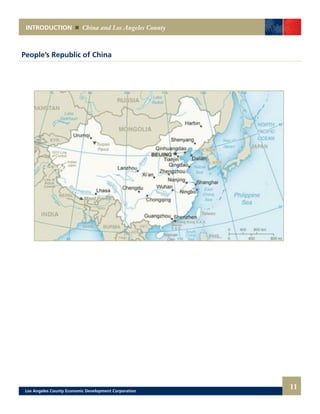
trade as it has in the past. The trade ties between Los Angeles
and China are very well known and long established. Significant
short and long term potential exist in the area of foreign
direct investment from China especially in the core LA County
industry clusters. In particular, the key industries expected
to draw the most attention are the property development,
cleantech, renewable energy, hi-tech and consumer electronics,
automotive and bio-tech areas. Automotive design will surely
command much interest from China as Los Angeles County is
the automotive design capital of the U.S. and many Chinese
auto manufacturers will be well advised to tap into that U.S.
market knowledge and talent before introducing vehicles for
sale in North America. In addition, solar energy should attract a
significant amount of investment from Chinese solar companies
as they seek sites for manufacturing plants in the U.S., they will
find value in the talented workforce that has made Los Angeles
County the manufacturing capital of America.
In conclusion, the future is very bright for the Los Angeles
County-China relationship. Los Angeles County will continue to
play a vital role in the California economy and for that matter
in the U.S. and global economies. As Time magazine pointed
out a few years ago in a cover story, the future of America is in
California as the key green industries of the future are all very
well positioned in the Golden State. The world will continue
to look to China as the global economic engine that propels
the global economy forward. Together Los Angeles County
and China can take the lead on the most pressing global issues
such as renewable energy and climate change. Innovation and
new technologies will come out of Los Angeles area research
universities and Chinese universities as both places continue to
produce some of the brightest talent. Los Angeles County is
in a very favorable position to benefit from China’s continued
economic rise and to fortify its position as the nation’s leading
gateway with China.
this development has already resulted in substantial economic
benefits for Los Angeles County and it will continue to provide
excellent opportunities in the coming years.
Business ties between Los Angeles County and China have
benefited greatly from China’s economic miracle and ever
growing financial globalization as increased capital flows
have changed global commerce. In addition, multinational
corporations have altered international business patterns
along with international relations. Fortune 500 companies
have expanded their global operations since the 1990s as
globalization has evolved. China has been by far the most
attractive market as it experienced unrivaled average double
digit growth rates over the past decade. The opportunities seem
to be boundless in China for American businesses with China’s
huge population, growing income, middle class and purchasing
power. L.A. County based Fortune 500 companies such as
Walt Disney, Jacobs Engineering, Reliance Steel & Aluminum,
Dole Food, Avery Dennison, Mattel, AECOM and CB Richard
Ellis are reaping the benefits and will continue to do so as the
emerging middle class expands in China. Other local companies
representing many of Los Angeles County’s key industry clusters
already have a strong presence in China, and others will want to
tap into China in the near future.
Significant Potential
Los Angeles County and China have developed a dynamic
and mutually beneficial relationship that has just skimmed
the surface of its true potential. The sky is truly the limit when
discussing Los Angeles County-China relations as the two areas
are bound by strong personal and economic ties. Los Angeles
County is home to more Chinese-Americans than any other
area in the U.S. and the local universities are home to more
Chinese students than any other region in the U.S. As more
“China’s government has encouraged its
companies to “go global” and in the coming years
they will pursue the mergers and acquisitions,
strategic partnerships and equity investments
that allow them to develop global brands and
distribution networks and access new markets and
technology. In fact, this development has already
resulted in substantial economic benefits for Los
Angeles County and it will continue to provide
excellent opportunities in the coming years.”
119Los Angeles County Economic Development Corporation
SECTION 8 Conclusion
Latin America by starting with establishing a partnership
with the Port of Hong Kong.
3 Attempt to better leverage the resources of the LAEDC and
the World Trade Center Los Angeles (WTC-LA), the Chinese
Consulate General and other China related organizations to
increase the level of interaction between U.S. and Chinese
companies – focus on business development exchanges and
foreign direct investment prospects.
4 Make full use of the “California -China Provinces Joint
Working Group on Trade and Investment Cooperation”
and help to substantiate its working mechanism through
partnering with its Southern California Secretariat – LARExC
and organizations like the LAEDC. Try to make better use
of local connections and resources of neighboring counties
to form a magnet to attract Chinese investors, while
establishing stronger business connections with the Working
Group’s Chinese member provinces whose aggregate GDP is
twice as large as California’s.
5	Focus on increasing the number of Chinese language
programs within Los Angeles County primary and secondary
schools, community colleges and universities as well as other
Los Angeles County organizations and associations such as
those mentioned within this report (please see the Personal
Ties section).
6	Work with federal legislators to support immigration and visa
policies that allow for easy access to the U.S. for students,
scientists, researchers, investors and other professionals
from China.
7 	Promote Los Angeles County to Chinese students and
tourists – attempt to attract Chinese high school students
via exchange programs; also college students, graduate
students and those looking to learn English at various
institutions – develop a marketing campaign to attract
Chinese tourists to Los Angeles County emphasizing all the
region has to offer to them including cultural and medical
tourism (as mentioned in the Personal Ties section) and
create cultural activities to strengthen the longstanding ties
between China and the people of Los Angeles County.
8	Attempt to work with the local media to advocate for a
more balanced reporting approach regarding the U.S.-China
relationship. Absolutely critical to make everyone aware of
the significance and overall impact of the relationship. As
clearly demonstrated within this report, the rise of China has
and will continue to have a tremendously beneficial impact
on the economic development of Los Angeles County.
However, as important as it is to highlight the future prospects
of the relationship, it is also of significant value to note some
improvements that could be made in order to ensure the
relationship continues to flourish. Los Angeles County’s
future prosperity will surely be impacted by how well it
manages its relations with China and the rest of Asia.
Recommendations
Here are some recommendations for nurturing the existing
Los Angeles County-China relationship in order to ensure that
future ties become even stronger:
1	 Promote and market Los Angeles County as an extremely
attractive location for Chinese foreign direct investment –
emphasize all the elements highlighted within this report
in order to make it very clear why LA County provides
significant overall value and return on investment. Focus
on attracting Chinese companies that are looking to locate
their U.S. or North American headquarters, manufacturing
plants, distribution centers, etc.
2 	Invest in improving the existing trade infrastructure (e.g. local
seaports, airports, freeways and intermodal rail capacity to
distribution centers). Implement strategies to ensure that
the local ports do not lose market share to other U.S. and/or
North American ports due to lower costs or faster times to
market. The local ports need to dispel all congestion myths,
bottleneck issues and business unfriendly perceptions.
Apply pressure at the local, state and federal levels to
adopt policies that support free trade and funding for trade
promotion programs via the U.S. Commerce Department.
Focus on expanding two-way trade, formulating stronger
relationships with our Chinese counterparts at the national
and provincial levels, expanding outreach programs, and
promoting our local seaports as a hub between China and
“Together Los Angeles County and China can
take the lead on the most pressing global issues
such as renewable energy and climate change.
Innovation and new technologies will come out of
Los Angeles area research universities and Chinese
universities as both places continue to produce some
of the brightest talent. Los Angeles County is in
a very favorable position to benefit from China’s
continued economic rise and to fortify its position
as the nation’s leading gateway with China.”
120 Los Angeles County Economic Development Corporation
121
GROWING TOGETHER China and Los Angeles County
Acknowledgements
The Los Angeles County Economic Development Corporation (LAEDC) and the World Trade Center –
Los Angeles wishes to express its thanks to the individuals and organizations who have contributed to
the final production of this study.
LAEDC and WTC-LA Staff
Bill Allen, President and CEO
Dr. Robert Kleinhenz, Chief Economist
George Entis, Research Assistant
Henry Wang, Chief China Representative
Natalie Moulding, Trade Assistant
U.S. Department of Commerce, U.S. Foreign Commercial Service
Embassy of the United States of America in Beijing
William M. Zarit, Former Minister for Commercial Affairs
East West Bank
Kwok-Yin (KY) Cheng, Executive Vice President, Director of International Trade Banking
Johns Hopkins University
The Paul H. Nitze School of Advanced International Studies (SAIS)
David M. Lampton, Director of SAIS-China (Nanjing Center) and China Studies
Mitchell Silberberg & Knupp
Lessing E. Gold, Partner and Chair of the LAEDC World Trade Committee
O’Melveny & Myers LLP
Steven J. Olson, Partner and Co-Chair of the LAEDC World Trade Committee
Los Angeles County Economic Development Corporation
GROWING TOGETHER China and Los Angeles County
Introduction
	 	 China’s Rise: Challenges and Opportunities, by C. Fred Bergsten,
		 Charles Freeman, Nicholas Lardy, Derek Mitchell
	 	 Global California, Rising to the Cosmopolitan Challenge, by Abraham
		 F. Lowenthal
	 	 Carnegie Endowment for International Peace | China’s Economic Rise
	 	 Financial Times Special Report | China
	 	 McKinsey & Company | Chinese Cities in 2025 and 2030
	 	 IHS Global Insight
	 	 California Department of Finance
Section 1 | Historical Ties
	 	 A History of the Chinese in California, Chinese Historical Society
		 of America
	 	 Chinese Labor in California, by Ping Chiu
	 	 The Chinese Role in Building the Central Pacific, Southern Pacific
		 Relations Memorandum
	 	 China: A Teaching Workbook, Columbia University, East Asian
		 Curriculum Project
	 	 Chinese Historical Society of California
Section 2 | Personal Ties
	 Educational Ties
	 	 Institute of International Education, 2013 Open Doors Report
	 	 U.S. Department of Education
	 	 Association of Pacific Rim Universities (APRU)
	 	 People’s Daily Online
	 	 University of Southern California (USC) 	
	 	 University of Southern California (USC)
			 Vice Provost’s Office for Globalization 	
			 Center for International Studies 	
			 Marshall School of Business
	 	 University of California, Los Angeles (UCLA)
			 Office of Analysis and Information Management 	
			 International Institute 	
			 International Education Office 	
			 Office of Media Relations 	
			 University of California Education Abroad 	
			 www.uschinamediabrief.com
Sources
122 Los Angeles County Economic Development Corporation
GROWING TOGETHER China and Los Angeles County
Educational Ties
	 	 Loyola Marymount University
			 Institutional Research 	
			 Communications & Government Relations
	 	 California State University (CSU), Dominguez Hills
			 Advancement Services
	 	 Occidental College
			 Office of Alumni Relations
	 	 California State University (CSU), Long Beach
			 Institutional Research and Assessment
	 	 Caltech
			 International Student Programs 	
			 Caltech Alumni Association
	 	 California State University (CSU), Pomona
			 International Center 	
			 Office of Alumni Affairs
	 	 California State University (CSU), Los Angeles
			 Office of Institutional Research 	
			 ERSS 	
			 Asian Pacific Business Institute
	 	 California State University (CSU), Northridge
			 Office of Institutional Research
	 	 The Claremont Colleges
			 International Placement Office
Cultural and Network Ties
	 	 Consulate General of the People’s Republic of China
	 	 U.S. Census Bureau, American Community Survey
	 	 City of Los Angeles, Sister Cities of Los Angeles
	 	 Sister Cities in the United States
	 	 Chinatown Los Angeles
	 	 Los Angeles Chinese Cultural Center
	 	 Los Angeles Chinese Learning Center
	 	 California Travel and Tourism Commission
	 	 China National Tourist Office
	 	 China International Travel Service
	 	 Asia Society
	 	 China-U.S. Exchange Foundation
	 	 Committee of 100
	 	 The 1990 Institute
	 	 China Enterprise Council (CEC)
	 	 Hong Kong Association of Southern California (HKASC)
Sources
123Los Angeles County Economic Development Corporation
GROWING TOGETHER China and Los Angeles County
Section 3 | The Chinese Economy
	 	 China’s Rise: Challenges and Opportunities, by C. Fred Bergsten,
		 Charles Freeman, Nicholas Lardy, Derek Mitchell – Peterson Institute
		 for International Economics
	 	 China-United States Exchange Foundation, U.S.-China Economic Relations
		 in the Next Ten Years: Towards Deeper Engagement and Mutual Benefit
	 	 International Monetary Fund, IMF Country Report, People’s Republic of China
	 	 Financial Times, Analysis Section, When China Sneezes
	 	 Bloomberg Brief, China’s Reform Plan
	 	 Stratfor Global Intelligence, China: The Next Phase of Reform
	 	 Council on Foreign Relations, Center for Geoeconomic Studies, Growth
		 and Reform in China
	 	 Yale Global Online, Get Ready for the Next China
	 	 Financial Times, Analysis Section, Slower but steady
	 	 HSBC Global Research
Section 4 | Trade Ties
	 	 U.S. Department of Commerce, Bureau of the Census, USATrade Online
	 	 National Bureau of Statistics of China
	 	 U.S. Census Bureau, Foreign Trade Division
	 	 Peterson Institute for International Economics
	 	 Los Angeles Chamber of Commerce, Global Initiatives
	 	 The US-China Business Council, Reports, Analysis & Statistics
	 	 Congressional Research Service, China-US Trade Issues, by Wayne Morrison
	 	 California Chamber of Commerce, Trade Statistics
	 	 California Department of Finance, California Trade Data
	 	 U.S. Department of Commerce, International Trade Administration (ITA)
	 	 U.S. Department of Commerce, U.S. Commercial Service
	 	 World Trade Organization (WTO), Tariff and Trade Statistics
	 	 Journal of Commerce (JOC)
	 	 PIERS Global Intelligence Solutions
	 	 Central Intelligence Agency (CIA) World Fact Book 2013
	 	 Port of Los Angeles (POLA)
	 	 Port of Long Beach (POLB)
	 	 Los Angeles World Airports, Los Angeles International Airport (LAX)
	 	 Airports Council International (ACI)
	 	 Los Angeles Times
	 	 E-Cargonews Asia
	 	 Los Angeles Tourism & Convention Board
	 	 Brookings Institution, Export Nation
	
Sources
124 Los Angeles County Economic Development Corporation
GROWING TOGETHER China and Los Angeles County
Section 5 | Investment Ties
	 	 Bureau of Economic Analysis (BEA), Foreign Direct Investment in the U.S.
	 	 U.S. Department of Commerce and the President’s Council of Economic
		Advisers, Foreign Direct Investment in the U.S.
	 	 U.S. Department of Commerce, SelectUSA
	 	 National Bureau of Statistics of China
	 	 Rhodium Group/Asia Society, An American Open Door? Maximizing
		 the Benefits of Chinese Foreign Direct Investment
	 	 Rhodium Group/ Asia Society, Chinese Direct Investment in California
	 	 Rhodium Group/Asia Society, The Next Wave of Chinese Investment
		 in America
	 	 The US-China Business Council
	 	 LAEDC Foreign Direct Investment Study
	 	 LAEDC FDI Database
	 	 Chinese Enterprise Council (CEC)
	 	 World Trade Center Los Angeles (WTC-LA) – www.wtca-lalb.org
	 	 Peterson Institute for International Economics
	 	 The China Business Review, China Invests Abroad
	 	 China Investment Corporation
	 	 Credit Suisse, China Research Office
	 	 ACG Los Angeles Capital Connection
	 	 Deloitte, Chinese Services Group
	 	 Deloitte Consulting
	 	 Vale Columbia Center on Sustainable International Investment, Fundacao
		 Dom Cabral, Fudan University, Indian School of Business, Moscow School
		 of Management SKOLKOVO – Five-Diamond International Conference
		Cycle, Thinking Outward: Global Players from Emerging Markets, by
		 Clarence Kwan and Karl Sauvant and While global FDI falls, China’s
		 outward FDI doubles, by Ken Davies
	 	 2014 Asia-Pacific Business Outlook (APBO)
	 	 OECD Investment Policy Reviews: China 2013
	 	 Consulate General of the People’s Republic of China
	 	 Hong Kong Trade Development Council (HKTDC)
	 	 North American Representative Office of Shenzhen (NAROS)
	 	 China Jiangsu Provincial Economic and Trade Office
	 	 Shanghai Foreign Investment Development Board
	 	 KPMG, Navigating China’s Trade and Customs Environment
	 	 The China Business Review
	 	 China-Mart
	 	 Southern California Edison, EV Technical Center
Sources
125Los Angeles County Economic Development Corporation
GROWING TOGETHER China and Los Angeles County
Section 5 | Investment Ties
	 	 World Economic Forum Meeting of New Champions
	 	 Fortune China
	 	 Xinhua New Agency
	 	 Business Week
	 	 The Economist Magazine
	 	 Time Magazine
	 	 The New York Times
Section 6 | Business Ties
	 	 Los Angeles Business Journal, Book of Lists 2014
	 	 Consulate General of the People’s Republic of China
	 	 Chinese Enterprise Council (CEC)
	 	 Fortune Magazine, Top 500 Companies
	 	 Chinese Historical Society of Southern California, History of Chinese
		 American Banking in Los Angeles
	 	 Xinhuanet.com
	 	 LAEDC, Foreign Direct Investment in Los Angeles County
	 	 World Trade Center | Los Angeles (WTC-LA)
	 Chinese Companies with a presence in Los Angeles County:
	 	 BYD Company Limited (Profile in Investment Ties Section)
	 	 Greenland Holdings Group (Profile in Investment Ties Section)
	 	 Shenzhen New World Group (Profile in Investment Ties Section)
	 	 Amoi Electronics
	 	 AVIC International Holding Company, previously China National
		 Aero-Technology Import & Export Corporation, CATIC
	 	 Bank of China
	 	 China Mobile
	 	 China Ocean Shipping Company, COSCO
	 	 China Shipping North America (CSNA)
	 	 China State Power (USA)
	 	 China NetCom Operations Limited USA
	 	 China America Electronics Corporation (CEIEC)
	 	 Chinatex Grains & Oil (USA)
	 	 China Television Corporation
	 	 China Interocean Transport
	 	 China First Capital
	 	 Dacheng Law Offices
	 	 Dalu International
	 	 GeneralTouch
Sources
126 Los Angeles County Economic Development Corporation
GROWING TOGETHER China and Los Angeles County
Section 6 | Business Ties
	 Chinese Companies with a presence in Los Angeles County:
	 	 Hangzhou HIKVision Digital Technology Company
	 	 Hongdou Group USA
	 	 Commercial Aircraft Corporation of China (COMAC)
	 	 Dalian Wanda Group
	 	 Industrial and Commercial Bank of China Ltd. (ICBC)
	 	 China Merchants Bank (Wing Lung Bank)
	 	 China CITIC Bank
	 	 Guangzhou Tech-Long Packaging Machinery Co.
	 	 Phoenix HK TV
	 	 Guangdong Phnix Eco-Energy Solution Ltd.
	 	 Landsea Group
	 	 Shanghai Greenland Holding Group
	 	 Golden Dream Media and Communications (USA)
	 	 China Southern Airlines
	 	 China Eastern Airlines
	 	 Air China
	 	 Cathay Pacific
	 Hong Kong Companies with a presence in Los Angeles County:
	 	 Orient Overseas Container Line (OOCL)
	 	 Kerry Logistics
	 	 Li & Fung LTD
	 	 TVB (USA)
	 	 Sing Tao News Corporation
	 	 Phoenix Satellite Television Holdings
	 	 K.Wah Group/Stanford Hotels Group
	 	 Great Eagle Group Holdings Limited/Langham Hotels and Resorts
	 	 The Hong Kong and Shanghai Hotels
	 	 Lee Kum Kee
	 	 Ken Wah Bakery
	 	 Café de Coral/Manchu Wok
	 	 Varitronix International
Sources
127Los Angeles County Economic Development Corporation
GROWING TOGETHER China and Los Angeles County
Appendix
	 	 4th largest country (in terms of territory) in the world after Russia,
		 Canada and U.S.
	 	 Population | approximately 1.4 billion | largest in the world
	 	 Different stages of Political Evolution:
			 221 B.C. | unification under the Qin or Ch’in Dynasty
			 January 1, 1912 | Qing or Ch’ing Dynasty replaced by the Republic of China
			 October 1, 1949 | People’s Republic of China established
	 	 Chief of State | President Xi Jinping
	 	 Head of Government | Premier Li Keqiang
	 	 New government took office in 2012
	 	 12th 5-Year Plan ends in 2015 and the 13th
		 5-Year Plan starts in 2016
	 	 Ambassador to the U.S. | Cui Tiankai
	 	 Consulate General of the People’s Republic of China in Los Angeles |
		 Consul General Liu Jian
China
at a Glance
China’s Economy
at a Glance
	 	 China’s GDP in 2013 was $9.2 trillion (based on current exchange rates)
	 	 Second largest economy in the world | expected to surpass the U.S.
		 to become the largest economy in the world by 2015 based on PPP*
		 exchange rates or by 2025 based on market exchange rates
	 	 China’s growth averaged 10% a year from 1980 to 2009
	 	 Largest trading nation in the world $400 billion when including Hong Kong
	 	 10 Main Ports | Shanghai (#1 in China and #2 in the world, Hong Kong
		 (#3 in China and #4 in the world), Shenzhen (#2 in China and #3 in the
		 world), Guangzhou (#6), Ningbo (#4), Qingdao (#5), Tianjin (#7), Xiamen (#8),
		 Dalian (#9) and Qinhuangdao (#10), and 6 of the top 10 in the world
	 	 No. 1 in inward FDI for developing nations | 22nd year in a row
	 	 GDP composition by sector | industry 44%, services 46%, and agriculture 10%
	 	 Total foreign exchange reserves held by China are $4 trillion
	 	 Total labor force is 798 million
	 	 2014 Forbes Billionaire List | 152 Chinese, second highest number after
		 the U.S.
	 	 Per capita Income | $6,800 or $9,800 in purchasing power parity (PPP)*
	 	 Gross National Saving Rate | 50% of GDP
All based on the most recent data available.
*Purchasing Power Parity | A nation’s GDP at purchasing power parity (PPP) exchange rates
is the sum value of all goods and services produced in the coun ry valued at prices prevailing
in the United States. This is the measure most economists prefer when looking at per-capita
welfare and when comparing living conditions or use of resources across countries.
128 Los Angeles County Economic Development Corporation
China and LA County Report

China and LA County Report

  • 1.
    China and Los AngelesCounty G R O W I N G T O G E T H E R
  • 2.
    PREPARED BY: Ferdinando Guerra,International Economist Principal Researcher and Author with special thanks to George Entis, Research Assistant June, 2014 Los Angeles County Economic Development Corporation Kyser Center for Economic Research 444 S. Flower St., 37th Floor Los Angeles, CA 90071 Tel: (213) 622-4300 or (888) 4-LAEDC-1 Fax: (213)-622-7100 E-mail: research@laedc.org Web: http://www.laedc.org The LAEDC, the region’s premier business leadership organization, is a private, non-profit 501(c)3 organization established in 1981. China and Los Angeles County G R O W I N G T O G E T H E R
  • 3.
    As Southern California’spremier economic development organization, the mission of the LAEDC is to attract, retain, and grow businesses and jobs for the regions of Los Angeles County. Since 1996, the LAEDC has helped retain or attract more than 198,000 jobs, providing over $12 billion in direct economic impact from salaries and over $850 million in property and sales tax revenues to the County of Los Angeles. LAEDC is a private, non-profit 501(c)3 organization established in 1981. Regional Leadership The members of the LAEDC are civic leaders and ranking executives of the region’s leading public and private organizations. Through financial support and direct participation in the mission, programs, and public policy initiatives of the LAEDC, the members are committed to playing a decisive role in shaping the region’s economic future. Business Services The LAEDC’s Business Development and Assistance Program provides essential services to L.A. County businesses at no cost, including coordinating site searches, securing incentives and permits, and identifying traditional and nontraditional financing including industrial development bonds. The LAEDC also works with workforce training, transportation, and utility providers. Economic Information Through our public information and for-fee research, the LAEDC provides critical economic analysis to business decision makers, education, media, and government. We publish a wide variety of industry focused and regional analysis, and our Economic Forecast report, produced by the Kyser Center for Economic Research, has been ranked #1 by the Wall Street Journal. Economic Consulting The LAEDC consulting practice offers thoughtful, highly regarded economic and policy expertise to private- and public-sector clients. The LAEDC takes a flexible approach to problem solving, supplementing its in-house staff when needed with outside firms and consultants. Depending on our clients’ needs, the LAEDC will assemble and lead teams for complex, long-term projects; contribute to other teams as a subcontractor; or act as sole consultant. Leveraging our Leadership The LAEDC Center for Economic Development partners with the Southern California Leadership Council to help enable pub- lic sector officials, policy makers, and other civic leaders to address and solve public policy issues critical to the entire region’s economic vitality and quality of life. Global Connections The World Trade Center Los Angeles-Long Beach works to support the development of international trade and business opportunities for Southern California companies as the leading international trade association, trade service organization and trade resource in Los Angeles County. It also promotes the Los Angeles region as a destination for foreign investment. The World Trade Center Los Angeles-Long Beach is a subsidiary of the Los Angeles County Economic Development Corporation. For more information, please visit www.wtca-lalb.org. GROWING TOGETHER China and Los Angeles County i Los Angeles County Economic Development Corporation
  • 4.
    GROWING TOGETHER Chinaand Los Angeles County Table of Contents Key Findings iii Executive Summary 1 Introduction 7 Section 1 Historical Ties 14 Section 2 Personal Ties 17 Educational Ties 17 Cultural Ties 26 Network Ties 31 Section 3 The Chinese Economy 35 Section 4 Trade Ties 41 Los Angeles Customs District (LACD) 42 Port of Los Angeles (POLA) 47 Port of Long Beach (POLB) 49 Los Angeles International Airport (LAX) 50 Section 5 Investment Ties 56 Foreign Direct Investment (FDI) 56 FDI into Los Angeles County 57 FDI into China 73 Venture Capital Firms 79 Private Equity Firms 80 Investment Banking Firms 81 Section 6 Business Ties 82 Fortune 500 Companies 84 Key Industry Cluster Companies 87 Other L.A. County Firms 102 Chinese Firms in L.A. County 103 Section 7 The Future of the Relationship 112 Key Challenges 112 Key Opportunities 114 Section 8 Conclusion 118 Acknowledgements 121 Sources 122 Appendix 128 iiLos Angeles County Economic Development Corporation
  • 5.
    GROWING TOGETHER Chinaand Los Angeles County 1 Investment into Los Angeles County from China has doubled over the past 5 years, with China becoming one of Los Angeles County’s top investors China and Los Angeles County continue to increase business and commercial ties and the opportunities for Los Angeles Tourism has nearly quadrupled over the past four years alone, from 158,000 Chinese tourists in 2009 to 570,000 in 2013, making China the top overseas market for Los Angeles tourism Los Angeles is America’s top international trade gateway to China and China’s top gateway to the U.S., handling nearly 45% of trade between the two countries China is the Los Angeles Customs District’s (LACD’s) #1 partner in international trade, accounting for nearly 60% of all activity at the San Pedro Bay ports LACD exports to China have increased from $23 billion in 2009 to $35 billion in 2013 – less waste and scrap and more consumer and knowledge-intensive goods Los Angeles County has the largest Chinese population of any county in the nation, and has grown from 360,000 in 2008 to 413,000 in 2012 Los Angeles County has the largest number of Chinese students of any county in the nation, increasing from roughly 3,000 Chinese students studying in local universities in 2009 to roughly 10,000 in 2013 Strong cultural and network ties are the foundation of the relationship Future business prospects may be found in clean tech, entertainment, aerospace, e-commerce, real estate/property development, tourism, logistics and electronics iii Key Findings Los Angeles County Economic Development Corporation
  • 6.
    Executive Summary In 2009,the LAEDC produced the first in a series of reports documenting how Los Angeles County’s economy has grown as a result of certain key trading and investment relationships with major nations of the world. This series, entitled “Growing Together” began with a report that focused on the relationship between China and Los Angeles County. The LAEDC is now taking another close look at this long and mutually beneficial relationship by producing this second edition of “Growing Together: China and Los Angeles County” in order to provide updated information and insights on what has transpired over the past few years. The main objective is to properly assess, and identify strategies to efficiently maximize the benefits of this relationship. Los Angeles County and China are two regions that have grown closer together by forging a more than 150-year partnership. The peoples of China and Overview of the Second Edition The objective of the report is to describe the long, deep and growing bonds between the People’s Republic of China (“China”) and Los Angeles County and how they have impacted the development of both areas. This report provides an overview of the scope of the ties between China and Los Angeles County beginning with the historical ties. Next, the report highlights the personal connections between China and Los Angeles County, including the educational, cultural and network ties. Third, the report takes a close look at the Chinese economy. Fourth, the analysis presents the economic links between the two with a focus on the critical trade links. Fifth, the report explains the significant role played by Foreign Direct Investment (“FDI”) and cites some investment prospects for the future. Sixth, the study provides some details about the business and financial links between the two areas by profiling firms that are based in Los Angeles County and active in China (and some not based in L.A. County, but with China operations closely tied to LA County offices) followed by profiles of some major Chinese firms with a presence in Los Angeles County. In the final sections of the report, we describe some of the challenges and opportunities that lie ahead for this partnership and present some recommendations to further solidify the relationship. GROWING TOGETHER China and Los Angeles County 1 Los Angeles County have a very special relationship and bond due to this long shared history. China’s impact on Los Angeles County can be felt both personally and in business. Indeed, Chinese- Americans have had a noticeable effect on the socio-economic fabric of the Los Angeles region. The futures of Los Angeles and China are inextricably tied together. The close connections forged in the past and new possibilities that will open up in the future are highlighted in this special report. 1 Throughout the entire report when we refer to China we mean Mainland China and the two special administrative regions (Hong Kong and Macau). Los Angeles County Economic Development Corporation
  • 7.
    EXECUTIVE SUMMARY Chinaand Los Angeles County 2 Historical Ties The Chinese were the first Asian immigrants to come to the United States. A massive influx of Chinese immigrants took place in the mid 1800’s due to the California Gold Rush. In 1850, the U.S. Census showed that there were two Chinese residents in Los Angeles. The history of the Chinese in Southern California really began in 1859 when Chinese fishermen established a presence on Catalina Island. By 1870, there were almost 6,000 Chinese citizens in Los Angeles, mostly because Chinese workers were needed to build the Central Pacific railroad down the San Joaquin Valley to Los Angeles. However, life was difficult for Chinese-Americans in Southern California after the railroad was completed and the local population dwindled. By the turn of the century, there were only 3,200 Chinese living in Los Angeles. Conditions improved in the twentieth century, and the Chinese presence in Los Angeles County increased, especially after World War II when U.S. immigration laws began to be relaxed. Successive waves of Chinese immigrants landed and settled in Los Angeles. Today, the County has more residents of Chinese descent—estimated at 413,000 persons—than any other in the U.S. Personal Ties The Chinese culture has always emphasized the importance of education throughout its dynamic history. As the country opened up its society over the past thirty-five years and with the advent of globalization, many Chinese students have taken advantage of the opportunity to study abroad. The U.S. is the leading destination for Chinese students (with currently over 235,000 and this is expected to grow to over 365,000 by 2015), and no other state has attracted more of them than California. As the leading gateway to the Pacific Rim, Los Angeles County has emerged at the center of Asian-American economic, business, educational and cultural exchanges. USC has the highest number of Chinese students of any university in the U.S., followed by UCLA. Other colleges and universities such as the Cal State campuses also enroll many Chinese students and offer programs that train provincial government professionals. The report estimates that in total, roughly 10,000 Chinese students are currently attending universities in Los Angeles County and when including community colleges that number rises closer to 20,000. When they become alumni and develop successful business, professional and government careers, these students will become important new links between the two regions in the future. China and Los Angeles County are tied together in many ways beside education. The personal connections between the two regions include many significant cultural ties targeted at the county’s large Chinese and Chinese-American population. In addition, Los Angeles County has many useful business and professional associations for Chinese and Chinese-Americans along with organizations such as the Asia Society, the Committee of 100 and the 1990 Institute. These resources go a long way in strengthening the relationship between Los Angeles County and China. All of these networks will continue to provide the leadership needed in order for the partnership to thrive in the future. The Chinese Economy China has made many economic headlines since the first edition of this report was published in 2010. The Chinese economy surpassed the Japanese economy to become the second largest economy in the world in 2010 using market exchange rates. In addition, China will surpass the U.S. to become the largest economy in the world by the end of 2014 in purchasing power parity terms according to the World Bank International Comparison Program (ICP) or by 2016 or 2017 according to the International Monetary Fund (IMF). The Chinese economy was able to avoid any substantial slowdown after the 2008 financial crisis by implementing the largest stimulus package in its history, consisting of both expansionary fiscal and monetary policies. The key development during this period was China’s increased reliance upon fixed investment as a driving force for growth. Fixed investment (meaning in infrastructure, real estate and manufacturing) has been roughly 50% of China’s GDP over the past few years. This is unprecedented in China’s economic development. Going forward China fully understands it must transition away from its export-oriented, investment driven, low-value added economic model to one based more on domestic consumption, high-value- added production and services. This is known as China’s Great Rebalancing Act or the Great Transformation. In addition, the country began to take on substantial levels of debt that started during the stimulus period. Both of these developments (rebalancing and higher levels of debt) have caused a fundamental shift in the government’s economic policies. Los Angeles County Economic Development Corporation
  • 8.
    EXECUTIVE SUMMARY Chinaand Los Angeles County 3 In 2011, China entered into its 12th 5-Year Plan (2011- 2015), which mainly focuses on altering the overall economic model. The key objectives of the plan are expanding growth in the western regions, improving the environment and energy efficiency, growing domestic consumption, reducing inequality, and furthering scientific development. The trajectory of the Chinese economy has become a hot topic in the past few years as the global economy has attempted to fully recover from the Great Recession. Some economists predicted a “hard landing” for China, while others like the LAEDC have correctly projected a “soft landing.” Another key development for the Chinese economy has been the transfer of power from one government to the next which takes place every decade. The new government is led by President Xi Jinping who actually visited Los Angeles in February 2012 while he was still Vice President. President Xi Jinping stated that Los Angeles is the epicenter of the U.S.- China relationship. As this report attempts to demonstrate, no other region of the U.S. has a closer relationship with China. China’s economic performance has suffered over the past two years, both as a result of internal factors and the global slowdown (especially the recession in Europe). The Chinese economy appeared to have turned the corner at the end of 2012, posting a growth rate of 7.9% in the fourth quarter, but GDP growth continued to decelerate into the 7.5% range in 2013. The country’s new leaders have attempted to address key concerns facing the Chinese economy including finding a balance between quantity and quality of growth. The slowdown has been detrimental to the global economy, particularly hitting those economies that have been most interconnected with the Chinese growth engine. A Chinese economic deceleration greatly impacts a wide range of industries and all of its trading partners. China is the first or second largest trading partner to roughly 80 countries, which account for nearly 60% of global GDP. It is the largest exporter in the world and the second largest importer. China has a significant impact on commodity markets as it has been the dominant player over the past 10 years. The economic slowdown has also impacted the trading relationship between the Los Angles Customs District (LACD) and China. China is the LACD’s top trading partner. Imports outnumber exports by roughly a 5:1 ratio, but this is expected to change in the coming years as China moves towards supplying less to the world (mainly due to higher wages) and consuming more. Our local ports will see more goods coming from Vietnam and elsewhere in Southeast Asia. More exports will leave our ports as the Chinese middle class continues to expand (currently estimated to be roughly 350 to 400 million people and projected to increase to over 600 million by 2022). Over the past decade a large percentage of LACD exports to China have been driven by China’s huge appetite for raw materials and components as inputs to its manufacturing. With the slowdown in Chinese manufacturing, those LACD exports have been negatively impacted as all waste and scrap experienced declines the last two years. However, another trend has evolved as a higher proportion of our exports include consumer and capital goods. This is an important development and will present excellent opportunities for our regional exporters in the future. With China’s economy expected to grow by 7% to 7.5% in 2014 and the next few years, this should bode well for the U.S., California and Los Angeles County economies, most importantly as an expanding market for our exports (particularly where we have a comparative advantage meaning in knowledge-intensive goods and services). In addition, it is critical to understand that China’s income per capita growth figures are more relevant and significant to China’s future economic development than China’s GDP growth figures. Trade Ties China has transformed its economy into the world’s fastest growing over the past thirty-five years since its adoption of its open door policy in 1979. A major factor in this performance was the nation’s decision in 1979 to open up to international trade. U.S.-China trade has increased dramatically over the past thirty-five years jumping from $4.8 billion to $366 billion. Los Angeles County has established very close economic ties with China. The Los Angeles Customs District (LACD) handles over 40% of total U.S., trade with China. Indeed, the ports of Los Angeles and Long Beach together handle nearly 37% of total trade between China and the U.S. In fact, roughly 60% of two-way trade volumes at the Port of LA and the Port of Long Beach and over 50% of the total two-way trade value at the Los Angeles Customs District (LACD) are related to trade with China. Los Angeles has been referred to as the capital of the Pacific Rim due to its deep connections with the Asian continent. Like the personal ties, the economic ties between Los Angeles County and China are unmatched by any other region of the United States. In fact, the growth in international trade links between Los Angeles County and China has contributed greatly to the economic development of the Los Angeles Los Angeles County Economic Development Corporation
  • 9.
    EXECUTIVE SUMMARY Chinaand Los Angeles County 4 region. The San Pedro port complex, which includes the Ports of Los Angeles and Long Beach, is the busiest port complex in the U.S., the largest in the Western Hemisphere and the ninth busiest in the world (based on 2013 figures). Only Singapore, three China ports (Shanghai, Hong Kong and Shenzhen), the South Korean Port of Busan, and another three Chinese ports (Ningbo, Qingdao and Guangzhou) are ranked ahead of the San Pedro ports. Trade between the U.S. and China increased during 2013 due to the continued economic recovery. China was the LACD’s largest trading partner in 2013, with total two-way trade valued at $221.4 billion (based on HS port-level data and includes general imports and exports). Total Chinese imports unloaded in the LACD were $186.0 billion (#1), and total U.S. exports to China through the LACD came to $35.4 billion (again #1). This gave the LACD a trade deficit with China of -$150.6 billion (also #1). China’s import-to-export ratio of 5.2 was by far the highest among the LACD’s top trading partners. China is the Los Angeles Metro area’s #3 export market based on a study completed by the Brookings Institution called Export Nation. The L.A. Metro Area had exports equal to $5.4 billion to China, which included $3.7 billion in merchandise exports (goods) and $1.7 billion in services. The top merchandise or goods exports were computers and electronics, transportation equipment, chemicals, machinery and food. The top services exports were royalties, travel & tourism, education, business services, and freight & port services. The overall top exports from the L.A. Metro Area to China were computers and electronics, transportation equipment, chemicals, royalties and travel & tourism. Tourism (classified as a services export): In 2012, China became Los Angeles’s top visitor overseas market when 470,000 Chinese tourists visited Los Angeles, an increase of nearly 40%. Then in 2013, Chinese tourists to Los Angeles reached 570,000, a jump of over 21% compared with the previous year. The number of Chinese tourists visiting Los Angeles was just 158,000 in 2009. China has gone from not being in the top 10 ranking of overseas visitors just a few years ago to the #1 source of overseas visitors to Los Angeles. As a direct result of this surge in Chinese tourism, areas like the San Gabriel Valley have been witnessing an economic transformation as tourism brings spending and attracts investment. Cities like San Gabriel and Monterey Park have benefitted greatly as it has a sparked a boom in new development. Investment Ties The U.S. Bureau of Economic Analysis (BEA) defines foreign direct investment as “ownership or control, directly or indirectly, by one foreign person, or entity, of 10 percent or more of the voting securities of an incorporated U.S. business enterprise or an equivalent interest in an unincorporated U.S. business enterprise.” Foreign direct investment (FDI) into China has grown substantially over the past thirty-five years and has played an instrumental role along with international trade in propelling China’s economy to becoming the second largest in the world. A significant portion of the growth of Chinese exports has been directly related to the rising number of foreign-owned and -invested factories, and economic development has been stronger in the regions that have higher proportions of FDI. In a comprehensive multi-country study of foreign direct investment in Los Angeles County that was completed in 2008, the LAEDC identified 127 Chinese-owned business establishments in 2007-2008. Chinese investment into Los Angeles County has doubled since 2007-2008 to 254 establishments according to LAEDC research conducted in 2013-2014. China is one of the ten largest sources of foreign-owned and -affiliated businesses in Los Angeles County, (estimated to be the eighth largest) based on a preliminary analysis of 2013 business data by the LAEDC. Out of a total of 254 establishments, the largest industry area for Chinese-owned companies is wholesale trade with 63 total establishments. This is followed by retail trade (51 total establishments) and transportation & warehousing (39 total establishments). Well known Chinese and Hong Kong companies with operations in Los Angeles County include the Bank of China, Industrial and Commercial Bank of China, Air China, China Southern Airlines, Cathay Pacific Airlines, China Telecom, China Mobile, China Unicom, COSCO Container Lines, China Shipping, and BYD. The LAEDC and its WTC-LA subsidiary have played a pro-active and significant role in attracting this investment including conducting and publishing regular research on China and L.A. County, leading many trade and investment mission trips to China, hosting dozens of inbound delegations each year, signing and fulfilling many memoranda of understanding and mutual cooperation agreements with trade and investment promotion organizations throughout China, and opening an office in China to facilitate further trade and investment. Los Angeles County Economic Development Corporation
  • 10.
    5 EXECUTIVE SUMMARY Chinaand Los Angeles County More direct investment from China is on the way. Chinese companies see Los Angeles as an attractive investment for many reasons. First, Los Angeles is a large market, with a population of 10 million people and over 300,000 business establishments. The county has an excellent transportation network, with the ports, an international airport, plus a well- developednetworkfreewaysystemandrailroadstocarrygoods to the rest of the U.S. The county has a world-class system of higher education with three superb research universities. Also, the Chinese government provides many incentives and subsidies to Chinese companies looking to invest abroad as part of the “go global” campaign and recent economic reforms. Importantly, setting up abroad allows companies to avoid the obstacles associated with trade disputes. Finally, the large Chinese population in Los Angeles County (the largest of any county in the U.S.) provides a “comfort factor” to Chinese business managers who must move to the area. The LAEDC believes that future Chinese investments will be made in the real estate and property development area along with green/clean technology industries like electric vehicles and renewable energy (solar and wind). Also, high- tech consumer electronics will be another core area as this has been targeted by both the government and the private sector. Other key industries likely to attract investment range from e-commerce to the auto industry to construction and engineering to logistics to biotech. In addition, more and more Chinese investors are looking for opportunities to acquire start-ups with brand new technologies or collaborating with local universities as this has become a new focus for outbound Chinese investment. The County of Los Angeles is aggressively pursuing foreign investment from China and has a very strong interest in attracting real estate/ property development and green/ clean technology. The World Trade Center – Los Angeles (WTC-LA) strategy targets Chinese investment in property development, e-commerce, high-tech, clean technology automotive industry and the alternative/renewable energy industry amongst others. The report describes a number of trade missions and conferences that took place over the past few years and summarizes the results to date. The latest effort culminated in Shanghai Greenland’s $1 billion mixed- use property development investment adjacent to L.A. Live that will include a hotel designed by LA-based architectural firm Gensler. This section of the report also includes a list of trade and investment resources in Los Angeles County for the benefit of foreign investors along with a parallel listing of Chinese trade and economic development organizations that have offices in Los Angeles. Business Ties This section of the report presents two annotated lists of companies involved in foreign direct investment activities in Los Angeles County and in China. The first consists of companies headquartered in Los Angeles (Fortune 500 companies, Key Industry Cluster Firms and Others) and having a physical presence—an office, factory, store, etc.—in China and companies not headquartered in L.A. County, but with China operations closely tied to L.A. County offices. This list includes over 70 companies at present and there are summary profiles of each firm’s activities in China. The list is surprisingly diverse—reflecting the wide variety of industry clusters in Los Angeles County. The companies range from large to small, in industries ranging from architecture and engineering to fashion, finance, law, professional services and advanced technology. The second list includes some (not all) key Chinese firms with a presence in Los Angeles County. There are over 40 companies at present—the number is expected to grow in the future— including four passenger airlines operating between LAX and various cities in China. This list includes well known names like the Bank of China, China Mobile, China Telecom, and COSCO as well as others perhaps not so well known today but eager to participate in the Los Angeles economy. The Future of the Relationship The report next considers the factors that will influence what lies ahead for the relationship between China and Los Angeles County. The Chinese economy is expected to continue growing (albeit at a slower pace), which suggests that exports to China and FDI flows from China also will increase. The key issue going forward is not whether or not Chinese policymakers will succeed in “re-balancing” the economy so that spending by China’s consumers for goods and services plays a larger role and exports and perhaps investment decline in importance (as a share of the total economy, not in absolute terms) but at what speed this takes place. Most China experts agree that it will not happen overnight. However, over the past few years we have already witnessed the impact of such a shift as China has become the Los Angeles Metropolitan Area’s third largest export market by demanding more of our key goods and services exports. It has already altered the direction and composition of goods moving through the Los Angeles Customs District as we are exporting more goods and services and less waste and scrap. The continuation of this trend along with continued strength in imports should translate into a very robust outlook in the coming years for the local ports. Los Angeles County Economic Development Corporation
  • 11.
    6 community and throughvarious programs led by organizations like the LAEDC, will work to promote trade and investment, strengthen communications, enhance trust, boost economic growth and create jobs. Conclusions and Recommendations This second edition report demonstrates that China and Los Angeles County do have a very special relationship based on cultural and personal ties as well as trade, investment and business transactions. In addition, this report provides strong justification for classifying Los Angeles as the epicenter of the U.S.-China relationship. While trade, investment and business ties will be even more important in the future, Los Angeles County’s large Chinese population, the growing numbers of Chinese students at area universities and colleges, and the area’s many cultural organizations will enhance and deepen the relationship even further as commerce between China and Los Angeles County does not happen in a vacuum. The futures of China and Los Angeles County are very bright. Both locations possess the resources and tools necessary to reap the benefits of increased globalization. China and Los Angeles County will continue to play vital roles in the California economy and for that matter in the U.S. and global economies. The world will continue to look to China as a global economic engine that propels the global economy forward. Together, Los Angeles County and China can take the lead on pressing global issues such as renewable energy and climate change. Innovation and new technologies will come out of Los Angeles area research universities and also Chinese universities as both places continue to produce some of the brightest talent. Los Angeles County is in a unique position to benefit from China’s continued economic rise and to fortify its position as the nation’s leading gateway with China. This 2nd edition report concludes with recommendations for nurturing the existing relationship to ensure that future ties are stronger still. With regard to foreign direct investment, there will be strong competition from other parts of the world as well as other regions of the U.S. Also, China will be continuing to look to secure its natural resource requirements (oil, natural gas, iron ore, etc.) with investments in Africa, South America and Australia for example. Still, the opportunities for Los Angeles County are undeniable and worth pursuing. They include not only increased flows of trade but also increased employment in Chinese-owned and -operated plants and offices. The outlook for foreign direct investment from China into Los Angeles County is very bright. Chinese companies are especially attracted to the Los Angeles area as the County has the highest population of Chinese-Americans in the U.S along with a broad economic base and necessary business infrastructure to enable profitable returns on their investment. Los Angeles County offers Chinese companies the following: a huge market, a well-educated and trained workforce, outstanding trade infrastructure, excellent access to national and international markets, technology rich area, first-rate apparel, auto and engineering design, the nation’s largest manufacturing base, competitive costs and great weather. The greatest opportunities for Chinese investment are in the real estate/property development, green/clean tech, aerospace, entertainment, e-commerce, electronics, logistics and apparel industries. Near term, investment will most likely occur within real estate, electric automobiles, solar energy, e-commerce, hi-tech electronics and textiles. The investment will be in the form of manufacturing, distribution, sales & service, research & development and regional headquarters. Other relevant opportunities are likely to be in bio-tech and healthcare, banking and financial services, professional and business services, materials & machinery, construction & engineering and creative design. The governments in both China and California attach great importance to promoting trade and investment cooperation between the two business communities. Chinese leader Xi Jinping visited the Los Angeles area twice in recent years (2012 and 2013), which also highlights the importance of the area in bilateral relations. The trade relationship was not only one of the focal points of President Xi’s visits, but it also was considered as the propeller and stabilizer for China - U.S. bilateral relations. After President Xi’s visit, California and China’s Ministry of Commerce and six provinces established a Joint Working Group on Trade and Investment Cooperation. The Working Group, in partnership with the business EXECUTIVE SUMMARY China and Los Angeles County Los Angeles County Economic Development Corporation
  • 12.
    Overview of Report Theobjective of the report is to describe the long, deep and growing bonds between the People’s Republic of China (“China”) and Los Angeles County and how they have impacted the development of both places. This report provides an overview of the scope of the ties between China and Los Angeles County beginning with the historical ties. Next, the report highlights the personal connections between China and Los Angeles County, including the educational, cultural and network ties. Third, the report takes a close look at the Chinese economy. Fourth, the analysis presents the economic links between the two with a focus on the critical trade links. Fifth, the report explains the significant role played by Foreign Direct Investment (“FDI”) and cites some investment prospects for the future. Sixth, the study provides some details about the business and financial links between the two areas by profiling firms that are based in Los Angeles County and active in China (and some not based in L.A. County, but with China operations closely tied to LA County offices) followed by profiles of some major Chinese firms with a presence in Los Angeles County. In the final sections of the report, we describe some of the challenges and opportunities that lie ahead for this partnership and present some recommendations to further solidify the relationship. Los Angeles County and China have grown both in absolute terms and in the interconnected nature of their economies by forging a more than 150-year relationship. The people of China and Los Angeles County have a very special bond due to this long shared history. China’s impact on Los Angeles County can be felt both culturally and in business. Indeed, Chinese-Americans have had a noticeable effect on the socio-economic fabric of the Los Angeles region. The futures of Los Angeles and China are inextricably tied together. These close connections forged in the past and new possibilities that will open up in the future are featured in this second edition. GROWING TOGETHER China and Los Angeles County 7 Introduction Los Angeles County Economic Development Corporation
  • 13.
    INTRODUCTION China andLos Angeles County fueled by private enterprises. State-owned enterprises now contribute approximately 30%-40% to China’s GDP, although estimates vary. This is a truly extraordinary example of how much China has evolved over the past thirty-five years. China’s Unprecedented Economic Rise Since 1979, China has concentrated on implementing market- oriented economic reforms which have proven to be extremely effective and successful. China began to transform its economy in 1979 by gradually moving from a centrally planned system to a more liberalized economy, by making very large state investments in heavy industry & infrastructure and by reforming prices throughout the economy. In the 1980’s China continued the reform process by restructuring the agricultural industry, removing price controls and authorizing more power to the provinces. In addition, the government allowed for more state- owned enterprises to become autonomous and established several small coastal economic zones in order to attract global investment. The 1990s was the decade in which China moved towards a more privatized corporate system and where both credit and investment expanded rapidly. From 1990-2004, China’s economy grew at an average rate of 10% per year. By 2000, China’s economic output had quadrupled from its 1978 level. Beginning in 2001, the Chinese economy soared to new heights as it entered into the World Trade Organization (WTO). In fact, from 2001-2007 China averaged economic growth higher than 10% per year. The Chinese economy has become a more global market-based economy since its entry into the WTO. Many experts attribute China’s remarkable growth rates mainly to its high investment rates. However, the impact of economic globalization cannot be understated as international trade and Foreign Direct Investment (FDI) have been significantly instrumental in China’s economic development particularly over the past 10 years. Manufactured exports have contributed to China becoming the world’s largest industrial producer and the biggest holder of foreign exchange reserves, which have grown to roughly $4 trillion. China has become the second largest economy in the world (measured in nominal GDP, based on official exchange rates), and it is expected (according to IMF estimates) to become the largest as soon as 2025 (based on market exchange rates). The key driving forces of this growth have been both government and foreign direct investment, labor and internal migration, and productivity and globalization. In addition, the overall market-based reforms that have been implemented since 1979 have transformed the Chinese economy from one that was dominated by state-owned enterprises to one now 8 Growth Projections for China Largest economy in the world by 2025-2030 Population | 1.45 billion in 2025 Per capita income | China to overtake U.S. by 2040-2050 Renminbi Yuan could make up more than 3% of global foreign exchange reserves and could become a reserve currency by 2020 Size of middle class | Roughly 600 million by 2025 Number of cities with a population over 1 million | 219 by 2025 Number of cities with a population over 5 million | 24 by 2025 Number of skyscrapers | 50,000 to be constructed by 2029 Car market will grow almost tenfold in next 20 years Number of miles of highway | 55,000 by 2020 Total number of airports | 244 by 2020 Number of Internet users will surpass 800 million in the next 5-10 years Number of mobile phone subscribers | one billion by 2020 China’s e-commerce will reach 30 trillion yuan in 2020 | currently 1.3 trillion yuan Los Angeles County Economic Development Corporation
  • 14.
    9 INTRODUCTION China andLos Angeles County L.A. Firsts: Some Things Born in the Los Angeles Area The Internet The Space Shuttle The Douglas DC-3, the first commercially viable passenger airplane Disney characters: Mickey Mouse & Donald Duck Barbie Doll The Modern T-shirt (for USC in 1932) The Fortune Cookie The Mars Exploration Rovers “Spirit” & “Opportunity” New VW Beetle Epogen/Neuprogen (Bio-Tech Blockbuster Drugs) The multi-channel recording process THX Sound System (for movie theaters) The Modern Theme Park – Disneyland Celebrity PR The Hula Hoop The Aeron Chair The economy is a well-rounded, diverse marketplace with a number of core competencies including higher education, creativity and design, and technological innovation. Los Angeles County is the “Creative Capital” of the world. It is home to the world’s leading movie studios, television networks, video game developers and publishers, the music industry, artists, producers and distributors. LA County has more creative establishments and creative employment than any other county in the U.S. LA County is also the “Manufacturing Capital” and “International Trade Capital” of America. The County has the most manufacturing business establishments and employment in the nation. In addition, as a result of economic globalization, LA County has become the international trade capital of the U.S. Its seaports and airport are the lifelines of Southern California’s thriving international trade community. The two major seaports (Port of Los Angeles and Port of Long Beach) make up the largest port complex in the nation and the Western Hemisphere. It is the largest in the nation and in the Americas in both cargo tonnage and containers handled. In terms of total containers processed the port complex ranks ninth among the world’s largest ports. Los Angeles International Airport (LAX) is the largest origin and destination (non-connecting flights) airport in the world, and the sixth busiest in terms of passengers. Los Angeles County Profile Los Angeles County Ranked #1 in the U.S.: County population 10 million Asian population roughly 1.5 million Labor force 5.0 million Professional/scientific/tech over 275,000 services employees Asian-owned businesses over 183,000 Total trade value L.A. Customs District $415 billion America’s most populous county, Los Angeles County encompasses over 26% of California’s population. Los Angeles County would be the eighth largest state in the U.S. if it were a separate state. With a $584 billion economy, Los Angeles County ranks among the world’s largest economies. In fact, Los Angeles County had the 21st largest economy in the world as of 2013 (measured in nominal GDP, based on official exchange rates). Its GDP was larger than Sweden, Norway, Poland, Belgium and Taiwan utilizing this methodology. China’s economy is very closely interconnected to the U.S. economy as a direct result of the effects of economic globalization. American firms have invested heavily in China in order to benefit from the remarkable economic growth that has taken place and to reduce costs of production. China’s top trading partner is the U.S. and American consumers have had a major impact on China’s export-led growth. Moreover, China’s economy is closely linked to California and Los Angeles County as a large percentage of U.S. investment and trade are tied to Los Angeles County, which will be demonstrated within this report. Los Angeles County Economic Development Corporation
  • 15.
    10 INTRODUCTION China andLos Angeles County Los Angeles County has been a leader in advancing environmental innovation as well. As the foremost market for alternative fuel vehicles, energy efficiency and clean air initiatives, Los Angeles County offers abundant opportunities for “green” growth. In fact, California was home to 143 venture capital investment deals and invested over $2.2 billion in clean technologies in 2012 (latest data). It also ranks first in the nation in new energy patents. California once again led the nation in green investment in 2012 as it has for many years. This trend is expected to continue in the coming years. Los Angeles County has the greenest ports in the world and has set the standard for other world ports to follow. In addition, Los Angeles County is a leader in “intelligent highways” technology. While it is a major urban area, Los Angeles is competitive cost- wise. Los Angeles has a larger consular corps (99 nations are represented) than any other U.S. city outside of Washington D.C. and New York. In addition, more than 220 languages and cultures are represented across the County. As a result, Los Angeles is increasingly being recognized as the “Capital of the Pacific Rim”. No other area of the U.S. has a stronger relationship with China. For example, China is the largest trading partner of the Los Angeles Customs District (LACD) and there are more Chinese-Americans in LA County than in any other county in the U.S. (with 413,000) based on the most recent Census data. L.A. County Growth Projections Population 11.5 million by 2025 Nonfarm employment 4.4 million in 2025 Per capita income $75,000 in 2025 Gross product nearly $1 trillion in 2025 Will become the North American/Global Center for Green Technology The County has 120 institutions of higher learning including such world class research universities as Caltech, the University of Southern California (“USC”), and the University of California at Los Angeles (“UCLA”) as well as five campuses of the California State University (CSU) system. Feeding fresh ideas and talent into the business community these institutions have enabled Los Angeles County to become a leader in technology innovation and bio-medical research. These world renowned schools produce a continuous flow of creative talent that becomes part of the County’s dynamic workforce. The County has a superb support infrastructure for entrepreneurs, which includes renowned entrepreneurial training programs at both USC and UCLA. Los Angeles County Economic Development Corporation
  • 16.
    11 INTRODUCTION China andLos Angeles County People’s Republic of China Los Angeles County Economic Development Corporation
  • 17.
    12 INTRODUCTION China andLos Angeles County Los Angeles County Los Angeles County Economic Development Corporation
  • 18.
    13 INTRODUCTION China andLos Angeles County Key Cities and Provinces in China: (Based on Administrative Area Population, minimum of 7 million) First Tier Cities Shanghai (Municipality) 23.8 million Beijing (Municipality) 21.1 million Hong Kong (Special Administrative Region) 7.0 million Chongqing (Municipality) 28.8 million Tianjin (Municipality) 14.1 million Guangzhou (Guangdong Province) 12.8 million Shenzhen (Guangdong Province) 10.4 million Second Tier Cities Chengdu (Sichuan Province) 14.2 million Harbin (Heilongjiang Province) 10.6 million Wuhan (Hubei Province) 10.0 million Qingdao (Shandong Province) 8.7 million Hangzhou (Zhejiang Province) 8.7 million Xi’an (Shaanxi Province) 8.6 million Dongguan (Guangdong Province) 8.2 million Shenyang (Liaoning Province) 8.1 million Shantou (Guangdong Province) 8.0 million Nanjing (Jiangsu Province) 8.0 million Fuzhou (Fujian Province) 7.1 million Jinan (Shandong Province) 7.0 million Dalian (Liaoning Province) 7.0 million Key Cities in Los Angeles County: (Based on Population, minimum of 100,000) Los Angeles County* 10.0 million City of Los Angeles 3.9 million Long Beach 470,000 Santa Clarita 209,000 Glendale 196,000 Lancaster 160,000 Palmdale 156,000 Pomona 152,000 Torrance 148,000 Pasadena 141,000 El Monte 115,000 Downey 114,000 Inglewood 112,000 West Covina 108,000 Norwalk 107,000 Burbank 106,000 * State of California, Department of Finance estimates as of January 1, 2014 Los Angeles County Economic Development Corporation
  • 19.
    GROWING TOGETHER Chinaand Los Angeles County U.S.-China Relations U.S. trade with China began back in 1784 immediately following the end of the American Revolutionary War. After the Treaty of Paris the U.S. could no longer trade with the British West Indies, formerly a key trade partner. Trade with other nations was also very weak so the U.S. had to look to expand its number of trading partners. Robert Morris, one of the key founders of the U.S. financial system and one of the two people to sign all three of the most significant documents in U.S. history (Declaration of Independence, the Articles of Confederation and the U.S. Constitution) wanted to find a way to revive trade and encourage international commerce. Mr. Morris hired a small vessel and named it the Empress of China. The ship was to sail east to Canton, China (modern day Guangzhou) carrying a $120,000 cargo. The cargo included lead, animal skins, camel cloth, cotton, pepper and most importantly, lots of ginseng. The Chinese were especially interested in the root due to its healing powers. The Empress of China left New York harbor on February 22, 1784 and arrived in Macau, China six months later (a far cry from today’s maritime time frames of 2-3 weeks). Section 1 | Historical Ties The Americans traded their cargo for tea, nankeen (Chinese cotton), tableware, silk and spices. The Empress returned to the U.S. in May, 1785, a year and a half after it left New York harbor. Robert Morris and his business partners earned a $30,000 profit (equivalent to $683,000 in today’s dollars). Naturally, others wanted to benefit from this lucrative trade route and initially ginseng was the top product. Sea-otter pelts and sandalwood became the other hot commodities and U.S.-China trade flourished until opium entered into the picture in the early 1800’s. The Chinese tried to prevent the drug from entering its shores as the British and the Americans attempted to take advantage of huge profit margins. The British defeated the Chinese in the “Opium War” leading to more port openings. The U.S. benefited a few years later as they gained more trading rights. Internal problems within China led to limited trade with the U.S. in the late 1800’s and early 1900s. Most of the trade was through New York and San Francisco, and the key U.S. exports were agricultural products, lumber, flour and kerosene heating oil. The Communist government came to power in 1949 and trade relations deteriorated. In 1950, the Korean War led to the end of U.S.-China relations. Trade relations did not resume until 1972. Full diplomatic relations did not From the Empress of China to Globalization 14 Los Angeles County Economic Development Corporation
  • 20.
    SECTION 1 HistoricalTies Twentieth Century Brings Change and New Opportunities The early 1900s saw the establishment of the City Market Wholesale Produce Terminal at 9th and San Pedro Street in downtown Los Angeles. Another development included the formation of the Chinese American Citizens Alliance to defend the civil rights of American-born Chinese in California. World War I saw Chinese Americans fight for the U.S. in Europe which demonstrated an allegiance to the U.S. In 1937, the Sino-Japanese War led to Chinese Americans protesting at the San Pedro Harbor as the U.S. was shipping scrap metal to the Japanese. The construction of Union Station in the late 1930s displaced many Chinese residents and led to the development of a new Chinatown. The year 1943 was an important year in U.S.-China relations as the First Lady of China Madame Chiang Kai-shek toured the U.S., delivering an address at the Hollywood Bowl. Later in her trip she persuaded Congress to repeal the 1892 Chinese Exclusion Act. After World War II, Chinese American servicemen were granted the right to have their Chinese brides come to the U.S. Significant Milestones: First Chinese-American Mayor in the United States | Daniel Wong (Chinese Name – Jinbo Huang), was elected as the Mayor of Cerritos in 1983 First Chinese-American Woman Mayor in the United States | Lily Chen (Chinese Name – Wanruo Chenli), was elected Mayor of Monterey Park in 1983 First Chinese-American to be appointed as a Federal Judge in the United States | Ronald Lew (Chinese Name – Chengwei Liu), had previously served on both the Municipal Court and Superior Court of Los Angeles First Chinese-American Congresswoman | Judy Chu (Chinese name – Meixin Zhao), was elected as the U.S. Representative from California’s 32nd District in 2008, had previously served as Mayor of Monterey Park and a member of the State Board of Equalization resume until 1979. Since 1979, the U.S. and China have come closer together, and the advent of globalization has led to very close economic ties between the two nations. The evolution of trade between the U.S. and China is a perfect example of how much the relationship has developed over the years as the top commodities have gone from ginseng, sea-otter pelts and sandalwood to electronics, computers and toys. What once used to take six months to be delivered can now be transported within two weeks by water or within hours by air. The Gold Rush The Chinese were the first Asian immigrants to come to the United States in large numbers. A massive influx of Chinese immigrants took place in the mid 1800’s due to the California Gold Rush. In 1849, the merchant ships participating in the Canton (modern day Guangzhou) trade route shared word that gold had been discovered in California leading to many young men making the journey to the “Gold Mountain”. By 1851, there were approximately 25,000 Chinese working in the Gold Rush area. The Chinese population grew to almost 50,000 by 1860. Reaching Southern California The history of the Chinese in Southern California really began in the 1850s. In 1850, the U.S. Census reported that there were two Chinese residents in Los Angeles. In 1859, Chinese fishermen established a presence on Catalina Island. By 1870, there were almost 6,000 Chinese residents in Los Angeles. Many lived in the first Chinatown near what is now downtown LA. Mostly, Chinese workers were needed to build the Central Pacific railroad through the San Joaquin Valley from Goshen in Tulare County to Los Angeles. In fact, the Chinese played an instrumental role in the enormously difficult task of completing the 1.25 mile San Fernando tunnel. The tunnel was one of the line’s most daunting projects, and the conditions were very dangerous for the 1,500 laborers of which 1,000 were Chinese. The tunnel was finished in 1876, and it transformed the development of the area, as Los Angeles was now finally connected to San Francisco by rail. Life was difficult for Chinese-Americans in Southern California after the railroad was completed. Two national laws were enacted prohibiting further Chinese immigration. Chinese goods were boycotted and some neighborhoods were targeted by violence. By the turn of the century, there were only 3,200 Chinese living in Los Angeles. 15Los Angeles County Economic Development Corporation
  • 21.
    SECTION 1 HistoricalTies The 1990s saw the world transform politically, ideologically and economically. The end of the cold war triggered the advent of globalization. China has benefited greatly from these events as trade and foreign direct investment have produced double digit economic growth rates. China passed Japan to become the second largest economy in the world in 2010 (based on $US current prices). Los Angeles has become known as the “Capital of the Pacific Rim” while the Sino-Southern California relationship has evolved and grown. In fact, the President of China Xi Jinping has called Los Angeles the epicenter of the U.S.-China relationship. Trade between the U.S. and China has surged over the past twenty years, and the greatest beneficiary of that two-way trade has been the San Pedro port complex, consisting of the Ports of Los Angeles and Long Beach. In 1949, Mao Tse-tung and the Communists defeated the Nationalist Chinese government led by Chiang Kai-shek and formed the People’s Republic of China. This marked a major turning point for Chinese immigration, as new laws were enacted in the U.S. easing immigration restrictions. This was followed by a period of massive migration to Southern California and throughout the U.S. The 1950s and 1960s saw Chinese Americans assimilate themselves into mainstream American culture. The first Chinese Chamber of Commerce was formed in Los Angeles in 1955 and in 1959 the first Chinese-American judge, Delbert Wong, was appointed in Los Angeles. The first Chinese- American bank (Cathay Bank) was created in Los Angeles in 1962. The U.S. Immigration Act of 1965 was another major turning point for Chinese immigrants, as it led to an enormous influx of new immigrants from Hong Kong and Taiwan. In the 1970s, new groups of Chinese immigrants settled in Monterey Park and the Chinese Historical Society of Southern California was formed. By 1986, Monterey Park became the first suburban Chinese community in the U.S. as the San Gabriel Valley became the epicenter of the region’s Chinese population. 16 “In fact, the President of China Xi Jinping has called Los Angeles the epicenter of the U.S.-China relationship.” Los Angeles County Economic Development Corporation
  • 22.
    GROWING TOGETHER Chinaand Los Angeles County Educational Ties “Furthering academic exchange – in both directions – is one of the best investments that we can make to strengthen U.S. higher education and research activities and foster cross-border collaboration on shared global problems such as fighting disease, protecting the environment, and countering terrorism.” – Allan E. Goodman, President and CEO of the Institute of International Education Section 2 | Personal Ties The Chinese culture has emphasized the importance of education throughout its long and dynamic history. As the country has opened up its society over the past thirty-five years and with the advent of globalization, many Chinese students have taken advantage of the opportunity to study abroad. Key enabling factors were the opportunities Chinese economic growth have created for families and also a change in U.S. visa policies that made it much easier for Chinese students to obtain F-1 student visas. These developments have triggered growth in this area, a trend that should surely continue as the ties between China and the U.S. become stronger. The U.S. is the leading destination for Chinese students according to the latest data published by the Institute of International Education (IIE) from November 2013. In 1988, China became the leading nation of origin for foreign students studying in the U.S. and has maintained either the number one or two ranking since that time, with India taking the other spot. In 2008-2009, China passed India to reclaim the top spot as the leading place of origin for students coming to the U.S. China, including Hong Kong, had a total of 243,623 (up from 106,564 in 2008-2009) students studying in American colleges and universities in the 2011-2012 academic year, an increase of 36,367 students (a 20% jump) from the previous Strong and Lasting Relationships 17Los Angeles County Economic Development Corporation
  • 23.
    No other universityin the U.S. has invested more time and resources dedicated to achieving the goal of better understanding China than the University of Southern California. USC President C.L. Max Nikias has said, “A deep understanding of China will be a cornerstone of what will define excellence in the 21st Century research university.” Many observers including President Obama have said that no other relationship will be as critical as the American- Sino relationship in the 21st Century. As a result, USC has embarked on a mission to establish the university as the leader in facilitating U.S.-China research by attracting the best faculty and students who are dedicated to studying this vital relationship. USC has been able to achieve this goal by establishing a relationship with China that goes back to 1978 after China implemented revolutionary market-based economic reforms. It was the first American university to visit Beijing during the restoration of diplomatic ties between the two nations. Over the past thirty-six years USC has deepened those ties with top university officials making multiple visits to China. In addition, since 1994 USC has made a conscious effort to expand to the Pacific Rim and make USC the first global American university. Under the leadership of former President Stephen B. Sample and current President Nikias, USC has moved up faster and higher in the national rankings than any other research university in the U.S. It has emphasized the geographical importance of Los Angeles within the Pacific Rim. In the 1990s, former President Sample spoke strongly about the emergence of the Pacific Rim, how it would be the most dominant economic region in the 21st Century, and how Southern California is the American gateway to this region of the world. In fact, former President Sample was the one who coined the phrase that Los Angeles is the “Capital of the Pacific Rim”. SECTION 2 Personal Ties academic year. The total number of students has more than doubled since 2008-2009 and then quintupled since 1995. This has been extremely helpful for the U.S. economy and for U.S.-China relations. The economic impact to various regional economies across the U.S including the L.A. region includes tuition fees, living expenses and real estate investment by the parents of these students. In addition, future benefits arise if alumni decide to work and live in the U.S. Of all of the states in the U.S. no other state has attracted more international and Asian students than California. As the leading gateway to the Pacific Rim, California has emerged as the natural center of Asian-American economic, business, educational and cultural exchanges. Local Educational Ties Few places in the world offer as rich an academic climate as Los Angeles County. It is home to three world-class research universities, Caltech, USC and UCLA, as well as dozens of other outstanding institutions. These schools graduate tens of thousands of students each year. By providing the right combination of educational curriculum, experienced faculty, and a broad selection of universities, L.A. County is the top choice for higher learning for international students (numbering between 20,000 to 30,000). In fact, there are roughly 10,000 Chinese students studying in Los Angeles County universities as of 2013, up roughly from 3,000 in 2009. University of Southern California (USC) | A Truly Global Private University Of all the universities in the U.S., the University of Southern California (USC) has enrolled the most international students for eleven consecutive years and will most likely maintain this ranking in the current academic year. In the academic year (“AY”) 2013-2014, USC hosted 9,269 international students out of a total student body of over 33,000 students. The number of Chinese students enrolled at USC for AY 2013- 2014 was 3,689. USC has the highest number of Chinese students of any university in the U.S. Chinese Students Enrolled at USC Undergraduate Students 716 Graduate Students 2,935 Other 38 Total Number of Chinese Students at USC 3,689 Source: Office of the Provost, Global Initiatives Office 18 Many observers including President Obama have said that no other relationship will be as critical as the American-Sino relationship in the 21st Century Los Angeles County Economic Development Corporation
  • 24.
    scholars, policy makers,government officials and journalists in search of research, trends, and issues regarding China and its ties with the U.S. The Institute offers publications, conferences, public events, and professional development. Also, the Institute hosts resident fellows from USC, visiting fellows from the U.S., China and the rest of the world, media, business, and policy fellows and post-doctoral fellows. A major advantage that the Institute has is its physical location on the USC campus. The Institute collaborates with the East Asian Studies Center, the Center for International Business Education and Research, and the Pacific Council on International Policy. East Asian Studies Center (EASC) The East Asian Studies Center (EASC) at USC was founded in 1975 within the College of Letters, Arts and Sciences. The EASC has been acknowledged as one of the country’s leading centers for East Asian Studies. In fact, the EASC is a part of a small group that has been designated a National Resource Center for East Asian Studies by the U.S. Department of Education. The EASC offers the following programs: East Asian Visual Cultures Visitors Program Explore East Asia: China, Japan and Korea Teaching East Asia Program (TEAP) Research Study Abroad Area Studies Abroad The center is also the headquarters for the USC/UCLA Joint East Asian Studies Center, which is funded under Title VI of the U.S. Department of Education. (Funded as part of the Higher Education Act, the Title VI programs represent a comprehensive approach to expanding international education in the U.S. Through numerous initiatives to strengthen international teaching and curricula at the K-12 level, Title VI helps to open students’ eyes to the wider world and engage future area studies specialists at a young age, increasing the likelihood that students will pursue internationally-focused studies later.) In addition, the College of Letters, Arts and Sciences includes an abundance of China experts in economics, linguistics, history, international relations, political science, anthropology, art history and religion. The director of the EASC is world- renowned political scientist and China expert, Stan Rosen. Association of Pacific Rim Universities (APRU) In 1997, former President Sample’s vision of a network of Pacific Rim universities was realized as the Association of Pacific Rim Universities (APRU) became a reality. The APRU is now a consortium of 45 universities from 16 countries in the Pacific Rim. The Association includes the following LA County and Chinese universities: Los Angeles County Member Universities University of Southern California (USC) University of California, Los Angeles (UCLA) California Institute of Technology (Caltech) Chinese Member Universities Fudan University Hong Kong University of Science & Technology University of Hong Kong Nanjing University Peking University Tsinghua University University of Science & Technology of China Zhejiang University During the 1990s, USC opened up international offices throughout the Pacific Rim including Taipei and Hong Kong. USC later opened up an office in Tokyo and most recently in Shanghai. The new USC international office in Shanghai is the second office in China and according to Adam Clayton Powell III, USC’s former vice provost for globalization, “The opening of our office in Shanghai is a reflection of USC’s many and deep connections to China, as well as the city’s rising international influence. As America’s leader in international education, it’s essential for USC to have a full-time presence in China’s largest city and such an important center of finance and trade.” USC U.S.-China Institute In 2006, USC created the USC U.S.-China Institute. The Institute focuses on policy-relevant social science research that concentrates on U.S.-China relations. The USC U.S.- China Institute has made USC a respected global leader in the area of U.S.-China policy issues. Other universities have Asia or China centers which emphasize the humanities and history, but none are solely focused on the social sciences. The Institute has attempted to become the leading source for SECTION 2 Personal Ties 19Los Angeles County Economic Development Corporation
  • 25.
    USC China StudyAbroad Programs Undergraduate Programs Overseas Studies in Beijing, (Peking University) | Office of Overseas Studies Overseas Studies in Hong Kong (Chinese University of Hong Kong) | Annenberg School for Communication Overseas Studies in Hong Kong (Chinese University of Hong Kong) | Marshall School of Business Overseas Studies in Hong Kong (Hong Kong University of Science & Technology) | Marshall School of Business Overseas Studies in Hong Kong (Hong Kong University of Science & Technology) | USC Viterbi School of Engineering Overseas Studies in Nanjing | Office of Overseas Studies Graduate Programs Graduate Overseas Studies in Hong Kong | Annenberg School of Journalism Graduate Overseas Studies in Hong Kong | Gould School of Law USC offers a wide range of China-related courses in various departments. Classes are offered within the American Studies and Ethnicity (AMST), Art History (AHIS), East Asian Language and Cultures (EALC), East Asian Studies (EASC), Economics (ECON), Health Promotion and Disease Prevention Studies (HP), History (HIST), International Relations (IR) and the Linguistics (LING) departments. Global Executive MBA The USC Marshall School of Business offers a Global Executive MBA in Shanghai in collaboration with Antai College of Economics and Management at Shanghai Jiao Tong University. The program is one of the top executive MBA programs in the world and considered to be Asia’s premier global executive MBA program. The program includes ten sessions in Shanghai plus two sessions at the USC campus and one business field trip to another Asian country over twenty months leading to the same MBA degree awarded to USC graduates at the Marshall School of Business in Los Angeles. East Asian Languages and Cultures Department (EALC) The USC College of Letters, Arts and Sciences offers an East Asian Languages and Cultures Department (EALC). Students can choose to study either the Chinese, Japanese or Korean languages and cultures in addition to an array of general courses on East Asia. The department also offers a Chinese Summer Program in Beijing. Other USC Campus Resources related to China Internet Mission Photography Collection of Digital Archives James Harmon Hoose Library of Philosophy The Chinese Historical Society of Southern California Collection USC Center for Active Learning in International Studies: Teaching East Asia Program (TEAP) & USC Center for International Studies USC Chinese Language Program, School of Social Work China Program USC China Programs Architecture | Summer Program Architecture | Traveling Fellowships Business | Asia-Pacific Business Outlook Business | Center for Global Business Excellence (C-Globe) Business | Global Executive MBA Business | Pacific Rim Education Program (Hong Kong or Shanghai) Business | PM Globe Cinema | Summer Exchange Program with Communication University of China Communications | Center on Public Diplomacy Communications | Graduate Internship Program, Hong Kong Communications | Study Abroad: Undergraduate, Hong Kong East Asian Languages & Cultures | 2009 USC Chinese Summer Program in Beijing East Asian Studies | Provost’s Distinguished Visitors Program Engineering | The Viterbi Exchange Program with Hong Kong University of Science and Technology Humanities | Overseas Studies Medicine | China Seven Cities Study (CSCS) Policy, Planning, and Development | International Labs – (Beijing) Social Work | China Program (Beijing, Tianjin) SECTION 2 Personal Ties 20 Los Angeles County Economic Development Corporation
  • 26.
    University of California,Los Angeles (UCLA) | A Truly Global Public University UCLA is another global academic institution located in the City of Los Angeles. UCLA ranked #6 in the nation in international student enrollment with a total of 6,703 in 2013-2014. The number of Chinese students enrolled at UCLA for AY 2013- 2014 was 2,827. With 2,827 Chinese students, UCLA has one of the highest number of Chinese students of any university in the U.S. Similarly to USC, UCLA has made a very deep commitment to China over the years and its overall programs, centers and institutes demonstrate that commitment. Chinese Students Enrolled at UCLA Undergraduate Students 1,849 Graduate Students 978 Total Number of Chinese Students at UCLA 2,827 Total Number of Chinese-American Students at UCLA 5,004 Source: Office of the Analysis and Information Management Department of Asian Languages & Cultures (ALC) UCLA has a department of Asian Languages and Cultures (ALC) which is dedicated to the study of Asian civilizations and cultures, including China. The department provides courses in language, religion, archaeology, thought and other areas. Asian American Studies Center In addition, UCLA has an Asian American Studies Center which was established in 1969. The founding committee’s goal was to “enrich the experience of the entire university by contributing to an understanding of the long neglected history, rich cultural heritage, and present position of Asian Americans in our society.” Over the past forty years the Center has achieved the following milestones: Recruited the largest faculty in Asian American Studies in the nation, with 38 professors Built the largest teaching program, with a B.A. major and minor, and M.A. major, and in 2004, the Department of Asian American Studies USC School of Architecture Qingyun Ma is one of the most influential architects in China (born in Xi’an, China). He became dean of the USC School of Architecture and holder of USC’s Della and Harry MacDonald Dean’s Chair in Architecture on January 1, 2007. After practicing architecture with Kohn Pedersen Fox Associates in New York City, Ma founded the Shanghai architectural firm MADA s.p.a.m. (for strategy, planning, architecture and media) in 1996, creating award-winning projects such as the Longyang Residential complex in Shanghai and the Silk Tower in Xian. Ma also coordinated Rem Koolhaas’s first Harvard Project on Cities, which yielded the 1993 book The Great Leap Forward. The two also worked on the Central China TV headquarters in Beijing and the Stock Exchange Building in Shenzhen as well. Ma’s other buildings include Qingpu Community Island in Shanghai, Centennial TV and Radio Center in Xian and Tianyi City Plaza in Ningpo. His work has been exhibited around the world, and his honors include a Design Vanguard award from Architectural Record, Phaidon’s Emerging Design Talents designation and a New Trends of Architecture designation by the Euro-Asia Foundation. Alumni Clubs USC has four China alumni clubs based in Beijing, Hong Kong, Pearl River Delta and in Shanghai. China represents the fifth largest country of USC alumni and many of those individuals have obtained very important positions in both business and government. USC has a distinguished history of alumni from China including: You Chung Hong, the first Chinese graduate from USC’s Law school, Class of 1924, one of the most famous Chinese attorneys and Lei Jieqiong, MA Class of 1931 was named USC’s International Alumna of the 20th Century. Prominent alumni include: Ronnie C. Chan, Chairman of the Hang Lung Group of Hong Kong and a member of the USC Board of Trustees; Ming Hsieh, Entrepreneur and founder of AMAZ Information Technologies and Cogent Systems and a member of the USC Board of Trustees; David Harilela, CEO of the Harilela Group; Fu Chengyu, President of the China National Offshore Oil Company (CNOOC); Lei Jieqiong, Former Vice Chair of the National People’s Congress and Former Vice Mayor of Beijing SECTION 2 Personal Ties 21Los Angeles County Economic Development Corporation
  • 27.
    energy, resources andinfluence around the globe along with commentaries from former President Carter and Berkeley professor L. Ling-Chi Wang. The Media Brief also includes a useful U.S./China timeline that explores the key events in our over 200 year history. Also, part of the U.S.-China Media Brief – the U.S./China Experts Exchange has brought together experts in law, labor, political theory, media, trade, U.S.-China relations, Chinese- Americans and other areas. These experts and faculty advisors include the following individuals from China and UCLA: Ying Chan – University of Hong Kong, Y.C. Chen – Hong Kong University of Science and Technology, Sam G. Nuo – UCLA, Vinay Lal – UCLA, Russell C. Leong – UCLA, Luo Xuanmin – Tsinghua University, Beijing, Kent Wong – UCLA, King-Kok Cheung – UCLA, Cindy Fan – UCLA, James Tong – UCLA, Tritia Toyota – UCLA, Paul Ong – UCLA, Min Zhou – UCLA. International Institute The UCLA International Institute includes eighteen multidisciplinary centers and programs focusing on world regions and global issues. The Institute provides a forum for international research and teaching at UCLA. It provides student exchange and research collaboration between UCLA and universities from around the world. The Institute offers events and lecture series that bring foreign dignitaries, politicians and academic scholars to the campus. It has outreach programs, funds research projects, offers business and government training programs and advises the media on global issues. In addition, the Institute plays a big role in keeping UCLA connected around the world and allows alumni to make a contribution to the development of the Institute. The Institute is UCLA’s bridge to the world as it maintains relationships with universities, companies and foundations in over forty countries. The International Institute contains three research centers and programs that are directly related to China. They include the Asia Institute, the Center for Chinese Studies and the Confucius Institute. Since 1971, the Center has published the leading scholarly journal in Asian American Studies, Amerasia Journal, and over 200 books on Asian Americans. In 2003, the Center launched a second national journal, AAPI Nexus: Asian Americans and Pacific Islanders Policy, Practice, and Community Developed the most diverse library and archival resources on Asian Americans in the nation Established strong working relationships with hundreds of organizations and leaders in California, nationally, and globally Presently, UCLA has been acknowledged by many publications and experts as having the top Asian American Studies program in the world. U.S.-China Media Brief In July 2008, one month before the opening of the Beijing Olympics, the UCLA Asian American Studies Center launched its U.S.-China Media Brief. The Media Brief was established by the Walter and Shirley Wang U.S.-China Relations and Communications Program and Endowed Chair at UCLA. The U.S.-China Media Brief is an excellent reference tool designed to provide essential information on issues that impact U.S.- China relations. The goal was to create an educational means primarily for U.S. media outlets and policymakers to learn about all the key issues related to China and the U.S. The critical issue areas include economics, finance, the environment, human rights, labor, media and the internet, product safety and trade. The media brief can be found at www.uschinamediabrief. com and it contains in-depth analysis on all of the issues listed above along with all of the UCLA and other academic experts who can address these issues. This extremely useful print and electronic tool was a big success during the Olympic Games and it led to another project undertaken by the Asian American Studies Center. In anticipation of President Obama’s first visit to China, the Center introduced another publication titled the “President’s Edition”, which attempted to serve the same purpose as the Beijing Olympic Games edition. It mainly focused on the U.S.-China relations at the presidential level beginning with President Nixon. In addition, the current U.S.-China Media Brief contained a map that compares U.S. and Chinese SECTION 2 Personal Ties 22 Los Angeles County Economic Development Corporation
  • 28.
    The UCLA Centerfor Chinese Studies offers the following programs -- Contemporary Studies, Literary and Cultural Studies, Historical Studies, Religious Studies & Ancient China. Confucius Institute The main objective of the UCLA Confucius Institute (UCLA CI) has been to accentuate an already impressive structure of resources and programs that UCLA offers with regards to the development of Chinese educational, cultural and economic links to the Los Angeles region. The Institute promotes the Chinese language, culture and history by connecting organizations and developing new initiatives. In addition, the UCLA CI provides study abroad opportunities, language training for businesses, training for language instructors, a support system for translation and programs in Chinese medicine. Other UCLA China Related Resources The Silk Road to the Future UCLA also participates in a project called the “Silk Road to the Future”, which enables American and Canadian students, staff and faculty to visit Beijing and establish relationships with their counterparts from Chinese universities. An organization called the Legends of China established this project in order to better prepare the U.S. and China for the 2008 Olympics. American students are able to experience Chinese culture firsthand and visit historical sites from the Forbidden City to the Great Wall of China. This program has drawn over 10,000 goodwill Ambassadors of Peace from the U.S., Canada and China. The China Law Association The UCLA China Law Association is an organization of students and lawyers who work with business people, academia and public policymakers whose primary objective is to further dialogue and education in Chinese law and areas of U.S. law and policies related to China such as international trade and intellectual property rights. The law association provides a great starting point to locate California attorneys who concentrate on Chinese law in addition to various Chinese scholars or institutions that provide Chinese expertise. The association actively traces the latest developments in Chinese law, politics and business. SECTION 2 Personal Ties Asia Institute The Asia Institute promotes Asian Studies at UCLA and fosters greater understanding of Asia through a wide variety of research support, public programs, and community outreach on East Asia, Southeast Asia, and South Asia. It promotes collaboration with institutions in Asia, Europe and North America to make the study of Asia even more interdisciplinary and truly international in its content, communication, and organization through international research exchanges and graduate and faculty fellowships. Asia Institute Programs | Workshops for K-12 Educators, Asia in LA, Asian Voices and the Media and Careers in Asia Asia Institute Initiatives | East China Normal University (ECNU) Collaborative Research and Scholarly Exchange Program, Central Asia Initiative: Mobility and Governability and China in Asia Workshop Series The Asia Institute encompasses three different interdepartmental programs which include East Asian Studies, South Asian Studies and Southeast Asian Studies. The East Asian Studies program is an interdisciplinary studies program divided into three specializations: China, Japan and Korea. The China specialization includes courses in Chinese, Anthropology, Art History, Asian, Communication Studies, Economics, Ethnomusicology, Film & Television, Geography, History, Philosophy, Political Science, Sociology, Theater and World Arts & Cultures. The Asia Institute offers study abroad programs in Beijing and Shanghai which include a summer in Beijing, Business Chinese in Shanghai and a summer workshop in scholarly translation at Fudan University in Shanghai. Center for Chinese Studies The UCLA Center for Chinese Studies focuses on the core areas of research and teaching and has developed some of the best graduate programs in the nation related to Chinese Studies. The Center was established in 1986 and has been able to attract the some of the most prominent faculty and students from around the world. The program allows students to concentrate on many different areas of study including Anthropology, Archaeology, Art History, Geography, History, Law, Linguistics, Literary Studies, Medicine, Political Science and Sociology. The Center can leverage the Richard C. Rudolph East Asian Library which holds 260,000 Chinese volumes and maintains subscriptions to over 1,500 Chinese journals and newspapers, the largest collection of any university in the nation. 23Los Angeles County Economic Development Corporation
  • 29.
    UCLA Study AbroadOpportunities in China Anderson School of Business: Shanghai (Chinese in International Business) Summer in Shanghai studying Chinese Language and Culture for Business Beginner and Advanced Courses Courses focus on China’s recent cultural, economic and political developments East Asian Studies: Beijing (Post-Olympics Beijing) Program focuses on China’s rise as a global power The 2008 Olympic Games serves as a Case Study Includes lectures, readings, discussions and field trips Sociology: Guangzhou (Transformation and Globalization in Urban China) Five-week program encompassing an overview of post-1949 China Focus on economic, social and cultural changes in Guangzhou Applies sociological theories and qualitative models in order to provide a strong understanding of 21st Century China University of California Programs in China Beijing Normal University – Full Year Economics and Business, Fudan University | Spring Semester Elementary Chinese, Beijing Normal University | Summer Program International Studies, Joint UC-Fudan University | Summer and Fall International Summer School, Peking University Language & Culture, Beijing Normal University | Summer Program Language & Culture, East China Normal University | Summer Program Peking University | Full Year Business, Hong Kong University of Science & Technology Chinese University of Hong Kong Engineering, Hong Kong University of Science & Technology Science, Hong Kong University of Science & Technology University of Hong Kong SECTION 2 Personal Ties Other Local Universities with Educational Ties to China California State University, Northridge Total Number of Chinese Students: 450 Total Number of Chinese-American Students: 645 Asian American Studies China Institute Center for China Finance and Business Research Pepperdine University Total Number of Chinese Students: 246 Asian Studies Program California State Polytechnic University (Cal Poly Pomona) Total Number of Chinese Students: 193 Total Number of Chinese Alumni living in China: roughly 40-45 Chinese Language Studies California Institute of Technology (Caltech) Total Number of Chinese Students: 165 Total Number of Chinese Alumni: 155 Chinese Language Classes Caltech Industrial Relations Center offers an Executive Course on “Growing Your Business in China” Most famous Chinese alum – H.S. Tsien (Chinese Name – Xuesan Qian) – earned his doctorate from Caltech in 1939, a famous rocket scientist in the U.S., a founder of the Jet Propulsion Laboratory, and the Father of Chinese Rocketry California State University, Los Angeles Total Number of Chinese Students: 133 Total Number of Chinese-American Students: 1,396 Chinese Program Chinese Studies Center Asian Pacific Business Institute 24 Los Angeles County Economic Development Corporation
  • 30.
    Occidental College Total Number of Chinese Students: 10 Total Number of Chinese Alumni: 40 Asian Studies Chinese Language Study Abroad in China Beijing-Intensive Chinese Language Beijing | Chinese Studies Nanjing Hong Kong | Chinese University of Hong Kong U.S./China Program California State University, Dominguez Hills Total Number of Chinese Students: 2 Total Number of Chinese-American Students: 154 Total Number of Chinese Alumni: 50 Asian-Pacific Studies Program Cal State Campuses and China Multiple Cal State campuses across Los Angeles County offer training programs to provincial government officials and professionals in addition to the traditional programs mentioned above. Other Local Universities with Educational Ties to China (continued) Loyola Marymount University (LMU) Total Number of Chinese Students: 77 Total Number of Chinese Alumni: 362 Asian & Pacific Studies Asian Pacific American Studies Mandarin Chinese Language & Literature Center for Asian Business Study Abroad in China The Beijing Center for Chinese Studies Chinese University of Hong Kong Chinese Visiting Scholar Program in Collaboration with Mount St. Mary’s College Bridging Cultures: U.S./China Program California State University, Long Beach Total Number of Chinese Students: 69 Total Number of Chinese-American Students: 274 Asian and Asian American Studies Chinese Studies Mandarin Chinese Intensive Immersion Language Program | Southern Consortium of California State Universities | Includes Summer Study Abroad in China Summer Study Abroad in China Fudan University in Shanghai Claremont Colleges Total Number of Chinese Students: 39 Pomona College Asian Studies Program Pacific Basin Institute Pomona’s Oldenborg Center Study Abroad in China Scripps College Asian American Studies Asian Studies SECTION 2 Personal Ties 25Los Angeles County Economic Development Corporation
  • 31.
    Sister Cities The followingis a short list of Chinese Sister Cities with Los Angeles County Cities: City of Los Angeles | Guangzhou | Formerly known as Canton (refer to Historical Ties Section) | Major International Trade Center for over 300 years | At the center of South China’s most important trade zone which includes Hong Kong and the Pearl River Delta | Known as China’s Southern Gateway to the World | Sister City Since 1981 Long Beach | Qingdao (also known as Tsingtao, one ofthe fourteen open coastal cities and one of the eight cities authorized for international conferences in the country, in Eastern Shandong Province, population 8.5 million, one of the busiest ports in China and home to Haier | became a sister city in April 1985) Lancaster | Huainan (prefecture-level city in central Anhui Province | became a sister city in 2010) Pasadena | Xicheng District, Beijing (located in the northwest of Beijing, largest portion of the old city of Beijing, central headquarters of the Chinese government are within this district | became a sister city in 1999) Culver City | Yanji (capital of the Yanbian Korean Autonomous Region in the Eastern Province of Jilin, majority of the population is Korean | became a sister city in 1993) Alhambra | Rizhao (prefecture-level city in southeastern Shandong Province | became a sister city in 2011) Monterey Park | Quanzhou (prefecture-level city in southern Fujian Province | became a sister city in 1993) Whittier | Changshu (located in Jiangsu Province and is a county-level city under the jurisdiction of Suzhou | became a sister city in 1994) Malibu | Lijiang (prefecture-level city in the northwest of Yunnan Province | became a sister city in 2011) Downtown Los Angeles Chinatown The only officially recognized traditional Chinatown in LA County is located in downtown LA. It is Chinatown’s second location as the first site was demolished to make way for Union Station. The Los Angeles Chinatown Business Council (LACBC) was established in 1999 in order to plan, manage and Cultural Ties China and the Los Angeles region are linked in many remarkable ways. In addition to the educational ties, the personal connections between the two regions include many significant cultural ties. First, Los Angeles County is home to more people of Chinese descent than anywhere else in the United States. The total number of Chinese living within Los Angeles County in 2012 was 413,000 (up from 360,000 in 2008) according to the latest American Community Survey (2012) published by the U.S. Census Bureau. The surrounding Counties also contain large numbers of Chinese-Americans (particularly in Orange County). SECTION 2 Personal Ties 26 Los Angeles County Economic Development Corporation
  • 32.
    Olympic Games The OlympicGames were held in Los Angeles in 1932 and 1984. Both were historic for the Chinese people, because of the significant milestones that occurred in these games. The 1932 Summer Olympic Games marked the first time a Chinese athlete competed in the Olympics. The first Chinese Olympic athlete was Changchun Liu. He was the only Chinese athlete present. Then, the 1984 Summer Olympic Games marked the very first gold medal for China as Haifeng Xu won the gold medal in Men’s Shooting (50 m pistol). Mr. Xu was also the first torchbearer to bring the Olympic Torch into the Stadium at the 2008 Beijing Olympics Closing Ceremony. As a result, Los Angeles and China have a very special Olympic bond that was also evident during the first Olympic Games ever to be held in China. One of the most important stops for the Olympic torch in 2008 took place in Los Angeles. Los Angeles Chinese Cultural Center (LACCC) The Chinese Cultural Center was established in 2005 in Hollywood. The Center offers multiple cultural programs including language classes, music, cooking, art and folk dance to people as young as four years old. The LACCC is the only school to teach China’s Pinyin (Alphabet) and simplified Chinese characters. The overall curriculum is activity based in order to provide students practical communication skills and a basic understanding of Chinese culture. Los Angeles Chinese Learning Center (LACLC) The LACLC is an organization that provides customized Chinese classes and online Chinese classes in Los Angeles and around the world. The LACLC also provides Chinese language group classes in Alhambra. The organization offers classes on Chinese culture and business in addition to language classes. The organization’s website also includes many links to many other services related to China. Temples Los Angeles County is home to the largest Chinese temple in the U.S. Hsi Lai Temple is the biggest Buddhist monastery in the U.S. and is located in Hacienda Heights. The temple encompasses 15 acres and took 10 years to complete. Hsi Lai means “coming to the west”, and its main mission is to spread the teachings of Buddhism to the west. The temple was designed using Ming and Qing dynasty architecture. The overall complex includes a pagoda, a main shrine building, a facilitate the rebirth of historic Chinatown as a multinational culturally defined, economically vibrant and socially engaging community. The Business District of Chinatown is twenty- four blocks and the population of Chinatown numbers approximately 15,000 people. The LACBC is the managing entity of the Los Angeles Chinatown Business Improvement District (BID), which was approved by the Los Angeles City Council in August 2000. There are 18 board members on the LACBC, consisting of local businesses, property owners and other community based organizations all attempting to achieve the organization’s mission. The organization works to promote Chinatown as a visitor destination which offers shopping and dining. Suburban Chinese Communities (First Suburban Chinatown in the U.S.) There are at least four suburban Chinese communities (Monterey Park, Alhambra, San Gabriel, and Rosemead) located east of the downtown Chinatown, all within the San Gabriel Valley. Most ethnic Chinese actually frequent these suburban Chinese areas instead of the more tourist oriented downtown location. In fact, most Chinese and Chinese- Americans in the Los Angeles region live in the San Gabriel Valley. Their neighborhoods tend to be more suburban in style, but are easily identified by the prominent Chinese lettering on the store front signs. Beginning in the 1970s, many Chinese began to settle in the San Gabriel Valley, initially in the City of Monterey Park. Then in the 1980’s a second wave of Chinese and Chinese- Americans began to move into other San Gabriel Valley cities including Alhambra, San Gabriel and Rosemead. Alhambra and San Gabriel annually host a Chinese New Year parade and festival. In addition, other cities in the San Gabriel Valley contain large and growing Chinese populations, including Arcadia, Temple City, Rowland Heights and Hacienda Heights. Outside the San Gabriel Valley but still in Los Angeles County, the cities of Artesia, Cerritos, Walnut and Diamond Bar are home to many Chinese-Americans. Many Chinese companies and import/ export warehouses are located in the City of Industry (based on findings from the LAEDC FDI database). SECTION 2 Personal Ties 27Los Angeles County Economic Development Corporation
  • 33.
    SECTION 2 PersonalTies bodhisattiva shrine, classrooms, a tea room garden, museum, cafeteria and gift shop. The temple offers classes on Buddhism, Chinese culture and language. In addition, the temple offers prayer services and mediation sessions. Another very significant Chinese religious shrine exists in Chinatown Los Angeles. The Chua Thien Hau Temple is dedicated to the goddess Lin Meng. The mother temple is in the Fujian province of China. The temple is 6,000 square feet and opened in 2005. The current temple replaced a smaller temple located right next door. The Chinatown temple is the largest Chua Thien Hau Temple in Southern California. A Chua Thien Hau temple also exists in Monterey Park. On the day before Chinese New Year, the Chinatown community comes together to bless the deities. The festivities include lion dancers and firecrackers. The 25 family associations headquartered in Chinatown attend the celebrations along with thousands from Los Angeles County. On the first day of the New Year and throughout the first week of the New Year many come to receive a blessing for the New Year. Los Angeles Chinatown has a total of six temples including: Chua Thien Hau Temple, Cambodian Ethnic Chinese Association Temple, Southern California Teo Chew Association Temple, Kong Chow Benevolent Association Temple, Lung Kong Tin Yee Association Temple and the Xuan Wu San Buddhist Association Temple. Other Chinese New Year Celebrations Include: Chinese New Year Spectacular at the Pasadena Civic Auditorium Chinese New Year Floral Street Fair & Lantern Festival in Monterey Park Golden Dragon Parade & Chinese New Year Festival in Chinatown The Chinese American Museum Lantern Festival at Olvera Street The Annual Lunar New Year Celebration at the LA Zoo At the following popular Lifestyle Malls: The Grove The Americana at Brand 28 Los Angeles County Economic Development Corporation
  • 34.
    SECTION 2 PersonalTies The Huntington-Chinese Gardens The Huntington Library, Art Collections and Botanical Gardens complex was founded in 1919 by Henry E. Huntington. The Huntington is located in San Marino and is considered to be one of the world’s leading cultural, research and educational centers. The Huntington Library has one of the most highly renowned research libraries specializing in British and American history and literature. The Botanical Gardens include various themed gardens including the Chinese Garden. It is the newest of only five Chinese classical gardens in the U.S. and is called the Garden of the Flowering Flagrance (Chinese Name – Liu Fang Yuan). The name was influenced by the famous Chinese poet Cao Zhi and by the famed Ming Dynasty painter Li Liufang. The garden was specifically designed to match the authenticity of a Chinese Garden, with typical Chinese-like woods, lake, architecture and rocks. Chinese-American Museum The Chinese American Museum was opened in 2003 and is located in the last surviving structure from the original Chinatown in Los Angeles. It is the first museum in Southern California that celebrates the Chinese- American experience and history. It focuses on the history of Chinese immigration that began over 150 years ago (see Historical Ties section), and offers exhibits and educational programming which are structured to provide Chinese American history, culture and highlight the contributions made by Chinese Americans to the U.S. and Southern California. Here are some of the main objectives of the Chinese American Museum: to house exhibits on Chinese Americans illustrating their rich culture and heritage, define and interpret their role in establishing the California community, provide educational programs to the visiting public and schools, collect and curate historical to contemporary arts, documents, images, and artifacts, and serve as a research center on the 150-year Chinese American experience in Southern California. The museum is operated by the Friends of the Chinese American Museum (FCAM) and El Pueblo de Los Angeles Historical Monument (El Pueblo). Cable TV/Satellite Channels, Radio Stations and Magazines in Chinese An important aspect of the China-Los Angeles County relationship is related to having resources that make it easier to stay connected to China. Chinese and Chinese- Americans have many opportunities to feel closely linked to what is happening in China. Here is a list of Chinese broadcasting on local Cable channels and satellite channels, radio stations, magazines and all other media outlets in Los Angeles County that bridge China and L.A. closer together: TV Stations | G&E Studio, ICN, HTTV, KSCI (Channel 18), TVB USA/Jadeworld TV, Sky Link TV, TVB, TVB2, ATV Home Channel, BTV, CCTV-4, CCTV-Entertainment, CCTV-Opera, China Movie Channel, CYRTV, Dragon TV, SETV, TVS, HTV, Jiangsu International Channel, PACVIA TV, Phoenix HK TV, Xiamen TV, Zhejiang TV, Sky Link TV, iCable, Channel V, and Tai Seng. Radio Stations | KAZN AM 1300, KMRV AM 1430, KAHZ AM 1600 Magazines | EDI City Newsweek 29 Chinese Newspapers in Los Angeles Chinese Daily News (World Journal) Largest Chinese newspaper in Los Angeles & North America Targets Mandarin speakers Founded in 1976 Sing Tao Daily Second largest Chinese newspaper in Los Angeles Targets Cantonese speakers The China Press Third largest subscription-based Chinese newspaper in Los Angeles. Most of the China Press’s readership are recent immigrants from Mainland China. A relatively young Chinese newspaper in Los Angeles, it focuses its news content to those of mainland China International Daily News Launched in 1981 in Monterey Park Los Angeles County Economic Development Corporation
  • 35.
    SECTION 2 PersonalTies 30 Chinese-American Newspapers in Los Angeles China Daily USA China Daily is the largest English-language daily newspaper published in China. It was established in 1981 and has a circulation of over 500,000 in China and roughly 150,000 in the U.S. China Daily USA was launched in 2009 and provides a window into China for North American readers. The newspaper has branch offices in several foreign cities including six offices in the U.S., which include New York, Washington DC, San Francisco, Chicago, Houston and Los Angeles. It is very common to find in newsstands on many street corners in Downtown L.A. TCL Chinese Theatre The Chinese Theatre is the most famous Hollywood theatre. It was opened in 1927, and authorization was obtained from the U.S. government to import bells, pagodas and other artifacts from China. Chinese artisans created many pieces within the theatre, and it was declared a historic-cultural landmark in 1968. It was originally named Grauman’s Chinese Theatre and renamed Mann’s Chinese Theatre in 1973. Then in January 2013, the naming rights were acquired by TCL Corporation. California Travel and Tourism Commission The California Travel and Tourism Commission was established in 1998 to work together with the State Division of Tourism to promote California as a travel destination. The organization helps implement the annual Marketing Plan and is made up of 37 members from the 12 regions within California. The Commission opened three locations in China over the past year. The offices were opened up in Beijing, Shanghai and Guangzhou in order to focus on the markets with the most growth potential. China National Tourist Office, Los Angeles The China National Tourist Office is part of the China National Tourism Administration and has offices around the world. The China National Tourist Office has three offices in North America including New York, Toronto and Los Angeles. The China National Tourism Administration is based in Beijing and regulated by the State Council. The Los Angeles office’s main duties are to promote travel to China. China International Travel Service (CITS) USA China International Travel Service is the biggest tour operator based outside of China. Based in Pasadena the CITS USA office is the only branch in North America and it is based in Pasadena. It offers tour packages, ticket bookings, reservations and visa services. Los Angeles Tourism & Convention Board The L.A. Tourism & Convention Board main objective is to augment L.A.’s visitor economy and all the individuals that are associated with it. Leisure and Hospitality is one of the most important industries in Los Angeles County. The Board concentrates on marketing Los Angeles as a prime destination for domestic and international tourists. Over the past five years we have seen significant growth in the number of Chinese tourists coming to Los Angeles. This has had a substantial beneficial impact on the Los Angeles County economy as China has become the top overseas market for visitation in Los Angeles with annual growth rates as high as 36% in recent years. In fact, the growth in Chinese tourism has propelled tourism into one of the Los Angeles Metro Area’s top export sectors. (please see pg. 53 for more information on the Los Angeles Tourism and Convention Board’s China offices/programs) International Visitors Council of Los Angeles (IVCLA) The International Visitors Council of Los Angeles is a non-profit organization that aims to create international understanding and cooperation between the Los Angeles region and the world. Emerging international leaders who are selected by U.S. embassies are welcomed to Los Angeles by Citizen Diplomats who participate in meeting and cultural activities. The IVCLA has arranged exchange programs for visitors from over 100 countries since 1980. The IVCLA programs allow visitors to experience first-hand the way of life in the U.S. including our institutions, values and culture. Los Angeles County Economic Development Corporation
  • 36.
    SECTION 2 PersonalTies 31 Network Ties The third very critical part of the personal ties that exist between the two regions includes the network ties. The network ties include very prominent national organizations that focus on increasing and promoting U.S.-China relations. In addition, the network ties include all of the Southern California and Los Angeles based Chinese organizations that serve as a bridge between China and the Los Angeles region. No other region of the U.S. offers more resources that Chinese and Chinese- Americans can leverage to further solidify the China-Los Angeles County relationship. These organizations provide extremely beneficial services that lead to increased integration between China and Los Angeles County. All of these organizations will play a large role in determining how far we can take this relationship into the future. Nationally Based Associations and Organizations Asia Society Asia Society is a global institution committed to bringing the people and institutions of Asia and the U.S. closer together. The international organization has been in existence for nearly 60 years and has focused on programs and events in the areas of economics, politics, arts, culture and international relations. Asia Society has offices in California, New York, Texas, Washington D.C., Hong Kong, Mumbai, Manila, Seoul, Sydney and Shanghai. Asia Society has two branches in California including San Francisco (Northern California) and Los Angeles (Southern California). Asia Society Southern California was established in 1985 and has grown substantially over the past thirty years and will continue to play a pivotal role in fortifying ties between Asia and the Western U.S. Asia Society Southern California offers programs and events in business, entertainment, education and public policy throughout Southern California. The organization plays a leading role in promoting Southern California as the center for Asian and U.S. innovation. It will be kicking off a series of conferences on the impact of the Asian economies on the U.S., the Pacific Cities Sustainability Initiative, and the LAsia 21 program designed to identify and promote up-and-coming Asian Pacific Islander leaders under the age of 40. The Asia Society has mulitiple initiatives related to China including: Center on U.S.-China Relations Founded in 2006 by Arthur Ross Directed by Orville Schell Chinese Language Initiatives Confucius Classrooms Network National Chinese Language Conference (2014 event was held in Los Angeles) Newsletter, Online Resources and Publications No other region of the U.S. offers more resources that Chinese and Chinese-Americans can leverage to further solidify the China-Los Angeles County relationship. Los Angeles County Economic Development Corporation
  • 37.
    SECTION 2 PersonalTies 32 Key Initiatives and Events | Corporate Board Report Card, Higher Education Report Card, Asian Curriculum Partnership and Mentoring Some Prominent Members from Los Angeles County: Dominic Ng | Chairman, President & CEO, East West Bank (and Chairman of the Committee of 100) Ronnie C. Chan | Chairman of Hang Lung Properties Limited Wing T. Chao | Vice Chairman, Asia Pacific Development, Walt Disney Parks & Resorts Dr. Alice S. Huang | Senior Faculty Associate in Biology, Caltech David Lee | Managing General Manager, Clarity Partners Edmond H. Pi | Associate Chair for Clinical Affairs and Professor of Clinical Psychiatry, Kern School of Medicine, USC The 1990 Institute The 1990 Institute started as a think tank focused on economic and social issues related to China. The Institute was formed in 1989 by academic, business and community leaders. The main objective of the Institute was to produce recommendations and solutions to the challenges facing China through books and issuing papers. In addition, the Institute sponsored conferences and forums on a number of issues. The Institute has become more than a traditional think tank in recent years by expanding its scope of projects. Projects address issues in the following areas | girl’s education, cross-cultural communications, art and the environment, microfinance and bio-fuels. The Institute attempts to improve the lives of Chinese citizens by concentrating on education, socioeconomic development, quality of life and advancing the relationship between the U.S. and China. China-United States Exchange Foundation The China-United States Exchange Foundation is a non- profit organization that was established in 2008 with the main objective of bringing the two nations closer together through expanding dialogue. The Foundation has created a large number of research initiatives related to economics, the environment, and education. The key areas of focus are climate change, energy security, food security, health issues, financial crimes and trade issues. The Foundation recently published a report entitled “U.S.-China 2022: U.S.- China Economic Relations in the Next Ten Years”. The report outlines areas of potential cooperation and identifies economic benefits that both sides may enjoy over the next eight years. The Committee of 100 The Committee of 100 was established in 1990 by a number of prominent Chinese-Americans including I.M. Pei and Yo- Yo Ma. The Committee is comprised of American citizens of Chinese descent. The mission of the organization is to encourage stronger relations between the U.S. and China and to encourage the full participation of Chinese-Americans in all aspects of American life. Members of the Committee have attained high positions in academics, government, business, law, science and the arts. The Committee of 100 has become one of the most prestigious organizations, promoting U.S.- China relations by supporting the exchange of ideas while maintaining respect for both cultures. Education Initiatives International Studies School Network First national network of urban secondary schools devoted to international studies & language Two schools in Los Angeles International Studies Learning Center and the Vaughn International Studies Academy Other China Programs & Events Film & food festivals, dinners, forums, lecture series, roundtable discussions, trade missions, language programs, book publishing, reports and catalogs Los Angeles County Economic Development Corporation
  • 38.
    trade, technology, law,tourism, real estate, education, hotel, financing and other areas. The CEC is based in Downtown Los Angeles. Pacific Council on International Policy (PCIP) The Pacific Council on International Policy was established in 1995 as a partnership with USC and the Council on Foreign Relations in order to provide the West Coast with a voice in international affairs. The organization is involved in resolving some of the world’s most critical issues such as terrorism, globalization and global warming. The Council’s members participate actively in the global debate through a network of global leaders, hosted public exchanges, research, publications and partnerships with key organizations from around the world. Asian Business League of Southern California (ABL) The Asian Business League was founded in 1984 in downtown Los Angeles. The main mission of the organization is to promote business opportunities for individuals throughout the Southland. The ABL provides educational programs to the Asian business community throughout Southern California, and educates the business community on the following issues – technology, e-commerce, real estate development and the Pacific-rim business climate. Chinese CEO Organization The Chinese CEO Organization was established in 1996 and includes Chinese business professionals from all commercial, trade and professional services areas. It was founded in order to promote economic ties between the U.S. and China, to create better relationships and members, and to enhance business opportunities in both nations. The organization hosts various trade organizations and seminars on international trade, financial investment, law and business management. Chinese Chamber of Commerce of Los Angeles The Chinese Chamber of Commerce of Los Angeles was formed in 1955 by a group of Chinese-American businessmen in order to strengthen the Chinese-American business community. American-Chinese CEO Society (ACCS) The ACCS is a group of U.S. and Chinese business leaders who are attempting to establish a strong friendship in order to solve key problems faced by both groups of executives. ACCS members include leading executives from a number of industries. The main mission of the organization is to promote trade, friendship and cultural awareness. The Society offers seminars, workshops, speaker engagements and trade missions to its members. The ACCS has development offices in Beijing and Shanghai and is also expanding in California. Membership is available to all CEO’s and senior managers in both countries and final approval is granted by the Executive Committee. Asia Pacific-USA Chamber of Commerce (APUCC) The Asia Pacific-USA Chamber of Commerce is based in Pasadena and is an organization that promotes free trade and economic development between the U.S. and China. The APUCC helps American executives by offering various business services including workshops, executive briefings, cultural exchanges and trade missions. The organization concentrates on opportunities within telecommunications, entertainment, commercial real estate, financial services, banking, waste and energy infrastructure and supply chain management. Southern California Based Associations and Organizations China Enterprise Council (CEC) China Enterprise Council is a non-profit organization that was established and registered in California in 1993. The main mission of the China Enterprise Council (CEC) is to bridge and promote US-China economic development and trade, and cooperation among US and China enterprises, to promote communications between Chinese enterprises and the U.S. government and industries and to protect Chinese enterprises’ interests and rights. CEC helps Chinese enterprises enter into the U.S. market and develop business in the U.S. CEC has almost 100 members including state-owned enterprises, government representative offices, private enterprises as well as world-renowned enterprises; involved in financial, transportation, energy, telecommunications, construction, SECTION 2 Personal Ties 33Los Angeles County Economic Development Corporation
  • 39.
    SECTION 2 PersonalTies 34 The Chamber’s main objectives are to support the Chinese business community and to promote dialogue on critical issues that are relevant to both the Chinese-American and the entire Los Angeles business community. The Chamber works to improve relations by providing luncheons, workshops, seminars and cultural events. Hong Kong Association of Southern California (HKASC) The Hong Kong Association of Southern California is a member organization of both the Federation of Hong Kong Business Associations Worldwide and the National U.S. Hong Kong Business Association. Its main objective is to strengthen the business and economic relationship between Hong Kong and Southern California. The Association meets this objective by providing members the following services: Networking; Programs that focus on key developments in Hong Kong and locally; and Information regarding the advantages of choosing Hong Kong as the entry point for Mainland China. Pacific Rim Chamber of Commerce The Pacific Rim Chamber of Commerce membership includes entrepreneurs, executives and leaders active in Pacific Rim trade and business. The Chamber has offices in New York, Japan, South Korea, Shanghai, Beijing, Shenyang and Beverly Hills. The main mission of the Chamber is to promote and support business ties between the Pacific Rim nations and the rest of the world. Los Angeles County Economic Development Corporation
  • 40.
    GROWING TOGETHER Chinaand Los Angeles County The Chinese Economy – Key Recent Developments China has made many economic headlines since the first edition of this report was published in 2010. The Chinese economy surpassed the Japanese economy to become the second largest economy in the world in 2010, an achievement that has to be put into perspective. The Chinese economy experienced the strongest economic growth rates in all of history over a thirty year time period from 1980 to 2009. China’s average annual growth rate was 10%. The real turning point for China was in 2001 as it became a member of the World Trade Organization (WTO). Since that time China’s economy has more than tripled in size. From 2001 to 2008, the Chinese economy was booming and it led to a surge in economic growth across the emerging world. Chinese exports were very strong during this period as demand from the U.S. was at an all time-high mainly stemming from an artificial period of consumption fueled on credit and a housing bubble, which led to the worst financial and economic crisis since the Great Depression. The Section 3 | The Chinese Economy easy credit and boom years in the advanced economies were accompanied by stellar growth years in China, which fueled a commodity boom that contributed to significant growth in emerging economies such as Brazil and Indonesia just to name a few. However, all of this came to an abrupt end in the latter half of 2008 and into 2009 due to the global financial crisis and economic recession. Both the U.S. and Europe fell into an economic abyss and the emerging economies began to lead the way. At this point the Chinese government had to decide how best to supplement economic growth as exports would not be able to lead the way. The Chinese economy was able to avoid any substantial slowdown after the 2008 financial crisis by implementing the largest stimulus package in its history, consisting of both expansionary fiscal and monetary policies. The stimulus package offset China’s dismal export figures that were triggered by the dramatic collapse in world trade in 2008- 2009. In 2009, China’s real GDP grew by 8.7% as consumer spending, business investment and especially government investment all increased, even as the advanced economies and the global economy were deteriorating. China’s total two-way trade with the world was over $4 trillion in 2013 making it the Past, Present and the Future 35Los Angeles County Economic Development Corporation
  • 41.
    world’s largest tradingnation in goods. In fact, China is the first or second largest trading partner of nearly 80 countries, which account for nearly 60% of global GDP. The key development during this period was China’s increased reliance upon fixed investment as a driving force for growth. Fixed investment (meaning in infrastructure, real estate and manufacturing) has been roughly 50% of China’s GDP over the past few years. This is unprecedented in China’s economic development. Going forward China fully understands it must transition away from its export-oriented, investment driven, low-value added economic model to one based more on domestic consumption, high-value- added production and services. This is known as China’s Great Rebalancing Act or the Great Transformation. In addition, the country began to take on substantial levels of debt that started during the stimulus period. Both of these developments (rebalancing and higher levels of debt) have caused a fundamental shift in the government’s economic policies. In 2011, China entered into its 12th 5-Year Plan (2011-2015), which mainly focuses on altering the overall economic model. The key objectives of the plan are expanding growth in the western regions, improving the environment and energy efficiency,growingdomesticconsumption,reducinginequality, and furthering scientific development. This year (2014), marks the fourth year of the plan and it has made progress on most of these objectives. However, the environment and inequality are still big problems that are going to take time to properly address. Also, one of the key differences between the 11th and 12th plans is the GDP growth target, which has moved from 7.5% to 7.0%. Other key economic targets include increasing service sector contribution to GDP from 43% to 47%, increasing spending on research and development to 2.2% of GDP, and holding inflation at or below 4%. In addition, China is focusing on developing seven key industries which are new energy, energy conservation and environmental protection, biotechnology, new materials, new IT, high-end equipment manufacturing and clean energy vehicles. This will of course entail domestic investment in these areas as well as foreign direct investment. The trajectory of the Chinese economy has become a hot topic in the past few years as the global economy has attempted to fully recover from the Great Recession. Some economists predicted a “hard landing” for China, while others like the LAEDC have correctly projected a “soft landing.” China’s recovery has happened against the backdrop of its attempt to move from an export-led model to a consumer based model. It is important to note that this transition will not happen overnight, and in fact, will directly translate into lower growth for a period of time, as has happened over the past two years. Another key development for the Chinese economy has been the transfer of power from one government to the next which takes place every decade. The new government is led by President Xi Jinping who actually visited Los Angeles in February 2012 while he was still Vice President. President Xi Jinping stated that Los Angeles is the epicenter of the U.S.- China relationship. As this report attempts to demonstrate, no other region of the U.S. has a closer relationship with China. China’s economic performance has suffered over the past two years, both as a result of internal factors and the global slowdown (especially the recession in Europe). The Chinese economy appeared to have turned the corner at the end of 2012, posting a growth rate of 7.9% in the fourth quarter, but GDP growth continued to decelerate into the 7.5% range in 2013. The country’s new leaders have attempted to address key concerns facing the Chinese economy including finding a balance between quantity and quality of growth. The slowdown has been detrimental to the global economy, particularly hitting those economies that have been most interconnected with the Chinese growth engine. A Chinese economic deceleration greatly impacts a wide range of industries and all of its trading partners. China is the first or second largest trading partner to roughly 80 countries, SECTION 3 The Chinese Economy President Xi Jinping stated that Los Angeles is the epicenter of the U.S.-China relationship. As this report attempts to demonstrate, no other region of the U.S. has a closer relationship with China. 36 Los Angeles County Economic Development Corporation
  • 42.
    which account fornearly 60% of global GDP. It is the largest exporter in the world and the second largest importer. China has a significant impact on commodity markets as it has been the dominant player over the past 10 years. There has been a dramatic decline in Chinese imports of raw materials, machinery, equipment, chemicals, and electronic components as the Chinese economic engine has decelerated. The economic slowdown has also impacted the trading relationship between the Los Angles Customs District (LACD) and China. China is the LACD’s top trading partner. Imports outnumber exports by a 5:1 ratio, but this is expected to change in the coming years as China moves towards supplying less to the world mainly due to rising wages in China and consuming more. Our local ports will see more goods coming from Vietnam and elsewhere in Southeast Asia. More exports will leave our ports as the Chinese middle class continues to expand. Over the past decade a large percentage of LACD exports to China have been driven by China’s huge appetite for raw materials and components as inputs to its manufacturing. With the slowdown in Chinese manufacturing, those LACD exports have been negatively impacted as all waste and scrap experienced declines the last two years. However, another trend has evolved as a higher proportion of our exports include consumer goods, capital goods and knowledge-intensive goods and services. This is an important development and will present excellent opportunities for our regional exporters in the future due to our comparative advantages in these specific areas. With China’s economy expected to grow by 7.3% in 2014 and the next few years, this should bode well for the U.S., California and Los Angeles County economies, most importantly as an expanding market for our exports. SECTION 3 The Chinese Economy However, another trend has evolved as a higher proportion of our exports include consumer goods, capital goods and knowledge-intensive goods and services. This is an important development and will present excellent opportunities for our regional exporters in the future due to our comparative advantages in these specific areas. China’s 12th Five-Year Plan Key Objectives: Develop Western Regions Environment Energy Efficiency Domestic Consumption Reduce Inequality Scientific Development Seven Key Industries: New Energy | solar, wind and nuclear | China is the largest investor in renewable energy globally Energy Conservation and Environmental Protection | energy reduction targets and reducing air, water and soil pollution Biotechnology | pharmaceuticals and medical devices New Materials | rare earths and high-end semiconductors New IT | broadband networks, internet security infrastructure, and network convergence High-End Equipment Manufacturing | aerospace and telecom equipment Clean Energy Vehicles | electric vehicles 37Los Angeles County Economic Development Corporation
  • 43.
    Allow farmers toenjoy the same benefits of urbanization as urban residents. Grant farmers more property rights and push for equal resource allocation among urban and rural areas. Maintain the dominance of public ownership while encouraging development of non-public sectors to spur the economy’s vitality and creativity. Strengthen the protection of property rights, and make state-owned enterprises adhere to modern corporate practices. Transform the role of government and deepen reforms of its administration. Improve the government’s credibility by making it more law-based and service-oriented. Clarify responsibilities within government; reform the tax system; improve the transparency of government budgets. Open up market access, speed development of free-trade zones, and open up inland cities along the borders. Build a strong army by cultivating its allegiance to the party, its combat capability, and morale. Third Plenum of the Central Committee of the Communist Party (November 2013) The Chinese Communist Party’s third plenum of the 18th Party Congress was the first key economic planning meeting under the new President Xi Jinping, and it sets the tone for the government’s next five-year term. The main objective of the meeting was to forge consensus among the party elite and set a general tone for the country’s development. This meeting sets the stage for China’s economic future. Key Recommendations of the Third Plenum Meeting: Achieve “decisive accomplishments” in major fields and build a sound, scientific, and effective institutional system in all sectors by 2020. Economic reform is the key to comprehensive reforms. Streamline the relationship between the government and the market. The latter will play a decisive role in the allocation of resources. Safeguard the authority of the constitution and law. Deepen law enforcement reform, guarantee the independent use of authority by the judiciary and prosecutors in accordance with the law; improve protection of human rights within the judicial system. Establish open and transparent market rules; let the market play a major role in pricing. Establish a unified market for construction land in cities and the countryside; improve the financial system; deepen reform of science and technology sectors. Set up a national security committee. Set up a leading committee on comprehensive reforms at central level to take charge of the overall design of reforms, coordination, implementation and supervision. Establish a comprehensive environmental protection regime, including better delineated property rights over natural resources and regulation of resource use; set up a charging mechanism for their use. SECTION 3 The Chinese Economy In order to properly place this into context, the 1978 meeting led by then President Deng Xiaoping, resulted in significant economic reforms for China that ultimately resulted in China witnessing its strongest economic growth rates in history. The 1993 meeting led to reforms that eventually enabled China to join the World Trade Organization (WTO) in 2001. That decision single- handily transformed the Southern California international trade industry as it propelled our region into becoming the international trade capital of America. Chinese imports into our local ports have more than doubled over the past decade. The forthcoming reforms that are expected to be put in place by President Xi Jinping could ultimately determine what the future of China will look like and hence, determine the future of the L.A. County-China relationship. 38 Los Angeles County Economic Development Corporation
  • 44.
    Key Risks/Issues/Challenges facing theChinese Economy The Chinese economy faces multiple internal and external risks in the short and long term. Any analysis of internal risks and obstacles ahead for the Chinese economy must begin with examining the problems that an unsustainable investment- driven growth model presents. The main problem has become overcapacity and reaching a level of diminishing marginal returns on investments. Overcapacity exists in real estate, infrastructure, and manufacturing. Its capital efficiency has fallen significantly as its incremental capital-to-output ratio has increased to 6.4 from 3.8 before the financial crisis. This represents the amount of capital needed to generate a unit of GDP. Overcapacity also exists in steel, aluminum and cement. It will be critical to address these three heavily polluting industries going forward in order to improve the pollution crisis facing China. Other key problems include deteriorating credit quality and weakening export markets. Inflation has also been a major issue over the past few years, especially food prices, and one cannot underestimate the potential impact this could have on social stability (just look at the uprisings over the past few years in the Middle East and North Africa and more recently in other emerging markets) and harmony which is so vital to the status quo in China. Maintaining harmony within society has been the key objective for the Chinese government in recent years. Corruption and a lack of transparency are significant challenges that China faces as well as income inequality and environmental issues (especially air and water quality). Another formidable challenge China faces in the coming years includes an ageing population and healthcare accessibility, quality, and costs. China also faces critical external economic, financial and geopolitical risks. First, it has been greatly impacted by the European debt crisis and the resulting recessions. China is particularly heavily dependent upon demand from Europe as it is China’s largest trading partner, but significant economic growth or substantial demand from Europe will not be happening any time soon. The other key market for Chinese goods is of course the U.S. Somewhat faster growth in the next two to three years (meaning 2014-2016) should be beneficial to China. Demand from emerging markets has also slowed down as these economies have been struggling of late for multiple reasons including as a result of the Chinese slowdown and demand for commodities. The Los Angeles region has become the gateway between the U.S. and China. The forthcoming reforms that are expected to be put in place by President Xi Jinping could ultimately determine what the future of China will look like and hence, determine the future of the L.A. County-China relationship. Economic Free Trade Zone of Shanghai The Shanghai free trade zone is the first free trade zone in Mainland China and it is going to act as a pilot zone with the expectation for others in the coming year. This is a very important step for the Chinese government and part of the entire reform process that is taking place. The main goal is to allow China to begin the difficult transition of moving towards becoming a more liberalized free-market economy. Other cities and provinces including Guangdong and Tianjin are aiming to also establish free trade zones. The Shanghai free trade zone is currently 28.8 square kilometers and it includes the Waigaoqiao duty-free zone and the world’s busiest port, the Yangshan port. The free trade zone may eventually encompass the entire Pudong district. Another key reason for the creation of the free trade zone was to further develop Shanghai into becoming the financial center of China and Asia. In March 2014, the Shanghai Stock Exchange received approvals to establish an international trading center in the free-trade zone. This could lead the way to foreign firms having the opportunity to issues shares on Chinese exchanges. In addition, the Chinese government has stated that they would allow a trial period of a fully convertible renminbi capital account in the free-trade zone. The prospects for a lifting of controls that forbid foreign companies from raising capital through initial public offerings (IPOs) would be substantially increased if all of this transpires in the coming months. SECTION 3 The Chinese Economy The Shanghai free trade zone is the first free trade zone in Mainland China and it is going to act as a pilot zone with the expectation for others in the coming years. 39Los Angeles County Economic Development Corporation
  • 45.
    Trap” that somany other countries have faced. It also has many significant challenges in the long term, including corruption, an ageing population, environmental degradation, income inequality, sustainable energy resources and inflation (mainly food prices). As China continues to develop, L.A. County will be uniquely positioned to benefit from China’s evolution. Over the past thirty-five years many doubters have continuously underestimated China’s ability to sustain economic growth and one cannot discount the fact that China has always found a new way to produce the strongest most consistent economic growth in history. China faces a couple of key geopolitical risks and challenges. First and foremost, instability in the Middle East and North Africa and the potential impact of higher oil prices poses risks to China given its heavy reliance upon Middle Eastern supply. Another key risk involves the various island disputes China has with countries like Japan, South Korea, the Philippines and Vietnam. Of course, there are many unanswered questions related to future Chinese economic development. The biggest question going forward remains: Has the economic development model of large investments in industry that led to growth in manufacturing output that led to an explosion of export growth, and huge trade surpluses finally run its course? Over the past 50 years in the world, every single case of excessive investment in industry that led to growth in manufacturing output has ended with a hard landing, a financial crisis and/or a long period of low growth. Will it happen in China? China has managed to avoid a hard landing over the past two years, but some key China experts are now projecting a crisis this year or in 2015. On the other hand, others are arguing that even though China cannot count on the advantages it had in the past (including cheap labor, an abundance of land, and past economic reforms), it can now create new competitive and comparative advantages and implement even more groundbreaking reforms (which they have already begun to do). Going forward China will need skilled workers, scientific and technological innovation, renewable energy, and additional substantial reforms (economic and financial). Where China is headed in the next few years will be based on whether or not much needed reforms come to fruition. China is unique, complex and unlike any other country in history, given its population size, history, and mixed economic system. The other key way China differentiates itself is that its government is quite influential and has the capacity to support the banking system and the real economy. Chinamustrestructureitseconomyfromitscurrentdevelopment model, but it still has a long way to go to become an advanced economy. Moreover, it will have to avoid the “Middle Income SECTION 3 The Chinese Economy As China continues to develop, L.A. County will be uniquely positioned to benefit from China’s evolution. Over the past thirty-five years many doubters have continuously underestimated China’s ability to sustain economic growth and one cannot discount the fact that China has always found a new way to produce the strongest most consistent economic growth in history. China Real GDP Growth 16.0 14.0 12.0 10.0 8.0 6.0 4.0 2.0 0 2003 2004 2005 2006 2007 2008 2009 2010 2011 2012 2013 2014f 2015f 2016f 2017f 2018f Percentage 10.0 Source: IMF World Economic Outlook, October 2013 and January 2014 Update Forecast 10.1 11.3 12.7 14.2 9.6 9.2 10.4 9.3 7.7 7.7 7.5 7.3 7.0 6.9 6.9 Top Ten Largest Economies in China (based on 2013 figures) 1 Guangdong $1 trillion 2 Jiangsu $955 billion 3 Shandong $883 billion 4 Zhejiang $607 billion Los Angeles County $584 billion 5 Henan $519 billion 6 Hebei $457 billion 7 Liaoning $438 billion 8 Sichuan $424 billion 9 Hubei $398 billion 10 Hunan $396 billion 40 Los Angeles County Economic Development Corporation
  • 46.
    GROWING TOGETHER Chinaand Los Angeles County U.S. | China Trade China has transformed its economy into the world’s fastest growing over the past three decades primarily due to its openness to world trade. In particular, U.S.-China trade has increased dramatically over the last thirty-five years. Trade climbed rapidly after the two countries re-established diplomatic relations in 1979, signed a bilateral trade agreement and provided mutual most-favored-nation status in 1979-1980. As a result, total trade between the U.S. and China grew from $1 billion to over $500 billion. China ranked as the 32nd largest export market for the U.S. and the 57th largest source of U.S. imports in 1979. By 2008, China became the 2nd largest U.S. trading partner after Canada, the 3rd largest U.S. export market and the largest source of U.S. imports. As of 2013, this still holds true. Section 4 | Trade Ties Over the past thirty plus years, trade (goods only) between the two nations escalated from approximately $4.8 billion to over $562 billion. U.S. exports to China have grown from $3.8 billion to $122 billion in 2013. U.S. imports from China have risen from $1 billion to over $440 billion in 2013. Roughly 15% of all U.S. trade is now with China. The rapid increase in trade that has taken place over the past thirteen years is primarily because China entered the World Trade Organization (WTO) at the end of 2001. Entry led directly to comprehensive trade agreements. Bilateral trade relations between the U.S. and China have become strained over recent years due to the enormous U.S. trade deficit, currency issues, intellectual property rights and product safety issues. All of these issues have led to a surge in demand for legal services related to international trade between the two nations (see the Business Ties – Law Firms section below for further detail). China’s Entryway into the United States 41Los Angeles County Economic Development Corporation
  • 47.
    California | ChinaTrade California is the U.S. gateway to the Pacific Rim and the state has realized significant export growth to China. In the years to come, California’s prosperity will become more closely tied to international trade particularly with China and the entire Asia-Pacific Region. No other state in the U.S. will gain more from this relationship. California and Los Angeles County are uniquely positioned to take advantage of China’s surging economic development due to the state’s beneficial geographical location. China was California’s second largest export market in 2012, with exports to China at $21.8 billion. In 2013, China became California’s largest export market for the first time reaching $24.1 billion. CA Exports – Top 5 Destinations from 2006-2013 Billions of $ Country 2006 2007 2008 2008 2010 2011 2012 2013 China* $27.6 $31.8 $35.0 $29.3 $38.2 $43.9 $44.0 $46.3 Japan 20.8 21.3 22.2 18.5 21.5 23.7 24.7 24.0 Mexico 17.7 17.2 18.5 15.6 18.5 20.9 22.1 22.6 South Korea 13.0 13.8 13.3 10.1 14.5 15.4 14.9 15.7 Taiwan 9.8 10.7 10.6 7.9 11.0 11.5 11.0 11.7 *Includes Hong Kong and Macao Source: USA Trade Online SECTION 4 Trade Ties L.A. County is the International Trade Capital of America America’s #1 Gateway to the Global Economy America’s #1 Gateway to Asia America’s #1 Gateway to China America’s #1 Customs District with $415 billion in two-way trade values in 2013 America’s #1 Port – The Port of Los Angeles (POLA) America’s #2 Port – The Port of Long Beach (POLB) Together the Ports of L.A. and Long Beach handle nearly 40% of all the waterborne containerized cargo coming into the U.S. Los Angeles International Airport (LAX) is one of the world’s busiest origin and destination airports Top World Container Ports by Volume (2013) Shanghai (China) 33.6 Million TEUs Singapore 32.6 Million TEUs Shenzhen (China) 23.3 Million TEUs Hong Kong (China) 22.3 Million TEUs Busan (South Korea) 17.7 Million TEUs Ningbo-Zhoushan (China) 17.3 Million TEUs Qingdao (China) 15.5 Million TEUs Guangzhou Harbor (China) 15.3 Million TEUs Los Angeles-Long Beach (combined) 14.6 Million TEUs Los Angeles Customs District (LACD) Los Angeles County has become the U.S. gateway to the Asian economies, as it evolved into a leader in international commerce and investment. In fact, Los Angeles has been referred to as the capital of the Pacific Rim due to its deep connections with Asia, the Pacific Islands and elsewhere across the Pacific. Like the personal ties, the economic ties between Southern California and China are unmatched by any other region of the United States. In particular, the international trade links between the Los Angeles Customs District (LACD) and China have revolutionized our economic connections in a way which has now created an especially strong bond. The San Pedro port complex, which includes the Ports of Los Angeles and Long Beach, is the busiest port complex in the U.S. and the western hemisphere, and was the fifth busiest in the world until the downturn in 2009. In fact, over the past couple of years, the ports of Busan, Ningbo, Guangzhou, and Qingdao have surpassed the San Pedro ports in total container traffic. Based on 2013 figures, the San Pedro Bay ports are now the ninth busiest port complex in the world. This means that China now has 7 of the top 10 busiest ports in the world. The Los Angeles region is the top beneficiary as the local ports are the focal point for U.S-China trade. Southern California has established very close economic ties with China. The Los Angeles Customs District handles nearly 45% of trade between China and the U.S. Together, the Ports of Los Angeles and Long Beach handle nearly 37% of trade between China and the U.S. China (which for purposes of this report includes the Mainland, Hong 42 Los Angeles County Economic Development Corporation
  • 48.
    SECTION 4 TradeTies 2013 LACD Top 10 Trading Partners *Includes Mainland, Hong Kong and Macao Source: USA Trade Online - HS Port-Level Data China* Japan SouthKoreaTaiwan Thailand Germany India Vietnam Australia Indonesia 250 200 150 100 50 0 Billions of $ $221.4 63.5 27.6 21.0 14.5 12.9 11.4 10.9 10.1 9.8 2013 LACD Top 10 Import Sources *Includes Mainland, Hong Kong and Macao Source: USA Trade Online - HS Port-Level Data China* Japan SouthKoreaTaiwan Vietnam Thailand Germany Indonesia Malaysia India 200 180 140 120 100 80 60 40 20 0 Billions of $ $186.0 48.3 16.5 13.9 12.7 9.9 8.5 7.7 6.9 6.7 2013 LACD Top 10 Export Destinations *Includes Mainland, Hong Kong and Macao Source: USA Trade Online - HS Port-Level Data China* Japan SouthKorea Australia Taiwan Singapore India Thailand Germany Netherlands 40 35 30 25 20 15 10 5 0 Billions of $ $35.4 15.2 11.1 7.8 4.2 2.9 2.5 2.4 2.1 1.6 Kong, and Macau) was once again the LACD’s largest trading partner in 2013, with total two-way trade (general imports & exports) valued at $221.4 billion, up by 4.5% from 2012. Total Chinese imports unloaded in the LACD were $186.0 billion (#1), while total U.S. exports to China through the LACD came to $35.4 billion (again #1). This gave the LACD a trade deficit of -$150.6 billion (also #1). China’s import-to-export ratio of 5.25 was once again by far the highest among the LACD’s top five trading partners, and slightly higher than the 2012 ratio of 5.2. The Los Angeles Customs District handled over $487 billion worth of international trade (general imports and exports) in 2013 and China accounted for 45% of that total. In fact, roughly 60% of two-way trade volumes at the Port of LA and the Port of Long Beach are related to trade with China. (All trade figures are based on data from USA TradeOnline HS port-level general imports and exports.) International trade has become one of the most significant economic drivers for Southern California, creating hundreds of thousands of jobs. Based on recent estimates from the LAEDC, over 163,000 workers were employed in trade related industries (includes transportation, logistics, and distribution) in Los Angeles County alone. Southern California has transformed itself into a formidable hub for logistics and transportation stemming from its trade links with Asia (primarily China) and the world. For this reason and owing to its many other long ties to China and its people, the Los Angeles County region has moved into an important strategic position with regards to U.S.-China relations. Southern California has transformed itself into a formidable hub for logistics and transportation stemming from its trade links with Asia (primarily China) and the world. For this reason and owing to its many other long ties to China and its people, the Los Angeles County region has moved into an important strategic position with regards to U.S.-China relations. 43Los Angeles County Economic Development Corporation
  • 49.
    SECTION 4 TradeTies LACD Top 10 Imports from China Commodity 2013 (millions of $) % of China Total Computer, Peripherals, $41,794.1 25.5% Machinery, Appliances, and Parts Electrical Equipment, $40,556.0 21.8% TVs and Electronic Parts Furniture, Bedding, and Lamps $11,078.8 6.0% Footwear and Footwear Parts $10,862.7 5.8% Toys, Games, and $9,849.4 5.3% Sports Equipment Apparel & Accessories $9,170.2 4.9% (Knit Or Crochet) Apparel & Accessories $8,198.9 4.4% (Not Knit Or Crochet) Plastics & Items Made of Plastic $5,935.9 3.2% Motor Vehicles and $5,022.2 2.7% Motor Vehicle Parts Leather Apparel, Handbags $4,788.8 2.6% and Luggage Total Top 10: $147,257.1 79.2% Source: USA Trade Online LACD Top Imports from China In 2013, the list of China’s major import product groups was again dominated by computers and peripherals and electronics equipment & components (mainly automatic data processing machines). The two major drivers of Chinese imports to the LACD were computer-related (both hardware and printers), and electronic products and components (dominated by flat-panel TVs). In response to U.S. economic growth, the value of imports from China unloaded in the LACD rose by 4.7% during 2013. Of the top 10 product groups (general imports) coming into the LACD, furniture posted the highest increase, climbing by 10.7%, due to the improvement in housing demand. Other noteworthy gains were seen in plastics (up 7.8%), auto parts (up 7.7%) and leather goods (up 7.7%). Growth in all of these product groups has been consistently strong over the past few years. All major general import product groups experienced growth in 2013 with the exception of toys and games, which saw a drop of 3.4% (this was the straight consecutive year of losses – after two consecutive yearly nearly declines of 10%). There was only one shuffle in the rankings across the top 10 groups, but no change in the composition. Furniture surpassed toys and games and footwear to move into the #3 ranking. Overall, growth in Chinese imports is mainly attributable to the resurgence of consumer demand stimulated by the U.S. economic expansion. 44 Los Angeles County Economic Development Corporation
  • 50.
    SECTION 4 TradeTies goods to China continued to grow in 2013, as Chinese consumers increasingly flexed their economic muscles, a trend that should continue to gather momentum over the long term. This is very relevant to LACD exports as this new composition of LACD exports will play an instrumental role in future growth trends. LACD Top 10 Exports to China Commodity 2013 (millions of $) % of China Total Computer, Peripherals, $4,707.5 8.2% Machinery, Appliances, and Parts Electrical Equipment, $3,841.9 6.7% TVs and Electronic Parts Plastics & Items Made of Plastic $2,750.3 4.8% Motor Vehicles and $2,289.3 4.0% Motor Vehicle Parts Copper and Items Made of Copper $1,754.7 3.1% Medical, Surgical, and $1,677.7 2.9% Dental Instruments Cotton and Cotton Yarn $1,556.3 2.7% and Woven Fabrics Raw Hides, Skins, and Leather $1,230.8 2.1% Natural Pearls, Precious Stones, $1,079.1 1.9% and Metals Prepared Animal Feed $1,078.6 1.9% Total Top 10: $21,966.4 38.3% Source: USA Trade Online LACD 2-Way Trade with China* 2003-2013 *Includes the Mainland, Hong Kong and Macau Source: USA TradeOnline – HS Port-Level Data 240 200 160 120 80 40 0 Billions of $ 2003 2004 2005 2006 2007 2008 2009 2010 2011 2012 2013 102.6 123.2 139.2 164.8 190.4186.5 155.3 183.2 208.1 221.4211.8 LACD Top Exports to China It is especially noteworthy that LACD exports to China have grown by over 52% since 2009, setting export records at the Port of Los Angeles (POLA) in 2010 and 2011 in terms of both value and number of containers. Exports of containers had yet another record year in 2012 with a 3.4% increase, but LACD exports by value dropped by 2.1%, with declines in all waste and scrap categories including plastics, copper, wood, aluminum, rubber, iron, steel, paper, nickel and precious metals. In 2013, LACD exports to China rose by 2.3%, with increases in computers and machinery, vehicles and auto parts, medical instruments, precious stones, leather goods and food waste and animal feed. A large percentage of LACD exports to China are driven by that nation’s huge appetite for raw materials, components, and waste and scrap as inputs to its manufacturing sector activities. In 2012 and 2013, the Chinese economy experienced a slowdown, particularly in manufacturing, and LACD waste and scrap exports to China suffered as a result. At the same time, China has been looking more towards Australia and Brazil to meet many raw material requirements and also has increased component imports from other Asian nations. However, on a positive note the percentage of total LACD exports that are related to just waste and scrap has been diminishing in recent years. Six of the top 10 LACD exports to China experienced an increase in 2013. The most significant jump occurred in food waste and animal feed, vehicles and auto parts, and leather goods. Of the top five LACD export product groups— machinery, electronic equipment and parts, plastic scrap, vehicles and copper—two actually witnessed declines in 2013. The biggest decline was seen in copper, which fell by 8.7% in 2013, while Chinese demand for plastic scrap dropped by 2.2%. In addition, the value of cotton exports fell by roughly 37% in 2013, mainly due to a drop in cotton prices which reached all-time highs in 2012. Exports of optic, medical and surgical instruments increased by 3.5% in 2013, approaching $1.7 billion, after growing by 18% in 2012. The biggest export story in 2013 was the entrance of food waste and animal feed into the top 10 LACD exports to China. LACD wood waste and scrap exports dropped out of the top ten rankings mainly due to the aforementioned drop in Chinese manufacturing. LACD exports of consumer 45Los Angeles County Economic Development Corporation
  • 51.
    SECTION 4 TradeTies The Los Angeles Customs District Top 10 Exports to China 2013 Detail Computer Products & Machinery Taps and Valves for Pipes Automatic data processing machinery Pumps for Liquids Electrical Machinery & Equipment Parts of phone sets Electronic integrated circuits Generators Plastics & Plastic Products Polyesters Polymers of Ethylene Polymers of Vinyl Chloride Vehicles & Parts Motor Homes & Parts Copper & Copper Products Copper waste & scrap Optical, Medical & Surgical Instruments Auto regulating instruments Measurement parts & instruments Cotton Leather Goods Precious Stones Waste and Scrap of Precious Metals Food Industry Waste and Animal Feed Residues of Starch and Sugar 1 2 3 4 5 6 7 8 9 10 The Los Angeles Customs District Top 10 Imports from China 2013 Detail Computer Products & Machinery Automatic data processor machinery Printer, copier & fax machinery Printer & copier parts & accessories Electrical Machinery & Equipment TV Receivers & Monitors Reception apparatus for TVs Voice/image/data machinery Water, Space and Soil Heaters TV & Digital Camera Recorders Video tape Furniture Seats & Parts Wooden Furniture Lamps & Lighting Fittings Footwear Sneakers/Tennis Shoes Toys Video game parts and accessories Apparel (Knit) Sweaters Apparel (Woven) Women’s or girls’ trousers Plastics & plastic products Articles made of plastic Vehicles and Parts Auto Parts Leather Goods Travel Goods & Handbags 1 2 3 4 5 6 7 8 9 10 46 Los Angeles County Economic Development Corporation
  • 52.
    SECTION 4 TradeTies The Port of Los Angeles (POLA) The Port of Los Angeles (POLA) is located in San Pedro Bay and together with the Port of Long Beach makes up the San Pedro Bay port complex. POLA is located 20 miles south of downtown Los Angeles and is comprised of 7,500 acres, with 43 miles of waterfront, 270 berths, 85 container cranes, 16 marinas and 23 cargo terminals, including dry and liquid bulk, container, breakbulk, automobiles and omni facilities. The Port is also home to the World Cruise Center at Berths 91-93, which has more than a dozen cruise lines throughout the year. During the 2013-2014 cruise season, six different cruise lines had regular ship calls including: Azamara Club Cruises Celebrity Cruises Crystal Cruises Disney Cruise Line Norwegian Cruise Line Princess Cruises The Port of Los Angeles was the busiest port in the U.S. for the fourteenth consecutive year in 2013. Container volumes have more than doubled during the past decade; POLA is the 16th busiest port in the world and is part of the 9th busiest port complex in the world when combined with the adjacent Port of Long Beach based on the most recent rankings from 2013. POLA handled 7.9 million Twenty-Foot Equivalent Units (TEUs) in Calendar Year (CY) 2013. The total cargo value of trade in CY 2013 was $284.5 billion. The total cargo tonnage for CY 2013 was 165.1 million metric revenue tons. The port saw 2,143 vessel arrivals in CY 2013, basically unchanged over the past few years. In addition, 169,107 automobiles were handled in 2013. Almost all of these measures experienced declines in 2013 as cargo shifted from POLA to the Port of Long Beach. 18 16 14 12 10 8 6 4 2 0 2000 2001 2002 2003 2004 2005 2006 2007 2008 2009 2010 2011 2012 2013 Millions of TEUs 9.5 4.9 Source: Ports of Los Angeles & Long Beach, forecasts by LAEDC Total TEUs Handled at the LA-LB Ports 4.6 9.7 5.2 4.5 10.6 6.1 4.5 11.8 7.1 4.7 13.1 7.3 5.8 14.2 7.5 6.7 15.8 8.5 7.3 15.7 8.4 7.3 14.3 7.8 6.5 11.8 6.7 5.1 14.1 7.8 6.3 14.0 6.1 7.9 Los Angeles Long Beach 14.1 6.0 8.1 14.6 6.7 7.9 The Port of Los Angeles CY 2013 top 5 Imports by TEU’s included | Total Import TEUs were 4.1 million in CY 2013. Of this number, the five largest categories were: Furniture 400, 879 TEUs Auto Parts 342, 977 TEUs Apparel 336,702 TEUs Electronic Products 217,617 TEUs Footwear 167,143 TEUs The Port of Los Angeles CY 2013 top 5 Exports by TEU’s included | Total Export TEUs at the Port of Los Angeles were 3.75 million in CY 2013. Of this number, the five largest categories were: Paper, Paperboard and Wastepaper 293,523 TEUs Animal Feeds 216,181 TEUs Scrap Metal 124,786 TEUs Fabric 83,544 TEUs Soybeans 50,731 TEUs Northeast and Southeast Asia account for almost all (over 90%) of the trade routes served by the Port of Los Angeles (POLA). This explains why the Los Angeles Customs District (LACD) top four trading partners are China, Japan, South Korea and Taiwan. The overwhelming majority of the total trade comes in the form of imports, mainly from China. In fact, China was the POLA’s most important trading partner in 2013 with a two-way trade total of $136 billion, followed by Japan at a very distant second with a value of $40 billion. 47Los Angeles County Economic Development Corporation
  • 53.
    SECTION 4 TradeTies Port of Los Angeles Top Imports from China The top import commodity into the Port of Los Angeles from China in CY 2013 was electronic products valued at $26.3 billion, followed by computers, machinery and parts which totaled $23.4 billion. The next top three imports from China were footwear ($8.8 billion), furniture ($7.9 billion) and knit apparel ($7.6 billion). Combined knit apparel and woven apparel would be the third largest import from China into the Port of Los Angeles. Rounding out the top ten were toys, woven apparel, plastics, autos and auto parts and leather goods. Port of Los Angeles (POLA) Top 10 Imports from China Commodity 2013 (millions of $) % of China Total 1 Electrical Equipment, TVs $26,282.4 11.7% and Electronic Parts 2 Computers, Peripherals, $23,384.7 10.4% Machinery, Alliances and Parts 3 Footwear and Footwear Parts $8,829.0 3.9% 4 Furniture, Bedding, and Lamps $7,934.3 3.5% 5 Apparel and Accessories $7,573.4 3.4% (Knit Or Crochet) 6 Toys, Games, and $7,074.2 3.1% Sports Equipment 7 Apparel and Accessories $6,530.5 2.9% (Knit Or Crochet) 8 Plastics and Items $4,196.8 1.9% Made of Plastic 9 Motor Vehicles and Motor $3,802.4 1.7% Vehicle Parts 10 Leather Apparel, Handbags, $3,501.4 1.6% and Luggage Top Ten Total: $99,109.4 44.0% Source: USA Trade Online Port of Los Angeles Top Exports to China On the export side, the top commodities sent out of the Port of Los Angeles to China in CY 2013 were computers & parts, plastics and plastic products and cotton. Computers & parts exports were valued at over $1.4 billion. Plastics were valued at $1.3 billion while cotton came in at nearly $960 million. These three exports were followed in the rankings by copper & copper products, vehicles & parts, leather goods and food industry residues. Port of Los Angeles (POLA) Top 10 Exports to China Commodity 2013 (millions of $) % of China Total 1 Computers, Peripherals, $1,445.2 12.2% Machinery, Alliances and Parts 2 Plastics and Items $1,266.8 10.7% Made of Plastic 3 Cotton and Cotton Yarn $958.5 8.1% and Woven Fabric 4 Copper and Items $666.0 5.6% Made of Copper 5 Motor Vehicles and Motor $614.0 5.2% Vehicle Parts 6 Raw Hides, Skins, $577.1 4.9% and Leather 7 Prepared Animal Feed $542.0 4.6% 8 Electrical Equipment, TVs $521.9 4.4% and Electronic Parts 9 Meats and Meat Products $493.5 4.2% 10 Wood Pulp (Waste & Scrap) $415.2 3.5% Top Ten Total: $7,500.2 63.1% Source: USA Trade Online The Port of Los Angeles (POLA) (continued) 48 Los Angeles County Economic Development Corporation
  • 54.
    SECTION 4 TradeTies The Port of Long Beach (POLB) The Port of Long Beach (POLB) is located in San Pedro Bay adjacent to the Port of Los Angeles. POLB is located 20 miles south of downtown Los Angeles and is comprised of 3,200 acres with 10 piers, 80 berths and 66 Post-panamex gantry cranes. The Port of Long Beach was the second busiest port in the U.S. in 2013. It is the 23rd busiest port in the world and part of the 9th busiest port complex when combined with the Port of Los Angeles (based on the most recent data from 2013). POLB handled 6.7 million Twenty-Foot Equivalent Units (TEUs) in 2013. The total cargo value was $155 billion. The port serviced 5,000 vessels in 2013 and 75 million metric tons of cargo. On average, the Port of Long Beach handled the equivalent of over 18,350 TEUs each day during CY 2013. The Port of Long Beach top 5 Exports: Petroleum Coke Petroleum Bulk Chemicals Waste Paper Foods The Port of Long Beach top Trading Partners: Top trading partners by tonnage are: China Japan Taiwan Vietnam The Port of Long Beach top 5 Imports: Crude Oil Electronics Plastics Furniture Clothing Port of Long Beach Top Imports from China The top import commodity from China in CY 2013 was computers, machinery and parts which totaled $10.5 billion, followed by electronic products valued at $8.4 billion. The next top three imports from China were furniture ($3.1 billion), toys ($2.5 billion) and footwear ($1.9 billion). Rounding out the top ten were plastics, iron and steel products, apparel and autos and auto parts. Port of Long Beach (POLB) Top 10 Imports from China Commodity 2013 (millions of $) % of China Total 1 Computers, Peripherals, $10,459.7 24.5% Machinery, Alliances and Parts 2 Electrical Equipment, TVs $8,400.3 19.7% and Electronic Parts 3 Furniture, Bedding, and Lamps $3,092.6 7.2% 4 Toys, Games, and $2,522.1 5.9% Sports Equipment 5 Footwear and Footwear Parts $1,915.6 4.5% 6 Plastics and Items $1,608.9 3.8% Made of Plastic 7 Iron and Steel Products $1,256.7 2.9% 8 Apparel and Accessories $1,235.7 2.9% (Knit Or Crochet) 9 Motor Vehicles and Motor $1,201.1 2.8% Vehicle Parts 10 Apparel and Accessories $1,174.4 2.8% (Not Knit Or Crochet) Top Ten Total: $32,866.9 77.0% Source: USA Trade Online 49Los Angeles County Economic Development Corporation
  • 55.
    SECTION 4 TradeTies The Port of Long Beach (POLB) (continued) Port of Long Beach Top Exports to China On the export side, the top commodities sent out of the Port of Long Beach to China in CY 2013 continued to be computers, machinery and parts followed by plastics and plastic products. Computer exports were valued at over $1.9 billion while plastics came in at over $1.4 billion. These two exports were followed in the rankings by vehicles & parts, copper and copper products, and electronics. Port of Long Beach (POLB) Top 10 Exports to China Commodity 2013 (millions of $) % of China Total 1 Computers, Peripherals, $1,9058.3 12.1% Machinery, Alliances and Parts 2 Plastics and Items $1,397.3 8.8% Made of Plastic 3 Motor Vehicles and Motor $1,339.4 8.5% Vehicle Parts 4 Copper and Items $1,061.2 6.7% Made of Copper 5 Electrical Equipment, TVs $828.3 5.2% and Electronic Parts 6 Fruits and Nuts $662.9 4.2% 7 Raw Hides, Skins, and Leather $651.6 4.1% 8 Cotton and Cotton Yarn $597.1 3.8% and Woven Fabric 9 Aluminum and Items $557.3 3.5% Made of Aluminum 10 Wood Pulp (Waste & Scraps) $554.9 3.5% (Not Knit Or Crochet) Top Ten Total: $9,558.4 60.4% Source: USA Trade Online Los Angeles International Airport (LAX) Los Angeles World Airports is the airport oversight and operations department for the City of Los Angeles which owns and operates Los Angeles International Airport. LAX is another key link in LA County’s international trade as it handles high-value products such as medical instruments, electronics, and perishables. LAX is also the world’s busiest origin and destination airport. It offers 680 daily flights to 96 domestic cities and 910 weekly nonstop flights to 59 cities in 30 countries on 60 commercial air carriers, and serves every Asian and Pacific Rim airline including Air China, Cathay Pacific, China Eastern Airlines, and China Southern Airlines. LAX has become a pivotal distribution center for cargo to and from China and the rest of the Pacific Rim. LAX was the 14th busiest cargo airport in the world in 2013 as it handled over 1.7 million metric tons of air cargo. It was also the 6th busiest passenger airport in the world as it handled 66.6 million passengers in 2013. In addition, LAX was ranked 4th in the world in aircraft movements in 2013 with nearly 615,000 take-off and landings. The top trading partner with LAX is the Asia-Pacific region. More than 1,000 flights arrive and depart LAX daily carrying air cargo. Of these over 50% are international. Eighty percent of the Los Angeles region’s air cargo is handled at LAX with the balance being handled at other smaller regional airports around the region. LAX is responsible for more than $85 billion in exports and imports. Los Angeles International Airport Top 5 Imports from China in 2013: Computer Equipment Cellular, Landline Phones and Equipment Apparel Medical Instruments Diamonds Los Angeles International Airport Top 5 Exports to China in 2013: Computer Chips Cellular, Landline Phones and Equipment Unmounted Diamonds Medical Instruments Aircraft and Aircraft Parts 50 Los Angeles County Economic Development Corporation
  • 56.
    SECTION 4 TradeTies Los Angeles International Airport (LAX) (continued) Los Angeles International Airport Top Import Sources in 2013 included: China $17.1 Billion India $3.5 Billion Japan $2.9 Billion Thailand $2.3 Billion Germany $2.1 Billion Los Angeles International Airport Top Export Markets in 2013 included: China $7.4 Billion Japan $4.6 Billion India $3.4 Billion Germany $2.4 Billion South Korea $2.3 Billion Los Angeles International Airport Top Trading Partners by Two-Way Value in 2013 included: China $24.5 Billion Japan $7.5 Billion India $6.9 Billion Los Angeles International Airport (LAX) Top 10 Imports from China Commodity 2013 (millions of $) % of China Total 1 Computers, Peripherals, $7,945.1 46.4% Machinery, Alliances and Parts 2 Electrical Equipment, TVs $5,866.0 34.3% and Electronic Parts 3 Apparel and Accessories $492.7 2.9% (Not Knit Or Crochet) 4 Medical, Surgical, and $448.3 2.6% Dental Instruments 5 Apparel and Accessories $359.9 2.1% (Knit Or Crochet) 6 Natural Pearls, Precious $285.4 1.7% Stones, and Metals 7 Toys, Games, and $251.7 1.5% Sports Equipment 8 Leather Apparel, Handbags, $213.4 1.2% and Luggage 9 Plastics and Items Made of Plastic $129.2 0.8% 10 Footwear and Footwear Parts $118.0 0.7% Top Ten Total: $16,109.7 94.1% Source: USA Trade Online Los Angeles International Airport (LAX) Top 10 Exports to China Commodity 2013 (millions of $) % of China Total 1 Electrical Equipment, TVs $2,488.6 33.6% and Electronic Parts 2 Computers, Peripherals, $1,329.9 18.0% Machinery, Alliances and Parts 3 Natural Pearls, Precious $1,046.8 14.1% Stones, and Metals 4 Medical, Surgical, and $1,021.2 13.8% Dental Instruments 5 Aircraft. Spacecraft, and Parts $378.8 5.1% 6 Miscellaneous Chemical Products $139.6 1.9% 7 Plastics and Items Made of Plastic $86.1 1.2% 8 Motor Vehicles and Motor $80.7 1.1% Vehicle Parts 9 Pharmaceutical Products $76.6 1.0% 10 Essential Oils, Perfumes, $56.7 0.8% and Cosmetics Top Ten Total: $6,704.9 90.6% Source: USA Trade Online 51Los Angeles County Economic Development Corporation
  • 57.
    translates into moretransit occupancy tax revenues. This is just one more perfect example of how China’s rise has positively benefitted the economic development of Los Angeles County. TheoutlookforChinesetourismgrowthisextremelypromising. In fact, a recent analysis by CLSA Asia-Pacific Markets predicts that the number of Chinese visitors to the U.S. will triple from 1.5 million in 2012 to 5.7 million by 2020. This is excellent news for the hospitality and tourism industry in California and Los Angeles County. Nearly half of all Chinese traveling to the U.S. visits California and over 72% (based on 2013 figures) of those visiting California come to Los Angeles County. As a result, Los Angeles County could see anywhere from 1.5 million to 2.0 million Chinese visitors by 2020, a development that would benefit hotels, restaurants, cultural venues, tourist attractions, luxury brand retailers and of course the overall Los Angeles County economy. SECTION 4 Trade Ties Tourism In2012,ChinabecameLosAngeles’stopvisitoroverseasmarket by attracting 470,000 people, an increase of nearly 40%. Then in 2013, Chinese tourists to Los Angeles reached 570,000, a jump of over 21% compared with the previous year. The number of Chinese tourists visiting Los Angeles was just 158,000 in 2009. China has gone from not being in the top 10 ranking of overseas visitors just a few years ago to the #1 source of overseas visitors to Los Angeles. As a direct result of this surge in Chinese tourism, the San Gabriel Valley has been witnessing an economic transformation as tourism brings spending and attracts investment. Cities like San Gabriel have benefitted greatly as it has a sparked a boom in new development. Chinese tourists are looking for authentic Chinese food and Chinese services. The real Chinatown or the classified “Suburban Chinatown” of Los Angeles is in the San Gabriel Valley and the region is providing those services that are in high demand by Chinese tourists. Most Chinese tourists will utilize San Gabriel Valley as a base for visiting all of the key main attractions throughout Southern California including Disneyland, shopping (Rodeo Drive, Beverly Center and South Coast Plaza) and casinos. The dramatic tourism growth has and will continue to translate into new commercial development including hotels, restaurants, shopping centers and luxury retail. In fact, parts of San Gabriel Valley did not experience a recession during the Great Recession of 2008-2009 due to the influx of Chinese tourists and investment, particularly in real estate. Both residential and commercial real estate values have more than doubled over the past decade in parts of the San Gabriel Valley. In addition, this has a tremendous overall economic and fiscal impact to the cities in the San Gabriel Valley, Los Angeles County and to the State of California. For example, the increase in tourists leads to more spending and jobs associated with that spending and hotel development Chinese Tourists Number of Visitors (Thousands) 2009 2010 2011 2012 2013 158 273 339 470 570 Source: LA Tourism Chinese Spending Spending (Millions) 2009 2010 2011 2012 169 268 450 655 Source: LA Tourism LAX and China: Air China, China Eastern Airlines, China Southern Airlines, and Cathay Pacific collectively had a total of 42 weekly non-stop flights in 2013. These Chinese airlines represented 2.0% of the total international passengers in 2013. In addition, these four airlines plus Yangtze River Express Airlines represented 11% of the total international air freight. Nearly 1.4 million passengers departed or arrived via the four Chinese airlines in 2013. Cathay Pacific carried the largest number of passengers amongst all of the Chinese and Hong Kong airlines serving LAX, followed by Air China and China Southern Airlines. Cathay Pacific carried the largest amount of tonnage followed by China Cargo Airlines. Other airlines that provide one-stop flights between Los Angeles and China are Korean Air, Delta, and United as they provide weekly flights via Tokyo or San Francisco. 52 Los Angeles County Economic Development Corporation
  • 58.
    SECTION 4 TradeTies The Los Angeles Tourism and Convention Board opened up a second office in China in 2013 in order to promote travel to Los Angeles and has the following China outreach programs: NiHao China Training Program Training program to help LA-area hotels, attractions and other tourism industry businesses meet the cultural preferences of Chinese visitors LA-Based Receptive and Tour Guide Designation and Training Training for tour guides to represent LA to Chinese tourists Shop LA Builds awareness among Chinese visitors of LA as a shopping Mecca Hello LA Promoting LA in China via a new Chinese- language website and a Chinese language version of LA’s official Visitor Guide Marketing Campaign in China Integrated consumer marketing campaign in China and a new comprehensive media campaign highlighting LA as a meetings and conventions destination World’s Busiest Passenger Airports Los Angeles International Airport (LAX) was the 6th busiest airport in the world in 2013, experiencing an increase of 4.7% in total passenger traffic. LAX was the third busiest airport in all of the U.S. in 2013. Atlanta’s Hartsfield-Jackson International Airport remained the world’s busiest passenger airport in 2013 with over 94 million passengers. Atlanta was once again followed by Beijing International Airport (PEK) as it reported an increase of 2.2% in passenger traffic in 2013. China also had three other airports ranked among the top 30 airports (Hong Kong International (HKG), Guangzhou Baiyun International Airport (CAN) and Shanghai Pudong International Airport (PVG). Hong Kong International had 59.6 million passengers (a 6.3% increase) while Guangzhou Baiyun International Airport served over 52.5 million passengers (an 8.6% increase) and Shanghai Pudong International served 47.2 million passengers in 2013 (a 5.2% increase over the year). 2013 World’s Busiest Airports Airports # of Passengers (YTY % change) Hartsfield-Jackson Atlanta 94.4 million (-1.13%) Beijing 83.7million (+2.2%) London Heathrow 72.3 million (+3.4%) Tokyo Haneda 69.0 million (+2.6%) Chicago O’Hare 66.9 million (+0.1%) Los Angeles International (LAX) 66.6 million (+4.75%) Dubai International 66.4 million (+15.2%) Jakarta Soekamo-Hatta 62.1 million (+3.4%) Paris Charles de Gaulle 62.0 million (+0.7%) Dallas Fort/Worth 60.4 million (+3.2%) Source: Airports Council International 53Los Angeles County Economic Development Corporation World’s Busiest Cargo Airports China possesses the busiest cargo airport in the world along with four other in the top 30. Hong Kong International Airport (HKG) was the world’s busiest cargo airport with 4.2 million metric tons in 2013, reflecting its status as the aviation hub of Asia. Four other Chinese airports were ranked in the top 30 (including third ranked Shanghai Pudong International Airport (PVG), 13th ranked Beijing, 18th ranked Guangzhou, and 24th ranked Shenzhen). Los Angeles International Airport (LAX) remained the 14th busiest cargo airport recording 1.75 million metric tons in 2013 (a decline of 1.9% over the year). LAX was surpassed by Beijing Capital International Airport in 2012. 2013 World’s Busiest Airports by Cargo Traffic Airports Tonnage Hong Kong 4,161,718 Memphis 4,137,801 Shanghai 2,928,527 Seoul (Incheon) 2,464,384 Dubai 2,435,567 Anchorage, Alaska 2,421,145 Louisville 2,216,079 Frankfurt 2,094,453 Paris 2,069,200 Tokyo (Narita) 2,019,844 Beijing (#13) 1,843,681 LAX (#14) 1,747,284 Guangzhou (#18) 1,309,746 Source: Airports Council International
  • 59.
    SECTION 4 TradeTies China Southern Airlines is part of the China Southern Air Holding Company, which is a state-owned air transportation group. China Air Holding Company has eight member enterprises including China Southern Airlines, pilot training academies in Beijing and Australia and a flight simulator training center in Zhuhai. China Air Holding Company is also engaged in import and export trade, financial planning and wealth management, construction and development, media advertising and other industries. China Southern Air Holding Company has more than 70,000 employees. China Southern Airlines is a public company listed on the New York and Hong Kong exchanges as well as on the Shanghai Stock Exchange. China Southern Airlines is a member of SkyTeam and headquartered in Guangzhou, Guangdong. China Southern has 22 sales offices in China and 56 sales offices worldwide, including Los Angeles. China Southern Airlines operates more than 500 passenger and cargo aircraft. China Southern has the largest fleet of any airline in Asia and the fifth largest in the world. China Southern was the first airline to operate both the Airbus 380 and the Boeing 787. PROFILE China Southern Airlines China Southern operates more than 1,930 daily flights to 190 destinations in 40 countries worldwide. Its global network spans 1,024 destinations to 187 countries. China Southern carried more than 90 million passengers in 2013, ranking it first in Asia and fifth in the world. It has been the largest Chinese airline for the past 34 years and is the fourth largest airline in the world in domestic passenger traffic. As of December 2013, the airline had a perfect safety record of 11 million flying hours and carried close to 700 million passengers without an incident. China Southern Airlines has received the following honors or awards: Diamond Flight Safety Award by the Civil Aviation Administration of China (CAAC) Best Airline in China Five Star Diamond Award by the American Academy of the Hospitality Sciences Four-Star status from SKYTRAX Top 50 Most Admired Chinese Company by FORTUNE China Magazine 54 Los Angeles County Economic Development Corporation Air China is the flag carrier of the People’s Republic of China. The company was founded in 1988 and is based out of Beijing International Airport. Air China is a member of the Star Alliance and was the official airline of the 2008 Beijing Olympic Games. Air China takes the responsibility of providing flights for Chinese national leaders visiting abroad and foreign leaders visiting China. Air China has several branch offices such as Zhejiang, Chongqing, Inner Mongolia, Tianjin, Shanghai, Hubei, and Guizhou besides its base in Southern China. The main subsidiaries of Air China are Air China Cargo, Air Macau, Shenzhen Airlines, Dalian Airlines and Beijing Airlines. In 2004, Air China was listed on the Hong Kong and London stock exchanges. Air China owns nearly 500 aircraft and operates over 280 PROFILE Air China passenger routes, including over 70 international routes, 15 regional routes and roughly 200 domestic routes, covering 29 countries and regions and 145 cities. In 2013, Air China carried 51 million domestic and international passengers with an average load factor of 81%. Air China has received the following honors or awards: China’s Top Ten International Brands by the Financial Times and McKinsey Consulting Top 25 Exemplary Brands of China by Brand China Chinese Brand Annual Award No.1 Air Service Sector Chinese Culture Brand Award Listed Among the Top 500 Global Brands
  • 60.
    Top Goods Exports Precision Instruments and Semiconductors Aircraft Products and Parts Chemicals Machinery Food Top Services Exports Royalties from Movies Tourism Education Business Services (Consulting) Freight and Port Services Los Angeles Metro Area Exports to China China is the Los Angeles Metro area’s #3 export market based on a recent study completed by the Brookings Institution called Export Nation. The Brookings report defines the Los Angeles metro area as Los Angeles and Orange Counties. Brookings includes both goods and services data and the value of exports is estimated by production location and not based on the origin of movement data that the U.S. Census Bureau produces. Based on this report, the L.A. Metro Area had exports equal to $5.4 billion to China, which included $3.7 billion in merchandise exports (goods) and $1.7 billion in services. The top merchandise or goods exports were computers and electronics, transportation equipment, chemicals, machinery and food. The top services exports were royalties, travel & tourism, education, business services, and freight & port services. The overall top exports from the L.A. Metro Area to China were computers and electronics, transportation equipment, chemicals, royalties and travel & tourism. The top goods exports category (computers and electronics) is mainly comprised of precision instruments and semiconductors due to the strong high-tech (knowledge-intensive) presence in Los Angeles County. It also highlights the linkages between our local high-tech industries with China’s manufacturing prowess. The second largest goods export, transportation equipment, is primarily made-up of aircraft products and parts due to the strong aerospace presence in L.A. and Orange County. The area’s top goods exports to China are directly related to L.A.’s competitive and comparative advantages in high-tech manufacturing as the manufacturing capital of America. Of the top five goods exports the L.A. Metro Area has witnessed the strongest growth in transportation equipment and machinery. On the services side of the equation, tourism, movie royalties, and business services (consulting) have experienced the most robust growth rates over the past few years. SECTION 4 Trade Ties 55Los Angeles County Economic Development Corporation
  • 61.
    GROWING TOGETHER Chinaand Los Angeles County Foreign Direct Investment (FDI) The U.S. Bureau of Economic Analysis (BEA) defines foreign direct investment as “ownership or control, directly or indirectly, by one foreign person, or entity, of 10 percent or more of the voting securities of an incorporated U.S. business enterprise or an equivalent interest in an unincorporated U.S. business enterprise.” FDI is normally divided into two categories: 1) Greenfield investment and 2) Mergers and Acquisitions. Greenfield investment involves the creation of new businesses and the development or expansion of production facilities. Mergers and acquisitions involve the purchase of existing enterprises. Economic history has demonstrated that as nations develop and trade grows so does outward investment. Strong economic growth generates higher savings which allows nations to eventually become net outward investors. China has a high saving rate already and has amassed a large amount of reserves, suggesting that China will become a leading foreign direct investor. China has been investing in the U.S. in recent years, a trend that will continue, given the trade ties between the two nations. Section 5 | Investment Ties FDI into the U.S. and California The United States as a whole and California in particular have been successful in attracting FDI, but global competition for FDI is becoming more intense. When measured in terms of FDI stock, foreign companies’ share of their overseas affiliates’ net worth and debt owed to them by their affiliates, the United States led the world in 2012, with $3.9 trillion (e.g., inward FDI stock in U.S. companies) followed by China. Other recent reports identify emerging countries like the BRIC group (Brazil, Russia, India, and China) plus Vietnam on par with North America and Europe for new foreign direct investment. Many developing countries have recorded impressive growth rates in inward FDI stock in recent years. Still, the advanced industrial nations account for the largest increases in world inward FDI stocks as a result of their sizable populations of affluent consumers and first-world legal and investment protections. With many countries developing explicit strategies to attract new FDI, advanced industrial nations (and regions within developed countries) cannot afford to become complacent with their currently favorable positions. Endless Opportunities 56 Los Angeles County Economic Development Corporation
  • 62.
    SECTION 5 InvestmentTies In the United States, California remains the largest recipient of foreign direct investment (FDI) by all measures. However, faster growth in FDI is occurring elsewhere in the country. From 1999 to 2005, the level of gross property, plant, and equipment of all non-bank affiliates in California grew by 10.7% to $124 billion, while the nationwide rate of growth was 20.6%. Since 2006, the U.S. has been the largest recipient of FDI globally. In 2012, the U.S. attracted FDI inflows of $166 billion. Since 2010, eleven countries (including Japan, Canada, Korea, Australia, the UK, Switzerland, Luxembourg, the Netherlands, Germany, France and Belgium) have accounted for more than 80% of new FDI. In 2011, value-added by majority-owned U.S. affiliates of foreign companies contributed nearly 5% of total U.S. private output. These foreign companies were responsible for employing nearly 6 million people in the U.S. or just above 4% of private sector employment. Roughly 33% of these jobs are in the manufacturing sector. These jobs pay a higher wage than the U.S. average in both manufacturing and non-manufacturing jobs. In addition, these U.S. affiliates account for over 20% of total U.S. goods exports. FDI into the U.S. finances a number of physical assets, including production facilities, R&D facilities, sales offices, warehouses and service centers. Most importantly, FDI translates into a higher economic output, high-paying jobs, more exports, and R&D investment. Foreign companies are attracted to the U.S. for the following reasons: Largest economy in the world Open investment regime Skilled labor force Top research universities and strong community colleges Stable regulatory regime Solid infrastructure New sources of energy FDI into Los Angeles County Throughout its history, Los Angeles has been a key destination for foreign direct investment. FDI strengthens the regional economy by bringing new technology, capital, skills, and international connections and by creating new jobs. While much is known about FDI at the national and state levels, there are no official government data publicly reported concerning FDI in Los Angeles County. Los Angeles County is home to many recent and older foreign direct investments throughout its diversified industrial base. The County’s sheer size (number one in the country for both population and the number of manufacturing employees) has led policymakers, business officials, and others to attribute to Los Angeles County a significant share of California’s FDI in terms of establishments, employees, and wages, but the facts necessary to make precise calculations are not made readily available by state and federal statistical agencies. Los Angeles County receives investment capital from countries all over the world. The LAEDC’s FDI database compiled in 2008 includes 4,521 foreign-owned and -affiliated business establishments in total, of which 2,130 (or 47.1%) are primary locations and 2,391 (52.9%) are secondary locations. The County’s 4,521 foreign-owned and -affiliated establishments represent slightly less than a third (32.4%) of the state’s 13,969 foreign-owned establishments as last measured in 2002. Foreign-owned and -affiliated establishments account for 359,000 total jobs (both direct and indirect) and roughly $17 billion in wages in Los Angeles County. The average wage for employees of foreign-owned and -affiliated businesses ($56,000) exceeds the County average wage for employees of all businesses ($47,700). “FDI strengthens the regional economy by bringing new technology, capital, skills, and international connections and by creating new jobs.” 57Los Angeles County Economic Development Corporation
  • 63.
    SECTION 5 InvestmentTies Chinese FDI Outflows Since China opened up its economy in 1979, it has since attracted large amounts of inward FDI, enabling the economy to flourish. More recently, China has become a significant source of outward FDI, particularly since 2004. In fact, over the last few years Chinese outward FDI has set new record highs globally and in the U.S. This trend will continue over the coming years as its economy continues onward to becoming the largest economy in the world. China’s outward FDI has grown steadily over the past 30 years. From 1982-1989, its FDI averaged around $450 million a year, but then rose to exceed $2 billion a year in the 1990s. In 2001, the Chinese government adopted a “go global” policy in order to develop its companies as international champions. That year, China’s outward FDI surged to nearly $7 billion. Though this total fell in 2002 and 2003, growth made a strong comeback in 2004 as outward FDI reached $5.5 billion. Since 2004, outward FDI has skyrocketed from $5.5 billion to nearly $80 billion in 2012. The majority of China’s outward FDI has been focused on developing areas that have an abundance of natural resources, particularly oil. Asia, Latin America and most recently, Africa have attracted the most investment from China. However, China has begun to focus on the developed world as part of the “go global” strategy and understanding the importance of penetrating more lucrative markets. The long-term prospects for FDI from China in the U.S. are very encouraging as investment flows are projected to grow in both absolute dollar terms and as a share of the nation’s total global investments. Industries Chinese Companies are Investing in Overseas Energy Metals Food Real Estate China faces two very important challenges with regards to penetrating developed country markets. First, China needs to build human resource capacity in these countries. Second, China must carefully navigate the political environments in these nations. The U.S. stands to benefit greatly, given that China likely faces fewer obstacles to entry in the U.S. as compared with other markets. With Los Angeles County having the largest Chinese community and the largest consumer market within the U.S., the likelihood of Chinese investment locally is high. In addition, the region is leading the way in transforming itself into a “green economy”. China has become very keen on green industries and should find many investment opportunities in Los Angeles County. Chinese direct foreign investment into the U.S. has and will continue to come in the form of both Greenfield investment and mergers & acquisitions. Separately, Chinese portfolio investment—which is distinct from FDI—will come through its sovereign wealth fund (China Investment Corporation). Currently, the majority of Chinese outward investment comes in the form of Greenfield investment. Mergers & acquisitions will likely increase as political sensitivities begin to diminish. Sovereign wealth funds likely will play an important role as China has accumulated $4 trillion in foreign reserves due to its huge trade surpluses. Even though these surpluses are expected to decline relative to pre-crisis levels, the Chinese have an overabundance of reserves that will most likely end up in the U.S. and other developed economies. Currently, China’s FDI in the U.S. is disproportionately small relative to the huge amount of its trade with the U.S. This will inevitably change in the coming years. The Los Angeles area has developed into China’s gateway to the U.S. and the U.S.’s gateway to China. As highlighted earlier in the Trade Ties section, the Los Angeles Customs District’s top trading partner is China. LAEDC research suggests that China ranks as one of the top ten leading sources of foreign direct investment into Los Angeles County. This ranking has moved up over the past few years and it will inevitably move higher in the coming years. Majority of Chinese Investment Originates from the Following Areas: Guangdong Province | largest economy in China | includes Guangzhou (formerly Canton) and Shenzhen (Pearl River Delta) Jiangsu Province | 2nd largest economy in China | solar module manufacturing capital of China | includes the City of Nanjing Shandong Province | 3rd largest economy in China | includes Qingdao Zhejiang Province | 4th largest economy in China | includes Hangzhou | about the size of the LA County economy Shanghai | largest city in China (Yangtze River Delta), population of nearly 24 million, 12th largest economy in China Beijing | capital and second largest city in China, 13th largest economy in China 58 Los Angeles County Economic Development Corporation
  • 64.
    SECTION 5 InvestmentTies Chinese FDI Outflows to the U.S. 2013 in Review Total of 82 deals 44 acquisitions and 38 greenfield investments Total value of $14 billion Double the amount of 2012 Top 6 investments (accounted for more than 80% of total value) Smithfield Nexen US Mississippi Lime JV Chase Manhattan Plaza GM Building Wolfcamp Shale Food, energy and real estate were the key sectors Private Chinese companies are leading the way Private firms were responsible for 87% of investments and 76% of total value Having a greater economic impact Accounted for more than 70,000 full-time jobs Chinese FDI Outflows to California (based on the Rhodium Group/Asia Society Report “Chinese Direct Investment in California”) China’s outward FDI has grown dramatically from an annual average of below $3 billion before 2005 to $20 billion in 2006 and more than $60 billion by 2010. The key turning point occurred in 2007. Between 2003 and 2011, 417 Chinese deals were made in the U.S. worth a total of $16.6 billion. They can be broken down into 261 Greenfield projects and 156 M&A’s and a further broken down into M&A’s accounting for 78% of the total value and Greenfield projects accounting for 22%. California has attracted the most deals with 121 out of the 417 -- about 33% of all Chinese investments in the U.S. However, California ranks fifth in total investment by value. The future for California and especially LA County should be very bright with respect to attracting more Chinese investment. The Los Angeles Metro area which includes both LA and Orange County is the premier destination for Chinese investment by both number of deals and value according to the Rhodium Group report, which clearly demonstrates that L.A. County is the epicenter of Chinese FDI. The L.A. Metro Area recorded 69 deals from 2003 to 2011 accounting for over $600 million in investments. The key development here was the acquisition of Riot Games in 2011 which was valued at $250 million. The San Francisco MSA was ranked second and the San Jose MSA was third, with a combined total that was less than the L.A. Metro Area. Recognizing that investment does not occur in a vacuum historical and personal ties were key to attracting this investment. The key industries attracting Chinese investment in California are software and IT services followed by green/clean tech, electronics, communications equipment and services, logistics due to our trade ties and all of the linkages including banking and legal services. The overwhelming majority of Chinese firms invested in California are privately owned as almost 90% of total deals in California involve private or publicly listed Chinese enterprises. The potential for future growth is staggering as Chinese investment is still in its infant stages. Key Projections: China’s current FDI-to-GDP ratio of 5% would yield $1 trillion in new outbound FDI through 2020 (or $100 billion per year on average). However, if China’s ratio rises to the transitional economy average of 15%, that would equate into $3 trillion and the Rhodium Group report projects something in between so that translates into $1 to 2 trillion by 2020. There is roughly $10 to $60 billion at stake in California and $6-$36 billion at stake for the Los Angeles Metro Area based on historical proportions. HIGH TECH: The Next Wave of Chinese Investment in America | Latest Rhodium Group Report on Chinese Investment in the U.S. Key Findings: China began to invest in the early 2000’s first wave was mostly related to natural resources however, in recent years it has been in other sectors such as technology and innovative intensive industries 59Los Angeles County Economic Development Corporation
  • 65.
    Chinaisoneofthetenlargestsources(estimatedtobeoureigth largest investor) offoreign-owned and -affiliated businesses in Los Angeles County, based on a preliminary analysis of 2013 business data by the LAEDC. Out of a total of 254 establishments, the largest industry area for Chinese-owned companies is wholesale trade with 63 total establishments. This is followed by retail trade (51 total establishments) and transportation & warehousing (39 total establishments). Based on LAEDC’s previous analysis Chinese investment was expected to grow over the past five years or so. However, one could not have expected a growth rate of 100%. This extraordinary growth is indicative of how much additional potential there is for Los Angeles over the coming years. The LAEDC and its WTC-LA subsidiary have played a pro-active and significant role in attracting this investment including conducting and publishing regular research on China and L.A. County leading to many trade and investment mission trips to China, hosting dozens of inbound delegations each year, signing and fulfilling many memoranda of understanding and mutual cooperation agreements, with trade and investment promotion organizations throughout China, and opening an office in China to facilitate further trade and investment. Chinese-owned Establishments by Major Industry Sector Total % Sector Establishments of Total Wholesale Trade 63 24.8% Retail Trade 51 20.0% Transportation & Warehousing 39 15.4% Other Sectors 101 39.8% Total 254 100.0% In retail trade, the major sub-sector is motion picture theaters (AMC movie theaters). In the transportation & warehousing industry sector, the major-sub sector is freight and passenger transportation (China Shipping, COSCO Container Lines, Air China, China Eastern, China Southern and Cathay Pacific). In addition to AMC and the major transportation companies, SECTION 5 Investment Ties First wave in the US was related to energy and real estate But now it is more about gaining access to technology and innovation | this is also a direct result of the shift related to the 12th 5-Year plan and how they are trying to move from being the world’s factory to the world’s innovative center Patterns From trade facilitation and resource extraction to investment in high-tech manufacturing and advanced services From mostly electronic equipment, machinery, and auto parts to new energy, aviation and biotech California has received the most investment Mostly Chinese private enterprises Motivations Initially trade facilitation mainly in the form of sales offices Then became more aimed at demonstrating capabilities and providing after-sales services Acquisition of technology, brands, distribution channels, and other strategic assets in order to improve long-term competitiveness Desire to increase the efficiency of their global operations by tapping into the talent base and advanced institutions in the U.S. The report also addresses the impacts of this investment and whether or not the major concerns are truly an issue or just unproven accusations. It goes on to discuss the impediments that Chinese investors face when entering into the U.S. market. Finally, the report ends with specific recommendations for both U.S. and Chinese policy makers and businesses. FDI into Los Angeles County from China In a comprehensive multi-country study of foreign direct investment in Los Angeles County that was completed in 2008, the LAEDC identified 127 Chinese-owned business establishments in 2007-2008. Chinese investment into Los Angeles County has doubled since 2007-2008 to 254 establishments according to LAEDC research conducted in 2013-2014. “This extraordinary growth is indicative of how much additional potential there is for Los Angeles over the coming years.” 60 Los Angeles County Economic Development Corporation
  • 66.
    SECTION 5 InvestmentTies major Chinese companies operating in Los Angeles County include Bank of China, China Mobile, China Television, BYD, China Telecom, Tech-Long, AVIC, Shenzhen New World Group and most recently Shanghai Greenland Group. The City of Los Angeles and the City of Industry are both host to the largest number of Chinese-owned and -affiliated businesses, with 22 total establishments, followed by other key cities like the City of Alhambra, Torrance and Long Beach. The Los Angeles area has become one of the key commercial centers for several Chinese companies entering into the U.S. market and more than 40 cities in L.A. County enjoy a share of the investment from China. Chinese-Owned Establishments by City Total % City Establishments of Total Los Angeles 22 8.7% City of Industry 22 8.7% Alhambra 9 3.5% Torrance 9 3.5% Long Beach 8 3.1% Other Cities 184 72.4% Total 254 100.0% Source: LAEDC China’s investment will have a real economic development impact due to increases in economic output, jobs, exports and research & development funding. It is noteworthy that the number of Chinese-owned establishments grew so strongly between 2007 and 2013, especially considering the occurrence of the Great Recession during the intervening years. The 2008 study estimated the economic impact of Chinese investment in the county. The 127 Chinese-owned establishments in the county created 2,700 direct jobs and 5,100 indirect jobs totaling 7,800 jobs, translating to a total of $360 million in wages and salaries related to Chinese investment into Los Angeles County. Prospects for Chinese FDI in California and Los Angeles County Chinese companies have been and are currently investing in Asia, Latin America, Africa and North America. Future Chinese investment is expected to grow significantly in the U.S. (with a large percentage taking place in California and Los Angeles County). In addition, future investment flows are projected to occur in South Korea and Australia (which has important natural resources). As a part of the Chinese government’s effort to “go global”, small and mid-sized Chinese companies have been encouraged to expand abroad in order to become global brands capable of competing in the world economy. The Chinese government has pledged to renew this strategy in the current 12th Five Year Plan which runs through 2015. These actions bode well for the U.S., California and Los Angeles County. It is also worth noting that it dovetails with the L.A. County’s Strategic Plan for Economic Development (facilitated by the LAEDC in 2009) which contains a specific strategic objective to attract more foreign direct investment into the County during its five year implementation period that runs through 2014. Chinese companies are looking to the U.S. as an attractive area for investment for many reasons. First, the U.S. is the largest domestic market in the world. Second, the U.S. market presents a few of the challenges that are major issues in other worldwide markets. Third, the Chinese government provides many incentives and subsidies for companies looking to invest abroad as part of the “go global” campaign. Fourth, setting up abroad allows companies to avoid the obstacles associated with trade disputes. Finally, the Chinese have an abundance of U.S. dollars in reserves. With its location, its large population and large economic base, California has the most to gain from this next wave of investment as Chinese companies are looking for large markets. No other county in the U.S. has a larger consumer market than Los Angeles County which is obviously very good news for potential investment prospects. In addition, Los Angeles County possesses some undeniable assets that will attract Chinese investment into the County. The first relates “Los Angeles County possesses some undeniable assets that will attract Chinese investment into the County.” 61Los Angeles County Economic Development Corporation
  • 67.
    SECTION 5 InvestmentTies to the overall transportation infrastructure, which includes the ports, rails, intermodal resources, established logistics and Los Angeles International Airport. The second is the world class university and R&D talent pool populated by thousands of Chinese students. Other factors that should entice Chinese investors to L.A. County include the largest established Chinese community in the U.S., the local Chinese language capabilities and the cultural ties. These should provide important comfort for concerned investors. The key is to identify industry clusters in L.A. County that will attract future Chinese investment. Informed observers believe investments will be made in the green/clean technology industries like electric vehicles, and renewable energy like solar & wind energy. Real estate and property development will be the other key area. Also, high- tech consumer electronics and apparel will be other core areas, as these industries have been targeted by both the government and private sector in China. Other key industries that are very likely to attract Chinese investment include the auto industry, construction & engineering and infrastructure development. In addition, other FDI Prospects from China in LA County include: logistics, entertainment, furniture and biotech. According to most observers, Chinese investment will come in the form of sales and service, distribution and assembly/ manufacturing or factories. Investment will have to include sales and service offices in order to provide critical customer service. Distribution centers are expected to draw much attention by Chinese companies looking to expand into the U.S. FDI will come in the shape of research and development facilities in order to promote crucial innovation to remain competitive. Chinese commercial real estate investment is expected to grow to significant levels in L.A. County in the coming years and has already started with Shenzhen New World’s acquisition of prime hotels in Downtown LA and Universal City, and Shanghai Greenland Group and Ocean Wide acquiring prime parcels in Downtown LA in 2014 for mixed use developments. Finally, the FDI will also come in the form of regional headquarters (U.S. or North American), which are already the case for multiple Chinese companies (mostly U.S. headquarters in LA County including some like BYD, TVB, and Phoenix Satellite Television Holdings). “Chinese commercial real estate investment is expected to grow to significant levels in L.A. County in the coming years and has already started with Shenzhen New World’s acquisition of prime hotels in Downtown LA and Universal City, and Shanghai Greenland Group and Ocean Wide acquiring prime parcels in Downtown LA in 2014 for mixed use developments.” 62 Los Angeles County Economic Development Corporation
  • 68.
    SECTION 5 InvestmentTies Key Reasons for Foreign Direct Investment (FDI) Based on economic theory, the key reasons why companies attempt to invest overseas are related to markets, efficiency and resources. First, firms participate in foreign direct investment in order to gain access to foreign markets. A perfect example of this occurs when a company tries to reduce costs by producing or assembling products inside a particular market or in close proximity to that target market. A relevant example for this report relates to the Chinese company BYD Auto, which is building an assembly plant in Los Angeles County in order to enter the local California and broader North American market. Secondly, corporations around the world are always looking to find ways to become more efficient which often means placing production sites where the inputs to production (labor or capital) are the most cost-efficient. There are many examples of companies moving production sites to parts of the world where labor costs or factory costs are very low relative to the home country. This particular phenomenon has been very common over the past twenty years. China itself has the been the recipient of this type of FDI. Finally, companies invest in basic natural resources all over the world. Acquiring sources of energy and other essential commodities has always been one of the most critical objectives of nations attempting to develop economically. Throughout history all of the world’s great economic powers have been sustained by gaining access to resource-rich areas. Today we see this occurring all over again as the next emerging economic superpower, China, looks to secure its economic future by investing in the Middle East, Africa, Australia and South America. China has invested billions in oilfields, natural gas, coal, copper, zinc, iron ore, cotton and soybeans in countries like Brazil, Indonesia, Malaysia, Australia, Russia, Canada, Saudi Arabia, Iran and multiple countries in Africa. The Evolution of China’s Outward FDI China’s first wave of outward investment mostly involved state-owned firms, and was centered around acquiring energy, minerals and land in developing countries in order to secure precious natural resources. This has changed over the past couple of years as new motives are driving Chinese outward investment. The Chinese government is now placing a greater emphasis upon ensuring high returns on investments rather than accumulating valuable resources. It has shifted its focus from developing countries to mature markets. State-owned enterprises are now keeping a close eye on investing in real estate and infrastructure in those advanced economies. In addition, private enterprises are attempting to establish themselves as global brands by acquiring established Western brands. Also, these private companies are attempting to acquire the necessary technology through outward investment in order to become globally competitive. We have witnessed this transformation over the past few years and are increasingly seeing this from Chinese firms. In fact, the share of Chinese outward investment into advanced economies has jumped from just 10% in 2002 to 66% in 2012. This trend will definitely continue in the coming years and the U.S., California, and Los Angeles County should all greatly benefit from these developments. 63Los Angeles County Economic Development Corporation
  • 69.
    SECTION 5 InvestmentTies SelectUSA is a government-wide initiative to encourage, facilitate, and accelerate business investment in the U.S. by both domestic and foreign firms to create jobs, spur economic growth, and promote American competitiveness. SelectUSA provides enhanced coordination to existing resources and functions within the U.S. Department of Commerce and across all federal departments and agencies with operations relevant to business investment. It works in partnership with state, regional, and local economic development organizations to promote and facilitate overall U.S. business attraction, retention, and reshoring. On its site, economic development agencies and businesses— foreign and domestic—will find the information they need to better understand the complete value proposition offered to firms locating in the United States. Steve Olson, former Executive Director of SelectUSA, has played an instrumental role in facilitating U.S. investments through his leadership. A partner with the global law firm of O’Melveny and Myers, Mr. Olson is currently on the Executive Committee of the Los Angeles County Economic Development Corporation (LAEDC) and is Co-Chair of LAEDC’s World Trade Committee. In October 2013, SelectUSA held its first annual conference in Washington D.C. The two-day conference drew over 1,200 attendees from nearly 60 countries and economic development officials from 47 states. The California coalition PROFILE Profile: SelectUSA included Mr. Olson and LAEDC CEO Bill Allen who were focused on directing those investments to L.A. County. First-EverU.S.CommercialServiceSelectUSA Roadshow: China’s Pearl River Delta The Pearl River Delta region includes the cities of Hong Kong, Shenzhen and Guangzhou. The region represents the largest economy in China with a GDP of over $1.2 trillion. In fact, the region would be the 15th largest economy in the world. The Pearl River Delta is already the largest source of foreign direct investment (FDI) into the U.S. Thousands of Chinese companies are located in the Pearl River Delta and many of these enterprises are very interested in investing in the U.S. As a result, the U.S. Department of Commerce’s Commercial Service organized the Roadshow that took place from April 14-18, 2014. This opportunity allowed state Economic Development Offices (EDOs), regional EDOs (including the LAEDC/World Trade Center - Los Angeles) to meet with potential investors and companies. Participating delegates had the chance to have one-on-one meetings with potential investors, meet with Chinese government officials and take part in manufacturing tours in Shenzhen. Attracting FDI from China into LA County Los Angeles County FDI | Green/Clean Tech Industry Strategy The County of Los Angeles aggressively pursues foreign investment from China and has a very strong interest in attracting investment in the area of green/clean technology. The World Trade Center - Los Angeles strategy involves attracting Chinese investment in the clean technology automotive industry and the alternative/renewable energy industry. The focus in the renewable energy industry lies with solar and wind. The state and county are attempting to attract this type of investment through state and federal legislation that create incentives, access to various funding sources and valuable resources to increase reliance on clean technology and alternative/renewable energy sources. Examples are: State Legislation California Assembly Bill (AB) 32 | California Global Warming Solutions Act Reduce statewide greenhouse gas emissions to 1990 levels by the year 2020 64 Los Angeles County Economic Development Corporation
  • 70.
    Renewable Energy Requirementsin California Requires California’s electric utilities to increase their renewable procurement to 33% of their portfolio by 2020 Go Solar California Program Provides more than $3.4 billion in incentives for solar-energy projects and aims to create 3,000 megawatts of new solar-produced electricity by 2016 Federal/State Incentives Federal Income Tax Credit Up to $7,500 for electric vehicles California Rebates Up to $2,500 for purchase or lease of plug-in hybrid electric vehicles California Assembly Bill (AB) 118 | Clean Vehicle Rebate Program Green Opportunities California ranks as the 10th largest consumer of energy in the world The Ports of Los Angeles and Long Beach are mandating significant CO2 reductions City of Los Angeles | Green LA Initiatives The Antelope Valley | centrally located to the state’s wind-generating capacity and output $40 Billion Available for Los Angeles County Projects $30+ Billion | Measure R: Funding LA County Transportation Projects $5+ Billion | Modernizing LAX ($1.9 Billion for International Terminal) $4+ Billion | Projects for the Port of Long Beach $1+ Billion | Projects for the Port of Los Angeles The federal government along with the state & county governments are trying to facilitate the investment process by providing access to various funding sources. The private sector also plays a key role as private equity and venture capital firms provide substantial opportunities. Other critical sources are federal grants and guaranteed loans. SECTION 5 Investment Ties PROFILE SoCal Edison’s Electric Vehicle (“EV”) Technical Center | Pomona The Southern California Edison’s (“SCE”) EV Technical Center is one of only two U.S. Department of Energy test sites approved to test electric vehicle performance in fleet operations. The Center was established in 1993, and it provides an array of electric transportation services centering on solutions for automakers, battery manufacturers, government agencies, business and industrial fleet customers and residential customers. The SCE EV Tech Center serves the following purposes: To help the SCE’s Transportation Services Department manage the nation’s largest and most successful fleet of pure battery-electric vehicles. To date, the EV fleet has logged more than 17 million tailpipe-emission- free miles; To evaluate various electric-drive technologies for uses in SCE’s own fleet applications to meet federal and state regulations; To understand and help minimize potential impacts of large increases in the numbers of vehicles connecting to the grid. This includes helping customers shift charging to off-peak (low-energy-use) periods; To provide education and outreach on the safe, reliable and energy-efficient use of electric-drive technologies The EV Center includes the following state-of-the-art Equipment: Electric vehicle testing and maintenance facilities “Garage of the Future” | capable of simulating volt charging, energy flow, energy storage, energy generation and meter control Charge testing and fast charge testing facilities Maintenance bay for hydrogen Internal Combustion Engine (ICE) and fuel cell EV prototypes Battery testing laboratory 65Los Angeles County Economic Development Corporation
  • 71.
    SECTION 5 InvestmentTies Renewable Energy in China Currently, renewable energy accounts for about 8% of China’s current energy production. China’s 12th Five Year Plan (12FYP) sets a goal of 11.4% of total primary energy from non-fossil sources by 2015, increasing to 15% by 2020. China has been making significant investments in renewable energy, investing over $65 billion in 2012. If China can continue investing heavily in renewable energy and clean technologies, then it could help displace “dirty” fossil fuels, such as coal, and slow greenhouse gas and noxious emissions that are negatively impacting air quality and public heath in China. Some of the key renewable sectors in China include hydropower, wind, solar and biomass. Hydropower is the country’s single largest renewable power source, providing about 18% of China’s total electricity. China is currently the world’s largest generator of hydropower with about a quarter of the world’s total. China is also the world’s biggest user of small-scale hydropower. Wind is the second leading source for renewable power in China. The Chinese market for wind power is growing very rapidly, currently the fastest in the world. Solar production from China accounted for nearly 30% of global solar PV supply in 2012. Biomass, such as wood, peat and energy crops, so far plays a relatively small role overall, but is important in providing heat, as well as conversion into biogas and liquid fuels. The Chinese government has plans for scaling up biomass use. China has established a legal framework for promoting renewable energy, through its Renewable Energy Law, which promoted renewable energy combining mandated targets, market-based incentives, and direct subsidies. These types of policies, along with tax breaks, preferential loans, and other financial incentives that encourage investors to back renewable ventures help explain why China is making significant progress in renewable energy. US China Clean Tech Center The U.S. China Clean Tech Center (UCCTC) provides U.S. clean technology firms a cost-effective and strategic launching pad to showcase products and services in China’s leading markets for clean technology. UCCTC has locations in both the U.S. and China, with offices in Los Angeles, Beijing’s Central Business District, and a U.S. Cleantech Products and Services Pavilion in the Tianjin TEDA Eco-Center. UCCTC is a U.S. Department of Commerce sponsored non-profit program of the Innovation Center of Energy and Transportation (iCET). UCCTC represents and promotes US-based clean technology product firms and its members. Benefits of UCCTC include deep ties in China in government and business; well-established local operations and staff in China; and direct sponsorship and support from both U.S. and Chinese governments. Established in 1984, Tianjin Economic Development Area (TEDA) has become one of China’s first state- level development zones with a focus on sustainable development. According to Business Wire, TEDA has ranked first nationwide for the twelfth consecutive year by China’s National Ministry of Commerce for its excellent environment for economic and technological development. TEDA has developed the TEDA ECO Center. This is the first low-carbon economic, technological, innovation promotion center in China focused on international cooperation. Tianjin is the ideal launching pad for U.S. clean technology companies seeking to increase U.S. market share because other cities in the region and nation already come to the TEDA ECO Center to obtain cutting edge international clean technology. Therefore, UCCTC partnered with the TEDA ECO Center to establish the first U.S. Clean Tech Pavilion in China. The pavilion provides exhibition space/ demo area for U.S. companies to demonstrate their products and services, sharply discounted classroom space for members to train customers or give technical presentations and also host matchmaking or B2B workshops. 66 Los Angeles County Economic Development Corporation
  • 72.
    SECTION 5 InvestmentTies Attracting Los Angeles County Inward FDI from China | Other Key Sectors The World Trade Center - Los Angeles strategy also targets attracting Chinese investment in the areas of property development, entertainment, logistics, e-commerce, and high-tech. The focus in the e-commerce and supply chain lies with business to consumer solutions. In addition, the focus on high-tech includes electronics and aerospace. Other Focus Areas for Attracting Chinese Investment EB-5 Program Overseen by the U.S. Citizenship and Immigration Services (USCIS), the EB-5 program provides foreign nationals the opportunity to become conditional residents for a period of two years upon making an investment of $1 million, or $500,000 in a designed Targeted Employment Area, in a new commercial enterprise. Each unit of investment must create at least ten new, direct or indirect jobs for U.S. workers. Once the job creation requirement is met, the conditions are removed and investors may obtain permanent residency. The EB-5 Program was introduced in 1990 but initially only attracted a relatively small number of immigrant investors. In 1993, the U.S. government modified it to include a Pilot Program under which the federal government could designate “Regional Centers” so that multiple immigrant investors could pool their funds into larger job-creating businesses in certain target regions and industries. Importantly, investors who apply through a USCIS-designated Regional Center have more flexibility in meeting the job creation requirements. More than 3,000 of the total 10,000 EB-5 Visas available annually are allocated to Regional Center-based investors. There are now over 400 Regional Centers in the United States, with many new applications pending. On September 28, 2012, U.S. President Obama signed bipartisan legislation extending the EB-5 Regional Center Program for an additional three years. The legislation also removed the word “pilot” from Section 610 of Public Law 102-395 (Oct. 6, 1992) when describing the Program. Los Angeles County Regional Center CanAm Enterprises promotes and administers private and government immigration-linked investment funds. In 2002, CanAm began to focus on the U.S. Immigrant Investor Program (EB-5) and has been the largest provider in the U.S. ever since, attracting more than $1.5 billion. Designated by the U.S. Citizenship and Immigration Services (USCIS) in March of 2008, as the Los Angeles Film Regional Center, this new Center operated by Can Am Enterprises first targeted investments in the motion picture and television industry in Los Angeles County, California gaining hundreds of millions of dollars for them. In 2012, the USCIS approved an application from Can Am Enterprises and the LAEDC to amend the name and expand the Regional Center’s target areas for the Los Angeles County Regional Center to encompass multiple industries, including agriculture and food processing; alternative energy; health services; higher education; motion pictures and television; technology; and transportation. LAEDC/WTCA Trade and Investment Missions For the past eight years, since 2006, the LAEDC and the WTC-LA have been very active in attracting Chinese foreign direct investment by participating in trade and investment missions throughout China. Some examples over the past few years included these missions & meetings: 2008 China Trade and Investment Mission to Shanghai, Beijing, Tianjin, and Dalian Los Angeles County was represented by the following delegation: (LA County Supervisor Michael D. Antonovich, and his Chief Deputy Kathryn Leibrich and Assistant Chief Deputy Lori Glasgow, LAEDC President & CEO Bill Allen, former World Trade Center Los Angeles (WTC LA) President Vance Baugham and Trade Managers Greg Moore and Lianne Chua, AECOM Vice Chairman, Corporate Development Ray Holdsworth, PricewaterhouseCoopers North American-Greater China Tax Practice Partner Alexander Pan, Squire Sanders & Dempsey Senior Advisor Chinese Business Affairs Bao Yongzhuo). 67Los Angeles County Economic Development Corporation
  • 73.
    SECTION 5 InvestmentTies Summary of the Mission Trip: Had 18 individual appointments with FDI prospects Held 2 conferences with 120 attendees, resulting in 32 business assistance requests and 12 immediate FDI leads 2 companies announced plans to expand their L.A. County operations 4 companies announced plans to open a new office in L.A. County 2009 China Investment Attraction Mission to Shanghai, Guangzhou and Shenzhen Summary of the Mission Trip: Solar/Renewable Energy Green Tech Investment Conference | Shanghai Sponsored by Shanghai Energy and Environment Exchange 50 Chinese Companies Attended Guangdong Investment Seminar Sponsored by the China Council for the Promotion of International Trade (CCPIT) 60 Chinese Companies Attended Individual Company Meetings – Shanghai, Guangzhou and Shenzhen 7 Manufacturing Companies 5 Auto Companies 1 Security Company 1 Solar Company Results of the Events/Trip Over 30 New FDI Project Prospects Generated 2 industry leading Companies will open L.A. County offices (BYD and Shenzhen New World Investment) 2 major Companies were attracted and will expand their L.A. County operations (China Mobile and Hikvision) Signing Ceremony of China Mart USA and Yiwu Mart—Shenzhen Attended by over 1,000 people Local and National TV Coverage Welcomed and Recognized L.A. County Both signed a partnership to create a gateway for Chinese Manufacturers to invest in China-Mart USA, a business platform in Los Angeles 2010 China Trade and Investment Mission to Guangzhou, Shenzhen, Shanghai, and Nanjing Individual Company Meetings 6 Auto Companies 1 Property Development and Real Estate Company 1 Solar Company 2nd Annual China Renewable Energy Conference in Wuxi featured LAEDC President & CEO Bill Allen as a guest speaker Shanghai Government Officials 2011 China Trade and Investment Mission to Shanghai Individual Company Meetings 1 Property Development Company 1 Solar Company 1 Auto Company 1 Aerospace Company Investment Conference Knowledge and Innovation Community Signed a Memorandum of Understanding (MOU) with the Development Promotion Council for Yangtze River Area (Yangtze Council) March 2013 China Trade and Investment Mission to Shenzhen and Guangzhou Los Angeles County was represented by the following delegation:LAEDCPresident&CEOBillAllen,MitchellSilberberg and Knupp Partner Lessing Gold, PricewaterhouseCoopers Tax Partner Deborah Lee, East West Bank Executive Vice President KY Cheng, former Executive Director, Corporate & Foundation Relations for USC Viterbi School of Engineering Angus McColl, CBRE Senior Vice President Dennis Zhang, and World Trade Center Los Angeles (WTC LA) staff Henry Wang and Ellen Tong. Individual Company Meetings 1 Solar Company 1 Auto Company 1 Airline 1 Electronics Company 1 Green Energy Company 1 Media Company 1 Package Machinery Company 1 Wireless Tech Company 1 Construction Company 68 Los Angeles County Economic Development Corporation
  • 74.
    April 2013 ChinaInvestment Attraction Mission to Beijing, Shanghai and Hangzhou with Governor Jerry Brown’s Office Los Angeles County was represented by the following delegation: LAEDC President & CEO Bill Allen, Deborah Lee from PricewaterhouseCoopers, Andrew Pan from East West Bank, LAEDC China Representative Henry Wang, and Steven Olson from O’Melveny & Myers. Signed an MOU with Ministry of Commerce and officials from Jiangsu, Inner Mongolia. Shanghai, Shandong, Guangdong, and Chongqing California Investment Forum with former U.S. Ambassador Gary Locke Ecocities Forum | Tsinghua University Lunch with members of American Chamber of Commerce Beijing Grand Opening of the California-China Office of Trade and Investment & California Investment Forum Toured Shanghai Tower (under construction) being designed by LA based architect Gensler. California Lifestyle Reception and Wine Maker’s Dinner Zhangjiang Hi-Tech Park and Eco Park in Hangzhou SECTION 5 Investment Ties PROFILE California-China Provinces Trade and Investment Working Group Then Vice President Xi Jinping and Governor Jerry Brown signed a memorandum of understanding in April 2013 in Beijing for China and California to form a Joint Working Group on trade and investment cooperation. The Joint Working Group is co-chaired by the Ministry of Commerce and the California Governor’s Office of Business and Economic Development (Go-Biz). The Los Angeles Regional Export Council (LARExC) was selected as the Secretariat for Southern California and along with the LAEDC works very closely with the local Chinese government representatives. Also, a representative from the LAEDC/WTC-LA has visited all the participant provinces and municipalities.. The China provinces include Jiangsu, Inner Mongolia, Shanghai, Shandong, Guangdong and Chongqing. The Joint Working Group meets regularly to work towards achieving the following objectives: Expand trade and investment cooperation Strengthen communication Enhance Trust Boost Economic Growth Create Jobs October 2013 China Trade and Investment Mission to Shanghai Los Angeles County was represented by the following delegation: LAEDC President & CEO Bill Allen, Mitchell Silberberg and Knupp Partner Lessing Gold, and his assistant Sandra Gold, PricewaterhouseCoopers Tax Partner Deborah Lee, East West Bank Executive Vice President KY Cheng, former Executive Director, Corporate & Foundation Relations for USC Viterbi School of Engineering Angus McColl, CBRE Senior Vice President Dennis Zhang, and World Trade Center Los Angeles (WTC LA) staff, Lianne Chua and Henry Wang. Individual Company Meetings 2 Property Development Companies (who subsequently announced major investments in Los Angeles County) 1 Logistics and Supply Chain Company 1 Electronics Company PROFILE China-Mart USA | Pomona (formerly at LAX) The China-Mart Los Angeles was the first of its kind in the entire United States. China Mart was initially located at the Los Angeles International Airport (LAX), as this wholesale and showroom facility was established to aid in the development of investment for Chinese manufacturers. China-Mart created a marketing platform for Chinese manufacturers so they can generate their own U.S. customer base. The marketing and sales support is executed by experienced teams from both the China Mart and the Canton Fair, which is China’s largest import and export fair. The China Mart USA is now located in Pomona. Chinese manufacturers have been able to sell in the U.S. market easily as a direct result of this resource. The China Mart provides key services to Chinese manufacturers such as: Marketing Warehousing and Logistics Financial Banking Capital Investment 69Los Angeles County Economic Development Corporation
  • 75.
    World Economic ForumAnnual Meeting of the New Champions in Tianjin, China (2010) Los Angeles County was represented by a delegation that included: LA County Supervisor Mike Antonovich, Mayor of Lancaster Rex Parris, Deputy Mayor of Lancaster Kit-Yee Szeto, City Manager of Lancaster Mark Bozigian, President & CEO of JM Eagle Walter Wang, President of Symtech Group Cole Harris, President of Power Wells Holdings Shirley Tai, Peter Shum of Belton Electronics, Executive VP of American WeiTaike Corporation Lu An, Chairman of U.S.V Tech Group Company Xu Zhangwo, former Chairman of the LAEDC Maura O’Connor, former CA Assembly Speaker and LAEDC Chair Robert Hertzberg (now Partner at Mayer Brown LLP), President and LAEDC CEO Bill Allen, former WTC LA President Vance Baugham, VP of Public Affairs of Southern California Edison Les Starck, VerdeXchange Managing Director David Abel, Partner at Mitchell Silberberg & Knupp Les Gold and Counsel Linda Lau, EVP of East West Bank KY Cheng, GM of Energy Efficient Energy Systems at AeroVironment Mike Bissonette, Director at Haig Barrett Mike Boehm, General Counsel at OASIS James Clark, Advisor for Jiang Qian & Associates Lucy Qian, and Lianne Chua and Henry Wang from the WTC Los Angeles staff. Activities: China Renewable Energy Conference PROFILE China-Mart USA | Pomona (formerly at LAX) (continued) At the end of 2012, China Mart decided to only focus on services and gave up its showroom facilities due to the evolution of its clients. It now only provides marketing, sales, warehousing and after sales-service through its partners for products that fit our expertise. China Mart has always wanted to help its foreign investors to transition most easily to the US, but there are many qualified providers that can provide the non- core services while we focus on the main goals. World Economic Forum Annual Meeting of the New Champions in Tianjin, China (2008) Los Angeles County was represented by a delegation that included: LA County Supervisor Mike Antonovich, Los Angeles County Assistant Chief Deputy Lori Glasgow, LAEDC CEO Bill Allen, GKK Works CEO Praful Kulkarni, Symtech Group President Cole Harris, Tianjin Jiang Sheng Group Chairwoman Linda Du, Sino-American Expressway Scientific Technology Co., Ltd. and Allen Matkins Law Firm Lead Counsel Michael Murphy. World Economic Forum Annual Meeting of the New Champions in Dalian, China (2009) Los Angeles County was represented by a delegation that included: LA County Supervisor Mike Antonovich, LAEDC CEO Bill Allen, then World Trade Center Los Angeles (WTC LA) President Vance Baugham, GKK Works CEO Praful Kulkarni, JM Eagle President & CEO Walter Wang, Operation Hope Founder, Chairman and CEO John Bryant, Symtech Group President Cole Harris, Tianjin Jiang Sheng Group Chairwoman Linda Du and Visco Financial Insurance Services President & CEO Frank Visco. Activities: 13 individual appointments with leading CEO’s from around the globe seeking opportunities to invest in LA County Meeting with the Party Secretary of Liaoning Province and Mayor of Dalian LA County Supervisor Mike Antonovich participated in one of the forum panels SECTION 5 Investment Ties 70 Los Angeles County Economic Development Corporation
  • 76.
    SECTION 5 InvestmentTies PROFILE BYD Company Limited BYD Company Limited was established in Shenzhen, China in 1995 as a high-tech private enterprise. The company has production facilities in Beijing, Shanghai, Guangdong, Shanxi, Pingshan, Kuichong, Baolong, Huizhou, Xi’an and Ningbo. The firm has opened up locations in Hong Kong, Taiwan, Japan, South Korea, India, Europe and North America. BYD has two main divisions: IT (including a focus on solar energy) and automobiles. The company manufactures batteries, chargers, electro components, connectors, plastic casing, LCD, metal components and electronics, keypads, keyboards, FPC, microelectronics, LED products, opto- electronics, cell phone decoration, cell phone design and cell phone assemblies. The company is the world’s leading rechargeable battery manufacturer and has leading cell phone companies as clients including Nokia, Motorola and Samsung. BYD has the largest market share of nickel batteries in the world. In addition in 2010, BYD teamed up with KB Homes in the city of Lancaster in L.A. County to construct an environmentally-friendly prototype home utilizing BYD’s solar and battery system. The new project is the first of its kind in the U.S. In 2003, the company entered the auto industry by buying Tsinchuan Automobile Company Limited (currently BYD Auto Company Limited). The company has four main production bases in Beijing, Shenzhen, Shanghai and Xi’an. BYD Auto products include high-end to low-end cars, auto moldings, auto parts and electric cars. BYD Auto has a technical comparative advantage in both electric cars and rechargeable batteries. Over the last few years, the company has focused on the development of drive engines for electric-hybrid vehicles. The firm launched its first all-electric vehicles in 2009. BYD Auto pursued the U.S. market aggressively by opening up its North American (NA) headquarters in downtown LA in 2011 and an assembly plant to assemble electric buses for public transit agencies in Lancaster in North Los Angeles County. BYD has chosen Los Angeles County due to its high population density, large passenger car and public transit market, affluent customer base, air pollution problems and the importance the region places on new green technologies. The company is also dedicated to developing green energy by focusing on solar energy. BYD has developed energy storage stations, solar power stations and other green energy projects. The company’s key areas of research are battery energy storage systems, photovoltaic (PV) energy generation systems, high-duty electrical system design, smart battery management systems and smart control, communication and metering systems. BYD places a heavy emphasis in China on research & development and education. The company has four research institutes including; the Central Research Institute, Electronics Research Institute, Electric Power Research Institute and the Auto Engineering Research Institute. BYD garnered international attention in 2008 when U.S. billionaire investor Warren Buffet’s Berkshire Hathaway purchased 10% of company shares on the Hong Kong exchange. This event propelled BYD onto the global stage and laid the foundation for the company’s expansion into the North American market and beyond. In addition to the operations in China and LA County, BYD has offices in Europe, Japan, South Korea, India, Taiwan, and other regions. BYD’s vision is to become the world’s leading manufacturer of telecommunication products, electronic products and vehicles. 71Los Angeles County Economic Development Corporation
  • 77.
    SECTION 5 InvestmentTies PROFILE Greenland Holdings Group Established in 1992, Greenland Group is one of the biggest state-owned enterprises in Shanghai as well as a leading real estate company in China. Greenland Group deals with real estate development and operation as their core business, especially for extra- high buildings, large urban complexes, residence properties, hotels and high-speed rail station commercial centers. It also has affiliates such as Greenland Energy Group, Greenland Financial Investment Holdings Group, Greenland Business Group, Hotel Group, Construction Group and Automobile Service Group. Greenland Group ranks No.483 in the 2012 Fortune Global 500 list, 87th place among the Top 500 China enterprises and 1st place among the real estate companies. The brand “Greenland” has been certified as “Chinese Famous Brand” by State Bureau of Industrial and Commercial Administration. In an effort to extend the China market abroad, the Greenland Group signed two recent agreements to acquire stakes in projects in both New York and California. The first of the two projects is a $1 billion investment in a downtown Los Angeles project, which involved the acquisition of a stake in the project from a teacher’s pension fund, California State Teachers’ Retirement System. The 25,600 square-meter Metropolis project – on Eighth Street near the L.A. Live development – will have hotels, offices, apartments and luxury homes. Greenland Group has invested approximately $150 million in purchasing the Metropolis Los Angeles project, which will consist of a high-rise hotel and a residential skyscraper in Downtown LA. The buildings are set to open by 2016. More recently, Greenland Group acquired a majority stake in New York’s Atlantic Yards, the 22-acre residential and commercial real estate project in Brooklyn. The transaction is the largest of its kind by a Chinese developer in the U.S. By working with Forest City Ratner Companies to co-develop the project, Greenland will expedite the process of delivering 6,400 units of housing, including 2,250 units of affordable housing. PROFILE Shenzhen New World Group Shenzhen New World Group Company LTD is a privately held firm based in Shenzhen, China. The company operates primarily as a commercial and residential real estate developer. In addition, Shenzhen New World Group has operations in retail, trade, product exhibition, hotel management, information technology, newspapers and restaurants through thirteen wholly owned subsidiary companies. Some of the key subsidiary companies are the Metro Grand Hotel, New World Department Store, Shenzhen New World Property Management Co. Ltd, Shenzhen New World Construction Engineering Co. Ltd, Shenzhen New World Investment Co. Ltd, Shenzhen New World Real Estate Development Co. Ltd and the New World International Textile Fashion Mart Co. Ltd. Shenzhen New World Investment Co. Ltd acquired the Los Angeles Marriott Downtown in 2010, upgraded the hotel to a five- star rating, and converted it to a Hyatt Regency. The purchase of the Los Angeles Marriott was the first California acquisition for Shenzhen New World Group. In addition, the Shenzhen New World Group acquired the Sheraton Universal in 2011 and invested $25 million. 72 Los Angeles County Economic Development Corporation
  • 78.
    October 2013 |Chinese Enterprise Council (CEC) Annual Meeting The Seminar on U.S. States – China Provinces Economic and Trade Cooperation was held in Downtown LA. The seminar focused on building a platform for bilateral exchanges and cooperation between Chinese and California businesses. There were officials and business representatives from the Chinese Ministry of Commerce, the Inner Mongolia Autonomous Region, the State of California, and the Province of Guangdong. Both the Vice Minister of China’s Ministry of Commerce and the Mayor of Los Angeles delivered remarks. October 2013 | CHINANOW | Finance and Supply Chain Summit The summit which was held in Century City brought companies and experts from around the world to focus on investment, finance strategies and opportunities to navigate successful market entry and best practice between the U.S. and China markets. Top economists, legal experts, banking representatives and government officials from both the U.S. and China were in attendance. This summit provided invaluable insight on best practice regarding partnerships, investment vehicles, and strategies for entering into the Chinese market. June 2013 | China-U.S. Exchange Foundation | U.S.-China Economic Relations in the Next Ten Years Report Launch Event The U.S.-China 2022 is sponsored by the China-U.S. Exchange Foundation, with the advice and participation of a diverse, high- level Steering Committee featuring elite business executives, former government officials, economists and representatives of non-governmental organizations from both China and the U.S. An Executive Committee was responsible for planning, organizing, and researching this report. The study outlines areas of potential cooperation, projects what can be achieved through continued economic relations, and charts a path that both countries can follow. This event at the Biltmore Hotel in Downtown LA was the West Coast Launch of the report. October 2012 | Rhodium Group/Asia Society Chinese Direct Investment in California Report Release Event and Conference The Asia Society and the Rhodium Group released a report that assesses the patterns and impacts of Chinese direct investment FDI into China Foreigndirectinvestment(FDI)intoChinahasgrownsubstantially over the past twenty years and has played an instrumental role, along with international trade, in propelling China’s economy into the second largest. In fact, the growth of exports from China has been directly related to foreign-owned factories, and economic development has been stronger in regions that have had high proportions of FDI. FDI into China dropped for the first time since the global financial crisis falling by 4% in 2012. However, it was still able to attract nearly $112 billion which was just below 2011’s record high of $116 billion. FDI into the services sector was higher than the manufacturing industry for the second consecutive year, which is a positive development as China attempts to transition to becoming a less manufacturing- based economy. A drop in manufacturing investment was expected due to rising production costs and a weakening of export markets. Expectations are for the new government to implement capital account reforms which would have a significant impact on future FDI inflows. Since the end of 2001 when China joined the World Trade Organization FDI inflows have more than doubled. In fact, China now rivals the U.S. as the world’s top FDI destination. The Chinese government has set a target of attracting roughly $120 billion of FDI through 2015. Through the first half of 2013 China was the second leading recipient of FDI after the UK with $67 billion, which was just slightly higher than the U.S. at $66 billion. Some Recent Los Angeles Area Events and Conferences Promoting Trade & Investment April 2014 | Rhodium Group/Asia Society High Tech: The Next Wave of Chinese Investment in America Report Release Event and Conference The Asia Society and the Rhodium Group released a report that focuses on how Chinese investment is increasingly targeting U.S. high tech sectors. The new report was released at a conference in Downtown LA that brought together leading experts in China policy and FDI. SECTION 5 Investment Ties 73Los Angeles County Economic Development Corporation
  • 79.
    mutually beneficial isthe most distinctive characteristic of China-US economic and trade cooperation; and 3) structural complements are the biggest merit of China-US economic and trade cooperation. President Xi Jinping also made four recommendations: 1) seize market opportunities and promote balanced trade development; 2) build an enabling environment and enhance mutual investment; 3) expand cooperation areas and foster new economic and trade growth points; and 4) address challenges together and strengthen global governance cooperation. California-China Trade & Investment Conference | 2009, 2010 and 2012 TheconferenceswereheldinLosAngeles.Theeventswerejointly sponsored by the District Export Council and the American Chinese CEO Society and supported by the U.S. Department of Commerce, U.S. Commercial Service. The events focused on attempting to improve commercial ties between California and China by exposing new markets. Featured speakers included the Chief Commercial Consul from the Consulate General of the People’s Republic of China and the Assistant Deputy Secretary of Economic Development from the State of California. The events highlighted case histories that profiled companies who have been very successful in establishing business relationships within China. Also, the U.S. Commercial Service provided critical information regarding the various services that the U.S. government offers in order to build stronger U.S.-China trade relations. Some of the Panels included Presentations from the following organizations – Princeton Asia Associates, MediaG3, Inc., Koo, Chow & Co. LLP, KPMG, LLP, City National Bank, Export Finance, U.S. Commercial Service, Export-Import Bank of America and the World Bank. Annual Asia-Pacific Outlook Conference (APBO) For over 25 years, the USC Marshall School’s Center for International Business and Research (CIBER) and the U.S. Commercial Service have held this conference to provide U.S. companies with the latest information on opportunities in Asian markets. The event discusses the business opportunities and challenges facing U.S. companies in the Asia-Pacific region. It allows companies to have direct access to U.S. Commercial Officers from embassies throughout the Pacific Rim (including China) and business experts who provide current details about the shifting business and economic landscape occurring within the region. in California. The study provides policy and business leaders in the state with recommendations on how to attract further investment and maximize its benefits. The report builds upon a 2011 study titled “An American Open Door? Maximizing the Benefits of Chinese Direct Investment”, which analyzed investment flows from China into the U.S. more broadly. The new report was released at a conference in Downtown LA that brought together leading experts in China policy and FDI to help move California forward in this important economic development area. April 2012 | 21st Annual Committee of 100 Conference The Committee of 100 held its 21st annual conference in Pasadena in 2012. The conference featured four roundtables on the current state of U.S.-China relations. The first roundtable examined the impact of 2012 political leadership transitions on U.S.-China relations. The second was focused on identifying key trends driving strategic philanthropy in the U.S. and China. The third explored key global forces, challenges and opportunities affecting investment between the U.S. and China. Finally, the fourth roundtable surveyed new frontiers in the global entertainment industry. The annual conference will next be held in Southern California in 2016. February 2012 | Current Chinese President and Former Chinese VP Xi Jinping Visited L.A. | U.S.-China Economic and Trade Cooperation Forum The City of Los Angeles hosted the U.S.-China Economic and Trade Cooperation Forum in 2012, which was part of then Vice President Xi Jinping’s week-long visit to the U.S. The forum highlighted ways the U.S. and China can cooperate to establish a level playing field, generate economic growth and create good jobs. The former U.S. Secretary of Commerce John Bryson, former Under Secretary of Commerce for International Trade Francisco Sanchez, Governor Jerry Brown, former Mayor Antonio Villaraigosa, and the Chinese International Trade Representative and Vice Minister of Commerce Gao Hucheng gave addresses at the event. The now President of China, Xi Jinping, delivered the keynote speechfortheevent.PresidentXiJinpingexpressedthefollowing points in his remarks: 1) economic and trade cooperation has become the brightest point of China-US relations; 2) being SECTION 5 Investment Ties 74 Los Angeles County Economic Development Corporation
  • 80.
    Americas Business Forum,Global Initiatives Council, Roundtable Discussions, Business Matchmaking & Trade Missions, Trade Briefings, Trade Commissioners Networking Group, Global Partnerships, Export Seminar Series and Certificates of Origin, Free Sale and Letters of Invitation. Los Angeles Regional Export Council (LARExC) Former Mayor Antonio Villaraigosa launched the Los Angeles Regional Export Council in 2011. The Regional Export Council is a public-private partnership that includes government, business, and academic institutions. The Regional Export Council helps local businesses reach global markets by creating a one-stop export resource. The LA Regional Export Council works directly with the Chinese Consulate in Los Angeles. It was also designated by GO-Biz (California Governor’s office of International Affairs and Business Development) in 2013 as the Southern California Secretariat for California- China Provinces Joint Working Group on Trade and Investment Cooperation. District Export Council of Southern California (DEC-SOCAL) District Export Councils are organizations of leaders from the local business community, appointed by successive U.S. Secretaries of Commerce, whose knowledge of international business provides a source of professional advice for local firms. The export councils are closely affiliated with the U.S. Commerce Department’s U.S. Export Assistance Centers. The overall mission of the District Export Councils is to contribute leadership and international trade expertise to complement the U.S. Commercial Service’s export promotion efforts through counseling businesses. The District Export Council of Southern California provides assistance to local companies on how to export. The DEC-SOCAL organizes and sponsors export-related events and workshops throughout Southern California so local companies can gain the necessary knowledge on how to export their products and services. Foreign Trade Association of Southern California (FTA) The Foreign Trade Association of Southern California (FTA) was established in 1919 in order to promote international business and support economic growth in Southern California and worldwide. The main objectives of the FTA are: to encourage interest in international trade and business, conduct high quality and timely meetings, provide educational courses, seminars and Los Angeles County Based Trade and Investment Organizations World Trade Center (WTC-LA) | Los Angeles The World Trade Center - Los Angeles provides trade facilitation and investment attraction for the greater Los Angeles region. The WTC LA works to support the development of international trade and business opportunities for Southern California companies as the leading international trade service organization and trade resource in the Los Angeles region. It also promotes the Los Angeles region as a destination for foreign investment to a targeted international audience in order to attract a significant flow of investment to the region, thereby enhancing the region’s economy, employment and business opportunities for local firms. The WTC LA is a subsidiary of the LAEDC. U.S. Department of Commerce | U.S. Commercial Service | Downtown & West Los Angeles U.S. Export Assistance Centers The U.S. Commercial Service of the U.S. Department of Commerce is a federal government agency whose main mission is to help small-to-medium sized Los Angeles manufacturing and service companies develop international markets. The experienced staff of International Trade Specialists focuses on identifying and evaluating international partners, developing market entry strategies, overcoming exporting challenges and navigating other export-related issues. The Downtown & West Los Angeles U.S Commercial Service/Export Assistance Centers are part of an international network of 1700 international trade specialists throughout the world, with 165 offices in 82 countries. The Department of Commerce’s new intiative SelectUSA was created at the federal level to showcase the United States as the world’s premier business location and to provide easy access to federal-level programs and services related to business investment. (Please see page 64 for a full profile of SelectUSA) Los Angeles Area Chamber of Commerce | Global Initiatives The Los Angeles Area Chamber of Commerce through its Global Initiatives programs works to increase global trade in the LA region by assisting local businesses to increase their global reach by establishing relationships abroad. The Chamber’s key global initiatives related to world trade are World Trade Week, the SECTION 5 Investment Ties 75Los Angeles County Economic Development Corporation
  • 81.
    Go-Biz led astatewide coalition of business groups to the first-ever SelectUSA investment summit in Washington DC in October 2013. The two-day conference drew over 1,200 attendees from nearly 60 countries, and economic development officials from 47 states. The California coalition members included the Los Angeles County Economic Development Corporation (LAEDC) and the Los Angeles Area Chamber of Commerce. California Center The California Center in Shanghai opened on May 30, 2014 in order to maximize the benefits of the newly created economic free trade zone in Shanghai. The California Center provides California companies the ideal platform for companies to get California goods, products and services directly to buyers and wholesalers in China. It will act as a storefront as Chinese buyers will be able to see, touch and explore various California goods and services. The Center will also provide door to door services for shipping, customs clearance, and warehousing. Members will receive the following services: Logistics services Office services Marketing services Product traceability Trade services Investment services Legal services The California Center will be a very valuable resource for Los Angeles County companies and will help create jobs and revenues for the county. The Center will boost exports to China, attract Chinese tourism and students and more foreign direct investment from China into our region. “The California Center presents a unique opportunity for California businesses to come together in collaboration and present their valuable products and services under a unified and highly recognizable California umbrella, that the Chinese consumers want!” said Margaret Wong, President/CEO of Golden California Inc./McWong and Partner of the California Center. The China based partner of the California Center is Mr. Edward Zhu, CEO of the Chic Group. conferences for the purpose of encouraging and developing international trade, cooperate with its members in matters relating to the growth and development of international trade, and provide informational trade updates and services, programs, and newsletters to its members and to publish and distribute worldwide an annual roster and directory, listing all firms and individuals who are members of the FTA. California Centers for International Trade Development (CITD) The California Centers for International Trade Development helps companies learn how to expand internationally, through matchmaking events, exporter and importer assistance, education, consulting, market research, and training. The CITD has three centers servicing Los Angeles County with offices in Santa Ana, Hawthorne, and Long Beach. California-China Office of Trade and Investment (Shanghai) The California-China Office of Trade and Investment is California’s central vehicle for cultivating transpacific trade and investment relations between the state and the People’s Republic of China, California’s third largest trading partner. The office was officially opened by Governor Jerry Brown in Shanghai during his trade mission to China in April 2013. It is the state’s first office in China since 2003. The office came back into existence due to AB 2012, which was authored by Assembly Speaker John A. Perez and was signed in October 2012 by the Governor. The bill allowed the Governor’s Office of Business and Economic Development (GO-Biz) to establish a public-private partnership to create state trade and investment offices. The Governor’s Office of Business and Economic Development was created by Governor Brown to serve as California’s single point of contact for economic development and job creation efforts. It offers a range of services to business owners including attraction, retention and expansion services, site selection, permit streamlining, clearing regulatory hurdles, small business assistance, international trade development, and assistance with state government. SECTION 5 Investment Ties 76 Los Angeles County Economic Development Corporation
  • 82.
    Some Important EconomicFacts About Shenzhen, China: Ranked #3 on the Forbes List of Best Commercial Cities on the Chinese Mainland Established as a Special Economic Zone in 1980 | first and fastest growing Special Economic Zone in China “The Window” of China’s opening-up drive “Pilot Field” for the country’s economic restructuring From 1980 (when it was established as a Special Economic Zone) to 2003, GDP had an average annual growth of 33.3% One of the highest Per Capita GDP’s in Mainland China 2nd busiest port in China and ranked #3 in the world The Shanghai Foreign Investment Board The Shanghai Foreign Investment Board (FID) was formed in 1999 with the consent of the Shanghai Municipal Government. The Board is committed to promoting inward and outward investment between Shanghai and the world. The FID’s main functions include: Promoting the City’s investment environment and industrial development policy Coordination of municipal foreign investment promotion projects Organizing investment promotion activities Working with the counties and districts of Shanghai to lead promotion activities and training Establishment, operations and management of investment agencies around the world The Shanghai FID has twelve overseas representative offices in the U.S., Japan, Europe and other regions of the world. The U.S. representative office is in Los Angeles and its responsibilities include: Supporting investment projects between Shanghai and the U.S. Organizing investment conferences around the U.S. Providing U.S. data regarding the economy, finance, trade and investment Promoting Shanghai and acting as a bridge between Shanghai and the U.S. Los Angeles County Based Chinese Government, Trade and Investment Organizations (Please see Sources for Websites) Consulate General of the People’s Republic of China in Los Angeles The Consulate General of the People’s Republic of China in Los Angeles promotes cooperation and exchange between China and the Southern California region in the areas of commerce, culture, education and science & technology in addition to handling all official visa and passport responsibilities. The Consulate General plays a key role in all trade and investment developments between China and Los Angeles County. In addition to covering the Southern California region, the Consulate’s service area includes Arizona, Hawaii, New Mexico and American Pacific islands. Ambassador Liu Jian became the Consul General in 2013. North American Representative Office of Shenzhen, People’s Republic of China (NAROS) NAROS is the official trade and investment promotion office of the Shenzhen City Government headquartered in Los Angeles (with other offices in Shenzhen, San Francisco and Chicago). The organization assists North American companies with direct investment, sourcing and outsourcing, and entry into the Shenzhen and Chinese markets at no cost. NAROS is sponsored by the Municipal Government of Shenzhen and the Shenzhen Bureau of Trade and Industry (SZBTI). NAROS offers the following services and benefits related to investment & trade promotion: Investment Promotion (Solutions and Investment Promotion Program) Market Research/Feasibility Study Assistance Partner Identification and Negotiation Support Site Selection and Fieldtrip Support Government Relations Trade Promotion (Sourcing from Shenzhen Program) Learn about consumer goods suppliers Better comprehend cultural, legal and financial rules and regulations Access to critical databases Field trips Establish relationships with suppliers Build Chinese government connections Reduced costs for setting up purchasing operations Gain a strategic position and assistance to fulfill due diligence SECTION 5 Investment Ties 77Los Angeles County Economic Development Corporation
  • 83.
    China Jiangsu ProvincialEconomic and Trade Office The Jiangsu Provincial Department of Foreign Trade & Economic Cooperation (JSDOFTEC) is the regional branch of the China Ministry of Commerce in Jiangsu Province. The JSDOFTEC is responsible for foreign trade, economic cooperation, foreign investment into and outward investment from Jiangsu. The Chief Representative in the U.S. is located in the San Gabriel Valley region of Los Angeles County. Hong Kong Trade Development Council (HKTDC) The HKTDC’s main objective is to build opportunities in international trade for Hong Kong companies. The Development Council focuses primarily on small and medium sized companies in Hong Kong. The main duties of the Development Council are to: Develop and diversify markets for small and medium sized Hong Kong companies Promote Hong Kong products and services around the world Promote Hong Kong as an international business hub Advance Hong Kong’s position as the top international business city of China Advance Hong Kong’s position as a partner and supporter of free trade The Development Council has 40 commercial offices around the world and three offices in the U.S. – Chicago, New York and Los Angeles. The HKTDC strongly supports the Hong Kong Business Associations around the world which have over 10,000 members. The Hong Kong Business Associations include the Hong Kong Business Association of Southern California located in Los Angeles. U.S.-China Guangdong Chamber of Commerce (USCGCC) The U.S.-China Guangdong Chamber of Commerce main mission is to promote trade, investment and economic and technical cooperation between the U.S. and Guangdong. Also, the USGCC promotes the mutual understanding and friendship between the American people and the people of Guangdong. The USCGG takes the China Council for the Promotion of International Trade (CCPTI) Guangdong Sub-Council & China Chamber of International Commerce SECTION 5 Investment Ties Some Important Economic Facts About Shanghai, China: Ranked #1 on the Forbes List of Best Commercial Cities on the Chinese Mainland Surpassed the size of Hong Kong’s Economy in 2009 8th largest Administrative Region Economy in China Largest Municipality Economy in China Ranked #1 in the nation | in Per Capita GDP in Mainland China Busiest port in China and ranked #2 in the world Economic Free Trade Zone of Shanghai The Shanghai free trade zone is the first free trade zone in Mainland China and it is going to act as a pilot zone with the expectations for others in the coming years. This is a very important step for the Chinese government and part of the entire reform process that is taking place. The main goal is to allow China to begin the difficult transition of moving towards becoming a more liberalized free-market economy. Other cities and provinces including Guangdong and Tianjin are aiming to also establish free trade zones. The Shanghai free trade zone is currently 28.8 square kilometers and it includes the Waigaoqiao duty-free zone and the world’s busiest port, the Yangshan port. The free trade zone may eventually encompass the entire Pudong district. Another key reason for the creation of the free trade zone was to further develop Shanghai into becoming the financial center of China and Asia. In March 2014, the Shanghai Stock Exchange received approvals to establish an international trading center in the free-trade zone. This could lead the way to foreign firms having the opportunity to issues shares on Chinese exchanges. In addition, the Chinese government has stated that they would allow a trial period of a fully convertible renminbi capital account in the free-trade zone. The prospects for a lifting of controls that forbid foreign companies from raising capital through initial public offerings (IPOs) would be substantially increased if all of this transpires in the coming months. 78 Los Angeles County Economic Development Corporation
  • 84.
    Netmovie (Beijing) |a leading aggregator and distributor of video on demand (VOD) content into internet cafes, households and mobile devices Shangpin (Beijing) | a leading social commerce company in China Trooden (Beijing) | leading developer and operator of mobile Massive Multiplayer Online Games in China UUSee (Beijing) | a leading Internet television and interactive video operator in China Youxigu (Beijing) | a leading browser-based web game developer and operator in China Yoyi (Beijing) | specializes in online rich-media advertising solutions that effectively and efficiently deliver advertisings to their targeted audience YY.com (Guangzhou) | one of the largest social media platforms in China California Technology Ventures California Technology Ventures (CTV) is a venture capital firm located in Pasadena that invests in early-stage companies as well as more developed companies. Investments are normally within the $250,000 to $2 million range, not exceeding $5 million for the life of the investment. The company has invested along the spectrum of start-ups to later stage companies. CTV typically invests in two industry sectors – Information & Communications Technology and Life Sciences. Focus has included: computer hardware, telecom, electronics, semiconductors, software, systems, multimedia, the internet and bio-pharmaceuticals and medical devices Investments in China include: China Genetics | operates a state- of-the-art dairy farm outside Beijing FirstDM.com | All4sales provides consumer and professional data in China from Beijing base. Company also provides database direct marketing services in China. (CCOIC) Guangdong Chamber of Commerce as its strategic cooperative partners in China. The USGCC and the LAEDC signed a MOU in November 2013. The USGCC is located in El Monte. Guangdong Economic and Trade Office (U.S.A.) TheGuangdongEconomicandTradeOfficeopenedinNovember 2013 at the same location as the U.S.-China Guangdong Chamber of Commerce in El Monte. The Guangdong Economic and Trade Office is responsible for foreign trade, economic cooperation, U.S. investment into Guangdong and outward investment from Guangdong to the U.S. LA County Based Venture Capital Firms Active in China Steamboat Ventures Steamboat Ventures was founded in 2000 in Burbank by John Ball as an independent venture capital firm affiliated with the Walt Disney Company. Steamboat has a traditional venture capital structure with Disney as the limited partner. The firm was established to invest on behalf of Disney, but has autonomy in overall investment strategies. It focuses on investing in young digital media and consumer technology companies, predominantly in the early- to mid-stages of development. Steamboat normally invests between $2-$15 million in any one particular company and will not exceed $20 million. In addition to its U.S. portfolio, Steamboat also has a China portfolio. Steamboat Ventures has an office in Shanghai and one in Hong Kong. The Steamboat portfolio in China includes: 51Fanli.com (Shanghai) | a leading consumer e-commerce and lead generation platform in China 56.com (Guangzhou) | the leading online video sharing website in China | was acquired by Renren in September 2011 Bokecc (Beijing) | a leading provider of outsourced IP video hosting and delivery solutions in China Cocoa China (Beijing) | a leading Apple iOs game developer and community in China Gridsum (Beijing) | a leading provider of web, video and search analytics solutions in China SECTION 5 Investment Ties 79Los Angeles County Economic Development Corporation
  • 85.
    Investments (formerly knownas Clarity China Partners) that was founded in 2005. Kailai Investments makes investment through two China-based private equity funds. The firm has about US$350 million under management, and Kailai [rak: is there a reason why this was in all caps, and why the entry below in the last bullet is also in all caps?] invests in growth-stage to mature businesses that are profitable or have significant underlying value and are positioned to capitalize on the growing domestic consumer demand in China. Kailai Investments has two offices in China: Beijing & Shanghai. Kailai invests in the following core areas: natural resources, renewable energy / cleantech, and consumer products and services. A Sample of Kailai Investments in China includes: JA Solar (Hebei) | a leading manufacturer of high-performance solar cells and modules. The company completed a $225 million IPO in the U.S. on NASDAQ in February 2007. Qinhe Energy (Shanxi) | a leading owner and operator of anthracite mines (high-grade coal) Ming Yang (Guangdong) | a leading and fast-growing wind turbine manufacturer in China, focused on designing, manufacturing, selling and servicing megawatt-class wind turbines | the company completed a $350 million IPO in the U.S. on the NYSE in October 2010 CYTS Holdings | a real estate platform company with office, retail, and hotel properties across China Allestari Nickel | a collaboration with a private, Chinese non-ferrous mining company to invest in a large, laterite nickel ore mine in Indonesia Dehong (Ningxia) | one of the world’s largest integrated cashmere producers, from raw cashmere to worsted yarn and high-end fabrics Kailai Oil | an oil & gas platform company with interests in various upstream and downstream oil & gas assets in Indonesia, including a mid-sized producing oilfield with considerable potential to ramp up production in the near term Ares Management Ares Management is a publicly traded (NYSE:ARES) private equity and debt investing company that was established in 1997 and is headquartered in Century City. Ares has approximately 700 employees in over 15 offices in the U.S., Europe and Asia, including China. The company has LA County Based Private Equity Firms Active in China Oaktree Capital Management Oaktree Capital Management is a publicly traded (NYSE:OAK) private equity firm that was established in 1995 and is headquartered in downtown Los Angeles. Oaktree has over 580 employees in 16 offices in 9 countries including China. The company has approximately $78 billion in assets under management and its preferred financing strategies are distress for control and buyouts. It specializes in less efficient markets and alternative investments, focusing on the following investment strategies: high yield debt, convertibles, distressed debt, private equity, real estate and listed equities. Oaktree has three offices in China (Hong Kong Office established in 2005, Beijing Office opened in 2007, and Shanghai Office in 2007 resulting from Oaktree acquisition of Pangaea Capital Management) and focuses on four main investment strategies within China including: Convertibles | International Convertibles Private Equity | Asia Principal Real Estate | Asia Special Situations Listed Equities | Emerging Markets Since the end of 2009 China’s sovereign wealth fund, China Investment Corporation (CIC), has invested with Oaktree Capital. Oaktree Capital has invested CIC’s funds in distressed debt and other fixed-income assets. Oaktree has invested slowly in China and is not fully invested as yet. Clarity Partners Clarity Partners is a private equity firm based in Beverly Hills which concentrates on investing in media, communications and business services firms. The firm not only provides equity capital but also strategy, technology, marketing, operating and financing services. Clarity usually invests in companies that have at least $20 million in revenues and normally invests anywhere from $15 to $100 million. The company typically makes a $40 million investment in growth equity, leveraged buyouts, divisional divestitures and recapitalizations. Clarity has over $1 billion in assets under management. The firm does not make early stage investments. While Clarity normally invests in companies within the U.S. and predominantly in Southern California, it also has a China affiliate called Kailai SECTION 5 Investment Ties 80 Los Angeles County Economic Development Corporation
  • 86.
    Greif & Co. Greif& Co. is an investment banking firm founded in 1992 by Lloyd Grief in downtown Los Angeles. The firm specializes in providing corporate advisory services to entrepreneurial companies at every stage of development. The company conducts transactions in the U.S and worldwide. Greif & Co. has become one of the leading financial advisory firms on the West Coast. Greif & Co. offers the following advisory services -- corporate finance activities: mergers & acquisitions, leveraged buyouts, private placements of equity and debt securities (venture capital, senior subordinated debt); financial advisory services: rendering business valuations, fairness opinions, and financial restructuring assistance. Greif & Co. has a strong international presence. In fact, one third of all transactions involve foreign companies. The firm is a member of Globalscope - An alliance of 23 independent investment banks and advisory firms in 19 countries. The firm’s China transactions include: Gusmer Machinery Co. (Nanjing) Nanjing Shenbai Far East Chemical Wuhan Fengfan Chemical Co. approximately $74 billion in assets under management and manages four distinct integrated investment groups that invest in the tradable credit, direct lending, private equity and real estate markets. Ares has the ability to invest in all levels of a company’s capital structure including senior debt to common equity. Ares Management has three offices in China (Hong Kong, Shanghai and Chengdu). Ares Management has four platforms that include the following: Tradable Credit | Long-Only and Alternative Credit Strategies | Roughly $28 billion Direct Lending | U.S. Direct Lending and Europe Direct Lending Strategies | Roughly $27 billion Private Equity | U.S./Europe Flexible Capital and China Growth Capital Strategies | Roughly $10 billion Real Estate | Real Estate Debt and Real Estate Equity Strategies | Roughly $9 billion LA County Based Investment Banking Firms Active in China Houlihan Lokey Houlihan Lokey was founded in 1972 in Los Angeles and is now one of the leading international investment banks in the world. The company was established in 1970 by O. Kit Lokey and Richard Houlihan as a financial consulting firm. The firm has expanded its operations to 14 offices in 6 countries in the U.S., Europe and Asia. Houlihan Lokey established its presence in Hong Kong in 2007 and then opened an office in Beijing in 2008. The company offers the following advisory services to clients – corporate finance: mergers & acquisitions, financing, secondary advisory; financial advisory services: opinion services, transactions & valuation reporting services, portfolio valuation, advisory services, financial consulting; financial restructuring: distressed mergers & acquisition, special situations. SECTION 5 Investment Ties 81Los Angeles County Economic Development Corporation
  • 87.
    GROWING TOGETHER Chinaand Los Angeles County Los Angeles County and China are enormous business markets. There are 18.2 million residents in the L.A.-five-county area (includes L.A. County, Orange County, Riverside County, San Bernardino County, and Ventura County) and 10 million people in Los Angeles County alone. Los Angeles County is so large that it would be the eighth largest state in the U.S. if it were a separate state and it would be the 21st largest economy in the world if it were a country. Most people think of Los Angeles as a “two-legged economy’ – movies and tourism. However, the reality is that L.A. County is one of the most diverse county economies in the nation with multiple industry clusters (bothtradedandlocalclusters).Theareais“technology rich”, with companies such as Northrop Grumman, Boeing and SpaceX. In addition, Los Angeles County is the nation’s largest manufacturing hub and Section 6 | Business Ties number one in apparel manufacturing employment. Los Angeles County is also a leading center for the design of autos, apparel, furniture and toys. Finally, Los Angeles County is both the international trade capital of America and the entertainment capital of the world. China represents a 1.3 billion consumer market and it became the second largest economy in the world in 2010. Economists from the World Bank have estimated that China could actually become the largest economy in the world by as early as the end of 2014 or by 2015 or 2016 based on projections from the IMF (both are based on using purchasing power parity exchange rates). The business opportunities are virtually limitless for international companies who are looking to invest or expand in China including those that are located right here in L.A. County. Many L.A. County based companies have already taken advantage of emerging market opportunities in China. Going forward other L.A. County based companies will look to explore significant opportunities in China. Both L.A. County and China represent excellent trade, investment, and capital opportunities for individuals and companies. Building New Bridges 82 Los Angeles County Economic Development Corporation
  • 88.
    Globalization and tradewith China have significantly impacted the Los Angeles County economy. Manufacturing, tourism, education, and international trade in Southern California have all been transformed over the past 20 years. Los Angeles County has become the international trade capital of the U.S. as a direct result of economic globalization and of course China’s role in that transformation particularly after it joined the World Trade Organization (WTO) in 2001. In fact, roughly 60% of two-way trade volumes at the Port of LA and the Port of Long Beach and roughly 45% of the total two-way trade value at the Los Angeles Customs District (LACD) are related to trade with China. Los Angeles seaports and the airport are the primary portals to and from Southern California’s thriving international trade community. The international trade community and trade and investment with China is supported by many organizations including the U.S. Commercial Service, the Southern California District Export Council, the Los Angeles Regional Export Council (LARExC), the LA Area Chamber of Commerce, the Foreign Trade Association of Southern California (FTA) and the World Trade Center – Los Angeles (WTC-LA) which, along with its parent corporation, the LAEDC, also leads the County’s FDI attraction efforts. Los Angeles County has two major seaports, Los Angeles and Long Beach, which combined make up the largest port complex in the nation and for that matter the entire Western Hemisphere. Los Angeles International Airport (LAX) is the largest origin and destination (non-connecting flights) airport in the world, and the sixth busiest in terms of total passenger volume. It is also the 14th busiest cargo airport in the world based on 2013 figures. The tourism industry has seen large growth rates over recent years. In 2013, 42.2 million people visited Los Angeles and produced over $30 billion in economic benefits to LA County. In 2013, China remained in the top spot as Los Angeles County’s number one overseas market. China sent 570,000 visitors to Los Angeles County last year, a jump of SECTION 6 Business Ties over 21% compared with the previous year. In fact, the Los Angeles Tourism and Convention Board opened up a second office in China last year to promote travel to Los Angeles. A recent analysis by CLSA Asia-Pacific Markets predicts that the number of Chinese visitors to the U.S. will triple from 1.5 million in 2012 to 5.7 million by 2020. This is excellent news for the hospitality and tourism industry in California and Los Angeles County. Nearly half of all Chinese traveling to the U.S. visit California and over 72% (based on 2013 figures) of those visiting California come to Los Angeles County. As a result, Los Angeles County could see anywhere from 1.5 to 2 million Chinese visitors by 2020, a development that would benefit hotels, restaurants, cultural venues, tourist attractions and luxury brand retailers. Higher education has also been a beneficiary of globalization. There are 120 institutions of higher education in Los Angeles County and the major local universities have some of the highest international student enrollments in the nation (please see the Educational Ties section). In fact, the University of Southern California (USC) has the largest number of international students and the largest number of Chinese students of any university in the nation. Los Angeles County has long been a key destination for Foreign Direct Investment (FDI), and has really benefited during the last three decades as economic globalization advanced. FDI has strengthened the Los Angeles County economy by bringing new technology, capital, skills, international connections, research & development and of course by creating new high paying jobs. There are over 4,500 foreign-owned and affiliated business establishments in L.A County with more than 250 from China. Nearly 360,000 direct and indirect employees owe their jobs to FDI in Los Angeles County. Total direct and indirect FDI employees now account for roughly 10% of all private-sector workers in Los Angeles County. This Section profiles companies with headquarters in Los Angeles County and a presence in China and some not based in Los Angeles County, but with China operations closely tied to the firm’s Los Angeles County office. We also include some key Chinese companies with a presence in Los Angeles County. Note | This list is not exhaustive, though we have attempted to include as many qualifying firms as possible. “Los Angeles County could see anywhere from 1.5 to 2 million Chinese visitors by 2020, a development that would benefit hotels, restaurants, cultural venues, tourist attractions and luxury brand retailers.” 83Los Angeles County Economic Development Corporation
  • 89.
    SECTION 6 BusinessTies Fortune 500 Companies based in Los Angeles County and Active in China Walt Disney 2013 Revenues | $42.3 Billion The Walt Disney Company was founded in 1923 in Los Angeles. It is headquartered in Burbank and is the largest international family entertainment and media enterprise in the world. The company has four business segments which include studio entertainment, parks and resorts, consumer products and media networks. Disney is one of the most active family entertainment companies in Mainland China and has all of its core lines of business in operation in Mainland China and Hong Kong. Disney has the following presence in China: investments in Content Companies; Disney Consumer Products – Disney Princess, Disney Consumer Products – expanded retail distribution, key product lines and overall brand presence; Disney Home has opened in Shanghai; Disney Publishing Worldwide opened Disney English (its 1st English-language learning center) in Shanghai; ESPN – coverage of the Beijing Olympics, X Games, and NBA China; Disney films made in China, Disney food products, Hong Kong Disneyland, Penny’s Bay, Lantau Island – Opened in 2005 and Shanghai Disneyland – Opening at the end of 2015. Hong Kong Disneyland has expanded with the opening of two more new theme lands in 2012 and 2013. China is home to the innovative and fast-growing Disney English business that inspires Chinese children to speak to the world, now with more than 30 centers across the country and more than one million English language learning books sold. Every year, Disney Channel and its locally produced television content reaches 530 million viewers through over 40 major free-to-air and cable TV channels and subscription video-on- demand services (SVOD). Disney has five offices in Shanghai, its head office among them, as well as in Beijing, Hong Kong, and Guangzhou. Many employees are also active VoluntEARS who help contribute the thousands of hours the Company gives back to local Chinese communities every year through international charities like UNICEF and local non-profits like the Chinese Youth Development Foundation. Walt Disney Company is co- producing “Iron Man 3” with China’s DMG Entertainment. DirecTV Group (Not present in China, but offers Chinese programming to L.A. County) 2013 Revenues | $29.7 Billion DirecTV transmits digital satellite television and audio in the U.S. The company is based in El Segundo and has been in business since 1994. DirecTV offers the most HD channels in the business and continues to expand its capacity to remain the market leader. DirecTV allows its customers throughout North America the option of international programming including Chinese channels. DirecTV offers a variety of Cantonese channels to the Chinese and Chinese-American community in Los Angeles County including; TVB1, TVB2, TVBS, TVB Entertainment, CCTV- 4, TVB8, CTI Zhong Tian, Phoenix North American Chinese Channel, Phoenix InfoNews, Tai Seng, Entertainment and Tai Seng Sat TV. Jacobs Engineering Group 2013 Revenues | $11.8 Billion Jacobs Engineering is the one of the largest public engineering and construction firms in the world with headquarters in Pasadena. Jacobs Engineering global network includes more than 250 offices in over 30 countries. They have operations in North America, South America, Europe, the Middle East, India, Australia, Africa, and Asia (including China) and employ 70,000 people. The company has offices in Shanghai, Hong Kong, Beijing and Nanjing. The firm concentrates on the following markets: aerospace and defense, automotive and industrial, buildings & infrastructure, chemicals and polymers, consumer and forest products, energy, environmental programs, oil and gas, pharmaceuticals and biotechnology, refining and technology. Jacobs Engineering contracts in China include; with Honeywell providing integrated project management team services for a new production project in Zhangjiagang City, Jiangsu Province; with Suzhou Han’s Chemical Engineering Company which brought Jacobs’ employee total to over 600 in China; with the Government of Hong Kong Special Adminstrative Region’s Civil Engineering and Development Department to provide services for its Landslip Prevention and Mitigation Program; and with the Shell Hong Kong Limited contract to provide detailed design for its Tranformer Oil Project located at its Tsing Yi installation in Hong Kong. 84 Los Angeles County Economic Development Corporation
  • 90.
    SECTION 6 BusinessTies AECOM has a strong presence in China including the following 11 offices: Beijing, Chongqing, Guangzhou, Nanchang, Hong Kong, Shenyang, Wuhan, Shanghai and three in Shenzhen. Some Major AECOM China Projects: Kai Tak Development, Hong Kong West Kowloon Terminus, Hong Kong Sha Tin Sewage Treatment Works, Hong Kong Ocean Park, Hong Kong Science Park Phase 2, Hong Kong Chongming South Channel Tunnel, Shanghai Grand Lisboa, Macau Stonecutters Bridge and Sludge Treatment Facilities, Hong Kong Jing Ji Dameisha Sheraton Hotel, Shenzhen AIG Tower, Hong Kong and Sha Tin and Ma On Shan New Town, Hong Kong Jinji Lake Landscape Master Plan, Suzhou Shanghai Chemical Industry Park Natural Treatment System, Shanghai Science Park, Hong Kong Central-Wan Chai Bypass and Island Eastern Corridor Link, Hong Kong Dole Food Company 2013 Revenues | $6.8 Billion Dole’s world headquarters are in Westlake Village. Dole Food Company is the world’s biggest producer of fresh fruits and vegetables. Dole has 76,000 employees and operates in more than 90 countries including China. Dole sources citrus fruit and deciduous fruit and vegetables in China. Shanghai Dole Food Company, Ltd is a subsidiary of Dole Food Company. Dole Food Company was bought out in 2013 by CEO and Chairman David Murdock, the company has been privately held in the past decade. Dole operations in China have included; a vegetable farm in Wendeng; ripening facilities in Shanghai, Beijing, Xiamen, Shenyang and in Dongguan City; regional offices in Shanghai and Hong Kong; vegetable facility in Qingdao; fruit ripening facility in Qingdao; distribution facility and a regional office in Hong Kong. PROFILE Some other Jacobs Engineering contracts in China include; Sulfur Recovery Project – Ningdong, Lingwu City, Ningxia Province; Sulfur Recovery Project – Tengzhou City, Shandong Province; and a Rail Project – Guangzhou- Shenzhen-Hong Kong Express Rail Link – Hong Kong section – West Kowloon to Huanggang. Reliance Steel & Aluminum 2013 Revenues | $8.4 Billion Reliance Steel & Aluminum was founded in 1939 and is headquartered in downtown Los Angeles. The company is the biggest metals service company in North America. Reliance Steel & Aluminum provides value-added metals processing services and distributes a full line of more than 100,000 metal products to over 125,000 customers in all kind of industries. Reliance Steel & Aluminum has two division locations in China including Everest Metals Co., Ltd. and Valex China Co., Ltd. Everest Metals – Based in Suzhou, outside of Shanghai was formed in 2001 to distribute aluminum products to the electronics industry. Reliance completed acquisition of Everest Metals in 2006. Valex China – Based in the Nanhui district of Shanghai since 2007 produces ultra-high purity tubes, fittings and valves for the semiconductor, LCD and solar industries. AECOM 2013 Revenues | $8.2 Billion AECOM, one of the largest engineering design firms in the world, serves the transportation, facilities, environmental, energy, water and government markets. AECOM was established by the merger of six separate firms and was founded in 1990. Since 1990, the company has acquired more than 30 companies and become one of the biggest professional technical and management support services firms in the world. The company is based in downtown Los Angeles and operates in over 140 countries. AECOM has 45,000 employees worldwide including over 4,000 in Asia.AECOMprovidesthefollowingservices:architecture, building engineering, design + planning, economics, energy, environment, geotechnical, government services, project and program management, transportation, urban development and water. 85Los Angeles County Economic Development Corporation
  • 91.
    PROFILE SECTION 6 BusinessTies Avery Dennison 2013 Revenues | $6.8 Billion Avery Dennison Corporation was founded in 1935 and is headquartered in Pasadena. The company specializes in labeling solutions for all industries. Avery Dennison has more than 26,000 employees in more than 50 countries. The company makes self-adhesive materials, labels and tapes, office products, tags, retail systems and specialty chemicals. Operations in China include 45 office locations. Including: 2 Corporate Office Locations 3 Graphics and Reflection Solutions Locations 5 Label and Packaging Materials Locations 1 Performance Tapes Location 33 Retail Branding and Information Solutions Locations 1 Vancive Medical Technologies Location Roll Materials China (Located in Shanghai) Nearly 20 years in China Manufactures a number of Fasson products Manages sales and distribution offices across China Philip M. Neal Research Center (located in Kunshan) Principal research facility in Asia Dedicated to research related to material sciences, polymers, precision coating and printing Self-Adhesive Converting College (located in Kunshan) Training facility that provides training in label printing and converting technologies for partners and label printers across Asia Alumni of over 1000 students from countries throughout Asia Avery Dennison Foundation China InvEnt Spirit of Invention Scholarships Awarded to 16 students from four universities in China including – Beijing Institute of Graphic Communications, East China University of Science and Technology, South China University of Technology and the University of Shanghai for Science and Technology CBRE 2013 Revenues | $6.5 Billion CBRE is the world’s largest commercial real estate services company and has 44,000 employees (excluding affiliates) in 349 offices in 42 countries (excluding affiliates). CBRE is headquartered in downtown Los Angeles. The company offers the following services: strategic advice and execution for property sales and leasing; corporate services; property, facilities and project management; mortgage banking; appraisal and valuation; development services; investment management and research and consulting. CBRE started its first Chinese operations in Hong Kong in 1978. The company began working on the mainland in 1988 when it became the leasing consultant to Tower One of the China World Trade Center in Beijing. Since then, CBRE has expanded throughout China and has established itself as one of the top real estate service providers in China. The firm has 16 offices in cities across China including Beijing, Shanghai, Guangzhou, Chengdu, Chongqing, Tianjin, Hangzhou, Dalian, Qingdao, Wuhan, Shenyang, Shenzhen, Changsha, Macau and 2 in Hong Kong (including Asia Headquarters) and 10 project offices. CB Richard Ellis has worked in over 80 cities in China. The company provides leasing, sales, valuation, investment, asset management, research and consulting services to its clients in China. Mattel 2013 Revenues | $6.4 Billion Mattel, headquartered in El Segundo is the world’s biggest toy importing company and the largest toymaker in the U.S. The company was founded in 1945 and is most famous for its Barbie product line. Mattel manufactures toy products through facilities and third-party manufacturers located primarily in China. The company established itself in China over 30 years ago and makes more than 65 percent of its products in China. In fact, over 80 percent of all toys sold in the U.S. are made in China. 86 Los Angeles County Economic Development Corporation
  • 92.
    PROFILE SECTION 6 BusinessTies Most of Mattel’s Chinese manufacturing facilities, third-party manufacturers, office space, warehouse space and retail space are located in Hong Kong and in Guangdong Province. Live Nation Entertainment 2013 Revenues | $5.8 Billion Live Nation is the world’s largest live entertainment company and is headquartered in Beverly Hills. The company has five core businesses including: concert promotion & venue operations, e-commerce, and artist management, sponsorship and ticketing solutions. Live Nation Concerts produces almost 23,000 shows annually for more than 3,000 artists globally. Artist Nation is the world’s top artist management company, representing over 200 artists. These businesses power Live Nation Network, the leading provider of entertainment marketing solutions, enabling nearly 800 advertisers to tap into the 250 million consumers Live Nation delivers annually through its live event and digital platforms. Live Nation Asia focuses on providing to its clients concert tickets and information about music artists. The Regional Head Office for Asia is located in Hong Kong and the company also has offices in Beijing and Shanghai. Los Angeles County Key Industry Cluster Companies Active in China Financial Services – Banking East West Bank East West Bank is a wholly owned subsidiary of East West Bancorp, which is a publicly owned company with over $27.4 billion in assets and a market capitalization of over $5 billion. East West Bancorp is traded on the Nasdaq under the symbol “EWBC”. In fact, East West is one of the 30 largest public banks in the U.S. by market capitalization. For four consecutive years, East West Bank has been ranked in the Top 10 of the 100 Best Banks in America by Forbes. East West is a premier bank focused exclusively on the United States and Greater China markets and operates over 130 locations worldwide, including in the United States markets of California, New York, Georgia, Massachusetts, Nevada, Texas and Washington. In Greater China, East West’s presence includes a full service branch in Hong Kong and representative offices in Beijing, Chongqing, Shenzhen, Taipei and Xiamen. Through a wholly-owned subsidiary bank, East West’s presence in Greater China also includes full service branches in Shanghai and Shantou and a representative office in Guangzhou. Founded in 1973, East West Bank has turned from a traditional savings and loan financial institution into a full service commercial bank as of today. East West Bank is active in industries with cross-border opportunities, including agriculture, aviation, entertainment and media, high tech and real estate. East West Bank entered into the Chinese market by opening a representative office in Beijing in 2003 and a full-service branch in Hong Kong in 2007. After the acquisition of United Commercial Bank in 2009, East West Bank (China) Ltd. was established and is headquartered in Shanghai with a branch in Shantou. In early 2014, East West Bank (China) Ltd. received regulatory approval from the China Banking Regulatory Commission to open a full-service branch in Shenzhen and a branch in the recently established China (Shanghai) Pilot Free Trade Zone. Both the Shenzhen and Shanghai locations are expected to open in late 2014. East West Bank Significant Milestones: Market Capitalization of over $5 Billion* Top 30 largest public banks in the U.S. by market capitalization Total Assets of $27.4 Billion * 2nd largest independent bank headquartered in Southern California Ranked in the Top 10 of The 100 Best Banks in America by Forbes for four consecutive years (2010-2013) Ranked in the Top Performing Big Banks in the 2013 American Business Association Business Journal. Over 130 locations in both United States and Greater China *As of 3/31/2014 87Los Angeles County Economic Development Corporation
  • 93.
    SECTION 6 BusinessTies Cathay Bank Cathay Bank is a subsidiary of Cathay General Bancorp. It is a publicly held bank with $10.7 billion in assets. Los Angeles based Cathay Bank was the first Chinese-American bank to open in California. Opening in the Chinatown section of downtown Los Angeles in 1962, it was unrivaled until the early 1970s. The bank has representative offices and full service locations in China including Shanghai and Hong Kong. The bank has benefited from the economic development of the Chinese-American community and as a direct result of the effects of financial globalization. A surge in international trade between the Asia-Pacific region and the U.S. was the key factor that propelled Cathay Bank into one of the most efficient bank holding companies in the entire U.S. Significant Cathay Bank Milestones: Opens in 1962 and opens in first branch in Monterey Park in 1979 Establishes first overseas representative office in Hong Kong | 1985 Establishes another office in Mainland China | 2002 in Shanghai First company founded by Chinese-Americans to be included in the S&P MidCap 400 In 2007, Hong Kong office becomes a full service branch Cathay Bank offers a full line of international and domestic trade financing services including import and export letters of credit, commercial letters of credit, stand-by letters of credit, back-to-back letters of credit, transfer letters of credit, documentary collection services, accounts receivable and inventory financing, asset-based financing, remittance services, foreign exchange services, foreign currency time deposits and e-Cash management service. HSBC HSBC, formerly known as Hong Kong and Shanghai Banking Corporation has been operating in the Los Angeles area market since 2005. The bank began its Hong Kong operations back in 1865 in order to finance the growing trade between Europe and China. HSBC has grown into the world’s local bank. In March of 2005, HSBC opened its West Coast headquarters in downtown Los Angeles. The bank now has 19 branches throughout Los Angeles County. HSBC markets itself in the international-trade-oriented Los Angeles County region as a financial institution that can offer import-export firms the use of its branches in Shanghai, Shenzhen and Los Angeles, along with the fact that it is one of the largest banks in the world. HSBC has roughly 6,300 offices in 75 countries and territories. HSBC was originally established as a trade finance bank and continues to build on that tradition in the Los Angeles region as globalization has launched Los Angeles into the busiest trade center in the U.S. HSBC Significant LA County-China Milestones: Opens West Coast headquarters in downtown LA | 2005 19 branches in the LA County area Best Foreign Commercial Bank in China | 2008-2011, 2013 by FinanceAsia Best Foreign Retail Bank in China | 2008-2013 by The Asian Banker Best Trade Finance Provider in China | 2011 by Euromoney Wells Fargo Wells Fargo was founded in 1852 and provides banking, insurance, investments, mortgage, and consumer and commercial finance through more than 9,000 locations, more than 12,500 ATMs, and online and mobile devices. Wells Fargo is the world’s most valuable bank as of 2013 per its market capitalization. It has $1.5 trillion in assets including $1 trillion in deposits and one of the highest credit ratings among all banks. Wells Fargo was the first retail and wholesale online bank. One in five retail mortgages originate from Wells Fargo anditisthelargestcommerciallenderintheU.S.Inaddition,itis the largest U.S. lender in the energy, agriculture and cleantech industries. Wells Fargo has more than 2650,000 team members in 36 countries (including China) across 90 businesses. It has been in China for over 30 years and has a wholesale branch in the Shanghai World Financial Center to serve U.S. customers expansion in China. The bank has also been serving Chinese Americans for more than 150 years throughout California including Southern California and Los Angeles. Although Wells Fargo is headquartered in San Francisco it has been in Los Angeles since 1928 through its predecessor First Interstate. Also, it is a key player with respect to international trade between China and Los Angeles. Wells Fargo provides trade 88 Los Angeles County Economic Development Corporation
  • 94.
    SECTION 6 BusinessTies finance, structured trade, trade services, and documentary preparations. It also provides banking services to the Los Angeles subsidiary of China’s largest gaming company and provides banking services to a Chinese real estate company with the largest land acquisition in Los Angeles. Wells Fargo is the second largest bank in Los Angeles with a 16% market share in deposits. Professional & Business Services | the Big Four Accounting Firms (Offer a large percentage of China Services from Los Angeles offices although firms are headquartered elsewhere) Deloitte & Touche Deloitte’s Chinese Services Group (CSG) helps U.S. companies that are investing and operating in China by coordinating with Deloitte’s member firms in China. The CSG also assists Chinese companies attempting to penetrate the U.S. market. The CSG offers many services to both U.S. and Chinese companies. These include market entry, supply chain advisement, corporate finance/mergers & acquisitions and risk management. Deloitte Member Firms in China | includes 19 offices in Beijing, Hong Kong, Shanghai, Chengdu, Chongqing, Dalian, Guangzhou, Hangzhou, Harbin, Hsinchu, Jinan, Macau, Nanjing, Shenzhen, Suzhou, Tainan, Tianjin, Wuhan and Xiamen. These member firms play an instrumental role in the Chinese professional business services industry. Deloitte was the first foreign accounting firm to open an office in China in 1917 (Shanghai). The firms employ nearly 13,500 individuals across China and provide services for a significant number of the companies listed on the Hong Kong Stock Exchange. Also, Deloitte related firms assist more than 800 multi-national corporations throughout China. Deloitte has provided advisory services related to accounting and taxes to the Chinese government since 1993. Deloitte China has accomplished some noteworthy firsts in China such as: 1st firm to sponsor a Hong Kong mainboard listing 1st to co-sponsor a Growth Enterprise Market (GEM) listing on the Hong Kong Stock Exchange 1st professional services firm to attain a seat on the Shanghai United Assets and Equity Exchange 1st to obtain licenses to serve as an investment advisor and dealer Deloitte’s China-Related Resources: Cross-Border Investment in China China Board Brief Series China Tax & Regulatory Environment China Insight via New Media China and Your Industry Chinese Companies Go Global Ernst & Young (E&Y) Ernst & Young offers Chinese and U.S. companies professional services via the China Overseas Investment Network (COIN). COIN is an extension of the existing China Business Group and now reaches over 40 countries and territories. The U.S. (Americas Area) COIN office is based in downtown Los Angeles and provides many vital services for both U.S. and Chinese companies attempting to invest in either country or expand within both countries. &Y offers the following services to clients in China and in the U.S.: Market Entry Strategic Analysis Transaction Advisory Services Performance Improvement Assurance Services IT Risk and Assurance Tax Advisory and Compliance Services Human Capital Advisory E&Y in China has 16 offices in Beijing, Qingdao, Tianjin, Wuhan, Chengdu, Xiamen, Dalian, Guangzhou, Hong Kong, Macau, Shanghai, Shenzhen, Suzhou, Hangzhou, Nanjing, ShenYang More information about E&Y in China: Operating in China since 1981 More than 9,000 employees in China Assisted many Chinese companies with their “go global” strategy Transaction advisor for more than 50 China outbound investment transactions around the world valued at over $40 billion 89Los Angeles County Economic Development Corporation
  • 95.
    SECTION 6 BusinessTies KPMG KPMG provides Tax Services to U.S. companies with operations in China and compliance & advisory services. Also, KPMG supplies trade and customs compliance services to U.S. companies. In addition, KPMG offers Chinese and U.S. companies professional services via the China Global Business Group. The China Global Business Group provides many vital services for U.S. and Chinese companies attempting to invest or expand in either country or both. KPMG offers the following services to clients in China: Corporate Tax Compliance Corporate Tax Advisory Global Transfer Pricing Services Indirect Tax International Executive Services International Corporate Tax Services The China Global Business Group provides the following services to Chinese and U.S. companies: Market Entry Feasibility Studies Investment Holding Structure Tax Planning and Compliance Merger and Acquisition Fund Raising Global Supply Chain Management Corporate Governance Business Performance Enhancement KPMG’s China Trade and Customs Advisory Services offers its clients compliance risk assessments, as business activities in China are governed by specific trade and customs regulations and procedures. Also, the Trade and Customs practice area offers assistance related to customs savings opportunities and action plans. KPMG in China | includes 16 offices in Beijing, Chongqing, Foshan, Qingdao, Chengdu, Guangzhou, Hong Kong, Macau, Shanghai, Shenzhen, Shenyang, Nanjing, Fuzhou, Hangzhou, Tianjin, and Xiamen More information about KPMG in China: In 1992, KPMG became the 1st international accounting firm to be issued a joint venture license Hong Kong operations have existed for over 60 years Over 9,000 employees in China PricewaterhouseCoopers (PWC) PricewaterhouseCoopers China, Hong Kong, Taiwan and Singapore operate together. PWC offers a broad spectrum of services to U.S. and Chinese companies and organizations including tax and advisory services. The firm also offers industry specific services in order to provide organizations the most cutting-edge information. PWC offers the following services to clients in China: Market Entry | Setting up in China | Pathfinder Service Corporate Finance/Mergers & Acquisitions Managing Tax Risk/Tax Planning Sustainability and Climate Change International Assignments China Customs and Trade PWC in China | includes 14 offices in Beijing, Chongqing, Ningbo, Qingdao, Tianjin, Xiamen, Xi’an, Dalian, Guangzhou, Hong Kong, Macau, Nanjing, Shanghai, Shenzhen and Suzhou PWC has received several distinguished awards in China such as: #1 firm for tax advice in Mainland China and Hong Kong China Tax Firm of the Year in 2008 Around 700 partners and 17,000 employees in China, Hong Kong, Taiwan and Singapore Other Professional & Business Services Firms with Los Angeles Headquarters Korn/Ferry International Korn/Ferry International was founded in 1969. Headquartered in Los Angeles, Korn/Ferry has become the worldwide leader in executive recruitment and talent management. The company has established 80 offices in 40 countries including China. Korn/Ferry has 3,700 employees worldwide including over 300 employees in four offices in China. Forbes recently ranked Korn/Ferry #1 in CEO recruiting effectiveness. The company serves the following core industries | consumer, financial, healthcare, industrial, life sciences and technology. 90 Los Angeles County Economic Development Corporation
  • 96.
    SECTION 6 BusinessTies Korn/Ferry International in China: First multinational human capital consulting company to operate in China Entered China in 1978 Four offices in China: Hong Kong, Beijing, Shanghai and Guangzhou Professional & Business Services – Law Firms Latham & Watkins Latham’s Greater China Practice is comprised of the Hong Kong, Shanghai and Beijing offices. The Hong Kong office opened in 1994 and just recently expanded to 20 lawyers. The new team is considered to be one of the finest corporate finance and M&A practices in all of China. Latham has the distinct honor of becoming one of a few top ranked law firms to offer U.S., Hong Kong and U.K. law advice in China as a result of the recent additions. The Hong Kong office provides legal services in the following practice areas: project development and finance, mergers & acquisitions, debt and equity capital markets, leveraged finance, private equity, foreign direct investment (FDI) and financial regulatory compliance The Shanghai office began operations in 2005 and offers legal services in the following practice areas: project development and financing, capital markets, mergers & acquisitions, joint ventures, private equity and restructurings. The Beijing office opened in 2010 and represents Chinese companies in cross-border mergers and acquisitions, private equity, capital markets transactions and complex financing transactions. Latham received a number of commendations in China from Chambers Asia in 2013 in the following practice areas: Banking and Finance Capital Markets Projects & Infrastructure O’Melveny & Myers O’Melveny & Myers was one of the first U.S. law firms to open an office in Beijing, China and now has the biggest China practice of any U.S. law firm. O’Melveny is considered to be one of the best international law firms in China and a reputation for understanding the local market. The firm has offices in Beijing, Hong Kong and Shanghai which are all interrelated, allowing for great flexibility depending upon the project. Also, the three China offices are integrated with China practice groups within the U.S. and other areas around the world. O’Melveny has located most of the firms’ China practice lawyers in China. The three offices offer diverse services based upon the specialized requirements of each city. For example, the Beijing office handles any services related to government issues. The Hong Kong office serves the financial community, while the Shanghai office focuses on multinational corporations as it has become the commercial center of China. Overall, the firm provides the following legal services throughout China: Private Equity, buyout and venture investments, foreign direct investment (FDI), corporate finance and securities offerings, mergers & acquisitions, distressed asset transactions, representations of foreign financial institutions in China, business tax, international arbitration, entertainment and media, intellectual property and technology, project development and infrastructure, trade law and policy, real estate, management and franchise contracts, China market entry and regulatory matters More than 100 professionals in China, including 16 partners Office in Shanghai is the largest and oldest among international law firms Shanghai office is also the largest O’Melveny office in Asia One of the first U.S. law firms to be licensed to practice in Hong Kong 91Los Angeles County Economic Development Corporation
  • 97.
    SECTION 6 BusinessTies Paul Hastings Paul Hastings has one of the leading Asia law practices groups. Paul Hastings has a China Practice with offices in Beijing, Hong Kong and Shanghai. The firm is one of the few to provide a Japan-China Practice based in both Beijing and Shanghai and has won Deal of the Year and Team of the Year awards. The Shanghai office is one of the biggest law practices in China. The Beijing office provides a number of corporate business services including: foreign direct investment (FDI), mergers & acquisitions (M&A), banking, corporate finance, project finance, non-performing loans, insurance, intellectual property law, infrastructure, distribution and retail, international trade, alternative dispute resolution, real estate and employment. The Hong Kong office offers the following practice groups | capital markets, private equity, banking and finance, M&A, project development and finance. The Shanghai office specializes in the following practice groups: real estate investment and finance, corporate finance, capital markets, private equity and venture capital, foreign direct investment and joint ventures, labor, employment and immigration, litigation and arbitration and M&A. Squire Sanders Squire Sanders was founded in 1890 in Cleveland, Ohio. In 2000, the firm expanded its operations, and the Los Angeles office became the key intermediary between its U.S. clients and Asia. The firm specializes in the following industries: airlines, automotive, banking, health care, public and private finance, energy, media and entertainment, real estate, high technology and transportation. Although the firm was not established in Los Angeles County it does conduct a significant amount of its Asia business within the Los Angeles office. Squire Sanders has 39 offices in 19 countries worldwide including Los Angeles, Beijing, Shanghai and Hong Kong. The first office established in Asia was in Hong Kong in 1998. The first office in Mainland China came in 2000. In 2004, Squire Sanders added its third China office in Shanghai. All three China offices are closely tied to the Los Angeles office. The Beijing office focuses on foreign direct investment and commercial operations. The Hong Kong office specializes in trust and tax planning, business transactions including mergers and acquisitions, private equity investments, and corporate and commercial law. Squire’s Shanghai office offers legal services in antimonopoly, competition, trade and regulatory including customs matters, corporate transactions, finance and governance. Sheppard Mullin Sheppard Mullin has Asia/China practice offices located in Beijing and Shanghai. The Shanghai office is the firm’s first overseas office and functions as the central location for its operations in Hong Kong, Taiwan, Korea, Japan, Singapore and the Philippines. The professionals in the Shanghai office have experience in the corporate, commercial, trade and disputes areas. The firm specializes in the following practice areas in China: international direct investment, emerging companies and venture capital, international dispute resolution, restructuring, intellectual property, antitrust and global trade. The Global Trade Practice Group assists clients with | the Import/export restrictions, trade barriers, customs duties, trade regulations and dispute resolution and arbitration related to bilateral treaties and other agreements. The firm opened its second China office in Beijing in 2011 to bring its total to 15 attorneys based in China. This was part of Sheppard Mullin’s strategic growth plan for Asia. The firm has been awarded with many awards and recognitions in recent years for its China legal services. Loeb & Loeb Loeb & Loeb was established in 1909 and the firm has played a substantial role in the development of Los Angeles. The firm was active in China for roughly 20 years before opening up a representative office in 2009 in Beijing. Loeb & Loeb’s China Practice focuses on U.S. companies attempting to invest or expand in China and Chinese companies trying to enter the U.S. market. The firm specializes in the areas of corporate finance and mergers & acquisitions. More than 50 Chinese firms have utilized the firms’ services in order to go public on U.S. exchanges. The firm has worked closely with private equity funds and investment banks. In addition, Loeb & Loeb has represented China based firms attempting to enter the Los Angeles or U.S. entertainment industry and U.S. based entertainment companies attempting to expand into China. The firm offers all of its practice areas in the Beijing office. Loeb & Loeb also has an affiliate office in Hong Kong. 92
  • 98.
    SECTION 6 BusinessTies China Practice services and specializations: initial and secondary public offerings, alternative public offerings, private equity and debt financings, M&A’s, commercial and cross- border transactions, joint ventures, venture capital financing, entertainment financing, corporate finance, corporate governance, intellectual property, management compensation plans, labor and employment issues, outsourcing and franchising. Major achievements with Chinese companies: In 2002, successfully helped complete a public flotation of its stock of American Oriental Bioengineering (AOBO) AOBO became the first Chinese issuer to list on the NYSE in 2006 Shortlisted for China Law & Practice 2013 Private Equity Deal of the Year Morrison & Foerster Morrison & Foerster has over 1,000 attorneys working in 17 offices around the world including China. Morrison & Foerster established its China Practice Group in 1983, opening its first office in Hong Kong. The first office in Mainland China opened in 1998 in Beijing. The firm expanded its presence in China when it established a second office in Shanghai which opened in 2003. The firm specializes in the following practice areas in China: mergers & acquisitions, securities offerings, private equity and venture capital, real estate, foreign direct investment and litigation. Morrison & Foerster’s major achievement in China was acting as international legal counsel to the Beijing Olympic Organizing Committee in 2008. Other notable China Practice achievements: Remains the only firm ranked in Band 1 in Legal 500 for Technology across China Recognized by Chambers Asia, Legal 500 Asia-Pacific, PLC Cross Border’s Private Equity Handbook, IFLR1000, Global Finance, AsiaLaw Leading Lawyers and Asian Counsel Bryan Cave Bryan Cave is a law firm in Santa Monica which has more than 1,100 lawyers in 25 offices worldwide including two offices in Hong Kong and Shanghai. Bryan Cave’s China Practice Group has offered legal services to Chinese and U.S. companies for nearly 15 years. The Practice’s main operations are located in its Shanghai office, where it also has its International Consulting subsidiary. The consulting practice advises clients on WTO/FTA compliance and opportunities, customs compliance, audits, classification, valuation, transfer pricing, duty drawback, country of origin, free trade agreements tariff schemes and export control. The firm also has a significant presence in other areas of China including Beijing, Hong Kong and Guangzhou, under its own license and in affiliation with a Chinese law firm called Alpha & Leader. This affiliation allows Bryan Cave to work with Chinese lawyers to represent their clients before Chinese courts, which foreign law firms are forbidden to do by themselves. Each office has specific areas of specialization which encompass corporate finance, commercial, technology, regulatory and transaction matters. The China Practice Group focuses on the following legal services | transactions, including technology transfer, trade & investment issues, mergers and acquisitions, corporate reorganizations and restructuring, banking transactions, labor and employment, venture capital, private equity and other fund work and real estate. Fulbright & Jaworski Fulbright & Jaworski was one of the first foreign law firms to enter the Chinese market, establishing its first office in Hong Kong in 1990. Fulbright & Jaworski has additional China offices in Beijing (almost 20 attorneys) and Shanghai. The attorneys at Fulbright & Jaworski work on wide range of matters for corporations, institutions, and private businesses. The firm’s core practice areas in China are the following: acquisition finance, asset finance, project finance, real estate finance,bankingandfinance,businessethicsandanti-corruption, cross-border transactional and corporate practice, energy, infrastructure and project finance, arbitration and disputes, labor and employment, intellectual property and international trade. Fulbright & Jaworski has received significant recognition for their work in China including: Ranked as a leading firm in Corporate/M&A Projects Ranked as a leading firm in Infrastructure & Energy Ranked as a leading firm in International Arbitration 93Los Angeles County Economic Development Corporation
  • 99.
    PROFILE SECTION 6 BusinessTies Greenberg Traurig Greenberg Traurig is headquartered in Miami and has its largest office in New York. However, the firm’s China Practice is concentrated in its Santa Monica and Shanghai offices. The firm has 1,750 attorneys in 36 offices around the world. The Santa Monica and Shanghai offices offer the following services within the China Practice: foreign direct investment (FDI), mergers and acquisitions, financings and securitization activities, intellectual property, trade and government strategies, international dispute resolution, infrastructure and project finance, technology and telecommunications, export controls and business immigration issues. The Shanghai office produces the China Newsletter which provides an overview of key developments in Chinese investment, labor, environmental, trade and anti-monopoly legislation. Law Offices of Frederick W. Hong The Frederick W. Hong Law Offices was founded in 1977 in Pasadena by Frederick W. Hong who was born and raised in Hong Kong. Mr. Hong came to the U.S. in 1968. The firm began its Chinese business development in the early 1980’s. In 1993, it was the first U.S. law firm licensed by the Ministry of Justice to open an office in Guangzhou. The firm expanded its Chinese operations by opening another office in Beijing in 2002. The China Practice also provides legal services in Shenyang via its Beijing office. The firm’s China Practice offers the following legal services: pre-investment planning & business negotiations, feasibility studies, due diligence, formation and structuring of joint ventures, real estate development and construction, securing permits and licenses, corporate finance & commercial contracts, employment and labor law, dispute resolution & arbitration and government relations. Law Offices of Steve Qi & Associates Steve Qi & Associates has become one of the most respected law firms serving the Chinese community in Los Angeles County. The firm has been operating out of Alhambra for nearly fifteen years and has strong ties to China. The firm’s China Practice concentrates on commercial, corporate and financial matters. The major areas the firm focuses on are related to cross-border mergers and acquisitions. Steve Qi & Associates has the following three areas in which it focuses on China: China practice, transnational business disputes & commercial transactions and antitrust. The firm has recently established a close working relationship with one of China’s largest law firms. The firm met with AllBright Law Offices in Shanghai in order to form closer ties with the Chinese law firm. AllBright is the largest law firm in Shanghai and second largest law firm in China. The firm has also played an instrumental role in improving overall business and economic ties with China in the Los Angeles area by sponsoring major trade and investment conferences. Steve Qi & Associates was a key sponsor of the first ever 2009 California-China Trade and Investment Conference. Professional & Business Services | Architecture, Engineering, & Construction Firms Gensler Gensler is a global design and architecture firm with 4,000 employees and 46 offices in North America, Latin America, Europe, the Middle East, and Asia Pacific. Its revenues were over $800 million in 2013. The company has an established presence in China with offices in Beijing, Shanghai and Hong Kong. It has completed multiple projects in China and has many ongoing projects in the region. Their most notable project to date is the design of the Shanghai Tower, to be completed in 2014 and is expected to be the second tallest building in the world with 121 stories. Gensler also designed Duke Kunshan University in Kunshan, China, as part of a collaboration between Duke University, Wuhan University, and the municipal government of Kunshan. 94 Los Angeles County Economic Development Corporation
  • 100.
    SECTION 6 BusinessTies Nadel Nadel was founded in 1973 in Los Angeles and has offices in California, Nevada and Arizona. The firm also has affiliate offices in China and the Middle East. Nadel is one of the largest architectural firms in the world and has received more than 75 awards for design excellence. The firm works on several types of building projects including: office projects, residential, retail, hotels & resorts and public and educational institutions. In addition, the firm offers these services: master planning, feasibility studies and sustainable design Nadel projects in China: China Merchant Bank | Chengdu Peacock Square | Beijing Futian Mixed-Use Sports Complex | Shenzhen Sang Da Residential | Shenzhen Dalian Sports Center | Dalian Nanjing University Sports Stadium Haikou New District Master Plan Fu Yuan Plaza | Changchun Dalian Convention City San Xing Agricultural Bank | Dalian Tianjin Master Plan | Tianjin Xinghai Bay – Dalian Lot #3 Residential Project | Wuhan Hengxi Plaza | Beijing Nantian Shopping Park | Changzhou Parsons Parsons Corporation is an engineering and construction firm that was founded in 1944 in Los Angeles by Ralph M. Parsons. The firm is one of the world’s leading engineering firms and has more than 13,000 employees worldwide. Parsons has worked on projects in every state of the U.S. and in 29 countries including China. Its business clients include private enterprises as well as local, federal and regional government agencies. The company specializes in the following markets: com- munications, education, energy, environment, facilities, govern- ment, healthcare, infrastructure, life sciences, transportation, vehicle inspection and water/wastewater. Prominent Gensler China Projects: Yellow River Delta International Plaza | Dongying Chang Cheng Hui | Wuhan Vanguard Hangzhou Langxiang Commercial Project | Zhejiang Huzhou Commercial Project | Zhejiang Nan-Lin Outlet Center | Shenzhen 1 + 8 City Plaza | Wuhan Jiang Xia CBD | Wuhan Altoon Partners Altoon & Porter was an architectural firm founded in 1984 by Ronald Altoon and James Porter. In 2012, Jim Porter retired and the firm was renamed Altoon Partners. The company specializes in master planning, urban design, interior architecture,environmentalpsychology,consultingandproject/ process visioning. Altoon Partners works with developers, government agencies and consultants on sustainable design, the regeneration of urban centers, the balance between public places and private space, new technologies and establishing a better environment. The firm is headquartered in Los Angeles and it has worked on projects in nearly 40 countries around the world. Altoon Partners has one office in China – Shanghai. The firm’s China projects include: Nanjing Walsin Centro in Nanjing, Nanjing Walsin Centro located in Hexi (the future central business district of Nanjing), Marina City in Qingdao and Happy Valley in Guangzhou. Johnson Fain Over the past twenty years Johnson Fain has been serving clients in the U.S. and worldwide from its Los Angeles headquarters. The firm specializes in architecture, urban design and planning, interior design and management. Johnson Fain has established itself as a leading international firm in China, working on a large number of high profile projects. These have included urban design & planning, architecture and interior projects. 95Los Angeles County Economic Development Corporation
  • 101.
    SECTION 6 BusinessTies Examples of Projects in China: New Baiyun Airport | Guanhzhou Long Tan Hydropower Dam | Tian’e Infant Nutritional Wastewater Treatment Systems | Suzhou TEDA Soccer Stadium | Tianjin Perkowitz + Ruth Architects Perkowitz + Ruth Architects was established in 1979 in Long Beach. Currently, the firm has over 200 professionals with project experience throughout the U.S. and internationally, including an office in Shanghai (which opened in 2010). The firm works on several types of building projects including: office projects, entertainment centers, hospitality destinations, urban design and development, town centers, mixed-use environments, civic projects and housing development. In addition, the firm offers these services: feasibility studies, sustainable design, adaptive reuse, ADA compliance, facade renovations and rehabilitations. Perkowitz + Ruth China Projects: Yellow River Delta International Plaza | Dongying Chang Cheng Hui – Wuhan Vanguard Hangzhou Langxiang Commercial Project | Zhejiang Huzhou Commercial Project | Zhejiang Nan-Lin Outlet Center | Shenzhen 1 + 8 City Plaza | Wuhan Jiang Xia CBD | Wuhan Tourism & Hospitality Princess Cruises Princess Cruises is the third largest cruise line in the world. The company began operating in 1965 with a cruise to Mexico and is headquartered in Santa Clarita. Princess Cruises serves over 1.3 million passengers each year and owns 17 vessels. It offers 100 different itineraries, sails to all seven continents and goes to 350 ports. Destinations include Alaska, Asia (including China), Africa, Caribbean, India, Europe, South America, Panama Canal, Mexican Riviera, Australia/New Zealand, South Pacific, Hawaii, French Polynesia/Tahiti and Canada/New England. Cruises to and from China include: Southeast Asia & China Cruise and the China & Far East Cruise Ports of Call in China: Beijing (Embarkation Port), Shanghai, Dalian and Hong Kong Fashion Design & Production Los Angeles County is the apparel manufacturing capital ofAmericaandishometomanywell-recognizeddesigner labels and large ‘private label’ product developers including American Apparel, BCBGMAXAZRIA, Forever 21, Guess, Karen Kane, Seven for all Mankind and True Religion. American Apparel American Apparel is a clothing designer, manufacturer, distributor and retailer located in downtown Los Angeles. The company primarily offers t-shirts, denim, sweaters, jackets and other casual wear. All operations are located in the downtown Los Angeles headquarters including design, knitting, dyeing, cutting, sewing, marketing and distribution. American Apparel has the largest on-site garment factory in the U.S. The company has over 10,000 employees with 5,000 in Los Angeles and has more than 260 retail stores in 19 countries. The company sells Made in USA clothing in China. This is truly revolutionary as “Made in China” accounts for 33% of all apparel sold in the U.S. while only 6% of all apparel sold in the U.S. is made in the U.S. The first American Apparel retail store opened in Los Angeles in 2003 and in ten years the company has expanded all over the world. American Apparel expanded into the Chinese market in 2008 just before the Beijing Olympic Games. The first store was opened in Beijing followed by Shanghai and Shenzhen. American Apparel now has five store locations in China including two in Beijing, Shanghai, Shenzhen and Suzhou. BCBGMAXAZRIA BCBG is a high-quality clothing company founded in 1989 by Max Azria and based in Los Angeles. BCBG are the letters representing the French phrase “bon chic, bon genre” meaning good style, good attitude. The first BCBG boutique was opened in Los Angeles in 1992. The clothing company produces women’s ready-to-wear and high-fashion collections 96 Los Angeles County Economic Development Corporation
  • 102.
    SECTION 6 BusinessTies for women. Products include evening dresses, denim, outerwear, footwear, swimwear, handbags and small leather goods. The company also owns the internationally renowned couture design brand, Herve Leger. BCBG has stores located throughout the world and has a strong presence in China with fifteen store locations including: Chongqing, seven in Hong Kong, Shanghai, Chengdu, two in Beijing, Changsha, Hangzhou and Yiwu. Forever 21 Forever 21 is a $3.7 billion specialty retail clothing company founded in 1984 in downtown Los Angeles. The company was originally called Fashion 21 and then, once it expanded, it became Forever 21. Forever 21 product lines include tops, dresses, sweaters, outerwear, jeans, pants, intimates, shoes and accessories. With over 30,000 employees worldwide, the company has stores throughout the U.S. and has locations in the Middle East and Asia (including China). Forever 21 has three stores in China with locations in Beijing, Shenzhen and Shanghai. Forever 21 is best known in the industry as the clothing company that offers the latest fashions at affordable prices. GUESS GUESS is one of the most recognized apparel brands internationally and was founded in 1981. The company designs, markets, distributes and licenses apparel and is based in Los Angeles. GUESS product lines include denim and cotton clothing, jeans, pants, overalls, skirts, dresses, shorts, blouses, shirts, jackets and knitwear. They also approve licenses for types of accessories including eyewear, watches, handbags, footwear, children’s apparel, leather apparel, swimwear, fragrance, jewelry and other items. GUESS has forty store locations in China in the following cities: Macau, Hong Kong, Shanghai, Beijing, Nanjing, Guangzhou, Xian, Shenzhen, Guiyang, Chongqing, Wenzhou, Ningbo, Kunming, Dalian and Mongkok 7 For All Mankind 7 for All Mankind was launched in 2000 in Los Angeles as a premium denim jean company and has expanded into other product lines. The company was extremely successful even in its first year and its “Sevens” have become a favorite for Hollywood’s leading celebrities. 7 for All Mankind has branched out into women’s, men’s, kids, sportswear and handbag and footwear collections. 7 for All Mankind products are sold in its own stores, department stores and boutiques in over 80 countries around the world including China. V.F. Corporation purchased the company in 2007, with operation remaining in Los Angeles. 7 for All Mankind operates 17 retail stores in China, including Hong Kong and Hangzhou. True Religion True Religion was founded in 2002 in Vernon as a premium denim jeans company and later developed into a sportswear company as well. The company is known throughout the world for its denim, knit and woven sportswear. Its sportswear includes t-shirts, western shirts, sweatshirts and sweatpants. In addition, True Religion has branched out into licensed products including footwear, headwear, handbags, swimwear, eyewear, hosiery, socks and fragrance. The company has also launched its own retail stores across the U.S. and throughout the world including China. There are two stores in China, in Beijing and Shanghai. As of March 2013, True Religion operated 124 stores in the U.S. and 31 international stores, going public in 2003. In May 2013, True Religion entered into a merger agreement with TowerBrook Capital Partners. Karen Kane In 1979, Karen and Lonnie Kane established a specialty clothing company in the garage of their home, which has grown into a 150,000 square foot facility in Los Angeles. The company distributes clothing all over the world, mostly to major department stores. Karen Kane manufactures its clothing in both Los Angeles and China. The company does not sell its clothing in China. Lucky Brand Lucky Brand was established in 1990 in Vernon as a jeans company by two friends, Gene Montesano and Barry Perlman. The company designs and manufacturers denim jeans, sportswear, knits, wovens, outerwear, T-shirts, shoes and active wear. Lucky Brand also offers licensed products such as swimwear and accessories for both men and women. In 1999, the company was 85% acquired by Liz Claiborne. Its jeans have become very popular amongst the Hollywood elite and for the past decade the company has sponsored the Santa Barbara International Film Festival. Lucky Brand now has stores throughout the U.S, Canada, Middle East and Asia (including China). There are five stores in China, four in Hong Kong and one in Macau. As of February 2014, Fifth & Pacific 97Los Angeles County Economic Development Corporation
  • 103.
    SECTION 6 BusinessTies Companies, Inc. (formerly Liz Claiborne) completed the sale of Lucky Brand Dungarees, Inc. to Los Angeles private equity firm Leonard Green & Partners, L.P. (profile of firm is on page ??) Topson Downs Founded in Downtown Los Angeles in 1971, Topson Downs has over 38 years in the fashion apparel industry. Gradually, Topson expanded into manufacturing worldwide. In the late seventies, Topson Downs expanded its production into Mexico. As a pioneer in outsourced shipping, Topson started a trend that has become mainstream in the garment industry. In the past five years, The Topson Downs Group has shipped over 100 million units. Brands include: Elwood, Bleulab, Love Fire, TT Collection, Tinseltown. Topson Downs currently has over 300 employees. The past decade has seen a major expansion era for Topson Downs. In 1998, Topson expanded into China and eventually opened a China design room. Starting with junior apparel, they have expanded their product line to include all categories of women’s apparel. Swatfame, Inc. Swatfame, Inc. is a family owned business, begun in Los Angeles, California in 1978. The company manufactures womens and juniors fashions, including the following brands: KUT from the Kloth, See Thru Soul, STS Blue, Whetherly, Speechless, Edyson, and CJ by Cookie Johnson. Swatfame, Inc. has 350 employees and manufacturers most of its product lines in China. KWDZ Manufacturing, LLC KWDZ Manufacturing, LLC (d.b.a Knit Works/Design Zone and Beautees) manufactures clothing for children; with everything made overseas, mainly in China . The company was founded in 1982 and is based in Los Angeles, California. The business also now caters to the ‘tween’ market, creating fast fashion for girl’s sizes 4-16. Brands are sold to department and specialty stores in the U.S. and internationally. KWDZ has approximately 270 employees. Stony Apparel Corp. Stony Apparel Corp is a contemporary junior, girls, and plus size apparel company. Since its inception in 1996, they have shipped over a billion dollars in sales worldwide. Stony Apparel is home to some of the most successful brands in junior and girls apparel currently at retail, including, “Eyeshadow”, “Love on a Hanger”, “Love and Let Love”,” Eyelash Couture”, “Eyeshadow girls”, “Lipgloss” and “Great Escape” In addition to branded apparel, Stony Apparel is an industry leader in private brand design for recognizable brands in retail, such as, Forever 21, Wet Seal, Maurices and Target Stores. All of Stony’s brands are designed 100% in Los Angeles. Stony Apparel also has an office in Shanghai. Stony Apparel Corp. employs over 200 people. Self-Esteem Clothing All Access Apparel, Inc., DBA as Self Esteem, manufactures clothing line for teens. The company’s clothing line includes fashion tops, active wear, footwear, and girls wear. All Access Apparel, Inc. was incorporated in 1997 and is based in Montebello, California; all clothing is imported. In 2003, the company expanded its line through licensing agreements to include junior and girl’s footwear, junior sunglasses, sleepwear, daywear, intimates, hosiery, headwear, and cold weather accessories. Self Esteem is carried in over 3,000 retail stores across the country including major department stores, specialty chains and specialty boutiques. Self-Esteem Clothing has approximately 155 employees Jerry Leigh Entertainment Apparel Jerry Leigh, established in 1962, is a family-owned clothing designer, manufacturer, and brand management company with a philosophy of designing fashion that reflects consumer’s lifestyles, utilizing a wide range of brands and licenses. Jerry Leigh distributes to retailers at all tiers of distribution, from boutiques to mass market, and manufacturers apparel for everyone, from toddlers to adults. Brands include, Disney, Hasbro, Hello Kitty, Harajuku Lovers, Mattel, Coca-Cola, Ed Hardy, Star Wars, David Lerner, and many more. It offers its products online and through retailers in the United States and internationally. The company is based in Van Nuys, California with production facilities in Los Angeles; New York; Orlando; Guatemala; Mexico & Shanghai. The company has over 1,000 employees. MGT Industries Inc. Establishedin1983,MGTIndustries,Inc.(dba.CaliforniaDynasty) is a supplier of branded and private label women’s and children’s sleepwear, loungewear & underwear. All of the company’s production and sourcing are done in Asia. The company employs approximately 125 people. 98 Los Angeles County Economic Development Corporation
  • 104.
    SECTION 6 BusinessTies Entertainment Hollywood and China China is now the second largest movie market after the U.S. At the time of the first publication of this report, Japan was the second largest movie market. Since 2003, China’s box office receipts have grown by more than 25% annually. In 2013, China’s box office receipts increased by 27%, reaching $3.6 billion. China is projected to surpass the U.S. and become the world’s largest movie market by 2020. In fact, DreamWorks Animation CEO Jeffrey Katzenberg said, “When you look out five to seven year from now, China will be the number one media market in the world.” As a result, Hollywood studies have been doing everything they can to enter into the market. However, that is not always that easy as China’s State Administration of Radio Film and Television (SARFT) has had a quota system in place that restricts the amount of new releases in the country. In 2012, China relaxed that quota from 20 foreign movies to 34 and it also includes a provision that foreign companies can only keep 25% of any revenues. Over the last few years co-productions and joint ventures have become the strategy for entering the Chinese market for Hollywood studios. Los Angeles County is the entertainment capital of the world. It is home to major studios such as Disney, Fox, Paramount, DreamWorks, Sony/Columbia, NBC/Universal, Warner Brothers and Lionsgate. Los Angeles County leads the world in producing and distributing popular movies, television programs, video games and recorded music and is home to the Oscars, Emmy and Grammy award shows. In addition to Disney, DreamWorks, Sony/Columbia and Warner Brothers have operations in China. DreamWorks DreamWorks is a film studio that develops, produces and distributes films, video games and television programs and is headquartered in Universal City. The company was founded in 1994 by Steven Spielberg, Jeffrey Katzenberg and David Geffen. The animation arm of DreamWorks was spun-off into DreamWorks Animation SKG and its films are distributed worldwide (including China) by Paramount. The recent animated films Kung Fu Panda and Kung Fu Panda 2 were huge successes and set in ancient China. DreamWorks is building a new $350 million production studio in Shanghai that will be called Oriental DreamWorks. DreamWorks has a 45% ownership stake in Oriental DreamWorks. The China partners of Oriental DreamWorks include Shanghai Media Group and Shanghai Alliance Investment. It is expected to release its first movie in 2016. Lionsgate Lionsgate Entertainment Corporation is one of the leading independent filmed entertainment studios. The company has established a presence in motion pictures, television programming, home entertainment, family entertainment, video-on demand and digital distribution of content. Lionsgate owns one of the largest libraries in the entertainment industry with nearly 12,000 titles. Lionsgate includes Tiger Gate Entertainment which is headquartered in Hong Kong. Tiger Gate is launching new pay-TV channels across Asia and the world. Tiger Gate produces and distributes original new feature films and TV series. It also distributes Lionsgate’s content to all media in Asia. Celestial Pictures Limited joined Tiger Gate Entertainment in late 2011 and added Celestial Classic Movies and Celestial Movies to the company’s channel lineup. Following the partnership, the company was renamed Celestial Tiger Entertainment. KIX HD was launched in November 2011 and Celestial Movies HD in March 2012 to select markets in Asia. A year after the initial launch, CTE closed 17 carriage deals with 13 platforms; as of January 2013, CTE TV coverage has grown with 24 carriage deals. Sony/Columbia Sony Pictures Entertainment’s global operations include: motion picture production and distribution, television production and distribution, digital content creation and distribution, worldwide channel investments, home entertainment acquisition and distribution, operation of studio facilities, development of new entertainment products, services and technologies, and distribution of filmed entertainment in more than 130 countries including China. Sony Pictures is headquartered in Culver City. Sony Pictures Entertainment international motion picture operations include Columbia Film Production Asia in Hong Kong. Sony Pictures Television includes the branded distribution channels AXN and AXN Beyond which were established in 2008 in Hong Kong. Animax Asia is another Sony channel shown in Hong Kong. 99Los Angeles County Economic Development Corporation
  • 105.
    SECTION 6 BusinessTies Warner Brothers Warner Brothers Entertainment Inc. also known as Warner Brothers is a film and television entertainment company based in Burbank. The company is a subsidiary of Time Warner and owns multiple subsidiaries including Interactive, New Line Cinema, The WB and DC Comics. Warner Brothers was the first foreign media company to invest its expertise and capital in the Chinese cinema industry through its business unit Warner Brothers International Cinemas in 2002. In 2008, the company partnered with Beijing-based Voole in order to make online movie rentals available in China. Then in 2011, Warner Brothers expanded its presence in China by began to distribute movies with technology provider You On Demand Media. In 2013, Warner Brothers was the top-grossing Hollywood film studio in China. Warner Brothers also has a partnership with RatPac Entertainment in which one of the key objectives of the partnership includes producing movies in China due to the overall potential of the marketplace. Fox Studios Fox studios, a unit of News Corporation has been very aggressive about establishing joint ventures with Chinese companies in recent years. Fox studios and Bona Film Group signed an agreement in September 2013 to co-produce and distribute Chinese language movies. Fox also owns 20% of Bona which is based in Beijing. Bona Film Group is China’s second-largest independent movie production and distribution company. Viacom (Paramount Pictures) Paramount Pictures “Tranformers 4: Age of Extinction”, which will be released in June 2014 was filmed in China and it has a China-based theme. The movie qualified as a Chinese and American co-production which means that it does not have to worry about the Chinese import quota on U.S. films. Also, Paramount signed a copyright deal with BesTV New Media, a subsidiary of Shanghai Media Group. BesTV will have the copyrights to Paramount movies. In addition, Paramount Pictures and China Film Group Corporation have signed a deal to produce the new 3D sci- fi action film “Marco Polo”. The movie will be produced by Par and Sino Partners Yuehua Entertainment, Phoenix Entertainment and Huahua Film & Media Culture. Production will start in October 2014. NBCUniversal In 2012, NBC Universal signed a multi-year licensing deal with Youku Tudou, China’s largest online video company with over 450 million monthly viewers. The deal allows Youku Tudou to provide 100 feature movies as premium paid content. Youku Tudou controls roughly 50% of the online video market in China. AEG AEG is a subsidiary of Anschutz Company and it owns, controls or is affiliated with companies that have over 100 facilities around the world including two in China. AEG Live is the live-entertainment division of Los Angeles-based AEG and it developed L.A. Live, the 4 million square foot downtown L.A. sports, residential and entertainment district that includes the Nokia Theatre; Club Nokia; the Conga Room; the Grammy Museum; the Ritz-Carlton (including residences) and JW Marriott hotels and luxury condominiums; Regal Cinemas and entertainment venues, restaurants and office space. The AEG umbrella in China includes the Mercedes-Benz Arena in Shanghai and the MasterCard Center in Beijing. AEG also consults Chinese cities regarding the design and construction of arenas. Technology Robinson Helicopter Robinson Helicopter Company was founded in 1973 by Frank Robinson and is based in Torrance. The company has 1,000 employees and is the leading producer of helicopters in North America. Robinson Helicopter also repairs older aircraft and provides training to flight instructors and technicians. The company has 126 factory-authorized dealers and more than 400 service centers in 50 countries including China. Its Torrance Airport factory performs all operations including welding, machining, assembly, painting and flight testing. In June 2002, the first Robinson Helicopter was delivered to China. There are nine dealer and services Centers in China: Zhengzhou (service), Henan (service), Sichuan (service), Changsha, Hunan (dealer and service), Guangzhou (service), Xian, Shaanxi (dealer and service), Nanjing (service), Shanghai (service) and Beijing (dealer and service). 100 Los Angeles County Economic Development Corporation
  • 106.
    SECTION 6 BusinessTies Trojan Battery Trojan Battery Company was established in 1925 in the Los Angeles area and moved to its current headquarters in Santa Fe Springs in the 1960s. The company is the world’s leading manufacturer of deep cycle battery technology. Trojan batteries are used to power golf carts, utility vehicles, aerial work platforms, floor machines, heavy duty and commercial trucks, marine/recreational vehicles and for renewable energy. The company has an office in Hong Kong and four distributor networks in Beijing and one in Hong Kong which service all of Mainland China. Trojan Battery Company is holding two events in Beijing and Shanghai in 2014 related to Electric Vehicles and Floor Machines. Heraeus Metal Processing Hereaus Group is a global precious metals and technology company based in Germany with offices worldwide. The main business segments of Heraeus are precious metals, sensors, dental and medical products, quartz glass and specialty lighting sources. Heraeus has eleven locations in the U.S. including only one in California. The California location is Heraeus Metal Processing and it is based in Santa Fe Springs. Heraeus Metal Processing falls under the Precious Metals (W.C. Heraeus) business segment of the company. The Precious Metals division processes gold, silver, platinum and special metals in order to produce industrial products for the telecom, IT, energy, environmental and health care industries. Heraeus Metal Processing conducts a significant amount of business with Heraeus Precious Metals (W.C. Heraeus) in Mainland China and Hong Kong. Heraeus Precious Metals is located in Hong Kong, Shanghai, Zhaoyuan, Changshu, and Jiangsu. Heraeus Group has 4 locations in Mainland China and Hong Kong. Bio-Medical AXM Pharma AXM Pharma is a pharmaceutical and nutraceutical company that produces, markets and distributes over- the-counter and prescription generic injectables, capsules, tablets, liquids and medicated skin products in China. The company is based in Diamond Bar and conducts business in China through a wholly-owned subsidiary called AXM Pharma (Shenyang). AXM Shenyang also has licenses to produce, market and distribute drug products, herbal remedies and vitamins in China. In 2004, AXM Pharma established a plant in Shenyang that produces tubes for ointments, tablets and capsules. The plant also has laboratory and administration facilities. The factory is located in a special economic zone that was established by the Chinese government in 1988 to promote high-tech industries in the Northeastern part of China. Obagi Medical Products Obagi Medical Products was founded in 1988 by skin care experts and is now owned by Valeant Pharmaceuticals International, Inc. Obagi is involved in the development, manufacturing and marketing of prescription skin care products. The company is based in Long Beach and is the top provider of topical aesthetic and skin care systems in the physician-dispensed market. The products are mainly used to prevent skin problems in adults. Obagi has greatly expanded its operations across the globe and now has distribution partners in more than 42 countries including China. The company has a distributor in Hong Kong called Neo Derm Group. The markets served by Obagi include dermatology, plastic surgery and aesthetic markets. Skin Conditions Treated include: photodamage, hyperpigmentation, senile lentigines, acne, sun damage, and rosacea Obagi and the local Chinese community: satellite clinic Located in San Gabriel that caters to the large Chinese community in the San Gabriel Valley Spectrum Chemicals & Laboratory Products Spectrum is a manufacturer and distributor of high quality chemicals, safety products and lab equipment based in Gardena. The company has laboratories in California, New Jersey and Shanghai, China. Spectrum also has a corporate office in Shanghai. Spectrum started its China operations in 2003 and then expanded in 2005 with the construction of the full-service laboratory in Shanghai. Then in 2011, Spectrum opened up a new 30,000 square foot facility in Shanghai. Spectrum China Analytical Services include: reliable in-country professional testing services, comprehensive analytical testing facility, serving pharma, biotech and FDA-regulated industries, experienced analysts and management, finished product testing and special testing and audit and inspection services. The benefits of having a laboratory in China include eliminating regulatory red tape, customs delays, reducing costs and a single source for testing. 101Los Angeles County Economic Development Corporation
  • 107.
    SECTION 6 BusinessTies Sunrider Sunrider is a wholesale distributor/franchiser and commercial real estate company with thousands of franchise stores worldwide and with hotels in Beijing, including a five-star hotel. The company is headquartered in Torrance and was founded by Dr. Tei-Fu Chen and Dr. Oi-Lin Chen who immigrated to the U.S. in the 1970s. The firm manufactures health, beauty, food, and household products at four manufacturing facilities located around the world. Sunrider conducts business in nearly 50 countries with over 7,000 retail stores. The firm has offices in over 20 countries including China. Sunrider has 20 branch offices, one manufacturing center and two flagship stores in Mainland China including Guangzhou, Jinan, Shenyang, Zhejiang, Tianjin, Shanghai, Harbin, Sichuan, Zhongshan, Zhengzhou, Shijiazhuang, Fuzhou, Kunshan, Yuzhong, Changchun, Urumqi, Xi’an, Guangzhou, Beijing and Nanjing. Sunrider also has a store in Hong Kong and one in Macau. Other Los Angeles County Based Firms Present in China Nestlè USA Nestlè USA is part of Nestlè S.A. of Switzerland, the world’s largest food company. Nestle USA is headquartered in Glendale. Nestlè USA has 26 manufacturing facilities, 22 distribution centers and more than 21,000 employees in California, Connecticut, New Jersey and Missouri. Nestlè Group in China: Invested over RMB 7 billion in the last 20 yrs Some significant milestones in China 1920 | Nestle Products established in Hong Kong 1987 | First joint-venture company Nestle Shuangcheng 1996 | China headquarters opened in Beijing 2001 | Opened R&D center in Shanghai 2008 | Opened Research center in Beijing Some of Nestlè USA famous brands include Lean Cuisine, Stouffer’s, Taster’s Choice, Libby’s, Carnation, Nesquik and Lean Pockets. Nestle Group operates 33 factories in China, China has become the company’s second largest market by sales behind the U.S. In 2011, Nestle bought a 60% stake in Chinese sweets and snack maker Hsu Fu Chi. In 2013, Nestle opened two new factories in China – a coffee plant in Shandong and another food factory with Chinese partner Yinlu Foods Group. Pelican Products Pelican Products is a manufacturing firm located in Torrance founded in 1978 by Dave Parker. The firm manufactures ad- vanced lighting systems, rugged protector cases and shipping containers. Pelican has nearly 1,500 employees worldwide and operates in 12 countries with 22 offices worldwide. Peli- can has six manufacturing plants, six distribution centers and sales offices around the globe including China. The company distributes its products in over 50 countries and provides: Multilingual product packaging and sales staff International power supplies Specification data in English and metric measurements Strong packaging for export shipping Pelican China has a Pelican Products China Representative Office in Shanghai. Megatoys Megatoys is a worldwide toy manufacturing, import/ export and wholesale company which is headquartered in downtown Los Angeles. The company specializes in toy cars, learning toys, dolls & play sets, outdoor toys, bargain toys, dinosaurs, kid’s furniture and novelty toys. The company has a sales office in Hong Kong which focuses on international customers. Megatoys caters to wholesale businesses, retail chains, independent stores and consumers directly. Peter and Charlie Woo are the President and CEO of the firm and they have played an instrumental role in the development of the Los Angeles toy district. Megatoys products are manufactured in China. International Lease Finance Corporation InternationalLeaseFinanceCorporation(ILFC)beganoperating in 1973 and focuses on the leasing and sales of aircraft to airlines around the world. The firm offers the following services: fleet planning and rationalization, revenue and route analysis and product support programs. ILFC works on all aspects of traditional leases including structured financings. The company has a fleet numbering close to 1000 aircraft. The company has leased or sold aircraft to the following airlines/customers in China: Air China, China Eastern, China Eastern Yunnan, China Postal Airlines, China Southern, China United, Chongqing, Hainan Airlines, Lucky Air, Okay Airlines, Shanghai Airlines, Shenzhen, Sichuan and Xiamen. 102 Los Angeles County Economic Development Corporation
  • 108.
    SECTION 6 BusinessTies Some Key Chinese Companies Present in L.A County Amoi Electronics Amoi Electronics is a consumer electronics company based in the Fujian Province of China. The company primarily develops, manufactures and distributes digital mobile communication products, consumer electronic products and computer products. Amoi’s main products are mobile phones, LCD TV’s, DVD players, speakers and computers. The company also focuses on other areas such as processing imported materials and assembling imported parts. Amoi Electronics is based in the City of Industry, where it markets and distributes its products. AVIC International Holding Company (previously China National Aero-Technology Import & Export Corporation - CATIC) China National Aero-Technology Import & Export Corporation (CATIC) is a state-owned conglomerate that was founded in 1979 in Beijing. The company focuses primarily on manufacturing aviation products. In 2008, CATIC was renamed AVIC International. AVIC International is controlled by Aviation Industry Corporation of China (AVIC). AVIC International has over 110 branches in more than 50 countries worldwide, including its U.S. headquarters in the City of Industry. AVIC has more than 70,000 employees that provide assistance to customers in over 180 countries. Bank of China The Bank of China is one of the four big state-owned banks in China and was established in 1912. The Bank is the top ranking international trade finance bank in China and has the largest international presence of the top four Chinese banks. The Bank is involved in commercial banking including corporate and retail banking, investment banking and insurance. The Bank of China offers financial services to individuals, corporations and institutions worldwide. The Bank of China has a played a vital role in China’s financial and economic history. The Bank of China actually served as the country’s central bank from 1912-1949. The Bank of China has two branches in New York and a branch in downtown Los Angeles. The LA branch focuses on all areas of international trade finance and settlement. In addition, the LA branch provides asset-based lending, term loans and commercial real estate loans. The bank has been ranked as high as 9th among the world’s top 1,000 banks according to the Banker magazine. The Bank of China has over $2 trillion in assets. The LA branch offers a full line of commercial banking, international banking and trade financing services including the following: import and export letters of credit, stand-by letter of credit, documentary collection and discounting, asset-based lending, term loans, commercial real estate loans and loan syndications. Significant China Milestones: Named Best Bank in China, Best Domestic Bank in China, Best Foreign Exchange Bank in China, Best Trade Finance Bank in China and the Best Cash Management Bank in China Sole banking partner of the 2008 Beijing Olympics Chinese Airlines with international offices in Los Angeles County: China Southern | China’s largest airline, and the 4th largest in the world L.A. County office is located in Los Angeles Main hub is located in Guangzhou China Eastern L.A. County office is located in Pasadena Main hub is located in Shanghai Air China Opened its new U.S. headquarters office in El Segundo in March 2010 Air China’s hub is located in Beijing Cathay Pacific L.A. County office is located in El Segundo Main hub is located in Hong Kong Shanghai Airlines (Cargo Only) Shanghai Airlines is a subsidiary of China Eastern and their main hub is located in Shanghai 103Los Angeles County Economic Development Corporation
  • 109.
    SECTION 6 BusinessTies China Mobile China Telecommunications Corporation (China Telecom) is a state-owned enterprise telecom operator. China Telecom is ranked #182 on the 2013 Fortune Global 500 list. The company’s main line of business is fixed-line telephone services. In addition, the telecom giant provides mobile services along with internet connection and application services. The company has over 150 million fixed line subscribers, over 180 million mobile subscribers and over 100 million broadband customers. China Telecom has a representative office in downtown Los Angeles. China Ocean Shipping (Group) Company (COSCO) China Ocean Shipping Company better known as COSCO is one of the world’s largest multinational enterprises and specializes in global shipping, logistics and shipbuilding and repairing. The company owns or operates over 800 vessels with an annual shipping volume of over 400 million tons. COSCO sails to over 1,500 ports in 160 countries and territories. COSCO has an office in the city of Long Beach. Key Facts: #1 Container fleet operator in China #6 Container fleet operator in the world #2 Dry bulk fleet in the world #1 Oil tanker fleet in China China Shipping North America (CSNA) China Shipping North America Holding was established in 2000 and is a wholly owned subsidiary of China Shipping Group (CSG). CSNA Holding focuses on service planning, key vendor contract control, auditing and business development. The general agent for CSNA Holding is its wholly owned company, CSNA Agency. CSNA Agency has offices in seven U.S. cities including Long Beach. The parent company CSG has a fleet of over 530 vessels with a capacity of over 34 million tons. These include container vessels, oil tankers, tramps, passenger ships, car carriers and special cargo ships. The company has a fleet of over 150 full container vessels with a total operating capacity of over 600,000 TEU’s. China State Power (USA) China State Power (USA) is a subsidiary of State Grid Corporation of China. State Grid Corporation of China was formed by integrating multiple companies and institutions formerly owned by State Power Corporation of China (SP). State Grid is the largest electric power transmission and distribution company in China and the world. State Grid is ranked #7 on the Fortune Global 500 2013 list. China State Power (USA) was formed in 2002 in order to penetrate the U.S. market. The U.S. headquarters are based in Pasadena. China Netcom (USA) Operations Limited (CNC) China Network Communications Group Corporation (CNC) provides data network solutions and telecom services in China, across Asia and to North America and Europe. CNC is one of the largest telecommunication carriers in China and operates one of the biggest facilities based networks in China. The company provides telecom, IT and broadband services to companies, carriers, service providers and VAR’s worldwide. China Netcom (USA) Operations Limited is a wholly owned subsidiary of CNC that offers international private line services from the U.S. to China, direct connectivity to China Netcom’s domestic China IP network and MPLS/VPN services. The U.S. headquarters are in downtown Los Angeles. China America Electronics Corporation China National Electronics Import & Export Corporation (CEIEC) was established in 1980 as a national foreign trader. Over the past thirty years the company has expanded into many businesses and is now involved in overseas engineering, tendering, defense electronics and the ship business. Since 2001, CEIEC has been active in engineering design, equipment procurement and integration, project construction and management. The company has been involved in over 2000 tendering projects. In addition, the CEIEC imports and exports electronics related to national defense system design and integration. Also, China National manufactures ships and marine operations. The CEIEC’s world trade network company in North America is called the China America Electronics Corporation and is based in La Verne. Chinatex Grains & Oil (USA) Chinatex Corporation was founded in 1951 as a state-owned enterprise in Beijing. The company engages in the trading, research & development and production of raw materials, 104 Los Angeles County Economic Development Corporation
  • 110.
    executive in theentertainment, finance and computer software industries in Los Angeles before starting China First Capital. The firm mainly specializes in capital-raising, strategic mergers and acquisitions, and other financial transactions. China First Capital is the only international investment bank that focuses on China’s privately owned SMEs. China First Capital is headquartered in Shenzhen, China and has offices in Hong Kong and in Los Angeles. According to the founder of China First Capital, Shenzhen and California have the following similarities – both places were built by and are still magnets for entrepreneurs, and California has produced Google and HP, while Shenzhen has produced Huawei and ZTE. Dacheng Law Offices Dacheng Law Offices was established in 1992 and is the largest domestic Chinese law firm. It also is the largest law firm in all of Asia with over 800 attorneys and partners with a total of 50 offices. The law firm has over 1,300 employees and is located in 23 countries around the world including an office in Los Angeles. Core practice areas include corporate, FDI, capital markets, M&A, restructuring, finance, mining and energy, real estate, intellectual property, construction, litigation, criminal defense, telecom, labor, tax and international trade. Dalu International Dalu Industrial Investment Group was established in 1993 and is located in the Nanjing Jiangning District National-level High-Tech Development Zone. The Dalu Group is a private high-tech company that focuses on high-tech development applications, investment and industrialization in domestic and global markets. Dalu International (USA) was established in 2005 in downtown Los Angeles. The company is developing and promoting high-tech products in the following areas: Power system measure and control Environmental protection Information technology Biotech The Dalu Group has developed seven industrial platforms including: Dalu Technology, Dalu Information, Dalu Biology, Dalu Energy, Dalu Investment & Finance, Dalu Modern Service and Dalu International textiles and garments. Chinatex has more than 30 subsidiaries and over 40 manufacturing plants. The company’s core business is divided into three areas: Raw Materials and Cotton Spinning Textile Production and Trade Oil and Oilseeds Chinatex Grains & Oils Import & Export Corporation is a subsidiary of Chinatex and the U.S. headquarters are in the City of Industry. The company has established a presence in the U.S. and Brazil in order to expand its soybean import business. The oilseeds business involves the trading, logistics and processing of bulky agricultural products such as soybeans, rapeseeds and corn. China Television Corporation China Television Corporation was formed in 2007. The company has three core areas of business including TV channels, advertising and mobile and internet TV. The company owns part of the Happy Study Channel in China, which is supported by the Ministry of Education. China Television has its U.S. headquarters in Pasadena. China Television’s three main objectives are to: Become the premier distance learning medium for educational and vocational institutions Accumulate television media assets Build additional thematic channels focusing on entertainment, sports, art and culture China Interocean Transport China Interocean Transport was established in 1981 as a subsidiary of the China National Foreign Trade Transportation Corporation. China Interocean is a full-service transportation company that provides commercial and non-commercial shipping by sea and air between the U.S and China. It also provides inland transportation within the U.S. and China. The company has U.S. offices in New York, San Francisco, Chicago and representative offices in Beijing, Shanghai and Wuhan. The company is headquartered in Inglewood. China First Capital China First Capital is a boutique investment bank serving China’s middle market private Small and Medium Enterprises (SMEs) that was started by Peter Fuhrman. Mr. Furhman was an SECTION 6 Business Ties 105Los Angeles County Economic Development Corporation
  • 111.
    PROFILE Shenzhen New WorldGroup Shenzhen New World Group Company LTD is a privately held firm based in Shenzhen, China. The company operates primarily as a commercial and residential real estatedeveloper.Inaddition,ShenzhenNewWorldGroup has operations in retail, trade, product exhibition, hotel management, information technology, newspapers and restaurants through thirteen wholly owned subsidiary companies. Some of the key subsidiary companies are the Metro Grand Hotel, New World Department Store, Shenzhen New World Property Management Co. Ltd, Shenzhen New World Construction Engineering Co. Ltd, Shenzhen New World Investment Co. Ltd, Shenzhen New World Real Estate Development Co. Ltd and the New World International Textile Fashion Mart Co. Ltd. Shenzhen New World Investment Co. Ltd acquired the Los Angeles Marriott Downtown in 2010 and upgraded the hotel to a five-star rating, and converted it to a Hyatt Regency. The purchase of the Los Angeles Marriott was the first California acquisition for Shenzhen New World Group. In addition, the Shenzhen New World Group acquired the Sheraton Universal in 2011 and invested $25 million. Commercial Aircraft Corporation of China Commercial Aircraft Corporation of China (COMAC) is a Chinese state-owned aerospace manufacturer that started with ¥19 billion in paid-up capital when it was established in 2008. Based out of Shanghai, COMAC functions as the main vehicle in implementing large passenger aircraft programs in China. COMAC’s mission is to produce homegrown jumbo jets and by 2020 to become the third major player in the worldwide commercial aircraft industry. In 2010, COMAC inaugurated a U.S. office in Los Angeles to better promote communication between COMAC and governmental agencies, as well as to build relationships with suppliers of their main components. GeneralTouch GeneralTouch is one of the world’s leading touch solution providers. The company was established in 2000 in Chengdu, China. GeneralTouch manufactures touch screens, touch monitor products and digital signage solutions. The company has already become the touch screen leader in China and is positioning itself to be the top in the industry worldwide. GeneralTouch Technology U.S.A. has its headquarters in Arcadia. General Touch’s main products include touch screens, touch monitors, controllers and accessories. Hangzhou Hikvision Digital Technology Company Hikvision was established in 2001 in Hangzhou, China and is the leading supplier of digital video surveillance products. Hikvision has a complete video surveillance product line including compression cards, DVR’s, digital video servers, IP cameras and IP speed domes. The company also has the most advanced technology based on its patented algorithms. Hikvision provides security for retail, airports, railways, banks and stadiums (including the 2008 Beijing Olympics). Hikvision has 1,700 employees located around the world. The company has been selected by Deloitte & Touche as one of the Top 50 High-Tech Fast Growing Enterprises in China. Hikvision’s U.S. headquarters are located in Walnut. Hongdou Group USA The Hongdou Group is a company based in the Jiangsu Province with 10 subsidiaries, 85 manufacturing plants and two branch offices in the U.S. Hongdou Group is involved in five different core areas: vehicles, clothing, rubber, real estate and bio-pharmaceuticals. The company is the second largest garment manufacturer in China and one of the best known exporting companies in the country. The Hongdou brand is one of the best known brands in China. Hongdou products include jackets, t-shirts, underwear and pants, car oil tanks, rubber tires, motorcycles and electronic bicycles. Hongdou Group USA has two branch offices overseas and both are in the U.S. The U.S. headquarters is located in the City of Alhambra. SECTION 6 Business Ties 106 Los Angeles County Economic Development Corporation
  • 112.
    PROFILE logistics, shipping, andthe shipbuilding industry. Sinotrans & CSC provides international transportation by marine cargo, airplane, railway, and automobiles, and also includes ship manufacturing and repairing, port machinery production, and motor production. China Merchants Bank (Wing Lung Bank) Wing Lung Bank, founded in 1933, is a wholly owned subsidiary of China Merchants Bank, and is among the oldest local Chinese banks in Hong Kong. Wing Lung Bank has altogether 52 banking offices operating in Hong Kong, Shenzhen, Shanghai, Macau, Guangzhou, Los Angeles, San Francisco and Cayman Islands, with a total staff of over 1,700. China Merchants Bank (CMB), established in 1987 and headquartered in Shenzhen, China, is the 6th largest commercial bank in China with over 1,000 banking business outlets and total assets exceeding $660 billion by the end of 2013. With strong support from CMB, Wing Lung Bank will further enhance and strengthen its service to Sino-US customers. Wing Lung Bank US Operations are geographically diversified in California, New York, Texas and 10 other states. Wing Lung Bank provides all types of commercial banking services, including by not limited to commercial real estate loan, trade finance, corporate banking and working capital finance. China CITIC Bank China CITIC Bank International is a Hong Kong-based full- service commercial bank that offers a broad spectrum of financial services spanning wealth management, personal banking, wholesale banking as well as global markets and treasury solutions. In the early 1980s the Bank established a presence in Los Angeles County that has expanded its capacity to provide a wide range of international banking and consultancy services to both U.S.-based companies with business activities or investments to China, and to Great China corporations with cross-border trade flows. The Bank is part of CITIC Group Corporation, a state-owned multinational financial and industrial conglomerate, and it is a subsidiary of CITIC International Financial Holdings. Guangzhou Tech-Long Packaging Machinery Co. Guangzhou Tech-Long Packaging Machinery Co., Ltd. is located in the Guangzhou Economic Technological Development District which is the most dynamic commercial Dalian Wanda Group Dalian Hexing Investment Co. is a holding company of the conglomerate Dalian Wanda Group, founded in 1988 as a residential real estate company. It has since expanded to cover four major segments: commercial property, luxury hotels, culture and tourism, and departmental stores. With $48 billion in assets, the conglomerate boasts a portfolio of 81 plazas, 46 five- star hotels, 6,000 movie screens, 70 department stores and 76 karaoke centers. In 2012, the Dalian Wanda Group acquired AMC Entertainment Holdings for about $2.6 billion to become one of the world’s largest cinema operators and has plans to an invest a further $500 million to renovate the newly acquired chain. Industrial and Commercial Bank of China Ltd. (ICBC) The Industrial and Commercial Bank of China (ICBC) is a Chinese state-owned commercial bank, the largest bank in the world by total assets and market capitalization. The Bank provides personal banking services, including personal deposits, personal loans, bank cards, credit cards, private banking, fund investment and personal financing services; corporate banking services, including corporate deposits, loans, international settlements, international financing, management of corporate annuity, assets custody, investment banking and trade financing services; electronic banking services, including online banking, telephone banking and mobile phone banking services, among others, as well as self-service banking business. The Industrial and Commercial Bank of China (USA) NA has a presence in, and serves, five different branch locations in the Los Angeles Greater Area and southern California. China Interocean Transports (CIT) China Interocean Transport Inc. (CIT) is a full logistics service provider of international freight forwarding, NVOCC, contract logistics, American domestic transportation, and warehousing and distribution. Established in 1981, CIT is headquartered in Los Angeles and is a wholly-owned subsidiary of Sinotrans & CSC Holdings Co., a group of business in integrated SECTION 6 Business Ties 107Los Angeles County Economic Development Corporation
  • 113.
    and exporter inthe world for swimming pool heat pumps, and one of the 3 biggest manufactories that specialize in producing house warming heat pumps in China. Guangdong Phnix established their U.S. operations in Pasadena, CA in 2012. Landsea Group Landsea Holdings Corporation (Landsea Holdings), the U.S. division of China based Landsea Group Co. Ltd. (Landsea Group), is engaged in property development and operations with green technology. Landsea Group’s existing business includes property investment, development and management in Hong Kong and in China. Landsea Group currently has projects in Nanjing, Shanghai, Hangzhou, Suzhou, Wuhan, Chengdu, Wuxi, Changzhou, Shaoxing and Zhangjiagang, with nearly 40 on-going property projects covering a total development area of approximately 6.7 million square meters. In 2013, Landsea established its U.S. division and currently has active projects in New Jersey, Greater Los Angeles and the San Francisco Bay Area. Established in 2001, Landsea Group is one of China’s top 100 enterprises in real estate and a leader in the field of “green” or “sustainable” property development. Landsea Group has implemented a long-term strategy of differentiation using green technology in its buildings. Although firmly focused on residential property development as its principal business, Landsea Group is also actively engaged in new technologies including green aged care, green construction technology and investment in green industries. Landsea Group’s total revenue in 2013 reached over RMB10 billion and its total assets exceeded RMB20 billion.In 2013, Landsea Group acquired a publicly traded company in Hong Kong and rebranded it as Landsea Green Properties Co. Ltd., which is traded on the Hong Kong stock exchange. Landsea Group is a founding member of the China Green Building Council, and is also a member of the German Sustainable Building Council and U.S. Green Building Council. Landsea Group has won the China’s Top 100 Green Companies award and the Chinese real estate Golden Brick Prize – Annual Green Estate Award three times, and has also been awarded multiple national accolades, including the National Science and Technology Award for Excellent Homes, Huaxia Building Science and Technology Award (First Prize) and the Guangsha Award. Fourteen of the Group’s residential projects were awarded the Green Three-Star Identification, the highest level of national green property design certification in China. Three of Landsea Group’s projects are regarded as technological demonstration projects of the Ministry of Housing and Urban- area in south China today. Tech-Long occupies an area of 170,000sqm for its single body workshop which is the largest in the Chinese beverage packing machinery industry and is the leading manufacturing base for beverage packaging equipments in Asia. In 2011, Tech-Long established a wholly- owned subsidiary named TECHLONG INC in the Greater Los Angeles Area that sells liquid product packaging whole lines, stand-alone machines and accessories, as well related services. Phoenix HK TV Phoenix Satellite Television Holdings Ltd or Phoenix Television is a Hong Kong-based Mandarin and Cantonese-language television broadcaster that serves the Chinese mainland and Hong Kong along with other markets with substantial Chinese viewers. It has six different television channels including Phoenix InfoNews Channel, Phoenix Chinese Channel, Phoenix Movies Channel, Phoenix Hong Kong Channel, etc. Phoenix Television provides news, information, entertainment programs. Phoenix is one of the few private broadcasters permitted to broadcast in mainland China. The company’s head office is located in Tai Po, New Territories, Hong Kong, it also has correspondent’s offices in Beijing, Shanghai and Shenzhen. The Shenzhen office is said to be responsible for one half of the TV programs’ production. Phoenix North America Chinese Channel is one of the six channels that Phoenix Television operates. It was launched on 1 January 2001 in order to serve Chinese viewers in North America, and it is the first Chinese language channel that is available across the continent. This channel now broadcasts on both EchoStar and DirectTV satellite systems and shares a similar programming with Phoenix Chinese News and Entertainment Channel. Some of its in-house programmes include “Phoenix North America News” and “Experience America”. Guangdong Phnix Eco-Energy Solution Ltd. Guangdong Phnix Eco-Energy Solutions was established in 2000 and provides heat pumps used mainly for swimming pools to oversea markets. Since 2000, Guangdong Phnix has grown to 700 employees and 60,000 square meters (196,850 square feet) of work space, and annual production volume 60,000 heat pumps. Some of the many products that Guangdong Phnix offers includes Air Source Heat Pumps, Water Source Heat Pumps, Hot Water Heat Pumps for sanitation, Swimming Pool Heat Pumps, and Solar Heating Systems, among others. The company is the biggest producer SECTION 6 Business Ties 108 Los Angeles County Economic Development Corporation
  • 114.
    PROFILE PROFILE Some Key HongKong Based Companies Present in L.A. County Orient Overseas Container Line (OOCL) OOCL is one of the largest container transportation, logistics and terminal companies in the world with more than 280 offices in 55 countries around the world. The shipping and logistics service company provides roughly 80 services covering international trading markets with a fleet of more than 270 ships, including Grand Alliance member line vessels, feeder and OOCL-owned and operated vessels. OOCL has vessels of different classes with capacity varying from 2,500 TEUs to 13,000 TEUs. OOCL and its subsidiary, Long Beach Container Terminal (LBCT) signed a 40-year, $4.6 billion lease with the Port of Long Beach as part of the Middle Harbor Project. It is the largest deal in history for any U.S. seaport. The nine-year projected that commenced in 2011 will upgrade water access and storage areas, wharfs and add an expanded on-dock rail yard. The $1.3 billion project will be very beneficial to the local economy as it will create thousands of jobs and will provide environmental benefits as well by reducing air pollution. Middle Harbor Project Economic and Environmental Impact: Create 1,000 temporary construction jobs annually for over 9 years Create about 14,000 total permanent jobs in Southern California New efficiencies and new equipment will provide environmental benefits Provide new infrastructure to Piers E and F Reduce Traffic Kerry Logistics Kerry Logistics is one of the leading logistics providers in Asia. The company is based in Hong Kong and has a network across six continents with over 400 service locations. Kerry Logistics has the largest distribution network and hub operations in China and the Southeast Asian region. The company’s core businesses Rural Development of PRC. Landsea Group’s green technology is supported by its research center, a Grade A design center, Shanghai Green Construction Technology Company and Landsea Europe R&D GmbH. With more than 130 patents in construction technology, Landsea Group distinguishes itself with unique technological advances in green construction. Landsea Group is widely recognized as the leading developer and builder of green properties. Shanghai Greenland Holding Group Established in 1992, Greenland Holding Group Co., Ltd (“Greenland”) has become one of the largest state- owned enterprises in Shanghai as well as a leading comprehensiverealestateenterpriseinChina. Greenland deals with real estate development and operation as its core business, especially for ultra-high-rise buildings, large urban complexes, residence properties, hotels and high-speed rail station commercial centers. Greenland also has other affiliates such as Greenland Energy Group, Greenland Financial Investment Holdings Group, Greenland Business Group, Hotel Group, Construction Group and Automobile Service Group. Greenland ranks No. 359 in the 2013 Fortune Global 500. The brand “Greenland” has been certified as “Chinese Famous Brand” by State Bureau of Industrial and Commercial Administration. Greenland is investing approximately USD 1 billion in the Metropolis Los Angeles project, which will consist of a high-rise hotel and 3 residential skyscrapers in Downtown LA. The first of the four buildings is set to open in 2016. Golden Dream Media and Communications (USA) Golden Dreams USA is a corporation based in Los Angeles, CA. The organization’s Experian file was established one year ago. SECTION 6 Business Ties 109Los Angeles County Economic Development Corporation
  • 115.
    Phoenix Satellite TelevisionHoldings Phoenix Satellite Television was established in 1996 and is based in Hong Kong. Phoenix TV has six channels including Phoenix Chinese Channel, Phoenix InfoNews Channel, Phoenix Movies Channel, Phoenix Hong Kong Channel, Phoenix North America Chinese Channel and Phoenix Chinese News and Entertainment Channel. It is broadcasted in 150 countries and regions around the world that reached 300 million people, including more than 150 million in Mainland China. Phoenix Satellite Television is the largest private-held TV company in China and is listed on the Hong Kong Stock Exchange. Phoenix Television has its U.S. head office in Irwindale. K. Wah Group/Stanford Hotels Group K. Wah Group is a global conglomerate with over 20,000 employees worldwide that is involved in property development and investment, entertainment & leisure resorts, hospitality and construction materials. The company was founded in 1955 by Dr. Lui Che-woo in Hong Kong. It has a market presence in China (including Hong Kong and Macau), Southeast Asia and in the U.S. K. Wah Group has over 200 subsidiaries including the Stanford Hotels Corporation in the U.S. The Stanford Hotels Corporation falls under the Stanford Hotels Group which owns the Hilton Woodland Hills. Great Eagle Group Holdings Limited/Langham Hotels and Resorts The Great Eagle Group is a property development and investment firm that was founded in 1963. The company is based in Hong Kong. The Great Eagle Group focuses on office, retail, residential and hotel properties in Asia, Australia, North American and Europe. The company invests in and manages hotel properties around the world under the Langham brand. In the U.S., the Great Eagle Group owns three office buildings and has hotel properties under the Langham brand in New York, Chicago, Boston, and in Pasadena. The Hong Kong and Shanghai Hotels The Hong Kong and Shanghai Hotels is a holding company that is based in Hong Kong. The company is involved in property development, investment and management related to hotels, commercial real estate, and residential properties across Asia, the U.S. and Europe. Hong Kong and Shanghai Hotels owns three luxury hotels in the U.S. including the Peninsula brands in New York, Chicago and Beverly Hills. are integrated logistics, freight forwarding, and supply chain solutions. Kerry logistics will top global companies in fashion, electronics, food, industrial science, autos, and healthcare. Kerry Logistics has an office in Long Beach. Li & Fung LTD Li & Fung Limited is one of the leading supply chain managers of time-sensitive consumer goods for top retailers and brands around the world. The company utilizes a global network to focus on consumer goods design, development, sourcing and distribution. Li & Fung concentrates on product design, raw material sourcing, and production management. The company is based in Hong Kong and is listed on the Hong Kong Stock Exchange. Its key core business is garments, which encompasses fashion accessories, gifts, furnishings, handicrafts, home products, toys, sporting goods and travel goods. Li & Fung has an office and a distribution center in Los Angeles. TVB (USA) TVB (USA) is a subsidiary of TVB Group, which is based in Hong Kong. TVB is the largest distributor of Chinese-language TV programs in the world. TVB (USA) was established in 1984 and is headquartered Norwalk. The company started by developing a Jade Channel on cable TV in order to target the Chinese community in the San Gabriel Valley. By 1991, the Jade Channel was also available in Northern California. Next, the Jade Channel Satellite Service was established in 1994 in order to offer Chinese programming across the U.S. Since 1994, the company has expanded to through cable systems, satellite platforms and telco TV platforms. TVB (USA) core objective is to bring China closer to Chinese American households in Los Angeles and across the U.S. Sing Tao News Corporation The company was founded in Hong Kong in 1938. Sing Tao Daily is the leading Chinese newspaper serving the Chinese community worldwide. It opened up its first office overseas in San Francsico in 1975. It currently has 22 offices worldwide including an office in the City of Industry. Sing Tao also has radio operations and Sing Tao Chinese Radio has 85% of the market share and together with the newspaper it serves nearly 60% of all Chinese language households. SECTION 6 Business Ties 110 Los Angeles County Economic Development Corporation
  • 116.
    SECTION 6 BusinessTies Café de Coral/Manchu Wok Café de Coral is the largest publicly traded Chinese fast food restaurant group. It is also Hong Kong’s leader in specialty restaurants. The company has over 330 operating units in Hong Kong as well as around 140 operations in North America. Café de Coral owns the Manchu Wok brand, which is North America’s biggest franchisor in the Chinese Quick Service Restaurant industry. Manchu Wok has a franchise location in Santa Monica. Varitronix International The company manufactures small-to-medium liquid crystal displays (LCDs). Varitronix International was established in 1978 and has its headquarters in Hong Kong. Varitronix has over 4,000 employees worldwide. The major production bases are located in Heyuan in Guangdong Province and it has sales and marketing offices in Asia, North America and Europe. The company went public in 1991 and is listed on the Hong Kong Stock Exchange. The company has an office in the City of Industry. Lee Kum Kee Lee Kum Kee was established in 1888 by its founder Mr. Lee Kum Sheung who invented oyster sauce in Guangdong Province. The company is based in Hong Kong and has production bases in Xinhui, Huangpu, Hong Kong, Malaysia and in the U.S. The U.S. base is in the City of Industry. The Lee Kum Kee Group produces over 220 choices of sauces and condiments that are sold in over 100 countries and regions across five continents. The company also develops Chinese herbal health products. Ken Wah Bakery Ken Wah Bakery was founded in 1938 in Hong Kong by Mr. Wong Yip Wing. The company specializes in Chinese Bridal Cakes and Mooncakes. In 1985, the company opened up its first subsidiary in the U.S. in Monterey Park. Then in 1989 and in 1996, the Kee Wah Corporation opened up bakeries in San Gabriel and Rowland Heights respectively. 111Los Angeles County Economic Development Corporation
  • 117.
    GROWING TOGETHER Chinaand Los Angeles County Key Challenges Global Economy The global economy will be a significant concern facing both China and Los Angeles County. In the medium to long term macro-economic growth trends and financial stability will also determine the amount of trade and investment between the U.S. (California and Los Angeles County) and China. The future seems to be bright for the Chinese economy as it is expected to become the largest economy in the world between 2025 and 2030 depending upon the various forecasts or sooner based on utilizing purchasing power parity exchange rates. In fact, by that measure the World Bank and the International Monetary Fund (IMF) have projected that the Chinese economy will become the largest economy in the world in by the end of 2014 or by 2016-2017. The economic miracle that is China is projected to continue over the coming years and this will be especially beneficial to trade patterns and investment and capital flows between China and the U.S (especially in California and Los Angeles County). Most Section 7 | The Future of the Relationship importantly, the Chinese middle class is expected to grow from 300-400 million to 630 million in 2022 to roughly 800 million just a few years later. One of the key questions and challenges remains whether or not China will resolve its economic imbalances. China’s lack of domestic consumption spending, particularly for U.S. made products, will be a fundamental challenge going forward. Exports from Los Angeles County could ultimately be the prime beneficiary of a surge in Chinese consumer spending. The Los Angeles County economy also appears to have a bright future as key emerging “Next Economy” growth industries have a solid foothold in the Los Angeles area. In addition, the existing well-diversified economy in Los Angeles County should continue to reap the benefits of increasing globalization. As demonstrated in this report, Los Angeles County has a very large market, a well-trained and creative workforce, the busiest port complex in the U.S., an excellent higher education base and is technology rich. In addition, the L.A. regional economy represents the future of the U.S. economy as it is the hi-tech manufacturing capital of the nation as well What Lies Ahead 112 Los Angeles County Economic Development Corporation
  • 118.
    SECTION 7 TheFuture of the Relationship as the leading metro area exporter. Also, the green/cleantech sectors, tourism and education are well positioned here in L.A. County. All of these elements should add up to a very strong economy in the years ahead and allow Los Angeles County to further solidify its overall ties with China. Trade Issues The U.S. trade imbalance with China and related trade disputes between the two nations will continue to be among the thorniest issues going forward in the U.S.-China relationship. The relationship has been rocky at times and the U.S. government faces many political pressures to pursue a more aggressive policy towards Chinese goods entering the U.S. In addition, Chinese companies have also had bad experiences over the past decade with their controversial attempts to invest in the U.S. (examples include Unocal, Whirlpool and Huawei) and disputes reached the local seaports when China Ocean Shipping Company was proposing to expand its terminal. Also, product safety issues have become a big concern over the last few years and could have a substantial impact on import growth at the local ports. Minimizing the number of new trade disputes will go a long way in encouraging growth of Los Angeles and China trade patterns. The good news is that over the past couple of years we have seen positive changes on these matters as the U.S. has become more receptive to Chinese investment and the ports have been much more accommodating to Chinese shipping companies. Protection of intellectual property rights (IPRs) is another concern with regard to trade disputes and international commerce in China. Trademark, copyright and patent infringement is a serious problem in China, though some improvements in Chinese law in recent years have been encouraging. Dispute and debate on the renminbi-dollar exchange rate is also among the hot topics in U.S.-China trade relations. Some in the U.S. Congress allege China as a currency “manipulator” and responsible for the growing U.S. trade deficit. This kind of voice has been very loud in years that the U.S. economy was not performing well or in election years. This debate may continue to surface in U.S.-China trade relations with the political and economic cycles. The local ports are dealing with an ever increasing competitive environment as other North American ports attempt to draw shippers away from the San Pedro Complex. Environmental standards have pushed up fees and the ports have gained a negative reputation for red tape over the past few years. In fact, some shipping companies have decided to go elsewhere to ports such as Prince Rupert (British Columbia), Canada. There have been some positive developments of late as port activity has increased and further international trade related employment has grown. Expectations are for trade volumes to continue to improve in 2014, but the local ports still face many challenges ahead including increased competition from the west and east coast ports (which could become even more problematic after the widening of the Panama Canal is completed in 2015). All of these trade issues can be managed by federal, state, and local officials supporting sensible policies that promote free trade and economic development. Many of these issues are in the hands of the federal government. However, state and local officials could play an instrumental role in increasing trade between the U.S. and China by pursuing the following policies: Tax Incentives Enterprise Zones Trade Infrastructure Spending – Ports, Airport, Railways, Intermodal Trade Financing Support Port Marketing Increasing Foreign Direct Investment from China Another key challenge related to investment involves attracting foreign direct investment from China in the coming years as a method of enhancing economic development in Los Angeles County. The biggest challenge will be competing for new investment from China as China focuses on investing in Asia, Latin America and Africa to secure natural resources for its future economic growth. However, China should begin to increase investments in California due to its strong economic ties with the state and the state’s focus on the green industries of the future. The good news is that Los Angeles County should capture much of that investment due to its strong trade and personal ties with China, and the growing Chinese tourism to Los Angeles and California. In addition, Los Angeles County is a high-tech and innovative area with a very diverse and talented workforce. China’s first wave of outward investment mostly involved state-owned firms, and was centered around acquiring energy, minerals and land in developing countries in order to secure precious natural resources. This has changed over the past 113Los Angeles County Economic Development Corporation
  • 119.
    SECTION 7 TheFuture of the Relationship couple of years as new motives are driving Chinese outward investment. The Chinese government is now placing a greater emphasis upon ensuring higher returns on investments rather than accumulating valuable resources. It has shifted its focus from developing countries to mature markets. State-owned enterprises are investing in real estate and infrastructure in those advanced economies. In addition, private enterprises are attempting to establish themselves as global brands by acquiring big name established Western brands. Also, these private companies are attempting to acquire the necessary technology through outward investment in order to become globally competitive. We have witnessed this transformation over the past few years and are increasingly seeing this from Chinese firms. In fact, the share of Chinese outward investment into advanced economies has jumped from just 10% in 2002 to 66% in 2012. This trend will definitely continue in the coming years and the U.S., California, Los Angeles County should all greatly benefit from these developments. Key Opportunities Trade The outlook for international trade calls for increased volumes between California and China. The Chinese government is pursuing macroeconomic policies that will encourage domestic consumption as it looks to resolve existing economic imbalances. In the short term, the Chinese economy will still be dominated by exports as it will take time to make a significant transition to a consumer-based economy. In the medium to long term the greatest opportunities in Los Angeles County-China trade would seem to be the growth potential for Los Angeles Customs District exports to China. China is very committed to creating stronger domestic spending within the economy in order to move away from such strong dependence upon export-led growth. The experience of the past few years has created a sense of urgency within economic circles in China to move towards a more balanced approach. In fact, we have seen a tremendous expansion in Los Angeles Customs District (LACD) and LA Metro Area exports to China over the past few years. Data from the Brookings Institution demonstrates that China is our third largest export market after Canada and Mexico. The LA Metro Area (defined as L.A. County and Orange County) exported $5.4 billion to China in 2010 (based on most recent data). LA Metro Area exports to China increased by 32% from 2008 to 2010. This dataset includes both goods and services. Also, this dataset is extremely valuable as it estimates the point of production, which means that these exports are actually made in the LA Metro Area. The traditional dataset we have had to rely on in the past only includes exports based on the point of origin. That includes everything that goes through our customs district including what is produced here and what is not. The growth potential for exports to China in those areas where we have a comparative advantage (including aerospace related products, royalties from movies, and hi-tech machinery) is critical to understand going forward. Foreign Direct Investment The overall outlook for foreign direct investment from China into Los Angeles County is very bright. In fact, the greatest economic opportunities for Los Angeles County are the significant flows of investment now arriving from China and what is projected to increase in the coming years. We have already witnessed this momentum in the past few years as investment from China has doubled in the number of business establishments. Chinese companies are especially attracted to the Los Angeles area as the County has the highest population of Chinese-Americans in the U.S along with the broad economic base and necessary business infrastructure to enable profitable returns on Chinese investment. In particular, Los Angeles County offers Chinese companies the following: A huge market (highest population of any County in the U.S.) Largest County economy in the U.S. A well-educated and trained workforce (excellent higher education institutions) Outstanding trade infrastructure (ports, railways, freeways and airport) Excellent access to national and international markets Technology rich area First-rate apparel, auto and engineering design Nation’s largest manufacturing base Competitive costs Great weather all year round As previously mentioned in the Investment Ties section of this report, the greatest opportunities are in the green/clean tech industries, real estate and property development, ecommerce, electronics, logistics and apparel. Near term, investment will most likely occur within electric automobiles, property development, solar energy, hi-tech electronics and textiles. 114 Los Angeles County Economic Development Corporation
  • 120.
    SECTION 7 TheFuture of the Relationship Likely Nature of Chinese Investment to Be Comprised of the Following Functions: Sales and Service Distribution Manufacturing/Assembly Research & Development Regional Headquarters (already the case for many Chinese companies, mostly U.S. headquarters) Key Sectors for Investment Clean Tech and Renewable Energy “The Greening of the Los Angeles Economy” | 2011 Report Prepared by the LAEDC Why L.A. County should be at the forefront of the greening of the global economy: With a population of 10 million, Los Angeles County presents a large market for green goods and services and, by itself, can create enough demand to influence greening trends. The L.A. region’s general prosperity means that it is better positioned than many emerging economies to afford the often more expensive up-front costs associated with greening. The state of California places a high priority on “greening” relative to other regions. Several pieces of legislation, executive orders, and administrative rules from the past decade convey the State’s commitment to greening the economy (e.g., Assembly Bill (AB) 32, AB 811, AB 474, AB 939, and the Renewables Portfolio Standard, etc.). There is a broad commitment to green policies in the state as Californians have consistently supported efforts to clean up and protect the environment. Likewise, business leaders have typically shared those commitments and/or pursued greening for the potential cost savings. Key public and private sector leaders have identified the greening of the economy as a source of current and future employment. The breadth of Los Angeles County’s economy and its established role as an international trade hub ensures that just about every developing green trend will be relevant here. With abundant sunshine and other natural resources, Los Angeles County and the rest of Southern California are making huge strides in developing, producing and utilizing renewable energy while promoting clean technology use by both businesses and households. As a part of the region’s effort to reduce pollution, the region’s publicutilitiesrelyon“clean”energysourcesforpowergeneration, while at the same time creating incentives for utility customers to reduce their energy consumption through conservation and increased reliance on solutions that promote efficient energy use, such as energy-efficient appliances and low-wattage lighting in the home, and a wide variety of efficiency measures in business. Clean sources of power in Southern California mainly include solar and wind. Public utilities and the state have offered financial incentives for homeowners and businesses to encourage the installation and use of solar power. The Southern California region is a hotbed for venture capital of all types, ranking third for the three past years among the regions of the United States for venture funds received, based on research from Ernst & Young. California as a whole attracted $2.8 billion in clean tech venture capital last year, 57% of the nationwide total. While Southern California received about a quarter of that total, it holds great potential going forward as utilities, employers, and government agencies turn increasingly to clean tech as a part of a regional effort to reduce pollution and conserve energy. In particular, the Ports of Los Angeles and Long Beach have implemented the San Pedro Bay Ports Clean Air Action Plan, the most comprehensive strategy to cut air pollution and reduce health risks ever produced for a global seaport complex. The ports have agreed to reduce pollution by at least 45 percent within five years. In addition, the ports are investing $5.5 billion to upgrade and green the ports infrastructure. The two ports have been leaders in environmental remediation and are the greenest ports in the world. Key Areas of Clean (Green) Tech/Renewable Energy in Los Angeles County Solar Energy Wind Power Electric Vehicles Water Management 115Los Angeles County Economic Development Corporation
  • 121.
    SECTION 7 TheFuture of the Relationship Los Angeles County is one of the most attractive areas of the U.S. for real estate investment. In fact, over the past few years many foreign investors (including South Korea’s Hanjin International, Canada’s Onni Group and Singapore’s Overseas United Enterprises) have made significant property development investments in Los Angeles County including Chinese companies. These have included Shenzhen New World Group (Downtown Marriot and the Sheraton Universal), Greenland Group (Metropolis at L.A. Live) and Oceanwide Real Estate Group (Figueroa Central near L.A. Live). Bio-tech and Healthcare California and Los Angeles County are at the forefront of bio-technology – Los Angeles County is home to some of the top bio-tech firms in the world and employs more people in the medical devices field than any other county in the U.S. With world class centers of excellence at LA County hospitals including Cedar Sinai, UCLA, USC, Children’s, and the City of Hope, medical tourism presents a significant opportunity. Entertainment With L.A. based global entertainment firms like Disney, DreamWorks and NBCUniversal investing billions in China and Chinese firms like Dalian Wanda acquiring AMC Theaters, TCL purchasing naming rights to the legendary Hollywood landmark “Grauman’s Chinese Theater”, and film makers in both countries increasingly collaborating on film making, financing, and distribution (please see Entertainment sub- section within the Business Ties section) this key creative sector is on growth trajectory for further two-way investment. Banking and Financial Services As trade continues to flourish between China and the U.S., China and Los Angeles County will experience strong growth in the demand for trade financing. Professional and Business Services As international trade and foreign direct investment flows between China and the U.S. (and particularly L.A. County) continue to experience high growth rates, the logical aftermath will be more Chinese law firms moving into the U.S. and particularly moving into the Los Angeles area. China and Los Angeles County will both experience strong growth in the demand for international legal services (international trade practices – intellectual property rights, etc.), as well as consulting and accounting services. Climate Change/Global Warming Los Angeles County can provide valuable leadership on this subject leveraging the landmark California Global Warming Solutions Act (AB 32) (the first-in-the-world comprehensive program of regulatory and market mechanisms to achieve real, quantifiable, cost-effective reductions of greenhouse gases). The State of California and the Province of Jiangsu formed a partnership to deal with climate change at the former Governor Schwarzenegger’s Global Climate Summit in Los Angeles (2009). In April 2013, during a six-day trade and investment mission trip to China Governor Brown signed environmental and climate change agreements with both Guangdong and Jiangsu provinces. Then in September 2013, China and California signed a Memorandum of Understanding (MOU) in a move to strengthen cooperation on lowering carbon dioxide emissions. Aerospace Southern California may no longer be the focal point of the aerospace industry in the United States, but aerospace is still an extremely vital component of the regional economy. Southern California’s aerospace firms continue to provide a significant number of high-paying jobs and are an important incubator for technological innovation. While complete airplanes may no longer be built from the ground up in the area once Boeing’s C-17 plant ceases production in 2015, there is still a large base of subcontracting firms that produce everything from 747 fuselage panels to fasteners to aircraft seating and in-flight entertainment systems. The local aircraft industry mainly consists of subcontractors who manufacture parts and assemblies for a variety of aircraft, although final assembly of some aircraft still take place here, notably the Boeing C-17 and the Northrop Grumman Global Hawk unmanned vehicle. Modern aircraft have become amazingly complex and require millions of individual parts as well as support systems to operate and maintain these vehicles. A significant proportion of aerospace electronic components and other parts for air and spacecraft are also produced in Southern California. Southern California’s aerospace industry is also a beneficiary of the growing importance of information in modern warfare systems (i.e. the rapid transfer of information between military units in the air, on the ground and at sea). The region’s strong information technology base is attracting new opportunities for this growing segment of the industry. Real Estate/Property Development 116 Los Angeles County Economic Development Corporation
  • 122.
    Materials & Machinery LosAngeles County is the nation’s number one manufacturing center and more Chinese manufacturers are expected to follow the successful lead of BYD to exploit the many advantages of L.A. County has as a manufacturing base. Construction & Engineering As China continues to develop its infrastructure, the big firms in theCounty(likeAECOM,JacobsandParsons)shouldseeincreased business opportunities. Creative Design As China endeavors to develop globally competitive brands, products and services in key sectors (e.g. electronics, automotive and consumer goods), the need for LA County’s creative design, marketing and communications expertise will increase. Exports We must focus on our comparative advantages and maximize exports to China by identifying the goods and services that China will demand including the following: Precision Instruments and Semiconductors Aircraft Products and Parts Chemicals Royalties Tourism Machinery Food Education Business Services Port Services SECTION 7 The Future of the Relationship 117Los Angeles County Economic Development Corporation
  • 123.
    GROWING TOGETHER Chinaand Los Angeles County Special Relationship This second edition of the Growing Together: China and Los Angeles County report has once again demonstrated that Los Angeles County has become the nation’s leading gateway with China due to its unique historical, educational, cultural, economic, business, trade and investment ties. Los Angeles County’s personal ties with China have flourished since the 1800’s and reached new heights since the opening up of China in 1979. China’s economic rise has transformed the global economic landscape and China’s economic development has created vast opportunities for both countries. The key development that solidified the unbreakable bond between China and Los Angeles County was globalization – the spread of trade, capital flows and people around the world – which began in the 1990s and has brought the world closer together. This is clearly evident in the growing numbers of students studying abroad. The U.S. is the leading destination for Chinese students and no other state has attracted more international and Chinese students than California. As the leading gateway to the Pacific Rim, Los Angeles has emerged as the natural center of Chinese-American educational and cultural exchanges. Two of LA County’s world renowned universities (USC and UCLA) have the highest combined number of Chinese students in the nation. Section 8 | Conclusion The entry of China into the World Trade Organization in 2001 strengthened the economic and trade ties between the two areas. The Ports of Los Angeles and Long Beach have become the busiest ports in the U.S. (and Western Hemisphere) and the largest recipients of U.S. imports and Chinese exports. In fact, as a direct result of huge trade flows from China, the San Pedro Bay Port Complex has become the ninth busiest in the world. Los Angeles County is truly the international trade capital of the U.S. and the gateway to the Pacific Rim. Direct investment from the U.S. to China has grown strongly over the past thirty years as U.S. companies built plants and factories in order to take advantage of China’s lower manufacturing costs. Many firms in the Los Angeles County area have profited from these investments and are keeping a close eye out for new opportunities. In turn, Los Angeles County has been very active as it works to bring new foreign direct investment from China in order to create new jobs and new revenue sources in Los Angeles County. China’s government has encouraged its companies to “go global” and in the coming years they will pursue the mergers and acquisitions, strategic partnerships and equity investments that allow them to develop global brands and distribution networks and access new markets and technology. In fact, Moving Forward 118 Los Angeles County Economic Development Corporation
  • 124.
    SECTION 8 Conclusion andmore Chinese decide to pursue studies in the U.S., they will immigrate into the L.A. basin making the trans-Pacific bond even more unbreakable. The benefit of having so many Chinese students studying locally is that they will become alumni of our institutions with lifelong alumni networks connecting them to our region regardless of where they choose to live and work. As future business and government leaders, they will either remain in the Los Angeles area or go back to China. Either way the local community will benefit greatly from this development as future cross-border business opportunities will flourish. The Los Angeles Customs District (LACD) has established itself as the entry point for Chinese goods into the U.S. China is the top trading partner of the LACD. Investment likely will follow trade as it has in the past. The trade ties between Los Angeles and China are very well known and long established. Significant short and long term potential exist in the area of foreign direct investment from China especially in the core LA County industry clusters. In particular, the key industries expected to draw the most attention are the property development, cleantech, renewable energy, hi-tech and consumer electronics, automotive and bio-tech areas. Automotive design will surely command much interest from China as Los Angeles County is the automotive design capital of the U.S. and many Chinese auto manufacturers will be well advised to tap into that U.S. market knowledge and talent before introducing vehicles for sale in North America. In addition, solar energy should attract a significant amount of investment from Chinese solar companies as they seek sites for manufacturing plants in the U.S., they will find value in the talented workforce that has made Los Angeles County the manufacturing capital of America. In conclusion, the future is very bright for the Los Angeles County-China relationship. Los Angeles County will continue to play a vital role in the California economy and for that matter in the U.S. and global economies. As Time magazine pointed out a few years ago in a cover story, the future of America is in California as the key green industries of the future are all very well positioned in the Golden State. The world will continue to look to China as the global economic engine that propels the global economy forward. Together Los Angeles County and China can take the lead on the most pressing global issues such as renewable energy and climate change. Innovation and new technologies will come out of Los Angeles area research universities and Chinese universities as both places continue to produce some of the brightest talent. Los Angeles County is in a very favorable position to benefit from China’s continued economic rise and to fortify its position as the nation’s leading gateway with China. this development has already resulted in substantial economic benefits for Los Angeles County and it will continue to provide excellent opportunities in the coming years. Business ties between Los Angeles County and China have benefited greatly from China’s economic miracle and ever growing financial globalization as increased capital flows have changed global commerce. In addition, multinational corporations have altered international business patterns along with international relations. Fortune 500 companies have expanded their global operations since the 1990s as globalization has evolved. China has been by far the most attractive market as it experienced unrivaled average double digit growth rates over the past decade. The opportunities seem to be boundless in China for American businesses with China’s huge population, growing income, middle class and purchasing power. L.A. County based Fortune 500 companies such as Walt Disney, Jacobs Engineering, Reliance Steel & Aluminum, Dole Food, Avery Dennison, Mattel, AECOM and CB Richard Ellis are reaping the benefits and will continue to do so as the emerging middle class expands in China. Other local companies representing many of Los Angeles County’s key industry clusters already have a strong presence in China, and others will want to tap into China in the near future. Significant Potential Los Angeles County and China have developed a dynamic and mutually beneficial relationship that has just skimmed the surface of its true potential. The sky is truly the limit when discussing Los Angeles County-China relations as the two areas are bound by strong personal and economic ties. Los Angeles County is home to more Chinese-Americans than any other area in the U.S. and the local universities are home to more Chinese students than any other region in the U.S. As more “China’s government has encouraged its companies to “go global” and in the coming years they will pursue the mergers and acquisitions, strategic partnerships and equity investments that allow them to develop global brands and distribution networks and access new markets and technology. In fact, this development has already resulted in substantial economic benefits for Los Angeles County and it will continue to provide excellent opportunities in the coming years.” 119Los Angeles County Economic Development Corporation
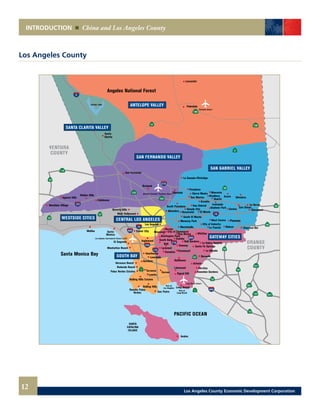
  • 125.
    SECTION 8 Conclusion LatinAmerica by starting with establishing a partnership with the Port of Hong Kong. 3 Attempt to better leverage the resources of the LAEDC and the World Trade Center Los Angeles (WTC-LA), the Chinese Consulate General and other China related organizations to increase the level of interaction between U.S. and Chinese companies – focus on business development exchanges and foreign direct investment prospects. 4 Make full use of the “California -China Provinces Joint Working Group on Trade and Investment Cooperation” and help to substantiate its working mechanism through partnering with its Southern California Secretariat – LARExC and organizations like the LAEDC. Try to make better use of local connections and resources of neighboring counties to form a magnet to attract Chinese investors, while establishing stronger business connections with the Working Group’s Chinese member provinces whose aggregate GDP is twice as large as California’s. 5 Focus on increasing the number of Chinese language programs within Los Angeles County primary and secondary schools, community colleges and universities as well as other Los Angeles County organizations and associations such as those mentioned within this report (please see the Personal Ties section). 6 Work with federal legislators to support immigration and visa policies that allow for easy access to the U.S. for students, scientists, researchers, investors and other professionals from China. 7 Promote Los Angeles County to Chinese students and tourists – attempt to attract Chinese high school students via exchange programs; also college students, graduate students and those looking to learn English at various institutions – develop a marketing campaign to attract Chinese tourists to Los Angeles County emphasizing all the region has to offer to them including cultural and medical tourism (as mentioned in the Personal Ties section) and create cultural activities to strengthen the longstanding ties between China and the people of Los Angeles County. 8 Attempt to work with the local media to advocate for a more balanced reporting approach regarding the U.S.-China relationship. Absolutely critical to make everyone aware of the significance and overall impact of the relationship. As clearly demonstrated within this report, the rise of China has and will continue to have a tremendously beneficial impact on the economic development of Los Angeles County. However, as important as it is to highlight the future prospects of the relationship, it is also of significant value to note some improvements that could be made in order to ensure the relationship continues to flourish. Los Angeles County’s future prosperity will surely be impacted by how well it manages its relations with China and the rest of Asia. Recommendations Here are some recommendations for nurturing the existing Los Angeles County-China relationship in order to ensure that future ties become even stronger: 1 Promote and market Los Angeles County as an extremely attractive location for Chinese foreign direct investment – emphasize all the elements highlighted within this report in order to make it very clear why LA County provides significant overall value and return on investment. Focus on attracting Chinese companies that are looking to locate their U.S. or North American headquarters, manufacturing plants, distribution centers, etc. 2 Invest in improving the existing trade infrastructure (e.g. local seaports, airports, freeways and intermodal rail capacity to distribution centers). Implement strategies to ensure that the local ports do not lose market share to other U.S. and/or North American ports due to lower costs or faster times to market. The local ports need to dispel all congestion myths, bottleneck issues and business unfriendly perceptions. Apply pressure at the local, state and federal levels to adopt policies that support free trade and funding for trade promotion programs via the U.S. Commerce Department. Focus on expanding two-way trade, formulating stronger relationships with our Chinese counterparts at the national and provincial levels, expanding outreach programs, and promoting our local seaports as a hub between China and “Together Los Angeles County and China can take the lead on the most pressing global issues such as renewable energy and climate change. Innovation and new technologies will come out of Los Angeles area research universities and Chinese universities as both places continue to produce some of the brightest talent. Los Angeles County is in a very favorable position to benefit from China’s continued economic rise and to fortify its position as the nation’s leading gateway with China.” 120 Los Angeles County Economic Development Corporation
  • 126.
    121 GROWING TOGETHER Chinaand Los Angeles County Acknowledgements The Los Angeles County Economic Development Corporation (LAEDC) and the World Trade Center – Los Angeles wishes to express its thanks to the individuals and organizations who have contributed to the final production of this study. LAEDC and WTC-LA Staff Bill Allen, President and CEO Dr. Robert Kleinhenz, Chief Economist George Entis, Research Assistant Henry Wang, Chief China Representative Natalie Moulding, Trade Assistant U.S. Department of Commerce, U.S. Foreign Commercial Service Embassy of the United States of America in Beijing William M. Zarit, Former Minister for Commercial Affairs East West Bank Kwok-Yin (KY) Cheng, Executive Vice President, Director of International Trade Banking Johns Hopkins University The Paul H. Nitze School of Advanced International Studies (SAIS) David M. Lampton, Director of SAIS-China (Nanjing Center) and China Studies Mitchell Silberberg & Knupp Lessing E. Gold, Partner and Chair of the LAEDC World Trade Committee O’Melveny & Myers LLP Steven J. Olson, Partner and Co-Chair of the LAEDC World Trade Committee Los Angeles County Economic Development Corporation
  • 127.
    GROWING TOGETHER Chinaand Los Angeles County Introduction China’s Rise: Challenges and Opportunities, by C. Fred Bergsten, Charles Freeman, Nicholas Lardy, Derek Mitchell Global California, Rising to the Cosmopolitan Challenge, by Abraham F. Lowenthal Carnegie Endowment for International Peace | China’s Economic Rise Financial Times Special Report | China McKinsey & Company | Chinese Cities in 2025 and 2030 IHS Global Insight California Department of Finance Section 1 | Historical Ties A History of the Chinese in California, Chinese Historical Society of America Chinese Labor in California, by Ping Chiu The Chinese Role in Building the Central Pacific, Southern Pacific Relations Memorandum China: A Teaching Workbook, Columbia University, East Asian Curriculum Project Chinese Historical Society of California Section 2 | Personal Ties Educational Ties Institute of International Education, 2013 Open Doors Report U.S. Department of Education Association of Pacific Rim Universities (APRU) People’s Daily Online University of Southern California (USC) University of Southern California (USC) Vice Provost’s Office for Globalization Center for International Studies Marshall School of Business University of California, Los Angeles (UCLA) Office of Analysis and Information Management International Institute International Education Office Office of Media Relations University of California Education Abroad www.uschinamediabrief.com Sources 122 Los Angeles County Economic Development Corporation
  • 128.
    GROWING TOGETHER Chinaand Los Angeles County Educational Ties Loyola Marymount University Institutional Research Communications & Government Relations California State University (CSU), Dominguez Hills Advancement Services Occidental College Office of Alumni Relations California State University (CSU), Long Beach Institutional Research and Assessment Caltech International Student Programs Caltech Alumni Association California State University (CSU), Pomona International Center Office of Alumni Affairs California State University (CSU), Los Angeles Office of Institutional Research ERSS Asian Pacific Business Institute California State University (CSU), Northridge Office of Institutional Research The Claremont Colleges International Placement Office Cultural and Network Ties Consulate General of the People’s Republic of China U.S. Census Bureau, American Community Survey City of Los Angeles, Sister Cities of Los Angeles Sister Cities in the United States Chinatown Los Angeles Los Angeles Chinese Cultural Center Los Angeles Chinese Learning Center California Travel and Tourism Commission China National Tourist Office China International Travel Service Asia Society China-U.S. Exchange Foundation Committee of 100 The 1990 Institute China Enterprise Council (CEC) Hong Kong Association of Southern California (HKASC) Sources 123Los Angeles County Economic Development Corporation
  • 129.
    GROWING TOGETHER Chinaand Los Angeles County Section 3 | The Chinese Economy China’s Rise: Challenges and Opportunities, by C. Fred Bergsten, Charles Freeman, Nicholas Lardy, Derek Mitchell – Peterson Institute for International Economics China-United States Exchange Foundation, U.S.-China Economic Relations in the Next Ten Years: Towards Deeper Engagement and Mutual Benefit International Monetary Fund, IMF Country Report, People’s Republic of China Financial Times, Analysis Section, When China Sneezes Bloomberg Brief, China’s Reform Plan Stratfor Global Intelligence, China: The Next Phase of Reform Council on Foreign Relations, Center for Geoeconomic Studies, Growth and Reform in China Yale Global Online, Get Ready for the Next China Financial Times, Analysis Section, Slower but steady HSBC Global Research Section 4 | Trade Ties U.S. Department of Commerce, Bureau of the Census, USATrade Online National Bureau of Statistics of China U.S. Census Bureau, Foreign Trade Division Peterson Institute for International Economics Los Angeles Chamber of Commerce, Global Initiatives The US-China Business Council, Reports, Analysis & Statistics Congressional Research Service, China-US Trade Issues, by Wayne Morrison California Chamber of Commerce, Trade Statistics California Department of Finance, California Trade Data U.S. Department of Commerce, International Trade Administration (ITA) U.S. Department of Commerce, U.S. Commercial Service World Trade Organization (WTO), Tariff and Trade Statistics Journal of Commerce (JOC) PIERS Global Intelligence Solutions Central Intelligence Agency (CIA) World Fact Book 2013 Port of Los Angeles (POLA) Port of Long Beach (POLB) Los Angeles World Airports, Los Angeles International Airport (LAX) Airports Council International (ACI) Los Angeles Times E-Cargonews Asia Los Angeles Tourism & Convention Board Brookings Institution, Export Nation Sources 124 Los Angeles County Economic Development Corporation
  • 130.
    GROWING TOGETHER Chinaand Los Angeles County Section 5 | Investment Ties Bureau of Economic Analysis (BEA), Foreign Direct Investment in the U.S. U.S. Department of Commerce and the President’s Council of Economic Advisers, Foreign Direct Investment in the U.S. U.S. Department of Commerce, SelectUSA National Bureau of Statistics of China Rhodium Group/Asia Society, An American Open Door? Maximizing the Benefits of Chinese Foreign Direct Investment Rhodium Group/ Asia Society, Chinese Direct Investment in California Rhodium Group/Asia Society, The Next Wave of Chinese Investment in America The US-China Business Council LAEDC Foreign Direct Investment Study LAEDC FDI Database Chinese Enterprise Council (CEC) World Trade Center Los Angeles (WTC-LA) – www.wtca-lalb.org Peterson Institute for International Economics The China Business Review, China Invests Abroad China Investment Corporation Credit Suisse, China Research Office ACG Los Angeles Capital Connection Deloitte, Chinese Services Group Deloitte Consulting Vale Columbia Center on Sustainable International Investment, Fundacao Dom Cabral, Fudan University, Indian School of Business, Moscow School of Management SKOLKOVO – Five-Diamond International Conference Cycle, Thinking Outward: Global Players from Emerging Markets, by Clarence Kwan and Karl Sauvant and While global FDI falls, China’s outward FDI doubles, by Ken Davies 2014 Asia-Pacific Business Outlook (APBO) OECD Investment Policy Reviews: China 2013 Consulate General of the People’s Republic of China Hong Kong Trade Development Council (HKTDC) North American Representative Office of Shenzhen (NAROS) China Jiangsu Provincial Economic and Trade Office Shanghai Foreign Investment Development Board KPMG, Navigating China’s Trade and Customs Environment The China Business Review China-Mart Southern California Edison, EV Technical Center Sources 125Los Angeles County Economic Development Corporation
  • 131.
    GROWING TOGETHER Chinaand Los Angeles County Section 5 | Investment Ties World Economic Forum Meeting of New Champions Fortune China Xinhua New Agency Business Week The Economist Magazine Time Magazine The New York Times Section 6 | Business Ties Los Angeles Business Journal, Book of Lists 2014 Consulate General of the People’s Republic of China Chinese Enterprise Council (CEC) Fortune Magazine, Top 500 Companies Chinese Historical Society of Southern California, History of Chinese American Banking in Los Angeles Xinhuanet.com LAEDC, Foreign Direct Investment in Los Angeles County World Trade Center | Los Angeles (WTC-LA) Chinese Companies with a presence in Los Angeles County: BYD Company Limited (Profile in Investment Ties Section) Greenland Holdings Group (Profile in Investment Ties Section) Shenzhen New World Group (Profile in Investment Ties Section) Amoi Electronics AVIC International Holding Company, previously China National Aero-Technology Import & Export Corporation, CATIC Bank of China China Mobile China Ocean Shipping Company, COSCO China Shipping North America (CSNA) China State Power (USA) China NetCom Operations Limited USA China America Electronics Corporation (CEIEC) Chinatex Grains & Oil (USA) China Television Corporation China Interocean Transport China First Capital Dacheng Law Offices Dalu International GeneralTouch Sources 126 Los Angeles County Economic Development Corporation
  • 132.
    GROWING TOGETHER Chinaand Los Angeles County Section 6 | Business Ties Chinese Companies with a presence in Los Angeles County: Hangzhou HIKVision Digital Technology Company Hongdou Group USA Commercial Aircraft Corporation of China (COMAC) Dalian Wanda Group Industrial and Commercial Bank of China Ltd. (ICBC) China Merchants Bank (Wing Lung Bank) China CITIC Bank Guangzhou Tech-Long Packaging Machinery Co. Phoenix HK TV Guangdong Phnix Eco-Energy Solution Ltd. Landsea Group Shanghai Greenland Holding Group Golden Dream Media and Communications (USA) China Southern Airlines China Eastern Airlines Air China Cathay Pacific Hong Kong Companies with a presence in Los Angeles County: Orient Overseas Container Line (OOCL) Kerry Logistics Li & Fung LTD TVB (USA) Sing Tao News Corporation Phoenix Satellite Television Holdings K.Wah Group/Stanford Hotels Group Great Eagle Group Holdings Limited/Langham Hotels and Resorts The Hong Kong and Shanghai Hotels Lee Kum Kee Ken Wah Bakery Café de Coral/Manchu Wok Varitronix International Sources 127Los Angeles County Economic Development Corporation
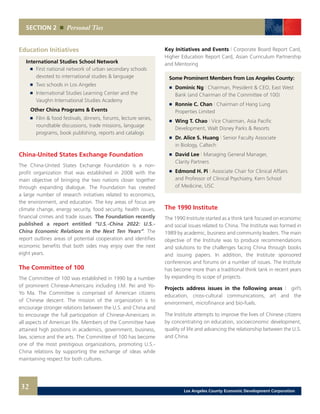
  • 133.
    GROWING TOGETHER Chinaand Los Angeles County Appendix 4th largest country (in terms of territory) in the world after Russia, Canada and U.S. Population | approximately 1.4 billion | largest in the world Different stages of Political Evolution: 221 B.C. | unification under the Qin or Ch’in Dynasty January 1, 1912 | Qing or Ch’ing Dynasty replaced by the Republic of China October 1, 1949 | People’s Republic of China established Chief of State | President Xi Jinping Head of Government | Premier Li Keqiang New government took office in 2012 12th 5-Year Plan ends in 2015 and the 13th 5-Year Plan starts in 2016 Ambassador to the U.S. | Cui Tiankai Consulate General of the People’s Republic of China in Los Angeles | Consul General Liu Jian China at a Glance China’s Economy at a Glance China’s GDP in 2013 was $9.2 trillion (based on current exchange rates) Second largest economy in the world | expected to surpass the U.S. to become the largest economy in the world by 2015 based on PPP* exchange rates or by 2025 based on market exchange rates China’s growth averaged 10% a year from 1980 to 2009 Largest trading nation in the world $400 billion when including Hong Kong 10 Main Ports | Shanghai (#1 in China and #2 in the world, Hong Kong (#3 in China and #4 in the world), Shenzhen (#2 in China and #3 in the world), Guangzhou (#6), Ningbo (#4), Qingdao (#5), Tianjin (#7), Xiamen (#8), Dalian (#9) and Qinhuangdao (#10), and 6 of the top 10 in the world No. 1 in inward FDI for developing nations | 22nd year in a row GDP composition by sector | industry 44%, services 46%, and agriculture 10% Total foreign exchange reserves held by China are $4 trillion Total labor force is 798 million 2014 Forbes Billionaire List | 152 Chinese, second highest number after the U.S. Per capita Income | $6,800 or $9,800 in purchasing power parity (PPP)* Gross National Saving Rate | 50% of GDP All based on the most recent data available. *Purchasing Power Parity | A nation’s GDP at purchasing power parity (PPP) exchange rates is the sum value of all goods and services produced in the coun ry valued at prices prevailing in the United States. This is the measure most economists prefer when looking at per-capita welfare and when comparing living conditions or use of resources across countries. 128 Los Angeles County Economic Development Corporation