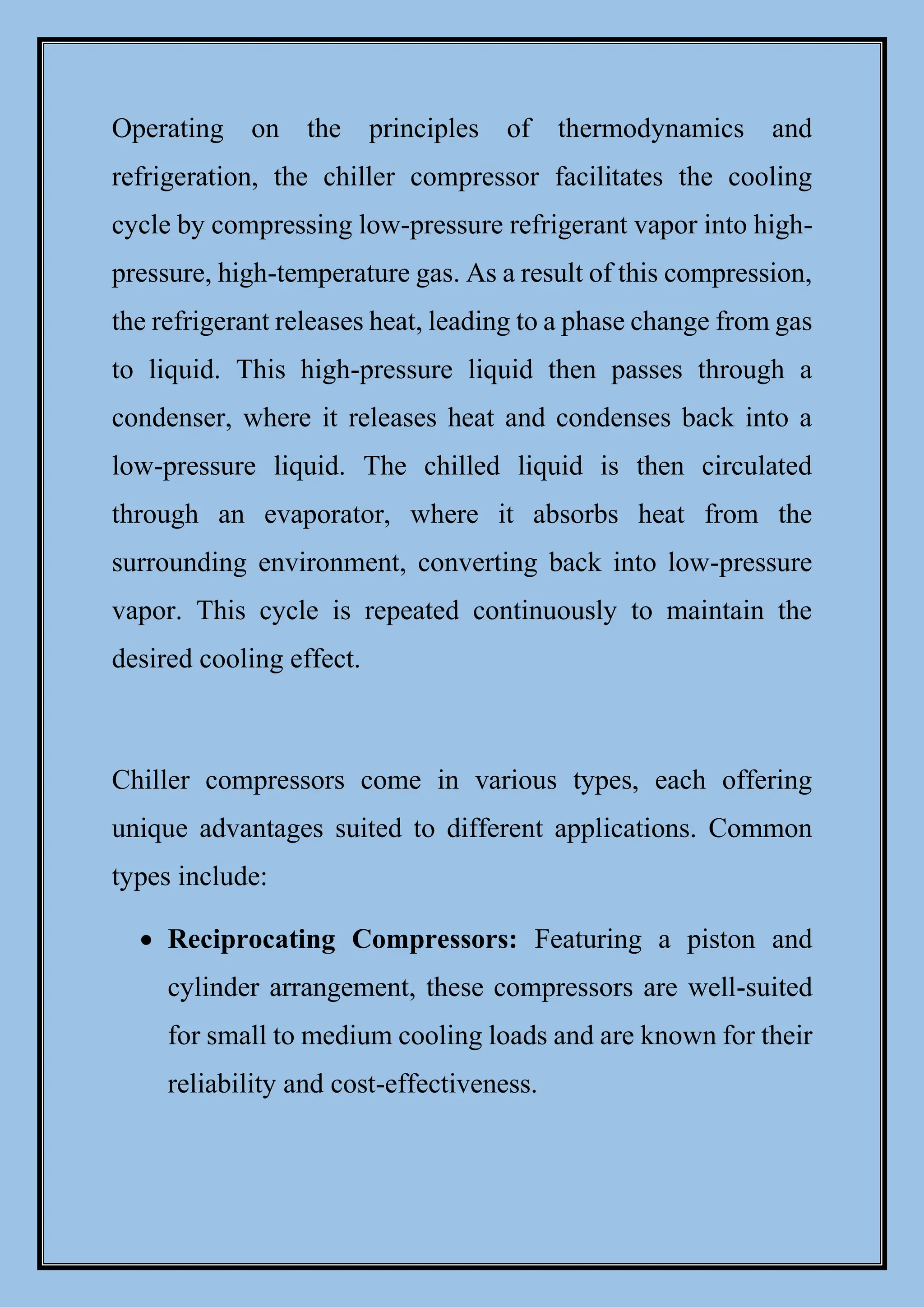
Chiller Compressor
A Chiller compressor is a vital component of chiller systems
used for cooling air or water in various industrial and
commercial applications. It plays a central role in the heat
transfer process, ensuring efficient and reliable cooling to
maintain temperature-controlled environments.
Operating on the principles of thermodynamics and
refrigeration, the chiller compressor facilitates the cooling
cycle by compressing low-pressure refrigerant vapor into high-
pressure, high-temperature gas. As a result of this compression,
the refrigerant releases heat, leading to a phase change from gas
to liquid. This high-pressure liquid then passes through a
condenser, where it releases heat and condenses back into a
low-pressure liquid. The chilled liquid is then circulated
through an evaporator, where it absorbs heat from the
surrounding environment, converting back into low-pressure
vapor. This cycle is repeated continuously to maintain the
desired cooling effect.
Chiller compressors come in various types, each offering
unique advantages suited to different applications. Common
types include:
 Reciprocating Compressors: Featuring a piston and
cylinder arrangement, these compressors are well-suited
for small to medium cooling loads and are known for their
reliability and cost-effectiveness.
 Screw Compressors: Utilizing two rotating helical
screws, these compressors are suitable for medium to
large cooling loads and offer high efficiency and smooth
operation.
 Scroll Compressors: Utilizing two interleaving scrolls,
these compressors are compact, energy-efficient, and ideal
for light to medium cooling loads.
 Centrifugal Compressors: Employing a high-speed
impeller, these compressors are designed for large cooling
capacities and are known for their energy efficiency and
low maintenance.
Choosing the right chiller compressor depends on factors such
as cooling capacity requirements, energy efficiency goals,
space constraints, and budget considerations.

Chiller Compressor.pdf

  • 1.
    Chiller Compressor A Chillercompressor is a vital component of chiller systems used for cooling air or water in various industrial and commercial applications. It plays a central role in the heat transfer process, ensuring efficient and reliable cooling to maintain temperature-controlled environments.
  • 2.
    Operating on theprinciples of thermodynamics and refrigeration, the chiller compressor facilitates the cooling cycle by compressing low-pressure refrigerant vapor into high- pressure, high-temperature gas. As a result of this compression, the refrigerant releases heat, leading to a phase change from gas to liquid. This high-pressure liquid then passes through a condenser, where it releases heat and condenses back into a low-pressure liquid. The chilled liquid is then circulated through an evaporator, where it absorbs heat from the surrounding environment, converting back into low-pressure vapor. This cycle is repeated continuously to maintain the desired cooling effect. Chiller compressors come in various types, each offering unique advantages suited to different applications. Common types include:  Reciprocating Compressors: Featuring a piston and cylinder arrangement, these compressors are well-suited for small to medium cooling loads and are known for their reliability and cost-effectiveness.
  • 3.
     Screw Compressors:Utilizing two rotating helical screws, these compressors are suitable for medium to large cooling loads and offer high efficiency and smooth operation.  Scroll Compressors: Utilizing two interleaving scrolls, these compressors are compact, energy-efficient, and ideal for light to medium cooling loads.  Centrifugal Compressors: Employing a high-speed impeller, these compressors are designed for large cooling capacities and are known for their energy efficiency and low maintenance. Choosing the right chiller compressor depends on factors such as cooling capacity requirements, energy efficiency goals, space constraints, and budget considerations.