Presented by: Charlyn D. Baldesco
BSED-2 English
MACRO SKILLS
COMPETENCIES IN
THE ENGLISH K TO
12 CURRICULUM
[REPUBLIC ACT NO. 10533]
The Enhanced Basic Education Curriculum or
popularly known as K-12 Curriculum.
“AN ACT ENHANCING THE PHILIPPINE BASIC EDUCATION SYSTEM BY
STRENGTHENING ITS CURRICULUM AND INCREASING THE NUMBER OF YEARS
FOR BASIC EDUCATION, APPROPRIATING FUNDS THEREFOR AND FOR OTHER
PURPOSES.”
COMPETENCIES BASED CURRICULUM (CBC)
Targets of CBC:
The Competence-Based Curriculum requests from teachers
to address individual learning style, to use their freedom of
adding or adapting the curriculum to local needs or specific
realities. The teacher may choose the teaching methods and
techniques and may adapt the pedagogical practices
depending on learner's cognitive and effective backgrounds
and learning styles.
The emphasis in the CBC is on:
1. The learner : as an autonomous thinker and explorer who expresses his/her own points of view, builds
arguments and asks questions for understanding, exchanges ideas, and co-operates with others in
problem solving rather than a passive recipient of information.
2. The teacher: as a facilitator of learning, a coach as well as a partner that helps the learner to
understand and explain rather than a "knowledge authority"
3. Classroom learning: the learning which is based on collaboration and aiming developing competences
instead of being based on competition in order to establish hierarchies among learners, and aiming at
developing factual knowledge focused only on validated examples
4. The content: The aim of the curriculum is to produce a major shift from a theoretical teaching of the
subject to a variety of contexts that generate learning with understanding
5. Teacher's role: from an information provider to an organizer of a wide variety oflearning activities for all
children
6. Assessment: From subjectivism and rigidity of marks meant to classify learners, to self-assessment and
progress assessment
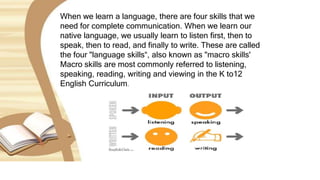
When we learn a language, there are four skills that we
need for complete communication. When we learn our
native language, we usually learn to listen first, then to
speak, then to read, and finally to write. These are called
the four "language skills“, also known as "macro skills'
Macro skills are most commonly referred to listening,
speaking, reading, writing and viewing in the K to12
English Curriculum.
LISTENING
It is the most important skills in communication. This is a communication
technique that requires the listener to understand, interpret and evaluate what he
or she hears. Listening effectively improves personal relationships through the
reduction of conflict and strengthens cooperation through a collective
understanding while speaking is vocalization of human communication. Being
able to express an idea, concept or opinion through speech is essential in the
communicative process and languages are about communication. A good
language teachers plan lessons, and sequences of lessons, which include a
mixture of all the macro skills, rather than focusing on developing only one
macro-skill at a time.
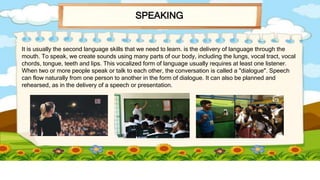
It is usually the second language skills that we need to learn. is the delivery of language through the
mouth. To speak, we create sounds using many parts of our body, including the lungs, vocal tract, vocal
chords, tongue, teeth and lips. This vocalized form of language usually requires at least one listener.
When two or more people speak or talk to each other, the conversation is called a "dialogue". Speech
can flow naturally from one person to another in the form of dialogue. It can also be planned and
rehearsed, as in the delivery of a speech or presentation.
SPEAKING
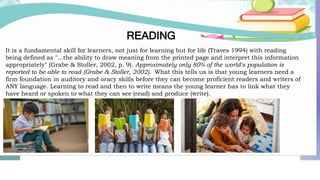
It is a fundamental skill for learners, not just for learning but for life (Traves 1994) with reading
being defined as "...the ability to draw meaning from the printed page and interpret this information
appropriately" (Grabe & Stoller, 2002, p. 9). Approximately only 80% of the world's population is
reported to be able to read (Grabe & Stoller, 2002). What this tells us is that young learners need a
firm foundation in auditory and oracy skills before they can become proficient readers and writers of
ANY language. Learning to read and then to write means the young learner has to link what they
have heard or spoken to what they can see (read) and produce (write).
READING
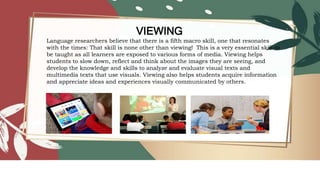
VIEWING
Language researchers believe that there is a fifth macro skill, one that resonates
with the times: That skill is none other than viewing! This is a very essential skill to
be taught as all learners are exposed to various forms of media. Viewing helps
students to slow down, reflect and think about the images they are seeing, and
develop the knowledge and skills to analyze and evaluate visual texts and
multimedia texts that use visuals. Viewing also helps students acquire information
and appreciate ideas and experiences visually communicated by others.
1. https://www.officialgazette.gov.ph/2013/05/15/republic-act-no-10533/
2. www.moe.edu.kw
3. https://www.onestopenglish.com/professional-development/advancing-learning-
the-fifth-skill-viewing/557577.article
LINKS:

charlyn-2.pptx

  • 1.
    Presented by: CharlynD. Baldesco BSED-2 English MACRO SKILLS COMPETENCIES IN THE ENGLISH K TO 12 CURRICULUM
  • 2.
    [REPUBLIC ACT NO.10533] The Enhanced Basic Education Curriculum or popularly known as K-12 Curriculum. “AN ACT ENHANCING THE PHILIPPINE BASIC EDUCATION SYSTEM BY STRENGTHENING ITS CURRICULUM AND INCREASING THE NUMBER OF YEARS FOR BASIC EDUCATION, APPROPRIATING FUNDS THEREFOR AND FOR OTHER PURPOSES.”
  • 3.
    COMPETENCIES BASED CURRICULUM(CBC) Targets of CBC: The Competence-Based Curriculum requests from teachers to address individual learning style, to use their freedom of adding or adapting the curriculum to local needs or specific realities. The teacher may choose the teaching methods and techniques and may adapt the pedagogical practices depending on learner's cognitive and effective backgrounds and learning styles.
  • 4.
    The emphasis inthe CBC is on: 1. The learner : as an autonomous thinker and explorer who expresses his/her own points of view, builds arguments and asks questions for understanding, exchanges ideas, and co-operates with others in problem solving rather than a passive recipient of information. 2. The teacher: as a facilitator of learning, a coach as well as a partner that helps the learner to understand and explain rather than a "knowledge authority" 3. Classroom learning: the learning which is based on collaboration and aiming developing competences instead of being based on competition in order to establish hierarchies among learners, and aiming at developing factual knowledge focused only on validated examples 4. The content: The aim of the curriculum is to produce a major shift from a theoretical teaching of the subject to a variety of contexts that generate learning with understanding 5. Teacher's role: from an information provider to an organizer of a wide variety oflearning activities for all children 6. Assessment: From subjectivism and rigidity of marks meant to classify learners, to self-assessment and progress assessment
  • 5.
    When we learna language, there are four skills that we need for complete communication. When we learn our native language, we usually learn to listen first, then to speak, then to read, and finally to write. These are called the four "language skills“, also known as "macro skills' Macro skills are most commonly referred to listening, speaking, reading, writing and viewing in the K to12 English Curriculum.
  • 6.
    LISTENING It is themost important skills in communication. This is a communication technique that requires the listener to understand, interpret and evaluate what he or she hears. Listening effectively improves personal relationships through the reduction of conflict and strengthens cooperation through a collective understanding while speaking is vocalization of human communication. Being able to express an idea, concept or opinion through speech is essential in the communicative process and languages are about communication. A good language teachers plan lessons, and sequences of lessons, which include a mixture of all the macro skills, rather than focusing on developing only one macro-skill at a time.
  • 7.
    It is usuallythe second language skills that we need to learn. is the delivery of language through the mouth. To speak, we create sounds using many parts of our body, including the lungs, vocal tract, vocal chords, tongue, teeth and lips. This vocalized form of language usually requires at least one listener. When two or more people speak or talk to each other, the conversation is called a "dialogue". Speech can flow naturally from one person to another in the form of dialogue. It can also be planned and rehearsed, as in the delivery of a speech or presentation. SPEAKING
  • 8.
    It is afundamental skill for learners, not just for learning but for life (Traves 1994) with reading being defined as "...the ability to draw meaning from the printed page and interpret this information appropriately" (Grabe & Stoller, 2002, p. 9). Approximately only 80% of the world's population is reported to be able to read (Grabe & Stoller, 2002). What this tells us is that young learners need a firm foundation in auditory and oracy skills before they can become proficient readers and writers of ANY language. Learning to read and then to write means the young learner has to link what they have heard or spoken to what they can see (read) and produce (write). READING
  • 9.
    VIEWING Language researchers believethat there is a fifth macro skill, one that resonates with the times: That skill is none other than viewing! This is a very essential skill to be taught as all learners are exposed to various forms of media. Viewing helps students to slow down, reflect and think about the images they are seeing, and develop the knowledge and skills to analyze and evaluate visual texts and multimedia texts that use visuals. Viewing also helps students acquire information and appreciate ideas and experiences visually communicated by others.
  • 10.
    1. https://www.officialgazette.gov.ph/2013/05/15/republic-act-no-10533/ 2. www.moe.edu.kw 3.https://www.onestopenglish.com/professional-development/advancing-learning- the-fifth-skill-viewing/557577.article LINKS: