The Effect of Calcium Ion Concentration on
Action Potential Initiation in Chara Internodal
Cells
Melinda Galazin
Abstract:
Cytoplasmic streaming is a vital process to chara cells, as their internodal cells can grow
up to 10 cm and are far too large for diffusion to distribute the needed nutrients properly.
However, this process can be dangerous when a cell is injured. In order to stop streaming,
enough calcium ions must be able to enter the cell and generate an action potential. Calcium
buffers were made from a range of pCa 5 to pCa 7 and E-C coupling was tested. A calcium
concentration of 6.5 or higher was found to be necessary for an action potential to be reliably
initiated. Channel blockers such as lanthanide inhibit the ability of calcium to enter the cell, and,
depending on the type of lanthanide and concentration, may be able to prevent an action potential
all together. pLa buffers ranging from pLa 3 to pLa 8 were tested, and a pLa concentration of 7 is
sufficient to inhibit E-C coupling. Action potential generation requires that there be enough
external calcium ions to be taken in by the cell, and also that the external lanthanide
concentration is low enough not to channel block calcium uptake.
Introduction:
Chara have large internodal cells, some up to 10 centimeters in length. Because of this,
their cells are visible even without a microscope, and cell contents can be easily visualized even
at low microscope magnifications. This allows for cytoplasmic streaming, a process vital to large
chara cells, to be observed.
Cytoplasmic streaming is the flow of the cytosol of the cell, caused by myosin motor
proteins sliding along actin filaments. Through this process, nutrients are moved throughout the
cell at a rate faster than simple diffusion, which helps to allow single chara cells to grow so large.
It also promotes a faster exchange of molecules across different membranes inside the cell
(Verchot-Lubicz, 2010). However, if chara cells are injured, cytoplasmic streaming stops
immediately, so as to prevent the cell contents from flowing out of the cell. The streaming stops
not because of the cytosol, but because there is no longer a force moving it (Hayama, 1979). An
action potential is required for this, meaning that there must be enough calcium ions outside the
cell for action potential to be generated. The mechanical stimulation of injury causes an action
potential, and calcium ions rush into the cell, binding to a protein kinase. The protein kinase then
phosphorylates the myosin, inhibiting its ability to bind to actin and effectively stopping
cytoplasmic streaming. After it is safe for the cell to begin streaming again, the myosin is
dephosphorylated, the membrane is repolarized, and streaming continues (Johnson, 2002).
Action potentials have an all or nothing response. If not enough calcium ions are able to
get into the cell and bind to a protein kinase, the membrane remains polarized and streaming
continues. As an injured cell would die if its contents streamed out of it, chara cells must have
adequate amounts of external calcium ions to survive injury. In chara cells, the ability to generate
an action potential and stop streaming when triggered by an electrical stimulation is known as E-
C coupling. A mechanical form of stimulation is also possible, but it is far more likely for the
cells to be damaged using mechanical stimulation, so electrical is preferred. By simply running
an electrical current through the cell, streaming can be halted if there is enough calcium ions in
solution. As such, this is an effective method to test whether the amount of calcium in solution
are adequate for the cells.
Streaming can also be affected by channel blockers such as lanthanide. Lanthanide has a
similar ionic radius to calcium, and is able to bind to the cell in place of calcium. Lanthanide has
a high enough binding affinity at micromolar concentrations to completely block calcium ion
entry, while ions such as magnesium require a millimolar concentration to do so (Lansman,
1990). When calcium cannot enter the cell, an action potential cannot be generated, and
streaming continues.
In this study we tested action potential generation in chara internodal cells at varying pCa
levels to determine the minimum calcium concentration they can be reliably initiated at. The
concentration of La3+ required to fully inhibit E/C coupling was also tested. While it may be
possible to initiate an action potential at pCa 6 and 7, pCa 5 will likely be the lowest
concentration with 100% E/C coupling. pCa 6 has been found to support half the minimal
response for an action potential (Staves, 1993). As lanthanide has a higher binding affinity to the
cell than calcium does for the calcium channel, the lowest pLa concentration able to prevent an
action potential generation should be 6 (Lansman, 1990).
Materials and Methods:
Our chara cells were grown in a greenhouse in artificial pond water. A series of buffers of
varying pCa concentrations were made to test chara internodal cell E/C coupling. The first three
buffers produced were pCa 5, 6 and 7. All were prepared with 18Ω water, EGTA, HEPES, NaCl
and KCl. CaCl2 concentration varied from buffer to buffer. Chara internodal cells were
incubated in each buffer for 15 minutes, starting with pCa 5, and then placed on a glass slide
filled with the same buffer with a silicon bridge in the middle. Current was run through the
buffer, and the cells either continued streaming (no E/C coupling at that pCa) or stopped (E/C
coupling occurs at that pCa).
After testing the pCa 5, 6 and 7 buffers, % E/C coupling was found to drop dramatically
between pCa 6 and 7. Six new buffers were made to test the range between them, using the same
procedure as before: pCa 6.15, pCa 6.25, pCa 6.35, pCa 6.45, pCa 6.55, and pCa 6.65. E/C
coupling was tested in the same way as before, until 0% E/C coupling was obtained.
After all pCa 6.15-6.65 buffers were tested, new buffers were made to be tested. They all
had a pCa value of 5 and varied in their concentration of La3+. All six lanthanide buffers were
prepared with 18Ω water, EGTA, HEPES, NaCl and KCL, and varied only in the amount of
CaCl2 and LaCl3 added: The buffers made had pLa concentrations of 8, 7, 6, 5, 4, and 3. Chara
internodal cells were incubated in each buffer for 15 minutes, and tested for E/C coupling in the
same manner as before, this time starting with pLa 8, the lowest concentration buffer. Testing
ended after all streaming ceased in each cell, as chara cells are unable to export La3+ out of their
cells effectively.
Results:
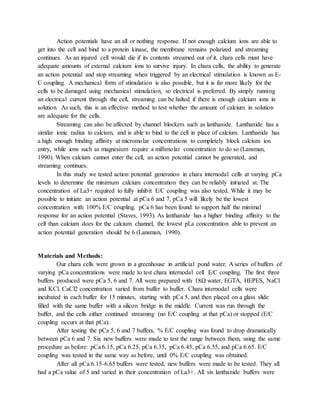
Chara cells were shown to have E-C coupling at pCa concentrations of 5 and 6, but not 7.
One of our cells was too long to fit fully in the buffer when tested, and gave poor results.
Excluding that cell, our E-C coupling at pCa 5 and 6 would have been 100%.
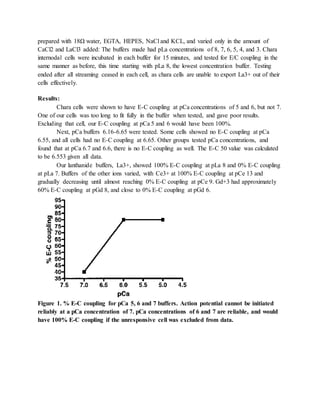
Next, pCa buffers 6.16-6.65 were tested. Some cells showed no E-C coupling at pCa
6.55, and all cells had no E-C coupling at 6.65. Other groups tested pCa concentrations, and
found that at pCa 6.7 and 6.6, there is no E-C coupling as well. The E-C 50 value was calculated
to be 6.553 given all data.
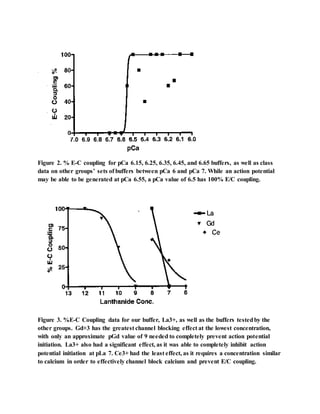
Our lanthanide buffers, La3+, showed 100% E-C coupling at pLa 8 and 0% E-C coupling
at pLa 7. Buffers of the other ions varied, with Ce3+ at 100% E-C coupling at pCe 13 and
gradually decreasing until almost reaching 0% E-C coupling at pCe 9. Gd+3 had approximately
60% E-C coupling at pGd 8, and close to 0% E-C coupling at pGd 6.
Figure 1. % E-C coupling for pCa 5, 6 and 7 buffers. Action potential cannot be initiated
reliably at a pCa concentration of 7. pCa concentrations of 6 and 7 are reliable, and would
have 100% E-C coupling if the unresponsive cell was excluded from data.
Figure 2. % E-C coupling for pCa 6.15, 6.25, 6.35, 6.45, and 6.65 buffers, as well as class
data on other groups’ sets of buffers between pCa 6 and pCa 7. While an action potential
may be able to be generated at pCa 6.55, a pCa value of 6.5 has 100% E/C coupling.
Figure 3. %E-C Coupling data for our buffer, La3+, as well as the buffers testedby the
other groups. Gd+3 has the greatest channel blocking effect at the lowest concentration,
with only an approximate pGd value of 9 needed to completely prevent action potential
initiation. La3+ also had a significant effect, as it was able to completely inhibit action
potential initiation at pLa 7. Ce3+ had the least effect, as it requires a concentration similar
to calcium in order to effectively channel block calcium and prevent E/C coupling.
Discussion:
A specific concentration of calcium is required to form an action potential and cease
cytoplasmic streaming. Our data found that somewhere between pCa 6 and 7, % E-C coupling
drops to zero. Given our results, pCa concentrations of of 6.6 aren’t high enough to allow E-C
coupling. E-C50 was found to be 6.553, and 100% E-C coupling occurs somewhere around pCa
6.5 or higher. However, as there are multiple ways to test action potential generation--using
either mechanical or electrical stimulation--the methods we used affected our results. Results
acquired from testing mechanical stimulation have found E-C50 to be around pCa 6, as opposed
to pCa 6.553 (Staves, 1993). There are several possible reasons for this. First of all, we tested a
greater number of buffers to determine our E-C50 value, leading to a more precise result.
Secondly, Staves tested the amount of depolarization, whereas we were simply testing to see
whether or not an action potential was fired. Staves looked at values while we looked at all or
nothing results. Thirdly, it is possible that chara cells respond more sensitively to electrical
stimulation than mechanical stimulation, as the mechanical stimulation is much more likely to
injure the cell.
One of the lanthanide buffers tested, Gd3+, caused 0% E-C coupling even at a much
lower concentration of calcium--pGd was ~9, while pCa was 5. The other lanthanide buffers
required higher concentrations, with pLa at 7 and pCe at ~6. Of the three, Gd+3 was favored the
most by the cell, while Ce+3 only has slightly more affinity than Ca+2. This could possibly be
attributed to ion size, however, the trend is not the same. Ce+3 required the highest concentration
to inhibit an action potential, but is medium in size compared to the other two ions.
Previous work has shown that smaller ions, like Gd+3, enter the cell more slowly but
bind more effectively than larger ions (Lansman, 1990). It’s possible that enough Gd+3 managed
to enter the cell and bind effectively to inhibit action potential initiation, and La+3 entered
quickly enough that, despite poorer binding affinity, some ions still managed to block calcium
entry. Ce+3 may have failed to enter quickly enough to overcome poor binding, and therefore
required a higher concentration to stop an action potential from being generated.
For a future experiment, it would be beneficial to compare the effect of mechanical and
electrical stimulation on chara cells at the same pCa. We could make the same range of buffers
as before, this time testing another set of cells with a mechanical stimulation. Even when we
were testing our internodal cells with electrical stimulation, we were able to somewhat see the
effects of mechanical stimulation. Streaming would cease if a cell was moved around too much
when positioning it under the microscope. By testing mechanical stimulation under the same
conditions as electrical stimulation, we could generate an E-C50 value for both and compare
them. This would allow us to determine what caused the discrepancy between our data and
Staves’s.
Calcium is essential for chara to survive in any environment, as it is necessary for them to
stop cytoplasmic streaming when injured. Without an external pCa of 6.5 or higher, an action
potential cannot be reliably generated when exposed to electrical stimulus. Mechanical stimulus
may require a higher calcium concentration in order to stop cytoplasmic streaming. To be on the
safe side, chara should be grown in an environment with a pCa value of at least 6 or higher.
Other ions similar to calcium in size are also able to bind in the cell where calcium would. This
interrupts cytoplasmic streaming in high enough concentrations, though the exact concentration
varies for each individual ion depending on its size. While cytoplasmic streaming allows chara to
grow to larger sizes than it could if it only had diffusion to transport molecules, if it cannot be
stopped, it is potentially able to slowly kill the cell when injured. As such, chara must be grown
in conditions with ample external calcium and minimum lanthanide levels.
References
Hayama, T., Shimmen, T., Tazawa, M. (1979). Participation of Ca+2 in cessation of cytoplasmic
streaming induced by membrane excitation in Characeae internodal cells. Protoplasma
99, 305-321.
Johnson, B. R., Wyttenbach, R. A., Wayne, R., Hoy, R. R. (2002). Action Potentials in a Giant
Algal Cell: A Comparative Approach to Mechanisms of Evolution and Excitability.
JUNE 1, 23-27.
Lansman, J. B. (1990). Blockage of Current through Single Calcium Channels by Trivalent
Lanthanide Cations. J Gen Physiol 95, 679-96.
Staves, M. P., Wayne, R. (1993). The Touch-induced Action Potential in Chara: Inquiry into the
Ionic Basis and the Mechanoreceptor. Aust. J. Plant physiol. 20, 471-88.
Verchot-Lubicz, J., Goldstein, R. E. (2010). Cytoplasmic streaming enables the distribution of
molecules and vesicles in large plant cells. Protoplasma 240, 99-107.

CharaPaper

  • 1.
    The Effect ofCalcium Ion Concentration on Action Potential Initiation in Chara Internodal Cells Melinda Galazin Abstract: Cytoplasmic streaming is a vital process to chara cells, as their internodal cells can grow up to 10 cm and are far too large for diffusion to distribute the needed nutrients properly. However, this process can be dangerous when a cell is injured. In order to stop streaming, enough calcium ions must be able to enter the cell and generate an action potential. Calcium buffers were made from a range of pCa 5 to pCa 7 and E-C coupling was tested. A calcium concentration of 6.5 or higher was found to be necessary for an action potential to be reliably initiated. Channel blockers such as lanthanide inhibit the ability of calcium to enter the cell, and, depending on the type of lanthanide and concentration, may be able to prevent an action potential all together. pLa buffers ranging from pLa 3 to pLa 8 were tested, and a pLa concentration of 7 is sufficient to inhibit E-C coupling. Action potential generation requires that there be enough external calcium ions to be taken in by the cell, and also that the external lanthanide concentration is low enough not to channel block calcium uptake. Introduction: Chara have large internodal cells, some up to 10 centimeters in length. Because of this, their cells are visible even without a microscope, and cell contents can be easily visualized even at low microscope magnifications. This allows for cytoplasmic streaming, a process vital to large chara cells, to be observed. Cytoplasmic streaming is the flow of the cytosol of the cell, caused by myosin motor proteins sliding along actin filaments. Through this process, nutrients are moved throughout the cell at a rate faster than simple diffusion, which helps to allow single chara cells to grow so large. It also promotes a faster exchange of molecules across different membranes inside the cell (Verchot-Lubicz, 2010). However, if chara cells are injured, cytoplasmic streaming stops immediately, so as to prevent the cell contents from flowing out of the cell. The streaming stops not because of the cytosol, but because there is no longer a force moving it (Hayama, 1979). An action potential is required for this, meaning that there must be enough calcium ions outside the cell for action potential to be generated. The mechanical stimulation of injury causes an action potential, and calcium ions rush into the cell, binding to a protein kinase. The protein kinase then phosphorylates the myosin, inhibiting its ability to bind to actin and effectively stopping cytoplasmic streaming. After it is safe for the cell to begin streaming again, the myosin is dephosphorylated, the membrane is repolarized, and streaming continues (Johnson, 2002).
  • 2.
    Action potentials havean all or nothing response. If not enough calcium ions are able to get into the cell and bind to a protein kinase, the membrane remains polarized and streaming continues. As an injured cell would die if its contents streamed out of it, chara cells must have adequate amounts of external calcium ions to survive injury. In chara cells, the ability to generate an action potential and stop streaming when triggered by an electrical stimulation is known as E- C coupling. A mechanical form of stimulation is also possible, but it is far more likely for the cells to be damaged using mechanical stimulation, so electrical is preferred. By simply running an electrical current through the cell, streaming can be halted if there is enough calcium ions in solution. As such, this is an effective method to test whether the amount of calcium in solution are adequate for the cells. Streaming can also be affected by channel blockers such as lanthanide. Lanthanide has a similar ionic radius to calcium, and is able to bind to the cell in place of calcium. Lanthanide has a high enough binding affinity at micromolar concentrations to completely block calcium ion entry, while ions such as magnesium require a millimolar concentration to do so (Lansman, 1990). When calcium cannot enter the cell, an action potential cannot be generated, and streaming continues. In this study we tested action potential generation in chara internodal cells at varying pCa levels to determine the minimum calcium concentration they can be reliably initiated at. The concentration of La3+ required to fully inhibit E/C coupling was also tested. While it may be possible to initiate an action potential at pCa 6 and 7, pCa 5 will likely be the lowest concentration with 100% E/C coupling. pCa 6 has been found to support half the minimal response for an action potential (Staves, 1993). As lanthanide has a higher binding affinity to the cell than calcium does for the calcium channel, the lowest pLa concentration able to prevent an action potential generation should be 6 (Lansman, 1990). Materials and Methods: Our chara cells were grown in a greenhouse in artificial pond water. A series of buffers of varying pCa concentrations were made to test chara internodal cell E/C coupling. The first three buffers produced were pCa 5, 6 and 7. All were prepared with 18Ω water, EGTA, HEPES, NaCl and KCl. CaCl2 concentration varied from buffer to buffer. Chara internodal cells were incubated in each buffer for 15 minutes, starting with pCa 5, and then placed on a glass slide filled with the same buffer with a silicon bridge in the middle. Current was run through the buffer, and the cells either continued streaming (no E/C coupling at that pCa) or stopped (E/C coupling occurs at that pCa). After testing the pCa 5, 6 and 7 buffers, % E/C coupling was found to drop dramatically between pCa 6 and 7. Six new buffers were made to test the range between them, using the same procedure as before: pCa 6.15, pCa 6.25, pCa 6.35, pCa 6.45, pCa 6.55, and pCa 6.65. E/C coupling was tested in the same way as before, until 0% E/C coupling was obtained. After all pCa 6.15-6.65 buffers were tested, new buffers were made to be tested. They all had a pCa value of 5 and varied in their concentration of La3+. All six lanthanide buffers were
  • 3.
    prepared with 18Ωwater, EGTA, HEPES, NaCl and KCL, and varied only in the amount of CaCl2 and LaCl3 added: The buffers made had pLa concentrations of 8, 7, 6, 5, 4, and 3. Chara internodal cells were incubated in each buffer for 15 minutes, and tested for E/C coupling in the same manner as before, this time starting with pLa 8, the lowest concentration buffer. Testing ended after all streaming ceased in each cell, as chara cells are unable to export La3+ out of their cells effectively. Results: Chara cells were shown to have E-C coupling at pCa concentrations of 5 and 6, but not 7. One of our cells was too long to fit fully in the buffer when tested, and gave poor results. Excluding that cell, our E-C coupling at pCa 5 and 6 would have been 100%. Next, pCa buffers 6.16-6.65 were tested. Some cells showed no E-C coupling at pCa 6.55, and all cells had no E-C coupling at 6.65. Other groups tested pCa concentrations, and found that at pCa 6.7 and 6.6, there is no E-C coupling as well. The E-C 50 value was calculated to be 6.553 given all data. Our lanthanide buffers, La3+, showed 100% E-C coupling at pLa 8 and 0% E-C coupling at pLa 7. Buffers of the other ions varied, with Ce3+ at 100% E-C coupling at pCe 13 and gradually decreasing until almost reaching 0% E-C coupling at pCe 9. Gd+3 had approximately 60% E-C coupling at pGd 8, and close to 0% E-C coupling at pGd 6. Figure 1. % E-C coupling for pCa 5, 6 and 7 buffers. Action potential cannot be initiated reliably at a pCa concentration of 7. pCa concentrations of 6 and 7 are reliable, and would have 100% E-C coupling if the unresponsive cell was excluded from data.
  • 4.
    Figure 2. %E-C coupling for pCa 6.15, 6.25, 6.35, 6.45, and 6.65 buffers, as well as class data on other groups’ sets of buffers between pCa 6 and pCa 7. While an action potential may be able to be generated at pCa 6.55, a pCa value of 6.5 has 100% E/C coupling. Figure 3. %E-C Coupling data for our buffer, La3+, as well as the buffers testedby the other groups. Gd+3 has the greatest channel blocking effect at the lowest concentration, with only an approximate pGd value of 9 needed to completely prevent action potential initiation. La3+ also had a significant effect, as it was able to completely inhibit action potential initiation at pLa 7. Ce3+ had the least effect, as it requires a concentration similar to calcium in order to effectively channel block calcium and prevent E/C coupling.
  • 5.
    Discussion: A specific concentrationof calcium is required to form an action potential and cease cytoplasmic streaming. Our data found that somewhere between pCa 6 and 7, % E-C coupling drops to zero. Given our results, pCa concentrations of of 6.6 aren’t high enough to allow E-C coupling. E-C50 was found to be 6.553, and 100% E-C coupling occurs somewhere around pCa 6.5 or higher. However, as there are multiple ways to test action potential generation--using either mechanical or electrical stimulation--the methods we used affected our results. Results acquired from testing mechanical stimulation have found E-C50 to be around pCa 6, as opposed to pCa 6.553 (Staves, 1993). There are several possible reasons for this. First of all, we tested a greater number of buffers to determine our E-C50 value, leading to a more precise result. Secondly, Staves tested the amount of depolarization, whereas we were simply testing to see whether or not an action potential was fired. Staves looked at values while we looked at all or nothing results. Thirdly, it is possible that chara cells respond more sensitively to electrical stimulation than mechanical stimulation, as the mechanical stimulation is much more likely to injure the cell. One of the lanthanide buffers tested, Gd3+, caused 0% E-C coupling even at a much lower concentration of calcium--pGd was ~9, while pCa was 5. The other lanthanide buffers required higher concentrations, with pLa at 7 and pCe at ~6. Of the three, Gd+3 was favored the most by the cell, while Ce+3 only has slightly more affinity than Ca+2. This could possibly be attributed to ion size, however, the trend is not the same. Ce+3 required the highest concentration to inhibit an action potential, but is medium in size compared to the other two ions. Previous work has shown that smaller ions, like Gd+3, enter the cell more slowly but bind more effectively than larger ions (Lansman, 1990). It’s possible that enough Gd+3 managed to enter the cell and bind effectively to inhibit action potential initiation, and La+3 entered quickly enough that, despite poorer binding affinity, some ions still managed to block calcium entry. Ce+3 may have failed to enter quickly enough to overcome poor binding, and therefore required a higher concentration to stop an action potential from being generated. For a future experiment, it would be beneficial to compare the effect of mechanical and electrical stimulation on chara cells at the same pCa. We could make the same range of buffers as before, this time testing another set of cells with a mechanical stimulation. Even when we were testing our internodal cells with electrical stimulation, we were able to somewhat see the effects of mechanical stimulation. Streaming would cease if a cell was moved around too much when positioning it under the microscope. By testing mechanical stimulation under the same conditions as electrical stimulation, we could generate an E-C50 value for both and compare them. This would allow us to determine what caused the discrepancy between our data and Staves’s. Calcium is essential for chara to survive in any environment, as it is necessary for them to stop cytoplasmic streaming when injured. Without an external pCa of 6.5 or higher, an action potential cannot be reliably generated when exposed to electrical stimulus. Mechanical stimulus may require a higher calcium concentration in order to stop cytoplasmic streaming. To be on the
  • 6.
    safe side, charashould be grown in an environment with a pCa value of at least 6 or higher. Other ions similar to calcium in size are also able to bind in the cell where calcium would. This interrupts cytoplasmic streaming in high enough concentrations, though the exact concentration varies for each individual ion depending on its size. While cytoplasmic streaming allows chara to grow to larger sizes than it could if it only had diffusion to transport molecules, if it cannot be stopped, it is potentially able to slowly kill the cell when injured. As such, chara must be grown in conditions with ample external calcium and minimum lanthanide levels. References Hayama, T., Shimmen, T., Tazawa, M. (1979). Participation of Ca+2 in cessation of cytoplasmic streaming induced by membrane excitation in Characeae internodal cells. Protoplasma 99, 305-321. Johnson, B. R., Wyttenbach, R. A., Wayne, R., Hoy, R. R. (2002). Action Potentials in a Giant Algal Cell: A Comparative Approach to Mechanisms of Evolution and Excitability. JUNE 1, 23-27. Lansman, J. B. (1990). Blockage of Current through Single Calcium Channels by Trivalent Lanthanide Cations. J Gen Physiol 95, 679-96. Staves, M. P., Wayne, R. (1993). The Touch-induced Action Potential in Chara: Inquiry into the Ionic Basis and the Mechanoreceptor. Aust. J. Plant physiol. 20, 471-88. Verchot-Lubicz, J., Goldstein, R. E. (2010). Cytoplasmic streaming enables the distribution of molecules and vesicles in large plant cells. Protoplasma 240, 99-107.