PRODUCTIVITY
ALLPPT.com _ Free PowerPoint Templates, Diagrams and Charts
What is productivity?
Productivity is a rule-governed
process and the productivity of a
morphological process is its
potential for repetitive non-
creative morphological coining.
(Bauer, 2001)
Productivity
Definition in the literature
1. The frequency of the output words
2. The number of available bases
3. The proportion of words actually used to the
number of words potentially created by a pro
cess
4. The possibility of forming new words
5. The probability of new words forming
6. The number of new words occurring in a
specific period of time
Productivity
Productivity describes a property of language
that allow people to say things which we
have never said or heard of before because
(1) they know the rules for the combination
of appropriate elements into sentences and
(2) because they are able to assign meanings
to those elements.
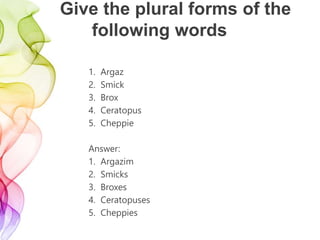
Give the plural forms of the
following words
1. Argaz
2. Smick
3. Brox
4. Ceratopus
5. Cheppie
Answer:
1. Argazim
2. Smicks
3. Broxes
4. Ceratopuses
5. Cheppies
Is productivity the same as
creativity?
NO
Productivity is rule-governed
Creativity is not rule-governed
What to study?
 Productivity in shape: formal generality and regularity
 Productivity in meaning: semantic regularity
 Semantic blocking
 Productivity in compounding
 Measuring productivity: the significance of neologisms
 Conclusions: Productivity in syntax
1. Formal generality and Regularity
Consider the following suffixes
1.-ness
2.-ity
3.-th
Which one is most productive?
-ness:
 formally general
-ity/-th: mush less general => the result
of attaching these suffixes sound
unconventional and un-English.
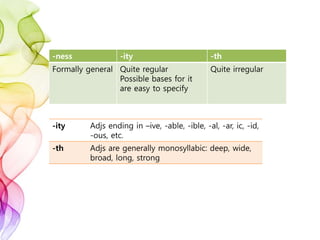
-ness -ity -th
Formally general Quite regular
Possible bases for it
are easy to specify
Quite irregular
-ity Adjs ending in –ive, -able, -ible, -al, -ar, ic, -id,
-ous, etc.
-th Adjs are generally monosyllabic: deep, wide,
broad, long, strong
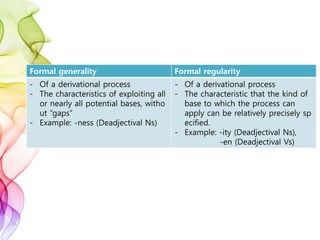
Formal generality Formal regularity
- Of a derivational process
- The characteristics of exploiting all
or nearly all potential bases, witho
ut “gaps”
- Example: -ness (Deadjectival Ns)
- Of a derivational process
- The characteristic that the kind of
base to which the process can
apply can be relatively precisely sp
ecified.
- Example: -ity (Deadjectival Ns),
-en (Deadjectival Vs)
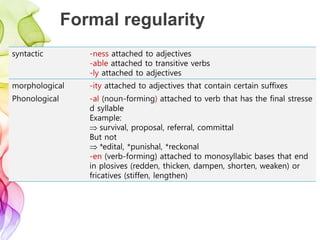
Formal regularity
syntactic -ness attached to adjectives
-able attached to transitive verbs
-ly attached to adjectives
morphological -ity attached to adjectives that contain certain suffixes
Phonological -al (noun-forming) attached to verb that has the final stresse
d syllable
Example:
 survival, proposal, referral, committal
But not
 *edital, *punishal, *reckonal
-en (verb-forming) attached to monosyllabic bases that end
in plosives (redden, thicken, dampen, shorten, weaken) or
fricatives (stiffen, lengthen)
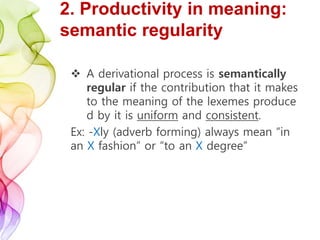
2. Productivity in meaning:
semantic regularity
 A derivational process is semantically
regular if the contribution that it makes
to the meaning of the lexemes produce
d by it is uniform and consistent.
Ex: -Xly (adverb forming) always mean “in
an X fashion” or “to an X degree”
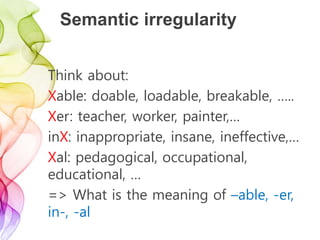
Semantic irregularity
Think about:
Xable: doable, loadable, breakable, 
..
Xer: teacher, worker, painter,

inX: inappropriate, insane, ineffective,

Xal: pedagogical, occupational,
educational, 

=> What is the meaning of –able, -er,
in-, -al
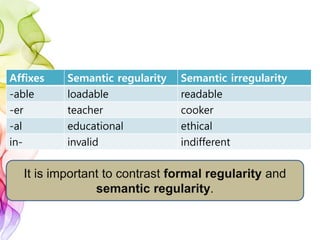
Affixes Semantic regularity Semantic irregularity
-able loadable readable
-er teacher cooker
-al educational ethical
in- invalid indifferent
It is important to contrast formal regularity and
semantic regularity.
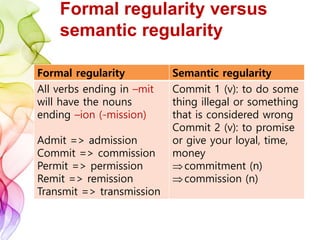
Formal regularity versus
semantic regularity
Formal regularity Semantic regularity
All verbs ending in –mit
will have the nouns
ending –ion (-mission)
Admit => admission
Commit => commission
Permit => permission
Remit => remission
Transmit => transmission
Commit 1 (v): to do some
thing illegal or something
that is considered wrong
Commit 2 (v): to promise
or give your loyal, time,
money
commitment (n)
commission (n)
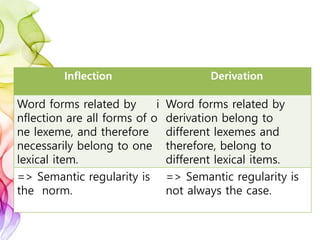
Inflection Derivation
Word forms related by i
nflection are all forms of o
ne lexeme, and therefore
necessarily belong to one
lexical item.
Word forms related by
derivation belong to
different lexemes and
therefore, belong to
different lexical items.
=> Semantic regularity is
the norm.
=> Semantic regularity is
not always the case.
3. Semantic blocking
What do you call the baby of a
1. pig
2. goose
3. cat
4. dog
Can you say 
.?
catlet? doglet?
Why not?
3. Semantic blocking
Consider two adjectives:
curious and glorious
What are the nouns derived from them?
 curiosity?
 *gloriosity?
 glory
3. Semantic blocking
Why not saying:
 goed (past tense of go)
 unbad
 Fastly
 Semantic blocking
3. Semantic blocking
Semantic blocking: the phenomenon whereby the
existence of a word (whether simple or derived) with
a particular meaning inhibits the morphological
derivation, even by formally regular means, of another
word with precisely that meaning.
 Example:
 like – dislike
 love - *dislove => hate
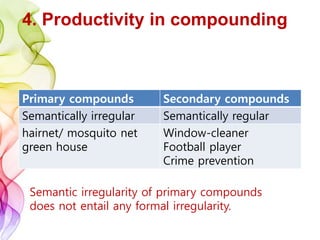
4. Productivity in compounding
Primary compounds Secondary compounds
Semantically irregular Semantically regular
hairnet/ mosquito net
green house
Window-cleaner
Football player
Crime prevention
Semantic irregularity of primary compounds
does not entail any formal irregularity.
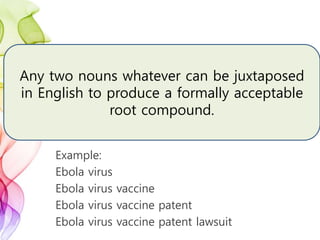
Example:
Ebola virus
Ebola virus vaccine
Ebola virus vaccine patent
Ebola virus vaccine patent lawsuit
Any two nouns whatever can be juxtaposed
in English to produce a formally acceptable
root compound.

Chapter_8_Productivity.pptx

  • 1.
    PRODUCTIVITY ALLPPT.com _ FreePowerPoint Templates, Diagrams and Charts
  • 2.
    What is productivity? Productivityis a rule-governed process and the productivity of a morphological process is its potential for repetitive non- creative morphological coining. (Bauer, 2001)
  • 3.
    Productivity Definition in theliterature 1. The frequency of the output words 2. The number of available bases 3. The proportion of words actually used to the number of words potentially created by a pro cess 4. The possibility of forming new words 5. The probability of new words forming 6. The number of new words occurring in a specific period of time
  • 4.
    Productivity Productivity describes aproperty of language that allow people to say things which we have never said or heard of before because (1) they know the rules for the combination of appropriate elements into sentences and (2) because they are able to assign meanings to those elements.
  • 5.
    Give the pluralforms of the following words 1. Argaz 2. Smick 3. Brox 4. Ceratopus 5. Cheppie Answer: 1. Argazim 2. Smicks 3. Broxes 4. Ceratopuses 5. Cheppies
  • 6.
    Is productivity thesame as creativity? NO Productivity is rule-governed Creativity is not rule-governed
  • 7.
    What to study? Productivity in shape: formal generality and regularity  Productivity in meaning: semantic regularity  Semantic blocking  Productivity in compounding  Measuring productivity: the significance of neologisms  Conclusions: Productivity in syntax
  • 8.
    1. Formal generalityand Regularity Consider the following suffixes 1.-ness 2.-ity 3.-th Which one is most productive? -ness:  formally general -ity/-th: mush less general => the result of attaching these suffixes sound unconventional and un-English.
  • 9.
    -ness -ity -th Formallygeneral Quite regular Possible bases for it are easy to specify Quite irregular -ity Adjs ending in –ive, -able, -ible, -al, -ar, ic, -id, -ous, etc. -th Adjs are generally monosyllabic: deep, wide, broad, long, strong
  • 10.
    Formal generality Formalregularity - Of a derivational process - The characteristics of exploiting all or nearly all potential bases, witho ut “gaps” - Example: -ness (Deadjectival Ns) - Of a derivational process - The characteristic that the kind of base to which the process can apply can be relatively precisely sp ecified. - Example: -ity (Deadjectival Ns), -en (Deadjectival Vs)
  • 11.
    Formal regularity syntactic -nessattached to adjectives -able attached to transitive verbs -ly attached to adjectives morphological -ity attached to adjectives that contain certain suffixes Phonological -al (noun-forming) attached to verb that has the final stresse d syllable Example:  survival, proposal, referral, committal But not  *edital, *punishal, *reckonal -en (verb-forming) attached to monosyllabic bases that end in plosives (redden, thicken, dampen, shorten, weaken) or fricatives (stiffen, lengthen)
  • 12.
    2. Productivity inmeaning: semantic regularity  A derivational process is semantically regular if the contribution that it makes to the meaning of the lexemes produce d by it is uniform and consistent. Ex: -Xly (adverb forming) always mean “in an X fashion” or “to an X degree”
  • 13.
    Semantic irregularity Think about: Xable:doable, loadable, breakable, 
.. Xer: teacher, worker, painter,
 inX: inappropriate, insane, ineffective,
 Xal: pedagogical, occupational, educational, 
 => What is the meaning of –able, -er, in-, -al
  • 14.
    Affixes Semantic regularitySemantic irregularity -able loadable readable -er teacher cooker -al educational ethical in- invalid indifferent It is important to contrast formal regularity and semantic regularity.
  • 15.
    Formal regularity versus semanticregularity Formal regularity Semantic regularity All verbs ending in –mit will have the nouns ending –ion (-mission) Admit => admission Commit => commission Permit => permission Remit => remission Transmit => transmission Commit 1 (v): to do some thing illegal or something that is considered wrong Commit 2 (v): to promise or give your loyal, time, money commitment (n) commission (n)
  • 16.
    Inflection Derivation Word formsrelated by i nflection are all forms of o ne lexeme, and therefore necessarily belong to one lexical item. Word forms related by derivation belong to different lexemes and therefore, belong to different lexical items. => Semantic regularity is the norm. => Semantic regularity is not always the case.
  • 17.
    3. Semantic blocking Whatdo you call the baby of a 1. pig 2. goose 3. cat 4. dog Can you say 
.? catlet? doglet? Why not?
  • 18.
    3. Semantic blocking Considertwo adjectives: curious and glorious What are the nouns derived from them?  curiosity?  *gloriosity?  glory
  • 19.
    3. Semantic blocking Whynot saying:  goed (past tense of go)  unbad  Fastly  Semantic blocking
  • 20.
    3. Semantic blocking Semanticblocking: the phenomenon whereby the existence of a word (whether simple or derived) with a particular meaning inhibits the morphological derivation, even by formally regular means, of another word with precisely that meaning.  Example:  like – dislike  love - *dislove => hate
  • 21.
    4. Productivity incompounding Primary compounds Secondary compounds Semantically irregular Semantically regular hairnet/ mosquito net green house Window-cleaner Football player Crime prevention Semantic irregularity of primary compounds does not entail any formal irregularity.
  • 22.
    Example: Ebola virus Ebola virusvaccine Ebola virus vaccine patent Ebola virus vaccine patent lawsuit Any two nouns whatever can be juxtaposed in English to produce a formally acceptable root compound.