Approaches to Discourse
Presented By:
A. Najib Tuanany
The Ethnography Of Communication;
The Speech Act Approach
Interactional Sociolinguistics;
Outline:
Pragmatic Approach
Conversation Analysis;
Variationist Approach
Although speech act theory was not first developed as a
means of analyzing discourse, particular issues in speech
act theory (indirect speech acts, multiple functions of
utterances) led to discourse analysis
Founders of the
speech act theory:
John Austin & John
Searle.
There are different types of
speech acts:
e.g.
 “speak louder” (directive)
 “Oxford Street is a
shopper’s paradise“
(assertive)
The Speech Act Approach
From the basic belief
that language is used
to perform actions.
e.g. “yeah, bring them down here.
I’ll flog them for you”
(Australian English)
Represents the
combination of three
disciplines:
anthropology, sociology,
and linguistics.
Focuses on how people from
different socio-cultures may share
grammatical knowledge of a
language but contextualize what is
said differently to produce
different messages.
Interactional Sociolinguistics
(Gumperz 1982, Goffman 1959-1981)
USA
19,450000
Brasil
19,450000
Europe
19,450000
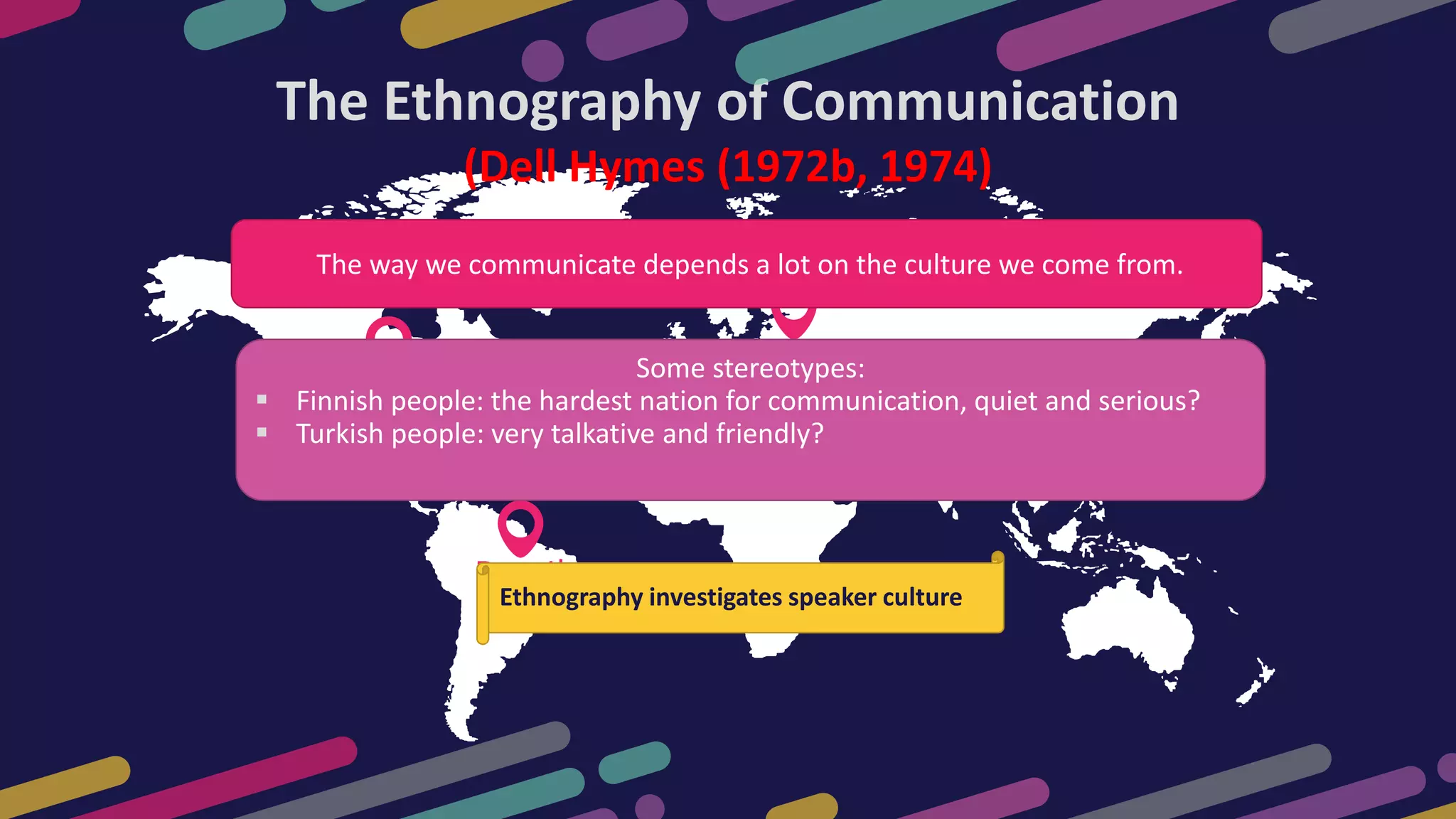
The Ethnography of Communication
(Dell Hymes (1972b, 1974)
The way we communicate depends a lot on the culture we come from.
Some stereotypes:
 Finnish people: the hardest nation for communication, quiet and serious?
 Turkish people: very talkative and friendly?
Ethnography investigates speaker culture
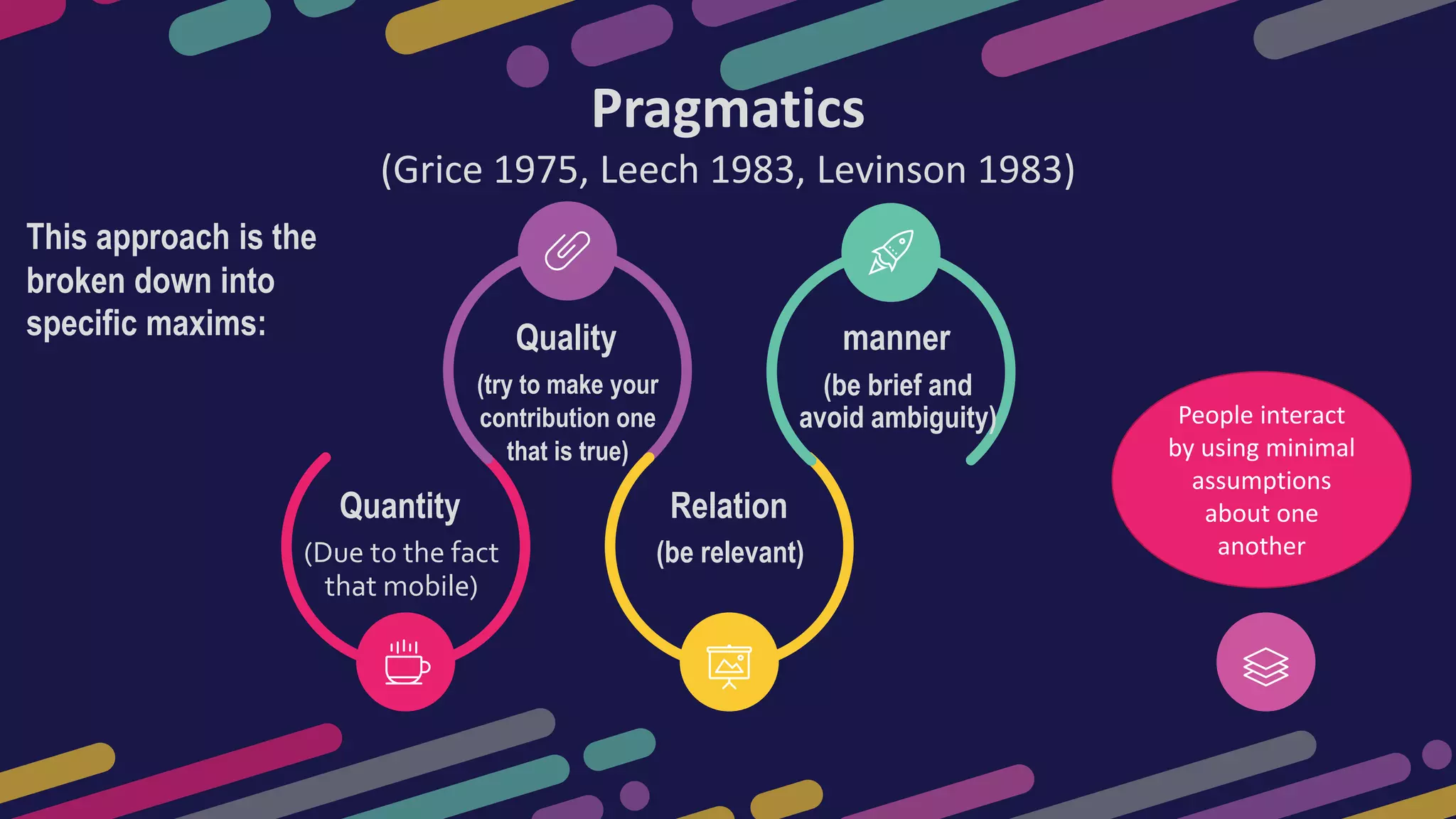
(be relevant)
Relation
(be brief and
avoid ambiguity)
manner
(try to make your
contribution one
that is true)
Quality
(Due to the fact
that mobile)
Quantity
Pragmatics
(Grice 1975, Leech 1983, Levinson 1983)
This approach is the
broken down into
specific maxims:
People interact
by using minimal
assumptions
about one
another
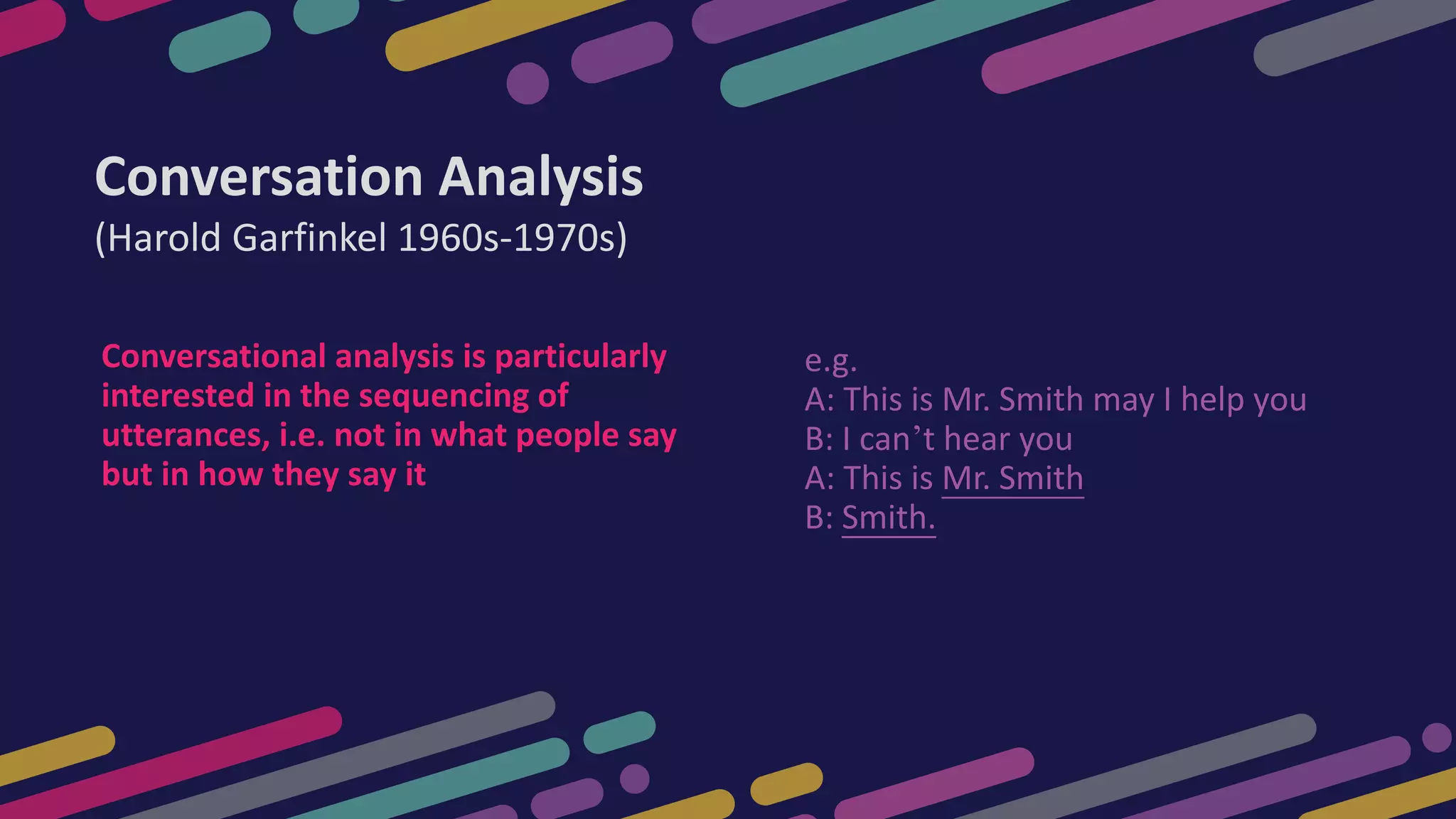
e.g.
A: This is Mr. Smith may I help you
B: I can’t hear you
A: This is Mr. Smith
B: Smith.
Conversation Analysis
(Harold Garfinkel 1960s-1970s)
Conversational analysis is particularly
interested in the sequencing of
utterances, i.e. not in what people say
but in how they say it
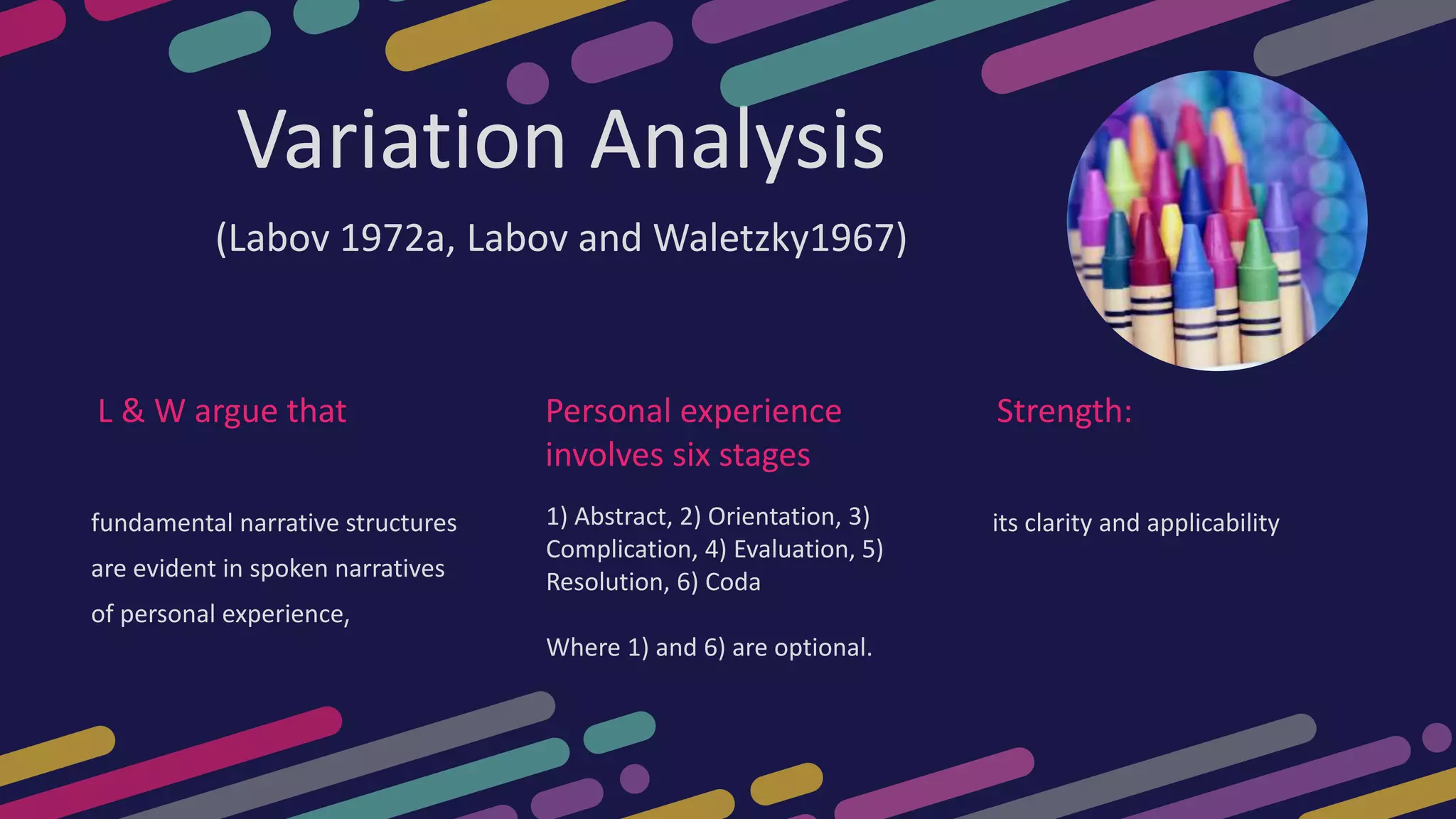
its clarity and applicability
Strength:
Variation Analysis
(Labov 1972a, Labov and Waletzky1967)
fundamental narrative structures
are evident in spoken narratives
of personal experience,
L & W argue that
1) Abstract, 2) Orientation, 3)
Complication, 4) Evaluation, 5)
Resolution, 6) Coda
Where 1) and 6) are optional.
Personal experience
involves six stages
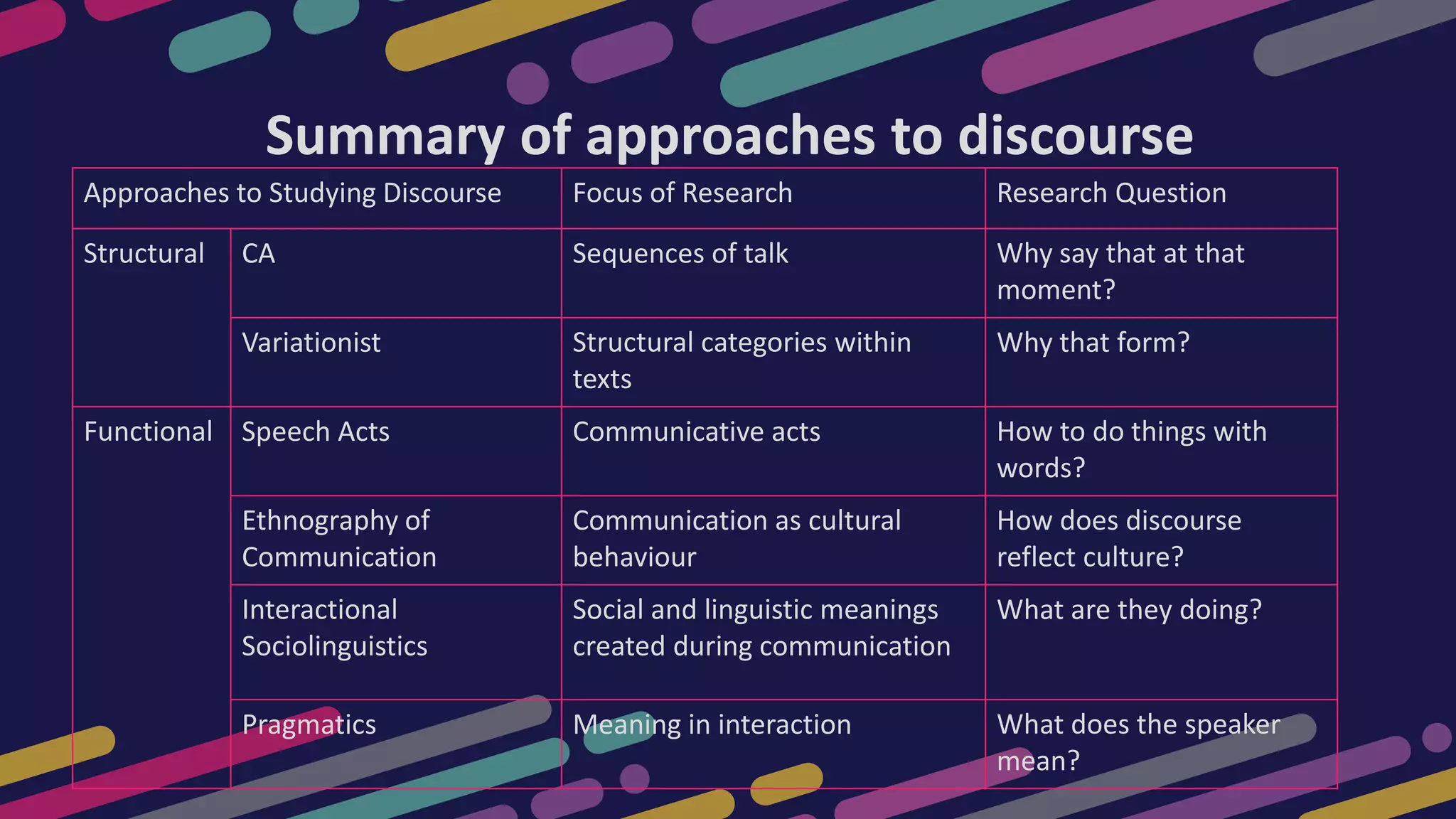
Summary of approaches to discourse
Approaches to Studying Discourse Focus of Research Research Question
Structural CA Sequences of talk Why say that at that
moment?
Variationist Structural categories within
texts
Why that form?
Functional Speech Acts Communicative acts How to do things with
words?
Ethnography of
Communication
Communication as cultural
behaviour
How does discourse
reflect culture?
Interactional
Sociolinguistics
Social and linguistic meanings
created during communication
What are they doing?
Pragmatics Meaning in interaction What does the speaker
mean?
THANKS!

Approaches to discourse

  • 1.
  • 2.
    The Ethnography OfCommunication; The Speech Act Approach Interactional Sociolinguistics; Outline: Pragmatic Approach Conversation Analysis; Variationist Approach
  • 3.
    Although speech acttheory was not first developed as a means of analyzing discourse, particular issues in speech act theory (indirect speech acts, multiple functions of utterances) led to discourse analysis Founders of the speech act theory: John Austin & John Searle. There are different types of speech acts: e.g.  “speak louder” (directive)  “Oxford Street is a shopper’s paradise“ (assertive) The Speech Act Approach From the basic belief that language is used to perform actions.
  • 4.
    e.g. “yeah, bringthem down here. I’ll flog them for you” (Australian English) Represents the combination of three disciplines: anthropology, sociology, and linguistics. Focuses on how people from different socio-cultures may share grammatical knowledge of a language but contextualize what is said differently to produce different messages. Interactional Sociolinguistics (Gumperz 1982, Goffman 1959-1981)
  • 5.
    USA 19,450000 Brasil 19,450000 Europe 19,450000 The Ethnography ofCommunication (Dell Hymes (1972b, 1974) The way we communicate depends a lot on the culture we come from. Some stereotypes:  Finnish people: the hardest nation for communication, quiet and serious?  Turkish people: very talkative and friendly? Ethnography investigates speaker culture
  • 6.
    (be relevant) Relation (be briefand avoid ambiguity) manner (try to make your contribution one that is true) Quality (Due to the fact that mobile) Quantity Pragmatics (Grice 1975, Leech 1983, Levinson 1983) This approach is the broken down into specific maxims: People interact by using minimal assumptions about one another
  • 7.
    e.g. A: This isMr. Smith may I help you B: I can’t hear you A: This is Mr. Smith B: Smith. Conversation Analysis (Harold Garfinkel 1960s-1970s) Conversational analysis is particularly interested in the sequencing of utterances, i.e. not in what people say but in how they say it
  • 8.
    its clarity andapplicability Strength: Variation Analysis (Labov 1972a, Labov and Waletzky1967) fundamental narrative structures are evident in spoken narratives of personal experience, L & W argue that 1) Abstract, 2) Orientation, 3) Complication, 4) Evaluation, 5) Resolution, 6) Coda Where 1) and 6) are optional. Personal experience involves six stages
  • 9.
    Summary of approachesto discourse Approaches to Studying Discourse Focus of Research Research Question Structural CA Sequences of talk Why say that at that moment? Variationist Structural categories within texts Why that form? Functional Speech Acts Communicative acts How to do things with words? Ethnography of Communication Communication as cultural behaviour How does discourse reflect culture? Interactional Sociolinguistics Social and linguistic meanings created during communication What are they doing? Pragmatics Meaning in interaction What does the speaker mean?
  • 10.