Downloaded 17 times
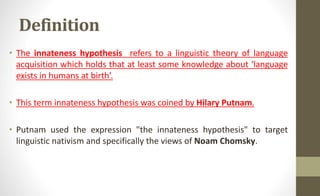
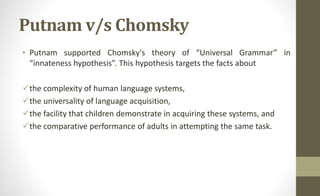
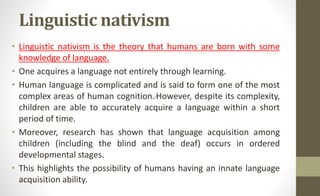


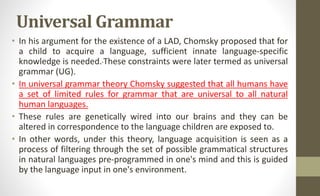
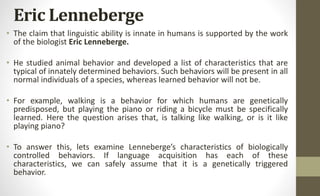
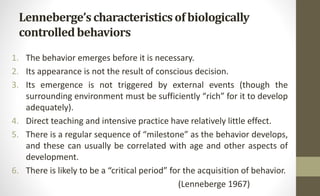


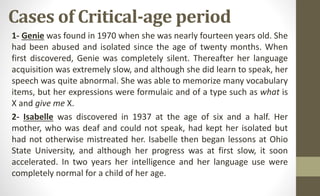


The innateness hypothesis proposes that humans are born with some innate knowledge of language. Hilary Putnam coined the term to describe Noam Chomsky's theory of Universal Grammar, which suggests humans possess an innate Language Acquisition Device containing the core principles of grammar. Evidence for innateness comes from observations that language acquisition in children follows predictable stages and is not dependent on formal teaching, and adults generally fail to achieve native-like proficiency in a second language. The critical period hypothesis of Eric Lenneberge further suggests there is an optimal period in early childhood for acquiring full native language competence.


![Theories Of Language Acquisition[1]](https://cdn.slidesharecdn.com/ss_thumbnails/theories-of-language-acquisition1-1225480010904742-8-thumbnail.jpg?width=640&height=640&fit=bounds)
![Theories%20of%20 Language%20 Acquisition[1]](https://cdn.slidesharecdn.com/ss_thumbnails/theories20of20language20acquisition1-1225479043858786-9-thumbnail.jpg?width=640&height=640&fit=bounds)
![Theories Of Language Acquisition[1]](https://cdn.slidesharecdn.com/ss_thumbnails/theories-of-language-acquisition1-1225479040063582-9-thumbnail.jpg?width=640&height=640&fit=bounds)


