Copyright © The McGraw-Hill Companies, Inc. Permission required for reproduction or display.
Parallel Programming
with MPI and OpenMP
Michael J. Quinn
Copyright © The McGraw-Hill Companies, Inc. Permission required for reproduction or display.
Chapter 7
Performance Analysis
Copyright © The McGraw-Hill Companies, Inc. Permission required for reproduction or display.
Learning Objectives
 Predict performance of parallel programs
 Understand barriers to higher performance
Copyright © The McGraw-Hill Companies, Inc. Permission required for reproduction or display.
Outline
 General speedup formula
 Amdahl’s Law
 Gustafson-Barsis’ Law
 Karp-Flatt metric
 Isoefficiency metric
Copyright © The McGraw-Hill Companies, Inc. Permission required for reproduction or display.
Speedup Formula
time
execution
Parallel
time
execution
Sequential
Speedup 
Copyright © The McGraw-Hill Companies, Inc. Permission required for reproduction or display.
Execution Time Components
 Inherently sequential computations: (n)
 Potentially parallel computations: (n)
 Communication operations: (n,p)
Copyright © The McGraw-Hill Companies, Inc. Permission required for reproduction or display.
Speedup Expression
)
,
(
/
)
(
)
(
)
(
)
(
)
,
(
p
n
p
n
n
n
n
p
n










Copyright © The McGraw-Hill Companies, Inc. Permission required for reproduction or display.
(n)/p
Copyright © The McGraw-Hill Companies, Inc. Permission required for reproduction or display.
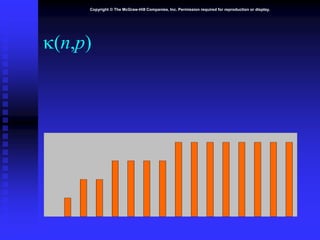
(n,p)
Copyright © The McGraw-Hill Companies, Inc. Permission required for reproduction or display.
(n)/p + (n,p)
Copyright © The McGraw-Hill Companies, Inc. Permission required for reproduction or display.
Speedup Plot
“elbowing out”
Copyright © The McGraw-Hill Companies, Inc. Permission required for reproduction or display.
Efficiency
used
Processors
Speedup
Efficiency
time
execution
Parallel
used
Processors
time
execution
Sequential
Efficiency



Processors
Speedup
Efficiency
time
execution
Parallel
Processors
time
execution
Sequential
Efficiency



Copyright © The McGraw-Hill Companies, Inc. Permission required for reproduction or display.
0  (n,p)  1
)
,
(
)
(
)
(
)
(
)
(
)
,
(
p
n
p
n
n
p
n
n
p
n










All terms > 0  (n,p) > 0
Denominator > numerator  (n,p) < 1
Copyright © The McGraw-Hill Companies, Inc. Permission required for reproduction or display.
Amdahl’s Law
p
n
n
n
n
p
n
p
n
n
n
n
p
n
/
)
(
)
(
)
(
)
(
)
,
(
/
)
(
)
(
)
(
)
(
)
,
(

















Let f = (n)/((n) + (n))
p
f
f /
)
1
(
1




Copyright © The McGraw-Hill Companies, Inc. Permission required for reproduction or display.
Example 1
 95% of a program’s execution time occurs
inside a loop that can be executed in parallel.
What is the maximum speedup we should
expect from a parallel version of the
program executing on 8 CPUs?
9
.
5
8
/
)
05
.
0
1
(
05
.
0
1





Copyright © The McGraw-Hill Companies, Inc. Permission required for reproduction or display.
Example 2
 20% of a program’s execution time is spent
within inherently sequential code. What is
the limit to the speedup achievable by a
parallel version of the program?
5
2
.
0
1
/
)
2
.
0
1
(
2
.
0
1
lim 




 p
p
Copyright © The McGraw-Hill Companies, Inc. Permission required for reproduction or display.
Pop Quiz
 An oceanographer gives you a serial
program and asks you how much faster it
might run on 8 processors. You can only
find one function amenable to a parallel
solution. Benchmarking on a single
processor reveals 80% of the execution time
is spent inside this function. What is the
best speedup a parallel version is likely to
achieve on 8 processors?
Copyright © The McGraw-Hill Companies, Inc. Permission required for reproduction or display.
Pop Quiz
 A computer animation program generates a
feature movie frame-by-frame. Each frame
can be generated independently and is
output to its own file. If it takes 99 seconds
to render a frame and 1 second to output it,
how much speedup can be achieved by
rendering the movie on 100 processors?
Copyright © The McGraw-Hill Companies, Inc. Permission required for reproduction or display.
Limitations of Amdahl’s Law
 Ignores (n,p)
 Overestimates speedup achievable
Copyright © The McGraw-Hill Companies, Inc. Permission required for reproduction or display.
Amdahl Effect
 Typically (n,p) has lower complexity than
(n)/p
 As n increases, (n)/p dominates (n,p)
 As n increases, speedup increases
Copyright © The McGraw-Hill Companies, Inc. Permission required for reproduction or display.
Illustration of Amdahl Effect
n = 100
n = 1,000
n = 10,000
Speedup
Processors
Copyright © The McGraw-Hill Companies, Inc. Permission required for reproduction or display.
Review of Amdahl’s Law
 Treats problem size as a constant
 Shows how execution time decreases as
number of processors increases
Copyright © The McGraw-Hill Companies, Inc. Permission required for reproduction or display.
Another Perspective
 We often use faster computers to solve
larger problem instances
 Let’s treat time as a constant and allow
problem size to increase with number of
processors
Copyright © The McGraw-Hill Companies, Inc. Permission required for reproduction or display.
Gustafson-Barsis’s Law
p
n
n
n
n
p
n
/
)
(
)
(
)
(
)
(
)
,
(








Let s = (n)/((n)+(n)/p)
s
p
p )
1
( 



Copyright © The McGraw-Hill Companies, Inc. Permission required for reproduction or display.
Gustafson-Barsis’s Law
 Begin with parallel execution time
 Estimate sequential execution time to solve
same problem
 Problem size is an increasing function of p
 Predicts scaled speedup
Copyright © The McGraw-Hill Companies, Inc. Permission required for reproduction or display.
Example 1
 An application running on 10 processors
spends 3% of its time in serial code. What is
the scaled speedup of the application?
73
.
9
27
.
0
10
)
03
.
0
)(
10
1
(
10 






Execution on 1 CPU takes 10 times as long…
…except 9 do not have to execute serial code
Copyright © The McGraw-Hill Companies, Inc. Permission required for reproduction or display.
Example 2
 What is the maximum fraction of a
program’s parallel execution time that can
be spent in serial code if it is to achieve a
scaled speedup of 7 on 8 processors?
14
.
0
)
8
1
(
8
7 



 s
s
Copyright © The McGraw-Hill Companies, Inc. Permission required for reproduction or display.
Pop Quiz
 A parallel program executing on 32
processors spends 5% of its time in
sequential code. What is the scaled speedup
of this program?
Copyright © The McGraw-Hill Companies, Inc. Permission required for reproduction or display.
The Karp-Flatt Metric
 Amdahl’s Law and Gustafson-Barsis’ Law
ignore (n,p)
 They can overestimate speedup or scaled
speedup
 Karp and Flatt proposed another metric
Copyright © The McGraw-Hill Companies, Inc. Permission required for reproduction or display.
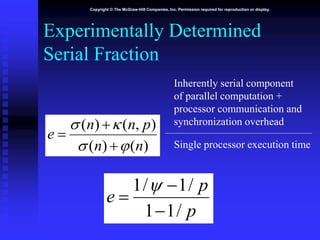
Experimentally Determined
Serial Fraction
)
(
)
(
)
,
(
)
(
n
n
p
n
n
e







Inherently serial component
of parallel computation +
processor communication and
synchronization overhead
Single processor execution time
p
p
e
/
1
1
/
1
/
1




Copyright © The McGraw-Hill Companies, Inc. Permission required for reproduction or display.
Experimentally Determined
Serial Fraction
 Takes into account parallel overhead
 Detects other sources of overhead or
inefficiency ignored in speedup model
 Process startup time
 Process synchronization time
 Imbalanced workload
 Architectural overhead
Copyright © The McGraw-Hill Companies, Inc. Permission required for reproduction or display.
Example 1
p 2 3 4 5 6 7
1.8 2.5 3.1 3.6 4.0 4.4
8
4.7

What is the primary reason for speedup of only 4.7 on 8 CPUs?
e 0.1 0.1 0.1 0.1 0.1 0.1 0.1
Since e is constant, large serial fraction is the primary reason.
Copyright © The McGraw-Hill Companies, Inc. Permission required for reproduction or display.
Example 2
p 2 3 4 5 6 7
1.9 2.6 3.2 3.7 4.1 4.5
8
4.7

What is the primary reason for speedup of only 4.7 on 8 CPUs?
e 0.070 0.075 0.080 0.085 0.090 0.095 0.100
Since e is steadily increasing, overhead is the primary reason.
Copyright © The McGraw-Hill Companies, Inc. Permission required for reproduction or display.
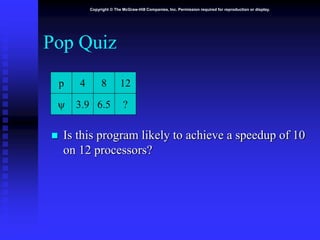
Pop Quiz
 Is this program likely to achieve a speedup of 10
on 12 processors?
p 4
3.9
8
6.5

12
?
Copyright © The McGraw-Hill Companies, Inc. Permission required for reproduction or display.
Isoefficiency Metric
 Parallel system: parallel program executing
on a parallel computer
 Scalability of a parallel system: measure of
its ability to increase performance as
number of processors increases
 A scalable system maintains efficiency as
processors are added
 Isoefficiency: way to measure scalability
Copyright © The McGraw-Hill Companies, Inc. Permission required for reproduction or display.
Isoefficiency Derivation Steps
 Begin with speedup formula
 Compute total amount of overhead
 Assume efficiency remains constant
 Determine relation between sequential
execution time and overhead
Copyright © The McGraw-Hill Companies, Inc. Permission required for reproduction or display.
Deriving Isoefficiency Relation
)
,
(
)
(
)
1
(
)
,
( p
n
p
n
p
p
n
To 
 


Determine overhead
Substitute overhead into speedup equation
)
,
(
)
(
)
(
))
(
)
(
(
0
)
,
( p
n
T
n
n
n
n
p
p
n 


 




Substitute T(n,1) = (n) + (n). Assume efficiency is constant.
)
,
(
)
1
,
( 0 p
n
CT
n
T  Isoefficiency Relation
Copyright © The McGraw-Hill Companies, Inc. Permission required for reproduction or display.
Scalability Function
 Suppose isoefficiency relation is n  f(p)
 Let M(n) denote memory required for
problem of size n
 M(f(p))/p shows how memory usage per
processor must increase to maintain same
efficiency
 We call M(f(p))/p the scalability function
Copyright © The McGraw-Hill Companies, Inc. Permission required for reproduction or display.
Meaning of Scalability Function
 To maintain efficiency when increasing p, we
must increase n
 Maximum problem size limited by available
memory, which is linear in p
 Scalability function shows how memory usage per
processor must grow to maintain efficiency
 Scalability function a constant means parallel
system is perfectly scalable
Copyright © The McGraw-Hill Companies, Inc. Permission required for reproduction or display.
Interpreting Scalability Function
Number of processors
Memory
needed
per
processor
Cplogp
Cp
Clogp
C
Memory Size
Can maintain
efficiency
Cannot maintain
efficiency
Copyright © The McGraw-Hill Companies, Inc. Permission required for reproduction or display.
Example 1: Reduction
 Sequential algorithm complexity
T(n,1) = (n)
 Parallel algorithm
 Computational complexity = (n/p)
 Communication complexity = (log p)
 Parallel overhead
T0(n,p) = (p log p)
Copyright © The McGraw-Hill Companies, Inc. Permission required for reproduction or display.
Reduction (continued)
 Isoefficiency relation: n  C p log p
 We ask: To maintain same level of
efficiency, how must n increase when p
increases?
 M(n) = n
 The system has good scalability
p
C
p
p
Cp
p
p
Cp
M log
/
log
/
)
log
( 

Copyright © The McGraw-Hill Companies, Inc. Permission required for reproduction or display.
Example 2: Floyd’s Algorithm
 Sequential time complexity: (n3)
 Parallel computation time: (n3/p)
 Parallel communication time: (n2log p)
 Parallel overhead: T0(n,p) = (pn2log p)
Copyright © The McGraw-Hill Companies, Inc. Permission required for reproduction or display.
Floyd’s Algorithm (continued)
 Isoefficiency relation
n3  C(p n3 log p)  n  C p log p
 M(n) = n2
 The parallel system has poor scalability
p
p
C
p
p
p
C
p
p
Cp
M 2
2
2
2
2
log
/
log
/
)
log
( 

Copyright © The McGraw-Hill Companies, Inc. Permission required for reproduction or display.
Example 3: Finite Difference
 Sequential time complexity per iteration:
(n2)
 Parallel communication complexity per
iteration: (n/p)
 Parallel overhead: (n p)
Copyright © The McGraw-Hill Companies, Inc. Permission required for reproduction or display.
Finite Difference (continued)
 Isoefficiency relation
n2  Cnp  n  C p
 M(n) = n2
 This algorithm is perfectly scalable
2
2
/
/
)
( C
p
p
C
p
p
C
M 

Copyright © The McGraw-Hill Companies, Inc. Permission required for reproduction or display.
Summary (1/3)
 Performance terms
 Speedup
 Efficiency
 Model of speedup
 Serial component
 Parallel component
 Communication component
Copyright © The McGraw-Hill Companies, Inc. Permission required for reproduction or display.
Summary (2/3)
 What prevents linear speedup?
 Serial operations
 Communication operations
 Process start-up
 Imbalanced workloads
 Architectural limitations
Copyright © The McGraw-Hill Companies, Inc. Permission required for reproduction or display.
Summary (3/3)
 Analyzing parallel performance
 Amdahl’s Law
 Gustafson-Barsis’ Law
 Karp-Flatt metric
 Isoefficiency metric

chapter7.ppt

  • 1.
    Copyright © TheMcGraw-Hill Companies, Inc. Permission required for reproduction or display. Parallel Programming with MPI and OpenMP Michael J. Quinn
  • 2.
    Copyright © TheMcGraw-Hill Companies, Inc. Permission required for reproduction or display. Chapter 7 Performance Analysis
  • 3.
    Copyright © TheMcGraw-Hill Companies, Inc. Permission required for reproduction or display. Learning Objectives  Predict performance of parallel programs  Understand barriers to higher performance
  • 4.
    Copyright © TheMcGraw-Hill Companies, Inc. Permission required for reproduction or display. Outline  General speedup formula  Amdahl’s Law  Gustafson-Barsis’ Law  Karp-Flatt metric  Isoefficiency metric
  • 5.
    Copyright © TheMcGraw-Hill Companies, Inc. Permission required for reproduction or display. Speedup Formula time execution Parallel time execution Sequential Speedup 
  • 6.
    Copyright © TheMcGraw-Hill Companies, Inc. Permission required for reproduction or display. Execution Time Components  Inherently sequential computations: (n)  Potentially parallel computations: (n)  Communication operations: (n,p)
  • 7.
    Copyright © TheMcGraw-Hill Companies, Inc. Permission required for reproduction or display. Speedup Expression ) , ( / ) ( ) ( ) ( ) ( ) , ( p n p n n n n p n          
  • 8.
    Copyright © TheMcGraw-Hill Companies, Inc. Permission required for reproduction or display. (n)/p
  • 9.
    Copyright © TheMcGraw-Hill Companies, Inc. Permission required for reproduction or display. (n,p)
  • 10.
    Copyright © TheMcGraw-Hill Companies, Inc. Permission required for reproduction or display. (n)/p + (n,p)
  • 11.
    Copyright © TheMcGraw-Hill Companies, Inc. Permission required for reproduction or display. Speedup Plot “elbowing out”
  • 12.
    Copyright © TheMcGraw-Hill Companies, Inc. Permission required for reproduction or display. Efficiency used Processors Speedup Efficiency time execution Parallel used Processors time execution Sequential Efficiency    Processors Speedup Efficiency time execution Parallel Processors time execution Sequential Efficiency   
  • 13.
    Copyright © TheMcGraw-Hill Companies, Inc. Permission required for reproduction or display. 0  (n,p)  1 ) , ( ) ( ) ( ) ( ) ( ) , ( p n p n n p n n p n           All terms > 0  (n,p) > 0 Denominator > numerator  (n,p) < 1
  • 14.
    Copyright © TheMcGraw-Hill Companies, Inc. Permission required for reproduction or display. Amdahl’s Law p n n n n p n p n n n n p n / ) ( ) ( ) ( ) ( ) , ( / ) ( ) ( ) ( ) ( ) , (                  Let f = (n)/((n) + (n)) p f f / ) 1 ( 1    
  • 15.
    Copyright © TheMcGraw-Hill Companies, Inc. Permission required for reproduction or display. Example 1  95% of a program’s execution time occurs inside a loop that can be executed in parallel. What is the maximum speedup we should expect from a parallel version of the program executing on 8 CPUs? 9 . 5 8 / ) 05 . 0 1 ( 05 . 0 1     
  • 16.
    Copyright © TheMcGraw-Hill Companies, Inc. Permission required for reproduction or display. Example 2  20% of a program’s execution time is spent within inherently sequential code. What is the limit to the speedup achievable by a parallel version of the program? 5 2 . 0 1 / ) 2 . 0 1 ( 2 . 0 1 lim       p p
  • 17.
    Copyright © TheMcGraw-Hill Companies, Inc. Permission required for reproduction or display. Pop Quiz  An oceanographer gives you a serial program and asks you how much faster it might run on 8 processors. You can only find one function amenable to a parallel solution. Benchmarking on a single processor reveals 80% of the execution time is spent inside this function. What is the best speedup a parallel version is likely to achieve on 8 processors?
  • 18.
    Copyright © TheMcGraw-Hill Companies, Inc. Permission required for reproduction or display. Pop Quiz  A computer animation program generates a feature movie frame-by-frame. Each frame can be generated independently and is output to its own file. If it takes 99 seconds to render a frame and 1 second to output it, how much speedup can be achieved by rendering the movie on 100 processors?
  • 19.
    Copyright © TheMcGraw-Hill Companies, Inc. Permission required for reproduction or display. Limitations of Amdahl’s Law  Ignores (n,p)  Overestimates speedup achievable
  • 20.
    Copyright © TheMcGraw-Hill Companies, Inc. Permission required for reproduction or display. Amdahl Effect  Typically (n,p) has lower complexity than (n)/p  As n increases, (n)/p dominates (n,p)  As n increases, speedup increases
  • 21.
    Copyright © TheMcGraw-Hill Companies, Inc. Permission required for reproduction or display. Illustration of Amdahl Effect n = 100 n = 1,000 n = 10,000 Speedup Processors
  • 22.
    Copyright © TheMcGraw-Hill Companies, Inc. Permission required for reproduction or display. Review of Amdahl’s Law  Treats problem size as a constant  Shows how execution time decreases as number of processors increases
  • 23.
    Copyright © TheMcGraw-Hill Companies, Inc. Permission required for reproduction or display. Another Perspective  We often use faster computers to solve larger problem instances  Let’s treat time as a constant and allow problem size to increase with number of processors
  • 24.
    Copyright © TheMcGraw-Hill Companies, Inc. Permission required for reproduction or display. Gustafson-Barsis’s Law p n n n n p n / ) ( ) ( ) ( ) ( ) , (         Let s = (n)/((n)+(n)/p) s p p ) 1 (    
  • 25.
    Copyright © TheMcGraw-Hill Companies, Inc. Permission required for reproduction or display. Gustafson-Barsis’s Law  Begin with parallel execution time  Estimate sequential execution time to solve same problem  Problem size is an increasing function of p  Predicts scaled speedup
  • 26.
    Copyright © TheMcGraw-Hill Companies, Inc. Permission required for reproduction or display. Example 1  An application running on 10 processors spends 3% of its time in serial code. What is the scaled speedup of the application? 73 . 9 27 . 0 10 ) 03 . 0 )( 10 1 ( 10        Execution on 1 CPU takes 10 times as long… …except 9 do not have to execute serial code
  • 27.
    Copyright © TheMcGraw-Hill Companies, Inc. Permission required for reproduction or display. Example 2  What is the maximum fraction of a program’s parallel execution time that can be spent in serial code if it is to achieve a scaled speedup of 7 on 8 processors? 14 . 0 ) 8 1 ( 8 7      s s
  • 28.
    Copyright © TheMcGraw-Hill Companies, Inc. Permission required for reproduction or display. Pop Quiz  A parallel program executing on 32 processors spends 5% of its time in sequential code. What is the scaled speedup of this program?
  • 29.
    Copyright © TheMcGraw-Hill Companies, Inc. Permission required for reproduction or display. The Karp-Flatt Metric  Amdahl’s Law and Gustafson-Barsis’ Law ignore (n,p)  They can overestimate speedup or scaled speedup  Karp and Flatt proposed another metric
  • 30.
    Copyright © TheMcGraw-Hill Companies, Inc. Permission required for reproduction or display. Experimentally Determined Serial Fraction ) ( ) ( ) , ( ) ( n n p n n e        Inherently serial component of parallel computation + processor communication and synchronization overhead Single processor execution time p p e / 1 1 / 1 / 1    
  • 31.
    Copyright © TheMcGraw-Hill Companies, Inc. Permission required for reproduction or display. Experimentally Determined Serial Fraction  Takes into account parallel overhead  Detects other sources of overhead or inefficiency ignored in speedup model  Process startup time  Process synchronization time  Imbalanced workload  Architectural overhead
  • 32.
    Copyright © TheMcGraw-Hill Companies, Inc. Permission required for reproduction or display. Example 1 p 2 3 4 5 6 7 1.8 2.5 3.1 3.6 4.0 4.4 8 4.7  What is the primary reason for speedup of only 4.7 on 8 CPUs? e 0.1 0.1 0.1 0.1 0.1 0.1 0.1 Since e is constant, large serial fraction is the primary reason.
  • 33.
    Copyright © TheMcGraw-Hill Companies, Inc. Permission required for reproduction or display. Example 2 p 2 3 4 5 6 7 1.9 2.6 3.2 3.7 4.1 4.5 8 4.7  What is the primary reason for speedup of only 4.7 on 8 CPUs? e 0.070 0.075 0.080 0.085 0.090 0.095 0.100 Since e is steadily increasing, overhead is the primary reason.
  • 34.
    Copyright © TheMcGraw-Hill Companies, Inc. Permission required for reproduction or display. Pop Quiz  Is this program likely to achieve a speedup of 10 on 12 processors? p 4 3.9 8 6.5  12 ?
  • 35.
    Copyright © TheMcGraw-Hill Companies, Inc. Permission required for reproduction or display. Isoefficiency Metric  Parallel system: parallel program executing on a parallel computer  Scalability of a parallel system: measure of its ability to increase performance as number of processors increases  A scalable system maintains efficiency as processors are added  Isoefficiency: way to measure scalability
  • 36.
    Copyright © TheMcGraw-Hill Companies, Inc. Permission required for reproduction or display. Isoefficiency Derivation Steps  Begin with speedup formula  Compute total amount of overhead  Assume efficiency remains constant  Determine relation between sequential execution time and overhead
  • 37.
    Copyright © TheMcGraw-Hill Companies, Inc. Permission required for reproduction or display. Deriving Isoefficiency Relation ) , ( ) ( ) 1 ( ) , ( p n p n p p n To      Determine overhead Substitute overhead into speedup equation ) , ( ) ( ) ( )) ( ) ( ( 0 ) , ( p n T n n n n p p n          Substitute T(n,1) = (n) + (n). Assume efficiency is constant. ) , ( ) 1 , ( 0 p n CT n T  Isoefficiency Relation
  • 38.
    Copyright © TheMcGraw-Hill Companies, Inc. Permission required for reproduction or display. Scalability Function  Suppose isoefficiency relation is n  f(p)  Let M(n) denote memory required for problem of size n  M(f(p))/p shows how memory usage per processor must increase to maintain same efficiency  We call M(f(p))/p the scalability function
  • 39.
    Copyright © TheMcGraw-Hill Companies, Inc. Permission required for reproduction or display. Meaning of Scalability Function  To maintain efficiency when increasing p, we must increase n  Maximum problem size limited by available memory, which is linear in p  Scalability function shows how memory usage per processor must grow to maintain efficiency  Scalability function a constant means parallel system is perfectly scalable
  • 40.
    Copyright © TheMcGraw-Hill Companies, Inc. Permission required for reproduction or display. Interpreting Scalability Function Number of processors Memory needed per processor Cplogp Cp Clogp C Memory Size Can maintain efficiency Cannot maintain efficiency
  • 41.
    Copyright © TheMcGraw-Hill Companies, Inc. Permission required for reproduction or display. Example 1: Reduction  Sequential algorithm complexity T(n,1) = (n)  Parallel algorithm  Computational complexity = (n/p)  Communication complexity = (log p)  Parallel overhead T0(n,p) = (p log p)
  • 42.
    Copyright © TheMcGraw-Hill Companies, Inc. Permission required for reproduction or display. Reduction (continued)  Isoefficiency relation: n  C p log p  We ask: To maintain same level of efficiency, how must n increase when p increases?  M(n) = n  The system has good scalability p C p p Cp p p Cp M log / log / ) log (  
  • 43.
    Copyright © TheMcGraw-Hill Companies, Inc. Permission required for reproduction or display. Example 2: Floyd’s Algorithm  Sequential time complexity: (n3)  Parallel computation time: (n3/p)  Parallel communication time: (n2log p)  Parallel overhead: T0(n,p) = (pn2log p)
  • 44.
    Copyright © TheMcGraw-Hill Companies, Inc. Permission required for reproduction or display. Floyd’s Algorithm (continued)  Isoefficiency relation n3  C(p n3 log p)  n  C p log p  M(n) = n2  The parallel system has poor scalability p p C p p p C p p Cp M 2 2 2 2 2 log / log / ) log (  
  • 45.
    Copyright © TheMcGraw-Hill Companies, Inc. Permission required for reproduction or display. Example 3: Finite Difference  Sequential time complexity per iteration: (n2)  Parallel communication complexity per iteration: (n/p)  Parallel overhead: (n p)
  • 46.
    Copyright © TheMcGraw-Hill Companies, Inc. Permission required for reproduction or display. Finite Difference (continued)  Isoefficiency relation n2  Cnp  n  C p  M(n) = n2  This algorithm is perfectly scalable 2 2 / / ) ( C p p C p p C M  
  • 47.
    Copyright © TheMcGraw-Hill Companies, Inc. Permission required for reproduction or display. Summary (1/3)  Performance terms  Speedup  Efficiency  Model of speedup  Serial component  Parallel component  Communication component
  • 48.
    Copyright © TheMcGraw-Hill Companies, Inc. Permission required for reproduction or display. Summary (2/3)  What prevents linear speedup?  Serial operations  Communication operations  Process start-up  Imbalanced workloads  Architectural limitations
  • 49.
    Copyright © TheMcGraw-Hill Companies, Inc. Permission required for reproduction or display. Summary (3/3)  Analyzing parallel performance  Amdahl’s Law  Gustafson-Barsis’ Law  Karp-Flatt metric  Isoefficiency metric