Chapter 25: Physical Distribution Management
Responses to Questions
1. The merit of analytical solutions is that they come up with a definitive
solution.
Analytical solutions are limited by the physical analogue. They do not take
into account various other factors. Hence, the analytical solutions need to
be used with caution.
2. Warehouses have fixed costs, transportation costs, variable costs of
operating them, and inventory carrying and handling costs among others.
These are the tangible costs. The intangibles include costs to people
around the location, socio-political costs, climatic / weather related costs,
etc.
3. Warehouse location problem is a location problem while the
‘transportation problem’ is that of allocation of demand to the warehouses.
4. It is similar to the model presented in the book.
5. Linear Programming has inequalities while Transportation problem has all
equalities.
6. As stated in the Savings Criterion, the points on the circumference if
joined (for the route) will produce distance savings. And, the vehicle has to
come back to the depot ultimately. Hence, the flower-petal contour of the
route.
7. Network theory offers solutions to the vehicle scheduling problem.
8. Logistics could include entire gamut of packaging, materials handling,
transporting / shipping, and warehousing (including inventory control
therein).
9. Warehouse inventory is very relevant for customer service; inventory in
transit (in pipeline) is very relevant in inventory-related cost controls.
Hence, logistics has several inventory control decisions as part of its
management decision process.
10.The objective of logistics is to serve the customer with desired profitability
for the firm.
11.Transport costs and distances (or proximities) are important in purchasing
and sales decisions.
2
12.Solve the problem as a Linear Programming problem which has
inequalities.
13.Solve the problem as a Linear Programming problem.
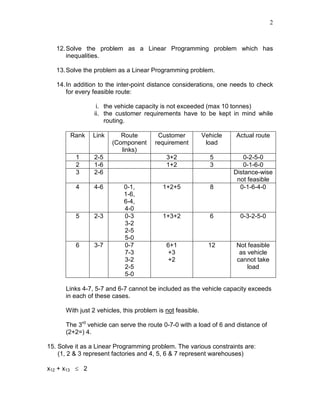
14.In addition to the inter-point distance considerations, one needs to check
for every feasible route:
i. the vehicle capacity is not exceeded (max 10 tonnes)
ii. the customer requirements have to be kept in mind while
routing.
Rank Link Route
(Component
links)
Customer
requirement
Vehicle
load
Actual route
1 2-5 3+2 5 0-2-5-0
2 1-6 1+2 3 0-1-6-0
3 2-6 Distance-wise
not feasible
4 4-6 0-1,
1-6,
6-4,
4-0
1+2+5 8 0-1-6-4-0
5 2-3 0-3
3-2
2-5
5-0
1+3+2 6 0-3-2-5-0
6 3-7 0-7
7-3
3-2
2-5
5-0
6+1
+3
+2
12 Not feasible
as vehicle
cannot take
load
Links 4-7, 5-7 and 6-7 cannot be included as the vehicle capacity exceeds
in each of these cases.
With just 2 vehicles, this problem is not feasible.
The 3rd
vehicle can serve the route 0-7-0 with a load of 6 and distance of
(2+2=) 4.
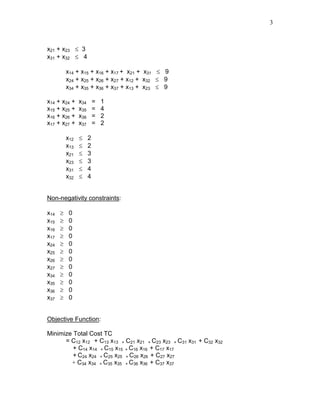
15. Solve it as a Linear Programming problem. The various constraints are:
(1, 2 & 3 represent factories and 4, 5, 6 & 7 represent warehouses)
x12 + x13 ≤ 2
3
x21 + x23 ≤ 3
x31 + x32 ≤ 4
x14 + x15 + x16 + x17 + x21 + x31 ≤ 9
x24 + x25 + x26 + x27 + x12 + x32 ≤ 9
x34 + x35 + x36 + x37 + x13 + x23 ≤ 9
x14 + x24 + x34 = 1
x15 + x25 + x35 = 4
x16 + x26 + x36 = 2
x17 + x27 + x37 = 2
x12 ≤ 2
x13 ≤ 2
x21 ≤ 3
x23 ≤ 3
x31 ≤ 4
x32 ≤ 4
Non-negativity constraints:
x14 ≥ 0
x15 ≥ 0
x16 ≥ 0
x17 ≥ 0
x24 ≥ 0
x25 ≥ 0
x26 ≥ 0
x27 ≥ 0
x34 ≥ 0
x35 ≥ 0
x36 ≥ 0
x37 ≥ 0
Objective Function:
Minimize Total Cost TC
= C12 x12 + C13 x13 + C21 x21 + C23 x23 + C31 x31 + C32 x32
+ C14 x14 + C15 x15 + C16 x16 + C17 x17
+ C24 x24 + C25 x25 + C26 x26 + C27 x27
+ C34 x34 + C35 x35 + C36 x36 + C37 x37
4
16. w1 = 1000, w2 = 2000 and w3 = 2500.
(x1, y1) = (2, 0) (x2, y2) = (7, 0) (x3, y3) = (0, 5)
Initial depot location is (by the CG method):
X = ∑ w1 x1 Y = ∑ w1 y1
∑ w1 ∑ w1
i.e. X = 1000 x 2 + 2000 x 7 + 2500 x 0
1000 + 2000 + 2500
= 16,000 = 2.9091
5,500
Y = 1000 x 0 + 2000 x 0 + 2500 x 5
1000 + 2000 + 2500
= 12,500 = 2.2727
5,500
The distances can be calculated and iterations performed to arrive at a
solution.
17. Since the transactions on the Internet are almost instantaneous, the physical
delivery has to be very quick so as to match to some extent the rapidity of
Internet transactions. The PDM function will, therefore, come to play a
dominant role.
In order to bring in the agility into the delivery mechanism, there will be
greater emphasis on integrating procurement, production, order receipt and
PDM functions.
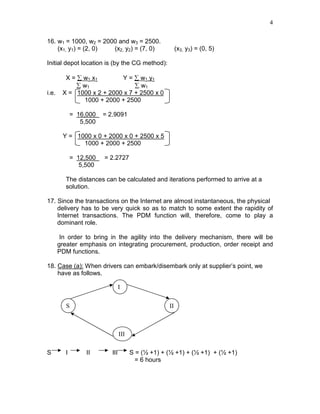
18. Case (a): When drivers can embark/disembark only at supplier’s point, we
have as follows.
S I II III S = (½ +1) + (½ +1) + (½ +1) + (½ +1)
= 6 hours
S II
I
III
5
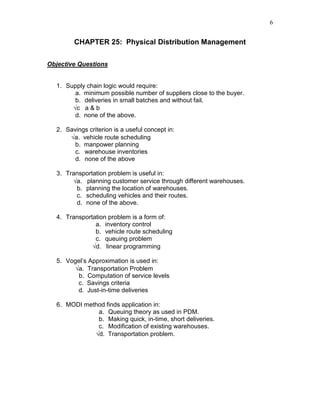
Any trip and back would take (½ +1 + ½ +1) = 3 hours and so not possible.
Hence only 3 deliveries can be made in a day.
Case (b): When drivers can embark and disembark at any point, we have as
follows:
S I II III S I II III S I II
III S I II III S
Thus, 4 deliveries are possible.
Case ©: 4 drivers instead of 3 of case (b).
Truck is the limiting factor, not the drivers. Having more drivers does not help.
6
CHAPTER 25: Physical Distribution Management
Objective Questions
1. Supply chain logic would require:
a. minimum possible number of suppliers close to the buyer.
b. deliveries in small batches and without fail.
√c a & b
d. none of the above.
2. Savings criterion is a useful concept in:
√a. vehicle route scheduling
b. manpower planning
c. warehouse inventories
d. none of the above
3. Transportation problem is useful in:
√a. planning customer service through different warehouses.
b. planning the location of warehouses.
c. scheduling vehicles and their routes.
d. none of the above.
4. Transportation problem is a form of:
a. inventory control
b. vehicle route scheduling
c. queuing problem
√d. linear programming
5. Vogel’s Approximation is used in:
√a. Transportation Problem
b. Computation of service levels
c. Savings criteria
d. Just-in-time deliveries
6. MODI method finds application in:
a. Queuing theory as used in PDM.
b. Making quick, in-time, short deliveries.
c. Modification of existing warehouses.
√d. Transportation problem.
7
7. Strings and weights method is useful in:
a. scheduling vehicle routes.
b. optimizing inventories in the depots.
√c. location of warehouses or depots.
d. material handling for bulk items.
8. North-West corner rule is of much use in:
a. assigning place for materials in a store.
b. locating the movement of vehicles.
c. comparing quality performance of two suppliers.
√d. solving a Transportation problem.
9. An optimal depot location can be given by:
√a. Centre of Gravity method
b. Inter-point Savings method
c. MRP-II
d. Waiting line problem
10.Cost of a distribution system consists of:
a. costs of transportation.
b. costs of supply centers.
c. costs of inventories in the pipeline and supply centers.
√d. all of the above.
11. ‘Penalties’ for rows and columns are used in:
a. MODI method
√b. Vogel’s approximation method
c. Savings criteria for linking points
d. Strings & weights method
12. Mnemonic method is used in:
a. Optimal warehouse location
b. Optimal allocation of warehouses to customers
c. Minimizing travel in vehicle route scheduling
√d. Codification of inventoried materials
13. Poisson distribution is of use in:
a. Vehicle route scheduling
b. Just-in-Time production scheduling
√c. Spare parts inventorying
d. Materials Requirement Planning
8
14. BAAN is:
a. a method of solving a Transportation Problem.
b. a system to optimize vehicle routes.
c. a variant of two-bin system.
√d. none of the above .
15.In a ’Transportation Problem’ it is mandatory that:
a. number of ‘origins’ and ‘destinations’ are equal.
√b. both the ‘origins’ and ‘destinations’ should be capable of
being expressed in the same units.
c. a & b
d. none of the above.

Production & Operation Management Chapter25[1]

  • 1.
    Chapter 25: PhysicalDistribution Management Responses to Questions 1. The merit of analytical solutions is that they come up with a definitive solution. Analytical solutions are limited by the physical analogue. They do not take into account various other factors. Hence, the analytical solutions need to be used with caution. 2. Warehouses have fixed costs, transportation costs, variable costs of operating them, and inventory carrying and handling costs among others. These are the tangible costs. The intangibles include costs to people around the location, socio-political costs, climatic / weather related costs, etc. 3. Warehouse location problem is a location problem while the ‘transportation problem’ is that of allocation of demand to the warehouses. 4. It is similar to the model presented in the book. 5. Linear Programming has inequalities while Transportation problem has all equalities. 6. As stated in the Savings Criterion, the points on the circumference if joined (for the route) will produce distance savings. And, the vehicle has to come back to the depot ultimately. Hence, the flower-petal contour of the route. 7. Network theory offers solutions to the vehicle scheduling problem. 8. Logistics could include entire gamut of packaging, materials handling, transporting / shipping, and warehousing (including inventory control therein). 9. Warehouse inventory is very relevant for customer service; inventory in transit (in pipeline) is very relevant in inventory-related cost controls. Hence, logistics has several inventory control decisions as part of its management decision process. 10.The objective of logistics is to serve the customer with desired profitability for the firm. 11.Transport costs and distances (or proximities) are important in purchasing and sales decisions.
  • 2.
    2 12.Solve the problemas a Linear Programming problem which has inequalities. 13.Solve the problem as a Linear Programming problem. 14.In addition to the inter-point distance considerations, one needs to check for every feasible route: i. the vehicle capacity is not exceeded (max 10 tonnes) ii. the customer requirements have to be kept in mind while routing. Rank Link Route (Component links) Customer requirement Vehicle load Actual route 1 2-5 3+2 5 0-2-5-0 2 1-6 1+2 3 0-1-6-0 3 2-6 Distance-wise not feasible 4 4-6 0-1, 1-6, 6-4, 4-0 1+2+5 8 0-1-6-4-0 5 2-3 0-3 3-2 2-5 5-0 1+3+2 6 0-3-2-5-0 6 3-7 0-7 7-3 3-2 2-5 5-0 6+1 +3 +2 12 Not feasible as vehicle cannot take load Links 4-7, 5-7 and 6-7 cannot be included as the vehicle capacity exceeds in each of these cases. With just 2 vehicles, this problem is not feasible. The 3rd vehicle can serve the route 0-7-0 with a load of 6 and distance of (2+2=) 4. 15. Solve it as a Linear Programming problem. The various constraints are: (1, 2 & 3 represent factories and 4, 5, 6 & 7 represent warehouses) x12 + x13 ≤ 2
  • 3.
    3 x21 + x23≤ 3 x31 + x32 ≤ 4 x14 + x15 + x16 + x17 + x21 + x31 ≤ 9 x24 + x25 + x26 + x27 + x12 + x32 ≤ 9 x34 + x35 + x36 + x37 + x13 + x23 ≤ 9 x14 + x24 + x34 = 1 x15 + x25 + x35 = 4 x16 + x26 + x36 = 2 x17 + x27 + x37 = 2 x12 ≤ 2 x13 ≤ 2 x21 ≤ 3 x23 ≤ 3 x31 ≤ 4 x32 ≤ 4 Non-negativity constraints: x14 ≥ 0 x15 ≥ 0 x16 ≥ 0 x17 ≥ 0 x24 ≥ 0 x25 ≥ 0 x26 ≥ 0 x27 ≥ 0 x34 ≥ 0 x35 ≥ 0 x36 ≥ 0 x37 ≥ 0 Objective Function: Minimize Total Cost TC = C12 x12 + C13 x13 + C21 x21 + C23 x23 + C31 x31 + C32 x32 + C14 x14 + C15 x15 + C16 x16 + C17 x17 + C24 x24 + C25 x25 + C26 x26 + C27 x27 + C34 x34 + C35 x35 + C36 x36 + C37 x37
  • 4.
    4 16. w1 =1000, w2 = 2000 and w3 = 2500. (x1, y1) = (2, 0) (x2, y2) = (7, 0) (x3, y3) = (0, 5) Initial depot location is (by the CG method): X = ∑ w1 x1 Y = ∑ w1 y1 ∑ w1 ∑ w1 i.e. X = 1000 x 2 + 2000 x 7 + 2500 x 0 1000 + 2000 + 2500 = 16,000 = 2.9091 5,500 Y = 1000 x 0 + 2000 x 0 + 2500 x 5 1000 + 2000 + 2500 = 12,500 = 2.2727 5,500 The distances can be calculated and iterations performed to arrive at a solution. 17. Since the transactions on the Internet are almost instantaneous, the physical delivery has to be very quick so as to match to some extent the rapidity of Internet transactions. The PDM function will, therefore, come to play a dominant role. In order to bring in the agility into the delivery mechanism, there will be greater emphasis on integrating procurement, production, order receipt and PDM functions. 18. Case (a): When drivers can embark/disembark only at supplier’s point, we have as follows. S I II III S = (½ +1) + (½ +1) + (½ +1) + (½ +1) = 6 hours S II I III
  • 5.
    5 Any trip andback would take (½ +1 + ½ +1) = 3 hours and so not possible. Hence only 3 deliveries can be made in a day. Case (b): When drivers can embark and disembark at any point, we have as follows: S I II III S I II III S I II III S I II III S Thus, 4 deliveries are possible. Case ©: 4 drivers instead of 3 of case (b). Truck is the limiting factor, not the drivers. Having more drivers does not help.
  • 6.
    6 CHAPTER 25: PhysicalDistribution Management Objective Questions 1. Supply chain logic would require: a. minimum possible number of suppliers close to the buyer. b. deliveries in small batches and without fail. √c a & b d. none of the above. 2. Savings criterion is a useful concept in: √a. vehicle route scheduling b. manpower planning c. warehouse inventories d. none of the above 3. Transportation problem is useful in: √a. planning customer service through different warehouses. b. planning the location of warehouses. c. scheduling vehicles and their routes. d. none of the above. 4. Transportation problem is a form of: a. inventory control b. vehicle route scheduling c. queuing problem √d. linear programming 5. Vogel’s Approximation is used in: √a. Transportation Problem b. Computation of service levels c. Savings criteria d. Just-in-time deliveries 6. MODI method finds application in: a. Queuing theory as used in PDM. b. Making quick, in-time, short deliveries. c. Modification of existing warehouses. √d. Transportation problem.
  • 7.
    7 7. Strings andweights method is useful in: a. scheduling vehicle routes. b. optimizing inventories in the depots. √c. location of warehouses or depots. d. material handling for bulk items. 8. North-West corner rule is of much use in: a. assigning place for materials in a store. b. locating the movement of vehicles. c. comparing quality performance of two suppliers. √d. solving a Transportation problem. 9. An optimal depot location can be given by: √a. Centre of Gravity method b. Inter-point Savings method c. MRP-II d. Waiting line problem 10.Cost of a distribution system consists of: a. costs of transportation. b. costs of supply centers. c. costs of inventories in the pipeline and supply centers. √d. all of the above. 11. ‘Penalties’ for rows and columns are used in: a. MODI method √b. Vogel’s approximation method c. Savings criteria for linking points d. Strings & weights method 12. Mnemonic method is used in: a. Optimal warehouse location b. Optimal allocation of warehouses to customers c. Minimizing travel in vehicle route scheduling √d. Codification of inventoried materials 13. Poisson distribution is of use in: a. Vehicle route scheduling b. Just-in-Time production scheduling √c. Spare parts inventorying d. Materials Requirement Planning
  • 8.
    8 14. BAAN is: a.a method of solving a Transportation Problem. b. a system to optimize vehicle routes. c. a variant of two-bin system. √d. none of the above . 15.In a ’Transportation Problem’ it is mandatory that: a. number of ‘origins’ and ‘destinations’ are equal. √b. both the ‘origins’ and ‘destinations’ should be capable of being expressed in the same units. c. a & b d. none of the above.