CHAPTER 19: PRODUCTIVITY
Responses to Questions
1. Productivity improvement is a continuous activity. It can be achieved
through improvements in technology, in management systems and
procedures, in skills and knowledge improvement – all of these backed by
effective leadership motivating the people working with the firm and
aligning their capabilities and motivations with the goals of the firm.
Productivity improvement as a ‘one shot’ project will be temporary and
unsustainable.
2. A productivity measure is situation-dependent. There could be different
inputs and outputs giving rise to various measures of productivity.
Different measures offer different perspectives of productivity.
Management has to take an integrated view.
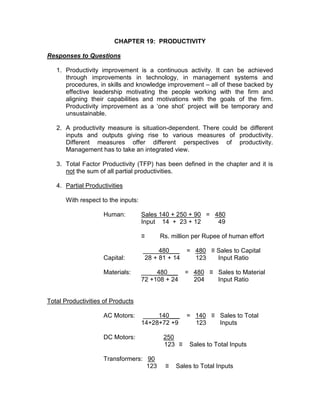
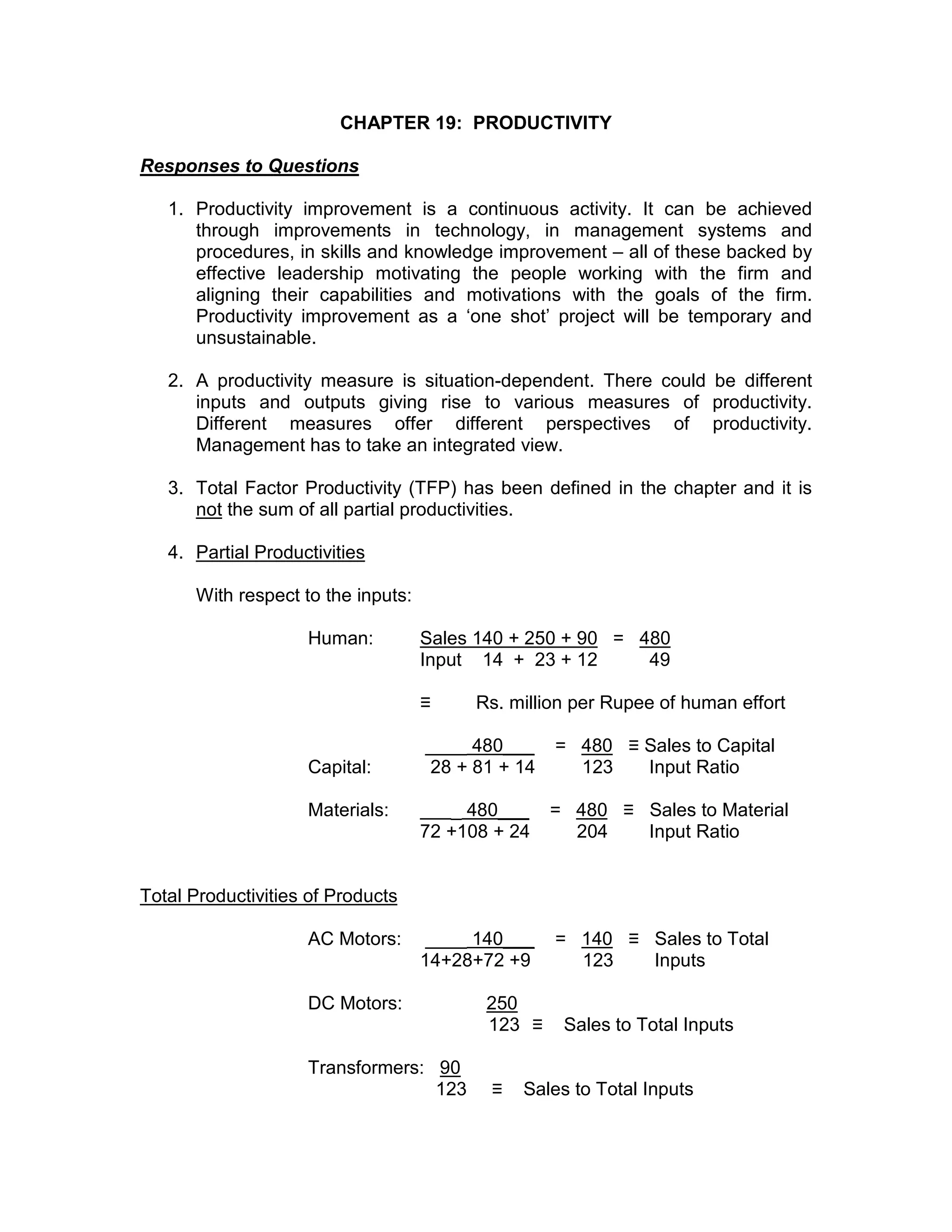
3. Total Factor Productivity (TFP) has been defined in the chapter and it is
not the sum of all partial productivities.
4. Partial Productivities
With respect to the inputs:
Human: Sales 140 + 250 + 90 = 480
Input 14 + 23 + 12 49
≡ Rs. million per Rupee of human effort
____ 480___ = 480 ≡ Sales to Capital
Capital: 28 + 81 + 14 123 Input Ratio
Materials: _ 480___ = 480 ≡ Sales to Material
72 +108 + 24 204 Input Ratio
Total Productivities of Products
AC Motors: ____ 140___ = 140 ≡ Sales to Total
14+28+72 +9 123 Inputs
DC Motors: 250
123 ≡ Sales to Total Inputs
Transformers: 90
123 ≡ Sales to Total Inputs
2
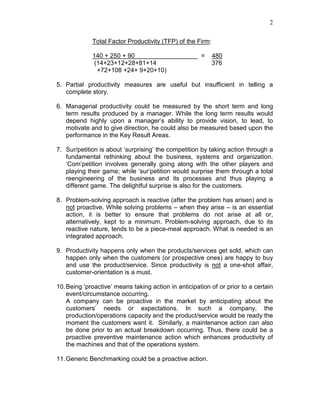
Total Factor Productivity (TFP) of the Firm:
140 + 250 + 90 = 480
(14+23+12+28+81+14 376
+72+108 +24+ 9+20+10)
5. Partial productivity measures are useful but insufficient in telling a
complete story.
6. Managerial productivity could be measured by the short term and long
term results produced by a manager. While the long term results would
depend highly upon a manager’s ability to provide vision, to lead, to
motivate and to give direction, he could also be measured based upon the
performance in the Key Result Areas.
7. Sur/petition is about ‘surprising’ the competition by taking action through a
fundamental rethinking about the business, systems and organization.
‘Com’petition involves generally going along with the other players and
playing their game; while ‘sur’petition would surprise them through a total
reengineering of the business and its processes and thus playing a
different game. The delightful surprise is also for the customers.
8. Problem-solving approach is reactive (after the problem has arisen) and is
not proactive. While solving problems – when they arise – is an essential
action, it is better to ensure that problems do not arise at all or,
alternatively, kept to a minimum. Problem-solving approach, due to its
reactive nature, tends to be a piece-meal approach. What is needed is an
integrated approach.
9. Productivity happens only when the products/services get sold, which can
happen only when the customers (or prospective ones) are happy to buy
and use the product/service. Since productivity is not a one-shot affair,
customer-orientation is a must.
10.Being ‘proactive’ means taking action in anticipation of or prior to a certain
event/circumstance occurring.
A company can be proactive in the market by anticipating about the
customers’ needs or expectations. In such a company, the
production/operations capacity and the product/service would be ready the
moment the customers want it. Similarly, a maintenance action can also
be done prior to an actual breakdown occurring. Thus, there could be a
proactive preventive maintenance action which enhances productivity of
the machines and that of the operations system.
11.Generic Benchmarking could be a proactive action.
3
Processes/procedures of dissimilar industries could be used or emulated
to improve productivities. Even internal benchmarking or competitive or
functional benchmarking could suggest several proactive actions.
Examples have been given in the text book.
12.TQM, Benchmarking and BPR are organisation-wide exercises to improve
productivity. So, they are connected. However, while TQM approach is
more organic and evolving, the BPR approach is more surgical or radical
in nature. That does not suggest that the aspect of customer-orientation
which is emphatic in BPR cannot be used in TQM. Also, TQM can always
use inputs from benchmarking; so can BPR. Similarly the TQM thinking on
leadership, human resource management and on organization goals can
be used in BPR.
13.With the advances in technology and use of automation, there is a danger
of a reduction in human interactions within in an organisation. In such a
case, the organizational climate might get affected. Also, organizational
learning might get affected. Moreover, technology may make certain jobs
redundant and the staff in those jobs may need to be re-trained for other
jobs. All this requires much Human Resource Development action. This is
true of both manufacturing and service industries.
14. Yes. In fact, many Japanese management techniques / philosophies
seem to exhibit the ‘family’ culture. Family involves a committed team
work. This concept could be transferred to the work place. But, for
anything to work a committed top management is essential.
15.Western and Japanese management are now coming closer and such
distinctions will soon vanish with increased globalization. However if
‘traditional’ means ‘earlier’ styles, then the human dimension has been
more emphasized in the Japanese style of management with its Quality
circles, Productivity teams, Life long employment and such other
practices.
Traditional Western and Japanese styles could be used in such a way as
to complement each other. Only when a firm does not evolve and utilize
what is good elsewhere does the firm start getting slowly out-dated.
16.Social values do have a large impact on the attitudes of managers and
other staff of the Company. Management styles cannot be divorced from
society and its ways of functioning. Therefore, work culture does depend
upon the social values and hence productivity also gets affected. For
instance, in India the family culture would have its repercussions in the
management of an enterprise. Similarly, the concept of time in India had
been different from that in the occident. However, with rapid globalization
4
the social values are merging with each other and management styles are
getting increasingly integrated.
5
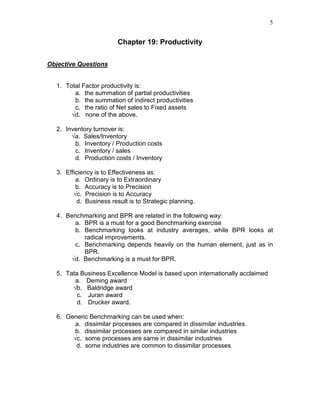
Chapter 19: Productivity
Objective Questions
1. Total Factor productivity is:
a. the summation of partial productivities
b. the summation of indirect productivities
c. the ratio of Net sales to Fixed assets
√d. none of the above.
2. Inventory turnover is:
√a. Sales/Inventory
b. Inventory / Production costs
c. Inventory / sales
d. Production costs / Inventory
3. Efficiency is to Effectiveness as:
a. Ordinary is to Extraordinary
b. Accuracy is to Precision
√c. Precision is to Accuracy
d. Business result is to Strategic planning.
4. Benchmarking and BPR are related in the following way:
a. BPR is a must for a good Benchmarking exercise
b. Benchmarking looks at industry averages, while BPR looks at
radical improvements.
c. Benchmarking depends heavily on the human element, just as in
BPR.
√d. Benchmarking is a must for BPR.
5. Tata Business Excellence Model is based upon internationally acclaimed
a. Deming award
√b. Baldridge award
c. Juran award
d. Drucker award.
6. Generic Benchmarking can be used when:
a. dissimilar processes are compared in dissimilar industries.
b. dissimilar processes are compared in similar industries
√c. some processes are same in dissimilar industries
d. some industries are common to dissimilar processes
6
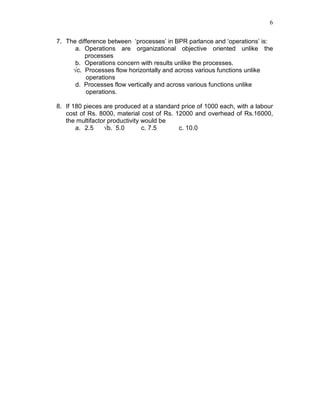
7. The difference between ‘processes’ in BPR parlance and ‘operations’ is:
a. Operations are organizational objective oriented unlike the
processes
b. Operations concern with results unlike the processes.
√c. Processes flow horizontally and across various functions unlike
operations
d. Processes flow vertically and across various functions unlike
operations.
8. If 180 pieces are produced at a standard price of 1000 each, with a labour
cost of Rs. 8000, material cost of Rs. 12000 and overhead of Rs.16000,
the multifactor productivity would be
a. 2.5 √b. 5.0 c. 7.5 c. 10.0

Production & Operation Management Chapter19[1]

  • 1.
    CHAPTER 19: PRODUCTIVITY Responsesto Questions 1. Productivity improvement is a continuous activity. It can be achieved through improvements in technology, in management systems and procedures, in skills and knowledge improvement – all of these backed by effective leadership motivating the people working with the firm and aligning their capabilities and motivations with the goals of the firm. Productivity improvement as a ‘one shot’ project will be temporary and unsustainable. 2. A productivity measure is situation-dependent. There could be different inputs and outputs giving rise to various measures of productivity. Different measures offer different perspectives of productivity. Management has to take an integrated view. 3. Total Factor Productivity (TFP) has been defined in the chapter and it is not the sum of all partial productivities. 4. Partial Productivities With respect to the inputs: Human: Sales 140 + 250 + 90 = 480 Input 14 + 23 + 12 49 ≡ Rs. million per Rupee of human effort ____ 480___ = 480 ≡ Sales to Capital Capital: 28 + 81 + 14 123 Input Ratio Materials: _ 480___ = 480 ≡ Sales to Material 72 +108 + 24 204 Input Ratio Total Productivities of Products AC Motors: ____ 140___ = 140 ≡ Sales to Total 14+28+72 +9 123 Inputs DC Motors: 250 123 ≡ Sales to Total Inputs Transformers: 90 123 ≡ Sales to Total Inputs
  • 2.
    2 Total Factor Productivity(TFP) of the Firm: 140 + 250 + 90 = 480 (14+23+12+28+81+14 376 +72+108 +24+ 9+20+10) 5. Partial productivity measures are useful but insufficient in telling a complete story. 6. Managerial productivity could be measured by the short term and long term results produced by a manager. While the long term results would depend highly upon a manager’s ability to provide vision, to lead, to motivate and to give direction, he could also be measured based upon the performance in the Key Result Areas. 7. Sur/petition is about ‘surprising’ the competition by taking action through a fundamental rethinking about the business, systems and organization. ‘Com’petition involves generally going along with the other players and playing their game; while ‘sur’petition would surprise them through a total reengineering of the business and its processes and thus playing a different game. The delightful surprise is also for the customers. 8. Problem-solving approach is reactive (after the problem has arisen) and is not proactive. While solving problems – when they arise – is an essential action, it is better to ensure that problems do not arise at all or, alternatively, kept to a minimum. Problem-solving approach, due to its reactive nature, tends to be a piece-meal approach. What is needed is an integrated approach. 9. Productivity happens only when the products/services get sold, which can happen only when the customers (or prospective ones) are happy to buy and use the product/service. Since productivity is not a one-shot affair, customer-orientation is a must. 10.Being ‘proactive’ means taking action in anticipation of or prior to a certain event/circumstance occurring. A company can be proactive in the market by anticipating about the customers’ needs or expectations. In such a company, the production/operations capacity and the product/service would be ready the moment the customers want it. Similarly, a maintenance action can also be done prior to an actual breakdown occurring. Thus, there could be a proactive preventive maintenance action which enhances productivity of the machines and that of the operations system. 11.Generic Benchmarking could be a proactive action.
  • 3.
    3 Processes/procedures of dissimilarindustries could be used or emulated to improve productivities. Even internal benchmarking or competitive or functional benchmarking could suggest several proactive actions. Examples have been given in the text book. 12.TQM, Benchmarking and BPR are organisation-wide exercises to improve productivity. So, they are connected. However, while TQM approach is more organic and evolving, the BPR approach is more surgical or radical in nature. That does not suggest that the aspect of customer-orientation which is emphatic in BPR cannot be used in TQM. Also, TQM can always use inputs from benchmarking; so can BPR. Similarly the TQM thinking on leadership, human resource management and on organization goals can be used in BPR. 13.With the advances in technology and use of automation, there is a danger of a reduction in human interactions within in an organisation. In such a case, the organizational climate might get affected. Also, organizational learning might get affected. Moreover, technology may make certain jobs redundant and the staff in those jobs may need to be re-trained for other jobs. All this requires much Human Resource Development action. This is true of both manufacturing and service industries. 14. Yes. In fact, many Japanese management techniques / philosophies seem to exhibit the ‘family’ culture. Family involves a committed team work. This concept could be transferred to the work place. But, for anything to work a committed top management is essential. 15.Western and Japanese management are now coming closer and such distinctions will soon vanish with increased globalization. However if ‘traditional’ means ‘earlier’ styles, then the human dimension has been more emphasized in the Japanese style of management with its Quality circles, Productivity teams, Life long employment and such other practices. Traditional Western and Japanese styles could be used in such a way as to complement each other. Only when a firm does not evolve and utilize what is good elsewhere does the firm start getting slowly out-dated. 16.Social values do have a large impact on the attitudes of managers and other staff of the Company. Management styles cannot be divorced from society and its ways of functioning. Therefore, work culture does depend upon the social values and hence productivity also gets affected. For instance, in India the family culture would have its repercussions in the management of an enterprise. Similarly, the concept of time in India had been different from that in the occident. However, with rapid globalization
  • 4.
    4 the social valuesare merging with each other and management styles are getting increasingly integrated.
  • 5.
    5 Chapter 19: Productivity ObjectiveQuestions 1. Total Factor productivity is: a. the summation of partial productivities b. the summation of indirect productivities c. the ratio of Net sales to Fixed assets √d. none of the above. 2. Inventory turnover is: √a. Sales/Inventory b. Inventory / Production costs c. Inventory / sales d. Production costs / Inventory 3. Efficiency is to Effectiveness as: a. Ordinary is to Extraordinary b. Accuracy is to Precision √c. Precision is to Accuracy d. Business result is to Strategic planning. 4. Benchmarking and BPR are related in the following way: a. BPR is a must for a good Benchmarking exercise b. Benchmarking looks at industry averages, while BPR looks at radical improvements. c. Benchmarking depends heavily on the human element, just as in BPR. √d. Benchmarking is a must for BPR. 5. Tata Business Excellence Model is based upon internationally acclaimed a. Deming award √b. Baldridge award c. Juran award d. Drucker award. 6. Generic Benchmarking can be used when: a. dissimilar processes are compared in dissimilar industries. b. dissimilar processes are compared in similar industries √c. some processes are same in dissimilar industries d. some industries are common to dissimilar processes
  • 6.
    6 7. The differencebetween ‘processes’ in BPR parlance and ‘operations’ is: a. Operations are organizational objective oriented unlike the processes b. Operations concern with results unlike the processes. √c. Processes flow horizontally and across various functions unlike operations d. Processes flow vertically and across various functions unlike operations. 8. If 180 pieces are produced at a standard price of 1000 each, with a labour cost of Rs. 8000, material cost of Rs. 12000 and overhead of Rs.16000, the multifactor productivity would be a. 2.5 √b. 5.0 c. 7.5 c. 10.0