Statistics
Chapter 1: Statistics, Data and Statistical Thinking
McClave, Statistics, 11th ed. Chapter 1:
Statistics, Data and Statistical Thinking
2
Where We’re Going
 Introduction to the field of statistics
 How statistics applies to real-world problems
 Establish the link between statistics and
data
 Differentiate between population and
sample data
 Differentiate between descriptive and
inferential statistics
McClave, Statistics, 11th ed. Chapter 1:
Statistics, Data and Statistical Thinking
3
1.1: The Science of Statistics
 Statistics is the science of data. This involves
collecting, classifying, summarizing, organizing,
analyzing and interpreting numerical
information.
McClave, Statistics, 11th ed. Chapter 1:
Statistics, Data and Statistical Thinking
4
1.2: Types of Statistical
Applications
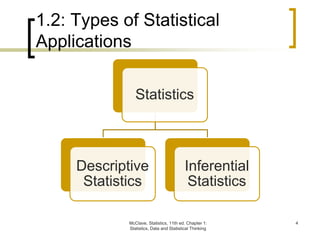
Statistics
Descriptive
Statistics
Inferential
Statistics
McClave, Statistics, 11th ed. Chapter 1:
Statistics, Data and Statistical Thinking
5
1.2: Types of Statistical
Applications
 Descriptive statistics utilizes numerical
and graphical methods to look for patterns
in a data set, to summarize the information
revealed in a data set and to present that
information in a convenient form.
McClave, Statistics, 11th ed. Chapter 1:
Statistics, Data and Statistical Thinking
6
1.2: Types of Statistical
Applications
 Inferential statistics utilizes sample data
to make estimates, decisions, predictions
or other generalizations about a larger set
of data.
McClave, Statistics, 11th ed. Chapter 1:
Statistics, Data and Statistical Thinking
7
1.3: Fundamental Elements of
Statistics
 An experimental unit is an object
about which we collect data.
 Person
 Place
 Thing
 Event
McClave, Statistics, 11th ed. Chapter 1:
Statistics, Data and Statistical Thinking
8
1.3: Fundamental Elements of
Statistics
 An population is a set of units in
which we are interested.
 Typically, there are too many
experimental units in a population to
consider every one.
 If we can examine every single one, we
conduct a census.
McClave, Statistics, 11th ed. Chapter 1:
Statistics, Data and Statistical Thinking
9
1.3: Fundamental Elements of
Statistics
 A variable is a characteristic or
property of an individual unit.
 The values of these characteristics will,
not surprisingly, vary.
McClave, Statistics, 11th ed. Chapter 1:
Statistics, Data and Statistical Thinking
10
1.3: Fundamental Elements of
Statistics
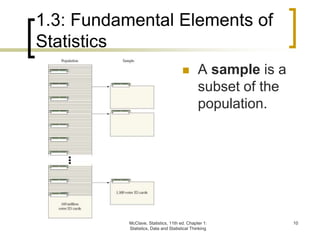
 A sample is a
subset of the
population.
McClave, Statistics, 11th ed. Chapter 1:
Statistics, Data and Statistical Thinking
11
1.3: Fundamental Elements of
Statistics
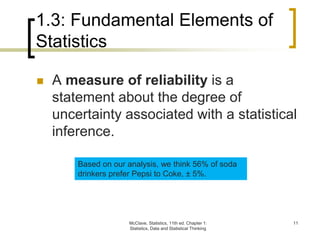
 A measure of reliability is a
statement about the degree of
uncertainty associated with a statistical
inference.
Based on our analysis, we think 56% of soda
drinkers prefer Pepsi to Coke, ± 5%.
1.3: Fundamental Elements of
Statistics
Descriptive Statistics
 The population or
sample of interest
 One or more variables to
be investigated
 Tables, graphs or
numerical summary tools
 Identification of patterns
in the data
Inferential Statistics
 Population of interest
 One or more variables to
be investigated
 The sample of
population units
 The inference about the
population based on the
sample data
 A measure of reliability
of the inference
McClave, Statistics, 11th ed. Chapter 1:
Statistics, Data and Statistical Thinking
12
1.4: Types of Data
 Quantitative Data are measurements
that are recorded on a naturally
occurring numerical scale.
 Age
 GPA
 Salary
 Cost of books this semester
McClave, Statistics, 11th ed. Chapter 1:
Statistics, Data and Statistical Thinking
13
1.4: Types of Data
 Qualitative Data are measurements
that cannot be recorded on a natural
numerical scale, but are recorded in
categories.
 Year in school
 Live on/off campus
 Major
 Gender
McClave, Statistics, 11th ed. Chapter 1:
Statistics, Data and Statistical Thinking
14
1.5: Collecting Data
McClave, Statistics, 11th ed. Chapter 1:
Statistics, Data and Statistical Thinking
15
 Published
Source
 Designed
Experiment
 Survey
 Observational
Study
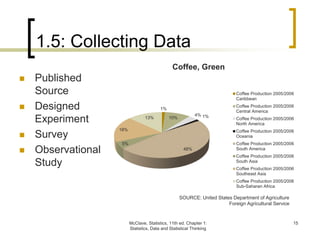
1%
10%
4% 1%
48%
5%
18%
13%
Coffee, Green
Coffee Production 2005/2006
Caribbean
Coffee Production 2005/2006
Central America
Coffee Production 2005/2006
North America
Coffee Production 2005/2006
Oceania
Coffee Production 2005/2006
South America
Coffee Production 2005/2006
South Asia
Coffee Production 2005/2006
Southeast Asia
Coffee Production 2005/2006
Sub-Saharan Africa
SOURCE: United States Department of Agriculture
Foreign Agricultural Service
1.5: Collecting Data
McClave, Statistics, 11th ed. Chapter 1:
Statistics, Data and Statistical Thinking
16
 Published Source
 Journal
 Book
 Newspaper
 Magazine
 (Reliable) Web Site
1.5: Collecting Data
McClave, Statistics, 11th ed. Chapter 1:
Statistics, Data and Statistical Thinking
17
 Designed Experiment
 Strict control over the experiment and the
units in the experiment
1.5: Collecting Data
McClave, Statistics, 11th ed. Chapter 1:
Statistics, Data and Statistical Thinking
18
 Survey
 Gallup, Harris and other polls
 Nielsen
1.5: Collecting Data
McClave, Statistics, 11th ed. Chapter 1:
Statistics, Data and Statistical Thinking
19
 Observational Study
 Observe units in natural settings
 No control over behavior of units
1.5: Collecting Data
McClave, Statistics, 11th ed. Chapter 1:
Statistics, Data and Statistical Thinking
20
 A representative sample exhibits
characteristics typical of those
possessed by the target population.
 A random sample of n units is
selected in such a way that every
different sample of size n has the
same chance of being selected.
1.6: The Role of Statistics in
Critical Thinking
McClave, Statistics, 11th ed. Chapter 1:
Statistics, Data and Statistical Thinking
21
 Statistical thinking involves applying
rational thought and the science of
statistics to critically assess data and
inferences.
1.6: The Role of Statistics in
Critical Thinking
McClave, Statistics, 11th ed. Chapter 1:
Statistics, Data and Statistical Thinking
22
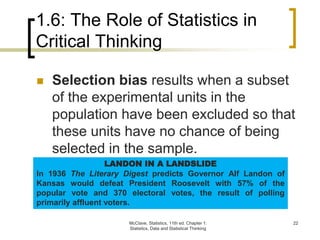
 Selection bias results when a subset
of the experimental units in the
population have been excluded so that
these units have no chance of being
selected in the sample.
LANDON IN A LANDSLIDE
In 1936 The Literary Digest predicts Governor Alf Landon of
Kansas would defeat President Roosevelt with 57% of the
popular vote and 370 electoral votes, the result of polling
primarily affluent voters.
1.6: The Role of Statistics in
Critical Thinking
McClave, Statistics, 11th ed. Chapter 1:
Statistics, Data and Statistical Thinking
23
 Nonresponse bias results when the
researchers conducting a survey or
study are unable to obtain data on all
experimental units selected for the
sample.
1.6: The Role of Statistics in
Critical Thinking
McClave, Statistics, 11th ed. Chapter 1:
Statistics, Data and Statistical Thinking
24
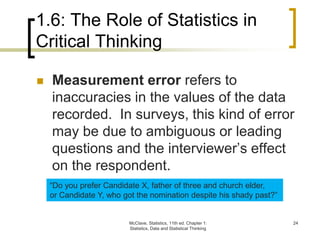
 Measurement error refers to
inaccuracies in the values of the data
recorded. In surveys, this kind of error
may be due to ambiguous or leading
questions and the interviewer’s effect
on the respondent.
“Do you prefer Candidate X, father of three and church elder,
or Candidate Y, who got the nomination despite his shady past?”

Chapter_01_Intro $xxxxxxxxxxxxxxxxxxxxxx.ppt

  • 1.
    Statistics Chapter 1: Statistics,Data and Statistical Thinking
  • 2.
    McClave, Statistics, 11thed. Chapter 1: Statistics, Data and Statistical Thinking 2 Where We’re Going  Introduction to the field of statistics  How statistics applies to real-world problems  Establish the link between statistics and data  Differentiate between population and sample data  Differentiate between descriptive and inferential statistics
  • 3.
    McClave, Statistics, 11thed. Chapter 1: Statistics, Data and Statistical Thinking 3 1.1: The Science of Statistics  Statistics is the science of data. This involves collecting, classifying, summarizing, organizing, analyzing and interpreting numerical information.
  • 4.
    McClave, Statistics, 11thed. Chapter 1: Statistics, Data and Statistical Thinking 4 1.2: Types of Statistical Applications Statistics Descriptive Statistics Inferential Statistics
  • 5.
    McClave, Statistics, 11thed. Chapter 1: Statistics, Data and Statistical Thinking 5 1.2: Types of Statistical Applications  Descriptive statistics utilizes numerical and graphical methods to look for patterns in a data set, to summarize the information revealed in a data set and to present that information in a convenient form.
  • 6.
    McClave, Statistics, 11thed. Chapter 1: Statistics, Data and Statistical Thinking 6 1.2: Types of Statistical Applications  Inferential statistics utilizes sample data to make estimates, decisions, predictions or other generalizations about a larger set of data.
  • 7.
    McClave, Statistics, 11thed. Chapter 1: Statistics, Data and Statistical Thinking 7 1.3: Fundamental Elements of Statistics  An experimental unit is an object about which we collect data.  Person  Place  Thing  Event
  • 8.
    McClave, Statistics, 11thed. Chapter 1: Statistics, Data and Statistical Thinking 8 1.3: Fundamental Elements of Statistics  An population is a set of units in which we are interested.  Typically, there are too many experimental units in a population to consider every one.  If we can examine every single one, we conduct a census.
  • 9.
    McClave, Statistics, 11thed. Chapter 1: Statistics, Data and Statistical Thinking 9 1.3: Fundamental Elements of Statistics  A variable is a characteristic or property of an individual unit.  The values of these characteristics will, not surprisingly, vary.
  • 10.
    McClave, Statistics, 11thed. Chapter 1: Statistics, Data and Statistical Thinking 10 1.3: Fundamental Elements of Statistics  A sample is a subset of the population.
  • 11.
    McClave, Statistics, 11thed. Chapter 1: Statistics, Data and Statistical Thinking 11 1.3: Fundamental Elements of Statistics  A measure of reliability is a statement about the degree of uncertainty associated with a statistical inference. Based on our analysis, we think 56% of soda drinkers prefer Pepsi to Coke, ± 5%.
  • 12.
    1.3: Fundamental Elementsof Statistics Descriptive Statistics  The population or sample of interest  One or more variables to be investigated  Tables, graphs or numerical summary tools  Identification of patterns in the data Inferential Statistics  Population of interest  One or more variables to be investigated  The sample of population units  The inference about the population based on the sample data  A measure of reliability of the inference McClave, Statistics, 11th ed. Chapter 1: Statistics, Data and Statistical Thinking 12
  • 13.
    1.4: Types ofData  Quantitative Data are measurements that are recorded on a naturally occurring numerical scale.  Age  GPA  Salary  Cost of books this semester McClave, Statistics, 11th ed. Chapter 1: Statistics, Data and Statistical Thinking 13
  • 14.
    1.4: Types ofData  Qualitative Data are measurements that cannot be recorded on a natural numerical scale, but are recorded in categories.  Year in school  Live on/off campus  Major  Gender McClave, Statistics, 11th ed. Chapter 1: Statistics, Data and Statistical Thinking 14
  • 15.
    1.5: Collecting Data McClave,Statistics, 11th ed. Chapter 1: Statistics, Data and Statistical Thinking 15  Published Source  Designed Experiment  Survey  Observational Study 1% 10% 4% 1% 48% 5% 18% 13% Coffee, Green Coffee Production 2005/2006 Caribbean Coffee Production 2005/2006 Central America Coffee Production 2005/2006 North America Coffee Production 2005/2006 Oceania Coffee Production 2005/2006 South America Coffee Production 2005/2006 South Asia Coffee Production 2005/2006 Southeast Asia Coffee Production 2005/2006 Sub-Saharan Africa SOURCE: United States Department of Agriculture Foreign Agricultural Service
  • 16.
    1.5: Collecting Data McClave,Statistics, 11th ed. Chapter 1: Statistics, Data and Statistical Thinking 16  Published Source  Journal  Book  Newspaper  Magazine  (Reliable) Web Site
  • 17.
    1.5: Collecting Data McClave,Statistics, 11th ed. Chapter 1: Statistics, Data and Statistical Thinking 17  Designed Experiment  Strict control over the experiment and the units in the experiment
  • 18.
    1.5: Collecting Data McClave,Statistics, 11th ed. Chapter 1: Statistics, Data and Statistical Thinking 18  Survey  Gallup, Harris and other polls  Nielsen
  • 19.
    1.5: Collecting Data McClave,Statistics, 11th ed. Chapter 1: Statistics, Data and Statistical Thinking 19  Observational Study  Observe units in natural settings  No control over behavior of units
  • 20.
    1.5: Collecting Data McClave,Statistics, 11th ed. Chapter 1: Statistics, Data and Statistical Thinking 20  A representative sample exhibits characteristics typical of those possessed by the target population.  A random sample of n units is selected in such a way that every different sample of size n has the same chance of being selected.
  • 21.
    1.6: The Roleof Statistics in Critical Thinking McClave, Statistics, 11th ed. Chapter 1: Statistics, Data and Statistical Thinking 21  Statistical thinking involves applying rational thought and the science of statistics to critically assess data and inferences.
  • 22.
    1.6: The Roleof Statistics in Critical Thinking McClave, Statistics, 11th ed. Chapter 1: Statistics, Data and Statistical Thinking 22  Selection bias results when a subset of the experimental units in the population have been excluded so that these units have no chance of being selected in the sample. LANDON IN A LANDSLIDE In 1936 The Literary Digest predicts Governor Alf Landon of Kansas would defeat President Roosevelt with 57% of the popular vote and 370 electoral votes, the result of polling primarily affluent voters.
  • 23.
    1.6: The Roleof Statistics in Critical Thinking McClave, Statistics, 11th ed. Chapter 1: Statistics, Data and Statistical Thinking 23  Nonresponse bias results when the researchers conducting a survey or study are unable to obtain data on all experimental units selected for the sample.
  • 24.
    1.6: The Roleof Statistics in Critical Thinking McClave, Statistics, 11th ed. Chapter 1: Statistics, Data and Statistical Thinking 24  Measurement error refers to inaccuracies in the values of the data recorded. In surveys, this kind of error may be due to ambiguous or leading questions and the interviewer’s effect on the respondent. “Do you prefer Candidate X, father of three and church elder, or Candidate Y, who got the nomination despite his shady past?”