Ch. 1: Intro to Statics
1.0 Outline 7
 Basic Concepts 8
 Scalars and Vectors 11
 Newton’s Laws (overview) 22
 Gravitational Law 25
1.0 Outline
7
Ch. 1: Intro to Statics
1.1 Basic Concepts
Space The region occupied by bodies. Their positions
and orientations can be described by linear and angular
measurements relative to a specified coordinate system.
Time The measure of the succession of events. Often,
the change in the physical quantities are described with
respect to time, e.g.,
Mass The measure of the inertia of a body, which
indicates the resistance to a change in its velocity.
Force The measure of the attempt to move a body. It is
a fixed vector.
dr
v
dt
=
1.1 Basic Concepts
1
8
Ch. 1: Intro to Statics
1.1 Basic Concepts
Particle A body of negligible dimensions. This is a
relative matter to the surrounding effect. Hence, rotation
effect is insignificant.
Rigid body A body whose relative movement between its
parts are negligible relative to the gross motion of the
body.
Nonrigid body A body whose relative movement
between its parts are significant relative to the gross
motion of the body. Mechanics of the deformable
material.
1.1 Basic Concepts
9
Particles Objects
differential element analysis
of the body
Molecular effects in the body
Flight speed of the airplane
Yawing, pitching motion of
the plane
Rigid bodies Nonrigid bodies
Tension in the truss structure
Material for constructing the
truss
A stiff linkage of the robot An n-joint robot arm
Ch. 1: Intro to Statics
The body-fixed inertia of the nonrigid body
is not constant.
1.1 Basic Concepts
10
Ch. 1: Intro to Statics
1.2 Scalars and Vectors
Scalars Quantities for which only the magnitude can
describe completely. Time, volume, density, speed,
energy,
and mass are some examples.
Vectors Quantities for which both the magnitude and
the direction must be used to describe. For example,
displacement, velocity, acceleration, force, moment,
momentum.
1.2 Scalars and Vectors
11
Ch. 1: Intro to Statics
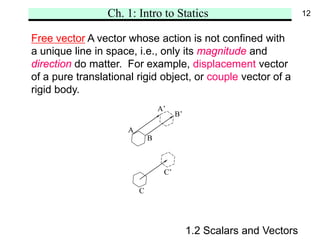
Free vector A vector whose action is not confined with
a unique line in space, i.e., only its magnitude and
direction do matter. For example, displacement vector
of a pure translational rigid object, or couple vector of a
rigid body.
1.2 Scalars and Vectors
A
A’
B
B’
C
C’
12
Ch. 1: Intro to Statics
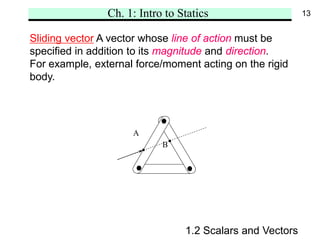
Sliding vector A vector whose line of action must be
specified in addition to its magnitude and direction.
For example, external force/moment acting on the rigid
body.
1.2 Scalars and Vectors
A
B
13
Ch. 1: Intro to Statics
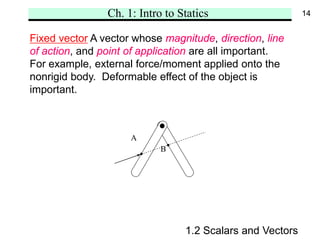
Fixed vector A vector whose magnitude, direction, line
of action, and point of application are all important.
For example, external force/moment applied onto the
nonrigid body. Deformable effect of the object is
important.
1.2 Scalars and Vectors
A
B
14
Ch. 1: Intro to Statics
,v,v,v
v

Representation of the Vector
Notation vector
magnitude
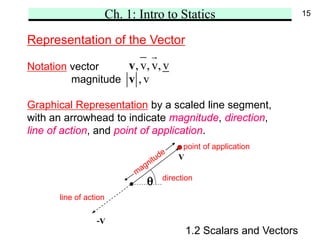
Graphical Representation by a scaled line segment,
with an arrowhead to indicate magnitude, direction,
line of action, and point of application.
1.2 Scalars and Vectors
,v
v
V
-V
θ direction
line of action
point of application
15
Ch. 1: Intro to Statics
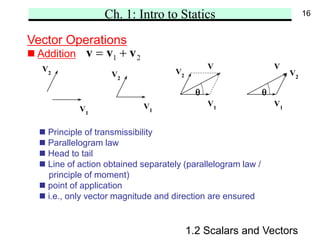
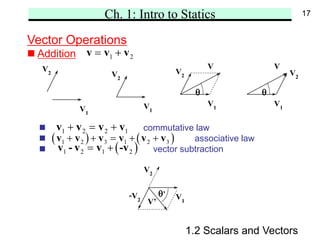
Vector Operations
 Addition
1.2 Scalars and Vectors
1 2
= +
v v v
V2
V1
V2
V1
V2
V1
θ
V
V1
θ
V
 Principle of transmissibility
 Parallelogram law
 Head to tail
 Line of action obtained separately (parallelogram law /
principle of moment)
 point of application
 i.e., only vector magnitude and direction are ensured
V2
16
Ch. 1: Intro to Statics
1 2
= +
v v v
1 2 2 1
+ = +
v v v v
( ) ( )
1 2 3 1 2 3
+ + = + +
v v v v v v
Vector Operations
 Addition
1.2 Scalars and Vectors
V2
V1
V2
V1
V2
V1
θ
V
V1
θ
V
 commutative law
 associative law
 vector subtraction
V2
( )
1 2 1 2
= +
v - v v -v
V2
V1
θ’
V’
-V2
17
Ch. 1: Intro to Statics
θ β
2 2 2
1 2 1 2
v v v 2v v cos β
= + −
Magnitude and Direction Calculation
(algebraic approach)
Cosine law:
Sine law: + kill impossible angle
1.2 Scalars and Vectors
V
V1
V2
2
v
v
sin sin
β θ
=
2 unknowns (scalar)
18
Ch. 1: Intro to Statics
1.2 Scalars and Vectors
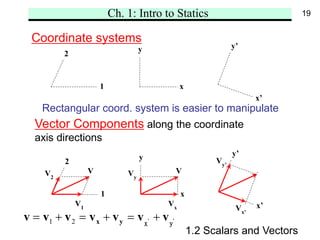
Coordinate systems
1 2
= + = + = +
x y
v v v v v v v
' '
x y
x’
y’
y
x
1
2
Rectangular coord. system is easier to manipulate
Vector Components along the coordinate
axis directions
x’
y’
y
x
1
2
V
V1
V2
V
Vx
Vy
Vy’
Vx’
19
Ch. 1: Intro to Statics
1.2 Scalars and Vectors
2-D Rectangular Coordinate systems
( )
2 2 2
ˆˆ
ˆ
v v v
1
ˆˆ
ˆ cos sin
v
v v v
v vcos
v vsin
arctan 2 v ,v
θ θ
θ
θ
θ
= +
= +
=
=
=
x y
x y
x
y
y x
v n = i j
n = i + j = v
Vy
Vx
θ
V
x
y
n
20
Ch. 1: Intro to Statics
1.2 Scalars and Vectors
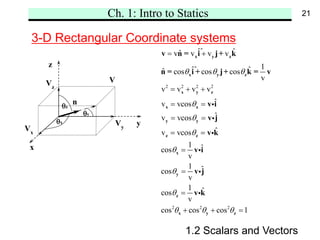
3-D Rectangular Coordinate systems
2 2 2 2
2 2 2
ˆˆ ˆ
ˆ
v v v v
1
ˆˆ ˆ
ˆ cos cos cos
v
v v v v
ˆ
v vcos
ˆ
v vcos
ˆ
v vcos
1 ˆ
cos
v
1 ˆ
cos
v
1 ˆ
cos
v
cos cos cos 1
θ θ θ
θ
θ
θ
θ
θ
θ
θ θ θ
= +
= + +
= =
= =
= =
=
=
=
+ + =
x y z
x y z
x y z
x x
y y
z z
x
y
z
x y z
v n = i j+ k
n = i + j+ k = v
v i
v j
v k
v i
v j
v k






Vz
Vy
θy
V
x
z
n
y
Vx
θx
θz
21
Ch. 1: Intro to Statics
1.3 Newton’s Laws
Newton’s Laws
1st Law: A particle remains at rest or continues to move
in a straight line with a uniform velocity if there is no
unbalanced force acting on it.
= ⇔
∑F 0 a = 0
22
Ch. 1: Intro to Statics
m
=
∑F a
1.3 Newton’s Laws
Newton’s Laws
2nd Law: The absolute acceleration of a particle is
proportional to the resultant force acting on it and is in
the direction of this resultant force.
acceleration
a = absolute
23
Ch. 1: Intro to Statics
F
-F
F
1.3 Newton’s Laws
Newton’s Laws
3rd Law: The forces of action and reaction between
interacting bodies are equal in magnitude, opposite
in direction, and collinear.
action force = -(reaction force)
F
FBD
24
Ch. 1: Intro to Statics
r
F F
1.4 Gravitational Law
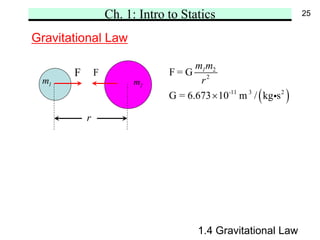
Gravitational Law
1
m 2
m
2
2
F G 1
m m
=
r
( )
-11 3 2
G = 6.673 10 m / kg s
× 
25
Ch. 1: Intro to Statics
1.4 Gravitational Law
Gravitational acceleration
Calculate from the gravitational force between the earth
and the object. This attractive force is called the weight
of the body.
2
G
W
free falling acceleration observed on the earth
= 9.81 m/s can be considered the absolute acceleration
in the engineering problem on earth
e
2
m
= m mg
r
g
=
= moving
26

chapter one introduction to statics course

  • 1.
    Ch. 1: Introto Statics 1.0 Outline 7  Basic Concepts 8  Scalars and Vectors 11  Newton’s Laws (overview) 22  Gravitational Law 25 1.0 Outline 7
  • 2.
    Ch. 1: Introto Statics 1.1 Basic Concepts Space The region occupied by bodies. Their positions and orientations can be described by linear and angular measurements relative to a specified coordinate system. Time The measure of the succession of events. Often, the change in the physical quantities are described with respect to time, e.g., Mass The measure of the inertia of a body, which indicates the resistance to a change in its velocity. Force The measure of the attempt to move a body. It is a fixed vector. dr v dt = 1.1 Basic Concepts 1 8
  • 3.
    Ch. 1: Introto Statics 1.1 Basic Concepts Particle A body of negligible dimensions. This is a relative matter to the surrounding effect. Hence, rotation effect is insignificant. Rigid body A body whose relative movement between its parts are negligible relative to the gross motion of the body. Nonrigid body A body whose relative movement between its parts are significant relative to the gross motion of the body. Mechanics of the deformable material. 1.1 Basic Concepts 9
  • 4.
    Particles Objects differential elementanalysis of the body Molecular effects in the body Flight speed of the airplane Yawing, pitching motion of the plane Rigid bodies Nonrigid bodies Tension in the truss structure Material for constructing the truss A stiff linkage of the robot An n-joint robot arm Ch. 1: Intro to Statics The body-fixed inertia of the nonrigid body is not constant. 1.1 Basic Concepts 10
  • 5.
    Ch. 1: Introto Statics 1.2 Scalars and Vectors Scalars Quantities for which only the magnitude can describe completely. Time, volume, density, speed, energy, and mass are some examples. Vectors Quantities for which both the magnitude and the direction must be used to describe. For example, displacement, velocity, acceleration, force, moment, momentum. 1.2 Scalars and Vectors 11
  • 6.
    Ch. 1: Introto Statics Free vector A vector whose action is not confined with a unique line in space, i.e., only its magnitude and direction do matter. For example, displacement vector of a pure translational rigid object, or couple vector of a rigid body. 1.2 Scalars and Vectors A A’ B B’ C C’ 12
  • 7.
    Ch. 1: Introto Statics Sliding vector A vector whose line of action must be specified in addition to its magnitude and direction. For example, external force/moment acting on the rigid body. 1.2 Scalars and Vectors A B 13
  • 8.
    Ch. 1: Introto Statics Fixed vector A vector whose magnitude, direction, line of action, and point of application are all important. For example, external force/moment applied onto the nonrigid body. Deformable effect of the object is important. 1.2 Scalars and Vectors A B 14
  • 9.
    Ch. 1: Introto Statics ,v,v,v v  Representation of the Vector Notation vector magnitude Graphical Representation by a scaled line segment, with an arrowhead to indicate magnitude, direction, line of action, and point of application. 1.2 Scalars and Vectors ,v v V -V θ direction line of action point of application 15
  • 10.
    Ch. 1: Introto Statics Vector Operations  Addition 1.2 Scalars and Vectors 1 2 = + v v v V2 V1 V2 V1 V2 V1 θ V V1 θ V  Principle of transmissibility  Parallelogram law  Head to tail  Line of action obtained separately (parallelogram law / principle of moment)  point of application  i.e., only vector magnitude and direction are ensured V2 16
  • 11.
    Ch. 1: Introto Statics 1 2 = + v v v 1 2 2 1 + = + v v v v ( ) ( ) 1 2 3 1 2 3 + + = + + v v v v v v Vector Operations  Addition 1.2 Scalars and Vectors V2 V1 V2 V1 V2 V1 θ V V1 θ V  commutative law  associative law  vector subtraction V2 ( ) 1 2 1 2 = + v - v v -v V2 V1 θ’ V’ -V2 17
  • 12.
    Ch. 1: Introto Statics θ β 2 2 2 1 2 1 2 v v v 2v v cos β = + − Magnitude and Direction Calculation (algebraic approach) Cosine law: Sine law: + kill impossible angle 1.2 Scalars and Vectors V V1 V2 2 v v sin sin β θ = 2 unknowns (scalar) 18
  • 13.
    Ch. 1: Introto Statics 1.2 Scalars and Vectors Coordinate systems 1 2 = + = + = + x y v v v v v v v ' ' x y x’ y’ y x 1 2 Rectangular coord. system is easier to manipulate Vector Components along the coordinate axis directions x’ y’ y x 1 2 V V1 V2 V Vx Vy Vy’ Vx’ 19
  • 14.
    Ch. 1: Introto Statics 1.2 Scalars and Vectors 2-D Rectangular Coordinate systems ( ) 2 2 2 ˆˆ ˆ v v v 1 ˆˆ ˆ cos sin v v v v v vcos v vsin arctan 2 v ,v θ θ θ θ θ = + = + = = = x y x y x y y x v n = i j n = i + j = v Vy Vx θ V x y n 20
  • 15.
    Ch. 1: Introto Statics 1.2 Scalars and Vectors 3-D Rectangular Coordinate systems 2 2 2 2 2 2 2 ˆˆ ˆ ˆ v v v v 1 ˆˆ ˆ ˆ cos cos cos v v v v v ˆ v vcos ˆ v vcos ˆ v vcos 1 ˆ cos v 1 ˆ cos v 1 ˆ cos v cos cos cos 1 θ θ θ θ θ θ θ θ θ θ θ θ = + = + + = = = = = = = = = + + = x y z x y z x y z x x y y z z x y z x y z v n = i j+ k n = i + j+ k = v v i v j v k v i v j v k       Vz Vy θy V x z n y Vx θx θz 21
  • 16.
    Ch. 1: Introto Statics 1.3 Newton’s Laws Newton’s Laws 1st Law: A particle remains at rest or continues to move in a straight line with a uniform velocity if there is no unbalanced force acting on it. = ⇔ ∑F 0 a = 0 22
  • 17.
    Ch. 1: Introto Statics m = ∑F a 1.3 Newton’s Laws Newton’s Laws 2nd Law: The absolute acceleration of a particle is proportional to the resultant force acting on it and is in the direction of this resultant force. acceleration a = absolute 23
  • 18.
    Ch. 1: Introto Statics F -F F 1.3 Newton’s Laws Newton’s Laws 3rd Law: The forces of action and reaction between interacting bodies are equal in magnitude, opposite in direction, and collinear. action force = -(reaction force) F FBD 24
  • 19.
    Ch. 1: Introto Statics r F F 1.4 Gravitational Law Gravitational Law 1 m 2 m 2 2 F G 1 m m = r ( ) -11 3 2 G = 6.673 10 m / kg s ×  25
  • 20.
    Ch. 1: Introto Statics 1.4 Gravitational Law Gravitational acceleration Calculate from the gravitational force between the earth and the object. This attractive force is called the weight of the body. 2 G W free falling acceleration observed on the earth = 9.81 m/s can be considered the absolute acceleration in the engineering problem on earth e 2 m = m mg r g = = moving 26