Seminar On
MICROENCAPSULATION AND MDDS
1/53
By:Rajesh L. Dumpala
(B.Pharm, M. Pharm.) PhD. ( Pursuing)
Research Scientist,
Alembic Research Centre. Vadodara
E.Mail:-rdumpala64@gmail.com
Contents:
 Introduction
 Methods for microencapsulation
 Characterization and evaluation
 Drug release measurement
 Applications
 Recent advances
2/53
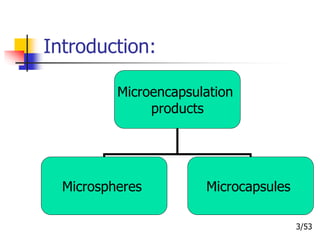
Introduction:
Microencapsulation
products
Microspheres Microcapsules
3/53
What is Microcapsule &
Microsphere?
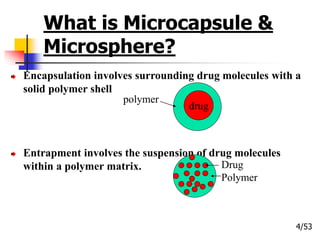
Encapsulation involves surrounding drug molecules with a
solid polymer shell
Entrapment involves the suspension of drug molecules
within a polymer matrix.
drug
polymer
Drug
Polymer
4/53
Selection of a coating material:
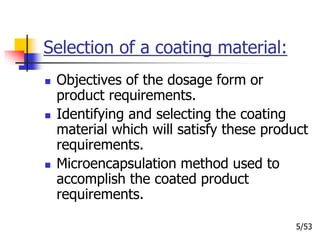
 Objectives of the dosage form or
product requirements.
 Identifying and selecting the coating
material which will satisfy these product
requirements.
 Microencapsulation method used to
accomplish the coated product
requirements.
5/53
Ideal requirements of a coating
material:
 Capable of forming a cohesive film with
the core material.
 Chemically compatible and non reactive
with the core material.
 Provide the desired coating properties,
like, strength, flexibility, impermeability,
optical properties and stability.
6/53
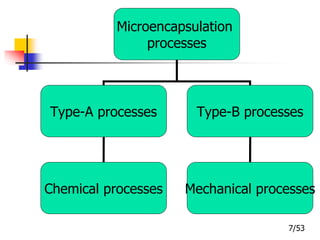
Microencapsulation
processes
Type-A processes Type-B processes
Chemical processes Mechanical processes
7/53
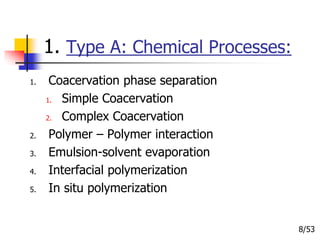
1. Type A: Chemical Processes:
1. Coacervation phase separation
1. Simple Coacervation
2. Complex Coacervation
2. Polymer – Polymer interaction
3. Emulsion-solvent evaporation
4. Interfacial polymerization
5. In situ polymerization
8/53
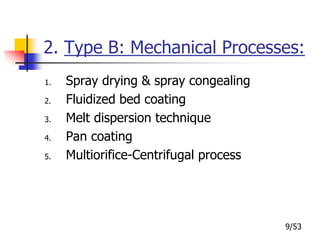
2. Type B: Mechanical Processes:
1. Spray drying & spray congealing
2. Fluidized bed coating
3. Melt dispersion technique
4. Pan coating
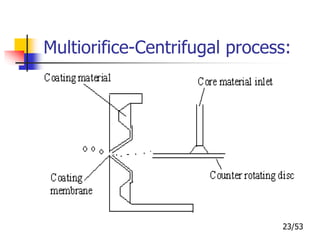
5. Multiorifice-Centrifugal process
9/53
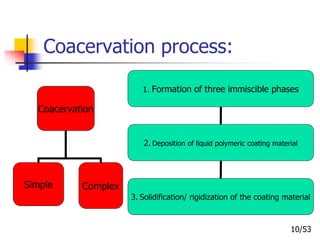
Coacervation process:
Coacervation
Simple Complex
1. Formation of three immiscible phases
2. Deposition of liquid polymeric coating material
3. Solidification/ rigidization of the coating material
10/53
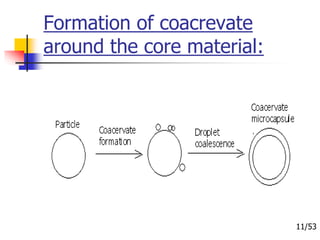
Formation of coacrevate
around the core material:
11/53
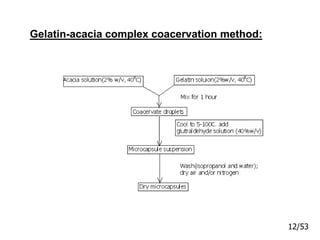
Gelatin-acacia complex coacervation method:
12/53
Limitations of coacervate microcapsules:
 Produced only at specific pH values.
 Toxicity problems.
 Addition of chemical cross linking agents and
application of heat are harmful to the encapsulant
materials, such as thermo and chemically labile drugs
and live cells.
13/53
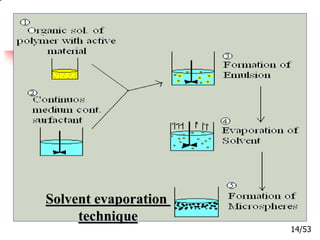
Solvent evaporation
technique
14/53
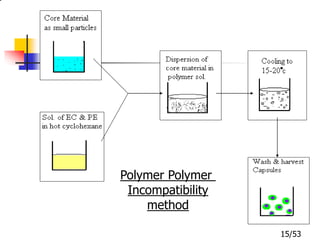
Polymer Polymer
Incompatibility
method
15/53
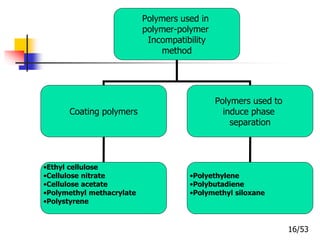
Polymers used in
polymer-polymer
Incompatibility
method
Coating polymers
Polymers used to
induce phase
separation
•Ethyl cellulose
•Cellulose nitrate
•Cellulose acetate
•Polymethyl methacrylate
•Polystyrene
•Polyethylene
•Polybutadiene
•Polymethyl siloxane
16/53
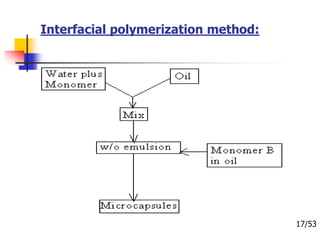
Interfacial polymerization method:
17/53
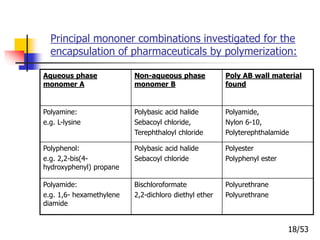
Principal mononer combinations investigated for the
encapsulation of pharmaceuticals by polymerization:
Aqueous phase
monomer A
Non-aqueous phase
monomer B
Poly AB wall material
found
Polyamine:
e.g. L-lysine
Polybasic acid halide
Sebacoyl chloride,
Terephthaloyl chloride
Polyamide,
Nylon 6-10,
Polyterephthalamide
Polyphenol:
e.g. 2,2-bis(4-
hydroxyphenyl) propane
Polybasic acid halide
Sebacoyl chloride
Polyester
Polyphenyl ester
Polyamide:
e.g. 1,6- hexamethylene
diamide
Bischloroformate
2,2-dichloro diethyl ether
Polyurethrane
Polyurethrane
18/53
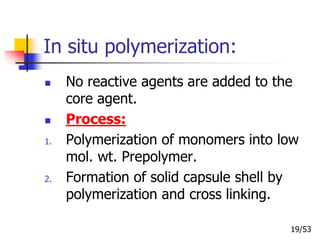
In situ polymerization:
 No reactive agents are added to the
core agent.
 Process:
1. Polymerization of monomers into low
mol. wt. Prepolymer.
2. Formation of solid capsule shell by
polymerization and cross linking.
19/53
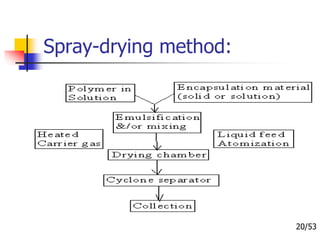
Spray-drying method:
20/53
Fluidized bed coating:
Fluidized bed
coating
Top spray Tangential spray
Bottom spray
(wurster coater)
21/53
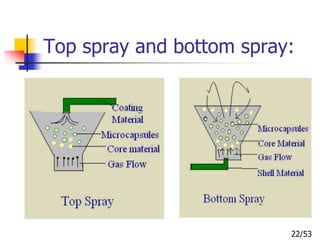
Top spray and bottom spray:
22/53
Multiorifice-Centrifugal process:
23/53
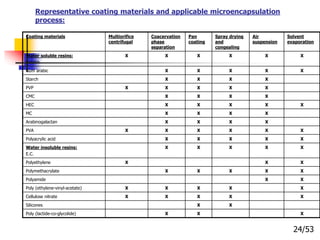
Representative coating materials and applicable microencapsulation
process:
Coating materials Multiorifice
centrifugal
Coacervation
phase
separation
Pan
coating
Spray drying
and
congealing
Air
suspension
Solvent
evaporation
Water soluble resins:
Gelatin
X X X X X X
Gum arabic X X X X X
Starch X X X X
PVP X X X X X
CMC X X X X
HEC X X X X X
MC X X X X
Arabinogalactan X X X X
PVA X X X X X X
Polyacrylic acid X X X X X
Water insoluble resins:
E.C.
X X X X X
Polyethylene X X X
Polymethacrylate X X X X X
Polyamide X X
Poly (ethylene-vinyl-acetate) X X X X X
Cellulose nitrate X X X X X
Silicones X X
Poly (lactide-co-glycolide) X X X
24/53
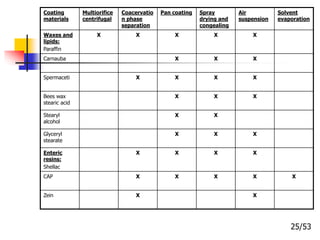
Coating
materials
Multiorifice
centrifugal
Coacervatio
n phase
separation
Pan coating Spray
drying and
congealing
Air
suspension
Solvent
evaporation
Waxes and
lipids:
Paraffin
X X X X X
Carnauba X X X
Spermaceti X X X X
Bees wax
stearic acid
X X X
Stearyl
alcohol
X X
Glyceryl
stearate
X X X
Enteric
resins:
Shellac
X X X X
CAP X X X X X
Zein X X
25/53
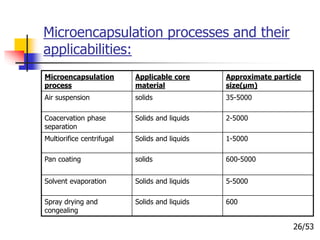
Microencapsulation processes and their
applicabilities:
Microencapsulation
process
Applicable core
material
Approximate particle
size(μm)
Air suspension solids 35-5000
Coacervation phase
separation
Solids and liquids 2-5000
Multiorifice centrifugal Solids and liquids 1-5000
Pan coating solids 600-5000
Solvent evaporation Solids and liquids 5-5000
Spray drying and
congealing
Solids and liquids 600
26/53
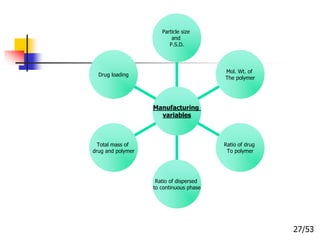
Drug loading
Total mass of
drug and polymer
Ratio of dispersed
to continuous phase
Ratio of drug
To polymer
Mol. Wt. of
The polymer
Particle size
and
P.S.D.
Manufacturing
variables
27/53
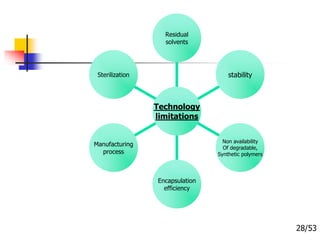
Sterilization
Manufacturing
process
Encapsulation
efficiency
Non availability
Of degradable,
Synthetic polymers
stability
Residual
solvents
Technology
limitations
28/53
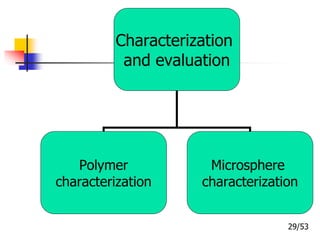
Characterization
and evaluation
Polymer
characterization
Microsphere
characterization
29/53
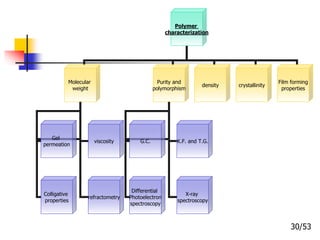
Polymer
characterization
Molecular
weight
Purity and
polymorphism
density
Gel
permeation
viscosity
Colligative
properties
refractometry
G.C. K.F. and T.G.
Differential
Photoelectron
spectroscopy
X-ray
spectroscopy
crystallinity
Film forming
properties
30/53
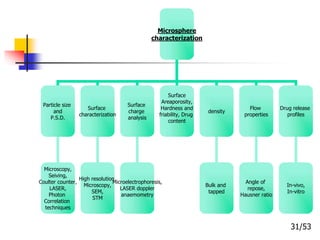
Microsphere
characterization
Particle size
and
P.S.D.
Surface
characterization
Surface
charge
analysis
Surface
Areaporosity,
Hardness and
friability, Drug
content
density
Flow
properties
Drug release
profiles
Microscopy,
Seiving,
Coulter counter,
LASER,
Photon
Correlation
techniques
High resolution
Microscopy,
SEM,
STM
Microelectrophoresis,
LASER doppler
anaemometry
Bulk and
tapped
Angle of
repose,
Hausner ratio
In-vivo,
In-vitro
31/53
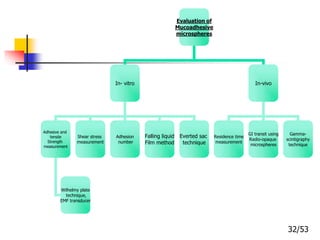
Evaluation of
Mucoadhesive
microspheres
In- vitro In-vivo
Adhesive and
tensile
Strength
measurement
Wilhelmy plate
technique,
EMF transducer
Shear stress
measurement
Adhesion
number
Falling liquid
Film method
Everted sac
technique
Residence time
measurement
GI transit using
Radio-opaque
microspheres
Gamma-
scintigraphy
technique
32/53
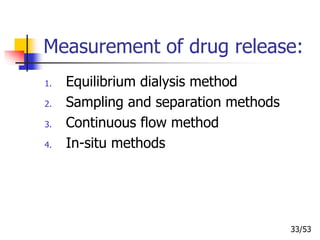
Measurement of drug release:
1. Equilibrium dialysis method
2. Sampling and separation methods
3. Continuous flow method
4. In-situ methods
33/53
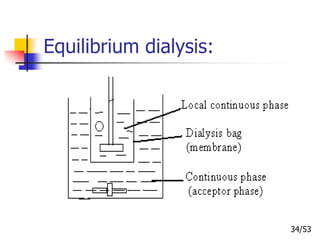
Equilibrium dialysis:
34/53
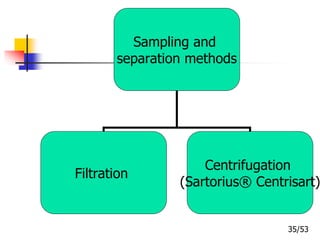
Sampling and
separation methods
Filtration
Centrifugation
(Sartorius® Centrisart)
35/53
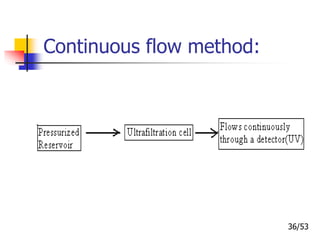
Continuous flow method:
36/53
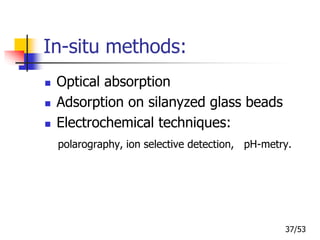
In-situ methods:
 Optical absorption
 Adsorption on silanyzed glass beads
 Electrochemical techniques:
polarography, ion selective detection, pH-metry.
37/53
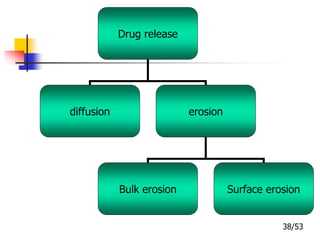
Drug release
diffusion erosion
Bulk erosion Surface erosion
38/53
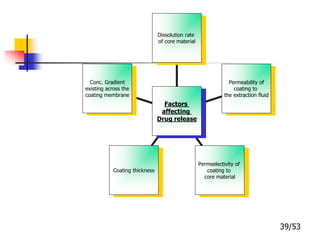
Conc. Gradient
existing across the
coating membrane
Coating thickness
Permselectivity of
coating to
core material
Permeability of
coating to
the extraction fluid
Dissolution rate
of core material
Factors
affecting
Drug release
39/53
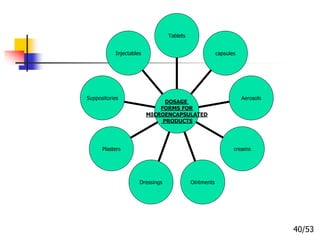
Injectables
Suppositories
Plasters
Dressings Ointments
creams
Aerosols
capsules
Tablets
DOSAGE
FORMS FOR
MICROENCAPSULATED
PRODUCTS
40/53
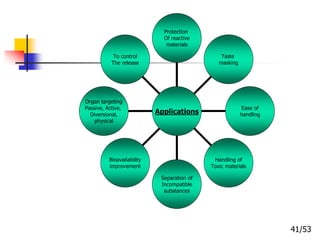
To control
The release
Organ targeting
Passive, Active,
Diversional,
physical
Bioavailability
improvement
Separation of
Incompatible
substances
Handling of
Toxic materials
Ease of
handling
Taste
masking
Protection
Of reactive
materials
Applications
41/53
APPLICATIONS OF MICROENCAPSULATION:
Core material Characteristic properties Purpose of
encapsulation
Final product form
Acetaminophen Slightly water soluble solid Taste masking Tablet
Activated charcoal Adsorbent Selective sorption Dry powder
Aspirin Slightly water soluble solid Taste masking, sustained
release, reduced gastric
irritation
Tablet or capsule
Islet of langerhans Viable cells Sustained normalization
of diabetic condition
Injectable
Isosorbide
dinitrate
water soluble solid Sustained release Capsule
Liquid crystals Liquid Conversion of liquid to
solid, stabilization
Flexible film for thermal
mapping of anatomy
Methanol/methyl
salicylate camphor
mixture
Volatile solution Raduction of volatility Lotion
Projesterone Slightly water soluble solid Sustained release Varied
KCl Highly water soluble solid Reduced gastric irritation capsule
Urease water soluble enzyme Permselectivity of
enzyme, substrate, and
reaction products
dispersion
Vit. A palmitate Nonvolatile liquid Stabilization to oxidation Dry powder
42/53
Research work (recent):
 Encapsulation of DNA in
nanoengineered polymer(disulfide cross
linked poly(methacrylic acid))
microcapsules.- 284707n
 Preparation of floating microspheres of
Eudragit E 1oo for fish farming by
solvent evaporation method of
josamycin.-248781g
 CA- sept-24, vol 147, no. 13, 2007
43/53
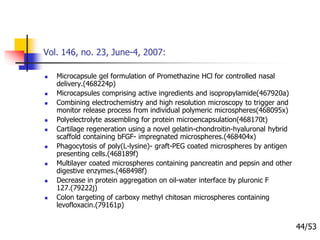
Vol. 146, no. 23, June-4, 2007:
 Microcapsule gel formulation of Promethazine HCl for controlled nasal
delivery.(468224p)
 Microcapsules comprising active ingredients and isopropylamide(467920a)
 Combining electrochemistry and high resolution microscopy to trigger and
monitor release process from individual polymeric microspheres(468095x)
 Polyelectrolyte assembling for protein microencapsulation(468170t)
 Cartilage regeneration using a novel gelatin-chondroitin-hyaluronal hybrid
scaffold containing bFGF- impregnated microspheres.(468404x)
 Phagocytosis of poly(L-lysine)- graft-PEG coated microspheres by antigen
presenting cells.(468189f)
 Multilayer coated microspheres containing pancreatin and pepsin and other
digestive enzymes.(468498f)
 Decrease in protein aggregation on oil-water interface by pluronic F
127.(79222j)
 Colon targeting of carboxy methyl chitosan microspheres containing
levofloxacin.(79161p)
44/53
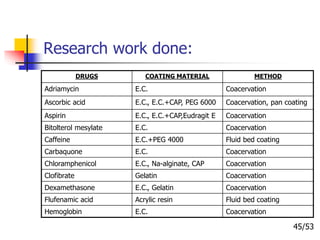
Research work done:
DRUGS COATING MATERIAL METHOD
Adriamycin E.C. Coacervation
Ascorbic acid E.C., E.C.+CAP, PEG 6000 Coacervation, pan coating
Aspirin E.C., E.C.+CAP,Eudragit E Coacervation
Bitolterol mesylate E.C. Coacervation
Caffeine E.C.+PEG 4000 Fluid bed coating
Carbaquone E.C. Coacervation
Chloramphenicol E.C., Na-alginate, CAP Coacervation
Clofibrate Gelatin Coacervation
Dexamethasone E.C., Gelatin Coacervation
Flufenamic acid Acrylic resin Fluid bed coating
Hemoglobin E.C. Coacervation
45/53
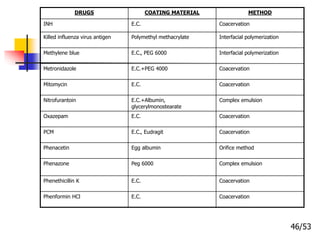
DRUGS COATING MATERIAL METHOD
INH E.C. Coacervation
Killed influenza virus antigen Polymethyl methacrylate Interfacial polymerization
Methylene blue E.C., PEG 6000 Interfacial polymerization
Metronidazole E.C.+PEG 4000 Coacervation
Mitomycin E.C. Coacervation
Nitrofurantoin E.C.+Albumin,
glycerylmonostearate
Complex emulsion
Oxazepam E.C. Coacervation
PCM E.C., Eudragit Coacervation
Phenacetin Egg albumin Orifice method
Phenazone Peg 6000 Complex emulsion
Phenethicillin K E.C. Coacervation
Phenformin HCl E.C. Coacervation
46/53
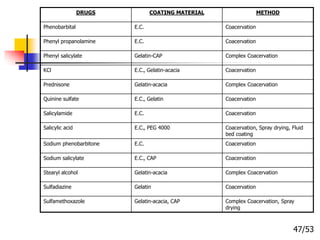
DRUGS COATING MATERIAL METHOD
Phenobarbital E.C. Coacervation
Phenyl propanolamine E.C. Coacervation
Phenyl salicylate Gelatin-CAP Complex Coacervation
KCl E.C., Gelatin-acacia Coacervation
Prednisone Gelatin-acacia Complex Coacervation
Quinine sulfate E.C., Gelatin Coacervation
Salicylamide E.C. Coacervation
Salicylic acid E.C., PEG 4000 Coacervation, Spray drying, Fluid
bed coating
Sodium phenobarbitone E.C. Coacervation
Sodium salicylate E.C., CAP Coacervation
Stearyl alcohol Gelatin-acacia Complex Coacervation
Sulfadiazine Gelatin Coacervation
Sulfamethoxazole Gelatin-acacia, CAP Complex Coacervation, Spray
drying
47/53
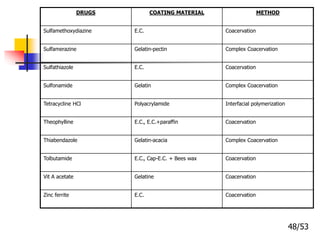
DRUGS COATING MATERIAL METHOD
Sulfamethoxydiazine E.C. Coacervation
Sulfamerazine Gelatin-pectin Complex Coacervation
Sulfathiazole E.C. Coacervation
Sulfonamide Gelatin Complex Coacervation
Tetracycline HCl Polyacrylamide Interfacial polymerization
Theophylline E.C., E.C.+paraffin Coacervation
Thiabendazole Gelatin-acacia Complex Coacervation
Tolbutamide E.C., Cap-E.C. + Bees wax Coacervation
Vit A acetate Gelatine Coacervation
Zinc ferrite E.C. Coacervation
48/53
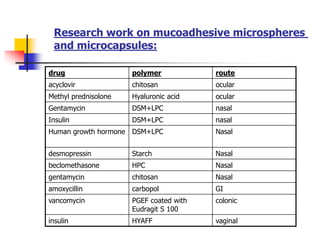
Research work on mucoadhesive microspheres
and microcapsules:
drug polymer route
acyclovir chitosan ocular
Methyl prednisolone Hyaluronic acid ocular
Gentamycin DSM+LPC nasal
Insulin DSM+LPC nasal
Human growth hormone DSM+LPC Nasal
desmopressin Starch Nasal
beclomethasone HPC Nasal
gentamycin chitosan Nasal
amoxycillin carbopol GI
vancomycin PGEF coated with
Eudragit S 100
colonic
insulin HYAFF vaginal
References:
Encyclopedia of pharmaceutical Technology.10,1-29.
Controlled drug delivery- by J.R. Robinson.
The theory and practice of industrial pharmacy- by Leon
Lachman.
Sustained release injectable products- by Michael L.
Randomsky, Judy H. Senior
‘M. Pharm’ thesis of Archana Surati August 2000.
‘Microencapsulation’, by Simon benita, Marcel Dekkar
publications
J Pharm Sci 93(4) 831-837.
J Pharm Sci 93(4) 943-955.
J Pharm Sci 93(5) 1100-1109.
J Pharm Sci 93(10) 2573-2584.
J Pharm Sci 93(10) 2624-2634.
50/53
Web Sites:
 www.artecoll.com/ microspheres.jpg
 www.kubiatowicz.com/.../
Albumin_Microspheres.jpg
 www.indiamart.com/tureen/
 www.tlchm.bris.ac.uk/.../
rob/RobAtkin.htm
 www.siigroup.com/.../
micro_intro.htm
51/53
THANK YOU
53/53

Chapter on Microencapsulation and mdds

  • 1.
    Seminar On MICROENCAPSULATION ANDMDDS 1/53 By:Rajesh L. Dumpala (B.Pharm, M. Pharm.) PhD. ( Pursuing) Research Scientist, Alembic Research Centre. Vadodara E.Mail:-rdumpala64@gmail.com
  • 2.
    Contents:  Introduction  Methodsfor microencapsulation  Characterization and evaluation  Drug release measurement  Applications  Recent advances 2/53
  • 3.
  • 4.
    What is Microcapsule& Microsphere? Encapsulation involves surrounding drug molecules with a solid polymer shell Entrapment involves the suspension of drug molecules within a polymer matrix. drug polymer Drug Polymer 4/53
  • 5.
    Selection of acoating material:  Objectives of the dosage form or product requirements.  Identifying and selecting the coating material which will satisfy these product requirements.  Microencapsulation method used to accomplish the coated product requirements. 5/53
  • 6.
    Ideal requirements ofa coating material:  Capable of forming a cohesive film with the core material.  Chemically compatible and non reactive with the core material.  Provide the desired coating properties, like, strength, flexibility, impermeability, optical properties and stability. 6/53
  • 7.
    Microencapsulation processes Type-A processes Type-Bprocesses Chemical processes Mechanical processes 7/53
  • 8.
    1. Type A:Chemical Processes: 1. Coacervation phase separation 1. Simple Coacervation 2. Complex Coacervation 2. Polymer – Polymer interaction 3. Emulsion-solvent evaporation 4. Interfacial polymerization 5. In situ polymerization 8/53
  • 9.
    2. Type B:Mechanical Processes: 1. Spray drying & spray congealing 2. Fluidized bed coating 3. Melt dispersion technique 4. Pan coating 5. Multiorifice-Centrifugal process 9/53
  • 10.
    Coacervation process: Coacervation Simple Complex 1.Formation of three immiscible phases 2. Deposition of liquid polymeric coating material 3. Solidification/ rigidization of the coating material 10/53
  • 11.
    Formation of coacrevate aroundthe core material: 11/53
  • 12.
  • 13.
    Limitations of coacervatemicrocapsules:  Produced only at specific pH values.  Toxicity problems.  Addition of chemical cross linking agents and application of heat are harmful to the encapsulant materials, such as thermo and chemically labile drugs and live cells. 13/53
  • 14.
  • 15.
  • 16.
    Polymers used in polymer-polymer Incompatibility method Coatingpolymers Polymers used to induce phase separation •Ethyl cellulose •Cellulose nitrate •Cellulose acetate •Polymethyl methacrylate •Polystyrene •Polyethylene •Polybutadiene •Polymethyl siloxane 16/53
  • 17.
  • 18.
    Principal mononer combinationsinvestigated for the encapsulation of pharmaceuticals by polymerization: Aqueous phase monomer A Non-aqueous phase monomer B Poly AB wall material found Polyamine: e.g. L-lysine Polybasic acid halide Sebacoyl chloride, Terephthaloyl chloride Polyamide, Nylon 6-10, Polyterephthalamide Polyphenol: e.g. 2,2-bis(4- hydroxyphenyl) propane Polybasic acid halide Sebacoyl chloride Polyester Polyphenyl ester Polyamide: e.g. 1,6- hexamethylene diamide Bischloroformate 2,2-dichloro diethyl ether Polyurethrane Polyurethrane 18/53
  • 19.
    In situ polymerization: No reactive agents are added to the core agent.  Process: 1. Polymerization of monomers into low mol. wt. Prepolymer. 2. Formation of solid capsule shell by polymerization and cross linking. 19/53
  • 20.
  • 21.
    Fluidized bed coating: Fluidizedbed coating Top spray Tangential spray Bottom spray (wurster coater) 21/53
  • 22.
    Top spray andbottom spray: 22/53
  • 23.
  • 24.
    Representative coating materialsand applicable microencapsulation process: Coating materials Multiorifice centrifugal Coacervation phase separation Pan coating Spray drying and congealing Air suspension Solvent evaporation Water soluble resins: Gelatin X X X X X X Gum arabic X X X X X Starch X X X X PVP X X X X X CMC X X X X HEC X X X X X MC X X X X Arabinogalactan X X X X PVA X X X X X X Polyacrylic acid X X X X X Water insoluble resins: E.C. X X X X X Polyethylene X X X Polymethacrylate X X X X X Polyamide X X Poly (ethylene-vinyl-acetate) X X X X X Cellulose nitrate X X X X X Silicones X X Poly (lactide-co-glycolide) X X X 24/53
  • 25.
    Coating materials Multiorifice centrifugal Coacervatio n phase separation Pan coatingSpray drying and congealing Air suspension Solvent evaporation Waxes and lipids: Paraffin X X X X X Carnauba X X X Spermaceti X X X X Bees wax stearic acid X X X Stearyl alcohol X X Glyceryl stearate X X X Enteric resins: Shellac X X X X CAP X X X X X Zein X X 25/53
  • 26.
    Microencapsulation processes andtheir applicabilities: Microencapsulation process Applicable core material Approximate particle size(μm) Air suspension solids 35-5000 Coacervation phase separation Solids and liquids 2-5000 Multiorifice centrifugal Solids and liquids 1-5000 Pan coating solids 600-5000 Solvent evaporation Solids and liquids 5-5000 Spray drying and congealing Solids and liquids 600 26/53
  • 27.
    Drug loading Total massof drug and polymer Ratio of dispersed to continuous phase Ratio of drug To polymer Mol. Wt. of The polymer Particle size and P.S.D. Manufacturing variables 27/53
  • 28.
  • 29.
  • 30.
    Polymer characterization Molecular weight Purity and polymorphism density Gel permeation viscosity Colligative properties refractometry G.C. K.F.and T.G. Differential Photoelectron spectroscopy X-ray spectroscopy crystallinity Film forming properties 30/53
  • 31.
    Microsphere characterization Particle size and P.S.D. Surface characterization Surface charge analysis Surface Areaporosity, Hardness and friability,Drug content density Flow properties Drug release profiles Microscopy, Seiving, Coulter counter, LASER, Photon Correlation techniques High resolution Microscopy, SEM, STM Microelectrophoresis, LASER doppler anaemometry Bulk and tapped Angle of repose, Hausner ratio In-vivo, In-vitro 31/53
  • 32.
    Evaluation of Mucoadhesive microspheres In- vitroIn-vivo Adhesive and tensile Strength measurement Wilhelmy plate technique, EMF transducer Shear stress measurement Adhesion number Falling liquid Film method Everted sac technique Residence time measurement GI transit using Radio-opaque microspheres Gamma- scintigraphy technique 32/53
  • 33.
    Measurement of drugrelease: 1. Equilibrium dialysis method 2. Sampling and separation methods 3. Continuous flow method 4. In-situ methods 33/53
  • 34.
  • 35.
  • 36.
  • 37.
    In-situ methods:  Opticalabsorption  Adsorption on silanyzed glass beads  Electrochemical techniques: polarography, ion selective detection, pH-metry. 37/53
  • 38.
    Drug release diffusion erosion Bulkerosion Surface erosion 38/53
  • 39.
    Conc. Gradient existing acrossthe coating membrane Coating thickness Permselectivity of coating to core material Permeability of coating to the extraction fluid Dissolution rate of core material Factors affecting Drug release 39/53
  • 40.
  • 41.
    To control The release Organtargeting Passive, Active, Diversional, physical Bioavailability improvement Separation of Incompatible substances Handling of Toxic materials Ease of handling Taste masking Protection Of reactive materials Applications 41/53
  • 42.
    APPLICATIONS OF MICROENCAPSULATION: Corematerial Characteristic properties Purpose of encapsulation Final product form Acetaminophen Slightly water soluble solid Taste masking Tablet Activated charcoal Adsorbent Selective sorption Dry powder Aspirin Slightly water soluble solid Taste masking, sustained release, reduced gastric irritation Tablet or capsule Islet of langerhans Viable cells Sustained normalization of diabetic condition Injectable Isosorbide dinitrate water soluble solid Sustained release Capsule Liquid crystals Liquid Conversion of liquid to solid, stabilization Flexible film for thermal mapping of anatomy Methanol/methyl salicylate camphor mixture Volatile solution Raduction of volatility Lotion Projesterone Slightly water soluble solid Sustained release Varied KCl Highly water soluble solid Reduced gastric irritation capsule Urease water soluble enzyme Permselectivity of enzyme, substrate, and reaction products dispersion Vit. A palmitate Nonvolatile liquid Stabilization to oxidation Dry powder 42/53
  • 43.
    Research work (recent): Encapsulation of DNA in nanoengineered polymer(disulfide cross linked poly(methacrylic acid)) microcapsules.- 284707n  Preparation of floating microspheres of Eudragit E 1oo for fish farming by solvent evaporation method of josamycin.-248781g  CA- sept-24, vol 147, no. 13, 2007 43/53
  • 44.
    Vol. 146, no.23, June-4, 2007:  Microcapsule gel formulation of Promethazine HCl for controlled nasal delivery.(468224p)  Microcapsules comprising active ingredients and isopropylamide(467920a)  Combining electrochemistry and high resolution microscopy to trigger and monitor release process from individual polymeric microspheres(468095x)  Polyelectrolyte assembling for protein microencapsulation(468170t)  Cartilage regeneration using a novel gelatin-chondroitin-hyaluronal hybrid scaffold containing bFGF- impregnated microspheres.(468404x)  Phagocytosis of poly(L-lysine)- graft-PEG coated microspheres by antigen presenting cells.(468189f)  Multilayer coated microspheres containing pancreatin and pepsin and other digestive enzymes.(468498f)  Decrease in protein aggregation on oil-water interface by pluronic F 127.(79222j)  Colon targeting of carboxy methyl chitosan microspheres containing levofloxacin.(79161p) 44/53
  • 45.
    Research work done: DRUGSCOATING MATERIAL METHOD Adriamycin E.C. Coacervation Ascorbic acid E.C., E.C.+CAP, PEG 6000 Coacervation, pan coating Aspirin E.C., E.C.+CAP,Eudragit E Coacervation Bitolterol mesylate E.C. Coacervation Caffeine E.C.+PEG 4000 Fluid bed coating Carbaquone E.C. Coacervation Chloramphenicol E.C., Na-alginate, CAP Coacervation Clofibrate Gelatin Coacervation Dexamethasone E.C., Gelatin Coacervation Flufenamic acid Acrylic resin Fluid bed coating Hemoglobin E.C. Coacervation 45/53
  • 46.
    DRUGS COATING MATERIALMETHOD INH E.C. Coacervation Killed influenza virus antigen Polymethyl methacrylate Interfacial polymerization Methylene blue E.C., PEG 6000 Interfacial polymerization Metronidazole E.C.+PEG 4000 Coacervation Mitomycin E.C. Coacervation Nitrofurantoin E.C.+Albumin, glycerylmonostearate Complex emulsion Oxazepam E.C. Coacervation PCM E.C., Eudragit Coacervation Phenacetin Egg albumin Orifice method Phenazone Peg 6000 Complex emulsion Phenethicillin K E.C. Coacervation Phenformin HCl E.C. Coacervation 46/53
  • 47.
    DRUGS COATING MATERIALMETHOD Phenobarbital E.C. Coacervation Phenyl propanolamine E.C. Coacervation Phenyl salicylate Gelatin-CAP Complex Coacervation KCl E.C., Gelatin-acacia Coacervation Prednisone Gelatin-acacia Complex Coacervation Quinine sulfate E.C., Gelatin Coacervation Salicylamide E.C. Coacervation Salicylic acid E.C., PEG 4000 Coacervation, Spray drying, Fluid bed coating Sodium phenobarbitone E.C. Coacervation Sodium salicylate E.C., CAP Coacervation Stearyl alcohol Gelatin-acacia Complex Coacervation Sulfadiazine Gelatin Coacervation Sulfamethoxazole Gelatin-acacia, CAP Complex Coacervation, Spray drying 47/53
  • 48.
    DRUGS COATING MATERIALMETHOD Sulfamethoxydiazine E.C. Coacervation Sulfamerazine Gelatin-pectin Complex Coacervation Sulfathiazole E.C. Coacervation Sulfonamide Gelatin Complex Coacervation Tetracycline HCl Polyacrylamide Interfacial polymerization Theophylline E.C., E.C.+paraffin Coacervation Thiabendazole Gelatin-acacia Complex Coacervation Tolbutamide E.C., Cap-E.C. + Bees wax Coacervation Vit A acetate Gelatine Coacervation Zinc ferrite E.C. Coacervation 48/53
  • 49.
    Research work onmucoadhesive microspheres and microcapsules: drug polymer route acyclovir chitosan ocular Methyl prednisolone Hyaluronic acid ocular Gentamycin DSM+LPC nasal Insulin DSM+LPC nasal Human growth hormone DSM+LPC Nasal desmopressin Starch Nasal beclomethasone HPC Nasal gentamycin chitosan Nasal amoxycillin carbopol GI vancomycin PGEF coated with Eudragit S 100 colonic insulin HYAFF vaginal
  • 50.
    References: Encyclopedia of pharmaceuticalTechnology.10,1-29. Controlled drug delivery- by J.R. Robinson. The theory and practice of industrial pharmacy- by Leon Lachman. Sustained release injectable products- by Michael L. Randomsky, Judy H. Senior ‘M. Pharm’ thesis of Archana Surati August 2000. ‘Microencapsulation’, by Simon benita, Marcel Dekkar publications J Pharm Sci 93(4) 831-837. J Pharm Sci 93(4) 943-955. J Pharm Sci 93(5) 1100-1109. J Pharm Sci 93(10) 2573-2584. J Pharm Sci 93(10) 2624-2634. 50/53
  • 51.
    Web Sites:  www.artecoll.com/microspheres.jpg  www.kubiatowicz.com/.../ Albumin_Microspheres.jpg  www.indiamart.com/tureen/  www.tlchm.bris.ac.uk/.../ rob/RobAtkin.htm  www.siigroup.com/.../ micro_intro.htm 51/53
  • 52.