HARAR HEALTH SCIENCESCOLLEGE
10/10/2025
By Kidist D. 1
DEPARTMENT OF
MEDICAL LABORATORY SCIENCES
Module name: Health Informatics
Module code: HInf-M4421
10/10/2025
By Kidist D.
3
LEARNINGOBJECTIVES
At the end of the chapter you will be able to:
Health Information Systems Overview
Why health information system
Classification of health information system
Health information system reform
4.
10/10/2025
By Kidist D.
4
HealthInformation Systems
Overview
A health information system (HIS) refers to a system
designed to manage healthcare data.
This includes systems that collect, store, manage and
transmit a patient's electronic medical record (EMR), a
hospital's operational management or a system supporting
healthcare policy decisions.
5.
10/10/2025
By Kidist D.
5
HealthInformation Systems(HIS)
WHO: The HIS provides the underpinnings for
decision-making and has four key functions:
data generation, analysis and synthesis, and
compilation, communication and use.
The HIS collects data from the health sector and other
relevant sectors, analyses the data and ensures their
overall quality, relevance and timeliness, and converts
data into information for health-related decision-making.
6.
10/10/2025
By Kidist D.
6
HealthInformation System (HIS)
Health information has been variously described as the
“foundation” for better health, as the “glue” holding the
health system together, and as the "oil” keeping the health
system running.
It is a system that provides specific information support
to the decision making process at each level of the health
system.
7.
10/10/2025
By Kidist D.
7
HIS is an integral part of the health system, the
operational boundaries of which include:
all resources, organizations and actors that are involved
in the regulation, financing, and provision of actions
whose primary intent is to protect, promote or improve
health.
Health Information System (HIS)
8.
10/10/2025
By Kidist D.
8
Thegoal of HIS
The ultimate objective of a health information
system is to produce information for taking action in
the health sector.
9.
10/10/2025
By Kidist D.
9
Whyhealth information system?
Good management is a prerequisite for increasing the
efficiency of health services.
Information is crucial at all management levels of the
health services.
The system, provides information on past, present and
projected future and relevant events inside and outside
the organization.
It is required by policy makers, managers, healthcare
providers, community health workers.
10.
10/10/2025
By Kidist D.
10
Classificationof HIS
Classification of Health Information
System
Operational Health Information System and
Tactical systems Health Information System
11.
10/10/2025
By Kidist D.
11
Con..
1.Operational Systems :- are designed to manage day-
to-day activities and processes in healthcare settings.
They focus on real-time operations and data handling.
Key Features:
Real-Time Data Entry: Capture patient information
immediately during encounters.
Patient Management: Schedule appointments, manage
admissions, and track patient flow.
12.
10/10/2025
By Kidist D.
12
Con…
Billing and Claims Processing: Handle invoicing,
insurance claims, and payments.
Clinical Documentation: Maintain accurate and timely
clinical records.
Examples:
Electronic Health Records (EHRs)
Laboratory Information Systems (LIS)
13.
10/10/2025
By Kidist D.
13
Con…
2.Tactical Systems:- support decision-making and strategic
planning by analyzing data and generating insights.
Key Features:
Data Analysis: Aggregate and analyze data for performance
metrics and population health.
Reporting Tools: Generate reports for quality improvement and
regulatory compliance.
Decision Support: Provide clinical decision support tools to
enhance care delivery.
Examples:- Clinical Decision Support Systems (CDSS),Health
Analytics Platforms
10/10/2025
By Kidist D.
15
Buildingblocks of health system
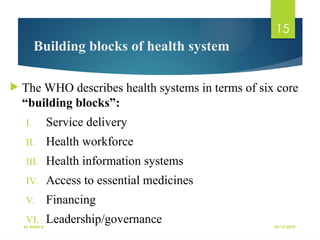
The WHO describes health systems in terms of six core
“building blocks”:
I. Service delivery
II. Health workforce
III. Health information systems
IV. Access to essential medicines
V. Financing
VI. Leadership/governance
16.
10/10/2025
By Kidist D.
16
Componentsof Ethiopian HIS
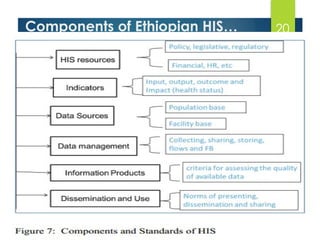
The Health Metrics Network’s “Framework and
Standards for Country HIS” describes the six
components of a HIS and the standards needed
for each.
1. HIS resources
It includes networks (internet access), computers,
skilled human power, policy, legislatives, guidelines,
software, etc. to ensure a fully functioning HIS.
17.
10/10/2025
By Kidist D.
17
Componentsof Ethiopian HIS….
2. Indicators
Indicators need to encompass determinants of health;
health system inputs, outputs, and outcomes; and health
status.
Indicators in the context of Health Information Systems
(HIS) are metrics used to evaluate performance, quality,
and outcomes in healthcare.
Examples:- Maternal Mortality Rate, Child Immunization
Coverage, Bed Occupancy Rate
18.
10/10/2025
By Kidist D.
18
Componentsof Ethiopian HIS….
3. Data sources
Population based (Census, vital Registration, population
based survey)
Facility based (Individual records, Service records,
Administrative records.
4. Data management
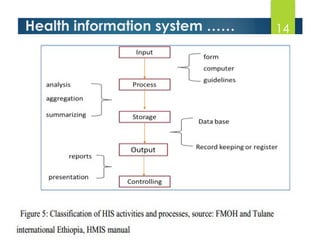
This covers all aspects of data handling: collection,
storage, quality-assurance, flow, processing,
compilation, and analysis.
19.
10/10/2025
By Kidist D.
19
Componentsof Ethiopian HIS…
5. Information products.
Data must be transformed into information that will
become the basis for evidence and knowledge
to shape health action.
6. Dissemination and use.
Dissemination and use of health information are critical
for improving health outcomes and informing policy
decisions.
10/10/2025
By Kidist D.
21
Factorsaffecting successful
implementation of HIS in the Ethiopia
implementation of HIS can be affected by numerous
factors. Some of the factors are:
Proportion of budget spending on ICT is low.
Education and Training of system users (cost of capacity
building) is high.
Poor linkage between information sources and limited
Information use for decision making.
22.
10/10/2025
By Kidist D.
22
Factorsaffecting successful implementation of HIS in the
Ethiopia ….
Standards in clinical terminology and concerns on data
privacy and security.
Challenges of data entry and difficulty in interpreting
record with other information sources and systems.
Shortage of ICTs and in adequate skilled human power
(HI) for all facilities.
System failure and high maintenance costs.
10/10/2025
By Kidist D.
24
At the end of the chapter you will be able to:
Introduction to Routine health information system
Information cycle
Data collection, Data processing, Data presentation
Information utilization
Data quality
Health management information system (HMIS in
Ethiopia)
LEARNING OBJECTIVES
25.
10/10/2025
By Kidist D.
25
Introduction
RHISs are defined as systems that provide information at
regular intervals of a year or less to meet predictable
information needs.
These include paper-based or electronic health records and
facility- and district-level management information systems.
It comprises data collected at regular intervals at public,
private and community level heath facilities and institutions.
The data give picture of health status, health service and
health resources.
26.
10/10/2025
By Kidist D.
26
HealthSystems and Health
Information Systems
Health system - It also sometimes referred to as health
care system , is the organization of people, institutions,
and resources that deliver health care services to meet the
health needs of target populations.
HIS refers to a system designed to manage healthcare
data. This includes systems that collect, store, manage and
transmit a patient's EMR, a hospital's operational
management or a system supporting healthcare policy
decisions.
27.
10/10/2025
By Kidist D.
27
HealthManagement Information
System (HMIS) in Ethiopia
System: A collection of components that work together
to achieve a common objective.
Health System: All the activities whose primary
purpose is to improve, restore or maintain health.
Information: Meaningful collection of facts or data.
Information System: A system that provides
information support to the decision-making process at
each level an organization.
28.
10/10/2025
By Kidist D.
28
Con…
Management information system: A formal method of
making available accurate and timely information to
management that is necessary to facilitate the decision
making process and enable the organizations planning,
control and operational functions to be carried out
effectively.
29.
10/10/2025
By Kidist D.
29
Con…
Health Management Information System: it is an
application of the principles of management information
system in healthcare systems.
Or HMIS is an info system specially designed to assist in
the management and planning of health programs, as
opposed to delivery of care.
30.
10/10/2025
By Kidist D.
30
Con..
HMIS is a system specifically designed to support
planning, management, and decision making in health
facilities and organizations.
The ultimate goal of the HMIS is to generate quality data
and use that data for management decisions there by
improve health service provision.
31.
10/10/2025
By Kidist D.
31
Purposesof HMIS
Routine collection and aggregation of quality health
information.
Availing accurate, timely and complete data.
Provide specific information support to health decision
making process.
Strengthening the use of locally generated data for
evidence based decision making.
32.
10/10/2025
By Kidist D.
32
Componentsof HMIS
HMIS has two main components:
1. Information management and
2. Use of the information for management purpose.
33.
10/10/2025
By Kidist D.
33
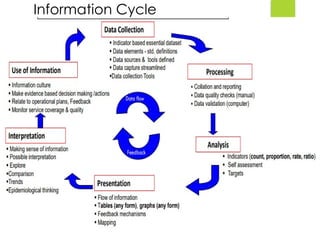
1.Information management
a. Data collection: recording of health data using HMIS
data collection tools such as individual and family
folder, registers, tally and reporting formats.
b. Data processing: is a process of cleaning, entering and
aggregation of data.
c. Data analysis and presentation: is a process of
interpretation and comparison of generated information
in the form of sentence, tables and graphs.
34.
10/10/2025
By Kidist D.
34
2.Using information for management
purposes
a. Problem identification: identifying problems using key
indicators.
b. Prioritizing problems: problems identified should be
prioritized.
c. Decision-making: decide what types of actions need to
be taken.
d. Action taking: implementing the agreed action.
35.
10/10/2025
By Kidist D.
35
Con..
e.Monitoring: closely following the progress of the
activities.
f. Evaluation: assessing the desired result has been
achieved.
36.
10/10/2025
By Kidist D.
36
Con…
At national level, the current reformed HMIS is working with
131 standardized indicators that were revised since 2017.
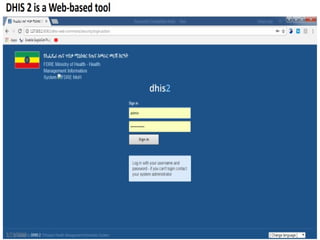
The revised indicators are tracking using the new software
adopted called District Health Information System version
two (DHIS 2)
Six classical epidemiological questions; who, what, when,
where, why and how about the health status of the people
will be answered.
37.
10/10/2025
By Kidist D.
37
TheDHIS
Who gets sick?
Information about who gets sick is collected on a set of
data collection tools, client cards, registers, tally sheets
and data input forms
What conditions?
The DHIS concentrates on diagnoses of local public
health importance that are identified in the situation
analysis.
38.
10/10/2025
By Kidist D.
38
Con…
Wheredo clients come from?
The DHIS is based upon facility information so that all
information can be related to the geographical catchment
area of the facility and the people who live there.
The computer can be used to prepare larger scale maps
of entire districts or provinces using a Geographical
Information System (GIS).
Early action based on knowledge of where clients are
found can be a powerful tool to control outbreaks of
disease.
39.
10/10/2025
By Kidist D.
39
Con…
Whendo people get sick?
The monthly DHIS data allows facility staff to graph
conditions and use of services over time and to compare
numbers of cases in different months of the year.
40.
10/10/2025
By Kidist D.
40
Con…
Whydo they get sick?
Social or economic conditions; water, sanitation, diet,
housing, education, and habits like smoking or sexual
practice have more direct influence over health than
health services.
the DHIS provides information to enable research to be
focused on the most important conditions.
41.
10/10/2025
By Kidist D.
41
Con…
Howdo we overcome the problems?
Analysis of the DHIS identifies the common problems,
the age groups that are affected and the places they
occur.
This gives facility health managers the knowledge to
plan, implement and evaluate activities to overcome
such problems.
10/10/2025
By Kidist D.
44
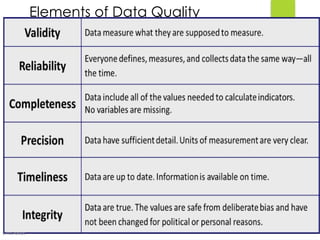
Dataquality
Commonly seen data quality errors
Incomplete Data: Missing values for critical fields, such
as patient demographics or treatment out comes.
Inaccurate Data: Errors in data entry, such as incorrect
patient IDs, medication dosages, or diagnostic codes.
Duplicate Records: Multiple entries for the same patient,
leading to confusion and inconsistencies in treatment
histories.
45.
10/10/2025
By Kidist D.
45
Con…
Outdated Information: Use of old data that may not reflect
the current health status or treatment protocols.
Inconsistent Data: Variations in data formats or
terminology, such as different units of measurement or
coding systems.
Invalid Data: Entries that do not conform to expected
formats, such as dates in the wrong format or impossible
values (e.g., age over 150).
46.
10/10/2025
By Kidist D.
46
Con..
Poor Documentation: Insufficient or unclear
documentation of data sources, processes, and
changes, making it difficult to trace data quality
issues.




![health information system [HMIS] BY SHIVAM](https://cdn.slidesharecdn.com/ss_thumbnails/hmisshivam-240328053832-aa09a6ab-thumbnail.jpg?width=640&height=640&fit=bounds)


