Chapter 8 Constructivism Amy Smith-Visualizer
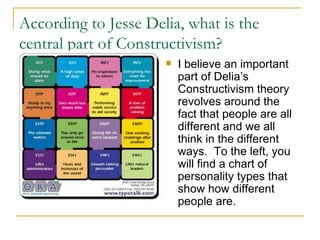
According to Jesse Delia, what is the central part of Constructivism?  I believe an important part of Delia’s Constructivism theory revolves around the fact that people are all different and we all think in the different ways.  To the left, you will find a chart of personality types that show how different people are.
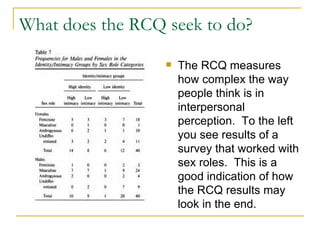
What does the RCQ seek to do?  The RCQ measures how complex the way people think is in interpersonal perception.  To the left you see results of a survey that worked with sex roles.  This is a good indication of how the RCQ results may look in the end.
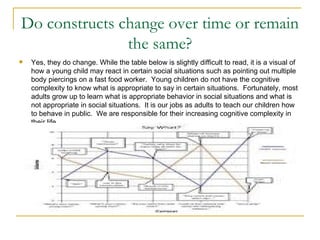
Do constructs change over time or remain the same? Yes, they do change. While the table below is slightly difficult to read, it is a visual of how a young child may react in certain social situations such as pointing out multiple body piercings on a fast food worker.  Young children do not have the cognitive complexity to know what is appropriate to say in certain situations.  Fortunately, most adults grow up to learn what is appropriate behavior in social situations and what is not appropriate in social situations.  It is our jobs as adults to teach our children how to behave in public.  We are responsible for their increasing cognitive complexity in their life.
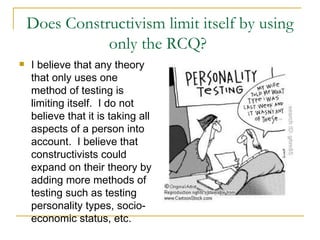
Does Constructivism limit itself by using only the RCQ?  I believe that any theory that only uses one method of testing is limiting itself.  I do not believe that it is taking all aspects of a person into account.  I believe that constructivists could expand on their theory by adding more methods of testing such as testing personality types, socio-economic status, etc.
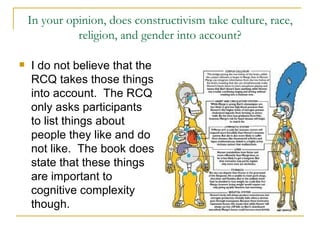
In your opinion, does constructivism take culture, race, religion, and gender into account? I do not believe that the RCQ takes those things into account.  The RCQ only asks participants to list things about people they like and do not like.  The book does state that these things are important to cognitive complexity though.
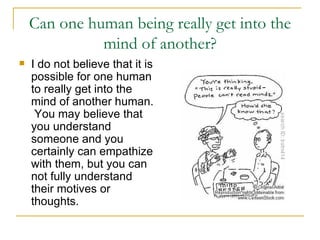
Can one human being really get into the mind of another? I do not believe that it is possible for one human to really get into the mind of another human.  You may believe that you understand someone and you certainly can empathize with them, but you can not fully understand their motives or thoughts.

Chapter 8 Visualizer

  • 1.
    Chapter 8 ConstructivismAmy Smith-Visualizer
  • 2.
    According to JesseDelia, what is the central part of Constructivism? I believe an important part of Delia’s Constructivism theory revolves around the fact that people are all different and we all think in the different ways. To the left, you will find a chart of personality types that show how different people are.
  • 3.
    What does theRCQ seek to do? The RCQ measures how complex the way people think is in interpersonal perception. To the left you see results of a survey that worked with sex roles. This is a good indication of how the RCQ results may look in the end.
  • 4.
    Do constructs changeover time or remain the same? Yes, they do change. While the table below is slightly difficult to read, it is a visual of how a young child may react in certain social situations such as pointing out multiple body piercings on a fast food worker. Young children do not have the cognitive complexity to know what is appropriate to say in certain situations. Fortunately, most adults grow up to learn what is appropriate behavior in social situations and what is not appropriate in social situations. It is our jobs as adults to teach our children how to behave in public. We are responsible for their increasing cognitive complexity in their life.
  • 5.
    Does Constructivism limititself by using only the RCQ? I believe that any theory that only uses one method of testing is limiting itself. I do not believe that it is taking all aspects of a person into account. I believe that constructivists could expand on their theory by adding more methods of testing such as testing personality types, socio-economic status, etc.
  • 6.
    In your opinion,does constructivism take culture, race, religion, and gender into account? I do not believe that the RCQ takes those things into account. The RCQ only asks participants to list things about people they like and do not like. The book does state that these things are important to cognitive complexity though.
  • 7.
    Can one humanbeing really get into the mind of another? I do not believe that it is possible for one human to really get into the mind of another human. You may believe that you understand someone and you certainly can empathize with them, but you can not fully understand their motives or thoughts.