Download free for 30 days
Sign in
Upload
Language (EN)
Support
Business
Mobile
Social Media
Marketing
Technology
Art & Photos
Career
Design
Education
Presentations & Public Speaking
Government & Nonprofit
Healthcare
Internet
Law
Leadership & Management
Automotive
Engineering
Software
Recruiting & HR
Retail
Sales
Services
Science
Small Business & Entrepreneurship
Food
Environment
Economy & Finance
Data & Analytics
Investor Relations
Sports
Spiritual
News & Politics
Travel
Self Improvement
Real Estate
Entertainment & Humor
Health & Medicine
Devices & Hardware
Lifestyle
Change Language
Language
English
Español
Português
Français
Deutsche
Cancel
Save
Submit search
EN
Uploaded by
CHATHUMINI2
PPT, PDF
22 views
chapter 6.ppt synchronization tools in os
this is about syncronization
Education
◦
Read more
0
Save
Share
Embed
Embed presentation
Download
Download to read offline
1
/ 54
2
/ 54
Most read
3
/ 54
4
/ 54
5
/ 54
6
/ 54
7
/ 54
8
/ 54
Most read
9
/ 54
10
/ 54
11
/ 54
12
/ 54
13
/ 54
14
/ 54
15
/ 54
16
/ 54
17
/ 54
18
/ 54
19
/ 54
20
/ 54
21
/ 54
22
/ 54
23
/ 54
24
/ 54
25
/ 54
26
/ 54
27
/ 54
28
/ 54
29
/ 54
30
/ 54
31
/ 54
32
/ 54
33
/ 54
34
/ 54
35
/ 54
36
/ 54
37
/ 54
38
/ 54
39
/ 54
40
/ 54
41
/ 54
42
/ 54
43
/ 54
44
/ 54
45
/ 54
46
/ 54
47
/ 54
48
/ 54
49
/ 54
50
/ 54
51
/ 54
52
/ 54
53
/ 54
54
/ 54
More Related Content
PPTX
bai thuyet trinh Chuong sau race condition.pptx
by
akirayuki1910
PPT
ch6.ppt
by
MaxJoker2
PPTX
chapterrrrrrrrrrrrrrrrr...r.r.r.r.6.pptx
by
aaaa226043
PPTX
chapter 6 of computer operating system and fundamentals
by
Tasin17
PPTX
Operating Systems Chapter 6 silberschatz
by
GiulianoRanauro
PPTX
peterson prsenestation on Synchronization Tools
by
manumohan364850
PPTX
Process Synchronization Process Synchronization.pptx
by
Settuji1
PDF
ch6_EN_BK_syn1.pdf
by
HoNguyn746501
bai thuyet trinh Chuong sau race condition.pptx
by
akirayuki1910
ch6.ppt
by
MaxJoker2
chapterrrrrrrrrrrrrrrrr...r.r.r.r.6.pptx
by
aaaa226043
chapter 6 of computer operating system and fundamentals
by
Tasin17
Operating Systems Chapter 6 silberschatz
by
GiulianoRanauro
peterson prsenestation on Synchronization Tools
by
manumohan364850
Process Synchronization Process Synchronization.pptx
by
Settuji1
ch6_EN_BK_syn1.pdf
by
HoNguyn746501
Similar to chapter 6.ppt synchronization tools in os
PDF
ch5-process-synchronization. pdf
by
iamayesha2526
PDF
Unit II - 3 - Operating System - Process Synchronization
by
cscarcas
PPT
Operating System Process Synchronization
by
harryfletcherlinkbui
PPTX
Lecture Week 6 Process Synchronisation.pptx
by
vemiri6305
PPT
Process Synchronization
by
K Gowsic Gowsic
PPTX
process synchronisation operating system
by
codefast
PPT
Lecture process synchronization ppt how it
by
sk2940635
PPT
Operating System-Process Synchronization
by
bismahmalik22
PDF
Process synchronisation. Chapter .......
by
deepikam681248
PPTX
Chapter 6 Process Synchronizationss.pptx
by
AdanSaleban
PPT
chapter5 processes of synchronizatio ppt
by
Abdikani34
PPT
ch05.ppt
by
RohitPaul71
PPT
PS.ppt
by
DrCMeenakshiVISTAS
PDF
Lecture 9.pdfLecture 9.pdfLecture 9.pdfLecture 9.pdf
by
mohammedabomashowrms
PPT
ch5 [Autosaved].ppt
by
monirJihad2
PDF
ch5-Process_Synchronization.pdf
by
sharada3
PPT
ch5.ppt
by
karinaabyys
PPT
ch5.ppt
by
vijay974055
PPT
ch5.ppt operating system
by
Sami Mughal
PPT
ch6-1.ppt
by
ssuserc35fa4
ch5-process-synchronization. pdf
by
iamayesha2526
Unit II - 3 - Operating System - Process Synchronization
by
cscarcas
Operating System Process Synchronization
by
harryfletcherlinkbui
Lecture Week 6 Process Synchronisation.pptx
by
vemiri6305
Process Synchronization
by
K Gowsic Gowsic
process synchronisation operating system
by
codefast
Lecture process synchronization ppt how it
by
sk2940635
Operating System-Process Synchronization
by
bismahmalik22
Process synchronisation. Chapter .......
by
deepikam681248
Chapter 6 Process Synchronizationss.pptx
by
AdanSaleban
chapter5 processes of synchronizatio ppt
by
Abdikani34
ch05.ppt
by
RohitPaul71
PS.ppt
by
DrCMeenakshiVISTAS
Lecture 9.pdfLecture 9.pdfLecture 9.pdfLecture 9.pdf
by
mohammedabomashowrms
ch5 [Autosaved].ppt
by
monirJihad2
ch5-Process_Synchronization.pdf
by
sharada3
ch5.ppt
by
karinaabyys
ch5.ppt
by
vijay974055
ch5.ppt operating system
by
Sami Mughal
ch6-1.ppt
by
ssuserc35fa4
More from CHATHUMINI2
PPT
chapter7_ synchronization examples in os.ppt
by
CHATHUMINI2
PPT
chpter8.ppt deadlocks in poerating systems
by
CHATHUMINI2
PPT
chapter 05 cpu scheduling in operating systems
by
CHATHUMINI2
PDF
Lesson 1 - Computer Architecture.pdf on computer
by
CHATHUMINI2
PDF
Lesson 4 - Boolean Algebra.pdfvvdfvdvbdbdbd
by
CHATHUMINI2
PDF
Lesson 2 - Number System.pdfdbdgbvdfdfbdd
by
CHATHUMINI2
PDF
Lesson 3 - Number Representation.pdfbcvcvvc
by
CHATHUMINI2
chapter7_ synchronization examples in os.ppt
by
CHATHUMINI2
chpter8.ppt deadlocks in poerating systems
by
CHATHUMINI2
chapter 05 cpu scheduling in operating systems
by
CHATHUMINI2
Lesson 1 - Computer Architecture.pdf on computer
by
CHATHUMINI2
Lesson 4 - Boolean Algebra.pdfvvdfvdvbdbdbd
by
CHATHUMINI2
Lesson 2 - Number System.pdfdbdgbvdfdfbdd
by
CHATHUMINI2
Lesson 3 - Number Representation.pdfbcvcvvc
by
CHATHUMINI2
Recently uploaded
PPTX
Java Programming_BJD_Slideshare-Introduction.pptx
by
BapusahebDange
PDF
Overview of Ethiopian Agriculture: Systems and Economic Impact.pdf
by
inebaseifu
PPTX
Redox Titration - Oxidation and Reduction
by
Khushbu Shah
PPTX
When UDL is no longer enough: Examining post-UDL reflections on inclusive des...
by
Frederic Fovet
PPTX
MELA QUIZ 2026 | Silchar Medical College & Hospital | 11-01-2026
by
Ultimatewinner0342
PPTX
INSTAGRAM: Where Moment Turns Into Stories.pptx
by
andriemark51
PDF
Digital Transformation, AI, and ML in Pharma R&D and Manufacturing Workflows ...
by
Ajaz Hussain
PDF
Profiling, Placement, Pathways, and Pedagogies.pdf
by
RHEAMARIMLA2
PDF
Master3 Realms and Yoga All students by LDMMIA
by
©LDMMIA, ©Reiki Yoga
PDF
First Semester BCA Exam 2025 – Constitution Values – 1 Solved Answers.pdf
by
Kuvempu University
PPTX
PLATELET RICH PLASMA in regenerative med
by
Dr SMRUTI REKHA HOTA
PPTX
DISCHARGE FROM HOSPITAL (JHASKETAN )(1).pptx
by
JK NURSING VIBES ONLY JHASKETAN KUANAR
PDF
Application of ICT Lecture 2 Basic ICT Productivity Tools.pdf
by
Khalil Khan Marwat
PPTX
CHAPTER NO. 09 HCP BY GG LABORATORY CLINICAL TEST
by
Ganu Gavade
PPTX
How to use sorted() method in Odoo 18
by
Celine George
PPTX
Shipping Policies & Picking Policies in Odoo 18 Inventory
by
Celine George
PDF
Application of ICT Lecture 3 ICT in Education.pdf
by
Khalil Khan Marwat
PDF
how to write your (written) research instruments
by
Thelma Villaflores
PDF
Application of Information and Communication Technology Content.pdf
by
Khalil Khan Marwat
PPTX
Capacity Building Programme for Teachers on Equitable and Inclusive Education
by
MUKHTAR133762
Java Programming_BJD_Slideshare-Introduction.pptx
by
BapusahebDange
Overview of Ethiopian Agriculture: Systems and Economic Impact.pdf
by
inebaseifu
Redox Titration - Oxidation and Reduction
by
Khushbu Shah
When UDL is no longer enough: Examining post-UDL reflections on inclusive des...
by
Frederic Fovet
MELA QUIZ 2026 | Silchar Medical College & Hospital | 11-01-2026
by
Ultimatewinner0342
INSTAGRAM: Where Moment Turns Into Stories.pptx
by
andriemark51
Digital Transformation, AI, and ML in Pharma R&D and Manufacturing Workflows ...
by
Ajaz Hussain
Profiling, Placement, Pathways, and Pedagogies.pdf
by
RHEAMARIMLA2
Master3 Realms and Yoga All students by LDMMIA
by
©LDMMIA, ©Reiki Yoga
First Semester BCA Exam 2025 – Constitution Values – 1 Solved Answers.pdf
by
Kuvempu University
PLATELET RICH PLASMA in regenerative med
by
Dr SMRUTI REKHA HOTA
DISCHARGE FROM HOSPITAL (JHASKETAN )(1).pptx
by
JK NURSING VIBES ONLY JHASKETAN KUANAR
Application of ICT Lecture 2 Basic ICT Productivity Tools.pdf
by
Khalil Khan Marwat
CHAPTER NO. 09 HCP BY GG LABORATORY CLINICAL TEST
by
Ganu Gavade
How to use sorted() method in Odoo 18
by
Celine George
Shipping Policies & Picking Policies in Odoo 18 Inventory
by
Celine George
Application of ICT Lecture 3 ICT in Education.pdf
by
Khalil Khan Marwat
how to write your (written) research instruments
by
Thelma Villaflores
Application of Information and Communication Technology Content.pdf
by
Khalil Khan Marwat
Capacity Building Programme for Teachers on Equitable and Inclusive Education
by
MUKHTAR133762
chapter 6.ppt synchronization tools in os
1.
Silberschatz, Galvin and
Gagne ©2018 Operating System Concepts – 10th Edition Chapter 6: Synchronization Tools
2.
6.2 Silberschatz, Galvin
and Gagne ©2018 Operating System Concepts – 10th Edition Chapter 6: Synchronization Tools Background The Critical-Section Problem Peterson’s Solution Hardware Support for Synchronization Mutex Locks Semaphores Monitors Liveness Evaluation
3.
6.3 Silberschatz, Galvin
and Gagne ©2018 Operating System Concepts – 10th Edition Objectives Describe the critical-section problem and illustrate a race condition Illustrate hardware solutions to the critical-section problem using memory barriers, compare-and-swap operations, and atomic variables Demonstrate how mutex locks, semaphores, monitors, and condition variables can be used to solve the critical section problem Evaluate tools that solve the critical-section problem in low-. Moderate-, and high-contention scenarios
4.
6.4 Silberschatz, Galvin
and Gagne ©2018 Operating System Concepts – 10th Edition Background Processes can execute concurrently May be interrupted at any time, partially completing execution Concurrent access to shared data may result in data inconsistency Maintaining data consistency requires mechanisms to ensure the orderly execution of cooperating processes Illustration of the problem: Suppose that we wanted to provide a solution to the consumer-producer problem that fills all the buffers. We can do so by having an integer counter that keeps track of the number of full buffers. Initially, counter is set to 0. It is incremented by the producer after it produces a new buffer and is decremented by the consumer after it consumes a buffer.
5.
6.5 Silberschatz, Galvin
and Gagne ©2018 Operating System Concepts – 10th Edition Producer while (true) { /* produce an item in next produced */ while (counter == BUFFER_SIZE) ; /* do nothing */ buffer[in] = next_produced; in = (in + 1) % BUFFER_SIZE; counter++; }
6.
6.6 Silberschatz, Galvin
and Gagne ©2018 Operating System Concepts – 10th Edition Consumer while (true) { while (counter == 0) ; /* do nothing */ next_consumed = buffer[out]; out = (out + 1) % BUFFER_SIZE; counter--; /* consume the item in next consumed */ }
7.
6.7 Silberschatz, Galvin
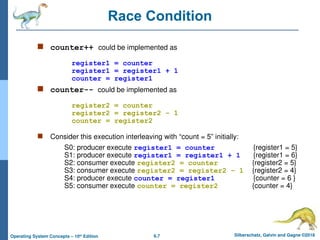
and Gagne ©2018 Operating System Concepts – 10th Edition Race Condition counter++ could be implemented as register1 = counter register1 = register1 + 1 counter = register1 counter-- could be implemented as register2 = counter register2 = register2 - 1 counter = register2 Consider this execution interleaving with “count = 5” initially: S0: producer execute register1 = counter {register1 = 5} S1: producer execute register1 = register1 + 1 {register1 = 6} S2: consumer execute register2 = counter {register2 = 5} S3: consumer execute register2 = register2 – 1 {register2 = 4} S4: producer execute counter = register1 {counter = 6 } S5: consumer execute counter = register2 {counter = 4}
8.
6.8 Silberschatz, Galvin
and Gagne ©2018 Operating System Concepts – 10th Edition Race Condition Processes P0 and P1 are creating child processs using the fork() system call Race condition on kernel variable next_available_pid which represents the next available process identifier (pid) Unless there is mutual exclusion, the same pid could be assigned to two different processes!
9.
6.9 Silberschatz, Galvin
and Gagne ©2018 Operating System Concepts – 10th Edition Critical Section Problem Consider system of n processes {p0, p1, … pn-1} Each process has critical section segment of code Process may be changing common variables, updating table, writing file, etc When one process in critical section, no other may be in its critical section Critical section problem is to design protocol to solve this Each process must ask permission to enter critical section in entry section, may follow critical section with exit section, then remainder section
10.
6.10 Silberschatz, Galvin
and Gagne ©2018 Operating System Concepts – 10th Edition Critical Section General structure of process Pi
11.
6.11 Silberschatz, Galvin
and Gagne ©2018 Operating System Concepts – 10th Edition Solution to Critical-Section Problem 1. Mutual Exclusion - If process Pi is executing in its critical section, then no other processes can be executing in their critical sections 2. Progress - If no process is executing in its critical section and there exist some processes that wish to enter their critical section, then the selection of the processes that will enter the critical section next cannot be postponed indefinitely 3. Bounded Waiting - A bound must exist on the number of times that other processes are allowed to enter their critical sections after a process has made a request to enter its critical section and before that request is granted Assume that each process executes at a nonzero speed No assumption concerning relative speed of the n processes
12.
6.12 Silberschatz, Galvin
and Gagne ©2018 Operating System Concepts – 10th Edition Critical-Section Handling in OS Two approaches depending on if kernel is preemptive or non- preemptive Preemptive – allows preemption of process when running in kernel mode Non-preemptive – runs until exits kernel mode, blocks, or voluntarily yields CPU Essentially free of race conditions in kernel mode
13.
6.13 Silberschatz, Galvin
and Gagne ©2018 Operating System Concepts – 10th Edition Peterson’s Solution Not guaranteed to work on modern architectures! (But good algorithmic description of solving the problem) Two process solution Assume that the load and store machine-language instructions are atomic; that is, cannot be interrupted The two processes share two variables: int turn; boolean flag[2] The variable turn indicates whose turn it is to enter the critical section The flag array is used to indicate if a process is ready to enter the critical section. flag[i] = true implies that process Pi is ready!
14.
6.14 Silberschatz, Galvin
and Gagne ©2018 Operating System Concepts – 10th Edition Algorithm for Process Pi while (true){ flag[i] = true; turn = j; while (flag[j] && turn = = j) ; /* critical section */ flag[i] = false; /* remainder section */ }
15.
6.15 Silberschatz, Galvin
and Gagne ©2018 Operating System Concepts – 10th Edition Peterson’s Solution (Cont.) Provable that the three CS requirement are met: 1. Mutual exclusion is preserved Pi enters CS only if: either flag[j] = false or turn = i 2. Progress requirement is satisfied 3. Bounded-waiting requirement is met
16.
6.16 Silberschatz, Galvin
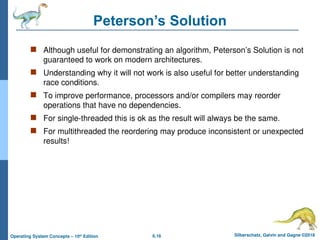
and Gagne ©2018 Operating System Concepts – 10th Edition Peterson’s Solution Although useful for demonstrating an algorithm, Peterson’s Solution is not guaranteed to work on modern architectures. Understanding why it will not work is also useful for better understanding race conditions. To improve performance, processors and/or compilers may reorder operations that have no dependencies. For single-threaded this is ok as the result will always be the same. For multithreaded the reordering may produce inconsistent or unexpected results!
17.
6.17 Silberschatz, Galvin
and Gagne ©2018 Operating System Concepts – 10th Edition Peterson’s Solution Two threads share the data: boolean flag = false; int x = 0; Thread 1 performs while (!flag) ; print x Thread 2 performs x = 100; flag = true What is the expected output?
18.
6.18 Silberschatz, Galvin
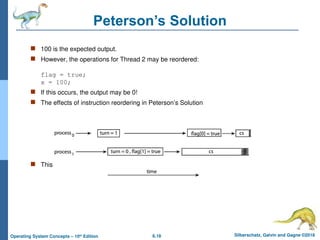
and Gagne ©2018 Operating System Concepts – 10th Edition Peterson’s Solution 100 is the expected output. However, the operations for Thread 2 may be reordered: flag = true; x = 100; If this occurs, the output may be 0! The effects of instruction reordering in Peterson’s Solution This allows both processes to be in their critical section at the same time!
19.
6.19 Silberschatz, Galvin
and Gagne ©2018 Operating System Concepts – 10th Edition Synchronization Hardware Many systems provide hardware support for implementing the critical section code. Uniprocessors – could disable interrupts Currently running code would execute without preemption Generally too inefficient on multiprocessor systems Operating systems using this not broadly scalable We will look at three forms of hardware support: 1. Memory barriers 2. Hardware instructions 3. Atomic variables
20.
6.20 Silberschatz, Galvin
and Gagne ©2018 Operating System Concepts – 10th Edition Memory Barriers Memory model are the memory guarantees a computer architecture makes to application programs. Memory models may be either: Strongly ordered – where a memory modification of one processor is immediately visible to all other processors. Weakly ordered – where a memory modification of one processor may not be immediately visible to all other processors. A memory barrier is an instruction that forces any change in memory to be propagated (made visible) to all other processors.
21.
6.21 Silberschatz, Galvin
and Gagne ©2018 Operating System Concepts – 10th Edition Memory Barrier We could add a memory barrier to the following instructions to ensure Thread 1 outputs 100: Thread 1 now performs while (!flag) memory_barrier(); print x Thread 2 now performs x = 100; memory_barrier(); flag = true
22.
6.22 Silberschatz, Galvin
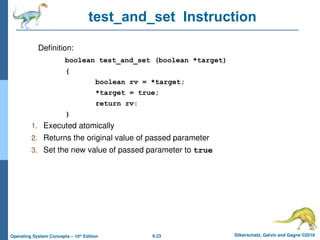
and Gagne ©2018 Operating System Concepts – 10th Edition Hardware Instructions Special hardware instructions that allow us to either test-and-modify the content of a word, or two swap the contents of two words atomically (uninterruptibly.) Test-and-Set instruction Compare-and-Swap instruction
23.
6.23 Silberschatz, Galvin
and Gagne ©2018 Operating System Concepts – 10th Edition test_and_set Instruction Definition: boolean test_and_set (boolean *target) { boolean rv = *target; *target = true; return rv: } 1. Executed atomically 2. Returns the original value of passed parameter 3. Set the new value of passed parameter to true
24.
6.24 Silberschatz, Galvin
and Gagne ©2018 Operating System Concepts – 10th Edition Solution using test_and_set() Shared boolean variable lock, initialized to false Solution: do { while (test_and_set(&lock)) ; /* do nothing */ /* critical section */ lock = false; /* remainder section */ } while (true);
25.
6.25 Silberschatz, Galvin
and Gagne ©2018 Operating System Concepts – 10th Edition compare_and_swap Instruction Definition: int compare _and_swap(int *value, int expected, int new_value) { int temp = *value; if (*value == expected) *value = new_value; return temp; } 1. Executed atomically 2. Returns the original value of passed parameter value 3. Set the variable value the value of the passed parameter new_value but only if *value == expected is true. That is, the swap takes place only under this condition.
26.
6.26 Silberschatz, Galvin
and Gagne ©2018 Operating System Concepts – 10th Edition Solution using compare_and_swap Shared integer lock initialized to 0; Solution: while (true){ while (compare_and_swap(&lock, 0, 1) != 0) ; /* do nothing */ /* critical section */ lock = 0; /* remainder section */ }
27.
6.27 Silberschatz, Galvin
and Gagne ©2018 Operating System Concepts – 10th Edition Bounded-waiting Mutual Exclusion with compare-and-swap while (true) { waiting[i] = true; key = 1; while (waiting[i] && key == 1) key = compare_and_swap(&lock,0,1); waiting[i] = false; /* critical section */ j = (i + 1) % n; while ((j != i) && !waiting[j]) j = (j + 1) % n; if (j == i) lock = 0; else waiting[j] = false; /* remainder section */ }
28.
6.28 Silberschatz, Galvin
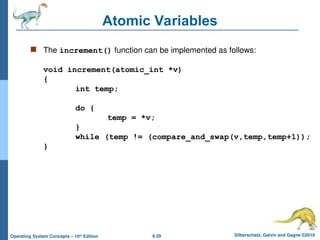
and Gagne ©2018 Operating System Concepts – 10th Edition Atomic Variables Typically, instructions such as compare-and-swap are used as building blocks for other synchronization tools. One tool is an atomic variable that provides atomic (uninterruptible) updates on basic data types such as integers and booleans. For example, the increment() operation on the atomic variable sequence ensures sequence is incremented without interruption: increment(&sequence);
29.
6.29 Silberschatz, Galvin
and Gagne ©2018 Operating System Concepts – 10th Edition Atomic Variables The increment() function can be implemented as follows: void increment(atomic_int *v) { int temp; do { temp = *v; } while (temp != (compare_and_swap(v,temp,temp+1)); }
30.
6.30 Silberschatz, Galvin
and Gagne ©2018 Operating System Concepts – 10th Edition Mutex Locks Previous solutions are complicated and generally inaccessible to application programmers OS designers build software tools to solve critical section problem Simplest is mutex lock Protect a critical section by first acquire() a lock then release() the lock Boolean variable indicating if lock is available or not Calls to acquire() and release() must be atomic Usually implemented via hardware atomic instructions such as compare-and-swap. But this solution requires busy waiting This lock therefore called a spinlock
31.
6.31 Silberschatz, Galvin
and Gagne ©2018 Operating System Concepts – 10th Edition Solution to Critical-section Problem Using Locks while (true) { acquire lock critical section release lock remainder section }
32.
6.32 Silberschatz, Galvin
and Gagne ©2018 Operating System Concepts – 10th Edition Mutex Lock Definitions acquire() { while (!available) ; /* busy wait */ available = false;; } release() { available = true; } These two functions must be implemented atomically. Both test-and-set and compare-and-swap can be used to implement these functions.
33.
6.33 Silberschatz, Galvin
and Gagne ©2018 Operating System Concepts – 10th Edition Semaphore Synchronization tool that provides more sophisticated ways (than Mutex locks) for process to synchronize their activities. Semaphore S – integer variable Can only be accessed via two indivisible (atomic) operations wait() and signal() (Originally called P() and V()) Definition of the wait() operation wait(S) { while (S <= 0) ; // busy wait S--; } Definition of the signal() operation signal(S) { S++; }
34.
6.34 Silberschatz, Galvin
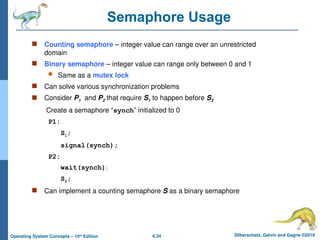
and Gagne ©2018 Operating System Concepts – 10th Edition Semaphore Usage Counting semaphore – integer value can range over an unrestricted domain Binary semaphore – integer value can range only between 0 and 1 Same as a mutex lock Can solve various synchronization problems Consider P1 and P2 that require S1 to happen before S2 Create a semaphore “synch” initialized to 0 P1: S1; signal(synch); P2: wait(synch); S2; Can implement a counting semaphore S as a binary semaphore
35.
6.35 Silberschatz, Galvin
and Gagne ©2018 Operating System Concepts – 10th Edition Semaphore Implementation Must guarantee that no two processes can execute the wait() and signal() on the same semaphore at the same time Thus, the implementation becomes the critical section problem where the wait and signal code are placed in the critical section Could now have busy waiting in critical section implementation But implementation code is short Little busy waiting if critical section rarely occupied Note that applications may spend lots of time in critical sections and therefore this is not a good solution
36.
6.36 Silberschatz, Galvin
and Gagne ©2018 Operating System Concepts – 10th Edition Semaphore Implementation with no Busy waiting With each semaphore there is an associated waiting queue Each entry in a waiting queue has two data items: value (of type integer) pointer to next record in the list Two operations: block – place the process invoking the operation on the appropriate waiting queue wakeup – remove one of processes in the waiting queue and place it in the ready queue typedef struct { int value; struct process *list; } semaphore;
37.
6.37 Silberschatz, Galvin
and Gagne ©2018 Operating System Concepts – 10th Edition Implementation with no Busy waiting (Cont.) wait(semaphore *S) { S->value--; if (S->value < 0) { add this process to S->list; block(); } } signal(semaphore *S) { S->value++; if (S->value <= 0) { remove a process P from S->list; wakeup(P); } }
38.
6.38 Silberschatz, Galvin
and Gagne ©2018 Operating System Concepts – 10th Edition Problems with Semaphores Incorrect use of semaphore operations: signal (mutex) …. wait (mutex) wait (mutex) … wait (mutex) Omitting of wait (mutex) and/or signal (mutex) These – and others – are examples of what can occur when sempahores and other synchronization tools are used incorrectly.
39.
6.39 Silberschatz, Galvin
and Gagne ©2018 Operating System Concepts – 10th Edition Monitors A high-level abstraction that provides a convenient and effective mechanism for process synchronization Abstract data type, internal variables only accessible by code within the procedure Only one process may be active within the monitor at a time Pseudocode syntax of a monitor: monitor monitor-name { // shared variable declarations function P1 (…) { …. } function P2 (…) { …. } function Pn (…) {……} initialization code (…) { … } }
40.
6.40 Silberschatz, Galvin
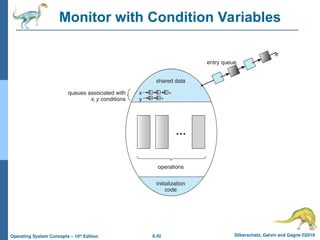
and Gagne ©2018 Operating System Concepts – 10th Edition Schematic view of a Monitor
41.
6.41 Silberschatz, Galvin
and Gagne ©2018 Operating System Concepts – 10th Edition Condition Variables condition x, y; Two operations are allowed on a condition variable: x.wait() – a process that invokes the operation is suspended until x.signal() x.signal() – resumes one of processes (if any) that invoked x.wait() If no x.wait() on the variable, then it has no effect on the variable
42.
6.42 Silberschatz, Galvin
and Gagne ©2018 Operating System Concepts – 10th Edition Monitor with Condition Variables
43.
6.43 Silberschatz, Galvin
and Gagne ©2018 Operating System Concepts – 10th Edition Condition Variables Choices If process P invokes x.signal(), and process Q is suspended in x.wait(), what should happen next? Both Q and P cannot execute in paralel. If Q is resumed, then P must wait Options include Signal and wait – P waits until Q either leaves the monitor or it waits for another condition Signal and continue – Q waits until P either leaves the monitor or it waits for another condition Both have pros and cons – language implementer can decide Monitors implemented in Concurrent Pascal compromise P executing signal immediately leaves the monitor, Q is resumed Implemented in other languages including Mesa, C#, Java
44.
6.44 Silberschatz, Galvin
and Gagne ©2018 Operating System Concepts – 10th Edition Monitor Implementation Using Semaphores Variables semaphore mutex; // (initially = 1) semaphore next; // (initially = 0) int next_count = 0; Each function F will be replaced by wait(mutex); … body of F; … if (next_count > 0) signal(next) else signal(mutex); Mutual exclusion within a monitor is ensured
45.
6.45 Silberschatz, Galvin
and Gagne ©2018 Operating System Concepts – 10th Edition Monitor Implementation – Condition Variables For each condition variable x, we have: semaphore x_sem; // (initially = 0) int x_count = 0; The operation x.wait() can be implemented as: x_count++; if (next_count > 0) signal(next); else signal(mutex); wait(x_sem); x_count--;
46.
6.46 Silberschatz, Galvin
and Gagne ©2018 Operating System Concepts – 10th Edition Monitor Implementation (Cont.) The operation x.signal() can be implemented as: if (x_count > 0) { next_count++; signal(x_sem); wait(next); next_count--; }
47.
6.47 Silberschatz, Galvin
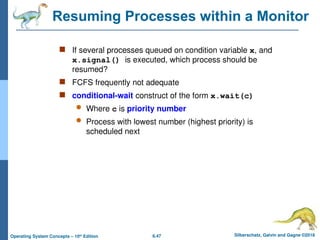
and Gagne ©2018 Operating System Concepts – 10th Edition Resuming Processes within a Monitor If several processes queued on condition variable x, and x.signal() is executed, which process should be resumed? FCFS frequently not adequate conditional-wait construct of the form x.wait(c) Where c is priority number Process with lowest number (highest priority) is scheduled next
48.
6.48 Silberschatz, Galvin
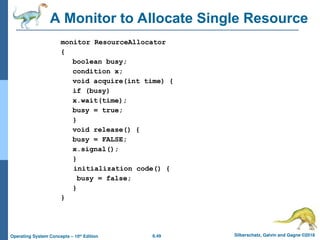
and Gagne ©2018 Operating System Concepts – 10th Edition Allocate a single resource among competing processes using priority numbers that specify the maximum time a process plans to use the resource R.acquire(t); ... access the resurce; ... R.release; Where R is an instance of type ResourceAllocator Single Resource allocation
49.
6.49 Silberschatz, Galvin
and Gagne ©2018 Operating System Concepts – 10th Edition A Monitor to Allocate Single Resource monitor ResourceAllocator { boolean busy; condition x; void acquire(int time) { if (busy) x.wait(time); busy = true; } void release() { busy = FALSE; x.signal(); } initialization code() { busy = false; } }
50.
6.50 Silberschatz, Galvin
and Gagne ©2018 Operating System Concepts – 10th Edition Liveness Processes may have to wait indefinitely while trying to acquire a synchronization tool such as a mutex lock or semaphore. Waiting indefinitely violates the progress and bounded-waiting criteria discussed at the beginning of this chapter. Liveness refers to a set of properties that a system must satisfy to ensure processes make progress. Indefinite waiting is an example of a liveness failure.
51.
6.51 Silberschatz, Galvin
and Gagne ©2018 Operating System Concepts – 10th Edition Liveness Deadlock – two or more processes are waiting indefinitely for an event that can be caused by only one of the waiting processes Let S and Q be two semaphores initialized to 1 P0 P1 wait(S); wait(Q); wait(Q); wait(S); ... ... signal(S); signal(Q); signal(Q); signal(S); Consider if P0 executes wait(S) and P1 wait(Q). When P0 executes wait(Q), it must wait until P1 executes signal(Q) However, P1 is waiting until P0 execute signal(S). Since these signal() operations will never be executed, P0 and P1 are deadlocked.
52.
6.52 Silberschatz, Galvin
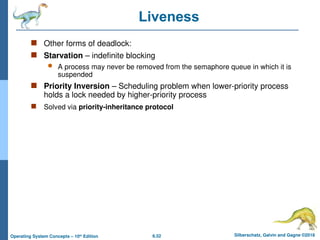
and Gagne ©2018 Operating System Concepts – 10th Edition Liveness Other forms of deadlock: Starvation – indefinite blocking A process may never be removed from the semaphore queue in which it is suspended Priority Inversion – Scheduling problem when lower-priority process holds a lock needed by higher-priority process Solved via priority-inheritance protocol
53.
6.53 Silberschatz, Galvin
and Gagne ©2018 Operating System Concepts – 10th Edition Priority Inheritance Protocol Consider the scenario with three processes P1, P2, and P3. P1 has the highest priority, P2 the next highest, and P3 the lowest. Assume a resouce P3 is assigned a resource R that P1 wants. Thus, P1 must wait for P3 to finish using the resource. However, P2 becomes runnable and preempts P3. What has happened is that P2 - a process with a lower priority than P1 - has indirectly prevented P3 from gaining access to the resource. To prevent this from occurring, a priority inheritance protocol is used. This simply allows the priority of the highest thread waiting to access a shared resource to be assigned to the thread currently using the resource. Thus, the current owner of the resource is assigned the priority of the highest priority thread wishing to acquire the resource.
54.
Silberschatz, Galvin and
Gagne ©2018 Operating System Concepts – 10th Edition End of Chapter 6
Download



![6.5 Silberschatz, Galvin and Gagne ©2018
Operating System Concepts – 10th
Edition
Producer
while (true) {
/* produce an item in next produced */
while (counter == BUFFER_SIZE)
; /* do nothing */
buffer[in] = next_produced;
in = (in + 1) % BUFFER_SIZE;
counter++;
}](https://image.slidesharecdn.com/ch6-250918221325-adba2b8c/85/chapter-6-ppt-synchronization-tools-in-os-5-320.jpg)
![6.6 Silberschatz, Galvin and Gagne ©2018
Operating System Concepts – 10th
Edition
Consumer
while (true) {
while (counter == 0)
; /* do nothing */
next_consumed = buffer[out];
out = (out + 1) % BUFFER_SIZE;
counter--;
/* consume the item in next consumed */
}](https://image.slidesharecdn.com/ch6-250918221325-adba2b8c/85/chapter-6-ppt-synchronization-tools-in-os-6-320.jpg)


![6.13 Silberschatz, Galvin and Gagne ©2018
Operating System Concepts – 10th
Edition
Peterson’s Solution
Not guaranteed to work on modern architectures! (But good
algorithmic description of solving the problem)
Two process solution
Assume that the load and store machine-language
instructions are atomic; that is, cannot be interrupted
The two processes share two variables:
int turn;
boolean flag[2]
The variable turn indicates whose turn it is to enter the critical
section
The flag array is used to indicate if a process is ready to enter
the critical section. flag[i] = true implies that process Pi is
ready!](https://image.slidesharecdn.com/ch6-250918221325-adba2b8c/85/chapter-6-ppt-synchronization-tools-in-os-13-320.jpg)
![6.14 Silberschatz, Galvin and Gagne ©2018
Operating System Concepts – 10th
Edition
Algorithm for Process Pi
while (true){
flag[i] = true;
turn = j;
while (flag[j] && turn = = j)
;
/* critical section */
flag[i] = false;
/* remainder section */
}](https://image.slidesharecdn.com/ch6-250918221325-adba2b8c/85/chapter-6-ppt-synchronization-tools-in-os-14-320.jpg)
![6.15 Silberschatz, Galvin and Gagne ©2018
Operating System Concepts – 10th
Edition
Peterson’s Solution (Cont.)
Provable that the three CS requirement are met:
1. Mutual exclusion is preserved
Pi enters CS only if:
either flag[j] = false or turn = i
2. Progress requirement is satisfied
3. Bounded-waiting requirement is met](https://image.slidesharecdn.com/ch6-250918221325-adba2b8c/85/chapter-6-ppt-synchronization-tools-in-os-15-320.jpg)





![6.27 Silberschatz, Galvin and Gagne ©2018
Operating System Concepts – 10th
Edition
Bounded-waiting Mutual Exclusion
with compare-and-swap
while (true) {
waiting[i] = true;
key = 1;
while (waiting[i] && key == 1)
key = compare_and_swap(&lock,0,1);
waiting[i] = false;
/* critical section */
j = (i + 1) % n;
while ((j != i) && !waiting[j])
j = (j + 1) % n;
if (j == i)
lock = 0;
else
waiting[j] = false;
/* remainder section */
}](https://image.slidesharecdn.com/ch6-250918221325-adba2b8c/85/chapter-6-ppt-synchronization-tools-in-os-27-320.jpg)












![ch5 [Autosaved].ppt](https://cdn.slidesharecdn.com/ss_thumbnails/ch5autosaved-230604145932-d82b045b-thumbnail.jpg?width=640&height=640&fit=bounds)


