MULTIMEDIA SYSTEM
INTRODUCTION
Multimedia system comprises of combination
from elements such as texts, graphics,
animation, sounds and videos to present the
information to consumers through computers.
Usually, not all of the elements are used but
mostly just two or three elements that were
deemed appropriate, which was determined by
the content which was to be presented. For
example, the audio element is not suitable if the
courseware is for the deaf.
TYPES OF MULTIMEDIA
 Text
 Graphics
 Video
 Animation
 Audio
 Hypermedia
TEXT
 Text is the most important thing in a
  presentation. It can usually be imported
  from text documents which has the .txt
  or .doc extension.
 It is commonly known that texts on the
  screen are much harder to look at, so you
  would have to be aware to not put too
  much information on one screen.
GRAPHICS
   Graphics can be referred to photos, charts,
    graphs, etc, that is used to present information
    that would take too much space if the text
    versions were used. It can be obtained from
    drawing it ourselves, using scanned and pre-
    made graphics, and taking photos with digital
    cameras.
   There are basically two types of graphics: 2
    dimensional (2D) graphics and 3 dimensional
    (3D) graphics. Digitalized graphics have the
    extension as follows: .jpg, .tiff, .gif, etc.
VIDEO
 Digital video clips can be integrated into
  your multimedia courseware. It’s unique
  because it can be used to show the real
  situation. Furthermore, digital video clips
  are better than analog video clips because
  it can replay on its own.
 Digitalized video clips have the following
  extension: .avi, .mov, etc.
ANIMATION
 Animation refers to the use of multiple
  moving images to present information. It
  has the ability to make the presentation
  more systematic.
 Animation can be build by using
  animation-making software and digitalized
  animation has the following extension:
  .avi, .flc, .dir, .mov, etc.
AUDIO
 Usually, audios are used to play music or
  special effects in the multimedia
  courseware.
 Like a video, audio have to be digitalized
  to change the format and it has the
  following extensions: .wav, .aiff, .pcm,
  .swa, .ram, etc
HYPERMEDIA
   Hypermedia refers to non-linear
    hyperlinks. E.g. photos can be clicked to
    bring users to another pop-up window.
THE PROCESS OF DESIGNING
SYSTEMATIC TEACHING
Introduction
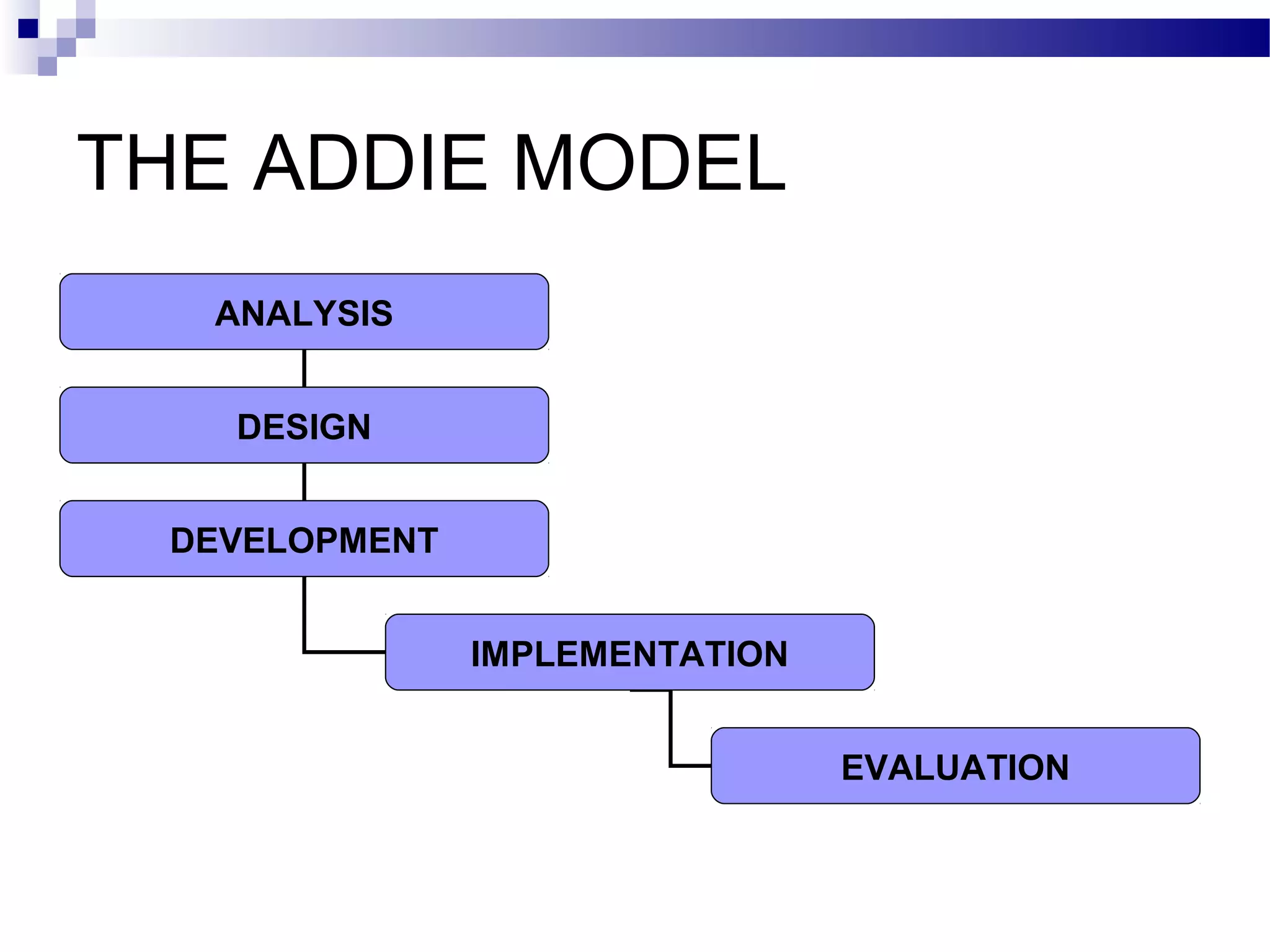
   The ADDIE model is the generic process
    traditionally used by instructional
    designers and training developers.

   The five phases—Analysis, Design,
    Development, Implementation, and
    Evaluation—represent a dynamic, flexible
    guideline for building effective training and
    performance support tools.
THE ADDIE MODEL
THE ADDIE MODEL
  ANALYSIS


   DESIGN


 DEVELOPMENT


               IMPLEMENTATION


                                EVALUATION
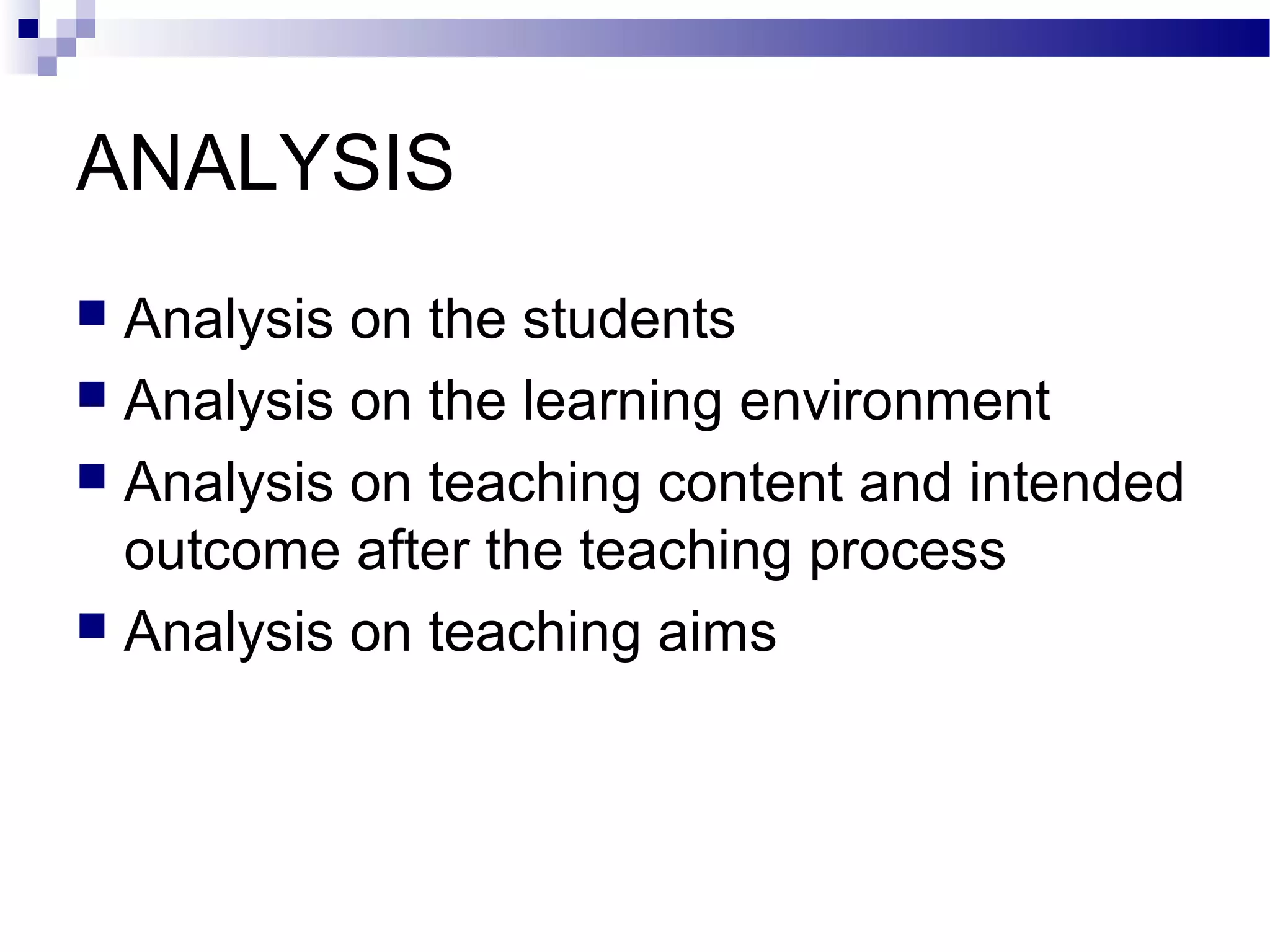
ANALYSIS
 Analysis on the students
 Analysis on the learning environment
 Analysis on teaching content and intended
  outcome after the teaching process
 Analysis on teaching aims
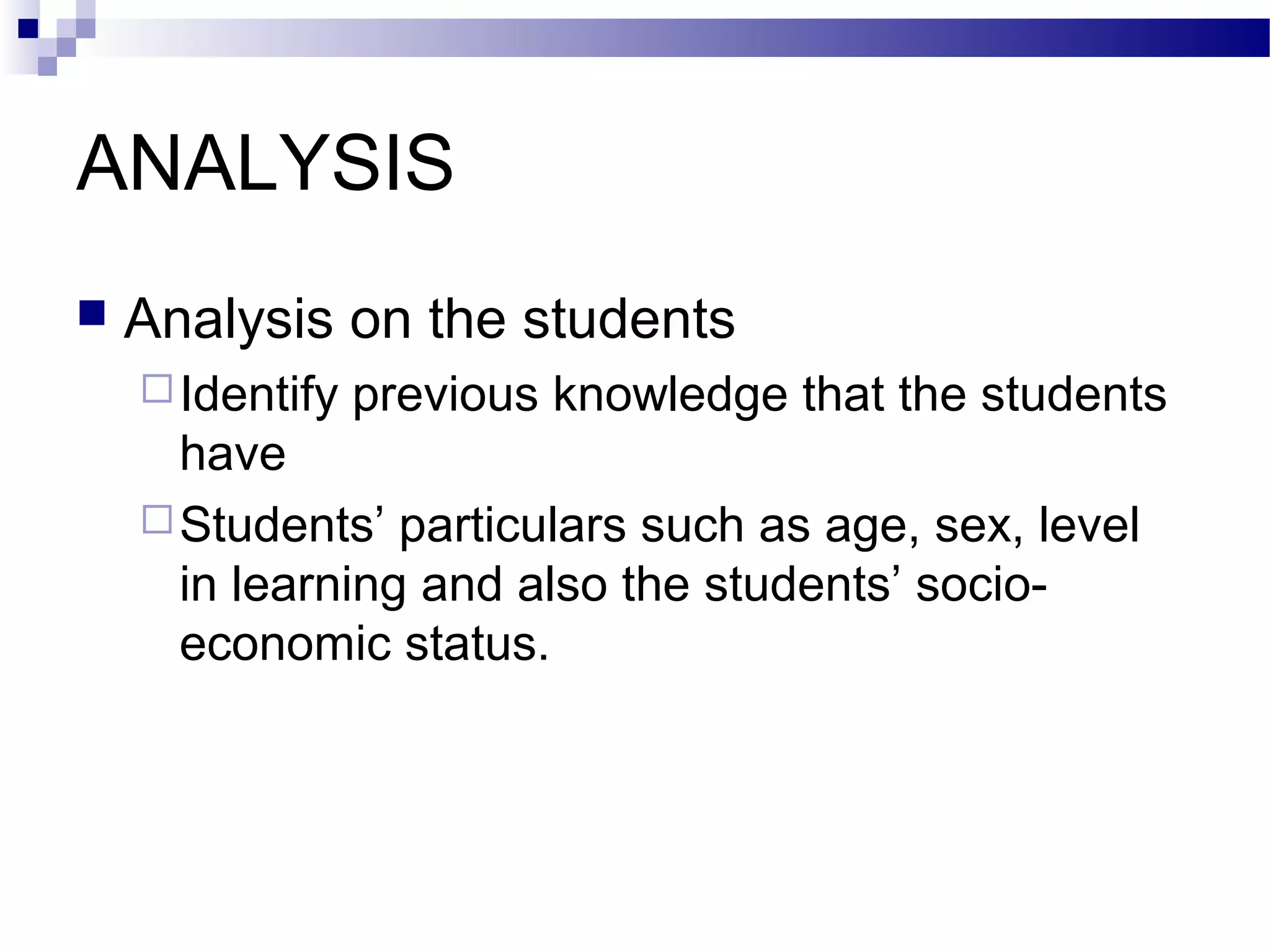
ANALYSIS
   Analysis on the students
     Identify   previous knowledge that the students
      have
     Students’ particulars such as age, sex, level
      in learning and also the students’ socio-
      economic status.
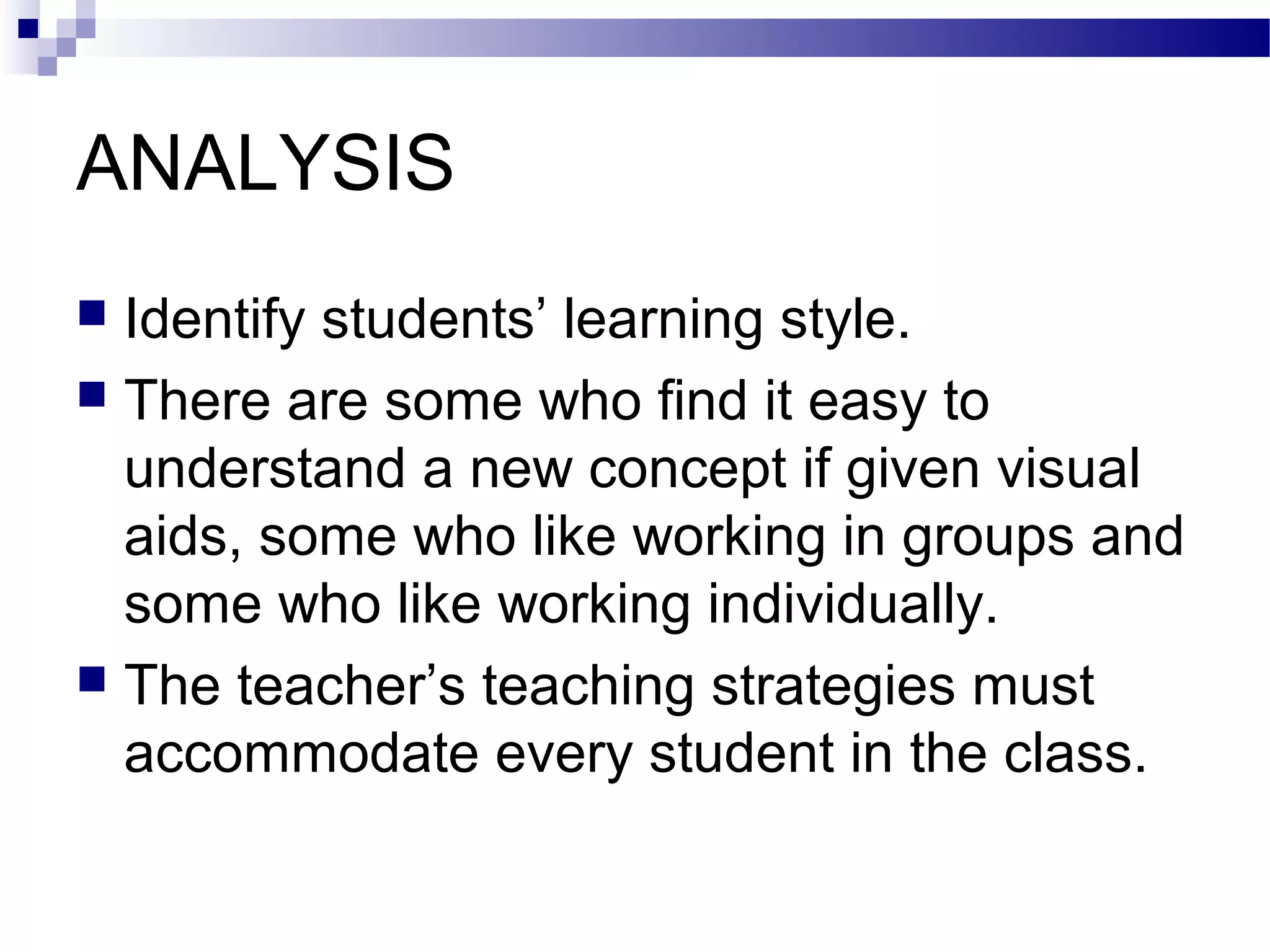
ANALYSIS
 Identify students’ learning style.
 There are some who find it easy to
  understand a new concept if given visual
  aids, some who like working in groups and
  some who like working individually.
 The teacher’s teaching strategies must
  accommodate every student in the class.
ANALYSIS
   Analysis on the learning environment
       The environment where learning takes place
        has a big implication in determining the
        preparation of teaching tools.
       Resources that are available in school or
        some organization such as:
           tools, cost, time and expertise will determine the
            method of presentation,
           time and place of learning.
ANALYSIS
   Analysis on teaching content and
    intended outcome after the teaching
    process
       Intended outcomes on students’ behaviours
        can be determined and analysed after a
        teaching and learning session has finished.
       Usually, this is done through observation at
        a working place such as in school, or in
        organization where ex-students work after
        finishing their studies, or doing an interview
        with them.
ANALYSIS
   Analysis on teaching aims
     Determine what the students have to know
      when they have finished learning.
     Teaching aims can be recognized based on
        difficulties that the students might encounter during
         previous learning process.
        previous analysis done by others researchers or

         based on other needs.
DESIGN
   Forming specific objectives for teaching
       Using the information gathered from the
        analysis, you must come up with specific
        objectives (focusing on behavioural
        outcome) for the students after they have
        finished their lesson.
   Test items
       Questions used to test the students must
        follow the specific objectives that had been
        set based on the analysis earlier.
DESIGN
   Choosing teaching strategies
       There are various teaching strategies that
        are commonly used in systematic teaching
        based on situation and learners.
       Some of them are: drilling, tutorial, games
        and simulation.
DEVELOPMENT
   Preparation of teaching materials
       Teaching materials would be prepared in
        stages.
       Visual designs and message designs have
        to be taken into consideration based on the
        chosen materials or medium.
IMPLEMENTATION
   Implementation of the teaching process
       This is the stage where teaching takes
        places.
       Teaching strategies and process are
        presented to the students based on the
        organization that had been done previously.
EVALUATION
   Formative evaluation
       Information for this type of evaluation is
        collected while going through each of the
        stages to further improve the teaching and
        learning process.
       In order to avoid from having a big problem
        that can only be detected after a programme
        had been developed.
       It cuts on cost and time.
       Done through interviews, observation and
        commentary from experts.
EVALUATION
   Summative Evaluation
     This  type of evaluation is done towards the
      end of the teaching and learning process to
      evaluate and make any necessary changes
      for the next session of teaching and learning.
     Usually, it’s done through questionnaires.
THE ASSURE MODEL

Chapter 5 The Addie Model

  • 1.
  • 2.
    INTRODUCTION Multimedia system comprisesof combination from elements such as texts, graphics, animation, sounds and videos to present the information to consumers through computers. Usually, not all of the elements are used but mostly just two or three elements that were deemed appropriate, which was determined by the content which was to be presented. For example, the audio element is not suitable if the courseware is for the deaf.
  • 3.
    TYPES OF MULTIMEDIA Text  Graphics  Video  Animation  Audio  Hypermedia
  • 4.
    TEXT  Text isthe most important thing in a presentation. It can usually be imported from text documents which has the .txt or .doc extension.  It is commonly known that texts on the screen are much harder to look at, so you would have to be aware to not put too much information on one screen.
  • 5.
    GRAPHICS  Graphics can be referred to photos, charts, graphs, etc, that is used to present information that would take too much space if the text versions were used. It can be obtained from drawing it ourselves, using scanned and pre- made graphics, and taking photos with digital cameras.  There are basically two types of graphics: 2 dimensional (2D) graphics and 3 dimensional (3D) graphics. Digitalized graphics have the extension as follows: .jpg, .tiff, .gif, etc.
  • 6.
    VIDEO  Digital videoclips can be integrated into your multimedia courseware. It’s unique because it can be used to show the real situation. Furthermore, digital video clips are better than analog video clips because it can replay on its own.  Digitalized video clips have the following extension: .avi, .mov, etc.
  • 7.
    ANIMATION  Animation refersto the use of multiple moving images to present information. It has the ability to make the presentation more systematic.  Animation can be build by using animation-making software and digitalized animation has the following extension: .avi, .flc, .dir, .mov, etc.
  • 8.
    AUDIO  Usually, audiosare used to play music or special effects in the multimedia courseware.  Like a video, audio have to be digitalized to change the format and it has the following extensions: .wav, .aiff, .pcm, .swa, .ram, etc
  • 9.
    HYPERMEDIA  Hypermedia refers to non-linear hyperlinks. E.g. photos can be clicked to bring users to another pop-up window.
  • 10.
    THE PROCESS OFDESIGNING SYSTEMATIC TEACHING
  • 11.
    Introduction  The ADDIE model is the generic process traditionally used by instructional designers and training developers.  The five phases—Analysis, Design, Development, Implementation, and Evaluation—represent a dynamic, flexible guideline for building effective training and performance support tools.
  • 12.
  • 13.
    THE ADDIE MODEL ANALYSIS DESIGN DEVELOPMENT IMPLEMENTATION EVALUATION
  • 14.
    ANALYSIS  Analysis onthe students  Analysis on the learning environment  Analysis on teaching content and intended outcome after the teaching process  Analysis on teaching aims
  • 15.
    ANALYSIS  Analysis on the students  Identify previous knowledge that the students have  Students’ particulars such as age, sex, level in learning and also the students’ socio- economic status.
  • 16.
    ANALYSIS  Identify students’learning style.  There are some who find it easy to understand a new concept if given visual aids, some who like working in groups and some who like working individually.  The teacher’s teaching strategies must accommodate every student in the class.
  • 17.
    ANALYSIS  Analysis on the learning environment  The environment where learning takes place has a big implication in determining the preparation of teaching tools.  Resources that are available in school or some organization such as:  tools, cost, time and expertise will determine the method of presentation,  time and place of learning.
  • 18.
    ANALYSIS  Analysis on teaching content and intended outcome after the teaching process  Intended outcomes on students’ behaviours can be determined and analysed after a teaching and learning session has finished.  Usually, this is done through observation at a working place such as in school, or in organization where ex-students work after finishing their studies, or doing an interview with them.
  • 19.
    ANALYSIS  Analysis on teaching aims  Determine what the students have to know when they have finished learning.  Teaching aims can be recognized based on  difficulties that the students might encounter during previous learning process.  previous analysis done by others researchers or based on other needs.
  • 20.
    DESIGN  Forming specific objectives for teaching  Using the information gathered from the analysis, you must come up with specific objectives (focusing on behavioural outcome) for the students after they have finished their lesson.  Test items  Questions used to test the students must follow the specific objectives that had been set based on the analysis earlier.
  • 21.
    DESIGN  Choosing teaching strategies  There are various teaching strategies that are commonly used in systematic teaching based on situation and learners.  Some of them are: drilling, tutorial, games and simulation.
  • 22.
    DEVELOPMENT  Preparation of teaching materials  Teaching materials would be prepared in stages.  Visual designs and message designs have to be taken into consideration based on the chosen materials or medium.
  • 23.
    IMPLEMENTATION  Implementation of the teaching process  This is the stage where teaching takes places.  Teaching strategies and process are presented to the students based on the organization that had been done previously.
  • 24.
    EVALUATION  Formative evaluation  Information for this type of evaluation is collected while going through each of the stages to further improve the teaching and learning process.  In order to avoid from having a big problem that can only be detected after a programme had been developed.  It cuts on cost and time.  Done through interviews, observation and commentary from experts.
  • 25.
    EVALUATION  Summative Evaluation  This type of evaluation is done towards the end of the teaching and learning process to evaluate and make any necessary changes for the next session of teaching and learning.  Usually, it’s done through questionnaires.
  • 26.