INTERNAL AND
EXTERNAL
INSTITUTION AND
INFLUENCES OF
CORPORATE
s.
INTRODUCTION
 Good corporate governance is based on intellectual
honesty and acting in the company's best interests.
 Quality of governance is more important than quantity.
 Transparency is crucial for effective communication of
board decisions, including both positives and
negatives.
The right board team should understand the company's
purpose, values, stakeholders, and sustainability.
Governance, strategy, and sustainability are
interconnected, emphasizing the need for long-term
consideration of financial, human, social,
environmental, and technological aspects.
INTERNAL FOUNDATION OF CORPORATE
GOVERNANCE
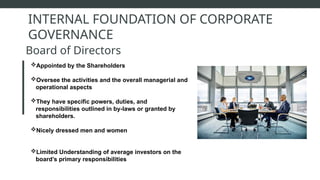
Appointed by the Shareholders
Oversee the activities and the overall managerial and
operational aspects
They have specific powers, duties, and
responsibilities outlined in by-laws or granted by
shareholders.
Nicely dressed men and women
Limited Understanding of average investors on the
board’s primary responsibilities
Board of Directors
Authority and Responsibility and purpose
of Board of Directors
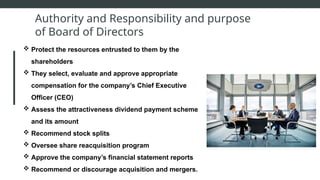
 Protect the resources entrusted to them by the
shareholders
 They select, evaluate and approve appropriate
compensation for the company’s Chief Executive
Officer (CEO)
 Assess the attractiveness dividend payment scheme
and its amount
 Recommend stock splits
 Oversee share reacquisition program
 Approve the company’s financial statement reports
 Recommend or discourage acquisition and mergers.
Structure and Makeup of Board of
Directors
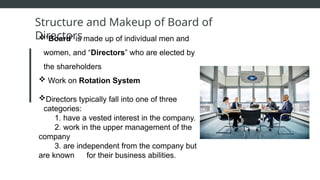
“Board” is made up of individual men and
women, and “Directors” who are elected by
the shareholders
 Work on Rotation System
Directors typically fall into one of three
categories:
1. have a vested interest in the company.
2. work in the upper management of the
company
3. are independent from the company but
are known for their business abilities.
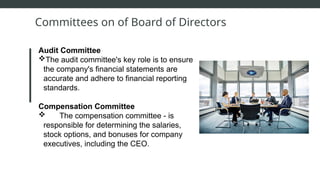
Committees on of Board of Directors
Audit Committee
The audit committee's key role is to ensure
the company's financial statements are
accurate and adhere to financial reporting
standards.
Compensation Committee
 The compensation committee - is
responsible for determining the salaries,
stock options, and bonuses for company
executives, including the CEO.
Ownership Structure and Its Impact on
the Board of Directors
Large single shareholders can effectively control a
company.
Directors may appeal to controlling shareholders when
facing challenges.
In the absence of a controlling shareholder, directors
should act as if one exists.
Directors have limited authority to override majority
shareholder decisions.
 Singular Organizational Position
 Directly under the Board of Directors
 They are task to bring into line the company
internally and externally.
Typical Responsibilities of CEO:
1. Support to the Board
2. Delivery of Program, Product and Services
(PPS)
3. Financial, Risk and Tax Management
4. Human Capital Management
5. Public Relations
Chief Executive Officer (CEO)
CFO plays a critical role beyond accounting, as they are
responsible for crucial financial functions that establish a
strong foundation for business growth and expansion.
Functions of CFO:
1. Implements Internal Controls
2. Supervises Major Impact Projects
3. Develops Relations with Financing Resources
4. Advisor to Management
5. Drives Major Strategic issues
6. Risk Manager
7. Relationship Role
Chief Financial Officer (CFO)
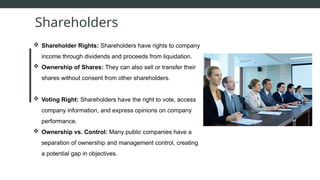
 Shareholder Rights: Shareholders have rights to company
income through dividends and proceeds from liquidation.
 Ownership of Shares: They can also sell or transfer their
shares without consent from other shareholders.
 Voting Right: Shareholders have the right to vote, access
company information, and express opinions on company
performance.
 Ownership vs. Control: Many public companies have a
separation of ownership and management control, creating
a potential gap in objectives.
Shareholders
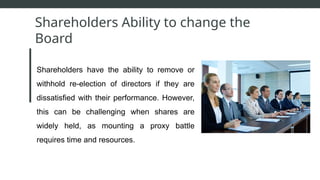
Shareholders have the ability to remove or
withhold re-election of directors if they are
dissatisfied with their performance. However,
this can be challenging when shares are
widely held, as mounting a proxy battle
requires time and resources.
Shareholders Ability to change the
Board
EXTERNAL
ENVIRONMENT
OF CORPORATE
GOVERNANCE
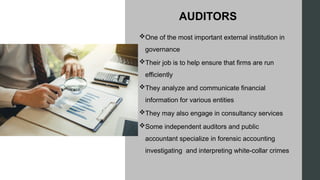
AUDITORS
One of the most important external institution in
governance
Their job is to help ensure that firms are run
efficiently
They analyze and communicate financial
information for various entities
They may also engage in consultancy services
Some independent auditors and public
accountant specialize in forensic accounting
investigating and interpreting white-collar crimes
LEGAL ENVIRONMENT
Some contend it is the market that can
really press good governance
Markets may be good for some
governance task but weak for other
Law and other institutions are more
important here than markets
Derived partly from the general
political climate in a country
MARKETS
Considered the most important institution of corporate
governance
Firm’s product market, Capital market, the Managerial
labor market
Market imperfections press charge with governance to
make the company afloat
Public market can be considered as the most feared
disciplinarian
Capital market also favor those with good track records
Labor market is also important variable in selecting
right people for position In company
OTHER EXTERNAL
ENVIRONMENT
The external environment significantly impacts
organizations, presenting both threats and
opportunities. Events in the environment directly
affect how an organization operates. Adapting to
the external environment is crucial for an
organization's survival. Those that adapt thrive,
while those that don't struggle in competition—
it's a matter of survival of the fittest, where those
who can integrate with their environment thrive.
POLITICAL ENVIRONMENT
The political environment of a country or
region directly impacts an organization's
policies, benefits, and even its workforce.
It plays a significant role in shaping the
organization both internally and externally.
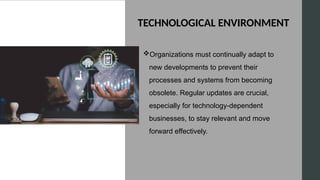
TECHNOLOGICAL ENVIRONMENT
Organizations must continually adapt to
new developments to prevent their
processes and systems from becoming
obsolete. Regular updates are crucial,
especially for technology-dependent
businesses, to stay relevant and move
forward effectively.
SOCIAL ENVIRONMENT
The social environment, characterized by
societal behavior and ethical values, forms
the ecosystem in which organizations
operate. It sets the enabling atmosphere
for businesses and significantly influences
their long-term existence and functioning.
CORPORATE
PROTECTION
WITHIN LEGAL
BOUNDARIES
Anti-Takeover Defenses
Anti-takeover defenses are strategies and mechanisms that a
company can put in place to protect itself from hostile takeover
attempts by other companies or investors.
Some common anti-takeover defenses include:
Poison pill
Golden Parachutes
Staggered Board
Supermajority Voting
Poison Put
Advantages of Anti-Takeover Defenses
Anti-takeover defenses are strategies or measures that a company can
implement to protect itself from hostile takeover attempts.
Some advantages of using these defenses include:
Protection of Shareholder Interests
Negotiating Power •Maintaining Strategic Direction
Time to Evaluate Offers
Employee and Stakeholder Stability
DISADVANTAGES OF ANTI-TAKEOVER DEFENSES
Anti-takeover defenses are strategies employed by companies to thwart
hostile takeover attempts. While they can be useful in protecting a
company's interests.
They also come with several disadvantages:
Shareholder Dilution
Reduced Market Confidence
Short-Term Focus
Entrenchment of Management
Legal and Regulatory Scrutiny
LIABILITY ISSUES
AND
INDEMNIFICATION
OF OFFICERS
Officers and directors can be liable for
harming the corporation through wrongful
acts, even crimes for personal gain.
Liability varies; some actions lead to
personal liability, while others may be
insured by the corporation.
LIABILITY ISSUES AND
INDEMNIFICATION OF
OFFICERS
Personal Liability
of Officers and
Directors
The following are issues that may subject
officers and directors to personal liability:
Issues involving misappropriation
Issues involving nondisclosure of conflict
of interest.
Issues on loyalty
Issues on non-separation of personal and
business concerns
Issues on prudence
Indemnification
of officers and
directors
 Reimbursement limits personal
liability, attracting talent to officer and
director roles.
 Corporate bylaws specify
indemnification and insurance,
structuring protection for expenses
and liabilities in a defined process.
Directors and
Officers Insurance
 Inability to indemnify? Insurance is
the solution.
 Specialized coverage, separate from
general liability, can be expensive
due to top-level roles and may have
restrictions due to risk factors and
insurer exclusions.
SHAREHOLDERS’
IMPOSABLE
LIMITATIONS
THROUGH CLASSES OF STOCK
FOUR MAIN TYPES OF SHARES (OPCR)
1. ORDINARY SHARE
standard shares with no special rights
give highest financial gains, and highest risk.
are shares that last to be paid.
2. PREFERENCE SHARES
are shares typically carry a right.
have a fixed value.
have rights to their dividend ahead of ordinary shareholders.
shares where a business will be liquidated and wind up.
SHAREHOLDERS’ IMPOSABLE
LIMITATION
3. CUMULATIVE PREFERENCE SHARES
are shares that give holders the right. dividends must be paid
in this share.
4. REDEEMABLE SHARES
shares that comes with an agreement— buy back at future
date.
SHAREHOLDERS’ IMPOSABLE
LIMITATION
percentage of ownership that is above simple majority
could mean 67% to 90%.
percentage holding which can have full control on corp's major goings.
often requisite for a company to take certain actions.
require as anti-takeover measures.
Issues in Supermajority
1.Small Business Owners look for Angel Investor.
2.Small Business Owners provide minority owners preferential and supermajority
voting rights.
SUPERMAJORITY
legal contract involving voting shares.
frequently covers how BOD selection.
occasionally covers major corporate
events.
VC expects execution with investment.
may stipulate—collectively or
cooperatively.
SHAREHOLDERS VOTING
AGREEMENT Valid Agreement
follow detailed procedures and
guidelines.
laws may limit agreement's length
require a copy of agreement.
agreement violators may be sued.
court disqualified the violating votes.
 investors' most important contractual protection.
 only relevant if corporate structure.
 most recommendable shareholders' protection system
 describe how company should operate.
MAIN FEATURES OF SHAREHOLDERS-MGT
AGREEMENTS
1.Board Appointment Rights
is common for shareholders' agreement.
minority shareholder seek one director.
larger shareholder seek large directors.
shareholder can only remove director.
SHAREHOLDERS – MANAGEMENT AGREEMENT
2. Veto Rights
right to overturn board decisions.
involves listing of material things.
normally range from fundamental matters.
3. Adoption and Amendment of Business
Plans and Budgets
ensure shareholders are properly represented.
before or during financial year.
SHAREHOLDERS – MANAGEMENT AGREEMENT
4. Scope of Business
found in the corporation's charter.
common particularly in joint venture.
describes how company will conduct
consent is required from shareholders.
5. Intellectual Property Rights
 parties contributing unique/distinct advantage.
 provides for ownership and licenses.
 common agreement in joint venture.
6. Right to Information
 extremely important for the investors.
 investors will expect contractual rights.
 seek the right to appoint director.
 expect board meetings regularly held.
7. Warranties from the Management Team
 series of statements about company.
 these statements will be confirmations.
 extend company's general trading affairs.
 statement of the management responsibility.
SHAREHOLDERS – MANAGEMENT AGREEMENT
8. Strategic Investor Rights
 where shareholders looks for ROI.
 to negotiate secondary commercial
arrangements.
9. Restrictions on Transfers of Shares
the investors will be keen.
the managers will be permitted.
10. Restrictive Covenants
cannot compete with company or employees.
expect covenants fit restrictive covenants.
 obviously critical from management's perspective.
11. Exit Provisions
exit through its nature illiquid.
shareholders' agreement often include provisions.
particularly important for minority shareholders.
normally a sophisticated legal document.
.
SHAREHOLDERS – MANAGEMENT AGREEMENT
BEHAVIORAL
MANAGEMENT
THEORY
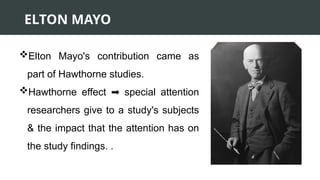
ELTON MAYO
Elton Mayo's contribution came as
part of Hawthorne studies.
Hawthorne effect special attention
➡️
researchers give to a study's subjects
& the impact that the attention has on
the study findings. .
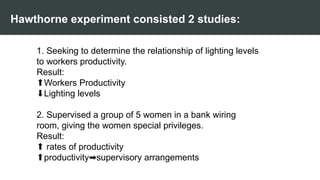
Hawthorne experiment consisted 2 studies:
1. Seeking to determine the relationship of lighting levels
to workers productivity.
Result:
⬆️
Workers Productivity
⬇️
Lighting levels
2. Supervised a group of 5 women in a bank wiring
room, giving the women special privileges.
Result:
⬆️rates of productivity
⬆️
productivity supervisory arrangements
➡️
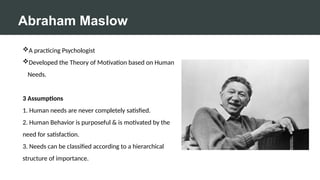
Abraham Maslow
A practicing Psychologist
Developed the Theory of Motivation based on Human
Needs.
3 Assumptions
1. Human needs are never completely satisfied.
2. Human Behavior is purposeful & is motivated by the
need for satisfaction.
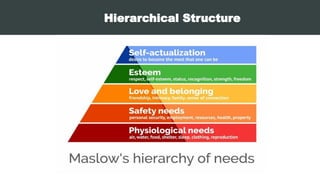
3. Needs can be classified according to a hierarchical
structure of importance.
Hierarchical Structure
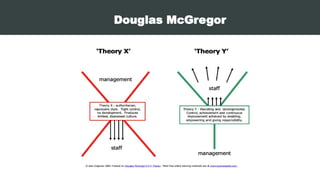
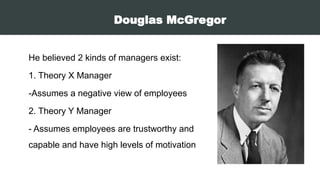
Douglas McGregor
Douglas McGregor
He believed 2 kinds of managers exist:
1. Theory X Manager
-Assumes a negative view of employees
2. Theory Y Manager
- Assumes employees are trustworthy and
capable and have high levels of motivation
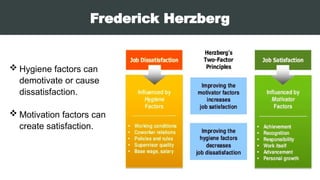
Frederick Herzberg
 Hygiene factors can
demotivate or cause
dissatisfaction.
 Motivation factors can
create satisfaction.
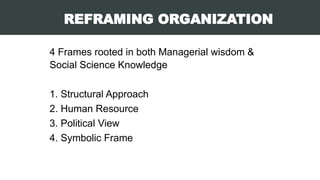
REFRAMING ORGANIZATION
4 Frames rooted in both Managerial wisdom &
Social Science Knowledge
1. Structural Approach
2. Human Resource
3. Political View
4. Symbolic Frame
EMPLOYEE STOCK OWNERSHIP PLAN (ESOP)
 A company which wants to set up an ESOP
creates a trust to which it makes annual
contributions.
 Vesting is the process whereby employees are
entitled to received stocks.
 Employees may sell their distribuited shares on
the market.
THANK
YOU!

Chapter-3-GGSR.pptx googd governance and so

  • 1.
  • 2.
    INTRODUCTION  Good corporategovernance is based on intellectual honesty and acting in the company's best interests.  Quality of governance is more important than quantity.  Transparency is crucial for effective communication of board decisions, including both positives and negatives. The right board team should understand the company's purpose, values, stakeholders, and sustainability. Governance, strategy, and sustainability are interconnected, emphasizing the need for long-term consideration of financial, human, social, environmental, and technological aspects.
  • 3.
    INTERNAL FOUNDATION OFCORPORATE GOVERNANCE Appointed by the Shareholders Oversee the activities and the overall managerial and operational aspects They have specific powers, duties, and responsibilities outlined in by-laws or granted by shareholders. Nicely dressed men and women Limited Understanding of average investors on the board’s primary responsibilities Board of Directors
  • 4.
    Authority and Responsibilityand purpose of Board of Directors  Protect the resources entrusted to them by the shareholders  They select, evaluate and approve appropriate compensation for the company’s Chief Executive Officer (CEO)  Assess the attractiveness dividend payment scheme and its amount  Recommend stock splits  Oversee share reacquisition program  Approve the company’s financial statement reports  Recommend or discourage acquisition and mergers.
  • 5.
    Structure and Makeupof Board of Directors “Board” is made up of individual men and women, and “Directors” who are elected by the shareholders  Work on Rotation System Directors typically fall into one of three categories: 1. have a vested interest in the company. 2. work in the upper management of the company 3. are independent from the company but are known for their business abilities.
  • 6.
    Committees on ofBoard of Directors Audit Committee The audit committee's key role is to ensure the company's financial statements are accurate and adhere to financial reporting standards. Compensation Committee  The compensation committee - is responsible for determining the salaries, stock options, and bonuses for company executives, including the CEO.
  • 7.
    Ownership Structure andIts Impact on the Board of Directors Large single shareholders can effectively control a company. Directors may appeal to controlling shareholders when facing challenges. In the absence of a controlling shareholder, directors should act as if one exists. Directors have limited authority to override majority shareholder decisions.
  • 8.
     Singular OrganizationalPosition  Directly under the Board of Directors  They are task to bring into line the company internally and externally. Typical Responsibilities of CEO: 1. Support to the Board 2. Delivery of Program, Product and Services (PPS) 3. Financial, Risk and Tax Management 4. Human Capital Management 5. Public Relations Chief Executive Officer (CEO)
  • 9.
    CFO plays acritical role beyond accounting, as they are responsible for crucial financial functions that establish a strong foundation for business growth and expansion. Functions of CFO: 1. Implements Internal Controls 2. Supervises Major Impact Projects 3. Develops Relations with Financing Resources 4. Advisor to Management 5. Drives Major Strategic issues 6. Risk Manager 7. Relationship Role Chief Financial Officer (CFO)
  • 10.
     Shareholder Rights:Shareholders have rights to company income through dividends and proceeds from liquidation.  Ownership of Shares: They can also sell or transfer their shares without consent from other shareholders.  Voting Right: Shareholders have the right to vote, access company information, and express opinions on company performance.  Ownership vs. Control: Many public companies have a separation of ownership and management control, creating a potential gap in objectives. Shareholders
  • 11.
    Shareholders have theability to remove or withhold re-election of directors if they are dissatisfied with their performance. However, this can be challenging when shares are widely held, as mounting a proxy battle requires time and resources. Shareholders Ability to change the Board
  • 12.
  • 13.
    AUDITORS One of themost important external institution in governance Their job is to help ensure that firms are run efficiently They analyze and communicate financial information for various entities They may also engage in consultancy services Some independent auditors and public accountant specialize in forensic accounting investigating and interpreting white-collar crimes
  • 14.
    LEGAL ENVIRONMENT Some contendit is the market that can really press good governance Markets may be good for some governance task but weak for other Law and other institutions are more important here than markets Derived partly from the general political climate in a country
  • 15.
    MARKETS Considered the mostimportant institution of corporate governance Firm’s product market, Capital market, the Managerial labor market Market imperfections press charge with governance to make the company afloat Public market can be considered as the most feared disciplinarian Capital market also favor those with good track records Labor market is also important variable in selecting right people for position In company
  • 16.
    OTHER EXTERNAL ENVIRONMENT The externalenvironment significantly impacts organizations, presenting both threats and opportunities. Events in the environment directly affect how an organization operates. Adapting to the external environment is crucial for an organization's survival. Those that adapt thrive, while those that don't struggle in competition— it's a matter of survival of the fittest, where those who can integrate with their environment thrive.
  • 17.
    POLITICAL ENVIRONMENT The politicalenvironment of a country or region directly impacts an organization's policies, benefits, and even its workforce. It plays a significant role in shaping the organization both internally and externally.
  • 18.
    TECHNOLOGICAL ENVIRONMENT Organizations mustcontinually adapt to new developments to prevent their processes and systems from becoming obsolete. Regular updates are crucial, especially for technology-dependent businesses, to stay relevant and move forward effectively.
  • 19.
    SOCIAL ENVIRONMENT The socialenvironment, characterized by societal behavior and ethical values, forms the ecosystem in which organizations operate. It sets the enabling atmosphere for businesses and significantly influences their long-term existence and functioning.
  • 20.
  • 21.
    Anti-Takeover Defenses Anti-takeover defensesare strategies and mechanisms that a company can put in place to protect itself from hostile takeover attempts by other companies or investors. Some common anti-takeover defenses include: Poison pill Golden Parachutes Staggered Board Supermajority Voting Poison Put
  • 22.
    Advantages of Anti-TakeoverDefenses Anti-takeover defenses are strategies or measures that a company can implement to protect itself from hostile takeover attempts. Some advantages of using these defenses include: Protection of Shareholder Interests Negotiating Power •Maintaining Strategic Direction Time to Evaluate Offers Employee and Stakeholder Stability
  • 23.
    DISADVANTAGES OF ANTI-TAKEOVERDEFENSES Anti-takeover defenses are strategies employed by companies to thwart hostile takeover attempts. While they can be useful in protecting a company's interests. They also come with several disadvantages: Shareholder Dilution Reduced Market Confidence Short-Term Focus Entrenchment of Management Legal and Regulatory Scrutiny
  • 24.
  • 25.
    Officers and directorscan be liable for harming the corporation through wrongful acts, even crimes for personal gain. Liability varies; some actions lead to personal liability, while others may be insured by the corporation. LIABILITY ISSUES AND INDEMNIFICATION OF OFFICERS
  • 26.
    Personal Liability of Officersand Directors The following are issues that may subject officers and directors to personal liability: Issues involving misappropriation Issues involving nondisclosure of conflict of interest. Issues on loyalty Issues on non-separation of personal and business concerns Issues on prudence
  • 27.
    Indemnification of officers and directors Reimbursement limits personal liability, attracting talent to officer and director roles.  Corporate bylaws specify indemnification and insurance, structuring protection for expenses and liabilities in a defined process.
  • 28.
    Directors and Officers Insurance Inability to indemnify? Insurance is the solution.  Specialized coverage, separate from general liability, can be expensive due to top-level roles and may have restrictions due to risk factors and insurer exclusions.
  • 29.
  • 30.
    THROUGH CLASSES OFSTOCK FOUR MAIN TYPES OF SHARES (OPCR) 1. ORDINARY SHARE standard shares with no special rights give highest financial gains, and highest risk. are shares that last to be paid. 2. PREFERENCE SHARES are shares typically carry a right. have a fixed value. have rights to their dividend ahead of ordinary shareholders. shares where a business will be liquidated and wind up. SHAREHOLDERS’ IMPOSABLE LIMITATION
  • 31.
    3. CUMULATIVE PREFERENCESHARES are shares that give holders the right. dividends must be paid in this share. 4. REDEEMABLE SHARES shares that comes with an agreement— buy back at future date. SHAREHOLDERS’ IMPOSABLE LIMITATION
  • 32.
    percentage of ownershipthat is above simple majority could mean 67% to 90%. percentage holding which can have full control on corp's major goings. often requisite for a company to take certain actions. require as anti-takeover measures. Issues in Supermajority 1.Small Business Owners look for Angel Investor. 2.Small Business Owners provide minority owners preferential and supermajority voting rights. SUPERMAJORITY
  • 33.
    legal contract involvingvoting shares. frequently covers how BOD selection. occasionally covers major corporate events. VC expects execution with investment. may stipulate—collectively or cooperatively. SHAREHOLDERS VOTING AGREEMENT Valid Agreement follow detailed procedures and guidelines. laws may limit agreement's length require a copy of agreement. agreement violators may be sued. court disqualified the violating votes.
  • 34.
     investors' mostimportant contractual protection.  only relevant if corporate structure.  most recommendable shareholders' protection system  describe how company should operate. MAIN FEATURES OF SHAREHOLDERS-MGT AGREEMENTS 1.Board Appointment Rights is common for shareholders' agreement. minority shareholder seek one director. larger shareholder seek large directors. shareholder can only remove director. SHAREHOLDERS – MANAGEMENT AGREEMENT
  • 35.
    2. Veto Rights rightto overturn board decisions. involves listing of material things. normally range from fundamental matters. 3. Adoption and Amendment of Business Plans and Budgets ensure shareholders are properly represented. before or during financial year. SHAREHOLDERS – MANAGEMENT AGREEMENT 4. Scope of Business found in the corporation's charter. common particularly in joint venture. describes how company will conduct consent is required from shareholders. 5. Intellectual Property Rights  parties contributing unique/distinct advantage.  provides for ownership and licenses.  common agreement in joint venture.
  • 36.
    6. Right toInformation  extremely important for the investors.  investors will expect contractual rights.  seek the right to appoint director.  expect board meetings regularly held. 7. Warranties from the Management Team  series of statements about company.  these statements will be confirmations.  extend company's general trading affairs.  statement of the management responsibility. SHAREHOLDERS – MANAGEMENT AGREEMENT 8. Strategic Investor Rights  where shareholders looks for ROI.  to negotiate secondary commercial arrangements. 9. Restrictions on Transfers of Shares the investors will be keen. the managers will be permitted.
  • 37.
    10. Restrictive Covenants cannotcompete with company or employees. expect covenants fit restrictive covenants.  obviously critical from management's perspective. 11. Exit Provisions exit through its nature illiquid. shareholders' agreement often include provisions. particularly important for minority shareholders. normally a sophisticated legal document. . SHAREHOLDERS – MANAGEMENT AGREEMENT
  • 38.
  • 39.
    ELTON MAYO Elton Mayo'scontribution came as part of Hawthorne studies. Hawthorne effect special attention ➡️ researchers give to a study's subjects & the impact that the attention has on the study findings. .
  • 40.
    Hawthorne experiment consisted2 studies: 1. Seeking to determine the relationship of lighting levels to workers productivity. Result: ⬆️ Workers Productivity ⬇️ Lighting levels 2. Supervised a group of 5 women in a bank wiring room, giving the women special privileges. Result: ⬆️rates of productivity ⬆️ productivity supervisory arrangements ➡️
  • 41.
    Abraham Maslow A practicingPsychologist Developed the Theory of Motivation based on Human Needs. 3 Assumptions 1. Human needs are never completely satisfied. 2. Human Behavior is purposeful & is motivated by the need for satisfaction. 3. Needs can be classified according to a hierarchical structure of importance.
  • 42.
  • 43.
  • 44.
    Douglas McGregor He believed2 kinds of managers exist: 1. Theory X Manager -Assumes a negative view of employees 2. Theory Y Manager - Assumes employees are trustworthy and capable and have high levels of motivation
  • 45.
    Frederick Herzberg  Hygienefactors can demotivate or cause dissatisfaction.  Motivation factors can create satisfaction.
  • 46.
    REFRAMING ORGANIZATION 4 Framesrooted in both Managerial wisdom & Social Science Knowledge 1. Structural Approach 2. Human Resource 3. Political View 4. Symbolic Frame
  • 47.
    EMPLOYEE STOCK OWNERSHIPPLAN (ESOP)  A company which wants to set up an ESOP creates a trust to which it makes annual contributions.  Vesting is the process whereby employees are entitled to received stocks.  Employees may sell their distribuited shares on the market.
  • 48.