Chapter 24
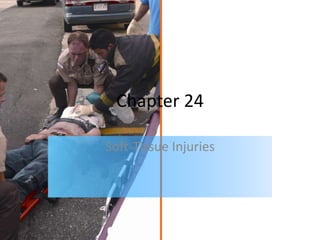
Soft-Tissue Injuries
Introduction (1 of 3)
• Soft-tissue injuries are common.
– Simple as a cut or scrape
– Serious as a life-threatening internal injury
• Do not be distracted by dramatic open
wounds.
– Do not forget airway obstructions.
Introduction (2 of 3)
• Soft tissues of the body can be injured
through a variety of mechanisms:
– Blunt injury
– Penetrating injury
– Barotrauma
– Burns
Introduction (3 of 3)
• Soft-tissue trauma is the leading form of
injury.
• Death is often related to hemorrhage or
infection.
• EMTs can teach children and others
preventive actions.
The Anatomy and Physiology of the
Skin (1 of 8)
• Skin is first line of defense against:
– External forces
– Infections
• Skin is relatively tough, but still susceptible to
injury.
– Simple bruises and abrasions to serious
lacerations and amputations
The Anatomy and Physiology of the
Skin (2 of 8)
• In all instances you must:
– Control bleeding.
– Prevent further contamination to decrease the
risk of infection.
– Protect wounds from further damage.
– Apply dressings and bandages to various parts of
the body.
The Anatomy and Physiology of the
Skin (3 of 8)
• Skin varies in thickness.
– Thinner in the very young and very old
– Thinner on the eyelids, lips, and ears than on the
scalp, back, soles of feet
– Thin skin is more easily damaged than thick skin.
The Anatomy and Physiology of the
Skin (4 of 8)
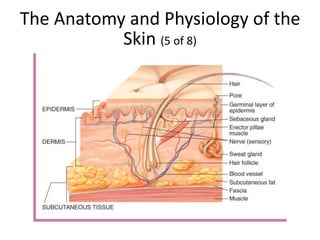
• Skin has two principal layers: the epidermis
and the dermis.
– Epidermis is the tough, external layer.
– Dermis is the inner layer.
The Anatomy and Physiology of the
Skin (5 of 8)
The Anatomy and Physiology of the
Skin (6 of 8)
• Skin covers all the external surfaces of the
body.
• Bodily openings are lined with mucous
membranes.
– Mucous membranes secrete a watery substance
that lubricates the openings.
– These are wet, whereas skin is dry.
The Anatomy and Physiology of the
Skin (7 of 8)
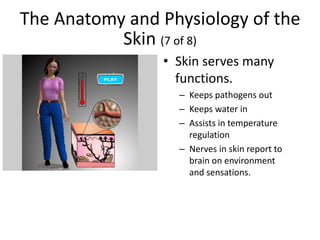
• Skin serves many
functions.
– Keeps pathogens out
– Keeps water in
– Assists in temperature
regulation
– Nerves in skin report to
brain on environment
and sensations.
The Anatomy and Physiology of the
Skin (8 of 8)
• Any break in the skin allows bacteria to enter
and raises the possibilities of:
– Infection
– Fluid loss
– Loss of temperature control
Pathophysiology (1 of 6)
• Three types of soft-tissue injuries:
– Closed injuries
• Damage is beneath skin or mucous membrane.
• Surface is intact.
– Open injuries
• Break in surface of skin or mucous membrane
• Exposes deeper tissues to contamination
Pathophysiology (2 of 6)
• Three types of soft-tissue injuries (cont’d):
– Burns
• Damage results from thermal heat, frictional heat,
toxic chemicals, electricity, nuclear radiation
Pathophysiology (3 of 6)
• Pathophysiology of closed and open injuries
– Cessation of bleeding is the primary concern.
– The next wound healing stage is inflammation.
– A new layer of cells is then moved into the
damaged area.
Pathophysiology (4 of 6)
• Pathophysiology of closed and open injuries
(cont’d)
– New blood vessels form.
– Collagen provides stability to the damaged tissue
and joins wound borders.
Pathophysiology (5 of 6)
• Pathophysiology of burns
– Severity of a thermal wound correlates directly
with:
• Temperature
• Concentration
• Amount of heat energy possessed by the object or
substance
• Duration of exposure
Pathophysiology (6 of 6)
• Pathophysiology of burns (cont’d)
– The greater the heat energy, the deeper the
wound.
– Exposure time is an important factor.
– People reflexively limit heat energy and exposure
time.
• But cannot if unconscious or trapped
Closed Injuries (1 of 4)
• Characteristics of closed injuries
– History of blunt trauma
– Pain at the site of injury
– Swelling beneath the skin
– Discoloration
Closed Injuries (2 of 4)
• A contusion (bruise) causes bleeding beneath
the skin but does not break the skin.
– Caused by blunt forces
– Buildup of blood produces blue or black
ecchymosis.
• A hematoma is blood collected within
damaged tissue or in a body cavity.
Closed Injuries (3 of 4)
• A crushing injury occurs when a great amount
of force is applied to the body.
• Extent of damage depends on:
– Amount of force
– Length of time force is applied
• When an area of the body is trapped for
longer than 4 hours, crush syndrome can
develop.
Closed Injuries (4 of 4)
• Compartment syndrome results from the
swelling that occurs whenever tissues are
injured.
• Severe closed injuries can also damage
internal organs.
– Assess all patients with closed injuries for more
serious hidden injuries.
Open Injuries (1 of 7)
• Protective layer of the skin is damaged.
• Wound is contaminated and may become
infected.
• Four types:
– Abrasions
– Lacerations
– Avulsions
– Penetrating wounds
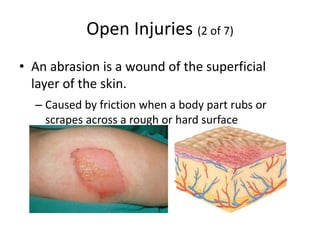
Open Injuries (2 of 7)
• An abrasion is a wound of the superficial
layer of the skin.
– Caused by friction when a body part rubs or
scrapes across a rough or hard surface
Open Injuries (3 of 7)
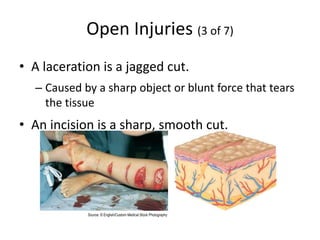
• A laceration is a jagged cut.
– Caused by a sharp object or blunt force that tears
the tissue
• An incision is a sharp, smooth cut.
Source: © English/Custom Medical Stock Photography
Open Injuries (4 of 7)
• An avulsion separates various layers of soft
tissue so that they become either completely
detached or hang as a flap.
– Often there is significant bleeding.
– Never remove an avulsion skin flap.
• An amputation is an injury in which part of
the body is completely severed.
Open Injuries (5 of 7)
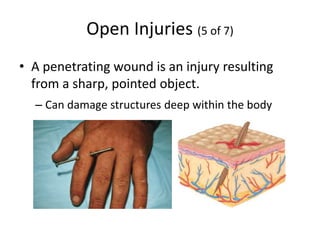
• A penetrating wound is an injury resulting
from a sharp, pointed object.
– Can damage structures deep within the body
Open Injuries (6 of 7)
• Stabbings and shootings often result in
multiple penetrating injuries.
– Assess the patient carefully to identify all
wounds.
– Count the number of penetrating injuries.
– Determine the type of gun and rounds fired, and
document your care.
– You may have to testify in court.
Open Injuries (7 of 7)
• Blast injuries
– Primary blast injury
• Damage caused by pressure of explosion
– Secondary blast injury
• Damage results from flying debris
– Tertiary blast injury
• Victim is thrown by explosion, perhaps into an object
Patient Assessment of Closed and
Open Injuries (1 of 2)
• More difficult to assess a closed injury
– You can see an open injury.
• Consider the possibility of a closed injury
when you observe:
– Bruising
– Swelling
– Deformity
– The patient reporting pain
Patient Assessment of Closed and
Open Injuries (2 of 2)
• Patient assessment steps
– Scene size-up
– Primary assessment
– History taking
– Secondary assessment
– Reassessment
Scene Size-up (1 of 2)
• Scene safety
– Observe the scene for hazards to yourself, your
crew, and the patient.
– Assess for the potential for violence.
– Assess for environmental hazards.
– Take standard precautions.
– Determine the number of patients.
– Consider if you need additional resources.
Scene Size-up (2 of 2)
• Mechanism of injury/nature of illness
– Look for indicators of the MOI as you assess the
scene.
– The MOI may provide indicators of safety threats.
– If the scene is unsafe, request additional help
early.
Primary Assessment (1 of 4)
• Form a general impression.
– Look for indicators to alert you to the seriousness
of the patient’s condition.
– Do not be distracted from looking for more
serious hidden injuries.
– Check for responsiveness using the AVPU scale.
Primary Assessment (2 of 4)
• Airway and breathing
– Ensure that the patient has a clear and patent
airway.
– Protect the patient from further spinal injury.
– Assess the patient for adequate breathing.
– Inspect and palpate the chest for DCAP-BTLS.
Primary Assessment (3 of 4)
• Circulation
– Assess the patient’s pulse rate and quality.
– Determine the skin condition, color, and
temperature.
– Check the capillary refill time.
– You may need to treat for shock.
– If visible significant bleeding is seen, you must
begin the steps to control it.
Primary Assessment (4 of 4)
• Transport decision
– Immediately transport in these cases:
• Poor initial general impression
• Altered level of consciousness
• Dyspnea
• Abnormal vital signs
• Shock
• Severe pain
History Taking (1 of 2)
• Investigate the chief complaint.
– Obtain a medical history.
– Obtain a SAMPLE history.
• Using OPQRST may provide some background on
isolated extremity injuries.
– If the patient is unresponsive, attempt to obtain
the history from other sources.
History Taking (2 of 2)
• Typical signs of an open injury include:
– Bleeding
– Break(s) in the skin
– Shock
– Hemorrhage
– Disfigurement or loss of a body part
Secondary Assessment (1 of 4)
• Physical examinations
– Is the patient in a tripod position?
– What is the skin’s color and condition?
– Are there any signs of increased respiratory
efforts?
• Retractions
• Nasal flaring
• Pursed lip breathing
• Use of accessory muscles
Secondary Assessment (2 of 4)
• Physical examinations (cont’d)
– Listen for air movement and breath sounds.
– Assess pulse rate and quality.
– Determine the skin condition, color, and
temperature.
– Check the capillary refill time.
Secondary Assessment (3 of 4)
• Physical examinations (cont’d)
– Assess the neurologic system.
– Assess the musculoskeletal system with a full-
body scan.
– Assess all anatomic regions.
Secondary Assessment (4 of 4)
• Vital signs
– You must reassess the vital signs to identify how
quickly the patient’s condition is changing.
– Use appropriate monitoring devices to quantify:
• Oxygenation
• Circulatory status
• Blood pressure
Reassessment (1 of 3)
• Repeat the primary assessment.
• Reassess vital signs and the chief complaint.
• Assess all bandaging frequently.
• Identify and treat changes in the patient’s
condition.
Reassessment (2 of 3)
• Interventions
– Assess and manage all threats to the patient’s
airway, breathing, and circulation.
– Expose all wounds, cleanse the wound surface,
control bleeding, and be prepared to treat for
shock.
– Extremities that are painful, swollen, or
deformed should be splinted.
Reassessment (3 of 3)
• Communication and documentation
– Description of the MOI
– Position in which you found the patient
– Amount of blood loss
– Location and description of any soft-tissue
injuries or other wounds
– Size and depth of the injury
– How you treated the injuries
Emergency Medical Care for Closed
Injuries (1 of 3)
• No special emergency care for small
contusions
• Soft-tissue injuries may look rather dramatic.
– Still focus on airway and breathing first
– You may have to assist ventilations with a bag-
mask device.
Emergency Medical Care for Closed
Injuries (2 of 3)
• Treat closed soft-tissue injury using the RICES
mnemonic:
– Rest
– Ice
– Compression
– Elevation
– Splinting
Emergency Medical Care for Closed
Injuries (3 of 3)
• Signs of developing shock:
– Anxiety or agitation
– Changes in mental status
– Increased heart rate
– Increased respiratory rate
– Diaphoresis
– Cool or clammy skin
– Decreased blood pressure
Emergency Medical Care for Open
Injuries (1 of 12)
• Before caring for the patient, follow standard
precautions.
• Wear gloves and eye protection.
– Wear a gown and a mask if necessary.
• Make sure the airway is open and administer
high-flow oxygen.
Emergency Medical Care for Open
Injuries (2 of 12)
• Control life-threatening bleeding using:
– Direct, even pressure and elevation
– Pressure dressings and/or splints
– Tourniquets
• Follow the steps in Skill Drill 24-1 to control
bleeding from an extremity.
Emergency Medical Care for Open
Injuries (4 of 12)
• All open wounds are assumed to be
contaminated and present a risk of infection.
• Often, you can better control bleeding from
an open soft-tissue wound by splinting the
extremity, even if there is no fracture.
Emergency Medical Care for Open
Injuries (5 of 12)
• Abdominal wounds
– An open wound in the abdominal cavity may
expose internal organs.
– The organs may even protrude through the
wound, an injury called evisceration.
Emergency Medical Care for Open
Injuries (6 of 12)
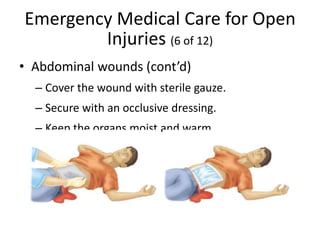
• Abdominal wounds (cont’d)
– Cover the wound with sterile gauze.
– Secure with an occlusive dressing.
– Keep the organs moist and warm.
Emergency Medical Care for Open
Injuries (7 of 12)
• Impaled objects
– To treat an impaled object, follow the steps in
Skill Drill 24-2.
– Only remove an impaled object when:
• The object is in the cheek and obstructs breathing.
• The object is in the chest and interferes with CPR.
Emergency Medical Care for Open
Injuries (8 of 12)
• Neck injuries
– Open neck injuries can be life threatening.
– Open veins may suck in air and cause cardiac
arrest.
– Cover the wound with an occlusive dressing.
– Apply pressure but do not compress both carotid
arteries at the same time.
Emergency Medical Care for Open
Injuries (9 of 12)
• Small-animal bites
– A small animal’s mouth is heavily contaminated
with virulent bacteria.
– Wounds may require:
• Antibiotics
• Tetanus prophylaxis
• Suturing
– Bites should be evaluated by a physician.
Emergency Medical Care for Open
Injuries (10 of 12)
• A major concern is the spread of rabies.
– Acute, potentially fatal viral infection of the
central nervous system
– Can affect all warm-blooded animals
– Transmitted through biting or licking an open
wound
– Prevented by a series of special vaccine injections
Emergency Medical Care for Open
Injuries (11 of 12)
• Human bites
– The human mouth contains an exceptionally
wide range of virulent bacteria and viruses.
– Regard any human bite that has penetrated the
skin as a very serious injury.
– Can result in a serious, spreading infection
Emergency Medical Care for Open
Injuries (12 of 12)
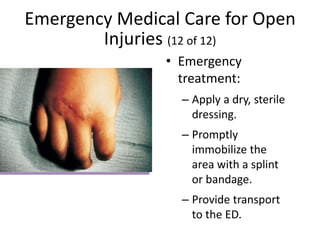
• Emergency
treatment:
– Apply a dry, sterile
dressing.
– Promptly
immobilize the
area with a splint
or bandage.
– Provide transport
to the ED.
Burns (1 of 2)
• Account for over 10,000 deaths a year
• Among the most serious and painful of all
injuries
• A burn occurs when the body receives more
radiant energy than it can absorb.
– Sources of this energy include heat, toxic
chemicals, and electricity.
Burns (2 of 2)
• Always perform a complete assessment to
determine whether there are other serious
injuries.
Complications of Burns (1 of 2)
• When a person is burned, the skin that acts
as a barrier is destroyed.
• The victim is now at high risk for:
– Infection
– Hypothermia
– Hypovolemia
– Shock
Complications of Burns (2 of 2)
• Burns to the airway are of significant
importance.
• Circumferential burns of the chest can
compromise breathing.
• Circumferential burns of the extremity can
lead to neurovascular compromise and
irreversible damage.
Burn Severity (1 of 5)
• Burn severity depends on:
– Depth of burn
– Extent of burn
– Critical areas involved
• Face, upper airway, hands, feet, genitalia
– Preexisting medical conditions
– Patient younger than 5 or older than 55
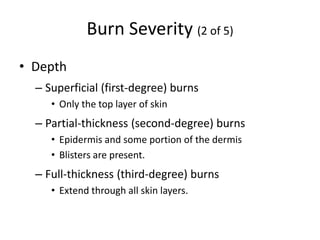
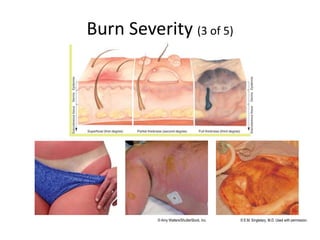
Burn Severity (2 of 5)
• Depth
– Superficial (first-degree) burns
• Only the top layer of skin
– Partial-thickness (second-degree) burns
• Epidermis and some portion of the dermis
• Blisters are present.
– Full-thickness (third-degree) burns
• Extend through all skin layers.
Burn Severity (3 of 5)
© Amy Walters/ShutterStock, Inc. © E.M. Singletary, M.D. Used with permission.
Burn Severity (4 of 5)
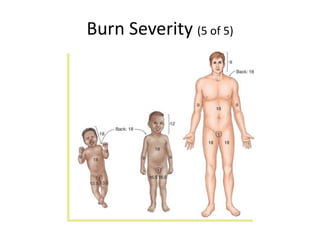
• Extent
– Can be estimated using the rule of nines
– Divides the body into sections, each representing
approximately 9% of the total body surface area
– Proportions differ for infants, children, and adults
Burn Severity (5 of 5)

Chapter 24 PPT part 1.pptx

  • 2.
  • 3.
    Introduction (1 of3) • Soft-tissue injuries are common. – Simple as a cut or scrape – Serious as a life-threatening internal injury • Do not be distracted by dramatic open wounds. – Do not forget airway obstructions.
  • 4.
    Introduction (2 of3) • Soft tissues of the body can be injured through a variety of mechanisms: – Blunt injury – Penetrating injury – Barotrauma – Burns
  • 5.
    Introduction (3 of3) • Soft-tissue trauma is the leading form of injury. • Death is often related to hemorrhage or infection. • EMTs can teach children and others preventive actions.
  • 6.
    The Anatomy andPhysiology of the Skin (1 of 8) • Skin is first line of defense against: – External forces – Infections • Skin is relatively tough, but still susceptible to injury. – Simple bruises and abrasions to serious lacerations and amputations
  • 7.
    The Anatomy andPhysiology of the Skin (2 of 8) • In all instances you must: – Control bleeding. – Prevent further contamination to decrease the risk of infection. – Protect wounds from further damage. – Apply dressings and bandages to various parts of the body.
  • 8.
    The Anatomy andPhysiology of the Skin (3 of 8) • Skin varies in thickness. – Thinner in the very young and very old – Thinner on the eyelids, lips, and ears than on the scalp, back, soles of feet – Thin skin is more easily damaged than thick skin.
  • 9.
    The Anatomy andPhysiology of the Skin (4 of 8) • Skin has two principal layers: the epidermis and the dermis. – Epidermis is the tough, external layer. – Dermis is the inner layer.
  • 10.
    The Anatomy andPhysiology of the Skin (5 of 8)
  • 11.
    The Anatomy andPhysiology of the Skin (6 of 8) • Skin covers all the external surfaces of the body. • Bodily openings are lined with mucous membranes. – Mucous membranes secrete a watery substance that lubricates the openings. – These are wet, whereas skin is dry.
  • 12.
    The Anatomy andPhysiology of the Skin (7 of 8) • Skin serves many functions. – Keeps pathogens out – Keeps water in – Assists in temperature regulation – Nerves in skin report to brain on environment and sensations.
  • 13.
    The Anatomy andPhysiology of the Skin (8 of 8) • Any break in the skin allows bacteria to enter and raises the possibilities of: – Infection – Fluid loss – Loss of temperature control
  • 14.
    Pathophysiology (1 of6) • Three types of soft-tissue injuries: – Closed injuries • Damage is beneath skin or mucous membrane. • Surface is intact. – Open injuries • Break in surface of skin or mucous membrane • Exposes deeper tissues to contamination
  • 15.
    Pathophysiology (2 of6) • Three types of soft-tissue injuries (cont’d): – Burns • Damage results from thermal heat, frictional heat, toxic chemicals, electricity, nuclear radiation
  • 16.
    Pathophysiology (3 of6) • Pathophysiology of closed and open injuries – Cessation of bleeding is the primary concern. – The next wound healing stage is inflammation. – A new layer of cells is then moved into the damaged area.
  • 17.
    Pathophysiology (4 of6) • Pathophysiology of closed and open injuries (cont’d) – New blood vessels form. – Collagen provides stability to the damaged tissue and joins wound borders.
  • 18.
    Pathophysiology (5 of6) • Pathophysiology of burns – Severity of a thermal wound correlates directly with: • Temperature • Concentration • Amount of heat energy possessed by the object or substance • Duration of exposure
  • 19.
    Pathophysiology (6 of6) • Pathophysiology of burns (cont’d) – The greater the heat energy, the deeper the wound. – Exposure time is an important factor. – People reflexively limit heat energy and exposure time. • But cannot if unconscious or trapped
  • 20.
    Closed Injuries (1of 4) • Characteristics of closed injuries – History of blunt trauma – Pain at the site of injury – Swelling beneath the skin – Discoloration
  • 21.
    Closed Injuries (2of 4) • A contusion (bruise) causes bleeding beneath the skin but does not break the skin. – Caused by blunt forces – Buildup of blood produces blue or black ecchymosis. • A hematoma is blood collected within damaged tissue or in a body cavity.
  • 22.
    Closed Injuries (3of 4) • A crushing injury occurs when a great amount of force is applied to the body. • Extent of damage depends on: – Amount of force – Length of time force is applied • When an area of the body is trapped for longer than 4 hours, crush syndrome can develop.
  • 23.
    Closed Injuries (4of 4) • Compartment syndrome results from the swelling that occurs whenever tissues are injured. • Severe closed injuries can also damage internal organs. – Assess all patients with closed injuries for more serious hidden injuries.
  • 24.
    Open Injuries (1of 7) • Protective layer of the skin is damaged. • Wound is contaminated and may become infected. • Four types: – Abrasions – Lacerations – Avulsions – Penetrating wounds
  • 25.
    Open Injuries (2of 7) • An abrasion is a wound of the superficial layer of the skin. – Caused by friction when a body part rubs or scrapes across a rough or hard surface
  • 26.
    Open Injuries (3of 7) • A laceration is a jagged cut. – Caused by a sharp object or blunt force that tears the tissue • An incision is a sharp, smooth cut. Source: © English/Custom Medical Stock Photography
  • 27.
    Open Injuries (4of 7) • An avulsion separates various layers of soft tissue so that they become either completely detached or hang as a flap. – Often there is significant bleeding. – Never remove an avulsion skin flap. • An amputation is an injury in which part of the body is completely severed.
  • 28.
    Open Injuries (5of 7) • A penetrating wound is an injury resulting from a sharp, pointed object. – Can damage structures deep within the body
  • 29.
    Open Injuries (6of 7) • Stabbings and shootings often result in multiple penetrating injuries. – Assess the patient carefully to identify all wounds. – Count the number of penetrating injuries. – Determine the type of gun and rounds fired, and document your care. – You may have to testify in court.
  • 30.
    Open Injuries (7of 7) • Blast injuries – Primary blast injury • Damage caused by pressure of explosion – Secondary blast injury • Damage results from flying debris – Tertiary blast injury • Victim is thrown by explosion, perhaps into an object
  • 31.
    Patient Assessment ofClosed and Open Injuries (1 of 2) • More difficult to assess a closed injury – You can see an open injury. • Consider the possibility of a closed injury when you observe: – Bruising – Swelling – Deformity – The patient reporting pain
  • 32.
    Patient Assessment ofClosed and Open Injuries (2 of 2) • Patient assessment steps – Scene size-up – Primary assessment – History taking – Secondary assessment – Reassessment
  • 33.
    Scene Size-up (1of 2) • Scene safety – Observe the scene for hazards to yourself, your crew, and the patient. – Assess for the potential for violence. – Assess for environmental hazards. – Take standard precautions. – Determine the number of patients. – Consider if you need additional resources.
  • 34.
    Scene Size-up (2of 2) • Mechanism of injury/nature of illness – Look for indicators of the MOI as you assess the scene. – The MOI may provide indicators of safety threats. – If the scene is unsafe, request additional help early.
  • 35.
    Primary Assessment (1of 4) • Form a general impression. – Look for indicators to alert you to the seriousness of the patient’s condition. – Do not be distracted from looking for more serious hidden injuries. – Check for responsiveness using the AVPU scale.
  • 36.
    Primary Assessment (2of 4) • Airway and breathing – Ensure that the patient has a clear and patent airway. – Protect the patient from further spinal injury. – Assess the patient for adequate breathing. – Inspect and palpate the chest for DCAP-BTLS.
  • 37.
    Primary Assessment (3of 4) • Circulation – Assess the patient’s pulse rate and quality. – Determine the skin condition, color, and temperature. – Check the capillary refill time. – You may need to treat for shock. – If visible significant bleeding is seen, you must begin the steps to control it.
  • 38.
    Primary Assessment (4of 4) • Transport decision – Immediately transport in these cases: • Poor initial general impression • Altered level of consciousness • Dyspnea • Abnormal vital signs • Shock • Severe pain
  • 39.
    History Taking (1of 2) • Investigate the chief complaint. – Obtain a medical history. – Obtain a SAMPLE history. • Using OPQRST may provide some background on isolated extremity injuries. – If the patient is unresponsive, attempt to obtain the history from other sources.
  • 40.
    History Taking (2of 2) • Typical signs of an open injury include: – Bleeding – Break(s) in the skin – Shock – Hemorrhage – Disfigurement or loss of a body part
  • 41.
    Secondary Assessment (1of 4) • Physical examinations – Is the patient in a tripod position? – What is the skin’s color and condition? – Are there any signs of increased respiratory efforts? • Retractions • Nasal flaring • Pursed lip breathing • Use of accessory muscles
  • 42.
    Secondary Assessment (2of 4) • Physical examinations (cont’d) – Listen for air movement and breath sounds. – Assess pulse rate and quality. – Determine the skin condition, color, and temperature. – Check the capillary refill time.
  • 43.
    Secondary Assessment (3of 4) • Physical examinations (cont’d) – Assess the neurologic system. – Assess the musculoskeletal system with a full- body scan. – Assess all anatomic regions.
  • 44.
    Secondary Assessment (4of 4) • Vital signs – You must reassess the vital signs to identify how quickly the patient’s condition is changing. – Use appropriate monitoring devices to quantify: • Oxygenation • Circulatory status • Blood pressure
  • 45.
    Reassessment (1 of3) • Repeat the primary assessment. • Reassess vital signs and the chief complaint. • Assess all bandaging frequently. • Identify and treat changes in the patient’s condition.
  • 46.
    Reassessment (2 of3) • Interventions – Assess and manage all threats to the patient’s airway, breathing, and circulation. – Expose all wounds, cleanse the wound surface, control bleeding, and be prepared to treat for shock. – Extremities that are painful, swollen, or deformed should be splinted.
  • 47.
    Reassessment (3 of3) • Communication and documentation – Description of the MOI – Position in which you found the patient – Amount of blood loss – Location and description of any soft-tissue injuries or other wounds – Size and depth of the injury – How you treated the injuries
  • 48.
    Emergency Medical Carefor Closed Injuries (1 of 3) • No special emergency care for small contusions • Soft-tissue injuries may look rather dramatic. – Still focus on airway and breathing first – You may have to assist ventilations with a bag- mask device.
  • 49.
    Emergency Medical Carefor Closed Injuries (2 of 3) • Treat closed soft-tissue injury using the RICES mnemonic: – Rest – Ice – Compression – Elevation – Splinting
  • 50.
    Emergency Medical Carefor Closed Injuries (3 of 3) • Signs of developing shock: – Anxiety or agitation – Changes in mental status – Increased heart rate – Increased respiratory rate – Diaphoresis – Cool or clammy skin – Decreased blood pressure
  • 51.
    Emergency Medical Carefor Open Injuries (1 of 12) • Before caring for the patient, follow standard precautions. • Wear gloves and eye protection. – Wear a gown and a mask if necessary. • Make sure the airway is open and administer high-flow oxygen.
  • 52.
    Emergency Medical Carefor Open Injuries (2 of 12) • Control life-threatening bleeding using: – Direct, even pressure and elevation – Pressure dressings and/or splints – Tourniquets • Follow the steps in Skill Drill 24-1 to control bleeding from an extremity.
  • 53.
    Emergency Medical Carefor Open Injuries (4 of 12) • All open wounds are assumed to be contaminated and present a risk of infection. • Often, you can better control bleeding from an open soft-tissue wound by splinting the extremity, even if there is no fracture.
  • 54.
    Emergency Medical Carefor Open Injuries (5 of 12) • Abdominal wounds – An open wound in the abdominal cavity may expose internal organs. – The organs may even protrude through the wound, an injury called evisceration.
  • 55.
    Emergency Medical Carefor Open Injuries (6 of 12) • Abdominal wounds (cont’d) – Cover the wound with sterile gauze. – Secure with an occlusive dressing. – Keep the organs moist and warm.
  • 56.
    Emergency Medical Carefor Open Injuries (7 of 12) • Impaled objects – To treat an impaled object, follow the steps in Skill Drill 24-2. – Only remove an impaled object when: • The object is in the cheek and obstructs breathing. • The object is in the chest and interferes with CPR.
  • 57.
    Emergency Medical Carefor Open Injuries (8 of 12) • Neck injuries – Open neck injuries can be life threatening. – Open veins may suck in air and cause cardiac arrest. – Cover the wound with an occlusive dressing. – Apply pressure but do not compress both carotid arteries at the same time.
  • 58.
    Emergency Medical Carefor Open Injuries (9 of 12) • Small-animal bites – A small animal’s mouth is heavily contaminated with virulent bacteria. – Wounds may require: • Antibiotics • Tetanus prophylaxis • Suturing – Bites should be evaluated by a physician.
  • 59.
    Emergency Medical Carefor Open Injuries (10 of 12) • A major concern is the spread of rabies. – Acute, potentially fatal viral infection of the central nervous system – Can affect all warm-blooded animals – Transmitted through biting or licking an open wound – Prevented by a series of special vaccine injections
  • 60.
    Emergency Medical Carefor Open Injuries (11 of 12) • Human bites – The human mouth contains an exceptionally wide range of virulent bacteria and viruses. – Regard any human bite that has penetrated the skin as a very serious injury. – Can result in a serious, spreading infection
  • 61.
    Emergency Medical Carefor Open Injuries (12 of 12) • Emergency treatment: – Apply a dry, sterile dressing. – Promptly immobilize the area with a splint or bandage. – Provide transport to the ED.
  • 62.
    Burns (1 of2) • Account for over 10,000 deaths a year • Among the most serious and painful of all injuries • A burn occurs when the body receives more radiant energy than it can absorb. – Sources of this energy include heat, toxic chemicals, and electricity.
  • 63.
    Burns (2 of2) • Always perform a complete assessment to determine whether there are other serious injuries.
  • 64.
    Complications of Burns(1 of 2) • When a person is burned, the skin that acts as a barrier is destroyed. • The victim is now at high risk for: – Infection – Hypothermia – Hypovolemia – Shock
  • 65.
    Complications of Burns(2 of 2) • Burns to the airway are of significant importance. • Circumferential burns of the chest can compromise breathing. • Circumferential burns of the extremity can lead to neurovascular compromise and irreversible damage.
  • 66.
    Burn Severity (1of 5) • Burn severity depends on: – Depth of burn – Extent of burn – Critical areas involved • Face, upper airway, hands, feet, genitalia – Preexisting medical conditions – Patient younger than 5 or older than 55
  • 67.
    Burn Severity (2of 5) • Depth – Superficial (first-degree) burns • Only the top layer of skin – Partial-thickness (second-degree) burns • Epidermis and some portion of the dermis • Blisters are present. – Full-thickness (third-degree) burns • Extend through all skin layers.
  • 68.
    Burn Severity (3of 5) © Amy Walters/ShutterStock, Inc. © E.M. Singletary, M.D. Used with permission.
  • 69.
    Burn Severity (4of 5) • Extent – Can be estimated using the rule of nines – Divides the body into sections, each representing approximately 9% of the total body surface area – Proportions differ for infants, children, and adults
  • 70.