Chapter 2: Developing and Implementing Strategic HRM
Plans
The Value of Planning
James stumbled into his position as the human resource
manager. He had been working for Techno, Inc.
for three years, and when the company grew, James moved from
a management position into a human
resource management position. Techno, Inc. is a technology and
software consulting company for the
music industry.
James didn’t have a good handle on how to effectively run a
human resources (HR) department, so for
much of the time he tried to figure it out as he went. When
Techno started seeing rapid growth, he hired
thirty people within a one-month period to meet the demand.
Proud of his ability to accomplish his task of
meeting the business’s current needs, James was rather pleased
with himself. He had spent numerous
hours mulling over recruitment strategies, putting together
excellent compensation plans, and then
eventually sifting through résumés as a small part of the hiring
process. Now the organization had the
right number of people needed to carry out its projects.
Fast forward five months, however, and it turned out the rapid
growth was only temporary. James met
with the executives of the business who told him the contracts
they had acquired were finished, and there
wasn’t enough new work coming in to make payroll next month
if they didn’t let some people go. James
felt frustrated because he had gone through so much effort to
hire people, and now they would be laid off.
Never mind the costs of hiring and training his department had
taken on to make this happen. As James
sat with the executives to determine who should be laid off, he
felt sad for the people who had given up
other jobs just five months before, only to be laid off.
After the meeting, James reflected on this situation and realized
that if he had spoken with the executives
of the company sooner, they would have shared information on
the duration of the contracts, and he likely
would have hired people differently, perhaps on a contract basis
rather than on a full-time basis. He also
considered the fact that the organization could have hired an
outsourcing company to recruit workers for
him. As Jason mulled this over, he realized that he needed a
strategic plan to make sure his department
was meeting the needs of the organization. He vowed to work
with the company executives to find out
more about the company’s strategic plan and then develop a
human resource management (HRM)
strategic plan to make sure Techno, Inc. has the right number of
workers with the right skills, at the right
time in the future.
2.1 Strategic Planning
LEARNING OBJECTIVES
1. Explain the differences been HRM and personnel
management.
2. Be able to define the steps in HRM strategic planning.
In the past, human resource management (HRM) was called the
personnel department. In the past, the
personnel department hired people and dealt with the hiring
paperwork and processes. It is believed the
first human resource department was created in 1901 by the
National Cash Register Company (NCR). The
company faced a major strike but eventually defeated the union
after a lockout. (We address unions
in Chapter 11 "Working with Labor Unions".) After this
difficult battle, the company president decided to
improve worker relations by organizing a personnel department
to handle grievances, discharges, safety
concerns, and other employee issues. The department also kept
track of new legislation surrounding laws
impacting the organization. Many other companies were coming
to the same realization that a
department was necessary to create employee satisfaction,
which resulted in more productivity. In 1913,
Henry Ford saw employee turnover at 380 percent and tried to
ease the turnover by increasing wages
from $2.50 to $5.00, even though $2.50 was fair during this
time period. [1] Of course, this approach
didn’t work for long, and these large companies began to
understand they had to do more than hire and
fire if they were going to meet customer demand.
More recently, however, the personnel department has divided
into human resource management and
human resource development, as these functions have evolved
over the century. HRM is not only crucial
to an organization’s success, but it should be part of the overall
company’s strategic plan, because so many
businesses today depend on people to earn profits. Strategic
planning plays an important role in how
productive the organization is.
Table 2.1 Examples of Differences between Personnel
Management and HRM
Personnel Management Focus HRM Focus
Administering of policies Helping to achieve strategic goals
through people
Personnel Management Focus HRM Focus
Stand-alone programs, such as training
HRM training programs that are integrated with company’s
mission and values
Personnel department responsible for
managing people
Line managers share joint responsibility in all areas of people
hiring and management
Creates a cost within an organization Contributes to the profit
objectives of the organization
Most people agree that the following duties normally fall under
HRM. Each of these aspects has its own
part within the overall strategic plan of the organization:
1. Staffing. Staffing includes the development of a strategic
plan to determine how many people you
might need to hire. Based on the strategic plan, HRM then
performs the hiring process to recruit
and select the right people for the right jobs. We discuss
staffing in greater detail in Chapter 4
"Recruitment", Chapter 5 "Selection", and Chapter 6
"Compensation and Benefits".
2. Basic workplace policies. Development of policies to help
reach the strategic plan’s goals is the job
of HRM. After the policies have been developed,
communication of these policies on safety,
security, scheduling, vacation times, and flextime schedules
should be developed by the HR
department. Of course, the HR managers work closely with
supervisors in organizations to
develop these policies. Workplace policies will be addressed
throughout the book.
3. Compensation and benefits. In addition to paychecks, 401(k)
plans, health benefits, and other
perks are usually the responsibility of an HR manager.
Compensation and benefits are discussed
in Chapter 6 "Compensation and Benefits" and Chapter 7
"Retention and Motivation".
4. Retention. Assessment of employees and strategizing on how
to retain the best employees is a
task that HR managers oversee, but other managers in the
organization will also provide
input. Chapter 9 "Managing Employee Performance" and
Chapter 10 "Employee
Assessment" cover different types of retention strategies, from
training to assessment.
5. Training and development. Helping new employees develop
skills needed for their jobs and
helping current employees grow their skills are also tasks for
which the HRM department is
responsible. Determination of training needs and development
and implementation of training
programs are important tasks in any organization. Succession
planning includes handling the
departure of managers and making current employees ready to
take on managerial roles when a
manager does leave.
6. Regulatory issues and worker safety. Keeping up to date on
new regulations relating to
employment, health care, and other issues is generally a
responsibility that falls on the HRM
department. While various laws are discussed throughout the
book, unions and safety and health
laws in the workplace are covered in Chapter 11 "Working with
Labor Unions" and Chapter 12
"Safety and Health at Work".
In smaller organizations, the manager or owner is likely
performing the HRM functions. [2] They hire
people, train them, and determine how much they should be
paid. Larger companies ultimately perform
the same tasks, but because they have more employees, they can
afford to employ specialists, or human
resource managers, to handle these areas of the business. As a
result, it is highly likely that you, as a
manager or entrepreneur, will be performing HRM tasks, hence
the value in understanding the strategic
components of HRM.
HRM vs. Personnel Management
Human resource strategy is an elaborate and systematic plan of
action developed by a human resource
department. This definition tells us that an HR strategy includes
detailed pathways to implement HRM
strategic plans and HR plans. Think of theHRM strategic plan as
the major objectives the organization
wants to achieve, and the HR plan as the specific activities
carried out to achieve the strategic plan. In
other words, the strategic plan may include long-term goals,
while the HR plan may include short-term
objectives that are tied to the overall strategic plan. As
mentioned at the beginning of this chapter, human
resource departments in the past were called personnel
departments. This term implies that the
department provided “support” for the rest of the organization.
Companies now understand that the
human side of the business is the most important asset in any
business (especially in this global
economy), and therefore HR has much more importance than it
did twenty years ago. While personnel
management mostly involved activities surrounding the hiring
process and legal compliance, human
resources involves much more, including strategic planning,
which is the focus of this chapter. The Ulrich
HR model, a common way to look at HRM strategic planning,
provides an overall view of the role of HRM
in the organization. His model is said to have started the
movement that changed the view of HR; no
longer merely a functional area, HR became more of a
partnership within the organization. While his
model has changed over the years, the current model looks at
alignment of HR activities with the overall
global business strategy to form a strategic partnership. [3] His
newly revised model looks at five main
areas of HR:
1. Strategic partner. Partnership with the entire organization to
ensure alignment of the HR
function with the needs of the organization.
2. Change agent. The skill to anticipate and respond to change
within the HR function, but as a
company as a whole.
3. Administrative expert and functional expert. The ability to
understand and implement policies,
procedures, and processes that relate to the HR strategic plan.
4. Human capital developer. Means to develop talent that is
projected to be needed in the future.
5. Employee advocate. Works for employees currently within
the organization.
According to Ulrich, [4] implementation of this model must
happen with an understanding of the overall
company objectives, problems, challenges, and opportunities.
For example, the HR professional must
understand the dynamic nature of the HRM environment, such
as changes in labor markets, company
culture and values, customers, shareholders, and the economy.
Once this occurs, HR can determine how
best to meet the needs of the organization within these five
main areas.
HRM AS A STRATEGIC COMPONENT OF THE BUSINESS
Keeping the Ulrich model in mind, consider these four aspects
when creating a good HRM strategic plan:
1. Make it applicable. Often people spend an inordinate amount
of time developing plans, but the
plans sit in a file somewhere and are never actually used. A
good strategic plan should be the
guiding principles for the HRM function. It should be reviewed
and changed as aspects of the
business change. Involvement of all members in the HR
department (if it’s a larger department)
and communication among everyone within the department will
make the plan better.
2. Be a strategic partner. Alignment of corporate values in the
HRM strategic plan should be a major
objective of the plan. In addition, the HRM strategic plan
should be aligned with the mission and
objectives of the organization as a whole. For example, if the
mission of the organization is to
Figure 2.1
To be successful in writing an HRM strategic plan, one must
understand the dynamic
external environment.
promote social responsibility, then the HRM strategic plan
should address this in the hiring
criteria.
3. Involve people. An HRM strategic plan cannot be written
alone. The plan should involve everyone
in the organization. For example, as the plan develops, the HR
manager should meet with various
people in departments and find out what skills the best
employees have. Then the HR manager
can make sure the people recruited and interviewed have similar
qualities as the best people
already doing the job. In addition, the HR manager will likely
want to meet with the financial
department and executives who do the budgeting, so they can
determine human resource needs
and recruit the right number of people at the right times. In
addition, once the HR department
determines what is needed, communicating a plan can gain
positive feedback that ensures the
plan is aligned with the business objectives.
4. Understand how technology can be used. Organizations
oftentimes do not have the money or the
inclination to research software and find budget-friendly
options for implementation. People are
sometimes nervous about new technology. However, the best
organizations are those that
embrace technology and find the right technology uses for their
businesses. There are thousands
of HRM software options that can make the HRM processes
faster, easier, and more effective.
Good strategic plans address this aspect.
HR managers know the business and therefore know the needs
of the business and can develop a plan to
meet those needs. They also stay on top of current events, so
they know what is happening globally that
could affect their strategic plan. If they find out, for example,
that an economic downturn is looming, they
will adjust their strategic plan. In other words, the strategic plan
needs to be a living document, one that
changes as the business and the world changes.
The Steps to Strategic Plan Creation
As we addressed in Section 2.1.2 "The Steps to Strategic Plan
Creation", HRM strategic plans must have
several elements to be successful. There should be a distinction
made here: the HRM strategic plan is
different from the HR plan. Think of the HRM strategic plan as
the major objectives the organization
wants to achieve, while the HR plan consists of the detailed
plans to ensure the strategic plan is achieved.
Oftentimes the strategic plan is viewed as just another report
that must be written. Rather than jumping
in and writing it without much thought, it is best to give the
plan careful consideration.
The goal of Section 2 "Conduct a Strategic Analysis"is to
provide you with some basic elements to consider
and research before writing any HRM plans.
Conduct a Strategic Analysis
A strategic analysis looks at three aspects of the individual
HRM department:
1. Understanding of the company mission and values. It is
impossible to plan for HRM if one does
not know the values and missions of the organization. As we
have already addressed in this
chapter, it is imperative for the HR manager to align department
objectives with organizational
objectives. It is worthwhile to sit down with company
executives, management, and supervisors to
make sure you have a good understanding of the company
mission and values.
Another important aspect is the understanding of the
organizational life cycle. You may have learned
about the life cycle in marketing or other business classes, and
this applies to HRM, too.
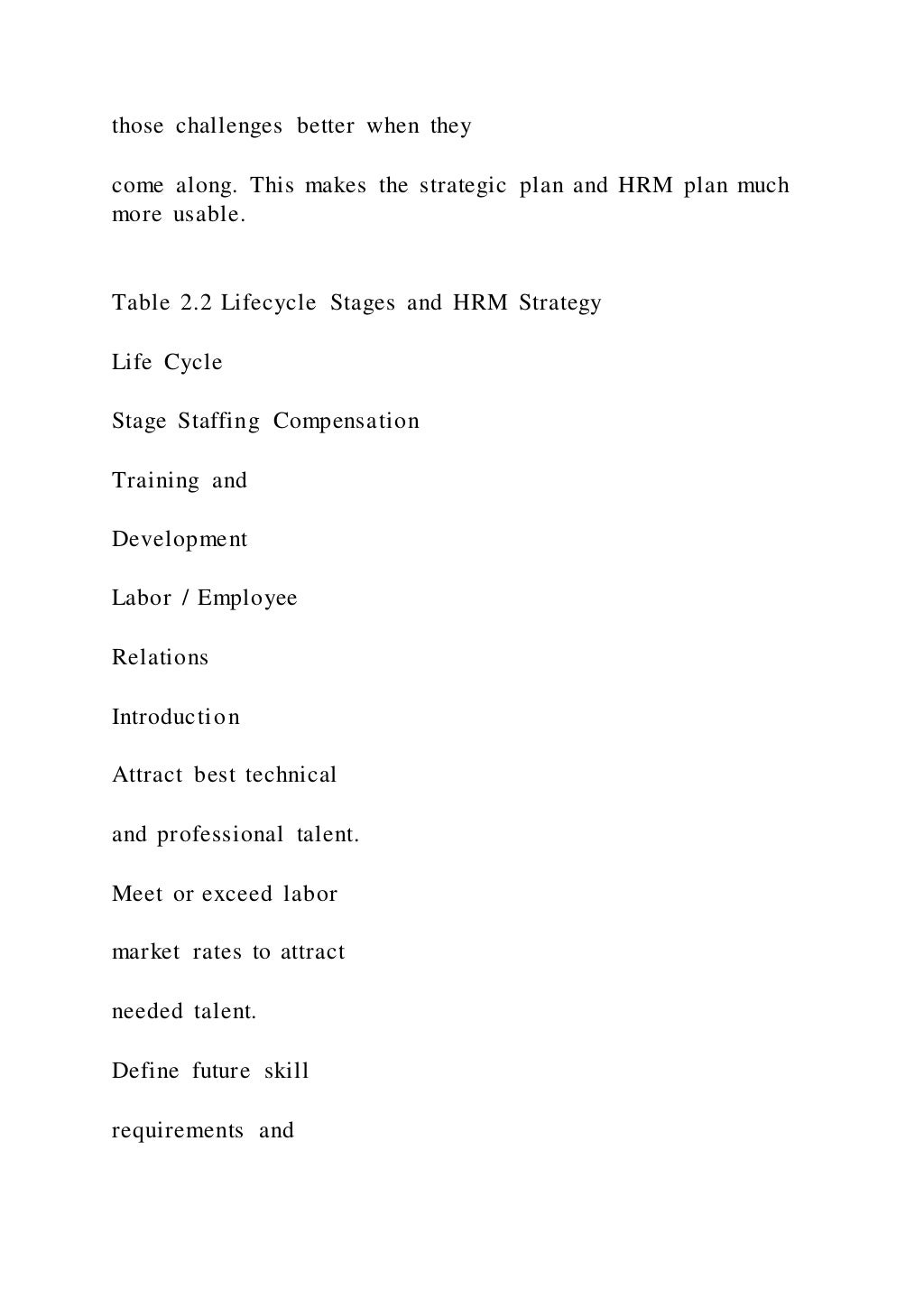
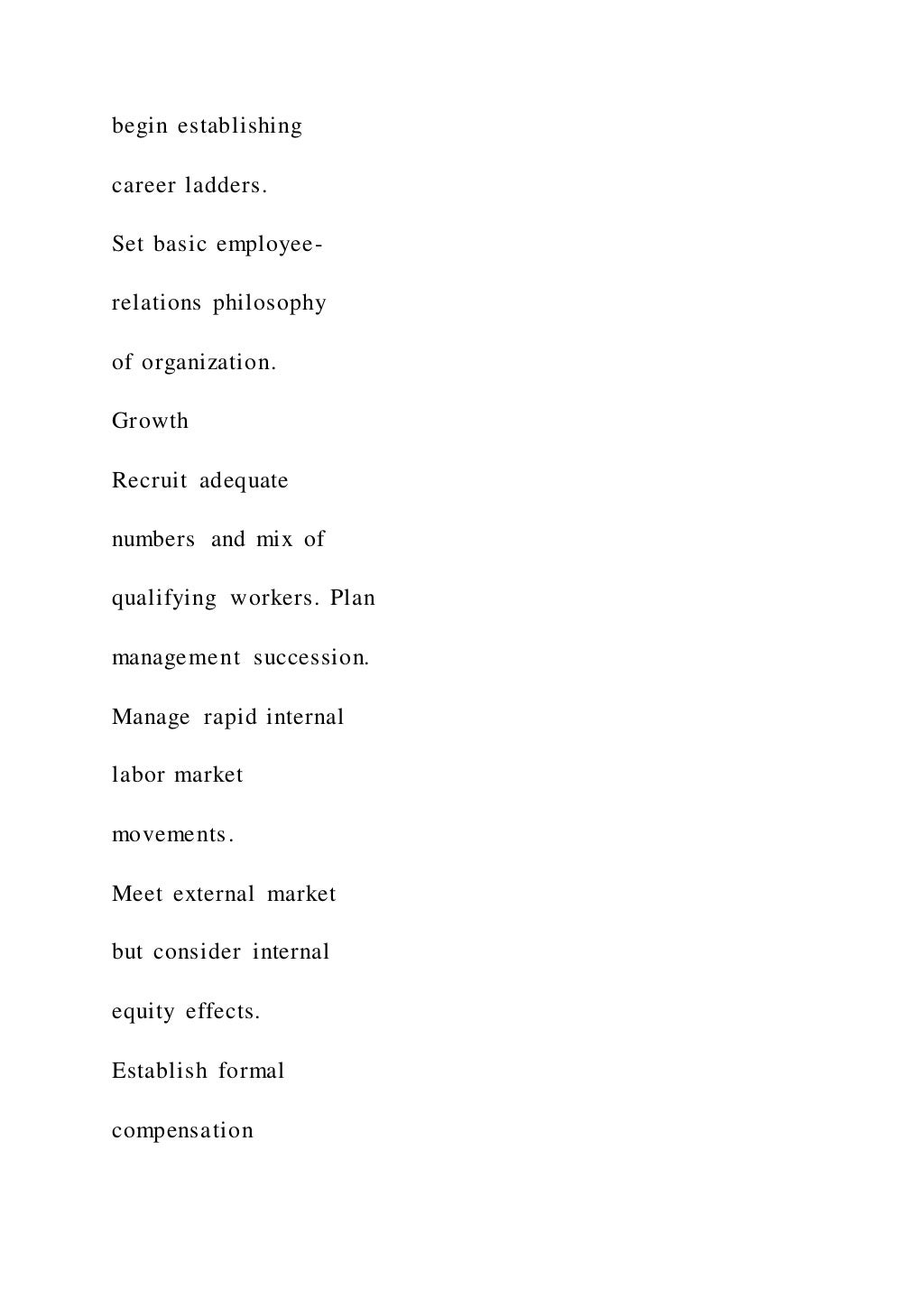
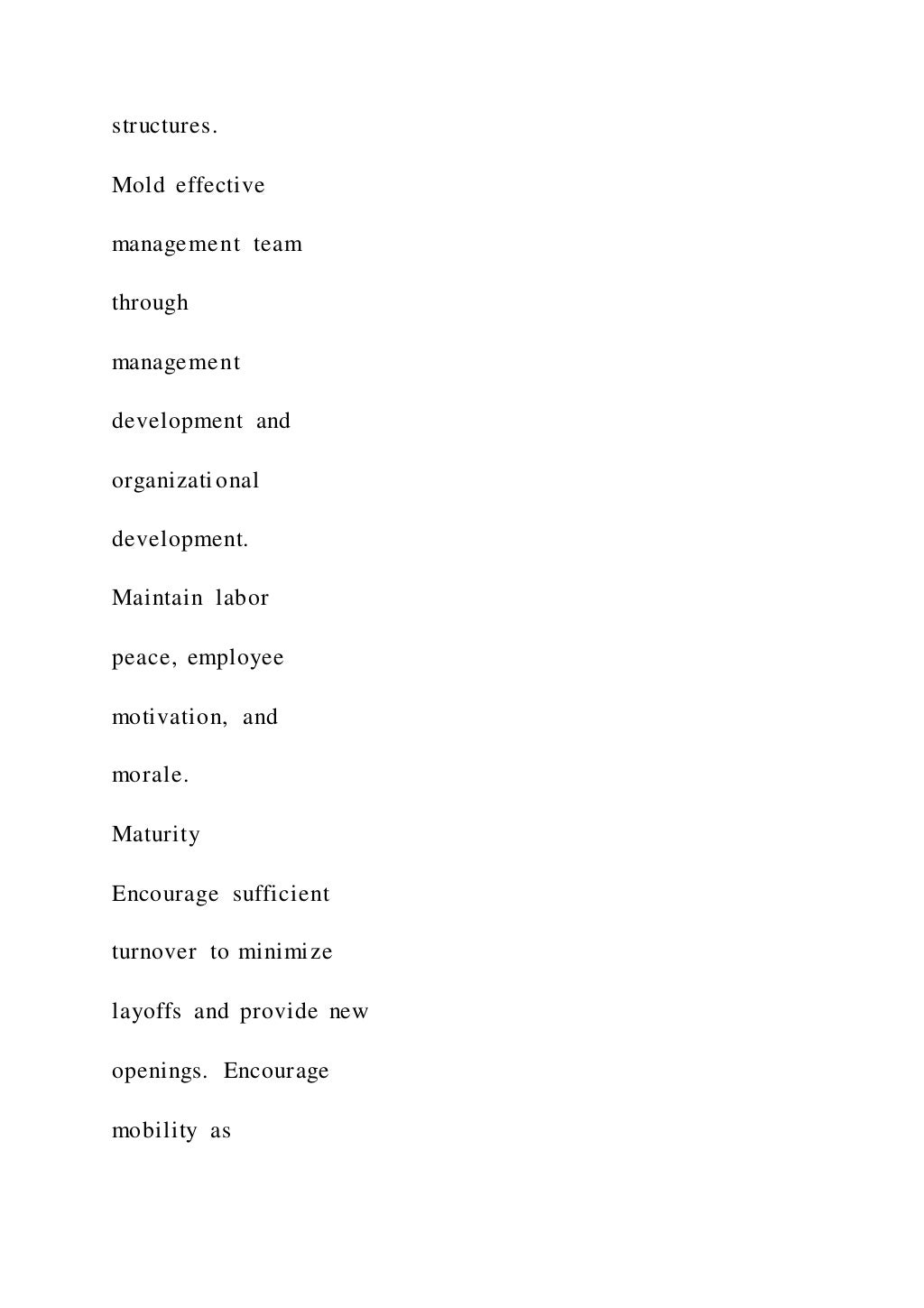
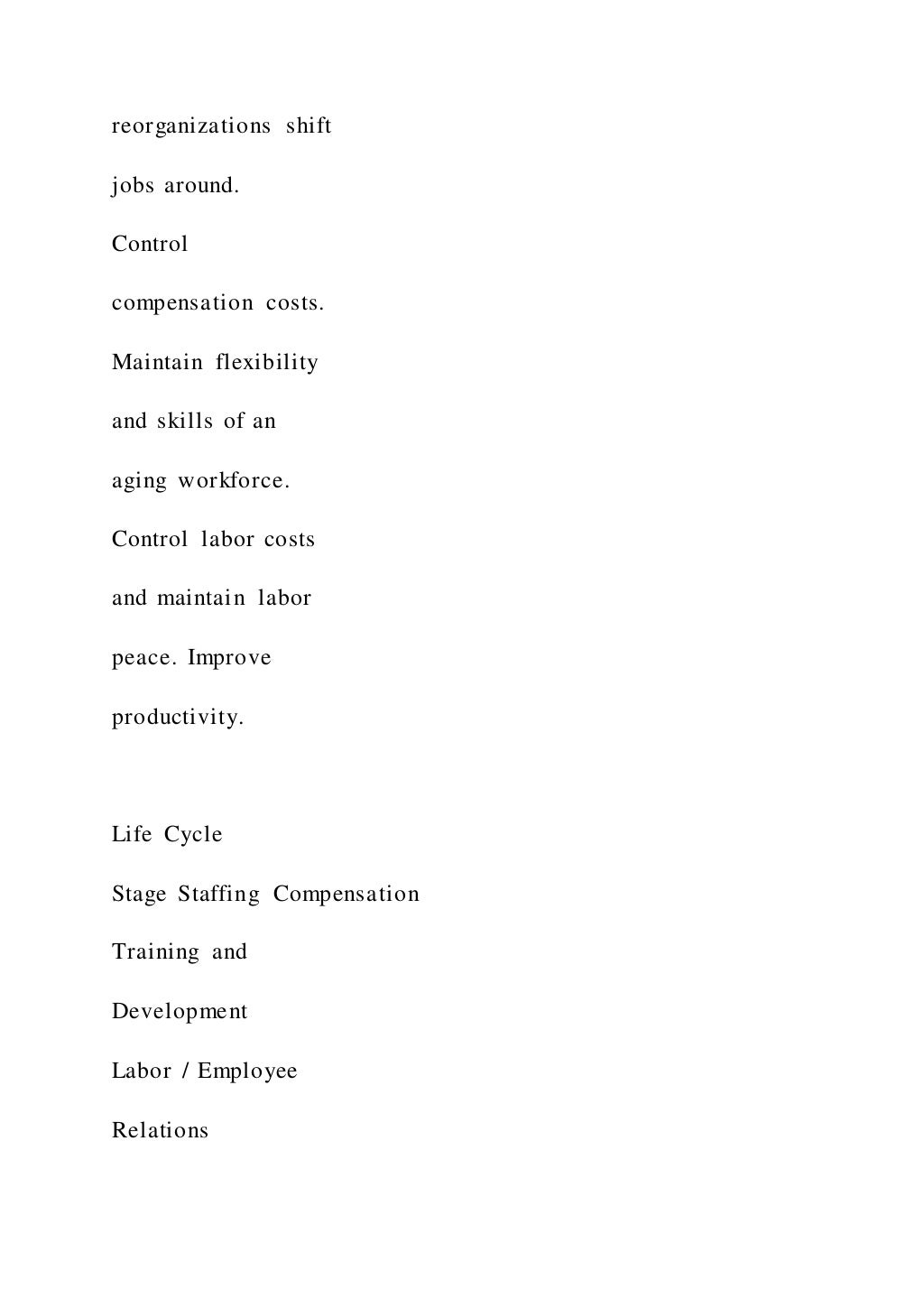
An organizational life cycle refers to the introduction, growth,
maturity, and decline of the organization,
which can vary over time. For example, when the organization
first begins, it is in the introduction phase,
and a different staffing, compensation, training, and
labor/employee relations strategy may be necessary
to align HRM with the organization’s goals. This might be
opposed to an organization that is struggling to
stay in business and is in the decline phase. That same
organization, however, can create a new product,
for example, which might again put the organization in the
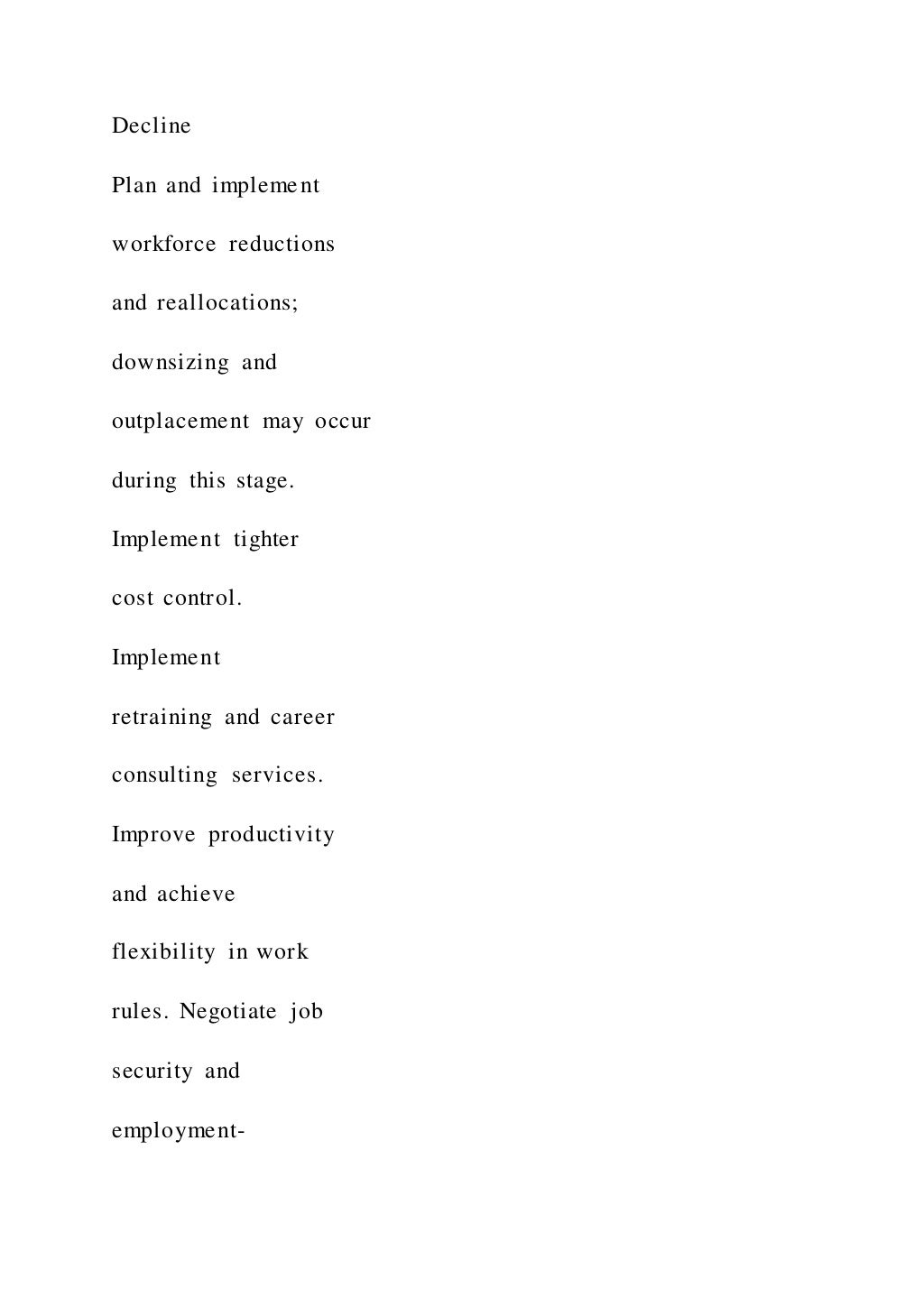
growth phase. Table 2.2 "Lifecycle Stages and
HRM Strategy" explains some of the strategies that may be
different depending on the organizational life
cycle.
2. Understanding of the HRM department mission and values.
HRM departments must develop
their own departmental mission and values. These guiding
principles for the department will
change as the company’s overall mission and values change.
Often the mission statement is a list
of what the department does, which is less of a strategic
approach. Brainstorming about HR goals,
values, and priorities is a good way to start. The mission
statement should express how an
organization’s human resources help that organization meet the
business goals. A poor mission
statement might read as follows: “The human resource
department at Techno, Inc. provides
resources to hiring managers and develops compensation plans
and other services to assist the
employees of our company.”
A strategic statement that expresses how human resources help
the organization might read as follows:
“HR’s responsibility is to ensure that our human resources are
more talented and motivated than our
competitors’, giving us a competitive advantage. This will be
achieved by monitoring our turnover rates,
compensation, and company sales data and comparing that data
to our competitors.” [5] When the mission
statement is written in this way, it is easier to take a strategic
approach with the HR planning process.
3. Understanding of the challenges facing the department. HRM
managers cannot deal with change
quickly if they are not able to predict changes. As a result, the
HRM manager should know what
upcoming challenges may be faced to make plans to deal with
those challenges better when they
come along. This makes the strategic plan and HRM plan much
more usable.
Table 2.2 Lifecycle Stages and HRM Strategy
Life Cycle
Stage Staffing Compensation
Training and
Development
Labor / Employee
Relations
Introduction
Attract best technical
and professional talent.
Meet or exceed labor
market rates to attract
needed talent.
Define future skill
requirements and
begin establishing
career ladders.
Set basic employee-
relations philosophy
of organization.
Growth
Recruit adequate
numbers and mix of
qualifying workers. Plan
management succession.
Manage rapid internal
labor market
movements.
Meet external market
but consider internal
equity effects.
Establish formal
compensation
structures.
Mold effective
management team
through
management
development and
organizational
development.
Maintain labor
peace, employee
motivation, and
morale.
Maturity
Encourage sufficient
turnover to minimize
layoffs and provide new
openings. Encourage
mobility as
reorganizations shift
jobs around.
Control
compensation costs.
Maintain flexibility
and skills of an
aging workforce.
Control labor costs
and maintain labor
peace. Improve
productivity.
Life Cycle
Stage Staffing Compensation
Training and
Development
Labor / Employee
Relations
Decline
Plan and implement
workforce reductions
and reallocations;
downsizing and
outplacement may occur
during this stage.
Implement tighter
cost control.
Implement
retraining and career
consulting services.
Improve productivity
and achieve
flexibility in work
rules. Negotiate job
security and
employment-
adjustment policies
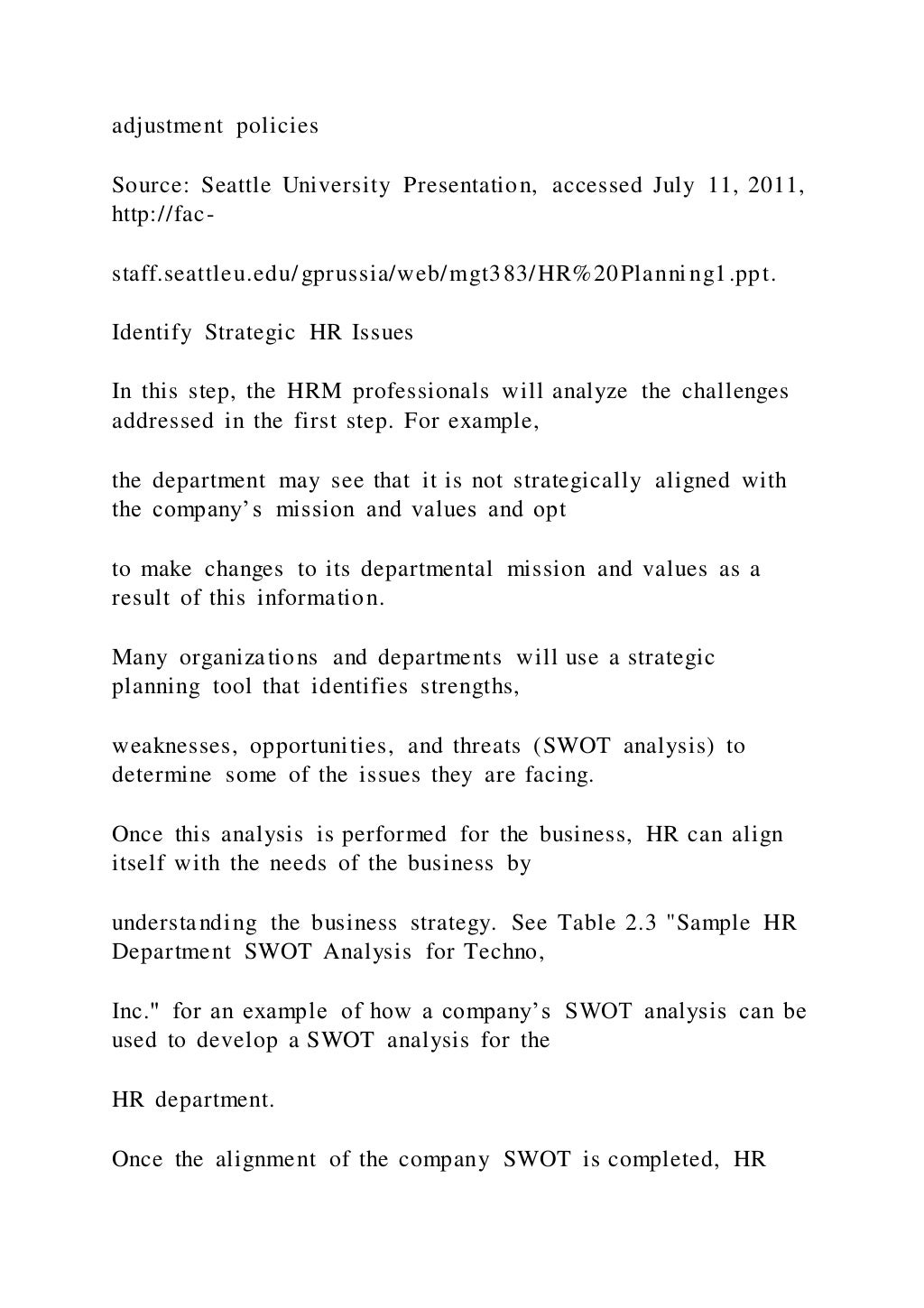
Source: Seattle University Presentation, accessed July 11, 2011,
http://fac-
staff.seattleu.edu/gprussia/web/mgt383/HR%20Planning1.ppt.
Identify Strategic HR Issues
In this step, the HRM professionals will analyze the challenges
addressed in the first step. For example,
the department may see that it is not strategically aligned with
the company’s mission and values and opt
to make changes to its departmental mission and values as a
result of this information.
Many organizations and departments will use a strategic
planning tool that identifies strengths,
weaknesses, opportunities, and threats (SWOT analysis) to
determine some of the issues they are facing.
Once this analysis is performed for the business, HR can align
itself with the needs of the business by
understanding the business strategy. See Table 2.3 "Sample HR
Department SWOT Analysis for Techno,
Inc." for an example of how a company’s SWOT analysis can be
used to develop a SWOT analysis for the
HR department.
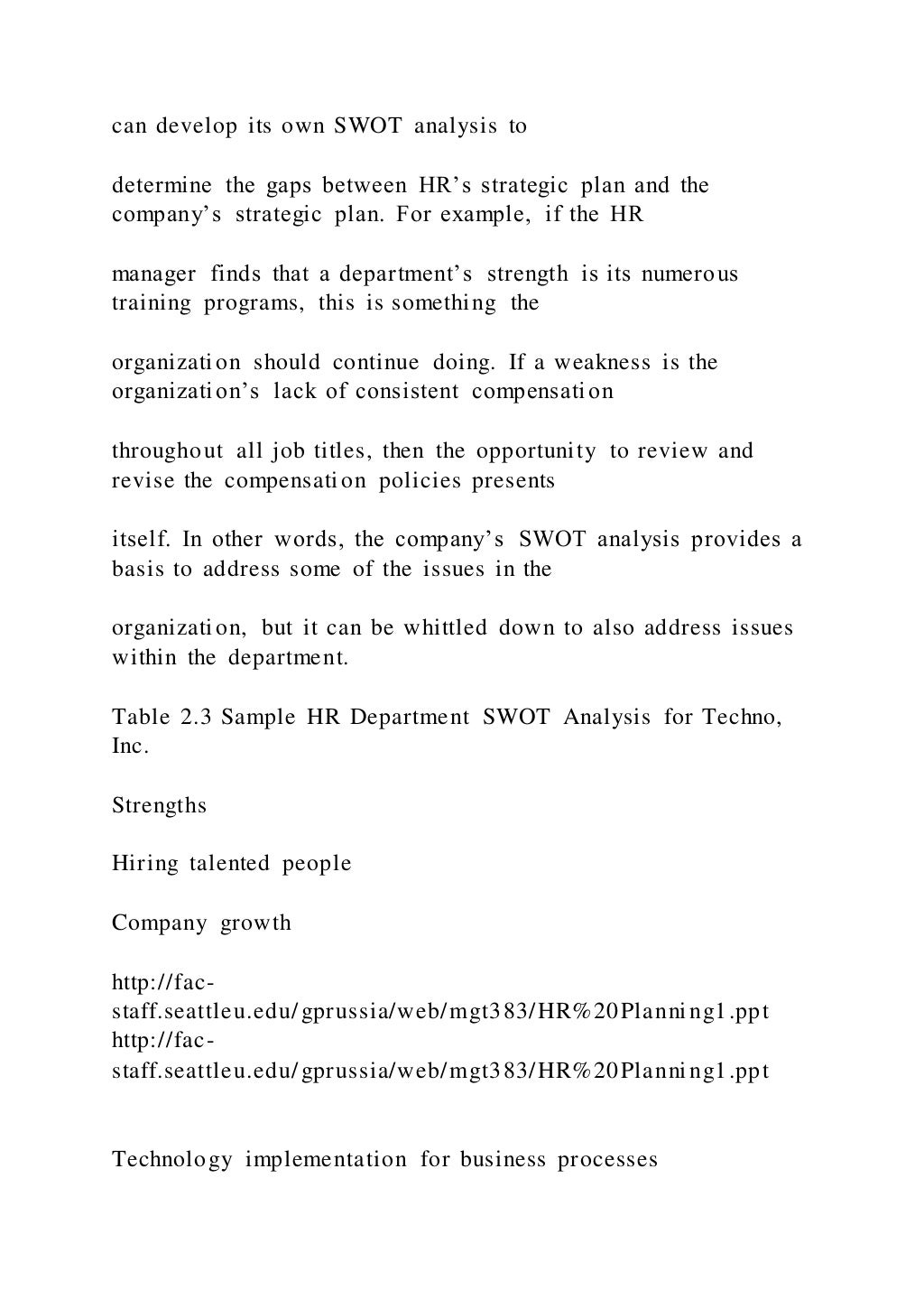
Once the alignment of the company SWOT is completed, HR
can develop its own SWOT analysis to
determine the gaps between HR’s strategic plan and the
company’s strategic plan. For example, if the HR
manager finds that a department’s strength is its numerous
training programs, this is something the
organization should continue doing. If a weakness is the
organization’s lack of consistent compensation
throughout all job titles, then the opportunity to review and
revise the compensation policies presents
itself. In other words, the company’s SWOT analysis provides a
basis to address some of the issues in the
organization, but it can be whittled down to also address issues
within the department.
Table 2.3 Sample HR Department SWOT Analysis for Techno,
Inc.
Strengths
Hiring talented people
Company growth
http://fac-
staff.seattleu.edu/gprussia/web/mgt383/HR%20Planning1.ppt
http://fac-
staff.seattleu.edu/gprussia/web/mgt383/HR%20Planning1.ppt
Technology implementation for business processes
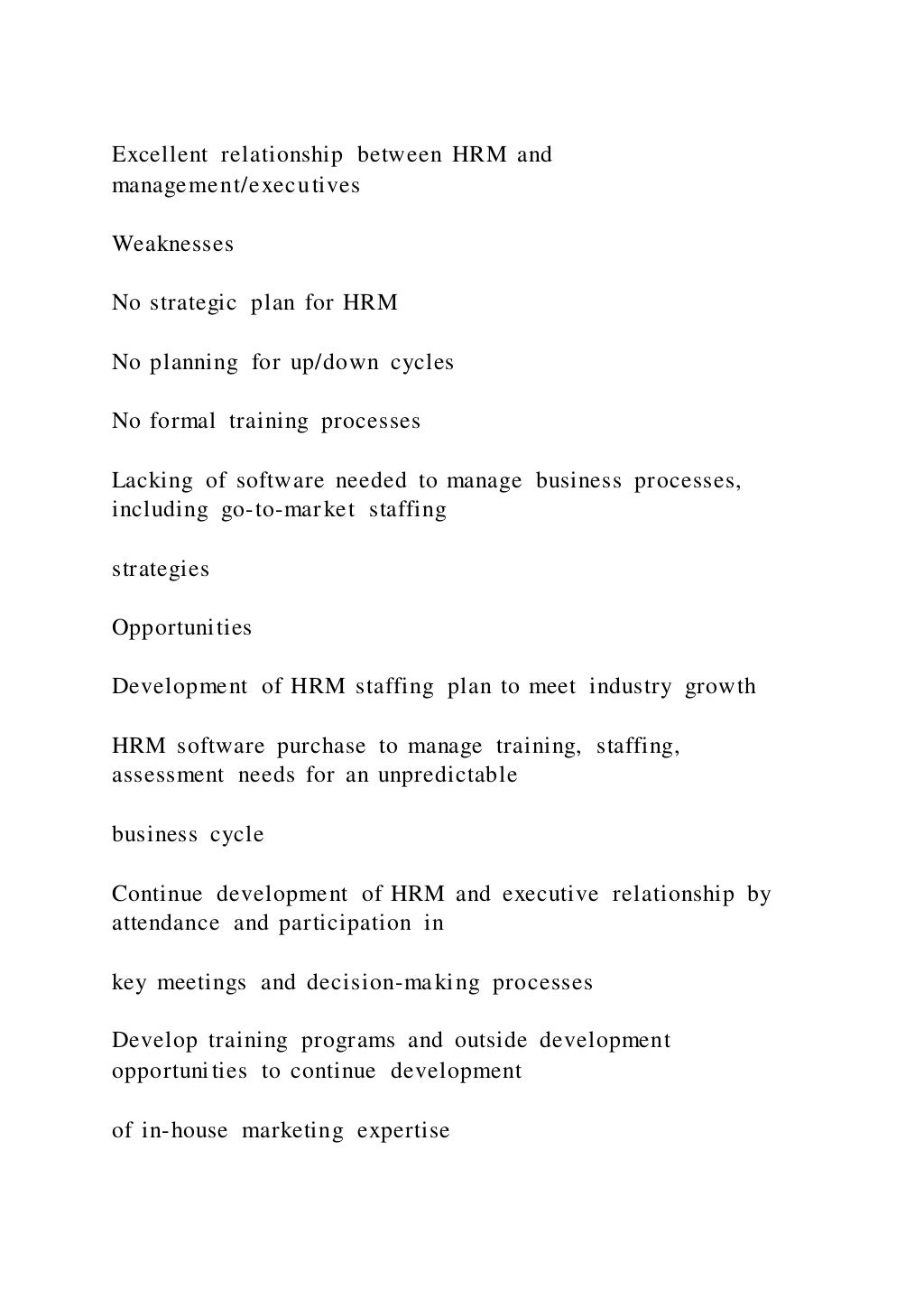
Excellent relationship between HRM and
management/executives
Weaknesses
No strategic plan for HRM
No planning for up/down cycles
No formal training processes
Lacking of software needed to manage business processes,
including go-to-market staffing
strategies
Opportunities
Development of HRM staffing plan to meet industry growth
HRM software purchase to manage training, staffing,
assessment needs for an unpredictable
business cycle
Continue development of HRM and executive relationship by
attendance and participation in
key meetings and decision-making processes
Develop training programs and outside development
opportunities to continue development
of in-house marketing expertise
Threats
Economy
Changing technology
Prioritize Issues and Actions
Based on the data gathered in the last step, the HRM manager
should prioritize the goals and then put
action plans together to deal with these challenges. For
example, if an organization identifies that they
lack a comprehensive training program, plans should be
developed that address this need. (Training
needs are discussed in Chapter 8 "Training and Development"
.) An important aspect of this step is the
involvement of the management and executives in the
organization. Once you have a list of issues you will
address, discuss them with the management and executives, as
they may see other issues or other
priorities differently than you. Remember, to be effective, HRM
must work with the organization and
assist the organization in meeting goals. This should be
considered in every aspect of HRM planning.
Draw Up an HRM Plan
Once the HRM manager has met with executives and
management, and priorities have been agreed upon,
the plans are ready to be developed. Detailed development of
these plans will be discussed in Section 2.2
"Writing the HRM Plan". Sometimes companies have great
strategic plans, but when the development of
the details occurs, it can be difficult to align the strategic plan
with the more detailed plans. An HRM
manager should always refer to the overall strategic plan before
developing the HRM strategic plan and
HR plans.
Even if a company does not have an HR department, HRM
strategic plans and HR plans should still be
developed by management. By developing and monitoring these
plans, the organization can ensure the
right processes are implemented to meet the ever-changing
needs of the organization. The strategic plan
looks at the organization as a whole, the HRM strategic plan
looks at the department as a whole, and the
HR plan addresses specific issues in the human resource
department.
[1] Michael Losey, “HR Comes of Age,” HR Magazine, March
15, 1998, accessed July 11,
2011,http://findarticles.com/p/articles/mi_m3495/is_n3_v43/ai_
20514399.
[2] Jan de Kok and Lorraine M. Uhlaner, “Organization Context
and Human Resource Management in the Small
Firm” (Tinbergen Institute Discussion Papers 01-038/3,
Tinbergen Institute, 2001), accessed August 13,
2011, http://ideas.repec.org/s/dgr/uvatin.html.
[3] David Ulrich and Wayne Brockbank, The HR Value
Proposition (Boston: Harvard Business Press, 2005), 9–14.
[4] David Ulrich, “Evaluating the Ulrich Model,” Acerta, 2011,
accessed July 11,
2011,http://www.goingforhr.be/extras/web-specials/hr-
according-to-dave-ulrich#ppt_2135261.
[5] Gary Kaufman, “How to Fix HR,” Harvard Business Review,
September 2006, accessed July 11,
2011, http://hbr.org/2006/09/how-to-fix-hr/ar/1.
http://findarticles.com/p/articles/mi_m3495/is_n3_v43/ai_20514
399
http://ideas.repec.org/s/dgr/uvatin.html
http://www.goingforhr.be/extras/web-specials/hr-according-to-
dave-ulrich#ppt_2135261
http://hbr.org/2006/09/how-to-fix-hr/ar/1
2.2 Writing the HRM Plan
LEARNING OBJECTIVE
1. Describe the steps in the development of an HRM plan.
As addressed in Section 2.1 "Strategic Planning", the writing of
an HRM strategic plan should be based on
the strategic plans of the organization and of the department.
Once the strategic plan is written, the HR
professional can begin work on the HR plan. This is different
from the strategic plan in that it is more
detailed and more focused on the short term. The six parts
described here are addressed in more detail
in Chapter 4 "Recruitment", Chapter 5 "Selection", Chapter 6
"Compensation and Benefits", Chapter 7
"Retention and Motivation", Chapter 8 "Training and
Development", Chapter 9 "Managing Employee
Performance", and Chapter 10 "Employee Assessment".
The six parts of the HRM plan include the following:
Figure 2.3
As you can see from this figure, the company strategic plan ties
into the HRM strategic plan,
and from the HRM strategic plan, the HR plan can be
developed.
1. Determine human resource needs. This part is heavily
involved with the strategic plan. What
growth or decline is expected in the organization? How will this
impact your workforce? What is
the economic situation? What are your forecasted sales for next
year?
2. Determine recruiting strategy. Once you have a plan in place,
it’s necessary to write down a
strategy addressing how you will recruit the right people at the
right time.
3. Select employees. The selection process consists of the
interviewing and hiring process.
4. Develop training. Based on the strategic plan, what training
needs are arising? Is there new
software that everyone must learn? Are there problems in
handling conflict? Whatever the
training topics are, the HR manager should address plans to
offer training in the HRM plan.
5. Determine compensation. In this aspect of the HRM plan, the
manager must determine pay scales
and other compensation such as health care, bonuses, and other
perks.
6. Appraise performance. Sets of standards need to be
developed so you know how to rate the
performance of your employees and continue with their
development.
Each chapter of this text addresses one area of the HR plan, but
the next sections provide some basic
knowledge of planning for each area.
Determine Human Resource Needs
The first part of an HR plan will consist of determining how
many people are needed. This step involves
looking at company operations over the last year and asking a
lot of questions:
1. Were enough people hired?
2. Did you have to scramble to hire people at the last minute?
3. What are the skills your current employees possess?
4. What skills do your employees need to gain to keep up with
technology?
5. Who is retiring soon? Do you have someone to replace them?
6. What are the sales forecasts? How might this affect your
hiring?
These are the questions to answer in this first step of the HR
plan process. As you can imagine, this cannot
be done alone. Involvement of other departments, managers, and
executives should take place to obtain
an accurate estimate of staffing needs for now and in the future.
We discuss staffing in greater detail
in Chapter 4 "Recruitment".
Many HR managers will prepare an inventory of all current
employees, which includes their educational
level and abilities. This gives the HR manager the big picture
on what current employees can do. It can
serve as a tool to develop employees’ skills and abilities, if you
know where they are currently in their
development. For example, by taking an inventory, you may
find out that Richard is going to retire next
year, but no one in his department has been identified or trained
to take over his role. Keeping the
inventory helps you know where gaps might exist and allows
you to plan for these gaps. This topic is
addressed further in Chapter 4 "Recruitment".
HR managers will also look closely at all job components and
will analyze each job. By doing this analysis,
they can get a better picture of what kinds of skills are needed
to perform a job successfully. Once the HR
manager has performed the needs assessment and knows exactly
how many people, and in what positions
and time frame they need to be hired, he or she can get to work
on recruiting, which is also called
astaffing plan. This is addressed further in Chapter 4
"Recruitment".
Recruit
Recruitment is an important job of the HR manager. More detail
is provided in Chapter 4 "Recruitment".
Knowing how many people to hire, what skills they should
possess, and hiring them when the time is right
are major challenges in the area of recruiting. Hiring
individuals who have not only the skills to do the job
but also the attitude, personality, and fit can be the biggest
challenge in recruiting. Depending on the type
of job you are hiring for, you might place traditional
advertisements on the web or use social networking
sites as an avenue. Some companies offer bonuses to employees
who refer friends. No matter where you
decide to recruit, it is important to keep in mind that the
recruiting process should be fair and equitable
and diversity should be considered. We discuss diversity in
greater detail in Chapter 3 "Diversity and
Multiculturalism".
Depending on availability and time, some companies may
choose to outsource their recruiting processes.
For some types of high-level positions, a head hunter will be
used to recruit people nationally and
internationally. A head hunter is a person who specializes in
matching jobs with people, and they usually
work only with high-level positions. Another option is to use an
agency that specializes in hiring people
for a variety of positions, including temporary and permanent
positions. Some companies decide to hire
temporary employees because they anticipate only a short-term
need, and it can be less expensive to hire
someone for only a specified period of time.
No matter how it is done, recruitment is the process of
obtaining résumés of people interested in the job.
In our next step, we review those résumés, interview, and select
the best person for the job.
Select
After you have reviewed résumés for a position, now is the time
to work toward selecting the right person
for the job. Although we discuss selection in great detail in
Chapter 6 "Compensation and Benefits", it is
worth a discussion here as well. Numerous studies have been
done, and while they have various results,
the majority of studies say it costs an average of $45,000 to hire
a new manager. [1] While this may seem
exaggerated, consider the following items that contribute to the
cost:
1. Time to review résumés
2. Time to interview candidates
3. Interview expenses for candidates
4. Possible travel expenses for new hire or recruiter
5. Possible relocation expenses for new hire
6. Additional bookkeeping, payroll, 401(k), and so forth
7. Additional record keeping for government agencies
8. Increased unemployment insurance costs
9. Costs related to lack of productivity while new employee gets
up to speed
Because it is so expensive to hire, it is important to do it right.
First, résumés are reviewed and people who
closely match the right skills are selected for interviews. Many
organizations perform phone interviews
first so they can further narrow the field. The HR manager is
generally responsible for setting up the
interviews and determining the interview schedule for a
particular candidate. Usually, the more senior the
position is, the longer the interview process takes, even up to
eight weeks. [2] After the interviews are
conducted, there may be reference checks, background checks,
or testing that will need to be performed
before an offer is made to the new employee. HR managers are
generally responsible for this aspect. Once
the applicant has met all criteria, the HR manager will offer the
selected person the position. At this point,
salary, benefits, and vacation time may be negotiated.
Compensation is the next step in HR management.
Determine Compensation
What you decide to pay people is much more difficult than it
seems. This issue is covered in greater detail
in Chapter 6 "Compensation and Benefits". Pay systems must be
developed that motivate employees and
embody fairness to everyone working at the organization.
However, organizations cannot offer every
benefit and perk because budgets always have constraints. Even
governmental agencies need to be
concerned with compensation as part of their HR plan. For
example, in 2011, Illinois State University gave
salary increases of 3 percent to all faculty, despite state budget
cuts in other areas. They reasoned that the
pay increase was needed because of the competitive nature of
hiring and retaining faculty and staff. The
university president said, “Our employees have had a very good
year and hopefully this is a good shot in
the arm that will keep our morale high.” [3]
The process in determining the right pay for the right job can
have many variables, in addition to keeping
morale high. First, as we have already discussed, the
organization life cycle can determine the pay strategy
for the organization. The supply and demand of those skills in
the market, economy, region, or area in
which the business is located is a determining factor in
compensation strategy. For example, a company
operating in Seattle may pay higher for the same job than their
division in Missoula, Montana, because
the cost of living is higher in Seattle. The HR manager is
always researching to ensure the pay is fair and
at market value. In Chapter 6 "Compensation and Benefits", we
get into greater detail about the variety of
pay systems, perks, and bonuses that can be offered. For many
organizations, training is a perk.
Employees can develop their skills while getting paid for it.
Training is the next step in the HR planning
process.
Develop Training
Once we have planned our staffing, recruited people, selected
employees, and then compensated them, we
want to make sure our new employees are successful. Training
is covered in more detail in Chapter 8. One
way we can ensure success is by training our employees in three
main areas:
1. Company culture. A company culture is the organization’s
way of doing things. Every company
does things a bit differently, and by understanding the corporate
culture, the employee will be set
up for success. Usually this type of training is performed at an
orientation, when an employee is
first hired. Topics might include how to request time off, dress
codes, and processes.
2. Skills needed for the job. If you work for a retail store, your
employees need to know how to use
the register. If you have sales staff, they need to have product
knowledge to do the job. If your
company uses particular software, training is needed in this
area.
3. Human relations skills. These are non-job-specific skills your
employees need not only to do their
jobs but also to make them all-around successful employees.
Skills needed include
communication skills and interviewing potential employees.
Perform a Performance Appraisal
The last thing an HR manager should plan is the performance
appraisal. While we discuss performance
appraisals in greater detail in Chapter 10 "Employee
Assessment", it is definitely worth a mention here,
since it is part of the strategic plan. Aperformance appraisal is a
method by which job performance is
measured. The performance appraisal can be called many
different things, such as the following:
1. Employee appraisal
2. Performance review
3. 360 review
4. Career development review
No matter what the name, these appraisals can be very
beneficial in motivating and rewarding employees.
The performance evaluation includes metrics on which the
employee is measured. These metrics should
be based on the job description, both of which the HR manager
develops. Various types of rating systems
can be used, and it’s usually up to the HR manager to develop
these as well as employee evaluation forms.
The HR manager also usually ensures that every manager in the
organization is trained on how to fill out
the evaluation forms, but more importantly, how to discuss job
performance with the employee. Then the
HR manager tracks the due dates of performance appraisals and
sends out e-mails to those managers
letting them know it is almost time to write an evaluation.
[1] Susan Herman, Hiring Right: A Practical Guide (Thousand
Oaks, CA: Sage, 1993), xv.
[2] John Crant, “How Long Does an Interview Process Take?”
Jobsinminneapolis.com, December 2, 2009, accessed
October 28,
2010,http://www.jobsinminneapolis.com/articles/title/How -
Long-Does-an-Interview-Process-
Take/3500/422.
[3] Stephanie Pawlowski, “Illinois State University to Get
Salary Bump,” WJBC Radio, July 11, 2011, accessed July
11, 2011, http://wjbc.com/illinois-state-university-faculty-to-
get-salary-bump.
http://www.jobsinminneapolis.com/articles/title/How -Long-
Does-an-Interview-Process-Take/3500/422
http://www.jobsinminneapolis.com/articles/title/How -Long-
Does-an-Interview-Process-Take/3500/422
http://wjbc.com/illinois-state-university-faculty-to-get-salary-
bump
2.3 Tips in HRM Planning
LEARNING OBJECTIVE
1. Explain the aspects needed to create a usable and successful
HRM plan.
As you have learned from this chapter, human resource strategic
planning involves understanding your
company’s strategic plan and HR’s role in the organization. The
planning aspect meets the needs of the
strategic plan by knowing how many people should be hired,
how many people are needed, and what kind
of training they need to meet the goals of the organization. This
section gives some tips on successful HR
strategic planning.
FORTUNE 500 FOCUS
Like many Fortune 500 companies throughout the world, IBM in
India finds that picking the best
prospects for job postings isn’t always easy. By using advanced
analytics, however, it aims to connect the
strategic plan, staffing needs, and the hiring process usi ng a
simple tool. The project was originally
developed to assign people to projects internally at IBM, but
IBM found this tool able to not only extract
essential details like the number of years of experience but also
make qualitative judgments, such as how
good the person actually is for the job. [1] This makes the
software unique, as most résumé-scanning
software programs can only search for specific keywords and
are not able to assess the job fit or tie the
criteria directly to the overall strategic plan. The project uses
IBM India’s spoken web technology, in
which the prospective employee answers a few questions,
creating the equivalent of voice résumé. Then
using these voice résumés, the hiring manager can easily search
for those prospects who meet the needs of
the organization and the objectives of the strategic plan.
Some of the challenges noted with this software include the
recognition of language and dialect issues.
However, the IBM human resources solution is still one of the
most sophisticated of such tools to be
developed. “Services is very people-intensive. Today, there is
talk of a war for talent, but attracting the
right kind of people is a challenge, yet unemployment is very
high. Our solution applies sophisticated
analytics to workforce management,” says Manish Gupta,
director at IBM Research-India. [2]
It is likely that this is only the beginning of the types of
technology that allow HR professionals to tie their
HR plans directly to a strategic plan with the touch of a few
buttons.
Link HRM Strategic Plan to Company Plan
Understanding the nature of the business is key to being
successful in creating a strategic plan for HRM.
Because every business is different, the needs of the business
may change, depending on the economy, the
season, and societal changes in our country. HR managers need
to understand all these aspects of the
business to better predict how many people are needed, what
types of training are needed, and how to
compensate people, for example. The strategic plan that the HR
manager writes should address these
issues. To address these issues, the HR manager should develop
the departmental goals and HR plans
based on the overall goals of the organization. In other words,
HR should not operate alone but in tandem
with the other parts of the organization. The HRM plan should
reflect this.
Monitor the Plan Constantly
Oftentimes a great strategic plan is written, taking lots of time,
but isn’t actually put into practice for a
variety of reasons, such as the following:
1. The plan wasn’t developed so that it could be useful.
2. The plan wasn’t communicated with management and others
in the HRM department.
3. The plan did not meet the budget guidelines of the
organization.
4. The plan did not match the strategic outcomes of the
organization.
5. There was lack of knowledge on how to actually implement
it.
There is no point in developing a plan that isn’t going to be
used. Developing the plan and then making
changes as necessary are important to making it a valuable asset
for the organization. A strategic plan
should be a living document, in that it changes as organizational
or external factors change. People can get
too attached to a specific plan or way of doing things and then
find it hard to change. The plan needs to
change constantly or it won’t be of value.
Measure It
A good strategic plan and HR plan should discuss the way
“success” will be measured. For example, rather
than writing, “Meet the hiring needs of the organization,” be
more specific: “Based on sales forecasts from
our sales department, hire ten people this quarter with the skills
to meet our ten job openings.” This is a
goal that is specific enough to be measured. These types of
quantitative data also make it easier to show
the relationship between HR and the organization, and better
yet, to show how HR adds value to the
bottom line. Likewise, if a company has a strategic objective to
be a safe workplace, you might include a
goal to “develop training to meet the needs of the organization.”
While this is a great goal, how will this be
measured? How will you know if you did what you were
supposed to do? It might be difficult to measure
this with such a general statement. On the other hand, a goal to
“develop a safety training workshop and
have all employees complete it by the end of the year” is
specific and can be measured at the end to
determine success.
Sometimes Change Is Necessary
It can be difficult to base an entire plan on forecasted numbers.
As a result, an HRM department that is
willing to change quickly to meet the needs of the organization
proves its worthiness. Consider a sales
forecast that called for fifteen new hires, but you find out
months later the organization is having a hard
time making payroll. Upon digging deeper, you find the sales
forecasts were overexaggerated, and now
you have fifteen people you don’t really need. By monitoring
the changes constantly (usually done by
asking lots of questions to other departments), you can be sure
you are able to change your strategic plan
as they come.
Be Aware of Legislative Changes
One of the major challenges in HRM, as we discuss in Chapter 1
"The Role of Human Resources", is
having an awareness of what is happening from a legal
perspective. Because most budgets are based on
certain current laws, knowing when the law changes and how it
will affect department budgets and
planning (such as compensation planning) will create a more
solid strategic plan. For example, if the
minimum wage goes up in your state and you have minimum
wage workers, reworking the budget and
communicating this change to your accounting team is
imperative in providing value to the organization.
We will discuss various legislation throughout this book.
[1] Sridhar Chari, “IBM Automates Parsing of Resumes,” iStock
Analyst, July 11, 2011, accessed July 11,
2011,
http://www.istockanalyst.com/business/news/5283887/ibm-
automates-parsing-of-resumes.
[2] Sridhar Chari, “IBM Automates Parsing of Resumes,” iStock
Analyst, July 11, 2011, accessed July 11,
2011,
http://www.istockanalyst.com/business/news/5283887/ibm-
automates-parsing-of-resumes.
http://www.istockanalyst.com/business/news/5283887/ibm-
automates-parsing-of-resumes
http://www.istockanalyst.com/business/news/5283887/ibm-
automates-parsing-of-resumes
2.4 Case and Summary
CHAPTER SUMMARY
• Human resource management was once called the personnel
department. In the past, hiring
people and working with hiring paperwork was this
department’s job. Today, the HRM
department has a much broader role, and as a result, HR
managers must align their strategies
with the company’s strategies.
• Functions that fall under HRM today include staffing, creation
of workplace policies,
compensation and benefits, retention, training and development,
and working with regulatory
issues and worker protection.
• Human resource strategy is a set of elaborate and systematic
plans of action. The company
objectives and goals should be aligned with the objectives and
goals of the individual
departments.
• The steps to creating an HRM strategic plan include
conducting a strategic analysis. This entails
having an understanding of the values and mission of the
organization, so you can align your
departmental strategy in the same way.
• The second step is to identify any HR issues that might impact
the business.
• The third step, based on the information from the first and
second steps, is to prioritize issues and
take action. Finally, the HRM professional will draw up the
HRM plan.
• The HRM plan consists of six steps. The first is to determine
the needs of the organization based
on sales forecasts, for example. Then the HR professional will
recruit and select the right person
for the job. HRM develops training and development to help
better the skills of existing
employees and new employees, too. The HR manager will then
determine compensation and
appraise performance of employees. Each of these parts of the
HRM plan is discussed in its own
separate chapter in greater detail.
• As things in the organization change, the strategic plan should
also change.
• To make the most from a strategic plan, it’s important to write
the goals in a way that makes them
measurable.
CHAPTER CASE
We Merged…Now What?
Earlier this month, your company, a running equipment designer
and manufacturer called Runners
Paradise, merged with a smaller clothing design company called
ActiveLeak. Your company initiated the
buyout because of the excellent design team at ActiveLeak and
their brand recognition, specifically for
their MP3-integrated running shorts. Runners Paradise has
thirty-five employees and ActiveLeak has ten
employees. At ActiveLeak, the owner, who often was too busy
doing other tasks, handled the HRM roles.
As a result, ActiveLeak has no strategic plan, and you are
wondering if you should develop a strategic
plan, given this change. Here are the things you have
accomplished so far:
• Reviewed compensation and adjusted salaries for the sake of
fairness. Communicated this to all
affected employees.
• Developed job requirements for current and new jobs.
• Had each old and new employee fill out a skills inventory
Excel document, which has been
merged into a database.
From this point, you are not sure what to do to fully integrate
the new organization.
1. Why should you develop an HRM strategic plan?
2. Which components of your HR plan will you have to change?
3. What additional information would you need to create an
action plan for these changes?
1 Mappingthefieldofstrategic
human resource management
Human Resource Management (HRM) has become the
predominant term to
describe the theory and practices relating to the way people are
managed at
work. In previous times (and indeed even now in some places)
other terms
have been used which, in varying degrees, broadly correspond.
These other
terms include personnel management, personnel administration,
people
management, employee relations, human capital management,
industrial
relations and employment management. Each of these terms
reflects the
diverse antecedents of HRM and they also reveal aspects of the
differ-
ent ideologies associated with these approaches. For example,
some early
forms of personnel management had a ‘welfare’ parentage,
others carried
traces of a social-psychological ‘human relations movement’
history (Mayo
1949). Each of these traditions reflected a primary focus on
individuals and
small groups. Conversely, the terms ‘industrial relations’ and
‘employment
relations’ reflect the collectivist (pluralist) approach to
management-worker
relations which, at times and in places, were dominant
throughout much
of the 20th century in Europe, North America and beyond
(Clegg 1979;
Dunlop 1958; Flanders 1964; 1970; Fox 1974). This tradition
was devel-
oped in North America and beyond with ideas about mutual
gains and
union-management partnerships (Kochan and Osterman 1994).
The disci-
plinary roots of the field include aspects of labour economics,
industrial
sociology, psychology and law.
The term ‘Strategic Human Resource Management’ (SHRM) is
used
to emphasise the strategic character of a particular approach to
talent and
organization management – though some commentators would
argue that
HRM itself is inherently strategic in nature. Hence, the terms
HRM and
SHRM are often used interchangeably.
The field of HRM/SHRM has burgeoned over the past thirty
years. Its
roots can be found in American literature of the 1980s, which
re-framed
people issues away from conceptions that cast people-
management as an
C
o
p
y
r
i
g
h
t
2
0
1
9
.
R
o
u
t
l
e
d
g
e
.
A
l
l
r
i
g
h
t
s
r
e
s
e
r
v
e
d
.
M
a
y
n
o
t
b
e
r
e
p
r
o
d
u
c
e
d
i
n
a
n
y
f
o
r
m
w
i
t
h
o
u
t
p
e
r
m
i
s
s
i
o
n
f
r
o
m
t
h
e
p
u
b
l
i
s
h
e
r
,
e
x
c
e
p
t
f
a
i
r
u
s
e
s
p
e
r
m
i
t
t
e
d
u
n
d
e
r
U
.
S
.
o
r
a
p
p
l
i
c
a
b
l
e
c
o
p
y
r
i
g
h
t
l
a
w
.
EBSCO Publishing : eBook Collection (EBSCOhost) - printed
on 1/12/2022 2:41 PM via UNIVERSITY OF MARYLAND
GLOBAL CAMPUS
AN: 2042824 ; John Storey, Dave Ulrich, Patrick M. Wright.;
Strategic Human Resource Management : A Research Overview
Account: s4264928.main.eds
2 Mapping the field of SHRM
afterthought that could be handled in an ad hoc, reactive way, or
managed
through formal institutions such as collective bargaining and
regulation
(Beer et al. 1985). In place of this traditional conceptualisation,
there
was a shift towards a strategic conception which posited
workers as
‘assets’ rather than ‘costs’ (Storey 1992). The workforce was
therefore
a ‘resource’ and recognised as a key source (arguably the key
source)
of competitive advantage. As such, these assets were to be
treated seri-
ously: the composition planned with care, selected with care,
trained
and developed, and above all, induced to offer commitment.
Indeed, the
overall shift was memorably described as a journey ‘from
control to com-
mitment’ (Walton 1985). Alongside all of this, and indeed
providing an
economics underpinning to it, the concept of ‘human capital’
came to the
fore (Becker 1964).
This reconceptualization coincided with the emergence of the
‘resource-based view’ in the strategy domain (Wernerfelt 1984;
Grant
1991; Peteraf 1993). Emphasis was given to the importance of
maintain-
ing a link between business strategy and human resource
strategy. The
human resource approach displaced ‘personnel management’
and gave
emphasis to the importance of establishing both vertical and
horizontal
alignment in HR policies and practices.
Influential new models and frameworks were developed
including the
Harvard Model (Beer 1985), which established a flow from
environment
to business strategy and to human resource choices and onwards
to out-
comes. In parallel, important contingency models and
frameworks emerged
(Fombrun et al. 1984; Kochan and Barocci 1985; Schuler and
Jackson
1987), which made links between appropriate HR strategies and
a firm’s
location in relation to such contingencies as business stages and
variations
in product/service characteristics (e.g., low cost, innovation or
service
quality). Empirical research traced how major mainstream
companies and
public sector organizations were responding to these ideas
(Storey 1992).
The role of general managers and line mangers alongside human
resource
and personnel/IR specialists was assessed.
This theme of the nature of the HR function’s profile was
elaborated
and developed by Ulrich in a series of influential publications
(Ulrich et al.
1995; 1997; Ulrich et al. 2017). Based on global research, his
classification
of the HR function into different segments: business partner,
shared services
and centres of expertise became the dominant model among
practitioners.
A related development in the field has been the impact of
SHRM on firm
performance. Ulrich (1997) has also made a significant
contribution here, as
has Patrick Wright who traced the link between HR resources,
capabilities
and performance (Wright and Snell 1998).
EBSCOhost - printed on 1/12/2022 2:41 PM via UNIVERSITY
OF MARYLAND GLOBAL CAMPUS. All use subject to
https://www.ebsco.com/terms-of-use
Mapping the field of SHRM 3
A reincarnation of many of the underlying premises of HRM can
be
found in the influential work of economists investigating the
sources of
productivity (Bender et al 2018; Bloom and Van Reenen 2007;
Bloom
et al 2012; Sadun et al 2017). This body of work takes a step
back and
asks which, if any, ‘management practices’ impact on
productivity.
They use the World Management Survey which has been
administered
across thirty-four countries (see
https://worldmanagementsurvey.org/).
They make the case for recognising the vital importance of
management
competence, central to which, they accept, is competent
management of
human resources. The key practices are identified as: target
setting, the
use of incentives, monitoring of performance, and talent
management.
Achieving managerial competence ‘requires sizable investments
in peo-
ple and processes’ (Sadun et al 2017, p. 122). This new wave of
research
and associated practical interventions replays many of the core
themes in
classic HRM.
The above paragraphs give a synoptic view of the emergence
and devel-
opment of the field. Now we proceed to dig deeper.
Defining the field
Based on a review of SHRM theorizing and research, Wright
and McMahan
(1992) defined SHRM as ‘the pattern of planned human
resource deploy-
ments and activities intended to enable an organizatio n to
achieve its goals,’
(p. 298). They noted that this entails vertically linking the
strategic manage-
ment process to HRM practices, and horizontally creating
coordination and
congruence among those HRM practices. They then noted that
the major
variables of concern in SHRM are
the determinants of decisions about human resource practices,
the
composition of the human capital resource pool (i.e., skills and
abili-
ties), the specification of required human resource behaviors,
and the
effectiveness of these decisions given various business
strategies and/
or competitive situations.
(pp. 298–299)
It is important to emphasise that currently the term ‘Human
Resource
Management’ is used in two different ways. In one usage, which
we can
term the generic, it is used to encompass all of the forms of
employment
management in its infinite variety. In this first sense it is just a
new label
for personnel management or employment management in
general. But
there is a second usage. In its second form the term has at times
denoted
EBSCOhost - printed on 1/12/2022 2:41 PM via UNIVERSITY
OF MARYLAND GLOBAL CAMPUS. All use subject to
https://www.ebsco.com/terms-of-use
https://worldmanagementsurvey.org
4 Mapping the field of SHRM
a particular approach to employment management. Thus, the
term in this
second sense refers to one of the many ways of managing labour
and is
used to demarcate it from other ways. Not surprisingly, the
existence of
two different usages has caused considerable confusion in the
academic
literature with commentators often talking at cross-purposes.
So, what is this second, more specific and narrow meaning? In
this particular
sense it has been defined as follows:
Human resource management is a distinctive approach to
employment
management which seeks to achieve competitive advantage
through
the strategic deployment of a highly committed and capable
workforce
using an array of cultural, structural and personnel techniques.
(Storey 2007, p. 7)
The Chartered Institute of Personnel and Development (CIPD)
the UK-based
professional body for HR practitioners, appears to reflect these
same ideas in
its own definition:
Strategic human resource management (strategic HRM, or
SHRM) may
be regarded as an approach to the management of human
resources that
provides a strategic framework to support long-term business
goals and
outcomes. The approach is concerned with longer-term people
issues
and macro-concerns about structure, quality, culture, values,
commit-
ment and matching resources to future need.
(CIPD Factsheet 2013)
The key elements in both these definitions are: long-term focus,
a strong link
with business goals and a concern with ‘macro’ issues such as
culture and
values. Notably, apart from the reference to business goals,
there is no specific
mention of contextual issues such as changes in product market
conditions,
labour markets, regulation, innovations in technology or social
changes. This
may or may not imply a one-best way or universalist approach.
As noted, it is an approach which openly seeks to secure a
‘competi-
tive advantage’. This declared objective is not to every
ideological taste.
This element alone indicates that the approach shares a similar
stance as
American strategy theorists such as Michael Porter (Porter
1980). Many
critics of HRM have been, and are, uncomfortable with this first
element.
They posit the idea that economic activity does not to have to
be quite so
single-mindedly dedicated to free market competition. They also
contend
that even within a capitalist framework, collaboration as well as
com-
petition can operate and that other objectives in addition to
competitive
EBSCOhost - printed on 1/12/2022 2:41 PM via UNIVERSITY
OF MARYLAND GLOBAL CAMPUS. All use subject to
https://www.ebsco.com/terms-of-use
Mapping the field of SHRM 5
advantage such as wellbeing, equity and multiple stakeholder
interests
could be pursued. And they are of course correct. But some of
these
critics have failed to recognise that an identification and
description of
a movement and an idea should not be confused with an
endorsement of
that idea.
Second, the definition points to the distinctive means through
which the
objective will be sought. These include, crucially, the element
of a ‘strategic’
approach. This means that the management of people and of the
workforce
in general is approached not in an ad hoc, tactical and merely
reactive way
but in a manner which regards this aspect of management as of
central impor-
tance. HRM practices helped deliver strategic objectives.
Different strategies
require different employee skills. As with other aspects of the
definition, the
interesting features are in noting not only what this form of
HRM is, but also
what the meaning suggests HRM is not. The counterfactual is
important. For
the HRM debate and the emergence of HRM only makes sense
when it is
recognised as part of the history of its time.
HRM emerged at a time when labour management, in broad
characteri-
sation, might be described as a secondary, Cinderella-like,
management practice
(‘Personnel Management’ was often described in these terms).
Markets were
defined, finance arranged, production plans drawn up – and only
then was
the request for certain units of labour issued, often at short
notice. Similarly,
as industrial conflict was of concern in the post-second world
war period, the
skills in subduing and ‘managing conflict’ were to the fore in
the then field
of personnel/IR management. It was into this climate when
western product
markets were coming up against international competition – and
often
losing out – that this ‘new’ approach to managing labour
emerged and presented
a challenge to existing assumptions and practices.
Third, the definition refers to the deployment of a ‘highly
committed and
capable workforce’. This is an important feature of the
distinctive approach.
As we know, very large sections of the economy operate on very
differ-
ent principles. The high commitment approach is relatively
unusual in large
swathes of the employment scene. Hire and fire, short-term
contracts, even
zero-hour contracts, outsourcing, agency work and many other
such methods
to treat labour as a mere transaction are relatively
commonplace. Recent talk of
‘employee engagement’ or ‘employee experience’ can be seen
as a latter-day
attempt to (re)capture some of that high commitment agenda.
The distinctive
high commitment mode of HRM equates with what is termed the
‘High Road’
approach to employment management. The ‘Low Road’
approach relates to
the precarious forms of employment (Osterman 2018). The links
between
high pay/high productivity versus low pay/low productivity
models
have been explored in the disciplines of economics (Abowd et
al. 1999)
EBSCOhost - printed on 1/12/2022 2:41 PM via UNIVERSITY
OF MARYLAND GLOBAL CAMPUS. All use subject to
https://www.ebsco.com/terms-of-use
6 Mapping the field of SHRM
and employment relations (Holzer et al. 2004). HRM, in the
distinctive
sense, is expressive of the High Road approach. This high
road/high com-
mitment perspective is likewise integral to the theory of High
Performance
Workplaces (Appelbaum et al. 2000)
Fourth, the ‘array of cultural, structural and personnel
techniques’ refers
to the mutually-reinforcing ways in which a truly thought-out
strategic
approach can deploy a wide range of methods which would have
internal
‘fit’ and would complement each other (a further instance of the
strate-
gic nature of the idea). These techniques include attempts to:
‘win hearts
and minds’ rather than merely enforce a contract; to de-
emphasise custom
and practice in favour of instilling values and mission;
pluralism is also
downplayed in favour of an implied unitary perspective where
employers,
managers and employees are seen to share at least one similar
interest:
to keep the enterprise in business. Thus, a set of beliefs and
assumptions
underpin this distinctive form of HRM. Other dimensions stress
the role
of strategy in that the business plan becomes pertinent to the
way that
employees and workers in general are managed; and an
emphasis on the
role of line managers as crucial to the practice and experience
of HR poli-
cies. Then there is a set of key levers such as serious attention
to selection
(in place of hire and fire), performance related pay, an attempt
to move
from ‘temporary truces’ in labour negotiations to management
through cul-
ture and shared goals.
When viewed holistically, is this package to be regarded as a
‘soft’, ‘human
relations’, approach with employee welfare at its core? There
are facets such as
an emphasis on training and development and the winning of
hearts and minds
that might lean in that direction. But there are also ‘hard’
aspects to this model
of HRM (Storey 2007). Labour is seen as a strategic resour ce.
As such it is to
be planned-for, measured carefully, and used as an asset. HRM
sits alongside
the resource-based view of the firm as strategic perspective on
how to manage
the employment relationship (Storey 1992; 2007).
What about practice? While the HRM label has become so
ubiquitous
and has, in the main, replaced personnel management in many
organizations
(contrary to expectations and indeed contrary to empirical
evidence dur-
ing its early days – as revealed by the WERS surveys1), the
management of
work has, over the past couple of decades, not been a steady
journey to the
wider diffusion of the best practice HRM model. In the wider,
generic sense,
Human Resource Management continues, but the nature of its
practice is very
varied. This variation is reflected in terms such as ‘High Road
and Low Road’
practices, ‘polarized work’ and in the metaphor of the
‘hourglass economy’.
These variations might seem to suggest the degree of strategic
choice fac-
ing HR professionals. Yet, research across major economies
indicates that,
EBSCOhost - printed on 1/12/2022 2:41 PM via UNIVERSITY
OF MARYLAND GLOBAL CAMPUS. All use subject to
https://www.ebsco.com/terms-of-use
Mapping the field of SHRM 7
for many workers, the erstwhile trend towards good practice has
shifted into
reverse (Kalleberg 2013; 2018).
Theory and practice
As currently conceived, HRM is constituted by both research
and practice.
These two are related but they are not the same. It is a truism
that practice
often differs from theory in the sense that everyday practices do
not always
live up to some theoretically-derived prescription of an ideal or
a ‘best’ way.
But the practice-research distinction can be exaggerated. Much
research in
human resource management is simply the identification and
cataloguing
of practice. For example, they include statistical and descriptive
summa-
ries of the state of play with regard to what human resource
specialists do,
how they are distributed, what influence they exercise, and so
on, which are
research-based mirrors of practice. The same can be said for
those examples
of HR research which draw a picture of recruitment and
selection practices,
appraisal methods, reward systems and the like. This type of
research reflects
practice. It is descriptive.
But, there is another type of research which seeks to identify
‘good practice’
and even ‘best practice’. This type tries to identify the causal
links between
context, practices and outcomes. For example, this goes beyond
describing
what HR professionals do and moves on to study the impact of
what they
do on key outcomes such as employee well-being or business
performance.
Theory then, explains why these outcomes might occur by
building conceptual
frameworks. As a result, it follows that in many instances,
actual practice will
often differ from ‘theory’. Yet additionally, many practitioners
pay regard to
research when seeking to develop their practice and so theory
and practice can
become closer as a consequence.
Thus, the question ‘what is HRM?’ can then be answered in
terms of
both theory and practice.
The nature of strategy in HRM
A strategic approach to HR could normally be expected to
include ele-
ments such as: a longer-term perspective; a concern with big
issues that
go beyond operational detail; an approach which scans, and
factors-in,
relevant information about the environment and about changes
within it;
the construction of policies which seek to align HR practices to
the needs
of the business often expressed as mission, vision, strategy or
goals; and
the construction of HR policies which bring each of the
elements of HR
into mutual, reinforcing, alignment. Thus, decisions in relation
to recruitment
EBSCOhost - printed on 1/12/2022 2:41 PM via UNIVERSITY
OF MARYLAND GLOBAL CAMPUS. All use subject to
https://www.ebsco.com/terms-of-use
8 Mapping the field of SHRM
and selection priorities should be consistent with priorities in
the areas of
goal-setting, performance management, reward, training and
development,
and promotion and exit.
So, whereas an operational decision might be confined to a one-
off
interaction with an employee (for example, how to handle a
particular
appraisal interview) and may require some tactical skill, SHRM
is con-
cerned with the wider issues and usually involves making
choices about
matters which will have longer-term consequences and will
affect the
success or otherwise of the business.
The alignment of HR components has been termed ‘internal fit’,
while the
alignment of HR with business strategy and the wider business
environment
has been termed ‘external fit’. Strategic HR should aspire to
both types of fit
(Miles and Snow 1994).
SHRM is concerned with both policies and practices. Ideally,
these
work in tandem, but appropriate policies can be undermined by
poor prac-
tices, and conversely, good practice may, to some extent,
compensate for
defective policies. It is a field which comprises practice,
prescription and
empirical study. Although one might desire and assume a strong
connec-
tion between these, in reality, there is sometimes a considerable
disconnect
between these three elements.
An important question is who generates HR strategy? It might
be a
specialist HR Director and team but not all organisations have
these. Even
if the senior business team have created a separate HR function
(in the
form of a unit or department), it is possible that they may not
necessar-
ily devolve all big decisions in this area to that department.
Indeed, the
choices about whether to have such an HR department can be
seen as one
of the strategic decisions we are talking about here.
Research evidence suggests that key integrated business
decisions
(which include HR and finance and marketing strategies) are
formulated
by executive groups (not Boards) and that the members of these
groups
multitask and are most effective when they adopt a business
orientation and
not a functional orientation. A business orientation ‘makes
strategic deci-
sion makers comfortable to deal with issues outside thei r
business function’
(Kelly and Gennard 2007, p. 114).
Classic definitions include the idea that ‘business strategy’ is:
The determination of the basic long-term goals and objectives
of an
enterprise and the adoption of courses of action and the
allocation of
resources necessary for those goals.
(Chandler 1962, p. 13)
EBSCOhost - printed on 1/12/2022 2:41 PM via UNIVERSITY
OF MARYLAND GLOBAL CAMPUS. All use subject to
https://www.ebsco.com/terms-of-use
Mapping the field of SHRM 9
Thus, from one perspective, strategy requires systematic
rational assessment
of contexts and resources.
Some approaches to doing strategy focus mainly on finding the
optimal
space or location in a market. So, these approaches tend to look
outwards to the
characteristic features of a market such as price, quality and the
distinctiveness
of offers for goods or services.
A business strategy (and by extension an HR strategy) that
focuses more
on utilising internal resources than on locating the best market
position
is known as ‘the resource-based view’ (RBV). This was
advanced most
fully by Prahalad and Hamel (1990) and Grant (1991). These
analysts were
mainly talking about business strategy but their approach has
profound
implications for HR. The re-focusing on internal resources is an
approach
which is closely aligned to the idea of an HRM strategy because
it gives
emphasis to the importance of leveraging resources to gain a
competitive
advantage. As noted above, it regards labour as assets rather
than in the
conventional accounting view as costs. And, of course, one
implication of
this is that one tends to invest in and to nurture assets, whereas
one nor-
mally tends to try to cut costs. This idea of the workforce as
assets gets to
the heart of many approaches to SHRM. It involves seeking to
build human
capability and to gain competitive advantage from workforce
skills, crea-
tivity and commitment.
Strategy as plan?
Another issue that has been central to debates in business
strategy and
also has much relevance to HR strategy, is whether a ‘strategic
approach’
requires a formal plan. There is often a tendency to think about
strategy as
requiring the compilation of information and as a formal
process of decision
making that culminates in a series of plans. But there is another
view; the
view that suggests strategy can be inferred from a pattern that
emerges from
a long series of decisions, even in the absence of a formal
written plan or
strategy document. This could be termed a ‘de facto strategy’.
This idea of
an ‘emergent strategy’ is normally associated with Henry
Mintzberg (1978).
So, an enterprise may have no formal strategy document and yet
still
have a de facto emergent strategy. Or it may even be that an
enterprise has
a formal and lengthy strategy document which is largely ignored
in practice
while a different de facto strategy is pursued.
A de facto strategy which has been built up incrementally and
found to
‘work’ (in the sense that the organisation has proved to be
sustainable and
no major chronic problems are occurring) may add up to a
coherent strategy.
EBSCOhost - printed on 1/12/2022 2:41 PM via UNIVERSITY
OF MARYLAND GLOBAL CAMPUS. All use subject to
https://www.ebsco.com/terms-of-use
10 Mapping the field of SHRM
But not all ad hoc approaches have such optimal outcomes. ‘Ad
hocery’ may result in a lack of forethought, inconsistencies,
short-term
thinking, and waste and can be very costly and lead to an
uncompetitive
position (e.g., paying redundancies as a reaction to economi c
downturn
and then facing recruitment difficulties and training costs when
upturn
occurs). The word ‘rudderless’ is sometimes used to describe
this kind
of drift and lack of direction. Hence, this particular approach
would be
considered as non-strategic.
So, what would an approach to HR look like if it was not ad
hoc, rudderless
and reactive? The implied alternative is some kind of strategic
approach – that
is, one which:
• tries to build a big picture
• has a sense of direction of travel
• has some coherence and consistency
• has mutually reinforcing elements
Coherence is about fit and integration. In other words, it
suggests that the
parts or elements fit together smoothly rather than contradict
each other or
lean in different directions. A classic example of HR decisions
which tend
towards contradiction is where ‘team focus’ is urged and
policies are put
in place to promote that, but where the remuneration system is
based on
individual performance-related pay.
But, in addition to alignment and coherence, HR strategy design
requires
attention to contexts – that is, the inner and outer contexts as
outlined in the
previous unit.
The nature of the design, and the range of factors to be taken
into
account when attempting this design, is a matter of some
debate. The skill
involved in making these decisions may be a matter of good
judgement –
an essential quality for a competent strategist in HR. Some
analysts rec-
ommend an approach which amounts to a ‘design’ or ‘decision
science’
(Boudreau and Ramstad 2009) with an associated emphasis on
systematic
concepts, frameworks and measurement, while others lean more
towards
an approach based on aspects of leadership and social
intelligence.
Why is SHRM important?
The arguments relating to the importance of SHRM tend to be
constructed
around the claim that ‘people make the difference’. The point
being made
here is that other resources are available and purchasable
(capital, new
plant, and new equipment, etc.) on a relatively open market, but
it is the
EBSCOhost - printed on 1/12/2022 2:41 PM via UNIVERSITY
OF MARYLAND GLOBAL CAMPUS. All use subject to
https://www.ebsco.com/terms-of-use
Mapping the field of SHRM 11
creative utilisation of these resources and ideas by people
(singularly and
in combination) which lies at the root of creating a competitive
advantage.
These arguments are in some ways similar to those that stress
the
importance of the resource-based view or of the role of
knowledge and the
importance of organization capability (Ulrich 1997; Ulrich and
Smallwood
2004) or ‘dynamic capability’ (Teece et al. 1997). Dynamic
capability was
defined by Teece et al. as a ‘firm’s ability to integrate, build
and reconfigure
internal and external competences to address rapidly changing
environments’
(1997, p. 516). It suggests that intangible assets, including the
knowledge
and skills of the workforce, can be configured so that traditional
routines do
not hamper responses to rapidly changing environments.
Instead, more flex-
ible, meta-routines can be created which enable organisations to
be capable
of a higher state of responsiveness to inherently unpredictable
forces. Failure
to attract, retain and motivate the right numbers and right kinds
of people
mean that opportunities are missed and that other resources are
wasted.
In general, the available studies appear to reveal impressive
evidence
of robust impacts and outcomes (for example, Huselid 1995;
Becker and
Gerhart 1996; Ichniowski et al. 1997; Becker and Huselid 1998;
Ichniowski
and Shaw 1999). An influential idea has been that appropriate
‘bundles’
of HR practices make the real difference (MacDuffie 1995).
These classic
studies were mainly conducted in the USA and in the mid-
1990s. They sug-
gest that those firms which used ‘bundles’ of HR interventions
were more
likely, on a statistical basis, to enjoy better financial
performance. This
issue of the links between policies and performance outcomes
are explored
more fully in Chapter 2.
The importance of dynamic capabilities and a strategic mind-set
in an
innovation-oriented economy heightens the need to attend to the
man-
agement of human resources and other intangible assets
(Davenport and
Leibold 2006). And resource-based theories suggest that
sustainable com-
petitive advantage stems from unique bundles of resources that
competitors
cannot, or find extremely hard to, imitate (Wernerfelt 1984;
Barney 1991).
Ironically, it has tended to be economists and others who have
argued the
case that human assets in particular can fulfil this criterion
(Polanyi 1966;
Davenport and Leibold 2006; Teece et al. 1997). Such
accumulating evi-
dence has helped advance the idea of ‘human capital’
management.
Contingency models and frameworks
In contrast to the best practice models considered in the
previous sec-
tion, contingency models of SHRM are based on the premise
that
what is required is a skilful alignment between HR policies and
various
EBSCOhost - printed on 1/12/2022 2:41 PM via UNIVERSITY
OF MARYLAND GLOBAL CAMPUS. All use subject to
https://www.ebsco.com/terms-of-use
12 Mapping the field of SHRM
organisational and contextual characteristics. Thus, best fit
approaches
can be located within this category. The word ‘contingency’
here refers
to those theories which explain organisational behaviours and
outcomes
as highly dependent on some inner or outer environmental
variable such
as country, technology, organisational size or industry type or
the fit with
a particular business strategy. In some versions of contingency
theory
(the more deterministic ones) the interpretation would seem to
chal-
lenge the idea of strategic choice. In less deterministic versions,
strategic
choice occurs when HR policies and practices uniquely align to
a particular
business strategy.
Types of contingency frameworks
Below we summarise three main types of contingency model
which link
HR strategy to different ways of thinking about context
(environment). The
three types are: linking SHRM to business strategy; linking
SHRM to busi-
ness life-cycle; linking SHRM to strategy and structure.
Linking SHRM to business strategy
It is sometimes argued that an HR approach is only ‘strategic’ if
it ‘fits’
with the organisation’s product–market strategy and if it is
proactive in this
regard. Most of the theorists in this category draw on Porter’s
distinction
between innovation, quality-enhancement or cost-reduction
strategies (e.g.,
Schuler and Jackson 1987, or Miles and Snow 1984).
For example, Schuler and Jackson (1987) suggest that where a
firm has
opted for innovation as a means to gain competitive advantage,
this sets up
certain predictable required patterns of behaviour. Prime among
these req-
uisite ‘role behaviours’ are creativity, a capacity and
willingness to focus
on longer-term goals, a relatively high level of collaborative
action, a high
tolerance of ambiguity and a high degree of readiness to take
risks.
Linking SHRM to business life-cycle
The business life-cycle approach essentially seeks to tailor
human
resource policy choices to the varying requirements of a firm at
different
stages of its life-cycle, i.e., from business start-up, through
early growth
and maturity, and eventually on to business decline. At each
stage a busi-
ness might be hypothesised to have different priorities. These
different
priorities, in turn, require their own appropriate human resource
strate-
gies. There are a number of examples of the life cycle or
‘stages’ approach
EBSCOhost - printed on 1/12/2022 2:41 PM via UNIVERSITY
OF MARYLAND GLOBAL CAMPUS. All use subject to
https://www.ebsco.com/terms-of-use
Mapping the field of SHRM 13
(Lengnick-Hall and Lengnick-Hall 1988; Kochan and Barocci
1985; Baird
and Meshoulam 1988).
Kochan and Barocci (1985) and others suggest that, at the start-
up
stage, new enterprises require recruitment and selection
strategies that
quickly attract the best talent; reward strategies that support
this by paying
highly competitive rates; training and development strategies
that build
the foundations for the future; and employee relations strategies
that draw
the basic architecture and put in place the underlying
philosophy for the
new business.
Under mature conditions, the emphasis in HRM is upon control
and
maintenance of costs and resources. Hence, the recruitment and
selection
stance might be geared to a gradual introduction of new blood
into vacant
positions created by retirements. There might also be a policy of
encour-
aging enough labour turnover so as to minimise the need for
compulsory
lay-offs. Meanwhile, the pay and benefits policy is likely to be
geared to
a keen control over costs. Training and development might be
expected to
have the maintenance of flexibility and the adequate provision
of skill levels
in an ageing workforce as their priority.
Linking SHRM to organizational strategy and structure
The most noted example of the strategy/structure linkage of
contingency
theory is the work of Fombrun et al. (1984). Their model shows
a range of
‘appropriate’ HR choices suited to five different
strategy/structure types,
ranging from single product businesses with functional
structures, through
diversified product strategies allied to multi-divisional
organisational forms,
and on to multi-product companies operating globally. For each
of the five
types of situation, the key HR policy choices in the spheres of
selection,
appraisal, reward and development, are delineated.
For instance, the HRM strategy of a company following a
single-product
strategy with an associated functional structure is likely to be
traditional in
appearance. Selection and appraisal may well be conducted in a
subjective
fashion, and reward and development practices may veer to the
unsystem-
atic and paternalistic.
By way of contrast, a company pursuing a diversification
strategy and
operating with a multi-divisional structure, is likely to be
characterised by a
HR strategy driven by impersonal, systematic devices which are
adaptable
to the different parts of the organisation. Reward systems are
likely to be
formula-based with a tendency towards a focus on return on
investment and
profitability. Selection, and even appraisal, may be found to
vary between
the different constituent business divisions.
EBSCOhost - printed on 1/12/2022 2:41 PM via UNIVERSITY
OF MARYLAND GLOBAL CAMPUS. All use subject to
https://www.ebsco.com/terms-of-use
14 Mapping the field of SHRM
Summary
This chapter has summarised the key aspects of strategic human
resource
management:
• What is it and what does it look like?
• What were its antecedents?
• Why is it important?
• What kind of performance outcomes have been found?
• What are the main theories and frameworks?
Key issues include:
• That strategy can be emergent as well as planned. Either way,
it can be
assessed and evaluated in terms of its efficacy and
appropriateness to
labour and product market conditions.
• Ad hoc decisions and responses which lack consistency may
risk inef-
ficiencies and waste.
• HR strategy normally has to validate itself in terms of its
contribution
to the wider organisational mission. This does not necessarily
mean
simply following in an unquestioning way the lead taken by
other
directors in operations and marketing – it may be that a
resource-based
approach requires a HR strategy which is distinctive.
In the next chapter we assess the body of research which has
tried to clarify
the performance outcomes arising from the deployment of
strategic human
resource practices. These outcomes may be behavioural in the
sense, for
example, of higher employee commitment or firm outcomes in
the shape of
higher productivity or even higher profitability.
Note
1 WERS is the acronym for the highly-respected Workplace
Employment Relations
Surveys in the UK. Results during the 1980s and 1990s showed
very low take-up
of the term ‘Human Resource Management’.
EBSCOhost - printed on 1/12/2022 2:41 PM via UNIVERSITY
OF MARYLAND GLOBAL CAMPUS. All use subject to
https://www.ebsco.com/terms-of-use
2 Strategic human resource
management and performance
outcomes
This chapter will explore the research that, over the past
twenty-five years,
has sought to examine the link between HR practices and
performance.
One of the earliest frameworks for exploring the impact of HR
practices
on performance was the ‘Behavioral Perspective’ outlined by
Schuler and
Jackson (1987) and noted briefly in Chapter 1. Having its roots
in con-
tingency theory, this model was based on the assumption that
the purpose
of employment practices was to shape or control employee
attitudes and
behaviours. They suggested that (a) different competitive
strategies require
different employee ‘role behaviours’, and (b) different HR
practices can
elicit these different role behaviours. Thus, they suggested that
employee
role behaviour mediated the relationship between strategy and
performance,
and that HR practices were critical for producing the relevant
behaviours.
Also central to this model was the need for congruence across
HRM prac-
tices such that all worked towards producing the required set of
behaviours.
The behavioural perspective also formed the conceptual basis
for Miles
and Snow’s (1978) exploration of HR practices associated with
different
organisational types. Having proposed three types, ‘defenders’,
‘prospec-
tors’, and ‘analysers’ in an earlier paper (Miles and Snow
1978), they
provided an analysis of the types of practices that would be
appropriate for
each of these types.
Another behavioural approach to explaining the relationship
between
HR practices and performance can be found using Social
Exchange Theory
(Blau 1986; Homans 1961). This theory originated as a way to
explain how
relationships develop between individuals, but was later
expanded to explore
the relationship between an organisation and its employees
(Eisenberger
et al. 1986). This more macro-level application suggests that
when employ-
ees perceive that the organisation is taking positive beneficial
actions
towards them, they will reciprocate in positive and beneficial
ways toward
the organisation. Consequently, a number of authors have
suggested
C
o
p
y
r
i
g
h
t
2
0
1
9
.
R
o
u
t
l
e
d
g
e
.
A
l
l
r
i
g
h
t
s
r
e
s
e
r
v
e
d
.
M
a
y
n
o
t
b
e
r
e
p
r
o
d
u
c
e
d
i
n
a
n
y
f
o
r
m
w
i
t
h
o
u
t
p
e
r
m
i
s
s
i
o
n
f
r
o
m
t
h
e
p
u
b
l
i
s
h
e
r
,
e
x
c
e
p
t
f
a
i
r
u
s
e
s
p
e
r
m
i
t
t
e
d
u
n
d
e
r
U
.
S
.
o
r
a
p
p
l
i
c
a
b
l
e
c
o
p
y
r
i
g
h
t
l
a
w
.
EBSCO Publishing : eBook Collection (EBSCOhost) - printed
on 1/12/2022 2:43 PM via UNIVERSITY OF MARYLAND
GLOBAL CAMPUS
AN: 2042824 ; John Storey, Dave Ulrich, Patrick M. Wright.;
Strategic Human Resource Management : A Research Overview
Account: s4264928.main.eds
16 HR management and performance outcomes
that commitment-based HR practices demonstrate beneficial
treatment of
employees, which causes them to reciprocate by being more
committed and
productive, resulting in higher organisational performance (e.g.,
Chuang and
Liao 2010; Messersmith et al., 2011; Sun et al. 2007; Takeuchi
et al. 2011).
While these frameworks provide more detailed process
explanations
for the relationship between HR practice and performance, the
Resource-
based Theory (RBT) of the firm (Barney 1991; Wernerfelt 1984)
provided a
higher level explanation for why HR practices can impact firm
performance.
Barney (1991) noted that resources that are valuable, rare,
inimitable, and
non-substitutable can be a source of sustainable competitive
advantage to
a firm. Sustainable advantages accrue when a firm implements a
value-
creating strategy that competitors have ceased trying to imitate.
While such
an advantage is defined in terms of economic rents that can be
distributed
to, or among, a variety of stakeholders (e.g., shareholders,
customers,
employees, etc.; see Coff, 1999), the assumption within
empirical research
is that such advantages are observed in shareholder returns, and
thus financial
and market-based performance of firms.
Early on, debates arose about the extent to which HR practices
could be
viewed as sources of sustainable competitive advantage, with
the debates
focused on the inimitability of the practices. Wright et al.
(1994) suggested
that any HR practice could easily be imitated by competitors.
However,
Lado and Wilson (1994) argued that the system (as opposed to
individual
practices) could be unique, causally ambiguous, and synergistic
in how it
impacted firm competencies. Later, Barney and Wright (1998)
similarly
suggested that while competitors could imitate any one practice,
they would
find it difficult to imitate the system of practices. Consequently,
the field
has come to a consensus on the importance of HR practices and
their poten-
tial to at least aid in creating competitive advantage. This
consensus has
become so great, that one would be hard pressed to find any
study of the
relationship between HR practices and performance that does
not at least
pay lip service to the RBT as the overarching rationale for
hypothesising a
positive relationship.
The earliest conceptual and empirical research on HR practices
began with
explorations of the ‘determinants’ of the various practices.
Miles and Snow
(1978) were among the first to offer a framework for aligning
HR practices
with strategy. They argued that the different strategic types
(defenders,
etc.) required different approaches to how they managed people.
They then
provided an analysis showing the different HR practices
associated with
these strategic types, and provided company examples to
illustrate these dif-
ferences. Baird and Meshoulam (1988) examined the
determinants of HR
practices rather differently. Instead of examining business
strategies, these
EBSCOhost - printed on 1/12/2022 2:43 PM via UNIVERSITY
OF MARYLAND GLOBAL CAMPUS. All use subject to
https://www.ebsco.com/terms-of-use
HR management and performance outcomes 17
authors focused on different stages in organisational life-cycles,
and provided
a conceptual examination of how HR practices might become
more sophisti-
cated as firms moved into different stages. Lengnick-Hall and
Lengnick-Hall
(1988) developed a model juxtaposing organisational readiness
and corporate
growth potential to create a two-by-two matrix. They then
hypothesised the
different types of HR systems that would be associated with
each.
Following these conceptual examinations, the earliest research
empiri-
cally explored the determinants, rather than the outcomes, of
HR practices.
For instance, Snell (1992) was among the first to explore the
determinants
of HR practices at the organisational level of analysis. He
viewed HR prac-
tices as control mechanisms (input, e.g., selection and
throughput, using
for example, behavioural appraisal; and output, using for
example, results-
based appraisal) and found that the use of these aspects of HR
practices
were associated with administrative information and strategic
context. Snell
and Dean (1992) explored the link between integrated
manufacturing and
HR practices. They measured integrated manufacturing in terms
of the use
of advanced manufacturing technology (AMT), just-in-time
inventory con-
trol (JIT), and total quality management (TQM). They suggested
that such
manufacturing technologies required upskilling of the workforce
to be able
to effectively utilise the technologies. Thus, they expected that
their use
would be associated with more selective staffing practices,
comprehensive
training, developmental performance appraisal, and equitable
rewards.
They generally found support for these hypotheses among
operations and
quality-control staff, but not among production control
employees. Finally,
Arthur (1992) examined how strategy impacted HR practices in
a sample
of steel mini-mills. Using cluster analysis he identified six
different clusters
of mini-mills similar in their profile of HR practices. He then
collapsed
them into two types: ‘cost-reducers’ and ‘commitment
maximisers’. This
was consistent with Walton’s (1985) view of firms using control
or com-
mitment approaches, and Arthur’s (1994) later use of this
nomenclature.
He found that mini-mills emphasising manufacturing few
products in large
quantities tended toward the use of a cost-reducer/control HR
system, while
those stressing more flexible manufacturing were more likely to
use a
commitment-maximiser HR system.
Research redirection: HR practices and performance
Following the initial inquiries into the determinants of HR
practices, the
field then began to shift to exploring the consequences,
particularly their
impact on firm performance. This research progressed in three
stages as
described below.
EBSCOhost - printed on 1/12/2022 2:43 PM via UNIVERSITY
OF MARYLAND GLOBAL CAMPUS. All use subject to
https://www.ebsco.com/terms-of-use
18 HR management and performance outcomes
Stage 1: demonstrating the relationship between HR practices
and performance
Exploring the determinants of HR practices, while useful, did
not accom-
plish the goal of showing that HR mattered. However, that soon
changed.
Huselid’s (1995) seminal study provided the empirical
foundation for HR
advocates to argue that HR can have a profound impact on
organisational
performance. Using a sample from the Russell 3000, Huselid
surveyed
Chief HR Officers regarding their use of thirteen, what he
termed, ‘High
Performance Work Practices’. (These can be seen as the
component ele-
ments of the much vaunted ‘High Performance Work Systems’
(HPWS)).
He then regressed the firm’s financial performance (both
Tobin’s Q and
Gross Rate of Return on Assets) on these practices and found
significant
results. However, the basis for the study’s immediate popularity
stemmed
from the fact that he provided point estimates of the value of
HR practices.
In fact, he concluded that a one standard deviation increase in
the use of
HPWS were associated with a per employee increase in market
value of
$18,641, an increase of $27,044 in sales, and an increased profit
of $3,814.
Needless to say, HR practitioners jumped on these results to
tout their
importance, and HR academics quickly set out to conduct
similar studies.
Appearing somewhat simultaneously with the Huselid (1995)
study,
were three other studies that captured the imagination of the
field by dem-
onstrating empirical linkages between HR practices and
performance. First,
Arthur (1994) used the data from his previously discussed study
to exam-
ine how the HR systems might differentially impact outcomes.
His results
showed that, compared to mini-mills using commitment-based
HR systems,
those using control systems displayed lower productivity,
higher scrap rates,
and higher employee turnover. MacDuffie (1995) examined how
bundles
of organisational systems impact performance in a
manufacturing environ-
ment. Using data from automobile assembly plants, he
demonstrated that
those using a combination of ‘high commitment’ HR systems
and low
inventory and repair buffers consistently outperformed those
using mass
production systems in terms of both quality and productivity.
Delery and
Doty (1996) tested the relationship between HR practices and
performance
in a sample of banks. Distinguishing among universalistic,
contingency, and
configurational approaches, they found the most support for a
universalistic
(a consistent set of practices across all firms) model in terms of
explaining
performance variance.
Needless to say, these four studies appearing within a two-year
time
frame sparked a plethora of further studies examining the
relationship
between HR practices and performance. For instance, Youndt et
al.
(1996) followed up the original Snell and Dean (1992) study by
surveying
EBSCOhost - printed on 1/12/2022 2:43 PM via UNIVERSITY
OF MARYLAND GLOBAL CAMPUS. All use subject to
https://www.ebsco.com/terms-of-use
HR management and performance outcomes 19
the companies regarding a number of performance measures.
They found
that an HR system focused on enhancing human capital was
related to
employee productivity, machine efficiency, and customer
alignment, but
that this relationship was predominantly observed with a quality
manu-
facturing strategy.
But demonstrating a clear link is by no means easy. Based on an
empiri-
cal study of HR and firm performance in Finland, it was found
that the link
between HR practices and firm performance was highly
equivocal; the stage
in the economic cycle was found to play a much more direct
part in explain-
ing firm performance (Lahteenmaki et al. 1986).
Stage 2: exploring the black box
As the research base showing a positive relationship between
HR practices
and performance grew, one thing was missing: an empirical
exploration of
how these practices impacted performance. Wright et al. (2005)
described
this problem as the failure to explain the black box between
practices and
performance. Their call, along with others, began to spark an
increase in
studies that explored the mediating mechanisms between these
two variables.
So, for example, Cappelli and Neumark (2001) conducted an
interesting
study examining the costs and benefits of HPWS. They found
that these
practices transfer power to employees and result in higher
wages, but only
weakly impacted productivity. Given the higher wages, they
found that
there was no effect on labour efficiency in terms of the output
per dollar
spent on labour. Way (2002) found similar results in a sample
of small busi-
nesses. His results showed that HR practices were associated
with lower
workforce turnover, but not with labour productivity.
In a study of call centres, Batt (2002) found that HPWS were
negatively
related to quit rates and positively related to sales growth and
that the impact
of HPWS on sales growth was mediated by quit rates. Takeuchi
et al. (2007),
relying on the resource-based view of the firm and social
exchange theory,
hypothesised that HPWS raise human capital and social
exchange within
a firm, and that the human capital and social exchange should
be related
to establishment performance. Using a sample of Japanese
business establish-
ments, they found that human capital and social exchange
mediated the
relationship between HR practices and establishment
performance.
In an extensive meta-analysis, Jiang et al. (2012) explored
human capi-
tal and employee motivation as mediators of the relationships
between HR
practices and voluntary turnover, operational performance, and
financial
performance. They found that the skill-enhancing HR practices
relation-
ship with financial performance was partially mediated by
human capital,
EBSCOhost - printed on 1/12/2022 2:43 PM via UNIVERSITY
OF MARYLAND GLOBAL CAMPUS. All use subject to
https://www.ebsco.com/terms-of-use
20 HR management and performance outcomes
employee motivation, turnover, and operational outcomes, but
that the
motivation- and opportunity-enhancing practices relationship
with perfor-
mance was fully mediated by these variables.
In what Schuler et al. (2014) refer to as ‘targeting practices’, a
number
of studies began to emerge which examined HR practices
developed spe-
cifically to encourage certain behaviours. For example, Collins
and Clark
(2003) examined HR practices for top managers. They explored
how HR
practices that encouraged networking were related to how much
top manag-
ers networked internally within the firm and externally with
others outside
the firm. They found that HR practices encouraging networking
were related
to sales growth and stock growth, and that these relationships
were medi-
ated by networking behaviour. Similar efforts have explored HR
practices
targeted at HR flexibility (Chang et al. 2013), customer service
(Chuang and
Liao 2010) and knowledge intensive teamwork (Chuang et al.
2016).
Stage 3: process models of the relationship between HR
practices
and performance
While the mediation research has demonstrated a number of
potential mediat-
ing variables, a more recent development is the emergence of
process models of
the relationship. One of the earliest models was proposed by
Truss and Gratton
(1994). Building on the previous work of Dyer (1985) they
distinguished
between ‘Planned HR Practices’ and ‘Implemented HR
Practices’. They noted
that some practices could emerge, not as a result of a planning
process, and con-
versely, some practices that are planned may never be
implemented.
Bowen and Ostroff (2004) provided another foundational
contribution to
process models of Strategic HRM through their development of
a construct
they termed HR ‘system strength’. Those authors used
communication the-
ory to examine how HR systems could strongly or weakly
communicate the
intended messages aimed at managing employee behaviour.
They argued
that climate serves as the critical multilevel mediating construct
between
HRM practices and performance. They stated,
We propose that HRM content and process must be integrated
effec-
tively in order for prescriptive models of strategic HRM
actually to link
to firm performance. By process, we refer to how the HRM
system can
be designed and administered effectively by defining
metafeatures of
an overall HRM system that can create strong situations in the
form of
shared meaning about the content that might ultimately lead to
organi-
zational performance.
(Bowen and Ostroff, 2004, p. 206)
EBSCOhost - printed on 1/12/2022 2:43 PM via UNIVERSITY
OF MARYLAND GLOBAL CAMPUS. All use subject to
https://www.ebsco.com/terms-of-use
HR management and performance outcomes 21
They argued that the strength of HR system can be described as
the extent
to which the system induces conformity. Consequently, they
described the
features of an HR system that could create strong situations as
having dis-
tinctiveness, consistency, and consensus.
Building and expanding on these basic ideas, Wright and Nishii
(2013)
and Nishii and Wright (2008) proposed a more thorough process
model.
This recognises that the basic relationship between HR practices
and
performance requires a number of individual-level processes.
They, like
Truss and Gratton (1994), distinguished between the ‘intended
HR prac-
tices’ and ‘actual HR practices’. However, they further
recognised that
the actual practices are implemented by managers, and thus,
there could
be significant variance in the practices across managers, and
even across
employees with the same manager. Thus, the actual HR
practices are most
accurately described at the individual level of analysis. The
next stage in
the process entailed clarifying the ‘Perceived HR Practices’.
Even if a
supervisor treats two employees the exact same way, it can be
perceived
differently by each. The concept of ‘Employee Reactions’
described the
affective, cognitive, and behavioural reactions of employees to
the prac-
tices they perceived. Finally, how all employees coordinate,
integrate, and
align their behaviours determines the performance at the unit
level. Thus,
their process model starts at the unit level, goes down to the
individual
level, and then comes back up to the unit level.
Similarly, Guest and Bos-Nehles (2014) developed a model of
HR prac-
tice implementation. They described four stages to
implementation. In the
first stage, HR managers and senior executives (including the
CEO) make
the decision to implement HR practices. In the second stage, HR
managers
consider the cultural and regulatory constraints to decide on the
quality of
the HR practices that can be implemented. The third stage
concerns how
line managers and/or senior managers actually implement the
HR practices.
Finally, the extent to which line managers accurately use the
practices deals
with the line management quality of implementation.
Thus, these process models primarily recognise the fact that the
ways
through which HRM practices can influence performance
requires examin-
ing processes at multiple levels of analysis. They also correctly
note that
what an organisation intends to do according to its HR strategy
may diverge
greatly from what actually happens and how employees
experience HR
practices (Nishii et al. 2008).
Having described some of the theories, the more impactful
empirical
research, and the process models linking HR practices to
performance, we
now turn our attention to answering the two critical questions.
What do we
now know about this relationship, and what do we still not
know?
EBSCOhost - printed on 1/12/2022 2:43 PM via UNIVERSITY
OF MARYLAND GLOBAL CAMPUS. All use subject to
https://www.ebsco.com/terms-of-use
22 HR management and performance outcomes
What do we know about the relationship between HR
practices and performance?
Given the extensive literature on HR practices, one would
expect that there
would be a number of consistent findings. A more accurate
description of
this literature, however, is that there are indeed quite a number
of findings,
but few very consistent ones.
There is a positive relationship between the use of HR practices
and unit performance
One almost unarguable finding across the hundreds of research
studies
conducted examining the link between HR practices and
performance is
that a positive relationship exists between these two variables.
Combs et al.
(2006) identified ninety-two studies with an overall N of over
19,000 that
fit their criterion to meta-analyse the relationship between HR
practices and
performance. Using a conservative estimate, they suggested a
mean cor-
relation of .20 between HPWS and performance. They noted that
while this
number may not seem large, ‘it is much larger than what is
found among
other organisation-level phenomena where long-held
organisational perfor-
mance hypotheses either do not stand up to the evidence. . .or
are much
smaller than predicted by theory. . .’ (p. 517).
The positive relationship between HR practices and
performance
transcends country boundaries
Hofstede (1993) has strongly influenced management thinking
based on
his research on country cultures. He originally described four
dimensions
of culture: individualism-collectivism, masculine-feminine,
uncertainty
avoidance and power distance, and he later added the dimension
of long-term-
short-term orientation. For decades, authors suggested that US-
originated
HR systems, such as High Performance Work Systems, would
not work or
at least not work as well in certain country cultures. However,
Gerhart and
Fang (2005) were among the first to question what they termed
the ‘cultural
constraint’ hypothesis which suggests that the effectiveness of
HR practices
are constrained by country cultures. They noted the conditions
that had to
be true in order for the cultural constraint hypothesis to hold,
and presented
preliminary data suggesting that these conditions likely did not
hold. Then,
in a meta-analysis using 156 effect sizes and over 35,000 firms,
Rabl et al.
(2014) found (a) an overall mean correlations of .28, (b) that the
relation-
ship between HPWS and performance was positive in every
country, and
EBSCOhost - printed on 1/12/2022 2:43 PM via UNIVERSITY
OF MARYLAND GLOBAL CAMPUS. All use subject to
https://www.ebsco.com/terms-of-use
HR management and performance outcomes 23
(c) that the relationship was actually stronger in countries that
the cultural
constraint hypothesis would suggest would result in weaker
relationships.
Bundling of HR practices matters in the relationship with
performance
MacDuffie (1995) was one of the first researchers to introduce
the concept
of ‘bundling’. He actually described the importance of bundling
a set of HR
practices with corresponding production system characteristics,
but many
translated his bundling concept to examining bundles of HR
practices. In
the Combs et al. (2011) meta-analysis described below, they
demonstrate
that the effect of a system of HR practices is greater than the
effect of indi-
vidual HR practices. In fact, the average correlations between
individual
HR practices and performance was only .14 compared to the .28
estimate
for the systems of HR practices as noted above.
What do we still not know about the relationship between
HR practices and performance?
While the above conclusions seem almost unarguable given the
significant
body of research that exists, a number of unanswered questions
remain.
Which practices?
While research has clearly demonstrated the positive
relationship between
HR practices and performance, one critical question remains
unanswered:
which practices? As early as Becker and Gerhart’s (1996)
introduction to the
Academy of Management Journal’s special issue, we see
complaints about
the lack of consistency in the HR practices measured across the
studies
comprising that issue. They noted no single practice was part of
each paper,
and only one, training, appeared in all but one paper. This
problem has not
gone away. Posthuma et al. (2013) analysed 193 peer-reviewed
articles and
identified 61 specific HR practices that had been measured.
However, they
bemoaned the fact that there was very little consistency in the
practices that
have been measured across these studies. Similarly, Langevin-
Heavey et al.
(2013) found little agreement on the specific practices that have
been used
in studying the relationship between HR practices and
performance.
Recently, Su and his colleagues have called for expanding the
list of
practices used in this research. They noted that since the early
distinc-
tion between commitment- and control-oriented practices
(Arthur 1994),
EBSCOhost - printed on 1/12/2022 2:43 PM via UNIVERSITY
OF MARYLAND GLOBAL CAMPUS. All use subject to
https://www.ebsco.com/terms-of-use
24 HR management and performance outcomes
HPWS research has focused almost entirely on commitment-
oriented
practices, In two studies, Su and his colleagues (Su and Wright
2012; Su
et al. 2018) have found that adding control-oriented practices
increases
the amount of performance variance explained beyond that of
just the
commitment-oriented practices.
In addition to the specific practices, there is little consensus on
the approach
to aggregating the practices. Since the Huselid (1995) study,
virtually all
research has simply added the items together to compute an
overall scale (or
used factor analysis and added up the sub-scales). However,
recent research
based on the Ability, Motivation, and Opportunity (AMO)
perspective has
suggested that HPWS really contain three subcomponents:
ability-enhancing,
motivation-enhancing, and opportunity-enhancing subscales.
For instance,
Gardner et al. (2011) noted that ability-enhancing practices
were actually
positively related to turnover, while motivation- and
opportunity-enhancing
practices were negatively related.
More exhaustively, the Jiang et al. (2012) meta-analysis
segmented HR
practices into three sub-components: ability, motivation, and
opportunity-
enhancing practices. They found that skill-enhancing practices
were more
strongly related to human capital and less strongly related to
employee
motivation than were motivation and opportunity-enhancing
practices.
They noted:
The findings of the differential relationships between the
dimensions
of HR systems and organizational outcomes also offer
methodologi-
cal implications for strategic HRM research. First, if all three
dimen-
sions of HR systems have unique effects on organizational
outcomes,
failure to include any dimension may compromise the overall
impact
of HR systems on organizational outcomes or at least lead to
inaccu-
rate results.. . . Relatedly, the results indicate that the three-
dimensional
model fit the data slightly better than the model combining the
three
HR dimensions into a unidimensional HPWS element.
(p. 1278)
Which direction does the causal arrow point?
While the positive relationship between HR practices and
performance
seems virtually unarguable at this point in the field’s evolution,
what
remains unclear is whether increasing HR practices causes
higher perfor-
mance or high performance encourages firms to develop and
implement
more HR practices. Guest et al. (2003) examined the
relationship between
HR practices and performance among a sample of UK-based
firms. They
EBSCOhost - printed on 1/12/2022 2:43 PM via UNIVERSITY
OF MARYLAND GLOBAL CAMPUS. All use subject to
https://www.ebsco.com/terms-of-use
HR management and performance outcomes 25
found that while the positive relationship existed between the
practice and
performance, once they controlled for past performance, the
relationship
disappeared. Similarly, Wright et al. (2005) found that measures
of HR
practices were equally correlated with measures of past,
present, and future
performance, and that the correlations between HR practices
and future
performance were greatly reduced when controlling for past
performance.
These findings do not suggest that HR practices do not cause
future perfor-
mance; rather they only suggest that current research cannot
prove which
way the causal arrow points.
How much value can we expect from increasing HR practices?
Given the fact that the data does not prove a causal relationship
of HR prac-
tices on performance, this calls into question some of the point
estimates of
the value accrued from increasing them. For instance, Huselid
and Becker
(2000) stated, ‘Based on four national surveys and observations
on more
than 2,000 firms, our judgment is that the effect of a one
standard deviation
change in the HR system is 10–20% of a firm’s market value’
(p. 851).
Likewise, based on their meta-analytic results discussed above,
Combs
et al. (2006), when trying to argue for why the observed mean
correlation of
.20 is meaningful, state:
It means that 20% of the utility available from predicting
performance
differences among organizations is given by HPWPs. Increasing
use of
HPWPs by one standard deviation increases performance by .20
of a
standard deviation. For example, Huselid (1995) reports means
of 5.1
and 18.4% and standard deviations of 23 and 21.9% for gross
ROA
(i.e., returns plus non-cash items) and turnover, respectively. In
this
sample, a one standard deviation increase in the use of HPWPs
trans-
lates, on average, to a 4.6 percentage-point increase in gross
ROA from
5.1 to 9.7 and a 4.4 percentage-point decrease in turnover from
18.4
to 14.0%. Thus, HPWPs’ impact on organizational performance
is not
only statistically significant, but managerially relevant.
(pp. 517–518)
Here again, we do not mean to dispute the relationship between
HR prac-
tices and performance, nor do we suggest that implementing HR
practices
should not lead to greater performance, all else being equal.
However, we
do suspect that there may be a dually causal relationship, where
HR prac-
tices may help increase performance, and that increased
performance may
then provide more money to invest in HR practices. But, in such
a situation,
EBSCOhost - printed on 1/12/2022 2:43 PM via UNIVERSITY
OF MARYLAND GLOBAL CAMPUS. All use subject to
https://www.ebsco.com/terms-of-use
26 HR management and performance outcomes
using the correlation or effect size reflects both of the causal
forces, and
thus overestimates the true impact of HR on performance. Thus,
given that
the causal arrow could point either way (or both), we caution
that the point
estimates of the value of increasing HR practices may be overly
inflated.
Conclusion
Research on the impact of HR practices on performance has
grown to be one
of the more frequently studied phenomena in the field of HR.
This research
has been conducted in cross-industry (e.g., Huselid 1995),
within indus-
try (e.g., Delery and Doty 1996; MacDuffie 1995), and within
corporation
(e.g., Wright et al. 2005) settings. In addition, it has been
conducted across
a large number of geographies. In the main, these studies have
revealed a
consistent finding of a positive relationship between HR
practices and per-
formance. In the next chapter we make a closer examination of
the precise
nature of the practices involved.
EBSCOhost - printed on 1/12/2022 2:43 PM via UNIVERSITY
OF MARYLAND GLOBAL CAMPUS. All use subject to
https://www.ebsco.com/terms-of-use
Topic 1: Trends in Human Resources Management
and the Strategic Importance of Adapting to Those
Trends
This course is based on your having had an introductory course
in human resources
management. In addition to that course, many of you have taken
other human resources
management courses and have experience working in human
resources. With that knowledge,
you already know some of the tasks performed by human
resources managers, as well as some
of the changes and challenges they face. What you should
contemplate and become conversant
with in this section is how those activities, changes, and
challenges fit into an organization’s
strategic process.
What differentiates managers from line workers is that
managers coordinate the people in their
organizations so that those people’s activities contribute to the
organization’s strategic goals.
This coordination is strategic human resources management
(HRM). Most managers spend
more time on HRM than on any other part of their jobs.
We know how to increase productivity in most organizations,
yet many managers persist in using
old methods that do not necessarily increase productivity. One
of the best ways to increase
productivity is to use validated methods to select, staff, train,
and motivate people, which helps
to create high-performance work systems. Making these
validated methods part of an
organization’s culture and contributing to strategic goals are
important HRM functions.
Academic preparation is important to being the best human
resources manager you can be, but
what we learn academically is not always implemented in the
workplace. Although practical
considerations often prevent the implementation of purely
academic solutions, knowledgeable
managers nonetheless learn how to increase productivity in an
organization.
A human resources manager’s major responsibilities can be
categorized as follows:
• organizational design
• staffing
• performance management and appraisal
• employee training and organizational development
• reward systems, benefits, and compliance
Good management of each of these areas is important to an
organization’s smooth functioning,
and each contributes to the successful achievement of its
strategic goals.
Many changes affect HRM and being aware of and ready to
react to these changes is imperative
to the successful management of a workforce for an
organization. Trends in HRM include:
• increased globalization
• technological changes
• the need for flexibility
• increasing litigation
• changing character of the workforce
Increased globalization is one of the greatest challenges human
resources managers face. A
manager must know not only how to manage people who work
in other countries but also must
be aware of the laws, regulations, and customs of those
countries. Globalization also has major
effects on other functions in the organization that in turn affect
HRM. If its product is marketed
in other countries, the organization may need to hire for other
skills to help in adapting that
product to the cultures of those countries. Being aware of these
other functions helps the
organization achieve strategic goals.
Technological changes in the last few years have affected all
human resources managers. It is
a great challenge for human resources managers to keep up with
the possibilities that
technology offers. Managers must find people with the latest
skills; and if those people are not
available, we must design a training program that will provide
our organization with those skills.
Human resources managers also should be aware of
technological advances that make HRM
more effective, including the latest databases and software that
can make HR functions more
efficient.
Flexibility is more important than ever before. The outsourcing
of jobs to other companies and
often to other countries continues to be a practical but political
issue in many organizations.
Increased use of outsourcing, part-time employees, temporary
employees, and contract
employees has a great effect on what a human resources
manager does. While the use of these
staffing techniques makes an organization more flexible, it can
also be a real headache for a
human resources manager—flexibility often comes at the price
of having a less loyal workforce.
Increasing litigation emphasizes the need for human resources
managers to be familiar with
laws and regulations related to HR issues such as equal
employment, compensation, and liability.
With ever-increasing frequency, human resources managers are
expected to take actions to keep
an organization out of legal trouble. A human resources
manager often must educate those
involved in developing strategic plans as to how the legal
environment may limit or promote
certain organizational actions.
The changing character of the workforce is one of the most
important changes of which
human resources managers must be aware. A generation ago,
there were fewer women and
minorities in the workforce. The presence of two-income
families affects the efforts of human
resources managers to recruit and promote many individuals—
workers are more mobile, but
mobility often must take into account the flexibility of two-
income families. A more highly
educated workforce means that managers must manage people
differently than they have in the
past. There is less loyalty between workers and organizations
than there was in the past, which
means that there will likely be more turnover of employees.
Part-time and contract employees
are being used more than ever before.
Each of the issues detailed in this first topic is part of an
organization's strategic planning. The
development of high-performance work systems through the use
of academic knowledge is
important in developing an effective strategic plan. The basis
for successful production of a
strategic plan is an awareness of what human resource managers
do. Having a strategic plan
with true long-term effectiveness demands knowledge of the
trends in HRM. All of these factors
must come together if the organization is to develop a strategic
plan that will give it a
competitive advantage, and it is only through a good strategic
plan that an organization can
maintain its uniqueness and keep adding value for its customers.
The human resources manager
is a key player in developing the strategic plan.
Module 1: Linking Human Resources Management to the
Strategic
Plan
Your instructor may ask you to respond to one or more the case
scenarios below. If your
instructor does not ask you to respond to these case scenarios,
you can still respond on your
own to help you study for the course.
Human
Solution
s Software, Inc.
You have just received exciting news. You have been appointed
to be the new human resources
manager for Human

Chapter 2 Developing and Implementing Strategic HRM Plans

  • 1.
    Chapter 2: Developingand Implementing Strategic HRM Plans The Value of Planning James stumbled into his position as the human resource manager. He had been working for Techno, Inc. for three years, and when the company grew, James moved from a management position into a human resource management position. Techno, Inc. is a technology and software consulting company for the music industry. James didn’t have a good handle on how to effectively run a human resources (HR) department, so for much of the time he tried to figure it out as he went. When Techno started seeing rapid growth, he hired thirty people within a one-month period to meet the demand. Proud of his ability to accomplish his task of meeting the business’s current needs, James was rather pleased with himself. He had spent numerous hours mulling over recruitment strategies, putting together excellent compensation plans, and then eventually sifting through résumés as a small part of the hiring
  • 2.
    process. Now theorganization had the right number of people needed to carry out its projects. Fast forward five months, however, and it turned out the rapid growth was only temporary. James met with the executives of the business who told him the contracts they had acquired were finished, and there wasn’t enough new work coming in to make payroll next month if they didn’t let some people go. James felt frustrated because he had gone through so much effort to hire people, and now they would be laid off. Never mind the costs of hiring and training his department had taken on to make this happen. As James sat with the executives to determine who should be laid off, he felt sad for the people who had given up other jobs just five months before, only to be laid off. After the meeting, James reflected on this situation and realized that if he had spoken with the executives of the company sooner, they would have shared information on the duration of the contracts, and he likely would have hired people differently, perhaps on a contract basis rather than on a full-time basis. He also considered the fact that the organization could have hired an outsourcing company to recruit workers for
  • 3.
    him. As Jasonmulled this over, he realized that he needed a strategic plan to make sure his department was meeting the needs of the organization. He vowed to work with the company executives to find out more about the company’s strategic plan and then develop a human resource management (HRM) strategic plan to make sure Techno, Inc. has the right number of workers with the right skills, at the right time in the future. 2.1 Strategic Planning LEARNING OBJECTIVES 1. Explain the differences been HRM and personnel management. 2. Be able to define the steps in HRM strategic planning. In the past, human resource management (HRM) was called the personnel department. In the past, the personnel department hired people and dealt with the hiring paperwork and processes. It is believed the first human resource department was created in 1901 by the
  • 4.
    National Cash RegisterCompany (NCR). The company faced a major strike but eventually defeated the union after a lockout. (We address unions in Chapter 11 "Working with Labor Unions".) After this difficult battle, the company president decided to improve worker relations by organizing a personnel department to handle grievances, discharges, safety concerns, and other employee issues. The department also kept track of new legislation surrounding laws impacting the organization. Many other companies were coming to the same realization that a department was necessary to create employee satisfaction, which resulted in more productivity. In 1913, Henry Ford saw employee turnover at 380 percent and tried to ease the turnover by increasing wages from $2.50 to $5.00, even though $2.50 was fair during this time period. [1] Of course, this approach didn’t work for long, and these large companies began to understand they had to do more than hire and fire if they were going to meet customer demand. More recently, however, the personnel department has divided into human resource management and human resource development, as these functions have evolved over the century. HRM is not only crucial
  • 5.
    to an organization’ssuccess, but it should be part of the overall company’s strategic plan, because so many businesses today depend on people to earn profits. Strategic planning plays an important role in how productive the organization is. Table 2.1 Examples of Differences between Personnel Management and HRM Personnel Management Focus HRM Focus Administering of policies Helping to achieve strategic goals through people Personnel Management Focus HRM Focus Stand-alone programs, such as training HRM training programs that are integrated with company’s mission and values Personnel department responsible for managing people Line managers share joint responsibility in all areas of people hiring and management
  • 6.
    Creates a costwithin an organization Contributes to the profit objectives of the organization Most people agree that the following duties normally fall under HRM. Each of these aspects has its own part within the overall strategic plan of the organization: 1. Staffing. Staffing includes the development of a strategic plan to determine how many people you might need to hire. Based on the strategic plan, HRM then performs the hiring process to recruit and select the right people for the right jobs. We discuss staffing in greater detail in Chapter 4 "Recruitment", Chapter 5 "Selection", and Chapter 6 "Compensation and Benefits". 2. Basic workplace policies. Development of policies to help reach the strategic plan’s goals is the job of HRM. After the policies have been developed, communication of these policies on safety, security, scheduling, vacation times, and flextime schedules should be developed by the HR department. Of course, the HR managers work closely with supervisors in organizations to develop these policies. Workplace policies will be addressed throughout the book. 3. Compensation and benefits. In addition to paychecks, 401(k)
  • 7.
    plans, health benefits,and other perks are usually the responsibility of an HR manager. Compensation and benefits are discussed in Chapter 6 "Compensation and Benefits" and Chapter 7 "Retention and Motivation". 4. Retention. Assessment of employees and strategizing on how to retain the best employees is a task that HR managers oversee, but other managers in the organization will also provide input. Chapter 9 "Managing Employee Performance" and Chapter 10 "Employee Assessment" cover different types of retention strategies, from training to assessment. 5. Training and development. Helping new employees develop skills needed for their jobs and helping current employees grow their skills are also tasks for which the HRM department is responsible. Determination of training needs and development and implementation of training programs are important tasks in any organization. Succession planning includes handling the departure of managers and making current employees ready to take on managerial roles when a
  • 8.
    manager does leave. 6.Regulatory issues and worker safety. Keeping up to date on new regulations relating to employment, health care, and other issues is generally a responsibility that falls on the HRM department. While various laws are discussed throughout the book, unions and safety and health laws in the workplace are covered in Chapter 11 "Working with Labor Unions" and Chapter 12 "Safety and Health at Work". In smaller organizations, the manager or owner is likely performing the HRM functions. [2] They hire people, train them, and determine how much they should be paid. Larger companies ultimately perform the same tasks, but because they have more employees, they can afford to employ specialists, or human resource managers, to handle these areas of the business. As a result, it is highly likely that you, as a manager or entrepreneur, will be performing HRM tasks, hence the value in understanding the strategic components of HRM. HRM vs. Personnel Management
  • 9.
    Human resource strategyis an elaborate and systematic plan of action developed by a human resource department. This definition tells us that an HR strategy includes detailed pathways to implement HRM strategic plans and HR plans. Think of theHRM strategic plan as the major objectives the organization wants to achieve, and the HR plan as the specific activities carried out to achieve the strategic plan. In other words, the strategic plan may include long-term goals, while the HR plan may include short-term objectives that are tied to the overall strategic plan. As mentioned at the beginning of this chapter, human resource departments in the past were called personnel departments. This term implies that the department provided “support” for the rest of the organization. Companies now understand that the human side of the business is the most important asset in any business (especially in this global economy), and therefore HR has much more importance than it did twenty years ago. While personnel management mostly involved activities surrounding the hiring process and legal compliance, human resources involves much more, including strategic planning, which is the focus of this chapter. The Ulrich
  • 10.
    HR model, acommon way to look at HRM strategic planning, provides an overall view of the role of HRM in the organization. His model is said to have started the movement that changed the view of HR; no longer merely a functional area, HR became more of a partnership within the organization. While his model has changed over the years, the current model looks at alignment of HR activities with the overall global business strategy to form a strategic partnership. [3] His newly revised model looks at five main areas of HR: 1. Strategic partner. Partnership with the entire organization to ensure alignment of the HR function with the needs of the organization. 2. Change agent. The skill to anticipate and respond to change within the HR function, but as a company as a whole. 3. Administrative expert and functional expert. The ability to understand and implement policies, procedures, and processes that relate to the HR strategic plan. 4. Human capital developer. Means to develop talent that is projected to be needed in the future.
  • 11.
    5. Employee advocate.Works for employees currently within the organization. According to Ulrich, [4] implementation of this model must happen with an understanding of the overall company objectives, problems, challenges, and opportunities. For example, the HR professional must understand the dynamic nature of the HRM environment, such as changes in labor markets, company culture and values, customers, shareholders, and the economy. Once this occurs, HR can determine how best to meet the needs of the organization within these five main areas. HRM AS A STRATEGIC COMPONENT OF THE BUSINESS Keeping the Ulrich model in mind, consider these four aspects when creating a good HRM strategic plan: 1. Make it applicable. Often people spend an inordinate amount of time developing plans, but the plans sit in a file somewhere and are never actually used. A good strategic plan should be the guiding principles for the HRM function. It should be reviewed and changed as aspects of the
  • 12.
    business change. Involvementof all members in the HR department (if it’s a larger department) and communication among everyone within the department will make the plan better. 2. Be a strategic partner. Alignment of corporate values in the HRM strategic plan should be a major objective of the plan. In addition, the HRM strategic plan should be aligned with the mission and objectives of the organization as a whole. For example, if the mission of the organization is to Figure 2.1 To be successful in writing an HRM strategic plan, one must understand the dynamic external environment. promote social responsibility, then the HRM strategic plan should address this in the hiring criteria. 3. Involve people. An HRM strategic plan cannot be written alone. The plan should involve everyone in the organization. For example, as the plan develops, the HR
  • 13.
    manager should meetwith various people in departments and find out what skills the best employees have. Then the HR manager can make sure the people recruited and interviewed have similar qualities as the best people already doing the job. In addition, the HR manager will likely want to meet with the financial department and executives who do the budgeting, so they can determine human resource needs and recruit the right number of people at the right times. In addition, once the HR department determines what is needed, communicating a plan can gain positive feedback that ensures the plan is aligned with the business objectives. 4. Understand how technology can be used. Organizations oftentimes do not have the money or the inclination to research software and find budget-friendly options for implementation. People are sometimes nervous about new technology. However, the best organizations are those that embrace technology and find the right technology uses for their businesses. There are thousands of HRM software options that can make the HRM processes faster, easier, and more effective.
  • 14.
    Good strategic plansaddress this aspect. HR managers know the business and therefore know the needs of the business and can develop a plan to meet those needs. They also stay on top of current events, so they know what is happening globally that could affect their strategic plan. If they find out, for example, that an economic downturn is looming, they will adjust their strategic plan. In other words, the strategic plan needs to be a living document, one that changes as the business and the world changes. The Steps to Strategic Plan Creation As we addressed in Section 2.1.2 "The Steps to Strategic Plan Creation", HRM strategic plans must have several elements to be successful. There should be a distinction made here: the HRM strategic plan is different from the HR plan. Think of the HRM strategic plan as the major objectives the organization wants to achieve, while the HR plan consists of the detailed plans to ensure the strategic plan is achieved. Oftentimes the strategic plan is viewed as just another report that must be written. Rather than jumping
  • 15.
    in and writingit without much thought, it is best to give the plan careful consideration. The goal of Section 2 "Conduct a Strategic Analysis"is to provide you with some basic elements to consider and research before writing any HRM plans. Conduct a Strategic Analysis A strategic analysis looks at three aspects of the individual HRM department: 1. Understanding of the company mission and values. It is impossible to plan for HRM if one does not know the values and missions of the organization. As we have already addressed in this chapter, it is imperative for the HR manager to align department objectives with organizational objectives. It is worthwhile to sit down with company executives, management, and supervisors to make sure you have a good understanding of the company mission and values. Another important aspect is the understanding of the organizational life cycle. You may have learned about the life cycle in marketing or other business classes, and this applies to HRM, too. An organizational life cycle refers to the introduction, growth,
  • 16.
    maturity, and declineof the organization, which can vary over time. For example, when the organization first begins, it is in the introduction phase, and a different staffing, compensation, training, and labor/employee relations strategy may be necessary to align HRM with the organization’s goals. This might be opposed to an organization that is struggling to stay in business and is in the decline phase. That same organization, however, can create a new product, for example, which might again put the organization in the growth phase. Table 2.2 "Lifecycle Stages and HRM Strategy" explains some of the strategies that may be different depending on the organizational life cycle. 2. Understanding of the HRM department mission and values. HRM departments must develop their own departmental mission and values. These guiding principles for the department will change as the company’s overall mission and values change. Often the mission statement is a list of what the department does, which is less of a strategic approach. Brainstorming about HR goals, values, and priorities is a good way to start. The mission statement should express how an
  • 17.
    organization’s human resourceshelp that organization meet the business goals. A poor mission statement might read as follows: “The human resource department at Techno, Inc. provides resources to hiring managers and develops compensation plans and other services to assist the employees of our company.” A strategic statement that expresses how human resources help the organization might read as follows: “HR’s responsibility is to ensure that our human resources are more talented and motivated than our competitors’, giving us a competitive advantage. This will be achieved by monitoring our turnover rates, compensation, and company sales data and comparing that data to our competitors.” [5] When the mission statement is written in this way, it is easier to take a strategic approach with the HR planning process. 3. Understanding of the challenges facing the department. HRM managers cannot deal with change quickly if they are not able to predict changes. As a result, the HRM manager should know what upcoming challenges may be faced to make plans to deal with
  • 18.
    those challenges betterwhen they come along. This makes the strategic plan and HRM plan much more usable. Table 2.2 Lifecycle Stages and HRM Strategy Life Cycle Stage Staffing Compensation Training and Development Labor / Employee Relations Introduction Attract best technical and professional talent. Meet or exceed labor market rates to attract needed talent. Define future skill requirements and
  • 19.
    begin establishing career ladders. Setbasic employee- relations philosophy of organization. Growth Recruit adequate numbers and mix of qualifying workers. Plan management succession. Manage rapid internal labor market movements. Meet external market but consider internal equity effects. Establish formal compensation
  • 20.
    structures. Mold effective management team through management developmentand organizational development. Maintain labor peace, employee motivation, and morale. Maturity Encourage sufficient turnover to minimize layoffs and provide new openings. Encourage mobility as
  • 21.
    reorganizations shift jobs around. Control compensationcosts. Maintain flexibility and skills of an aging workforce. Control labor costs and maintain labor peace. Improve productivity. Life Cycle Stage Staffing Compensation Training and Development Labor / Employee Relations
  • 22.
    Decline Plan and implement workforcereductions and reallocations; downsizing and outplacement may occur during this stage. Implement tighter cost control. Implement retraining and career consulting services. Improve productivity and achieve flexibility in work rules. Negotiate job security and employment-
  • 23.
    adjustment policies Source: SeattleUniversity Presentation, accessed July 11, 2011, http://fac- staff.seattleu.edu/gprussia/web/mgt383/HR%20Planning1.ppt. Identify Strategic HR Issues In this step, the HRM professionals will analyze the challenges addressed in the first step. For example, the department may see that it is not strategically aligned with the company’s mission and values and opt to make changes to its departmental mission and values as a result of this information. Many organizations and departments will use a strategic planning tool that identifies strengths, weaknesses, opportunities, and threats (SWOT analysis) to determine some of the issues they are facing. Once this analysis is performed for the business, HR can align itself with the needs of the business by understanding the business strategy. See Table 2.3 "Sample HR Department SWOT Analysis for Techno, Inc." for an example of how a company’s SWOT analysis can be used to develop a SWOT analysis for the HR department. Once the alignment of the company SWOT is completed, HR
  • 24.
    can develop itsown SWOT analysis to determine the gaps between HR’s strategic plan and the company’s strategic plan. For example, if the HR manager finds that a department’s strength is its numerous training programs, this is something the organization should continue doing. If a weakness is the organization’s lack of consistent compensation throughout all job titles, then the opportunity to review and revise the compensation policies presents itself. In other words, the company’s SWOT analysis provides a basis to address some of the issues in the organization, but it can be whittled down to also address issues within the department. Table 2.3 Sample HR Department SWOT Analysis for Techno, Inc. Strengths Hiring talented people Company growth http://fac- staff.seattleu.edu/gprussia/web/mgt383/HR%20Planning1.ppt http://fac- staff.seattleu.edu/gprussia/web/mgt383/HR%20Planning1.ppt Technology implementation for business processes
  • 25.
    Excellent relationship betweenHRM and management/executives Weaknesses No strategic plan for HRM No planning for up/down cycles No formal training processes Lacking of software needed to manage business processes, including go-to-market staffing strategies Opportunities Development of HRM staffing plan to meet industry growth HRM software purchase to manage training, staffing, assessment needs for an unpredictable business cycle Continue development of HRM and executive relationship by attendance and participation in key meetings and decision-making processes Develop training programs and outside development opportunities to continue development of in-house marketing expertise
  • 26.
    Threats Economy Changing technology Prioritize Issuesand Actions Based on the data gathered in the last step, the HRM manager should prioritize the goals and then put action plans together to deal with these challenges. For example, if an organization identifies that they lack a comprehensive training program, plans should be developed that address this need. (Training needs are discussed in Chapter 8 "Training and Development" .) An important aspect of this step is the involvement of the management and executives in the organization. Once you have a list of issues you will address, discuss them with the management and executives, as they may see other issues or other priorities differently than you. Remember, to be effective, HRM must work with the organization and assist the organization in meeting goals. This should be considered in every aspect of HRM planning. Draw Up an HRM Plan
  • 27.
    Once the HRMmanager has met with executives and management, and priorities have been agreed upon, the plans are ready to be developed. Detailed development of these plans will be discussed in Section 2.2 "Writing the HRM Plan". Sometimes companies have great strategic plans, but when the development of the details occurs, it can be difficult to align the strategic plan with the more detailed plans. An HRM manager should always refer to the overall strategic plan before developing the HRM strategic plan and HR plans. Even if a company does not have an HR department, HRM strategic plans and HR plans should still be developed by management. By developing and monitoring these plans, the organization can ensure the right processes are implemented to meet the ever-changing needs of the organization. The strategic plan looks at the organization as a whole, the HRM strategic plan looks at the department as a whole, and the HR plan addresses specific issues in the human resource department. [1] Michael Losey, “HR Comes of Age,” HR Magazine, March 15, 1998, accessed July 11,
  • 28.
    2011,http://findarticles.com/p/articles/mi_m3495/is_n3_v43/ai_ 20514399. [2] Jan deKok and Lorraine M. Uhlaner, “Organization Context and Human Resource Management in the Small Firm” (Tinbergen Institute Discussion Papers 01-038/3, Tinbergen Institute, 2001), accessed August 13, 2011, http://ideas.repec.org/s/dgr/uvatin.html. [3] David Ulrich and Wayne Brockbank, The HR Value Proposition (Boston: Harvard Business Press, 2005), 9–14. [4] David Ulrich, “Evaluating the Ulrich Model,” Acerta, 2011, accessed July 11, 2011,http://www.goingforhr.be/extras/web-specials/hr- according-to-dave-ulrich#ppt_2135261. [5] Gary Kaufman, “How to Fix HR,” Harvard Business Review, September 2006, accessed July 11, 2011, http://hbr.org/2006/09/how-to-fix-hr/ar/1. http://findarticles.com/p/articles/mi_m3495/is_n3_v43/ai_20514 399 http://ideas.repec.org/s/dgr/uvatin.html http://www.goingforhr.be/extras/web-specials/hr-according-to- dave-ulrich#ppt_2135261 http://hbr.org/2006/09/how-to-fix-hr/ar/1 2.2 Writing the HRM Plan
  • 29.
    LEARNING OBJECTIVE 1. Describethe steps in the development of an HRM plan. As addressed in Section 2.1 "Strategic Planning", the writing of an HRM strategic plan should be based on the strategic plans of the organization and of the department. Once the strategic plan is written, the HR professional can begin work on the HR plan. This is different from the strategic plan in that it is more detailed and more focused on the short term. The six parts described here are addressed in more detail in Chapter 4 "Recruitment", Chapter 5 "Selection", Chapter 6 "Compensation and Benefits", Chapter 7 "Retention and Motivation", Chapter 8 "Training and Development", Chapter 9 "Managing Employee Performance", and Chapter 10 "Employee Assessment". The six parts of the HRM plan include the following: Figure 2.3 As you can see from this figure, the company strategic plan ties
  • 30.
    into the HRMstrategic plan, and from the HRM strategic plan, the HR plan can be developed. 1. Determine human resource needs. This part is heavily involved with the strategic plan. What growth or decline is expected in the organization? How will this impact your workforce? What is the economic situation? What are your forecasted sales for next year? 2. Determine recruiting strategy. Once you have a plan in place, it’s necessary to write down a strategy addressing how you will recruit the right people at the right time. 3. Select employees. The selection process consists of the interviewing and hiring process. 4. Develop training. Based on the strategic plan, what training needs are arising? Is there new software that everyone must learn? Are there problems in handling conflict? Whatever the training topics are, the HR manager should address plans to offer training in the HRM plan.
  • 31.
    5. Determine compensation.In this aspect of the HRM plan, the manager must determine pay scales and other compensation such as health care, bonuses, and other perks. 6. Appraise performance. Sets of standards need to be developed so you know how to rate the performance of your employees and continue with their development. Each chapter of this text addresses one area of the HR plan, but the next sections provide some basic knowledge of planning for each area. Determine Human Resource Needs The first part of an HR plan will consist of determining how many people are needed. This step involves looking at company operations over the last year and asking a lot of questions: 1. Were enough people hired? 2. Did you have to scramble to hire people at the last minute? 3. What are the skills your current employees possess? 4. What skills do your employees need to gain to keep up with technology? 5. Who is retiring soon? Do you have someone to replace them?
  • 32.
    6. What arethe sales forecasts? How might this affect your hiring? These are the questions to answer in this first step of the HR plan process. As you can imagine, this cannot be done alone. Involvement of other departments, managers, and executives should take place to obtain an accurate estimate of staffing needs for now and in the future. We discuss staffing in greater detail in Chapter 4 "Recruitment". Many HR managers will prepare an inventory of all current employees, which includes their educational level and abilities. This gives the HR manager the big picture on what current employees can do. It can serve as a tool to develop employees’ skills and abilities, if you know where they are currently in their development. For example, by taking an inventory, you may find out that Richard is going to retire next year, but no one in his department has been identified or trained to take over his role. Keeping the inventory helps you know where gaps might exist and allows you to plan for these gaps. This topic is addressed further in Chapter 4 "Recruitment".
  • 33.
    HR managers willalso look closely at all job components and will analyze each job. By doing this analysis, they can get a better picture of what kinds of skills are needed to perform a job successfully. Once the HR manager has performed the needs assessment and knows exactly how many people, and in what positions and time frame they need to be hired, he or she can get to work on recruiting, which is also called astaffing plan. This is addressed further in Chapter 4 "Recruitment". Recruit Recruitment is an important job of the HR manager. More detail is provided in Chapter 4 "Recruitment". Knowing how many people to hire, what skills they should possess, and hiring them when the time is right are major challenges in the area of recruiting. Hiring individuals who have not only the skills to do the job but also the attitude, personality, and fit can be the biggest challenge in recruiting. Depending on the type of job you are hiring for, you might place traditional advertisements on the web or use social networking sites as an avenue. Some companies offer bonuses to employees who refer friends. No matter where you decide to recruit, it is important to keep in mind that the
  • 34.
    recruiting process shouldbe fair and equitable and diversity should be considered. We discuss diversity in greater detail in Chapter 3 "Diversity and Multiculturalism". Depending on availability and time, some companies may choose to outsource their recruiting processes. For some types of high-level positions, a head hunter will be used to recruit people nationally and internationally. A head hunter is a person who specializes in matching jobs with people, and they usually work only with high-level positions. Another option is to use an agency that specializes in hiring people for a variety of positions, including temporary and permanent positions. Some companies decide to hire temporary employees because they anticipate only a short-term need, and it can be less expensive to hire someone for only a specified period of time. No matter how it is done, recruitment is the process of obtaining résumés of people interested in the job. In our next step, we review those résumés, interview, and select the best person for the job. Select
  • 35.
    After you havereviewed résumés for a position, now is the time to work toward selecting the right person for the job. Although we discuss selection in great detail in Chapter 6 "Compensation and Benefits", it is worth a discussion here as well. Numerous studies have been done, and while they have various results, the majority of studies say it costs an average of $45,000 to hire a new manager. [1] While this may seem exaggerated, consider the following items that contribute to the cost: 1. Time to review résumés 2. Time to interview candidates 3. Interview expenses for candidates 4. Possible travel expenses for new hire or recruiter 5. Possible relocation expenses for new hire 6. Additional bookkeeping, payroll, 401(k), and so forth 7. Additional record keeping for government agencies 8. Increased unemployment insurance costs 9. Costs related to lack of productivity while new employee gets up to speed Because it is so expensive to hire, it is important to do it right.
  • 36.
    First, résumés arereviewed and people who closely match the right skills are selected for interviews. Many organizations perform phone interviews first so they can further narrow the field. The HR manager is generally responsible for setting up the interviews and determining the interview schedule for a particular candidate. Usually, the more senior the position is, the longer the interview process takes, even up to eight weeks. [2] After the interviews are conducted, there may be reference checks, background checks, or testing that will need to be performed before an offer is made to the new employee. HR managers are generally responsible for this aspect. Once the applicant has met all criteria, the HR manager will offer the selected person the position. At this point, salary, benefits, and vacation time may be negotiated. Compensation is the next step in HR management. Determine Compensation What you decide to pay people is much more difficult than it seems. This issue is covered in greater detail in Chapter 6 "Compensation and Benefits". Pay systems must be developed that motivate employees and
  • 37.
    embody fairness toeveryone working at the organization. However, organizations cannot offer every benefit and perk because budgets always have constraints. Even governmental agencies need to be concerned with compensation as part of their HR plan. For example, in 2011, Illinois State University gave salary increases of 3 percent to all faculty, despite state budget cuts in other areas. They reasoned that the pay increase was needed because of the competitive nature of hiring and retaining faculty and staff. The university president said, “Our employees have had a very good year and hopefully this is a good shot in the arm that will keep our morale high.” [3] The process in determining the right pay for the right job can have many variables, in addition to keeping morale high. First, as we have already discussed, the organization life cycle can determine the pay strategy for the organization. The supply and demand of those skills in the market, economy, region, or area in which the business is located is a determining factor in compensation strategy. For example, a company operating in Seattle may pay higher for the same job than their division in Missoula, Montana, because the cost of living is higher in Seattle. The HR manager is
  • 38.
    always researching toensure the pay is fair and at market value. In Chapter 6 "Compensation and Benefits", we get into greater detail about the variety of pay systems, perks, and bonuses that can be offered. For many organizations, training is a perk. Employees can develop their skills while getting paid for it. Training is the next step in the HR planning process. Develop Training Once we have planned our staffing, recruited people, selected employees, and then compensated them, we want to make sure our new employees are successful. Training is covered in more detail in Chapter 8. One way we can ensure success is by training our employees in three main areas: 1. Company culture. A company culture is the organization’s way of doing things. Every company does things a bit differently, and by understanding the corporate culture, the employee will be set up for success. Usually this type of training is performed at an orientation, when an employee is first hired. Topics might include how to request time off, dress codes, and processes.
  • 39.
    2. Skills neededfor the job. If you work for a retail store, your employees need to know how to use the register. If you have sales staff, they need to have product knowledge to do the job. If your company uses particular software, training is needed in this area. 3. Human relations skills. These are non-job-specific skills your employees need not only to do their jobs but also to make them all-around successful employees. Skills needed include communication skills and interviewing potential employees. Perform a Performance Appraisal The last thing an HR manager should plan is the performance appraisal. While we discuss performance appraisals in greater detail in Chapter 10 "Employee Assessment", it is definitely worth a mention here, since it is part of the strategic plan. Aperformance appraisal is a method by which job performance is measured. The performance appraisal can be called many different things, such as the following: 1. Employee appraisal 2. Performance review
  • 40.
    3. 360 review 4.Career development review No matter what the name, these appraisals can be very beneficial in motivating and rewarding employees. The performance evaluation includes metrics on which the employee is measured. These metrics should be based on the job description, both of which the HR manager develops. Various types of rating systems can be used, and it’s usually up to the HR manager to develop these as well as employee evaluation forms. The HR manager also usually ensures that every manager in the organization is trained on how to fill out the evaluation forms, but more importantly, how to discuss job performance with the employee. Then the HR manager tracks the due dates of performance appraisals and sends out e-mails to those managers letting them know it is almost time to write an evaluation. [1] Susan Herman, Hiring Right: A Practical Guide (Thousand Oaks, CA: Sage, 1993), xv. [2] John Crant, “How Long Does an Interview Process Take?” Jobsinminneapolis.com, December 2, 2009, accessed October 28,
  • 41.
    2010,http://www.jobsinminneapolis.com/articles/title/How - Long-Does-an-Interview-Process- Take/3500/422. [3] StephaniePawlowski, “Illinois State University to Get Salary Bump,” WJBC Radio, July 11, 2011, accessed July 11, 2011, http://wjbc.com/illinois-state-university-faculty-to- get-salary-bump. http://www.jobsinminneapolis.com/articles/title/How -Long- Does-an-Interview-Process-Take/3500/422 http://www.jobsinminneapolis.com/articles/title/How -Long- Does-an-Interview-Process-Take/3500/422 http://wjbc.com/illinois-state-university-faculty-to-get-salary- bump 2.3 Tips in HRM Planning LEARNING OBJECTIVE 1. Explain the aspects needed to create a usable and successful HRM plan. As you have learned from this chapter, human resource strategic planning involves understanding your company’s strategic plan and HR’s role in the organization. The planning aspect meets the needs of the strategic plan by knowing how many people should be hired, how many people are needed, and what kind
  • 42.
    of training theyneed to meet the goals of the organization. This section gives some tips on successful HR strategic planning. FORTUNE 500 FOCUS Like many Fortune 500 companies throughout the world, IBM in India finds that picking the best prospects for job postings isn’t always easy. By using advanced analytics, however, it aims to connect the strategic plan, staffing needs, and the hiring process usi ng a simple tool. The project was originally developed to assign people to projects internally at IBM, but IBM found this tool able to not only extract essential details like the number of years of experience but also make qualitative judgments, such as how good the person actually is for the job. [1] This makes the software unique, as most résumé-scanning software programs can only search for specific keywords and are not able to assess the job fit or tie the criteria directly to the overall strategic plan. The project uses IBM India’s spoken web technology, in which the prospective employee answers a few questions, creating the equivalent of voice résumé. Then using these voice résumés, the hiring manager can easily search for those prospects who meet the needs of
  • 43.
    the organization andthe objectives of the strategic plan. Some of the challenges noted with this software include the recognition of language and dialect issues. However, the IBM human resources solution is still one of the most sophisticated of such tools to be developed. “Services is very people-intensive. Today, there is talk of a war for talent, but attracting the right kind of people is a challenge, yet unemployment is very high. Our solution applies sophisticated analytics to workforce management,” says Manish Gupta, director at IBM Research-India. [2] It is likely that this is only the beginning of the types of technology that allow HR professionals to tie their HR plans directly to a strategic plan with the touch of a few buttons. Link HRM Strategic Plan to Company Plan Understanding the nature of the business is key to being successful in creating a strategic plan for HRM. Because every business is different, the needs of the business may change, depending on the economy, the
  • 44.
    season, and societalchanges in our country. HR managers need to understand all these aspects of the business to better predict how many people are needed, what types of training are needed, and how to compensate people, for example. The strategic plan that the HR manager writes should address these issues. To address these issues, the HR manager should develop the departmental goals and HR plans based on the overall goals of the organization. In other words, HR should not operate alone but in tandem with the other parts of the organization. The HRM plan should reflect this. Monitor the Plan Constantly Oftentimes a great strategic plan is written, taking lots of time, but isn’t actually put into practice for a variety of reasons, such as the following: 1. The plan wasn’t developed so that it could be useful. 2. The plan wasn’t communicated with management and others in the HRM department. 3. The plan did not meet the budget guidelines of the organization. 4. The plan did not match the strategic outcomes of the organization.
  • 45.
    5. There waslack of knowledge on how to actually implement it. There is no point in developing a plan that isn’t going to be used. Developing the plan and then making changes as necessary are important to making it a valuable asset for the organization. A strategic plan should be a living document, in that it changes as organizational or external factors change. People can get too attached to a specific plan or way of doing things and then find it hard to change. The plan needs to change constantly or it won’t be of value. Measure It A good strategic plan and HR plan should discuss the way “success” will be measured. For example, rather than writing, “Meet the hiring needs of the organization,” be more specific: “Based on sales forecasts from our sales department, hire ten people this quarter with the skills to meet our ten job openings.” This is a goal that is specific enough to be measured. These types of quantitative data also make it easier to show the relationship between HR and the organization, and better yet, to show how HR adds value to the bottom line. Likewise, if a company has a strategic objective to
  • 46.
    be a safeworkplace, you might include a goal to “develop training to meet the needs of the organization.” While this is a great goal, how will this be measured? How will you know if you did what you were supposed to do? It might be difficult to measure this with such a general statement. On the other hand, a goal to “develop a safety training workshop and have all employees complete it by the end of the year” is specific and can be measured at the end to determine success. Sometimes Change Is Necessary It can be difficult to base an entire plan on forecasted numbers. As a result, an HRM department that is willing to change quickly to meet the needs of the organization proves its worthiness. Consider a sales forecast that called for fifteen new hires, but you find out months later the organization is having a hard time making payroll. Upon digging deeper, you find the sales forecasts were overexaggerated, and now you have fifteen people you don’t really need. By monitoring the changes constantly (usually done by asking lots of questions to other departments), you can be sure
  • 47.
    you are ableto change your strategic plan as they come. Be Aware of Legislative Changes One of the major challenges in HRM, as we discuss in Chapter 1 "The Role of Human Resources", is having an awareness of what is happening from a legal perspective. Because most budgets are based on certain current laws, knowing when the law changes and how it will affect department budgets and planning (such as compensation planning) will create a more solid strategic plan. For example, if the minimum wage goes up in your state and you have minimum wage workers, reworking the budget and communicating this change to your accounting team is imperative in providing value to the organization. We will discuss various legislation throughout this book. [1] Sridhar Chari, “IBM Automates Parsing of Resumes,” iStock Analyst, July 11, 2011, accessed July 11, 2011, http://www.istockanalyst.com/business/news/5283887/ibm- automates-parsing-of-resumes. [2] Sridhar Chari, “IBM Automates Parsing of Resumes,” iStock Analyst, July 11, 2011, accessed July 11,
  • 48.
    2011, http://www.istockanalyst.com/business/news/5283887/ibm- automates-parsing-of-resumes. http://www.istockanalyst.com/business/news/5283887/ibm- automates-parsing-of-resumes http://www.istockanalyst.com/business/news/5283887/ibm- automates-parsing-of-resumes 2.4 Case andSummary CHAPTER SUMMARY • Human resource management was once called the personnel department. In the past, hiring people and working with hiring paperwork was this department’s job. Today, the HRM department has a much broader role, and as a result, HR managers must align their strategies with the company’s strategies. • Functions that fall under HRM today include staffing, creation of workplace policies, compensation and benefits, retention, training and development, and working with regulatory issues and worker protection. • Human resource strategy is a set of elaborate and systematic
  • 49.
    plans of action.The company objectives and goals should be aligned with the objectives and goals of the individual departments. • The steps to creating an HRM strategic plan include conducting a strategic analysis. This entails having an understanding of the values and mission of the organization, so you can align your departmental strategy in the same way. • The second step is to identify any HR issues that might impact the business. • The third step, based on the information from the first and second steps, is to prioritize issues and take action. Finally, the HRM professional will draw up the HRM plan. • The HRM plan consists of six steps. The first is to determine the needs of the organization based on sales forecasts, for example. Then the HR professional will recruit and select the right person for the job. HRM develops training and development to help better the skills of existing employees and new employees, too. The HR manager will then determine compensation and
  • 50.
    appraise performance ofemployees. Each of these parts of the HRM plan is discussed in its own separate chapter in greater detail. • As things in the organization change, the strategic plan should also change. • To make the most from a strategic plan, it’s important to write the goals in a way that makes them measurable. CHAPTER CASE We Merged…Now What? Earlier this month, your company, a running equipment designer and manufacturer called Runners Paradise, merged with a smaller clothing design company called ActiveLeak. Your company initiated the buyout because of the excellent design team at ActiveLeak and their brand recognition, specifically for their MP3-integrated running shorts. Runners Paradise has thirty-five employees and ActiveLeak has ten employees. At ActiveLeak, the owner, who often was too busy doing other tasks, handled the HRM roles. As a result, ActiveLeak has no strategic plan, and you are wondering if you should develop a strategic
  • 51.
    plan, given thischange. Here are the things you have accomplished so far: • Reviewed compensation and adjusted salaries for the sake of fairness. Communicated this to all affected employees. • Developed job requirements for current and new jobs. • Had each old and new employee fill out a skills inventory Excel document, which has been merged into a database. From this point, you are not sure what to do to fully integrate the new organization. 1. Why should you develop an HRM strategic plan? 2. Which components of your HR plan will you have to change? 3. What additional information would you need to create an action plan for these changes? 1 Mappingthefieldofstrategic human resource management Human Resource Management (HRM) has become the predominant term to
  • 52.
    describe the theoryand practices relating to the way people are managed at work. In previous times (and indeed even now in some places) other terms have been used which, in varying degrees, broadly correspond. These other terms include personnel management, personnel administration, people management, employee relations, human capital management, industrial relations and employment management. Each of these terms reflects the diverse antecedents of HRM and they also reveal aspects of the differ- ent ideologies associated with these approaches. For example, some early forms of personnel management had a ‘welfare’ parentage, others carried traces of a social-psychological ‘human relations movement’ history (Mayo 1949). Each of these traditions reflected a primary focus on individuals and small groups. Conversely, the terms ‘industrial relations’ and ‘employment relations’ reflect the collectivist (pluralist) approach to management-worker relations which, at times and in places, were dominant throughout much of the 20th century in Europe, North America and beyond (Clegg 1979; Dunlop 1958; Flanders 1964; 1970; Fox 1974). This tradition was devel- oped in North America and beyond with ideas about mutual gains and union-management partnerships (Kochan and Osterman 1994). The disci-
  • 53.
    plinary roots ofthe field include aspects of labour economics, industrial sociology, psychology and law. The term ‘Strategic Human Resource Management’ (SHRM) is used to emphasise the strategic character of a particular approach to talent and organization management – though some commentators would argue that HRM itself is inherently strategic in nature. Hence, the terms HRM and SHRM are often used interchangeably. The field of HRM/SHRM has burgeoned over the past thirty years. Its roots can be found in American literature of the 1980s, which re-framed people issues away from conceptions that cast people- management as an C o p y r i g h t 2 0 1 9 .
  • 54.
  • 55.
  • 56.
  • 57.
  • 58.
    o r a p p l i c a b l e c o p y r i g h t l a w . EBSCO Publishing :eBook Collection (EBSCOhost) - printed on 1/12/2022 2:41 PM via UNIVERSITY OF MARYLAND GLOBAL CAMPUS AN: 2042824 ; John Storey, Dave Ulrich, Patrick M. Wright.; Strategic Human Resource Management : A Research Overview Account: s4264928.main.eds
  • 59.
    2 Mapping thefield of SHRM afterthought that could be handled in an ad hoc, reactive way, or managed through formal institutions such as collective bargaining and regulation (Beer et al. 1985). In place of this traditional conceptualisation, there was a shift towards a strategic conception which posited workers as ‘assets’ rather than ‘costs’ (Storey 1992). The workforce was therefore a ‘resource’ and recognised as a key source (arguably the key source) of competitive advantage. As such, these assets were to be treated seri- ously: the composition planned with care, selected with care, trained and developed, and above all, induced to offer commitment. Indeed, the overall shift was memorably described as a journey ‘from control to com- mitment’ (Walton 1985). Alongside all of this, and indeed providing an economics underpinning to it, the concept of ‘human capital’ came to the fore (Becker 1964). This reconceptualization coincided with the emergence of the ‘resource-based view’ in the strategy domain (Wernerfelt 1984; Grant 1991; Peteraf 1993). Emphasis was given to the importance of maintain- ing a link between business strategy and human resource
  • 60.
    strategy. The human resourceapproach displaced ‘personnel management’ and gave emphasis to the importance of establishing both vertical and horizontal alignment in HR policies and practices. Influential new models and frameworks were developed including the Harvard Model (Beer 1985), which established a flow from environment to business strategy and to human resource choices and onwards to out- comes. In parallel, important contingency models and frameworks emerged (Fombrun et al. 1984; Kochan and Barocci 1985; Schuler and Jackson 1987), which made links between appropriate HR strategies and a firm’s location in relation to such contingencies as business stages and variations in product/service characteristics (e.g., low cost, innovation or service quality). Empirical research traced how major mainstream companies and public sector organizations were responding to these ideas (Storey 1992). The role of general managers and line mangers alongside human resource and personnel/IR specialists was assessed. This theme of the nature of the HR function’s profile was elaborated and developed by Ulrich in a series of influential publications (Ulrich et al. 1995; 1997; Ulrich et al. 2017). Based on global research, his
  • 61.
    classification of the HRfunction into different segments: business partner, shared services and centres of expertise became the dominant model among practitioners. A related development in the field has been the impact of SHRM on firm performance. Ulrich (1997) has also made a significant contribution here, as has Patrick Wright who traced the link between HR resources, capabilities and performance (Wright and Snell 1998). EBSCOhost - printed on 1/12/2022 2:41 PM via UNIVERSITY OF MARYLAND GLOBAL CAMPUS. All use subject to https://www.ebsco.com/terms-of-use Mapping the field of SHRM 3 A reincarnation of many of the underlying premises of HRM can be found in the influential work of economists investigating the sources of productivity (Bender et al 2018; Bloom and Van Reenen 2007; Bloom et al 2012; Sadun et al 2017). This body of work takes a step back and asks which, if any, ‘management practices’ impact on productivity. They use the World Management Survey which has been administered across thirty-four countries (see https://worldmanagementsurvey.org/). They make the case for recognising the vital importance of
  • 62.
    management competence, central towhich, they accept, is competent management of human resources. The key practices are identified as: target setting, the use of incentives, monitoring of performance, and talent management. Achieving managerial competence ‘requires sizable investments in peo- ple and processes’ (Sadun et al 2017, p. 122). This new wave of research and associated practical interventions replays many of the core themes in classic HRM. The above paragraphs give a synoptic view of the emergence and devel- opment of the field. Now we proceed to dig deeper. Defining the field Based on a review of SHRM theorizing and research, Wright and McMahan (1992) defined SHRM as ‘the pattern of planned human resource deploy- ments and activities intended to enable an organizatio n to achieve its goals,’ (p. 298). They noted that this entails vertically linking the strategic manage- ment process to HRM practices, and horizontally creating coordination and congruence among those HRM practices. They then noted that the major variables of concern in SHRM are the determinants of decisions about human resource practices, the
  • 63.
    composition of thehuman capital resource pool (i.e., skills and abili- ties), the specification of required human resource behaviors, and the effectiveness of these decisions given various business strategies and/ or competitive situations. (pp. 298–299) It is important to emphasise that currently the term ‘Human Resource Management’ is used in two different ways. In one usage, which we can term the generic, it is used to encompass all of the forms of employment management in its infinite variety. In this first sense it is just a new label for personnel management or employment management in general. But there is a second usage. In its second form the term has at times denoted EBSCOhost - printed on 1/12/2022 2:41 PM via UNIVERSITY OF MARYLAND GLOBAL CAMPUS. All use subject to https://www.ebsco.com/terms-of-use https://worldmanagementsurvey.org 4 Mapping the field of SHRM a particular approach to employment management. Thus, the term in this second sense refers to one of the many ways of managing labour and is
  • 64.
    used to demarcateit from other ways. Not surprisingly, the existence of two different usages has caused considerable confusion in the academic literature with commentators often talking at cross-purposes. So, what is this second, more specific and narrow meaning? In this particular sense it has been defined as follows: Human resource management is a distinctive approach to employment management which seeks to achieve competitive advantage through the strategic deployment of a highly committed and capable workforce using an array of cultural, structural and personnel techniques. (Storey 2007, p. 7) The Chartered Institute of Personnel and Development (CIPD) the UK-based professional body for HR practitioners, appears to reflect these same ideas in its own definition: Strategic human resource management (strategic HRM, or SHRM) may be regarded as an approach to the management of human resources that provides a strategic framework to support long-term business goals and outcomes. The approach is concerned with longer-term people issues and macro-concerns about structure, quality, culture, values, commit-
  • 65.
    ment and matchingresources to future need. (CIPD Factsheet 2013) The key elements in both these definitions are: long-term focus, a strong link with business goals and a concern with ‘macro’ issues such as culture and values. Notably, apart from the reference to business goals, there is no specific mention of contextual issues such as changes in product market conditions, labour markets, regulation, innovations in technology or social changes. This may or may not imply a one-best way or universalist approach. As noted, it is an approach which openly seeks to secure a ‘competi- tive advantage’. This declared objective is not to every ideological taste. This element alone indicates that the approach shares a similar stance as American strategy theorists such as Michael Porter (Porter 1980). Many critics of HRM have been, and are, uncomfortable with this first element. They posit the idea that economic activity does not to have to be quite so single-mindedly dedicated to free market competition. They also contend that even within a capitalist framework, collaboration as well as com- petition can operate and that other objectives in addition to competitive EBSCOhost - printed on 1/12/2022 2:41 PM via UNIVERSITY
  • 66.
    OF MARYLAND GLOBALCAMPUS. All use subject to https://www.ebsco.com/terms-of-use Mapping the field of SHRM 5 advantage such as wellbeing, equity and multiple stakeholder interests could be pursued. And they are of course correct. But some of these critics have failed to recognise that an identification and description of a movement and an idea should not be confused with an endorsement of that idea. Second, the definition points to the distinctive means through which the objective will be sought. These include, crucially, the element of a ‘strategic’ approach. This means that the management of people and of the workforce in general is approached not in an ad hoc, tactical and merely reactive way but in a manner which regards this aspect of management as of central impor- tance. HRM practices helped deliver strategic objectives. Different strategies require different employee skills. As with other aspects of the definition, the interesting features are in noting not only what this form of HRM is, but also what the meaning suggests HRM is not. The counterfactual is important. For the HRM debate and the emergence of HRM only makes sense
  • 67.
    when it is recognisedas part of the history of its time. HRM emerged at a time when labour management, in broad characteri- sation, might be described as a secondary, Cinderella-like, management practice (‘Personnel Management’ was often described in these terms). Markets were defined, finance arranged, production plans drawn up – and only then was the request for certain units of labour issued, often at short notice. Similarly, as industrial conflict was of concern in the post-second world war period, the skills in subduing and ‘managing conflict’ were to the fore in the then field of personnel/IR management. It was into this climate when western product markets were coming up against international competition – and often losing out – that this ‘new’ approach to managing labour emerged and presented a challenge to existing assumptions and practices. Third, the definition refers to the deployment of a ‘highly committed and capable workforce’. This is an important feature of the distinctive approach. As we know, very large sections of the economy operate on very differ- ent principles. The high commitment approach is relatively unusual in large swathes of the employment scene. Hire and fire, short-term contracts, even zero-hour contracts, outsourcing, agency work and many other
  • 68.
    such methods to treatlabour as a mere transaction are relatively commonplace. Recent talk of ‘employee engagement’ or ‘employee experience’ can be seen as a latter-day attempt to (re)capture some of that high commitment agenda. The distinctive high commitment mode of HRM equates with what is termed the ‘High Road’ approach to employment management. The ‘Low Road’ approach relates to the precarious forms of employment (Osterman 2018). The links between high pay/high productivity versus low pay/low productivity models have been explored in the disciplines of economics (Abowd et al. 1999) EBSCOhost - printed on 1/12/2022 2:41 PM via UNIVERSITY OF MARYLAND GLOBAL CAMPUS. All use subject to https://www.ebsco.com/terms-of-use 6 Mapping the field of SHRM and employment relations (Holzer et al. 2004). HRM, in the distinctive sense, is expressive of the High Road approach. This high road/high com- mitment perspective is likewise integral to the theory of High Performance Workplaces (Appelbaum et al. 2000) Fourth, the ‘array of cultural, structural and personnel techniques’ refers
  • 69.
    to the mutually-reinforcingways in which a truly thought-out strategic approach can deploy a wide range of methods which would have internal ‘fit’ and would complement each other (a further instance of the strate- gic nature of the idea). These techniques include attempts to: ‘win hearts and minds’ rather than merely enforce a contract; to de- emphasise custom and practice in favour of instilling values and mission; pluralism is also downplayed in favour of an implied unitary perspective where employers, managers and employees are seen to share at least one similar interest: to keep the enterprise in business. Thus, a set of beliefs and assumptions underpin this distinctive form of HRM. Other dimensions stress the role of strategy in that the business plan becomes pertinent to the way that employees and workers in general are managed; and an emphasis on the role of line managers as crucial to the practice and experience of HR poli- cies. Then there is a set of key levers such as serious attention to selection (in place of hire and fire), performance related pay, an attempt to move from ‘temporary truces’ in labour negotiations to management through cul- ture and shared goals. When viewed holistically, is this package to be regarded as a ‘soft’, ‘human
  • 70.
    relations’, approach withemployee welfare at its core? There are facets such as an emphasis on training and development and the winning of hearts and minds that might lean in that direction. But there are also ‘hard’ aspects to this model of HRM (Storey 2007). Labour is seen as a strategic resour ce. As such it is to be planned-for, measured carefully, and used as an asset. HRM sits alongside the resource-based view of the firm as strategic perspective on how to manage the employment relationship (Storey 1992; 2007). What about practice? While the HRM label has become so ubiquitous and has, in the main, replaced personnel management in many organizations (contrary to expectations and indeed contrary to empirical evidence dur- ing its early days – as revealed by the WERS surveys1), the management of work has, over the past couple of decades, not been a steady journey to the wider diffusion of the best practice HRM model. In the wider, generic sense, Human Resource Management continues, but the nature of its practice is very varied. This variation is reflected in terms such as ‘High Road and Low Road’ practices, ‘polarized work’ and in the metaphor of the ‘hourglass economy’. These variations might seem to suggest the degree of strategic choice fac- ing HR professionals. Yet, research across major economies indicates that,
  • 71.
    EBSCOhost - printedon 1/12/2022 2:41 PM via UNIVERSITY OF MARYLAND GLOBAL CAMPUS. All use subject to https://www.ebsco.com/terms-of-use Mapping the field of SHRM 7 for many workers, the erstwhile trend towards good practice has shifted into reverse (Kalleberg 2013; 2018). Theory and practice As currently conceived, HRM is constituted by both research and practice. These two are related but they are not the same. It is a truism that practice often differs from theory in the sense that everyday practices do not always live up to some theoretically-derived prescription of an ideal or a ‘best’ way. But the practice-research distinction can be exaggerated. Much research in human resource management is simply the identification and cataloguing of practice. For example, they include statistical and descriptive summa- ries of the state of play with regard to what human resource specialists do, how they are distributed, what influence they exercise, and so on, which are research-based mirrors of practice. The same can be said for those examples of HR research which draw a picture of recruitment and selection practices,
  • 72.
    appraisal methods, rewardsystems and the like. This type of research reflects practice. It is descriptive. But, there is another type of research which seeks to identify ‘good practice’ and even ‘best practice’. This type tries to identify the causal links between context, practices and outcomes. For example, this goes beyond describing what HR professionals do and moves on to study the impact of what they do on key outcomes such as employee well-being or business performance. Theory then, explains why these outcomes might occur by building conceptual frameworks. As a result, it follows that in many instances, actual practice will often differ from ‘theory’. Yet additionally, many practitioners pay regard to research when seeking to develop their practice and so theory and practice can become closer as a consequence. Thus, the question ‘what is HRM?’ can then be answered in terms of both theory and practice. The nature of strategy in HRM A strategic approach to HR could normally be expected to include ele- ments such as: a longer-term perspective; a concern with big issues that go beyond operational detail; an approach which scans, and factors-in, relevant information about the environment and about changes
  • 73.
    within it; the constructionof policies which seek to align HR practices to the needs of the business often expressed as mission, vision, strategy or goals; and the construction of HR policies which bring each of the elements of HR into mutual, reinforcing, alignment. Thus, decisions in relation to recruitment EBSCOhost - printed on 1/12/2022 2:41 PM via UNIVERSITY OF MARYLAND GLOBAL CAMPUS. All use subject to https://www.ebsco.com/terms-of-use 8 Mapping the field of SHRM and selection priorities should be consistent with priorities in the areas of goal-setting, performance management, reward, training and development, and promotion and exit. So, whereas an operational decision might be confined to a one- off interaction with an employee (for example, how to handle a particular appraisal interview) and may require some tactical skill, SHRM is con- cerned with the wider issues and usually involves making choices about matters which will have longer-term consequences and will affect the success or otherwise of the business.
  • 74.
    The alignment ofHR components has been termed ‘internal fit’, while the alignment of HR with business strategy and the wider business environment has been termed ‘external fit’. Strategic HR should aspire to both types of fit (Miles and Snow 1994). SHRM is concerned with both policies and practices. Ideally, these work in tandem, but appropriate policies can be undermined by poor prac- tices, and conversely, good practice may, to some extent, compensate for defective policies. It is a field which comprises practice, prescription and empirical study. Although one might desire and assume a strong connec- tion between these, in reality, there is sometimes a considerable disconnect between these three elements. An important question is who generates HR strategy? It might be a specialist HR Director and team but not all organisations have these. Even if the senior business team have created a separate HR function (in the form of a unit or department), it is possible that they may not necessar- ily devolve all big decisions in this area to that department. Indeed, the choices about whether to have such an HR department can be seen as one of the strategic decisions we are talking about here.
  • 75.
    Research evidence suggeststhat key integrated business decisions (which include HR and finance and marketing strategies) are formulated by executive groups (not Boards) and that the members of these groups multitask and are most effective when they adopt a business orientation and not a functional orientation. A business orientation ‘makes strategic deci- sion makers comfortable to deal with issues outside thei r business function’ (Kelly and Gennard 2007, p. 114). Classic definitions include the idea that ‘business strategy’ is: The determination of the basic long-term goals and objectives of an enterprise and the adoption of courses of action and the allocation of resources necessary for those goals. (Chandler 1962, p. 13) EBSCOhost - printed on 1/12/2022 2:41 PM via UNIVERSITY OF MARYLAND GLOBAL CAMPUS. All use subject to https://www.ebsco.com/terms-of-use Mapping the field of SHRM 9 Thus, from one perspective, strategy requires systematic rational assessment of contexts and resources.
  • 76.
    Some approaches todoing strategy focus mainly on finding the optimal space or location in a market. So, these approaches tend to look outwards to the characteristic features of a market such as price, quality and the distinctiveness of offers for goods or services. A business strategy (and by extension an HR strategy) that focuses more on utilising internal resources than on locating the best market position is known as ‘the resource-based view’ (RBV). This was advanced most fully by Prahalad and Hamel (1990) and Grant (1991). These analysts were mainly talking about business strategy but their approach has profound implications for HR. The re-focusing on internal resources is an approach which is closely aligned to the idea of an HRM strategy because it gives emphasis to the importance of leveraging resources to gain a competitive advantage. As noted above, it regards labour as assets rather than in the conventional accounting view as costs. And, of course, one implication of this is that one tends to invest in and to nurture assets, whereas one nor- mally tends to try to cut costs. This idea of the workforce as assets gets to the heart of many approaches to SHRM. It involves seeking to build human capability and to gain competitive advantage from workforce skills, crea-
  • 77.
    tivity and commitment. Strategyas plan? Another issue that has been central to debates in business strategy and also has much relevance to HR strategy, is whether a ‘strategic approach’ requires a formal plan. There is often a tendency to think about strategy as requiring the compilation of information and as a formal process of decision making that culminates in a series of plans. But there is another view; the view that suggests strategy can be inferred from a pattern that emerges from a long series of decisions, even in the absence of a formal written plan or strategy document. This could be termed a ‘de facto strategy’. This idea of an ‘emergent strategy’ is normally associated with Henry Mintzberg (1978). So, an enterprise may have no formal strategy document and yet still have a de facto emergent strategy. Or it may even be that an enterprise has a formal and lengthy strategy document which is largely ignored in practice while a different de facto strategy is pursued. A de facto strategy which has been built up incrementally and found to ‘work’ (in the sense that the organisation has proved to be sustainable and no major chronic problems are occurring) may add up to a coherent strategy.
  • 78.
    EBSCOhost - printedon 1/12/2022 2:41 PM via UNIVERSITY OF MARYLAND GLOBAL CAMPUS. All use subject to https://www.ebsco.com/terms-of-use 10 Mapping the field of SHRM But not all ad hoc approaches have such optimal outcomes. ‘Ad hocery’ may result in a lack of forethought, inconsistencies, short-term thinking, and waste and can be very costly and lead to an uncompetitive position (e.g., paying redundancies as a reaction to economi c downturn and then facing recruitment difficulties and training costs when upturn occurs). The word ‘rudderless’ is sometimes used to describe this kind of drift and lack of direction. Hence, this particular approach would be considered as non-strategic. So, what would an approach to HR look like if it was not ad hoc, rudderless and reactive? The implied alternative is some kind of strategic approach – that is, one which: • tries to build a big picture • has a sense of direction of travel • has some coherence and consistency • has mutually reinforcing elements Coherence is about fit and integration. In other words, it
  • 79.
    suggests that the partsor elements fit together smoothly rather than contradict each other or lean in different directions. A classic example of HR decisions which tend towards contradiction is where ‘team focus’ is urged and policies are put in place to promote that, but where the remuneration system is based on individual performance-related pay. But, in addition to alignment and coherence, HR strategy design requires attention to contexts – that is, the inner and outer contexts as outlined in the previous unit. The nature of the design, and the range of factors to be taken into account when attempting this design, is a matter of some debate. The skill involved in making these decisions may be a matter of good judgement – an essential quality for a competent strategist in HR. Some analysts rec- ommend an approach which amounts to a ‘design’ or ‘decision science’ (Boudreau and Ramstad 2009) with an associated emphasis on systematic concepts, frameworks and measurement, while others lean more towards an approach based on aspects of leadership and social intelligence. Why is SHRM important? The arguments relating to the importance of SHRM tend to be
  • 80.
    constructed around the claimthat ‘people make the difference’. The point being made here is that other resources are available and purchasable (capital, new plant, and new equipment, etc.) on a relatively open market, but it is the EBSCOhost - printed on 1/12/2022 2:41 PM via UNIVERSITY OF MARYLAND GLOBAL CAMPUS. All use subject to https://www.ebsco.com/terms-of-use Mapping the field of SHRM 11 creative utilisation of these resources and ideas by people (singularly and in combination) which lies at the root of creating a competitive advantage. These arguments are in some ways similar to those that stress the importance of the resource-based view or of the role of knowledge and the importance of organization capability (Ulrich 1997; Ulrich and Smallwood 2004) or ‘dynamic capability’ (Teece et al. 1997). Dynamic capability was defined by Teece et al. as a ‘firm’s ability to integrate, build and reconfigure internal and external competences to address rapidly changing environments’ (1997, p. 516). It suggests that intangible assets, including the knowledge and skills of the workforce, can be configured so that traditional
  • 81.
    routines do not hamperresponses to rapidly changing environments. Instead, more flex- ible, meta-routines can be created which enable organisations to be capable of a higher state of responsiveness to inherently unpredictable forces. Failure to attract, retain and motivate the right numbers and right kinds of people mean that opportunities are missed and that other resources are wasted. In general, the available studies appear to reveal impressive evidence of robust impacts and outcomes (for example, Huselid 1995; Becker and Gerhart 1996; Ichniowski et al. 1997; Becker and Huselid 1998; Ichniowski and Shaw 1999). An influential idea has been that appropriate ‘bundles’ of HR practices make the real difference (MacDuffie 1995). These classic studies were mainly conducted in the USA and in the mid- 1990s. They sug- gest that those firms which used ‘bundles’ of HR interventions were more likely, on a statistical basis, to enjoy better financial performance. This issue of the links between policies and performance outcomes are explored more fully in Chapter 2. The importance of dynamic capabilities and a strategic mind-set in an innovation-oriented economy heightens the need to attend to the man-
  • 82.
    agement of humanresources and other intangible assets (Davenport and Leibold 2006). And resource-based theories suggest that sustainable com- petitive advantage stems from unique bundles of resources that competitors cannot, or find extremely hard to, imitate (Wernerfelt 1984; Barney 1991). Ironically, it has tended to be economists and others who have argued the case that human assets in particular can fulfil this criterion (Polanyi 1966; Davenport and Leibold 2006; Teece et al. 1997). Such accumulating evi- dence has helped advance the idea of ‘human capital’ management. Contingency models and frameworks In contrast to the best practice models considered in the previous sec- tion, contingency models of SHRM are based on the premise that what is required is a skilful alignment between HR policies and various EBSCOhost - printed on 1/12/2022 2:41 PM via UNIVERSITY OF MARYLAND GLOBAL CAMPUS. All use subject to https://www.ebsco.com/terms-of-use 12 Mapping the field of SHRM organisational and contextual characteristics. Thus, best fit approaches can be located within this category. The word ‘contingency’
  • 83.
    here refers to thosetheories which explain organisational behaviours and outcomes as highly dependent on some inner or outer environmental variable such as country, technology, organisational size or industry type or the fit with a particular business strategy. In some versions of contingency theory (the more deterministic ones) the interpretation would seem to chal- lenge the idea of strategic choice. In less deterministic versions, strategic choice occurs when HR policies and practices uniquely align to a particular business strategy. Types of contingency frameworks Below we summarise three main types of contingency model which link HR strategy to different ways of thinking about context (environment). The three types are: linking SHRM to business strategy; linking SHRM to busi- ness life-cycle; linking SHRM to strategy and structure. Linking SHRM to business strategy It is sometimes argued that an HR approach is only ‘strategic’ if it ‘fits’ with the organisation’s product–market strategy and if it is proactive in this regard. Most of the theorists in this category draw on Porter’s distinction between innovation, quality-enhancement or cost-reduction strategies (e.g.,
  • 84.
    Schuler and Jackson1987, or Miles and Snow 1984). For example, Schuler and Jackson (1987) suggest that where a firm has opted for innovation as a means to gain competitive advantage, this sets up certain predictable required patterns of behaviour. Prime among these req- uisite ‘role behaviours’ are creativity, a capacity and willingness to focus on longer-term goals, a relatively high level of collaborative action, a high tolerance of ambiguity and a high degree of readiness to take risks. Linking SHRM to business life-cycle The business life-cycle approach essentially seeks to tailor human resource policy choices to the varying requirements of a firm at different stages of its life-cycle, i.e., from business start-up, through early growth and maturity, and eventually on to business decline. At each stage a busi- ness might be hypothesised to have different priorities. These different priorities, in turn, require their own appropriate human resource strate- gies. There are a number of examples of the life cycle or ‘stages’ approach EBSCOhost - printed on 1/12/2022 2:41 PM via UNIVERSITY OF MARYLAND GLOBAL CAMPUS. All use subject to https://www.ebsco.com/terms-of-use
  • 85.
    Mapping the fieldof SHRM 13 (Lengnick-Hall and Lengnick-Hall 1988; Kochan and Barocci 1985; Baird and Meshoulam 1988). Kochan and Barocci (1985) and others suggest that, at the start- up stage, new enterprises require recruitment and selection strategies that quickly attract the best talent; reward strategies that support this by paying highly competitive rates; training and development strategies that build the foundations for the future; and employee relations strategies that draw the basic architecture and put in place the underlying philosophy for the new business. Under mature conditions, the emphasis in HRM is upon control and maintenance of costs and resources. Hence, the recruitment and selection stance might be geared to a gradual introduction of new blood into vacant positions created by retirements. There might also be a policy of encour- aging enough labour turnover so as to minimise the need for compulsory lay-offs. Meanwhile, the pay and benefits policy is likely to be geared to a keen control over costs. Training and development might be expected to
  • 86.
    have the maintenanceof flexibility and the adequate provision of skill levels in an ageing workforce as their priority. Linking SHRM to organizational strategy and structure The most noted example of the strategy/structure linkage of contingency theory is the work of Fombrun et al. (1984). Their model shows a range of ‘appropriate’ HR choices suited to five different strategy/structure types, ranging from single product businesses with functional structures, through diversified product strategies allied to multi-divisional organisational forms, and on to multi-product companies operating globally. For each of the five types of situation, the key HR policy choices in the spheres of selection, appraisal, reward and development, are delineated. For instance, the HRM strategy of a company following a single-product strategy with an associated functional structure is likely to be traditional in appearance. Selection and appraisal may well be conducted in a subjective fashion, and reward and development practices may veer to the unsystem- atic and paternalistic. By way of contrast, a company pursuing a diversification strategy and operating with a multi-divisional structure, is likely to be characterised by a
  • 87.
    HR strategy drivenby impersonal, systematic devices which are adaptable to the different parts of the organisation. Reward systems are likely to be formula-based with a tendency towards a focus on return on investment and profitability. Selection, and even appraisal, may be found to vary between the different constituent business divisions. EBSCOhost - printed on 1/12/2022 2:41 PM via UNIVERSITY OF MARYLAND GLOBAL CAMPUS. All use subject to https://www.ebsco.com/terms-of-use 14 Mapping the field of SHRM Summary This chapter has summarised the key aspects of strategic human resource management: • What is it and what does it look like? • What were its antecedents? • Why is it important? • What kind of performance outcomes have been found? • What are the main theories and frameworks? Key issues include: • That strategy can be emergent as well as planned. Either way, it can be assessed and evaluated in terms of its efficacy and appropriateness to labour and product market conditions.
  • 88.
    • Ad hocdecisions and responses which lack consistency may risk inef- ficiencies and waste. • HR strategy normally has to validate itself in terms of its contribution to the wider organisational mission. This does not necessarily mean simply following in an unquestioning way the lead taken by other directors in operations and marketing – it may be that a resource-based approach requires a HR strategy which is distinctive. In the next chapter we assess the body of research which has tried to clarify the performance outcomes arising from the deployment of strategic human resource practices. These outcomes may be behavioural in the sense, for example, of higher employee commitment or firm outcomes in the shape of higher productivity or even higher profitability. Note 1 WERS is the acronym for the highly-respected Workplace Employment Relations Surveys in the UK. Results during the 1980s and 1990s showed very low take-up of the term ‘Human Resource Management’. EBSCOhost - printed on 1/12/2022 2:41 PM via UNIVERSITY OF MARYLAND GLOBAL CAMPUS. All use subject to https://www.ebsco.com/terms-of-use
  • 89.
    2 Strategic humanresource management and performance outcomes This chapter will explore the research that, over the past twenty-five years, has sought to examine the link between HR practices and performance. One of the earliest frameworks for exploring the impact of HR practices on performance was the ‘Behavioral Perspective’ outlined by Schuler and Jackson (1987) and noted briefly in Chapter 1. Having its roots in con- tingency theory, this model was based on the assumption that the purpose of employment practices was to shape or control employee attitudes and behaviours. They suggested that (a) different competitive strategies require different employee ‘role behaviours’, and (b) different HR practices can elicit these different role behaviours. Thus, they suggested that employee role behaviour mediated the relationship between strategy and performance, and that HR practices were critical for producing the relevant behaviours. Also central to this model was the need for congruence across HRM prac- tices such that all worked towards producing the required set of
  • 90.
    behaviours. The behavioural perspectivealso formed the conceptual basis for Miles and Snow’s (1978) exploration of HR practices associated with different organisational types. Having proposed three types, ‘defenders’, ‘prospec- tors’, and ‘analysers’ in an earlier paper (Miles and Snow 1978), they provided an analysis of the types of practices that would be appropriate for each of these types. Another behavioural approach to explaining the relationship between HR practices and performance can be found using Social Exchange Theory (Blau 1986; Homans 1961). This theory originated as a way to explain how relationships develop between individuals, but was later expanded to explore the relationship between an organisation and its employees (Eisenberger et al. 1986). This more macro-level application suggests that when employ- ees perceive that the organisation is taking positive beneficial actions towards them, they will reciprocate in positive and beneficial ways toward the organisation. Consequently, a number of authors have suggested C o p
  • 91.
  • 92.
  • 93.
  • 94.
  • 95.
  • 96.
    l a w . EBSCO Publishing :eBook Collection (EBSCOhost) - printed on 1/12/2022 2:43 PM via UNIVERSITY OF MARYLAND GLOBAL CAMPUS AN: 2042824 ; John Storey, Dave Ulrich, Patrick M. Wright.; Strategic Human Resource Management : A Research Overview Account: s4264928.main.eds 16 HR management and performance outcomes that commitment-based HR practices demonstrate beneficial treatment of employees, which causes them to reciprocate by being more committed and productive, resulting in higher organisational performance (e.g., Chuang and Liao 2010; Messersmith et al., 2011; Sun et al. 2007; Takeuchi et al. 2011). While these frameworks provide more detailed process explanations for the relationship between HR practice and performance, the Resource- based Theory (RBT) of the firm (Barney 1991; Wernerfelt 1984) provided a higher level explanation for why HR practices can impact firm performance. Barney (1991) noted that resources that are valuable, rare, inimitable, and non-substitutable can be a source of sustainable competitive
  • 97.
    advantage to a firm.Sustainable advantages accrue when a firm implements a value- creating strategy that competitors have ceased trying to imitate. While such an advantage is defined in terms of economic rents that can be distributed to, or among, a variety of stakeholders (e.g., shareholders, customers, employees, etc.; see Coff, 1999), the assumption within empirical research is that such advantages are observed in shareholder returns, and thus financial and market-based performance of firms. Early on, debates arose about the extent to which HR practices could be viewed as sources of sustainable competitive advantage, with the debates focused on the inimitability of the practices. Wright et al. (1994) suggested that any HR practice could easily be imitated by competitors. However, Lado and Wilson (1994) argued that the system (as opposed to individual practices) could be unique, causally ambiguous, and synergistic in how it impacted firm competencies. Later, Barney and Wright (1998) similarly suggested that while competitors could imitate any one practice, they would find it difficult to imitate the system of practices. Consequently, the field has come to a consensus on the importance of HR practices and their poten- tial to at least aid in creating competitive advantage. This
  • 98.
    consensus has become sogreat, that one would be hard pressed to find any study of the relationship between HR practices and performance that does not at least pay lip service to the RBT as the overarching rationale for hypothesising a positive relationship. The earliest conceptual and empirical research on HR practices began with explorations of the ‘determinants’ of the various practices. Miles and Snow (1978) were among the first to offer a framework for aligning HR practices with strategy. They argued that the different strategic types (defenders, etc.) required different approaches to how they managed people. They then provided an analysis showing the different HR practices associated with these strategic types, and provided company examples to illustrate these dif- ferences. Baird and Meshoulam (1988) examined the determinants of HR practices rather differently. Instead of examining business strategies, these EBSCOhost - printed on 1/12/2022 2:43 PM via UNIVERSITY OF MARYLAND GLOBAL CAMPUS. All use subject to https://www.ebsco.com/terms-of-use HR management and performance outcomes 17
  • 99.
    authors focused ondifferent stages in organisational life-cycles, and provided a conceptual examination of how HR practices might become more sophisti- cated as firms moved into different stages. Lengnick-Hall and Lengnick-Hall (1988) developed a model juxtaposing organisational readiness and corporate growth potential to create a two-by-two matrix. They then hypothesised the different types of HR systems that would be associated with each. Following these conceptual examinations, the earliest research empiri- cally explored the determinants, rather than the outcomes, of HR practices. For instance, Snell (1992) was among the first to explore the determinants of HR practices at the organisational level of analysis. He viewed HR prac- tices as control mechanisms (input, e.g., selection and throughput, using for example, behavioural appraisal; and output, using for example, results- based appraisal) and found that the use of these aspects of HR practices were associated with administrative information and strategic context. Snell and Dean (1992) explored the link between integrated manufacturing and HR practices. They measured integrated manufacturing in terms of the use of advanced manufacturing technology (AMT), just-in-time inventory con- trol (JIT), and total quality management (TQM). They suggested
  • 100.
    that such manufacturing technologiesrequired upskilling of the workforce to be able to effectively utilise the technologies. Thus, they expected that their use would be associated with more selective staffing practices, comprehensive training, developmental performance appraisal, and equitable rewards. They generally found support for these hypotheses among operations and quality-control staff, but not among production control employees. Finally, Arthur (1992) examined how strategy impacted HR practices in a sample of steel mini-mills. Using cluster analysis he identified six different clusters of mini-mills similar in their profile of HR practices. He then collapsed them into two types: ‘cost-reducers’ and ‘commitment maximisers’. This was consistent with Walton’s (1985) view of firms using control or com- mitment approaches, and Arthur’s (1994) later use of this nomenclature. He found that mini-mills emphasising manufacturing few products in large quantities tended toward the use of a cost-reducer/control HR system, while those stressing more flexible manufacturing were more likely to use a commitment-maximiser HR system. Research redirection: HR practices and performance Following the initial inquiries into the determinants of HR practices, the
  • 101.
    field then beganto shift to exploring the consequences, particularly their impact on firm performance. This research progressed in three stages as described below. EBSCOhost - printed on 1/12/2022 2:43 PM via UNIVERSITY OF MARYLAND GLOBAL CAMPUS. All use subject to https://www.ebsco.com/terms-of-use 18 HR management and performance outcomes Stage 1: demonstrating the relationship between HR practices and performance Exploring the determinants of HR practices, while useful, did not accom- plish the goal of showing that HR mattered. However, that soon changed. Huselid’s (1995) seminal study provided the empirical foundation for HR advocates to argue that HR can have a profound impact on organisational performance. Using a sample from the Russell 3000, Huselid surveyed Chief HR Officers regarding their use of thirteen, what he termed, ‘High Performance Work Practices’. (These can be seen as the component ele- ments of the much vaunted ‘High Performance Work Systems’ (HPWS)). He then regressed the firm’s financial performance (both Tobin’s Q and Gross Rate of Return on Assets) on these practices and found
  • 102.
    significant results. However, thebasis for the study’s immediate popularity stemmed from the fact that he provided point estimates of the value of HR practices. In fact, he concluded that a one standard deviation increase in the use of HPWS were associated with a per employee increase in market value of $18,641, an increase of $27,044 in sales, and an increased profit of $3,814. Needless to say, HR practitioners jumped on these results to tout their importance, and HR academics quickly set out to conduct similar studies. Appearing somewhat simultaneously with the Huselid (1995) study, were three other studies that captured the imagination of the field by dem- onstrating empirical linkages between HR practices and performance. First, Arthur (1994) used the data from his previously discussed study to exam- ine how the HR systems might differentially impact outcomes. His results showed that, compared to mini-mills using commitment-based HR systems, those using control systems displayed lower productivity, higher scrap rates, and higher employee turnover. MacDuffie (1995) examined how bundles of organisational systems impact performance in a manufacturing environ- ment. Using data from automobile assembly plants, he demonstrated that
  • 103.
    those using acombination of ‘high commitment’ HR systems and low inventory and repair buffers consistently outperformed those using mass production systems in terms of both quality and productivity. Delery and Doty (1996) tested the relationship between HR practices and performance in a sample of banks. Distinguishing among universalistic, contingency, and configurational approaches, they found the most support for a universalistic (a consistent set of practices across all firms) model in terms of explaining performance variance. Needless to say, these four studies appearing within a two-year time frame sparked a plethora of further studies examining the relationship between HR practices and performance. For instance, Youndt et al. (1996) followed up the original Snell and Dean (1992) study by surveying EBSCOhost - printed on 1/12/2022 2:43 PM via UNIVERSITY OF MARYLAND GLOBAL CAMPUS. All use subject to https://www.ebsco.com/terms-of-use HR management and performance outcomes 19 the companies regarding a number of performance measures. They found that an HR system focused on enhancing human capital was
  • 104.
    related to employee productivity,machine efficiency, and customer alignment, but that this relationship was predominantly observed with a quality manu- facturing strategy. But demonstrating a clear link is by no means easy. Based on an empiri- cal study of HR and firm performance in Finland, it was found that the link between HR practices and firm performance was highly equivocal; the stage in the economic cycle was found to play a much more direct part in explain- ing firm performance (Lahteenmaki et al. 1986). Stage 2: exploring the black box As the research base showing a positive relationship between HR practices and performance grew, one thing was missing: an empirical exploration of how these practices impacted performance. Wright et al. (2005) described this problem as the failure to explain the black box between practices and performance. Their call, along with others, began to spark an increase in studies that explored the mediating mechanisms between these two variables. So, for example, Cappelli and Neumark (2001) conducted an interesting study examining the costs and benefits of HPWS. They found that these
  • 105.
    practices transfer powerto employees and result in higher wages, but only weakly impacted productivity. Given the higher wages, they found that there was no effect on labour efficiency in terms of the output per dollar spent on labour. Way (2002) found similar results in a sample of small busi- nesses. His results showed that HR practices were associated with lower workforce turnover, but not with labour productivity. In a study of call centres, Batt (2002) found that HPWS were negatively related to quit rates and positively related to sales growth and that the impact of HPWS on sales growth was mediated by quit rates. Takeuchi et al. (2007), relying on the resource-based view of the firm and social exchange theory, hypothesised that HPWS raise human capital and social exchange within a firm, and that the human capital and social exchange should be related to establishment performance. Using a sample of Japanese business establish- ments, they found that human capital and social exchange mediated the relationship between HR practices and establishment performance. In an extensive meta-analysis, Jiang et al. (2012) explored human capi- tal and employee motivation as mediators of the relationships between HR practices and voluntary turnover, operational performance, and
  • 106.
    financial performance. They foundthat the skill-enhancing HR practices relation- ship with financial performance was partially mediated by human capital, EBSCOhost - printed on 1/12/2022 2:43 PM via UNIVERSITY OF MARYLAND GLOBAL CAMPUS. All use subject to https://www.ebsco.com/terms-of-use 20 HR management and performance outcomes employee motivation, turnover, and operational outcomes, but that the motivation- and opportunity-enhancing practices relationship with perfor- mance was fully mediated by these variables. In what Schuler et al. (2014) refer to as ‘targeting practices’, a number of studies began to emerge which examined HR practices developed spe- cifically to encourage certain behaviours. For example, Collins and Clark (2003) examined HR practices for top managers. They explored how HR practices that encouraged networking were related to how much top manag- ers networked internally within the firm and externally with others outside the firm. They found that HR practices encouraging networking were related to sales growth and stock growth, and that these relationships were medi-
  • 107.
    ated by networkingbehaviour. Similar efforts have explored HR practices targeted at HR flexibility (Chang et al. 2013), customer service (Chuang and Liao 2010) and knowledge intensive teamwork (Chuang et al. 2016). Stage 3: process models of the relationship between HR practices and performance While the mediation research has demonstrated a number of potential mediat- ing variables, a more recent development is the emergence of process models of the relationship. One of the earliest models was proposed by Truss and Gratton (1994). Building on the previous work of Dyer (1985) they distinguished between ‘Planned HR Practices’ and ‘Implemented HR Practices’. They noted that some practices could emerge, not as a result of a planning process, and con- versely, some practices that are planned may never be implemented. Bowen and Ostroff (2004) provided another foundational contribution to process models of Strategic HRM through their development of a construct they termed HR ‘system strength’. Those authors used communication the- ory to examine how HR systems could strongly or weakly communicate the intended messages aimed at managing employee behaviour. They argued
  • 108.
    that climate servesas the critical multilevel mediating construct between HRM practices and performance. They stated, We propose that HRM content and process must be integrated effec- tively in order for prescriptive models of strategic HRM actually to link to firm performance. By process, we refer to how the HRM system can be designed and administered effectively by defining metafeatures of an overall HRM system that can create strong situations in the form of shared meaning about the content that might ultimately lead to organi- zational performance. (Bowen and Ostroff, 2004, p. 206) EBSCOhost - printed on 1/12/2022 2:43 PM via UNIVERSITY OF MARYLAND GLOBAL CAMPUS. All use subject to https://www.ebsco.com/terms-of-use HR management and performance outcomes 21 They argued that the strength of HR system can be described as the extent to which the system induces conformity. Consequently, they described the features of an HR system that could create strong situations as having dis- tinctiveness, consistency, and consensus.
  • 109.
    Building and expandingon these basic ideas, Wright and Nishii (2013) and Nishii and Wright (2008) proposed a more thorough process model. This recognises that the basic relationship between HR practices and performance requires a number of individual-level processes. They, like Truss and Gratton (1994), distinguished between the ‘intended HR prac- tices’ and ‘actual HR practices’. However, they further recognised that the actual practices are implemented by managers, and thus, there could be significant variance in the practices across managers, and even across employees with the same manager. Thus, the actual HR practices are most accurately described at the individual level of analysis. The next stage in the process entailed clarifying the ‘Perceived HR Practices’. Even if a supervisor treats two employees the exact same way, it can be perceived differently by each. The concept of ‘Employee Reactions’ described the affective, cognitive, and behavioural reactions of employees to the prac- tices they perceived. Finally, how all employees coordinate, integrate, and align their behaviours determines the performance at the unit level. Thus, their process model starts at the unit level, goes down to the individual level, and then comes back up to the unit level.
  • 110.
    Similarly, Guest andBos-Nehles (2014) developed a model of HR prac- tice implementation. They described four stages to implementation. In the first stage, HR managers and senior executives (including the CEO) make the decision to implement HR practices. In the second stage, HR managers consider the cultural and regulatory constraints to decide on the quality of the HR practices that can be implemented. The third stage concerns how line managers and/or senior managers actually implement the HR practices. Finally, the extent to which line managers accurately use the practices deals with the line management quality of implementation. Thus, these process models primarily recognise the fact that the ways through which HRM practices can influence performance requires examin- ing processes at multiple levels of analysis. They also correctly note that what an organisation intends to do according to its HR strategy may diverge greatly from what actually happens and how employees experience HR practices (Nishii et al. 2008). Having described some of the theories, the more impactful empirical research, and the process models linking HR practices to performance, we now turn our attention to answering the two critical questions. What do we
  • 111.
    now know aboutthis relationship, and what do we still not know? EBSCOhost - printed on 1/12/2022 2:43 PM via UNIVERSITY OF MARYLAND GLOBAL CAMPUS. All use subject to https://www.ebsco.com/terms-of-use 22 HR management and performance outcomes What do we know about the relationship between HR practices and performance? Given the extensive literature on HR practices, one would expect that there would be a number of consistent findings. A more accurate description of this literature, however, is that there are indeed quite a number of findings, but few very consistent ones. There is a positive relationship between the use of HR practices and unit performance One almost unarguable finding across the hundreds of research studies conducted examining the link between HR practices and performance is that a positive relationship exists between these two variables. Combs et al. (2006) identified ninety-two studies with an overall N of over 19,000 that fit their criterion to meta-analyse the relationship between HR practices and performance. Using a conservative estimate, they suggested a mean cor-
  • 112.
    relation of .20between HPWS and performance. They noted that while this number may not seem large, ‘it is much larger than what is found among other organisation-level phenomena where long-held organisational perfor- mance hypotheses either do not stand up to the evidence. . .or are much smaller than predicted by theory. . .’ (p. 517). The positive relationship between HR practices and performance transcends country boundaries Hofstede (1993) has strongly influenced management thinking based on his research on country cultures. He originally described four dimensions of culture: individualism-collectivism, masculine-feminine, uncertainty avoidance and power distance, and he later added the dimension of long-term- short-term orientation. For decades, authors suggested that US- originated HR systems, such as High Performance Work Systems, would not work or at least not work as well in certain country cultures. However, Gerhart and Fang (2005) were among the first to question what they termed the ‘cultural constraint’ hypothesis which suggests that the effectiveness of HR practices are constrained by country cultures. They noted the conditions that had to be true in order for the cultural constraint hypothesis to hold, and presented
  • 113.
    preliminary data suggestingthat these conditions likely did not hold. Then, in a meta-analysis using 156 effect sizes and over 35,000 firms, Rabl et al. (2014) found (a) an overall mean correlations of .28, (b) that the relation- ship between HPWS and performance was positive in every country, and EBSCOhost - printed on 1/12/2022 2:43 PM via UNIVERSITY OF MARYLAND GLOBAL CAMPUS. All use subject to https://www.ebsco.com/terms-of-use HR management and performance outcomes 23 (c) that the relationship was actually stronger in countries that the cultural constraint hypothesis would suggest would result in weaker relationships. Bundling of HR practices matters in the relationship with performance MacDuffie (1995) was one of the first researchers to introduce the concept of ‘bundling’. He actually described the importance of bundling a set of HR practices with corresponding production system characteristics, but many translated his bundling concept to examining bundles of HR practices. In the Combs et al. (2011) meta-analysis described below, they demonstrate that the effect of a system of HR practices is greater than the
  • 114.
    effect of indi- vidualHR practices. In fact, the average correlations between individual HR practices and performance was only .14 compared to the .28 estimate for the systems of HR practices as noted above. What do we still not know about the relationship between HR practices and performance? While the above conclusions seem almost unarguable given the significant body of research that exists, a number of unanswered questions remain. Which practices? While research has clearly demonstrated the positive relationship between HR practices and performance, one critical question remains unanswered: which practices? As early as Becker and Gerhart’s (1996) introduction to the Academy of Management Journal’s special issue, we see complaints about the lack of consistency in the HR practices measured across the studies comprising that issue. They noted no single practice was part of each paper, and only one, training, appeared in all but one paper. This problem has not gone away. Posthuma et al. (2013) analysed 193 peer-reviewed articles and identified 61 specific HR practices that had been measured. However, they bemoaned the fact that there was very little consistency in the practices that
  • 115.
    have been measuredacross these studies. Similarly, Langevin- Heavey et al. (2013) found little agreement on the specific practices that have been used in studying the relationship between HR practices and performance. Recently, Su and his colleagues have called for expanding the list of practices used in this research. They noted that since the early distinc- tion between commitment- and control-oriented practices (Arthur 1994), EBSCOhost - printed on 1/12/2022 2:43 PM via UNIVERSITY OF MARYLAND GLOBAL CAMPUS. All use subject to https://www.ebsco.com/terms-of-use 24 HR management and performance outcomes HPWS research has focused almost entirely on commitment- oriented practices, In two studies, Su and his colleagues (Su and Wright 2012; Su et al. 2018) have found that adding control-oriented practices increases the amount of performance variance explained beyond that of just the commitment-oriented practices. In addition to the specific practices, there is little consensus on the approach to aggregating the practices. Since the Huselid (1995) study, virtually all
  • 116.
    research has simplyadded the items together to compute an overall scale (or used factor analysis and added up the sub-scales). However, recent research based on the Ability, Motivation, and Opportunity (AMO) perspective has suggested that HPWS really contain three subcomponents: ability-enhancing, motivation-enhancing, and opportunity-enhancing subscales. For instance, Gardner et al. (2011) noted that ability-enhancing practices were actually positively related to turnover, while motivation- and opportunity-enhancing practices were negatively related. More exhaustively, the Jiang et al. (2012) meta-analysis segmented HR practices into three sub-components: ability, motivation, and opportunity- enhancing practices. They found that skill-enhancing practices were more strongly related to human capital and less strongly related to employee motivation than were motivation and opportunity-enhancing practices. They noted: The findings of the differential relationships between the dimensions of HR systems and organizational outcomes also offer methodologi- cal implications for strategic HRM research. First, if all three dimen- sions of HR systems have unique effects on organizational outcomes,
  • 117.
    failure to includeany dimension may compromise the overall impact of HR systems on organizational outcomes or at least lead to inaccu- rate results.. . . Relatedly, the results indicate that the three- dimensional model fit the data slightly better than the model combining the three HR dimensions into a unidimensional HPWS element. (p. 1278) Which direction does the causal arrow point? While the positive relationship between HR practices and performance seems virtually unarguable at this point in the field’s evolution, what remains unclear is whether increasing HR practices causes higher perfor- mance or high performance encourages firms to develop and implement more HR practices. Guest et al. (2003) examined the relationship between HR practices and performance among a sample of UK-based firms. They EBSCOhost - printed on 1/12/2022 2:43 PM via UNIVERSITY OF MARYLAND GLOBAL CAMPUS. All use subject to https://www.ebsco.com/terms-of-use HR management and performance outcomes 25 found that while the positive relationship existed between the
  • 118.
    practice and performance, oncethey controlled for past performance, the relationship disappeared. Similarly, Wright et al. (2005) found that measures of HR practices were equally correlated with measures of past, present, and future performance, and that the correlations between HR practices and future performance were greatly reduced when controlling for past performance. These findings do not suggest that HR practices do not cause future perfor- mance; rather they only suggest that current research cannot prove which way the causal arrow points. How much value can we expect from increasing HR practices? Given the fact that the data does not prove a causal relationship of HR prac- tices on performance, this calls into question some of the point estimates of the value accrued from increasing them. For instance, Huselid and Becker (2000) stated, ‘Based on four national surveys and observations on more than 2,000 firms, our judgment is that the effect of a one standard deviation change in the HR system is 10–20% of a firm’s market value’ (p. 851). Likewise, based on their meta-analytic results discussed above, Combs et al. (2006), when trying to argue for why the observed mean correlation of
  • 119.
    .20 is meaningful,state: It means that 20% of the utility available from predicting performance differences among organizations is given by HPWPs. Increasing use of HPWPs by one standard deviation increases performance by .20 of a standard deviation. For example, Huselid (1995) reports means of 5.1 and 18.4% and standard deviations of 23 and 21.9% for gross ROA (i.e., returns plus non-cash items) and turnover, respectively. In this sample, a one standard deviation increase in the use of HPWPs trans- lates, on average, to a 4.6 percentage-point increase in gross ROA from 5.1 to 9.7 and a 4.4 percentage-point decrease in turnover from 18.4 to 14.0%. Thus, HPWPs’ impact on organizational performance is not only statistically significant, but managerially relevant. (pp. 517–518) Here again, we do not mean to dispute the relationship between HR prac- tices and performance, nor do we suggest that implementing HR practices should not lead to greater performance, all else being equal. However, we do suspect that there may be a dually causal relationship, where HR prac- tices may help increase performance, and that increased performance may
  • 120.
    then provide moremoney to invest in HR practices. But, in such a situation, EBSCOhost - printed on 1/12/2022 2:43 PM via UNIVERSITY OF MARYLAND GLOBAL CAMPUS. All use subject to https://www.ebsco.com/terms-of-use 26 HR management and performance outcomes using the correlation or effect size reflects both of the causal forces, and thus overestimates the true impact of HR on performance. Thus, given that the causal arrow could point either way (or both), we caution that the point estimates of the value of increasing HR practices may be overly inflated. Conclusion Research on the impact of HR practices on performance has grown to be one of the more frequently studied phenomena in the field of HR. This research has been conducted in cross-industry (e.g., Huselid 1995), within indus- try (e.g., Delery and Doty 1996; MacDuffie 1995), and within corporation (e.g., Wright et al. 2005) settings. In addition, it has been conducted across a large number of geographies. In the main, these studies have revealed a consistent finding of a positive relationship between HR practices and per- formance. In the next chapter we make a closer examination of
  • 121.
    the precise nature ofthe practices involved. EBSCOhost - printed on 1/12/2022 2:43 PM via UNIVERSITY OF MARYLAND GLOBAL CAMPUS. All use subject to https://www.ebsco.com/terms-of-use Topic 1: Trends in Human Resources Management and the Strategic Importance of Adapting to Those Trends This course is based on your having had an introductory course in human resources management. In addition to that course, many of you have taken other human resources management courses and have experience working in human resources. With that knowledge, you already know some of the tasks performed by human resources managers, as well as some of the changes and challenges they face. What you should contemplate and become conversant with in this section is how those activities, changes, and challenges fit into an organization’s strategic process.
  • 122.
    What differentiates managersfrom line workers is that managers coordinate the people in their organizations so that those people’s activities contribute to the organization’s strategic goals. This coordination is strategic human resources management (HRM). Most managers spend more time on HRM than on any other part of their jobs. We know how to increase productivity in most organizations, yet many managers persist in using old methods that do not necessarily increase productivity. One of the best ways to increase productivity is to use validated methods to select, staff, train, and motivate people, which helps to create high-performance work systems. Making these validated methods part of an organization’s culture and contributing to strategic goals are important HRM functions. Academic preparation is important to being the best human resources manager you can be, but what we learn academically is not always implemented in the workplace. Although practical considerations often prevent the implementation of purely academic solutions, knowledgeable managers nonetheless learn how to increase productivity in an
  • 123.
    organization. A human resourcesmanager’s major responsibilities can be categorized as follows: • organizational design • staffing • performance management and appraisal • employee training and organizational development • reward systems, benefits, and compliance Good management of each of these areas is important to an organization’s smooth functioning, and each contributes to the successful achievement of its strategic goals. Many changes affect HRM and being aware of and ready to react to these changes is imperative to the successful management of a workforce for an organization. Trends in HRM include: • increased globalization • technological changes • the need for flexibility • increasing litigation • changing character of the workforce
  • 124.
    Increased globalization isone of the greatest challenges human resources managers face. A manager must know not only how to manage people who work in other countries but also must be aware of the laws, regulations, and customs of those countries. Globalization also has major effects on other functions in the organization that in turn affect HRM. If its product is marketed in other countries, the organization may need to hire for other skills to help in adapting that product to the cultures of those countries. Being aware of these other functions helps the organization achieve strategic goals. Technological changes in the last few years have affected all human resources managers. It is a great challenge for human resources managers to keep up with the possibilities that technology offers. Managers must find people with the latest skills; and if those people are not available, we must design a training program that will provide our organization with those skills. Human resources managers also should be aware of technological advances that make HRM
  • 125.
    more effective, includingthe latest databases and software that can make HR functions more efficient. Flexibility is more important than ever before. The outsourcing of jobs to other companies and often to other countries continues to be a practical but political issue in many organizations. Increased use of outsourcing, part-time employees, temporary employees, and contract employees has a great effect on what a human resources manager does. While the use of these staffing techniques makes an organization more flexible, it can also be a real headache for a human resources manager—flexibility often comes at the price of having a less loyal workforce. Increasing litigation emphasizes the need for human resources managers to be familiar with laws and regulations related to HR issues such as equal employment, compensation, and liability. With ever-increasing frequency, human resources managers are expected to take actions to keep an organization out of legal trouble. A human resources manager often must educate those
  • 126.
    involved in developingstrategic plans as to how the legal environment may limit or promote certain organizational actions. The changing character of the workforce is one of the most important changes of which human resources managers must be aware. A generation ago, there were fewer women and minorities in the workforce. The presence of two-income families affects the efforts of human resources managers to recruit and promote many individuals— workers are more mobile, but mobility often must take into account the flexibility of two- income families. A more highly educated workforce means that managers must manage people differently than they have in the past. There is less loyalty between workers and organizations than there was in the past, which means that there will likely be more turnover of employees. Part-time and contract employees are being used more than ever before. Each of the issues detailed in this first topic is part of an organization's strategic planning. The development of high-performance work systems through the use of academic knowledge is
  • 127.
    important in developingan effective strategic plan. The basis for successful production of a strategic plan is an awareness of what human resource managers do. Having a strategic plan with true long-term effectiveness demands knowledge of the trends in HRM. All of these factors must come together if the organization is to develop a strategic plan that will give it a competitive advantage, and it is only through a good strategic plan that an organization can maintain its uniqueness and keep adding value for its customers. The human resources manager is a key player in developing the strategic plan. Module 1: Linking Human Resources Management to the Strategic Plan Your instructor may ask you to respond to one or more the case scenarios below. If your instructor does not ask you to respond to these case scenarios, you can still respond on your
  • 128.
    own to helpyou study for the course. Human Solution s Software, Inc. You have just received exciting news. You have been appointed to be the new human resources manager for Human