Chapter 1:
Nature of Auditing
1-1
Suggested Readings
 Alvin, A. Elder and Beasley (2017) Auditing
and Assurance Services - an Integrated
Approach, 16th edition, Pearson, USA,
Chapter 1 and 2.
 Nguyen Quang Quynh, Nguyen Thi Phuong
Hoa at al, (2008), Auditing Theory,
National Economics University Publisher,
Chapter 2.
1-2
Learning objectives
 Definition of auditing and nature of auditing
 Describe assurance services and distinguish
audit services from other assurance and
nonassurance services
 Factors affecting the demand of auditing
 Demand for auditing
1-3
Copyright © 2017 Pearson Education, Inc. 1-4
OBJECTIVE 2-1
Nature of auditing
What is an audit – Nature of
auditing
 Auditing is the accumulation and
evaluation of evidence about
information to determine and
report on the degree of
correspondence between the
information and established
criteria.
 Auditing is done by a
competent, independent person.
1-5
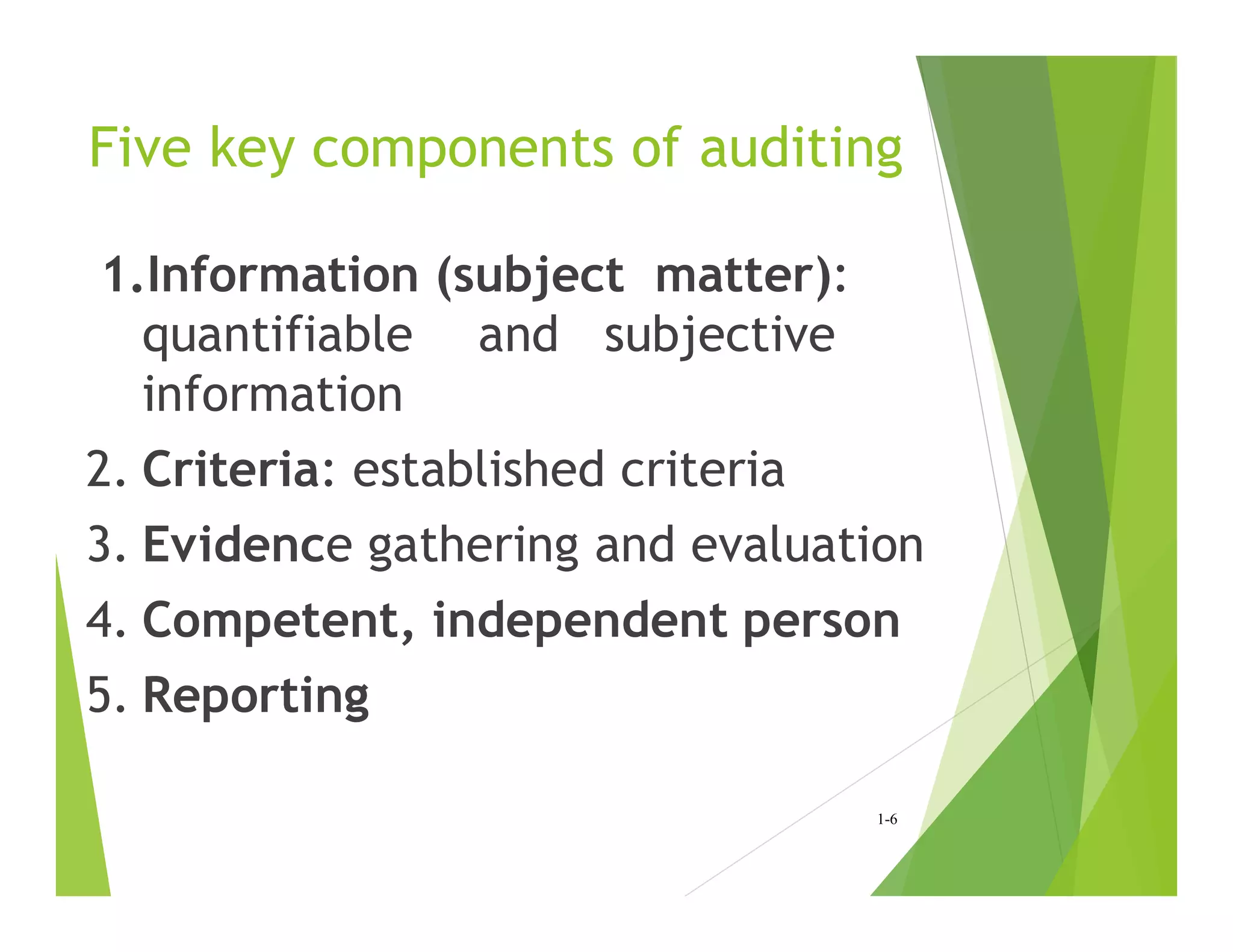
Five key components of auditing
1.Information (subject matter):
quantifiable and subjective
information
2. Criteria: established criteria
3. Evidence gathering and evaluation
4. Competent, independent person
5. Reporting
1-6
Information and established
criteria
Copyright © 2017 Pearson Education, Inc. 1-5
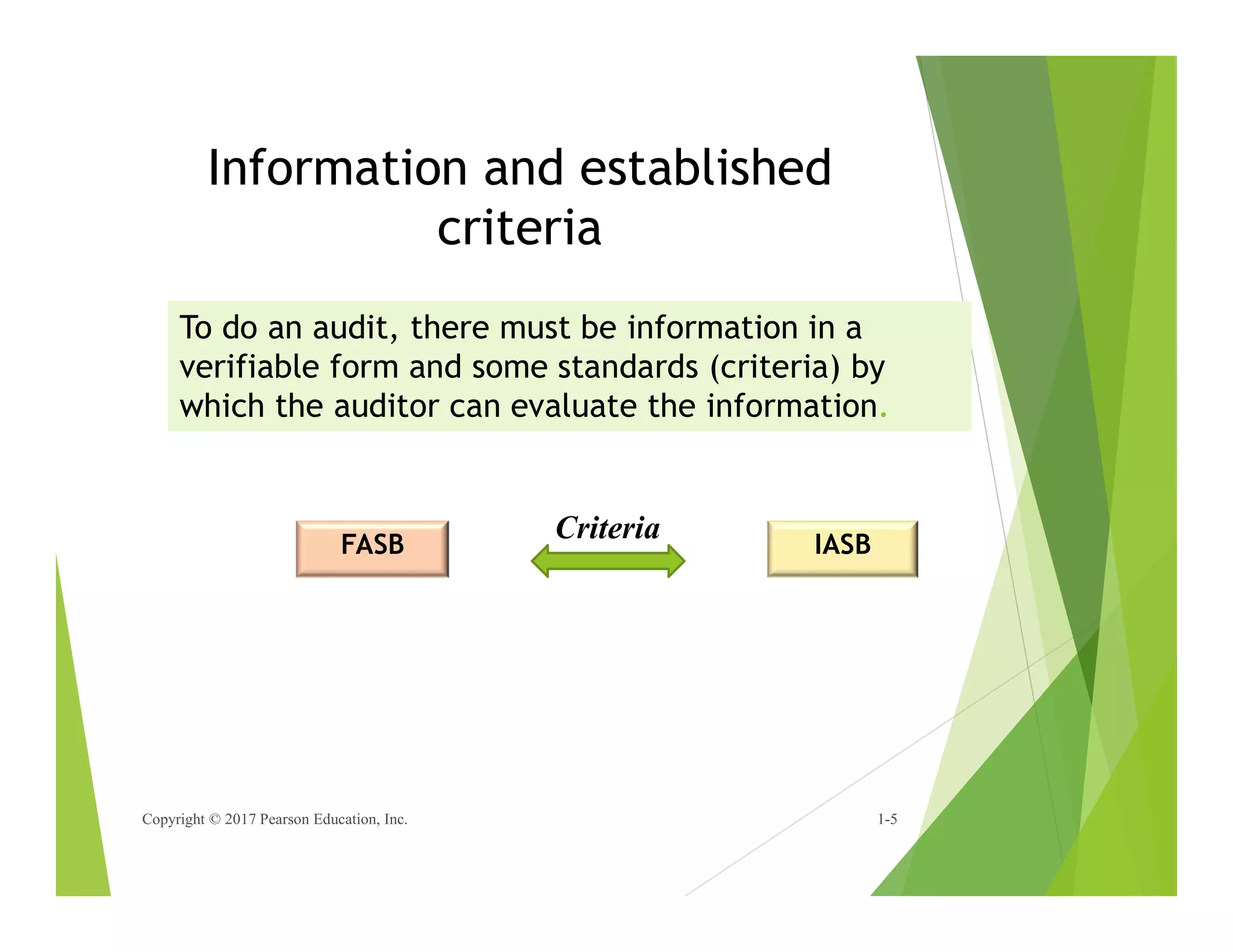
To do an audit, there must be information in a
verifiable form and some standards (criteria) by
which the auditor can evaluate the information.
FASB IASB
Criteria
ACCUMULATING AND EVALUATING
EVIDENCE
Copyright © 2017 Pearson Education, Inc. 1-8
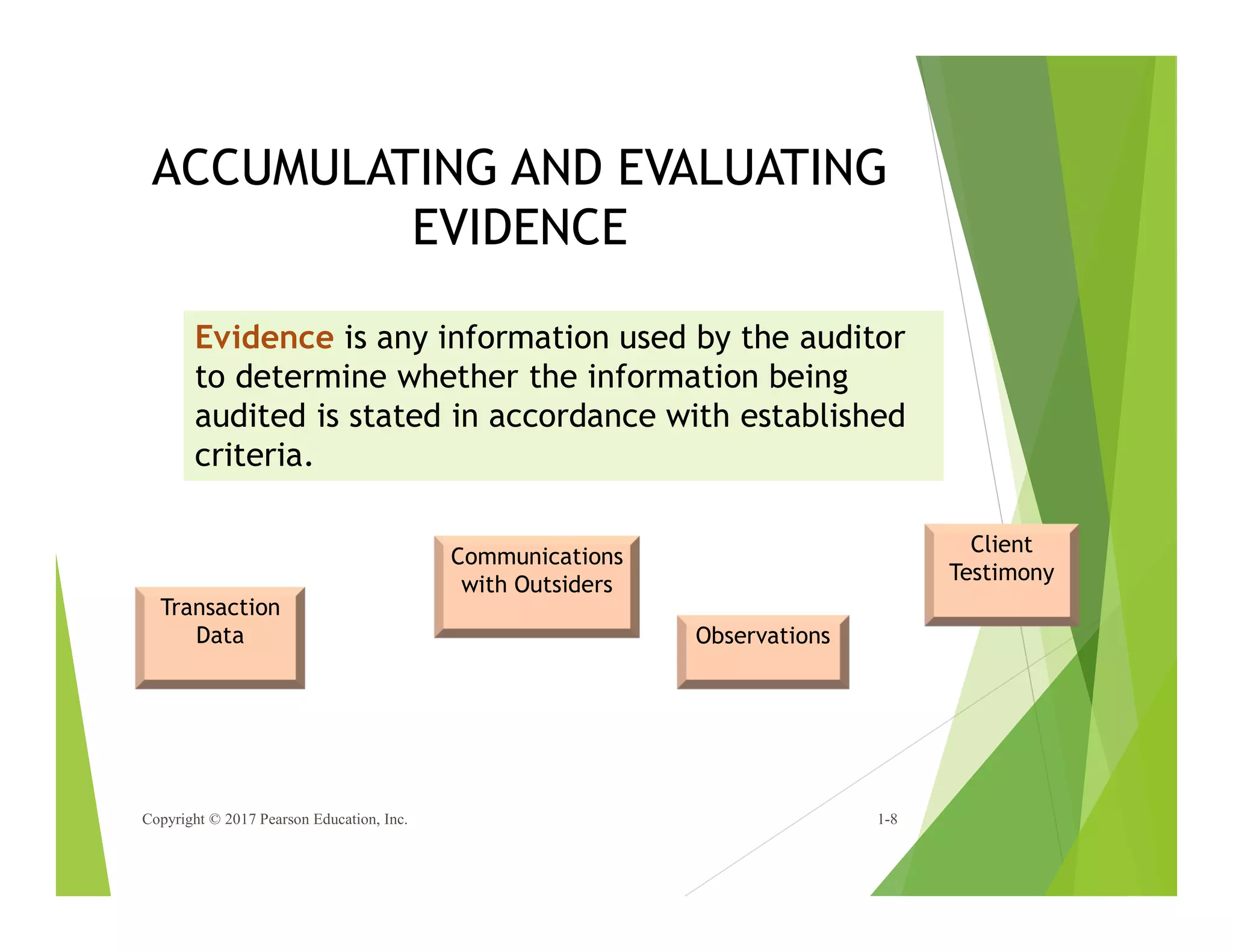
Evidence is any information used by the auditor
to determine whether the information being
audited is stated in accordance with established
criteria.
Transaction
Data
Communications
with Outsiders
Observations
Client
Testimony
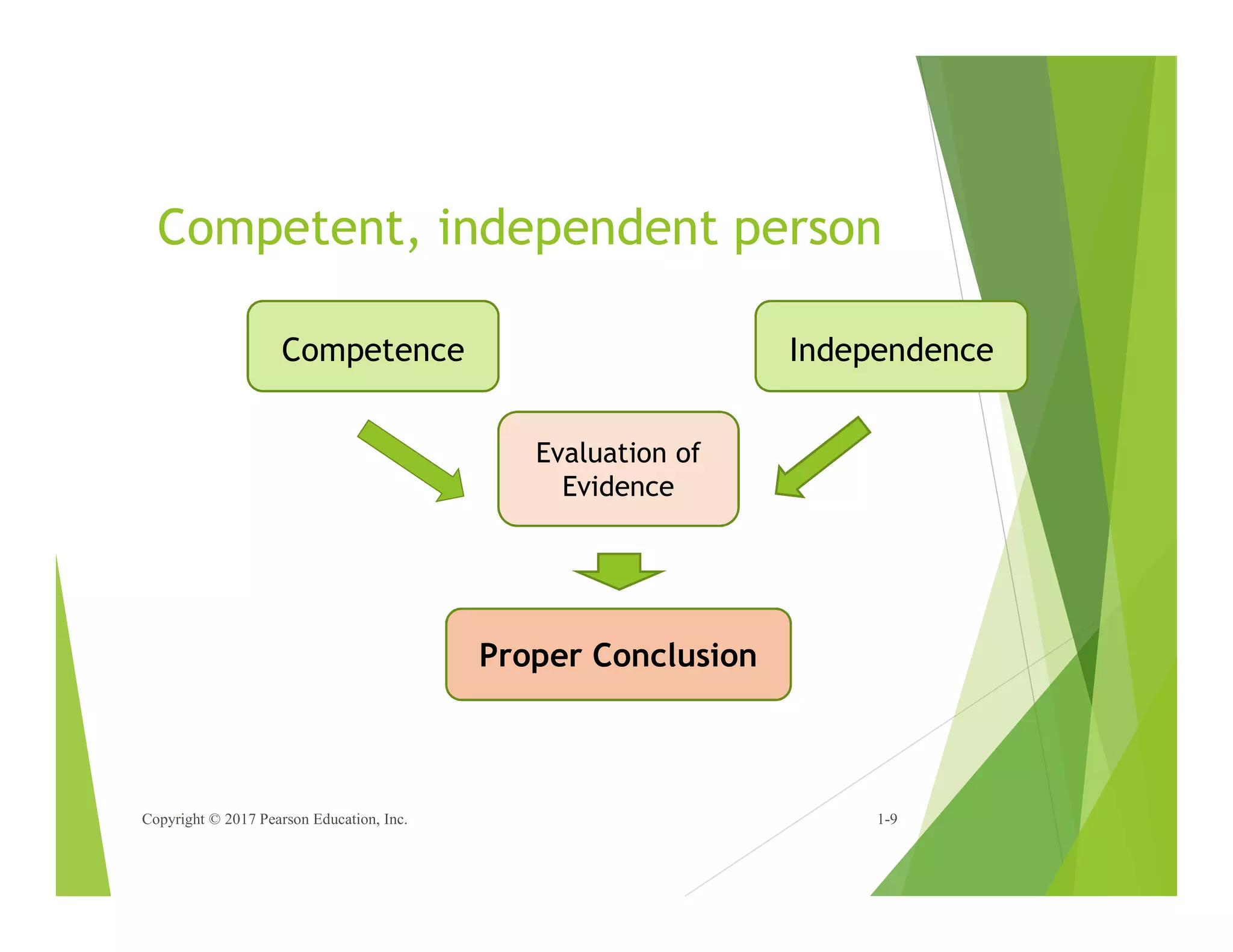
Competent, independent person
Copyright © 2017 Pearson Education, Inc. 1-9
Competence Independence
Evaluation of
Evidence
Proper Conclusion
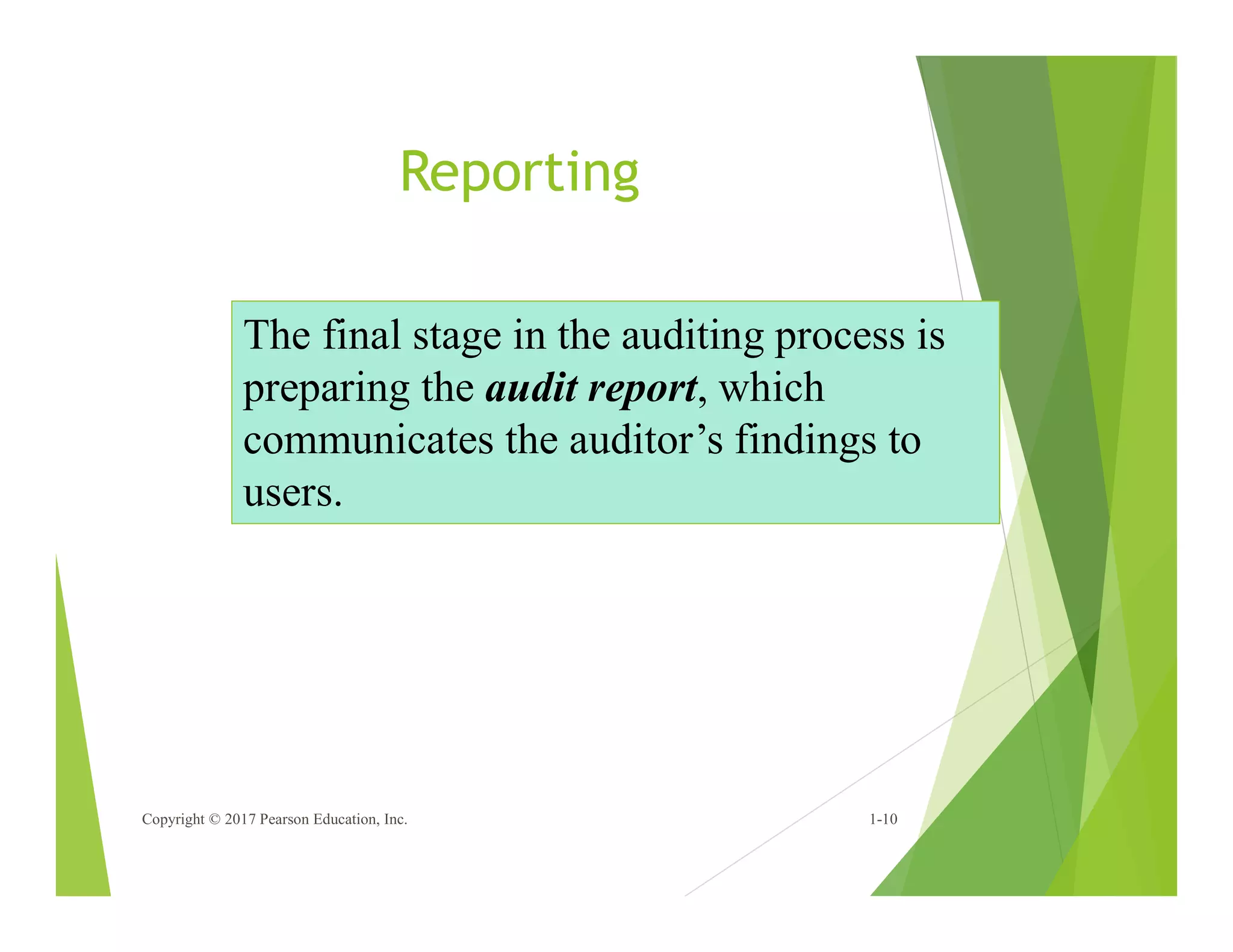
Reporting
Copyright © 2017 Pearson Education, Inc. 1-10
The final stage in the auditing process is
preparing the audit report, which
communicates the auditor’s findings to
users.
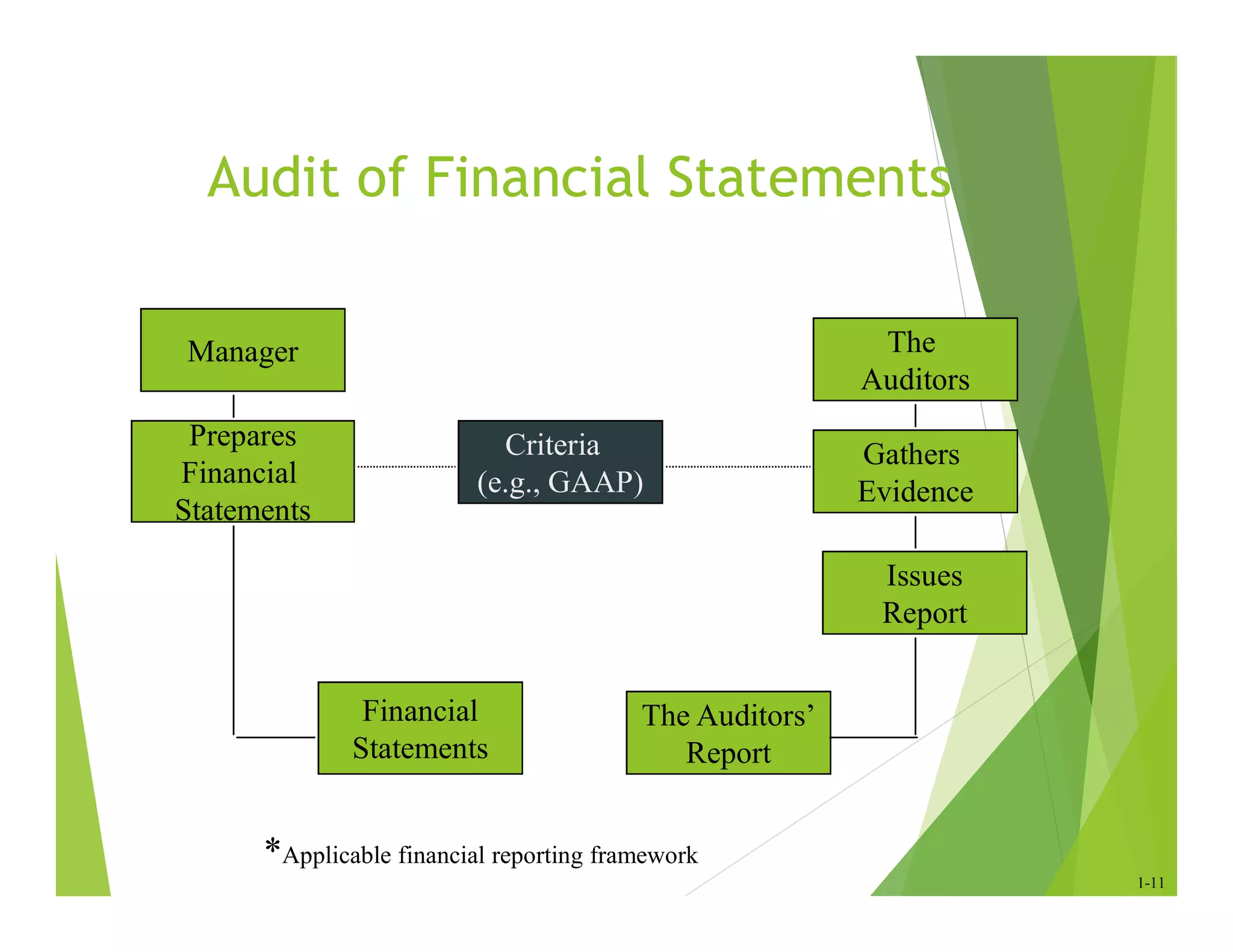
*Applicable financial reporting framework
Audit of Financial Statements
Manager
Prepares
Financial
Statements
Criteria
(e.g., GAAP)
The
Auditors
Gathers
Evidence
Financial
Statements
The Auditors’
Report
Issues
Report
1-11
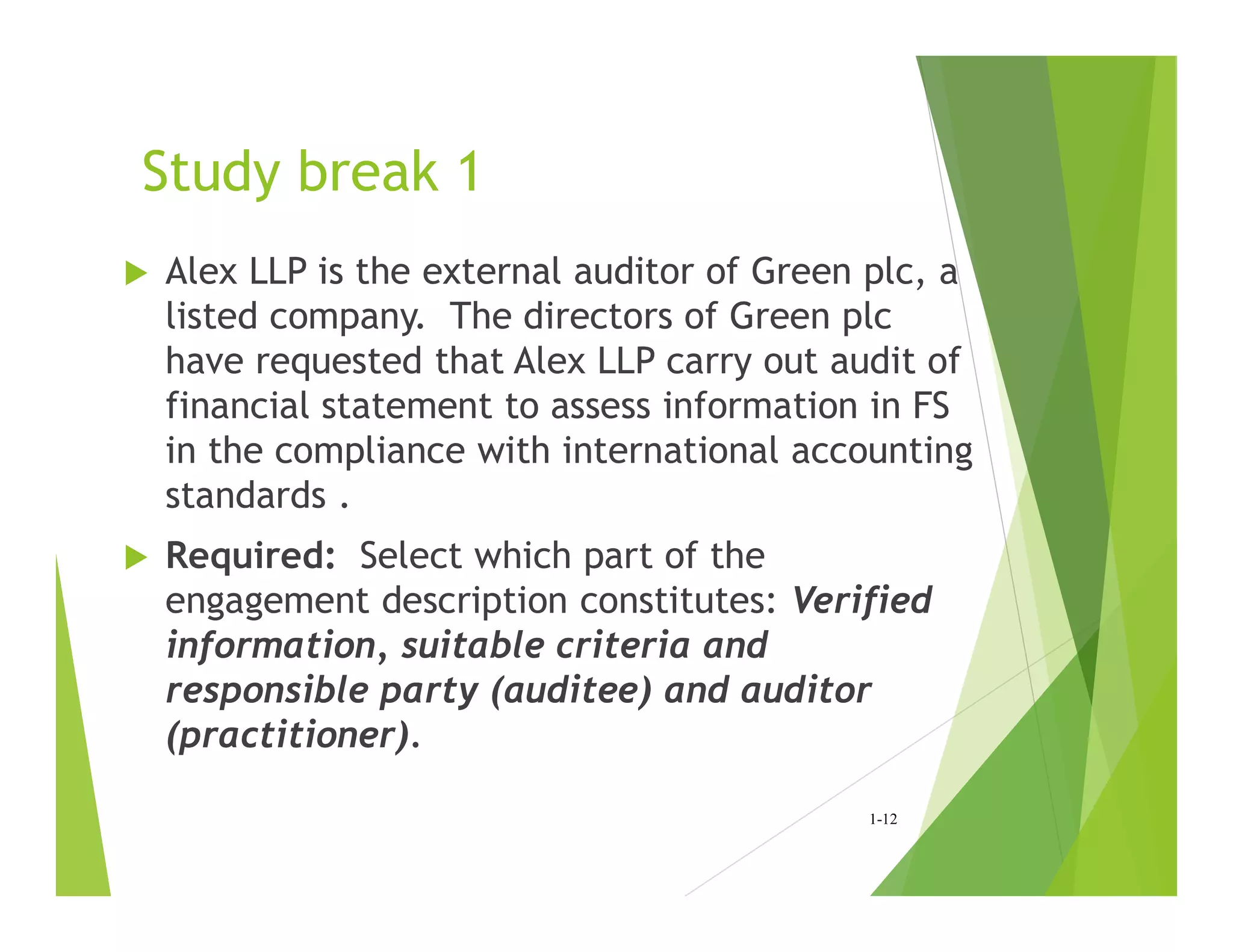
Study break 1
 Alex LLP is the external auditor of Green plc, a
listed company. The directors of Green plc
have requested that Alex LLP carry out audit of
financial statement to assess information in FS
in the compliance with international accounting
standards .
 Required: Select which part of the
engagement description constitutes: Verified
information, suitable criteria and
responsible party (auditee) and auditor
(practitioner).
1-12
Study break 2
 The internal auditor conducts the audit of
assessing effectiveness of internal control at a
casino which is in compliance with federal and
state regulations.
 The government auditor performs the audit of
federal income tax return of corporation to
determine whether the tax law have been
followed
Required: Identify the key elements of these
engagement in these situations.
1-13
Distinction between
accounting and auditing
 What is accounting?
 What is auditing?
 Who is responsible for accounting
or auditing?
 Can an auditor do both for the
same company?
1-14
Copyright © 2017 Pearson Education, Inc. 1-15
OBJECTIVE 2-2
Describe assurance services and distinguish
audit services from other assurance and
nonassurance services provided by CPAs.
Assurance services
 An assurance service is an independent
professional service that improves the
quality of information for decision
makers.
 Assurance services can be provided by
CPAs or other professionals.
 Assurance services by CPAs have been
common for years, especially regarding
historical financial statement information.
 Section 404 of the Sarbanes-Oxley Act
now requires assurance regarding
internal controls for larger public
companies.
1-16
Attestation services
Copyright © 2017 Pearson Education, Inc. 1-17
An attestation service is a type of service in
which the CPA issues a report about a
subject matter or assertion that is made by
another party.
Primary categories of attestation services
include:
• Audits of historical financial statements
• Audits of internal control over financial
reporting
• Reviews of historical financial statements
• Other attestation that may be applied to a
broad range of subjects
Other assurance and nonassurance
services
Copyright © 2017 Pearson Education, Inc. 1-18
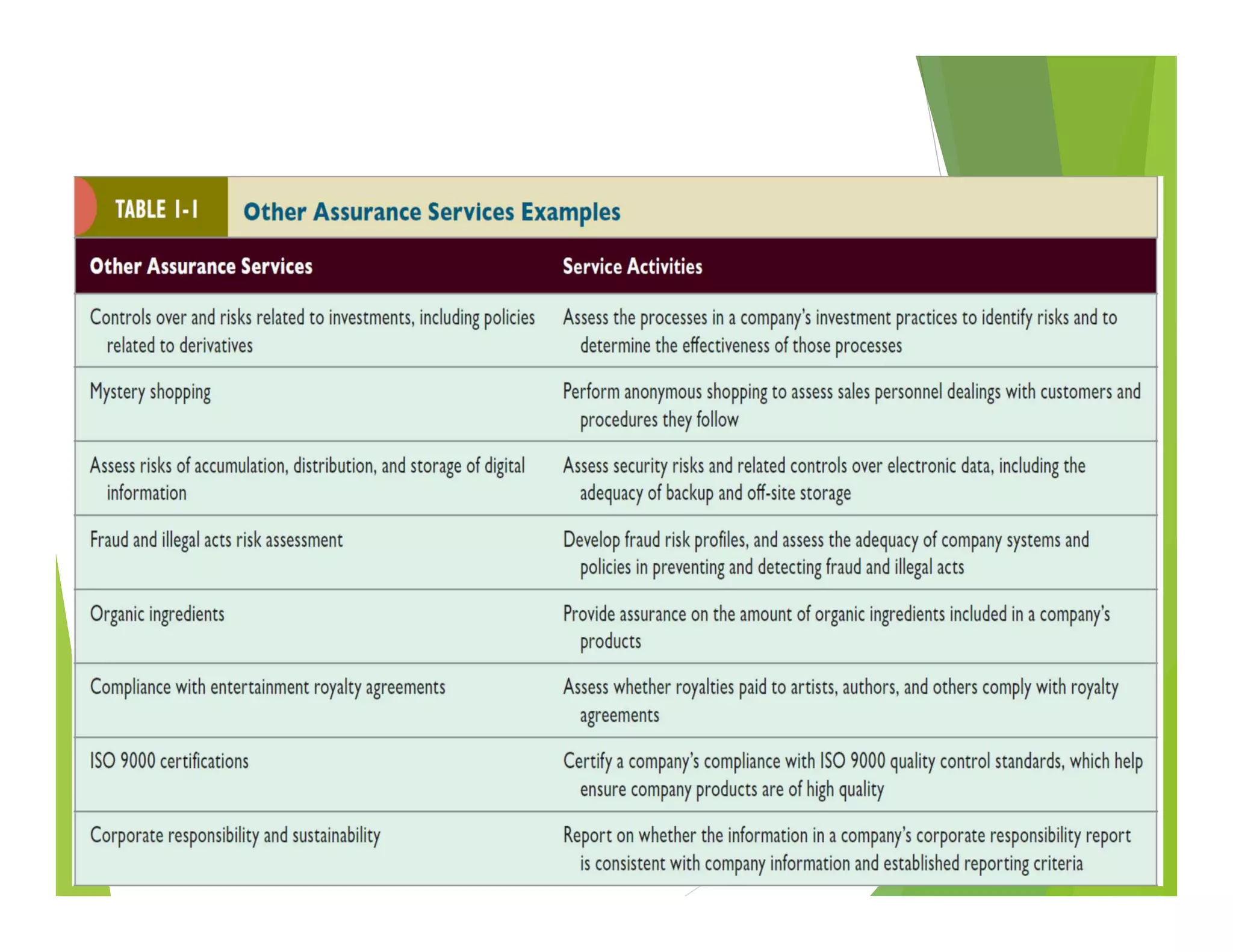
Other assurance services do not meet the
definition of attestation services. A written
report is not required, and it need not be about
reliability or compliance.
Nonassurance services: CPA firms perform
numerous other services that generally fall
outside the scope of assurance services. Three
specific examples are:
1.Accounting and bookkeeping services
2.Tax services
3.Management consulting services
Copyright © 2017 Pearson Education, Inc. 1-19
Copyright © 2017 Pearson Education, Inc. 1-20
OBJECTIVE 2-3
Demand for auditing
Demand for audits
 Remoteness of information
 Bias and motives of provider
 Voluminous data
 Complex exchange transactions
1-21
Demand for audits
 Remoteness of information: Decision makers
do not have firsthand knowledge and must rely
on information provided by others.
 Biases and motives of the provider:
Information is provided by someone whose
goals are inconsistent with those of the decision
maker and may be biased.
Copyright © 2017 Pearson Education, Inc. 1-22
Demand for audits
 Voluminous data: Higher volumes of
transactions increase the likelihood of
undetected errors.
 Complex exchange transactions: Transactions
are increasingly complex and more difficult to
record properly. Complex accounting standards
are difficult to interpret and apply.
Copyright © 2017 Pearson Education, Inc. 1-23
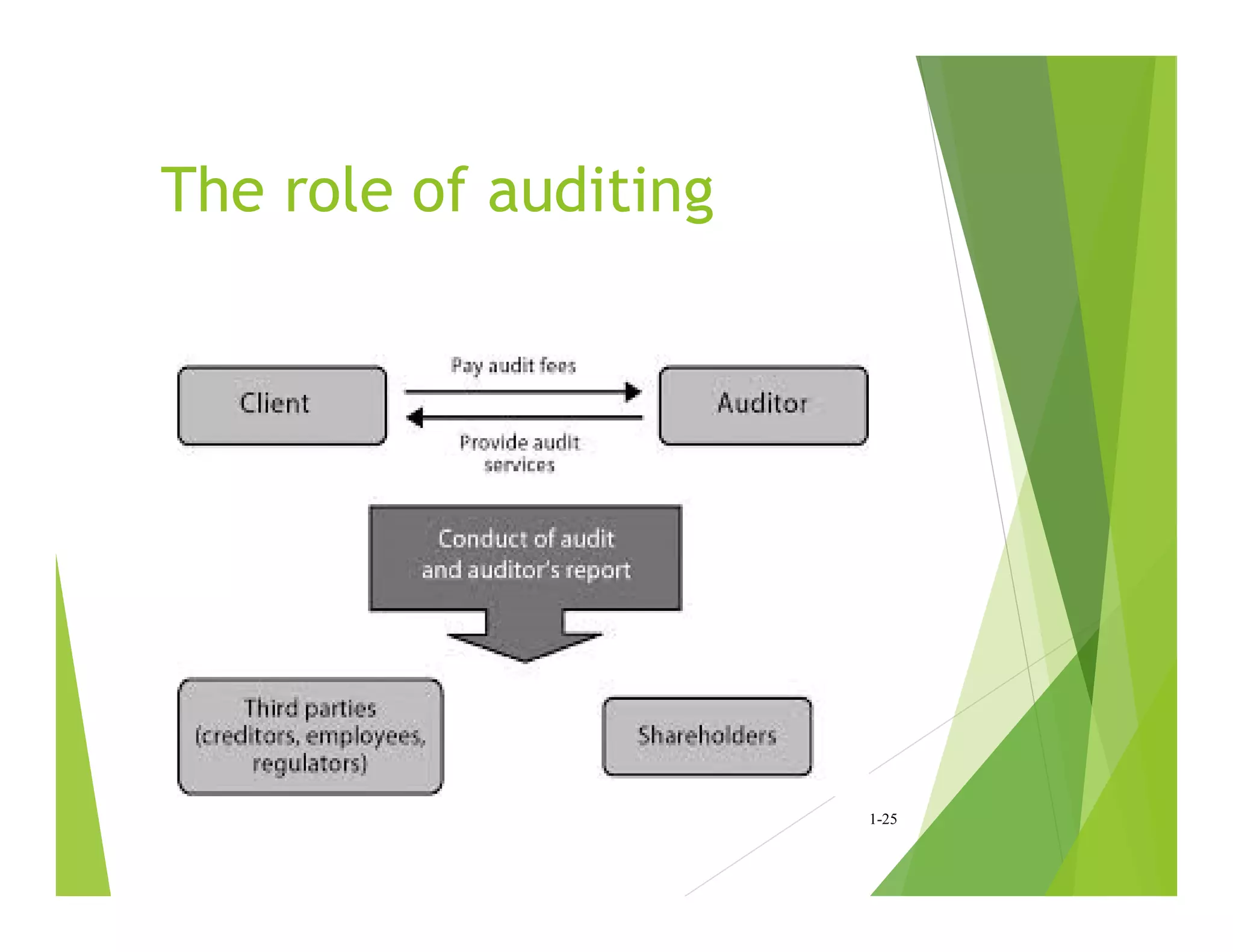
The role of auditing
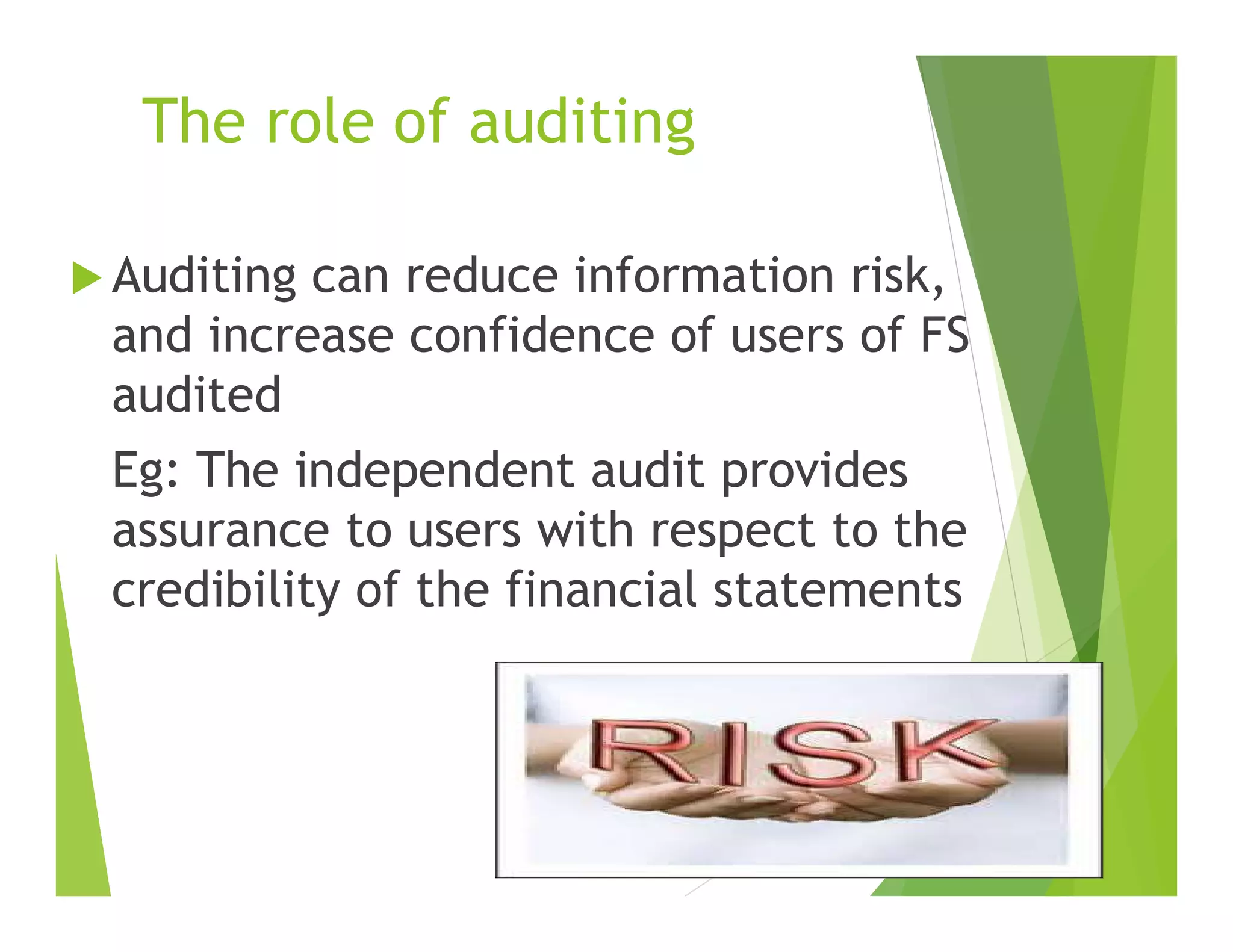
 Auditing can reduce information risk,
and increase confidence of users of FS
audited
Eg: The independent audit provides
assurance to users with respect to the
credibility of the financial statements
1-24
The role of auditing
1-25
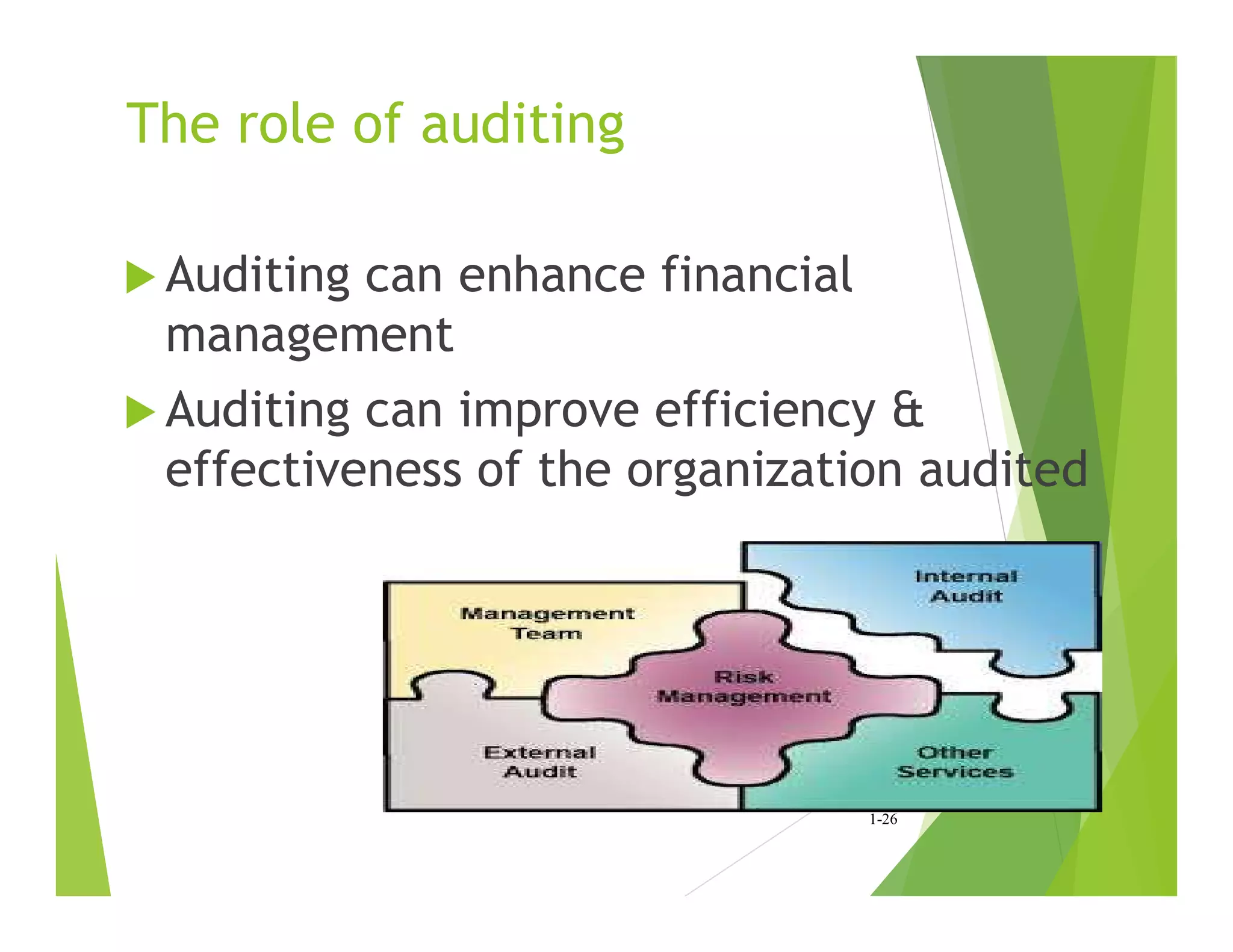
The role of auditing
 Auditing can enhance financial
management
 Auditing can improve efficiency &
effectiveness of the organization audited
1-26
Copyright © 2017 Pearson Education, Inc. 1-27
OBJECTIVE 2-5
Historical development of auditing
Historical development of
auditing – Prior to 1840
 In ancient times:
 Early stages of the ancient period: not
existed auditing
 At the end of ancient period: The ownership
and control are separately.(The ancient
checking activities were found in Greece
around 350 B.C. )
 A single public officer was appointed to find
fraudulent actions (embezzlement,
corruption, administrative errors,…).
Examination result was used by court to fine
the person who did fraudulent actions. 1-28
Historical development of
auditing – Prior to 1840
 In Middle ages:
 In 1494, “double entry book - keeping”
was published by Luca Pacioli
 The merchants of Florence, Genoa,
Venice used auditors to help them
verify the riches brought by captains of
sailing ships and detect of fraud.
1-29
Historical development of
auditing – 1840s to 1920s
 The advent of the industrial revolution
in the UK made vast changes in
company’s scale and nature of
operations
 The share market during this period was
unregulated and highly speculative
1-30
1-31
1-32
Historical development of
auditing –1920s to now
 The advancement of the securities market
facilitated the development of auditing
 In 1934, SEC required that all listed
companies have financial statements
audited by an independent auditor
 From 1960s – 1990s, the provision of
advisory services emerged as a secondary
audit function.
1-33
Historical development of auditing
 Prior to 1840
The audit objective in the early period was
primarily designed to verify the honesty of
persons charges with fiscal responsibilites
 1840s – 1920s
This period prefers to period of “auditing
stagnation”
 1920s to now
1-34
Historical development of auditing
 1920s to now
Audit function focuses on assessing
the truth and fairness of the
companies’ financial statements
Furthermore, auditing provides
advisory services to audit’s client.
1-35
Historical development of auditing
– in Viet Nam
 In 1991, independent auditing emerged
 In 1994, Vietnamese State Audit was
established
 In 1996, internal auding was firstly regulated
1-36

Chapter 1.pdf

  • 1.
  • 2.
    Suggested Readings  Alvin,A. Elder and Beasley (2017) Auditing and Assurance Services - an Integrated Approach, 16th edition, Pearson, USA, Chapter 1 and 2.  Nguyen Quang Quynh, Nguyen Thi Phuong Hoa at al, (2008), Auditing Theory, National Economics University Publisher, Chapter 2. 1-2
  • 3.
    Learning objectives  Definitionof auditing and nature of auditing  Describe assurance services and distinguish audit services from other assurance and nonassurance services  Factors affecting the demand of auditing  Demand for auditing 1-3
  • 4.
    Copyright © 2017Pearson Education, Inc. 1-4 OBJECTIVE 2-1 Nature of auditing
  • 5.
    What is anaudit – Nature of auditing  Auditing is the accumulation and evaluation of evidence about information to determine and report on the degree of correspondence between the information and established criteria.  Auditing is done by a competent, independent person. 1-5
  • 6.
    Five key componentsof auditing 1.Information (subject matter): quantifiable and subjective information 2. Criteria: established criteria 3. Evidence gathering and evaluation 4. Competent, independent person 5. Reporting 1-6
  • 7.
    Information and established criteria Copyright© 2017 Pearson Education, Inc. 1-5 To do an audit, there must be information in a verifiable form and some standards (criteria) by which the auditor can evaluate the information. FASB IASB Criteria
  • 8.
    ACCUMULATING AND EVALUATING EVIDENCE Copyright© 2017 Pearson Education, Inc. 1-8 Evidence is any information used by the auditor to determine whether the information being audited is stated in accordance with established criteria. Transaction Data Communications with Outsiders Observations Client Testimony
  • 9.
    Competent, independent person Copyright© 2017 Pearson Education, Inc. 1-9 Competence Independence Evaluation of Evidence Proper Conclusion
  • 10.
    Reporting Copyright © 2017Pearson Education, Inc. 1-10 The final stage in the auditing process is preparing the audit report, which communicates the auditor’s findings to users.
  • 11.
    *Applicable financial reportingframework Audit of Financial Statements Manager Prepares Financial Statements Criteria (e.g., GAAP) The Auditors Gathers Evidence Financial Statements The Auditors’ Report Issues Report 1-11
  • 12.
    Study break 1 Alex LLP is the external auditor of Green plc, a listed company. The directors of Green plc have requested that Alex LLP carry out audit of financial statement to assess information in FS in the compliance with international accounting standards .  Required: Select which part of the engagement description constitutes: Verified information, suitable criteria and responsible party (auditee) and auditor (practitioner). 1-12
  • 13.
    Study break 2 The internal auditor conducts the audit of assessing effectiveness of internal control at a casino which is in compliance with federal and state regulations.  The government auditor performs the audit of federal income tax return of corporation to determine whether the tax law have been followed Required: Identify the key elements of these engagement in these situations. 1-13
  • 14.
    Distinction between accounting andauditing  What is accounting?  What is auditing?  Who is responsible for accounting or auditing?  Can an auditor do both for the same company? 1-14
  • 15.
    Copyright © 2017Pearson Education, Inc. 1-15 OBJECTIVE 2-2 Describe assurance services and distinguish audit services from other assurance and nonassurance services provided by CPAs.
  • 16.
    Assurance services  Anassurance service is an independent professional service that improves the quality of information for decision makers.  Assurance services can be provided by CPAs or other professionals.  Assurance services by CPAs have been common for years, especially regarding historical financial statement information.  Section 404 of the Sarbanes-Oxley Act now requires assurance regarding internal controls for larger public companies. 1-16
  • 17.
    Attestation services Copyright ©2017 Pearson Education, Inc. 1-17 An attestation service is a type of service in which the CPA issues a report about a subject matter or assertion that is made by another party. Primary categories of attestation services include: • Audits of historical financial statements • Audits of internal control over financial reporting • Reviews of historical financial statements • Other attestation that may be applied to a broad range of subjects
  • 18.
    Other assurance andnonassurance services Copyright © 2017 Pearson Education, Inc. 1-18 Other assurance services do not meet the definition of attestation services. A written report is not required, and it need not be about reliability or compliance. Nonassurance services: CPA firms perform numerous other services that generally fall outside the scope of assurance services. Three specific examples are: 1.Accounting and bookkeeping services 2.Tax services 3.Management consulting services
  • 19.
    Copyright © 2017Pearson Education, Inc. 1-19
  • 20.
    Copyright © 2017Pearson Education, Inc. 1-20 OBJECTIVE 2-3 Demand for auditing
  • 21.
    Demand for audits Remoteness of information  Bias and motives of provider  Voluminous data  Complex exchange transactions 1-21
  • 22.
    Demand for audits Remoteness of information: Decision makers do not have firsthand knowledge and must rely on information provided by others.  Biases and motives of the provider: Information is provided by someone whose goals are inconsistent with those of the decision maker and may be biased. Copyright © 2017 Pearson Education, Inc. 1-22
  • 23.
    Demand for audits Voluminous data: Higher volumes of transactions increase the likelihood of undetected errors.  Complex exchange transactions: Transactions are increasingly complex and more difficult to record properly. Complex accounting standards are difficult to interpret and apply. Copyright © 2017 Pearson Education, Inc. 1-23
  • 24.
    The role ofauditing  Auditing can reduce information risk, and increase confidence of users of FS audited Eg: The independent audit provides assurance to users with respect to the credibility of the financial statements 1-24
  • 25.
    The role ofauditing 1-25
  • 26.
    The role ofauditing  Auditing can enhance financial management  Auditing can improve efficiency & effectiveness of the organization audited 1-26
  • 27.
    Copyright © 2017Pearson Education, Inc. 1-27 OBJECTIVE 2-5 Historical development of auditing
  • 28.
    Historical development of auditing– Prior to 1840  In ancient times:  Early stages of the ancient period: not existed auditing  At the end of ancient period: The ownership and control are separately.(The ancient checking activities were found in Greece around 350 B.C. )  A single public officer was appointed to find fraudulent actions (embezzlement, corruption, administrative errors,…). Examination result was used by court to fine the person who did fraudulent actions. 1-28
  • 29.
    Historical development of auditing– Prior to 1840  In Middle ages:  In 1494, “double entry book - keeping” was published by Luca Pacioli  The merchants of Florence, Genoa, Venice used auditors to help them verify the riches brought by captains of sailing ships and detect of fraud. 1-29
  • 30.
    Historical development of auditing– 1840s to 1920s  The advent of the industrial revolution in the UK made vast changes in company’s scale and nature of operations  The share market during this period was unregulated and highly speculative 1-30
  • 31.
  • 32.
  • 33.
    Historical development of auditing–1920s to now  The advancement of the securities market facilitated the development of auditing  In 1934, SEC required that all listed companies have financial statements audited by an independent auditor  From 1960s – 1990s, the provision of advisory services emerged as a secondary audit function. 1-33
  • 34.
    Historical development ofauditing  Prior to 1840 The audit objective in the early period was primarily designed to verify the honesty of persons charges with fiscal responsibilites  1840s – 1920s This period prefers to period of “auditing stagnation”  1920s to now 1-34
  • 35.
    Historical development ofauditing  1920s to now Audit function focuses on assessing the truth and fairness of the companies’ financial statements Furthermore, auditing provides advisory services to audit’s client. 1-35
  • 36.
    Historical development ofauditing – in Viet Nam  In 1991, independent auditing emerged  In 1994, Vietnamese State Audit was established  In 1996, internal auding was firstly regulated 1-36