National College of Business Administration &
Economics
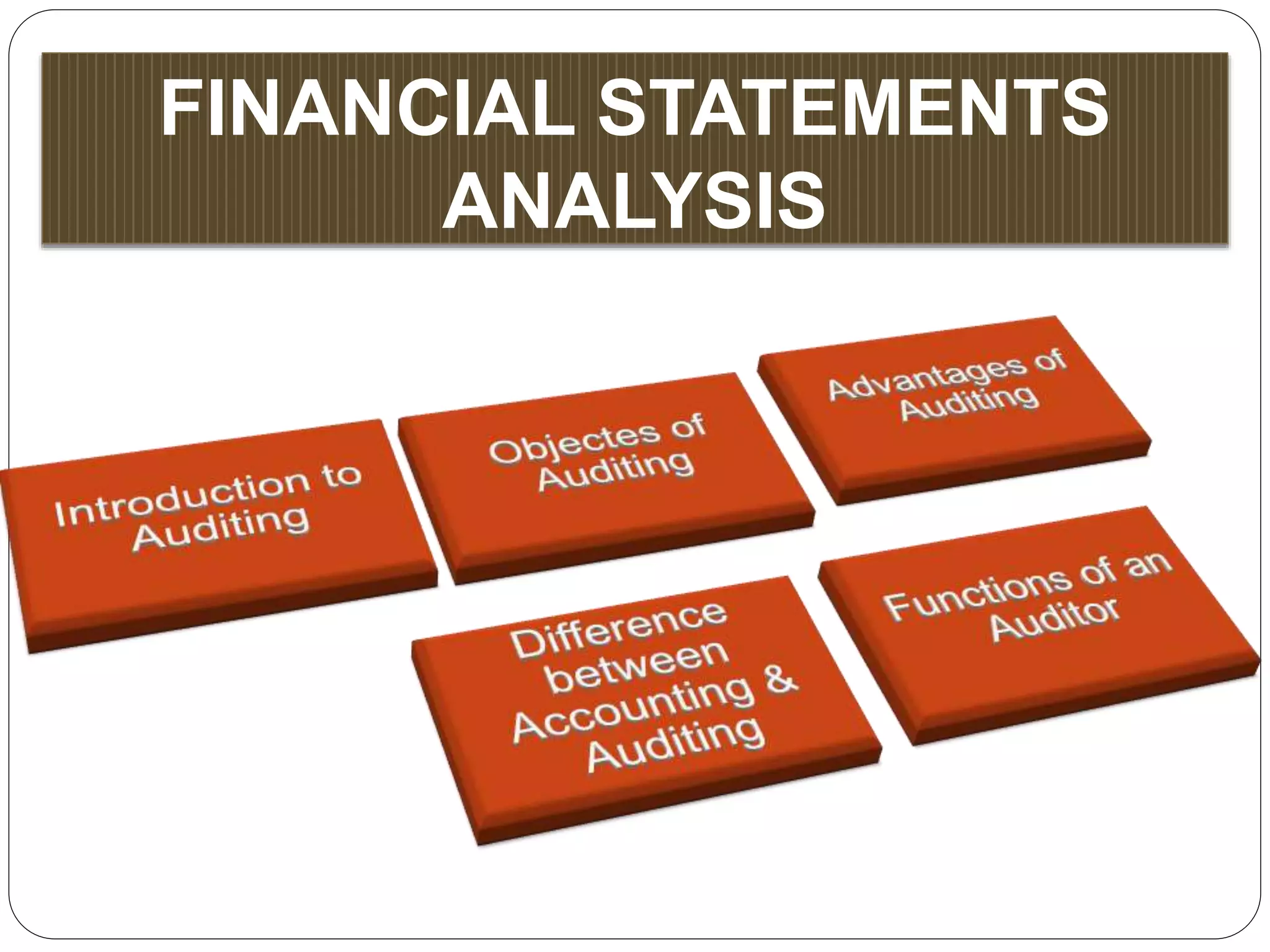
FINANCIAL STATEMENTS
ANALYSIS
INTRODUCTION
History of auditing:
The word audit has been derived from a Latin world “audir”
which means to hear. A long time ago when people buy their need of life
through barter system then merchants assign different transactions to
different people. For the check and balance of these people a forum of
expertise is sit to hear their transaction process and detected the frauds
and finds the guilty person for merchants so this hearing process is named
as “Auditing”.
Auditing meaning: “To examine the accounting data”
Purpose of auditing:
The purpose of auditing is to check the true and fair
view of accounting record that there is nothing missing in the record and
everything is correctly posted in the record.
Need for auditing:
Need of audit is felt when the owner is separate from the
management. And the organization structure is large and there are number of
transactions take place in the organization.
Why Audit become compulsory?
In 1844 in England the audit of companies become
necessary. Every company is required to perform the audit of his company for a
specific interval of time.
Qualification of an auditor:
“An auditor must be charted accountant within the
meaning of the charted accountant ordinance 1961.”
Appointment of an auditor:
The auditor is appointed by shareholder if
shareholder fail to appoint hat auditor than board of director appoint if B.O.D
also fail to appoint auditor within 120 days of incorporation of company than
SECP appoint such director.
Auditing process:
1- Vouching: Examination of correctness of transactions as recorded in
journal.
2- Routine checking: Examination of correctness of posting to ledger,
trial balance
3- Verification: Examination whether assets or liabilities as shown in
balance sheet really exist.
4- Reporting: Preparation of report in the form prescribed by companies
ordinance 1984.
Definition:
“Auditing means to smell the errors and frauds from the financial
statements of a business during a particular period and to express an
independent opinion there after regarding true and fairness of financial
position and business result described in such statements”
Objectives of auditing
Primary objective: Principle object of an audit is expression of independent opinion that whether or not
financial statements give true and fair view by following ways.
• Financial statements are drawn up according to company’s ordinance 1984.
• Financial statements are also in accordance with GAAP.
• Financial statements are in agreement with book of account.
• Financial statements give true and fair view
Secondary objectives:
1. Detection of errors and frauds
2. Prevention of errors and frauds
Detection of errors and frauds:
Detection of errors and frauds means to draw out or separate the errors and
frauds in financial statements made by management efficiently.
Prevention of errors and frauds:
Auditor suggests suitable measures to remove flaws in accounting and
internal control system. Thus the possibilities of errors and frauds are minimized.
OBJECTS OF AUDITING
Implied objectives
Implied objectives are those objectives which are
associated with primary and secondary objective. When we do
primary and secondary activities then implied activities automatically
done. These are following.
Checking account:
Audit operates as an effective check on accounting staff.
Implementation of accounting policies:
Audit ensures
implementation of prescribed accounting policies and procedures.
Credibility of financial statements:
Audit makes the financial
statements more reliable for managers, owners and outsiders
Shareholders satisfaction:
Auditor is the representative of share holder he check the
true and fair view of financial statements which cause satisfaction of shareholders.
Compliance of statutory requirement:
Compliance of statutory requirement is one of
the implied objectives of audit.
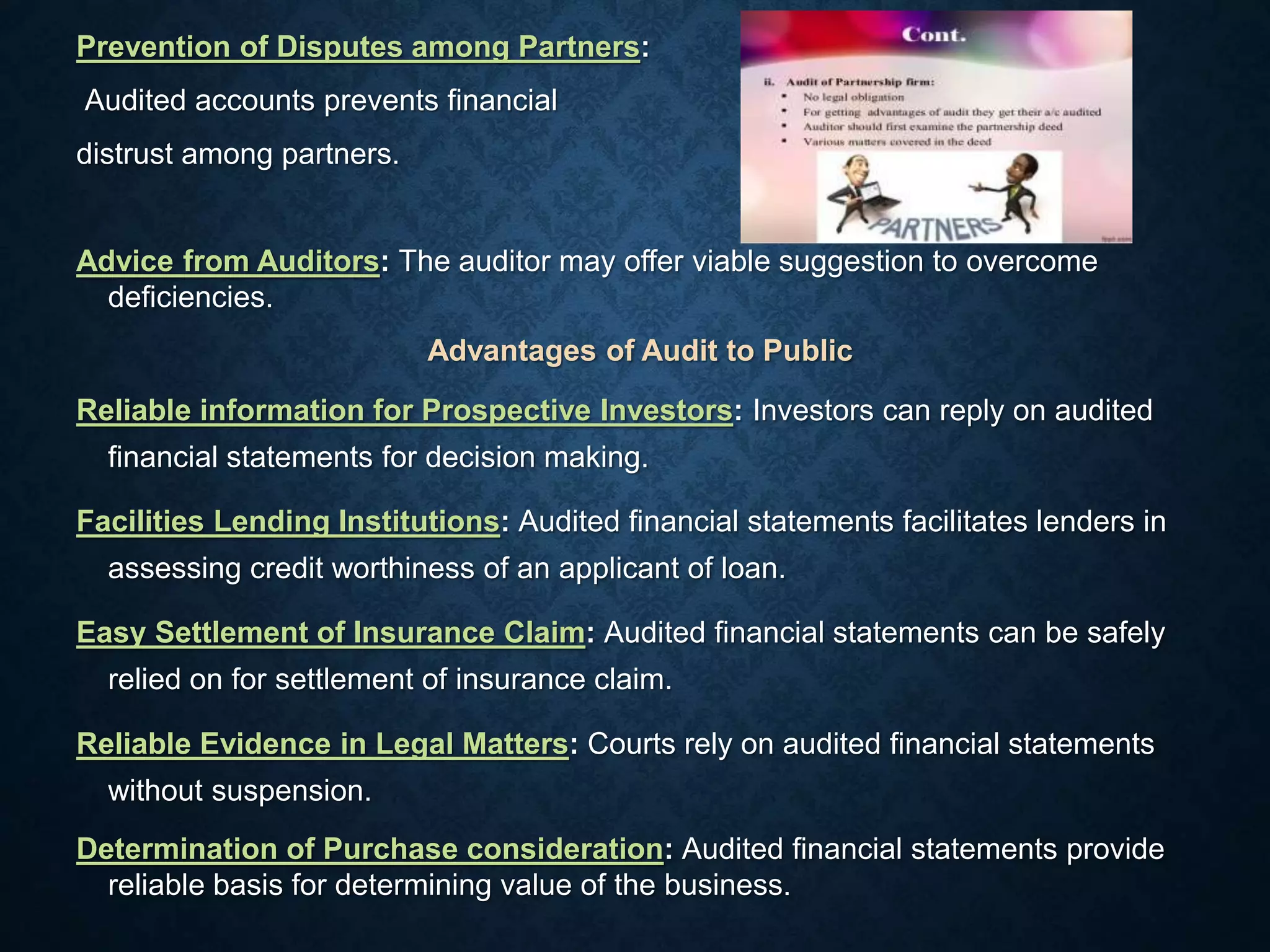
Prevention of disputes among partners:
Many partners get their accounts audited so
that any misunderstanding among partners regarding financial may be avoided.
Advice from auditor:
After auditing the accounts an auditor give beneficial advice to the
owners.
Attraction of investors:
Easy availability of authentic financial statements information
encourages investors.
Economic development:
Auditing contributes to economic development by ensuring that
companies are kept free from mal practices.
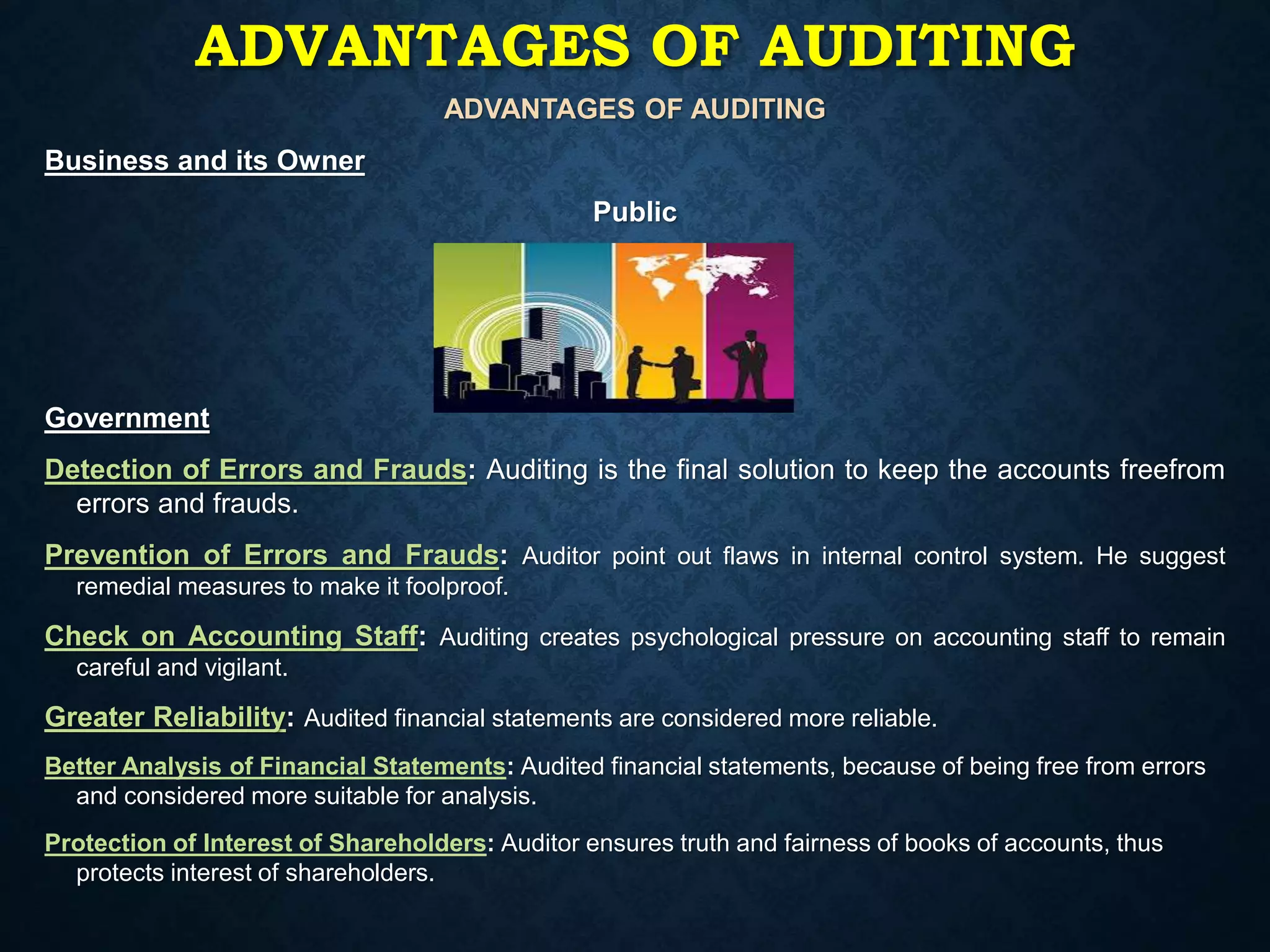
ADVANTAGES OF AUDITING
Business and its Owner
Public
Government
Detection of Errors and Frauds: Auditing is the final solution to keep the accounts freefrom
errors and frauds.
Prevention of Errors and Frauds: Auditor point out flaws in internal control system. He suggest
remedial measures to make it foolproof.
Check on Accounting Staff: Auditing creates psychological pressure on accounting staff to remain
careful and vigilant.
Greater Reliability: Audited financial statements are considered more reliable.
Better Analysis of Financial Statements: Audited financial statements, because of being free from errors
and considered more suitable for analysis.
Protection of Interest of Shareholders: Auditor ensures truth and fairness of books of accounts, thus
protects interest of shareholders.
ADVANTAGES OF AUDITING
Prevention of Disputes among Partners:
Audited accounts prevents financial
distrust among partners.
Advice from Auditors: The auditor may offer viable suggestion to overcome
deficiencies.
Advantages of Audit to Public
Reliable information for Prospective Investors: Investors can reply on audited
financial statements for decision making.
Facilities Lending Institutions: Audited financial statements facilitates lenders in
assessing credit worthiness of an applicant of loan.
Easy Settlement of Insurance Claim: Audited financial statements can be safely
relied on for settlement of insurance claim.
Reliable Evidence in Legal Matters: Courts rely on audited financial statements
without suspension.
Determination of Purchase consideration: Audited financial statements provide
reliable basis for determining value of the business.
Advantages of Audit to Government
Easy Assessment of Tax: Income tax authorities place confidence in
audited financial statements. Auditing makes assessment of tax easy
for government functionaries.
Compliance of Laws: Audit of accounts of companies ensures
compliance of statutory requirements for companies.
Economic Planning: Audit ensures availability of reliable information
about corporate sector. Thus its assists in economic planning.
Meaning:-
Accounts: Accounting means the maintaining of the books of accounts.
Audit: Auditing means examining the books of accounts and reporting means to report about
Their accuracy.
Performance of Work:-
Accounts: Accountant job is performed by the accountant.
Audit: Auditing job is performed by the auditor.
Appointment:-
Accounts: Accountant is appointed by the management.
Audit: Auditor is appointed by the share holders.
Nature Of Job :-
Accounts: Accountant job is a mechanical nature.
Audit: Auditor job is not so mechanical in that sense.
Qualification:-
Accounts: For the accountant no specific qualification is required
Audit: For the auditor specific qualification is required.
DIFFERENCE BETWEEN ACCOUNTING & AUDITING
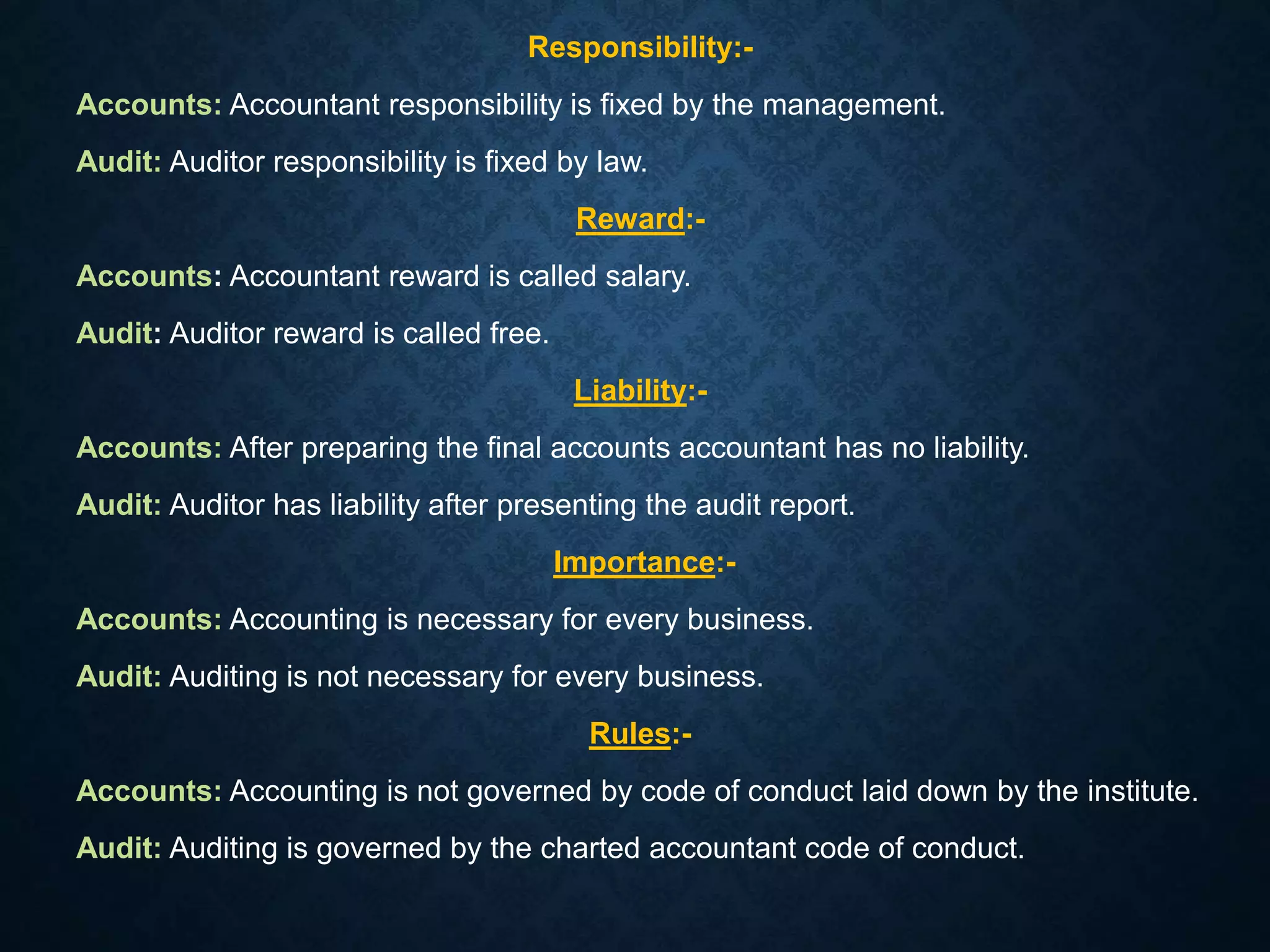
Responsibility:-
Accounts: Accountant responsibility is fixed by the management.
Audit: Auditor responsibility is fixed by law.
Reward:-
Accounts: Accountant reward is called salary.
Audit: Auditor reward is called free.
Liability:-
Accounts: After preparing the final accounts accountant has no liability.
Audit: Auditor has liability after presenting the audit report.
Importance:-
Accounts: Accounting is necessary for every business.
Audit: Auditing is not necessary for every business.
Rules:-
Accounts: Accounting is not governed by code of conduct laid down by the institute.
Audit: Auditing is governed by the charted accountant code of conduct.
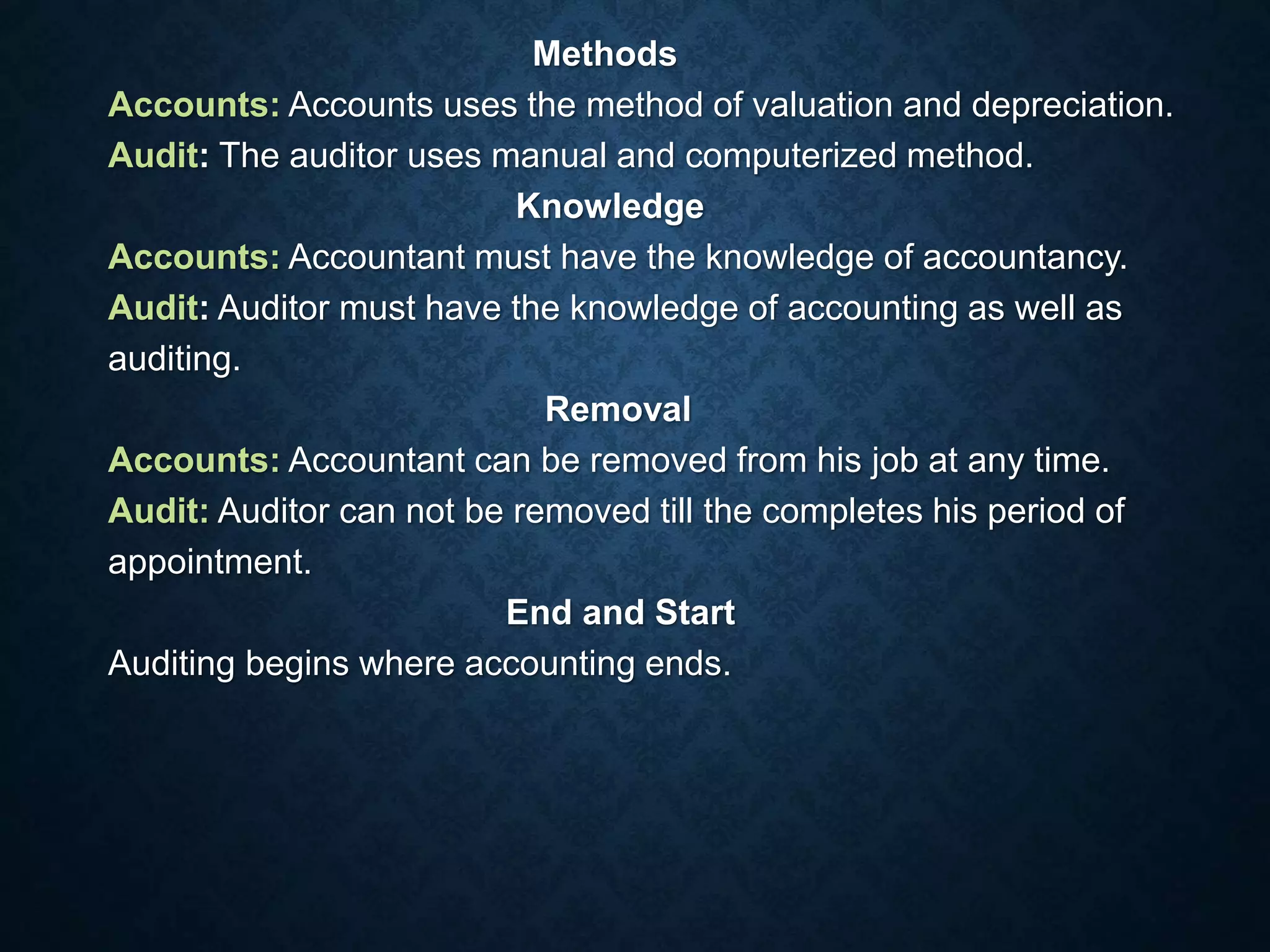
Methods
Accounts: Accounts uses the method of valuation and depreciation.
Audit: The auditor uses manual and computerized method.
Knowledge
Accounts: Accountant must have the knowledge of accountancy.
Audit: Auditor must have the knowledge of accounting as well as
auditing.
Removal
Accounts: Accountant can be removed from his job at any time.
Audit: Auditor can not be removed till the completes his period of
appointment.
End and Start
Auditing begins where accounting ends.
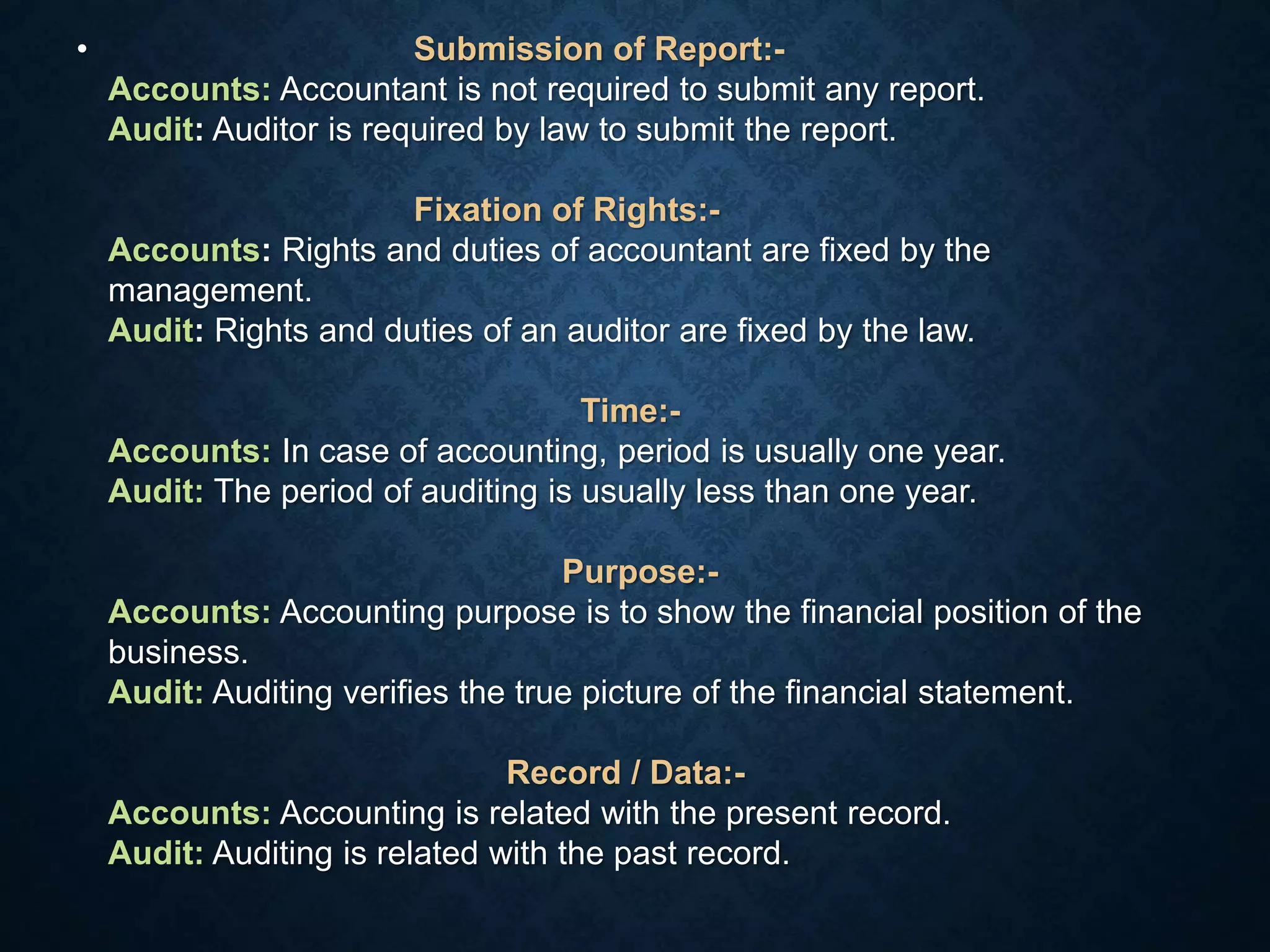
• Submission of Report:-
Accounts: Accountant is not required to submit any report.
Audit: Auditor is required by law to submit the report.
Fixation of Rights:-
Accounts: Rights and duties of accountant are fixed by the
management.
Audit: Rights and duties of an auditor are fixed by the law.
Time:-
Accounts: In case of accounting, period is usually one year.
Audit: The period of auditing is usually less than one year.
Purpose:-
Accounts: Accounting purpose is to show the financial position of the
business.
Audit: Auditing verifies the true picture of the financial statement.
Record / Data:-
Accounts: Accounting is related with the present record.
Audit: Auditing is related with the past record.
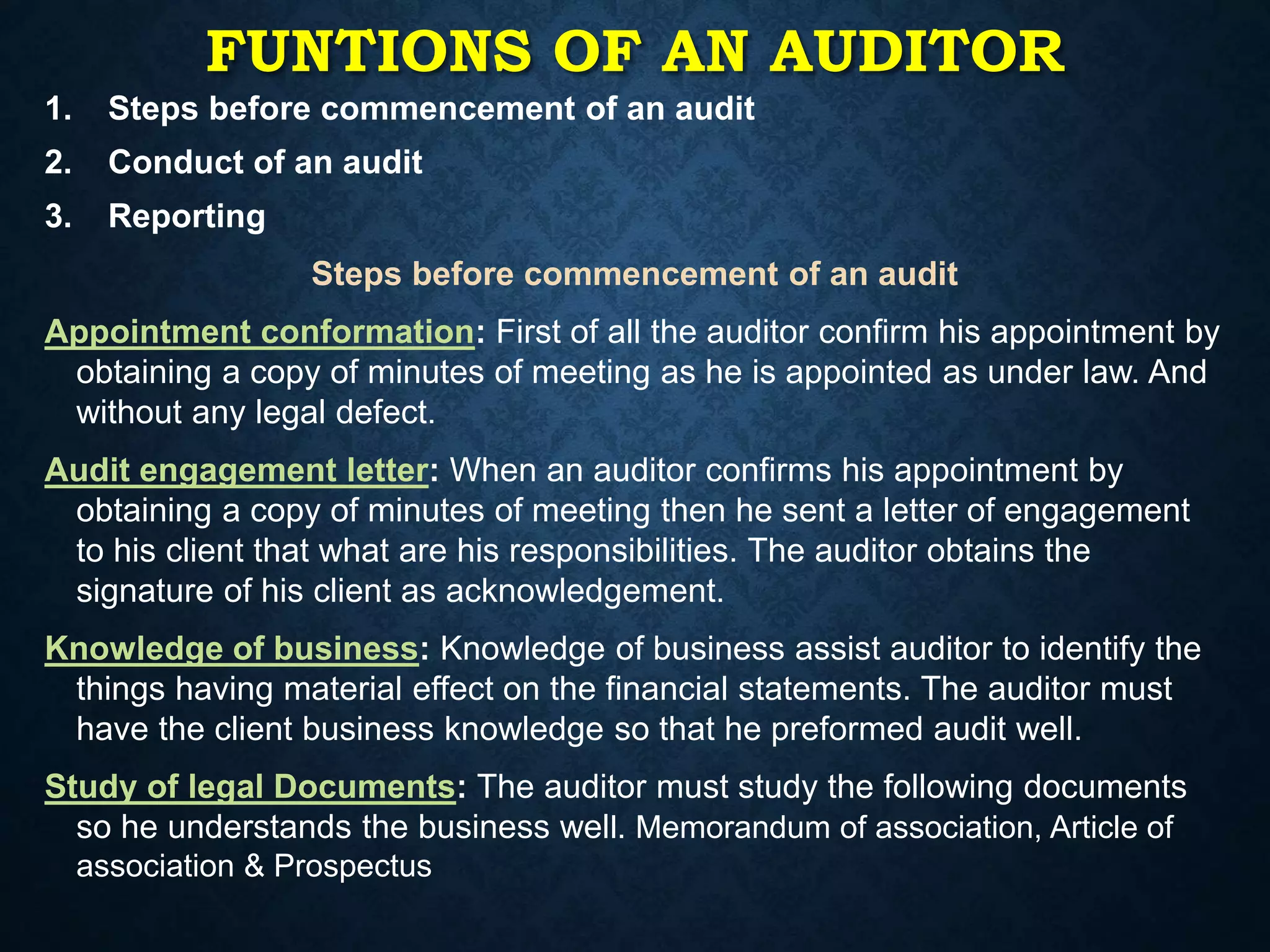
1. Steps before commencement of an audit
2. Conduct of an audit
3. Reporting
Steps before commencement of an audit
Appointment conformation: First of all the auditor confirm his appointment by
obtaining a copy of minutes of meeting as he is appointed as under law. And
without any legal defect.
Audit engagement letter: When an auditor confirms his appointment by
obtaining a copy of minutes of meeting then he sent a letter of engagement
to his client that what are his responsibilities. The auditor obtains the
signature of his client as acknowledgement.
Knowledge of business: Knowledge of business assist auditor to identify the
things having material effect on the financial statements. The auditor must
have the client business knowledge so that he preformed audit well.
Study of legal Documents: The auditor must study the following documents
so he understands the business well. Memorandum of association, Article of
association & Prospectus
FUNTIONS OF AN AUDITOR
Evolution of internal control: The auditor carefully studies the internal
policies and procedures which are adopted by the client to run his
organization.
Analytical Review: The auditors analyze the previous record and
calculate the trends. Actual Figures are compared with forecasted
figures and check the variations. On experience base minimize the
variance.
Determination of audit materiality:From audit point of view
information is material if it omission may influence economic decision
of the user taken on the basis of financial statements.
Valuation certificate: When an auditor is not in position to examine all
the assets physically then he obtains the valuation certificate from
concern officers regarding the existence of assets.
List of officers and employees: The auditor obtains a list of all officers
and employees in the organization so that he can contact with
everyone at any time when he considered fit.
Preparation of an audit plan: The audit plan is the detail procedure of
an audit in which all the audit activities are mapped according to their
occurrence. Its help the organization officers and employees to
conduct of an audit.
Conduct of an audit:
• Vouching
• Routine checking
• Verification
• Reporting

Final project of auditing

  • 1.
    National College ofBusiness Administration & Economics
  • 2.
  • 3.
    INTRODUCTION History of auditing: Theword audit has been derived from a Latin world “audir” which means to hear. A long time ago when people buy their need of life through barter system then merchants assign different transactions to different people. For the check and balance of these people a forum of expertise is sit to hear their transaction process and detected the frauds and finds the guilty person for merchants so this hearing process is named as “Auditing”. Auditing meaning: “To examine the accounting data” Purpose of auditing: The purpose of auditing is to check the true and fair view of accounting record that there is nothing missing in the record and everything is correctly posted in the record.
  • 4.
    Need for auditing: Needof audit is felt when the owner is separate from the management. And the organization structure is large and there are number of transactions take place in the organization. Why Audit become compulsory? In 1844 in England the audit of companies become necessary. Every company is required to perform the audit of his company for a specific interval of time. Qualification of an auditor: “An auditor must be charted accountant within the meaning of the charted accountant ordinance 1961.” Appointment of an auditor: The auditor is appointed by shareholder if shareholder fail to appoint hat auditor than board of director appoint if B.O.D also fail to appoint auditor within 120 days of incorporation of company than SECP appoint such director.
  • 5.
    Auditing process: 1- Vouching:Examination of correctness of transactions as recorded in journal. 2- Routine checking: Examination of correctness of posting to ledger, trial balance 3- Verification: Examination whether assets or liabilities as shown in balance sheet really exist. 4- Reporting: Preparation of report in the form prescribed by companies ordinance 1984. Definition: “Auditing means to smell the errors and frauds from the financial statements of a business during a particular period and to express an independent opinion there after regarding true and fairness of financial position and business result described in such statements”
  • 6.
    Objectives of auditing Primaryobjective: Principle object of an audit is expression of independent opinion that whether or not financial statements give true and fair view by following ways. • Financial statements are drawn up according to company’s ordinance 1984. • Financial statements are also in accordance with GAAP. • Financial statements are in agreement with book of account. • Financial statements give true and fair view Secondary objectives: 1. Detection of errors and frauds 2. Prevention of errors and frauds Detection of errors and frauds: Detection of errors and frauds means to draw out or separate the errors and frauds in financial statements made by management efficiently. Prevention of errors and frauds: Auditor suggests suitable measures to remove flaws in accounting and internal control system. Thus the possibilities of errors and frauds are minimized. OBJECTS OF AUDITING
  • 7.
    Implied objectives Implied objectivesare those objectives which are associated with primary and secondary objective. When we do primary and secondary activities then implied activities automatically done. These are following. Checking account: Audit operates as an effective check on accounting staff. Implementation of accounting policies: Audit ensures implementation of prescribed accounting policies and procedures. Credibility of financial statements: Audit makes the financial statements more reliable for managers, owners and outsiders
  • 8.
    Shareholders satisfaction: Auditor isthe representative of share holder he check the true and fair view of financial statements which cause satisfaction of shareholders. Compliance of statutory requirement: Compliance of statutory requirement is one of the implied objectives of audit. Prevention of disputes among partners: Many partners get their accounts audited so that any misunderstanding among partners regarding financial may be avoided. Advice from auditor: After auditing the accounts an auditor give beneficial advice to the owners. Attraction of investors: Easy availability of authentic financial statements information encourages investors. Economic development: Auditing contributes to economic development by ensuring that companies are kept free from mal practices.
  • 9.
    ADVANTAGES OF AUDITING Businessand its Owner Public Government Detection of Errors and Frauds: Auditing is the final solution to keep the accounts freefrom errors and frauds. Prevention of Errors and Frauds: Auditor point out flaws in internal control system. He suggest remedial measures to make it foolproof. Check on Accounting Staff: Auditing creates psychological pressure on accounting staff to remain careful and vigilant. Greater Reliability: Audited financial statements are considered more reliable. Better Analysis of Financial Statements: Audited financial statements, because of being free from errors and considered more suitable for analysis. Protection of Interest of Shareholders: Auditor ensures truth and fairness of books of accounts, thus protects interest of shareholders. ADVANTAGES OF AUDITING
  • 10.
    Prevention of Disputesamong Partners: Audited accounts prevents financial distrust among partners. Advice from Auditors: The auditor may offer viable suggestion to overcome deficiencies. Advantages of Audit to Public Reliable information for Prospective Investors: Investors can reply on audited financial statements for decision making. Facilities Lending Institutions: Audited financial statements facilitates lenders in assessing credit worthiness of an applicant of loan. Easy Settlement of Insurance Claim: Audited financial statements can be safely relied on for settlement of insurance claim. Reliable Evidence in Legal Matters: Courts rely on audited financial statements without suspension. Determination of Purchase consideration: Audited financial statements provide reliable basis for determining value of the business.
  • 11.
    Advantages of Auditto Government Easy Assessment of Tax: Income tax authorities place confidence in audited financial statements. Auditing makes assessment of tax easy for government functionaries. Compliance of Laws: Audit of accounts of companies ensures compliance of statutory requirements for companies. Economic Planning: Audit ensures availability of reliable information about corporate sector. Thus its assists in economic planning.
  • 12.
    Meaning:- Accounts: Accounting meansthe maintaining of the books of accounts. Audit: Auditing means examining the books of accounts and reporting means to report about Their accuracy. Performance of Work:- Accounts: Accountant job is performed by the accountant. Audit: Auditing job is performed by the auditor. Appointment:- Accounts: Accountant is appointed by the management. Audit: Auditor is appointed by the share holders. Nature Of Job :- Accounts: Accountant job is a mechanical nature. Audit: Auditor job is not so mechanical in that sense. Qualification:- Accounts: For the accountant no specific qualification is required Audit: For the auditor specific qualification is required. DIFFERENCE BETWEEN ACCOUNTING & AUDITING
  • 13.
    Responsibility:- Accounts: Accountant responsibilityis fixed by the management. Audit: Auditor responsibility is fixed by law. Reward:- Accounts: Accountant reward is called salary. Audit: Auditor reward is called free. Liability:- Accounts: After preparing the final accounts accountant has no liability. Audit: Auditor has liability after presenting the audit report. Importance:- Accounts: Accounting is necessary for every business. Audit: Auditing is not necessary for every business. Rules:- Accounts: Accounting is not governed by code of conduct laid down by the institute. Audit: Auditing is governed by the charted accountant code of conduct.
  • 14.
    Methods Accounts: Accounts usesthe method of valuation and depreciation. Audit: The auditor uses manual and computerized method. Knowledge Accounts: Accountant must have the knowledge of accountancy. Audit: Auditor must have the knowledge of accounting as well as auditing. Removal Accounts: Accountant can be removed from his job at any time. Audit: Auditor can not be removed till the completes his period of appointment. End and Start Auditing begins where accounting ends.
  • 15.
    • Submission ofReport:- Accounts: Accountant is not required to submit any report. Audit: Auditor is required by law to submit the report. Fixation of Rights:- Accounts: Rights and duties of accountant are fixed by the management. Audit: Rights and duties of an auditor are fixed by the law. Time:- Accounts: In case of accounting, period is usually one year. Audit: The period of auditing is usually less than one year. Purpose:- Accounts: Accounting purpose is to show the financial position of the business. Audit: Auditing verifies the true picture of the financial statement. Record / Data:- Accounts: Accounting is related with the present record. Audit: Auditing is related with the past record.
  • 16.
    1. Steps beforecommencement of an audit 2. Conduct of an audit 3. Reporting Steps before commencement of an audit Appointment conformation: First of all the auditor confirm his appointment by obtaining a copy of minutes of meeting as he is appointed as under law. And without any legal defect. Audit engagement letter: When an auditor confirms his appointment by obtaining a copy of minutes of meeting then he sent a letter of engagement to his client that what are his responsibilities. The auditor obtains the signature of his client as acknowledgement. Knowledge of business: Knowledge of business assist auditor to identify the things having material effect on the financial statements. The auditor must have the client business knowledge so that he preformed audit well. Study of legal Documents: The auditor must study the following documents so he understands the business well. Memorandum of association, Article of association & Prospectus FUNTIONS OF AN AUDITOR
  • 17.
    Evolution of internalcontrol: The auditor carefully studies the internal policies and procedures which are adopted by the client to run his organization. Analytical Review: The auditors analyze the previous record and calculate the trends. Actual Figures are compared with forecasted figures and check the variations. On experience base minimize the variance. Determination of audit materiality:From audit point of view information is material if it omission may influence economic decision of the user taken on the basis of financial statements. Valuation certificate: When an auditor is not in position to examine all the assets physically then he obtains the valuation certificate from concern officers regarding the existence of assets. List of officers and employees: The auditor obtains a list of all officers and employees in the organization so that he can contact with everyone at any time when he considered fit.
  • 18.
    Preparation of anaudit plan: The audit plan is the detail procedure of an audit in which all the audit activities are mapped according to their occurrence. Its help the organization officers and employees to conduct of an audit. Conduct of an audit: • Vouching • Routine checking • Verification • Reporting