Alternative Restructuring
Strategies
Experience is the name everyone
gives to their mistakes.
—
Oscar Wilde
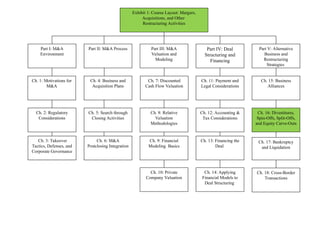
Exhibit 1: Course Layout: Mergers,
Acquisitions, and Other
Restructuring Activities
Part IV: Deal
Structuring and
Financing
Part II: M&A Process
Part I: M&A
Environment
Ch. 11: Payment and
Legal Considerations
Ch. 7: Discounted
Cash Flow Valuation
Ch. 9: Financial
Modeling Basics
Ch. 6: M&A
Postclosing Integration
Ch. 4: Business and
Acquisition Plans
Ch. 5: Search through
Closing Activities
Part V: Alternative
Business and
Restructuring
Strategies
Ch. 12: Accounting &
Tax Considerations
Ch. 15: Business
Alliances
Ch. 16: Divestitures,
Spin-Offs, Split-Offs,
and Equity Carve-Outs
Ch. 17: Bankruptcy
and Liquidation
Ch. 2: Regulatory
Considerations
Ch. 1: Motivations for
M&A
Part III: M&A
Valuation and
Modeling
Ch. 3: Takeover
Tactics, Defenses, and
Corporate Governance
Ch. 13: Financing the
Deal
Ch. 8: Relative
Valuation
Methodologies
Ch. 18: Cross-Border
Transactions
Ch. 14: Applying
Financial Models to
Deal Structuring
Ch. 10: Private
Company Valuation
Learning Objectives
• Primary Learning Objective: To provide students
with an understanding of alternative exit and
restructuring strategies.
• Secondary Learning Objectives: To provide
students with an understanding of
– Divestiture, spin-off, split-up, equity carve-out,
split-off, and tracking stock strategies
– Criteria for choosing strategy for viable firms
– Options for failing firms
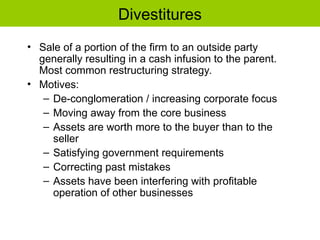
Divestitures
• Sale of a portion of the firm to an outside party
generally resulting in a cash infusion to the parent.
Most common restructuring strategy.
• Motives:
– De-conglomeration / increasing corporate focus
– Moving away from the core business
– Assets are worth more to the buyer than to the
seller
– Satisfying government requirements
– Correcting past mistakes
– Assets have been interfering with profitable
operation of other businesses
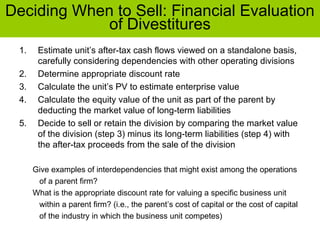
Deciding When to Sell: Financial Evaluation
of Divestitures
1. Estimate unit’s after-tax cash flows viewed on a standalone basis,
carefully considering dependencies with other operating divisions
2. Determine appropriate discount rate
3. Calculate the unit’s PV to estimate enterprise value
4. Calculate the equity value of the unit as part of the parent by
deducting the market value of long-term liabilities
5. Decide to sell or retain the division by comparing the market value
of the division (step 3) minus its long-term liabilities (step 4) with
the after-tax proceeds from the sale of the division
Give examples of interdependencies that might exist among the operations
of a parent firm?
What is the appropriate discount rate for valuing a specific business unit
within a parent firm? (i.e., the parent’s cost of capital or the cost of capital
of the industry in which the business unit competes)
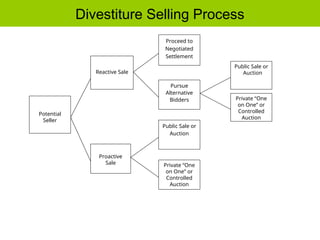
Potential
Seller
Reactive Sale
Proceed to
Negotiated
Settlement
Pursue
Alternative
Bidders
Public Sale or
Auction
Private “One
on One” or
Controlled
Auction
Proactive
Sale
Public Sale or
Auction
Private “One
on One” or
Controlled
Auction
Divestiture Selling Process
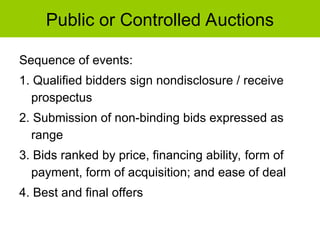
Public or Controlled Auctions
Sequence of events:
1. Qualified bidders sign nondisclosure / receive
prospectus
2. Submission of non-binding bids expressed as
range
3. Bids ranked by price, financing ability, form of
payment, form of acquisition; and ease of deal
4. Best and final offers
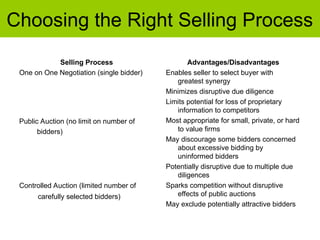
Choosing the Right Selling Process
Selling Process
One on One Negotiation (single bidder)
Public Auction (no limit on number of
bidders)
Controlled Auction (limited number of
carefully selected bidders)
Advantages/Disadvantages
Enables seller to select buyer with
greatest synergy
Minimizes disruptive due diligence
Limits potential for loss of proprietary
information to competitors
Most appropriate for small, private, or hard
to value firms
May discourage some bidders concerned
about excessive bidding by
uninformed bidders
Potentially disruptive due to multiple due
diligences
Sparks competition without disruptive
effects of public auctions
May exclude potentially attractive bidders
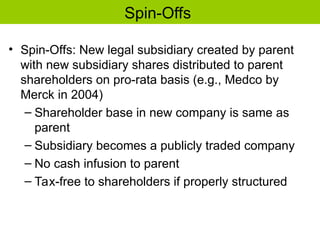
Spin-Offs
• Spin-Offs: New legal subsidiary created by parent
with new subsidiary shares distributed to parent
shareholders on pro-rata basis (e.g., Medco by
Merck in 2004)
– Shareholder base in new company is same as
parent
– Subsidiary becomes a publicly traded company
– No cash infusion to parent
– Tax-free to shareholders if properly structured
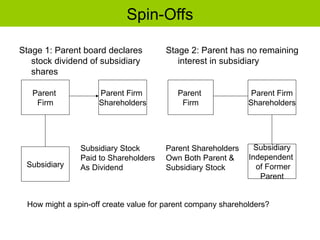
Spin-Offs
Stage 1: Parent board declares
stock dividend of subsidiary
shares
Stage 2: Parent has no remaining
interest in subsidiary
Parent
Firm
Parent Firm
Shareholders
Subsidiary
Parent
Firm
Parent Firm
Shareholders
Subsidiary
Independent
of Former
Parent
Subsidiary Stock
Paid to Shareholders
As Dividend
Parent Shareholders
Own Both Parent &
Subsidiary Stock
How might a spin-off create value for parent company shareholders?
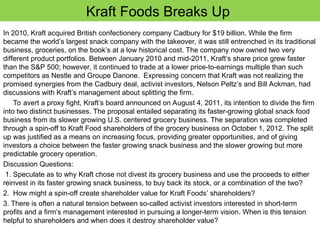
Kraft Foods Breaks Up
In 2010, Kraft acquired British confectionery company Cadbury for $19 billion. While the firm
became the world’s largest snack company with the takeover, it was still entrenched in its traditional
business, groceries, on the book’s at a low historical cost. The company now owned two very
different product portfolios. Between January 2010 and mid-2011, Kraft’s share price grew faster
than the S&P 500; however, it continued to trade at a lower price-to-earnings multiple than such
competitors as Nestle and Groupe Danone. Expressing concern that Kraft was not realizing the
promised synergies from the Cadbury deal, activist investors, Nelson Peltz’s and Bill Ackman, had
discussions with Kraft’s management about splitting the firm.
To avert a proxy fight, Kraft’s board announced on August 4, 2011, its intention to divide the firm
into two distinct businesses. The proposal entailed separating its faster-growing global snack food
business from its slower growing U.S. centered grocery business. The separation was completed
through a spin-off to Kraft Food shareholders of the grocery business on October 1, 2012. The split
up was justified as a means on increasing focus, providing greater opportunities, and of giving
investors a choice between the faster growing snack business and the slower growing but more
predictable grocery operation.
Discussion Questions:
1. Speculate as to why Kraft chose not divest its grocery business and use the proceeds to either
reinvest in its faster growing snack business, to buy back its stock, or a combination of the two?
2. How might a spin-off create shareholder value for Kraft Foods’ shareholders?
3. There is often a natural tension between so-called activist investors interested in short-term
profits and a firm’s management interested in pursuing a longer-term vision. When is this tension
helpful to shareholders and when does it destroy shareholder value?
Equity Carve-outs
• Two forms: Initial public offering (IPO) and subsidiary equity carve-out
• IPOs represent the first offering of stock to the public of all or a portion of
the equity of a formerly privately held firm (e.g., UPS sells 9% of its
shares in 1999) or a reorganized firm emerging from bankruptcy (e.g.,
GM in 2010)
– The cash may be retained by the parent or returned to shareholders
• Subsidiary equity carve-out is a transaction in which the parent sells a
portion of the stock of a wholly-owned subsidiary to the public. (e.g.,
Phillip Morris’ 2001 sale of 15% of its Kraft subsidiary)
– The cash may be invested in the subsidiary, retained by the parent,
used to pay off parent or subsidiary debt, or returned to the parent’s
shareholders
– Although the parent generally sells less than 20% of the sub’s equity,
the sub’s shareholder base may be different than that of the parent
In addition to generating cash, what other motivations may a parent firm have in
undertaking an equity carve-out?
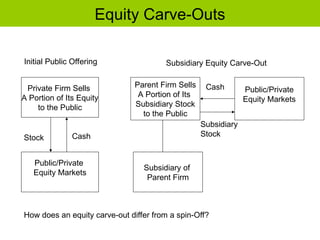
Equity Carve-Outs
Private Firm Sells
A Portion of Its Equity
to the Public
Public/Private
Equity Markets
Parent Firm Sells
A Portion of Its
Subsidiary Stock
to the Public
Public/Private
Equity Markets
Subsidiary of
Parent Firm
Initial Public Offering Subsidiary Equity Carve-Out
Cash
Stock
Subsidiary
Stock
Cash
How does an equity carve-out differ from a spin-Off?
Tracking Stocks
• Separate classes of common stock created by the parent for one or more
of its operating units (e.g., USX creates Marathon Oil stock in 1991)
• Each class of stock links the shareholder’s return to the performance of
the individual operating unit
• For the investor, such shares enable investment in a single operating unit
(i.e., a pure play) rather than in the parent
• For the parent and the operating unit, such shares
– Give the parent another means of raising capital,
– Enable parent to retain control
– Represent an “acquisition currency” for the unit, and
– Provide an equity-based incentive plan to attract and maintain key
managers
• May create conflict of interest
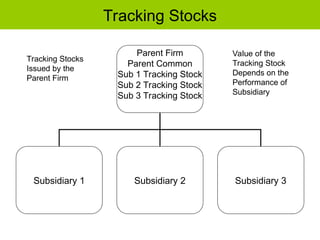
Tracking Stocks
Parent Firm
Parent Common
Sub 1 Tracking Stock
Sub 2 Tracking Stock
Sub 3 Tracking Stock
Subsidiary 1 Subsidiary 2 Subsidiary 3
Tracking Stocks
Issued by the
Parent Firm
Value of the
Tracking Stock
Depends on the
Performance of
Subsidiary
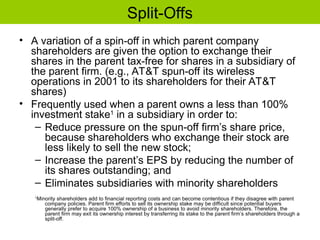
Split-Offs
• A variation of a spin-off in which parent company
shareholders are given the option to exchange their
shares in the parent tax-free for shares in a subsidiary of
the parent firm. (e.g., AT&T spun-off its wireless
operations in 2001 to its shareholders for their AT&T
shares)
• Frequently used when a parent owns a less than 100%
investment stake1
in a subsidiary in order to:
– Reduce pressure on the spun-off firm’s share price,
because shareholders who exchange their stock are
less likely to sell the new stock;
– Increase the parent’s EPS by reducing the number of
its shares outstanding; and
– Eliminates subsidiaries with minority shareholders
1
Minority shareholders add to financial reporting costs and can become contentious if they disagree with parent
company policies. Parent firm efforts to sell its ownership stake may be difficult since potential buyers
generally prefer to acquire 100% ownership of a business to avoid minority shareholders. Therefore, the
parent firm may exit its ownership interest by transferring its stake to the parent firm’s shareholders through a
split-off.
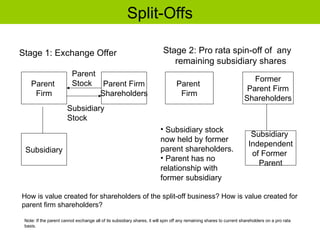
Split-Offs
Stage 1: Exchange Offer Stage 2: Pro rata spin-off of any
remaining subsidiary shares
Parent
Firm
Parent Firm
Shareholders
Subsidiary
Parent
Firm
Former
Parent Firm
Shareholders
Subsidiary
Independent
of Former
Parent
Subsidiary
Stock
• Subsidiary stock
now held by former
parent shareholders.
• Parent has no
relationship with
former subsidiary
Parent
Stock
Note: If the parent cannot exchange all of its subsidiary shares, it will spin off any remaining shares to current shareholders on a pro rata
basis.
How is value created for shareholders of the split-off business? How is value created for
parent firm shareholders?
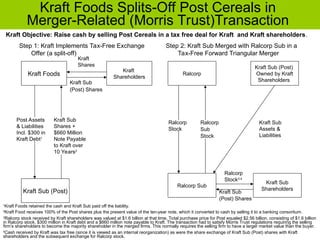
Kraft Foods Splits-Off Post Cereals in
Merger-Related (Morris Trust)Transaction
Step 1: Kraft Implements Tax-Free Exchange
Offer (a split-off)
Step 2: Kraft Sub Merged with Ralcorp Sub in a
Tax-Free Forward Triangular Merger
Kraft Foods
Kraft
Shareholders
Kraft Sub (Post)
Post Assets
& Liabilities
Incl. $300 in
Kraft Debt1
Kraft Sub
Shares +
$660 Million
Note Payable
to Kraft over
10 Years2
Kraft
Shares
Kraft Sub
(Post) Shares
Ralcorp
Kraft Sub (Post)
Owned by Kraft
Shareholders
Ralcorp Sub
Kraft Sub
Shareholders
Ralcorp
Stock
Ralcorp
Sub
Stock
Ralcorp
Stock3,4
Kraft Sub
Assets &
Liabilities
Kraft Sub
(Post) Shares
1
Kraft Foods retained the cash and Kraft Sub paid off the liability.
2
Kraft Food receives 100% of the Post shares plus the present value of the ten-year note, which it converted to cash by selling it to a banking consortium.
3
Ralcorp stock received by Kraft shareholders was valued at $1.6 billion at that time. Total purchase price for Post equaled $2.56 billion, consisting of $1.6 billion
in Ralcorp stock, $300 million in Kraft debt and a $660 million note payable to Kraft. The transaction had to satisfy Morris Trust regulations requiring the selling
firm’s shareholders to become the majority shareholder in the merged firms. This normally requires the selling firm to have a larger market value than the buyer.
4
Cash received by Kraft was tax free (since it is viewed as an internal reorganization) as were the share exchange of Kraft Sub (Post) shares with Kraft
shareholders and the subsequent exchange for Ralcorp stock.
Kraft Objective: Raise cash by selling Post Cereals in a tax free deal for Kraft and Kraft shareholders.
Voluntary Liquidations or Bust-Ups
• Involves the sale of all of a firm’s individual
operating units
• After paying off any remaining outstanding
liabilities, after-tax proceeds are returned to the
parent’s shareholders and the corporate shell is
dissolved
• This option may be pursued if management
views the growth prospects of the consolidated
firm as limited
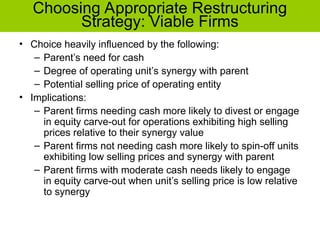
Choosing Appropriate Restructuring
Strategy: Viable Firms
• Choice heavily influenced by the following:
– Parent’s need for cash
– Degree of operating unit’s synergy with parent
– Potential selling price of operating entity
• Implications:
– Parent firms needing cash more likely to divest or engage
in equity carve-out for operations exhibiting high selling
prices relative to their synergy value
– Parent firms not needing cash more likely to spin-off units
exhibiting low selling prices and synergy with parent
– Parent firms with moderate cash needs likely to engage
in equity carve-out when unit’s selling price is low relative
to synergy
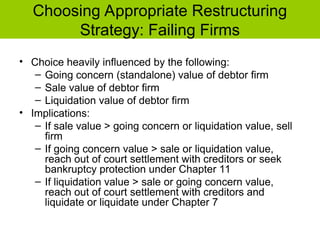
Choosing Appropriate Restructuring
Strategy: Failing Firms
• Choice heavily influenced by the following:
– Going concern (standalone) value of debtor firm
– Sale value of debtor firm
– Liquidation value of debtor firm
• Implications:
– If sale value > going concern or liquidation value, sell
firm
– If going concern value > sale or liquidation value,
reach out of court settlement with creditors or seek
bankruptcy protection under Chapter 11
– If liquidation value > sale or going concern value,
reach out of court settlement with creditors and
liquidate or liquidate under Chapter 7
Discussion Questions
1. Divestitures, equity carve-outs, and spin-offs
represent alternative restructuring strategies?
Explain the primary advantages and
disadvantages of each.
2. Under what circumstances might senior
management prefer to divest a business unit
rather than to spin-off the business?
3. Under what circumstances might senior
management prefer an equity carve-out to a
spin-off?
Quick Quiz
An equity carve-out differs from a spin-off for all but which
one of the following reasons?
a. Generates a cash infusion into the parent
b. Is undertaken when the unit has very little synergy
with the parent
c. The proceeds often are taxable to the parent
d. Continues to be influenced by the parent’s e.
management and board
e. The carve-out’s shareholders may differ from those
of the parent’s shareholders
Things to Remember…
• Divestitures, spin-offs, equity carve-outs, split-
ups, split-offs, and tracking stock are common
restructuring strategies to enhance shareholder
value
• Divestitures and equity carve-outs are more
likely for operating units whose selling price is
much higher than its perceived synergy with
parent and whose parents need cash
• Spin-offs are more likely for operating units
whose selling price and synergy are low and
whose parent firm does not need cash

Chapter 16 Alternative Restructurng Strategies.ppt

  • 1.
  • 2.
    Experience is thename everyone gives to their mistakes. — Oscar Wilde
  • 3.
    Exhibit 1: CourseLayout: Mergers, Acquisitions, and Other Restructuring Activities Part IV: Deal Structuring and Financing Part II: M&A Process Part I: M&A Environment Ch. 11: Payment and Legal Considerations Ch. 7: Discounted Cash Flow Valuation Ch. 9: Financial Modeling Basics Ch. 6: M&A Postclosing Integration Ch. 4: Business and Acquisition Plans Ch. 5: Search through Closing Activities Part V: Alternative Business and Restructuring Strategies Ch. 12: Accounting & Tax Considerations Ch. 15: Business Alliances Ch. 16: Divestitures, Spin-Offs, Split-Offs, and Equity Carve-Outs Ch. 17: Bankruptcy and Liquidation Ch. 2: Regulatory Considerations Ch. 1: Motivations for M&A Part III: M&A Valuation and Modeling Ch. 3: Takeover Tactics, Defenses, and Corporate Governance Ch. 13: Financing the Deal Ch. 8: Relative Valuation Methodologies Ch. 18: Cross-Border Transactions Ch. 14: Applying Financial Models to Deal Structuring Ch. 10: Private Company Valuation
  • 4.
    Learning Objectives • PrimaryLearning Objective: To provide students with an understanding of alternative exit and restructuring strategies. • Secondary Learning Objectives: To provide students with an understanding of – Divestiture, spin-off, split-up, equity carve-out, split-off, and tracking stock strategies – Criteria for choosing strategy for viable firms – Options for failing firms
  • 5.
    Divestitures • Sale ofa portion of the firm to an outside party generally resulting in a cash infusion to the parent. Most common restructuring strategy. • Motives: – De-conglomeration / increasing corporate focus – Moving away from the core business – Assets are worth more to the buyer than to the seller – Satisfying government requirements – Correcting past mistakes – Assets have been interfering with profitable operation of other businesses
  • 6.
    Deciding When toSell: Financial Evaluation of Divestitures 1. Estimate unit’s after-tax cash flows viewed on a standalone basis, carefully considering dependencies with other operating divisions 2. Determine appropriate discount rate 3. Calculate the unit’s PV to estimate enterprise value 4. Calculate the equity value of the unit as part of the parent by deducting the market value of long-term liabilities 5. Decide to sell or retain the division by comparing the market value of the division (step 3) minus its long-term liabilities (step 4) with the after-tax proceeds from the sale of the division Give examples of interdependencies that might exist among the operations of a parent firm? What is the appropriate discount rate for valuing a specific business unit within a parent firm? (i.e., the parent’s cost of capital or the cost of capital of the industry in which the business unit competes)
  • 7.
    Potential Seller Reactive Sale Proceed to Negotiated Settlement Pursue Alternative Bidders PublicSale or Auction Private “One on One” or Controlled Auction Proactive Sale Public Sale or Auction Private “One on One” or Controlled Auction Divestiture Selling Process
  • 8.
    Public or ControlledAuctions Sequence of events: 1. Qualified bidders sign nondisclosure / receive prospectus 2. Submission of non-binding bids expressed as range 3. Bids ranked by price, financing ability, form of payment, form of acquisition; and ease of deal 4. Best and final offers
  • 9.
    Choosing the RightSelling Process Selling Process One on One Negotiation (single bidder) Public Auction (no limit on number of bidders) Controlled Auction (limited number of carefully selected bidders) Advantages/Disadvantages Enables seller to select buyer with greatest synergy Minimizes disruptive due diligence Limits potential for loss of proprietary information to competitors Most appropriate for small, private, or hard to value firms May discourage some bidders concerned about excessive bidding by uninformed bidders Potentially disruptive due to multiple due diligences Sparks competition without disruptive effects of public auctions May exclude potentially attractive bidders
  • 10.
    Spin-Offs • Spin-Offs: Newlegal subsidiary created by parent with new subsidiary shares distributed to parent shareholders on pro-rata basis (e.g., Medco by Merck in 2004) – Shareholder base in new company is same as parent – Subsidiary becomes a publicly traded company – No cash infusion to parent – Tax-free to shareholders if properly structured
  • 11.
    Spin-Offs Stage 1: Parentboard declares stock dividend of subsidiary shares Stage 2: Parent has no remaining interest in subsidiary Parent Firm Parent Firm Shareholders Subsidiary Parent Firm Parent Firm Shareholders Subsidiary Independent of Former Parent Subsidiary Stock Paid to Shareholders As Dividend Parent Shareholders Own Both Parent & Subsidiary Stock How might a spin-off create value for parent company shareholders?
  • 12.
    Kraft Foods BreaksUp In 2010, Kraft acquired British confectionery company Cadbury for $19 billion. While the firm became the world’s largest snack company with the takeover, it was still entrenched in its traditional business, groceries, on the book’s at a low historical cost. The company now owned two very different product portfolios. Between January 2010 and mid-2011, Kraft’s share price grew faster than the S&P 500; however, it continued to trade at a lower price-to-earnings multiple than such competitors as Nestle and Groupe Danone. Expressing concern that Kraft was not realizing the promised synergies from the Cadbury deal, activist investors, Nelson Peltz’s and Bill Ackman, had discussions with Kraft’s management about splitting the firm. To avert a proxy fight, Kraft’s board announced on August 4, 2011, its intention to divide the firm into two distinct businesses. The proposal entailed separating its faster-growing global snack food business from its slower growing U.S. centered grocery business. The separation was completed through a spin-off to Kraft Food shareholders of the grocery business on October 1, 2012. The split up was justified as a means on increasing focus, providing greater opportunities, and of giving investors a choice between the faster growing snack business and the slower growing but more predictable grocery operation. Discussion Questions: 1. Speculate as to why Kraft chose not divest its grocery business and use the proceeds to either reinvest in its faster growing snack business, to buy back its stock, or a combination of the two? 2. How might a spin-off create shareholder value for Kraft Foods’ shareholders? 3. There is often a natural tension between so-called activist investors interested in short-term profits and a firm’s management interested in pursuing a longer-term vision. When is this tension helpful to shareholders and when does it destroy shareholder value?
  • 13.
    Equity Carve-outs • Twoforms: Initial public offering (IPO) and subsidiary equity carve-out • IPOs represent the first offering of stock to the public of all or a portion of the equity of a formerly privately held firm (e.g., UPS sells 9% of its shares in 1999) or a reorganized firm emerging from bankruptcy (e.g., GM in 2010) – The cash may be retained by the parent or returned to shareholders • Subsidiary equity carve-out is a transaction in which the parent sells a portion of the stock of a wholly-owned subsidiary to the public. (e.g., Phillip Morris’ 2001 sale of 15% of its Kraft subsidiary) – The cash may be invested in the subsidiary, retained by the parent, used to pay off parent or subsidiary debt, or returned to the parent’s shareholders – Although the parent generally sells less than 20% of the sub’s equity, the sub’s shareholder base may be different than that of the parent In addition to generating cash, what other motivations may a parent firm have in undertaking an equity carve-out?
  • 14.
    Equity Carve-Outs Private FirmSells A Portion of Its Equity to the Public Public/Private Equity Markets Parent Firm Sells A Portion of Its Subsidiary Stock to the Public Public/Private Equity Markets Subsidiary of Parent Firm Initial Public Offering Subsidiary Equity Carve-Out Cash Stock Subsidiary Stock Cash How does an equity carve-out differ from a spin-Off?
  • 15.
    Tracking Stocks • Separateclasses of common stock created by the parent for one or more of its operating units (e.g., USX creates Marathon Oil stock in 1991) • Each class of stock links the shareholder’s return to the performance of the individual operating unit • For the investor, such shares enable investment in a single operating unit (i.e., a pure play) rather than in the parent • For the parent and the operating unit, such shares – Give the parent another means of raising capital, – Enable parent to retain control – Represent an “acquisition currency” for the unit, and – Provide an equity-based incentive plan to attract and maintain key managers • May create conflict of interest
  • 16.
    Tracking Stocks Parent Firm ParentCommon Sub 1 Tracking Stock Sub 2 Tracking Stock Sub 3 Tracking Stock Subsidiary 1 Subsidiary 2 Subsidiary 3 Tracking Stocks Issued by the Parent Firm Value of the Tracking Stock Depends on the Performance of Subsidiary
  • 17.
    Split-Offs • A variationof a spin-off in which parent company shareholders are given the option to exchange their shares in the parent tax-free for shares in a subsidiary of the parent firm. (e.g., AT&T spun-off its wireless operations in 2001 to its shareholders for their AT&T shares) • Frequently used when a parent owns a less than 100% investment stake1 in a subsidiary in order to: – Reduce pressure on the spun-off firm’s share price, because shareholders who exchange their stock are less likely to sell the new stock; – Increase the parent’s EPS by reducing the number of its shares outstanding; and – Eliminates subsidiaries with minority shareholders 1 Minority shareholders add to financial reporting costs and can become contentious if they disagree with parent company policies. Parent firm efforts to sell its ownership stake may be difficult since potential buyers generally prefer to acquire 100% ownership of a business to avoid minority shareholders. Therefore, the parent firm may exit its ownership interest by transferring its stake to the parent firm’s shareholders through a split-off.
  • 18.
    Split-Offs Stage 1: ExchangeOffer Stage 2: Pro rata spin-off of any remaining subsidiary shares Parent Firm Parent Firm Shareholders Subsidiary Parent Firm Former Parent Firm Shareholders Subsidiary Independent of Former Parent Subsidiary Stock • Subsidiary stock now held by former parent shareholders. • Parent has no relationship with former subsidiary Parent Stock Note: If the parent cannot exchange all of its subsidiary shares, it will spin off any remaining shares to current shareholders on a pro rata basis. How is value created for shareholders of the split-off business? How is value created for parent firm shareholders?
  • 19.
    Kraft Foods Splits-OffPost Cereals in Merger-Related (Morris Trust)Transaction Step 1: Kraft Implements Tax-Free Exchange Offer (a split-off) Step 2: Kraft Sub Merged with Ralcorp Sub in a Tax-Free Forward Triangular Merger Kraft Foods Kraft Shareholders Kraft Sub (Post) Post Assets & Liabilities Incl. $300 in Kraft Debt1 Kraft Sub Shares + $660 Million Note Payable to Kraft over 10 Years2 Kraft Shares Kraft Sub (Post) Shares Ralcorp Kraft Sub (Post) Owned by Kraft Shareholders Ralcorp Sub Kraft Sub Shareholders Ralcorp Stock Ralcorp Sub Stock Ralcorp Stock3,4 Kraft Sub Assets & Liabilities Kraft Sub (Post) Shares 1 Kraft Foods retained the cash and Kraft Sub paid off the liability. 2 Kraft Food receives 100% of the Post shares plus the present value of the ten-year note, which it converted to cash by selling it to a banking consortium. 3 Ralcorp stock received by Kraft shareholders was valued at $1.6 billion at that time. Total purchase price for Post equaled $2.56 billion, consisting of $1.6 billion in Ralcorp stock, $300 million in Kraft debt and a $660 million note payable to Kraft. The transaction had to satisfy Morris Trust regulations requiring the selling firm’s shareholders to become the majority shareholder in the merged firms. This normally requires the selling firm to have a larger market value than the buyer. 4 Cash received by Kraft was tax free (since it is viewed as an internal reorganization) as were the share exchange of Kraft Sub (Post) shares with Kraft shareholders and the subsequent exchange for Ralcorp stock. Kraft Objective: Raise cash by selling Post Cereals in a tax free deal for Kraft and Kraft shareholders.
  • 20.
    Voluntary Liquidations orBust-Ups • Involves the sale of all of a firm’s individual operating units • After paying off any remaining outstanding liabilities, after-tax proceeds are returned to the parent’s shareholders and the corporate shell is dissolved • This option may be pursued if management views the growth prospects of the consolidated firm as limited
  • 21.
    Choosing Appropriate Restructuring Strategy:Viable Firms • Choice heavily influenced by the following: – Parent’s need for cash – Degree of operating unit’s synergy with parent – Potential selling price of operating entity • Implications: – Parent firms needing cash more likely to divest or engage in equity carve-out for operations exhibiting high selling prices relative to their synergy value – Parent firms not needing cash more likely to spin-off units exhibiting low selling prices and synergy with parent – Parent firms with moderate cash needs likely to engage in equity carve-out when unit’s selling price is low relative to synergy
  • 22.
    Choosing Appropriate Restructuring Strategy:Failing Firms • Choice heavily influenced by the following: – Going concern (standalone) value of debtor firm – Sale value of debtor firm – Liquidation value of debtor firm • Implications: – If sale value > going concern or liquidation value, sell firm – If going concern value > sale or liquidation value, reach out of court settlement with creditors or seek bankruptcy protection under Chapter 11 – If liquidation value > sale or going concern value, reach out of court settlement with creditors and liquidate or liquidate under Chapter 7
  • 23.
    Discussion Questions 1. Divestitures,equity carve-outs, and spin-offs represent alternative restructuring strategies? Explain the primary advantages and disadvantages of each. 2. Under what circumstances might senior management prefer to divest a business unit rather than to spin-off the business? 3. Under what circumstances might senior management prefer an equity carve-out to a spin-off?
  • 24.
    Quick Quiz An equitycarve-out differs from a spin-off for all but which one of the following reasons? a. Generates a cash infusion into the parent b. Is undertaken when the unit has very little synergy with the parent c. The proceeds often are taxable to the parent d. Continues to be influenced by the parent’s e. management and board e. The carve-out’s shareholders may differ from those of the parent’s shareholders
  • 25.
    Things to Remember… •Divestitures, spin-offs, equity carve-outs, split- ups, split-offs, and tracking stock are common restructuring strategies to enhance shareholder value • Divestitures and equity carve-outs are more likely for operating units whose selling price is much higher than its perceived synergy with parent and whose parents need cash • Spin-offs are more likely for operating units whose selling price and synergy are low and whose parent firm does not need cash

Editor's Notes

  • #4 Prof. Notes: The focus in this lecture is on alternative means of maximizing shareholder value through “exit” and restructuring strategies. Such strategies are in marked contrast to more conventional growth strategies involving value creation through the reinvestment of internally generated cash flow and through mergers and acquisitions.
  • #5 Prof. Notes: While divestitures usually result in a cash infusion, sometimes a parent divests a business in order to minimize recurring losses and receives nothing from the buyer in the form of cash, stock, or debt. The purchase price paid by the buyer is the present value of assumed liabilities. In many instances, where the impact of future liabilities (such as environmental liabilities) is largely unknown, the seller will agree to indemnify the buyer for future expenses up to a specific amount. Motives: Numerous studies have documented the so-called “conglomerate discount” or discount from intrinsic value that conglomerates experience. To improve operating performance and to increase the ease with which investors can value the business, firms have increasing moved to increase their focus on a relatively few product lines. As the pace of technological change accelerates, businesses are increasingly forced to shift their business focus (e.g., Apple away from PC hardware and software to consumer electronics). Often reflecting the effort by large corporations to increase their focus or to realign their focus, private equity firms are able to buy a product line or business and improve its operating performance by making decisions that the previous parent was unable or unwilling to do. Such decisions include downsizing, increasing focus, reducing the size of the product offering, increasing operational monitoring, and utilizing leverage to magnify financial returns. Antitrust approval often requires firms undergoing mergers to divest overlapping businesses. Large firms often acquire firms with the intent of operating them more efficiently and later learning that they cannot do so because of the parent’s substantial overhead expense. This factor, coupled the trend toward increasing corporate focus, forces firms to make divestitures. Strategy changes often puts parent firms in a position where their prior businesses conflict with their new focus. AT&T felt compelled to spin-off Lucent which sold telecommunications equipment to other telecommunications companies who competed against AT&T.
  • #6 Prof. Notes: Intra-company dependencies include products made by one unit that are used by other operating units or operating units whose products are sold to the same customers as packages of goods. Even though the after-tax sale value of a unit may exceed its standalone value to the parent, the parent firm may choose not to sell because the profitability of other units is partially dependent on the unit under consideration for sale. The appropriate discount rate would be that reflecting the risk of the industry in which the firm’s operating unit competes.
  • #7 Prof. Notes: Proactive sales differ from reactive in that the firm is intentionally marketing a business rather than responding to a largely unanticipated expression of interest in a business. Public sales (auctions) involve the selling firm making public its intention to divest a specific business as opposed to selectively and clandestinely approaching one or more potential buyers.
  • #8 Prof. Notes: While public solicitations attract many bidders, they are often unqualified financially to complete the transaction. Also, a public pronouncement may endanger the unit’s operations by encouraging employee, supplier, and customer attrition. Private solicitations enable the seller to better control the selling process by pre-selecting who would be contacted and could encourage more qualified bidders to participate. Often, qualified bidders are discouraged from participating in a public auction because they are concerned that comparatively uninformed bidders will bid the price to excessive levels. Price is not always the deciding factor for the seller in determining who to select as a buyer in an auction. Other considerations include how easily the buyer can finance the transaction, whether the form of payment is satisfactory to the seller, whether the buyer is willing to buy assets or stock, and finally the “ease of deal” factor. Is the potential buyer reliable and reputable? Can the deal be done quickly or will it be tied up by the regulators?
  • #9 Prof. Notes: Many sophisticated buyers will not participate in a public auction.
  • #10 Prof. Notes: Spin-offs are undertaken to avoid the disruptive effects of the selling process, because they are tax-free if properly structured, as a means of rewarding selling firm shareholders, and to gain greater focus for the parent when the parent does not need a cash infusion and when there is limited synergy between the parent and the unit to be spun-off.
  • #11 Prof. Notes: The parent has no relationship to the spun-off unit after the transaction has been completed. The parent firm shareholders has two shares: one in the parent and one in the spun-off unit. In theory, the value of the parent’s stock will decline by the value of the unit that was spun-off. However, the shareholder will be made better off if the spun-off unit is able to grow more rapidly now that it is independent of the parent or is acquired by another firm. Once independent of the parent, theory suggests that the firm can become more profitable because its management is more focused and more in tune with the markets in which it participates and that the firm can use its own shares to provide incentive options to its management and to acquire other firms.
  • #12 Prof. Notes: Discussion Questions:   1. Speculate as to why Kraft chose not to divest its grocery business and use the proceeds to either reinvest in its faster growing snack business, to buy back its stock, or a combination of the two?   Answer: Many of Kraft’s grocery brands were quite old and the firm’s tax basis was probably quite low. A divestiture would have resulted in a huge tax liability to the firm and have significantly reduced the after-tax proceeds available for reinvesting in the remaining snack businesses or to buy back stock or to raise dividends. Furthermore, a divestiture would have resulted in double taxation, with the corporation paying taxes on any gains on the sale and shareholders paying taxes on dividends or any capital gains resulting from share buybacks. In addition, it may have been impractical to sell the entire grocery business to a single buyer for antitrust reasons. Consequently, the effort to sell the individual brands could have been lengthy and could have degraded value given the impact of due diligence performed by multiple potential buyers. A spin-off, in contrast, represents a faster, cleaner means of increasing the firm’s focus.   2. How might a spin-off create shareholder value for Kraft Foods shareholders?   Answer: Spin-offs create value for shareholders in a variety of ways. First, if properly structured, they are tax-free to the parent firm’s shareholders. Second, shareholders can determine the timing of their sale of the shares. Third, units that have been spun-off may be acquired by a firm looking for a “pure play.” Fourth, units that have been spun-off may be able to make better decisions than when they were part of a larger organization and have their own shares with which they can make acquisitions.   3. There is often a natural tension between so-called activist investors interested in short-term profits and a firm’s management interested in pursuing a longer-term vision. When is this tension helpful to shareholders and when does it destroy shareholder value?   Answer: If a firm’s current strategy is faltering, activist investors can force a change in direction. While the firm’s share price did grow in excess of the S&P 500 index since 2010, it is unclear if activist investors gave the Kraft enough time to test its business strategy. Eighteen months is a relatively short time period in which to realize revenue and cost synergies. What may have happened is that the firm was not realizing synergies at the same rate as promised in its acquisition plan. Investor impatience often is a major factor encouraging a public firm to go private in order to gain time to implement fully its business plan.
  • #13 Prof. Notes: Carve-outs are undertaken to value a business unit, to raise funds, to create a market for stock that can be used to provide incentive options for the unit’s management, and to provide a currency to enable the unit to acquire other firms. Carve-outs are often used rather than a divestiture or spin-off if the parent believes there is synergy between it and the parent’s other units. Carve-outs create value for the parent shareholders if the cash generated can be reinvested at or above the parent’s cost of capital, used to reduce debt which lowers the risk associated with the firm, or highlights the value of a subsidiary which had previously been undervalued by the parent’s shareholders. Other motives for undertaking an equity carve-out (other than for cash generation) include placing a value on the subsidiary, raising cash without giving up synergy, creating an acquisition currency for the subsidiary, and providing equity that could be used to incentivize the subsidiary’s management.
  • #14 Prof. Notes: Carve-outs can be of the parent or of a subsidiary to the parent. Unlike a spin-off or divestiture, the parent retains an interest in the business. The carve-out also can create a tax liability for the parent firm and for shareholders if the proceeds are distributed to shareholders through a special dividend or share repurchase. The composition of the shareholders in an equity carve-out can include both parent shareholders and public shareholders, while in a spin-off the shareholders in the spun off unit remain the same as those in the parent.
  • #15 Prof. Notes: Tracking stocks often fail to increase shareholder value because the units for which the tracking stock is created is still subject to the oversight of the parent’s board of directors, which may not wholly understand the business. Tracking stocks may create conflicts of interest when the cash flows from one unit are transferred to another rather than paid out to those holding tracking stock in the unit whose cash flow is being reinvested elsewhere. This happened with USX when excess cash flows from Marathon Oil were routinely reinvested in US Steel.
  • #16 Prof. Notes: The key point is that tracking stock is simply another class of stock issued by the parent. As such, control after such stock is issued remains with the parent.
  • #17 Prof. Notes: Similar to a spin-off in that the parent will no longer have control over the unit after the transaction is completed. However, it differs in that the all parent shareholders do not automatically receive shares, but rather are given the option to exchange their parent shares for shares in the unit. Any shares that were not exchanged are usually spun-off by the parent to its shareholders on a pro rata basis such that parent is able to rid itself of all minority shareholders.
  • #18 Prof. Notes: Post-transaction, the parent has no relationship to the split-off unit, as is the case in a divestiture and spin-off. If properly structured, such transactions are tax-free to the parent’s shareholders. Value is created for shareholders of the split-off firm by allowing them to hold shares either in the parent firm or in the firm being split-off on a tax free basis. Moreover, they can choose to sell such shares when the feel it is most favorable. The split-off firm’s management is able to make investment decisions outside of the parent firm’s bureaucracy which may lack the appropriate knowledge of the business to make the best decisions. Such firms, once independent of the parent, may also become takeover targets. Value is created for parent firm shareholders since EPS is increased as a result of the split-off, parent firm management is better able to focus attention on the remaining businesses, and the expense associated with SEC reporting requirements and the need for a shareholders meeting and the distractions of having minority shareholders is eliminated.
  • #19 Prof. Notes: Kraft Objective: Sell Post Cereals in a tax-free transaction. While a tax-free reorganization or merger could have been undertaken with Kraft merging Post with Ralcorp, the split-off and subsequent merger resulted in Kraft borrowing $300 million, retaining the proceeds and transferring the responsibility to repay the debt to Post, and Kraft receiving a tax-free $600 million note payable from Post. Kraft borrowed the $300 million and transferred the associated debt to Kraft Sub (Post) in order to equalize the value between Kraft parent shares and Post shares that would be split-off in the exchange offer. To be tax-free to Kraft, the transaction had to satisfy Morris Trust regulations requiring the selling company shareholders to be the majority owner in the combined entity once the split-off Post unit was merged with Ralcorp. Note that by qualifying as a Morris Trust Transaction the transaction is tax free in that the Kraft Sub (Post) shareholders control a majority interest in the combined Ralcorp/Post business and the transaction is viewed as a reorganization rather than a sale. Hence, the Morris Trust transaction protects the tax-free status of the split-off, even though the merger subsequent to the split-off was part of a plan in which the two transactions were linked. Absent the qualifying as a Morris Trust transaction, the fact that the split-off and merger were part of a larger plan would have disallowed the tax free status of the split-off. In an ideal world, the impact of taxes on investment decisions would be neutral, such that taxes would not impact how the free market allocates capital. Resources would be transferred to those who can use them most efficiently, as they would be able to offer the highest risk adjusted financial returns. Value is created for both Kraft and Ralcorp shareholders in this type of a transaction as follows:’ Kraft shareholders participating in the split-off do so only if they believe the appreciation potential for the post Cereals shares is greater than for Kraft shares. No gain is realized until the Post Cereal shares are sold; therefore, no tax is owed when the split-off is implemented. This allows investors to change their investment strategy without the fear of paying taxes until a gain has been realized. By allowing the Post Cereals business to become independent of the Kraft bureaucracy, Post Cereals may be able to grow more rapidly and increase its profit, employment levels, and in turn pay more in taxes than it would have paid if it had remained part of Kraft. Ralcorp shareholders, 54 percent of whom are also Kraft shareholders, benefit to the extent Post Cereals is a better fit with Ralcorp than with Kraft. Furthermore, Kraft receives tax-free $960 million because of the intercompany transfer of assets and liabilities between Kraft and Kraft Sub which were then merged with Ralcorp Sub with Kraft retaining the cash. If Kraft were to have received the same amount of an after-tax basis by selling Post Cereals directly to Ralcorp, they would have had to receive a purchase price of $3.2 billion consisting of $1.6 billion in Ralcorp Stock and $1.6 billion in cash. Note the $1.6 billion in cash is equivalent to $960 million after-tax (i.e., $960/(1-.4), where .4 is the firm’s marginal tax rate.
  • #23 Prof. Notes: Advantages of a divestiture include the ability to rid the parent of a unit and to generally get a cash infusion; however, such transactions often are highly disruptive to the operations of the unit to be sold, resulting in the parent losing any synergy, and may be subject to double taxation: to the corporation and again to the shareholder if the proceeds of the sale are distributed to shareholders. Spin-offs enable the parent to escape the disruption associated with a sale, can be tax-free to shareholders and enable shareholders to determine the timing of when to realize any profit.; however, spin-offs do not provide any cash to the parent, force the parent to surrender any synergy with its other units, and may limit any restructuring activities subsequent to the transaction since the tax free status of the spin-off may be jeopardized if the unit is sold with several years of the spin-off. Equity carve-outs enable the parent to receive cash, maintain control and synergy, and value the unit; however, the parent forgoes realizing the full value of the unit if it had been divested. Divestitures are preferred to a spin-off when the parent does not need cash and is concerned about the deleterious impact of multiple due diligences performed on the unit to be sold. Equity carve-out is preferable to a spin-off when the parent needs cash, sees synergy between the unit and its other units, and is unsure of the unit’s true value.
  • #24 Prof. Notes: Answer: B