SHARED
VISION
Shared vision is one of the five disciplines identified by Peter Senge as
necessary to create a learning organization
A COMMON CARING
1
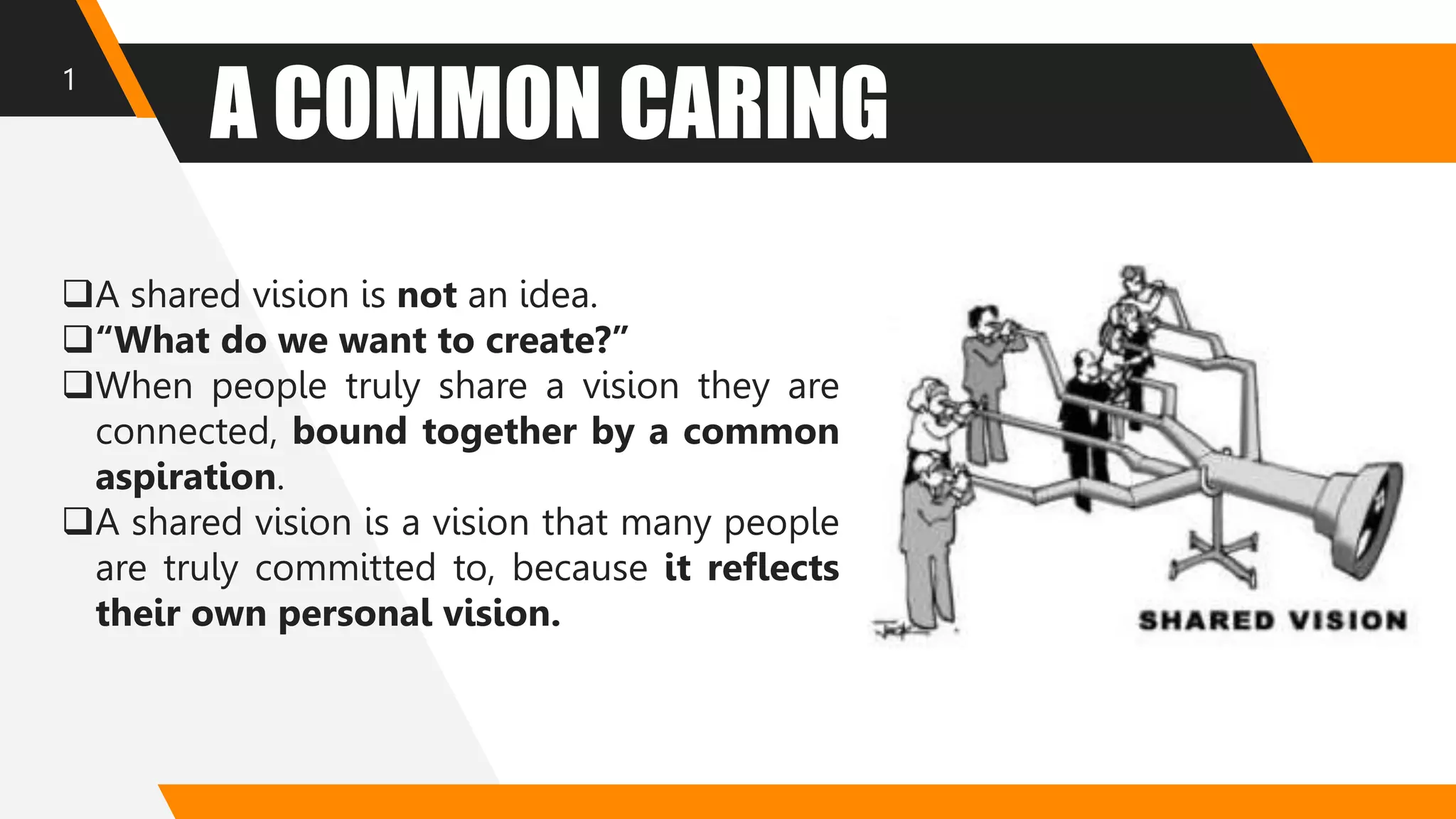
A shared vision is not an idea.
“What do we want to create?”
When people truly share a vision they are
connected, bound together by a common
aspiration.
A shared vision is a vision that many people
are truly committed to, because it reflects
their own personal vision.
WHY SHARED VISION MATTERS?
Visionaries like Henry Ford, Steve Jobs, Theodore Vail, Kennedy were
able to articulate their visions in ways that impacted people to join
with them.
Many shared visions are extrinsic – that is, they focus on achieving
something relative an outsider, such as competitor. Defensive
posture.
A shared vision, especially one that is intrinsic, uplifts people’s
aspiration.
Visions are exhilarating. They create the spark, the excitement that
lifts an organization out of the mundane.
THE DISCIPLINE OF BUILDING A
SHARED VISION
“Organizations intent on building shared visions continually encourage
members to develop their personal visions. If people don't have their
vision, all they can do is sign up for someone else’s” – Peter Senge, The
Fifth Discipline
Encouraging personal vision
“
“Shared vision equals a shared
sense of purpose”
From personal vision to shared vision
Shared vision as “hologram”
As the shared vision develops it becomes both “my vision”
and “our vision”.
THE DISCIPLINE OF BUILDING A SHARED VISION
From personal vision to shared vision
Visions are not always announced from “on high” or come from
an organization’s institutionalized planning processes.
In Top down vision, the results are often disappointing for
several reasons.
Vision is not a solution to a problem.
From personal vision to shared vision
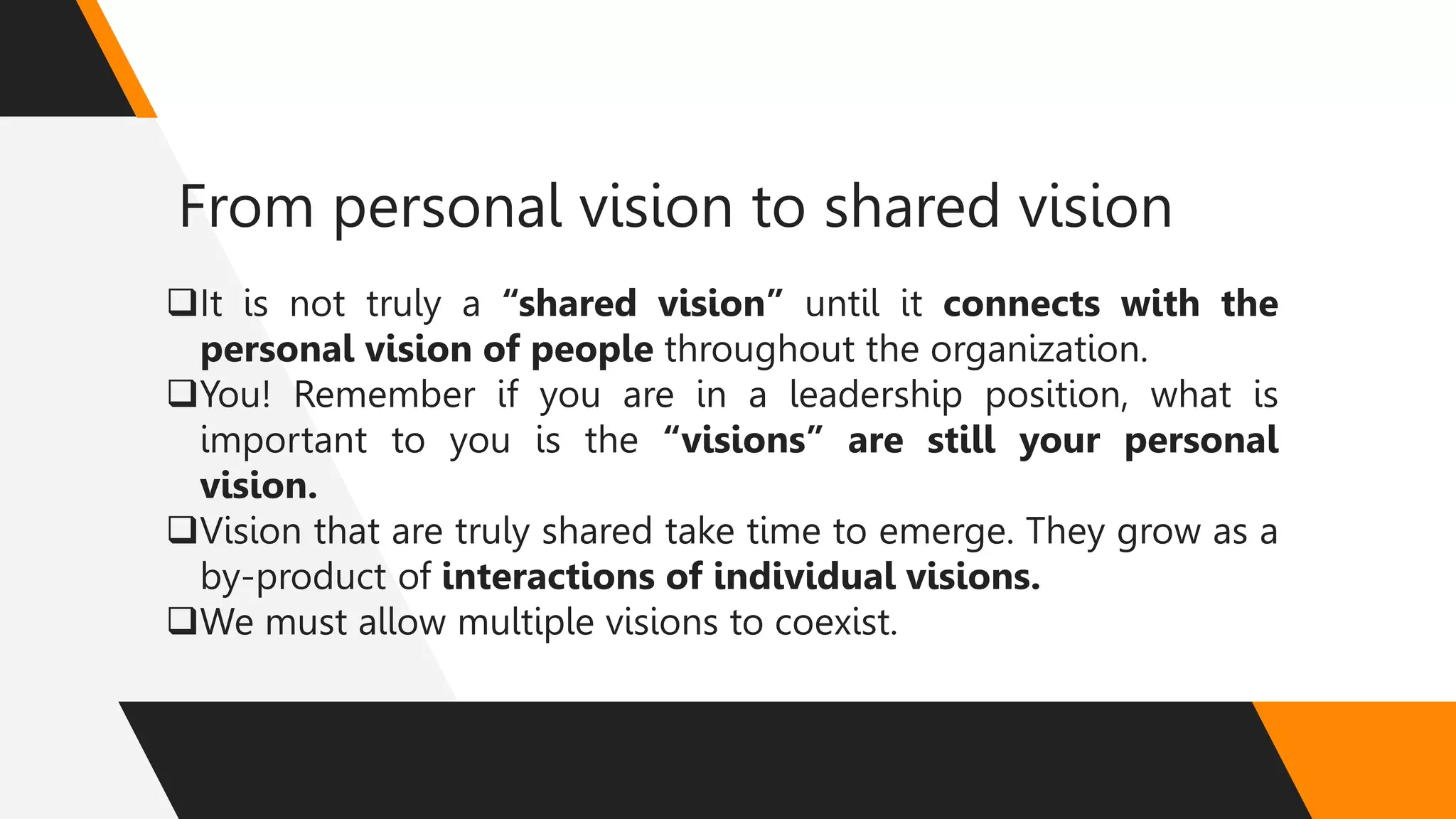
It is not truly a “shared vision” until it connects with the
personal vision of people throughout the organization.
You! Remember if you are in a leadership position, what is
important to you is the “visions” are still your personal
vision.
Vision that are truly shared take time to emerge. They grow as a
by-product of interactions of individual visions.
We must allow multiple visions to coexist.
“
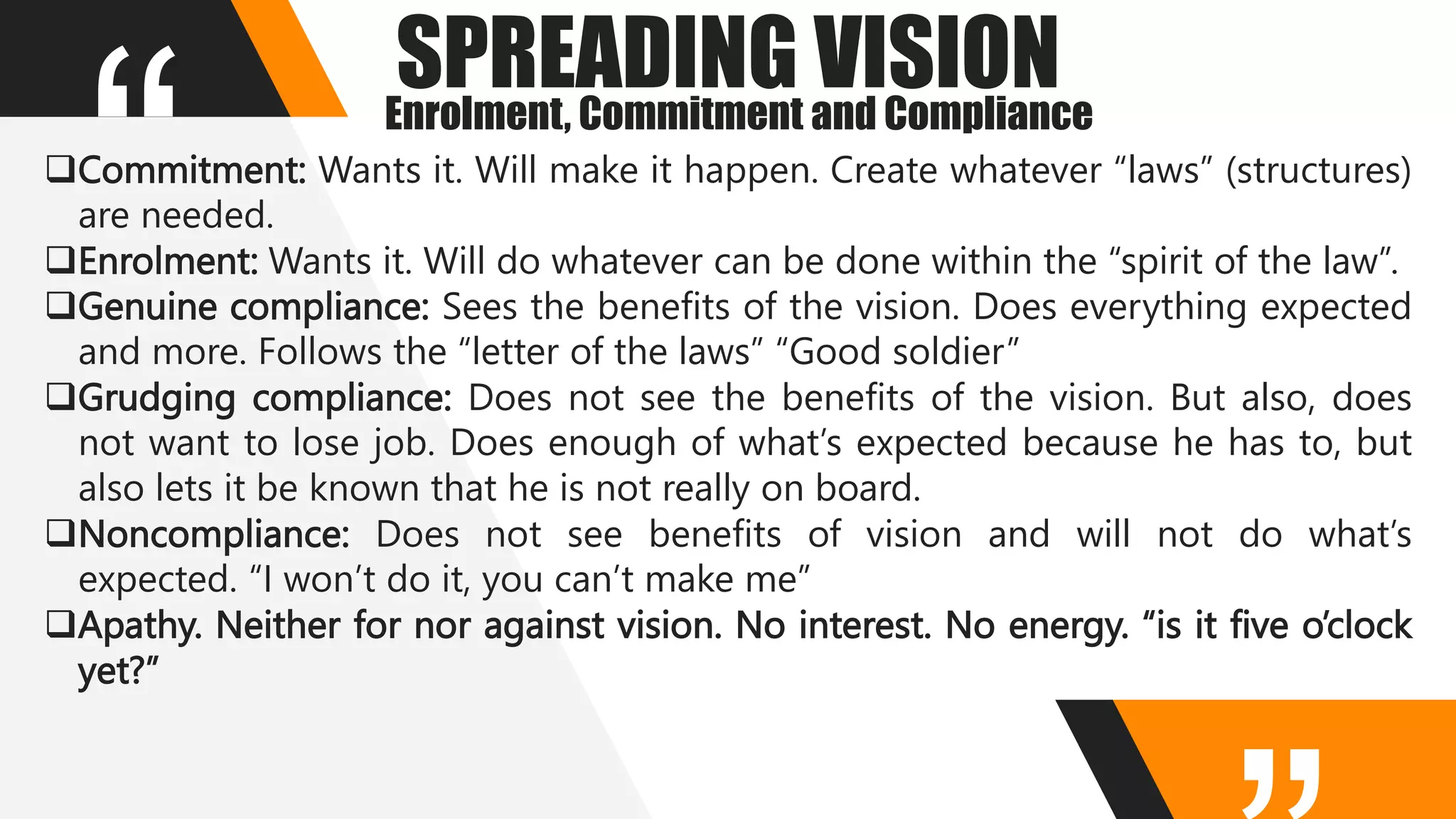
SPREADING VISION
Enrolment, Commitment and Compliance
Commitment: Wants it. Will make it happen. Create whatever “laws” (structures)
are needed.
Enrolment: Wants it. Will do whatever can be done within the “spirit of the law”.
Genuine compliance: Sees the benefits of the vision. Does everything expected
and more. Follows the “letter of the laws” “Good soldier”
Grudging compliance: Does not see the benefits of the vision. But also, does
not want to lose job. Does enough of what’s expected because he has to, but
also lets it be known that he is not really on board.
Noncompliance: Does not see benefits of vision and will not do what’s
expected. “I won’t do it, you can’t make me”
Apathy. Neither for nor against vision. No interest. No energy. “is it five o’clock
yet?”
GUIDELINES FOR ENROLLEMENT
AND COMMITEMENT
 Be enrolled themselves.
Be on the level/honest/ - do not inflate benefits or expectations.
Let the other person choose
ANCHORING VISION IN A SET OF
GOVERNING IDEAS
A vision not consistent with values that people live day by day
will not only fail to inspire genuine enthusiasm, it will often
outright cynicism.
Vision is the “What?” – picture of the future we seek to create.
Purpose or “mission” is the “Why?”, “Why do we exists?”
Core values answer to the question “How do we want to act,
consistent with our mission, along the path toward achieving
vision?”
POSITIVE VERSUS NEGATIVE VISION
"What do we want?" is different from "What do we want to avoid?“
Negative visions are probably more common than positive
The power of fear underlies negative visions. The power of
aspiration drives positive visions. Fear can produce
changes in short periods, but aspiration endures as a continuing
source of learning and growth.
CREATIVE TENSION AND
COMMITMENT TO THE TRUTH
The key is “creative tension”, the tension between
vision and reality.
The most effective people are those who can hold
their vision while remaining committed to seeing
current reality clearly.
IBM’s Stretch Computer
“Daring Vision” to build the fastest super-computer the world had ever
seen.
Be ambitious yet realistic.
Look at failures and try to learn something from them.
CREATIVE TENSION AND COMMITMENT TO THE TRUTH
“SHARED VISION AND THE
FIFTH DISCIPLINE
WHY VISION DIE PREMATURELY?
Many vision never take root and spread
– despite having intrinsic merit.
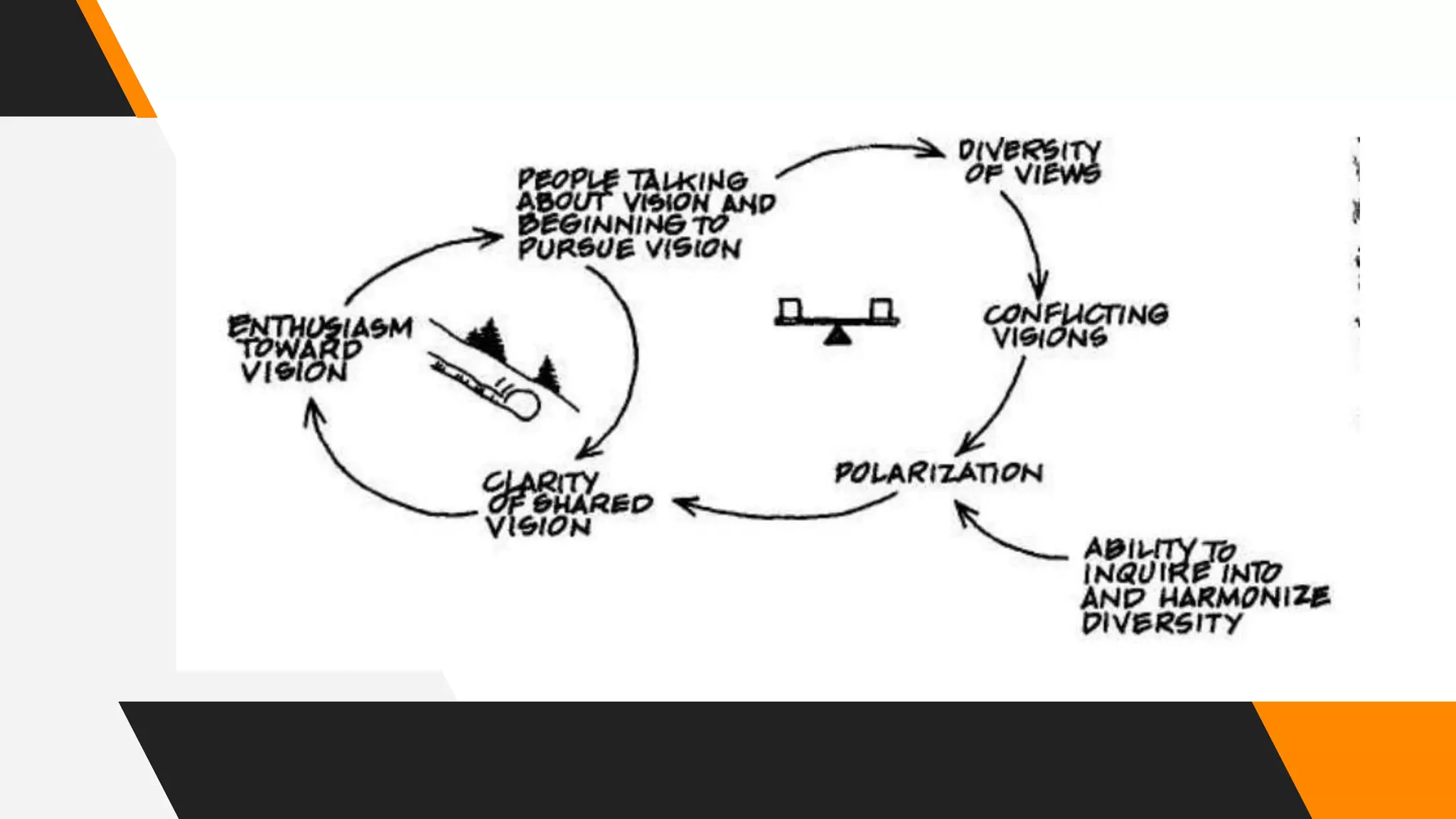
Vision spread because of reinforcing
process
Limits to growth structure, where the
reinforcing process of growing
enthusiasm for the vision interacts with
a balancing process that limits the
spread of the vision, due to increasing
diversity and polarization.
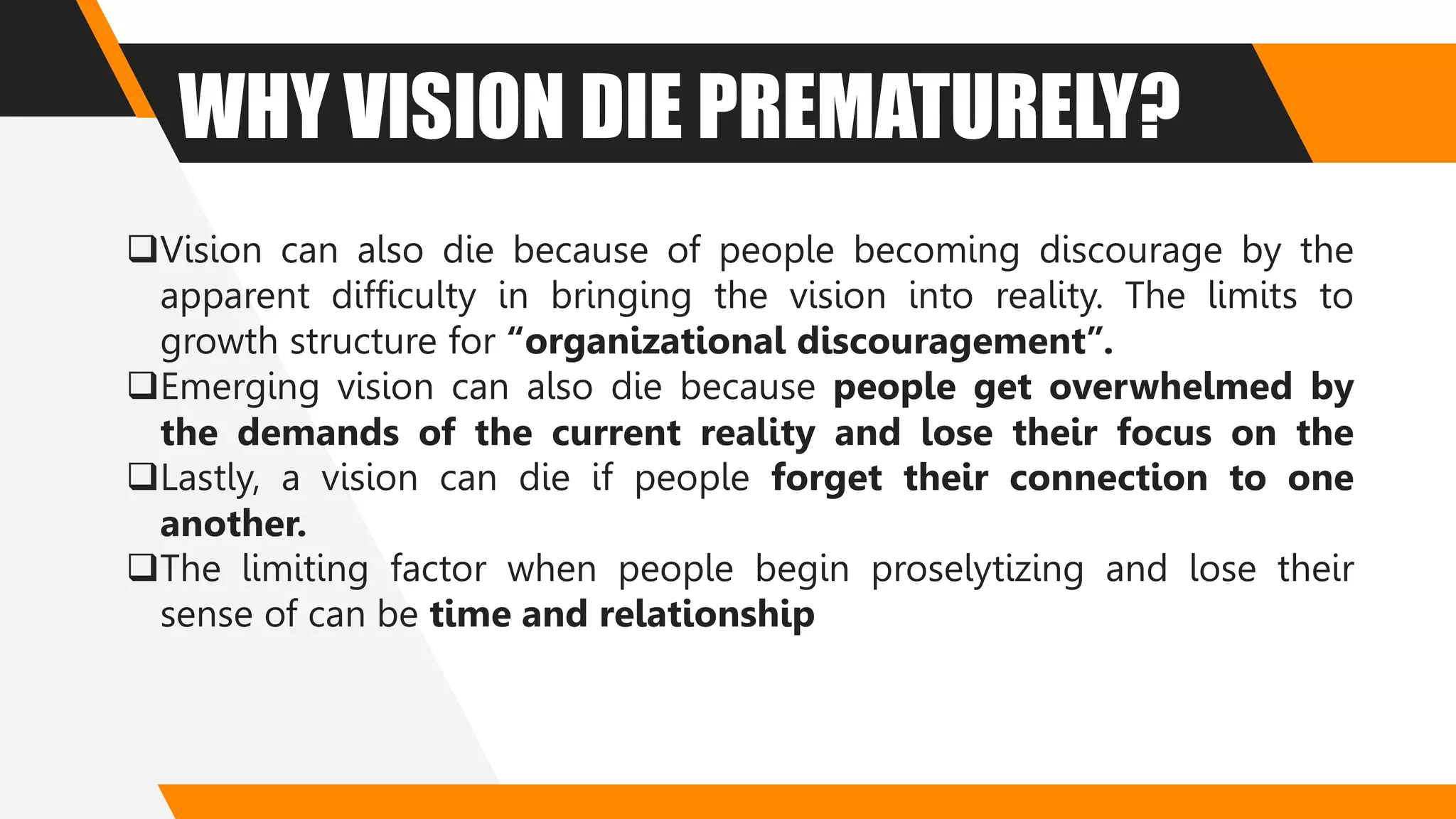
Vision can also die because of people becoming discourage by the
apparent difficulty in bringing the vision into reality. The limits to
growth structure for “organizational discouragement”.
Emerging vision can also die because people get overwhelmed by
the demands of the current reality and lose their focus on the
Lastly, a vision can die if people forget their connection to one
another.
The limiting factor when people begin proselytizing and lose their
sense of can be time and relationship
WHY VISION DIE PREMATURELY?
“ Shared vision
matters

Chapter 10 Shared Vision.pptx

  • 1.
    SHARED VISION Shared vision isone of the five disciplines identified by Peter Senge as necessary to create a learning organization
  • 2.
    A COMMON CARING 1 Ashared vision is not an idea. “What do we want to create?” When people truly share a vision they are connected, bound together by a common aspiration. A shared vision is a vision that many people are truly committed to, because it reflects their own personal vision.
  • 3.
  • 4.
    WHY SHARED VISIONMATTERS? Visionaries like Henry Ford, Steve Jobs, Theodore Vail, Kennedy were able to articulate their visions in ways that impacted people to join with them. Many shared visions are extrinsic – that is, they focus on achieving something relative an outsider, such as competitor. Defensive posture. A shared vision, especially one that is intrinsic, uplifts people’s aspiration. Visions are exhilarating. They create the spark, the excitement that lifts an organization out of the mundane.
  • 5.
    THE DISCIPLINE OFBUILDING A SHARED VISION “Organizations intent on building shared visions continually encourage members to develop their personal visions. If people don't have their vision, all they can do is sign up for someone else’s” – Peter Senge, The Fifth Discipline Encouraging personal vision
  • 6.
    “ “Shared vision equalsa shared sense of purpose” From personal vision to shared vision Shared vision as “hologram” As the shared vision develops it becomes both “my vision” and “our vision”. THE DISCIPLINE OF BUILDING A SHARED VISION
  • 7.
    THE DISCIPLINE OFBUILDING A SHARED VISION From personal vision to shared vision Visions are not always announced from “on high” or come from an organization’s institutionalized planning processes. In Top down vision, the results are often disappointing for several reasons. Vision is not a solution to a problem.
  • 8.
    From personal visionto shared vision It is not truly a “shared vision” until it connects with the personal vision of people throughout the organization. You! Remember if you are in a leadership position, what is important to you is the “visions” are still your personal vision. Vision that are truly shared take time to emerge. They grow as a by-product of interactions of individual visions. We must allow multiple visions to coexist.
  • 9.
    “ SPREADING VISION Enrolment, Commitmentand Compliance Commitment: Wants it. Will make it happen. Create whatever “laws” (structures) are needed. Enrolment: Wants it. Will do whatever can be done within the “spirit of the law”. Genuine compliance: Sees the benefits of the vision. Does everything expected and more. Follows the “letter of the laws” “Good soldier” Grudging compliance: Does not see the benefits of the vision. But also, does not want to lose job. Does enough of what’s expected because he has to, but also lets it be known that he is not really on board. Noncompliance: Does not see benefits of vision and will not do what’s expected. “I won’t do it, you can’t make me” Apathy. Neither for nor against vision. No interest. No energy. “is it five o’clock yet?”
  • 10.
    GUIDELINES FOR ENROLLEMENT ANDCOMMITEMENT  Be enrolled themselves. Be on the level/honest/ - do not inflate benefits or expectations. Let the other person choose
  • 11.
    ANCHORING VISION INA SET OF GOVERNING IDEAS A vision not consistent with values that people live day by day will not only fail to inspire genuine enthusiasm, it will often outright cynicism. Vision is the “What?” – picture of the future we seek to create. Purpose or “mission” is the “Why?”, “Why do we exists?” Core values answer to the question “How do we want to act, consistent with our mission, along the path toward achieving vision?”
  • 12.
    POSITIVE VERSUS NEGATIVEVISION "What do we want?" is different from "What do we want to avoid?“ Negative visions are probably more common than positive The power of fear underlies negative visions. The power of aspiration drives positive visions. Fear can produce changes in short periods, but aspiration endures as a continuing source of learning and growth.
  • 13.
    CREATIVE TENSION AND COMMITMENTTO THE TRUTH The key is “creative tension”, the tension between vision and reality. The most effective people are those who can hold their vision while remaining committed to seeing current reality clearly.
  • 14.
    IBM’s Stretch Computer “DaringVision” to build the fastest super-computer the world had ever seen. Be ambitious yet realistic. Look at failures and try to learn something from them. CREATIVE TENSION AND COMMITMENT TO THE TRUTH
  • 15.
    “SHARED VISION ANDTHE FIFTH DISCIPLINE WHY VISION DIE PREMATURELY?
  • 16.
    WHY VISION DIEPREMATURELY? Many vision never take root and spread – despite having intrinsic merit. Vision spread because of reinforcing process Limits to growth structure, where the reinforcing process of growing enthusiasm for the vision interacts with a balancing process that limits the spread of the vision, due to increasing diversity and polarization.
  • 19.
    Vision can alsodie because of people becoming discourage by the apparent difficulty in bringing the vision into reality. The limits to growth structure for “organizational discouragement”. Emerging vision can also die because people get overwhelmed by the demands of the current reality and lose their focus on the Lastly, a vision can die if people forget their connection to one another. The limiting factor when people begin proselytizing and lose their sense of can be time and relationship WHY VISION DIE PREMATURELY?
  • 20.