PREFACE
The patient and family care study is a full written description of comprehensive nursing care
provided to a specific patient and family, beginning at the time of admission and continuing
through follow-up care (home visits) and ending on the day of care termination, all within a
minimum of one month.
This is done to address the physical, psychological, and socioeconomic needs of the patient and
family in order for them to achieve optimal health.
The care study is undertaking to allow the student nurse to connect theory with practice during
his or her college training. It also allows the student nurse to demonstrate skills in providing
individualistic and complete nursing care to his or her patient, as well as provide an account of
the patient's treatment, observation, and care using the nursing process. It is a means for the
student nurse to learn the development of effective nurse-patient and family relationships. It's
also a way of providing high-quality nursing care to patients and their loved ones.
The patient and family care study is conducted by all final year students of the Nursing
Institutions and submitted to the Nursing and Midwifery Council of Ghana as one of the
requirement for the award of a professional certificate to practice in Ghana.
ACKNOWLEDGEMENT
This care study's composition needs a great deal of research and information gathering from
helpful people, as well as financial assistance and support from family and friends, without
which this piece of work would not have been accomplished successfully. As a result, they
deserve a lot of praise and admiration.
My sincerest gratitude goes to the Almighty God for providing me with the strength and
knowledge necessary to successfully complete this care study.
I owe a debt of gratitude to my parents and my family for their guidance and support during my
studies. I say “ayeekoo” bravo for spending chunk of your resources on me.
Again, I thank the patient and other members of his family for their cooperation and seamless
interaction, which enabled me to complete this care research.
My heartfelt gratitude goes to the principal, Hellen Gifty Dwamena Amoah (Mrs), and the entire
tutorial and non-tutorial staff of the Nursing and Midwifery Training College, Mampong-Ashanti,
for their time and unwavering support, advice, and assistance provided to me during my time
there. Thank you, Mr. Antierefaa Paul, for taking the time to read through and fix this work,
which allowed me to assemble and finish my care study.
My heartfelt gratitude also goes out to the Ashanti Mampong government Hospital's
management, paramedicals, clinical and non-clinical staff, particularly the Nursing administrator
() and the In-charge Mrs. Nancy Adzor and nurses at the males medical ward, for allowing me to
assess the facility and guiding me to find a client and condition for my care study.
I owe a debt of thanks to the authors and publishers of the publications from which I gleaned
useful material for this care study. I say thank you for availing your in-depth knowledge of
resource through various means for some of us to access
Finally, my deepest thanks go to my friends of the Mampong Nursing and Midwifery Training
College Ashanti for the socialization, warm reception and various support offered me during my
life in the college.
INTRODUCTION
The glue that keeps a patient's health care journey together is 21st century nursing. Nurses labor
relentlessly throughout the patient experience, and wherever there is someone in need of care, to
identify and defend the individual's needs. Beyond the long-standing reputation for compassion
and dedication, there is a highly specialized profession that is always growing to meet society's
requirements.Nurses are crucial in protecting public health, from assuring the most accurate
diagnoses to continuing to educate the public about critical health issues. Nursing can be
described as both an art and a science; a heart and a mind. At its heart, lies a fundamental respect
for human dignity and an intuition for a patient’s needs.
Nursing is defined as the autonomous and collaborative care of individuals of all ages, families,
groups, and communities, in all settings, sick or well. It encompasses health promotion, illness
prevention, and care for the sick, disabled, and dying through the nursing process - a five-step
system that serves as a guide to providing client-centered care. Assessment, diagnosis, planning,
implementation, and evaluation are the five steps. The first step is assessment, which entails
critical thinking skills and data collection, both subjective and objective.
The study of patient and family care is based on the nursing process, which is a systematic way
to recognizing a patient's problem and performing nursing action to provide a solution based on
scientific principles. This is done by employing the nursing process, taking the precise nursing
duties, and applying theoretical knowledge to the practical context to help the individual attain
and maintain optimal function throughout their lives.This engagement takes place over a set
amount of time. It include gathering data, identifying issues, designing an outcome-based plan,
implementing the plan, and assessing the results. The effectiveness of the patient/family care
study will determine the study's success.
Patient-centered care, as well as family-centered care, is now widely regarded as essential for
achieving high-quality outcomes. Nurses, physicians, and other healthcare workers are being
challenged to build a trusting connection with their patients so that they may work together to
create goals for their treatment and achieve the best possible outcomes for each patient. Dignity,
respect, honesty, collaboration, and encouragement should be among the key ideals of patient-
and family-centered care.
These values should be at the forefront of every interaction with the patient and family in order
to promote patient- and family-centered care in healthcare.
This patient care study gives a detailed account of the nursing care rendered to Master A.A a 19
year old man who was admitted to the males ward on 25th February 2022 at 7:00pm with the
diagnosis of peptic ulcer and was discharged on 3rd March 2022. He was admitted to the
Mampong Municipal Hospital male’s ward with a provisional diagnosis of peptic ulcer and
gastroenteritis within the hours of 7:00pm.
My interaction with the client lasted for one month, starting on 25th February, 2022 to 25th March
2022. He was treated medically with antibiotics clarithromycin, Amoxicillin, Metronidazole,
Ciprofloxacin, Intravenous fluids: ringers lactate ,analgesic Paracetamol and proton pump
inhibitor Omeprazole and was discharged home on the 3rd March,2022.
To ensure continuity of care, a maximum of three home visits were made - first whiles the
patient was n admission to assess home environment and ascertain the possible factors
contributing to the patient ill-health . Secondly a week after the patient was discharge to ascertain
recovery status, adherence to treatment regimen and remind patient of the review date. Then
finally after the review to terminate care and finally hand over the patient to a community health
nurse.
I met the client when he was brought to the Outpatient Department (OPD) of the Mampong
Municipal Hospital partially ambulatory in the company of some relatives for OPD services. He
was observed at a distance looking weak I supported him into a wheel chair and quickly process
his OPD card, checked his OPD vitals and took him to the consulting room. He was later
admitted as an unplanned admission into the male’s ward. I handed over the patient to the OPD
nurse to be send to the admission ward whiles I collect his medications from the pharmacy. I
followed up with his medications to continue the admission process at the ward.
After rendering him the nursing services I introduced myself as a final year student nurse of the
Mampong Nursing and Midwifery Training College. I declared my intention to use him for my
patient and family care study noting to him that it was a requirement in partial fulfillment for the
award of the registered general nursing diploma certificate by the nursing and midwifery council
of Ghana. He was assured of confidentiality of information and privacy. Consent was verbally
sought from the patient and family after a detailed explanation of the process was made, of
which they made an informed choice and willingly agreed to be used for the study.
I used Master A.A as my care study because I wanted to have more knowledge on peptic ulcer,
its risk factors, possible signs and symptoms, treatment and complications in order to educate
people on the disease condition and also give better nursing care to patients with the same
condition. The patient and family high level of cooperation and understanding was great which
convinced me that patient will willingly offer me the needed support in terms of data collection
and adhering to health teachings.
Choosing this condition has helped me to gain enough knowledge about the occurrence and
treatment of peptic ulcer.
This report has been written under five chapters; Chapter one deals with the assessment of the
patient and it also includes the literature review of the disease condition. Chapter two deals with
comparison of data with standards covering diagnostic investigations, causes, clinical features,
treatment, complications, patient and family strengths, health problems and nursing diagnosis.
Chapter three states the nursing care plan. Chapter four talks about the implementation of patient
and family care plan, preparation of patient and family for discharged and rehabilitation and
follow ups/home visits/continuity of care. And Chapter five deals with the evaluation of care
rendered to patient and family, summary and conclusion of care given to patient. For reasons of
confidentiality all names used in the work will be abbreviated and also the patient outpatient
department number will not be indicated.
CHAPTER ONE
ASSESSMENT OF PATIENT/FAMILY
INTRODUCTION
The term "assessment" refers to the gathering of scientific data in order to make clinical
judgments and decisions about the care of patients and their relatives. Physical examination,
history taking, clinical symptoms, and laboratory studies are all examples of assessment
approaches.The purpose of the evaluation is to determine the patient's current and potential
health concerns as well as establish nursing diagnoses. The data was acquired using four major
evaluation methods, which included observation during home visits and follow-up care,
interview, inspection, palpation, and contact between the patient and a relative, as well as the use
of the patient's previous and current medical records using both physical examination, history
taking and observation methods The information gathered in this chapter includes; Patient`s
particulars, Patient`s and family`s medical history, Patient`s lifestyle and hobbies, Admission of
patient, Literature review of patient`s condition, patient concept of illness and the validation of
data. For reasons of confidentiality and privacy of the patient data the patient will be referred to
as Master A.A and also vital information such as patient address would be replaced with
descriptions.
PATIENT’S PARTICULARS
Master A.A is the subject of this care study, a male who is nineteen years of age (19yrs) born on
1st August, 2002 to Madam A.A and Master. S.A. He is a Ghanaian citizen who comes from
Bongo, a suburb in Bolegatanga in the Northern Region of Ghana. He is the third (3rd) born of
five children. He dropped out of school at the level Junior Secondary School form two (2) and is
Currently he works with his cousin I.A on the farm at New Daaman .
He lives with his cousin and his wife at New Daaman in a house close to the New Jehovah
Witness Church. He is a Christian by religion who fellowships with The Jesus Salvation Miracle
Church at New Daaman. He is dark in complexion without any physical impairment. He is 65
centimeters (cm) tall and has a weight of 70 kilogram (kg), he appears neat throughout my
interaction with him.
He is not married and is single currently with no child. He was admitted to male ward by Dr.
Louisa and cared for by Dr. Sarkodie According to him, he has no known allergies. He has no
national health insurance Scheme identification card (NHIS). He requires an interpreter during
care as he understands only Fafra. He is a Fafra a subset of the Gurunsi tribe.
His main source of medical care is the use of orthodox medicine at the Mampong municipal
hospital though he does purchase over the counter drugs for his first aid treatment. His main
source of financing his medical bills is his cousin. His next of kin is his cousin I.A.
PATIENT’S FAMILY MEDICAL HISTORY
A family medical history is a record of illness, medical conditions, and or associated risk factors
that typically affect or lead to family members and the client, and is frequently recorded at the
hospital. Family medical history assists in tracing prevalent family illnesses, providing insight
into the client's condition, and providing information that may be important to the client's health.
According to Master A.A, both parents are alive and healthy with no any diagnosed health
condition. His grandmother is deceased with no definite cause of death established. There is no
history of any hereditary disease such Diabetes, Hypertension, sickle cell disease, Asthma in his
family neither is there evidence of their risk factors. However, there are common ailments like
headache, malaria, common cold, abdominal pain, headache, diarrhea and body pains which they
often treat with over the counter medications. There was no history of alcoholism and no known
allergies were established.
There are no known abnormalities such as mental disorders, birth deformities and abnormalities
such as Down syndrome and extra digits in the family. The family main facility of medical care
is the Mampong Municipal Hospital even though they sometimes buy drugs from the license
chemical sellers. No family member has undergone surgery before. Client and relatives were
therefore advised and educated on the need to report to the hospital for medical checkup and
assessment; they were also educated to avoid the use of over the counter medication during ill-
health and to avoid self-medication due to their risk to their health status and seek medical
attention from professional doctors as this will help minimize their health risk. There are no
history acute conditions such as peritonitis, perforations, gastritis, hypertensive crisis in the
family; the patient said he cannot recount any history of chronic condition such as diabetes, and
hypertension, peptic ulcer disease. There is no history of communicable disease such as
tuberculosis, and leprosy. Patient and family has no history of alcohol abuse and drug addiction.
PATIENT/FAMILY SOCIO-ECONOMIC HISTORY
Master A.A parents and grandparents are all farmers at Bongo. But they sell 50% of their
produce and consume the rest of it .He elaborated that he is unsure of the amount of bags
produced by his parents. His sisters W.A and M.A are all traders who earn about 1,500 cedis and
1,300 cedis respectively. He stated that this was 3 years ago as he left his family house at Bongo
to come and stay with his cousin and currently does not know how much they earn a month.
Master A.A works with his cousin on the farm at New Daaman. They farm yam, maize and
carrot. However his cousin stated that both the yam and maize are for family consumption only
and do not sell it. He further elaborated that with the carrot they are able to produce a maximum
of 100 bags every three months which gathers them an amount of 10,000 cedis every month.
Master A.A support system is his cousin I.A who provides him with security, financial aid,
protection and emotional support in trial times
Master A.A is a respecter of societal norms and culture. The family totem is the python. He is a
Gurunsi by tribe and they celebrate the “Ndaakoya” festival. The patient Family celebrates both
Christian and traditional festivals such as the “Ndaakoya”Christmas, Easter, New Year and the
Pentecostal day. He attends community gathering such funerals, weddings, naming ceremonies
and clean up exercise. The family practices both the nuclear family and extended family system.
They have a positive family cohesion as they interact with each other positively. He goes to the
church every Sunday and other days when there is a special occasion. There is no histo ry of
divorce, separations and remarriages in the patient family.
The economic status of Master A.A family is classified under middle class as they lives a little
above the minimum wages and is able to meet three square meals with snacks without much
difficulty. Master A.A could not give an exact amount as to how much he makes annually as he
works with his cousin and also due to the changes in market prices every now and then. He said
he is not affiliated to any political party. He stated that he and his cousin are very active in
church. He is very friendly with his neighbors and is also very close to both him nuclear and
extended family. He said; in his work (farming), there are numerous risks involved, he made
mention of fractures, trauma or injury from sharps, blunt and pointed object, snake bites, toxic
effect of some chemicals and accidents.
The family lives in a rented apartment, three bed room flat. The environment is clean, well
ventilated. Their main source of water supplies is from the Ghana Water Company, they are
connected to the national grade for their source of light. They practice burning as the means of
waste disposal.
PATIENT’S DEVELOPMENTAL HISTORY
Development refers to the biological, psychological and emotional changes that occur in human
beings between births to the end of adolescent as the individual progress from dependency till
increasing autonomy. (Macmillan 2007).
Master A.A was born on 1st August, 2002 at Bongo as a home delivery per spontaneous vaginal
delivery with the aid of a traditional birth attendant at term without any birth complications.
According to the client there was no history of antenatal attendance. . He was not immunized
against childhood infections neither was he given six month exclusive breastfeeding. “He was
not taken to post natal clinic. Truly, the indelible scar left by the BCG vaccine on the right upper
arm was not present confirming all that he said. However, he was given herbal medicine by his
grandmother as he grows. “This is done to all children in their family to strengthen and provide
protection against physical and spiritual diseases”. “Mater A.A’’ narrated .According to the
patient, he was told he went through a normal developmental milestone without any fixation;
According to patient he responded to stimuli, within a minute after delivery and he went through
the normal developmental milestone without any difficulties and also wasn’t involved in any
major incidence or accident. Form one to six month he started sitting with support, sitting
without support, copying sounds, respond to own name by turning to direction of call, likes
playing with others especially mother and siblings, between ages six months to twelve months he
was able to use gestures such as shaking of head for “no” or waving bye - bye” and also responds
to simple spoken requests .He was able to say mama and pulls up to stand (12 months -1year).
Within one and half year, he was able to differentiate between cutlass and broom and their uses
as well. He plays simple pretends such as feeding a doll and pointing to show others something
interesting, he was good in singing several single songs and walking alone. At age two, he was
able to say sentences with two words and recite when with other children and also follow simple
instructions like come, sit and pointing to things and picture when they are named. At age three,
he was able to copy adult and friends (like running when other children run). He could carry on
conversation using two to three sentences, climb well, show affection without prompting, hop
and stand on one foot for up to two seconds , could play with other children than alone, could tell
stories, also draw a person with at least two to four body parts and play co-operatively at four
years (4years). He started his schooling at a public school in Bogoso at age 5 in the year 2007
where he started kindergarten, at age 7 he was in class one (1) in the year 2009 and completed
his primary education in the year 2015. He continued to the junior high in the year 2016 but
could not complete his junior high education and out to drop out as he had to help out with the
farm work .Whiles in school he was interested in playing football and had military as his future
dream job but it could not materialized due to educational and financial reasons. He was allowed
to carry out his personal hygiene alone by the age of 6 and this according to Eric Erikson’s
theory is the stage of purpose vs. initiative and this could be seen from client’s ability to make
decisions on his own and from the client’s accomplishments in life.
He narrated that as an adult he has had intimacy for the opposite sex, plays and enjoys playing
with them. Master A.A said he is currently not dating and is not married. He developed
secondary male sexual characteristics such as development of hair around the genital; armpit and
broadening of the chest at age thirteen (puberty). Currently apart from farming he does no
additional work. Master A.A elaborated that he is not particularly satisfied with his farming
work and wishes to someday pursue his dream of being in the military and his only fear is the
risk the farming exposes him to. He has no disability, and also has a good working relationship
both with his nuclear and the extended family.
He rest on Sundays .He is used to the phones but not smartphones and social media platforms
like facebook, whatsApp, instagram etc,.
Comparison of Master A.A stages of development with Eric Erikson theory of psychosocial
growth and development theory (1902-1994) shows that he is at stage Sixth stage with crisis of
intimacy verses isolation and it occurs during adolescence from about 12-40 years of which
during this stage adolescents search for a sense of self and personal identity. This is done through
an intense exploration of personal values, beliefs, and goals. During adolescence, the transition
from childhood to adulthood is most important. Children are becoming more independent and
begin to look at the future in terms of career, relationship, families, housing. The individual
wants to belong to a society and fit. This can be seen in Master A.A as he left his home in Bongo
to come live with his cousin to figure his way out in life.
PATIENT LIFESTYLE AND HOBBIES
Master A.A observes a good personal hygiene. He baths twice daily and cleans his teeth with
toothpaste (pepsodent) and tooth brush but uses chewing stick during daytime especially when
he is at work. He goes to farm during week days with the exception of Sundays where he goes to
prayers and normal service respectively. He does all his washing (clothes) on Sundays and has
no difficulty in eating and grooming. He does not have sleep pattern disturbances. He empties his
bowels twice daily and empties his bladder as often as he could and frequently especially on
sunny days. He enjoys playing football with his friends at his leisure time. His favorite meal is
sama zerio with red rice balls but he said after he left home and came to live with his cousin
sweet potato and yam has become his favorite meal. He sleeps at 8:30pm after his supper and
wakes up at 5:00am to prepare for farm. He takes his breakfast midmorning made by his cousins
wife which is at 9:30am of which mostly consist of yam and stew and lunch at 1:30 which
consist mostly of rice. He usually reads the bible, attends to nature call, perform oral hygiene,
takes his bath and off to work. ”I am yet to know if I am allergic to any food”. He said. To Him,
farming in itself is as a form of exercise. He uses verbal and non-verbal communication style
and does not stammer. He is kind, very generous, loving and caring, sometimes sociable and
love caring for family members especially the child of his cousin. He does not use any illicit
drugs; smoke cigarette, tobacco nor drink alcohol. He can tolerate all levels of activity with no
interspersed rest period. He is able to go to his farm and perform all kinds of stressful activities.
Master A.A established that, he pays keen attention to important issues and does not play with
his health. He adheres and applies medical advice so as to assist him to live long. He handle
medications with caution and did indicate that, his cousin will not even allow him skip his
treatment regimen and review dates. He impressed me the first time I approached him, he smiled
and was willing to answer any question. He is hardworking, very generous and kind and does not
easily give up.
PATIENT’S PAST MEDICAL HISTORY
Information gathered from Master A.A and review of his health record card indicates that this
was his second admission to the hospital. He was first admitted having being diagnosed of
Gastroenteritis but prior to that has not been admitted to the hospital although he has suffered
from headache and malaria attacks before. Although he adheres to health teachings, he does not
go for medical checkups.
According to Master A.A, He has never had any sort of illness during his childhood such as
measles, whooping cough, and mumps. and in the course of his growth never suffered any
serious ailment except the occasionally usual abdominal pains, headaches and malaria which
most often is treated by the use of over the counter medications, only in severe cases do they
seek treatment from the hospital. He further explained that he has never had any kind of accident,
no known allergies and has never consulted a specialist for health care or check-up. According to
him, this is his second hospitalization but has never undergone any surgery before to the best of
his knowledge. Access to health care was aproblem for him when he was in bogoso but now that
he lives with his cousin I.A it is not that much of a problem both financially and geographically.
Master A.A has easy access to the Mampong Government Hospital as the facility is not that far
from his residence. The facility is well resourced with human resources and infrastructural
resources; it has a laboratory including an x-ray unit. It has female and male medical unit,
children unit and the maternity wing, consulting room including special consulting rooms. And
special units such as theater, dental unit, physiotherapy, diabetic clinic, ear nose and throat, the
eye clinic, the mental and chronic care unit. The facility has standard records unit and
administrative block including a pharmacy and billing unit. They have six medical officers
including a gynecologist, physiotherapist, an optician and a surgeon as well as numerous
physician assistant with all classes of nurses.
He strongly believed that his illness was caused by his poor and inconsistent eating habit and did
not attribute his illness to any witchcraft or superstition but also believed that illness is part of
life. He is partially satisfied with the Municipal Hospital, Mampong-Ashanti, but belief they
can do better by providing ultramodern laboratory equipment for a better healthcare delivery.
PATIENT’S PRESENT MEDICAL HISTORY
Client was very healthy until the early morning of 24th February, 2022 when he started
experiencing nausea and vomiting, abdominal pains (epigastric),feverish and was weak and tired
making him unable to perform his duties. He resorted to over the counter drugs where he
purchased some pain killers in hopes of reducing pain of which he said made him feel a bit better.
The next day which was on the 25th Febuary,2022 he thought he was fine now and that the pain
killers had worked since he was not having abdominal pains although he was a bit weak, hence
he set out for the farm. But he was proven wrong when about 30 minutes after having breakfast
he began to have intense pain at the abdomen .He left the farm and went home to take some pain
killers hoping the extreme pain he was feeling would be reduced again. “I was so tired and
feverish so I slept’’ he said. In the evening on the same day he was not feeling well hence his
cousin told him the next day they would go to the hospital to find out what was wrong with him
as it was late. However, his disease condition never improved and got worse by the early evening
of the same day after taking his supper, he was accompanied by his cousin to the outpatient
department unit of Mampong Municipal Hospital at 7:30pm. The doctor after thorough
examination gave an impression of peptic ulcer and admitted him to the male ward within the
hours of 8pm for further investigation and proper management.
ADMISSION OF PATIENT
On 25th Febuary,2022 exactly 7:35pm Master A.A was wheeled into the male’s ward in a
wheel chair accompanied by an accompany outpatient department (OPD) staff nurse, and his
cousin, as an unplanned urgent admission into the male ward with the provisional diagnosis of
peptic ulcer(new diagnosis). They were welcomed into the male medical ward and the patient
was made comfortable in a simple admission bed already prepared after confirming the patient
by mentioning his name and age and his Hospital Administration System (HAMS) number.
On assessment patient was clutching the abdomen in pain, warm to touch, he was weak, dizzy
and could not stand well, very restless and could not speak to our hearing. Patient was
immediately covered with blanket. The foot end of the bed elevated as well as well as the head
end and the shoulders to release pressure on the abdomen to minimize abdominal pain . His
admission vital signs were immediately checked and recorded as follows; Temperature - 39.2
Degree Celsius (°c), Pulse – 100 Beat per minute (bpm) weak and thready pulse beat,
Respiration rate – 24 Cycle per minute (cpm) fast and rapid breath, Blood pressure – 90/60
Millimeter of mercury (mmHg), RBS – 8.6mmol/Hg. His OPD Vitals were also recorded as
follows; Temperature -39.3 Degree Celsius (°c), Pulse - 96 Beat per minute (bpm), Respiration -
20 cycle per minute (cpm), Blood pressure - 80/ 50 millimeter of mercury (mmHg), Wight 100
kilogram (kg), RBS – 9.6 mmol/l.
Intravenous access was secured and intravenous fluid set up. Samples were taking for laboratory
investigations full blood count, routine urine examination, Helicobacter pylori test, widal test.
Emergency and other treatment were immediately started including 1litre normal saline and
1litre ringer lactate interchangeably , IV Paracetamol 1g tds for 24hours, then oral Paracetamol
1g tds for 5days, injection buscopam 40mg st. IV. Ciprofloxacin 400mg bd for 24hours, IV
Metronidazole 500mg tds for 24hours, IV Omeprazole 400mg for 24hours then oral
Omeprazole 20mg bd for 30days. Caps clarithromycin 500mg bd for 14days, table Amosiklav 1g
bd for 14days. Other Laboratory investigation ordered include endoscopy A four hourly vital
signs monitoring was initiated to check and monitor client recovery status from sign of shock.
Intake and output chart was immediately maintained.
Comprehensive assessment was done by the ward incharge and findings documented. Client
particulars; his name, age and sex, diagnosis, occupation, address were entered in the admission
and discharge book , daily ward state, changes book, as well as the rounds books. Procedures
done were documented in the nurse’s notes, report books and in the client folder. They were
assured and reassured of speedy recovery as they will be attended to by competent professionals.
They were educated on the client disease state as diagnosed on the causes, management,
complications and prevention of complications, dietary habit, rest, exercise and sleep. His
cousin was asked to stay with him for a while. The Patient and his cousin were later oriented to
time, person and place. Client was informed of the times of the ward routine; rounds (8:30am –
10:30am), medication was regularly served based on the treatment regimen of client, visiting
hours include; 6: 00am to 7:30am, for the morning session and 5:00pm to 6:00pm for the
evening session. They were introduced to colleague’s staff and oriented to the nurses’ station
and the ward annexes, and was told to ask any of the nurses on duty for any assistance if the need
arise and call on the ward in-charge for any explanation on matters he do not understand. Some
items like the oxygen cylinder, suction machine were introduced to them. Patients cousin was
really happy to have him recovered with such immediacy. Anxiety was allayed through the
orientation and education process and they were relaxed.
After rendering him the nursing services I introduced myself as a final year student nurse of the
Mampong Nursing and Midwifery Training College. I declared my intention to use him for my
patient and family care study noting to him that it was a requirement in partial fulfillment for the
award of the registered general nursing diploma certificate by the nursing and midwifery council
Ghana. He was assured of confidentiality of information and privacy. Consent was verbally
sought from the patient and family after a detailed explanation of the process was made, of
which they made an informed choice and willingly agreed to be used for the study.
I used Master A.A as my care study because I wanted to have more knowledge on peptic ulcer,
its risk factors, possible signs and symptoms, treatment and complications in order to educate
people on the disease condition and also give better nursing care to patients with the same
condition. The patient and family high level of cooperation and understanding was great which
convinced me that patient will willingly offer me the needed support in terms data collection and
adhering to health teachings.
Client’s information was documented in the nurses’ notes, reports, rounds books and changes
book. I assisted in, obtaining intravenous access, monitoring and observations.
PATIENT’S CONCENPT OF THE IILLNESS
Master A.A did not attribute the disease condition to any evil or supernatural power but said is as
a result of some food he ate earlier on. His main concern was about the expensive treatment of
the disease condition. Client was hopeful that the treatment he is receiving can restore his health
on time for him to be discharged home.
LITERATURE REVIEW ON PEPTIC ULCER
This section gathered factual information about the condition. It involves the definition,
incidence, incubation period, anatomy of the system and organ involved diagnosis of the
condition, incidence, clinical manifestations, pathophysiology, specific medical and nursing care,
specific surgical care, complications, classification and types of the condition, prevention of the
condition.
OVERVIEW OF PEPTIC ULCER
Peptic ulcer disease can involve the stomach or duodenum. Gastric and duodenal ulcers usually
cannot be differentiated based on history alone, although some findings may be suggestive (see
(Differential Diagnosis) DDx). Epigastric pain is the most common symptom of both gastric and
duodenal ulcers, characterized by a gnawing or burning sensation and that occurs after meals—
classically, shortly after meals with gastric ulcers and 2-3 hours afterward with duodenal ulcers.
In uncomplicated peptic ulcer disease, the clinical findings are few and nonspecific. “Alarm
features" that warrant prompt gastroenterology referral include; bleeding, anemia, early satiety,
unexplained weight loss, progressive dysphagia or odynophagia, recurrent vomiting, and a
family history of gastrointestinal (GI) cancer. Patients with perforated peptic ulcer disease
usually present with a sudden onset of severe, sharp abdominal pain. (See Presentation.)
In most patients with uncomplicated peptic ulcer disease, routine laboratory tests usually are not
helpful; instead, documentation of peptic ulcer disease depends on radiographic and endoscopic
confirmation. Testing for H pylori infection is essential in all patients with peptic ulcers. Rapid
urease tests are considered the endoscopic diagnostic test of choice. Of the noninvasive tests,
fecal antigen testing is more accurate than antibody testing and is less expensive than urea breath
tests but either is reasonable. A fasting serum gastrin level should be obtained in certain cases to
screen for Zollinger-Ellison syndrome. (See Workup.)
Upper GI endoscopy is the preferred diagnostic test in the evaluation of patients with suspected
peptic ulcer disease. Endoscopy provides an opportunity to visualize the ulcer, to determine the
presence and degree of active bleeding, and to attempt hemostasis by direct measures, if required.
Perform endoscopy early in patients older than 45-50 years and in patients with associated so-
called alarm features.
Most patients with peptic ulcer disease are treated successfully with cure of H pylori infection
and/or avoidance of nonsteroidal anti-inflammatory drugs (NSAIDs), along with the appropriate
use of antisecretory therapy. In the United States, the recommended primary therapy for H pylori
infection is proton pump inhibitor (PPI)–based triple therapy. [1] These regimens result in a cure
of infection and ulcer healing in approximately 85-90% of cases. [2] Ulcers can recur in the
absence of successful H pylori eradication. (See Treatment.)
In patients with NSAID-associated peptic ulcers, discontinuation of NSAIDs is paramount, if it
is clinically feasible. For patients who must continue with their NSAIDs, proton pump inhibitor
(PPI) maintenance is recommended to prevent recurrences even after eradication of H pylori. [3,
4] Prophylactic regimens that have been shown to dramatically reduce the risk of NSAID-
induced gastric and duodenal ulcers include the use of a prostaglandin analog or a PPI.
Maintenance therapy with antisecretory medications (eg, H2 blockers, PPIs) for 1 year is
indicated in high-risk patients. (See Medication.)
The indications for urgent surgery include failure to achieve hemostasis endoscopically,
recurrent bleeding despite endoscopic attempts at achieving hemostasis (many advocate surgery
after two failed endoscopic attempts), and perforation.
Patients with gastric ulcers are also at risk of developing gastric malignancy.
DEFINITION OF PEPTIC ULCER
According to www.dictionary.comm peptic ulcer is an erosion of the mucous membrane of the
lower esophagus, stomach, or duodenum, caused in part by the corrosive action of the gastric
juice.
According to Merriam Webster peptic ulcer is a painful sore inside the stomach or another part
of the digestive system.
Peptic ulcer disease(PUD) is a break in the inner lining of the stomach, the first part of the
intestines, or sometimes the lower esophagus.( Wikipedia) An ulcer in the stomach is called a
gastric ulcer, while one in the first past of the intestines is duodenal ulcer..
INCIDENCE OF PEPTIC ULCER
Incidence refers to the occurrence, rate or frequency of a disease .
The global incidence and prevalence of peptic ulcer disease, along with the associated rates of
hospitalizations and mortality, have been in decline over the past couple of decades, attributed in
part to the complex changes in the risk factors for peptic ulcer disease, including reductions in
the prevalence of H pylori infection, the widespread use of antisecretory agents and nonsteroidal
anti-inflammatory drugs (NSAIDs), and an aging population.
United States statistics
In the United States, peptic ulcer disease affects approximately 4.6 million people annually, with
an estimated 10% of the US population having evidence of a duodenal ulcer at some time. H
pylori infection accounts for 90% of duodenal ulcers and 70%-90% of gastric ulcers. The
proportion of people with H pylori infection and peptic ulcer disease increases steadily with age.
Overall, the incidence of duodenal ulcers has been decreasing over the past 3-4 decades.
Although the rate of simple gastric ulcer is in decline, the incidence of complicated gastric ulcer
and hospitalization has remained stable, partly due to the concomitant use of aspirin in an aging
population.
The prevalence of peptic ulcer disease has shifted from predominance in males to similar
occurrences in males and females. The lifetime prevalence is approximately 11%-14% in men
and 8-11% in women. Age trends for ulcer occurrence reveal declining rates in younger men,
particularly for duodenal ulcer, and increasing rates in older women.
In a systematic search of PubMed, EMBASE, and the Cochrane library, the annual incidence
rates of peptic ulcer disease were found to be 0.10-0.19% for physician-diagnosed peptic ulcer
disease and 0.03-0.17% when based on hospitalization data. The 1-year prevalence based on
physician diagnosis was 0.12-1.50% and that based on hospitalization data was 0.10-0.19%. The
majority of studies reported a decrease in the incidence or prevalence of peptic ulcer disease over
time.
International statistics
The frequency of peptic ulcer disease in other countries is variable and is determined primarily
by association with the major causes of peptic ulcer disease: H pylori and NSAIDs. A 2018
systematic MEDLINE and PubMed review found Spain had the highest annual incidence of all
peptic ulcer disease (141.8/100,000 persons), whereas the United Kingdom had the lowest
(23.9/100,000 persons). When perforated peptic ulcer disease was assessed, South Korea had the
highest annual incidence (4.4/100,000 persons) and the United Kingdom, again, had the lowest
(2.2/100,000 persons).
TYPES OF PEPTIC ULCERS
Peptic ulcers can be classified into two ways by:
Using the degree of mucosal involvement
Using the location of the peptic ulcer.
Using the degree of mucosal involvements, peptic ulcer can be classified as either acute or
chronic.
Acute ulcers are usually shallow, show little inflammation and respond well to treatment
once the cause has been identified.
Chronic ulcers, they extend through the muscularis mucosal, heal slowly and can form
variable amount of fibrous tissue giving them irregular appearance.
Using the location of peptic ulcer, it can be classified as gastric or duodenal.
Gastric ulcer increases gastric acidity, decreases mucosal blood flow, decreases secretion
of mucous.
CAUSES OR ETIOLOGY OF PEPTIC ULCER
Peptic ulcer disease may be due to any of the following:
H pylori infection
Drugs
Lifestyle factors
Severe physiologic stress
Hypersecretory states (uncommon)
Genetic factors
H pylori infection
H pylori infection and nonsteroidal anti-inflammatory drug (NSAID) use account for most cases
of peptic ulcer disease. The rate of H pylori infection for duodenal ulcers in the United States is
less than 75% for patients who do not use NSAIDs. Excluding patients who used NSAIDs, 61%
of duodenal ulcers and 63% of gastric ulcers were positive for H pylori in one study. These rates
were lower in whites than in nonwhites. Prevalence of H pylori infection in complicated ulcers
(ie, bleeding, perforation) is significantly lower than that found in uncomplicated ulcer disease.
Drugs
NSAID use is a common cause of peptic ulcer disease. These drugs disrupt the mucosal
permeability barrier, rendering the mucosa vulnerable to injury. As many as 30% of adults taking
NSAIDs have GI adverse effects. Factors associated with an increased risk of duodenal ulcers in
the setting of NSAID use include history of previous peptic ulcer disease, older age, female sex,
high doses or combinations of NSAIDs, long-term NSAID use, concomitant use of
anticoagulants, and severe comorbid illnesses.
A long-term prospective study found that patients with arthritis who were older than 65 years
who regularly took low-dose aspirin were at an increased risk for dyspepsia severe enough to
necessitate the discontinuation of NSAIDs. [7] This suggests that better management of NSAID
use should be discussed with older patients in order to reduce NSAID-associated upper GI events.
A UK retrospective study of patients newly initiated on low-dose aspirin for secondary
prevention of cardiovascular events identified risk factors for uncomplicated peptic ulcer disease
in these patients that included the following :
Previous history of peptic ulcer disease
Current use of NSAIDs, oral steroid agents, or acid suppressive agents
Tobacco use
Stress
Depression
Anemia
Social deprivation (comprises four census variables used in the Townsend deprivation
index [9] : households that lack a car, are overcrowded, not owner-occupied, and have
unemployed persons)
Although the idea was initially controversial, most evidence now supports the assertion that H
pylori and NSAIDs are synergistic with respect to the development of peptic ulcer disease. A
meta-analysis found that H pylori eradication in NSAID-naive users before the initiation of
NSAIDs was associated with a decrease in peptic ulcers.
Although the prevalence of NSAID gastropathy in children is unknown, it seems to be increasing,
especially in children with chronic arthritis treated with NSAIDs. Case reports have
demonstrated gastric ulceration from low-dose ibuprofen in children, even after just 1 or 2 doses.
Corticosteroids alone do not increase the risk for peptic ulcer disease; however, they can
potentiate ulcer risk in patients who use NSAIDs concurrently.
The risk of upper GI tract bleeding may be increased in users of the diuretic spironolactone [12]
or serotonin reuptake inhibitors with moderate to high affinity for serotonin transporter. [13]
Lifestyle factors
Evidence that tobacco use is a risk factor for duodenal ulcers is not conclusive. Support for a
pathogenic role for smoking comes from the finding that smoking may accelerate gastric
emptying and decrease pancreatic bicarbonate production. However, studies have produced
contradictory findings. In one prospective study of more than 47,000 men with duodenal ulcers,
smoking did not emerge as a risk factor. [14] However, smoking in the setting of H pylori
infection may increase the risk of relapse of peptic ulcer disease. Smoking is harmful to the
gastroduodenal mucosa, and H pylori infiltration is denser in the gastric antrum of smokers.
Ethanol is known to cause gastric mucosal irritation and nonspecific gastritis. Evidence that
consumption of alcohol is a risk factor for duodenal ulcer is inconclusive. A prospective study of
more than 47,000 men with duodenal ulcer did not find an association between alcohol intake
and duodenal ulcer.
Little evidence suggests that caffeine intake is associated with an increased risk of duodenal
ulcers.
Severe physiologic stress
Stressful conditions that may cause peptic ulcer disease include burns, central nervous system
(CNS) trauma, surgery, and severe medical illness. Serious systemic illness, sepsis, hypotension,
respiratory failure, and multiple traumatic injuries increase the risk for secondary (stress)
ulceration.
Cushing ulcers are associated with a brain tumor or injury and typically are single, deep ulcers
that are prone to perforation. They are associated with high gastric acid output and are located in
the duodenum or stomach. Extensive burns are associated with Curling ulcers.
Stress ulceration and upper-gastrointestinal (GI) hemorrhage are complications that are
increasingly encountered in critically ill children in the intensive care setting. Severe illness and
a decreased gastric pH are related to an increased risk of gastric ulceration and hemorrhage.
Hyper-secretory states (uncommon)
The following are among hypersecretory states that may, uncommonly, cause peptic ulcer
disease:
Gastrinoma (Zollinger-Ellison syndrome) or multiple endocrine neoplasia type I (MEN-I)
Antral G cell hyperplasia
Systemic mastocytosis
Basophilic leukemias
Cystic fibrosis
Short bowel syndrome
Hyperparathyroidism
Physiologic factors
In up to one third of patients with duodenal ulcers, basal acid output (BAO) and maximal acid
output (MAO) are increased. In one study, increased BAO was associated with an odds ratio [OR]
of up to 3.5, and increased MAO was associated with an OR of up to 7 for the development of
duodenal ulcers. Individuals at especially high risk are those with a BAO greater than 15 mEq/h.
The increased BAO may reflect the fact that in a significant proportion of patients with duodenal
ulcers, the parietal cell mass is increased to nearly twice that of the reference range.
In addition to the increased gastric and duodenal acidity observed in some patients with duodenal
ulcers, accelerated gastric emptying is often present. This acceleration leads to a high acid load
delivered to the first part of the duodenum, where 95% of all duodenal ulcers are located.
Acidification of the duodenum leads to gastric metaplasia, which indicates replacement of
duodenal villous cells with cells that share morphologic and secretory characteristics of the
gastric epithelium. Gastric metaplasia may create an environment that is well suited to
colonization by H pylori.
Seasonal changes and climate extremes may also affect gastric mucosa and cause damage to the
gastric mucosa and its barrier function. [18] In extreme cold climate, Yuan et al noted
significantly lower expression of heat shock protein 70 (HSP70) as well as decreased mucosal
thickness in the gastric antrum of patients with peptic ulcer disease who were at high risk of
bleeding compared to those at low risk of bleeding.
Moreover, compared to extreme hot climate, extreme cold climate was associated with
significantly lower levels of occludin, HSP70, nitric oxide synthase (NOS), and epidermal
growth factor receptor (EGFR), but no statistically significant differences in these protein
expression levels were found between patients at high and low risk of bleeding. The
investigators also did not note any significant differences found in the rates of H pylori infection
and pH levels of gastric juices between patients at high bleeding risk and those at low bleeding
risk.
Genetics
More than 20% of patients have a family history of duodenal ulcers, compared with only 5-10%
in the control groups. In addition, weak associations have been observed between duodenal
ulcers and blood type O. Furthermore, patients who do not secrete ABO antigens in their saliva
and gastric juices are known to be at higher risk. The reason for these apparent genetic
associations is unclear.
A rare genetic association exists between familial hyperpepsinogenemia type I (a genetic
phenotype leading to enhanced secretion of pepsin) and duodenal ulcers. However, H pylori can
increase pepsin secretion, and a retrospective analysis of the sera of one family studied before the
discovery of H pylori revealed that their high pepsin levels were more likely related to H pylori
infection.
Additional etiologic factors
Any of the following may be associated with peptic ulcer disease:
Hepatic cirrhosis
Chronic obstructive pulmonary disease
Allergic gastritis and eosinophilic gastritis
Cytomegalovirus infection
Graft versus host disease
Uremic gastropathy
Henoch-Schönlein gastritis
Corrosive gastropathy
Celiac disease
Bile gastropathy
Autoimmune disease
Crohn disease
Other granulomatous gastritides (eg, sarcoidosis, histiocytosis X, tuberculosis)
Phlegmonous gastritis and emphysematous gastritis
Other infections, including Epstein-Barr virus, HIV, Helicobacter heilmannii, herpes
simplex, influenza, syphilis, Candida albicans, histoplasmosis, mucormycosis, and
anisakiasis
Chemotherapeutic agents, such as 5-fluorouracil (5-FU), methotrexate (MTX), and
cyclophosphamide
Local radiation resulting in mucosal damage, which may lead to the development of
duodenal ulcers
Use of crack cocaine, which causes localized vasoconstriction, resulting in reduced blood
flow and possibly leading to mucosal damage
ANATOMICAL REVIEW OF THE ALIMENTARY CANAL
The function of the digestive system is to break down the foods you eat, release their nutrients,
and absorb those nutrients into the body. Although the small intestine is the workhorse of the
system, where the majority of digestion occurs, and where most of the released nutrients are
absorbed into the blood or lymph, each of the digestive system organs makes a vital contribution
to this process. Components of the Digestive System. All digestive organs play integral roles in
the life-sustaining process of digestion.
Alimentary Canal Organs
Also called the gastrointestinal (GI) tract or gut, the alimentary canal is a one-way tube about
7.62 meters (25 feet) in length during life and closer to 10.67 meters (35 feet) in length when
measured after death, once smooth muscle tone is lost. The main function of the organs of the
alimentary canal is to nourish the body. This tube begins at the mouth and terminates at the anus.
Between those two points, the canal is modified as the pharynx, esophagus, stomach, and small
and large intestines to fit the functional needs of the body. Both the mouth and anus are open to
the external environment; thus, food and wastes within the alimentary canal are technically
considered to be outside the body. Only through the process of absorption do the nutrients in
food enter into and nourish the body’s “inner space.”
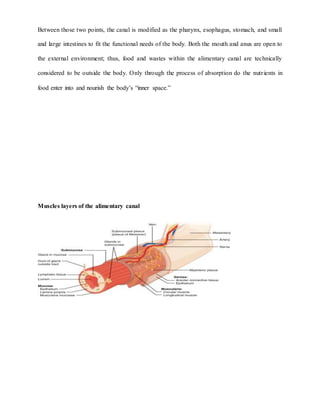
Muscles layers of the alimentary canal
Duodenal ulcer, increases the secretion of acid believed to be caused by an over active
vagus nerve, which stimulates the release of gastrin.
Anatomy And Physiology Of The Small Intestine
The word intestine is derived from a Latin root meaning “internal,” and indeed, the two organs
together nearly fill the interior of the abdominal cavity. In addition, called the small and large
bowel, or colloquially the “guts,” they constitute the greatest mass and length of the alimentary
canal and, with the exception of ingestion, perform all digestive system functions.
The Small Intestine
Chyme released from the stomach enters the small intestine, which is the primary digestive organ
in the body. Not only is this where most digestion occurs, it is also where practically all
absorption occurs. The longest part of the alimentary canal, the small intestine is about 3.05
meters (10 feet) long in a living person (but about twice as long in a cadaver due to the loss of
muscle tone). Since this makes it about five times longer than the large intestine, you might
wonder why it is called “small.” In fact, its name derives from its relatively smaller diameter of
only about 2.54 cm (1 in), compared with 7.62 cm (3 in) for the large intestine. As we’ll see
shortly, in addition to its length, the folds and projections of the lining of the small intestine work
to give it an enormous surface area, which is approximately 200m, more than 100 times the
surface area of your skin. This large surface area is necessary for complex processes of digestion
and absorption that occur within it.
The three regions of the small intestine are the duodenum, jejunum, and ileum. The jejunum is
about 0.9 meters (3 feet) long (in life) and runs from the duodenum to the ileum. Jejunum means
“empty” in Latin and supposedly was so named by the ancient Greeks who noticed it was always
empty at death. No clear demarcation exists between the jejunum and the final segment of the
small intestine, the ileum. The ileum is the longest part of the small intestine, measuring about
1.8 meters (6 feet) in length. It is thicker, more vascular, and has more developed mucosal folds
than the jejunum. The ileum joins the cecum, the first portion of the large intestine, at the
ileocecal sphincter (or valve). The jejunum and ileum are tethered to the posterior abdominal
wall by the mesentery. The large intestine frames these three parts of the small intestine.
Parasympathetic nerve fibers from the vagus nerve and sympathetic nerve fibers from the
thoracic splanchnic nerve provide extrinsic innervation to the small intestine. The superior
mesenteric artery is its main arterial supply. Veins run parallel to the arteries and drain into the
superior mesenteric vein. Nutrient-rich blood from the small intestine is then carried to the liver
via the hepatic portal vein.
Anatomy of the Large Intestine
The large intestine is the terminal part of the alimentary canal. The primary function of this
organ is to finish absorption of nutrients and water, synthesize certain vitamins, as well as to
form, store, and eliminate feces from the body. The large intestine runs from the appendix to the
anus. It frames the small intestine on three sides. Despite its being about one-half as long as the
small intestine, it is called large because it is more than twice the diameter of the small intestine,
about 3 inches.
Regions of the large intestine
The large intestine is subdivided into four main regions: the cecum, the colon, the rectum, and
the anus. The ileocecal valve, located at the opening between the ileum and the large intestine,
controls the flow of chyme from the small intestine to the large intestine.
Cecum
The first part of the large intestine is the cecum, a sac-like structure that is suspended inferior to
the ileocecal valve. It is about 6 cm (2.4 in) long, receives the contents of the ileum, and
continues the absorption of water and salts. The appendix (or vermiform appendix) is a winding
tube that attaches to the cecum. Although the 7.6-cm (3-in) long appendix contains lymphoid
tissue, suggesting an immunologic function, this organ is generally considered vestigial.
However, at least one recent report postulates a survival advantage conferred by the appendix: In
diarrheal illness, the appendix may serve as a bacterial reservoir to repopulate the enteric bacteria
for those surviving the initial phases of the illness. Moreover, its twisted anatomy provides a
haven for the accumulation and multiplication of enteric bacteria. The mesoappendix, the
mesentery of the appendix, tethers it to the mesentery of the ileum.
Colon
The cecum blends seamlessly with the colon. Upon entering the colon, the food residue first
travels up the ascending colon on the right side of the abdomen. At the inferior surface of the
liver, the colon bends to form the right colic flexure (hepatic flexure) and becomes the transverse
colon. The region defined as hindgut begins with the last third of the transverse colon and
continues on. Food residue passing through the transverse colon travels across to the left side of
the abdomen, where the colon angles sharply immediately inferior to the spleen, at the left colic
flexure (splenic flexure). From there, food residue passes through the descending colon, which
runs down the left side of the posterior abdominal wall. After entering the pelvis inferiorly, it
becomes the s-shaped sigmoid colon , which extends medially to the midline The ascending and
descending colon, and the rectum (discussed next) are located in the retroperitoneum. The
transverse and sigmoid colon are tethered to the posterior abdominal wall by the mesocolon.
Large Intestine. The large intestine includes the cecum, colon, and rectum.
Rectum
Food residue leaving the sigmoid colon enters the rectum in the pelvis, near the third sacral
vertebra. The final 20.3 cm (8 in) of the alimentary canal, the rectum extends anterior to the
sacrum and coccyx. Even though rectum is Latin for “straight,” this structure follows the curved
contour of the sacrum and has three lateral bends that create a trio of internal transverse folds
called the rectal valves. These valves help separate the feces from gas to prevent the
simultaneous passage of feces and gas.
Anal Canal
Finally, food residue reaches the last part of the large intestine, the anal canal, which is located in
the perineum, completely outside of the abdominopelvic cavity. This 3.8–5 cm (1.5–2 in) long
structure opens to the exterior of the body at the anus. The anal canal includes two sphincters.
The internal anal sphincter is made of smooth muscle, and its contractions are involuntary. The
external anal sphincter is made of skeletal muscle, which is under voluntary control. Except
when defecating, both usually remain closed.
ANATOMY OF THE STOMACH
The stomach, is an intraperitoneal digestive organ located between the oesophagus and the
duodenum.
It has a ‘J’ shape, and features a lesser and greater curvature. The anterior and posterior surfaces
are smoothly rounded with a peritoneal covering. In this article, we shall look at the anatomy of
the stomach – its position, structure and neurovascular supply.
Anatomical Position
The stomach lies within the superior aspect of the abdomen. It primarily lies in the epigastric and
umbilical regions, however, the exact size, shape and position of the stomach can vary from
person to person and with position and respiration.
Anatomical Structure
The stomach has four main anatomical divisions; the cardia, fundus, body and pylorus:
Cardia – surrounds the superior opening of the stomach at the T11 level.
Fundus – the rounded, often gas filled portion superior to and left of the cardia.
Body – the large central portion inferior to the fundus.
Pylorus – This area connects the stomach to the duodenum. It is divided into the pyloric antrum,
pyloric canal and pyloric sphincter. The pyloric sphincter demarcates the transpyloric plane at
the level of L1.
Greater and LesserCurvatures
The medial and lateral borders of the stomach are curved, forming the lesser and greater
curvatures:
Greater curvature – forms the long, convex, lateral border of the stomach. Arising at the cardiac
notch, it arches backwards and passes inferiorly to the left. It curves to the right as it continues
medially to reach the pyloric antrum. The short gastric arteries and the right and left gastro-
omental arteries supply branches to the greater curvature.
Lesser curvature – forms the shorter, concave, medial surface of the stomach. The most inferior
part of the lesser curvature, the angular notch, indicates the junction of the body and pyloric
region. The lesser curvature gives attachment to the hepatogastric ligament and is supplied by the
left gastric artery and right gastric branch of the hepatic artery.
Anatomical Relations
Anatomical Relation Structures
Superior Oesophagus and left dome of the diaphragm
Anterior Diaphragm, greater omentum, anterior abdominal wall, left lobe of liver, gall
bladder
Posterior Lesser sac, pancreas, left kidney, left adrenal gland, spleen, splenic artery,
transverse mesocolon
Sphincters of the Stomach
There are two sphincters of the stomach, located at each orifice. They control the passage of
material entering and exiting the stomach.
Inferior Oesophageal Sphincter
The oesophagus passes through the diaphragm through the oesophageal hiatus at the level of T10.
It descends a short distance to the inferior oesophageal sphincter at the T11 level which marks
the transition point between the oesophagus and stomach (in contrast to the superior oesophageal
sphincter, located in the pharynx). It allows food to pass through the cardiac orifice and into the
stomach and is not under voluntary control.
Pyloric Sphincter
The pyloric sphincter lies between the pylorus and the first part of the duodenum. It controls of
the exit of chyme (food and gastric acid mixture) from the stomach.
In contrast to the inferior oesophageal sphincter, this is an anatomical sphincter. It contains
smooth muscle, which constricts to limit the discharge of stomach contents through the orifice.
Emptying of the stomach occurs intermittently when intragastric pressure overcomes the
resistance of the pylorus. The pylorus is normally contracted so that the orifice is small and food
can stay in the stomach for a suitable period. Gastric peristalsis pushes the chyme through the
pyloric canal into the duodenum for further digestion
Greater and LesserMomenta
Within the abdominal cavity, a double layered membrane called the peritoneum, supports most
of the abdominal viscera and assists with their attachment to the abdominal wall.
The greater and lesser momenta are two structures that consist of peritoneum folded over itself
(two layers of peritoneum – four membrane layers). Both momenta attach to the stomach, and
are useful anatomical landmarks:
Greater momentum – hangs down from the greater curvature of the stomach and folds back upon
itself where it attaches to the transverse colon It contains many lymph nodes and may adhere to
inflamed areas , therefore playing a key role in gastrointestinal immunity and minimizing the
spread of intraperitoneal infections.
Lesser momentum– continuous with peritoneal layers of the stomach and duodenum, this smaller
peritoneal fold arises at the lesser curvature and ascend to attach to the liver. The main function
of the lesser momentum is to attach the stomach and duodenum to the liver.
Together, the greater and lesser momenta divide the abdominal cavity into two; the greater and
lesser sac. The stomach lies immediately anterior to the lesser sac. The greater and lesser sacs
communicate via the epiploic foramen, a hole in the lesser momentum.
Pathophysiology of Peptic Ulcer
Peptic ulcers are defects in the gastric or duodenal mucosa that extend through the muscularis
mucosa. The epithelial cells of the stomach and duodenum secrete mucus in response to irritation
of the epithelial lining and as a result of cholinergic stimulation. The superficial portion of the
gastric and duodenal mucosa exists in the form of a gel layer, which is impermeable to acid and
pepsin. Other gastric and duodenal cells secrete bicarbonate, which aids in buffering acid that
lies near the mucosa. Prostaglandins of the E type (PGE) have an important protective role,
because PGE increases the production of both bicarbonate and the mucous layer.
In the event of acid and pepsin entering the epithelial cells, additional mechanisms are in place to
reduce injury. Within the epithelial cells, ion pumps in the basolateral cell membrane help to
regulate intracellular pH by removing excess hydrogen ions. Through the process of restitution,
healthy cells migrate to the site of injury. Mucosal blood flow removes acid that diffuses through
the injured mucosa and provides bicarbonate to the surface epithelial cells.
Under normal conditions, a physiologic balance exists between gastric acid secretion and
gastroduodenal mucosal defense. Mucosal injury and, thus, peptic ulcer occur when the balance
between the aggressive factors and the defensive mechanisms is disrupted. Aggressive factors,
such as nonsteroidal anti-inflammatory drugs (NSAIDs), H pylori infection, alcohol, bile salts,
acid, and pepsin, can alter the mucosal defense by allowing the back diffusion of hydrogen ions
and subsequent epithelial cell injury. The defensive mechanisms include tight intercellular
junctions, mucus, bicarbonate, mucosal blood flow, cellular restitution, and epithelial renewal.
The gram-negative spirochete H pylori was first linked to gastritis in 1983. Since then, further
study of H pylori has revealed that it is a major part of the triad, which includes acid and pepsin,
that contributes to primary peptic ulcer disease. The unique microbiologic characteristics of this
organism, such as urease production, allows it to alkalinize its microenvironment and survive for
years in the hostile acidic environment of the stomach, where it causes mucosal inflammation
and, in some individuals, worsens the severity of peptic ulcer disease.
When H pylori colonizes the gastric mucosa, inflammation usually results. The causal
association between H pylori gastritis and duodenal ulceration is now well established in the
adult and pediatric literature. In patients infected with H pylori, high levels of gastrin and
pepsinogen and reduced levels of somatostatin have been measured. In infected patients,
exposure of the duodenum to acid is increased. Virulence factors produced by H pylori,
including urease, catalase, vacuolating cytotoxin, and lipopolysaccharide, are well described.
Most patients with duodenal ulcers have impaired duodenal bicarbonate secretion, which has
also proven to be caused by H pylori because its eradication reverses the defect. [5] The
combination of increased gastric acid secretion and reduced duodenal bicarbonate secretion
lowers the pH in the duodenum, which promotes the development of gastric metaplasia (ie, the
presence of gastric epithelium in the first portion of the duodenum). H pylori infection in areas of
gastric metaplasia induces duodenitis and enhances the susceptibility to acid injury, thereby
predisposing to duodenal ulcers. Duodenal colonization by H pylori was found to be a highly
significant predictor of subsequent development of duodenal ulcers in one study that followed
181 patients with endoscopy-negative, nonulcer dyspepsia. [6]
Signs and Symptoms
Smeltzer (2004) outlined the clinical manifestation shown by a peptic ulcer patient as follows;
dull, gnawing pain or a burning sensation in the mid-epigastrium or the back
pyrosis (heartburn)
vomiting
constipation or diarrhea
vague and poorly localized discomfort in the older adult, weight loss in anemia
possible black tarry stool
Manifestation of hemorrhage and shock.
Diagnosis of Peptic Ulcer
Testing for H pylori infection is essential in all patients with peptic ulcers. In most patients with
uncomplicated peptic ulcer disease, routine laboratory tests usually are not helpful.
Documentation of peptic ulcer disease depends on radiographic and endoscopic confirmation.
Hung et al conducted a retrospective study of 830 records of patients hospitalized for bleeding
peptic ulcers and found that 19% of patients were not tested for H pylori. Further analysis
revealed that failure to test for H pylori within 60 days of endoscopy was associated with
increased risk of rebleeding or death within 1 year. [32]
If the diagnosis of peptic ulcer disease is suspected, obtaining a complete blood cell (CBC) count,
liver function tests (LFTs), and levels of amylase and lipase may be useful. CBC count and iron
studies can help detect anemia, which is an alarm signal that mandates early endoscopy to rule
out other sources of chronic gastrointestinal (GI) blood loss.
The 2017 American College of Gastroenterology (ACG) guidelines for the treatment of H pylori
infection (HPI) include recommendations for testing for H pylori. [33] (See ACG Guidelines.)
The 2017 ACG guidelines also recommend posttreatment testing to prove eradication of HPI
with the use of a urea breath test, fecal antigen test, or biopsy-based testing at least 4 weeks
following the completion of antimicrobial therapy and after proton pump inhibitors have been
withheld for 1-2 weeks. [33]
H pylori testing
Testing for H pylori infection is essential in all patients with peptic ulcers.
Endoscopic or invasive tests for H pylori include a rapid urease test, histopathology, and culture.
Rapid urease tests are considered the endoscopic diagnostic test of choice. The presence of H
pylori in gastric mucosal biopsy specimens is detected by testing for the bacterial product urease.
Fecal antigen testing identifies active H pylori infection by detecting the presence of H pylori
antigens in stools. This test is more accurate than antibody testing and is less expensive than urea
breath tests.
Three kits (ie, CLOtest, Hp-fast, Pyloritek) are commercially available for H pylori testing, and
each contains a combination of a urea substrate and a pH sensitive indicator. One or more gastric
biopsy specimens are placed in the rapid urease test kit. If H pylori is present, bacterial urease
converts urea to ammonia, which changes the pH, resulting in a color change.
Urea breath tests detect active H pylori infection by testing for the enzymatic activity of bacterial
urease. In the presence of urease produced by H pylori, labeled carbon dioxide (heavy isotope,
carbon-13, or radioactive isotope, carbon-14) is produced in the stomach, absorbed into the
bloodstream, diffused into the lungs, and exhaled.
Obtain histopathology, often considered the criterion standard to establish a diagnosis of H pylori
infection, if the rapid urease test result is negative and a high suspicion for H pylori persists
(presence of a duodenal ulcer).
Antibodies (immunoglobulin G [IgG]) to H pylori can be measured in serum, plasma, or whole
blood. Results with whole blood tests obtained from finger sticks are less reliable.
Endoscopy
The American Society for Gastrointestinal Endoscopy (ASGE) released guidelines for sedation
and anesthesia in gastrointestinal endoscopy in January 2018. [34] (See ASGE Guidelines.)
Upper gastrointestinal (GI) endoscopy is the preferred diagnostic test in the evaluation of
patients with suspected peptic ulcer disease. It is highly sensitive for the diagnosis of gastric and
duodenal ulcers, allows for biopsies and cytologic brushings in the setting of a gastric ulcer to
differentiate a benign ulcer from a malignant lesion, and allows for the detection of H pylori
infection with antral biopsies for a rapid urease test and/or histopathology in patients with peptic
ulcer disease. (See the images below.)
At endoscopy, gastric ulcers appear as discrete mucosal lesions with a punched-out smooth ulcer
base, which often is filled with whitish fibrinoid exudate. Ulcers tend to be solitary and well
circumscribed and usually are 0.5-2.5 cm in diameter. Most gastric ulcers tend to occur at the
junction of the fundus and antrum, along the lesser curvature. Benign ulcers tend to have a
smooth, regular, rounded edge with a flat smooth base and surrounding mucosa that shows
radiating folds. Malignant ulcers usually have irregular heaped-up or overhanging margins. The
ulcerated mass often protrudes into the lumen, and the folds surrounding the ulcer crater are
often nodular and irregular.
More than 95% of duodenal ulcers are found in the first part of the duodenum; most are less than
1 cm in diameter. [35] Duodenal ulcers are characterized by the presence of a well-demarcated
break in the mucosa that may extend into the muscularis propria of the duodenum (see the
images below).
A meta-analysis has shown that for individuals who undergo endoscopy for dyspepsia, the most
common finding is erosive esophagitis (though prevalence was lower when the Rome criteria
were used to define dyspepsia) followed by peptic ulcer. [36]
Radiography
In patients presenting acutely, a chest radiograph may be useful to detect free abdominal air
when perforation is suspected. On upper gastrointestinal (GI) contrast study with water-soluble
contrast, the extravasation of contrast indicates gastric perforation.
Double-contrast radiography performed by an experienced radiologist may approach the
diagnostic accuracy of upper GI endoscopy. However, it has been replaced largely by diagnostic
endoscopy, when available. An upper GI series is not as sensitive as endoscopy for establishing a
diagnosis of small ulcers (< 0.5 cm). It also does not allow for obtaining a biopsy to rule out
malignancy in the setting of a gastric ulcer or to assess for H pylori infection in the setting of a
gastroduodenal ulcer.
Angiography
Angiography may be necessary in patients with a massive gastrointestinal bleed in whom
endoscopy cannot be performed. An ongoing bleeding rate of 0.5 mL/min or more is needed for
the angiography to be able to accurately identify the bleeding source. Angiography can depict the
source of the bleeding and can help provide needed therapy in the form of a direct injection of
vasoconstrictive agents.
Serum Gastrin Level
A fasting serum gastrin level should be obtained in certain cases to screen for Zollinger-Ellison
syndrome. Such cases include the following:
Patients with multiple ulcers
Ulcers occurring distal to the duodenal bulb
Strong family history of peptic ulcer disease
Peptic ulcer associated with diarrhea, steatorrhea, or weight loss
Peptic ulcer not associated with H pylori infection or use of nonsteroidal anti-
inflammatory agents
Peptic ulcer associated with hypercalcemia or renal stones
Ulcer refractory to medical therapy
Ulcer recurring after surgery
Secretin Stimulation Test
A secretin stimulation test may be required if the diagnosis of Zollinger-Ellison syndrome cannot
be made on the basis of the serum gastrin level alone. This test can distinguish Zollinger-Ellison
syndrome from other conditions with a high serum gastrin level, such as use of antisecretory
therapy with a proton pump inhibitor, renal failure, or gastric outlet obstruction.
Biopsy and Histologic Findings
Biopsy
A single biopsy offers 70% accuracy in diagnosing gastric cancer, but 7 biopsy samples obtained
from the base and ulcer margins increase the sensitivity to 99%. Brush cytology has been shown
to increase the biopsy yield, and this method may be useful particularly when bleeding is a
concern in a patient with coagulopathy.
Histologic findings
The histology of gastric ulcer depends on its chronicity. The surface is covered with slough and
inflammatory debris. Beneath this neutrophilic infiltration, active granulation with mononuclear
leukocytic infiltration and fibrinoid necrosis may be seen. In chronic superficial gastritis,
lymphocytes, monocytes, and plasma cells often infiltrate the mucosa and submucosa.
Emergency Department Workup
The emergency department (ED) workup will vary depending on presentation and includes the
following:
Complete blood cell (CBC) count is used to evaluate acute or chronic blood loss.
Electrolytes, blood urea nitrogen (BUN), and creatinine levels are useful tests for critical-
appearing patients who require fluid resuscitation.
Type and screen and crossmatched blood for transfusion is indicated in unstable or potentially
critical patients.
Activated partial thromboplastin time (aPTT), prothrombin time (PT) and international
normalized ratio (INR) are indicated in patients with active bleeding and those on anticoagulants.
Amylase, lipase, and liver transaminase levels can be helpful to rule out other common causes of
epigastric pain.
Patients younger than 55 years with no alarm features should be referred for noninvasive testing
for H pylori infection in the outpatient setting.
COMPLICATIONS OF PEPTIC ULCER DISEASE
The following are some of the complications of peptic ulcer given by Atindabila (2003).
Perforation: the ulceration extends completely through the wall of the stomach or duodenum into
the peritoneal cavity as a result, the gastric or duodenal content escape into the peritoneum and
sat up peritonitis. This gives the patient server generalized abdominal pain and abdominal muscle
rigidity. The patient is quite still because nay movement aggravate his pain and signs of shock
(pallor, sweating, fast pulse decreased Bp)
Hemorrhage: the peptic ulcer bleeds if the ulceration has eroded a blood vessel, the bleeding can
be slight or sever. The blood may be vomited (hematemesis) or appear in the stool making them
black and tarry (melaena). The bleeding is profuse, he showed signs of shock.
pyloric stenosis: this result from fibrosis and edema from recurrent ulceration and may
progressively obstruct the lumen of the affected part of the duodenum.
This obstruction at the pylorus leads to a distention of the stomach, which is evacuated
from time to time by vomiting which is often copious and projectile.
Hour-glass stomach. These is a scar contraction in the center of the stomach dividing it into two
cavities with a narrow opening between them. This is started by parietal gastrectomy.
NURSING MANAGEMENT
According to Atindanbila (2003) they are not normally admitted except in severe cases once they
are given health education on the following;
Rest
The patient should have both physical and mental rest. Patient should have psychological rest by
getting over the problem through psychotherapy.
Psychological management
Tranquilizer should be given to patient to allay anxiety. Patient should also be hospitalized, if
possible, as a change in environment is often beneficial for 2 – 4 weeks until symptoms have
improved. Other measures to ensure rest should be applied also.
Patient should also be reassured of competent care to allay fear
Dietary management
Plenty of protein meals should be given to repair the ulcer. They also act as buffer e.g., Milk. Fat
should also be given, because they delay the emptying time of the stomach, hence it does not
encourage the secretion of the stomach. Hence patient can take them in normal quantity.
Carbohydrate should be given with little fiber to avoid irritation. Vitamin should be given
especially vitamin C.
Contraindications; foods that intake the mucosa of the GIT likes pepper, spices, ginger and
coffee should be avoided. In addition, there should be frequent and regular meals. Milk also
buffers the acid and is taken at the onset by the pain and the night.
MEDICAL TRATMENT OF PEPTIC UCLER DISEASE
Pharmacologic therapy
The goals of pharmacotherapy are to eradicate H pylori infection, to reduce morbidity, and to
prevent complications in patients with peptic ulcers. Acid suppression is the general
pharmacologic principle of medical management of acute bleeding from a peptic ulcer, using
histamine-2 receptor antagonists (H2RAs) and proton pump inhibitors (PPIs). [48] Both classes
are available in intravenous or oral preparations. Discontinuation of NSAIDs is paramount, if it
is clinically feasible. For patients who must continue with their NSAIDs, PPI maintenance is
recommended to prevent recurrences even after eradication of H pylori.
The recommended primary therapy for H pylori infection is proton pump inhibitor (PPI)–based
triple therapy. Antacids or a GI cocktail (typically an antacid with an anesthetic such as viscous
lidocaine and/or an antispasmodic) may be used as symptomatic therapy in the ED. Maintenance
treatment with antisecretory medications (eg, H2 blockers, PPIs) for 1 year is indicated in high-
risk patients. High-risk patients include those with recurrent ulcers and those with complicated or
giant ulcers. If H pylori eradication is not achieved despite repeat treatment, maintenance
antisecretory therapy should be recommended. Patients with refractory ulcers may continue
receiving once-daily PPI therapy indefinitely. In this setting, if H pylori is absent, consider a
secondary cause of duodenal ulcer, such as Zollinger-Ellison syndrome.
Primary prevention of NSAID-induced ulcers includes avoiding unnecessary use of NSAIDs,
using acetaminophen or nonacetylated salicylates when possible, and using the lowest effective
dose of an NSAID and switching to less toxic NSAIDs.
Proton Pump Inhibitors
PPIs are inhibitors of the gastric H+/K+ -ATPase (proton pump) enzyme system, which
catalyzes the exchange of H+ and K+.
Omeprazole (Prilosec)
Omeprazole decreases gastric acid secretion by inhibiting the parietal cell H+/K+ ATP pump. It
usually is given with clarithromycin and amoxicillin (or metronidazole if the patient is allergic to
penicillin) when administering proton pump inhibitor–based triple therapy. It might decrease the
incidence of NSAID-induced peptic ulcers and can be used to help prevent peptic ulcers in long-
term NSAID users at high risk.
Lansoprazole (Prevacid)
Lansoprazole decreases gastric acid secretion by inhibiting the parietal cell H+/K+ ATP pump. It
usually is given with clarithromycin and amoxicillin (or metronidazole if the patient is allergic to
penicillin) when administering proton pump inhibitor–based triple therapy. It might decrease the
incidence of NSAID-induced peptic ulcers and can be used to help prevent peptic ulcers in long-
term NSAID users at high risk.
Rabeprazole (Aciphex)
Rabeprazole decreases gastric acid secretion by inhibiting the parietal cell H+/K+ ATP pump. It
is used for short-term (4-8 wk) treatment and relief of symptomatic erosive or ulcerative
gastroesophageal reflux disease. Patients not healed after 8 weeks should consider an additional
8-week course.
Esomeprazole (Nexium)
Esomeprazole is an S-isomer of omeprazole. It inhibits gastric acid secretion by inhibiting the
H+/K+-ATPase enzyme system at the secretory surface of gastric parietal cells. It is used in
severe cases and in patients who have not responded to H2 antagonist therapy. Esomeprazole is
used for up to 4 weeks to treat and relieve symptoms of active duodenal ulcers, and it may be
used for up to 8 weeks to treat all grades of erosive esophagitis.
Pantoprazole (Protonix)
Pantoprazole suppresses gastric acid secretion by specifically inhibiting the H+/K+-ATPase
enzyme system at the secretory surface of gastric parietal cells. Use of the intravenous
preparation has only been studied for short-term use (ie, 7-10 d).
H2-Receptor Antagonists
H2 blocker antihistamine agents are used in the short-term treatment of an active duodenal ulcer
and as prophylaxis in the long term.
Cimetidine (Tagamet)
Cimetidine can be used as primary therapy to heal ulcers not associated with H pylori infection.
The duration of treatment is 6-8 weeks. A longer treatment course might be required for gastric
ulcers.
Famotidine (Pepcid)
Famotidine competitively inhibits histamine at H2 receptor of gastric parietal cells, resulting in
reduced gastric acid secretion, gastric volume, and hydrogen ion concentrations.
Nizatidine (Axid)
Nizatidine competitively inhibits histamine at H2 receptor of gastric parietal cells, resulting in
reduced gastric acid secretion, gastric volume, and hydrogen ion concentrations.
Ranitidine (Zantac)
View full drug information
Ranitidine inhibits histamine stimulation of the H2 receptor in gastric parietal cells, which, in
turn, reduces gastric acid secretion, gastric volume, and hydrogen ion concentrations. As of
April 1, 2020, ranitidine was withdrawn from the market due to an increasing number of
products containing the contaminant known as N-Nitrosodimethylamine (NDMA), a possible
carcinogen.
Antimicrobials
Antimicrobial agents exert an antibacterial effect on H pylori.
Amoxicillin (Amoxil, Biomox, Trimox)
This is a component of drug combination therapy that effectively treats duodenal ulcer or gastric
ulcer associated with H pylori infection. It interferes with the synthesis of cell wall mucopeptides
during active multiplication, resulting in bactericidal activity against susceptible bacteria.
Administer with omeprazole or lansoprazole plus clarithromycin in proton pump inhibitor–based
triple therapy.
Clarithromycin (Biaxin)
This is a semisynthetic macrolide antibiotic that reversibly binds to the P site of the 50S
ribosomal subunit of susceptible organisms and may inhibit RNA-dependent protein synthesis by
stimulating the dissociation of peptidyl t-RNA from ribosomes, causing bacterial growth
inhibition. This component of drug combination therapy effectively treats duodenal ulcer or
gastric ulcer associated with H pylori infection. It interferes with the synthesis of cell wall
mucopeptides during active multiplication, resulting in bactericidal activity against susceptible
bacteria. Administer with omeprazole or lansoprazole plus amoxicillin in proton pump inhibitor–
based triple therapy.
Tetracycline (Sumycin)
Component of drug combination therapy that effectively treats duodenal ulcer or gastric ulcer
associated with H pylori infection. Usually used in combination with bismuth subsalicylate and
metronidazole.
Metronidazole (Flagyl, Flagyl ER)
This is a component of drug combination therapy that effectively treats duodenal ulcers or gastric
ulcers associated with H pylori infection. It is active against various anaerobic bacteria and
protozoa. It appears to be absorbed into cells. The intermediate-metabolized compounds formed
bind DNA and inhibit protein synthesis, causing cell death.
Antidiarrheal Agents
Antidiarrheal agents may have antisecretory and antimicrobial action.
Bismuth subsalicylate (Pepto Bismol, Pink Bismuth, Kaopectate Extra Strength)This is a highly
insoluble salt of trivalent bismuth and salicylic acid. Greater than 80% of salicylic acid is
absorbed from oral doses of bismuth subsalicylate chewable tablets. It controls diarrhea by
reducing fluid secretion into the intestinal lumen, by binding bacterial toxins, or by acting as an
antimicrobial agent.
Cytoprotective Agents
Cytoprotective agents stimulate mucus production and enhance blood flow throughout the lining
of the gastrointestinal tract. These agents also work by forming a coating that protects the
ulcerated tissue. Examples of cytoprotective agents include misoprostol and sucralfate.
Misoprostol (Cytotec)
Misoprostol is a prostaglandin analog that can be used to decrease the incidence of peptic ulcers
and complications in long-term NSAID users at high risk.
Sucralfate (Carafate)
Sucralfate binds with positively charged proteins in exudates and forms a viscous adhesive
substance that protects the GI lining against pepsin, peptic acid, and bile salts. It is used for
short-term management of ulcers.
NON-PHARMACOLOGICAL TREATMENTS
Smoking cessation: research indicated that continued smoking may significantly inhibit ulcer
repair (Konturek, Plasnka 2003). Therefore, the patient should strongly be encouraged to stop
smoking.
Dietary modification: patient with peptic ulcer are to avoid over secretion of acid and
hypermotility in the GIT by avoiding extremes of temperature of food, beverages and
overstimulation from consumption of meat extract, alcohol coffee and diet rich in milk and
cream. In addition, an effort is made to neutralize acid by eating three regular meals a day.
SURGICAL TREATMENT
Anane-Darko (2003) said the surgical therapy of peptic ulcer such as:
Subtotal
This is the removal of part of the stomach. The lower half is usually removed. It is also
known as partial gastrectomy.
Total Gastrectomy
This is the removal of the stomach with attachment of the esophagus to the jejunum or
duodenum.
Vagotomy
Surgical division of the vagus nerve to eliminate the vagal impulses that stimulates
hydrochloric acid
Vagotomy with pyloroplasty
Vagotomy is done on patient then the pylorus is enlarged to prevent or decrease pyloric
obstruction, thereby enhancing gastric emptying.
These interventions are undertaken when medical therapy has failed to heal the ulcer or far the
following reasons;
An ulcer which has produced pyloric or duodenal stenosis or hour glass stomach.
an ulcer which has become malignant
Perforated ulcer.
VALIDATION OF DATA
Validation is an act of confirming or verifying data to keep it as free from error, bias and
misinterpretation. Valid information leads to appropriate nursing care. Thus, validation is done
by the nurse during data gathering process. Data was sourced from the patient, his family,
clinical features presented by him, other members of the health team, medical records and
literature review. In this light, data gathered from Master A.A, his relatives, from observations
made during home visits, staff nurses of the Male medical ward, laboratory investigations, the
doctors and finally the reviewed literatures, showed no incongruities. Aside that data obtained at
the Male medical ward was compared with those obtained from the outpatient department of
which also no incongruities were found, hence the data was said to be free from errors and was
valid.

chapter 1 Naomi.docx

  • 1.
    PREFACE The patient andfamily care study is a full written description of comprehensive nursing care provided to a specific patient and family, beginning at the time of admission and continuing through follow-up care (home visits) and ending on the day of care termination, all within a minimum of one month. This is done to address the physical, psychological, and socioeconomic needs of the patient and family in order for them to achieve optimal health. The care study is undertaking to allow the student nurse to connect theory with practice during his or her college training. It also allows the student nurse to demonstrate skills in providing individualistic and complete nursing care to his or her patient, as well as provide an account of the patient's treatment, observation, and care using the nursing process. It is a means for the student nurse to learn the development of effective nurse-patient and family relationships. It's also a way of providing high-quality nursing care to patients and their loved ones. The patient and family care study is conducted by all final year students of the Nursing Institutions and submitted to the Nursing and Midwifery Council of Ghana as one of the requirement for the award of a professional certificate to practice in Ghana.
  • 2.
    ACKNOWLEDGEMENT This care study'scomposition needs a great deal of research and information gathering from helpful people, as well as financial assistance and support from family and friends, without which this piece of work would not have been accomplished successfully. As a result, they deserve a lot of praise and admiration. My sincerest gratitude goes to the Almighty God for providing me with the strength and knowledge necessary to successfully complete this care study. I owe a debt of gratitude to my parents and my family for their guidance and support during my studies. I say “ayeekoo” bravo for spending chunk of your resources on me. Again, I thank the patient and other members of his family for their cooperation and seamless interaction, which enabled me to complete this care research. My heartfelt gratitude goes to the principal, Hellen Gifty Dwamena Amoah (Mrs), and the entire tutorial and non-tutorial staff of the Nursing and Midwifery Training College, Mampong-Ashanti, for their time and unwavering support, advice, and assistance provided to me during my time there. Thank you, Mr. Antierefaa Paul, for taking the time to read through and fix this work, which allowed me to assemble and finish my care study. My heartfelt gratitude also goes out to the Ashanti Mampong government Hospital's management, paramedicals, clinical and non-clinical staff, particularly the Nursing administrator () and the In-charge Mrs. Nancy Adzor and nurses at the males medical ward, for allowing me to assess the facility and guiding me to find a client and condition for my care study.
  • 3.
    I owe adebt of thanks to the authors and publishers of the publications from which I gleaned useful material for this care study. I say thank you for availing your in-depth knowledge of resource through various means for some of us to access Finally, my deepest thanks go to my friends of the Mampong Nursing and Midwifery Training College Ashanti for the socialization, warm reception and various support offered me during my life in the college.
  • 4.
    INTRODUCTION The glue thatkeeps a patient's health care journey together is 21st century nursing. Nurses labor relentlessly throughout the patient experience, and wherever there is someone in need of care, to identify and defend the individual's needs. Beyond the long-standing reputation for compassion and dedication, there is a highly specialized profession that is always growing to meet society's requirements.Nurses are crucial in protecting public health, from assuring the most accurate diagnoses to continuing to educate the public about critical health issues. Nursing can be described as both an art and a science; a heart and a mind. At its heart, lies a fundamental respect for human dignity and an intuition for a patient’s needs. Nursing is defined as the autonomous and collaborative care of individuals of all ages, families, groups, and communities, in all settings, sick or well. It encompasses health promotion, illness prevention, and care for the sick, disabled, and dying through the nursing process - a five-step system that serves as a guide to providing client-centered care. Assessment, diagnosis, planning, implementation, and evaluation are the five steps. The first step is assessment, which entails critical thinking skills and data collection, both subjective and objective. The study of patient and family care is based on the nursing process, which is a systematic way to recognizing a patient's problem and performing nursing action to provide a solution based on scientific principles. This is done by employing the nursing process, taking the precise nursing duties, and applying theoretical knowledge to the practical context to help the individual attain and maintain optimal function throughout their lives.This engagement takes place over a set amount of time. It include gathering data, identifying issues, designing an outcome-based plan, implementing the plan, and assessing the results. The effectiveness of the patient/family care study will determine the study's success.
  • 5.
    Patient-centered care, aswell as family-centered care, is now widely regarded as essential for achieving high-quality outcomes. Nurses, physicians, and other healthcare workers are being challenged to build a trusting connection with their patients so that they may work together to create goals for their treatment and achieve the best possible outcomes for each patient. Dignity, respect, honesty, collaboration, and encouragement should be among the key ideals of patient- and family-centered care. These values should be at the forefront of every interaction with the patient and family in order to promote patient- and family-centered care in healthcare. This patient care study gives a detailed account of the nursing care rendered to Master A.A a 19 year old man who was admitted to the males ward on 25th February 2022 at 7:00pm with the diagnosis of peptic ulcer and was discharged on 3rd March 2022. He was admitted to the Mampong Municipal Hospital male’s ward with a provisional diagnosis of peptic ulcer and gastroenteritis within the hours of 7:00pm. My interaction with the client lasted for one month, starting on 25th February, 2022 to 25th March 2022. He was treated medically with antibiotics clarithromycin, Amoxicillin, Metronidazole, Ciprofloxacin, Intravenous fluids: ringers lactate ,analgesic Paracetamol and proton pump inhibitor Omeprazole and was discharged home on the 3rd March,2022. To ensure continuity of care, a maximum of three home visits were made - first whiles the patient was n admission to assess home environment and ascertain the possible factors contributing to the patient ill-health . Secondly a week after the patient was discharge to ascertain recovery status, adherence to treatment regimen and remind patient of the review date. Then finally after the review to terminate care and finally hand over the patient to a community health nurse.
  • 6.
    I met theclient when he was brought to the Outpatient Department (OPD) of the Mampong Municipal Hospital partially ambulatory in the company of some relatives for OPD services. He was observed at a distance looking weak I supported him into a wheel chair and quickly process his OPD card, checked his OPD vitals and took him to the consulting room. He was later admitted as an unplanned admission into the male’s ward. I handed over the patient to the OPD nurse to be send to the admission ward whiles I collect his medications from the pharmacy. I followed up with his medications to continue the admission process at the ward. After rendering him the nursing services I introduced myself as a final year student nurse of the Mampong Nursing and Midwifery Training College. I declared my intention to use him for my patient and family care study noting to him that it was a requirement in partial fulfillment for the award of the registered general nursing diploma certificate by the nursing and midwifery council of Ghana. He was assured of confidentiality of information and privacy. Consent was verbally sought from the patient and family after a detailed explanation of the process was made, of which they made an informed choice and willingly agreed to be used for the study. I used Master A.A as my care study because I wanted to have more knowledge on peptic ulcer, its risk factors, possible signs and symptoms, treatment and complications in order to educate people on the disease condition and also give better nursing care to patients with the same condition. The patient and family high level of cooperation and understanding was great which convinced me that patient will willingly offer me the needed support in terms of data collection and adhering to health teachings. Choosing this condition has helped me to gain enough knowledge about the occurrence and treatment of peptic ulcer.
  • 7.
    This report hasbeen written under five chapters; Chapter one deals with the assessment of the patient and it also includes the literature review of the disease condition. Chapter two deals with comparison of data with standards covering diagnostic investigations, causes, clinical features, treatment, complications, patient and family strengths, health problems and nursing diagnosis. Chapter three states the nursing care plan. Chapter four talks about the implementation of patient and family care plan, preparation of patient and family for discharged and rehabilitation and follow ups/home visits/continuity of care. And Chapter five deals with the evaluation of care rendered to patient and family, summary and conclusion of care given to patient. For reasons of confidentiality all names used in the work will be abbreviated and also the patient outpatient department number will not be indicated.
  • 8.
    CHAPTER ONE ASSESSMENT OFPATIENT/FAMILY INTRODUCTION The term "assessment" refers to the gathering of scientific data in order to make clinical judgments and decisions about the care of patients and their relatives. Physical examination, history taking, clinical symptoms, and laboratory studies are all examples of assessment approaches.The purpose of the evaluation is to determine the patient's current and potential health concerns as well as establish nursing diagnoses. The data was acquired using four major evaluation methods, which included observation during home visits and follow-up care, interview, inspection, palpation, and contact between the patient and a relative, as well as the use of the patient's previous and current medical records using both physical examination, history taking and observation methods The information gathered in this chapter includes; Patient`s particulars, Patient`s and family`s medical history, Patient`s lifestyle and hobbies, Admission of patient, Literature review of patient`s condition, patient concept of illness and the validation of data. For reasons of confidentiality and privacy of the patient data the patient will be referred to as Master A.A and also vital information such as patient address would be replaced with descriptions.
  • 9.
    PATIENT’S PARTICULARS Master A.Ais the subject of this care study, a male who is nineteen years of age (19yrs) born on 1st August, 2002 to Madam A.A and Master. S.A. He is a Ghanaian citizen who comes from Bongo, a suburb in Bolegatanga in the Northern Region of Ghana. He is the third (3rd) born of five children. He dropped out of school at the level Junior Secondary School form two (2) and is Currently he works with his cousin I.A on the farm at New Daaman . He lives with his cousin and his wife at New Daaman in a house close to the New Jehovah Witness Church. He is a Christian by religion who fellowships with The Jesus Salvation Miracle Church at New Daaman. He is dark in complexion without any physical impairment. He is 65 centimeters (cm) tall and has a weight of 70 kilogram (kg), he appears neat throughout my interaction with him. He is not married and is single currently with no child. He was admitted to male ward by Dr. Louisa and cared for by Dr. Sarkodie According to him, he has no known allergies. He has no national health insurance Scheme identification card (NHIS). He requires an interpreter during care as he understands only Fafra. He is a Fafra a subset of the Gurunsi tribe. His main source of medical care is the use of orthodox medicine at the Mampong municipal hospital though he does purchase over the counter drugs for his first aid treatment. His main source of financing his medical bills is his cousin. His next of kin is his cousin I.A.
  • 10.
    PATIENT’S FAMILY MEDICALHISTORY A family medical history is a record of illness, medical conditions, and or associated risk factors that typically affect or lead to family members and the client, and is frequently recorded at the hospital. Family medical history assists in tracing prevalent family illnesses, providing insight into the client's condition, and providing information that may be important to the client's health. According to Master A.A, both parents are alive and healthy with no any diagnosed health condition. His grandmother is deceased with no definite cause of death established. There is no history of any hereditary disease such Diabetes, Hypertension, sickle cell disease, Asthma in his family neither is there evidence of their risk factors. However, there are common ailments like headache, malaria, common cold, abdominal pain, headache, diarrhea and body pains which they often treat with over the counter medications. There was no history of alcoholism and no known allergies were established. There are no known abnormalities such as mental disorders, birth deformities and abnormalities such as Down syndrome and extra digits in the family. The family main facility of medical care is the Mampong Municipal Hospital even though they sometimes buy drugs from the license chemical sellers. No family member has undergone surgery before. Client and relatives were therefore advised and educated on the need to report to the hospital for medical checkup and assessment; they were also educated to avoid the use of over the counter medication during ill- health and to avoid self-medication due to their risk to their health status and seek medical attention from professional doctors as this will help minimize their health risk. There are no history acute conditions such as peritonitis, perforations, gastritis, hypertensive crisis in the family; the patient said he cannot recount any history of chronic condition such as diabetes, and hypertension, peptic ulcer disease. There is no history of communicable disease such as tuberculosis, and leprosy. Patient and family has no history of alcohol abuse and drug addiction.
  • 11.
    PATIENT/FAMILY SOCIO-ECONOMIC HISTORY MasterA.A parents and grandparents are all farmers at Bongo. But they sell 50% of their produce and consume the rest of it .He elaborated that he is unsure of the amount of bags produced by his parents. His sisters W.A and M.A are all traders who earn about 1,500 cedis and 1,300 cedis respectively. He stated that this was 3 years ago as he left his family house at Bongo to come and stay with his cousin and currently does not know how much they earn a month. Master A.A works with his cousin on the farm at New Daaman. They farm yam, maize and carrot. However his cousin stated that both the yam and maize are for family consumption only and do not sell it. He further elaborated that with the carrot they are able to produce a maximum of 100 bags every three months which gathers them an amount of 10,000 cedis every month. Master A.A support system is his cousin I.A who provides him with security, financial aid, protection and emotional support in trial times Master A.A is a respecter of societal norms and culture. The family totem is the python. He is a Gurunsi by tribe and they celebrate the “Ndaakoya” festival. The patient Family celebrates both Christian and traditional festivals such as the “Ndaakoya”Christmas, Easter, New Year and the Pentecostal day. He attends community gathering such funerals, weddings, naming ceremonies and clean up exercise. The family practices both the nuclear family and extended family system. They have a positive family cohesion as they interact with each other positively. He goes to the church every Sunday and other days when there is a special occasion. There is no histo ry of divorce, separations and remarriages in the patient family. The economic status of Master A.A family is classified under middle class as they lives a little above the minimum wages and is able to meet three square meals with snacks without much difficulty. Master A.A could not give an exact amount as to how much he makes annually as he works with his cousin and also due to the changes in market prices every now and then. He said
  • 12.
    he is notaffiliated to any political party. He stated that he and his cousin are very active in church. He is very friendly with his neighbors and is also very close to both him nuclear and extended family. He said; in his work (farming), there are numerous risks involved, he made mention of fractures, trauma or injury from sharps, blunt and pointed object, snake bites, toxic effect of some chemicals and accidents. The family lives in a rented apartment, three bed room flat. The environment is clean, well ventilated. Their main source of water supplies is from the Ghana Water Company, they are connected to the national grade for their source of light. They practice burning as the means of waste disposal. PATIENT’S DEVELOPMENTAL HISTORY Development refers to the biological, psychological and emotional changes that occur in human beings between births to the end of adolescent as the individual progress from dependency till increasing autonomy. (Macmillan 2007). Master A.A was born on 1st August, 2002 at Bongo as a home delivery per spontaneous vaginal delivery with the aid of a traditional birth attendant at term without any birth complications. According to the client there was no history of antenatal attendance. . He was not immunized against childhood infections neither was he given six month exclusive breastfeeding. “He was not taken to post natal clinic. Truly, the indelible scar left by the BCG vaccine on the right upper arm was not present confirming all that he said. However, he was given herbal medicine by his grandmother as he grows. “This is done to all children in their family to strengthen and provide protection against physical and spiritual diseases”. “Mater A.A’’ narrated .According to the patient, he was told he went through a normal developmental milestone without any fixation;
  • 13.
    According to patienthe responded to stimuli, within a minute after delivery and he went through the normal developmental milestone without any difficulties and also wasn’t involved in any major incidence or accident. Form one to six month he started sitting with support, sitting without support, copying sounds, respond to own name by turning to direction of call, likes playing with others especially mother and siblings, between ages six months to twelve months he was able to use gestures such as shaking of head for “no” or waving bye - bye” and also responds to simple spoken requests .He was able to say mama and pulls up to stand (12 months -1year). Within one and half year, he was able to differentiate between cutlass and broom and their uses as well. He plays simple pretends such as feeding a doll and pointing to show others something interesting, he was good in singing several single songs and walking alone. At age two, he was able to say sentences with two words and recite when with other children and also follow simple instructions like come, sit and pointing to things and picture when they are named. At age three, he was able to copy adult and friends (like running when other children run). He could carry on conversation using two to three sentences, climb well, show affection without prompting, hop and stand on one foot for up to two seconds , could play with other children than alone, could tell stories, also draw a person with at least two to four body parts and play co-operatively at four years (4years). He started his schooling at a public school in Bogoso at age 5 in the year 2007 where he started kindergarten, at age 7 he was in class one (1) in the year 2009 and completed his primary education in the year 2015. He continued to the junior high in the year 2016 but could not complete his junior high education and out to drop out as he had to help out with the farm work .Whiles in school he was interested in playing football and had military as his future dream job but it could not materialized due to educational and financial reasons. He was allowed to carry out his personal hygiene alone by the age of 6 and this according to Eric Erikson’s
  • 14.
    theory is thestage of purpose vs. initiative and this could be seen from client’s ability to make decisions on his own and from the client’s accomplishments in life. He narrated that as an adult he has had intimacy for the opposite sex, plays and enjoys playing with them. Master A.A said he is currently not dating and is not married. He developed secondary male sexual characteristics such as development of hair around the genital; armpit and broadening of the chest at age thirteen (puberty). Currently apart from farming he does no additional work. Master A.A elaborated that he is not particularly satisfied with his farming work and wishes to someday pursue his dream of being in the military and his only fear is the risk the farming exposes him to. He has no disability, and also has a good working relationship both with his nuclear and the extended family. He rest on Sundays .He is used to the phones but not smartphones and social media platforms like facebook, whatsApp, instagram etc,. Comparison of Master A.A stages of development with Eric Erikson theory of psychosocial growth and development theory (1902-1994) shows that he is at stage Sixth stage with crisis of intimacy verses isolation and it occurs during adolescence from about 12-40 years of which during this stage adolescents search for a sense of self and personal identity. This is done through an intense exploration of personal values, beliefs, and goals. During adolescence, the transition from childhood to adulthood is most important. Children are becoming more independent and begin to look at the future in terms of career, relationship, families, housing. The individual wants to belong to a society and fit. This can be seen in Master A.A as he left his home in Bongo to come live with his cousin to figure his way out in life.
  • 15.
    PATIENT LIFESTYLE ANDHOBBIES Master A.A observes a good personal hygiene. He baths twice daily and cleans his teeth with toothpaste (pepsodent) and tooth brush but uses chewing stick during daytime especially when he is at work. He goes to farm during week days with the exception of Sundays where he goes to prayers and normal service respectively. He does all his washing (clothes) on Sundays and has no difficulty in eating and grooming. He does not have sleep pattern disturbances. He empties his bowels twice daily and empties his bladder as often as he could and frequently especially on sunny days. He enjoys playing football with his friends at his leisure time. His favorite meal is sama zerio with red rice balls but he said after he left home and came to live with his cousin sweet potato and yam has become his favorite meal. He sleeps at 8:30pm after his supper and wakes up at 5:00am to prepare for farm. He takes his breakfast midmorning made by his cousins wife which is at 9:30am of which mostly consist of yam and stew and lunch at 1:30 which consist mostly of rice. He usually reads the bible, attends to nature call, perform oral hygiene, takes his bath and off to work. ”I am yet to know if I am allergic to any food”. He said. To Him, farming in itself is as a form of exercise. He uses verbal and non-verbal communication style and does not stammer. He is kind, very generous, loving and caring, sometimes sociable and love caring for family members especially the child of his cousin. He does not use any illicit drugs; smoke cigarette, tobacco nor drink alcohol. He can tolerate all levels of activity with no interspersed rest period. He is able to go to his farm and perform all kinds of stressful activities. Master A.A established that, he pays keen attention to important issues and does not play with his health. He adheres and applies medical advice so as to assist him to live long. He handle medications with caution and did indicate that, his cousin will not even allow him skip his treatment regimen and review dates. He impressed me the first time I approached him, he smiled
  • 16.
    and was willingto answer any question. He is hardworking, very generous and kind and does not easily give up. PATIENT’S PAST MEDICAL HISTORY Information gathered from Master A.A and review of his health record card indicates that this was his second admission to the hospital. He was first admitted having being diagnosed of Gastroenteritis but prior to that has not been admitted to the hospital although he has suffered from headache and malaria attacks before. Although he adheres to health teachings, he does not go for medical checkups. According to Master A.A, He has never had any sort of illness during his childhood such as measles, whooping cough, and mumps. and in the course of his growth never suffered any serious ailment except the occasionally usual abdominal pains, headaches and malaria which most often is treated by the use of over the counter medications, only in severe cases do they seek treatment from the hospital. He further explained that he has never had any kind of accident, no known allergies and has never consulted a specialist for health care or check-up. According to him, this is his second hospitalization but has never undergone any surgery before to the best of his knowledge. Access to health care was aproblem for him when he was in bogoso but now that he lives with his cousin I.A it is not that much of a problem both financially and geographically. Master A.A has easy access to the Mampong Government Hospital as the facility is not that far from his residence. The facility is well resourced with human resources and infrastructural resources; it has a laboratory including an x-ray unit. It has female and male medical unit, children unit and the maternity wing, consulting room including special consulting rooms. And special units such as theater, dental unit, physiotherapy, diabetic clinic, ear nose and throat, the eye clinic, the mental and chronic care unit. The facility has standard records unit and
  • 17.
    administrative block includinga pharmacy and billing unit. They have six medical officers including a gynecologist, physiotherapist, an optician and a surgeon as well as numerous physician assistant with all classes of nurses. He strongly believed that his illness was caused by his poor and inconsistent eating habit and did not attribute his illness to any witchcraft or superstition but also believed that illness is part of life. He is partially satisfied with the Municipal Hospital, Mampong-Ashanti, but belief they can do better by providing ultramodern laboratory equipment for a better healthcare delivery. PATIENT’S PRESENT MEDICAL HISTORY Client was very healthy until the early morning of 24th February, 2022 when he started experiencing nausea and vomiting, abdominal pains (epigastric),feverish and was weak and tired making him unable to perform his duties. He resorted to over the counter drugs where he purchased some pain killers in hopes of reducing pain of which he said made him feel a bit better. The next day which was on the 25th Febuary,2022 he thought he was fine now and that the pain killers had worked since he was not having abdominal pains although he was a bit weak, hence he set out for the farm. But he was proven wrong when about 30 minutes after having breakfast he began to have intense pain at the abdomen .He left the farm and went home to take some pain killers hoping the extreme pain he was feeling would be reduced again. “I was so tired and feverish so I slept’’ he said. In the evening on the same day he was not feeling well hence his cousin told him the next day they would go to the hospital to find out what was wrong with him as it was late. However, his disease condition never improved and got worse by the early evening of the same day after taking his supper, he was accompanied by his cousin to the outpatient department unit of Mampong Municipal Hospital at 7:30pm. The doctor after thorough examination gave an impression of peptic ulcer and admitted him to the male ward within the hours of 8pm for further investigation and proper management.
  • 18.
    ADMISSION OF PATIENT On25th Febuary,2022 exactly 7:35pm Master A.A was wheeled into the male’s ward in a wheel chair accompanied by an accompany outpatient department (OPD) staff nurse, and his cousin, as an unplanned urgent admission into the male ward with the provisional diagnosis of peptic ulcer(new diagnosis). They were welcomed into the male medical ward and the patient was made comfortable in a simple admission bed already prepared after confirming the patient by mentioning his name and age and his Hospital Administration System (HAMS) number. On assessment patient was clutching the abdomen in pain, warm to touch, he was weak, dizzy and could not stand well, very restless and could not speak to our hearing. Patient was immediately covered with blanket. The foot end of the bed elevated as well as well as the head end and the shoulders to release pressure on the abdomen to minimize abdominal pain . His admission vital signs were immediately checked and recorded as follows; Temperature - 39.2 Degree Celsius (°c), Pulse – 100 Beat per minute (bpm) weak and thready pulse beat, Respiration rate – 24 Cycle per minute (cpm) fast and rapid breath, Blood pressure – 90/60 Millimeter of mercury (mmHg), RBS – 8.6mmol/Hg. His OPD Vitals were also recorded as follows; Temperature -39.3 Degree Celsius (°c), Pulse - 96 Beat per minute (bpm), Respiration - 20 cycle per minute (cpm), Blood pressure - 80/ 50 millimeter of mercury (mmHg), Wight 100 kilogram (kg), RBS – 9.6 mmol/l. Intravenous access was secured and intravenous fluid set up. Samples were taking for laboratory investigations full blood count, routine urine examination, Helicobacter pylori test, widal test. Emergency and other treatment were immediately started including 1litre normal saline and 1litre ringer lactate interchangeably , IV Paracetamol 1g tds for 24hours, then oral Paracetamol 1g tds for 5days, injection buscopam 40mg st. IV. Ciprofloxacin 400mg bd for 24hours, IV Metronidazole 500mg tds for 24hours, IV Omeprazole 400mg for 24hours then oral
  • 19.
    Omeprazole 20mg bdfor 30days. Caps clarithromycin 500mg bd for 14days, table Amosiklav 1g bd for 14days. Other Laboratory investigation ordered include endoscopy A four hourly vital signs monitoring was initiated to check and monitor client recovery status from sign of shock. Intake and output chart was immediately maintained. Comprehensive assessment was done by the ward incharge and findings documented. Client particulars; his name, age and sex, diagnosis, occupation, address were entered in the admission and discharge book , daily ward state, changes book, as well as the rounds books. Procedures done were documented in the nurse’s notes, report books and in the client folder. They were assured and reassured of speedy recovery as they will be attended to by competent professionals. They were educated on the client disease state as diagnosed on the causes, management, complications and prevention of complications, dietary habit, rest, exercise and sleep. His cousin was asked to stay with him for a while. The Patient and his cousin were later oriented to time, person and place. Client was informed of the times of the ward routine; rounds (8:30am – 10:30am), medication was regularly served based on the treatment regimen of client, visiting hours include; 6: 00am to 7:30am, for the morning session and 5:00pm to 6:00pm for the evening session. They were introduced to colleague’s staff and oriented to the nurses’ station and the ward annexes, and was told to ask any of the nurses on duty for any assistance if the need arise and call on the ward in-charge for any explanation on matters he do not understand. Some items like the oxygen cylinder, suction machine were introduced to them. Patients cousin was really happy to have him recovered with such immediacy. Anxiety was allayed through the orientation and education process and they were relaxed. After rendering him the nursing services I introduced myself as a final year student nurse of the Mampong Nursing and Midwifery Training College. I declared my intention to use him for my patient and family care study noting to him that it was a requirement in partial fulfillment for the
  • 20.
    award of theregistered general nursing diploma certificate by the nursing and midwifery council Ghana. He was assured of confidentiality of information and privacy. Consent was verbally sought from the patient and family after a detailed explanation of the process was made, of which they made an informed choice and willingly agreed to be used for the study. I used Master A.A as my care study because I wanted to have more knowledge on peptic ulcer, its risk factors, possible signs and symptoms, treatment and complications in order to educate people on the disease condition and also give better nursing care to patients with the same condition. The patient and family high level of cooperation and understanding was great which convinced me that patient will willingly offer me the needed support in terms data collection and adhering to health teachings. Client’s information was documented in the nurses’ notes, reports, rounds books and changes book. I assisted in, obtaining intravenous access, monitoring and observations.
  • 21.
    PATIENT’S CONCENPT OFTHE IILLNESS Master A.A did not attribute the disease condition to any evil or supernatural power but said is as a result of some food he ate earlier on. His main concern was about the expensive treatment of the disease condition. Client was hopeful that the treatment he is receiving can restore his health on time for him to be discharged home.
  • 22.
    LITERATURE REVIEW ONPEPTIC ULCER This section gathered factual information about the condition. It involves the definition, incidence, incubation period, anatomy of the system and organ involved diagnosis of the condition, incidence, clinical manifestations, pathophysiology, specific medical and nursing care, specific surgical care, complications, classification and types of the condition, prevention of the condition. OVERVIEW OF PEPTIC ULCER Peptic ulcer disease can involve the stomach or duodenum. Gastric and duodenal ulcers usually cannot be differentiated based on history alone, although some findings may be suggestive (see (Differential Diagnosis) DDx). Epigastric pain is the most common symptom of both gastric and duodenal ulcers, characterized by a gnawing or burning sensation and that occurs after meals— classically, shortly after meals with gastric ulcers and 2-3 hours afterward with duodenal ulcers. In uncomplicated peptic ulcer disease, the clinical findings are few and nonspecific. “Alarm features" that warrant prompt gastroenterology referral include; bleeding, anemia, early satiety, unexplained weight loss, progressive dysphagia or odynophagia, recurrent vomiting, and a
  • 23.
    family history ofgastrointestinal (GI) cancer. Patients with perforated peptic ulcer disease usually present with a sudden onset of severe, sharp abdominal pain. (See Presentation.) In most patients with uncomplicated peptic ulcer disease, routine laboratory tests usually are not helpful; instead, documentation of peptic ulcer disease depends on radiographic and endoscopic confirmation. Testing for H pylori infection is essential in all patients with peptic ulcers. Rapid urease tests are considered the endoscopic diagnostic test of choice. Of the noninvasive tests, fecal antigen testing is more accurate than antibody testing and is less expensive than urea breath tests but either is reasonable. A fasting serum gastrin level should be obtained in certain cases to screen for Zollinger-Ellison syndrome. (See Workup.) Upper GI endoscopy is the preferred diagnostic test in the evaluation of patients with suspected peptic ulcer disease. Endoscopy provides an opportunity to visualize the ulcer, to determine the presence and degree of active bleeding, and to attempt hemostasis by direct measures, if required. Perform endoscopy early in patients older than 45-50 years and in patients with associated so- called alarm features. Most patients with peptic ulcer disease are treated successfully with cure of H pylori infection and/or avoidance of nonsteroidal anti-inflammatory drugs (NSAIDs), along with the appropriate use of antisecretory therapy. In the United States, the recommended primary therapy for H pylori infection is proton pump inhibitor (PPI)–based triple therapy. [1] These regimens result in a cure
  • 24.
    of infection andulcer healing in approximately 85-90% of cases. [2] Ulcers can recur in the absence of successful H pylori eradication. (See Treatment.) In patients with NSAID-associated peptic ulcers, discontinuation of NSAIDs is paramount, if it is clinically feasible. For patients who must continue with their NSAIDs, proton pump inhibitor (PPI) maintenance is recommended to prevent recurrences even after eradication of H pylori. [3, 4] Prophylactic regimens that have been shown to dramatically reduce the risk of NSAID- induced gastric and duodenal ulcers include the use of a prostaglandin analog or a PPI. Maintenance therapy with antisecretory medications (eg, H2 blockers, PPIs) for 1 year is indicated in high-risk patients. (See Medication.) The indications for urgent surgery include failure to achieve hemostasis endoscopically, recurrent bleeding despite endoscopic attempts at achieving hemostasis (many advocate surgery after two failed endoscopic attempts), and perforation. Patients with gastric ulcers are also at risk of developing gastric malignancy. DEFINITION OF PEPTIC ULCER According to www.dictionary.comm peptic ulcer is an erosion of the mucous membrane of the lower esophagus, stomach, or duodenum, caused in part by the corrosive action of the gastric juice.
  • 25.
    According to MerriamWebster peptic ulcer is a painful sore inside the stomach or another part of the digestive system. Peptic ulcer disease(PUD) is a break in the inner lining of the stomach, the first part of the intestines, or sometimes the lower esophagus.( Wikipedia) An ulcer in the stomach is called a gastric ulcer, while one in the first past of the intestines is duodenal ulcer.. INCIDENCE OF PEPTIC ULCER Incidence refers to the occurrence, rate or frequency of a disease . The global incidence and prevalence of peptic ulcer disease, along with the associated rates of hospitalizations and mortality, have been in decline over the past couple of decades, attributed in part to the complex changes in the risk factors for peptic ulcer disease, including reductions in the prevalence of H pylori infection, the widespread use of antisecretory agents and nonsteroidal anti-inflammatory drugs (NSAIDs), and an aging population. United States statistics In the United States, peptic ulcer disease affects approximately 4.6 million people annually, with an estimated 10% of the US population having evidence of a duodenal ulcer at some time. H pylori infection accounts for 90% of duodenal ulcers and 70%-90% of gastric ulcers. The proportion of people with H pylori infection and peptic ulcer disease increases steadily with age.
  • 26.
    Overall, the incidenceof duodenal ulcers has been decreasing over the past 3-4 decades. Although the rate of simple gastric ulcer is in decline, the incidence of complicated gastric ulcer and hospitalization has remained stable, partly due to the concomitant use of aspirin in an aging population. The prevalence of peptic ulcer disease has shifted from predominance in males to similar occurrences in males and females. The lifetime prevalence is approximately 11%-14% in men and 8-11% in women. Age trends for ulcer occurrence reveal declining rates in younger men, particularly for duodenal ulcer, and increasing rates in older women. In a systematic search of PubMed, EMBASE, and the Cochrane library, the annual incidence rates of peptic ulcer disease were found to be 0.10-0.19% for physician-diagnosed peptic ulcer disease and 0.03-0.17% when based on hospitalization data. The 1-year prevalence based on physician diagnosis was 0.12-1.50% and that based on hospitalization data was 0.10-0.19%. The majority of studies reported a decrease in the incidence or prevalence of peptic ulcer disease over time. International statistics The frequency of peptic ulcer disease in other countries is variable and is determined primarily by association with the major causes of peptic ulcer disease: H pylori and NSAIDs. A 2018 systematic MEDLINE and PubMed review found Spain had the highest annual incidence of all peptic ulcer disease (141.8/100,000 persons), whereas the United Kingdom had the lowest
  • 27.
    (23.9/100,000 persons). Whenperforated peptic ulcer disease was assessed, South Korea had the highest annual incidence (4.4/100,000 persons) and the United Kingdom, again, had the lowest (2.2/100,000 persons). TYPES OF PEPTIC ULCERS Peptic ulcers can be classified into two ways by: Using the degree of mucosal involvement Using the location of the peptic ulcer. Using the degree of mucosal involvements, peptic ulcer can be classified as either acute or chronic. Acute ulcers are usually shallow, show little inflammation and respond well to treatment once the cause has been identified. Chronic ulcers, they extend through the muscularis mucosal, heal slowly and can form variable amount of fibrous tissue giving them irregular appearance. Using the location of peptic ulcer, it can be classified as gastric or duodenal. Gastric ulcer increases gastric acidity, decreases mucosal blood flow, decreases secretion of mucous.
  • 28.
    CAUSES OR ETIOLOGYOF PEPTIC ULCER Peptic ulcer disease may be due to any of the following: H pylori infection Drugs Lifestyle factors Severe physiologic stress Hypersecretory states (uncommon) Genetic factors H pylori infection H pylori infection and nonsteroidal anti-inflammatory drug (NSAID) use account for most cases of peptic ulcer disease. The rate of H pylori infection for duodenal ulcers in the United States is less than 75% for patients who do not use NSAIDs. Excluding patients who used NSAIDs, 61%
  • 29.
    of duodenal ulcersand 63% of gastric ulcers were positive for H pylori in one study. These rates were lower in whites than in nonwhites. Prevalence of H pylori infection in complicated ulcers (ie, bleeding, perforation) is significantly lower than that found in uncomplicated ulcer disease. Drugs NSAID use is a common cause of peptic ulcer disease. These drugs disrupt the mucosal permeability barrier, rendering the mucosa vulnerable to injury. As many as 30% of adults taking NSAIDs have GI adverse effects. Factors associated with an increased risk of duodenal ulcers in the setting of NSAID use include history of previous peptic ulcer disease, older age, female sex, high doses or combinations of NSAIDs, long-term NSAID use, concomitant use of anticoagulants, and severe comorbid illnesses. A long-term prospective study found that patients with arthritis who were older than 65 years who regularly took low-dose aspirin were at an increased risk for dyspepsia severe enough to necessitate the discontinuation of NSAIDs. [7] This suggests that better management of NSAID use should be discussed with older patients in order to reduce NSAID-associated upper GI events. A UK retrospective study of patients newly initiated on low-dose aspirin for secondary prevention of cardiovascular events identified risk factors for uncomplicated peptic ulcer disease in these patients that included the following : Previous history of peptic ulcer disease
  • 30.
    Current use ofNSAIDs, oral steroid agents, or acid suppressive agents Tobacco use Stress Depression Anemia Social deprivation (comprises four census variables used in the Townsend deprivation index [9] : households that lack a car, are overcrowded, not owner-occupied, and have unemployed persons) Although the idea was initially controversial, most evidence now supports the assertion that H pylori and NSAIDs are synergistic with respect to the development of peptic ulcer disease. A meta-analysis found that H pylori eradication in NSAID-naive users before the initiation of NSAIDs was associated with a decrease in peptic ulcers.
  • 31.
    Although the prevalenceof NSAID gastropathy in children is unknown, it seems to be increasing, especially in children with chronic arthritis treated with NSAIDs. Case reports have demonstrated gastric ulceration from low-dose ibuprofen in children, even after just 1 or 2 doses. Corticosteroids alone do not increase the risk for peptic ulcer disease; however, they can potentiate ulcer risk in patients who use NSAIDs concurrently. The risk of upper GI tract bleeding may be increased in users of the diuretic spironolactone [12] or serotonin reuptake inhibitors with moderate to high affinity for serotonin transporter. [13] Lifestyle factors Evidence that tobacco use is a risk factor for duodenal ulcers is not conclusive. Support for a pathogenic role for smoking comes from the finding that smoking may accelerate gastric emptying and decrease pancreatic bicarbonate production. However, studies have produced contradictory findings. In one prospective study of more than 47,000 men with duodenal ulcers, smoking did not emerge as a risk factor. [14] However, smoking in the setting of H pylori infection may increase the risk of relapse of peptic ulcer disease. Smoking is harmful to the gastroduodenal mucosa, and H pylori infiltration is denser in the gastric antrum of smokers.
  • 32.
    Ethanol is knownto cause gastric mucosal irritation and nonspecific gastritis. Evidence that consumption of alcohol is a risk factor for duodenal ulcer is inconclusive. A prospective study of more than 47,000 men with duodenal ulcer did not find an association between alcohol intake and duodenal ulcer. Little evidence suggests that caffeine intake is associated with an increased risk of duodenal ulcers. Severe physiologic stress Stressful conditions that may cause peptic ulcer disease include burns, central nervous system (CNS) trauma, surgery, and severe medical illness. Serious systemic illness, sepsis, hypotension, respiratory failure, and multiple traumatic injuries increase the risk for secondary (stress) ulceration. Cushing ulcers are associated with a brain tumor or injury and typically are single, deep ulcers that are prone to perforation. They are associated with high gastric acid output and are located in the duodenum or stomach. Extensive burns are associated with Curling ulcers. Stress ulceration and upper-gastrointestinal (GI) hemorrhage are complications that are increasingly encountered in critically ill children in the intensive care setting. Severe illness and a decreased gastric pH are related to an increased risk of gastric ulceration and hemorrhage.
  • 33.
    Hyper-secretory states (uncommon) Thefollowing are among hypersecretory states that may, uncommonly, cause peptic ulcer disease: Gastrinoma (Zollinger-Ellison syndrome) or multiple endocrine neoplasia type I (MEN-I) Antral G cell hyperplasia Systemic mastocytosis Basophilic leukemias Cystic fibrosis Short bowel syndrome Hyperparathyroidism
  • 34.
    Physiologic factors In upto one third of patients with duodenal ulcers, basal acid output (BAO) and maximal acid output (MAO) are increased. In one study, increased BAO was associated with an odds ratio [OR] of up to 3.5, and increased MAO was associated with an OR of up to 7 for the development of duodenal ulcers. Individuals at especially high risk are those with a BAO greater than 15 mEq/h. The increased BAO may reflect the fact that in a significant proportion of patients with duodenal ulcers, the parietal cell mass is increased to nearly twice that of the reference range. In addition to the increased gastric and duodenal acidity observed in some patients with duodenal ulcers, accelerated gastric emptying is often present. This acceleration leads to a high acid load delivered to the first part of the duodenum, where 95% of all duodenal ulcers are located. Acidification of the duodenum leads to gastric metaplasia, which indicates replacement of duodenal villous cells with cells that share morphologic and secretory characteristics of the gastric epithelium. Gastric metaplasia may create an environment that is well suited to colonization by H pylori. Seasonal changes and climate extremes may also affect gastric mucosa and cause damage to the gastric mucosa and its barrier function. [18] In extreme cold climate, Yuan et al noted significantly lower expression of heat shock protein 70 (HSP70) as well as decreased mucosal thickness in the gastric antrum of patients with peptic ulcer disease who were at high risk of bleeding compared to those at low risk of bleeding.
  • 35.
    Moreover, compared toextreme hot climate, extreme cold climate was associated with significantly lower levels of occludin, HSP70, nitric oxide synthase (NOS), and epidermal growth factor receptor (EGFR), but no statistically significant differences in these protein expression levels were found between patients at high and low risk of bleeding. The investigators also did not note any significant differences found in the rates of H pylori infection and pH levels of gastric juices between patients at high bleeding risk and those at low bleeding risk. Genetics More than 20% of patients have a family history of duodenal ulcers, compared with only 5-10% in the control groups. In addition, weak associations have been observed between duodenal ulcers and blood type O. Furthermore, patients who do not secrete ABO antigens in their saliva and gastric juices are known to be at higher risk. The reason for these apparent genetic associations is unclear. A rare genetic association exists between familial hyperpepsinogenemia type I (a genetic phenotype leading to enhanced secretion of pepsin) and duodenal ulcers. However, H pylori can increase pepsin secretion, and a retrospective analysis of the sera of one family studied before the discovery of H pylori revealed that their high pepsin levels were more likely related to H pylori infection.
  • 36.
    Additional etiologic factors Anyof the following may be associated with peptic ulcer disease: Hepatic cirrhosis Chronic obstructive pulmonary disease Allergic gastritis and eosinophilic gastritis Cytomegalovirus infection Graft versus host disease Uremic gastropathy Henoch-Schönlein gastritis Corrosive gastropathy
  • 37.
    Celiac disease Bile gastropathy Autoimmunedisease Crohn disease Other granulomatous gastritides (eg, sarcoidosis, histiocytosis X, tuberculosis) Phlegmonous gastritis and emphysematous gastritis Other infections, including Epstein-Barr virus, HIV, Helicobacter heilmannii, herpes simplex, influenza, syphilis, Candida albicans, histoplasmosis, mucormycosis, and anisakiasis Chemotherapeutic agents, such as 5-fluorouracil (5-FU), methotrexate (MTX), and cyclophosphamide
  • 38.
    Local radiation resultingin mucosal damage, which may lead to the development of duodenal ulcers Use of crack cocaine, which causes localized vasoconstriction, resulting in reduced blood flow and possibly leading to mucosal damage ANATOMICAL REVIEW OF THE ALIMENTARY CANAL The function of the digestive system is to break down the foods you eat, release their nutrients, and absorb those nutrients into the body. Although the small intestine is the workhorse of the system, where the majority of digestion occurs, and where most of the released nutrients are absorbed into the blood or lymph, each of the digestive system organs makes a vital contribution to this process. Components of the Digestive System. All digestive organs play integral roles in the life-sustaining process of digestion. Alimentary Canal Organs Also called the gastrointestinal (GI) tract or gut, the alimentary canal is a one-way tube about 7.62 meters (25 feet) in length during life and closer to 10.67 meters (35 feet) in length when measured after death, once smooth muscle tone is lost. The main function of the organs of the alimentary canal is to nourish the body. This tube begins at the mouth and terminates at the anus.
  • 39.
    Between those twopoints, the canal is modified as the pharynx, esophagus, stomach, and small and large intestines to fit the functional needs of the body. Both the mouth and anus are open to the external environment; thus, food and wastes within the alimentary canal are technically considered to be outside the body. Only through the process of absorption do the nutrients in food enter into and nourish the body’s “inner space.” Muscles layers of the alimentary canal
  • 40.
    Duodenal ulcer, increasesthe secretion of acid believed to be caused by an over active vagus nerve, which stimulates the release of gastrin. Anatomy And Physiology Of The Small Intestine The word intestine is derived from a Latin root meaning “internal,” and indeed, the two organs together nearly fill the interior of the abdominal cavity. In addition, called the small and large bowel, or colloquially the “guts,” they constitute the greatest mass and length of the alimentary canal and, with the exception of ingestion, perform all digestive system functions. The Small Intestine Chyme released from the stomach enters the small intestine, which is the primary digestive organ in the body. Not only is this where most digestion occurs, it is also where practically all absorption occurs. The longest part of the alimentary canal, the small intestine is about 3.05 meters (10 feet) long in a living person (but about twice as long in a cadaver due to the loss of muscle tone). Since this makes it about five times longer than the large intestine, you might wonder why it is called “small.” In fact, its name derives from its relatively smaller diameter of only about 2.54 cm (1 in), compared with 7.62 cm (3 in) for the large intestine. As we’ll see shortly, in addition to its length, the folds and projections of the lining of the small intestine work to give it an enormous surface area, which is approximately 200m, more than 100 times the surface area of your skin. This large surface area is necessary for complex processes of digestion and absorption that occur within it.
  • 41.
    The three regionsof the small intestine are the duodenum, jejunum, and ileum. The jejunum is about 0.9 meters (3 feet) long (in life) and runs from the duodenum to the ileum. Jejunum means “empty” in Latin and supposedly was so named by the ancient Greeks who noticed it was always empty at death. No clear demarcation exists between the jejunum and the final segment of the small intestine, the ileum. The ileum is the longest part of the small intestine, measuring about 1.8 meters (6 feet) in length. It is thicker, more vascular, and has more developed mucosal folds than the jejunum. The ileum joins the cecum, the first portion of the large intestine, at the ileocecal sphincter (or valve). The jejunum and ileum are tethered to the posterior abdominal wall by the mesentery. The large intestine frames these three parts of the small intestine. Parasympathetic nerve fibers from the vagus nerve and sympathetic nerve fibers from the thoracic splanchnic nerve provide extrinsic innervation to the small intestine. The superior mesenteric artery is its main arterial supply. Veins run parallel to the arteries and drain into the superior mesenteric vein. Nutrient-rich blood from the small intestine is then carried to the liver via the hepatic portal vein. Anatomy of the Large Intestine
  • 42.
    The large intestineis the terminal part of the alimentary canal. The primary function of this organ is to finish absorption of nutrients and water, synthesize certain vitamins, as well as to form, store, and eliminate feces from the body. The large intestine runs from the appendix to the anus. It frames the small intestine on three sides. Despite its being about one-half as long as the small intestine, it is called large because it is more than twice the diameter of the small intestine, about 3 inches. Regions of the large intestine The large intestine is subdivided into four main regions: the cecum, the colon, the rectum, and the anus. The ileocecal valve, located at the opening between the ileum and the large intestine, controls the flow of chyme from the small intestine to the large intestine. Cecum The first part of the large intestine is the cecum, a sac-like structure that is suspended inferior to the ileocecal valve. It is about 6 cm (2.4 in) long, receives the contents of the ileum, and continues the absorption of water and salts. The appendix (or vermiform appendix) is a winding tube that attaches to the cecum. Although the 7.6-cm (3-in) long appendix contains lymphoid tissue, suggesting an immunologic function, this organ is generally considered vestigial. However, at least one recent report postulates a survival advantage conferred by the appendix: In diarrheal illness, the appendix may serve as a bacterial reservoir to repopulate the enteric bacteria for those surviving the initial phases of the illness. Moreover, its twisted anatomy provides a
  • 43.
    haven for theaccumulation and multiplication of enteric bacteria. The mesoappendix, the mesentery of the appendix, tethers it to the mesentery of the ileum. Colon The cecum blends seamlessly with the colon. Upon entering the colon, the food residue first travels up the ascending colon on the right side of the abdomen. At the inferior surface of the liver, the colon bends to form the right colic flexure (hepatic flexure) and becomes the transverse colon. The region defined as hindgut begins with the last third of the transverse colon and continues on. Food residue passing through the transverse colon travels across to the left side of the abdomen, where the colon angles sharply immediately inferior to the spleen, at the left colic flexure (splenic flexure). From there, food residue passes through the descending colon, which runs down the left side of the posterior abdominal wall. After entering the pelvis inferiorly, it becomes the s-shaped sigmoid colon , which extends medially to the midline The ascending and descending colon, and the rectum (discussed next) are located in the retroperitoneum. The transverse and sigmoid colon are tethered to the posterior abdominal wall by the mesocolon. Large Intestine. The large intestine includes the cecum, colon, and rectum.
  • 44.
    Rectum Food residue leavingthe sigmoid colon enters the rectum in the pelvis, near the third sacral vertebra. The final 20.3 cm (8 in) of the alimentary canal, the rectum extends anterior to the sacrum and coccyx. Even though rectum is Latin for “straight,” this structure follows the curved contour of the sacrum and has three lateral bends that create a trio of internal transverse folds called the rectal valves. These valves help separate the feces from gas to prevent the simultaneous passage of feces and gas. Anal Canal Finally, food residue reaches the last part of the large intestine, the anal canal, which is located in the perineum, completely outside of the abdominopelvic cavity. This 3.8–5 cm (1.5–2 in) long structure opens to the exterior of the body at the anus. The anal canal includes two sphincters. The internal anal sphincter is made of smooth muscle, and its contractions are involuntary. The
  • 45.
    external anal sphincteris made of skeletal muscle, which is under voluntary control. Except when defecating, both usually remain closed. ANATOMY OF THE STOMACH The stomach, is an intraperitoneal digestive organ located between the oesophagus and the duodenum. It has a ‘J’ shape, and features a lesser and greater curvature. The anterior and posterior surfaces are smoothly rounded with a peritoneal covering. In this article, we shall look at the anatomy of the stomach – its position, structure and neurovascular supply. Anatomical Position The stomach lies within the superior aspect of the abdomen. It primarily lies in the epigastric and umbilical regions, however, the exact size, shape and position of the stomach can vary from person to person and with position and respiration. Anatomical Structure
  • 46.
    The stomach hasfour main anatomical divisions; the cardia, fundus, body and pylorus: Cardia – surrounds the superior opening of the stomach at the T11 level. Fundus – the rounded, often gas filled portion superior to and left of the cardia. Body – the large central portion inferior to the fundus. Pylorus – This area connects the stomach to the duodenum. It is divided into the pyloric antrum, pyloric canal and pyloric sphincter. The pyloric sphincter demarcates the transpyloric plane at the level of L1. Greater and LesserCurvatures The medial and lateral borders of the stomach are curved, forming the lesser and greater curvatures: Greater curvature – forms the long, convex, lateral border of the stomach. Arising at the cardiac notch, it arches backwards and passes inferiorly to the left. It curves to the right as it continues medially to reach the pyloric antrum. The short gastric arteries and the right and left gastro- omental arteries supply branches to the greater curvature. Lesser curvature – forms the shorter, concave, medial surface of the stomach. The most inferior part of the lesser curvature, the angular notch, indicates the junction of the body and pyloric region. The lesser curvature gives attachment to the hepatogastric ligament and is supplied by the left gastric artery and right gastric branch of the hepatic artery. Anatomical Relations Anatomical Relation Structures
  • 47.
    Superior Oesophagus andleft dome of the diaphragm Anterior Diaphragm, greater omentum, anterior abdominal wall, left lobe of liver, gall bladder Posterior Lesser sac, pancreas, left kidney, left adrenal gland, spleen, splenic artery, transverse mesocolon Sphincters of the Stomach There are two sphincters of the stomach, located at each orifice. They control the passage of material entering and exiting the stomach. Inferior Oesophageal Sphincter The oesophagus passes through the diaphragm through the oesophageal hiatus at the level of T10. It descends a short distance to the inferior oesophageal sphincter at the T11 level which marks the transition point between the oesophagus and stomach (in contrast to the superior oesophageal sphincter, located in the pharynx). It allows food to pass through the cardiac orifice and into the stomach and is not under voluntary control. Pyloric Sphincter The pyloric sphincter lies between the pylorus and the first part of the duodenum. It controls of the exit of chyme (food and gastric acid mixture) from the stomach. In contrast to the inferior oesophageal sphincter, this is an anatomical sphincter. It contains smooth muscle, which constricts to limit the discharge of stomach contents through the orifice. Emptying of the stomach occurs intermittently when intragastric pressure overcomes the resistance of the pylorus. The pylorus is normally contracted so that the orifice is small and food
  • 48.
    can stay inthe stomach for a suitable period. Gastric peristalsis pushes the chyme through the pyloric canal into the duodenum for further digestion Greater and LesserMomenta Within the abdominal cavity, a double layered membrane called the peritoneum, supports most of the abdominal viscera and assists with their attachment to the abdominal wall. The greater and lesser momenta are two structures that consist of peritoneum folded over itself (two layers of peritoneum – four membrane layers). Both momenta attach to the stomach, and are useful anatomical landmarks: Greater momentum – hangs down from the greater curvature of the stomach and folds back upon itself where it attaches to the transverse colon It contains many lymph nodes and may adhere to inflamed areas , therefore playing a key role in gastrointestinal immunity and minimizing the spread of intraperitoneal infections. Lesser momentum– continuous with peritoneal layers of the stomach and duodenum, this smaller peritoneal fold arises at the lesser curvature and ascend to attach to the liver. The main function of the lesser momentum is to attach the stomach and duodenum to the liver. Together, the greater and lesser momenta divide the abdominal cavity into two; the greater and lesser sac. The stomach lies immediately anterior to the lesser sac. The greater and lesser sacs communicate via the epiploic foramen, a hole in the lesser momentum. Pathophysiology of Peptic Ulcer Peptic ulcers are defects in the gastric or duodenal mucosa that extend through the muscularis mucosa. The epithelial cells of the stomach and duodenum secrete mucus in response to irritation of the epithelial lining and as a result of cholinergic stimulation. The superficial portion of the
  • 49.
    gastric and duodenalmucosa exists in the form of a gel layer, which is impermeable to acid and pepsin. Other gastric and duodenal cells secrete bicarbonate, which aids in buffering acid that lies near the mucosa. Prostaglandins of the E type (PGE) have an important protective role, because PGE increases the production of both bicarbonate and the mucous layer. In the event of acid and pepsin entering the epithelial cells, additional mechanisms are in place to reduce injury. Within the epithelial cells, ion pumps in the basolateral cell membrane help to regulate intracellular pH by removing excess hydrogen ions. Through the process of restitution, healthy cells migrate to the site of injury. Mucosal blood flow removes acid that diffuses through the injured mucosa and provides bicarbonate to the surface epithelial cells. Under normal conditions, a physiologic balance exists between gastric acid secretion and gastroduodenal mucosal defense. Mucosal injury and, thus, peptic ulcer occur when the balance between the aggressive factors and the defensive mechanisms is disrupted. Aggressive factors, such as nonsteroidal anti-inflammatory drugs (NSAIDs), H pylori infection, alcohol, bile salts, acid, and pepsin, can alter the mucosal defense by allowing the back diffusion of hydrogen ions and subsequent epithelial cell injury. The defensive mechanisms include tight intercellular junctions, mucus, bicarbonate, mucosal blood flow, cellular restitution, and epithelial renewal. The gram-negative spirochete H pylori was first linked to gastritis in 1983. Since then, further study of H pylori has revealed that it is a major part of the triad, which includes acid and pepsin, that contributes to primary peptic ulcer disease. The unique microbiologic characteristics of this
  • 50.
    organism, such asurease production, allows it to alkalinize its microenvironment and survive for years in the hostile acidic environment of the stomach, where it causes mucosal inflammation and, in some individuals, worsens the severity of peptic ulcer disease. When H pylori colonizes the gastric mucosa, inflammation usually results. The causal association between H pylori gastritis and duodenal ulceration is now well established in the adult and pediatric literature. In patients infected with H pylori, high levels of gastrin and pepsinogen and reduced levels of somatostatin have been measured. In infected patients, exposure of the duodenum to acid is increased. Virulence factors produced by H pylori, including urease, catalase, vacuolating cytotoxin, and lipopolysaccharide, are well described. Most patients with duodenal ulcers have impaired duodenal bicarbonate secretion, which has also proven to be caused by H pylori because its eradication reverses the defect. [5] The combination of increased gastric acid secretion and reduced duodenal bicarbonate secretion lowers the pH in the duodenum, which promotes the development of gastric metaplasia (ie, the presence of gastric epithelium in the first portion of the duodenum). H pylori infection in areas of gastric metaplasia induces duodenitis and enhances the susceptibility to acid injury, thereby predisposing to duodenal ulcers. Duodenal colonization by H pylori was found to be a highly significant predictor of subsequent development of duodenal ulcers in one study that followed 181 patients with endoscopy-negative, nonulcer dyspepsia. [6]
  • 51.
    Signs and Symptoms Smeltzer(2004) outlined the clinical manifestation shown by a peptic ulcer patient as follows; dull, gnawing pain or a burning sensation in the mid-epigastrium or the back pyrosis (heartburn) vomiting constipation or diarrhea vague and poorly localized discomfort in the older adult, weight loss in anemia possible black tarry stool Manifestation of hemorrhage and shock. Diagnosis of Peptic Ulcer Testing for H pylori infection is essential in all patients with peptic ulcers. In most patients with uncomplicated peptic ulcer disease, routine laboratory tests usually are not helpful. Documentation of peptic ulcer disease depends on radiographic and endoscopic confirmation. Hung et al conducted a retrospective study of 830 records of patients hospitalized for bleeding peptic ulcers and found that 19% of patients were not tested for H pylori. Further analysis revealed that failure to test for H pylori within 60 days of endoscopy was associated with increased risk of rebleeding or death within 1 year. [32]
  • 52.
    If the diagnosisof peptic ulcer disease is suspected, obtaining a complete blood cell (CBC) count, liver function tests (LFTs), and levels of amylase and lipase may be useful. CBC count and iron studies can help detect anemia, which is an alarm signal that mandates early endoscopy to rule out other sources of chronic gastrointestinal (GI) blood loss. The 2017 American College of Gastroenterology (ACG) guidelines for the treatment of H pylori infection (HPI) include recommendations for testing for H pylori. [33] (See ACG Guidelines.) The 2017 ACG guidelines also recommend posttreatment testing to prove eradication of HPI with the use of a urea breath test, fecal antigen test, or biopsy-based testing at least 4 weeks following the completion of antimicrobial therapy and after proton pump inhibitors have been withheld for 1-2 weeks. [33] H pylori testing Testing for H pylori infection is essential in all patients with peptic ulcers. Endoscopic or invasive tests for H pylori include a rapid urease test, histopathology, and culture. Rapid urease tests are considered the endoscopic diagnostic test of choice. The presence of H pylori in gastric mucosal biopsy specimens is detected by testing for the bacterial product urease. Fecal antigen testing identifies active H pylori infection by detecting the presence of H pylori
  • 53.
    antigens in stools.This test is more accurate than antibody testing and is less expensive than urea breath tests. Three kits (ie, CLOtest, Hp-fast, Pyloritek) are commercially available for H pylori testing, and each contains a combination of a urea substrate and a pH sensitive indicator. One or more gastric biopsy specimens are placed in the rapid urease test kit. If H pylori is present, bacterial urease converts urea to ammonia, which changes the pH, resulting in a color change. Urea breath tests detect active H pylori infection by testing for the enzymatic activity of bacterial urease. In the presence of urease produced by H pylori, labeled carbon dioxide (heavy isotope, carbon-13, or radioactive isotope, carbon-14) is produced in the stomach, absorbed into the bloodstream, diffused into the lungs, and exhaled. Obtain histopathology, often considered the criterion standard to establish a diagnosis of H pylori infection, if the rapid urease test result is negative and a high suspicion for H pylori persists (presence of a duodenal ulcer). Antibodies (immunoglobulin G [IgG]) to H pylori can be measured in serum, plasma, or whole blood. Results with whole blood tests obtained from finger sticks are less reliable.
  • 54.
    Endoscopy The American Societyfor Gastrointestinal Endoscopy (ASGE) released guidelines for sedation and anesthesia in gastrointestinal endoscopy in January 2018. [34] (See ASGE Guidelines.) Upper gastrointestinal (GI) endoscopy is the preferred diagnostic test in the evaluation of patients with suspected peptic ulcer disease. It is highly sensitive for the diagnosis of gastric and duodenal ulcers, allows for biopsies and cytologic brushings in the setting of a gastric ulcer to differentiate a benign ulcer from a malignant lesion, and allows for the detection of H pylori infection with antral biopsies for a rapid urease test and/or histopathology in patients with peptic ulcer disease. (See the images below.) At endoscopy, gastric ulcers appear as discrete mucosal lesions with a punched-out smooth ulcer base, which often is filled with whitish fibrinoid exudate. Ulcers tend to be solitary and well circumscribed and usually are 0.5-2.5 cm in diameter. Most gastric ulcers tend to occur at the junction of the fundus and antrum, along the lesser curvature. Benign ulcers tend to have a smooth, regular, rounded edge with a flat smooth base and surrounding mucosa that shows radiating folds. Malignant ulcers usually have irregular heaped-up or overhanging margins. The ulcerated mass often protrudes into the lumen, and the folds surrounding the ulcer crater are often nodular and irregular. More than 95% of duodenal ulcers are found in the first part of the duodenum; most are less than 1 cm in diameter. [35] Duodenal ulcers are characterized by the presence of a well-demarcated
  • 55.
    break in themucosa that may extend into the muscularis propria of the duodenum (see the images below). A meta-analysis has shown that for individuals who undergo endoscopy for dyspepsia, the most common finding is erosive esophagitis (though prevalence was lower when the Rome criteria were used to define dyspepsia) followed by peptic ulcer. [36] Radiography In patients presenting acutely, a chest radiograph may be useful to detect free abdominal air when perforation is suspected. On upper gastrointestinal (GI) contrast study with water-soluble contrast, the extravasation of contrast indicates gastric perforation. Double-contrast radiography performed by an experienced radiologist may approach the diagnostic accuracy of upper GI endoscopy. However, it has been replaced largely by diagnostic endoscopy, when available. An upper GI series is not as sensitive as endoscopy for establishing a diagnosis of small ulcers (< 0.5 cm). It also does not allow for obtaining a biopsy to rule out malignancy in the setting of a gastric ulcer or to assess for H pylori infection in the setting of a gastroduodenal ulcer.
  • 56.
    Angiography Angiography may benecessary in patients with a massive gastrointestinal bleed in whom endoscopy cannot be performed. An ongoing bleeding rate of 0.5 mL/min or more is needed for the angiography to be able to accurately identify the bleeding source. Angiography can depict the source of the bleeding and can help provide needed therapy in the form of a direct injection of vasoconstrictive agents. Serum Gastrin Level A fasting serum gastrin level should be obtained in certain cases to screen for Zollinger-Ellison syndrome. Such cases include the following: Patients with multiple ulcers Ulcers occurring distal to the duodenal bulb Strong family history of peptic ulcer disease Peptic ulcer associated with diarrhea, steatorrhea, or weight loss
  • 57.
    Peptic ulcer notassociated with H pylori infection or use of nonsteroidal anti- inflammatory agents Peptic ulcer associated with hypercalcemia or renal stones Ulcer refractory to medical therapy Ulcer recurring after surgery Secretin Stimulation Test A secretin stimulation test may be required if the diagnosis of Zollinger-Ellison syndrome cannot be made on the basis of the serum gastrin level alone. This test can distinguish Zollinger-Ellison syndrome from other conditions with a high serum gastrin level, such as use of antisecretory therapy with a proton pump inhibitor, renal failure, or gastric outlet obstruction. Biopsy and Histologic Findings Biopsy A single biopsy offers 70% accuracy in diagnosing gastric cancer, but 7 biopsy samples obtained from the base and ulcer margins increase the sensitivity to 99%. Brush cytology has been shown
  • 58.
    to increase thebiopsy yield, and this method may be useful particularly when bleeding is a concern in a patient with coagulopathy. Histologic findings The histology of gastric ulcer depends on its chronicity. The surface is covered with slough and inflammatory debris. Beneath this neutrophilic infiltration, active granulation with mononuclear leukocytic infiltration and fibrinoid necrosis may be seen. In chronic superficial gastritis, lymphocytes, monocytes, and plasma cells often infiltrate the mucosa and submucosa. Emergency Department Workup The emergency department (ED) workup will vary depending on presentation and includes the following: Complete blood cell (CBC) count is used to evaluate acute or chronic blood loss. Electrolytes, blood urea nitrogen (BUN), and creatinine levels are useful tests for critical- appearing patients who require fluid resuscitation. Type and screen and crossmatched blood for transfusion is indicated in unstable or potentially critical patients.
  • 59.
    Activated partial thromboplastintime (aPTT), prothrombin time (PT) and international normalized ratio (INR) are indicated in patients with active bleeding and those on anticoagulants. Amylase, lipase, and liver transaminase levels can be helpful to rule out other common causes of epigastric pain. Patients younger than 55 years with no alarm features should be referred for noninvasive testing for H pylori infection in the outpatient setting. COMPLICATIONS OF PEPTIC ULCER DISEASE The following are some of the complications of peptic ulcer given by Atindabila (2003). Perforation: the ulceration extends completely through the wall of the stomach or duodenum into the peritoneal cavity as a result, the gastric or duodenal content escape into the peritoneum and sat up peritonitis. This gives the patient server generalized abdominal pain and abdominal muscle rigidity. The patient is quite still because nay movement aggravate his pain and signs of shock (pallor, sweating, fast pulse decreased Bp) Hemorrhage: the peptic ulcer bleeds if the ulceration has eroded a blood vessel, the bleeding can be slight or sever. The blood may be vomited (hematemesis) or appear in the stool making them black and tarry (melaena). The bleeding is profuse, he showed signs of shock. pyloric stenosis: this result from fibrosis and edema from recurrent ulceration and may progressively obstruct the lumen of the affected part of the duodenum.
  • 60.
    This obstruction atthe pylorus leads to a distention of the stomach, which is evacuated from time to time by vomiting which is often copious and projectile. Hour-glass stomach. These is a scar contraction in the center of the stomach dividing it into two cavities with a narrow opening between them. This is started by parietal gastrectomy. NURSING MANAGEMENT According to Atindanbila (2003) they are not normally admitted except in severe cases once they are given health education on the following; Rest The patient should have both physical and mental rest. Patient should have psychological rest by getting over the problem through psychotherapy. Psychological management Tranquilizer should be given to patient to allay anxiety. Patient should also be hospitalized, if possible, as a change in environment is often beneficial for 2 – 4 weeks until symptoms have improved. Other measures to ensure rest should be applied also. Patient should also be reassured of competent care to allay fear
  • 61.
    Dietary management Plenty ofprotein meals should be given to repair the ulcer. They also act as buffer e.g., Milk. Fat should also be given, because they delay the emptying time of the stomach, hence it does not encourage the secretion of the stomach. Hence patient can take them in normal quantity. Carbohydrate should be given with little fiber to avoid irritation. Vitamin should be given especially vitamin C. Contraindications; foods that intake the mucosa of the GIT likes pepper, spices, ginger and coffee should be avoided. In addition, there should be frequent and regular meals. Milk also buffers the acid and is taken at the onset by the pain and the night. MEDICAL TRATMENT OF PEPTIC UCLER DISEASE Pharmacologic therapy The goals of pharmacotherapy are to eradicate H pylori infection, to reduce morbidity, and to prevent complications in patients with peptic ulcers. Acid suppression is the general pharmacologic principle of medical management of acute bleeding from a peptic ulcer, using histamine-2 receptor antagonists (H2RAs) and proton pump inhibitors (PPIs). [48] Both classes are available in intravenous or oral preparations. Discontinuation of NSAIDs is paramount, if it is clinically feasible. For patients who must continue with their NSAIDs, PPI maintenance is recommended to prevent recurrences even after eradication of H pylori. The recommended primary therapy for H pylori infection is proton pump inhibitor (PPI)–based triple therapy. Antacids or a GI cocktail (typically an antacid with an anesthetic such as viscous
  • 62.
    lidocaine and/or anantispasmodic) may be used as symptomatic therapy in the ED. Maintenance treatment with antisecretory medications (eg, H2 blockers, PPIs) for 1 year is indicated in high- risk patients. High-risk patients include those with recurrent ulcers and those with complicated or giant ulcers. If H pylori eradication is not achieved despite repeat treatment, maintenance antisecretory therapy should be recommended. Patients with refractory ulcers may continue receiving once-daily PPI therapy indefinitely. In this setting, if H pylori is absent, consider a secondary cause of duodenal ulcer, such as Zollinger-Ellison syndrome. Primary prevention of NSAID-induced ulcers includes avoiding unnecessary use of NSAIDs, using acetaminophen or nonacetylated salicylates when possible, and using the lowest effective dose of an NSAID and switching to less toxic NSAIDs. Proton Pump Inhibitors PPIs are inhibitors of the gastric H+/K+ -ATPase (proton pump) enzyme system, which catalyzes the exchange of H+ and K+. Omeprazole (Prilosec) Omeprazole decreases gastric acid secretion by inhibiting the parietal cell H+/K+ ATP pump. It usually is given with clarithromycin and amoxicillin (or metronidazole if the patient is allergic to penicillin) when administering proton pump inhibitor–based triple therapy. It might decrease the incidence of NSAID-induced peptic ulcers and can be used to help prevent peptic ulcers in long- term NSAID users at high risk.
  • 63.
    Lansoprazole (Prevacid) Lansoprazole decreasesgastric acid secretion by inhibiting the parietal cell H+/K+ ATP pump. It usually is given with clarithromycin and amoxicillin (or metronidazole if the patient is allergic to penicillin) when administering proton pump inhibitor–based triple therapy. It might decrease the incidence of NSAID-induced peptic ulcers and can be used to help prevent peptic ulcers in long- term NSAID users at high risk. Rabeprazole (Aciphex) Rabeprazole decreases gastric acid secretion by inhibiting the parietal cell H+/K+ ATP pump. It is used for short-term (4-8 wk) treatment and relief of symptomatic erosive or ulcerative gastroesophageal reflux disease. Patients not healed after 8 weeks should consider an additional 8-week course. Esomeprazole (Nexium) Esomeprazole is an S-isomer of omeprazole. It inhibits gastric acid secretion by inhibiting the H+/K+-ATPase enzyme system at the secretory surface of gastric parietal cells. It is used in severe cases and in patients who have not responded to H2 antagonist therapy. Esomeprazole is used for up to 4 weeks to treat and relieve symptoms of active duodenal ulcers, and it may be used for up to 8 weeks to treat all grades of erosive esophagitis.
  • 64.
    Pantoprazole (Protonix) Pantoprazole suppressesgastric acid secretion by specifically inhibiting the H+/K+-ATPase enzyme system at the secretory surface of gastric parietal cells. Use of the intravenous preparation has only been studied for short-term use (ie, 7-10 d). H2-Receptor Antagonists H2 blocker antihistamine agents are used in the short-term treatment of an active duodenal ulcer and as prophylaxis in the long term. Cimetidine (Tagamet) Cimetidine can be used as primary therapy to heal ulcers not associated with H pylori infection. The duration of treatment is 6-8 weeks. A longer treatment course might be required for gastric ulcers. Famotidine (Pepcid) Famotidine competitively inhibits histamine at H2 receptor of gastric parietal cells, resulting in reduced gastric acid secretion, gastric volume, and hydrogen ion concentrations.
  • 65.
    Nizatidine (Axid) Nizatidine competitivelyinhibits histamine at H2 receptor of gastric parietal cells, resulting in reduced gastric acid secretion, gastric volume, and hydrogen ion concentrations. Ranitidine (Zantac) View full drug information Ranitidine inhibits histamine stimulation of the H2 receptor in gastric parietal cells, which, in turn, reduces gastric acid secretion, gastric volume, and hydrogen ion concentrations. As of April 1, 2020, ranitidine was withdrawn from the market due to an increasing number of products containing the contaminant known as N-Nitrosodimethylamine (NDMA), a possible carcinogen. Antimicrobials Antimicrobial agents exert an antibacterial effect on H pylori. Amoxicillin (Amoxil, Biomox, Trimox) This is a component of drug combination therapy that effectively treats duodenal ulcer or gastric ulcer associated with H pylori infection. It interferes with the synthesis of cell wall mucopeptides during active multiplication, resulting in bactericidal activity against susceptible bacteria. Administer with omeprazole or lansoprazole plus clarithromycin in proton pump inhibitor–based triple therapy.
  • 66.
    Clarithromycin (Biaxin) This isa semisynthetic macrolide antibiotic that reversibly binds to the P site of the 50S ribosomal subunit of susceptible organisms and may inhibit RNA-dependent protein synthesis by stimulating the dissociation of peptidyl t-RNA from ribosomes, causing bacterial growth inhibition. This component of drug combination therapy effectively treats duodenal ulcer or gastric ulcer associated with H pylori infection. It interferes with the synthesis of cell wall mucopeptides during active multiplication, resulting in bactericidal activity against susceptible bacteria. Administer with omeprazole or lansoprazole plus amoxicillin in proton pump inhibitor– based triple therapy. Tetracycline (Sumycin) Component of drug combination therapy that effectively treats duodenal ulcer or gastric ulcer associated with H pylori infection. Usually used in combination with bismuth subsalicylate and metronidazole. Metronidazole (Flagyl, Flagyl ER) This is a component of drug combination therapy that effectively treats duodenal ulcers or gastric ulcers associated with H pylori infection. It is active against various anaerobic bacteria and protozoa. It appears to be absorbed into cells. The intermediate-metabolized compounds formed bind DNA and inhibit protein synthesis, causing cell death. Antidiarrheal Agents Antidiarrheal agents may have antisecretory and antimicrobial action.
  • 67.
    Bismuth subsalicylate (PeptoBismol, Pink Bismuth, Kaopectate Extra Strength)This is a highly insoluble salt of trivalent bismuth and salicylic acid. Greater than 80% of salicylic acid is absorbed from oral doses of bismuth subsalicylate chewable tablets. It controls diarrhea by reducing fluid secretion into the intestinal lumen, by binding bacterial toxins, or by acting as an antimicrobial agent. Cytoprotective Agents Cytoprotective agents stimulate mucus production and enhance blood flow throughout the lining of the gastrointestinal tract. These agents also work by forming a coating that protects the ulcerated tissue. Examples of cytoprotective agents include misoprostol and sucralfate. Misoprostol (Cytotec) Misoprostol is a prostaglandin analog that can be used to decrease the incidence of peptic ulcers and complications in long-term NSAID users at high risk. Sucralfate (Carafate) Sucralfate binds with positively charged proteins in exudates and forms a viscous adhesive substance that protects the GI lining against pepsin, peptic acid, and bile salts. It is used for short-term management of ulcers.
  • 68.
    NON-PHARMACOLOGICAL TREATMENTS Smoking cessation:research indicated that continued smoking may significantly inhibit ulcer repair (Konturek, Plasnka 2003). Therefore, the patient should strongly be encouraged to stop smoking. Dietary modification: patient with peptic ulcer are to avoid over secretion of acid and hypermotility in the GIT by avoiding extremes of temperature of food, beverages and overstimulation from consumption of meat extract, alcohol coffee and diet rich in milk and cream. In addition, an effort is made to neutralize acid by eating three regular meals a day. SURGICAL TREATMENT Anane-Darko (2003) said the surgical therapy of peptic ulcer such as: Subtotal This is the removal of part of the stomach. The lower half is usually removed. It is also known as partial gastrectomy. Total Gastrectomy This is the removal of the stomach with attachment of the esophagus to the jejunum or duodenum. Vagotomy Surgical division of the vagus nerve to eliminate the vagal impulses that stimulates hydrochloric acid
  • 69.
    Vagotomy with pyloroplasty Vagotomyis done on patient then the pylorus is enlarged to prevent or decrease pyloric obstruction, thereby enhancing gastric emptying. These interventions are undertaken when medical therapy has failed to heal the ulcer or far the following reasons; An ulcer which has produced pyloric or duodenal stenosis or hour glass stomach. an ulcer which has become malignant Perforated ulcer. VALIDATION OF DATA Validation is an act of confirming or verifying data to keep it as free from error, bias and misinterpretation. Valid information leads to appropriate nursing care. Thus, validation is done by the nurse during data gathering process. Data was sourced from the patient, his family, clinical features presented by him, other members of the health team, medical records and literature review. In this light, data gathered from Master A.A, his relatives, from observations made during home visits, staff nurses of the Male medical ward, laboratory investigations, the doctors and finally the reviewed literatures, showed no incongruities. Aside that data obtained at the Male medical ward was compared with those obtained from the outpatient department of
  • 70.
    which also noincongruities were found, hence the data was said to be free from errors and was valid.