3   Syndicating Content


                          Web 2.0:
                      Concepts and
                      Applications
Overview

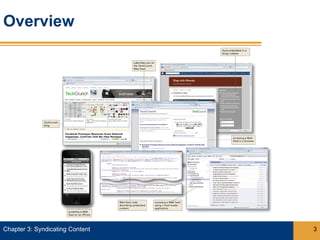
 Syndication is the process of making a
  summary of a Web site’s information available
  to other Web sites and applications
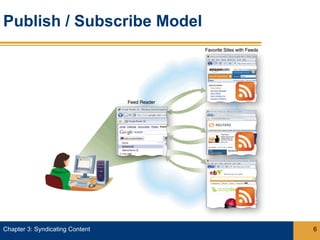
 A Web feed represents the list of items that
  are being shared
 Feed reader applications and devices access
  the Web feed of each of the subscribed sites
  and deliver any new content


Chapter 3: Syndicating Content                    2
Overview


Chapter 3: Syndicating Content   3
Exploring Web Feeds

 RSS (Really Simple Syndication) is one of the
  first and most popular types of Web feeds
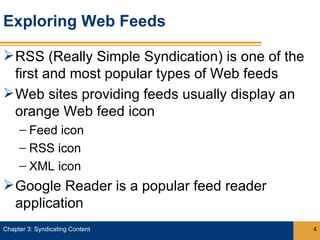
 Web sites providing feeds usually display an
  orange Web feed icon
     – Feed icon
     – RSS icon
     – XML icon
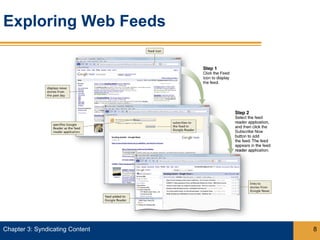
 Google Reader is a popular feed reader
  application
Chapter 3: Syndicating Content                    4
Exploring Web Feeds


Chapter 3: Syndicating Content   5
Publish / Subscribe Model


Chapter 3: Syndicating Content   6
Exploring Web Feeds

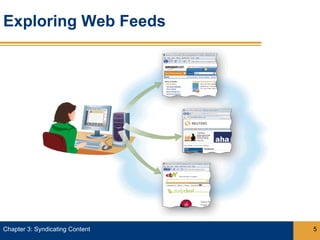
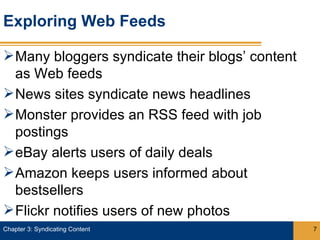
 Many bloggers syndicate their blogs’ content
  as Web feeds
 News sites syndicate news headlines
 Monster provides an RSS feed with job
  postings
 eBay alerts users of daily deals
 Amazon keeps users informed about
  bestsellers
 Flickr notifies users of new photos
Chapter 3: Syndicating Content                   7
Exploring Web Feeds


Chapter 3: Syndicating Content   8
Subscribing to
and Reading Feeds


Chapter 3: Syndicating Content   9
Subscribing to
and Reading Feeds
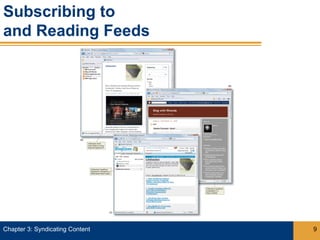
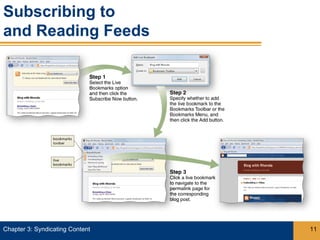
 The ability to subscribe to a feed is standard in
  many Web browsers
 The method by which you subscribe to feeds
  varies with each Web browser
 Every browser presents Web feeds differently
     – Feeds are syndicated the same
           • XML (Extensible Markup Language)


Chapter 3: Syndicating Content                        10
Subscribing to
and Reading Feeds


Chapter 3: Syndicating Content   11
Features of Web-Based and
Client Feed Readers


Chapter 3: Syndicating Content   12
Features of Web-Based and
Client Feed Readers
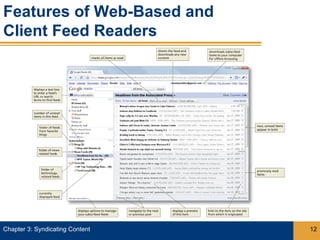
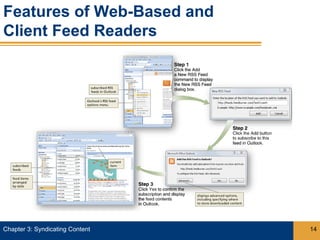
 Web-based feed readers
     – Google Reader
           • Contains feed searching capability
     – Bloglines
 Client feed readers
     – FeedDemon
     – FeedReader
     – Microsoft Outlook


Chapter 3: Syndicating Content                    13
Features of Web-Based and
Client Feed Readers


Chapter 3: Syndicating Content   14
Features of Web-Based and
Client Feed Readers
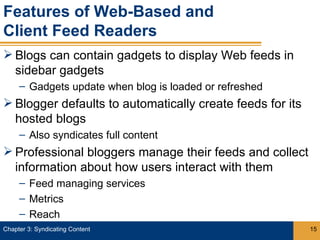
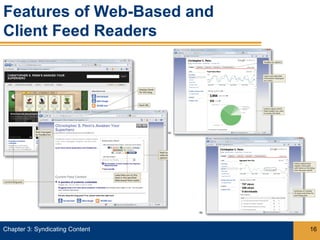
 Blogs can contain gadgets to display Web feeds in
  sidebar gadgets
     – Gadgets update when blog is loaded or refreshed
 Blogger defaults to automatically create feeds for its
  hosted blogs
     – Also syndicates full content
 Professional bloggers manage their feeds and collect
  information about how users interact with them
     – Feed managing services
     – Metrics
     – Reach
Chapter 3: Syndicating Content                             15
Features of Web-Based and
Client Feed Readers


Chapter 3: Syndicating Content   16
Features of Web-Based and
Client Feed Readers
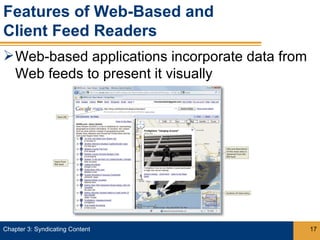
 Web-based applications incorporate data from
  Web feeds to present it visually


Chapter 3: Syndicating Content                   17
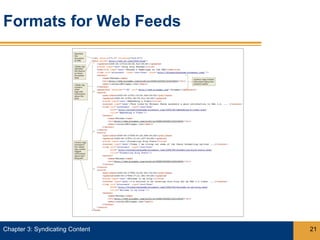
Formats for Web Feeds

 RSS 2.0 is the most widely used version of
  RSS
     – RSS is closed to further modifications
 Atom is a newer, evolving alternative to RSS
     – Not as simple as RSS, but is becoming popular
 Differences between RSS and Atom are
  transparent to the user


Chapter 3: Syndicating Content                         18
Formats for Web Feeds

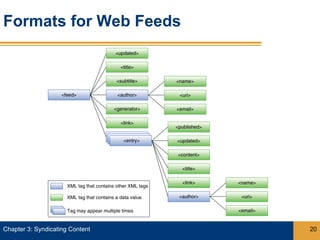
 XML (Extensible Markup Language) is the
  underlying technology used for describing
  content syndicated using RSS and Atom feeds
     – Tags describe information
           • Opening tags
           • Closing tags
     – RSS and Atom feeds are the most common types
       of content represented in XML


Chapter 3: Syndicating Content                        19
Formats for Web Feeds


Chapter 3: Syndicating Content   20
Formats for Web Feeds


Chapter 3: Syndicating Content   21
Exploring Podcasts

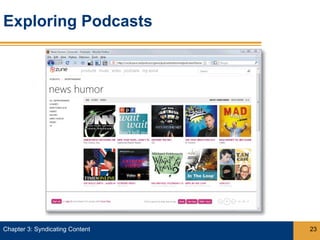
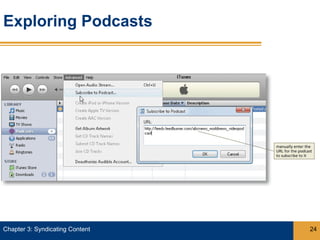
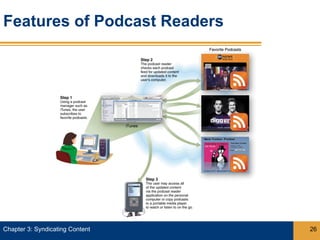
 A podcast is a series of audio or video files
  that are broadcast to a computer or personal
  media player over the Internet by a publication
  in an RSS feed
     – Podcast reader
           • iTunes
     – You can download and watch podcast episodes
       directly on a Web site, or with a Web-based
       application

Chapter 3: Syndicating Content                       22
Exploring Podcasts


Chapter 3: Syndicating Content   23
Exploring Podcasts


Chapter 3: Syndicating Content   24
Exploring Podcasts

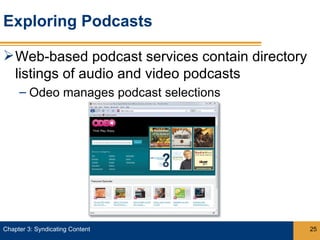
 Web-based podcast services contain directory
  listings of audio and video podcasts
     – Odeo manages podcast selections


Chapter 3: Syndicating Content                   25
Features of Podcast Readers


Chapter 3: Syndicating Content   26
Anatomy of a Podcast Feed


Chapter 3: Syndicating Content   27
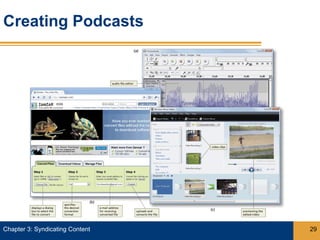
Creating Podcasts

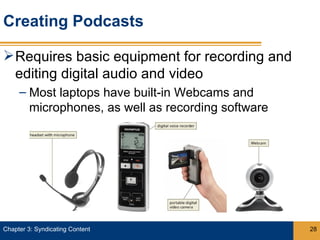
 Requires basic equipment for recording and
  editing digital audio and video
     – Most laptops have built-in Webcams and
       microphones, as well as recording software


Chapter 3: Syndicating Content                      28
Creating Podcasts


Chapter 3: Syndicating Content   29
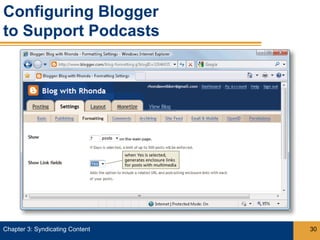
Configuring Blogger
to Support Podcasts


Chapter 3: Syndicating Content   30
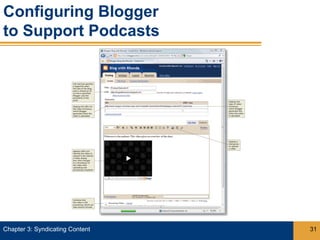
Configuring Blogger
to Support Podcasts


Chapter 3: Syndicating Content   31
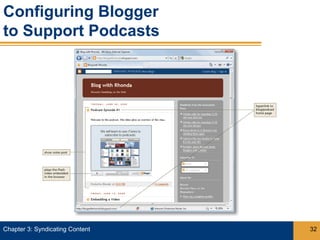
Configuring Blogger
to Support Podcasts


Chapter 3: Syndicating Content   32
Summary

 Syndication is a way to distribute and share Web
  content
     – Web feeds
 Users can subscribe to Web feeds using a Web
  browser or a feed reader application
 Content publishers syndicate their content as feeds
  using either the RSS or Atom formats, represented in
  XML
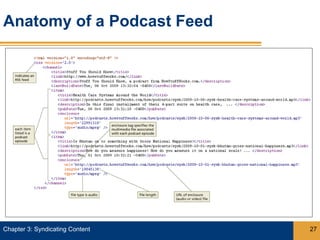
 Podcasts are RSS feeds with an enclosed multimedia
  file

Chapter 3: Syndicating Content                       33
3   Syndicating Content
            Chapter 3
            Complete


                          Web 2.0:
                        Concepts and
                        Applications

Chapter 03

  • 1.
    3 Syndicating Content Web 2.0: Concepts and Applications
  • 2.
    Overview  Syndication isthe process of making a summary of a Web site’s information available to other Web sites and applications  A Web feed represents the list of items that are being shared  Feed reader applications and devices access the Web feed of each of the subscribed sites and deliver any new content Chapter 3: Syndicating Content 2
  • 3.
  • 4.
    Exploring Web Feeds RSS (Really Simple Syndication) is one of the first and most popular types of Web feeds  Web sites providing feeds usually display an orange Web feed icon – Feed icon – RSS icon – XML icon  Google Reader is a popular feed reader application Chapter 3: Syndicating Content 4
  • 5.
    Exploring Web Feeds Chapter3: Syndicating Content 5
  • 6.
    Publish / SubscribeModel Chapter 3: Syndicating Content 6
  • 7.
    Exploring Web Feeds Many bloggers syndicate their blogs’ content as Web feeds  News sites syndicate news headlines  Monster provides an RSS feed with job postings  eBay alerts users of daily deals  Amazon keeps users informed about bestsellers  Flickr notifies users of new photos Chapter 3: Syndicating Content 7
  • 8.
    Exploring Web Feeds Chapter3: Syndicating Content 8
  • 9.
    Subscribing to and ReadingFeeds Chapter 3: Syndicating Content 9
  • 10.
    Subscribing to and ReadingFeeds  The ability to subscribe to a feed is standard in many Web browsers  The method by which you subscribe to feeds varies with each Web browser  Every browser presents Web feeds differently – Feeds are syndicated the same • XML (Extensible Markup Language) Chapter 3: Syndicating Content 10
  • 11.
    Subscribing to and ReadingFeeds Chapter 3: Syndicating Content 11
  • 12.
    Features of Web-Basedand Client Feed Readers Chapter 3: Syndicating Content 12
  • 13.
    Features of Web-Basedand Client Feed Readers  Web-based feed readers – Google Reader • Contains feed searching capability – Bloglines  Client feed readers – FeedDemon – FeedReader – Microsoft Outlook Chapter 3: Syndicating Content 13
  • 14.
    Features of Web-Basedand Client Feed Readers Chapter 3: Syndicating Content 14
  • 15.
    Features of Web-Basedand Client Feed Readers  Blogs can contain gadgets to display Web feeds in sidebar gadgets – Gadgets update when blog is loaded or refreshed  Blogger defaults to automatically create feeds for its hosted blogs – Also syndicates full content  Professional bloggers manage their feeds and collect information about how users interact with them – Feed managing services – Metrics – Reach Chapter 3: Syndicating Content 15
  • 16.
    Features of Web-Basedand Client Feed Readers Chapter 3: Syndicating Content 16
  • 17.
    Features of Web-Basedand Client Feed Readers  Web-based applications incorporate data from Web feeds to present it visually Chapter 3: Syndicating Content 17
  • 18.
    Formats for WebFeeds  RSS 2.0 is the most widely used version of RSS – RSS is closed to further modifications  Atom is a newer, evolving alternative to RSS – Not as simple as RSS, but is becoming popular  Differences between RSS and Atom are transparent to the user Chapter 3: Syndicating Content 18
  • 19.
    Formats for WebFeeds  XML (Extensible Markup Language) is the underlying technology used for describing content syndicated using RSS and Atom feeds – Tags describe information • Opening tags • Closing tags – RSS and Atom feeds are the most common types of content represented in XML Chapter 3: Syndicating Content 19
  • 20.
    Formats for WebFeeds Chapter 3: Syndicating Content 20
  • 21.
    Formats for WebFeeds Chapter 3: Syndicating Content 21
  • 22.
    Exploring Podcasts  Apodcast is a series of audio or video files that are broadcast to a computer or personal media player over the Internet by a publication in an RSS feed – Podcast reader • iTunes – You can download and watch podcast episodes directly on a Web site, or with a Web-based application Chapter 3: Syndicating Content 22
  • 23.
    Exploring Podcasts Chapter 3:Syndicating Content 23
  • 24.
    Exploring Podcasts Chapter 3:Syndicating Content 24
  • 25.
    Exploring Podcasts  Web-basedpodcast services contain directory listings of audio and video podcasts – Odeo manages podcast selections Chapter 3: Syndicating Content 25
  • 26.
    Features of PodcastReaders Chapter 3: Syndicating Content 26
  • 27.
    Anatomy of aPodcast Feed Chapter 3: Syndicating Content 27
  • 28.
    Creating Podcasts  Requiresbasic equipment for recording and editing digital audio and video – Most laptops have built-in Webcams and microphones, as well as recording software Chapter 3: Syndicating Content 28
  • 29.
    Creating Podcasts Chapter 3:Syndicating Content 29
  • 30.
    Configuring Blogger to SupportPodcasts Chapter 3: Syndicating Content 30
  • 31.
    Configuring Blogger to SupportPodcasts Chapter 3: Syndicating Content 31
  • 32.
    Configuring Blogger to SupportPodcasts Chapter 3: Syndicating Content 32
  • 33.
    Summary  Syndication isa way to distribute and share Web content – Web feeds  Users can subscribe to Web feeds using a Web browser or a feed reader application  Content publishers syndicate their content as feeds using either the RSS or Atom formats, represented in XML  Podcasts are RSS feeds with an enclosed multimedia file Chapter 3: Syndicating Content 33
  • 34.
    3 Syndicating Content Chapter 3 Complete Web 2.0: Concepts and Applications