Chapter 5 


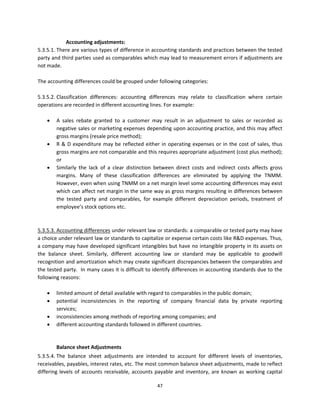
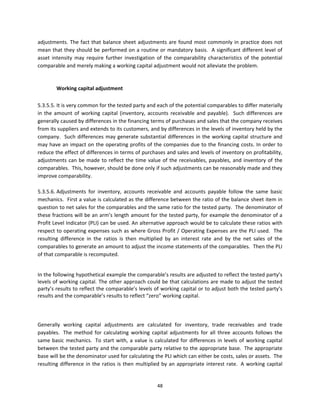
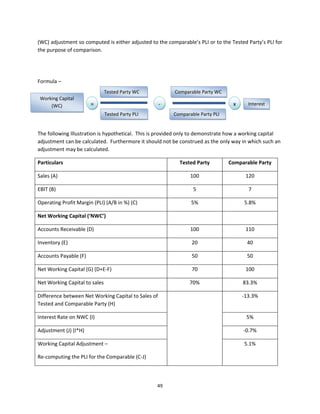
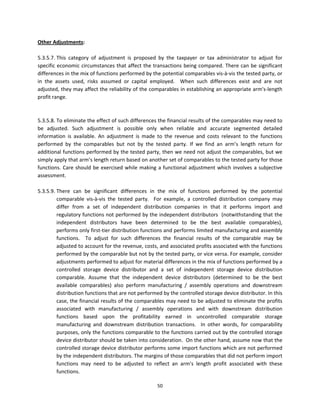
                                            Comparability Analysis 


                                              Table of Contents 

    Section #    Topic                                                                        Page 

       1         Rationale for Comparability Analysis                                          2 

       2         Comparability Analysis Process                                                4 

       3         Comparability Analysis in Operation                                           5 

                  Understanding the economically significant characteristics of the           5 
                   industry, taxpayer’s business and controlled transactions 

                  Examination  or comparability factors of controlled transaction             7 


                  Location savings                                                            26 


                  Selecting the tested party(ies)                                             33 

                  Identifying potentially comparable transactions ‐ internal and              39 
                   external 

                  Comparability adjustments where appropriate                                 46 


                  Selection of most appropriate transfer pricing method                       52 

                  Determination of an arm's length price or profit (or range of prices or     53 
                   profits) 

                  Documentation of comparability analysis and monitoring                      53 

        4        Issues regarding comparability analysis                                       53 

       5         Conclusion                                                                    64 


                                                         1 


5.1     Rationale for Comparability Analysis 
         
5.1.1.  The phrase “comparability analysis” is used to designate two distinct though related analytical 
steps: 
      An  understanding  of  the  economically  significant  characteristics  of  the  controlled  transaction, 
        i.e. the transaction between associated enterprises, and of the respective roles of the parties to 
        the  controlled  transaction.  This  is  generally  performed  through  an  examination  of  five 
        “comparability factors”, as discussed below.  
      A  comparison  between  the  conditions  of  the  controlled  transaction  and  conditions  in 
        uncontrolled  transactions  (i.e.  transactions  between  independent  enterprises)  taking  place  in 
        comparable  circumstances.  The  latter  are  often  referred  to  as  “comparable  uncontrolled 
        transactions” or “comparables”.  

5.1.2.  This concept of comparability analysis is used in the selection of the most appropriate transfer 
pricing  method  to  the  circumstances  of  the  case,  as  well  as  in  applying  the  selected  transfer  pricing 
method to arrive at an arm’s length price or financial indicator (or range of prices or financial indicators). 
It thus plays a central role in the overall application of the arm’s length principle. 
 
 
5.1.3.  A  practical  difficulty  in  applying  the  arm’s  length  principle  is  that  associated  enterprises  may 
engage  in  transactions  that  independent  enterprises  would  not  undertake.  Where  independent 
enterprises seldom undertake transactions of the type entered into by associated enterprises, the arm’s 
length principle is difficult to apply because there is little or no direct evidence of what conditions would 
have been established by independent enterprises. The mere fact that a transaction may not be found 
between independent parties does not of itself mean that it is, or is not, arm’s length.  
 
5.1.4.  It should be kept in mind that the lack of a comparable for a taxpayer’s controlled transaction 
does not mean that such transaction is or is not at arm’s length or that the arm’s length principle is not 
applicable  to  that  transaction.  In  a  number  of  instances  it  will  be  possible  to  use  “imperfect” 
comparables,  e.g.  comparables  from  different  countries  having  comparable  economic  conditions  or 
comparables  from  another  industry  sector,  possibly  adjusted  to  eliminate  or  reduce  the  differences 
between such transaction and the controlled transaction. In other instances where no comparables are 
found  for  a  controlled  transaction  between  associated  enterprises,  it  may  become  necessary  to  use  a 
transfer pricing method that does not depend on comparables (see the discussion in Chapter 6). It may 
also  be  necessary  to  examine  the  economic  substance  of  the  controlled  transaction  to  determine 
whether  its  conditions  are  such  that  might  be  expected  to  have  been  agreed  between  independent 
parties in similar circumstances – in the absence of evidence of what independent parties have actually 
done in similar circumstances. 


                                                          2 
 
5.1.5.  A  controlled  and  an  uncontrolled  transaction  are  regarded  as  comparable  if  the  economically 
relevant  characteristics  of  the  transactions  being  compared  and  the  circumstances  surrounding  them 
are sufficiently similar to provide a reliable measure of an arm’s length result.  It is recognized that in 
reality  two  transactions  are  seldom  completely  alike  and  in  this  imperfect  world  perfect  comparables 
are  often  not  available.  One  must  therefore  use  a  practical  approach  in  ascertaining  the  degree  of 
comparability between controlled and uncontrolled transactions. To be comparable does not mean that 
the  two  transactions  are  necessarily  identical,  but  that  either  none  of  the  differences  between  them 
could  materially  affect  the  arm’s  length  price  or  profit  or,  where  such  material  differences  exist,  that 
reasonably  accurate  adjustments  can  be  made  to  eliminate  their  effect.  Thus,  in  determining  a 
reasonable degree of comparability, adjustments may need to be made to account for certain material 
differences  between  the  controlled  and  uncontrolled  transactions.  These  adjustments  (which  are 
referred to as “comparability adjustments”) are to be made only if the effect of the material differences 
on price or profits can be ascertained with sufficient accuracy to improve the reliability of the results.   
 
5.1.6.  The  aforesaid  degree  of  comparability  is  typically  determined  on  the  basis  of  a  number  of 
attributes of the transactions or parties that could materially affect prices or profits and the adjustment 
that can be made to account for differences. These attributes, which are usually referred to as the five 
comparability factors, include: 
 
 characteristics of the property or service transferred; 
 functions performed by the parties taking into account assets employed and risks assumed, in short 
     referred to as the “functional analysis”; 
 contractual terms; 
 economic circumstances; and 
 business strategies pursued. 
 
5.1.7.   Obviously,  as  the  degree  of  comparability  increases,  the  number  and  extent  of  potential 
differences  that  could  render  the  analysis  inaccurate  necessarily  decreases.    Also,  in  general,  while 
adjustments can and must be made when evaluating these factors so as to increase comparability, the 
number,  magnitude  and  the  reliability  of  such  adjustments  may  affect  the  reliability  of  the  overall 
comparability analysis.   
 
5.1.8.  It  is  important  to  note  that  the  type  and  attributes  of  the  comparables  available  in  a  given 
situation  typically  determine  the  most  appropriate  transfer  pricing  method.  In  general,  closely 
comparable products (or services) are required if the comparable uncontrolled price ("CUP") method is 
used  for  arm's  length  pricing;  the  resale  price,  the  cost‐plus  method  and  the  transactional  net  margin 
method  (TNMM),  may  be  appropriate  if  the  functional  comparables  are  available,  i.e.  where  the 
functions performed, assets employed and risks assumed by the parties to the controlled transaction are 
sufficiently comparable to the functions performed, assets employed and risks assumed by the parties 
to the uncontrolled  transaction so  that the comparison makes economic sense. An example would be 
two  comparable  distributors  of  consumer  goods  of  the  same  industry  segment,  where  the  goods 
distributed may not be exactly the same, but the functional analyses of the two distributors would be 
comparable. This issue is further discussed in the chapter on transfer pricing methods.  

                                                           3 
 
5.1.9. Practical guidance is needed for cases without sufficient comparables.  There seems to be two 
distinct problems relating to comparables for developing countries.  The first relates to the inability to 
effectively access existing sources, such as existing non‐local company databases.  The second relates to 
the lack of reliable local country comparables.  For each of these, there are problems associated with 
both administration (e.g., how the lack of data impedes the reliable and efficient determination of 
appropriate arm’s length results) and problems associated with double tax/dispute avoidance (e.g., how 
the lack of appropriate data impedes a developing country’s ability to reach agreement with other tax 
authorities, or prevent the developing country from being taken advantage of). 
 
5.1.10. The 2010 version of the OECD Transfer Pricing Guidelines points out that non‐domestic 
comparables should not be automatically rejected merely because they are not domestic. The guidelines 
further recommend that where independent transactions are scarce in certain markets and industries a 
pragmatic solution may need to be found on a case‐by‐case basis.1 This means that when the data is 
insufficient, stakeholders can still use them as comparables, after in‐depth adjustments are made, to 
assess the arm’s length price. The validity of such procedures depends heavily on the accuracy of the 
comparability analysis as a whole.    
 
5.1.11.  This chapter discusses a possible procedure to identify, screen, select and adjust comparables in 
a  manner  that  enables  the  taxpayer  or  tax  administration  to  make  an  informed  choice  of  the  most 
appropriate transfer pricing method and apply tat method correctly to arrive at the appropriate arm’s 
length price or profit (or range of prices or profits). 
 
 
5.2      Comparability Analysis Process 
 
5.2.1.  A  typical  approach  that  can  be  followed  while  performing  a  comparability  analysis  is  outlined 
below.  The  steps  below  are  by  no  means  exhaustive  but  rather  suggest  an  outline  based  on  which  a 
comparability analysis could be carried out.  It may be noted that the process is not linear, for example a 
number of the steps may need to be carried out repeatedly until a satisfactory result is achieved. The 
subsequent sections of this chapter deal with each of these steps in more detail: 
 Understanding the economically significant  characteristics of the industry, taxpayer’s business and 
     controlled transactions 
         o 5.2.1.1.1. Gathering of basic information about the taxpayer 
         o 5.2.1.1.2. Transaction analysis 
         o 5.2.1.1.3. Evaluation of separate and/ or combined transactions 
 Examination  of comparability factors of the controlled transaction  
         o 5.2.1.2.1. Characteristics of the property or service transferred 
         o 5.2.1.2.2. Functional analysis of the controlled transaction under examination 

                                                            
1
  The 2010 OECD Transfer Pricing Guidelines para.3.35 and para3.38 


                                                        4 
 
o 5.2.1.2.3. Contractual terms of transaction  
             o 5.2.1.2.4. Economic circumstances of transaction 
             o 5.2.1.2.5. Business strategies of parties 
        Selecting the tested party(ies) (if applicable) 
        Identifying potentially comparable transactions ‐ internal and external 
        Comparability adjustments where appropriate 
        Selection of most appropriate transfer pricing method  
        Determination of an arm's length price or profit (or range or prices or profits) 
        Documentation of comparability analysis and monitoring. 
      

    5.3.     Comparability Analysis in Operation 
              
    5.3.1.  Understanding the economically significant characteristics of the industry, taxpayer’s business 
    and controlled transactions 
          
    5.3.1.1. Gathering of basic information about the taxpayer 
     
    5.3.1.1.1.          A  precursor  to  transfer  pricing  analysis  is  the  collection  of  background  information 
    about the taxpayer to understand its business operations and activities. This fact‐finding process should 
    include the identification of associated enterprises involved in the controlled transaction, identification 
    of  the  taxpayer’s  cross  border  controlled  transactions,  information  about  cross  border  controlled 
    transactions (nature of products/ services transferred, type of intangibles used, value thereof, terms and 
    conditions, etc.).  
     
    5.3.1.1.2.          An  analysis  should  be  performed  of  the  taxpayer’s  circumstances  including  but  not 
    limited to an analysis of the industry, competition, economy, regulatory factors and other elements that 
    may  significantly  affect  the  taxpayer  and  its  environment.  This  analysis  is  by  nature  specific  to  each 
    taxpayer and industry. 
     
    5.3.1.1.3.          Information  about  the  taxpayer  from  its  annual  report,  product  brochures,  news 
    articles, research reports prepared by independent agencies, management letters and internal reports 
    could  act  as  a  good  starting  point  for  understanding  the  taxpayer’s  circumstances.    A  study  of  these 
    documents  will  provide  an  idea  of  the  industry  to  which  the  enterprise  belongs,  the  nature  of  its 
    business  activities  (i.e.  manufacturer,  wholesaler,  distributor,  etc.),  its  market  segment,  market  share, 
    market penetration strategies, type of products / services dealt in, etc. 
              
    5.3.1.2. Transaction analysis 
 

    5.3.1.2.1.     The  arm’s  length  price  must  be  established  with  regard  to  transactions  actually 
    undertaken. The tax authorities should not substitute other transactions in the place of those that have 
    actually  happened  and  should  not  disregard  those  transactions  actually  undertaken,  except  in 


                                                              5 
     
exceptional  circumstances  such  as  where  the  economic  substance  of  the  transaction  differs  from  its 
form, or where the arrangements viewed in their totality are not commercially rational and practically 
impede the tax administration from determining an appropriate transfer price. In general, restructuring 
of  transactions  should  not  be  undertaken  lightly  as  this  would  create  significant  uncertainty  for 
taxpayers  and  tax  administrations;  this  may  also  lead  to  double  taxation  due  to  the  divergent  views 
taken by countries on how the transactions are structured.  The ability of tax authorities to do so will in 
any  case  depend  on  their  powers  under  applicable  domestic  law.  These  issues  are  relevant  for 
developing domestic transfer pricing legislation at the beginning of a country’s transfer pricing “journey” 
and also to the administration of transfer pricing. 
 
5.3.1.3. Evaluation of separate and combined transactions 
 

5.3.1.3.1.        An important aspect of transfer pricing analysis is whether this analysis is required to be 
carried  out  with  respect  to  a  taxpayer’s  individual  international  controlled  transactions  or  a  group  of 
international controlled transactions having a close economic nexus. 
 
5.3.1.3.2.        Ideally  transfer  pricing  analysis  should  be  made  on  a  transaction  by  transaction  basis. 
However, there are cases where separate transactions are so closely linked that such an approach would 
not  lead  to  a  reliable  result.  Where  transactions  are  so  closely  interrelated  or  continuous  that 
application of the arm’s length principle on a transaction‐by‐transaction basis would become unreliable 
or cumbersome, transactions are often aggregated for the purposes of the transfer pricing analysis.  
 
5.3.1.3.3.        Take  the  example  of  transactions  involving  the  licensing  of  know‐how  to  associated 
manufacturers  together  with  the  supply  to  the  licensed  associated  manufacturers  of  components 
needed to exploit such know‐how. In such a case, the transfer pricing analysis may be more reliable if it 
takes  into  account  both  the  license  and  the  supply  of  components  together,  than  if  it  looks  at  each 
separately  without  recognising  that  they  are  closely  interrelated  transactions.  Similarly,  long‐term 
service supply contracts and pricing of closely linked products are difficult to separate out into individual 
transactions.  
 
5.3.1.3.4.        Another  important  aspect  of  combined  transactions  is  the  increasing  presence  of 
composite contracts and “package deals” in an MNE group. A composite contract and/or package deal 
may  contain  a  number  of  elements  including  leases,  sales  and  licenses  all  packaged  into  one  deal.  
Generally,  it  will  be  appropriate  to  consider  the  deal  in  its  totality  to  understand  how  the  various 
elements relate to each other, but the components of the composite package and/or package deal may 
or may not, depending on the facts and circumstances of the case, need to be evaluated separately to 
arrive at the appropriate transfer price. In certain cases it may be more reliable to allocate the price to 
the elements of the package or composite contract. 
 
5.3.1.3.5.        Aggregation  issues  also  arise  when  looking  at  potential  comparables.  Since  third  party 
information is not often available at the transaction level, entity level information is frequently used in 
practice  when  looking  at  external  comparables  (e.g.  in  the  absence  of  reliable  internal  comparables). 

                                                         6 
 
(“External  comparable”  and  “internal  comparable”  are  defined  in  para  3.4.1  below).  It  must  be  noted 
that any application of the arm’s length principle, whether on a transaction‐by‐transaction basis or on 
an aggregation basis, needs to be evaluated on a case‐by‐case, applying the most appropriate transfer 
pricing method to the facts in that particular case.  
 
5.3.2.  Examination of comparability factors of the controlled transaction  
                   
5.3.2.1. Characteristics of the property or service transferred  
          
5.3.2.1.1.        With that background, an important step is to analyse the relevant characteristics of the 
property or service transferred. Property, tangible or intangible, as well as services, may have different 
characteristics  which  may  lead  to  a  difference  in  their  values  in  the  open  market.  Therefore  these 
differences  must  be  accounted  for  and  considered  in  any  comparability  analysis  of  controlled  and 
uncontrolled transactions. Characteristics that may be important to consider are: 
       
(i)      In the case of tangible property the physical features, quality, reliability and availability and the 
         volume of supply;  
(ii)     In the case of services, the nature and extent of such services; and  
(iii)    In the case of intangible property the form of the transaction (e.g. licensing or sale) and the type 
         and form of property, duration and degree of protection and anticipated benefits from use of 
         the  property.  For  example,  comparability  analysis  should  take  into  account  the  differences 
         between  trademarks  and  trade  names  that  aid  in  commercial  exploitation  (marketing 
         intangibles) as opposed to patents and know‐how (trade intangibles). 
       
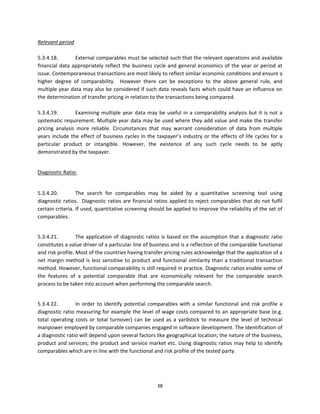
5.3.2.2. Functional analysis 
 
5.3.2.2.1.        Functional  analysis  typically  involves  identification  of  ‘functions  performed’,  ‘assets 
employed’ and ‘risks assumed’ (also called “F.A.R. analysis”) with respect to the international controlled 
transactions  of  an  enterprise.    Functional  analysis  seeks  to  identify  and  compare  the  economically 
significant  activities  and  the  responsibilities  undertaken  by  the  independent  and  the  associated 
enterprises.  An  economically  significant  activity  is  one  which  materially  affects  the  price  charged  in  a 
transaction and/or the profits earned from that transaction.  
 
5.3.2.2.2.        Functional analysis is the cornerstone of any transfer pricing exercise and its purpose is 
to gain an understanding of the operations of an enterprise with its associated enterprises and of the 
respective roles of the parties to the controlled transaction under examination, as these will affect the 
determination  of  an  arm’s  length  remuneration  for  the  transaction.  This  is  because  in  transactions 
between  two  independent  enterprises,  compensation  will  usually  reflect  the  functions  that  each 
enterprise performs, taking into account assets employed and risks assumed. The more valuable those 
functions, assets and risks, the greater the expected remuneration.  


                                                          7 
 
Functional analysis is also essential to the identification of potential comparables, as the search for the 
latter  will  generally  focus  on  uncontrolled  transactions  that  present  a  similar  allocation  of  functions, 
assets and risks between the parties. 
                                
5.3.2.2.3.                   Functional analysis is a process of finding and organizing facts about the transaction in 
terms of the functions, risks and assets in order to identify how these are divided between the parties 
involved  in  the  transaction.    The  functions,  risks  and  assets  are  analysed  to  determine  the  nature  of 
functions  performed,  degree  of  risks  undertaken  and  the  kind  of  the  assets  employed  by  each  party.  
This analysis helps to select the tested party (ies) where needed (as explained in section C below), the 
most appropriate transfer pricing method, and the comparables, and ultimately to determine whether 
the  profits  (or  losses)  earned  by  the  entities  are  appropriate  to  the  functions  performed,  assets 
employed and risks assumed. 
 
5.3.2.2.4.                   The functional analysis is important because the expected return of the entities involved 
in a transaction depends on the importance of the functions performed, the degree of risks undertaken 
and  the  nature  and  value  of  assets  employed.  Generally,  the  more  valuable  the  functions  performed, 
assets  employed  and  risks  assumed  by  a  party  to  a  transaction  the  greater  its  expected  return  (or 
potential loss).  It is therefore extremely important  to map the functions performed, assets employed 
and  risks  assumed  by  all  the  associated  enterprises  in  relation  to  the  controlled  transaction  under 
examination. 
 
5.3.2.2.5.                   A  clearer understanding of functional analysis may gained from an example2 which can 
be examined in detail below. 
                
Further, hypothetical examples for illustration purposes concerning the different types of international 
transactions listed below are given with a view to explaining the chapter in a more practical manner. The 
situations are: 
       1. Manufacturing  of  products  by  XYZ  &  Co,  where  the  technology  is  owned  by  an  associated 
               enterprise ABC & Co; and 
       2. Distribution by A Co of products imported from an associated enterprise B Co for sale in A Co’s 
               country.  
 
These examples are provided in the Annex at the end of the chapter as  Exhibit 1 and Exhibit 2 with a 
view  to  understand  the  FUNCTIONAL  ANALYSIS    in  a  more  practical  manner.  A  Co  is  a  company 
incorporated  and  registered  under  the  laws  of  Country  A.    A  Co  is  the  Intelligent  Energy  Solutions 
Company  and  is  a  market  leader  in  the  development,  production  and  supply  of  electronic  meters  and 
their  components,  software,  energy  monitoring,  billing  solutions  and  payment  systems.    A  Co  owns 
technologies  related  to  electronic  energy  meters.    A  Co  is  a  part  of  Entity,  the  largest  metering 
consortium  in  the  world  which  shares  technology  and  pools  the  extensive  experience  of  development 
                                                            
2
 Disclaimer: Any resemblance to any case (past, present or future) is purely coincidental and the example is for
illustration only as the example identifies a particular product or industry segment (electronic meters). Each FAR
analysis has to be done on the facts of each individual case.


                                                          8 
 
and  manufacture  within  a  network  covering  over  thirty  countries.    A  Co  has  an  established  marketing 
network in many developed and developing countries. 
 
B  Co  is  a  company  incorporated  and  registered  under  the  laws  of  Country  B  and  is  a  wholly  owned 
subsidiary (WOS) of A Co.  B Co intends to manufacture a wide range of electronic energy meters and 
portable  calibrators,  which  would  cater  to  all  segments  of  the  power  generation,  transmission, 
distribution  and  consumption  sectors  and  offers  similar  features  required  for  electricity  revenue 
management. However such meters will have to be customised to cater to the needs of domestic users. 
Such adaptations would be carried out by B Co in its own R&D facilities.  
 
B Co entered into a license agreement with A Co to source its core technology, TECHNO A™ ‐ developed 
and  patented  by  A  Co.  TECHNO  A™,  being  software  driven,  allows  cost  effective  product  feature 
enhancements and provides flexibility to utilities to effectively manage electricity revenue and demand, 
thereby limiting or eliminating revenue losses. TECHNO A™ technology was developed in Country A by A 
Co. TECHNO A™ technology measures electricity flow using digital and microprocessor based techniques 
and  processes  the  measurements  into  useful  information.  Use  of  TECHNO  A™  technology  has  major 
advantages in the design and manufacture of meters. 
 
With  the  above  background  in  place  the  controlled  transactions  between  B  Co  and  A  Co  are  the 
purchase of certain components and the license of technology from A Co. As mentioned earlier, A Co is 
specialised  in  dealing  with  processors  and  other  components  of  electronic  meters  and  their  sub‐
assemblies. These are critical components of an electronic meter.  B Co manufactures energy meters in 
Country B and uses processors and related components purchased from A Co. Post‐manufacturing B Co 
sells energy meters to A Co, in line with its requirements. B Co has its own R&D centre which tries to 
increase its performance by improving the technologies so as to achieve further efficiencies. This would 
mean that dependence on outside sources for technologies would be reduced in future and cost savings 
could be achieved. Also B Co has penetrated the market in the territory of country B by incurring huge 
marketing  expenditure  to  establish  its  own  marketing  intangibles.  These  are  separate  from  the 
intangibles of A Co. in Country A for which a technology license agreement is in place with A Co.  
 
In  the  following  paragraphs  a  possible  process  is  described  on  how  FUNCTIONAL  ANALYSIS  can  be 
carried out and documented in the given example. 
 
For the purpose of the FUNCTIONAL  ANALYSIS in the following paragraphs a qualitative  description of 
the  intra‐group  transactions  and  circumstances  between  A  Co  and  B  Co  in  relation  to  the  purchase  of 
components and raw materials can be described by symbols as follows: 


                                                         9 


        Symbol              Comparative risk          Comparative functional            Comparative asset level 
                             level standards             level standards                      standard 

            _                 No Exposure                    No Functions                       No assets 

            ®               Lowest Exposure                Least Functions                      Few assets 

           ®®              Medium Exposure                 Lesser Functions                  Medium assets 

          ®®®               Highest Exposure              Highest Functions                    Most assets 

                    
The  use  of  these  symbols  provides  a  tool  to  summarize  key  aspects  of  a  functional  analysis,  and  to 
qualitatively compare the different enterprises in a multinational group across a number of categories 
related to functions, assets, and risks, based solely on the facts of a particular case.  This tool, commonly 
referred  to  as  a  “tick  chart,”  is  used  extensively  in  Chapter  5  and  in  the  Annexure  to  Chapter  5.    Tick 
charts, while very useful, are inherently subjective.  Accordingly, the same set of facts in the hands of 
two different analysts may not result in identical tick charts.  Caution should be used in giving tick charts 
quantitative significance.  For example, three ticks do not reflect three times more value than a single 
tick.  Moreover, all categories in the chart do not have equivalent weight. Accordingly, tick charts should 
primarily  be  used  as  a  tool  in  evaluating  qualitative  aspects  of  the  analysis,  and  should  not  be  used 
mechanically to split profits according to the relative number of ticks. 
                    

         (a)      Functions performed 
          

5.3.2.2.6.       Functions performed are the activities that are carried out by each of the parties to the 
transaction. In conducting a functional analysis economically significant functions are to be considered, 
as  such  functions  add  more  value  to  the  transactions  and  are  therefore  expected  to  fetch  higher 
anticipated  returns  for  the  entity  performing  such  functions.    Thus,  the  focus  should  not  be  on 
identifying  the  maximum  number  of  functions  but  rather  on  identification  of  critical  functions 
performed by the associated enterprises.   
 
5.3.2.2.7.       Some  of  the  important  functions  that  are  generally  observed  and  examined  in  a 
transaction are: 
                Research and development; 
                Product design and engineering; 
                Manufacturing, production and process engineering and design work; 
                Purchasing and materials management and other procurement activities; 
                Manufacturing, production or assembly work; 
                Transportation, warehousing and inventory; 


                                                            10 
 
        Marketing, advertising, publicity and distribution; 
                 Market intelligence on technological developments; and  
                 Intra‐group services, for example managerial, legal, accounting and finance, credit and 
                  collection, training and personnel management services. 
 
5.3.2.2.8.        It should be emphasised that this list is purely indicative, and that the extent to which 
each of these functions (or other functions not listed above) is economically significant and contributes 
to the creation of value depends on the industry and on the taxpayer‐specific circumstances. 
A typical check list is annexed to the chapter as Exhibit (3). 
 
5.3.2.2.9.        Functional  analysis  can  be  approached  by  evaluating  all  the  economically  significant 
activities  performed  in  relation  to  the  controlled  transaction  under  examination  (such  as  the  list 
indicated above) and in potentially comparable uncontrolled transactions.  In general, a taxpayer should 
prepare  this  list  for  both  parties  to  the  relevant  controlled  transaction  (e.g.  for  the  producing  and 
selling/distributing activities) to ultimately support the selection of the most appropriate transfer pricing 
method. 
 
5.3.2.2.10.       Continuing  the  example  in  para  3.2.2.5,  the  following  are  the  functions  performed  by 
the respective parties. 
          
Functions performed by A Co 
 

         With respect to the sale of technology and components of electronic energy meters: 

It  is  assumed  that  in  the  context  of  the  sale  of  electronic  energy  meters  by  B  Co  on  the  basis  of  the 
technological support of A Co, A Co performs the following economically significant functions [Caution: 
this example is for illustration only, and each case should be judged on its own merits]: 


                 Market  development:  A  Co  shares  its  expertise  with  B  Co  and  assists  in  developing 
                  presentations to be made by B Co to the utilities for the development of markets. 
 

                 Product  development:  A  Co  undertakes  the  product  development  activities  based  on 
                  the concept developed and offered by it to the utilities. Product development involves 
                  product  engineering,  designs,  development  or  customization  of  microprocessors, 
                  observance of international standards and national standards for the product etc. 
 

                 Quality control: A Co undertakes quality control processes in order to ensure that the 
                  products manufactured by B Co conform to contractual specifications and international 
                  and  national  quality  standards  before  the  products  are  delivered  to  utilities  and  other 
                  customers. This is a critical activity because failure to ensure quality control may invite 

                                                           11 
 
reputational risk and product liability risk. 
 
Functions performed by A Co in relation to the import / purchase of raw materials / components by B Co: 
 

        Functions performed by A Co with respect to the purchase of components by B Co: 


It  is  assumed  that,  in  the  purchase  of  processors  and  other  components  by  B  Co  from  A  Co,  the 
economically  significant  functions  performed  by  A  Co  can  be  summarized  as  follows  :  [Caution:  this 
example is for illustration only, and each case should be judged on its own merits] 


                 Market development; 
                 Market intelligence on technological developments;   
                 Research and development activities; 
                 Production planning; 
                 Inventory management; 
                 Manufacturing;  
                 Testing and quality controls;  
                 Selling and distribution activities; 
                 Post sales activities including replacements; and 
                 Technical assistance, wherever required. 
 

       Functions performed by B Co 
 

It is assumed that the functions of B Co in the context of the purchase of components and subsequent 
sale to domestic utilities are as follows. 


 [Caution: this example is for illustration only, and each case should be judged on its own merits] 


                  Market  development:  B  Co  undertakes  the  market  development  activities.  The  market 
                   development  activities  primarily  include  development  of  the  selling  concept  (i.e. 
                   identifying how the company can offer a customized solution to a utility having regard 
                   to  the  specific  issues  being  faced  by  the  utility  concerned).  B  Co  makes  sales 
                   presentations  to  utilities  and  governments  and  liaises  with  them  for  concept  selling. 
                   Based on acceptance of the concept, pilot orders for the meters are procured by B Co. It 
                   also  participates  in  the  tendering  process  to  procure  full  commercial  orders  for  the 


                                                       12 
 
energy meters once the pilot runs successfully. B Co also carries out activities in relation 
            to  advertisement,  appointment  of  distributors,  commission  agents,  sales  promotion, 
            market research and marketing strategies. Also B Co has developed the market for the 
            new product in the territory of country B by incurring sizeable marketing expenditure to 
            establish its own marketing intangibles that are separate from the intangibles of A Co. in 
            Country A. 
 

             Research  and  development:  B  Co  has  its  own  R&D  centre  which  tries  to  boost  its 
               performance  by  improving  the  technologies  so  as  to  achieve  further  efficiencies, 
               reducing dependence on outside technologies in future and achieving cost savings. 
 

           Production  Scheduling:  The  production  by  B  Co  is  based  on  orders  obtained  from 
            domestic utilities. The procurement process for the various raw materials/inputs is based 
            on  prudently  prepared  sales  forecasts.  The  procurement  function  and  the  ordering 
            processes  are  looked  after  by  the  ‘materials  department’.  Factors  like  lead  time, 
            availability, negotiations, etc. are taken into consideration while deciding the party from 
            which a particular raw material/input is to be purchased. 
 

           Tooling: The tooling activities in relation to the products to be produced are undertaken 
            by  B  Co.  Different  products  may  require  different  tooling.  Different  contract 
            specifications may require different tooling. 
 

           Assembly:  This  involves  the  assembling  of  components.  Assembly  operations  are 
            mechanical as well as manual. The activity involves mounting SMT components, manual 
            inspection  of  placements  of  the  components,  computerised  shouldering  of  mounted 
            components,  manual  inspection  of  the  shouldering  process,  mounting  of  PTA 
            components manually, etc. 
 

           Intelligence  loading:  Intelligence  loading  refers  to  the  process  of  loading  software  and 
            other  intelligence  features  on  the  manufactured  meter.  B  Co  undertakes  this  activity 
            based on the technology and microprocessor specification of the contract. 
 

           Testing:  Testing  and  quality  controls  are  critical  processes  in  the  manufacture  and 
            marketing  of  electronic  meters.  B  Co  performs  testing  and  A  Co  undertakes  quality 
            control  measures.  Testing  activity  involves  temperature  variation  testing,  testing  of 
            manufactured meters against standard meters etc. 
 

           Packaging:  B  Co  packs  the  products  into  specially  designed  containers  of  various  sizes 

                                                   13 
 
depending  on  the  consignment.  The  containers  are  in  the  form  of  cartons  and  pallet 
                 packaging. After packaging, products are delivered to domestic utilities. 
 

                Post  sales  activities:  depending  on  the  contracts  with  the  customers,  B  Co  undertakes 
                 installation  and  commissioning  activities  wherever  required  under  the  contracts.  It  is 
                 also  responsible  for  the  collection  of  payments  from  customers.  Contractual  and  non‐
                 contractual product warranties are provided to customers. Any replacement or further 
                 activities required pursuant to product performance warranties are also undertaken by 
                 B Co. 
         

                Inventory  management:  B  Co  is  responsible  for  managing  the  procurement  of  raw 
                 materials/components  and  maintaining  the  requisite  stock  levels  for  the  products 
                 including finished goods. As raw materials are generally product specific and the finished 
                 products  are  manufactured  against  the  confirmed  orders  from  domestic  utilities,  no 
                 substantial inventory management is involved. 
 
General Management Functions  
 

In the above example the functions addressed below are common functions that are carried out by any 
business  irrespective  of  its  size  and  type.  These  functions  are  drivers  of  every  business  and  are 
indispensable in the economic environment. 


                Corporate  Strategy  Determination:  Generally,  all  policies  within  the  Multi  National 
                 Enterprise  group  are  determined  by  the  management  of  the  respective  entities  which 
                 continuously  monitor  the  economic  environment  surrounding  the  entity,  assess  their 
                 strategic  position  within  the  industry  and  set  targets  to  achieve  their  corporate 
                 objectives. 
 

                Finance,  Accounting,  Treasury  and  Legal  Functions:  The  management  of  the  respective 
                 entity is responsible for managing the finance, treasury, legal and accounting functions. 
                 Each entity is also responsible for all local statutory compliance. 
 

                Human Resource Management Function: The HR function of each entity is co‐ordinated 
                 by  its  management,  which  is  responsible  for  recruitment,  development  and  training  of 
                 the personnel including the emolument structure. 


                                                       14 
 
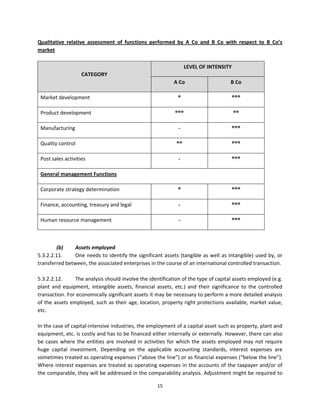
Qualitative  relative  assessment  of  functions  performed  by  A  Co  and  B  Co  with  respect  to  B  Co’s 
market 
 
                                                                        LEVEL OF INTENSITY 
                       CATEGORY 
                                                                 A Co                       B Co 

    Market development                                             ®                         ®®® 

    Product development                                          ®®®                          ®® 

    Manufacturing                                                  ‐                         ®®® 

    Quality control                                               ®®                         ®®® 

    Post sales activities                                          ‐                         ®®® 

    General management Functions 

    Corporate strategy determination                               ®                         ®®® 

    Finance, accounting, treasury and legal                        ‐                         ®®® 

    Human resource management                                      ‐                         ®®® 


         (b)     Assets employed 
5.3.2.2.11.      One  needs  to identify the significant  assets (tangible as well as intangible)  used by, or 
transferred between, the associated enterprises in the course of an international controlled transaction.  
 
5.3.2.2.12.      The analysis should involve the identification of the type of capital assets employed (e.g. 
plant  and  equipment,  intangible  assets,  financial  assets,  etc.)  and  their  significance  to  the  controlled 
transaction. For economically significant assets it may be necessary to perform a more detailed analysis 
of the assets employed, such as their age, location, property right protections available, market value, 
etc. 
 
In the case of capital‐intensive industries, the employment of a capital asset such as property, plant and 
equipment, etc. is costly and has to be financed either internally or externally. However, there can also 
be  cases  where  the  entities  are  involved  in  activities  for  which  the  assets  employed  may  not  require 
huge  capital  investment.  Depending  on  the  applicable  accounting  standards,  interest  expenses  are 
sometimes treated as operating expenses (“above the line”) or as financial expenses (“below the line”). 
Where interest expenses  are treated as operating  expenses in the accounts of the  taxpayer and/or of 
the comparable, they will be addressed in the comparability analysis. Adjustment might be required to 

                                                         15 
 
ensure  consistency  of  accounting  standards  between  the  controlled  transaction  and  the  comparable. 
Differences  in  the  use  of  assets  can  be  eliminated  or  reduced  to  a  significant  extent  by  making 
comparability adjustments on account of working capital or capacity utilization. 
 
5.3.2.2.13.        It is also essential to know which entity or entities has / have the legal ownership of the 
intangibles.  Note that in some cases an enterprise which does not have legal ownership of an intangible 
may nevertheless be entitled to share in the return from its exploitation. Some countries refer to this 
notion as “economic ownership”. For instance, where a MNE parent has legal ownership of a product 
trade mark or trade name it may have to be determined, depending on the facts and circumstances of 
the case, whether the subsidiary has “economic ownership” of the associated marketing intangibles that 
are created based on the subsidiary’s contribution to a strategy to enhance market share. 
5.3.2.2.14.        Continuing the above example in para 3.2.2.5, the following are the assets employed by 
the respective parties. 
            
           Tangible assets owned by B Co 
 
It is assumed for the purpose of the example that B Co owns the following tangible assets: 
 
          Land & Buildings; 
          Plant & Machinery; 
          R&D Equipment; 
          Office Equipment; 
          Furniture and Fixtures; 
          Vehicles; 
          Computers; and 
          Testing Equipment. 
 
Intangible asset ownership 
 
It  is  assumed  for  the  purpose  of  the  example  that  B  Co  has  established  a  research  and  development 
department  which  tries  to  increase  the  level  of  its  performance  by  improving  technologies  so  as  to 
achieve further efficiencies. This would also reduce dependence on outside sources of technology in the 
future  and  achieve  cost  savings.  The  department  also  conducts  research  and  development  (R&D) 
programmes  to  support  B  Co’s  business  and  to  provide  technical  assistance  to  its  customers.  These 
efforts help to increase production efficiency and product quality. 
 
It is assumed for the purpose of the example that B Co has established its own marketing intangibles in 
Country B by incurring significant expenditure on marketing and has penetrated the market for the new 
product in the territory of country B. These marketing intangibles are separate from the intangibles of A 
Co. in country A for which a technology agreement is in place with A Co.  
 
It  is  assumed  for  the  purpose  of  the  example  that  A  Co  is  the  market  leader  in  the  development  and 
supply of electronic meters, software, energy monitoring, billing solutions and payment systems. Over 

                                                         16 
 
the  years  it  has  amassed  a  wealth  of  proprietary  technical  knowledge.  This  includes  product 
specifications, designs, the latest manufacturing processes and empirical data on the usage of products 
by customers in the industry. 
 
It is assumed for the purpose of the example that B Co has entered into a technology license agreement 
with  A  Co  for  procuring  technology  for  the  manufacture  of  specified  products.  Thus  B  Co  uses  the 
process,  know‐how,  operating/quality  standards  etc.  developed/owned  by  A  Co.  B  Co  leverages  value 
from these intangibles for continued growth in revenues and profits. 
 
It  is  assumed  for  the  purpose  of  the  example  that  A  Co  enjoys  reputation  for  quality  products.  In  the 
international utility markets, product supplies from international players from developed countries are 
preferred by the customers and utilities as compared to direct product supplies from suppliers located 
in  developing  countries.  B  Co  leverages  on  A  Co’s  established  brand  name  and  reputation  for  high 
technology  products.  A  Co’s  commitment  to  quality  also  provides  B  Co  with  an  edge  while  selling 
products in the domestic markets. 
 
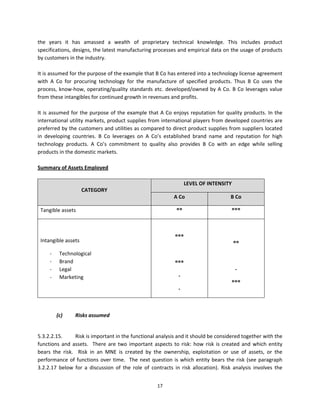
Summary of Assets Employed 
 
                                                                       LEVEL OF INTENSITY 
                       CATEGORY 
                                                                   A Co                      B Co 

    Tangible assets                                                 ®®                         ®®® 


                                                                   ®®® 
    Intangible assets                                                                           ®® 
                                                                      
        ‐    Technological                                                                        
        ‐    Brand                                                 ®®® 
        ‐    Legal                                                                               ‐ 
        ‐    Marketing                                               ‐ 
                                                                                               ®®® 
                                                                     ‐ 


            (c)    Risks assumed 
 

5.3.2.2.15.        Risk is important in the functional analysis and it should be considered together with the 
functions  and  assets.    There  are  two  important  aspects  to  risk:  how  risk  is  created  and  which  entity 
bears  the  risk.    Risk  in  an  MNE  is  created  by  the  ownership,  exploitation  or  use  of  assets,  or  the 
performance  of  functions  over  time.    The  next  question  is  which  entity  bears  the  risk  (see  paragraph 
3.2.2.17  below  for  a  discussion  of  the  role  of  contracts  in  risk  allocation).  Risk  analysis  involves  the 


                                                          17 
 
identification  of  the  economically  significant  risks  that  are  assumed  by  each  of  the  parties  to  the 
transaction.    It  is  commonly  understood  that  the  bearing  of  economically  significant  risk  is  related  to 
anticipation of  reward.   
 
5.3.2.2.16.         In  the  open  market  the  greater  the  economically  significant  risks  assumed  by  an 
enterprise  the  higher  the  return  that  it  expects,  although  the  actual  return  may  or  may  not  increase 
depending  on  the  degree  to  which  such  risks  are  realised.    Conversely,  in  a  case  where  such  risks 
undertaken  by  the  enterprise  in  a  transaction  are  minimal,  the  return  it  may  expect  from  such 
transactions should normally be lower.  It would be expected that this would be the case in a controlled 
transaction that satisfies the arm’s length principle. 
 
5.3.2.2.17.         An illustrative list of risks assumed by the parties to the transaction is provided below, 
however  the  relevance  of  each  individual  risk  factor  listed  below  will  depend  on  the  nature  of  the 
transaction:  
          

    Nature of risks                  Particulars 

    1.    Financial risk             a.      Method of funding 
                                     b.      Fluctuation in interest rates 
                                     c.      Funding of losses 
                                     d.      Foreign exchange risk 

    2.    Product risk               a.      Design and development of product 
                                     b.      Upgrading / obsolescence of product 

                                     c.      After‐sales service 

                                     d.      Risks associated with R&D 

                                     e.      Product liability risk 

                                     f.      Intellectual property risk, if any 
                                     g.      Scheduling risk 
                                     h.      Inventory risk 

    3.    Market risk                a.      Development  of  a  market  including  advertisement  and 
                                             product promotion, etc. 
                                     b.      Fluctuation in demand and prices 

                                     c.      Business cycle risk 
                                     d.      Volume risk 
                                     e.      Service  incentive scheme risk 
                                     f.      Asset redundancy risk  
    4.    Collection risk            a.      Credit risk 

                                                         18 
 
b.      Bad debt risk 
    5.   Entrepreneurial risk         a.      Risk  of loss associated with capital investment 
                                      b.      Single customer risk 
                                      c.      Risk of losing human capital intangible  
    6.   General business risk        a.      Risk related to ownership of property 
                                      b.      Risk associated with the exploitation of a business 
                                      c.      Inflation risk  
    7.   Country/regional risk         a.     Political risk  
                                       b.     Security risk  
                                       c.     Regulatory risk  
                                       d.     Risk related to government policies  
 
5.3.2.2.18         It should be emphasised that this list is purely indicative, and that the extent to which 
each  of  these  risks  (or  other  risks  not  listed  above)  is  economically  significant  and  contributes  to  the 
creation of value depends on the industry and on the taxpayer‐specific circumstances. Hence, real life 
knowledge of how a particular MNE is functioning and is documented vis‐à‐vis its associated enterprise 
(AE) is very crucial in determination of the risk. For instance, not all industries involve the same level of 
product liability risk.  
 
5.3.2.2.19.        Risk analysis is important because comparability adjustments may need to be made for 
differences in risks that are assumed in a controlled transaction as compared to those in an uncontrolled 
transaction. 
 
5.3.2.2.20.        It is not only necessary to identify the risks but also to identify who bears such risks. The 
allocation  of  risks  is  usually  based  on  the  contractual  terms  between  the  parties.  However,  contracts 
between associated enterprises may not specify the allocation of all the risks. Most commonly assigned 
risks in the contract are controllable risks, for example inventory risk, bad debts, foreign exchange risk 
etc.  Market  circumstances,  price  competition,  the  supply  of  raw  materials,  rises  in  wages  etc.  are 
uncontrollable  or  less  controllable  risks,  which  may  not  be  identified  in  the  contract.  Volatility  in  the 
global  market  in  the  last  decade  has  demonstrated  that  these  uncontrollable  risks  are  economically 
more significant than controllable risks or contractual risks as mentioned above.     
 
5.3.2.2.21.        Even  where  a  written  contract  is  in  place  an  analysis  of  the  conduct  of  the  parties  is 
critical  in  order  to  determine  whether  the  actual  allocation  of  risk  conforms  to  the  contractual  risk 
allocation.  The  allocation  of  risk  under  a  contract  will  generally  be  respected  by  the  tax  authorities 
unless it is not consistent with the economic substance of the transaction. Parties transacting at arm’s 
length  would  be  expected  to  agree  on  the  allocation  of  significant  risks  between  them  before  the 
outcome of the risk‐taking is known.  
 
5.3.2.2.22.        When  analysing  the  economic  substance  of  a  transaction,  it  is  necessary  to  examine 
whether  the  conduct  of  the  associated  enterprises  over  time  has  been  consistent  with  the  purported 


                                                           19 
 
allocation of risk and whether changes in the pattern of behaviour have been matched by changes in the 
contractual arrangements.  
 
5.3.2.2.23.       In addition, the contractual allocation of risks should be arm’s length.  Where there are 
reasonably  reliable  comparables  evidencing  a  similar  allocation  of  risks  between  independent  parties, 
then the allocation of risks between the associated enterprises is regarded as being at arm’s length.   
          
5.3.2.2.24.        In    the  absence  of  such  comparables  one  relevant,  although  not  determinative,  factor 
that  can  assist  in  the  determination  of  whether  the  allocation  of  risk  is  at  arm’s  length  is  the 
examination of which party(ies) has (have) relatively more control over the risk. In arm’s length dealings 
a  party  usually  bears  a  greater  proportion  of  the  risk  from  business  activities  over  which  it  exercises 
relatively more control. The components which may be considered to help identify the party which has 
control over the risk may include, when examined in relation to that particular risk: 
           
                  Core functions. 
           
                   Key responsibilities: formulation of policy, formulation of plan, budget, fixation of goals 
                   and targets etc.  
           
                   
                 Key  decisions:  strategic  decisions  which  have  greater  potential  to  impact  the  ability  of 
                  an entity to generate profit and the amount of profits.  
                 Level  of  individual  responsibility  for  the  key  decisions.  Allocation  of  power  to  senior 
                  management  or  a  level  below  depends  upon  the  location  of  core  functions  in  the 
                  country of the MNE or subsidiary, their contribution to core components of the various 
                  functions,  their  authority,  their  responsibility  and  the  duties  included  in  the 
                  employment contract of the MNE or subsidiary. 
          
                  Included in the determination of whether the allocation of risk is at arm’s length is the 
                  examination of which party(ies) has (have) relatively more control over the risk. This 
                  can be illustrated by following examples: 

                           Example 1 – Control over risk by parent company  

Company  A  situated  in  Country  Z  belongs  to  an  MNE  group  having  operations  worldwide  through 
various subsidiaries.  Company A is responsible for the overall research programmes of the group.  The 
group has two R&D centres operated by Companies B & C, both subsidiaries of Company A, situated in 
Countries X & Y respectively 

Company  A  employs  a  workforce  that  includes  the  CEO,  CFO,  senior  management  and  technical 
personnel  that  provides  strategic  supervision  of  the  group’s  R&D  activities.  Company  A  claims  that  it 
controls  and  takes  all  strategic  decisions  with  regard  to  the  core  functions  of  Companies  B  and  C. 
Company A designs and monitors the MNE’s overall research programs, provides funds needed for R&D 


                                                          20 
 
activities  and  controls  the  annual  budget  for  R  &  D  activities  of  Companies  B  &  C.  The  CEO,  CFO  and 
other  senior  management  personnel  of  Companies  B  and  C  reside  in  Countries  X  and  Y  and  are 
technically and functionally competent to take decisions and carry out the R&D activities of Company B 
and C, under the overall direction of Company A. The technical manpower needed for R & D activity and 
the assets of companies B & C are located in Countries X and Y.  

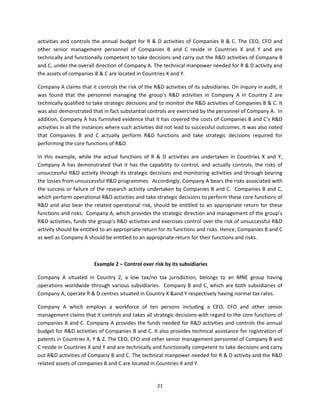
Company A claims that it controls the risk of the R&D activities of its subsidiaries. On inquiry in audit, it 
was  found  that  the  personnel  managing  the  group’s  R&D  activities  in  Company  A  in  Country  Z  are 
technically qualified to take strategic decisions and to monitor the R&D activities of Companies B & C. It 
was also demonstrated that in fact substantial controls are exercised by the personnel of Company A.  In 
addition, Company A has furnished evidence that it has covered the costs of Companies B and C’s R&D 
activities in all the instances where such activities did not lead to successful outcomes. It was also noted 
that  Companies  B  and  C  actually  perform  R&D  functions  and  take  strategic  decisions  required  for 
performing the core functions of R&D. 

In  this  example,  while  the  actual  functions  of  R  &  D  activities  are  undertaken  in  Countries  X  and  Y, 
Company  A  has  demonstrated  that  it  has  the  capability  to  control,  and  actually  controls,  the  risks  of 
unsuccessful R&D activity through its strategic decisions and monitoring activities and through bearing 
the losses from unsuccessful R&D programmes.  Accordingly, Company A bears the risks associated with 
the success or failure of the research activity undertaken by Companies B and C.  Companies B and C, 
which perform operational R&D activities and take strategic decisions to perform these core functions of 
R&D  and  also  bear  the  related  operational  risk,  should  be  entitled  to  an  appropriate  return  for  these 
functions and risks.  Company A, which provides the strategic direction and management of the group’s 
R&D activities, funds the group’s R&D activities and exercises control over the risk of unsuccessful R&D 
activity should be entitled to an appropriate return for its functions and risks. Hence, Companies B and C 
as well as Company A should be entitled to an appropriate return for their functions and risks.  


                           Example 2 – Control over risk by its subsidiaries 

Company  A  situated  in  Country  Z,  a  low  tax/no  tax  jurisdiction,  belongs  to  an  MNE  group  having 
operations  worldwide  through  various  subsidiaries.    Company  B  and  C,  which  are  both  subsidiaries  of 
Company A, operate R & D centres situated in Country X &and Y respectively having normal tax rates. 

Company  A  which  employs  a  workforce  of  ten  persons  including  a  CEO,  CFO  and  other  senior 
management claims that it controls and takes all strategic decisions with regard to the core functions of 
companies B and C. Company A provides the funds needed for R&D activities and controls the annual 
budget for R&D activities of Companies B and C. It also provides technical assistance for registration of 
patents in Countries X, Y & Z. The CEO, CFO and other senior management personnel of Company B and 
C reside in Countries X and Y and are technically and functionally competent to take decisions and carry 
out R&D activities of Company B and C. The technical manpower needed for R & D activity and the R&D 
related assets of companies B and C are located in Countries X and Y.  


                                                         21 
 
Company A claims that it controls the risk of the R&D activities of its subsidiaries. On inquiry in audit it 
was found that the CEO and CFO and Senior Management of Company A in country Z are technically not 
skilled either to take strategic decisions or to monitor the R&D activities of company B and C. Company 
A has not furnished any evidence of taking strategic decisions. On the other hand, it was found that the 
senior  management  of  Companies  B  and  C  are  taking  the  important  strategic  decisions  related  to  the 
design and direction of the R&D programme and budget. However, Company A has furnished evidence 
that the funds were actually transferred to its subsidiaries for R&D activities. 

In this example all the core functions of R & D activities are located in Countries X and Y and the non‐
core functions of registering patents are located in Country Z. Even though the senior management of 
company A are located in Country Z they are not capable of taking strategic decisions or controlling and 
monitoring  R  &  D  activities.  The  determination,  utilization  and  control  of  the  budget  for  carrying  out 
R&D  activities  and  decisions  regarding  day‐to‐day  performance  of  R&D  activities  were  carried  out  by 
Companies B and C. In view of these facts it cannot  be held that  Company A controls the risk of R&D 
activities.  Company  A  should  be  entitled  to  an  appropriate  return  for  the  provision  of  funding  and 
Companies B and C should be entitled to an appropriate return for their functions including the strategic 
decisions and control over the risk of R&D activities. 


5.3.2.2.25.         In  arm’s  length  transactions  another  factor,  although  not  a  determinative  factor,  that 
may influence an independent party’s willingness to take on a risk is its anticipated financial capacity, at 
the time when risk is allocated to it, to assume (i.e. to take on) the risk. If it is anticipated that the party 
will not have the capacity to bear the consequences of the risk should it materialise and that it also does 
not  put  in  place  a  mechanism  to  cover  the  risk,  doubts  may  arise  as  to  whether  the  risk  would  be 
assigned  to  this  party  at  arm’s  length.  Note  that  the  financial  capacity  to  assume  the  risk  is  not 
necessarily  the  financial  capacity  to  bear  the  full  consequences  of  the  risk  materialising  (e.g.  the  full 
loss),  as  it  may  be  the  capacity  for  the  risk‐bearer  to  protect  itself  from  the  consequences  of  the  risk 
materialising (e.g. by hedging the risk or otherwise). Furthermore, a high level of capitalisation by itself 
does not mean that the highly capitalised party carries higher risk. 
 
Beyond the identification of these two relevant factors it is not possible to provide prescriptive criteria 
that would provide certainty in all situations. The determination that the risk allocation in a controlled 
transaction is not one that would have been agreed between independent parties should therefore be 
made  with  care  considering  the  facts  and  circumstances  of  each  case.  It  is  pertinent  to  mention  here 
that in a multinational enterprise associated entities work together to exert control over the risks of the 
entire  MNE  group.  Real  and  precise  distribution  of  risk  among  the  associated  enterprises  is  virtually 
impossible  to  achieve,  due  to  the  lack  of  sufficiently  detailed  information  in  some  cases.  5.3.2.2.26.
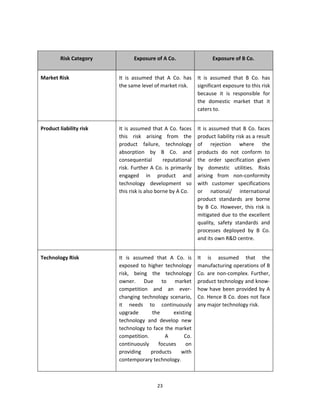
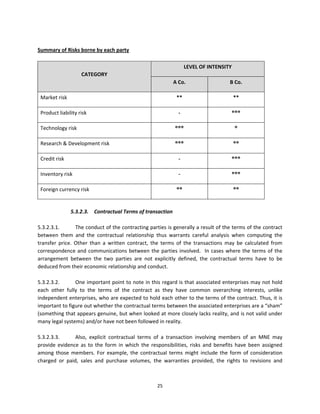
           Continuing  the  example  in  para  3.15,  it  is  assumed  for  the  purpose  of  the  example  that  the 
following are the risks borne by the respective parties. 
 [Caution: this example is for illustration only and each case should be judged on its own merits.] 


                                                           22 


             Risk Category            Exposure of A Co.                        Exposure of B Co. 


    Market Risk                It  is  assumed  that  A  Co.  has  It  is  assumed  that  B  Co.  has 
                               the same level of market risk.  significant exposure to this risk 
                                                                   because  it  is  responsible  for 
                                                                   the  domestic  market  that  it 
                                                                   caters to.  


    Product liability risk     It  is  assumed  that  A  Co.  faces     It  is  assumed  that  B  Co.  faces 
                               this  risk  arising  from  the           product liability risk as a result 
                               product  failure,  technology            of  rejection  where  the 
                               absorption  by  B  Co.  and              products  do  not  conform  to 
                               consequential         reputational       the  order  specification  given 
                               risk.  Further  A  Co.  is  primarily    by  domestic  utilities.  Risks 
                               engaged  in  product  and                arising  from  non‐conformity 
                               technology  development  so              with  customer  specifications 
                               this risk is also borne by A Co.         or  national/  international 
                                                                        product  standards  are  borne 
                                                                        by  B  Co.  However,  this  risk  is 
                                                                        mitigated due to the excellent 
                                                                        quality,  safety  standards  and 
                                                                        processes  deployed  by  B  Co. 
                                                                        and its own R&D centre. 


    Technology Risk            It  is  assumed  that  A  Co.  is        It  is  assumed  that  the 
                               exposed  to  higher  technology          manufacturing operations of B 
                               risk,  being  the  technology            Co.  are  non‐complex.  Further, 
                               owner.  Due  to  market                  product technology and know‐
                               competition  and  an  ever‐              how  have  been  provided  by  A 
                               changing  technology  scenario,          Co. Hence B Co. does not face 
                               it  needs  to  continuously              any major technology risk. 
                               upgrade        the      existing 
                               technology  and  develop  new 
                               technology to face the market 
                               competition.        A        Co. 
                               continuously  focuses  on 
                               providing  products  with 
                               contemporary technology. 


                                                  23 
 
Research & Development risk    It  is  assumed  that  since  A  Co.    It  is  assumed  that  since  no 
                                   serves  diverse  markets,  its          significant  R&D  (except  for 
                                   engineering         and        R&D      supporting B Co’s business and 
                                   professionals  constantly  strive       that  of  providing  technical 
                                   to provide innovative solutions         assistance  to  its  customers)  is 
                                   that        offer     competitive       carried out by B Co, it faces no 
                                   advantages  for  customers              significant risk on this account. 
                                   worldwide. 


    Credit Risk                    It  is  assumed  that  in  the  case  It is assumed that all the major 
                                   of  inter‐company  sales  of  credit  risks  associated  with 
                                   technology and components A  sales are borne by B Co. 
                                   Co. faces minimal risk. 


    Inventory Risk                 It  is  assumed  that  A  Co.  is       It  is  assumed  that  B  Co.  is 
                                   primarily  engaged  in  product         responsible  to  manage  the 
                                   and  technology  development            procurement  of  raw  materials 
                                   and this risk is not borne by A         /  components  and  maintain 
                                   Co.                                     the  requisite  stock  levels  for 
                                                                           each        product        including 
                                                                           finished  goods.  However,  this 
                                                                           risk  is  mitigated  to  the  extent 
                                                                           that components are procured 
                                                                           from A Co. 


    Foreign Currency Risk          It  is  assumed  that  A  Co.           It  is  assumed  that  since  B  Co. 
                                   exports      technology       and       imports  technology  and 
                                   components  to  B  Co.;  hence          components from A Co. and its 
                                   they  are  also  subjected  to          sales  are  restricted  to 
                                   appreciation/  depreciation  of         domestic markets, the imports 
                                   local  currency2  against  the          are          subjected            to 
                                   foreign  currency.  Hence  A  Co.       appreciation/depreciation  of 
                                   is also subjected to this risk.         local  currency  against  the 
                                                                           foreign  currency.  Hence  B  Co. 
                                                                           is subjected to this risk. 

#


                                                      24 
 
 
Summary of Risks borne by each party 
  
                                                                       LEVEL OF INTENSITY 
                       CATEGORY 
                                                               A Co.                      B Co. 

    Market risk                                                  **                          ** 

    Product liability risk                                        ‐                        ®®® 

    Technology risk                                             ®®®                          ® 

    Research & Development risk                                 ®®®                          ®® 

    Credit risk                                                   ‐                        ®®® 

    Inventory risk                                                ‐                        ®®® 

    Foreign currency risk                                        ®®                          ®® 

 
               5.3.2.3.  Contractual Terms of transaction  
 
5.3.2.3.1.        The conduct of the contracting parties is generally a result of the terms of the contract 
between  them  and  the  contractual  relationship  thus  warrants  careful  analysis  when  computing  the 
transfer  price.  Other  than  a  written  contract,  the  terms  of  the  transactions  may  be  calculated  from 
correspondence  and  communications  between  the  parties  involved.    In  cases  where  the  terms  of  the 
arrangement  between  the  two  parties  are  not  explicitly  defined,  the  contractual  terms  have  to  be 
deduced from their economic relationship and conduct.   
 
5.3.2.3.2.        One important point to note in this regard is that associated enterprises may not hold 
each  other  fully  to  the  terms  of  the  contract  as  they  have  common  overarching  interests,  unlike 
independent enterprises, who are expected to hold each other to the terms of the contract. Thus, it is 
important to figure out whether the contractual terms between the associated enterprises are a “sham” 
(something that appears genuine, but when looked at more closely lacks reality, and is not valid under 
many legal systems) and/or have not been followed in reality. 
 
5.3.2.3.3.        Also,  explicit  contractual  terms  of  a  transaction  involving  members  of  an  MNE  may 
provide  evidence  as  to  the  form  in  which  the  responsibilities,  risks  and  benefits  have  been  assigned 
among  those  members.  For  example,  the  contractual  terms  might  include  the  form  of  consideration 
charged  or  paid,  sales  and  purchase  volumes,  the  warranties  provided,  the  rights  to  revisions  and 


                                                        25 
 
modifications,  delivery  terms,  credit  and  payment  terms  etc.  In  addition  to  an  examination  of  these 
contractual terms, it will be important to check that the actual conduct of the parties conforms to them. 
 
5.3.2.3.4.        Where  there  are  material  differences  in  economically  significant  contractual  terms 
between the taxpayer’s controlled transactions and the potential comparables, such differences should 
be  evaluated,  in  order  to  judge  whether  comparability  between  the  controlled  and  uncontrolled 
transactions  is  nevertheless  satisfied  and  whether  comparability  adjustments  need  to  be  made  to 
eliminate the effects of such differences. 
 
5.3.2.3.5.        An example of how contractual terms may affect transfer pricing is as follows. Consider 
Company A in one country, an agricultural exporter, which regularly buys transportation services from 
Company  B  (its  foreign  subsidiary)  to  ship  its  product,  cocoa  beans,  from  Company  A’s  country  to 
overseas markets. Company B occasionally provides transportation services to Company C, an unrelated 
domestic  corporation  in  the  same  country  as  Company  B.  However,  the  provision  of  such  services  to 
Company  C  accounts  for  only  10%  of  the  gross  revenues  of  Company  B  and  the  remaining  90%  of 
Company  B’s  revenues  are  attributable  to  the  provision  of  transportation  services  for  cocoa  beans  to 
Company A. In determining the degree of comparability between Company B’s uncontrolled transaction 
with Company C and its controlled transaction with Company A, the difference in volumes involved in 
the two transactions, volume discount if any, and the regularity with which these services are provided 
must be taken into account where such factors would have a material effect on the price charged.  


5.3.2.4. Economic circumstances of the transaction 
 
5.3.2.4.1.        Economic  analysis  deals  with  industry  analysis  and  the  circumstances  that  may  be 
relevant for determining market comparability.  The relevant information on the industry can be broadly 
classified into following: 
                   
                 Global  economic  trends  and  developments  relating  to  the  industry  to  which  the 
                  enterprise belongs; 
                  Economic trends in each taxpayer’s country for the same industry; and 
                 Market position of the enterprise and surrounding economic conditions. 
          
Care must be exercised while considering global economic trends, as the market trends in the taxpayer’s 
country and in the country of its associated enterprise and/or of the potential comparables (in the case 
where foreign comparables are used) could be significantly different. For example in the 2008 meltdown 
of the global economy some of the banks and automobile companies reported huge losses globally, but 
significant  profits  in  emerging  economies.  Where  there  are  such  significant  differences  between  the 
economic circumstances prevailing in different markets such that it is not possible to eliminate them by 
making  reliable  comparability  adjustments,  then  companies  from  such  different  markets  might  not  be 
retained as reliable comparables.   
                 

                                                       26 
 
5.3.2.4.2.        Undertaking a more detailed classification of the above broad headings would yield the 
following specific factors which may need to be looked at in performing an industry analysis if they are 
economically significant for the examined controlled transaction: 
 
 Geographic location of the market; 
 Market size; 
 Level of the market (e.g. retail or wholesale); 
 Competition in the market and the relative competitive positions of the buyers and sellers; 
 Availability of substitutes; 
 Government regulations of the market; 
 Levels of supply and demand; 
 Consumer purchasing power; 
 Location‐specific costs of production including the costs of land, labour, capital, transportation costs 
      etc.;  
 Economic conditions of the overall industry, the key value drivers in the industry and the date and 
      time of transactions;  
 The existence of a cycle (economic, business, or product cycle); and  
 Other relevant factors. 
           
5.3.2.4.3.        Market prices for the transfer of the same or similar property may vary across different 
markets owing to cost differentials and/or differences in purchasing power and habits prevalent in the 
respective markets which may affect the market price. Markets can be different for numerous reasons; 
it is not possible to itemise exhaustively all the market conditions which may influence transfer pricing 
analysis but some of the key market conditions which influence such an analysis are as discussed below. 
  
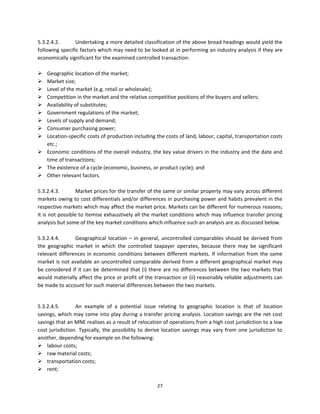
5.3.2.4.4.        Geographical  location  –  in  general,  uncontrolled  comparables  should  be  derived  from 
the  geographic  market  in  which  the  controlled  taxpayer  operates,  because  there  may  be  significant 
relevant  differences  in  economic  conditions  between  different  markets.  If  information  from  the  same 
market is not available an uncontrolled comparable derived from a different geographical market may 
be  considered  if  it  can  be  determined  that  (i)  there  are  no  differences  between  the  two  markets  that 
would materially affect the price or profit of the transaction or (ii) reasonably reliable adjustments can 
be made to account for such material differences between the two markets.  
           

5.3.2.4.5.        An  example  of  a  potential  issue  relating  to  geographic  location  is  that  of  location 
savings, which may come into play during a transfer pricing analysis. Location savings are the net cost 
savings that an MNE realises as a result of relocation of operations from a high cost jurisdiction to a low 
cost  jurisdiction.  Typically,  the  possibility  to  derive  location  savings  may  vary  from  one  jurisdiction  to 
another, depending for example on the following:  
 labour costs; 
 raw material costs;  
 transportation costs; 
 rent;  

                                                          27 
 
 training costs;  
 subsidies;  
 incentives including tax exemptions; and  
 infrastructure costs.  
 
It  is  quite  possible  that  part  of  the  cost  savings  may  be  offset at  times  by  “dis‐savings”  on  account  of 
poor  infrastructure  in  relation  to  the  quality  and  reliability  of  the  power  supply,  higher  costs  for 
transportation,  quality  control  etc.  Accordingly,  only  the  net  location  savings  (i.e.  savings  minus  dis‐
savings) may give rise to an extra profit arising to an MNE due to the relocation of its business from a 
high cost to a low cost jurisdiction.      
 
 
5.3.2.4.6. How are location savings measured: The computation of location savings typically involves the 
quantification of the net cost savings derived from relocating in a low cost country, as compared to the 
relevant high cost country. In theory, the cost savings computation includes selection of a pre‐transfer 
manufacturing  or  servicing  base  in  the  relevant  high‐cost  country  compared  to  the  comparable 
manufacturing or services cost in the low‐cost country, taking into account such things as total labour 
cost  per  unit  of  output  (adjustment  on  account  of  difference  in  labour  productivity),  cost  of  raw 
material, costs of land and rent costs; tax benefits etc. The cost savings can be partially offset by higher 
cost of infrastructure like less reliable power etc. in certain cases.  
 
 
              Cost savings                                    Dis savings                          Net location        
 
 
          (e.g. cheap labour)              ‐        (e.g. high transportation cost)              =   savings 

 
5.3.2.4.7.  What  are  location‐specific  advantages:  The  relocation  of  a  business  may  also  (in  addition  to 
location savings) or alternatively give some other location‐specific advantages (in short LSAs). Location 
savings and location specific advantages are one type of benefit related to geographical location. These 
LSAs could be, depending on the circumstances of the case: 
                    highly specialized skilled manpower and knowledge; 
                    proximity to growing local/regional market; 
                    large customer base with increased spending capacity;   
                    advanced  infrastructure  (e.g.  information/  communication  networks,  distribution 
                     system); or 
                    market premium.  
  
 
Taken together, location savings and each of the other types of benefit related to geographical location 
are  called  location‐specific  advantages  [LSAs].    LSAs  may  play  a  very  important  role  both  in  increasing 
the  profitability  of  the  MNE  and  in  determining  the  bargaining  power  of  each  of  the  associated 
enterprises. It should be noted that the term LSA includes sources of value that are discussed elsewhere 
in the Manual, and should not be double counted in assessing arm’s length outcomes. 
 

                                                           28 
 
LSAs can be measured as under:  
 
 
       Net location                                    Other Location                          Location Specific 
                                        +/‐           Specific Benefits
                                                                                  =          Advantages (“LSAs”)
           savings 
 
 
What is location rent? 
5.3.2.4.8.        The  incremental  profit,  if  any,  derived  from  the  exploitation  of  LSAs  is  known  as 
“location  rent”.  Thus,  the  term  “location  savings”  represents  “cost  savings”  whereas  “location  rent” 
represents the incremental profits derived from LSAs.  The value of “location rent” is at most equal to, 
or less than, the value of LSAs.    


                                                                                                        Location Rent  
                 Other Location                              Location Specific 
  +/‐                                          =                                        =>
                Specific Benefits                          Advantages (“LSAs”)                        (i.e. incremental 
 
                                                                                                             profit)
 
5.3.2.4.9.        What determines whether LSAs lead to location rents?   The extent to which LSAs will 
lead  to  location  rents  depends  on  competitive  factors  relating  to  the  end  product  and  to  the  general 
access  to  LSAs.    It  is  possible  that  in  a  particular  case,  even  though  LSAs  exist,  there  are  no  location 
rents.  For  example,  in  situations  in  which  the  market  for  the  end  product  is  highly  competitive  and 
potential competitors also have access to the LSAs, much or all of the benefits of LSAs would be passed 
on to the customers through lower prices of products, resulting in little or no location rents. However, 
circumstances  where  extra  profits  are  passed  on  to  customers  are  varied,  and  may  be  permanent  or 
temporary.  Where  this  is  temporary,  at  the  end  of  this  period  of  competition,  the  MNE  may  possibly 
achieve a larger market share in the local market with an increased ability to sell products at a higher 
price.  Alternatively,  if  an  MNE  has  exclusive  access  to  the  LSAs,  then  the  MNE  may  derive  significant 
location  rents  associated  with  the  LSAs,  as  the  LSAs  reflect  a  competitive  advantage.    These  location 
rents may dissipate over time due to competitive pressure, depending on the facts and circumstances of 
each case. 


5.3.2.4.10.       As with the determination of whether location rents exist, the arm’s length attribution 
of  location  rents  depends  on  competitive  factors  relating  to  access  to  the  LSAs,  and  on  the  realistic 
alternatives  available  to  the  associated  enterprises  given  their  respective  bargaining  power.    To  the 
extent that competitors would not have access to the LSAs, the relevant question is why this is so.  There 
are a number of possibilities.  For example, the MNE could have production intangibles that allow it to 
manufacture  at  a  lower  cost  than  competitors.    At  arm’s  length,  the  owner  of  the  intangible  would 
typically be entitled to the rents associated with this cost saving, as it would have a realistic alternative 

                                                            29 
 
to undertake its production elsewhere at similarly low costs.    As another example, it might be that the 
low‐cost producer is the first to operate in the low cost jurisdiction and there are no comparable low‐
cost producers in its or other jurisdictions, implying that, for a time at least, it is well‐placed to extract a 
part of the location rents. 
 

The next question would be what constitutes an appropriate split consistent with arm’s length principle? 
As discussed above, the bargaining power of the associated enterprises which reflects the arm’s length 
nature of two independent parties negotiating over their respective shares of savings/rents may be well 
suited.  This  can  be  used  to  determine  the  arm’s  length  surplus  (savings/rents)  allocations  when 
comparable uncontrolled transactions or benchmarks are not available. 
 
5.3.2.4.11.        Government rules and regulations – generally, government interventions in the form of 
price  controls,  interest  rate  controls,  exchange  controls,  subsidies  for  certain  sectors,  anti‐dumping 
duties etc., should be treated as conditions of the market in the particular country if they apply in the 
same way to controlled and uncontrolled transactions. In the ordinary course of events they should be 
taken  into  account  in  arriving  at  an  appropriate  transfer  price  in  that  market.  The  question  becomes 
whether,  in  light  of  these  conditions,  the  transactions  between  associated  enterprises  are  consistent 
with comparable uncontrolled transactions between independent enterprises.  
 
5.3.2.4.12.        An example of where government rules affect the market is that certain pharmaceutical 
formulations  may  be  subject  to  price  regulation  in  a  particular  country.  Another  example  is  Export 
Oriented  Units  (E.O.U.’s)  which  may  be  subject  to  beneficial  provisions  under  the  taxation  laws  of  a 
country; ideally companies that enjoy similar privileges should be used as the comparables, and if that is 
not  possible,  comparability  adjustments  may  need  to  be  made  as  part  of  the  comparability  analysis. 
Another example is where foreign exchange regulations limit the amounts of the payments that can be 
made  for  services  or  intangibles.  However,  such  regulatory  limits  may  not  set  arm’s  length  prices  for 
services or intangibles.  
          
For  example,  assuming  that  all  the  transactions  are  in  the  same  currency,  certain  countries  have 
restrictions  on  the  payment  of  interest  on  external  commercial  borrowings  and  the  exchange  control 
regulatory requirements authorise the borrower to pay interest at LIBOR plus say 200 basis points. The 
country  of  the  lender  may  however  not  agree  to  use  this  as  a  basis  for  benchmarking  the  transaction 
when the lending enterprise itself borrows in its domestic market at a higher rate than LIBOR plus 200 
basis points. 
 
5.3.2.4.13.        Level  of  Market  –  for  example,  the  price  at  the  wholesale  and  retail  levels  would 
generally differ. 
 
5.3.2.4.14.        Other  market  conditions  ‐  some  other  market  conditions  which  may  influence  the 
transfer  price  include  costs  of  production  (including  costs  of  land,  labour  and  capital);  availability  of 
substitutes  (both  goods  and  services);  level  of  demand/supply;  transport  costs;  the  size  of  the  market 
and the extent of competition. 

                                                          30 
 
 
5.3.2.5. Business strategies 
 
5.3.2.5.1.        On a general level business strategies are one of the important factors in comparability 
analysis.  However,  the  examination  of  the  legitimate  business  strategy  of  an  MNE  will  depend  on  the 
facts and circumstances of each case. The business strategy of an MNE is dependent upon the structural 
characteristics of an industry. Nonetheless, MNEs with different business strategies do exist within the 
same industry. In fact, the business strategy of MNEs may differ due to their different global integration 
‐  local  responsiveness  pressure,  different  corporate  histories,  internal  efficiencies  and  competitive 
advantages.  Business  strategies  would  take  into  account  many  aspects  of  an  enterprise  such  as 
innovation  and  new  product  development;  degree  of  diversification;  risk  aversion;  assessment  of 
political  changes;  impact  of  existing  and  planned  labour  laws;  duration  of  arrangements  and  other 
factors bearing upon the daily conduct of business. Such business strategies may need to be taken into 
account  when  determining  the  comparability  of  controlled  and  uncontrolled  transactions  of  the 
enterprises. However, the ultimate objective of a business strategy of an MNE is to improve its market 
share and/or overall profitability. 
 
5.3.2.5.2.        On  a  strategic  level  market  share  improvement  strategies  considered  by  MNEs  can  be 
divided into the following three main categories depending on the period of their existence in a market: 
 
                 market penetration strategy;  
                 market expansion strategy; or  
                 market maintenance strategy.  
                   

The  above  market  share  strategies  depend  on  various  factors  like  market  power  and  the  business  life 
cycle  of  the  MNE  in  a  particular  market.  Market  penetration  occurs  when  an  MNE  is  a  relative 
newcomer to a particular market and is seeking to enter and establish its products/services in the new 
market. An MNE might actively pursue a market expansion strategy to increase market share in highly 
competitive market. The market maintenance occurs when an MNE has already entered a market and is 
required to maintain its market share.  


5.3.2.5.3.        A market penetration strategy may involve a combination of strategies for:  
                  
                attracting existing users of a competitive brand to new products; and  
                attracting non users to the product category to which the new product belongs.  
          
5.3.2.5.4.     When  an  MNE  pursues  a  market  maintenance/expansion  strategy  it  may  focus  on  a 
combination of the multiple strategies of: 
 
 attracting users of competitive brands; 
 pursuing current users to increase usage; and  

                                                       31 
 
 attracting non users of the product category. 
                   

    All these three market share strategies use two fundamental tactics: 


     lowering  the  price  of  their  products  on  a  temporary  basis  by  offering  discounts  on  the  product  to 
      become extremely competitive in the market; and 
     increasing their marketing and selling expenses through increased advertisement; sales promotion 
      activities  like  offering  rebates,  free  samples,  offering  extended  warranties  etc.  and  increased 
      marketing activities like more salesmen, commission agents or distributors and increased payments 
      of commission to distributors. 
                      

    It may be desirable to isolate the costs related to the pursuit of the above referred tactics as precisely as 
    possible so that the allocation of costs at arm’s length can be computed.    

     
    5.3.2.5.5.       Although market penetration, market expansion and market maintenance strategies are 
    legitimate  business  strategies  these  may  involve  substantial  costs,  sometimes  resulting  in  significant 
    losses. Accordingly, there is strong implicit recognition that market share strategies cannot be pursued 
    indefinitely by a taxpayer and there has to be some definite time frame in the foreseeable future when 
    these  strategies  might  yield  future  profit.  The  allocation  of  the  costs  of  these  strategies  between  an 
    MNE  and  its  subsidiaries  is  an  important  issue  in  transfer  pricing  and  will  depend  on  the  facts  and 
    circumstances of each case. It is important to examine the following factors in order to address this issue 
    of cost allocation between parties to the transactions: 
     
     which entity is the initiator of the strategy; 
     which entity is the intended beneficiary of the strategy; 
     whether unusually intense advertising, marketing and sales  promotion efforts are taking place since 
         these would provide a signal of market penetration or market share expansion strategies; 
     the nature of the relationship between related parties, i.e. their responsibilities and risk profile; 
     whether the strategy involves intangibles; and   
     which party is the legal and economic owner of such intangibles. 
                      

    For  example,  a  limited  risk  company  acting  solely  as  a  sales  agent  with  little  or  no  responsibility  for 
    market development would generally not bear the costs of a market penetration strategy initiated by its 
    parent company.  

    . 

    5.3.2.5.6.     When  an  MNE  enters  a  new  market  with  its  product  or  expands  market  share  of  its 
    product in an existing market through its subsidiary, questions of the creation of marketing intangibles 


                                                              32 
     
and  increases  in  the  value  of  product‐related  intangibles  such  as  trademarks,  trade  names  etc.  follow 
    closely  behind.  Therefore,  it  is  quite  important  to  examine  and  follow  the  process  of  creation  of 
    intangibles  in  a  market,  as  well  as  the  legal  ownership  of  that  intangible  and  the  right  to  share  in  the 
    return  from  that  intangible  (the  notion  which  some  countries  refer  to  as  “economic  ownership”).  It  is 
    recognised that market research; designing or planning products suitable to market needs; advertising; 
    marketing  and  sales  promotion  strategies;  after‐sale  services  and  networks  of  dealers  and 
    sales/commission agents may contribute to the creation of marketing intangibles depending on the facts 
    and circumstances of each case.  
     
    5.3.3.  Selection of the tested party  
     
    5.3.3.1. When  applying  a  cost  plus,  resale  price  or  transactional  net  margin  method  it  is  necessary  to 
    choose the party to the transaction for which a financial indicator (mark‐up on costs, gross margin, or 
    net  profit  indicator)  is  tested.  The  choice  of  the  tested  party  should  be  consistent  with  the  functional 
    analysis of the controlled transaction. Attributes of controlled transaction(s) will influence the selection 
    of the tested party (where needed). The tested party normally should be the less complex party to the 
    controlled  transaction  and  should  be  the  party  in  respect  of  which  the  most  reliable  data  for 
    comparability  is  available.  It  may  be  the  local  or  the  foreign  party.  If  a  taxpayer  wishes  to  select  the 
    foreign associated enterprise as the tested party, it must ensure that the necessary relevant information 
    about it and sufficient data on comparables is furnished to the tax administration and vice versa in order 
    for the latter to be able to verify the selection and application of the transfer pricing method. 
     
    5.3.4.             Identification of potentially comparable transactions or companies 
              
    5.3.4.1. Uncontrolled comparable transactions (“comparables”) are of two types: 
 
             (a)      Internal  comparables,  i.e.  transactions  between  one  of  the  parties  to  the  controlled 
                      transaction (taxpayer or foreign associated enterprise) and an independent party; or  
             (b)      Third‐party  or  external  comparables,  i.e.  transactions  between  two  independent 
                      parties, neither of which is a party to the controlled transaction. 
         
             (a)     Internal comparable 
              
    5.3.4.2. Even though internal comparables may possibly display a higher degree of comparability there is 
    a  need  to  subject  internal  comparables  to  as  rigorous  a  scrutiny  as  external  ones  with  regard  to 
    comparability  factors,  and  to  make  comparability  adjustments  when  necessary.  Use  of  internal 
    comparables may have advantages but also requires caution as mentioned below; accordingly this will 
    require careful consideration of the facts and circumstances of each case.   


                                                                33 
     
Advantages:  

         i.         Internal comparables may have a more direct and closer relationship to the transaction 
                    under review than external ones due to one party to the transaction being the same and 
                    the use of identical accounting standards. 
         ii.        Transaction‐specific financial and other information is more likely to be available. 
         iii.       Comparability  analysis  involving  internal  comparables  may  be  less  expensive  for  the 
                    taxpayer as no public database search is required. 
                 

A Caution: 

                 
         i.         Potential  internal  comparables  may  not  necessarily  be  the  best  evidence  if  there  are 
                    differences,  e.g.  in  transaction  volumes,  contractual  terms,  geographical  markets  and 
                    business  strategy,  which  are  material  and  cannot  be  eliminated  through  reliable 
                    comparability adjustments.    
               
5.3.4.3. Internal comparables, where available and reliable, may allow the taxpayer to consider the use 
of  the  Comparable  Uncontrolled  Price  (CUP)  method  because  it  is  the  most  direct  method.  Internal 
comparables may also be used with the other recognised transfer pricing methods.   
 
5.3.4.4. However  reliable  internal  comparables  often  do  not  exist  to  cover  the  broad  scope  of  the 
controlled  transactions  under  consideration.    Thus,  the  taxpayer  often  needs  to  examine  external 
sources of potential comparable transactions among third parties. 
           
          (b)     Third‐party comparable / External comparable 
 
5.3.4.5. There are two types of third party or external comparable.  The first type relates to transactions 
between  two  independent  parties,  neither  of  which  is  a  party  to  the  controlled  transaction.    For 
example, it might be possible to apply the CUP method based on the price of a comparable product sold 
under comparable circumstances by uncontrolled parties.   
 
5.3.4.6. The second type of third party or uncontrolled comparable relates to comparable uncontrolled 
companies, for example in the application of profit based methods.   
 
The  identification  and  selection  of  these  reliable  external  comparables  can  be  executed  in  a  five  step 
process: 
 
          B.1     Examination of the five comparability factors for the controlled transaction; 
          B.2     Development of comparable search or “screening” criteria; 
          B.3     Approach to identifying potential comparables; 
          B.4     Initial identification and screening of comparables; and 
          B.5     Secondary screening, verification and selection of comparable. 

                                                          34 
 
 
5.3.4.7. Below  is  an  illustration  of  how  such  a  process  can  be  performed,  especially  in  cases  where 
external comparables are extracted from a database.  
 
         B.1       Examination of the five comparability factors for the controlled transaction 
                    
5.3.4.8. The  examination  of  the  five  comparability  factors  is  described  in  Section  B  above.  It  will  help 
both  in  understanding  the  taxpayer’s  controlled  transaction  to  select  the  most  appropriate  transfer 
pricing method and in developing search criteria to identify comparables in order to apply the selected 
method.  
 
         B.2       Development of comparable search or “screening” criteria  
          
5.3.4.9. Comparable search or “screening” criteria are developed based upon the results of the above‐
mentioned examination of the five comparability factors in relation to the controlled transaction.  These 
criteria  must  be  defined  so  as  to  identify  those  external  uncontrolled  transactions  that  satisfy 
comparability vis‐à‐vis the controlled transaction and the tested party. 
 
5.3.4.10.          The search criteria should be set so as to select the most reliable comparables. At the 
same  time,  the  initial  search  criteria  should  not  be  overly  restrictive,  in  order  not  to  set  unrealistic 
expectations in terms of comparability.  Once potential comparables have been selected comparability 
adjustments  can  be  performed  where  necessary  to  enhance  the  reliability  of  the  comparisons.  
Availability  of  reliable  comparables  will  influence  the  choice  of  the  most  appropriate  transfer  pricing 
method. 
 
5.3.4.11.          A  typical  process  of  comparable  search  may  be  divided  into  three  screening  phases, 
namely  database  screening  (primary  screening),  quantitative  screening  (secondary  screening)  and 
qualitative screening (tertiary screening). 


                                                          35 
 
Figure 1: Typical Screening Process 


In  each  of  these  phases  comparables  are  reviewed  in  order  to  determine  whether  they  qualify  as 
comparables for possible inclusion or rejection. The database screening is generally applied with regard 
to industry code, geographic location, level of market, business mix, scale of operations, independence 
and financials. The quantitative screening often involves screening the financial information relating to 
the potential comparables for the relevant period to determine whether they have comparable financial 
information or report sufficient operating profit data. However, qualitative screening is mostly used by 
applying  various  financial  ratios  (referred  to  as  diagnostic  ratios)  to  the  remaining  potential  set  of 
comparables.  The  qualitative  screening  is  generally  performed  by  diagnostic  ratio  to  reject  or  accept 
comparables  based  on  the  qualitative  information  available.  After  the  qualitative  screening  has  been 
performed  the  final  set  of  comparables  remains.  The  selection  criteria  must  be  tailored  to  the 
characteristics  of  the  controlled  transaction  under  examination.  The  criteria  below  must  be  matched 
with the specific transfer pricing method chosen: 
          
Geographic, product/service market 
 
5.3.4.12.          Independent  companies  operating  in  the  same  market(s)  as  the  tested  party,  where 
available, will generally be preferred. However in many countries, especially developing countries, the 
availability  of  independent  comparables,  or  of  public  information  on  independent  comparables,  is 
limited.  Use  of  foreign  comparables  may  therefore  be  needed,  although  this  can  also  be  difficult  for 


                                                        36 
 
many developing countries without access to relevant databases and with limited resources to analyse 
and adjust the foreign comparables. 
 
Mix of functions, level of market 
 
5.3.4.13.         Comparables  will  generally  be  selected  among  companies  performing  the  same  or  a 
similar mix of functions as the tested party and operating at the same level of market. 
 
Business mix 
 
5.3.4.14.         Typically  companies  engaged  in  significant  business  activities  that  are  substantially 
dissimilar to the controlled transaction and are not adequately disclosed to allow segmentation should 
be excluded from the set of comparables. 
 
Scale of operations 
 
5.3.4.15.         Comparables  must  be  selected  so  that  their  financial  performance  reasonably  reflects 
the scale of economies of the controlled party, depending upon the nature of the business. Size criteria 
in  terms  of  sales,  assets  or  number  of  employees  are  often  used,  as  the  size  of  the  transaction  in 
absolute  value  or  in  proportion  to  the  activities  of  the  parties  might  affect  the  relative  competitive 
positions of the buyer and seller and therefore affect comparability. 
 
Independence 
 
5.3.4.16.         Only  uncontrolled  transactions  can  be  used  as  comparables.  However,  companies 
having small associated party transactions which do not materially affect their gross or net margin may 
still be used as uncontrolled comparables. 
 
Financial disclosures 
 
5.3.4.17.         Public or  private companies reporting in a reasonably standard format with detailed e 
income  statement  and  balance  sheet  data  provide  an  objective  baseline  for  subsequent  analysis.  
Restricting  the  comparable  search  to  public  companies  also  has  clear  advantages.    Many  of  the 
regulatory agencies around the world require filing of audited financial statements that conform to their 
generally  accepted  accounting  principles.    Also  public  companies  provide  considerably  more  detail  in 
their  audited  financial  statements  and  in  the  accompanying  notes  and  management  review  of 
operations.  Further, audited financial statements are available in a relatively consistent form over time, 
including retrospective restatement of data wherever necessary, which allows for the use of a multi‐year 
statistical analysis that can be applied in prospective pricing decisions. 


                                                         37 
 
Relevant period 
 
5.3.4.18.         External comparables must be selected such that the relevant operations and available 
financial  data  appropriately  reflect  the  business  cycle  and  general  economics  of  the  year  or  period  at 
issue. Contemporaneous transactions are most likely to reflect similar economic conditions and ensure a 
higher  degree  of  comparability.    However  there  can  be  exceptions  to  the  above  general  rule,  and 
multiple year data may also be considered if such data reveals facts which could have an influence on 
the determination of transfer pricing in relation to the transactions being compared. 
 
5.3.4.19.         Examining  multiple  year  data  may  be  useful  in  a  comparability  analysis  but  it  is  not  a 
systematic requirement. Multiple year data may be used where they add value and make the transfer 
pricing  analysis  more  reliable.  Circumstances  that  may  warrant  consideration  of  data  from  multiple 
years  include  the  effect  of  business  cycles  in  the  taxpayer’s  industry  or  the  effects  of  life  cycles  for  a 
particular  product  or  intangible.  However,  the  existence  of  any  such  cycle  needs  to  be  aptly 
demonstrated by the taxpayer.  
          

Diagnostic Ratio:  

 
5.3.4.20.         The  search  for  comparables  may  be  aided  by  a  quantitative  screening  tool  using 
diagnostic  ratios.    Diagnostic  ratios  are  financial  ratios  applied  to  reject  comparables  that  do  not  fulfil 
certain criteria. If used, quantitative screening should be applied to improve the reliability of the set of 
comparables.  
 

5.3.4.21.         The  application  of  diagnostic  ratios  is  based  on  the  assumption  that  a  diagnostic  ratio 
constitutes a value driver of a particular line of business and is a reflection of the comparable functional 
and risk profile. Most of the countries having transfer pricing rules acknowledge that the application of a 
net  margin  method  is  less  sensitive  to  product  and  functional  similarity  than  a  traditional  transaction 
method. However, functional comparability is still required in practice. Diagnostic ratios enable some of 
the  features  of  a  potential  comparable  that  are  economically  relevant  for  the  comparable  search 
process to be taken into account when performing the comparable search.  
 

5.3.4.22.         In  order  to  identify  potential  comparables  with  a  similar  functional  and  risk  profile  a 
diagnostic ratio measuring for example the level of wage costs compared to an appropriate base (e.g. 
total  operating  costs  or  total  turnover)  can  be  used  as  a  yardstick  to  measure  the  level  of  technical 
manpower employed by comparable companies engaged in software development. The identification of 
a diagnostic ratio will depend upon several factors like geographical location; the nature of the business, 
product and services; the product and service market etc. Using diagnostic ratios may help to identify 
comparables which are in line with the functional and risk profile of the tested party.   


                                                            38 
 
5.3.4.23.        The diagnostic ratio is applied by using cut‐off criteria. In this method financials of the 
tested  party  are  used  to  calculate  the  diagnostic  ratios  and  these  ratios  are  then  used  to  create 
minimum or maximum values to reject companies. Once a cut‐off is determined, generally all the values 
above  or  below  a  particular  range  of  the  cut  off  will  be  eliminated,  depending  upon  the  facts  and 
circumstances of each case. Subsequently, based on the functional and risk profile of the tested party, 
all companies with a diagnostic ratio above and below the cut‐off range will be excluded.  
 

        B.3        Approach to identifying potential comparables 
                    
5.3.4.24.          In  identifying  potentially  comparable  uncontrolled  transactions  or  enterprises  two 
approaches are possible: the “additive” and the “deductive”. 
 
5.3.4.25.          In  the  additive  approach  a  list  is  prepared  of  potentially  comparable  uncontrolled 
transactions  or  of  third  parties  which  are  believed  to  be  carrying  out  potentially  comparable 
transactions.    The  taxpayer  then  collects  as  much  information  as  possible  on  these  transactions  to 
confirm whether they are in effect acceptable comparables, based on the five comparability factors for 
the  controlled  transaction.    When  adopting  the  additive  approach  one  may  take  special  care  that  in 
order to provide a reliable comparable it is not sufficient that a third party company be well‐known in 
the relevant industrial sector.  Also, one needs to avoid potential third party companies who themselves 
have transfer pricing issues.   
 
5.3.4.26.          The deductive approach usually commences with a search on a database for comparable 
companies  or  transactions.  These  can  be  commercial  databases  developed  by  editors  who  compile 
accounts  filed  by  companies  with  the  relevant  governmental  authorities  or  proprietary  databases 
developed  by  some  advisory  firms.  The  approach  typically  starts  with  a  wide  set  of  companies  that 
operate  in  the  same  sector  of  activity,  perform  similar  broad  functions,  and  do  not  present  economic 
characteristics that are obviously different.  
 
5.3.4.27.          It needs to be emphasised here that exclusive use of either of the two approaches may 
not yield valuable results. Depending on the facts of each case, one of the above two approaches can be 
used or both in combination.   
 
5.3.4.28.          In combining the “additive” and “deductive” approaches one may find that companies 
are  identified  from  the  additive  approach  that  have  not  been  picked  up  as  a  result  of  the  deductive 
approach.  This  may  suggest  that  the  search  strategy  applied  under  the  deductive  approach  is  not 
sufficiently  robust  and  should  be  reassessed.  Therefore  the  additive  approach  could  be  useful  for 
assessing  whether  the  deductive  search  strategy  is  reliable,  comprehensive  and  appropriate  given  the 
economic characteristics being considered. 
 
5.3.4.29.          It is very important that the taxpayer or tax administration using the “additive” and / or 
“deductive” approaches justifies and documents the criteria used to include or exclude particular third 
party data from the pool of potential comparables, in order to ensure a reasonable degree of objectivity 


                                                        39 
 
and transparency in the process. In particular, the process should be reproducible by the taxpayer and 
by  the  tax  administration  that  wishes  to  assess  it.    It  is  also  very  important  that  third  party  data  be 
refined  using  qualitative  criteria.    It  would  be  improper  to  use  financial  information  relating  to  the 
transactions of a large sample of companies that have been selected solely because they are classified in 
a database under a given industry code. 
 
            B.4       The deductive approach: Initial identification and screening of comparables 
             
5.3.4.30.            Having developed a set of comparability criteria that are tailored to the specifics of the 
controlled  transaction  at  issue,  the  next  step  is  to  conduct  an  initial  identification  and  screening  of 
potential  independent  comparables.    The  objective  in  this  initial  screening,  where  performed  using  a 
commercial  database,  is  to  identify  substantially  all  companies  that  have  a  reasonable  probability  of 
demonstrating  the  threshold  comparability  requirements  and  of  providing  verifiable,  objective 
documentary evidence of market pricing or profits.  In other words, the desired initial result is to obtain 
the largest possible pool of potential independent comparables for subsequent screening, verification, 
and analysis. Where comparables are selected from information sources other than databases this part 
of the process may be different. 
 
5.3.4.31.            The process of screening, verification and selection of comparables will largely depend 
upon the availability of databases in the public domain in the country. Public databases may be available 
in  some  countries  whereas  other  countries  may  not  have  these  databases.  In  such  cases,  one  of  the 
options  could  be  to  rely  on  a  database  from  a  comparable  economy  with  reasonable  and  reliable 
adjustments. 
 
5.3.4.32.            However, the following analytical needs and constraints should be kept in mind: 
                      
                    The searching process should avoid any systematic biases; 
                    The screening process must be executed and documented in a manner consistent with 
                     the general requirement for due diligence; and 
                    It  should  be  recognised  that  some  of  the  initial  comparables  will  be  eliminated  in 
                     subsequent stages of screening and analysis. 
                      
            B.5      Secondary screening, verification, and selection 
           
5.3.4.33.            Under this step the search process focuses on a rigorous review of each transaction or 
company  in  the  potential  independent  comparable  pool  against  the  full  range  of  specific  screening 
criteria.    In  this  step  the  objectives  are  verification  and  final  screening  and  selection.    This  process  is 
based  on  trial  and  error  and  requires  multiple  data  sources,  crosschecks  and  selected  follow‐up  and 
confirmation of factual data. 


                                                            40 
 
Information sources for third‐party or external comparables 


5.3.4.34.        The  taxpayer  may  have  to  use  a  variety  of  company‐specific  information  sources 
including  annual  reports,  regulatory  and  other  government  filings,  product  literature  and  securities 
analyst  reports,  as  well  as  various  trade  and  industry  association  materials.    Once  intermediate 
screening  has  been  accomplished  a  complete  set  of  company  financial  statement  data  should  be 
generated  and  reviewed  for  adequacy,  period  coverage  and  general  consistency.    Sometimes  the 
taxpayer may even obtain details through telephone or personal interviews with company management 
and can also use the knowledge of internal operating personnel to identify comparables.  For example, 
sales  and  marketing  personnel  can  be  asked  to  assist  in  identifying  independent  third‐party  resellers 
whose financial statements may be used as a basis for establishing comparable profit margins. 
 
5.3.4.35.        There  are  various  sources  of  data  and  information  which  are  available  to  assist  a 
taxpayer  or  tax  administration  in  identifying  potential  comparables.  Possible  sources  range  from 
electronic databases to regulatory and other government filings and various analytical reports issued by 
trade and industry associations.  The search objective is to identify the most reliable comparables for the 
controlled transaction under examination according to the specific set of criteria.     
 
5.3.4.36.        The  data  sources  provide  a  vast  array  of  information.    Some  provide  simple  leads  or 
contacts, or a starting point to learn more about a particular industry so that appropriate comparables 
are  ultimately  selected.    Others  provide  business  profiles  and  detailed  financial  information  about 
potential comparables.  Each source can be important in establishing and documenting the quantitative 
basis for an arm’s length transfer pricing policy. 
          
         (a)       Electronic data compilations 
 
5.3.4.37.          Among the general sources of information are databases which have been developed by 
various  organizations  which  compile  accounts  filed  by  companies  with  the  relevant  administrative 
bodies and present them in an electronic format suitable for searches and statistical analysis. Some of 
these  databases  compile  financial  data  from  one  country  only,  while  others  compile  regional  or  even 
global  data.    These  products  typically  provide  detailed  financial  information  as  well  as  some  textual 
information  such  as  short  business  descriptions,  although  the  level  of  detail  largely  depends  on  the 
country concerned. 
 
5.3.4.38.          The advantage of electronic databases in the comparable search process is that they can 
provide  the  ability  to  sort  quickly  and  retrieve  selectively  only  the  potential  comparables  that  meet 
certain  qualitative  and  quantitative  screening  criteria.    Criteria  commonly  used  for  initial  screening 
include industry codes, scale or sales volume, ownership and related/associated enterprises, availability 
of financial data or certain financial ratios.  


                                                        41 
 
5.3.4.39.         Criteria commonly used for initial screening may include inter alia:  
 

         i.       geographic restrictions with respect to a country or region; 
         ii.      a specific industry classification; 
         iii.     certain keywords; 
         iv.      elimination  of  all  those  enterprises  which  may  have  substantial  transfer  pricing  issues 
                  themselves and fail an independence screening; 
         v.       inclusion  or  exclusion  of  specific  functions  such  as  research  and  development, 
                  production, distribution or holding of shares; 
         vi.      exclusion of companies which were only recently set up; 
         vii.     consideration of diagnostic ratios such as turnover per employee, ratio of Net Value of 
                  Intangibles / Total Net Assets Value or ratio of Research and Development / Sales etc; 
                  and 
         viii.    a focus on sales volume, fixed assets or numbers of employees. 
 

         The  above  listed  screening  criteria  depend  on  the  facts  and  circumstances  of  each  particular 
         case and the above list is neither limitative nor prescriptive. 


5.3.4.40.         It  is  important  to  note  that  electronic  databases  rely  on  publicly  available  information 
which  may  not  be  available  in  all  countries,  since  not  all  countries  have  the  same  amount  of  publicly 
available  information  about  their  companies.    Further,  due  to  the  different  disclosure  and  filing 
requirements  depending  on  the  legal  form  of  the  enterprise,  the  information  may  not  be  in  a  similar 
format,  making  it  difficult  to  compare.    Most  of  these  databases  are  used  to  compare  the  results  of 
companies  rather  than  of  transactions  because  third‐party  transactional  information  is  generally  not 
readily available. 
 
5.3.4.41.         Commercial  databases  can  be  a  practical  and  sometimes  cost‐effective  way  of 
identifying  external  comparables and  may provide the most reliable source of  information,  depending 
on the facts and circumstances of the case. However, a number of limitations to commercial databases 
are frequently identified and commercial databases are not available in all countries. Further they may 
be costly to use and many developing countries may not have access to them. The use of commercial 
databases is not compulsory and it may be possible to identify reliable comparables from other sources 
of  information,  including  internal  comparables  as  described  above,  or  a  manual  identification  of  third 
parties (such as competitors) that are regarded as potential sources of comparables for the taxpayer’s 
controlled transaction. 
                   
         (b)      Other comparable data sources 
 
5.3.4.42.         There are other data sources available to provide more detailed business mix, product 
line,  geographic  market,  functional  mix  and  ownership  information  on  the  first‐round  selection  of 

                                                         42 
 
potential  comparables  as  well  as  to  identify  additional  companies  that  should  be  considered.    These 
sources include the following: 
                 
               Government sources ‐ many governments and regulatory agencies maintain databases 
                on several industries. Such sources can be located on the agency's Internet websites. 
               Trade  institutions  and  organisations  ‐  often  these  institutions  or  organisations  will 
                maintain  databases  and  research  reports,  and/or  hold  files  with  data  on  potential 
                comparables. Generally these institutions or organisations would be: 
                o         Chambers of commerce; 
                o         Trade and professional organizations; 
                o         Embassies, consulates or trade missions; or 
                o         International  organisations  (e.g.  United  Nations  agencies,  the  Organisation  for 
                          Economic  Cooperation  and  Development,  the  World  Bank,  the  International 
                          Monetary Fund). 
                           
5.3.4.43.       For  a  clear  understanding  of  screening  we  may  consider  an  example  which  can  be 
examined in detail in the paragraphs below. 
 

X Co is a 100% subsidiary of the Y based software company Y Co which is in the business of information 
technology  to  create  innovative  software  solutions  for  financial,  pharmaceutical  and  technology 
companies.  

X Co is a captive service provider related to software development and maintenance solutions for the 
parent company. From this discussion it is clear that X Co has only one type of international transaction 
with the related party, namely, the provision of offshore software development services. 

Functions performed3 


              Description of functions                          X Co                        Y Co (AE) 

    Products R & D, design and concept                            ‐                            ®®® 

    Testing of the product                                       ®                             ®®® 

    Marketing function                                            ‐                            ®®® 


3
   The following is a summary of the FAR analysis relating solely to X Co’s activities (provided for 
illustration purposes only); each particular case should be judged on its own merits. 


                                                       43 
 
Service function                                     ®®                                   ® 

    After‐sale function                                   ‐                              ®®® 

    Accounts function                                    ®®®                                  ‐ 

               Description of functions                  X Co                         Y Co (AE) 

    Products R & D, design and concept                    ‐                              ®®® 

    Testing of the product                                ®                              ®®® 

    Marketing function                                    ‐                              ®®® 

    Service function                                     ®®                                   ® 

    After‐sale function                                   ‐                              ®®® 

    Accounts function                                    ®®®                                  ‐ 


Assets employed relating to X Co’s operations 


         Description of assets             X Co                Y Co                Comments 
                                                               (AE) 

     Skilled workforce                     ®®®             ‐                               

     Property,      plant     and          ®®®             ®                               
     equipment  

     Intangibles                            ‐            ®®®           Any      technical      knowledge 
                                                                       acquired  during  projects  is 
                                                                       retained  in  the  country  of  X  Co. 
                                                                       The  Y  Co  trademark  is  not 
                                                                       registered in country of X Co. 


                                                   44 
 
Risks assumed 


    Description of risks                      X Co                Y Co (AE)            Comments 

    Credit risk of customers                    ‐                   ®®®                Y  Co  (AE)  raises  invoices  on 
                                                                                       the  end  clients.  Hence,  AE 
                                                                                       assumes  risk  of  collection 
                                                                                       from the clients. 

    Service level quality risk                ®®®                     ‐             

    Working capital risk                        ‐                   ®®®            X Co is compensated by the AE 
                                                                                   in  advance  and  hence,  is  not 
                                                                                   required  to  seek  finance  to 
                                                                                   fund its working capital. 

    Foreign currency risk                     ®®®                     ‐             

    Material risk                               ‐                   ®®®             

    Software technology risk                    ‐                   ®®®             

    Human capital risk                        ®®®                     ‐             


Since  the  controlled  transactions  of  X  Co  are  being  tested  it  is  taken  as  the  Tested  Party.  Further  it  is 
assumed that searches for potentially comparable companies were conducted on the publicly available 
data sources. 


The  steps  in  the  selection  process  can  be  summarized  as  follows  (table  provided  for  illustration 
purposes): 


Criteria                                 Number of                  Explanation 
                                         companies passing 
                                         the criterion 

Company’s main economic                              764            Company primarily engaged in providing 
activity                                                            computer software, and software services 
                                                                    and consultancy 


                                                            45 
 
Financial data March 2007                                      411          Companies where the latest data is not 
onwards                                                                     available have been excluded 

Sales> US$ 10 million                                          280           To eliminate companies whose sales are 
                                                                            less than US$ 10 million  

Wages to sales4                                                157          To eliminate companies whose wages to 
                                                                            sales are less than or equal to 25% 

Qualitative analysis                                            8           Companies which fall under the category 
                                                                            of “different line of business activity”, 
                                                                            “related party transactions”, “loss making” 
                                                                            (an average loss over a 3 year period) and 
                                                                            “data unavailable for review” were not 
                                                                            considered. 

 
5.3.5.  Adjustments to Comparables: “comparability adjustments” (where appropriate) 
         

Certain adjustments may be needed in order to satisfy the requirements for accuracy and reliability of 
the comparables so that the financial results of the comparables are stated on the same basis as those 
of the tested party.  However, the following important issues may be considered before an adjustment 
is made: 

                     Quality of data being adjusted: the comparability adjustment may only be applied where it 
                      can improve the reliability of comparables. If the search process for comparables has major 
                      shortcomings adjustments may not be applied to  poor comparables which would require 
                      too many adjustments; 
                     Purpose of adjustment performed: differences that have no material effect on comparability 
                      should not be adjusted; 
                     Not every transaction being compared is capable of being adjusted: there are transactions 
                      that may be adjusted but some other transactions like those concerning goodwill or 
                      intangibles may not be capable adjustment; 
                     Reliability and accuracy of the adjustment: the adjustment should be calculated based on 
                      objective and verifiable data; and 
                     Documentation: comparability adjustments are part of comparability analysis and should be 
                      appropriately documented in order to ensure its reliability. 
 

Comparability adjustments can be divided into the following three broad categories: 


4
  This criteria is used here as the example is that of a company engaged in the provision of services, which assumes
the need for a significant work force. Wages are therefore a major factor in the revenue earned, and thus these
criteria can be used in specific situations in the process of elimination.


                                                                      46 
 
Accounting adjustments: 
5.3.5.1. There are various types of difference in accounting standards and practices between the tested 
party and third parties used as comparables which may lead to measurement errors if adjustments are 
not made.  
 
The accounting differences could be grouped under following categories: 
 
5.3.5.2. Classification  differences:  accounting  differences  may  relate  to  classification  where  certain 
operations are recorded in different accounting lines. For example: 
 
      A  sales  rebate  granted  to  a  customer  may  result  in  an  adjustment  to  sales  or  recorded  as 
         negative sales or marketing expenses depending upon accounting practice, and this may affect 
         gross margins (resale price method); 
      R  &  D  expenditure  may  be  reflected  either  in  operating  expenses  or  in  the  cost  of  sales,  thus 
         gross margins are not comparable and this requires appropriate adjustment (cost plus method); 
         or 
      Similarly  the  lack  of  a  clear  distinction  between  direct  costs  and  indirect  costs  affects  gross 
         margins.  Many  of  these  classification  differences  are  eliminated  by  applying  the  TNMM. 
         However, even when using TNMM on a net margin level some accounting differences may exist 
         which can affect net margin in the same way as gross margins resulting in differences between 
         the  tested  party  and  comparables,  for  example  different  depreciation  periods,  treatment  of 
         employee’s stock options etc. 
 
                   
5.3.5.3. Accounting differences under relevant law or standards: a comparable or tested party may have 
a choice under relevant law or standards to capitalize or expense certain costs like R&D expenses. Thus, 
a company may have developed significant intangibles but have no intangible property in its assets on 
the  balance  sheet.  Similarly,  different  accounting  law  or  standard  may  be  applicable  to  goodwill 
recognition and amortization which may create significant discrepancies between the comparables and 
the tested party.  In many cases it is difficult to identify differences in accounting standards due to the 
following reasons: 
 
      limited amount of detail available with regard to comparables in the public domain; 
      potential  inconsistencies  in  the  reporting  of  company  financial  data  by  private  reporting 
         services; 
      inconsistencies among methods of reporting among companies; and      
      different accounting standards followed in different countries.  
          
          
         Balance sheet Adjustments 
5.3.5.4. The  balance  sheet  adjustments  are  intended  to  account  for  different  levels  of  inventories, 
receivables, payables, interest rates, etc. The most common balance sheet adjustments, made to reflect 
differing  levels  of  accounts  receivable,  accounts  payable  and  inventory,  are  known  as  working  capital 

                                                         47 
 
adjustments.  The  fact  that  balance  sheet  adjustments  are  found  most  commonly  in  practice  does  not 
mean that they should be performed on a routine or mandatory  basis.  A significant different level of 
asset  intensity  may  require  further  investigation  of  the  comparability  characteristics  of  the  potential 
comparable and merely making a working capital adjustment would not alleviate the problem. 
 
 
         Working capital adjustment 
          
5.3.5.5. It is very common for the tested party and each of the potential comparables to differ materially 
in  the  amount  of  working  capital  (inventory,  accounts  receivable  and  payable).    Such  differences  are 
generally caused by differences in the financing terms of purchases and sales that the company receives 
from its suppliers and extends to its customers, and by differences in the levels of inventory held by the 
company.    Such  differences  may  generate  substantial  differences  in  the  working  capital  structure  and 
may have an impact on  the operating profits of the companies  due to the financing costs. In order to 
reduce the effect of differences in terms of purchases and sales and levels of inventory on profitability, 
adjustments  can  be  made  to  reflect  the  time  value  of  the  receivables,  payables,  and  inventory  of  the 
comparables.  This, however, should be done only if such adjustments can be reasonably made and they 
improve comparability.  
 
5.3.5.6. Adjustments  for  inventory,  accounts  receivable  and  accounts  payable  follow  the  same  basic 
mechanics.  First a value is calculated as the difference between the ratio of the balance sheet item in 
question to net sales for the comparables and the same ratio for the tested party.  The denominator of 
these fractions will be an arm’s length amount for the tested party, for example the denominator of a 
Profit Level Indicator (PLI) can be used. An alternative approach would be to calculate these ratios with 
respect to operating expenses such as where Gross Profit / Operating Expenses are the PLI used.  The 
resulting  difference  in  the  ratios  is  then  multiplied  by  an  interest  rate  and  by  the  net  sales  of  the 
comparables to generate an amount to adjust the income statements of the comparables.  Then the PLI 
of that comparable is recomputed.  
           

In the following hypothetical example the comparable’s results are adjusted to reflect the tested party’s 
levels of working capital. The other approach could be that calculations are made to adjust the tested 
party’s results to reflect the comparable’s levels of working capital or to adjust both the tested party’s 
results and the comparable’s results to reflect “zero” working capital. 


Generally  working  capital  adjustments  are  calculated  for  inventory,  trade  receivables  and  trade 
payables.   The  method  for  calculating  working  capital  adjustments  for  all  three  accounts  follows  the 
same  basic  mechanics.   To  start  with,  a  value  is  calculated  for  differences  in  levels  of  working  capital 
between the tested party and the comparable party relative to the appropriate base.  The appropriate 
base will be the denominator used for calculating the PLI which can either be costs, sales or assets.  The 
resulting  difference  in  the  ratios  is  then  multiplied  by  an  appropriate  interest  rate.   A  working  capital 


                                                          48 
 
(WC) adjustment so computed is either adjusted to the comparable’s PLI or to the Tested Party’s PLI for 
the purpose of comparison.  


Formula –  
                           Tested Party WC              Comparable Party WC
  Working Capital 
      (WC)           =                           ‐                               x     Interest
                            Tested Party PLI            Comparable Party PLI
 

The following Illustration is hypothetical.  This is provided only to demonstrate how a working capital 
adjustment can be calculated.  Furthermore it should not be construed as the only way in which such an 
adjustment may be calculated. 

Particulars                                                 Tested Party         Comparable Party 

Sales (A)                                                        100                    120 

EBIT (B)                                                          5                      7 

Operating Profit Margin (PLI) (A/B in %) (C)                     5%                     5.8% 

Net Working Capital (‘NWC’)                                                                

Accounts Receivable (D)                                          100                    110 

Inventory (E)                                                    20                      40 

Accounts Payable (F)                                             50                      50 

Net Working Capital (G) (D+E‐F)                                  70                     100 

Net Working Capital to sales                                    70%                    83.3% 

Difference between Net Working Capital to Sales of                                     ‐13.3% 
Tested and Comparable Party (H) 

Interest Rate on NWC (I)                                                                5% 

Adjustment (J) (I*H)                                                                   ‐0.7% 

Working Capital Adjustment –                                                            5.1% 

Re‐computing the PLI for the Comparable (C‐J) 


                                                  49 
 
Other Adjustments: 
 
5.3.5.7. This  category  of  adjustment  is  proposed  by  the  taxpayer  or  tax  administrator  to  adjust  for 
specific economic circumstances that affect the transactions being compared.  There can be significant 
differences in the mix of functions performed by the potential comparables vis‐à‐vis the tested party, or 
in  the  assets  used,  risks  assumed  or  capital  employed.    When  such  differences  exist  and  are  not 
adjusted, they may affect the reliability of the comparables in establishing an appropriate arm's‐length 
profit range.  
 
                    
5.3.5.8. To eliminate the effect of such differences the financial results of the comparables may need to 
be  adjusted.  Such  adjustment  is  possible  only  when  reliable  and  accurate  segmented  detailed 
information  is  available.  An  adjustment  is  made  to  the  revenue  and  costs  relevant  to  the  functions 
performed  by  the  comparables  but  not  by  the  tested  party.  If  we  find  an  arm’s  length  return  for 
additional functions performed by the tested party, then we need not adjust the comparables, but we 
simply apply that arm’s length return based on another set of comparables to the tested party for those 
functions.  Care  should  be  exercised  while  making  a  functional  adjustment  which  involves  a  subjective 
assessment.  
 
5.3.5.9. There  can  be  significant  differences  in  the  mix  of  functions  performed  by  the  potential 
         comparable  vis‐à‐vis  the  tested  party.    For  example,  a  controlled  distribution  company  may 
         differ  from  a  set  of  independent  distribution  companies  in  that  it  performs  import  and 
         regulatory functions not performed by the independent distributors  (notwithstanding that the 
         independent  distributors  have  been  determined  to  be  the  best  available  comparables), 
         performs only first‐tier distribution functions and performs limited manufacturing and assembly 
         functions.    To  adjust  for  such  differences  the  financial  results  of  the  comparable  may  be 
         adjusted to account for the revenue, costs, and associated profits associated with the functions 
         performed by the comparable but not by the tested party, or vice versa. For example, consider 
         adjustments performed to adjust for material differences in the mix of functions performed by a 
         controlled  storage  device  distributor  and  a  set  of  independent  storage  device  distribution 
         comparable.  Assume  that  the  independent  device  distributors  (determined  to  be  the  best 
         available  comparables)  also  perform  manufacturing  /  assembly  operations  and  downstream 
         distribution functions that are not performed by the controlled storage device distributor. In this 
         case, the financial results of the comparables may need to be adjusted to eliminate the profits 
         associated  with  manufacturing  /  assembly  operations  and  with  downstream  distribution 
         functions  based  upon  the  profitability  earned  in  uncontrolled  comparable  storage 
         manufacturing  and  downstream  distribution  transactions.    In  other  words,  for  comparability 
         purposes, only the functions comparable to the functions carried out by the controlled storage 
         device distributor should be taken into consideration.  On the other hand, assume now that the 
         controlled storage device distributor performs some import functions which are not performed 
         by the independent distributors. The margins of those comparables that did not perform import 
         functions  may  need  to  be  adjusted  to  reflect  an  arm’s  length  profit  associated  with  these 
         functions.  

                                                       50 
 
 
             i.   Presence of significant intangibles 
                   
5.3.5.10.         Where  a  significant  part  of  the  potential  comparable’s  profits  is  attributable  to 
significant,  unique  intangibles,  such  as  unique  product  design  or  unique  engineering,  that  are  not 
present  in  the  tested  party,  it  may  not  be  possible  to  eliminate  the  effects  of  such  intangibles  on 
operating  profits  by  performing  reliable  comparability  adjustments.  In  such  cases,  the  potential 
comparable may need to be rejected.  
 
            ii.   Risk adjustment 
          
5.3.5.11.         As  discussed  earlier  (in  para  3.24  to  3.33)  economically  significant  risk  is  related  to 
anticipated reward and it would be expected that this would be reflected in a controlled transaction that 
satisfies the arm’s length principle.  However, the actual return may or may not increase depending on 
the  degree  to  which  the  risk  is  actually  realised.  As  such,  similarity  in  the  level  of  risk  is  an  important 
consideration in selecting comparable. 
 
5.3.5.12.         The  degree  of  comparability  between  a  tested  party  and  an  uncontrolled  taxpayer  is 
impaired when the entities assume different economically significant risks which may require making a 
risk adjustment.  For example a contract manufacturer in certain circumstances does not usually assume 
the market risk that full‐fledged manufacturers customarily do. 
 
5.3.5.13.         There is no universally accepted method for risk adjustment. However, in practice MNEs 
carry out risk adjustment through application of certain methods that attempt to quantify on an ex ante 
basis the effect of risk on anticipated profitability based on, for example, the weighted average cost of 
capital /capital asset pricing model. However it is worth mentioning that both models are based upon 
risk models used mainly in relation to the risk of securities.  Most statistical methods have their inherent 
known  limitations.  Therefore  risk  adjustment  must  be  made  carefully  and  only  if  a  reasonable  and 
accurate adjustment is possible. 
          
           iii.   Adjust  for  differences  in  transactional  structure  between  the  comparable  and  the 
                  tested party 
                   
5.3.5.14.         It  has  to  be  recognised  that  problems  can  arise  due  to  significant  differences  in  the 
transactional structure between associated party sales in a controlled company and similar transactions 
involving independent companies.  
 
5.3.5.15.         These problems typically arise in controlled situations when the parties allocate the risks 
and  functions  of  the  enterprise  among  themselves  in  a  different  way  from  the  allocation  of  risks  and 
functions  between  independent  enterprises.    The  differences  in  the  bargaining  power  and  degree  of 
common interest of the associated parties and the independent companies may lead to very different 
transaction  terms,  such  as  extremely  long‐lived  contracts,  or  instances  where  transfers  of  unique 


                                                             51 
 
intangibles  that  would  not  ordinarily  be  transferred  between  independent  companies  are  undertaken 
between the associated enterprises.   
 
5.3.5.16.        In some cases material differences may exist in the way transactions are structured by 
potential comparables and by the tested party, due to the fact that the latter operates with associated 
enterprises in an MNE group. In such cases it may not be possible to find comparable transactions that 
have  the  same  transactional  structure  as  the  controlled  transaction.  In  these  circumstances, 
adjustments may be needed to eliminate the effects of these differences. For example the margins of 
independent  distributors  operating  on  short  term  contracts  may  not  be  comparable  to  those  of 
associated  enterprises  in  long  term  contracts,  unless  an  adjustment  is  made  to  account  for  the  short 
duration of the former.     
 
5.3.5.17.        It has to be stressed that comparability adjustments should be considered if and only if 
they are expected to increase the reliability of the results. Relevant considerations in this regard include 
the materiality of the differences for which an adjustment is being considered, the quality of the data 
used in the adjustment, the purpose of the adjustment and the reliability of the approach used to make 
the adjustment. 
 
5.3.5.18.        Comparability  adjustments  are  only  appropriate  for  differences  that  have  a  material 
effect on the comparison. A comparison may be appropriate despite an unadjusted difference, provided 
that the difference does not have a material effect on the reliability of the comparison. 
 
5.3.5.19.        No specific rules or guidelines can be given that may be applicable to every transaction 
or indicate that comparability adjustments must be made.  In each case, the critical factors that have a 
material impact on the price of the product (if the CUP method is used) or on profit (if the RPM, Cost 
Plus  Method,  TNMM  or  profit  split  is  used)  should  be  identified.    Ultimately,  this  decision  depends 
entirely on the facts and circumstances surrounding the transactions, on the availability of information 
needed for the analysis and on the accuracy and reliability of any adjustments that may be made. 
 
5.3.5.20.        Available information is often not  complete  enough to enable a  review to be made of 
each possible comparability factor.  The analysis almost always takes place with imperfect information.  
That realisation can be helpful in deciding whether a particular difference is material enough to make 
adjustments,  or  whether  the  comparability  difficulties  should  affect  the  selection  of  the  most 
appropriate method. 
          
 
5.3.6.  Selection of Transfer Pricing Method 
        
5.3.6.1. The most appropriate transfer pricing method will be selected taking into account the strengths 
and  weaknesses  of  the  method,  the  appropriateness  of  the  method  in  the  light  of  the  nature  of  the 
controlled  transaction  (based  upon  a  functional  analysis),  the  availability  of  reliable  information 
(especially on uncontrolled comparables) and the degree of comparability between the controlled and 
the uncontrolled transactions (including reliability of comparability adjustments needed).  

                                                        52 
 
 
5.3.6.2. Once the taxpayer has identified the transfer pricing methods that are potentially applicable to 
the controlled transaction, application of the most appropriate method rule involves a careful balance in 
which the following factors may be taken into account to assess the relative accuracy of the identified 
methods: 
            
        i.       The  extent  to  which  the  comparability  factors  (characteristics  of  the  property  or 
                 services,  functional  analysis,  contractual  terms,  economic  circumstances  and  business 
                 strategies)  of    uncontrolled  transactions  or  entities  are  similar  to  the  controlled 
                 transactions  or  entities,  given  the  type  of  comparability  that  is  required  under  each 
                 pricing method; 
       ii.       The availability and reliability  of financial and other information that is known about the 
                 comparable; 
      iii.       Reliability and accuracy of the comparability adjustments; and 
      iv.        Reliability of presumptions as well as deficiencies in data and presumptions. 
 

   5.3.7 Determination of an arm’s length price or profit (or range or prices or profits) 

 
5.3.7.1. Once  the  transfer  pricing  method  is  selected,  the  next  logical  step  is  to  apply  the  selected 
method to arrive at the correct arm’s‐length price or profit (or range of prices or profits), which is dealt 
with more fully in other chapters of this Manual. See Chapter 6 on methods. 
 
   5.3.8. Documentation of the comparability analysis and monitoring 
 
5.3.8.1. Another important and necessary requirement while performing the comparability analysis is to 
maintain  complete  documentation  of  the  analysis,  evaluation  and  selection  (and  rejection)  of 
comparables  along  with  a  substantiation  of  the  adjustments,  if  any,  made.  Complying  with 
documentation requirements may be a significant but unavoidable burden for the taxpayer. Chapter [9] 
deals in detail with all these documentation requirements. See Chapter 7 on documentation. 
 
  5.4.  Issues regarding comparability analysis 
           
   5.4.1. The  comparability  analysis  should  be  as  reliable  as  possible  and  on  many  occasions  does  not 
   tend to yield perfect matches in terms of comparable enterprises or comparable transactions to those 
   carried out by the associated enterprises. The nature, type, quality, etc. and number of comparables 
   along  with  the  adjustments  made  during  a  comparability  analysis  may  be  the  subject  of  debate, 
   interpretation and contention between the taxpayer and tax authorities.  
 
          Some of the common concerns surrounding comparability analysis are described below. 


                                                        53 
 
5.4.2. Timing issues  
 
5.4.2.1. There  are  timing  issues  in  comparability  with  respect  to  the  time  of  origin,  collection  and 
production of information on comparability factors and comparable uncontrolled transactions that are 
used in a comparability analysis.   
 
           (a)      Timing of origin 
 
5.4.2.2. In  principle,  information  relating  to  the  conditions  of  comparable  uncontrolled  transactions 
undertaken  or  carried  out  during  the  same  period  of  time  as  the  controlled  transaction 
(“contemporaneous uncontrolled transactions”) is expected to be the most reliable information to use 
in a comparability analysis, because it reflects how independent parties have behaved in an economic 
environment that is the same as the economic environment of the taxpayer’s controlled transaction. 
 
           (b)      Timing of collection  
 
5.4.2.3. In some cases taxpayers establish transfer pricing documentation to demonstrate that they have 
made  reasonable  efforts  to  comply  with  the  arm’s  length  principle  at  the  time  their  intra‐group 
transactions  were  undertaken,  i.e.  on  an  ex  ante  basis  (hereinafter  “the  arm’s  length  price‐setting” 
approach), based on information that was reasonably available to them at that point. Such information 
includes not only information on comparable transactions from previous years, but also information on 
economic and market  changes that  may have occurred between those previous years and the year of 
the controlled transaction. In effect, independent parties in comparable circumstances would not base 
their  pricing  decision  on  historical  data  alone.  This  ex  ante  analysis  of  the  arm’s  length  price  may 
however be limited in practice. 
 
5.4.2.4. In other instances, taxpayers might test the actual outcome of their controlled transactions to 
demonstrate that the conditions of these transactions were consistent with the arm’s length principle, 
i.e.  on  an  ex  post  basis  (hereinafter  “the  arm’s  length  outcome‐testing”  approach).  This  test  typically 
takes place as part of the process for establishing the tax return at the year‐end. An ex post analysis is 
the most commonly used method to test the arm’s length price of international transactions. 
            
5.4.2.5. The  arm’s  length  price‐setting  and  the  arm’s  length  outcome‐testing  approaches,  as  well  as 
combinations  of  these  two  approaches,  are  found  among  countries  that  have  implemented  transfer 
pricing  rules.  Country  views  differ  as  to  whether  data  on  contemporaneous  transactions  which  only 
become  available  to  the  taxpayer  and  tax  administration  at  the  time  of  filing  of  the  tax  return  or 
conducting ex post analysis of transfer pricing is permitted or represents improper use of hindsight.   
  
                                 (c)   Valuation highly uncertain at the outset and unpredictable events 
                             
5.4.2.6. The question arises as to whether and if so how to take account in the transfer pricing analysis 
of  future  events  that  were  unpredictable  at  the  time  of  the  testing  of  a  controlled  transaction,  in 
particular where valuation at that time was highly uncertain. The question should be resolved, both by 

                                                         54 
 
taxpayers  and  tax  administrations,  by  reference  to  what  independent  enterprises  would  have  done  in 
comparable circumstances to take account of the valuation uncertainty in the pricing of the transaction.  
 
5.4.2.7. The  main  issue  is  to  determine  whether  the  valuation  was  sufficiently  uncertain  at  the  outset 
that  the  parties  at  arm’s  length  would  have  required  a  price  adjustment  mechanism,  or  whether 
because the change in value was so fundamental, or other developments arose, this would have led to a 
renegotiation  of  the  transaction.  Where  this  is  the  case,  the  tax  administration  would  be  justified  in 
determining  the  arm’s  length  price  for  the  transaction  on  the  basis  of  the  adjustment  clause  or  re‐
negotiation that would be provided at arm’s length in a comparable uncontrolled transaction. In other 
circumstances, where there is no reason to consider that the valuation was sufficiently uncertain at the 
outset that the parties would have required a price adjustment clause or would have renegotiated the 
terms  of  the  agreement,  there  is  no  reason  for  tax  administrations  to  make  such  an  adjustment  as  it 
would  represent  an  inappropriate  use  of  hindsight.  The  mere  existence  of  uncertainty  should  not 
require  an  ex  post  adjustment  without  a  consideration  of  what  independent  enterprises  would  have 
done or agreed between them.  
          
                   (d)     Data from years following the year of the transaction 
 
5.4.2.8. Data  from  years  following  the  year  of  the  transaction  may  also  be  relevant  to  the  analysis  of 
transfer prices, but care must be taken to avoid the use of hindsight.  
 
   5.4.3. Lack of reliable comparables 
 
5.4.3.1. One  of  the  most  frequent  problems  taxpayers  and  administrations  face  with  comparability 
analysis is the lack of reliable comparables with respect to the transaction(s). There may be a number of 
reasons for this as discussed later.  
 
5.4.3.2. The  lack  of  comparables  for  a  taxpayer’s  controlled  transaction  is  not  determinative  in  that  it 
does not mean that such transaction is or is not at arm’s length or that the arm’s length principle is not 
applicable  to  that  transaction.  In  some  instances  where  no  comparables  are  found  for  a  controlled 
transaction  between  associated  enterprises,  it  may  become  necessary  to  determine  whether  the 
conditions  of  the  transaction  are  such  that  might  be  expected  to  have  been  agreed  between 
independent  parties  in  similar  circumstances  –  lacking  evidence  of  what  independent  parties  have 
actually done in similar circumstances. 
                    
5.4.3.3. Absence of data: In many developing countries, reliable comparable transactions simply may not 
be  available.    This  may  be  due  to  the  fact  that  a  particular  sector  was  only  recently  opened  up  or 
liberalized  by  the  government  or  due  to  the  advent  of  a  new  sector  or  industry  in  the  region.  The 
available comparable transactions in such cases are at best inexact and have to be adjusted to arrive at a 
reasonable  degree  of  comparability.  It  may  be  possible  under  certain  circumstances  to  use  foreign 
comparables, possibly adjusted, to deal with these situations, but even then the administration may not 
have access to relevant databases and is therefore very reliant on the taxpayer’s use of the data. 
 

                                                         55 
 
Another  possibility  might  be  to  use  local  comparables  from  another  industry  sector  which  provide 
sufficient and reliable functional comparability. For instance, if the tested party is a manufacturer in a 
new  industry  for  which  independent  comparables  are  not  found,  it  may  be  possible  to  use  as 
comparables  manufacturers  that  have  a  comparable  FUNCTIONAL  ANALYSIS  but  operate  in  another 
industry.   
           
5.4.3.4. Use of new  technologies,  products and services: Similarly when products, property or services 
are  offered  by  first‐movers  in  specific  segments  there  may  be  a  dearth  of  comparables.  These 
transactions  typically  involve  new  technology,  cutting‐edge  research,  bundled  intangibles,  etc.  which 
may not have satisfactory comparables. An example is intellectual property content relating to high‐tech 
computer  software.  Such  situations  may  be  dealt  with  either  by  using  a  one‐sided  method  (cost  plus, 
resale price or TNMM) for which the tested party is the one that does not contribute such intangibles; 
or, in those cases where unique intangibles are contributed by both parties to the transaction, by using a 
profit split method. 
 
                    
5.4.3.5. Owing to consolidation and vertical integration, it may be extremely difficult in some industries 
to  find  reliable  internal  or  external  comparables.    An  example  is  the  pharmaceutical  industry  where 
there exists a high level of vertical integration and consolidation in order to drive up efficiencies. In such 
scenarios  the  controlled  transactions  are  part  of  a  larger  global  supply‐chain  and  it  can  be  difficult  to 
find comparable transactions between independent enterprises.  In such cases also, it may be possible 
under  certain  circumstances  to  use  comparables  from  other  industries,  possibly  adjusted,  in  order  to 
address this issue. 
                    
5.4.3.6. Non‐availability of data: In a number of countries, particularly developing countries, comparable 
data may not be available in the public domain, or there may not be enough resources or processes in 
place to collate and make available such data for public consumption. It may be possible under certain 
circumstances to use foreign comparables, possibly adjusted, to deal with these situations. 
 
5.4.4. “Cherry‐picking” of comparables 
 
5.4.4.1. In practice, it is frequently not possible to obtain information on perfect comparables, and it is 
therefore often necessary to use broad search criteria when identifying third party comparables. It must 
be ensured that potentially relevant external comparables are not excluded because of “cherry picking” 
of  favourable  third  party  information  by  either  the  taxpayers  or  the  tax  authorities.  For  example, 
extreme results may be rejected as comparables after careful consideration of reasons for such extreme 
results  by  the  tax  authorities  as  they  tend  to  skew  the  data.  While  this  could  on  the  one  hand  be  a 
correct application of the arm’s length principle in certain circumstances, on the other hand the reasons 
for a loss may be genuine and may not always justify rejecting the loss‐making company from the pool 
of  comparables.  This  may  be  for  instance  where  the  loss  is  due  to  a  recession  year  which  hit  the 
controlled  and  uncontrolled  transactions  in  the  same  way,  or  where  it  is  due  to  the  independent 
enterprise being in start‐up phase while the associated enterprise is also in a comparable start‐up phase, 
etc.  

                                                           56 
 
 
5.4.4.2. To come to a correct conclusion an unbiased analysis of the facts and circumstances surrounding 
the  transactions  has  to  be  carried  out.  Where  one  or  more  of  the  potential  comparables  are  loss‐
making,  further  examination  would  be  needed  to  understand  the  reasons  for  such  losses and  confirm 
whether the loss‐making transaction or company is a reliable comparable. The losses might be due to 
exceptional  conditions  met  by  an  otherwise  comparable  third  party.  Simple  or  low  risk  functions  in 
particular are not expected to generate losses for a long period of time. This does not mean however 
that  loss‐making  transactions  can  never  be  comparable.    In  short,  it  is  the  facts  and  circumstances 
surrounding the company in question that should determine its status as a comparable, not its financial 
result.  
 
5.4.4.3. Well‐documented  search  procedures  and  comparability  criteria  make  the  comparability 
standard transparent, in that the comparability standard that was applied is clearly stated and its scope 
can be evaluated. This will ensure that results are less susceptible to “cherry picking” since the reasons 
for rejection of each potential comparable are provided. 
 
5.4.5.  Losses  
 

5.4.5.1.  Analysis  of  the  losses  of  an  enterprise  in  an  MNE  group  is  an  important  process  both  in 
selection of comparables and in making comparability adjustments to the tested party or comparables. 
This requires careful scrutiny focusing on the type and nature of the losses, period of loss‐making and 
the  reasons  for  such  losses.  In  an  MNE  group  one  of  the  enterprises  may  be  suffering  a  loss,  even  a 
recurring  one,  but  the  overall  group  may  be  extremely  profitable.  The  fact  that  there  is  an  enterprise 
making losses that is doing business with profitable members of its MNE group may warrant scrutiny by 
the tax authorities concerned. Such a situation perhaps indicates that the loss‐making enterprise is not 
getting  adequate  compensation  from  the  MNE  group  of  which  it  is  a  part  in  relation  to  the  benefits 
derived  from  its  activities.  However  the  tax  authorities  must  appreciate  the  fact  that  these  losses,  if 
short‐term, may be the result of a deliberate business strategy for market penetration. Nevertheless, in 
such cases the question of who will bear the cost of market penetration should be carefully examined. 
For  example  the  allocation  of  market  penetration  expenditure  to  a  limited  risk  bearing  entity  is 
questionable.  The expenditure may be more correctly allocated to another company in the MNE group, 
as limited risk entities typically do not engage in such entrepreneurial activity. 
 
5.4.5.2. There could be number of causes for losses.  The most common reasons include: 
          
 The level of the operation;  
 The spread of losses with the MNE group i.e. losses may occur only within a single entity in the MNE 
     group or at the overall level of the MNE group;  
 Losses could be specific to a single product line or to a multiple product line, or relate to all the 
     products. 
 Loss making history within the entity and within the MNE group; and 
 Losses on account of natural disasters. 

                                                         57 
 
 
5.4.5.3.  Losses  can  occur  for  a  number  of  reasons  including  start‐up  losses,  poor  management, 
deliberate  business  strategies,  excessive  financial  risk,  the  business  cycle  stage  or  adverse  economic 
circumstances. There are also situations in which specific products result in overall losses for the MNE, 
but the MNE is itself profitable because it sells other product lines that have positive profits.  Losses in 
particular product lines arise for a variety of reasons, including increased competition, product lines at 
the beginning or end of their lifecycle or quality issues. 
           
           
5.4.5.4. Start‐up‐losses:  Depending  on  the  place  of  business  and  the  line  of  trade  or  industry,  a  new 
business entity may be unprofitable during the start‐up period. The allocation of a quantum of start‐up 
costs and the period of such losses within the MNE group will depend upon the risk of each entity of the 
MNE group.  In general a limited risk entity would not be willing to absorb start‐up costs as compared to 
a risk bearing entity. On the other hand, the allocation of start‐up losses to an enterprise operating in a 
new location as a full‐fledged operator with considerable entrepreneurial risk may not be questionable 
in the initial years as it may be reasonable.  
5.4.5.5. Deliberate  business  strategies:  An  MNE  might  undertake  deliberate  strategies  for  market 
penetration to increase market share and the profit potential, resulting in losses in some jurisdictions.  
However, such business strategies may only justify losses for a reasonable period.  Generally, associated 
parties  are  expected  to  act  in  the  same  way  as  independent  companies  under  comparable 
circumstances  and  therefore  such  strategies  are  acceptable  if  the  business  and  the  economic 
circumstances require them. However, the allocation of costs of market penetration will depend upon 
the  risk  profile  of  the  entities  in  a  MNE  group.  In  uncontrolled  circumstances  the  limited  risk  bearing 
entity is not likely to absorb the costs of a market penetration strategy.  
           
5.4.5.6.    Losses  caused  by  recession:    Whether  an  entity  should  share  or  absorb  the  losses  of  a 
recession  will  depend  upon  the  facts  of  each  case.  However,  three  important  issues  arising  from  a 
recession that need to be examined are:  
 Uneven  distribution  of  recession:  the  impact  of  a  recession  may  vary  from  country  to  country;  for 
example in the year 2009 the recession was experienced more in the developed countries as compared 
to emerging economies.  Accordingly, the location of the associated enterprise is an important factor in 
deciding  the  question  of  sharing  the  losses  of  an  MNE  group.  Profitability  may  also  vary  across 
industries. While a particular industry may experience significant losses other industries may not be hit 
by  the  recession.  This  may  be  a  relevant  factor  if  the  best  available  comparables  are  in  a  different 
market or industry. 

 Whether the entity is taking entrepreneurial risk:  the sharing or absorption of the losses due to a 
  recession will depend upon the risk profile of an entity. Sharing of such losses by risk free or limited 
  risk bearing entities would generally be unreasonable.  
 Support  payments  and  associated  loss  transfer:  this  will  require  a  close  scrutiny  of  the  inter‐
  company agreement. It is possible that due to a sharp decline in customer demand in a recessionary 
  market,  an  MNE  may  sell  to  customers  at  a  loss  in  order  to  protect  its  market  share.    At  arm’s 
  length,  the  sharing  of  such  losses  between  the  associated  enterprises  will  depend  upon  the 

                                                          58 
 
contractual risk profile of each. It is reasonable to assume that a limited risk or risk free distributor 
     would not share in such loss at arm’s length. 
  

5.4.5.7. Losses  arising  from  increased  competition:  Sometimes  a  product  faces  competition  because 
competitors attempt to gain market share by reducing prices or by increasing their marketing expenses, 
thus creating a loss for the MNE.  A transfer pricing analysis should determine which legal entity should 
bear  the  cost  of  the  “market  competition”.  Depending  upon  the  comparability  analysis,  including  the 
functional analysis, a possible solution may be that this cost is borne by a full fledged manufacturer with 
considerable entrepreneurial risk.  
          
5.4.5.8. Losses  arising  from  product‐life  cycle  issues:  The  product  life  cycle  has  four  phrases:  start  up, 
growth,  maturity  and  decline.  Products  at  either  the  beginning  or  end  of  their  product  life  cycle  may 
make losses.  At the beginning of the life cycle, volumes may be too low to allow efficient manufacturing 
(realization of economies of scale) which may result in the manufacturer incurring losses.  At the other 
end of the life cycle one of the choices for the MNE is to retain the products to offer a complete product 
line to customers even though the products may have been replaced by newer technology. However in 
this case attributing the overall loss to the risk bearing entity may require further scrutiny. Any losses in 
the growth and maturity stage may involve intensive scrutiny by the tax administration because losses in 
these phases are most unlikely.     
                    
5.4.5.9. Losses  arising  from  quality  issues:  Poor  quality  ordinarily  arises  from  design‐related  or  R&D 
issues,  or  from  manufacturing  issues.  In  the  latter  case,  depending  upon  the  facts  and  circumstances 
including  the  risk  profile  of  the  entities  in  question,  the  arm’s  length  position  can  be  that  the 
manufacturing affiliate is expected to bear the losses arising from its manufacturing activities.  The party 
responsible for the design or R&D, depending upon the facts and circumstances including the risk profile 
of the entities in question, may be bearing the losses of that faulty design or R&D. 
 
 
5.4.6.  Evaluation of separate and combined transactions  
 

5.4.6.1. An important aspect of transfer pricing analysis is whether this analysis is required to be carried 
out with respect to each separate international controlled transaction of a taxpayer or to a bundling of 
international controlled transactions having a close economic nexus. 
 
5.4.6.2. Ideally  the  arm’s  length  principle  should  be  applied  on  a  transaction‐by‐transaction  basis. 
However, there are many cases where separate transactions are so closely linked that such an approach 
would  not  lead  to  an  arm’s  length  result.  In  many  cases,  transactions  are  so  closely  interrelated  or 
continuous  that  the  application  of  the  arm’s  length  principle  on  a  transaction‐by‐transaction  basis 
becomes  cumbersome  for  all  involved.  In  this  case  it  may  be  preferable  to  evaluate  the  transaction 
according to the “aggregation” principle.  


                                                          59 
 
5.4.6.3. For example, with transactions dealing with intangible property such as the licensing of know‐
how  to  associated  enterprises  together  with  the  supply  of  vital  components  to  an  associated 
manufacturer,  it  may  prove  difficult  to  separate  out  the  transactions  involved.  Similarly  long‐term 
service  supply  contracts  and  pricing  of  closely  linked  products  are  difficult  to  analyse  into  separate 
transactions.  
 
5.4.6.4. Another  important  aspect  of  combined  transactions  is  the  increasing  presence  of  composite 
contracts and “package deals” in MNE groups; a composite contract and/or package deal may contain a 
number of elements including royalties, leases, sales and licenses all packaged into one  deal.  The tax 
authorities  would  generally  want  to  consider  the  deal  in  its  totality  to  understand  how  the  various 
elements relate to each other, but the components of the composite package and/or package deal may, 
depending on the facts and circumstances of the case, need to be evaluated separately to arrive at the 
appropriate  transfer  price.  In  certain  cases,  the  tax  authorities  might  find  it  appropriate  for  various 
reasons to allocate the price to the elements of the package or composite contract. 
 
5.4.6.5. Aggregation  issues  also  arise  when  looking  at  uncontrolled  comparables.  Since  third  party 
information  is  not  often  available  at  the  transaction  level  in  the  absence  of  internal  comparables, 
entity‐level information is frequently used in practice. It must be noted that any application of the arm’s 
length principle, whether on a transaction‐by‐transaction basis or on an aggregation basis, needs to be 
evaluated on a case‐by‐case basis, applying the relevant methodologies to the facts as they exist in that 
particular case. 
 
5.4.7.   Intentional set‐offs 
 
5.4.7.1. A deliberate or intentional set‐off occurs when an associated enterprise has provided a benefit 
to  another  associated  enterprise  within  the  MNE  group  and  is  compensated  in  return  by  that  other 
enterprise  with  some  other  benefits.  These  enterprises  may  claim  that  the  benefit  each  has  received 
should  be  set‐off  against  the  benefit  each  provided  and  that  only  the  net  gain  or  loss  if  any  on  the 
transactions needs to be considered for tax assessment.  
 
5.4.7.2. Set‐offs can be quite complex; they might involve a series of transactions and not just a single 
transaction,  two  party  set‐off.    Ideally  the  parties  disclose  all  set‐offs  accurately  and  have  enough 
documentation  to  substantiate  their  set‐off  claims  so  that  after  taking  account  of  these  set‐offs  the 
conditions governing the transactions are consistent with the arm’s length principle. 
 
5.4.7.3. The  tax  authorities  may  evaluate  the  transactions  separately  to  determine  whether  the 
transactions satisfy the arm’s length principle.  However the tax authorities may also choose to evaluate 
the  set‐off  transactions  together,  in  which  case  comparables  have  to  be  carefully  selected.  Set‐offs  in 
international transactions and in domestic transactions may not be easily comparable, due for example 
to  the  asymmetries  in  the  tax  treatment  of  the  set‐offs  under  the  taxation  systems  of  different 
countries.  


                                                          60 
 
5.4.8.  Use of customs valuations 
 
5.4.8.1. The  price  of  goods  (and  under  certain  circumstances  services  –  the  so‐called  ‘additionals’)  in 
import transactions is the starting point for determination of the assessment of customs duties. A higher 
price  on  import  reduces  the  profit  and  thus  the  direct  tax,  while  a  low  price  on  import  lowers  the 
customs  duty.  Thus,  there  is  an  inherent  conflict  between  the  revenue  implications  and  perhaps  the 
motivation of the Customs and direct tax authorities. While the direct tax authority may seek to lower 
the price on import to stop diversion of profit, the customs authority may prefer to determine a higher 
price  on  the  same  imports  so  as  to  collect  more  customs  duty.  These  inherent  differences  in  focus 
accentuate  the  challenge  tax  administrations  face  in  harmonizing  the  existing  transfer  pricing  and 
customs valuation methods and principles.     
 
5.4.8.2. The  General  Agreement  on  Tariffs  and  Trade  (GATT,  Article  VII),  now  part  of  the  World  Trade 
Organization (WTO) set of agreements, has laid down the general principles for an international system 
of  customs  valuation.    Customs  valuation  is  the  procedure  applied  to  determine  the  customs  value  of 
imported  goods.  Member  countries  of  the  WTO  typically  harmonise  their  internal  legislation  dealing 
with  the  customs  valuation  according  to  the  WTO  Agreement  on  Customs  Valuation5  .  The  tax 
authorities in most of the member countries use the “arm’s length principle” as a standard as set out in 
OECD Transfer Pricing Guidelines. It is important to note here that both the guidelines set by the WTO 
and  OECD  follow  the  arm’s  length  principle  and  both  aim  at  determining  a  “fair  price”,  however  the 
approaches  of  the  customs  authorities  and  direct  tax  authorities  are  often  different  and  incompatible 
due to different motivations and aims. There is a need to achieve a convergence of transfer pricing and 
customs  valuation  through  better  coordination  and  exchange  of  information  between  these  two 
authorities.  
 
5.4.8.3. In  appropriate  circumstances  the  documented  customs  valuation  may  be  useful  to  tax 
administrations  in  evaluating  the  arm’s  length  character  of  the  transfer  prices  of  imported  goods  in 
international transactions between associated enterprises.  The arm’s length principle is applied, broadly 
speaking, by many customs administrations as a principle to ensure that the price of an associated party 
transaction has not been affected by the special relationship between the parties. Customs authorities 
in  some  instances  use  comparisons  between  the  value  attributable  to  goods  imported  by  associated 
enterprises and the value for identical or similar goods imported by independent enterprises. There are 
some  similarities  between  customs  valuation  and  transfer  pricing  methods,  although  the  former  may 
not  be  aligned  with  the  latter.  Examining  customs  valuations  may  provide  relevant  information  and  a 
useful starting point for transfer pricing purposes and may also help in reducing the compliance burden 
for taxpayers.  
 
5.4.8.4. However  when  there  is  no  customs  duty  imposed  and  goods  are  valued  only  for  statistical 
purposes,  and  for  transactions  or  items  which  have  no  rate  of  duty  (e.g.  services  or  transfers  of 
intangibles),  relying  on  customs  valuation  would  not  be  useful.  Furthermore,  customs  valuation  and 

                                                            
5
    See http://www.wto.org/english/tratop_e/cusval_e/cusval_e.htm.


                                                               61 
 
transfer pricing relate to different areas of taxation: they operate differently and are used for different 
objectives.  
 
5.4.8.5. Even  when  utilising  the  customs  valuation  for  imports  in  a  transfer  pricing  context,  certain 
additional upward or downward adjustments may be required to derive the arm’s length price for the 
purpose of direct taxation.  
 
5.4.8.6. Internationally there is a great deal of focus on the interplay between transfer pricing methods 
on  the  one  hand  and  customs  valuation  methods  on  the  other  hand.    Debates  have  centred  on  the 
feasibility  and  desirability  of  the  convergence  of  the  valuation  and/or  administrative  systems 
surrounding  the  two  sets  of  value  determination.    Those  who  favour  convergence  point  to  the  higher 
compliance  costs  to  business  and  higher  enforcement  costs  to  government  arising  out  of  two  sets  of 
rules  existing  in  the  same  government.  The  opponents  of  this  idea  point  to  the  different  principles 
underlying the determination of value, for the levy of customs duty and the levy of tax on profits.   The 
issue is considered in more detail in a later chapter. 
 
5.4.9.  Use of secret comparables   
 
5.4.9.1. Concern is often expressed by enterprises over aspects of data collection by tax authorities and 
its  confidentiality.  The  fact  is  that  tax  authorities  are  privy  to,  as  they  need  to  be,  very  sensitive  and 
highly  confidential  information  about  taxpayers,  such  as  data  relating  to  margins,  profitability  and 
business contracts.  Confidence in the tax system means that this information needs to be treated very 
sensitively, especially as it may reveal sensitive business information about that taxpayer’s profitability, 
business strategies and so forth. 
 
5.4.9.2. A secret comparable generally refers to the use of information or data about a taxpayer by the 
tax authorities to form the basis of transfer pricing scrutiny of another taxpayer, who is often not given 
access to that information – it may reveal confidential information about a competitor’s operations, for 
example.  
 
5.4.9.3. There  is  a  need  to  exercise  caution  against  the  use  of  secret  comparables  unless  the  tax 
administration is able, within the limits of its domestic confidentiality requirements, to disclose the data 
to  the  taxpayer  so  that  there  would  be  an  adequate  opportunity  for  the  taxpayer  to  defend  its  own 
position  and  to  safeguard  effective  judicial  control  by  the  courts.    Taxpayers  contend  that  the  use  of 
such  secret  information  is  against  the  basic  principles  of  equity,  as  the  taxpayer  is  required  to 
benchmark its controlled transactions with comparables not available to him, without the opportunity 
to  question  comparability  or  argue  that  adjustments  are  needed.  Taxpayers  contend  that  it  would  be 
unfair  if  they  face  the  consequences  of  adjustments  made  on  this  basis,  such  as  additions  to  income, 
typically coupled with interest, penalties etc.  Furthermore, double taxation may not be relieved if secret 
comparables cannot be disclosed to the Competent Authority of another country.  


                                                            62 
 
5.4.10.  Recognition of the transaction actually undertaken  
 
5.4.10.1.          In other than exceptional cases the arm’s length price must be established with regard 
to the controlled transaction actually undertaken by the associated enterprises as it has been structured 
by them, using the methods applied by the taxpayer, provided that these are consistent with the arm’s 
length  principle.  In  other  than  exceptional  cases,  the  tax  authorities  should  not  substitute  other 
transactions  in  the  place  of  those  that  have  actually  happened  and  should  not  disregard  those 
transactions actually undertaken, unless there are special circumstances. Special circumstances may be 
present where the economic substance of the transaction differs from its form, or where, while the form 
and substance of the transaction are the same, the arrangements made in relation to the transaction, 
viewed in their totality, differ from those which would have been adopted by independent enterprises 
behaving  in  a  commercially  rational  manner  and  the  actual  structure  practically  impedes  the  tax 
administration from determining an appropriate transfer price.  
 
5.4.10.2           In  general,  restructuring  of  transactions  should  not  be  lightly  undertaken  as  it  would 
create significant uncertainty for taxpayers and may lead to double taxation due to the divergent views 
of  the  countries  on  how  the  transactions  are  structured.    Whether  tax  authorities  are  able  to  do  so  
depends on their powers under applicable domestic law.  These issues are relevant to the administration 
of  transfer  pricing,  but  also  to  developing  the  underlying  legislation  at  the  beginning  of  a  country’s 
transfer  pricing  “journey”  to  allow  effective  administration  (and  to  assist  compliance  by  taxpayers) 
during the course of that journey. 
  

5.4.11.  Overall process complexity 
 
5.4.11.1.         Comparability  analysis  looks  simple  in  theory  but  in  practice  it  can  be  a  laborious, 
difficult, time‐consuming and, more often than not, expensive exercise. Seeking information, analysing 
all the data from various sources, documenting the analysis and substantiating adjustments are all steps 
that cost precious time and money.  It is therefore important to put the need for comparability analyses 
into perspective and to ensure that the compliance burden and costs that should be borne by a taxpayer 
to  identify  possible  comparables  and  obtain  detailed  information  thereon  are  reasonable  and 
proportionate  to  the  complexity  of  the  transaction.  It  is  recognised  that  the  cost  of  obtaining 
information can be a real concern, especially for small to medium sized operations, but also for those 
MNEs  that  deal  with  a  very  large  number  of  controlled  transactions  in  many  countries.    However,  it 
should  be  observed  that  the  burden  of  cost  cannot  be  a  reason  for  the  dilution  of  comparability 
standards. 
 
5.4.11.2.         These resource considerations apply at least as much to many developing countries, and 
efforts  must  be  made  to  ensure  that  their  position  is  not  prejudiced  by  a  lack  of  such  resources  in 
ensuring the arm’s length pricing of transactions in their jurisdictions. 


                                                         63 
 
5.4.11.3.         When  undertaking  comparability  analysis  there  is  no  requirement  for  an  exhaustive 
search of all possible relevant sources of information. Taxpayers and tax administrations should exercise 
judgment to determine whether particular comparables are reliable.   
 
5.5.     Conclusion 
 
5.5.1.  Transfer  pricing  theory  meets  practice  in  comparability  analysis  –  the  translation  of  the  arm’s 
length  principle  into  the  selection  of  reliable  comparables  and  of  the  appropriate  transfer  pricing 
method, eventually yielding the transfer price.  This is all facilitated by comparability analysis.  
 
5.5.2.  A good comparability analysis is an essential step in any transfer pricing analysis in order to gain 
a correct understanding of the economically significant characteristics of the controlled transaction and 
of the respective roles of the parties to the controlled transaction. This will assist in the selection of the 
most appropriate transfer pricing method in the circumstances of the case. This part of the process is 
fact‐based  and  requires  the  taxpayer  or  tax  administration  to  demonstrate  an  understanding  of  how 
business operates. 
 
5.5.3.  In  most  cases,  the  application  of  the  selected  transfer  pricing  method  will  then  rely  on  the 
identification of uncontrolled comparable transactions. This part of the process may be complicated in 
particular  in  countries  that  have  limited  access  to  information  on  potential  comparables.  It  is  worth 
emphasising  that  solutions  exist  to  deal  with  this  problem,  including  the  collection  of  information  on 
internal  comparables  (i.e.  transactions  between  the  taxpayer  or  its  associated  enterprise  and  a  third 
party) where they exist; the collection of public information on third parties (e.g. competitors) that are 
likely to be involved in uncontrolled transactions comparable to the taxpayer’s controlled transaction or 
the possible use of databases from other countries.   
 
5.5.4.  It is clear that the comparability analysis should be as reliable as possible so as to arrive at the 
correct arm’s length price or profit (or range of prices or profits).  In doing this comparability analysis it 
may  be  necessary  for  the  taxpayer  or  the  tax  authorities  to  undertake  a  detailed  functional  analysis 
taking into consideration  a wide variety of data sources, of other factors and, if necessary, a series of 
comparability adjustments while arriving at a suitable set of benchmarks (or comparables). The choices 
made  in  the  course  of  this  analysis  have  to  be  substantiated  and  the  overall  process  has  to  be 
thoroughly documented. 
 
5.5.5.  It is essential to put the need for comparability analyses into perspective given the extent of the 
compliance  burden  and  costs  that  can  arise  to  a  taxpayer  or  tax  administration  in  identifying  possible 
comparables  and  obtaining  detailed  information.    Taxpayers  and  tax  administrations  should  exercise 
judgment to determine whether particular comparables are reliable.   
 
5.5.6.  Furthermore,  as  noted  in  the  introduction,  the  lack  of  comparables  for  a  given  controlled 
transaction does not mean that it is or is not at arm’s length or that the arm’s length principle cannot be  


                                                         64 
 
applied  to it. This is especially important given the  growing importance of integrated business models 
and of transactions involving unique intangibles for which comparables may not be available. The need 
for  a  reliable  analysis  must  therefore  be  balanced  with  a  pragmatic  approach  and  one  should  not  set 
unrealistic expectations for comparability analyses.   


                                                        65 
 

Transfer pricing: practical manual for developing countries - Chapter 5 Comparability

  • 1.
          Chapter 5    Comparability Analysis    Table of Contents  Section #  Topic  Page  1  Rationale for Comparability Analysis  2  2  Comparability Analysis Process  4  3  Comparability Analysis in Operation  5   Understanding the economically significant characteristics of the  5  industry, taxpayer’s business and controlled transactions   Examination  or comparability factors of controlled transaction  7   Location savings  26   Selecting the tested party(ies)  33   Identifying potentially comparable transactions ‐ internal and  39  external   Comparability adjustments where appropriate  46   Selection of most appropriate transfer pricing method  52   Determination of an arm's length price or profit (or range of prices or  53  profits)   Documentation of comparability analysis and monitoring  53  4  Issues regarding comparability analysis  53  5  Conclusion  64  1   
  • 2.
        5.1  Rationale for Comparability Analysis    5.1.1.  The phrase “comparability analysis” is used to designate two distinct though related analytical  steps:   An  understanding  of  the  economically  significant  characteristics  of  the  controlled  transaction,  i.e. the transaction between associated enterprises, and of the respective roles of the parties to  the  controlled  transaction.  This  is  generally  performed  through  an  examination  of  five  “comparability factors”, as discussed below.    A  comparison  between  the  conditions  of  the  controlled  transaction  and  conditions  in  uncontrolled  transactions  (i.e.  transactions  between  independent  enterprises)  taking  place  in  comparable  circumstances.  The  latter  are  often  referred  to  as  “comparable  uncontrolled  transactions” or “comparables”.   5.1.2.  This concept of comparability analysis is used in the selection of the most appropriate transfer  pricing  method  to  the  circumstances  of  the  case,  as  well  as  in  applying  the  selected  transfer  pricing  method to arrive at an arm’s length price or financial indicator (or range of prices or financial indicators).  It thus plays a central role in the overall application of the arm’s length principle.      5.1.3.  A  practical  difficulty  in  applying  the  arm’s  length  principle  is  that  associated  enterprises  may  engage  in  transactions  that  independent  enterprises  would  not  undertake.  Where  independent  enterprises seldom undertake transactions of the type entered into by associated enterprises, the arm’s  length principle is difficult to apply because there is little or no direct evidence of what conditions would  have been established by independent enterprises. The mere fact that a transaction may not be found  between independent parties does not of itself mean that it is, or is not, arm’s length.     5.1.4.  It should be kept in mind that the lack of a comparable for a taxpayer’s controlled transaction  does not mean that such transaction is or is not at arm’s length or that the arm’s length principle is not  applicable  to  that  transaction.  In  a  number  of  instances  it  will  be  possible  to  use  “imperfect”  comparables,  e.g.  comparables  from  different  countries  having  comparable  economic  conditions  or  comparables  from  another  industry  sector,  possibly  adjusted  to  eliminate  or  reduce  the  differences  between such transaction and the controlled transaction. In other instances where no comparables are  found  for  a  controlled  transaction  between  associated  enterprises,  it  may  become  necessary  to  use  a  transfer pricing method that does not depend on comparables (see the discussion in Chapter 6). It may  also  be  necessary  to  examine  the  economic  substance  of  the  controlled  transaction  to  determine  whether  its  conditions  are  such  that  might  be  expected  to  have  been  agreed  between  independent  parties in similar circumstances – in the absence of evidence of what independent parties have actually  done in similar circumstances.    2   
  • 3.
    5.1.5.  A  controlled and  an  uncontrolled  transaction  are  regarded  as  comparable  if  the  economically  relevant  characteristics  of  the  transactions  being  compared  and  the  circumstances  surrounding  them  are sufficiently similar to provide a reliable measure of an arm’s length result.  It is recognized that in  reality  two  transactions  are  seldom  completely  alike  and  in  this  imperfect  world  perfect  comparables  are  often  not  available.  One  must  therefore  use  a  practical  approach  in  ascertaining  the  degree  of  comparability between controlled and uncontrolled transactions. To be comparable does not mean that  the  two  transactions  are  necessarily  identical,  but  that  either  none  of  the  differences  between  them  could  materially  affect  the  arm’s  length  price  or  profit  or,  where  such  material  differences  exist,  that  reasonably  accurate  adjustments  can  be  made  to  eliminate  their  effect.  Thus,  in  determining  a  reasonable degree of comparability, adjustments may need to be made to account for certain material  differences  between  the  controlled  and  uncontrolled  transactions.  These  adjustments  (which  are  referred to as “comparability adjustments”) are to be made only if the effect of the material differences  on price or profits can be ascertained with sufficient accuracy to improve the reliability of the results.      5.1.6.  The  aforesaid  degree  of  comparability  is  typically  determined  on  the  basis  of  a  number  of  attributes of the transactions or parties that could materially affect prices or profits and the adjustment  that can be made to account for differences. These attributes, which are usually referred to as the five  comparability factors, include:     characteristics of the property or service transferred;   functions performed by the parties taking into account assets employed and risks assumed, in short  referred to as the “functional analysis”;   contractual terms;   economic circumstances; and   business strategies pursued.    5.1.7.   Obviously,  as  the  degree  of  comparability  increases,  the  number  and  extent  of  potential  differences  that  could  render  the  analysis  inaccurate  necessarily  decreases.    Also,  in  general,  while  adjustments can and must be made when evaluating these factors so as to increase comparability, the  number,  magnitude  and  the  reliability  of  such  adjustments  may  affect  the  reliability  of  the  overall  comparability analysis.      5.1.8.  It  is  important  to  note  that  the  type  and  attributes  of  the  comparables  available  in  a  given  situation  typically  determine  the  most  appropriate  transfer  pricing  method.  In  general,  closely  comparable products (or services) are required if the comparable uncontrolled price ("CUP") method is  used  for  arm's  length  pricing;  the  resale  price,  the  cost‐plus  method  and  the  transactional  net  margin  method  (TNMM),  may  be  appropriate  if  the  functional  comparables  are  available,  i.e.  where  the  functions performed, assets employed and risks assumed by the parties to the controlled transaction are  sufficiently comparable to the functions performed, assets employed and risks assumed by the parties  to the uncontrolled  transaction so  that the comparison makes economic sense. An example would be  two  comparable  distributors  of  consumer  goods  of  the  same  industry  segment,  where  the  goods  distributed may not be exactly the same, but the functional analyses of the two distributors would be  comparable. This issue is further discussed in the chapter on transfer pricing methods.   3   
  • 4.
    5.1.9. Practical guidance is needed for cases without sufficient comparables.  There seems to be two  distinct problems relating to comparables for developing countries.  The first relates to the inability to  effectively access existing sources, such as existing non‐local company databases.  The second relates to  the lack of reliable local country comparables.  For each of these, there are problems associated with  both administration (e.g., how the lack of data impedes the reliable and efficient determination of  appropriate arm’s length results) and problems associated with double tax/dispute avoidance (e.g., how  the lack of appropriate data impedes a developing country’s ability to reach agreement with other tax  authorities, or prevent the developing country from being taken advantage of).    5.1.10. The 2010 version of the OECD Transfer Pricing Guidelines points out that non‐domestic  comparables should not be automatically rejected merely because they are not domestic. The guidelines  further recommend that where independent transactions are scarce in certain markets and industries a  pragmatic solution may need to be found on a case‐by‐case basis.1 This means that when the data is  insufficient, stakeholders can still use them as comparables, after in‐depth adjustments are made, to  assess the arm’s length price. The validity of such procedures depends heavily on the accuracy of the  comparability analysis as a whole.       5.1.11.  This chapter discusses a possible procedure to identify, screen, select and adjust comparables in  a  manner that  enables  the  taxpayer  or  tax  administration  to  make  an  informed  choice  of  the  most  appropriate transfer pricing method and apply tat method correctly to arrive at the appropriate arm’s  length price or profit (or range of prices or profits).      5.2  Comparability Analysis Process    5.2.1.  A  typical  approach  that  can  be  followed  while  performing  a  comparability  analysis  is  outlined  below.  The  steps  below  are  by  no  means  exhaustive  but  rather  suggest  an  outline  based  on  which  a  comparability analysis could be carried out.  It may be noted that the process is not linear, for example a  number of the steps may need to be carried out repeatedly until a satisfactory result is achieved. The  subsequent sections of this chapter deal with each of these steps in more detail:   Understanding the economically significant  characteristics of the industry, taxpayer’s business and  controlled transactions  o 5.2.1.1.1. Gathering of basic information about the taxpayer  o 5.2.1.1.2. Transaction analysis  o 5.2.1.1.3. Evaluation of separate and/ or combined transactions   Examination  of comparability factors of the controlled transaction   o 5.2.1.2.1. Characteristics of the property or service transferred  o 5.2.1.2.2. Functional analysis of the controlled transaction under examination                                                               1  The 2010 OECD Transfer Pricing Guidelines para.3.35 and para3.38  4   
  • 5.
    o 5.2.1.2.3. Contractual terms of transaction   o 5.2.1.2.4. Economic circumstances of transaction  o 5.2.1.2.5. Business strategies of parties   Selecting the tested party(ies) (if applicable)   Identifying potentially comparable transactions ‐ internal and external   Comparability adjustments where appropriate   Selection of most appropriate transfer pricing method    Determination of an arm's length price or profit (or range or prices or profits)   Documentation of comparability analysis and monitoring.     5.3.  Comparability Analysis in Operation    5.3.1.  Understanding the economically significant characteristics of the industry, taxpayer’s business  and controlled transactions    5.3.1.1. Gathering of basic information about the taxpayer    5.3.1.1.1.  A  precursor  to  transfer  pricing  analysis  is  the  collection  of  background  information  about the taxpayer to understand its business operations and activities. This fact‐finding process should  include the identification of associated enterprises involved in the controlled transaction, identification  of  the  taxpayer’s  cross  border  controlled  transactions,  information  about  cross  border  controlled  transactions (nature of products/ services transferred, type of intangibles used, value thereof, terms and  conditions, etc.).     5.3.1.1.2.  An  analysis  should  be  performed  of  the  taxpayer’s  circumstances  including  but  not  limited to an analysis of the industry, competition, economy, regulatory factors and other elements that  may  significantly  affect  the  taxpayer  and  its  environment.  This  analysis  is  by  nature  specific  to  each  taxpayer and industry.    5.3.1.1.3.  Information  about  the  taxpayer  from  its  annual  report,  product  brochures,  news  articles, research reports prepared by independent agencies, management letters and internal reports  could  act  as  a  good  starting  point  for  understanding  the  taxpayer’s  circumstances.    A  study  of  these  documents  will  provide  an  idea  of  the  industry  to  which  the  enterprise  belongs,  the  nature  of  its  business  activities  (i.e.  manufacturer,  wholesaler,  distributor,  etc.),  its  market  segment,  market  share,  market penetration strategies, type of products / services dealt in, etc.    5.3.1.2. Transaction analysis    5.3.1.2.1.  The  arm’s  length  price  must  be  established  with  regard  to  transactions  actually  undertaken. The tax authorities should not substitute other transactions in the place of those that have  actually  happened  and  should  not  disregard  those  transactions  actually  undertaken,  except  in  5   
  • 6.
    exceptional  circumstances  such as  where  the  economic  substance  of  the  transaction  differs  from  its  form, or where the arrangements viewed in their totality are not commercially rational and practically  impede the tax administration from determining an appropriate transfer price. In general, restructuring  of  transactions  should  not  be  undertaken  lightly  as  this  would  create  significant  uncertainty  for  taxpayers  and  tax  administrations;  this  may  also  lead  to  double  taxation  due  to  the  divergent  views  taken by countries on how the transactions are structured.  The ability of tax authorities to do so will in  any  case  depend  on  their  powers  under  applicable  domestic  law.  These  issues  are  relevant  for  developing domestic transfer pricing legislation at the beginning of a country’s transfer pricing “journey”  and also to the administration of transfer pricing.    5.3.1.3. Evaluation of separate and combined transactions    5.3.1.3.1.  An important aspect of transfer pricing analysis is whether this analysis is required to be  carried  out  with  respect  to  a  taxpayer’s  individual  international  controlled  transactions  or  a  group  of  international controlled transactions having a close economic nexus.    5.3.1.3.2.  Ideally  transfer  pricing  analysis  should  be  made  on  a  transaction  by  transaction  basis.  However, there are cases where separate transactions are so closely linked that such an approach would  not  lead  to  a  reliable  result.  Where  transactions  are  so  closely  interrelated  or  continuous  that  application of the arm’s length principle on a transaction‐by‐transaction basis would become unreliable  or cumbersome, transactions are often aggregated for the purposes of the transfer pricing analysis.     5.3.1.3.3.  Take  the  example  of  transactions  involving  the  licensing  of  know‐how  to  associated  manufacturers  together  with  the  supply  to  the  licensed  associated  manufacturers  of  components  needed to exploit such know‐how. In such a case, the transfer pricing analysis may be more reliable if it  takes  into  account  both  the  license  and  the  supply  of  components  together,  than  if  it  looks  at  each  separately  without  recognising  that  they  are  closely  interrelated  transactions.  Similarly,  long‐term  service supply contracts and pricing of closely linked products are difficult to separate out into individual  transactions.     5.3.1.3.4.  Another  important  aspect  of  combined  transactions  is  the  increasing  presence  of  composite contracts and “package deals” in an MNE group. A composite contract and/or package deal  may  contain  a  number  of  elements  including  leases,  sales  and  licenses  all  packaged  into  one  deal.   Generally,  it  will  be  appropriate  to  consider  the  deal  in  its  totality  to  understand  how  the  various  elements relate to each other, but the components of the composite package and/or package deal may  or may not, depending on the facts and circumstances of the case, need to be evaluated separately to  arrive at the appropriate transfer price. In certain cases it may be more reliable to allocate the price to  the elements of the package or composite contract.    5.3.1.3.5.  Aggregation  issues  also  arise  when  looking  at  potential  comparables.  Since  third  party  information is not often available at the transaction level, entity level information is frequently used in  practice  when  looking  at  external  comparables  (e.g.  in  the  absence  of  reliable  internal  comparables).  6   
  • 7.
    (“External  comparable”  and “internal  comparable”  are  defined  in  para  3.4.1  below).  It  must  be  noted  that any application of the arm’s length principle, whether on a transaction‐by‐transaction basis or on  an aggregation basis, needs to be evaluated on a case‐by‐case, applying the most appropriate transfer  pricing method to the facts in that particular case.     5.3.2.  Examination of comparability factors of the controlled transaction       5.3.2.1. Characteristics of the property or service transferred     5.3.2.1.1.  With that background, an important step is to analyse the relevant characteristics of the  property or service transferred. Property, tangible or intangible, as well as services, may have different  characteristics  which  may  lead  to  a  difference  in  their  values  in  the  open  market.  Therefore  these  differences  must  be  accounted  for  and  considered  in  any  comparability  analysis  of  controlled  and  uncontrolled transactions. Characteristics that may be important to consider are:    (i) In the case of tangible property the physical features, quality, reliability and availability and the  volume of supply;   (ii) In the case of services, the nature and extent of such services; and   (iii) In the case of intangible property the form of the transaction (e.g. licensing or sale) and the type  and form of property, duration and degree of protection and anticipated benefits from use of  the  property.  For  example,  comparability  analysis  should  take  into  account  the  differences  between  trademarks  and  trade  names  that  aid  in  commercial  exploitation  (marketing  intangibles) as opposed to patents and know‐how (trade intangibles).    5.3.2.2. Functional analysis    5.3.2.2.1.  Functional  analysis  typically  involves  identification  of  ‘functions  performed’,  ‘assets  employed’ and ‘risks assumed’ (also called “F.A.R. analysis”) with respect to the international controlled  transactions  of  an  enterprise.    Functional  analysis  seeks  to  identify  and  compare  the  economically  significant  activities  and  the  responsibilities  undertaken  by  the  independent  and  the  associated  enterprises.  An  economically  significant  activity  is  one  which  materially  affects  the  price  charged  in  a  transaction and/or the profits earned from that transaction.     5.3.2.2.2.  Functional analysis is the cornerstone of any transfer pricing exercise and its purpose is  to gain an understanding of the operations of an enterprise with its associated enterprises and of the  respective roles of the parties to the controlled transaction under examination, as these will affect the  determination  of  an  arm’s  length  remuneration  for  the  transaction.  This  is  because  in  transactions  between  two  independent  enterprises,  compensation  will  usually  reflect  the  functions  that  each  enterprise performs, taking into account assets employed and risks assumed. The more valuable those  functions, assets and risks, the greater the expected remuneration.     7   
  • 8.
    Functional analysis is also essential to the identification of potential comparables, as the search for the  latter  will  generally focus  on  uncontrolled  transactions  that  present  a  similar  allocation  of  functions,  assets and risks between the parties.      5.3.2.2.3.   Functional analysis is a process of finding and organizing facts about the transaction in  terms of the functions, risks and assets in order to identify how these are divided between the parties  involved  in  the  transaction.    The  functions,  risks  and  assets  are  analysed  to  determine  the  nature  of  functions  performed,  degree  of  risks  undertaken  and  the  kind  of  the  assets  employed  by  each  party.   This analysis helps to select the tested party (ies) where needed (as explained in section C below), the  most appropriate transfer pricing method, and the comparables, and ultimately to determine whether  the  profits  (or  losses)  earned  by  the  entities  are  appropriate  to  the  functions  performed,  assets  employed and risks assumed.    5.3.2.2.4.  The functional analysis is important because the expected return of the entities involved  in a transaction depends on the importance of the functions performed, the degree of risks undertaken  and  the  nature  and  value  of  assets  employed.  Generally,  the  more  valuable  the  functions  performed,  assets  employed  and  risks  assumed  by  a  party  to  a  transaction  the  greater  its  expected  return  (or  potential loss).  It is therefore extremely important  to map the functions performed, assets employed  and  risks  assumed  by  all  the  associated  enterprises  in  relation  to  the  controlled  transaction  under  examination.    5.3.2.2.5.  A  clearer understanding of functional analysis may gained from an example2 which can  be examined in detail below.    Further, hypothetical examples for illustration purposes concerning the different types of international  transactions listed below are given with a view to explaining the chapter in a more practical manner. The  situations are:  1. Manufacturing  of  products  by  XYZ  &  Co,  where  the  technology  is  owned  by  an  associated  enterprise ABC & Co; and  2. Distribution by A Co of products imported from an associated enterprise B Co for sale in A Co’s  country.     These examples are provided in the Annex at the end of the chapter as  Exhibit 1 and Exhibit 2 with a  view  to  understand  the  FUNCTIONAL  ANALYSIS    in  a  more  practical  manner.  A  Co  is  a  company  incorporated  and  registered  under  the  laws  of  Country  A.    A  Co  is  the  Intelligent  Energy  Solutions  Company  and  is  a  market  leader  in  the  development,  production  and  supply  of  electronic  meters  and  their  components,  software,  energy  monitoring,  billing  solutions  and  payment  systems.    A  Co  owns  technologies  related  to  electronic  energy  meters.    A  Co  is  a  part  of  Entity,  the  largest  metering  consortium  in  the  world  which  shares  technology  and  pools  the  extensive  experience  of  development                                                               2 Disclaimer: Any resemblance to any case (past, present or future) is purely coincidental and the example is for illustration only as the example identifies a particular product or industry segment (electronic meters). Each FAR analysis has to be done on the facts of each individual case. 8   
  • 9.
    and  manufacture  within a  network  covering  over  thirty  countries.    A  Co  has  an  established  marketing  network in many developed and developing countries.    B  Co  is  a  company  incorporated  and  registered  under  the  laws  of  Country  B  and  is  a  wholly  owned  subsidiary (WOS) of A Co.  B Co intends to manufacture a wide range of electronic energy meters and  portable  calibrators,  which  would  cater  to  all  segments  of  the  power  generation,  transmission,  distribution  and  consumption  sectors  and  offers  similar  features  required  for  electricity  revenue  management. However such meters will have to be customised to cater to the needs of domestic users.  Such adaptations would be carried out by B Co in its own R&D facilities.     B Co entered into a license agreement with A Co to source its core technology, TECHNO A™ ‐ developed  and  patented  by  A  Co.  TECHNO  A™,  being  software  driven,  allows  cost  effective  product  feature  enhancements and provides flexibility to utilities to effectively manage electricity revenue and demand,  thereby limiting or eliminating revenue losses. TECHNO A™ technology was developed in Country A by A  Co. TECHNO A™ technology measures electricity flow using digital and microprocessor based techniques  and  processes  the  measurements  into  useful  information.  Use  of  TECHNO  A™  technology  has  major  advantages in the design and manufacture of meters.    With  the  above  background  in  place  the  controlled  transactions  between  B  Co  and  A  Co  are  the  purchase of certain components and the license of technology from A Co. As mentioned earlier, A Co is  specialised  in  dealing  with  processors  and  other  components  of  electronic  meters  and  their  sub‐ assemblies. These are critical components of an electronic meter.  B Co manufactures energy meters in  Country B and uses processors and related components purchased from A Co. Post‐manufacturing B Co  sells energy meters to A Co, in line with its requirements. B Co has its own R&D centre which tries to  increase its performance by improving the technologies so as to achieve further efficiencies. This would  mean that dependence on outside sources for technologies would be reduced in future and cost savings  could be achieved. Also B Co has penetrated the market in the territory of country B by incurring huge  marketing  expenditure  to  establish  its  own  marketing  intangibles.  These  are  separate  from  the  intangibles of A Co. in Country A for which a technology license agreement is in place with A Co.     In  the  following  paragraphs  a  possible  process  is  described  on  how  FUNCTIONAL  ANALYSIS  can  be  carried out and documented in the given example.    For the purpose of the FUNCTIONAL  ANALYSIS in the following paragraphs a qualitative  description of  the  intra‐group  transactions  and  circumstances  between  A  Co  and  B  Co  in  relation  to  the  purchase  of  components and raw materials can be described by symbols as follows:  9   
  • 10.
      Symbol  Comparative risk  Comparative functional  Comparative asset level  level standards  level standards  standard  _  No Exposure  No Functions  No assets  ®  Lowest Exposure  Least Functions  Few assets  ®®  Medium Exposure  Lesser Functions  Medium assets  ®®®  Highest Exposure  Highest Functions  Most assets    The  use  of  these  symbols  provides  a  tool  to  summarize  key  aspects  of  a  functional  analysis,  and  to  qualitatively compare the different enterprises in a multinational group across a number of categories  related to functions, assets, and risks, based solely on the facts of a particular case.  This tool, commonly  referred  to  as  a  “tick  chart,”  is  used  extensively  in  Chapter  5  and  in  the  Annexure  to  Chapter  5.    Tick  charts, while very useful, are inherently subjective.  Accordingly, the same set of facts in the hands of  two different analysts may not result in identical tick charts.  Caution should be used in giving tick charts  quantitative significance.  For example, three ticks do not reflect three times more value than a single  tick.  Moreover, all categories in the chart do not have equivalent weight. Accordingly, tick charts should  primarily  be  used  as  a  tool  in  evaluating  qualitative  aspects  of  the  analysis,  and  should  not  be  used  mechanically to split profits according to the relative number of ticks.    (a) Functions performed    5.3.2.2.6.  Functions performed are the activities that are carried out by each of the parties to the  transaction. In conducting a functional analysis economically significant functions are to be considered,  as  such  functions  add  more  value  to  the  transactions  and  are  therefore  expected  to  fetch  higher  anticipated  returns  for  the  entity  performing  such  functions.    Thus,  the  focus  should  not  be  on  identifying  the  maximum  number  of  functions  but  rather  on  identification  of  critical  functions  performed by the associated enterprises.      5.3.2.2.7.  Some  of  the  important  functions  that  are  generally  observed  and  examined  in  a  transaction are:   Research and development;   Product design and engineering;   Manufacturing, production and process engineering and design work;   Purchasing and materials management and other procurement activities;   Manufacturing, production or assembly work;   Transportation, warehousing and inventory;  10   
  • 11.
    Marketing, advertising, publicity and distribution;   Market intelligence on technological developments; and    Intra‐group services, for example managerial, legal, accounting and finance, credit and  collection, training and personnel management services.    5.3.2.2.8.  It should be emphasised that this list is purely indicative, and that the extent to which  each of these functions (or other functions not listed above) is economically significant and contributes  to the creation of value depends on the industry and on the taxpayer‐specific circumstances.  A typical check list is annexed to the chapter as Exhibit (3).    5.3.2.2.9.  Functional  analysis  can  be  approached  by  evaluating  all  the  economically  significant  activities  performed  in  relation  to  the  controlled  transaction  under  examination  (such  as  the  list  indicated above) and in potentially comparable uncontrolled transactions.  In general, a taxpayer should  prepare  this  list  for  both  parties  to  the  relevant  controlled  transaction  (e.g.  for  the  producing  and  selling/distributing activities) to ultimately support the selection of the most appropriate transfer pricing  method.    5.3.2.2.10.  Continuing  the  example  in  para  3.2.2.5,  the  following  are  the  functions  performed  by  the respective parties.    Functions performed by A Co    With respect to the sale of technology and components of electronic energy meters:  It  is  assumed  that  in  the  context  of  the  sale  of  electronic  energy  meters  by  B  Co  on  the  basis  of  the  technological support of A Co, A Co performs the following economically significant functions [Caution:  this example is for illustration only, and each case should be judged on its own merits]:     Market  development:  A  Co  shares  its  expertise  with  B  Co  and  assists  in  developing  presentations to be made by B Co to the utilities for the development of markets.     Product  development:  A  Co  undertakes  the  product  development  activities  based  on  the concept developed and offered by it to the utilities. Product development involves  product  engineering,  designs,  development  or  customization  of  microprocessors,  observance of international standards and national standards for the product etc.     Quality control: A Co undertakes quality control processes in order to ensure that the  products manufactured by B Co conform to contractual specifications and international  and  national  quality  standards  before  the  products  are  delivered  to  utilities  and  other  customers. This is a critical activity because failure to ensure quality control may invite  11   
  • 12.
    reputational risk and product liability risk.    Functions performed by A Co in relation to the import / purchase of raw materials / components by B Co:    Functions performed by A Co with respect to the purchase of components by B Co:    It  is  assumed  that,  in  the  purchase  of  processors  and  other  components  by  B  Co  from  A  Co,  the  economically  significant  functions  performed  by  A  Co  can  be  summarized  as  follows  :  [Caution:  this  example is for illustration only, and each case should be judged on its own merits]        Market development;   Market intelligence on technological developments;     Research and development activities;       Production planning;   Inventory management;   Manufacturing;    Testing and quality controls;    Selling and distribution activities;      Post sales activities including replacements; and     Technical assistance, wherever required.     Functions performed by B Co    It is assumed that the functions of B Co in the context of the purchase of components and subsequent  sale to domestic utilities are as follows.     [Caution: this example is for illustration only, and each case should be judged on its own merits]              Market  development:  B  Co  undertakes  the  market  development  activities.  The  market  development  activities  primarily  include  development  of  the  selling  concept  (i.e.  identifying how the company can offer a customized solution to a utility having regard  to  the  specific  issues  being  faced  by  the  utility  concerned).  B  Co  makes  sales  presentations  to  utilities  and  governments  and  liaises  with  them  for  concept  selling.  Based on acceptance of the concept, pilot orders for the meters are procured by B Co. It  also  participates  in  the  tendering  process  to  procure  full  commercial  orders  for  the  12   
  • 13.
    energy meters once the pilot runs successfully. B Co also carries out activities in relation  to  advertisement,  appointment  of  distributors,  commission  agents,  sales  promotion,  market research and marketing strategies. Also B Co has developed the market for the  new product in the territory of country B by incurring sizeable marketing expenditure to  establish its own marketing intangibles that are separate from the intangibles of A Co. in  Country A.             Research  and  development:  B  Co  has  its  own  R&D  centre  which  tries  to  boost  its  performance  by  improving  the  technologies  so  as  to  achieve  further  efficiencies,  reducing dependence on outside technologies in future and achieving cost savings.     Production  Scheduling:  The  production  by  B  Co  is  based  on  orders  obtained  from  domestic utilities. The procurement process for the various raw materials/inputs is based  on  prudently  prepared  sales  forecasts.  The  procurement  function  and  the  ordering  processes  are  looked  after  by  the  ‘materials  department’.  Factors  like  lead  time,  availability, negotiations, etc. are taken into consideration while deciding the party from  which a particular raw material/input is to be purchased.     Tooling: The tooling activities in relation to the products to be produced are undertaken  by  B  Co.  Different  products  may  require  different  tooling.  Different  contract  specifications may require different tooling.     Assembly:  This  involves  the  assembling  of  components.  Assembly  operations  are  mechanical as well as manual. The activity involves mounting SMT components, manual  inspection  of  placements  of  the  components,  computerised  shouldering  of  mounted  components,  manual  inspection  of  the  shouldering  process,  mounting  of  PTA  components manually, etc.     Intelligence  loading:  Intelligence  loading  refers  to  the  process  of  loading  software  and  other  intelligence  features  on  the  manufactured  meter.  B  Co  undertakes  this  activity  based on the technology and microprocessor specification of the contract.     Testing:  Testing  and  quality  controls  are  critical  processes  in  the  manufacture  and  marketing  of  electronic  meters.  B  Co  performs  testing  and  A  Co  undertakes  quality  control  measures.  Testing  activity  involves  temperature  variation  testing,  testing  of  manufactured meters against standard meters etc.     Packaging:  B  Co  packs  the  products  into  specially  designed  containers  of  various  sizes  13   
  • 14.
    depending  on  the consignment.  The  containers  are  in  the  form  of  cartons  and  pallet  packaging. After packaging, products are delivered to domestic utilities.     Post  sales  activities:  depending  on  the  contracts  with  the  customers,  B  Co  undertakes  installation  and  commissioning  activities  wherever  required  under  the  contracts.  It  is  also  responsible  for  the  collection  of  payments  from  customers.  Contractual  and  non‐ contractual product warranties are provided to customers. Any replacement or further  activities required pursuant to product performance warranties are also undertaken by  B Co.     Inventory  management:  B  Co  is  responsible  for  managing  the  procurement  of  raw  materials/components  and  maintaining  the  requisite  stock  levels  for  the  products  including finished goods. As raw materials are generally product specific and the finished  products  are  manufactured  against  the  confirmed  orders  from  domestic  utilities,  no  substantial inventory management is involved.    General Management Functions     In the above example the functions addressed below are common functions that are carried out by any  business  irrespective  of  its  size  and  type.  These  functions  are  drivers  of  every  business  and  are  indispensable in the economic environment.     Corporate  Strategy  Determination:  Generally,  all  policies  within  the  Multi  National  Enterprise  group  are  determined  by  the  management  of  the  respective  entities  which  continuously  monitor  the  economic  environment  surrounding  the  entity,  assess  their  strategic  position  within  the  industry  and  set  targets  to  achieve  their  corporate  objectives.     Finance,  Accounting,  Treasury  and  Legal  Functions:  The  management  of  the  respective  entity is responsible for managing the finance, treasury, legal and accounting functions.  Each entity is also responsible for all local statutory compliance.     Human Resource Management Function: The HR function of each entity is co‐ordinated  by  its  management,  which  is  responsible  for  recruitment,  development  and  training  of  the personnel including the emolument structure.        14   
  • 15.
    Qualitative  relative  assessment of  functions  performed  by  A  Co  and  B  Co  with  respect  to  B  Co’s  market    LEVEL OF INTENSITY  CATEGORY  A Co  B Co  Market development  ®  ®®®  Product development  ®®®  ®®  Manufacturing  ‐  ®®®  Quality control  ®®  ®®®  Post sales activities  ‐  ®®®  General management Functions  Corporate strategy determination  ®  ®®®  Finance, accounting, treasury and legal  ‐  ®®®  Human resource management  ‐  ®®®    (b) Assets employed  5.3.2.2.11.  One  needs  to identify the significant  assets (tangible as well as intangible)  used by, or  transferred between, the associated enterprises in the course of an international controlled transaction.     5.3.2.2.12.  The analysis should involve the identification of the type of capital assets employed (e.g.  plant  and  equipment,  intangible  assets,  financial  assets,  etc.)  and  their  significance  to  the  controlled  transaction. For economically significant assets it may be necessary to perform a more detailed analysis  of the assets employed, such as their age, location, property right protections available, market value,  etc.    In the case of capital‐intensive industries, the employment of a capital asset such as property, plant and  equipment, etc. is costly and has to be financed either internally or externally. However, there can also  be  cases  where  the  entities  are  involved  in  activities  for  which  the  assets  employed  may  not  require  huge  capital  investment.  Depending  on  the  applicable  accounting  standards,  interest  expenses  are  sometimes treated as operating expenses (“above the line”) or as financial expenses (“below the line”).  Where interest expenses  are treated as operating  expenses in the accounts of the  taxpayer and/or of  the comparable, they will be addressed in the comparability analysis. Adjustment might be required to  15   
  • 16.
    ensure  consistency  of accounting  standards  between  the  controlled  transaction  and  the  comparable.  Differences  in  the  use  of  assets  can  be  eliminated  or  reduced  to  a  significant  extent  by  making  comparability adjustments on account of working capital or capacity utilization.    5.3.2.2.13.  It is also essential to know which entity or entities has / have the legal ownership of the  intangibles.  Note that in some cases an enterprise which does not have legal ownership of an intangible  may nevertheless be entitled to share in the return from its exploitation. Some countries refer to this  notion as “economic ownership”. For instance, where a MNE parent has legal ownership of a product  trade mark or trade name it may have to be determined, depending on the facts and circumstances of  the case, whether the subsidiary has “economic ownership” of the associated marketing intangibles that  are created based on the subsidiary’s contribution to a strategy to enhance market share.  5.3.2.2.14.  Continuing the above example in para 3.2.2.5, the following are the assets employed by  the respective parties.    Tangible assets owned by B Co    It is assumed for the purpose of the example that B Co owns the following tangible assets:     Land & Buildings;   Plant & Machinery;   R&D Equipment;   Office Equipment;   Furniture and Fixtures;   Vehicles;   Computers; and   Testing Equipment.    Intangible asset ownership    It  is  assumed  for  the  purpose  of  the  example  that  B  Co  has  established  a  research  and  development  department  which  tries  to  increase  the  level  of  its  performance  by  improving  technologies  so  as  to  achieve further efficiencies. This would also reduce dependence on outside sources of technology in the  future  and  achieve  cost  savings.  The  department  also  conducts  research  and  development  (R&D)  programmes  to  support  B  Co’s  business  and  to  provide  technical  assistance  to  its  customers.  These  efforts help to increase production efficiency and product quality.    It is assumed for the purpose of the example that B Co has established its own marketing intangibles in  Country B by incurring significant expenditure on marketing and has penetrated the market for the new  product in the territory of country B. These marketing intangibles are separate from the intangibles of A  Co. in country A for which a technology agreement is in place with A Co.     It  is  assumed  for  the  purpose  of  the  example  that  A  Co  is  the  market  leader  in  the  development  and  supply of electronic meters, software, energy monitoring, billing solutions and payment systems. Over  16   
  • 17.
    the  years  it has  amassed  a  wealth  of  proprietary  technical  knowledge.  This  includes  product  specifications, designs, the latest manufacturing processes and empirical data on the usage of products  by customers in the industry.    It is assumed for the purpose of the example that B Co has entered into a technology license agreement  with  A  Co  for  procuring  technology  for  the  manufacture  of  specified  products.  Thus  B  Co  uses  the  process,  know‐how,  operating/quality  standards  etc.  developed/owned  by  A  Co.  B  Co  leverages  value  from these intangibles for continued growth in revenues and profits.    It  is  assumed  for  the  purpose  of  the  example  that  A  Co  enjoys  reputation  for  quality  products.  In  the  international utility markets, product supplies from international players from developed countries are  preferred by the customers and utilities as compared to direct product supplies from suppliers located  in  developing  countries.  B  Co  leverages  on  A  Co’s  established  brand  name  and  reputation  for  high  technology  products.  A  Co’s  commitment  to  quality  also  provides  B  Co  with  an  edge  while  selling  products in the domestic markets.    Summary of Assets Employed    LEVEL OF INTENSITY  CATEGORY  A Co  B Co  Tangible assets  ®®  ®®®      ®®®  Intangible assets  ®®    ‐ Technological    ‐ Brand  ®®®  ‐ Legal  ‐  ‐ Marketing  ‐  ®®®  ‐    (c) Risks assumed    5.3.2.2.15.  Risk is important in the functional analysis and it should be considered together with the  functions  and  assets.    There  are  two  important  aspects  to  risk:  how  risk  is  created  and  which  entity  bears  the  risk.    Risk  in  an  MNE  is  created  by  the  ownership,  exploitation  or  use  of  assets,  or  the  performance  of  functions  over  time.    The  next  question  is  which  entity  bears  the  risk  (see  paragraph  3.2.2.17  below  for  a  discussion  of  the  role  of  contracts  in  risk  allocation).  Risk  analysis  involves  the  17   
  • 18.
    identification  of  the economically  significant  risks  that  are  assumed  by  each  of  the  parties  to  the  transaction.    It  is  commonly  understood  that  the  bearing  of  economically  significant  risk  is  related  to  anticipation of  reward.      5.3.2.2.16.  In  the  open  market  the  greater  the  economically  significant  risks  assumed  by  an  enterprise  the  higher  the  return  that  it  expects,  although  the  actual  return  may  or  may  not  increase  depending  on  the  degree  to  which  such  risks  are  realised.    Conversely,  in  a  case  where  such  risks  undertaken  by  the  enterprise  in  a  transaction  are  minimal,  the  return  it  may  expect  from  such  transactions should normally be lower.  It would be expected that this would be the case in a controlled  transaction that satisfies the arm’s length principle.    5.3.2.2.17.  An illustrative list of risks assumed by the parties to the transaction is provided below,  however  the  relevance  of  each  individual  risk  factor  listed  below  will  depend  on  the  nature  of  the  transaction:     Nature of risks  Particulars  1. Financial risk  a. Method of funding  b. Fluctuation in interest rates  c. Funding of losses  d. Foreign exchange risk  2. Product risk  a. Design and development of product    b. Upgrading / obsolescence of product    c. After‐sales service    d. Risks associated with R&D    e. Product liability risk    f. Intellectual property risk, if any  g. Scheduling risk    h. Inventory risk  3. Market risk  a. Development  of  a  market  including  advertisement  and  product promotion, etc.    b. Fluctuation in demand and prices    c. Business cycle risk  d. Volume risk  e. Service  incentive scheme risk  f. Asset redundancy risk   4. Collection risk  a. Credit risk  18   
  • 19.
    b. Bad debt risk  5. Entrepreneurial risk   a. Risk  of loss associated with capital investment  b. Single customer risk  c. Risk of losing human capital intangible   6. General business risk  a. Risk related to ownership of property  b. Risk associated with the exploitation of a business  c. Inflation risk   7. Country/regional risk   a. Political risk   b. Security risk   c. Regulatory risk   d. Risk related to government policies     5.3.2.2.18  It should be emphasised that this list is purely indicative, and that the extent to which  each  of  these  risks  (or  other  risks  not  listed  above)  is  economically  significant  and  contributes  to  the  creation of value depends on the industry and on the taxpayer‐specific circumstances. Hence, real life  knowledge of how a particular MNE is functioning and is documented vis‐à‐vis its associated enterprise  (AE) is very crucial in determination of the risk. For instance, not all industries involve the same level of  product liability risk.     5.3.2.2.19.  Risk analysis is important because comparability adjustments may need to be made for  differences in risks that are assumed in a controlled transaction as compared to those in an uncontrolled  transaction.    5.3.2.2.20.  It is not only necessary to identify the risks but also to identify who bears such risks. The  allocation  of  risks  is  usually  based  on  the  contractual  terms  between  the  parties.  However,  contracts  between associated enterprises may not specify the allocation of all the risks. Most commonly assigned  risks in the contract are controllable risks, for example inventory risk, bad debts, foreign exchange risk  etc.  Market  circumstances,  price  competition,  the  supply  of  raw  materials,  rises  in  wages  etc.  are  uncontrollable  or  less  controllable  risks,  which  may  not  be  identified  in  the  contract.  Volatility  in  the  global  market  in  the  last  decade  has  demonstrated  that  these  uncontrollable  risks  are  economically  more significant than controllable risks or contractual risks as mentioned above.        5.3.2.2.21.  Even  where  a  written  contract  is  in  place  an  analysis  of  the  conduct  of  the  parties  is  critical  in  order  to  determine  whether  the  actual  allocation  of  risk  conforms  to  the  contractual  risk  allocation.  The  allocation  of  risk  under  a  contract  will  generally  be  respected  by  the  tax  authorities  unless it is not consistent with the economic substance of the transaction. Parties transacting at arm’s  length  would  be  expected  to  agree  on  the  allocation  of  significant  risks  between  them  before  the  outcome of the risk‐taking is known.     5.3.2.2.22.  When  analysing  the  economic  substance  of  a  transaction,  it  is  necessary  to  examine  whether  the  conduct  of  the  associated  enterprises  over  time  has  been  consistent  with  the  purported  19   
  • 20.
    allocation of risk and whether changes in the pattern of behaviour have been matched by changes in the  contractual arrangements.     5.3.2.2.23.  In addition, the contractual allocation of risks should be arm’s length.  Where there are  reasonably  reliable  comparables  evidencing  a  similar  allocation  of  risks  between  independent  parties,  then the allocation of risks between the associated enterprises is regarded as being at arm’s length.      5.3.2.2.24.  In    the  absence  of  such  comparables  one  relevant,  although  not  determinative,  factor  that  can  assist  in  the  determination  of  whether  the  allocation  of  risk  is  at  arm’s  length  is  the  examination of which party(ies) has (have) relatively more control over the risk. In arm’s length dealings  a  party  usually  bears  a  greater  proportion  of  the  risk  from  business  activities  over  which  it  exercises  relatively more control. The components which may be considered to help identify the party which has  control over the risk may include, when examined in relation to that particular risk:     Core functions.      Key responsibilities: formulation of policy, formulation of plan, budget, fixation of goals  and targets etc.        Key  decisions:  strategic  decisions  which  have  greater  potential  to  impact  the  ability  of  an entity to generate profit and the amount of profits.    Level  of  individual  responsibility  for  the  key  decisions.  Allocation  of  power  to  senior  management  or  a  level  below  depends  upon  the  location  of  core  functions  in  the  country of the MNE or subsidiary, their contribution to core components of the various  functions,  their  authority,  their  responsibility  and  the  duties  included  in  the  employment contract of the MNE or subsidiary.    Included in the determination of whether the allocation of risk is at arm’s length is the  examination of which party(ies) has (have) relatively more control over the risk. This  can be illustrated by following examples:  Example 1 – Control over risk by parent company   Company  A  situated  in  Country  Z  belongs  to  an  MNE  group  having  operations  worldwide  through  various subsidiaries.  Company A is responsible for the overall research programmes of the group.  The  group has two R&D centres operated by Companies B & C, both subsidiaries of Company A, situated in  Countries X & Y respectively  Company  A  employs  a  workforce  that  includes  the  CEO,  CFO,  senior  management  and  technical  personnel  that  provides  strategic  supervision  of  the  group’s  R&D  activities.  Company  A  claims  that  it  controls  and  takes  all  strategic  decisions  with  regard  to  the  core  functions  of  Companies  B  and  C.  Company A designs and monitors the MNE’s overall research programs, provides funds needed for R&D  20   
  • 21.
    activities  and  controls the  annual  budget  for  R  &  D  activities  of  Companies  B  &  C.  The  CEO,  CFO  and  other  senior  management  personnel  of  Companies  B  and  C  reside  in  Countries  X  and  Y  and  are  technically and functionally competent to take decisions and carry out the R&D activities of Company B  and C, under the overall direction of Company A. The technical manpower needed for R & D activity and  the assets of companies B & C are located in Countries X and Y.   Company A claims that it controls the risk of the R&D activities of its subsidiaries. On inquiry in audit, it  was  found  that  the  personnel  managing  the  group’s  R&D  activities  in  Company  A  in  Country  Z  are  technically qualified to take strategic decisions and to monitor the R&D activities of Companies B & C. It  was also demonstrated that in fact substantial controls are exercised by the personnel of Company A.  In  addition, Company A has furnished evidence that it has covered the costs of Companies B and C’s R&D  activities in all the instances where such activities did not lead to successful outcomes. It was also noted  that  Companies  B  and  C  actually  perform  R&D  functions  and  take  strategic  decisions  required  for  performing the core functions of R&D.  In  this  example,  while  the  actual  functions  of  R  &  D  activities  are  undertaken  in  Countries  X  and  Y,  Company  A  has  demonstrated  that  it  has  the  capability  to  control,  and  actually  controls,  the  risks  of  unsuccessful R&D activity through its strategic decisions and monitoring activities and through bearing  the losses from unsuccessful R&D programmes.  Accordingly, Company A bears the risks associated with  the success or failure of the research activity undertaken by Companies B and C.  Companies B and C,  which perform operational R&D activities and take strategic decisions to perform these core functions of  R&D  and  also  bear  the  related  operational  risk,  should  be  entitled  to  an  appropriate  return  for  these  functions and risks.  Company A, which provides the strategic direction and management of the group’s  R&D activities, funds the group’s R&D activities and exercises control over the risk of unsuccessful R&D  activity should be entitled to an appropriate return for its functions and risks. Hence, Companies B and C  as well as Company A should be entitled to an appropriate return for their functions and risks.     Example 2 – Control over risk by its subsidiaries  Company  A  situated  in  Country  Z,  a  low  tax/no  tax  jurisdiction,  belongs  to  an  MNE  group  having  operations  worldwide  through  various  subsidiaries.    Company  B  and  C,  which  are  both  subsidiaries  of  Company A, operate R & D centres situated in Country X &and Y respectively having normal tax rates.  Company  A  which  employs  a  workforce  of  ten  persons  including  a  CEO,  CFO  and  other  senior  management claims that it controls and takes all strategic decisions with regard to the core functions of  companies B and C. Company A provides the funds needed for R&D activities and controls the annual  budget for R&D activities of Companies B and C. It also provides technical assistance for registration of  patents in Countries X, Y & Z. The CEO, CFO and other senior management personnel of Company B and  C reside in Countries X and Y and are technically and functionally competent to take decisions and carry  out R&D activities of Company B and C. The technical manpower needed for R & D activity and the R&D  related assets of companies B and C are located in Countries X and Y.   21   
  • 22.
    Company A claims that it controls the risk of the R&D activities of its subsidiaries. On inquiry in audit it  was found that the CEO and CFO and Senior Management of Company A in country Z are technically not  skilled either to take strategic decisions or to monitor the R&D activities of company B and C. Company  A has not furnished any evidence of taking strategic decisions. On the other hand, it was found that the  senior  management  of Companies  B  and  C  are  taking  the  important  strategic  decisions  related  to  the  design and direction of the R&D programme and budget. However, Company A has furnished evidence  that the funds were actually transferred to its subsidiaries for R&D activities.  In this example all the core functions of R & D activities are located in Countries X and Y and the non‐ core functions of registering patents are located in Country Z. Even though the senior management of  company A are located in Country Z they are not capable of taking strategic decisions or controlling and  monitoring  R  &  D  activities.  The  determination,  utilization  and  control  of  the  budget  for  carrying  out  R&D  activities  and  decisions  regarding  day‐to‐day  performance  of  R&D  activities  were  carried  out  by  Companies B and C. In view of these facts it cannot  be held that  Company A controls the risk of R&D  activities.  Company  A  should  be  entitled  to  an  appropriate  return  for  the  provision  of  funding  and  Companies B and C should be entitled to an appropriate return for their functions including the strategic  decisions and control over the risk of R&D activities.          5.3.2.2.25.  In  arm’s  length  transactions  another  factor,  although  not  a  determinative  factor,  that  may influence an independent party’s willingness to take on a risk is its anticipated financial capacity, at  the time when risk is allocated to it, to assume (i.e. to take on) the risk. If it is anticipated that the party  will not have the capacity to bear the consequences of the risk should it materialise and that it also does  not  put  in  place  a  mechanism  to  cover  the  risk,  doubts  may  arise  as  to  whether  the  risk  would  be  assigned  to  this  party  at  arm’s  length.  Note  that  the  financial  capacity  to  assume  the  risk  is  not  necessarily  the  financial  capacity  to  bear  the  full  consequences  of  the  risk  materialising  (e.g.  the  full  loss),  as  it  may  be  the  capacity  for  the  risk‐bearer  to  protect  itself  from  the  consequences  of  the  risk  materialising (e.g. by hedging the risk or otherwise). Furthermore, a high level of capitalisation by itself  does not mean that the highly capitalised party carries higher risk.    Beyond the identification of these two relevant factors it is not possible to provide prescriptive criteria  that would provide certainty in all situations. The determination that the risk allocation in a controlled  transaction is not one that would have been agreed between independent parties should therefore be  made  with  care  considering  the  facts  and  circumstances  of  each  case.  It  is  pertinent  to  mention  here  that in a multinational enterprise associated entities work together to exert control over the risks of the  entire  MNE  group.  Real  and  precise  distribution  of  risk  among  the  associated  enterprises  is  virtually  impossible  to  achieve,  due  to  the  lack  of  sufficiently  detailed  information  in  some  cases.  5.3.2.2.26.   Continuing  the  example  in  para  3.15,  it  is  assumed  for  the  purpose  of  the  example  that  the  following are the risks borne by the respective parties.   [Caution: this example is for illustration only and each case should be judged on its own merits.]    22   
  • 23.
      Risk Category   Exposure of A Co.  Exposure of B Co.  Market Risk  It  is  assumed  that  A  Co.  has  It  is  assumed  that  B  Co.  has  the same level of market risk.  significant exposure to this risk  because  it  is  responsible  for    the  domestic  market  that  it  caters to.   Product liability risk  It  is  assumed  that  A  Co.  faces  It  is  assumed  that  B  Co.  faces  this  risk  arising  from  the  product liability risk as a result  product  failure,  technology  of  rejection  where  the  absorption  by  B  Co.  and  products  do  not  conform  to  consequential  reputational  the  order  specification  given  risk.  Further  A  Co.  is  primarily  by  domestic  utilities.  Risks  engaged  in  product  and  arising  from  non‐conformity  technology  development  so  with  customer  specifications  this risk is also borne by A Co.  or  national/  international  product  standards  are  borne  by  B  Co.  However,  this  risk  is  mitigated due to the excellent  quality,  safety  standards  and  processes  deployed  by  B  Co.  and its own R&D centre.  Technology Risk  It  is  assumed  that  A  Co.  is  It  is  assumed  that  the  exposed  to  higher  technology  manufacturing operations of B  risk,  being  the  technology  Co.  are  non‐complex.  Further,  owner.  Due  to  market  product technology and know‐ competition  and  an  ever‐ how  have  been  provided  by  A  changing  technology  scenario,  Co. Hence B Co. does not face  it  needs  to  continuously  any major technology risk.  upgrade  the  existing  technology  and  develop  new  technology to face the market  competition.  A  Co.  continuously  focuses  on  providing  products  with  contemporary technology.  23   
  • 24.
    Research & Development risk  It  is  assumed  that  since  A  Co.  It  is  assumed  that  since  no  serves  diverse  markets,  its  significant  R&D  (except  for  engineering  and  R&D  supporting B Co’s business and  professionals  constantly  strive  that  of  providing  technical  to provide innovative solutions  assistance  to  its  customers)  is  that  offer  competitive  carried out by B Co, it faces no  advantages  for  customers  significant risk on this account.  worldwide.  Credit Risk  It  is  assumed  that  in  the  case  It is assumed that all the major  of  inter‐company  sales  of  credit  risks  associated  with  technology and components A  sales are borne by B Co.  Co. faces minimal risk.  Inventory Risk  It  is  assumed  that  A  Co.  is  It  is  assumed  that  B  Co.  is  primarily  engaged  in  product  responsible  to  manage  the  and  technology  development  procurement  of  raw  materials  and this risk is not borne by A  /  components  and  maintain  Co.  the  requisite  stock  levels  for  each  product  including  finished  goods.  However,  this  risk  is  mitigated  to  the  extent  that components are procured  from A Co.  Foreign Currency Risk  It  is  assumed  that  A  Co.  It  is  assumed  that  since  B  Co.  exports  technology  and  imports  technology  and  components  to  B  Co.;  hence  components from A Co. and its  they  are  also  subjected  to  sales  are  restricted  to  appreciation/  depreciation  of  domestic markets, the imports  local  currency2  against  the  are  subjected  to  foreign  currency.  Hence  A  Co.  appreciation/depreciation  of  is also subjected to this risk.  local  currency  against  the  foreign  currency.  Hence  B  Co.    is subjected to this risk.  #    24   
  • 25.
      Summary of Risks borne by each party     LEVEL OF INTENSITY  CATEGORY  A Co.  B Co.  Market risk  **  **  Product liability risk  ‐  ®®®  Technology risk  ®®®  ®  Research & Development risk  ®®®  ®®  Credit risk  ‐  ®®®  Inventory risk  ‐  ®®®  Foreign currency risk  ®®  ®®    5.3.2.3.  Contractual Terms of transaction     5.3.2.3.1.  The conduct of the contracting parties is generally a result of the terms of the contract  between  them  and  the  contractual  relationship  thus  warrants  careful  analysis  when  computing  the  transfer  price.  Other  than  a  written  contract,  the  terms  of  the  transactions  may  be  calculated  from  correspondence  and  communications  between  the  parties  involved.    In  cases  where  the  terms  of  the  arrangement  between  the  two  parties  are  not  explicitly  defined,  the  contractual  terms  have  to  be  deduced from their economic relationship and conduct.      5.3.2.3.2.  One important point to note in this regard is that associated enterprises may not hold  each  other  fully  to  the  terms  of  the  contract  as  they  have  common  overarching  interests,  unlike  independent enterprises, who are expected to hold each other to the terms of the contract. Thus, it is  important to figure out whether the contractual terms between the associated enterprises are a “sham”  (something that appears genuine, but when looked at more closely lacks reality, and is not valid under  many legal systems) and/or have not been followed in reality.    5.3.2.3.3.  Also,  explicit  contractual  terms  of  a  transaction  involving  members  of  an  MNE  may  provide  evidence  as  to  the  form  in  which  the  responsibilities,  risks  and  benefits  have  been  assigned  among  those  members.  For  example,  the  contractual  terms  might  include  the  form  of  consideration  charged  or  paid,  sales  and  purchase  volumes,  the  warranties  provided,  the  rights  to  revisions  and  25   
  • 26.
    modifications,  delivery  terms, credit  and  payment  terms  etc.  In  addition  to  an  examination  of  these  contractual terms, it will be important to check that the actual conduct of the parties conforms to them.    5.3.2.3.4.  Where  there  are  material  differences  in  economically  significant  contractual  terms  between the taxpayer’s controlled transactions and the potential comparables, such differences should  be  evaluated,  in  order  to  judge  whether  comparability  between  the  controlled  and  uncontrolled  transactions  is  nevertheless  satisfied  and  whether  comparability  adjustments  need  to  be  made  to  eliminate the effects of such differences.    5.3.2.3.5.  An example of how contractual terms may affect transfer pricing is as follows. Consider  Company A in one country, an agricultural exporter, which regularly buys transportation services from  Company  B  (its  foreign  subsidiary)  to  ship  its  product,  cocoa  beans,  from  Company  A’s  country  to  overseas markets. Company B occasionally provides transportation services to Company C, an unrelated  domestic  corporation  in  the  same  country  as  Company  B.  However,  the  provision  of  such  services  to  Company  C  accounts  for  only  10%  of  the  gross  revenues  of  Company  B  and  the  remaining  90%  of  Company  B’s  revenues  are  attributable  to  the  provision  of  transportation  services  for  cocoa  beans  to  Company A. In determining the degree of comparability between Company B’s uncontrolled transaction  with Company C and its controlled transaction with Company A, the difference in volumes involved in  the two transactions, volume discount if any, and the regularity with which these services are provided  must be taken into account where such factors would have a material effect on the price charged.         5.3.2.4. Economic circumstances of the transaction    5.3.2.4.1.  Economic  analysis  deals  with  industry  analysis  and  the  circumstances  that  may  be  relevant for determining market comparability.  The relevant information on the industry can be broadly  classified into following:     Global  economic  trends  and  developments  relating  to  the  industry  to  which  the  enterprise belongs;    Economic trends in each taxpayer’s country for the same industry; and   Market position of the enterprise and surrounding economic conditions.    Care must be exercised while considering global economic trends, as the market trends in the taxpayer’s  country and in the country of its associated enterprise and/or of the potential comparables (in the case  where foreign comparables are used) could be significantly different. For example in the 2008 meltdown  of the global economy some of the banks and automobile companies reported huge losses globally, but  significant  profits  in  emerging  economies.  Where  there  are  such  significant  differences  between  the  economic circumstances prevailing in different markets such that it is not possible to eliminate them by  making  reliable  comparability  adjustments,  then  companies  from  such  different  markets  might  not  be  retained as reliable comparables.       26   
  • 27.
    5.3.2.4.2.  Undertaking a more detailed classification of the above broad headings would yield the  following specific factors which may need to be looked at in performing an industry analysis if they are  economically significant for the examined controlled transaction:     Geographic location of the market;   Market size;   Level of the market (e.g. retail or wholesale);   Competition in the market and the relative competitive positions of the buyers and sellers;   Availability of substitutes;   Government regulations of the market;   Levels of supply and demand;   Consumer purchasing power;   Location‐specific costs of production including the costs of land, labour, capital, transportation costs  etc.;    Economic conditions of the overall industry, the key value drivers in the industry and the date and  time of transactions;    The existence of a cycle (economic, business, or product cycle); and    Other relevant factors.    5.3.2.4.3.  Market prices for the transfer of the same or similar property may vary across different  markets owing to cost differentials and/or differences in purchasing power and habits prevalent in the  respective markets which may affect the market price. Markets can be different for numerous reasons;  it is not possible to itemise exhaustively all the market conditions which may influence transfer pricing  analysis but some of the key market conditions which influence such an analysis are as discussed below.     5.3.2.4.4.  Geographical  location  –  in  general,  uncontrolled  comparables  should  be  derived  from  the  geographic  market  in  which  the  controlled  taxpayer  operates,  because  there  may  be  significant  relevant  differences  in  economic  conditions  between  different  markets.  If  information  from  the  same  market is not available an uncontrolled comparable derived from a different geographical market may  be  considered  if  it  can  be  determined  that  (i)  there  are  no  differences  between  the  two  markets  that  would materially affect the price or profit of the transaction or (ii) reasonably reliable adjustments can  be made to account for such material differences between the two markets.     5.3.2.4.5.  An  example  of  a  potential  issue  relating  to  geographic  location  is  that  of  location  savings, which may come into play during a transfer pricing analysis. Location savings are the net cost  savings that an MNE realises as a result of relocation of operations from a high cost jurisdiction to a low  cost  jurisdiction.  Typically,  the  possibility  to  derive  location  savings  may  vary  from  one  jurisdiction  to  another, depending for example on the following:    labour costs;   raw material costs;    transportation costs;   rent;   27   
  • 28.
     training costs;    subsidies;   incentives including tax exemptions; and    infrastructure costs.     It  is  quite  possible  that  part  of  the  cost  savings  may  be  offset at  times  by  “dis‐savings”  on  account  of  poor  infrastructure  in  relation  to  the  quality  and  reliability  of  the  power  supply,  higher  costs  for  transportation,  quality  control  etc.  Accordingly,  only  the  net  location  savings  (i.e.  savings  minus  dis‐ savings) may give rise to an extra profit arising to an MNE due to the relocation of its business from a  high cost to a low cost jurisdiction.           5.3.2.4.6. How are location savings measured: The computation of location savings typically involves the  quantification of the net cost savings derived from relocating in a low cost country, as compared to the  relevant high cost country. In theory, the cost savings computation includes selection of a pre‐transfer  manufacturing  or  servicing  base  in  the  relevant  high‐cost  country  compared  to  the  comparable  manufacturing or services cost in the low‐cost country, taking into account such things as total labour  cost  per  unit  of  output  (adjustment  on  account  of  difference  in  labour  productivity),  cost  of  raw  material, costs of land and rent costs; tax benefits etc. The cost savings can be partially offset by higher  cost of infrastructure like less reliable power etc. in certain cases.       Cost savings                 Dis savings                        Net location             (e.g. cheap labour)  ‐  (e.g. high transportation cost)  = savings    5.3.2.4.7.  What  are  location‐specific  advantages:  The  relocation  of  a  business  may  also  (in  addition  to  location savings) or alternatively give some other location‐specific advantages (in short LSAs). Location  savings and location specific advantages are one type of benefit related to geographical location. These  LSAs could be, depending on the circumstances of the case:   highly specialized skilled manpower and knowledge;   proximity to growing local/regional market;   large customer base with increased spending capacity;     advanced  infrastructure  (e.g.  information/  communication  networks,  distribution  system); or   market premium.        Taken together, location savings and each of the other types of benefit related to geographical location  are  called  location‐specific  advantages  [LSAs].    LSAs  may  play  a  very  important  role  both  in  increasing  the  profitability  of  the  MNE  and  in  determining  the  bargaining  power  of  each  of  the  associated  enterprises. It should be noted that the term LSA includes sources of value that are discussed elsewhere  in the Manual, and should not be double counted in assessing arm’s length outcomes.    28   
  • 29.
    LSAs can be measured as under:         Net location         Other Location  Location Specific    +/‐  Specific Benefits = Advantages (“LSAs”) savings      What is location rent?  5.3.2.4.8.  The  incremental  profit,  if  any,  derived  from  the  exploitation  of  LSAs  is  known  as  “location  rent”.  Thus,  the  term  “location  savings”  represents  “cost  savings”  whereas  “location  rent”  represents the incremental profits derived from LSAs.  The value of “location rent” is at most equal to,  or less than, the value of LSAs.             Location Rent   Other Location  Location Specific    +/‐  = => Specific Benefits  Advantages (“LSAs”) (i.e. incremental      profit)   5.3.2.4.9.  What determines whether LSAs lead to location rents?   The extent to which LSAs will  lead  to  location  rents  depends  on  competitive  factors  relating  to  the  end  product  and  to  the  general  access  to  LSAs.    It  is  possible  that  in  a  particular  case,  even  though  LSAs  exist,  there  are  no  location  rents.  For  example,  in  situations  in  which  the  market  for  the  end  product  is  highly  competitive  and  potential competitors also have access to the LSAs, much or all of the benefits of LSAs would be passed  on to the customers through lower prices of products, resulting in little or no location rents. However,  circumstances  where  extra  profits  are  passed  on  to  customers  are  varied,  and  may  be  permanent  or  temporary.  Where  this  is  temporary,  at  the  end  of  this  period  of  competition,  the  MNE  may  possibly  achieve a larger market share in the local market with an increased ability to sell products at a higher  price.  Alternatively,  if  an  MNE  has  exclusive  access  to  the  LSAs,  then  the  MNE  may  derive  significant  location  rents  associated  with  the  LSAs,  as  the  LSAs  reflect  a  competitive  advantage.    These  location  rents may dissipate over time due to competitive pressure, depending on the facts and circumstances of  each case.        5.3.2.4.10.  As with the determination of whether location rents exist, the arm’s length attribution  of  location  rents  depends  on  competitive  factors  relating  to  access  to  the  LSAs,  and  on  the  realistic  alternatives  available  to  the  associated  enterprises  given  their  respective  bargaining  power.    To  the  extent that competitors would not have access to the LSAs, the relevant question is why this is so.  There  are a number of possibilities.  For example, the MNE could have production intangibles that allow it to  manufacture  at  a  lower  cost  than  competitors.    At  arm’s  length,  the  owner  of  the  intangible  would  typically be entitled to the rents associated with this cost saving, as it would have a realistic alternative  29   
  • 30.
    to undertake its production elsewhere at similarly low costs.    As another example, it might be that the  low‐cost producer is the first to operate in the low cost jurisdiction and there are no comparable low‐ cost producers in its or other jurisdictions, implying that, for a time at least, it is well‐placed to extract a  part of the location rents.    The next question would be what constitutes an appropriate split consistent with arm’s length principle?  As discussed above, the bargaining power of the associated enterprises which reflects the arm’s length  nature of two independent parties negotiating over their respective shares of savings/rents may be well  suited.  This  can be  used  to  determine  the  arm’s  length  surplus  (savings/rents)  allocations  when  comparable uncontrolled transactions or benchmarks are not available.    5.3.2.4.11.  Government rules and regulations – generally, government interventions in the form of  price  controls,  interest  rate  controls,  exchange  controls,  subsidies  for  certain  sectors,  anti‐dumping  duties etc., should be treated as conditions of the market in the particular country if they apply in the  same way to controlled and uncontrolled transactions. In the ordinary course of events they should be  taken  into  account  in  arriving  at  an  appropriate  transfer  price  in  that  market.  The  question  becomes  whether,  in  light  of  these  conditions,  the  transactions  between  associated  enterprises  are  consistent  with comparable uncontrolled transactions between independent enterprises.     5.3.2.4.12.  An example of where government rules affect the market is that certain pharmaceutical  formulations  may  be  subject  to  price  regulation  in  a  particular  country.  Another  example  is  Export  Oriented  Units  (E.O.U.’s)  which  may  be  subject  to  beneficial  provisions  under  the  taxation  laws  of  a  country; ideally companies that enjoy similar privileges should be used as the comparables, and if that is  not  possible,  comparability  adjustments  may  need  to  be  made  as  part  of  the  comparability  analysis.  Another example is where foreign exchange regulations limit the amounts of the payments that can be  made  for  services  or  intangibles.  However,  such  regulatory  limits  may  not  set  arm’s  length  prices  for  services or intangibles.     For  example,  assuming  that  all  the  transactions  are  in  the  same  currency,  certain  countries  have  restrictions  on  the  payment  of  interest  on  external  commercial  borrowings  and  the  exchange  control  regulatory requirements authorise the borrower to pay interest at LIBOR plus say 200 basis points. The  country  of  the  lender  may  however  not  agree  to  use  this  as  a  basis  for  benchmarking  the  transaction  when the lending enterprise itself borrows in its domestic market at a higher rate than LIBOR plus 200  basis points.    5.3.2.4.13.  Level  of  Market  –  for  example,  the  price  at  the  wholesale  and  retail  levels  would  generally differ.    5.3.2.4.14.  Other  market  conditions  ‐  some  other  market  conditions  which  may  influence  the  transfer  price  include  costs  of  production  (including  costs  of  land,  labour  and  capital);  availability  of  substitutes  (both  goods  and  services);  level  of  demand/supply;  transport  costs;  the  size  of  the  market  and the extent of competition.  30   
  • 31.
      5.3.2.5. Business strategies    5.3.2.5.1.  On a general level business strategies are one of the important factors in comparability  analysis.  However,  the  examination  of  the  legitimate  business  strategy  of  an  MNE  will  depend  on  the  facts and circumstances of each case. The business strategy of an MNE is dependent upon the structural  characteristics of an industry. Nonetheless, MNEs with different business strategies do exist within the  same industry. In fact, the business strategy of MNEs may differ due to their different global integration  ‐  local  responsiveness  pressure,  different  corporate  histories,  internal  efficiencies  and  competitive  advantages.  Business  strategies  would  take  into  account  many  aspects  of  an  enterprise  such  as  innovation  and  new  product  development;  degree  of  diversification;  risk  aversion;  assessment  of  political  changes;  impact  of  existing  and  planned  labour  laws;  duration  of  arrangements  and  other  factors bearing upon the daily conduct of business. Such business strategies may need to be taken into  account  when  determining  the  comparability  of  controlled  and  uncontrolled  transactions  of  the  enterprises. However, the ultimate objective of a business strategy of an MNE is to improve its market  share and/or overall profitability.    5.3.2.5.2.  On  a  strategic  level  market  share  improvement  strategies  considered  by  MNEs  can  be  divided into the following three main categories depending on the period of their existence in a market:     market penetration strategy;    market expansion strategy; or    market maintenance strategy.     The  above  market  share  strategies  depend  on  various  factors  like  market  power  and  the  business  life  cycle  of  the  MNE  in  a  particular  market.  Market  penetration  occurs  when  an  MNE  is  a  relative  newcomer to a particular market and is seeking to enter and establish its products/services in the new  market. An MNE might actively pursue a market expansion strategy to increase market share in highly  competitive market. The market maintenance occurs when an MNE has already entered a market and is  required to maintain its market share.     5.3.2.5.3.   A market penetration strategy may involve a combination of strategies for:      attracting existing users of a competitive brand to new products; and    attracting non users to the product category to which the new product belongs.     5.3.2.5.4.  When  an  MNE  pursues  a  market  maintenance/expansion  strategy  it  may  focus  on  a  combination of the multiple strategies of:     attracting users of competitive brands;   pursuing current users to increase usage; and   31   
  • 32.
     attracting non users of the product category.    All these three market share strategies use two fundamental tactics:     lowering  the  price  of  their  products  on  a  temporary  basis  by  offering  discounts  on  the  product  to  become extremely competitive in the market; and   increasing their marketing and selling expenses through increased advertisement; sales promotion  activities  like  offering  rebates,  free  samples,  offering  extended  warranties  etc.  and  increased  marketing activities like more salesmen, commission agents or distributors and increased payments  of commission to distributors.    It may be desirable to isolate the costs related to the pursuit of the above referred tactics as precisely as  possible so that the allocation of costs at arm’s length can be computed.       5.3.2.5.5.  Although market penetration, market expansion and market maintenance strategies are  legitimate  business  strategies  these  may  involve  substantial  costs,  sometimes  resulting  in  significant  losses. Accordingly, there is strong implicit recognition that market share strategies cannot be pursued  indefinitely by a taxpayer and there has to be some definite time frame in the foreseeable future when  these  strategies  might  yield  future  profit.  The  allocation  of  the  costs  of  these  strategies  between  an  MNE  and  its  subsidiaries  is  an  important  issue  in  transfer  pricing  and  will  depend  on  the  facts  and  circumstances of each case. It is important to examine the following factors in order to address this issue  of cost allocation between parties to the transactions:     which entity is the initiator of the strategy;   which entity is the intended beneficiary of the strategy;   whether unusually intense advertising, marketing and sales  promotion efforts are taking place since  these would provide a signal of market penetration or market share expansion strategies;   the nature of the relationship between related parties, i.e. their responsibilities and risk profile;   whether the strategy involves intangibles; and     which party is the legal and economic owner of such intangibles.    For  example,  a  limited  risk  company  acting  solely  as  a  sales  agent  with  little  or  no  responsibility  for  market development would generally not bear the costs of a market penetration strategy initiated by its  parent company.   .  5.3.2.5.6.   When  an  MNE  enters  a  new  market  with  its  product  or  expands  market  share  of  its  product in an existing market through its subsidiary, questions of the creation of marketing intangibles  32   
  • 33.
    and  increases  in the  value  of  product‐related  intangibles  such  as  trademarks,  trade  names  etc.  follow  closely  behind.  Therefore,  it  is  quite  important  to  examine  and  follow  the  process  of  creation  of  intangibles  in  a  market,  as  well  as  the  legal  ownership  of  that  intangible  and  the  right  to  share  in  the  return  from  that  intangible  (the  notion  which  some  countries  refer  to  as  “economic  ownership”).  It  is  recognised that market research; designing or planning products suitable to market needs; advertising;  marketing  and  sales  promotion  strategies;  after‐sale  services  and  networks  of  dealers  and  sales/commission agents may contribute to the creation of marketing intangibles depending on the facts  and circumstances of each case.     5.3.3.  Selection of the tested party     5.3.3.1. When  applying  a  cost  plus,  resale  price  or  transactional  net  margin  method  it  is  necessary  to  choose the party to the transaction for which a financial indicator (mark‐up on costs, gross margin, or  net  profit  indicator)  is  tested.  The  choice  of  the  tested  party  should  be  consistent  with  the  functional  analysis of the controlled transaction. Attributes of controlled transaction(s) will influence the selection  of the tested party (where needed). The tested party normally should be the less complex party to the  controlled  transaction  and  should  be  the  party  in  respect  of  which  the  most  reliable  data  for  comparability  is  available.  It  may  be  the  local  or  the  foreign  party.  If  a  taxpayer  wishes  to  select  the  foreign associated enterprise as the tested party, it must ensure that the necessary relevant information  about it and sufficient data on comparables is furnished to the tax administration and vice versa in order  for the latter to be able to verify the selection and application of the transfer pricing method.    5.3.4.    Identification of potentially comparable transactions or companies    5.3.4.1. Uncontrolled comparable transactions (“comparables”) are of two types:    (a) Internal  comparables,  i.e.  transactions  between  one  of  the  parties  to  the  controlled  transaction (taxpayer or foreign associated enterprise) and an independent party; or   (b) Third‐party  or  external  comparables,  i.e.  transactions  between  two  independent  parties, neither of which is a party to the controlled transaction.    (a) Internal comparable    5.3.4.2. Even though internal comparables may possibly display a higher degree of comparability there is  a  need  to  subject  internal  comparables  to  as  rigorous  a  scrutiny  as  external  ones  with  regard  to  comparability  factors,  and  to  make  comparability  adjustments  when  necessary.  Use  of  internal  comparables may have advantages but also requires caution as mentioned below; accordingly this will  require careful consideration of the facts and circumstances of each case.      33   
  • 34.
    Advantages:   i. Internal comparables may have a more direct and closer relationship to the transaction  under review than external ones due to one party to the transaction being the same and  the use of identical accounting standards.  ii. Transaction‐specific financial and other information is more likely to be available.  iii. Comparability  analysis  involving  internal  comparables  may  be  less  expensive  for  the  taxpayer as no public database search is required.    A Caution:    i. Potential  internal  comparables  may  not  necessarily  be  the  best  evidence  if  there  are  differences,  e.g.  in  transaction  volumes,  contractual  terms,  geographical  markets  and  business  strategy,  which  are  material  and  cannot  be  eliminated  through  reliable  comparability adjustments.       5.3.4.3. Internal comparables, where available and reliable, may allow the taxpayer to consider the use  of  the  Comparable  Uncontrolled  Price  (CUP)  method  because  it  is  the  most  direct  method.  Internal  comparables may also be used with the other recognised transfer pricing methods.      5.3.4.4. However  reliable  internal  comparables  often  do  not  exist  to  cover  the  broad  scope  of  the  controlled  transactions  under  consideration.    Thus,  the  taxpayer  often  needs  to  examine  external  sources of potential comparable transactions among third parties.    (b) Third‐party comparable / External comparable    5.3.4.5. There are two types of third party or external comparable.  The first type relates to transactions  between  two  independent  parties,  neither  of  which  is  a  party  to  the  controlled  transaction.    For  example, it might be possible to apply the CUP method based on the price of a comparable product sold  under comparable circumstances by uncontrolled parties.      5.3.4.6. The second type of third party or uncontrolled comparable relates to comparable uncontrolled  companies, for example in the application of profit based methods.      The  identification  and  selection  of  these  reliable  external  comparables  can  be  executed  in  a  five  step  process:    B.1 Examination of the five comparability factors for the controlled transaction;  B.2 Development of comparable search or “screening” criteria;  B.3 Approach to identifying potential comparables;  B.4 Initial identification and screening of comparables; and  B.5 Secondary screening, verification and selection of comparable.  34   
  • 35.
      5.3.4.7. Below  is  an illustration  of  how  such  a  process  can  be  performed,  especially  in  cases  where  external comparables are extracted from a database.     B.1 Examination of the five comparability factors for the controlled transaction    5.3.4.8. The  examination  of  the  five  comparability  factors  is  described  in  Section  B  above.  It  will  help  both  in  understanding  the  taxpayer’s  controlled  transaction  to  select  the  most  appropriate  transfer  pricing method and in developing search criteria to identify comparables in order to apply the selected  method.     B.2 Development of comparable search or “screening” criteria     5.3.4.9. Comparable search or “screening” criteria are developed based upon the results of the above‐ mentioned examination of the five comparability factors in relation to the controlled transaction.  These  criteria  must  be  defined  so  as  to  identify  those  external  uncontrolled  transactions  that  satisfy  comparability vis‐à‐vis the controlled transaction and the tested party.    5.3.4.10.  The search criteria should be set so as to select the most reliable comparables. At the  same  time,  the  initial  search  criteria  should  not  be  overly  restrictive,  in  order  not  to  set  unrealistic  expectations in terms of comparability.  Once potential comparables have been selected comparability  adjustments  can  be  performed  where  necessary  to  enhance  the  reliability  of  the  comparisons.   Availability  of  reliable  comparables  will  influence  the  choice  of  the  most  appropriate  transfer  pricing  method.    5.3.4.11.  A  typical  process  of  comparable  search  may  be  divided  into  three  screening  phases,  namely  database  screening  (primary  screening),  quantitative  screening  (secondary  screening)  and  qualitative screening (tertiary screening).    35   
  • 36.
    Figure 1: Typical Screening Process      In  each  of  these  phases  comparables  are  reviewed  in  order  to  determine  whether  they  qualify  as  comparables for possible inclusion or rejection. The database screening is generally applied with regard  to industry code, geographic location, level of market, business mix, scale of operations, independence  and financials. The quantitative screening often involves screening the financial information relating to  the potential comparables for the relevant period to determine whether they have comparable financial  information or report sufficient operating profit data. However, qualitative screening is mostly used by  applying  various  financial  ratios  (referred  to  as  diagnostic  ratios)  to  the  remaining  potential  set  of  comparables.  The  qualitative  screening  is  generally  performed  by  diagnostic  ratio  to  reject  or  accept  comparables  based  on  the  qualitative  information  available.  After  the  qualitative  screening  has  been  performed  the  final  set  of  comparables  remains.  The  selection  criteria  must  be  tailored  to  the  characteristics  of  the  controlled  transaction  under  examination.  The  criteria  below  must  be  matched  with the specific transfer pricing method chosen:    Geographic, product/service market    5.3.4.12.  Independent  companies  operating  in  the  same  market(s)  as  the  tested  party,  where  available, will generally be preferred. However in many countries, especially developing countries, the  availability  of  independent  comparables,  or  of  public  information  on  independent  comparables,  is  limited.  Use  of  foreign  comparables  may  therefore  be  needed,  although  this  can  also  be  difficult  for  36   
  • 37.
    many developing countries without access to relevant databases and with limited resources to analyse  and adjust the foreign comparables.    Mix of functions, level of market    5.3.4.13.  Comparables  will  generally  be  selected  among  companies  performing  the  same  or  a  similar mix of functions as the tested party and operating at the same level of market.    Business mix    5.3.4.14.  Typically  companies  engaged  in  significant  business  activities  that  are  substantially  dissimilar to the controlled transaction and are not adequately disclosed to allow segmentation should  be excluded from the set of comparables.    Scale of operations    5.3.4.15.  Comparables  must  be  selected  so  that  their  financial  performance  reasonably  reflects  the scale of economies of the controlled party, depending upon the nature of the business. Size criteria  in  terms  of  sales,  assets  or  number  of  employees  are  often  used,  as  the  size  of  the  transaction  in  absolute  value  or  in  proportion  to  the  activities  of  the  parties  might  affect  the  relative  competitive  positions of the buyer and seller and therefore affect comparability.    Independence    5.3.4.16.  Only  uncontrolled  transactions  can  be  used  as  comparables.  However,  companies  having small associated party transactions which do not materially affect their gross or net margin may  still be used as uncontrolled comparables.    Financial disclosures    5.3.4.17.  Public or  private companies reporting in a reasonably standard format with detailed e  income  statement  and  balance  sheet  data  provide  an  objective  baseline  for  subsequent  analysis.   Restricting  the  comparable  search  to  public  companies  also  has  clear  advantages.    Many  of  the  regulatory agencies around the world require filing of audited financial statements that conform to their  generally  accepted  accounting  principles.    Also  public  companies  provide  considerably  more  detail  in  their  audited  financial  statements  and  in  the  accompanying  notes  and  management  review  of  operations.  Further, audited financial statements are available in a relatively consistent form over time,  including retrospective restatement of data wherever necessary, which allows for the use of a multi‐year  statistical analysis that can be applied in prospective pricing decisions.    37   
  • 38.
    Relevant period    5.3.4.18.  External comparables must be selected such that the relevant operations and available  financial  data  appropriately  reflect  the  business  cycle  and  general  economics  of  the  year  or  period  at  issue. Contemporaneous transactions are most likely to reflect similar economic conditions and ensure a  higher  degree  of  comparability.    However  there  can  be  exceptions  to  the  above  general  rule,  and  multiple year data may also be considered if such data reveals facts which could have an influence on  the determination of transfer pricing in relation to the transactions being compared.    5.3.4.19.  Examining  multiple  year  data  may  be  useful  in  a  comparability  analysis  but  it  is  not  a  systematic requirement. Multiple year data may be used where they add value and make the transfer  pricing  analysis  more  reliable.  Circumstances  that  may  warrant  consideration  of  data  from  multiple  years  include  the  effect  of  business  cycles  in  the  taxpayer’s  industry  or  the  effects  of  life  cycles  for  a  particular  product  or  intangible.  However,  the  existence  of  any  such  cycle  needs  to  be  aptly  demonstrated by the taxpayer.     Diagnostic Ratio:     5.3.4.20.  The  search  for  comparables  may  be  aided  by  a  quantitative  screening  tool  using  diagnostic  ratios.    Diagnostic  ratios  are  financial  ratios  applied  to  reject  comparables  that  do  not  fulfil  certain criteria. If used, quantitative screening should be applied to improve the reliability of the set of  comparables.     5.3.4.21.  The  application  of  diagnostic  ratios  is  based  on  the  assumption  that  a  diagnostic  ratio  constitutes a value driver of a particular line of business and is a reflection of the comparable functional  and risk profile. Most of the countries having transfer pricing rules acknowledge that the application of a  net  margin  method  is  less  sensitive  to  product  and  functional  similarity  than  a  traditional  transaction  method. However, functional comparability is still required in practice. Diagnostic ratios enable some of  the  features  of  a  potential  comparable  that  are  economically  relevant  for  the  comparable  search  process to be taken into account when performing the comparable search.     5.3.4.22.  In  order  to  identify  potential  comparables  with  a  similar  functional  and  risk  profile  a  diagnostic ratio measuring for example the level of wage costs compared to an appropriate base (e.g.  total  operating  costs  or  total  turnover)  can  be  used  as  a  yardstick  to  measure  the  level  of  technical  manpower employed by comparable companies engaged in software development. The identification of  a diagnostic ratio will depend upon several factors like geographical location; the nature of the business,  product and services; the product and service market etc. Using diagnostic ratios may help to identify  comparables which are in line with the functional and risk profile of the tested party.      38   
  • 39.
    5.3.4.23.  The diagnostic ratio is applied by using cut‐off criteria. In this method financials of the  tested  party  are  used  to  calculate  the  diagnostic  ratios  and  these  ratios  are  then  used  to  create  minimum or maximum values to reject companies. Once a cut‐off is determined, generally all the values  above  or  below  a  particular  range  of  the  cut  off  will  be  eliminated,  depending  upon  the  facts  and  circumstances of each case. Subsequently, based on the functional and risk profile of the tested party,  all companies with a diagnostic ratio above and below the cut‐off range will be excluded.     B.3 Approach to identifying potential comparables    5.3.4.24.  In  identifying  potentially  comparable  uncontrolled  transactions  or  enterprises  two  approaches are possible: the “additive” and the “deductive”.    5.3.4.25.  In  the  additive  approach  a  list  is  prepared  of  potentially  comparable  uncontrolled  transactions  or  of  third  parties  which  are  believed  to  be  carrying  out  potentially  comparable  transactions.    The  taxpayer  then  collects  as  much  information  as  possible  on  these  transactions  to  confirm whether they are in effect acceptable comparables, based on the five comparability factors for  the  controlled  transaction.    When  adopting  the  additive  approach  one  may  take  special  care  that  in  order to provide a reliable comparable it is not sufficient that a third party company be well‐known in  the relevant industrial sector.  Also, one needs to avoid potential third party companies who themselves  have transfer pricing issues.      5.3.4.26.  The deductive approach usually commences with a search on a database for comparable  companies  or  transactions.  These  can  be  commercial  databases  developed  by  editors  who  compile  accounts  filed  by  companies  with  the  relevant  governmental  authorities  or  proprietary  databases  developed  by  some  advisory  firms.  The  approach  typically  starts  with  a  wide  set  of  companies  that  operate  in  the  same  sector  of  activity,  perform  similar  broad  functions,  and  do  not  present  economic  characteristics that are obviously different.     5.3.4.27.  It needs to be emphasised here that exclusive use of either of the two approaches may  not yield valuable results. Depending on the facts of each case, one of the above two approaches can be  used or both in combination.      5.3.4.28.  In combining the “additive” and “deductive” approaches one may find that companies  are  identified  from  the  additive  approach  that  have  not  been  picked  up  as  a  result  of  the  deductive  approach.  This  may  suggest  that  the  search  strategy  applied  under  the  deductive  approach  is  not  sufficiently  robust  and  should  be  reassessed.  Therefore  the  additive  approach  could  be  useful  for  assessing  whether  the  deductive  search  strategy  is  reliable,  comprehensive  and  appropriate  given  the  economic characteristics being considered.    5.3.4.29.  It is very important that the taxpayer or tax administration using the “additive” and / or  “deductive” approaches justifies and documents the criteria used to include or exclude particular third  party data from the pool of potential comparables, in order to ensure a reasonable degree of objectivity  39   
  • 40.
    and transparency in the process. In particular, the process should be reproducible by the taxpayer and  by  the  tax administration  that  wishes  to  assess  it.    It  is  also  very  important  that  third  party  data  be  refined  using  qualitative  criteria.    It  would  be  improper  to  use  financial  information  relating  to  the  transactions of a large sample of companies that have been selected solely because they are classified in  a database under a given industry code.    B.4  The deductive approach: Initial identification and screening of comparables    5.3.4.30.  Having developed a set of comparability criteria that are tailored to the specifics of the  controlled  transaction  at  issue,  the  next  step  is  to  conduct  an  initial  identification  and  screening  of  potential  independent  comparables.    The  objective  in  this  initial  screening,  where  performed  using  a  commercial  database,  is  to  identify  substantially  all  companies  that  have  a  reasonable  probability  of  demonstrating  the  threshold  comparability  requirements  and  of  providing  verifiable,  objective  documentary evidence of market pricing or profits.  In other words, the desired initial result is to obtain  the largest possible pool of potential independent comparables for subsequent screening, verification,  and analysis. Where comparables are selected from information sources other than databases this part  of the process may be different.    5.3.4.31.  The process of screening, verification and selection of comparables will largely depend  upon the availability of databases in the public domain in the country. Public databases may be available  in  some  countries  whereas  other  countries  may  not  have  these  databases.  In  such  cases,  one  of  the  options  could  be  to  rely  on  a  database  from  a  comparable  economy  with  reasonable  and  reliable  adjustments.    5.3.4.32.  However, the following analytical needs and constraints should be kept in mind:     The searching process should avoid any systematic biases;   The screening process must be executed and documented in a manner consistent with  the general requirement for due diligence; and   It  should  be  recognised  that  some  of  the  initial  comparables  will  be  eliminated  in  subsequent stages of screening and analysis.    B.5 Secondary screening, verification, and selection              5.3.4.33.  Under this step the search process focuses on a rigorous review of each transaction or  company  in  the  potential  independent  comparable  pool  against  the  full  range  of  specific  screening  criteria.    In  this  step  the  objectives  are  verification  and  final  screening  and  selection.    This  process  is  based  on  trial  and  error  and  requires  multiple  data  sources,  crosschecks  and  selected  follow‐up  and  confirmation of factual data.    40   
  • 41.
    Information sources for third‐party or external comparables    5.3.4.34.  The  taxpayer  may  have  to  use  a  variety  of  company‐specific  information  sources  including  annual  reports,  regulatory  and  other  government  filings,  product  literature  and  securities  analyst  reports,  as  well  as  various  trade  and  industry  association  materials.    Once  intermediate  screening  has  been  accomplished  a  complete  set  of  company  financial  statement  data  should  be  generated  and  reviewed  for  adequacy,  period  coverage  and  general  consistency.    Sometimes  the  taxpayer may even obtain details through telephone or personal interviews with company management  and can also use the knowledge of internal operating personnel to identify comparables.  For example,  sales  and  marketing  personnel  can  be  asked  to  assist  in  identifying  independent  third‐party  resellers  whose financial statements may be used as a basis for establishing comparable profit margins.    5.3.4.35.  There  are  various  sources  of  data  and  information  which  are  available  to  assist  a  taxpayer  or  tax  administration  in  identifying  potential  comparables.  Possible  sources  range  from  electronic databases to regulatory and other government filings and various analytical reports issued by  trade and industry associations.  The search objective is to identify the most reliable comparables for the  controlled transaction under examination according to the specific set of criteria.        5.3.4.36.  The  data  sources  provide  a  vast  array  of  information.    Some  provide  simple  leads  or  contacts, or a starting point to learn more about a particular industry so that appropriate comparables  are  ultimately  selected.    Others  provide  business  profiles  and  detailed  financial  information  about  potential comparables.  Each source can be important in establishing and documenting the quantitative  basis for an arm’s length transfer pricing policy.    (a) Electronic data compilations    5.3.4.37.  Among the general sources of information are databases which have been developed by  various  organizations  which  compile  accounts  filed  by  companies  with  the  relevant  administrative  bodies and present them in an electronic format suitable for searches and statistical analysis. Some of  these  databases  compile  financial  data  from  one  country  only,  while  others  compile  regional  or  even  global  data.    These  products  typically  provide  detailed  financial  information  as  well  as  some  textual  information  such  as  short  business  descriptions,  although  the  level  of  detail  largely  depends  on  the  country concerned.    5.3.4.38.  The advantage of electronic databases in the comparable search process is that they can  provide  the  ability  to  sort  quickly  and  retrieve  selectively  only  the  potential  comparables  that  meet  certain  qualitative  and  quantitative  screening  criteria.    Criteria  commonly  used  for  initial  screening  include industry codes, scale or sales volume, ownership and related/associated enterprises, availability  of financial data or certain financial ratios.     41   
  • 42.
    5.3.4.39.  Criteria commonly used for initial screening may include inter alia:     i. geographic restrictions with respect to a country or region;  ii. a specific industry classification;  iii. certain keywords;  iv. elimination  of  all  those  enterprises  which  may  have  substantial  transfer  pricing  issues  themselves and fail an independence screening;  v. inclusion  or  exclusion  of  specific  functions  such  as  research  and  development,  production, distribution or holding of shares;  vi. exclusion of companies which were only recently set up;  vii. consideration of diagnostic ratios such as turnover per employee, ratio of Net Value of  Intangibles / Total Net Assets Value or ratio of Research and Development / Sales etc;  and  viii. a focus on sales volume, fixed assets or numbers of employees.    The  above  listed  screening  criteria  depend  on  the  facts  and  circumstances  of  each  particular  case and the above list is neither limitative nor prescriptive.    5.3.4.40.  It  is  important  to  note  that  electronic  databases  rely  on  publicly  available  information  which  may  not  be  available  in  all  countries,  since  not  all  countries  have  the  same  amount  of  publicly  available  information  about  their  companies.    Further,  due  to  the  different  disclosure  and  filing  requirements  depending  on  the  legal  form  of  the  enterprise,  the  information  may  not  be  in  a  similar  format,  making  it  difficult  to  compare.    Most  of  these  databases  are  used  to  compare  the  results  of  companies  rather  than  of  transactions  because  third‐party  transactional  information  is  generally  not  readily available.    5.3.4.41.  Commercial  databases  can  be  a  practical  and  sometimes  cost‐effective  way  of  identifying  external  comparables and  may provide the most reliable source of  information,  depending  on the facts and circumstances of the case. However, a number of limitations to commercial databases  are frequently identified and commercial databases are not available in all countries. Further they may  be costly to use and many developing countries may not have access to them. The use of commercial  databases is not compulsory and it may be possible to identify reliable comparables from other sources  of  information,  including  internal  comparables  as  described  above,  or  a  manual  identification  of  third  parties (such as competitors) that are regarded as potential sources of comparables for the taxpayer’s  controlled transaction.    (b) Other comparable data sources    5.3.4.42.  There are other data sources available to provide more detailed business mix, product  line,  geographic  market,  functional  mix  and  ownership  information  on  the  first‐round  selection  of  42   
  • 43.
    potential  comparables  as well  as  to  identify  additional  companies  that  should  be  considered.    These  sources include the following:     Government sources ‐ many governments and regulatory agencies maintain databases  on several industries. Such sources can be located on the agency's Internet websites.   Trade  institutions  and  organisations  ‐  often  these  institutions  or  organisations  will  maintain  databases  and  research  reports,  and/or  hold  files  with  data  on  potential  comparables. Generally these institutions or organisations would be:  o Chambers of commerce;  o Trade and professional organizations;  o Embassies, consulates or trade missions; or  o International  organisations  (e.g.  United  Nations  agencies,  the  Organisation  for  Economic  Cooperation  and  Development,  the  World  Bank,  the  International  Monetary Fund).    5.3.4.43.  For  a  clear  understanding  of  screening  we  may  consider  an  example  which  can  be  examined in detail in the paragraphs below.    X Co is a 100% subsidiary of the Y based software company Y Co which is in the business of information  technology  to  create  innovative  software  solutions  for  financial,  pharmaceutical  and  technology  companies.   X Co is a captive service provider related to software development and maintenance solutions for the  parent company. From this discussion it is clear that X Co has only one type of international transaction  with the related party, namely, the provision of offshore software development services.  Functions performed3    Description of functions  X Co  Y Co (AE)  Products R & D, design and concept  ‐  ®®®  Testing of the product  ®  ®®®  Marketing function  ‐  ®®®                                                               3   The following is a summary of the FAR analysis relating solely to X Co’s activities (provided for  illustration purposes only); each particular case should be judged on its own merits.  43   
  • 44.
    Service function  ®®  ®  After‐sale function  ‐  ®®®  Accounts function  ®®®  ‐  Description of functions  X Co  Y Co (AE)  Products R & D, design and concept  ‐  ®®®  Testing of the product  ®  ®®®  Marketing function  ‐  ®®®  Service function  ®®  ®  After‐sale function  ‐  ®®®  Accounts function  ®®®  ‐      Assets employed relating to X Co’s operations      Description of assets  X Co  Y Co  Comments  (AE)  Skilled workforce  ®®®  ‐    Property,  plant  and  ®®®  ®    equipment   Intangibles  ‐  ®®®  Any  technical  knowledge  acquired  during  projects  is  retained  in  the  country  of  X  Co.  The  Y  Co  trademark  is  not  registered in country of X Co.    44   
  • 45.
    Risks assumed    Description of risks  X Co  Y Co (AE)  Comments  Credit risk of customers  ‐  ®®®  Y  Co  (AE)  raises  invoices  on  the  end  clients.  Hence,  AE  assumes  risk  of  collection  from the clients.  Service level quality risk  ®®®  ‐    Working capital risk  ‐  ®®®  X Co is compensated by the AE  in  advance  and  hence,  is  not  required  to  seek  finance  to  fund its working capital.  Foreign currency risk  ®®®  ‐    Material risk  ‐  ®®®    Software technology risk   ‐  ®®®    Human capital risk  ®®®  ‐        Since  the  controlled  transactions  of  X  Co  are  being  tested  it  is  taken  as  the  Tested  Party.  Further  it  is  assumed that searches for potentially comparable companies were conducted on the publicly available  data sources.    The  steps  in  the  selection  process  can  be  summarized  as  follows  (table  provided  for  illustration  purposes):    Criteria  Number of  Explanation  companies passing  the criterion  Company’s main economic  764  Company primarily engaged in providing  activity  computer software, and software services  and consultancy  45   
  • 46.
    Financial data March 2007  411  Companies where the latest data is not  onwards  available have been excluded  Sales> US$ 10 million  280   To eliminate companies whose sales are  less than US$ 10 million   Wages to sales4  157  To eliminate companies whose wages to  sales are less than or equal to 25%  Qualitative analysis   8  Companies which fall under the category  of “different line of business activity”,  “related party transactions”, “loss making”  (an average loss over a 3 year period) and  “data unavailable for review” were not  considered.    5.3.5.  Adjustments to Comparables: “comparability adjustments” (where appropriate)    Certain adjustments may be needed in order to satisfy the requirements for accuracy and reliability of  the comparables so that the financial results of the comparables are stated on the same basis as those  of the tested party.  However, the following important issues may be considered before an adjustment  is made:   Quality of data being adjusted: the comparability adjustment may only be applied where it  can improve the reliability of comparables. If the search process for comparables has major  shortcomings adjustments may not be applied to  poor comparables which would require  too many adjustments;   Purpose of adjustment performed: differences that have no material effect on comparability  should not be adjusted;   Not every transaction being compared is capable of being adjusted: there are transactions  that may be adjusted but some other transactions like those concerning goodwill or  intangibles may not be capable adjustment;   Reliability and accuracy of the adjustment: the adjustment should be calculated based on  objective and verifiable data; and   Documentation: comparability adjustments are part of comparability analysis and should be  appropriately documented in order to ensure its reliability.    Comparability adjustments can be divided into the following three broad categories:                                                                 4 This criteria is used here as the example is that of a company engaged in the provision of services, which assumes the need for a significant work force. Wages are therefore a major factor in the revenue earned, and thus these criteria can be used in specific situations in the process of elimination. 46   
  • 47.
    Accounting adjustments:  5.3.5.1. There are various types of difference in accounting standards and practices between the tested  party and third parties used as comparables which may lead to measurement errors if adjustments are  not made.     The accounting differences could be grouped under following categories:    5.3.5.2. Classification  differences:  accounting differences  may  relate  to  classification  where  certain  operations are recorded in different accounting lines. For example:     A  sales  rebate  granted  to  a  customer  may  result  in  an  adjustment  to  sales  or  recorded  as  negative sales or marketing expenses depending upon accounting practice, and this may affect  gross margins (resale price method);   R  &  D  expenditure  may  be  reflected  either  in  operating  expenses  or  in  the  cost  of  sales,  thus  gross margins are not comparable and this requires appropriate adjustment (cost plus method);  or   Similarly  the  lack  of  a  clear  distinction  between  direct  costs  and  indirect  costs  affects  gross  margins.  Many  of  these  classification  differences  are  eliminated  by  applying  the  TNMM.  However, even when using TNMM on a net margin level some accounting differences may exist  which can affect net margin in the same way as gross margins resulting in differences between  the  tested  party  and  comparables,  for  example  different  depreciation  periods,  treatment  of  employee’s stock options etc.      5.3.5.3. Accounting differences under relevant law or standards: a comparable or tested party may have  a choice under relevant law or standards to capitalize or expense certain costs like R&D expenses. Thus,  a company may have developed significant intangibles but have no intangible property in its assets on  the  balance  sheet.  Similarly,  different  accounting  law  or  standard  may  be  applicable  to  goodwill  recognition and amortization which may create significant discrepancies between the comparables and  the tested party.  In many cases it is difficult to identify differences in accounting standards due to the  following reasons:     limited amount of detail available with regard to comparables in the public domain;   potential  inconsistencies  in  the  reporting  of  company  financial  data  by  private  reporting  services;   inconsistencies among methods of reporting among companies; and        different accounting standards followed in different countries.       Balance sheet Adjustments  5.3.5.4. The  balance  sheet  adjustments  are  intended  to  account  for  different  levels  of  inventories,  receivables, payables, interest rates, etc. The most common balance sheet adjustments, made to reflect  differing  levels  of  accounts  receivable,  accounts  payable  and  inventory,  are  known  as  working  capital  47   
  • 48.
    adjustments.  The  fact that  balance  sheet  adjustments  are  found  most  commonly  in  practice  does  not  mean that they should be performed on a routine or mandatory  basis.  A significant different level of  asset  intensity  may  require  further  investigation  of  the  comparability  characteristics  of  the  potential  comparable and merely making a working capital adjustment would not alleviate the problem.      Working capital adjustment    5.3.5.5. It is very common for the tested party and each of the potential comparables to differ materially  in  the  amount  of  working  capital  (inventory,  accounts  receivable  and  payable).    Such  differences  are  generally caused by differences in the financing terms of purchases and sales that the company receives  from its suppliers and extends to its customers, and by differences in the levels of inventory held by the  company.    Such  differences  may  generate  substantial  differences  in  the  working  capital  structure  and  may have an impact on  the operating profits of the companies  due to the financing costs. In order to  reduce the effect of differences in terms of purchases and sales and levels of inventory on profitability,  adjustments  can  be  made  to  reflect  the  time  value  of  the  receivables,  payables,  and  inventory  of  the  comparables.  This, however, should be done only if such adjustments can be reasonably made and they  improve comparability.     5.3.5.6. Adjustments  for  inventory,  accounts  receivable  and  accounts  payable  follow  the  same  basic  mechanics.  First a value is calculated as the difference between the ratio of the balance sheet item in  question to net sales for the comparables and the same ratio for the tested party.  The denominator of  these fractions will be an arm’s length amount for the tested party, for example the denominator of a  Profit Level Indicator (PLI) can be used. An alternative approach would be to calculate these ratios with  respect to operating expenses such as where Gross Profit / Operating Expenses are the PLI used.  The  resulting  difference  in  the  ratios  is  then  multiplied  by  an  interest  rate  and  by  the  net  sales  of  the  comparables to generate an amount to adjust the income statements of the comparables.  Then the PLI  of that comparable is recomputed.     In the following hypothetical example the comparable’s results are adjusted to reflect the tested party’s  levels of working capital. The other approach could be that calculations are made to adjust the tested  party’s results to reflect the comparable’s levels of working capital or to adjust both the tested party’s  results and the comparable’s results to reflect “zero” working capital.      Generally  working  capital  adjustments  are  calculated  for  inventory,  trade  receivables  and  trade  payables.   The  method  for  calculating  working  capital  adjustments  for  all  three  accounts  follows  the  same  basic  mechanics.   To  start  with,  a  value  is  calculated  for  differences  in  levels  of  working  capital  between the tested party and the comparable party relative to the appropriate base.  The appropriate  base will be the denominator used for calculating the PLI which can either be costs, sales or assets.  The  resulting  difference  in  the  ratios  is  then  multiplied  by  an  appropriate  interest  rate.   A  working  capital  48   
  • 49.
    (WC) adjustment so computed is either adjusted to the comparable’s PLI or to the Tested Party’s PLI for  the purpose of comparison.         Formula –     Tested Party WC Comparable Party WC   Working Capital    (WC)  =   ‐ x Interest   Tested Party PLI Comparable Party PLI   The following Illustration is hypothetical.  This is provided only to demonstrate how a working capital  adjustment can be calculated.  Furthermore it should not be construed as the only way in which such an  adjustment may be calculated.  Particulars  Tested Party  Comparable Party  Sales (A)  100  120  EBIT (B)  5  7  Operating Profit Margin (PLI) (A/B in %) (C)  5%  5.8%  Net Working Capital (‘NWC’)      Accounts Receivable (D)  100  110  Inventory (E)  20  40  Accounts Payable (F)  50  50  Net Working Capital (G) (D+E‐F)  70  100  Net Working Capital to sales  70%  83.3%  Difference between Net Working Capital to Sales of    ‐13.3%  Tested and Comparable Party (H)  Interest Rate on NWC (I)  5%  Adjustment (J) (I*H)  ‐0.7%  Working Capital Adjustment –   5.1%  Re‐computing the PLI for the Comparable (C‐J)    49   
  • 50.
    Other Adjustments:    5.3.5.7. This  category  of adjustment  is  proposed  by  the  taxpayer  or  tax  administrator  to  adjust  for  specific economic circumstances that affect the transactions being compared.  There can be significant  differences in the mix of functions performed by the potential comparables vis‐à‐vis the tested party, or  in  the  assets  used,  risks  assumed  or  capital  employed.    When  such  differences  exist  and  are  not  adjusted, they may affect the reliability of the comparables in establishing an appropriate arm's‐length  profit range.       5.3.5.8. To eliminate the effect of such differences the financial results of the comparables may need to  be  adjusted.  Such  adjustment  is  possible  only  when  reliable  and  accurate  segmented  detailed  information  is  available.  An  adjustment  is  made  to  the  revenue  and  costs  relevant  to  the  functions  performed  by  the  comparables  but  not  by  the  tested  party.  If  we  find  an  arm’s  length  return  for  additional functions performed by the tested party, then we need not adjust the comparables, but we  simply apply that arm’s length return based on another set of comparables to the tested party for those  functions.  Care  should  be  exercised  while  making  a  functional  adjustment  which  involves  a  subjective  assessment.     5.3.5.9. There  can  be  significant  differences  in  the  mix  of  functions  performed  by  the  potential  comparable  vis‐à‐vis  the  tested  party.    For  example,  a  controlled  distribution  company  may  differ  from  a  set  of  independent  distribution  companies  in  that  it  performs  import  and  regulatory functions not performed by the independent distributors  (notwithstanding that the  independent  distributors  have  been  determined  to  be  the  best  available  comparables),  performs only first‐tier distribution functions and performs limited manufacturing and assembly  functions.    To  adjust  for  such  differences  the  financial  results  of  the  comparable  may  be  adjusted to account for the revenue, costs, and associated profits associated with the functions  performed by the comparable but not by the tested party, or vice versa. For example, consider  adjustments performed to adjust for material differences in the mix of functions performed by a  controlled  storage  device  distributor  and  a  set  of  independent  storage  device  distribution  comparable.  Assume  that  the  independent  device  distributors  (determined  to  be  the  best  available  comparables)  also  perform  manufacturing  /  assembly  operations  and  downstream  distribution functions that are not performed by the controlled storage device distributor. In this  case, the financial results of the comparables may need to be adjusted to eliminate the profits  associated  with  manufacturing  /  assembly  operations  and  with  downstream  distribution  functions  based  upon  the  profitability  earned  in  uncontrolled  comparable  storage  manufacturing  and  downstream  distribution  transactions.    In  other  words,  for  comparability  purposes, only the functions comparable to the functions carried out by the controlled storage  device distributor should be taken into consideration.  On the other hand, assume now that the  controlled storage device distributor performs some import functions which are not performed  by the independent distributors. The margins of those comparables that did not perform import  functions  may  need  to  be  adjusted  to  reflect  an  arm’s  length  profit  associated  with  these  functions.   50   
  • 51.
      i. Presence of significant intangibles    5.3.5.10.  Where  a  significant  part  of  the  potential  comparable’s  profits  is  attributable  to  significant,  unique  intangibles,  such  as  unique  product  design  or  unique  engineering,  that  are  not  present  in  the  tested  party,  it  may  not  be  possible  to  eliminate  the  effects  of  such  intangibles  on  operating  profits  by  performing  reliable  comparability  adjustments.  In  such  cases,  the  potential  comparable may need to be rejected.     ii. Risk adjustment    5.3.5.11.  As  discussed  earlier  (in  para  3.24  to  3.33)  economically  significant  risk  is  related  to  anticipated reward and it would be expected that this would be reflected in a controlled transaction that  satisfies the arm’s length principle.  However, the actual return may or may not increase depending on  the  degree  to  which  the  risk  is  actually  realised.  As  such,  similarity  in  the  level  of  risk  is  an  important  consideration in selecting comparable.    5.3.5.12.  The  degree  of  comparability  between  a  tested  party  and  an  uncontrolled  taxpayer  is  impaired when the entities assume different economically significant risks which may require making a  risk adjustment.  For example a contract manufacturer in certain circumstances does not usually assume  the market risk that full‐fledged manufacturers customarily do.    5.3.5.13.  There is no universally accepted method for risk adjustment. However, in practice MNEs  carry out risk adjustment through application of certain methods that attempt to quantify on an ex ante  basis the effect of risk on anticipated profitability based on, for example, the weighted average cost of  capital /capital asset pricing model. However it is worth mentioning that both models are based upon  risk models used mainly in relation to the risk of securities.  Most statistical methods have their inherent  known  limitations.  Therefore  risk  adjustment  must  be  made  carefully  and  only  if  a  reasonable  and  accurate adjustment is possible.    iii. Adjust  for  differences  in  transactional  structure  between  the  comparable  and  the  tested party    5.3.5.14.  It  has  to  be  recognised  that  problems  can  arise  due  to  significant  differences  in  the  transactional structure between associated party sales in a controlled company and similar transactions  involving independent companies.     5.3.5.15.  These problems typically arise in controlled situations when the parties allocate the risks  and  functions  of  the  enterprise  among  themselves  in  a  different  way  from  the  allocation  of  risks  and  functions  between  independent  enterprises.    The  differences  in  the  bargaining  power  and  degree  of  common interest of the associated parties and the independent companies may lead to very different  transaction  terms,  such  as  extremely  long‐lived  contracts,  or  instances  where  transfers  of  unique  51   
  • 52.
    intangibles  that  would not  ordinarily  be  transferred  between  independent  companies  are  undertaken  between the associated enterprises.      5.3.5.16.  In some cases material differences may exist in the way transactions are structured by  potential comparables and by the tested party, due to the fact that the latter operates with associated  enterprises in an MNE group. In such cases it may not be possible to find comparable transactions that  have  the  same  transactional  structure  as  the  controlled  transaction.  In  these  circumstances,  adjustments may be needed to eliminate the effects of these differences. For example the margins of  independent  distributors  operating  on  short  term  contracts  may  not  be  comparable  to  those  of  associated  enterprises  in  long  term  contracts,  unless  an  adjustment  is  made  to  account  for  the  short  duration of the former.        5.3.5.17.  It has to be stressed that comparability adjustments should be considered if and only if  they are expected to increase the reliability of the results. Relevant considerations in this regard include  the materiality of the differences for which an adjustment is being considered, the quality of the data  used in the adjustment, the purpose of the adjustment and the reliability of the approach used to make  the adjustment.    5.3.5.18.  Comparability  adjustments  are  only  appropriate  for  differences  that  have  a  material  effect on the comparison. A comparison may be appropriate despite an unadjusted difference, provided  that the difference does not have a material effect on the reliability of the comparison.    5.3.5.19.  No specific rules or guidelines can be given that may be applicable to every transaction  or indicate that comparability adjustments must be made.  In each case, the critical factors that have a  material impact on the price of the product (if the CUP method is used) or on profit (if the RPM, Cost  Plus  Method,  TNMM  or  profit  split  is  used)  should  be  identified.    Ultimately,  this  decision  depends  entirely on the facts and circumstances surrounding the transactions, on the availability of information  needed for the analysis and on the accuracy and reliability of any adjustments that may be made.    5.3.5.20.  Available information is often not  complete  enough to enable a  review to be made of  each possible comparability factor.  The analysis almost always takes place with imperfect information.   That realisation can be helpful in deciding whether a particular difference is material enough to make  adjustments,  or  whether  the  comparability  difficulties  should  affect  the  selection  of  the  most  appropriate method.      5.3.6.  Selection of Transfer Pricing Method    5.3.6.1. The most appropriate transfer pricing method will be selected taking into account the strengths  and  weaknesses  of  the  method,  the  appropriateness  of  the  method  in  the  light  of  the  nature  of  the  controlled  transaction  (based  upon  a  functional  analysis),  the  availability  of  reliable  information  (especially on uncontrolled comparables) and the degree of comparability between the controlled and  the uncontrolled transactions (including reliability of comparability adjustments needed).   52   
  • 53.
      5.3.6.2. Once the taxpayer has identified the transfer pricing methods that are potentially applicable to  the controlled transaction, application of the most appropriate method rule involves a careful balance in  which the following factors may be taken into account to assess the relative accuracy of the identified  methods:    i. The  extent  to  which  the  comparability  factors  (characteristics  of  the  property  or  services,  functional  analysis,  contractual  terms,  economic  circumstances  and  business  strategies)  of    uncontrolled  transactions  or  entities  are  similar  to  the  controlled  transactions  or  entities,  given  the  type  of  comparability  that  is  required  under  each  pricing method;  ii. The availability and reliability  of financial and other information that is known about the  comparable;  iii. Reliability and accuracy of the comparability adjustments; and  iv. Reliability of presumptions as well as deficiencies in data and presumptions.       5.3.7 Determination of an arm’s length price or profit (or range or prices or profits)    5.3.7.1. Once  the  transfer  pricing  method  is  selected,  the  next  logical  step  is  to  apply  the  selected  method to arrive at the correct arm’s‐length price or profit (or range of prices or profits), which is dealt  with more fully in other chapters of this Manual. See Chapter 6 on methods.    5.3.8. Documentation of the comparability analysis and monitoring    5.3.8.1. Another important and necessary requirement while performing the comparability analysis is to  maintain  complete  documentation  of  the  analysis,  evaluation  and  selection  (and  rejection)  of  comparables  along  with  a  substantiation  of  the  adjustments,  if  any,  made.  Complying  with  documentation requirements may be a significant but unavoidable burden for the taxpayer. Chapter [9]  deals in detail with all these documentation requirements. See Chapter 7 on documentation.    5.4.  Issues regarding comparability analysis    5.4.1. The  comparability  analysis  should  be  as  reliable  as  possible  and  on  many  occasions  does  not  tend to yield perfect matches in terms of comparable enterprises or comparable transactions to those  carried out by the associated enterprises. The nature, type, quality, etc. and number of comparables  along  with  the  adjustments  made  during  a  comparability  analysis  may  be  the  subject  of  debate,  interpretation and contention between the taxpayer and tax authorities.     Some of the common concerns surrounding comparability analysis are described below.    53   
  • 54.
    5.4.2. Timing issues     5.4.2.1. There  are  timing issues  in  comparability  with  respect  to  the  time  of  origin,  collection  and  production of information on comparability factors and comparable uncontrolled transactions that are  used in a comparability analysis.      (a) Timing of origin    5.4.2.2. In  principle,  information  relating  to  the  conditions  of  comparable  uncontrolled  transactions  undertaken  or  carried  out  during  the  same  period  of  time  as  the  controlled  transaction  (“contemporaneous uncontrolled transactions”) is expected to be the most reliable information to use  in a comparability analysis, because it reflects how independent parties have behaved in an economic  environment that is the same as the economic environment of the taxpayer’s controlled transaction.    (b) Timing of collection     5.4.2.3. In some cases taxpayers establish transfer pricing documentation to demonstrate that they have  made  reasonable  efforts  to  comply  with  the  arm’s  length  principle  at  the  time  their  intra‐group  transactions  were  undertaken,  i.e.  on  an  ex  ante  basis  (hereinafter  “the  arm’s  length  price‐setting”  approach), based on information that was reasonably available to them at that point. Such information  includes not only information on comparable transactions from previous years, but also information on  economic and market  changes that  may have occurred between those previous years and the year of  the controlled transaction. In effect, independent parties in comparable circumstances would not base  their  pricing  decision  on  historical  data  alone.  This  ex  ante  analysis  of  the  arm’s  length  price  may  however be limited in practice.    5.4.2.4. In other instances, taxpayers might test the actual outcome of their controlled transactions to  demonstrate that the conditions of these transactions were consistent with the arm’s length principle,  i.e.  on  an  ex  post  basis  (hereinafter  “the  arm’s  length  outcome‐testing”  approach).  This  test  typically  takes place as part of the process for establishing the tax return at the year‐end. An ex post analysis is  the most commonly used method to test the arm’s length price of international transactions.    5.4.2.5. The  arm’s  length  price‐setting  and  the  arm’s  length  outcome‐testing  approaches,  as  well  as  combinations  of  these  two  approaches,  are  found  among  countries  that  have  implemented  transfer  pricing  rules.  Country  views  differ  as  to  whether  data  on  contemporaneous  transactions  which  only  become  available  to  the  taxpayer  and  tax  administration  at  the  time  of  filing  of  the  tax  return  or  conducting ex post analysis of transfer pricing is permitted or represents improper use of hindsight.                                      (c)   Valuation highly uncertain at the outset and unpredictable events    5.4.2.6. The question arises as to whether and if so how to take account in the transfer pricing analysis  of  future  events  that  were  unpredictable  at  the  time  of  the  testing  of  a  controlled  transaction,  in  particular where valuation at that time was highly uncertain. The question should be resolved, both by  54   
  • 55.
    taxpayers  and  tax administrations,  by  reference  to  what  independent  enterprises  would  have  done  in  comparable circumstances to take account of the valuation uncertainty in the pricing of the transaction.     5.4.2.7. The  main  issue  is  to  determine  whether  the  valuation  was  sufficiently  uncertain  at  the  outset  that  the  parties  at  arm’s  length  would  have  required  a  price  adjustment  mechanism,  or  whether  because the change in value was so fundamental, or other developments arose, this would have led to a  renegotiation  of  the  transaction.  Where  this  is  the  case,  the  tax  administration  would  be  justified  in  determining  the  arm’s  length  price  for  the  transaction  on  the  basis  of  the  adjustment  clause  or  re‐ negotiation that would be provided at arm’s length in a comparable uncontrolled transaction. In other  circumstances, where there is no reason to consider that the valuation was sufficiently uncertain at the  outset that the parties would have required a price adjustment clause or would have renegotiated the  terms  of  the  agreement,  there  is  no  reason  for  tax  administrations  to  make  such  an  adjustment  as  it  would  represent  an  inappropriate  use  of  hindsight.  The  mere  existence  of  uncertainty  should  not  require  an  ex  post  adjustment  without  a  consideration  of  what  independent  enterprises  would  have  done or agreed between them.     (d)  Data from years following the year of the transaction    5.4.2.8. Data  from  years  following  the  year  of  the  transaction  may  also  be  relevant  to  the  analysis  of  transfer prices, but care must be taken to avoid the use of hindsight.     5.4.3. Lack of reliable comparables    5.4.3.1. One  of  the  most  frequent  problems  taxpayers  and  administrations  face  with  comparability  analysis is the lack of reliable comparables with respect to the transaction(s). There may be a number of  reasons for this as discussed later.     5.4.3.2. The  lack  of  comparables  for  a  taxpayer’s  controlled  transaction  is  not  determinative  in  that  it  does not mean that such transaction is or is not at arm’s length or that the arm’s length principle is not  applicable  to  that  transaction.  In  some  instances  where  no  comparables  are  found  for  a  controlled  transaction  between  associated  enterprises,  it  may  become  necessary  to  determine  whether  the  conditions  of  the  transaction  are  such  that  might  be  expected  to  have  been  agreed  between  independent  parties  in  similar  circumstances  –  lacking  evidence  of  what  independent  parties  have  actually done in similar circumstances.    5.4.3.3. Absence of data: In many developing countries, reliable comparable transactions simply may not  be  available.    This  may  be  due  to  the  fact  that  a  particular  sector  was  only  recently  opened  up  or  liberalized  by  the  government  or  due  to  the  advent  of  a  new  sector  or  industry  in  the  region.  The  available comparable transactions in such cases are at best inexact and have to be adjusted to arrive at a  reasonable  degree  of  comparability.  It  may  be  possible  under  certain  circumstances  to  use  foreign  comparables, possibly adjusted, to deal with these situations, but even then the administration may not  have access to relevant databases and is therefore very reliant on the taxpayer’s use of the data.    55   
  • 56.
    Another  possibility  might be  to  use  local  comparables  from  another  industry  sector  which  provide  sufficient and reliable functional comparability. For instance, if the tested party is a manufacturer in a  new  industry  for  which  independent  comparables  are  not  found,  it  may  be  possible  to  use  as  comparables  manufacturers  that  have  a  comparable  FUNCTIONAL  ANALYSIS  but  operate  in  another  industry.      5.4.3.4. Use of new  technologies,  products and services: Similarly when products, property or services  are  offered  by  first‐movers  in  specific  segments  there  may  be  a  dearth  of  comparables.  These  transactions  typically  involve  new  technology,  cutting‐edge  research,  bundled  intangibles,  etc.  which  may not have satisfactory comparables. An example is intellectual property content relating to high‐tech  computer  software.  Such  situations  may  be  dealt  with  either  by  using  a  one‐sided  method  (cost  plus,  resale price or TNMM) for which the tested party is the one that does not contribute such intangibles;  or, in those cases where unique intangibles are contributed by both parties to the transaction, by using a  profit split method.      5.4.3.5. Owing to consolidation and vertical integration, it may be extremely difficult in some industries  to  find  reliable  internal  or  external  comparables.    An  example  is  the  pharmaceutical  industry  where  there exists a high level of vertical integration and consolidation in order to drive up efficiencies. In such  scenarios  the  controlled  transactions  are  part  of  a  larger  global  supply‐chain  and  it  can  be  difficult  to  find comparable transactions between independent enterprises.  In such cases also, it may be possible  under  certain  circumstances  to  use  comparables  from  other  industries,  possibly  adjusted,  in  order  to  address this issue.    5.4.3.6. Non‐availability of data: In a number of countries, particularly developing countries, comparable  data may not be available in the public domain, or there may not be enough resources or processes in  place to collate and make available such data for public consumption. It may be possible under certain  circumstances to use foreign comparables, possibly adjusted, to deal with these situations.    5.4.4. “Cherry‐picking” of comparables    5.4.4.1. In practice, it is frequently not possible to obtain information on perfect comparables, and it is  therefore often necessary to use broad search criteria when identifying third party comparables. It must  be ensured that potentially relevant external comparables are not excluded because of “cherry picking”  of  favourable  third  party  information  by  either  the  taxpayers  or  the  tax  authorities.  For  example,  extreme results may be rejected as comparables after careful consideration of reasons for such extreme  results  by  the  tax  authorities  as  they  tend  to  skew  the  data.  While  this  could  on  the  one  hand  be  a  correct application of the arm’s length principle in certain circumstances, on the other hand the reasons  for a loss may be genuine and may not always justify rejecting the loss‐making company from the pool  of  comparables.  This  may  be  for  instance  where  the  loss  is  due  to  a  recession  year  which  hit  the  controlled  and  uncontrolled  transactions  in  the  same  way,  or  where  it  is  due  to  the  independent  enterprise being in start‐up phase while the associated enterprise is also in a comparable start‐up phase,  etc.   56   
  • 57.
      5.4.4.2. To come to a correct conclusion an unbiased analysis of the facts and circumstances surrounding  the  transactions  has to  be  carried  out.  Where  one  or  more  of  the  potential  comparables  are  loss‐ making,  further  examination  would  be  needed  to  understand  the  reasons  for  such  losses and  confirm  whether the loss‐making transaction or company is a reliable comparable. The losses might be due to  exceptional  conditions  met  by  an  otherwise  comparable  third  party.  Simple  or  low  risk  functions  in  particular are not expected to generate losses for a long period of time. This does not mean however  that  loss‐making  transactions  can  never  be  comparable.    In  short,  it  is  the  facts  and  circumstances  surrounding the company in question that should determine its status as a comparable, not its financial  result.     5.4.4.3. Well‐documented  search  procedures  and  comparability  criteria  make  the  comparability  standard transparent, in that the comparability standard that was applied is clearly stated and its scope  can be evaluated. This will ensure that results are less susceptible to “cherry picking” since the reasons  for rejection of each potential comparable are provided.    5.4.5.  Losses     5.4.5.1.  Analysis  of  the  losses  of  an  enterprise  in  an  MNE  group  is  an  important  process  both  in  selection of comparables and in making comparability adjustments to the tested party or comparables.  This requires careful scrutiny focusing on the type and nature of the losses, period of loss‐making and  the  reasons  for  such  losses.  In  an  MNE  group  one  of  the  enterprises  may  be  suffering  a  loss,  even  a  recurring  one,  but  the  overall  group  may  be  extremely  profitable.  The  fact  that  there  is  an  enterprise  making losses that is doing business with profitable members of its MNE group may warrant scrutiny by  the tax authorities concerned. Such a situation perhaps indicates that the loss‐making enterprise is not  getting  adequate  compensation  from  the  MNE  group  of  which  it  is  a  part  in  relation  to  the  benefits  derived  from  its  activities.  However  the  tax  authorities  must  appreciate  the  fact  that  these  losses,  if  short‐term, may be the result of a deliberate business strategy for market penetration. Nevertheless, in  such cases the question of who will bear the cost of market penetration should be carefully examined.  For  example  the  allocation  of  market  penetration  expenditure  to  a  limited  risk  bearing  entity  is  questionable.  The expenditure may be more correctly allocated to another company in the MNE group,  as limited risk entities typically do not engage in such entrepreneurial activity.    5.4.5.2. There could be number of causes for losses.  The most common reasons include:     The level of the operation;    The spread of losses with the MNE group i.e. losses may occur only within a single entity in the MNE  group or at the overall level of the MNE group;    Losses could be specific to a single product line or to a multiple product line, or relate to all the  products.   Loss making history within the entity and within the MNE group; and   Losses on account of natural disasters.  57   
  • 58.
      5.4.5.3.  Losses  can  occur for  a  number  of  reasons  including  start‐up  losses,  poor  management,  deliberate  business  strategies,  excessive  financial  risk,  the  business  cycle  stage  or  adverse  economic  circumstances. There are also situations in which specific products result in overall losses for the MNE,  but the MNE is itself profitable because it sells other product lines that have positive profits.  Losses in  particular product lines arise for a variety of reasons, including increased competition, product lines at  the beginning or end of their lifecycle or quality issues.      5.4.5.4. Start‐up‐losses:  Depending  on  the  place  of  business  and  the  line  of  trade  or  industry,  a  new  business entity may be unprofitable during the start‐up period. The allocation of a quantum of start‐up  costs and the period of such losses within the MNE group will depend upon the risk of each entity of the  MNE group.  In general a limited risk entity would not be willing to absorb start‐up costs as compared to  a risk bearing entity. On the other hand, the allocation of start‐up losses to an enterprise operating in a  new location as a full‐fledged operator with considerable entrepreneurial risk may not be questionable  in the initial years as it may be reasonable.   5.4.5.5. Deliberate  business  strategies:  An  MNE  might  undertake  deliberate  strategies  for  market  penetration to increase market share and the profit potential, resulting in losses in some jurisdictions.   However, such business strategies may only justify losses for a reasonable period.  Generally, associated  parties  are  expected  to  act  in  the  same  way  as  independent  companies  under  comparable  circumstances  and  therefore  such  strategies  are  acceptable  if  the  business  and  the  economic  circumstances require them. However, the allocation of costs of market penetration will depend upon  the  risk  profile  of  the  entities  in  a  MNE  group.  In  uncontrolled  circumstances  the  limited  risk  bearing  entity is not likely to absorb the costs of a market penetration strategy.     5.4.5.6.    Losses  caused  by  recession:    Whether  an  entity  should  share  or  absorb  the  losses  of  a  recession  will  depend  upon  the  facts  of  each  case.  However,  three  important  issues  arising  from  a  recession that need to be examined are:    Uneven  distribution  of  recession:  the  impact  of  a  recession  may  vary  from  country  to  country;  for  example in the year 2009 the recession was experienced more in the developed countries as compared  to emerging economies.  Accordingly, the location of the associated enterprise is an important factor in  deciding  the  question  of  sharing  the  losses  of  an  MNE  group.  Profitability  may  also  vary  across  industries. While a particular industry may experience significant losses other industries may not be hit  by  the  recession.  This  may  be  a  relevant  factor  if  the  best  available  comparables  are  in  a  different  market or industry.   Whether the entity is taking entrepreneurial risk:  the sharing or absorption of the losses due to a  recession will depend upon the risk profile of an entity. Sharing of such losses by risk free or limited  risk bearing entities would generally be unreasonable.    Support  payments  and  associated  loss  transfer:  this  will  require  a  close  scrutiny  of  the  inter‐ company agreement. It is possible that due to a sharp decline in customer demand in a recessionary  market,  an  MNE  may  sell  to  customers  at  a  loss  in  order  to  protect  its  market  share.    At  arm’s  length,  the  sharing  of  such  losses  between  the  associated  enterprises  will  depend  upon  the  58   
  • 59.
    contractual risk profile of each. It is reasonable to assume that a limited risk or risk free distributor  would not share in such loss at arm’s length.     5.4.5.7. Losses  arising  from  increased  competition:  Sometimes  a  product  faces  competition  because  competitors attempt to gain market share by reducing prices or by increasing their marketing expenses,  thus creating a loss for the MNE.  A transfer pricing analysis should determine which legal entity should  bear  the  cost  of  the  “market  competition”.  Depending  upon  the  comparability  analysis,  including  the  functional analysis, a possible solution may be that this cost is borne by a full fledged manufacturer with  considerable entrepreneurial risk.     5.4.5.8. Losses  arising  from  product‐life  cycle  issues:  The  product  life  cycle  has  four  phrases:  start  up,  growth,  maturity  and  decline.  Products  at  either  the  beginning  or  end  of  their  product  life  cycle  may  make losses.  At the beginning of the life cycle, volumes may be too low to allow efficient manufacturing  (realization of economies of scale) which may result in the manufacturer incurring losses.  At the other  end of the life cycle one of the choices for the MNE is to retain the products to offer a complete product  line to customers even though the products may have been replaced by newer technology. However in  this case attributing the overall loss to the risk bearing entity may require further scrutiny. Any losses in  the growth and maturity stage may involve intensive scrutiny by the tax administration because losses in  these phases are most unlikely.        5.4.5.9. Losses  arising  from  quality  issues:  Poor  quality  ordinarily  arises  from  design‐related  or  R&D  issues,  or  from  manufacturing  issues.  In  the  latter  case,  depending  upon  the  facts  and  circumstances  including  the  risk  profile  of  the  entities  in  question,  the  arm’s  length  position  can  be  that  the  manufacturing affiliate is expected to bear the losses arising from its manufacturing activities.  The party  responsible for the design or R&D, depending upon the facts and circumstances including the risk profile  of the entities in question, may be bearing the losses of that faulty design or R&D.      5.4.6.  Evaluation of separate and combined transactions     5.4.6.1. An important aspect of transfer pricing analysis is whether this analysis is required to be carried  out with respect to each separate international controlled transaction of a taxpayer or to a bundling of  international controlled transactions having a close economic nexus.    5.4.6.2. Ideally  the  arm’s  length  principle  should  be  applied  on  a  transaction‐by‐transaction  basis.  However, there are many cases where separate transactions are so closely linked that such an approach  would  not  lead  to  an  arm’s  length  result.  In  many  cases,  transactions  are  so  closely  interrelated  or  continuous  that  the  application  of  the  arm’s  length  principle  on  a  transaction‐by‐transaction  basis  becomes  cumbersome  for  all  involved.  In  this  case  it  may  be  preferable  to  evaluate  the  transaction  according to the “aggregation” principle.     59   
  • 60.
    5.4.6.3. For example, with transactions dealing with intangible property such as the licensing of know‐ how  to  associated enterprises  together  with  the  supply  of  vital  components  to  an  associated  manufacturer,  it  may  prove  difficult  to  separate  out  the  transactions  involved.  Similarly  long‐term  service  supply  contracts  and  pricing  of  closely  linked  products  are  difficult  to  analyse  into  separate  transactions.     5.4.6.4. Another  important  aspect  of  combined  transactions  is  the  increasing  presence  of  composite  contracts and “package deals” in MNE groups; a composite contract and/or package deal may contain a  number of elements including royalties, leases, sales and licenses all packaged into one  deal.  The tax  authorities  would  generally  want  to  consider  the  deal  in  its  totality  to  understand  how  the  various  elements relate to each other, but the components of the composite package and/or package deal may,  depending on the facts and circumstances of the case, need to be evaluated separately to arrive at the  appropriate  transfer  price.  In  certain  cases,  the  tax  authorities  might  find  it  appropriate  for  various  reasons to allocate the price to the elements of the package or composite contract.    5.4.6.5. Aggregation  issues  also  arise  when  looking  at  uncontrolled  comparables.  Since  third  party  information  is  not  often  available  at  the  transaction  level  in  the  absence  of  internal  comparables,  entity‐level information is frequently used in practice. It must be noted that any application of the arm’s  length principle, whether on a transaction‐by‐transaction basis or on an aggregation basis, needs to be  evaluated on a case‐by‐case basis, applying the relevant methodologies to the facts as they exist in that  particular case.    5.4.7.   Intentional set‐offs    5.4.7.1. A deliberate or intentional set‐off occurs when an associated enterprise has provided a benefit  to  another  associated  enterprise  within  the  MNE  group  and  is  compensated  in  return  by  that  other  enterprise  with  some  other  benefits.  These  enterprises  may  claim  that  the  benefit  each  has  received  should  be  set‐off  against  the  benefit  each  provided  and  that  only  the  net  gain  or  loss  if  any  on  the  transactions needs to be considered for tax assessment.     5.4.7.2. Set‐offs can be quite complex; they might involve a series of transactions and not just a single  transaction,  two  party  set‐off.    Ideally  the  parties  disclose  all  set‐offs  accurately  and  have  enough  documentation  to  substantiate  their  set‐off  claims  so  that  after  taking  account  of  these  set‐offs  the  conditions governing the transactions are consistent with the arm’s length principle.    5.4.7.3. The  tax  authorities  may  evaluate  the  transactions  separately  to  determine  whether  the  transactions satisfy the arm’s length principle.  However the tax authorities may also choose to evaluate  the  set‐off  transactions  together,  in  which  case  comparables  have  to  be  carefully  selected.  Set‐offs  in  international transactions and in domestic transactions may not be easily comparable, due for example  to  the  asymmetries  in  the  tax  treatment  of  the  set‐offs  under  the  taxation  systems  of  different  countries.       60   
  • 61.
    5.4.8.  Use of customs valuations    5.4.8.1. The  price of  goods  (and  under  certain  circumstances  services  –  the  so‐called  ‘additionals’)  in  import transactions is the starting point for determination of the assessment of customs duties. A higher  price  on  import  reduces  the  profit  and  thus  the  direct  tax,  while  a  low  price  on  import  lowers  the  customs  duty.  Thus,  there  is  an  inherent  conflict  between  the  revenue  implications  and  perhaps  the  motivation of the Customs and direct tax authorities. While the direct tax authority may seek to lower  the price on import to stop diversion of profit, the customs authority may prefer to determine a higher  price  on  the  same  imports  so  as  to  collect  more  customs  duty.  These  inherent  differences  in  focus  accentuate  the  challenge  tax  administrations  face  in  harmonizing  the  existing  transfer  pricing  and  customs valuation methods and principles.        5.4.8.2. The  General  Agreement  on  Tariffs  and  Trade  (GATT,  Article  VII),  now  part  of  the  World  Trade  Organization (WTO) set of agreements, has laid down the general principles for an international system  of  customs  valuation.    Customs  valuation  is  the  procedure  applied  to  determine  the  customs  value  of  imported  goods.  Member  countries  of  the  WTO  typically  harmonise  their  internal  legislation  dealing  with  the  customs  valuation  according  to  the  WTO  Agreement  on  Customs  Valuation5  .  The  tax  authorities in most of the member countries use the “arm’s length principle” as a standard as set out in  OECD Transfer Pricing Guidelines. It is important to note here that both the guidelines set by the WTO  and  OECD  follow  the  arm’s  length  principle  and  both  aim  at  determining  a  “fair  price”,  however  the  approaches  of  the  customs  authorities  and  direct  tax  authorities  are  often  different  and  incompatible  due to different motivations and aims. There is a need to achieve a convergence of transfer pricing and  customs  valuation  through  better  coordination  and  exchange  of  information  between  these  two  authorities.     5.4.8.3. In  appropriate  circumstances  the  documented  customs  valuation  may  be  useful  to  tax  administrations  in  evaluating  the  arm’s  length  character  of  the  transfer  prices  of  imported  goods  in  international transactions between associated enterprises.  The arm’s length principle is applied, broadly  speaking, by many customs administrations as a principle to ensure that the price of an associated party  transaction has not been affected by the special relationship between the parties. Customs authorities  in  some  instances  use  comparisons  between  the  value  attributable  to  goods  imported  by  associated  enterprises and the value for identical or similar goods imported by independent enterprises. There are  some  similarities  between  customs  valuation  and  transfer  pricing  methods,  although  the  former  may  not  be  aligned  with  the  latter.  Examining  customs  valuations  may  provide  relevant  information  and  a  useful starting point for transfer pricing purposes and may also help in reducing the compliance burden  for taxpayers.     5.4.8.4. However  when  there  is  no  customs  duty  imposed  and  goods  are  valued  only  for  statistical  purposes,  and  for  transactions  or  items  which  have  no  rate  of  duty  (e.g.  services  or  transfers  of  intangibles),  relying  on  customs  valuation  would  not  be  useful.  Furthermore,  customs  valuation  and                                                               5 See http://www.wto.org/english/tratop_e/cusval_e/cusval_e.htm. 61   
  • 62.
    transfer pricing relate to different areas of taxation: they operate differently and are used for different  objectives.     5.4.8.5. Even  when  utilising the  customs  valuation  for  imports  in  a  transfer  pricing  context,  certain  additional upward or downward adjustments may be required to derive the arm’s length price for the  purpose of direct taxation.     5.4.8.6. Internationally there is a great deal of focus on the interplay between transfer pricing methods  on  the  one  hand  and  customs  valuation  methods  on  the  other  hand.    Debates  have  centred  on  the  feasibility  and  desirability  of  the  convergence  of  the  valuation  and/or  administrative  systems  surrounding  the  two  sets  of  value  determination.    Those  who  favour  convergence  point  to  the  higher  compliance  costs  to  business  and  higher  enforcement  costs  to  government  arising  out  of  two  sets  of  rules  existing  in  the  same  government.  The  opponents  of  this  idea  point  to  the  different  principles  underlying the determination of value, for the levy of customs duty and the levy of tax on profits.   The  issue is considered in more detail in a later chapter.    5.4.9.  Use of secret comparables      5.4.9.1. Concern is often expressed by enterprises over aspects of data collection by tax authorities and  its  confidentiality.  The  fact  is  that  tax  authorities  are  privy  to,  as  they  need  to  be,  very  sensitive  and  highly  confidential  information  about  taxpayers,  such  as  data  relating  to  margins,  profitability  and  business contracts.  Confidence in the tax system means that this information needs to be treated very  sensitively, especially as it may reveal sensitive business information about that taxpayer’s profitability,  business strategies and so forth.    5.4.9.2. A secret comparable generally refers to the use of information or data about a taxpayer by the  tax authorities to form the basis of transfer pricing scrutiny of another taxpayer, who is often not given  access to that information – it may reveal confidential information about a competitor’s operations, for  example.     5.4.9.3. There  is  a  need  to  exercise  caution  against  the  use  of  secret  comparables  unless  the  tax  administration is able, within the limits of its domestic confidentiality requirements, to disclose the data  to  the  taxpayer  so  that  there  would  be  an  adequate  opportunity  for  the  taxpayer  to  defend  its  own  position  and  to  safeguard  effective  judicial  control  by  the  courts.    Taxpayers  contend  that  the  use  of  such  secret  information  is  against  the  basic  principles  of  equity,  as  the  taxpayer  is  required  to  benchmark its controlled transactions with comparables not available to him, without the opportunity  to  question  comparability  or  argue  that  adjustments  are  needed.  Taxpayers  contend  that  it  would  be  unfair  if  they  face  the  consequences  of  adjustments  made  on  this  basis,  such  as  additions  to  income,  typically coupled with interest, penalties etc.  Furthermore, double taxation may not be relieved if secret  comparables cannot be disclosed to the Competent Authority of another country.     62   
  • 63.
    5.4.10.  Recognition of the transaction actually undertaken     5.4.10.1.  In other than exceptional cases the arm’s length price must be established with regard  to the controlled transaction actually undertaken by the associated enterprises as it has been structured  by them, using the methods applied by the taxpayer, provided that these are consistent with the arm’s  length  principle.  In  other  than  exceptional  cases,  the  tax  authorities  should  not  substitute  other  transactions  in  the  place  of  those  that  have  actually  happened  and  should  not  disregard  those  transactions actually undertaken, unless there are special circumstances. Special circumstances may be  present where the economic substance of the transaction differs from its form, or where, while the form  and substance of the transaction are the same, the arrangements made in relation to the transaction,  viewed in their totality, differ from those which would have been adopted by independent enterprises  behaving  in  a  commercially  rational  manner  and  the  actual  structure  practically  impedes  the  tax  administration from determining an appropriate transfer price.     5.4.10.2  In  general,  restructuring  of  transactions  should  not  be  lightly  undertaken  as  it  would  create significant uncertainty for taxpayers and may lead to double taxation due to the divergent views  of  the  countries  on  how  the  transactions  are  structured.    Whether  tax  authorities  are  able  to  do  so   depends on their powers under applicable domestic law.  These issues are relevant to the administration  of  transfer  pricing,  but  also  to  developing  the  underlying  legislation  at  the  beginning  of  a  country’s  transfer  pricing  “journey”  to  allow  effective  administration  (and  to  assist  compliance  by  taxpayers)  during the course of that journey.     5.4.11.  Overall process complexity    5.4.11.1.  Comparability  analysis  looks  simple  in  theory  but  in  practice  it  can  be  a  laborious,  difficult, time‐consuming and, more often than not, expensive exercise. Seeking information, analysing  all the data from various sources, documenting the analysis and substantiating adjustments are all steps  that cost precious time and money.  It is therefore important to put the need for comparability analyses  into perspective and to ensure that the compliance burden and costs that should be borne by a taxpayer  to  identify  possible  comparables  and  obtain  detailed  information  thereon  are  reasonable  and  proportionate  to  the  complexity  of  the  transaction.  It  is  recognised  that  the  cost  of  obtaining  information can be a real concern, especially for small to medium sized operations, but also for those  MNEs  that  deal  with  a  very  large  number  of  controlled  transactions  in  many  countries.    However,  it  should  be  observed  that  the  burden  of  cost  cannot  be  a  reason  for  the  dilution  of  comparability  standards.    5.4.11.2.  These resource considerations apply at least as much to many developing countries, and  efforts  must  be  made  to  ensure  that  their  position  is  not  prejudiced  by  a  lack  of  such  resources  in  ensuring the arm’s length pricing of transactions in their jurisdictions.    63   
  • 64.
    5.4.11.3.  When  undertaking  comparability  analysis  there  is  no  requirement  for  an  exhaustive  search of all possible relevant sources of information. Taxpayers and tax administrations should exercise  judgment to determine whether particular comparables are reliable.      5.5.  Conclusion    5.5.1.  Transfer  pricing  theory  meets  practice  in  comparability  analysis  –  the  translation  of  the  arm’s  length  principle  into  the  selection  of  reliable  comparables  and  of  the  appropriate  transfer  pricing  method, eventually yielding the transfer price.  This is all facilitated by comparability analysis.     5.5.2.  A good comparability analysis is an essential step in any transfer pricing analysis in order to gain  a correct understanding of the economically significant characteristics of the controlled transaction and  of the respective roles of the parties to the controlled transaction. This will assist in the selection of the  most appropriate transfer pricing method in the circumstances of the case. This part of the process is  fact‐based  and  requires  the  taxpayer  or  tax  administration  to  demonstrate  an  understanding  of  how  business operates.    5.5.3.  In  most  cases,  the  application  of  the  selected  transfer  pricing  method  will  then  rely  on  the  identification of uncontrolled comparable transactions. This part of the process may be complicated in  particular  in  countries  that  have  limited  access  to  information  on  potential  comparables.  It  is  worth  emphasising  that  solutions  exist  to  deal  with  this  problem,  including  the  collection  of  information  on  internal  comparables  (i.e.  transactions  between  the  taxpayer  or  its  associated  enterprise  and  a  third  party) where they exist; the collection of public information on third parties (e.g. competitors) that are  likely to be involved in uncontrolled transactions comparable to the taxpayer’s controlled transaction or  the possible use of databases from other countries.      5.5.4.  It is clear that the comparability analysis should be as reliable as possible so as to arrive at the  correct arm’s length price or profit (or range of prices or profits).  In doing this comparability analysis it  may  be  necessary  for  the  taxpayer  or  the  tax  authorities  to  undertake  a  detailed  functional  analysis  taking into consideration  a wide variety of data sources, of other factors and, if necessary, a series of  comparability adjustments while arriving at a suitable set of benchmarks (or comparables). The choices  made  in  the  course  of  this  analysis  have  to  be  substantiated  and  the  overall  process  has  to  be  thoroughly documented.    5.5.5.  It is essential to put the need for comparability analyses into perspective given the extent of the  compliance  burden  and  costs  that  can  arise  to  a  taxpayer  or  tax  administration  in  identifying  possible  comparables  and  obtaining  detailed  information.    Taxpayers  and  tax  administrations  should  exercise  judgment to determine whether particular comparables are reliable.      5.5.6.  Furthermore,  as  noted  in  the  introduction,  the  lack  of  comparables  for  a  given  controlled  transaction does not mean that it is or is not at arm’s length or that the arm’s length principle cannot be   64   
  • 65.
    applied  to it. This is especially important given the  growing importance of integrated business models  and of transactions involving unique intangibles for which comparables may not be available. The need  for a  reliable  analysis  must  therefore  be  balanced  with  a  pragmatic  approach  and  one  should  not  set  unrealistic expectations for comparability analyses.    65