PHARMACOVIGILANCE
• The process and science of monitoring the safety of medicines and taking action to reduce the
risks and increase the benefits of medicines.
• All medicinal products in the EU are subject to a strict testing and assessment of their quality,
efficacy and safety before being authorised. Once placed on the market they continue to be
monitored so to assure that any aspect which could impact the safety profile of a medicine is
detected and assessed and that necessary measures are taken. This monitoring is called
pharmacovigilance.
• Pharmacovigilance activities include:
• Collecting and managing data on the safety of medicines.
• Looking at the data to detect 'signals' (any new or changing safety issue).
• Evaluating the data and making decisions with regard to safety issues.
• Pro-active risk management to minimise any potential risk associated with the use of the
medicine.
• Acting to protect public health (including regulatory action).
• Communicating with and informing stakeholders and the public.
• Audit, both of the outcomes of action taken and of the key processes involved.
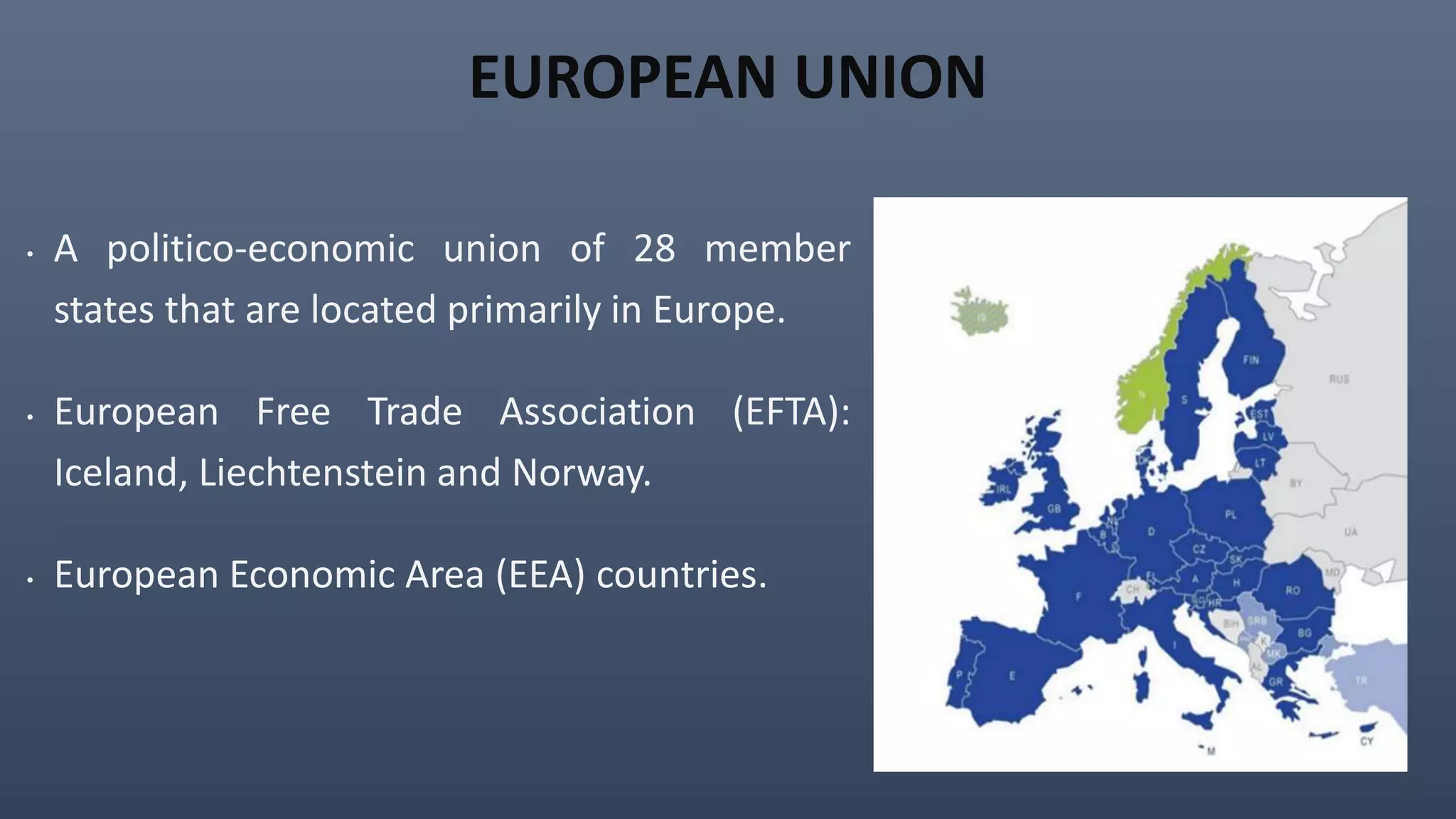
EUROPEAN UNION
• A politico-economic union of 28 member
states that are located primarily in Europe.
• European Free Trade Association (EFTA):
Iceland, Liechtenstein and Norway.
• European Economic Area (EEA) countries.
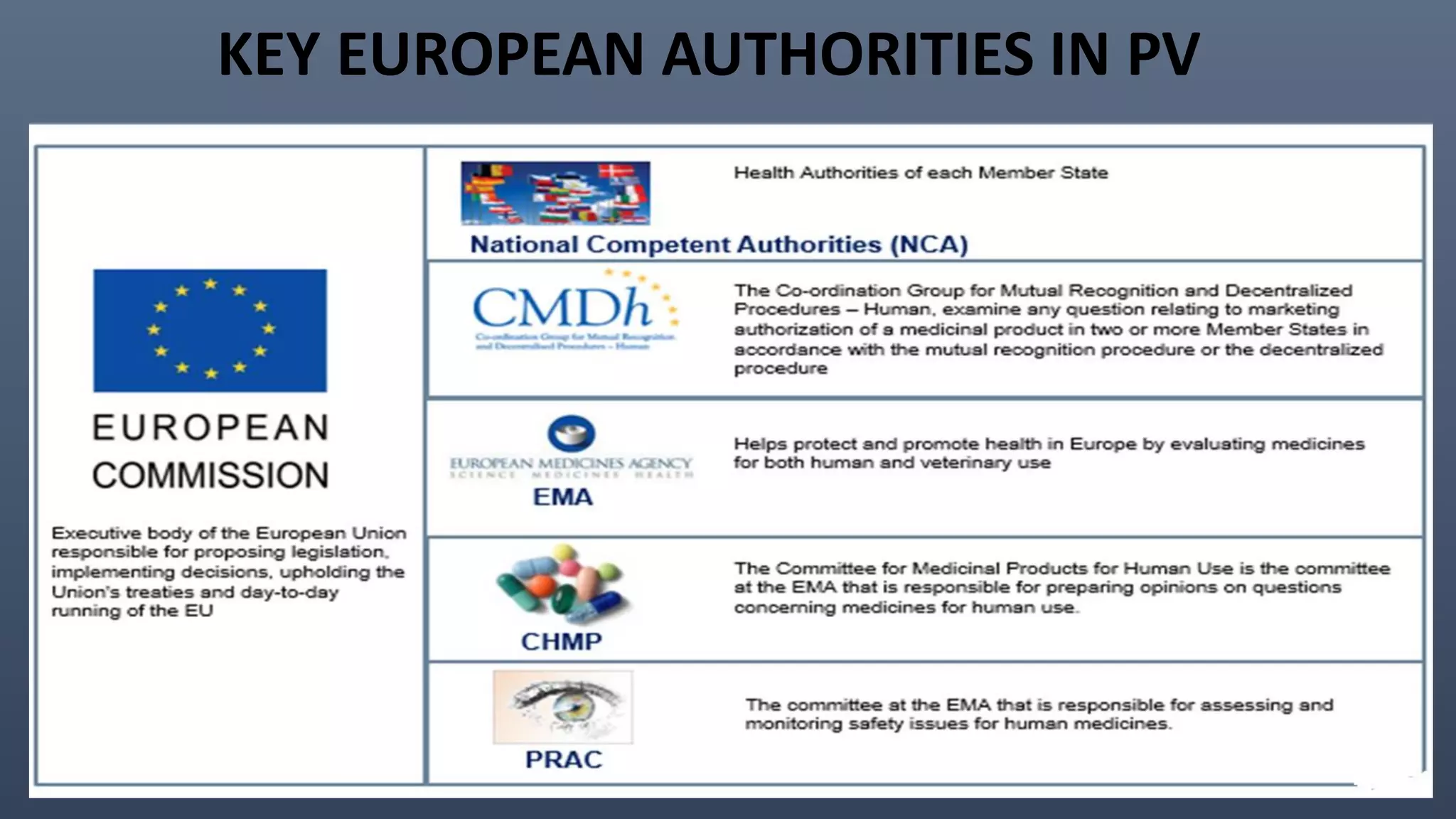
KEY EUROPEAN AUTHORITIES IN PV
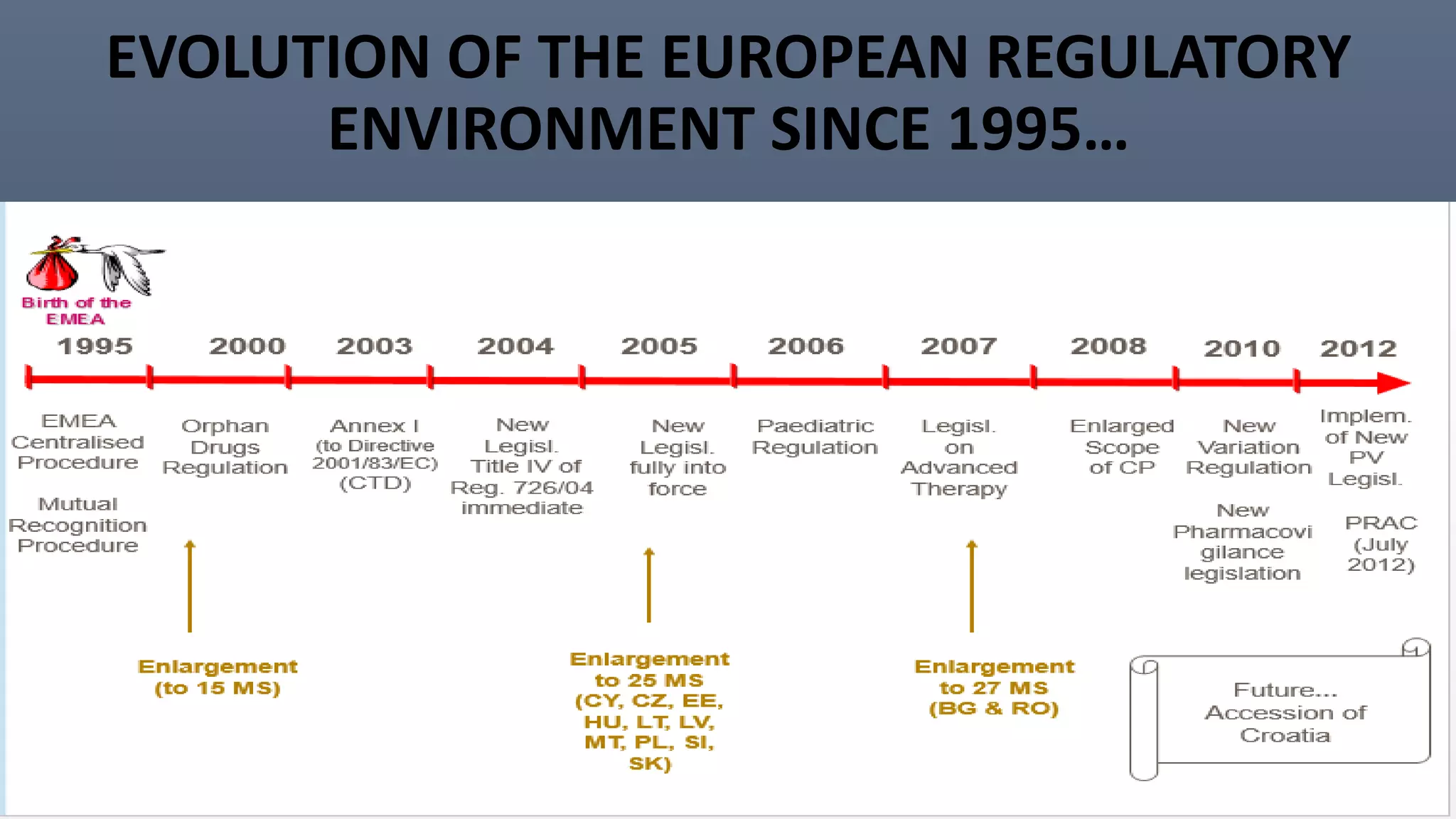
EVOLUTION OF THE EUROPEAN REGULATORY
ENVIRONMENT SINCE 1995…
EARLY CHALLENGES
• Increased demands requiring resources.
• Potential differences and conflicts in pharmacovigilance requirements across different
Health Authorities.
• A need to change to a new way of thinking about pharmacovigilance with a patient
centred approach and greater transparency.
KEY DATES
• The rules within the Regulation will apply from 2 July 2012, and the
provisions of the Directive will apply from 12 July 2012.
• Member States must transpose the provisions of the Directive into their
national laws by October 2013.
• The Commission must report to the Parliament and Council on the
shortcomings of package leaflet and summary of products by January
2013.
• The Member States have to do an audit of their pharmacovigilance
system and provide a report to the Commission by September 2013 at the
latest.
• The Commission will publish a report on the performance of
pharmacovigilance tasks by the Member States by 21 July 2015, and
thereafter every 3 years.
AIMS
• Improve the EU-PV system.
• Simplify regulatory decision making.
• Provide a legal basis for proactive Pharmacovigilance.
• Involve patients more closely in the reporting of ADRs.
• Overall Objective: “To protect public health”
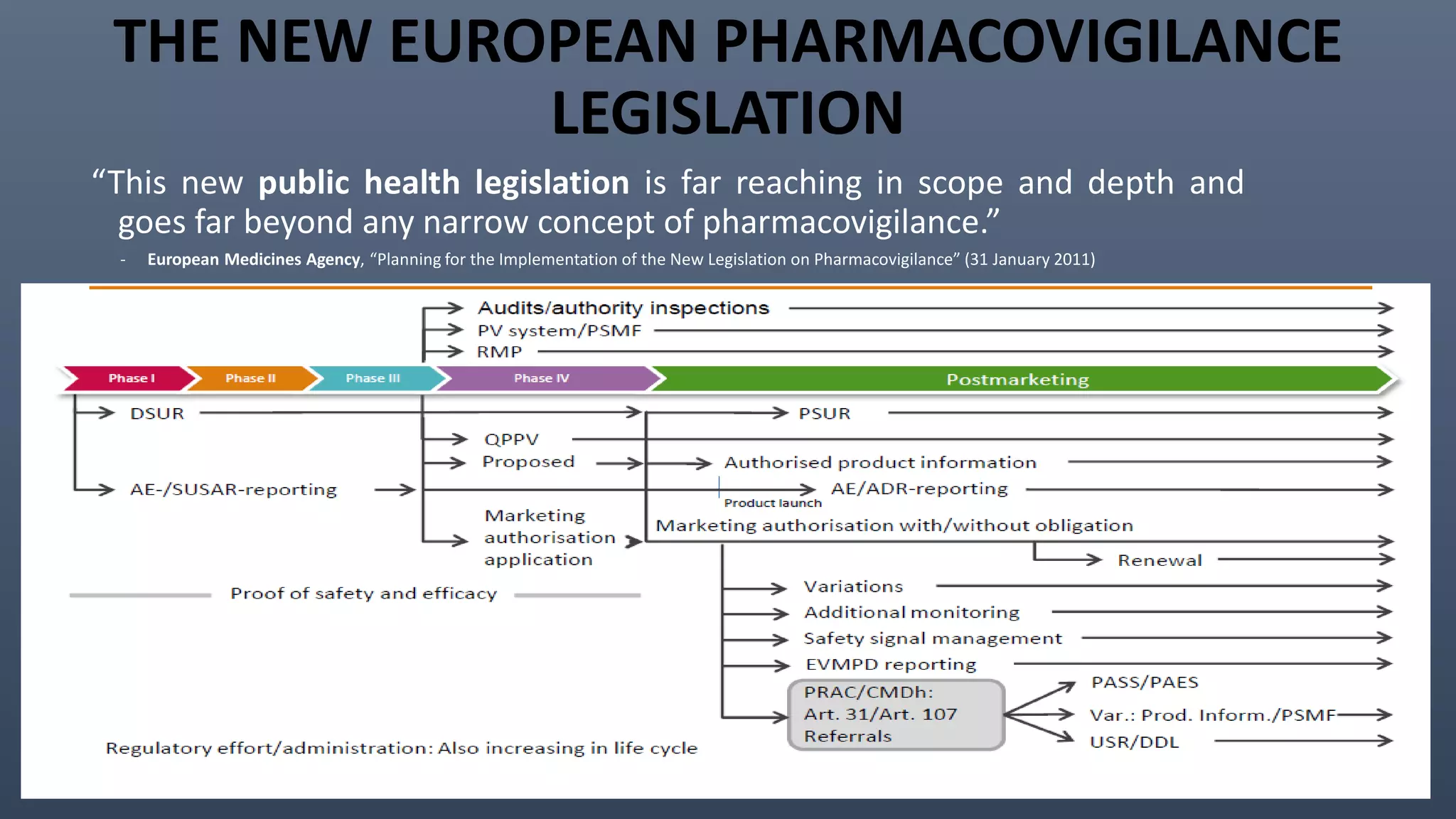
THE NEW EUROPEAN PHARMACOVIGILANCE
LEGISLATION
“This new public health legislation is far reaching in scope and depth and
goes far beyond any narrow concept of pharmacovigilance.”
- European Medicines Agency, “Planning for the Implementation of the New Legislation on Pharmacovigilance” (31 January 2011)
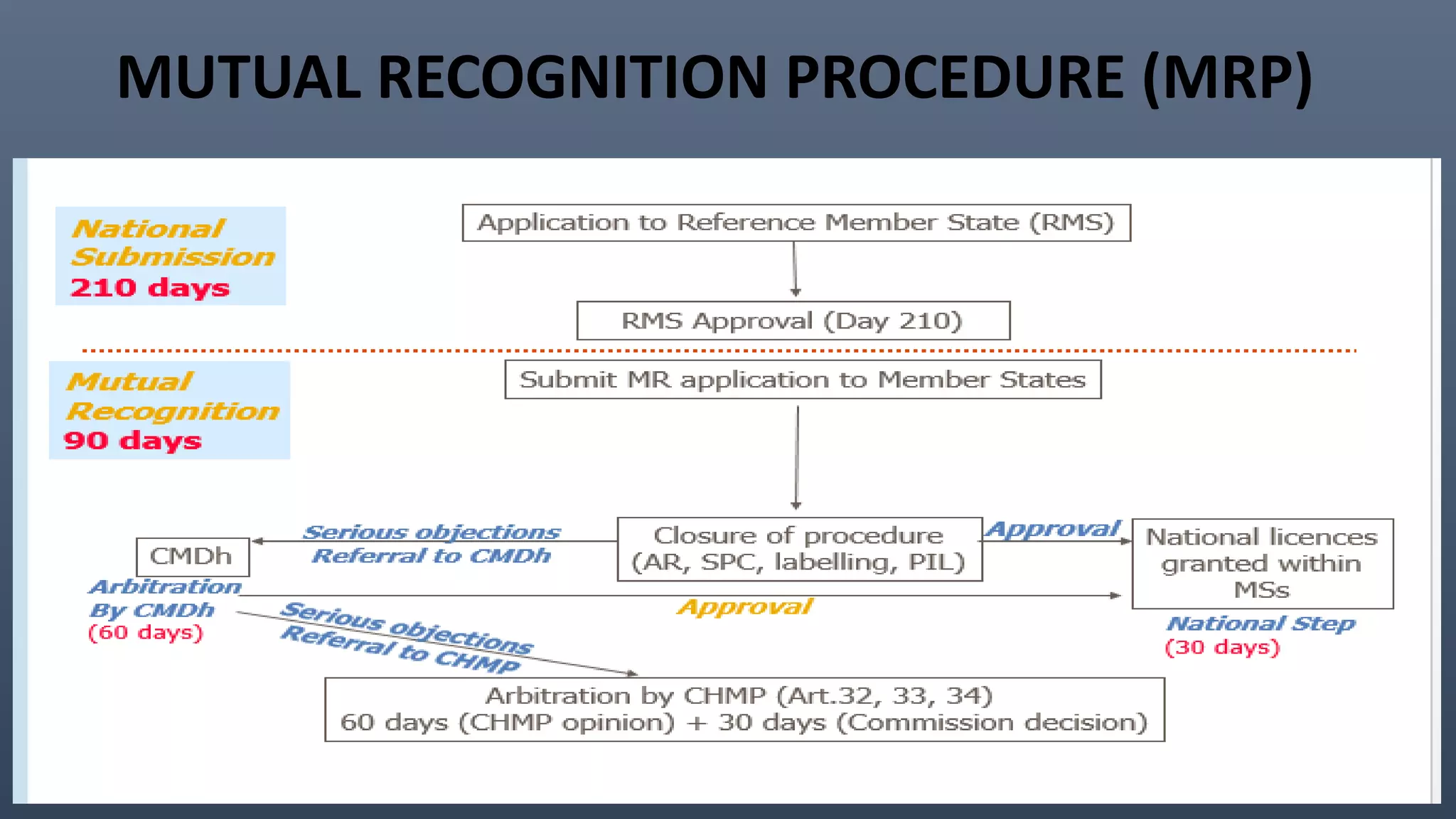
MUTUAL RECOGNITION PROCEDURE (MRP)
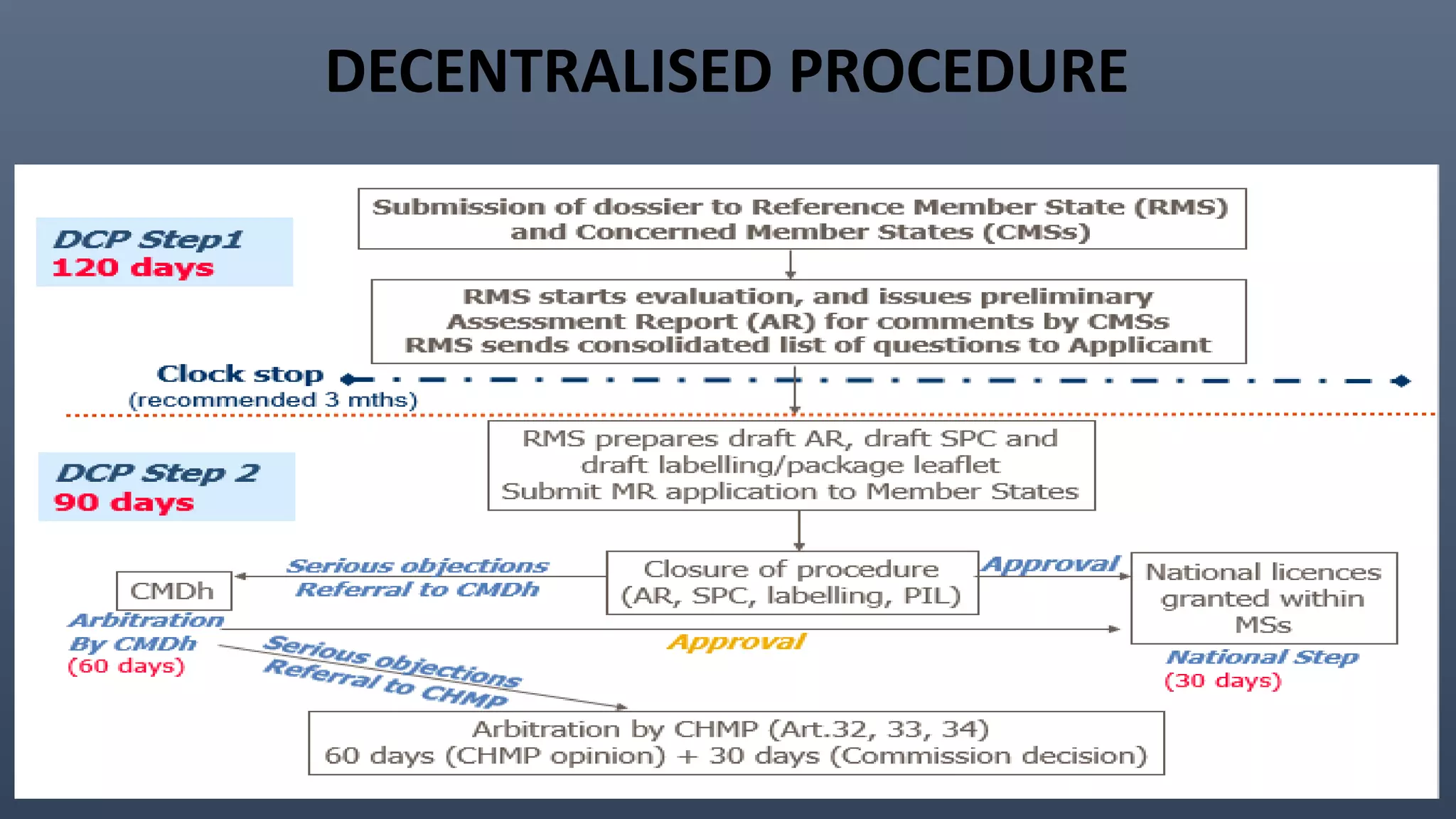
DECENTRALISED PROCEDURE
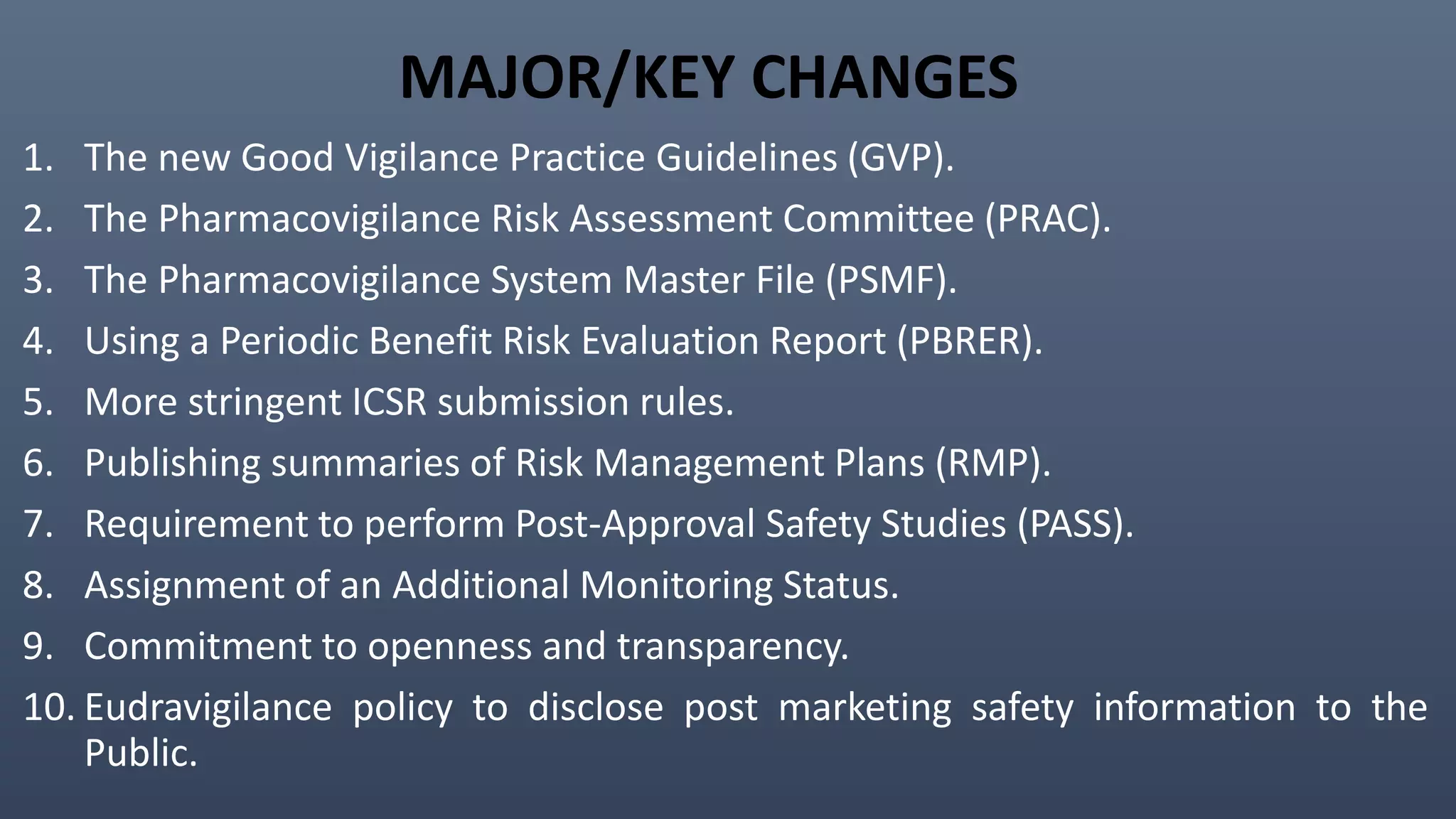
MAJOR/KEY CHANGES
1. The new Good Vigilance Practice Guidelines (GVP).
2. The Pharmacovigilance Risk Assessment Committee (PRAC).
3. The Pharmacovigilance System Master File (PSMF).
4. Using a Periodic Benefit Risk Evaluation Report (PBRER).
5. More stringent ICSR submission rules.
6. Publishing summaries of Risk Management Plans (RMP).
7. Requirement to perform Post-Approval Safety Studies (PASS).
8. Assignment of an Additional Monitoring Status.
9. Commitment to openness and transparency.
10. Eudravigilance policy to disclose post marketing safety information to the
Public.
1. Good Pharmacovigilance Guidelines(GVP):
• Replaces Eudralex Volume 9A.
• set of measures drawn up to facilitate the performance of pharmacovigilance in the EU.
• Applies to all medicinal products, irrespective of the MA granting procedure.
• Divided into 16 modules.
• Uses MedDRA terminology.
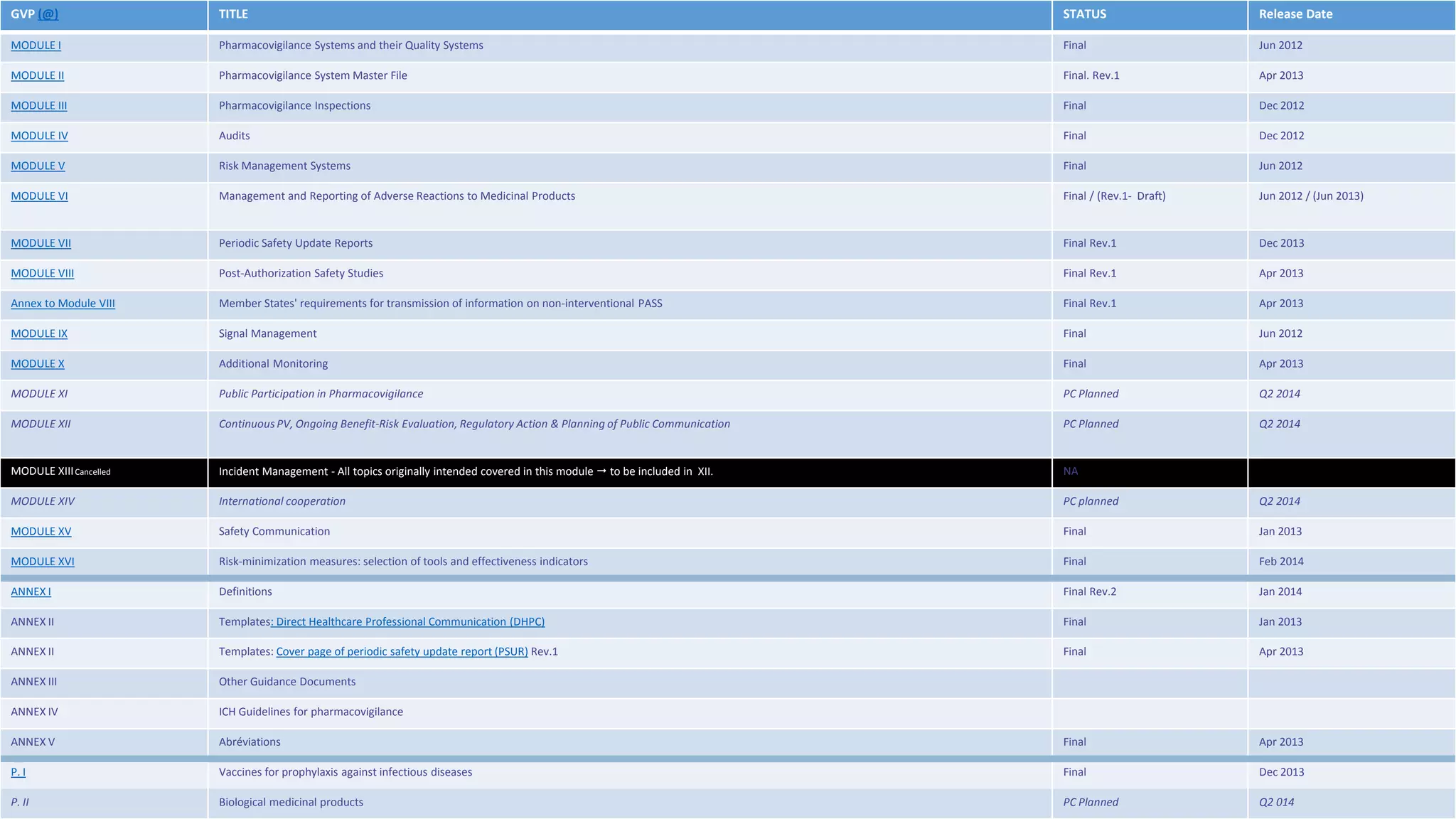
GVP (@) TITLE STATUS Release Date
MODULE I Pharmacovigilance Systems and their Quality Systems Final Jun 2012
MODULE II Pharmacovigilance System Master File Final. Rev.1 Apr 2013
MODULE III Pharmacovigilance Inspections Final Dec 2012
MODULE IV Audits Final Dec 2012
MODULE V Risk Management Systems Final Jun 2012
MODULE VI Management and Reporting of Adverse Reactions to Medicinal Products Final / (Rev.1- Draft) Jun 2012 / (Jun 2013)
MODULE VII Periodic Safety Update Reports Final Rev.1 Dec 2013
MODULE VIII Post-Authorization Safety Studies Final Rev.1 Apr 2013
Annex to Module VIII Member States' requirements for transmission of information on non-interventional PASS Final Rev.1 Apr 2013
MODULE IX Signal Management Final Jun 2012
MODULE X Additional Monitoring Final Apr 2013
MODULE XI Public Participation in Pharmacovigilance PC Planned Q2 2014
MODULE XII Continuous PV, Ongoing Benefit-Risk Evaluation, Regulatory Action & Planning of Public Communication PC Planned Q2 2014
MODULE XIIICancelled Incident Management - All topics originally intended covered in this module  to be included in XII. NA
MODULE XIV International cooperation PC planned Q2 2014
MODULE XV Safety Communication Final Jan 2013
MODULE XVI Risk-minimization measures: selection of tools and effectiveness indicators Final Feb 2014
ANNEX I Definitions Final Rev.2 Jan 2014
ANNEX II Templates: Direct Healthcare Professional Communication (DHPC) Final Jan 2013
ANNEX II Templates: Cover page of periodic safety update report (PSUR) Rev.1 Final Apr 2013
ANNEX III Other Guidance Documents
ANNEX IV ICH Guidelines for pharmacovigilance
ANNEX V Abréviations Final Apr 2013
P. I Vaccines for prophylaxis against infectious diseases Final Dec 2013
P. II Biological medicinal products PC Planned Q2 014
2. Pharmacovigilance Risk Assessment Advisory
Committee (PRAC):
• A new EMA committee-meets monthly from September 2012.
• Replaces the Pharmacovigilance Working Party.
• Advises to CHMP and CMDh.
• Members include (appointed by MS and EC) :
• Experts from the EU Member States.
• Representatives from Patient organizations.
• Representatives from Healthcare professionals.
• responsible for assessing all aspects of the risk management of the use of medicinal products
[human use] approved in EEA.
• responsible for the design and evaluation of post-authorisation safety studies and
pharmacovigilance audit.
3. Pharmacovigilance System Master File (PSMF)
• PSMF replaces DDPS.
• A legal requirement-document describing the company’s PV system.
• Presents the management organization of the Company PV system from a corporate perspective
including its affiliated entities in respect of the applicable regulatory requirements.
• Includes additional descriptions process (RMP, Safety, commitments,etc.) and figures pertaining to the
company portfolio, and results from system audits and Key Performance Indicators.
• Tool for QPPV to maintain oversight with the Pharmacovigilance System in the company.
• MA applicants and MAHs are required to maintain PSMF.
• To be provided within 7 days upon request by the EMA.
• The Pharmacovigilance System Summary comprises of:
• a signed statement.
• the location of PSMF.
• the name and contact details of the QPPV.
• the Member States in which the QPPV resides and operates.
• proof that the applicant has a QPPV.
4. Periodic Benefit Risk Evaluation Report (PBRER)
• Replaces Periodic Safety Update Report (PSUR).
• Scope changed from interval safety analysis to benefit-risk evaluation.
• Includes a Benefit versus Risk statement.
• New evaluation sections, including a section to give an overview on signals (tabulated as
new, ongoing or closed).
• Interval listings no longer required.
• Deletion of the chapter “Analysis of individual case histories”.
• Not required for generic products, well-established use products, homoeopathic products
and traditional herbal products.
• Six-monthly reports, summary bridging reports, or addendum reports will not be
accepted.
• Time interval between data-lock point and submission – expanded.
• New assessment procedure involving PRAC.
• Assessment will lead to automatic regulatory action (i.e, variation, suspension or
revocation).
• Assessment reports of PSURs will be published on a European medicines web portal.
5. Individual Case Safety Report (ICSR):
• Direct patient reporting.
• New Reporting arrangements:
• All EU and non-EU Serious ADRs to Eudravigilance (EV) only within 15 days , including
consumer reports.
• All EU non-serious reports to EV only within 90 days.
• EV database is the single point of receipt for expedited reports-until EMA can “ensure the
functionalities of EV“ (not before 2015) - Transitional arrangements.
• Requirement to submit non-serious ICSRs is extended to cases reported from Post-
authorization solicited settings such as:
• Post-Authorisation Safety Studies (PASS).
• Post-Authorisation Efficacy Studies (PAES).
• Non-Interventional Studies (NIS).
• Patient Support Program (PSP).
• Market Research Studies (MRS).
• Literature monitoring (starting 2015).
6. Risk Management Plan (RMP):
• The RMP will include
• a summary of the efficacy of the product.
• an evaluation of the effectiveness of risk minimization measures.
• PRAC will have regulatory oversight of RMPs.
• PRAC will appoint a rapporteur for an individual RMP, who will work with the (co-) rapporteur
appointed by CHMP.
• Summaries of RMPs shall be made publicly available via web portals.
• Educational materials for health professionals and patients are required in RMP for a new
product.
• UK version must be submitted to the MHRA prior to issue.
• MA application (after 21 July 2012) are required to submit a RMP.
• Includes generic MA applications also.
• Should be submitted in template for the EU-RMP.
• For MAs granted before 21 July 2012 without an existing RMP - no obligation to submit a
RMP (unless concerns arise).
7. Post-Authorization Safety Study (PASS):
• Performing a PASS/PAES(Post-Authorisation Efficacy Studies) may be required at first authorisation as
well as post-authorisation.
• The Competent Authority may impose an obligation on the MAH to conduct such a study.
• If the same safety concern applies to more than one product a joined PASS may be advised.
• New information detected during such studies shall be communicated to the competent authority.
• Proposed format and content of study protocols/reports. (outlined in GVP module VIII).
• If a PASS is condition of MA, must be described in RMP and results included in next PSUR.
8. Additional monitoring list:
• The Additional Monitoring Status can be assigned at any time of
the product life cycle.
• Subjected to more intense scrutiny (same as UK’s ‘Black Triangle’
list).
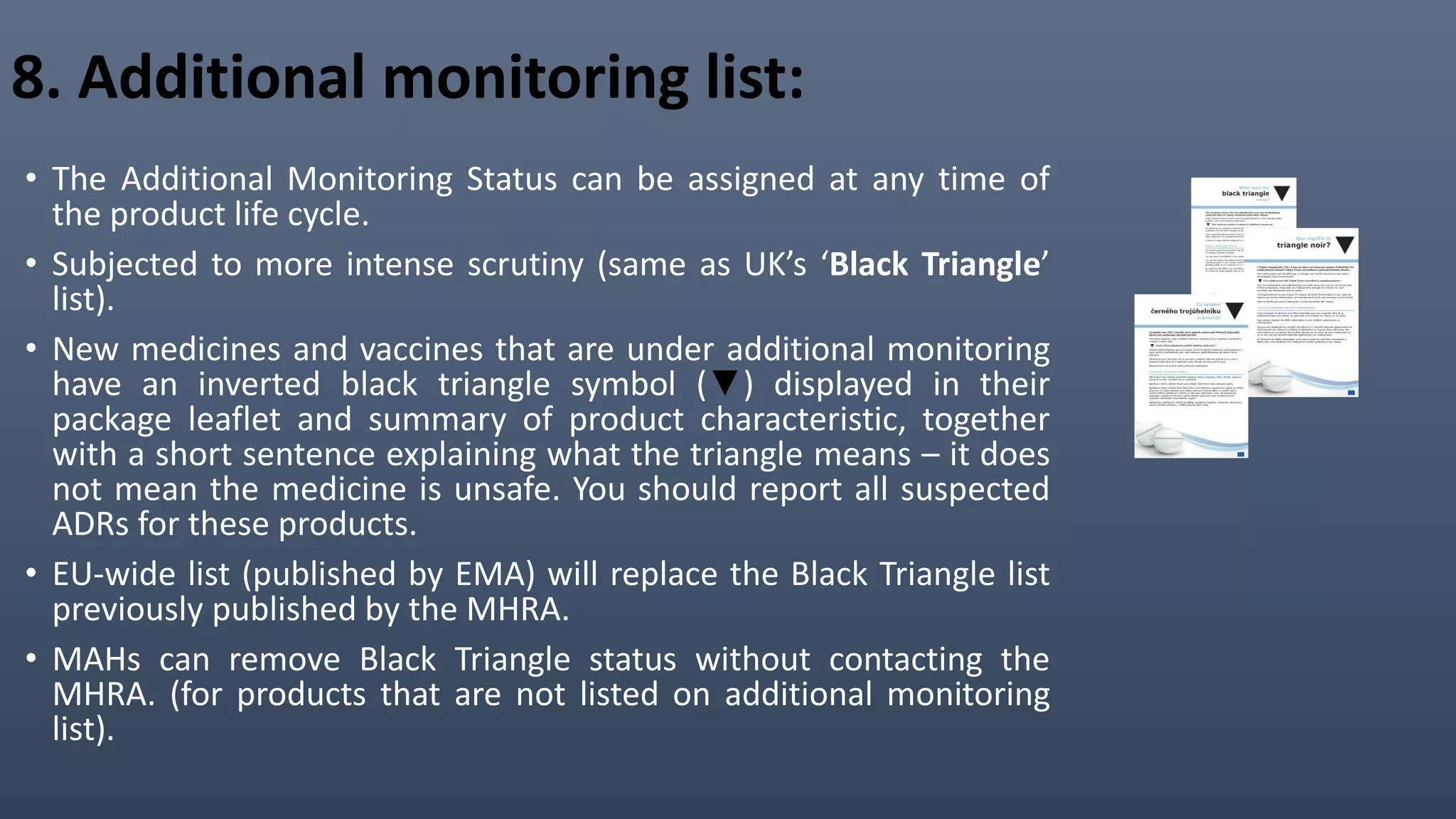
• New medicines and vaccines that are under additional monitoring
have an inverted black triangle symbol (▼) displayed in their
package leaflet and summary of product characteristic, together
with a short sentence explaining what the triangle means – it does
not mean the medicine is unsafe. You should report all suspected
ADRs for these products.
• EU-wide list (published by EMA) will replace the Black Triangle list
previously published by the MHRA.
• MAHs can remove Black Triangle status without contacting the
MHRA. (for products that are not listed on additional monitoring
list).
9. Openness and transparency:
• Provides the public with information about
• The safety of marketed medicines.
• How to report suspected ADRs.
• If MAHs want to make a public announcement, they shall inform the NCA, the EMA and
the EC.
• Two important changes:
• EU public hearings.
• Creation of medicines web portals-Extended EudraVigilance Medicinal Product
Dictionary(xEVMPD).
• Setup of interconnected web-portals:
• European medicines web-portal (www.ema.europa.eu) maintained by the EMA.
• Will be linked to national web-portals.
• Alternative reporting media remains available.
10. EudraVigilance Access Policy:
• ICSRs are expected to be submitted by MAHs directly to EudraVigilance rather
than via National Health Authorities.
• Formerly, only Member State HA, the EMA and the European Commission had
access to EudraVigilance.
• The EudraVigilance access policy is changed to allow HCPs, patients and
consumers, as well as MAH and research organisations accessing the
information.
ADR REPORTING/SIGNAL MANAGEMENT
• Centralized reporting-by industry to the Eudravigilance database at EMA.
• Inclusion of reports from patients as valid, reportable ADRs.
• Only medication errors that result in a serious ADR should be submitted.
• Non-serious cases should not be reported to EudraVigilance during the transitional
period.
• Sending non-EU serious consumer reports by the company is not mandatory.
• MAHs will also be required to monitor the Eudravigilance database according to their
level of access.
• Signals should follow a process of validation, prioritization and assessment.
AUDIT/INSPECTION
• PSMF should be made available to the NCA upon request.
• Changes to PSMF will not be automatically notifiable to the Competent Authorities.
• Transitional period for introduction of PSMF ends in July 2015.
• Quality Systems:
• MAHs, NCAs and the EMA will be required to have a quality system in place.
• Particularly for resource management, staff training, procedural documentation, quality
control, monitoring, and improvement.
• Inspections:
• Harmonization of inspection activities in the EU.
• Legal basis for the conduct of pre-authorisation inspections.
• Adequate pharmacovigilance system as a condition of MA.
• MA applicants should be aware that the PSMF may be requested.
• For centrally authorised products, the Supervisory Authority will be determined by the PSMF
location.
• MHRA will continue to operate a risk-based inspection programme.
MAIN PILLARS OF NEW LEGISLATION
• Proactive and proportionate risk management.
• Higher quality of safety data.
• Stronger link between safety assessments and regulatory action.
• Strengthened transparency, communication and patient involvement.
• Clear tasks and responsibilities for all parties (marketing authorisation holders, competent authorities,
EMA).
• Improved EU decision-making procedures (harmonised decisions and efficient use of resources).
• Establishment of a new scientific committee at the European Medicines Agency:
The Pharmacovigilance Risk Assessment Committee.
CONCLUSION
• New legislation:
• Provides strong legal basis for use of MedDRA through all steps of the
pharmacovigilance process
• Major change project that will take a few years to fully implement.
• Provides an opportunity to greatly improve the European system for the
benefit of public health.
REFERENCES
• http://ec.europa.eu.
• http://www.emea.europa.eu.
• Update on the New Pharmacovigilance Legislation by Product Life Group,
Consulting and operational assistance for Life Sciences.
• Experiences with Adverse Drug Reaction Reporting by Patients-An 11 Country
Survey by Florence van Hunsel,Linda Ha¨rmark,Shanthi Pal, Sten Olsson and Kees
van Grootheest; Drug Saf 2012; 35 (1).
• Appendix 4: The new pharmacovigilance legislation in the EU, Pharmacovigilance
Medical Writing: A Good Practice Guide, First Edition,Justina Orleans-Lindsay.
THANK YOU

Changes in European PV post July 2011

  • 2.
    PHARMACOVIGILANCE • The processand science of monitoring the safety of medicines and taking action to reduce the risks and increase the benefits of medicines. • All medicinal products in the EU are subject to a strict testing and assessment of their quality, efficacy and safety before being authorised. Once placed on the market they continue to be monitored so to assure that any aspect which could impact the safety profile of a medicine is detected and assessed and that necessary measures are taken. This monitoring is called pharmacovigilance. • Pharmacovigilance activities include: • Collecting and managing data on the safety of medicines. • Looking at the data to detect 'signals' (any new or changing safety issue). • Evaluating the data and making decisions with regard to safety issues. • Pro-active risk management to minimise any potential risk associated with the use of the medicine. • Acting to protect public health (including regulatory action). • Communicating with and informing stakeholders and the public. • Audit, both of the outcomes of action taken and of the key processes involved.
  • 3.
    EUROPEAN UNION • Apolitico-economic union of 28 member states that are located primarily in Europe. • European Free Trade Association (EFTA): Iceland, Liechtenstein and Norway. • European Economic Area (EEA) countries.
  • 4.
  • 5.
    EVOLUTION OF THEEUROPEAN REGULATORY ENVIRONMENT SINCE 1995…
  • 6.
    EARLY CHALLENGES • Increaseddemands requiring resources. • Potential differences and conflicts in pharmacovigilance requirements across different Health Authorities. • A need to change to a new way of thinking about pharmacovigilance with a patient centred approach and greater transparency.
  • 7.
    KEY DATES • Therules within the Regulation will apply from 2 July 2012, and the provisions of the Directive will apply from 12 July 2012. • Member States must transpose the provisions of the Directive into their national laws by October 2013. • The Commission must report to the Parliament and Council on the shortcomings of package leaflet and summary of products by January 2013. • The Member States have to do an audit of their pharmacovigilance system and provide a report to the Commission by September 2013 at the latest. • The Commission will publish a report on the performance of pharmacovigilance tasks by the Member States by 21 July 2015, and thereafter every 3 years.
  • 8.
    AIMS • Improve theEU-PV system. • Simplify regulatory decision making. • Provide a legal basis for proactive Pharmacovigilance. • Involve patients more closely in the reporting of ADRs. • Overall Objective: “To protect public health”
  • 9.
    THE NEW EUROPEANPHARMACOVIGILANCE LEGISLATION “This new public health legislation is far reaching in scope and depth and goes far beyond any narrow concept of pharmacovigilance.” - European Medicines Agency, “Planning for the Implementation of the New Legislation on Pharmacovigilance” (31 January 2011)
  • 10.
  • 11.
  • 12.
    MAJOR/KEY CHANGES 1. Thenew Good Vigilance Practice Guidelines (GVP). 2. The Pharmacovigilance Risk Assessment Committee (PRAC). 3. The Pharmacovigilance System Master File (PSMF). 4. Using a Periodic Benefit Risk Evaluation Report (PBRER). 5. More stringent ICSR submission rules. 6. Publishing summaries of Risk Management Plans (RMP). 7. Requirement to perform Post-Approval Safety Studies (PASS). 8. Assignment of an Additional Monitoring Status. 9. Commitment to openness and transparency. 10. Eudravigilance policy to disclose post marketing safety information to the Public.
  • 13.
    1. Good PharmacovigilanceGuidelines(GVP): • Replaces Eudralex Volume 9A. • set of measures drawn up to facilitate the performance of pharmacovigilance in the EU. • Applies to all medicinal products, irrespective of the MA granting procedure. • Divided into 16 modules. • Uses MedDRA terminology.
  • 14.
    GVP (@) TITLESTATUS Release Date MODULE I Pharmacovigilance Systems and their Quality Systems Final Jun 2012 MODULE II Pharmacovigilance System Master File Final. Rev.1 Apr 2013 MODULE III Pharmacovigilance Inspections Final Dec 2012 MODULE IV Audits Final Dec 2012 MODULE V Risk Management Systems Final Jun 2012 MODULE VI Management and Reporting of Adverse Reactions to Medicinal Products Final / (Rev.1- Draft) Jun 2012 / (Jun 2013) MODULE VII Periodic Safety Update Reports Final Rev.1 Dec 2013 MODULE VIII Post-Authorization Safety Studies Final Rev.1 Apr 2013 Annex to Module VIII Member States' requirements for transmission of information on non-interventional PASS Final Rev.1 Apr 2013 MODULE IX Signal Management Final Jun 2012 MODULE X Additional Monitoring Final Apr 2013 MODULE XI Public Participation in Pharmacovigilance PC Planned Q2 2014 MODULE XII Continuous PV, Ongoing Benefit-Risk Evaluation, Regulatory Action & Planning of Public Communication PC Planned Q2 2014 MODULE XIIICancelled Incident Management - All topics originally intended covered in this module  to be included in XII. NA MODULE XIV International cooperation PC planned Q2 2014 MODULE XV Safety Communication Final Jan 2013 MODULE XVI Risk-minimization measures: selection of tools and effectiveness indicators Final Feb 2014 ANNEX I Definitions Final Rev.2 Jan 2014 ANNEX II Templates: Direct Healthcare Professional Communication (DHPC) Final Jan 2013 ANNEX II Templates: Cover page of periodic safety update report (PSUR) Rev.1 Final Apr 2013 ANNEX III Other Guidance Documents ANNEX IV ICH Guidelines for pharmacovigilance ANNEX V Abréviations Final Apr 2013 P. I Vaccines for prophylaxis against infectious diseases Final Dec 2013 P. II Biological medicinal products PC Planned Q2 014
  • 15.
    2. Pharmacovigilance RiskAssessment Advisory Committee (PRAC): • A new EMA committee-meets monthly from September 2012. • Replaces the Pharmacovigilance Working Party. • Advises to CHMP and CMDh. • Members include (appointed by MS and EC) : • Experts from the EU Member States. • Representatives from Patient organizations. • Representatives from Healthcare professionals. • responsible for assessing all aspects of the risk management of the use of medicinal products [human use] approved in EEA. • responsible for the design and evaluation of post-authorisation safety studies and pharmacovigilance audit.
  • 17.
    3. Pharmacovigilance SystemMaster File (PSMF) • PSMF replaces DDPS. • A legal requirement-document describing the company’s PV system. • Presents the management organization of the Company PV system from a corporate perspective including its affiliated entities in respect of the applicable regulatory requirements. • Includes additional descriptions process (RMP, Safety, commitments,etc.) and figures pertaining to the company portfolio, and results from system audits and Key Performance Indicators. • Tool for QPPV to maintain oversight with the Pharmacovigilance System in the company. • MA applicants and MAHs are required to maintain PSMF. • To be provided within 7 days upon request by the EMA. • The Pharmacovigilance System Summary comprises of: • a signed statement. • the location of PSMF. • the name and contact details of the QPPV. • the Member States in which the QPPV resides and operates. • proof that the applicant has a QPPV.
  • 18.
    4. Periodic BenefitRisk Evaluation Report (PBRER) • Replaces Periodic Safety Update Report (PSUR). • Scope changed from interval safety analysis to benefit-risk evaluation. • Includes a Benefit versus Risk statement. • New evaluation sections, including a section to give an overview on signals (tabulated as new, ongoing or closed). • Interval listings no longer required. • Deletion of the chapter “Analysis of individual case histories”. • Not required for generic products, well-established use products, homoeopathic products and traditional herbal products. • Six-monthly reports, summary bridging reports, or addendum reports will not be accepted. • Time interval between data-lock point and submission – expanded. • New assessment procedure involving PRAC. • Assessment will lead to automatic regulatory action (i.e, variation, suspension or revocation). • Assessment reports of PSURs will be published on a European medicines web portal.
  • 19.
    5. Individual CaseSafety Report (ICSR): • Direct patient reporting. • New Reporting arrangements: • All EU and non-EU Serious ADRs to Eudravigilance (EV) only within 15 days , including consumer reports. • All EU non-serious reports to EV only within 90 days. • EV database is the single point of receipt for expedited reports-until EMA can “ensure the functionalities of EV“ (not before 2015) - Transitional arrangements. • Requirement to submit non-serious ICSRs is extended to cases reported from Post- authorization solicited settings such as: • Post-Authorisation Safety Studies (PASS). • Post-Authorisation Efficacy Studies (PAES). • Non-Interventional Studies (NIS). • Patient Support Program (PSP). • Market Research Studies (MRS). • Literature monitoring (starting 2015).
  • 21.
    6. Risk ManagementPlan (RMP): • The RMP will include • a summary of the efficacy of the product. • an evaluation of the effectiveness of risk minimization measures. • PRAC will have regulatory oversight of RMPs. • PRAC will appoint a rapporteur for an individual RMP, who will work with the (co-) rapporteur appointed by CHMP. • Summaries of RMPs shall be made publicly available via web portals. • Educational materials for health professionals and patients are required in RMP for a new product. • UK version must be submitted to the MHRA prior to issue. • MA application (after 21 July 2012) are required to submit a RMP. • Includes generic MA applications also. • Should be submitted in template for the EU-RMP. • For MAs granted before 21 July 2012 without an existing RMP - no obligation to submit a RMP (unless concerns arise).
  • 22.
    7. Post-Authorization SafetyStudy (PASS): • Performing a PASS/PAES(Post-Authorisation Efficacy Studies) may be required at first authorisation as well as post-authorisation. • The Competent Authority may impose an obligation on the MAH to conduct such a study. • If the same safety concern applies to more than one product a joined PASS may be advised. • New information detected during such studies shall be communicated to the competent authority. • Proposed format and content of study protocols/reports. (outlined in GVP module VIII). • If a PASS is condition of MA, must be described in RMP and results included in next PSUR.
  • 23.
    8. Additional monitoringlist: • The Additional Monitoring Status can be assigned at any time of the product life cycle. • Subjected to more intense scrutiny (same as UK’s ‘Black Triangle’ list). • New medicines and vaccines that are under additional monitoring have an inverted black triangle symbol (▼) displayed in their package leaflet and summary of product characteristic, together with a short sentence explaining what the triangle means – it does not mean the medicine is unsafe. You should report all suspected ADRs for these products. • EU-wide list (published by EMA) will replace the Black Triangle list previously published by the MHRA. • MAHs can remove Black Triangle status without contacting the MHRA. (for products that are not listed on additional monitoring list).
  • 24.
    9. Openness andtransparency: • Provides the public with information about • The safety of marketed medicines. • How to report suspected ADRs. • If MAHs want to make a public announcement, they shall inform the NCA, the EMA and the EC. • Two important changes: • EU public hearings. • Creation of medicines web portals-Extended EudraVigilance Medicinal Product Dictionary(xEVMPD). • Setup of interconnected web-portals: • European medicines web-portal (www.ema.europa.eu) maintained by the EMA. • Will be linked to national web-portals. • Alternative reporting media remains available.
  • 25.
    10. EudraVigilance AccessPolicy: • ICSRs are expected to be submitted by MAHs directly to EudraVigilance rather than via National Health Authorities. • Formerly, only Member State HA, the EMA and the European Commission had access to EudraVigilance. • The EudraVigilance access policy is changed to allow HCPs, patients and consumers, as well as MAH and research organisations accessing the information.
  • 26.
    ADR REPORTING/SIGNAL MANAGEMENT •Centralized reporting-by industry to the Eudravigilance database at EMA. • Inclusion of reports from patients as valid, reportable ADRs. • Only medication errors that result in a serious ADR should be submitted. • Non-serious cases should not be reported to EudraVigilance during the transitional period. • Sending non-EU serious consumer reports by the company is not mandatory. • MAHs will also be required to monitor the Eudravigilance database according to their level of access. • Signals should follow a process of validation, prioritization and assessment.
  • 27.
    AUDIT/INSPECTION • PSMF shouldbe made available to the NCA upon request. • Changes to PSMF will not be automatically notifiable to the Competent Authorities. • Transitional period for introduction of PSMF ends in July 2015. • Quality Systems: • MAHs, NCAs and the EMA will be required to have a quality system in place. • Particularly for resource management, staff training, procedural documentation, quality control, monitoring, and improvement. • Inspections: • Harmonization of inspection activities in the EU. • Legal basis for the conduct of pre-authorisation inspections. • Adequate pharmacovigilance system as a condition of MA. • MA applicants should be aware that the PSMF may be requested. • For centrally authorised products, the Supervisory Authority will be determined by the PSMF location. • MHRA will continue to operate a risk-based inspection programme.
  • 28.
    MAIN PILLARS OFNEW LEGISLATION • Proactive and proportionate risk management. • Higher quality of safety data. • Stronger link between safety assessments and regulatory action. • Strengthened transparency, communication and patient involvement. • Clear tasks and responsibilities for all parties (marketing authorisation holders, competent authorities, EMA). • Improved EU decision-making procedures (harmonised decisions and efficient use of resources). • Establishment of a new scientific committee at the European Medicines Agency: The Pharmacovigilance Risk Assessment Committee.
  • 29.
    CONCLUSION • New legislation: •Provides strong legal basis for use of MedDRA through all steps of the pharmacovigilance process • Major change project that will take a few years to fully implement. • Provides an opportunity to greatly improve the European system for the benefit of public health.
  • 30.
    REFERENCES • http://ec.europa.eu. • http://www.emea.europa.eu. •Update on the New Pharmacovigilance Legislation by Product Life Group, Consulting and operational assistance for Life Sciences. • Experiences with Adverse Drug Reaction Reporting by Patients-An 11 Country Survey by Florence van Hunsel,Linda Ha¨rmark,Shanthi Pal, Sten Olsson and Kees van Grootheest; Drug Saf 2012; 35 (1). • Appendix 4: The new pharmacovigilance legislation in the EU, Pharmacovigilance Medical Writing: A Good Practice Guide, First Edition,Justina Orleans-Lindsay.
  • 31.