Nature of AI problems with examples
Artificial Intelligence (AI) has brought on numerous disruptive changes
in today's technology-intensive world. There have been many debates
surrounding the challenges of AI, from the proliferation of AI-powered
weaponry to replacing human jobs. The incorporation of AI is one that
is characterized by highs and lows. Numerous benefits have been
drawn, while there is fear of AI creating more significant issues for the
human race. Let us explore the various problems of AI today and learn
in-depth about its complexities and limitations.
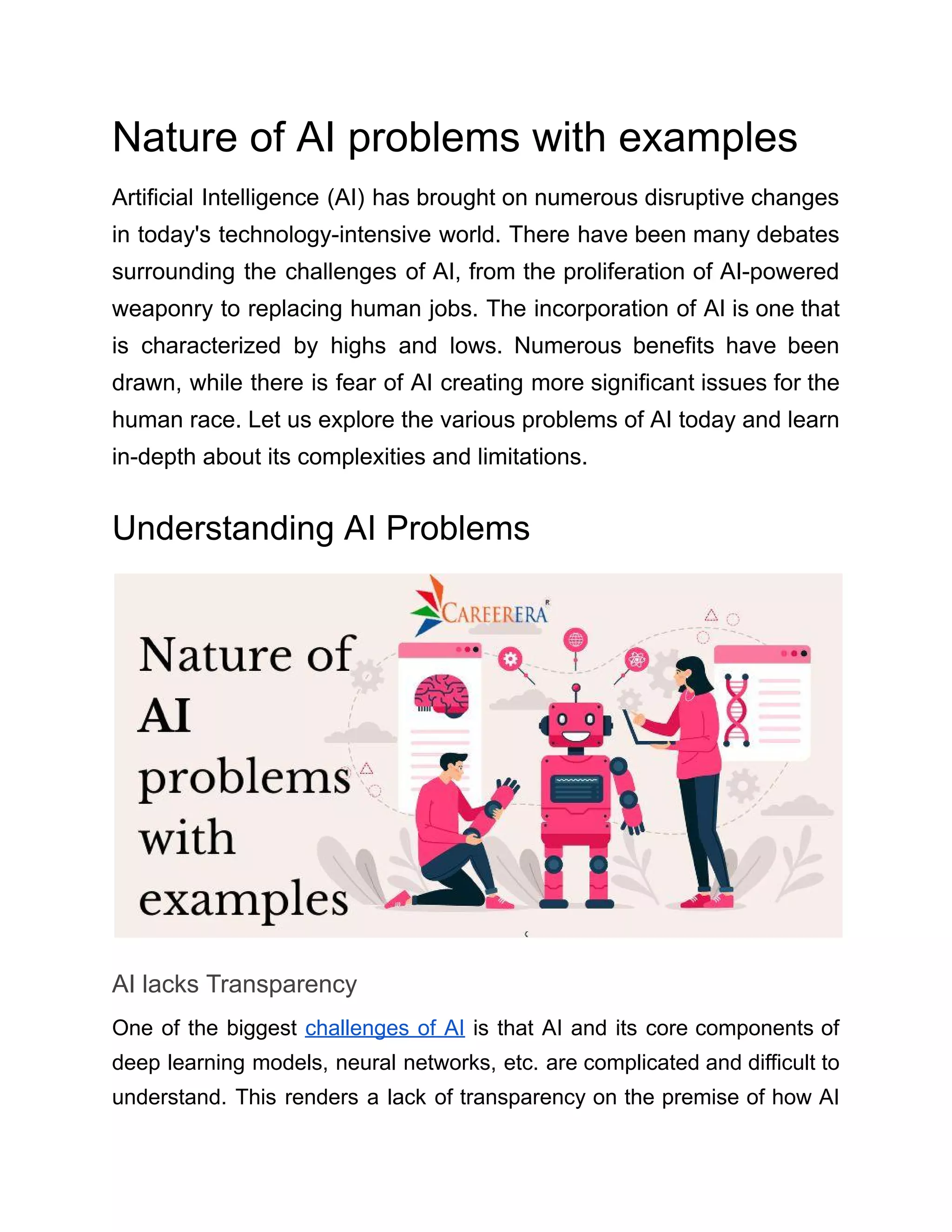
Understanding AI Problems
AI lacks Transparency
One of the biggest challenges of AI is that AI and its core components of
deep learning models, neural networks, etc. are complicated and difficult to
understand. This renders a lack of transparency on the premise of how AI
draws the conclusion, its mechanism of using algorithms or making biased
decisions, etc.
Example: One of the best examples of AI Problems is the Black box
problem.
AI Automation Leading to Job Loss
This is one of the top challenges of AI that the world is constantly debating
about. The process of task automation powered by AI can result in a
negative impact on human workers. This has become a pressing issue as
almost every industry adopts technology for automating tasks.
AI-powered technologies, machines, and robots have come about with a
high potential of being more dexterous and smarter at tasks that may
require massive human work.
Example: One of the most recent examples would be US companies laying
off about 3900 people due to AI integration in May, as reported by a
Chicago-based firm Challenger, Gray & Christmas, Inc.
Issue of Data Privacy with AI Tools
This is a long-debated concern and one of the biggest AI problems. AI tools
collect data from the user of the AI-powered technology or program. AI
systems collect personal data to train the models for a more customized
user experience for the users. This often raises the question of how and
where such data is used, and the data collected may not be secured.
Example: The finest example of this AI problem may be the case that
occurred in 2023 with ChatGPT, wherein a bug incident exposed an active
user's chat history to some other users. Hence, data, especially confidential
and sensitive data, are not secure in AI, and AI tools cannot be considered
accountable tools for securing personal information.
Responsibility Issue
With the implementation of AI technology, the issue of identifying the factor
responsible for any hardware malfunction has become relatively complex.
In AI, there is a responsibility gap in AI-powered technology and machines.
Example: In self-driving cars, when accidents occur, it becomes
complicated to identify the causal factor of the accident. Whether it is a
malfunction in the data or the machines in the car, etc. when the vehicle's
performances are modeled and designed on the basis of the data fed to the
machine.
Ethical Challenges
One of the top AI problems is the ethical issue. Developers are designing
and grooming chatbots with the potential of generating human-like
conversation, making it difficult to discern between real human customer
support and a machine.
AI works on algorithms that are fed with data for training, and AI makes
predictions based on the training it receives. These predictions are labeled
based on the data assumption. This leaves the scope for bias and
inaccuracy, which is one of the most prominent challenges of AI.
AI is expensive
One of the most pressing and challenging AI problems is its cost, as
adopting AI and deploying AI-powered machines and technologies requires
expertise and field experts. Also, AI works on a colossal amount of data
that requires great computational power.
They make the most of the high-level capabilities of required
supercomputers, which are expensive. Hence, small businesses are
unable to capture and explore the numerous advantages of AI, while
supercomputers and technologies driven by AI are confined to the big
business moguls. Cloud computing has emerged as an ideal alternative
that provides parallel processing.
However, with the increasing proliferation of data, there is the emergence
of more and more complex algorithms which may result in the insufficiency
of catering to the present-day computational power. There will come about
the requirement for more computational and storage power for handling
crunching exabytes or Zettabytes of data.
Those are the few major problems of AI, although AI is known to be
bringing revolutionary changes in the technological spectrum.
Source URL: Nature of AI problems with examples

Challenges of Artificial intelligence

  • 1.
    Nature of AIproblems with examples Artificial Intelligence (AI) has brought on numerous disruptive changes in today's technology-intensive world. There have been many debates surrounding the challenges of AI, from the proliferation of AI-powered weaponry to replacing human jobs. The incorporation of AI is one that is characterized by highs and lows. Numerous benefits have been drawn, while there is fear of AI creating more significant issues for the human race. Let us explore the various problems of AI today and learn in-depth about its complexities and limitations. Understanding AI Problems AI lacks Transparency One of the biggest challenges of AI is that AI and its core components of deep learning models, neural networks, etc. are complicated and difficult to understand. This renders a lack of transparency on the premise of how AI
  • 2.
    draws the conclusion,its mechanism of using algorithms or making biased decisions, etc. Example: One of the best examples of AI Problems is the Black box problem. AI Automation Leading to Job Loss This is one of the top challenges of AI that the world is constantly debating about. The process of task automation powered by AI can result in a negative impact on human workers. This has become a pressing issue as almost every industry adopts technology for automating tasks. AI-powered technologies, machines, and robots have come about with a high potential of being more dexterous and smarter at tasks that may require massive human work. Example: One of the most recent examples would be US companies laying off about 3900 people due to AI integration in May, as reported by a Chicago-based firm Challenger, Gray & Christmas, Inc. Issue of Data Privacy with AI Tools This is a long-debated concern and one of the biggest AI problems. AI tools collect data from the user of the AI-powered technology or program. AI systems collect personal data to train the models for a more customized user experience for the users. This often raises the question of how and where such data is used, and the data collected may not be secured. Example: The finest example of this AI problem may be the case that occurred in 2023 with ChatGPT, wherein a bug incident exposed an active
  • 3.
    user's chat historyto some other users. Hence, data, especially confidential and sensitive data, are not secure in AI, and AI tools cannot be considered accountable tools for securing personal information. Responsibility Issue With the implementation of AI technology, the issue of identifying the factor responsible for any hardware malfunction has become relatively complex. In AI, there is a responsibility gap in AI-powered technology and machines. Example: In self-driving cars, when accidents occur, it becomes complicated to identify the causal factor of the accident. Whether it is a malfunction in the data or the machines in the car, etc. when the vehicle's performances are modeled and designed on the basis of the data fed to the machine. Ethical Challenges One of the top AI problems is the ethical issue. Developers are designing and grooming chatbots with the potential of generating human-like conversation, making it difficult to discern between real human customer support and a machine. AI works on algorithms that are fed with data for training, and AI makes predictions based on the training it receives. These predictions are labeled based on the data assumption. This leaves the scope for bias and inaccuracy, which is one of the most prominent challenges of AI.
  • 4.
    AI is expensive Oneof the most pressing and challenging AI problems is its cost, as adopting AI and deploying AI-powered machines and technologies requires expertise and field experts. Also, AI works on a colossal amount of data that requires great computational power. They make the most of the high-level capabilities of required supercomputers, which are expensive. Hence, small businesses are unable to capture and explore the numerous advantages of AI, while supercomputers and technologies driven by AI are confined to the big business moguls. Cloud computing has emerged as an ideal alternative that provides parallel processing. However, with the increasing proliferation of data, there is the emergence of more and more complex algorithms which may result in the insufficiency of catering to the present-day computational power. There will come about the requirement for more computational and storage power for handling crunching exabytes or Zettabytes of data. Those are the few major problems of AI, although AI is known to be bringing revolutionary changes in the technological spectrum. Source URL: Nature of AI problems with examples