CHALLENGES IN BUILDING
AN AI ASSISSTANTS
Sarthak Dasgupta
AI Assistant : what is it
 A software agent that
– “augments human intelligence”
– Performs tasks and offer services (assists human in decision making and taking actions)
– Complements human by offering capabilities that is beyond the ordinary power and reach of
human (intelligence amplification)
 A more technical definition
– Cognitive Assistant offers computational capabilities typically based on Natural Language
Processing (NLP), Machine Learning (ML), and reasoning chains, on large amount of data,
which provides cognition powers that augment and scale human intelligence
 Getting us closer to the vision painted for human-machine partnership in 1960:
– “The hope is that, in not too many years, human brains and computing machines will be coupled
together very tightly, and that the resulting partnership will think as no human brain has ever
thought and process data in a way not approached by the information handling machines we
know today”
Types of AI Assistants
• Cognitive AI Assistant-
• Cognitive Computing in simple word is a technique
of solving problem with human like thinking.
• Cognitive Computing is trying to simulate human
thought process
• This process uses many of the same fundamentals
as AI, such as machine learning, neural networks,
natural language processing, contextual awareness
and sentiment analysis, to follow the problem-
solving processes that humans do day in and day
out
Types of AI Assistant
• Personal AI Assistant –
• Also called Automated Personal Assistant or Virtual Assistant is
a software agent that can perform tasks or services for an
individual.
• Mainly used in commercial market for providing a variety of
services to its Customers
• It is used to perform various task on behalf of its user by the help
of User inputs and Personal Awareness.
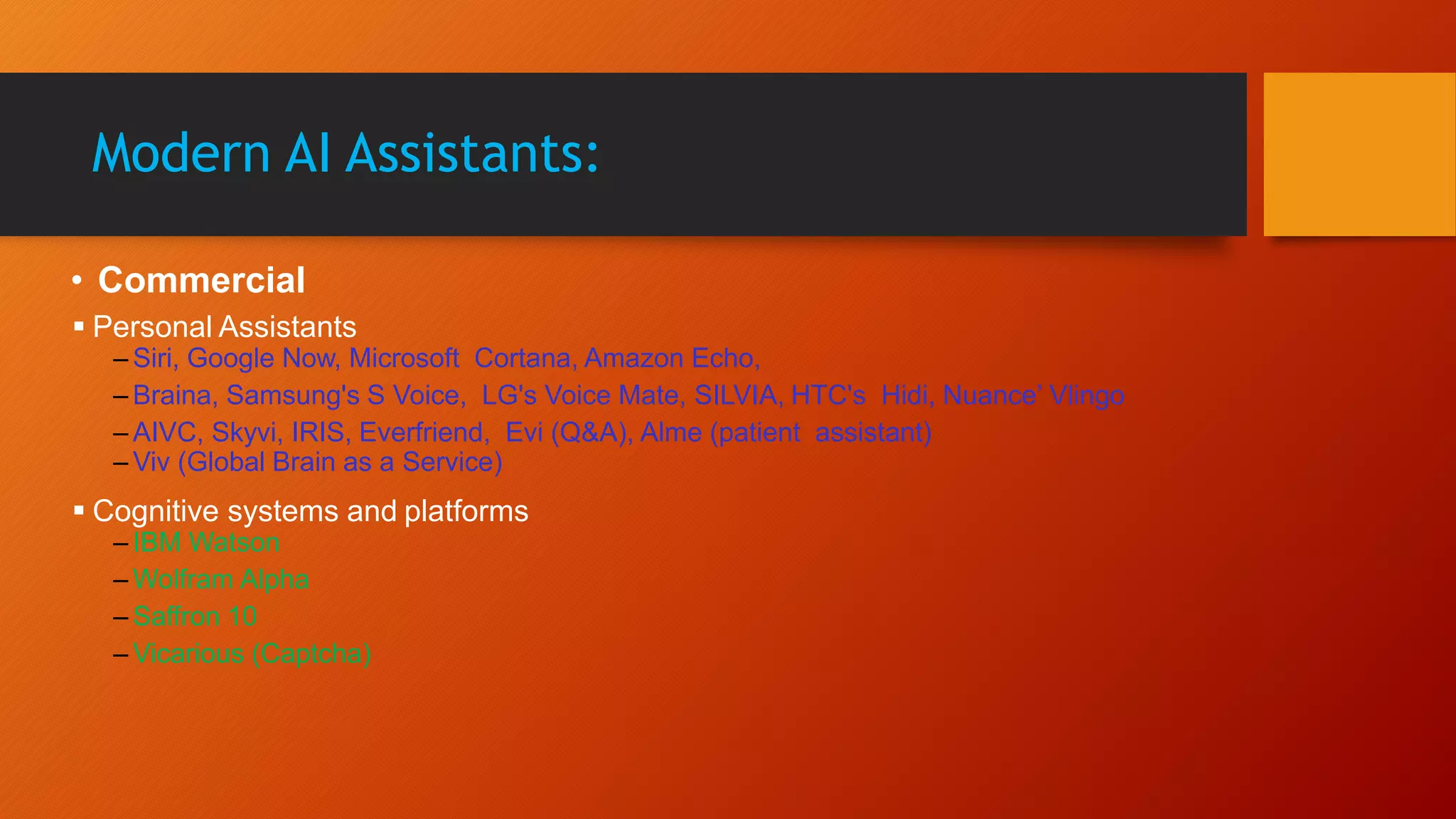
Modern AI Assistants:
• Commercial
 Personal Assistants
– Siri, Google Now, Microsoft Cortana, Amazon Echo,
– Braina, Samsung's S Voice, LG's Voice Mate, SILVIA, HTC's Hidi, Nuance’ Vlingo
– AIVC, Skyvi, IRIS, Everfriend, Evi (Q&A), Alme (patient assistant)
– Viv (Global Brain as a Service)
 Cognitive systems and platforms
– IBM Watson
– Wolfram Alpha
– Saffron 10
– Vicarious (Captcha)
Vision of an AI Assistant :
• Create new insights and new valueDiscovery
• Provide bias-free advice semi- autonomously,
learns, and is proactive
Decision
• Build and reason about models of the world, of
the user, and of the system itself
Understanding
• Leverage encyclopedic domain knowledge in
context, and interacts in natural language
Question
Answering
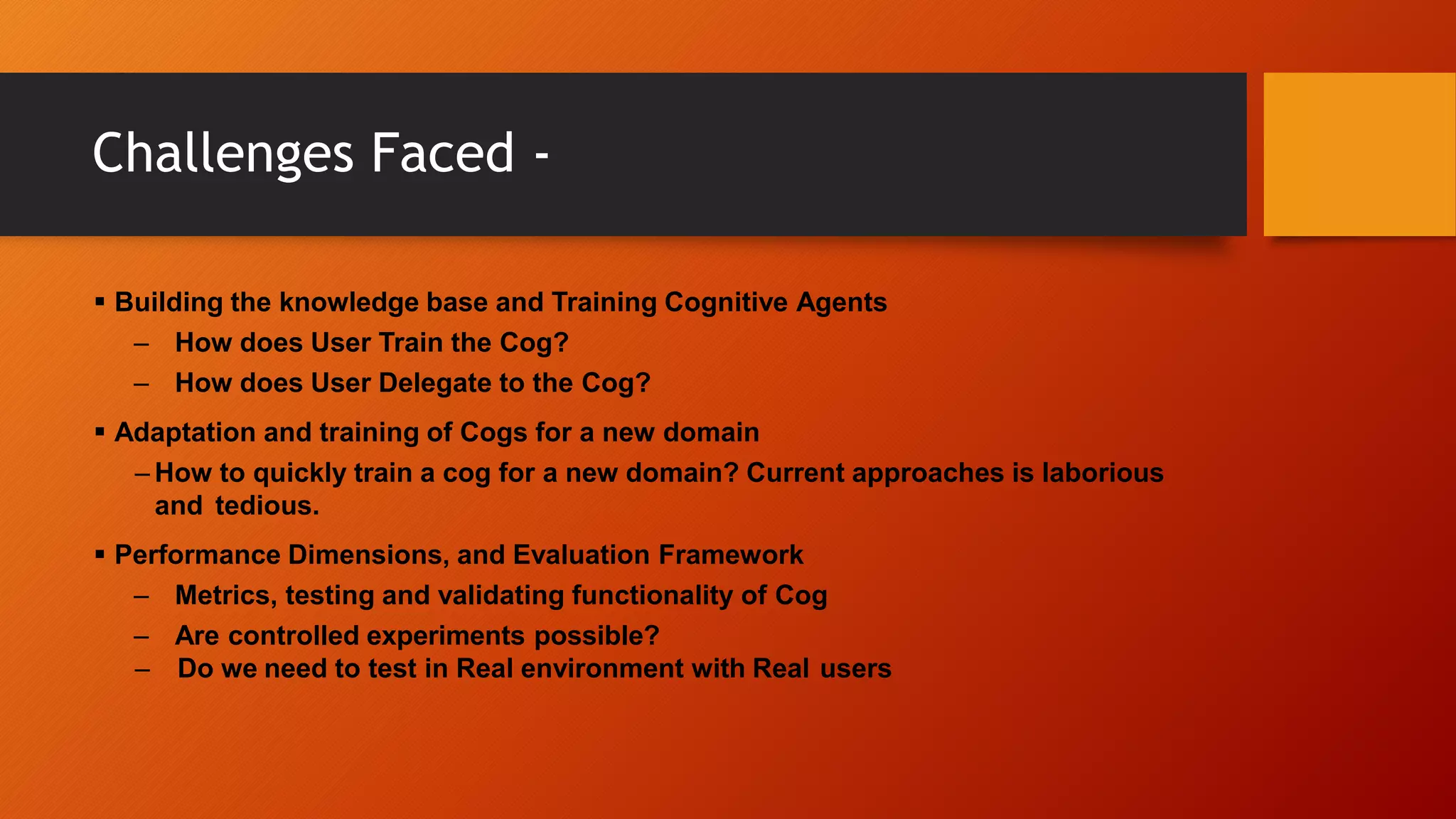
Challenges Faced -
 Building the knowledge base and Training Cognitive Agents
– How does User Train the Cog?
– How does User Delegate to the Cog?
 Adaptation and training of Cogs for a new domain
– How to quickly train a cog for a new domain? Current approaches is laborious
and tedious.
 Performance Dimensions, and Evaluation Framework
– Metrics, testing and validating functionality of Cog
– Are controlled experiments possible?
– Do we need to test in Real environment with Real users
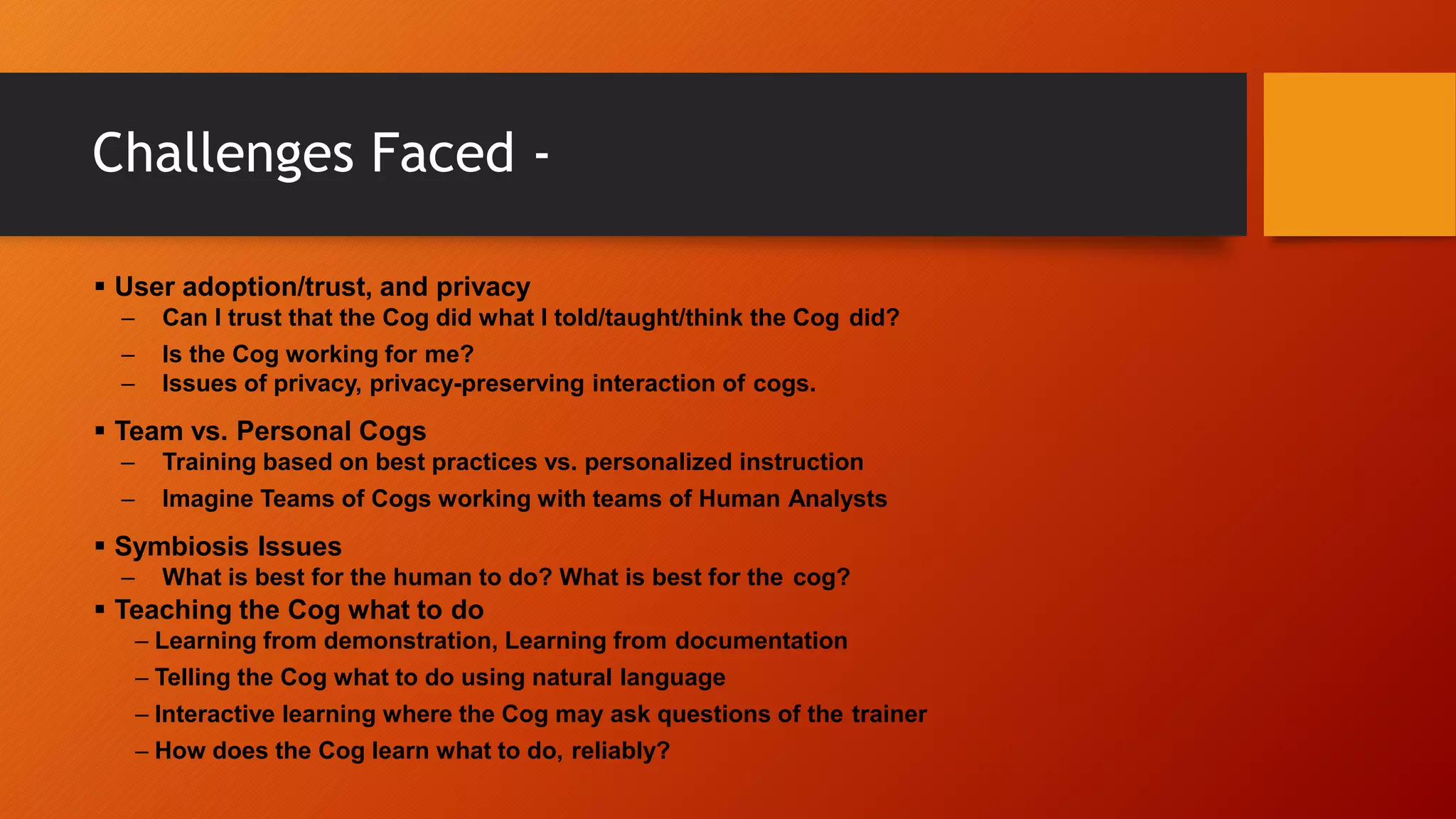
Challenges Faced -
 User adoption/trust, and privacy
– Can I trust that the Cog did what I told/taught/think the Cog did?
– Is the Cog working for me?
– Issues of privacy, privacy-preserving interaction of cogs.
 Team vs. Personal Cogs
– Training based on best practices vs. personalized instruction
– Imagine Teams of Cogs working with teams of Human Analysts
 Symbiosis Issues
– What is best for the human to do? What is best for the cog?
 Teaching the Cog what to do
– Learning from demonstration, Learning from documentation
– Telling the Cog what to do using natural language
– Interactive learning where the Cog may ask questions of the trainer
– How does the Cog learn what to do, reliably?
Challenges Faced -
 Proactive Action taking
– Initiating actions based on learning and incoming requests
• E.g., deciding what information sources to search for the request , issuing queries,
evaluating responses
– Deciding on next steps based on results or whether it needs further guidance from Human
 Personal knowledge representation and reasoning
– Capturing user behavior, interaction in form of personal knowledge
– Ability to build knowledge from various structured and unstructured information
THANK YOU

Challenges in building ai

  • 1.
    CHALLENGES IN BUILDING ANAI ASSISSTANTS Sarthak Dasgupta
  • 2.
    AI Assistant :what is it  A software agent that – “augments human intelligence” – Performs tasks and offer services (assists human in decision making and taking actions) – Complements human by offering capabilities that is beyond the ordinary power and reach of human (intelligence amplification)  A more technical definition – Cognitive Assistant offers computational capabilities typically based on Natural Language Processing (NLP), Machine Learning (ML), and reasoning chains, on large amount of data, which provides cognition powers that augment and scale human intelligence  Getting us closer to the vision painted for human-machine partnership in 1960: – “The hope is that, in not too many years, human brains and computing machines will be coupled together very tightly, and that the resulting partnership will think as no human brain has ever thought and process data in a way not approached by the information handling machines we know today”
  • 3.
    Types of AIAssistants • Cognitive AI Assistant- • Cognitive Computing in simple word is a technique of solving problem with human like thinking. • Cognitive Computing is trying to simulate human thought process • This process uses many of the same fundamentals as AI, such as machine learning, neural networks, natural language processing, contextual awareness and sentiment analysis, to follow the problem- solving processes that humans do day in and day out
  • 4.
    Types of AIAssistant • Personal AI Assistant – • Also called Automated Personal Assistant or Virtual Assistant is a software agent that can perform tasks or services for an individual. • Mainly used in commercial market for providing a variety of services to its Customers • It is used to perform various task on behalf of its user by the help of User inputs and Personal Awareness.
  • 5.
    Modern AI Assistants: •Commercial  Personal Assistants – Siri, Google Now, Microsoft Cortana, Amazon Echo, – Braina, Samsung's S Voice, LG's Voice Mate, SILVIA, HTC's Hidi, Nuance’ Vlingo – AIVC, Skyvi, IRIS, Everfriend, Evi (Q&A), Alme (patient assistant) – Viv (Global Brain as a Service)  Cognitive systems and platforms – IBM Watson – Wolfram Alpha – Saffron 10 – Vicarious (Captcha)
  • 6.
    Vision of anAI Assistant : • Create new insights and new valueDiscovery • Provide bias-free advice semi- autonomously, learns, and is proactive Decision • Build and reason about models of the world, of the user, and of the system itself Understanding • Leverage encyclopedic domain knowledge in context, and interacts in natural language Question Answering
  • 7.
    Challenges Faced - Building the knowledge base and Training Cognitive Agents – How does User Train the Cog? – How does User Delegate to the Cog?  Adaptation and training of Cogs for a new domain – How to quickly train a cog for a new domain? Current approaches is laborious and tedious.  Performance Dimensions, and Evaluation Framework – Metrics, testing and validating functionality of Cog – Are controlled experiments possible? – Do we need to test in Real environment with Real users
  • 8.
    Challenges Faced - User adoption/trust, and privacy – Can I trust that the Cog did what I told/taught/think the Cog did? – Is the Cog working for me? – Issues of privacy, privacy-preserving interaction of cogs.  Team vs. Personal Cogs – Training based on best practices vs. personalized instruction – Imagine Teams of Cogs working with teams of Human Analysts  Symbiosis Issues – What is best for the human to do? What is best for the cog?  Teaching the Cog what to do – Learning from demonstration, Learning from documentation – Telling the Cog what to do using natural language – Interactive learning where the Cog may ask questions of the trainer – How does the Cog learn what to do, reliably?
  • 9.
    Challenges Faced - Proactive Action taking – Initiating actions based on learning and incoming requests • E.g., deciding what information sources to search for the request , issuing queries, evaluating responses – Deciding on next steps based on results or whether it needs further guidance from Human  Personal knowledge representation and reasoning – Capturing user behavior, interaction in form of personal knowledge – Ability to build knowledge from various structured and unstructured information
  • 10.