
Organizational
   Behavior, 9/E
Schermerhorn, Hunt, and
       Osborn
                 Prepared by
             Michael K. McCuddy
             Valparaiso University

      John Wiley & Sons, Inc.
Chapter 16 Study Questions
 What is organizational change?
 What change strategies are used in
  organizations?
 How is resistance to change best managed?
 How do organizations innovate?
 How does stress affect people in change
  environments?
            Organizational Behavior: Chapter 16
                                         2
Study Question 1: What is
organizational change?
 Transformational change.
  – Results in a major overhaul of the organization
    or its component systems.
  – Described as radical change or frame-breaking
    change.
  – Organizations experiencing transformational
    change undergo a significant shift in basic
    characteristic features.

             Organizational Behavior: Chapter 16
                                          3
Study Question 1: What is
organizational change?
 Incremental change or frame-bending
 change.
  – Part of the organization’s natural evolution in
    building on the existing ways of operating to
    enhance or extend them in new directions.
  – Introduction of new products, new
    technologies, and new systems and processes.
  – Continuous improvement through incremental
    change is an important asset.

             Organizational Behavior: Chapter 16
                                          4
Study Question 1: What is
organizational change?
 Change agents.
  – Individuals and groups who take responsibility
    for changing the existing behavior patterns of
    another person or social system.
  – Success of change efforts depends in part on
    change agents.
  – Being an effective change agent means being
    a great change leader.

             Organizational Behavior: Chapter 16
                                          5
Study Question 1: What is
organizational change?

 Unplanned change.
  – Occurs spontaneously and without a change
    agent’s direction, and such change may be
    disruptive.
  – Appropriate goal is to act quickly to minimize
    the negative consequences and maximize any
    possible benefits.

             Organizational Behavior: Chapter 16
                                          6
Study Question 1: What is
organizational change?
 Planned change.
  – The result of specific efforts by a change
    agent.
  – Direct response to someone’s perception of a
    performance gap.
     • A performance gap is the discrepancy between the
      desired and actual state of affairs.
     • Performance gaps represent problems to be
      resolved or opportunities to be explored.

              Organizational Behavior: Chapter 16
                                           7
Study Question 1: What is
organizational change?

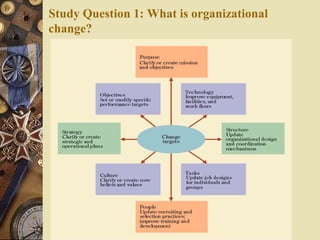
 Organizational forces for change.

  – Organization-environment relationships.

  – Organizational life cycle.

  – Political nature of organizations.


             Organizational Behavior: Chapter 16
                                          8
Study Question 1: What is organizational
change?


             Organizational Behavior: Chapter 16
                                          9
Study Question 1: What is
organizational change?
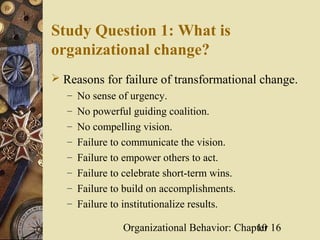
 Reasons for failure of transformational change.
   – No sense of urgency.
   – No powerful guiding coalition.
   – No compelling vision.
   – Failure to communicate the vision.
   – Failure to empower others to act.
   – Failure to celebrate short-term wins.
   – Failure to build on accomplishments.
   – Failure to institutionalize results.

                 Organizational Behavior: Chapter 16
                                              10
Study Question 1: What is
organizational change?
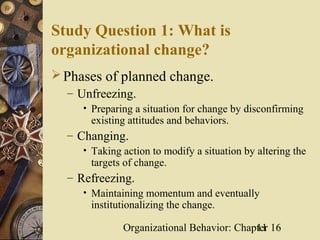
 Phases of planned change.
   – Unfreezing.
     • Preparing a situation for change by disconfirming
       existing attitudes and behaviors.
  – Changing.
     • Taking action to modify a situation by altering the
       targets of change.
  – Refreezing.
     • Maintaining momentum and eventually
       institutionalizing the change.

               Organizational Behavior: Chapter 16
                                            11
Study Question 2: What change
strategies are used in organizations?


          Organizational Behavior: Chapter 16
                                       12
Study Question 3: How is resistance
to change best managed?
 Resistance to change.
  – Any attitude or behavior that indicates
    unwillingness to make or support a desired
    change.
  – Alternative views of resistance.
     • Something that must be overcome for change to be
       successful.
     • Feedback that can be used to facilitate achieving
       change objectives.

              Organizational Behavior: Chapter 16
                                           13
Study Question 3: How is resistance
to change best managed?
 Why people resist change.
   – Fear of the unknown.
   – Lack of good information.
   – Fear for loss of security.
   – No reasons to change.
   – Fear for loss of power.
   – Lack of resources.
   – Bad timing.
   – Habit.

                Organizational Behavior: Chapter 16
                                             14
Study Question 3: How is resistance
to change best managed?
 Resistance to the change itself.
   – People may reject a change because they believe it is
     not worth their time, effort, or attention.
   – To deal with resistance to the change itself, all those
     affected should know how it satisfies the following
     criteria:
      • Benefit.
      • Compatibility.
      • Complexity.
      • Triability.

                   Organizational Behavior: Chapter 16
                                                15
Study Question 3: How is resistance
to change best managed?
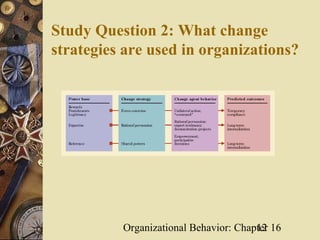
 Resistance to the change strategy.
   – Force-coercion strategy.
      • Likely resistance among individuals who resent management
        by “command” or the use of threatened punishment.

   – Rational persuasion strategy.
      • Likely resistance when the data are suspect or the expertise
        of advocates is unclear.

   – Shared-power strategy.
      • Likely resistance if it appears manipulative and insincere.

                 Organizational Behavior: Chapter 16
                                              16
Study Question 3: How is resistance
to change best managed?

 Resistance to the change agent.
  – Resistance to the change agent is directed at
    the person implementing the change and often
    involves personality and other differences.


             Organizational Behavior: Chapter 16
                                          17
Study Question 3: How is resistance
to change best managed?
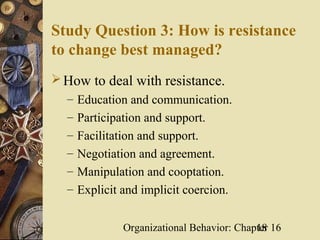
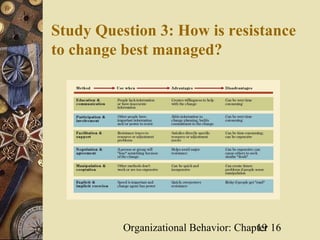
 How to deal with resistance.
  – Education and communication.
  – Participation and support.
  – Facilitation and support.
  – Negotiation and agreement.
  – Manipulation and cooptation.
  – Explicit and implicit coercion.


             Organizational Behavior: Chapter 16
                                          18
Study Question 3: How is resistance
to change best managed?


          Organizational Behavior: Chapter 16
                                       19
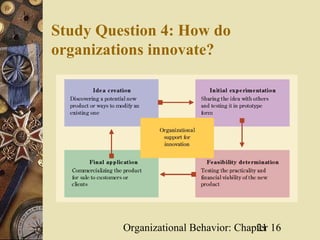
Study Question 4: How do
organizations innovate?
 Innovation.
   – The process of creating new ideas and putting them
     into practice.
 Product innovations.
   – The introduction of new or improved goods or
     services to better meet customer needs.
 Process innovations.
   – The introduction of new and better work methods and
     operations.

                Organizational Behavior: Chapter 16
                                             20
Study Question 4: How do
organizations innovate?


         Organizational Behavior: Chapter 16
                                      21
Study Question 4: How do
organizations innovate?
 Features of innovative organizations.
  – Strategies and cultures that are built around a
    commitment to innovation.
  – Structures that support innovation.
  – Staffing with a clear commitment to
    innovation.
  – Top-management support for innovation.

             Organizational Behavior: Chapter 16
                                          22
Study Question 5: How does stress affect
people in change environments?

 Stress.

  – A state of tension experienced by individuals

    facing extraordinary demands, constraints, or
    opportunities.


             Organizational Behavior: Chapter 16
                                          23
Study Question 5: How does stress affect
people in change environments?

 Source of stress.
  – Stressors.
     • The wide variety of things that cause stress for
       individuals.
  – Types of stressors.
     • Work-related stressors.
     • Life stressors.


               Organizational Behavior: Chapter 16
                                            24
Study Question 5: How does stress affect
people in change environments?

 Work-related stressors.
  – Task demands.
  – Role ambiguities.
  – Role conflicts.
  – Ethical dilemmas.
  – Interpersonal problems.
  – Career developments.
  – Physical setting.

             Organizational Behavior: Chapter 16
                                          25
Study Question 5: How does stress affect
people in change environments?

 Life stressors.
  – Family events.
  – Economic difficulties.
  – Personal affairs.
  – Individual’s needs.
  – Individual’s capabilities.
  – Individual’s personality.

             Organizational Behavior: Chapter 16
                                          26
Study Question 5: How does stress affect
people in change environments?
 Stress and performance.
   – Constructive stress (or eustress).
      • Moderate levels of stress act in a positive way for
        both individuals and organization.
   – Destructive stress (or distress).
      • Low and especially high levels of stress act in a
        negative way for both individuals and
        organization.
   – Job burnout.
      • A loss of interest in and satisfaction with a job due
        to stressful working conditions.
                Organizational Behavior: Chapter 16
                                                 27
Study Question 5: How does stress affect
people in change environments?
 Stress and health.
   – Stress can harm people’s physical and psychological
     health.
   – Health problems associated with stress.
       •   Heart attack.
       •   Stroke.
       •   Hypertension.
       •   Migraine headache.
       •   Ulcers.
       •   Substance abuse.
       •   Overeating.
       •   Depression.
       •   Muscle aches.
   – Managers and team leaders should be alert to signs of
     excessive stress.
                   Organizational Behavior: Chapter 16
                                                28
Study Question 5: How does stress affect
people in change environments?
 Stress management.
  – Stress prevention.
     • Taking action to keep stress from reaching
       destructive levels in the first place.
  – Once stress has reached a destructive point,
    special techniques of stress management can
    be implemented.
  – Stress management.
     • Begins with the recognition of stress symptoms
      and continues with actions to maintain a positive
      performance edge.
              Organizational Behavior: Chapter 16
                                           29
Study Question 5: How does stress affect
people in change environments?

 Stress management (cont.).
  – Personal wellness.
     • Pursuit of one’s job and career goals with the
      support of a personal health promotion program.
  – Employee assistance programs.
     • Provide help for employees who are experiencing
      personal problems and related stress.


              Organizational Behavior: Chapter 16
                                           30
COPYRIGHT

Copyright 2005 © John Wiley & Sons, Inc. All rights reserved.
Reproduction or translation of this work beyond that permitted in Section
117 of the 1976 United States Copyright Act without the express written
permission of the copyright owner is unlawful. Request for further
information should be addressed to the Permissions Department, John Wiley
& Sons, Inc. The purchaser may make back-up copies for his/her own use
only and not for distribution or resale. The Publisher assumes no
responsibility for errors, omissions, or damages, caused by the use of these
programs or from the use of the information contained herein.


                Organizational Behavior: Chapter 16
                                             31

Ch16

  • 1.
    Organizational Behavior, 9/E Schermerhorn, Hunt, and Osborn Prepared by Michael K. McCuddy Valparaiso University John Wiley & Sons, Inc.
  • 2.
    Chapter 16 StudyQuestions  What is organizational change?  What change strategies are used in organizations?  How is resistance to change best managed?  How do organizations innovate?  How does stress affect people in change environments? Organizational Behavior: Chapter 16 2
  • 3.
    Study Question 1:What is organizational change?  Transformational change. – Results in a major overhaul of the organization or its component systems. – Described as radical change or frame-breaking change. – Organizations experiencing transformational change undergo a significant shift in basic characteristic features. Organizational Behavior: Chapter 16 3
  • 4.
    Study Question 1:What is organizational change?  Incremental change or frame-bending change. – Part of the organization’s natural evolution in building on the existing ways of operating to enhance or extend them in new directions. – Introduction of new products, new technologies, and new systems and processes. – Continuous improvement through incremental change is an important asset. Organizational Behavior: Chapter 16 4
  • 5.
    Study Question 1:What is organizational change?  Change agents. – Individuals and groups who take responsibility for changing the existing behavior patterns of another person or social system. – Success of change efforts depends in part on change agents. – Being an effective change agent means being a great change leader. Organizational Behavior: Chapter 16 5
  • 6.
    Study Question 1:What is organizational change?  Unplanned change. – Occurs spontaneously and without a change agent’s direction, and such change may be disruptive. – Appropriate goal is to act quickly to minimize the negative consequences and maximize any possible benefits. Organizational Behavior: Chapter 16 6
  • 7.
    Study Question 1:What is organizational change?  Planned change. – The result of specific efforts by a change agent. – Direct response to someone’s perception of a performance gap. • A performance gap is the discrepancy between the desired and actual state of affairs. • Performance gaps represent problems to be resolved or opportunities to be explored. Organizational Behavior: Chapter 16 7
  • 8.
    Study Question 1:What is organizational change?  Organizational forces for change. – Organization-environment relationships. – Organizational life cycle. – Political nature of organizations. Organizational Behavior: Chapter 16 8
  • 9.
    Study Question 1:What is organizational change? Organizational Behavior: Chapter 16 9
  • 10.
    Study Question 1:What is organizational change?  Reasons for failure of transformational change. – No sense of urgency. – No powerful guiding coalition. – No compelling vision. – Failure to communicate the vision. – Failure to empower others to act. – Failure to celebrate short-term wins. – Failure to build on accomplishments. – Failure to institutionalize results. Organizational Behavior: Chapter 16 10
  • 11.
    Study Question 1:What is organizational change?  Phases of planned change. – Unfreezing. • Preparing a situation for change by disconfirming existing attitudes and behaviors. – Changing. • Taking action to modify a situation by altering the targets of change. – Refreezing. • Maintaining momentum and eventually institutionalizing the change. Organizational Behavior: Chapter 16 11
  • 12.
    Study Question 2:What change strategies are used in organizations? Organizational Behavior: Chapter 16 12
  • 13.
    Study Question 3:How is resistance to change best managed?  Resistance to change. – Any attitude or behavior that indicates unwillingness to make or support a desired change. – Alternative views of resistance. • Something that must be overcome for change to be successful. • Feedback that can be used to facilitate achieving change objectives. Organizational Behavior: Chapter 16 13
  • 14.
    Study Question 3:How is resistance to change best managed?  Why people resist change. – Fear of the unknown. – Lack of good information. – Fear for loss of security. – No reasons to change. – Fear for loss of power. – Lack of resources. – Bad timing. – Habit. Organizational Behavior: Chapter 16 14
  • 15.
    Study Question 3:How is resistance to change best managed?  Resistance to the change itself. – People may reject a change because they believe it is not worth their time, effort, or attention. – To deal with resistance to the change itself, all those affected should know how it satisfies the following criteria: • Benefit. • Compatibility. • Complexity. • Triability. Organizational Behavior: Chapter 16 15
  • 16.
    Study Question 3:How is resistance to change best managed?  Resistance to the change strategy. – Force-coercion strategy. • Likely resistance among individuals who resent management by “command” or the use of threatened punishment. – Rational persuasion strategy. • Likely resistance when the data are suspect or the expertise of advocates is unclear. – Shared-power strategy. • Likely resistance if it appears manipulative and insincere. Organizational Behavior: Chapter 16 16
  • 17.
    Study Question 3:How is resistance to change best managed?  Resistance to the change agent. – Resistance to the change agent is directed at the person implementing the change and often involves personality and other differences. Organizational Behavior: Chapter 16 17
  • 18.
    Study Question 3:How is resistance to change best managed?  How to deal with resistance. – Education and communication. – Participation and support. – Facilitation and support. – Negotiation and agreement. – Manipulation and cooptation. – Explicit and implicit coercion. Organizational Behavior: Chapter 16 18
  • 19.
    Study Question 3:How is resistance to change best managed? Organizational Behavior: Chapter 16 19
  • 20.
    Study Question 4:How do organizations innovate?  Innovation. – The process of creating new ideas and putting them into practice.  Product innovations. – The introduction of new or improved goods or services to better meet customer needs.  Process innovations. – The introduction of new and better work methods and operations. Organizational Behavior: Chapter 16 20
  • 21.
    Study Question 4:How do organizations innovate? Organizational Behavior: Chapter 16 21
  • 22.
    Study Question 4:How do organizations innovate?  Features of innovative organizations. – Strategies and cultures that are built around a commitment to innovation. – Structures that support innovation. – Staffing with a clear commitment to innovation. – Top-management support for innovation. Organizational Behavior: Chapter 16 22
  • 23.
    Study Question 5:How does stress affect people in change environments?  Stress. – A state of tension experienced by individuals facing extraordinary demands, constraints, or opportunities. Organizational Behavior: Chapter 16 23
  • 24.
    Study Question 5:How does stress affect people in change environments?  Source of stress. – Stressors. • The wide variety of things that cause stress for individuals. – Types of stressors. • Work-related stressors. • Life stressors. Organizational Behavior: Chapter 16 24
  • 25.
    Study Question 5:How does stress affect people in change environments?  Work-related stressors. – Task demands. – Role ambiguities. – Role conflicts. – Ethical dilemmas. – Interpersonal problems. – Career developments. – Physical setting. Organizational Behavior: Chapter 16 25
  • 26.
    Study Question 5:How does stress affect people in change environments?  Life stressors. – Family events. – Economic difficulties. – Personal affairs. – Individual’s needs. – Individual’s capabilities. – Individual’s personality. Organizational Behavior: Chapter 16 26
  • 27.
    Study Question 5:How does stress affect people in change environments?  Stress and performance. – Constructive stress (or eustress). • Moderate levels of stress act in a positive way for both individuals and organization. – Destructive stress (or distress). • Low and especially high levels of stress act in a negative way for both individuals and organization. – Job burnout. • A loss of interest in and satisfaction with a job due to stressful working conditions. Organizational Behavior: Chapter 16 27
  • 28.
    Study Question 5:How does stress affect people in change environments?  Stress and health. – Stress can harm people’s physical and psychological health. – Health problems associated with stress. • Heart attack. • Stroke. • Hypertension. • Migraine headache. • Ulcers. • Substance abuse. • Overeating. • Depression. • Muscle aches. – Managers and team leaders should be alert to signs of excessive stress. Organizational Behavior: Chapter 16 28
  • 29.
    Study Question 5:How does stress affect people in change environments?  Stress management. – Stress prevention. • Taking action to keep stress from reaching destructive levels in the first place. – Once stress has reached a destructive point, special techniques of stress management can be implemented. – Stress management. • Begins with the recognition of stress symptoms and continues with actions to maintain a positive performance edge. Organizational Behavior: Chapter 16 29
  • 30.
    Study Question 5:How does stress affect people in change environments?  Stress management (cont.). – Personal wellness. • Pursuit of one’s job and career goals with the support of a personal health promotion program. – Employee assistance programs. • Provide help for employees who are experiencing personal problems and related stress. Organizational Behavior: Chapter 16 30
  • 31.
    COPYRIGHT Copyright 2005 ©John Wiley & Sons, Inc. All rights reserved. Reproduction or translation of this work beyond that permitted in Section 117 of the 1976 United States Copyright Act without the express written permission of the copyright owner is unlawful. Request for further information should be addressed to the Permissions Department, John Wiley & Sons, Inc. The purchaser may make back-up copies for his/her own use only and not for distribution or resale. The Publisher assumes no responsibility for errors, omissions, or damages, caused by the use of these programs or from the use of the information contained herein. Organizational Behavior: Chapter 16 31