Software Engineering:
Chapter 2
Process: A Generic View
1 Balaganesh-Lincoln university college
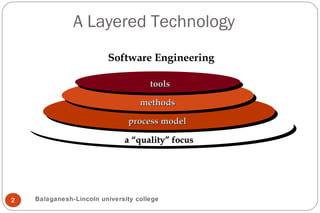
A Layered Technology
2
Software Engineering
a “quality” focusa “quality” focus
process modelprocess model
methodsmethods
toolstools
Balaganesh-Lincoln university college
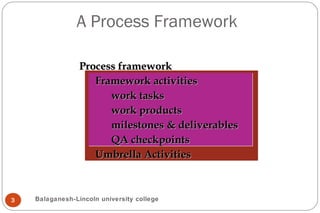
A Process Framework
3
Process frameworkProcess framework
Framework activitiesFramework activities
work taskswork tasks
work productswork products
milestones & deliverablesmilestones & deliverables
QA checkpointsQA checkpoints
Umbrella ActivitiesUmbrella Activities
Balaganesh-Lincoln university college
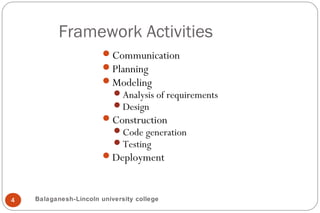
Framework Activities
4
Communication
Planning
Modeling
Analysis of requirements
Design
Construction
Code generation
Testing
Deployment
Balaganesh-Lincoln university college
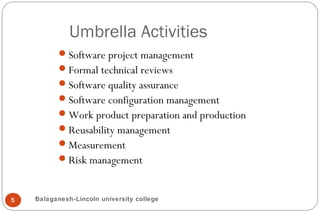
Umbrella Activities
5
Software project management
Formal technical reviews
Software quality assurance
Software configuration management
Work product preparation and production
Reusability management
Measurement
Risk management
Balaganesh-Lincoln university college
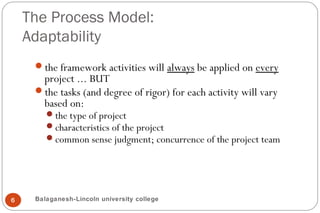
The Process Model:
Adaptability
6
the framework activities will always be applied on every
project ... BUT
the tasks (and degree of rigor) for each activity will vary
based on:
the type of project
characteristics of the project
common sense judgment; concurrence of the project team
Balaganesh-Lincoln university college
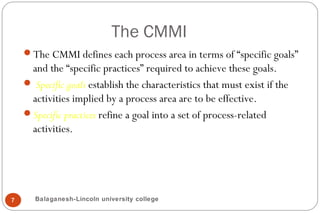
The CMMI
7
The CMMI defines each process area in terms of “specific goals”
and the “specific practices” required to achieve these goals.
 Specific goals establish the characteristics that must exist if the
activities implied by a process area are to be effective.
Specific practices refine a goal into a set of process-related
activities.
Balaganesh-Lincoln university college
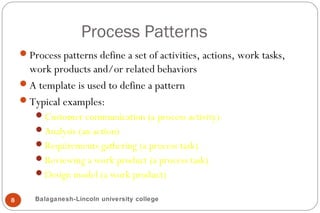
Process Patterns
8
Process patterns define a set of activities, actions, work tasks,
work products and/or related behaviors
A template is used to define a pattern
Typical examples:
Customer communication (a process activity)
Analysis (an action)
Requirements gathering (a process task)
Reviewing a work product (a process task)
Design model (a work product)
Balaganesh-Lincoln university college
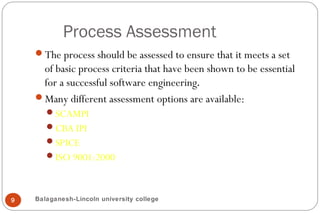
Process Assessment
9
The process should be assessed to ensure that it meets a set
of basic process criteria that have been shown to be essential
for a successful software engineering.
Many different assessment options are available:
SCAMPI
CBA IPI
SPICE
ISO 9001:2000
Balaganesh-Lincoln university college
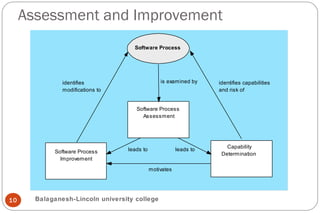
Assessment and Improvement
10
Software Process
Software Process
Assessment
is examined by identifies capabilities
and risk of
identifies
modifications to
Software Process
Improvement
Capability
Determination
leads to leads to
motivates
Balaganesh-Lincoln university college
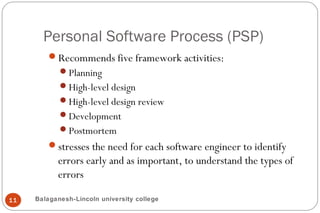
Personal Software Process (PSP)
11
Recommends five framework activities:
Planning
High-level design
High-level design review
Development
Postmortem
stresses the need for each software engineer to identify
errors early and as important, to understand the types of
errors
Balaganesh-Lincoln university college
Team Software Process (TSP)
12
Each project is “launched” using a “script” that defines the
tasks to be accomplished
Teams are self-directed
Measurement is encouraged
Measures are analyzed with the intent of improving the
team process
Balaganesh-Lincoln university college
The Primary Goal of Any Software Process: High
Quality
13
Remember:Remember:
High quality = project timelinessHigh quality = project timeliness
Why?Why?
Less rework!Less rework!
Balaganesh-Lincoln university college

Ch02-Generic View

  • 1.
    Software Engineering: Chapter 2 Process:A Generic View 1 Balaganesh-Lincoln university college
  • 2.
    A Layered Technology 2 SoftwareEngineering a “quality” focusa “quality” focus process modelprocess model methodsmethods toolstools Balaganesh-Lincoln university college
  • 3.
    A Process Framework 3 ProcessframeworkProcess framework Framework activitiesFramework activities work taskswork tasks work productswork products milestones & deliverablesmilestones & deliverables QA checkpointsQA checkpoints Umbrella ActivitiesUmbrella Activities Balaganesh-Lincoln university college
  • 4.
    Framework Activities 4 Communication Planning Modeling Analysis ofrequirements Design Construction Code generation Testing Deployment Balaganesh-Lincoln university college
  • 5.
    Umbrella Activities 5 Software projectmanagement Formal technical reviews Software quality assurance Software configuration management Work product preparation and production Reusability management Measurement Risk management Balaganesh-Lincoln university college
  • 6.
    The Process Model: Adaptability 6 theframework activities will always be applied on every project ... BUT the tasks (and degree of rigor) for each activity will vary based on: the type of project characteristics of the project common sense judgment; concurrence of the project team Balaganesh-Lincoln university college
  • 7.
    The CMMI 7 The CMMIdefines each process area in terms of “specific goals” and the “specific practices” required to achieve these goals.  Specific goals establish the characteristics that must exist if the activities implied by a process area are to be effective. Specific practices refine a goal into a set of process-related activities. Balaganesh-Lincoln university college
  • 8.
    Process Patterns 8 Process patternsdefine a set of activities, actions, work tasks, work products and/or related behaviors A template is used to define a pattern Typical examples: Customer communication (a process activity) Analysis (an action) Requirements gathering (a process task) Reviewing a work product (a process task) Design model (a work product) Balaganesh-Lincoln university college
  • 9.
    Process Assessment 9 The processshould be assessed to ensure that it meets a set of basic process criteria that have been shown to be essential for a successful software engineering. Many different assessment options are available: SCAMPI CBA IPI SPICE ISO 9001:2000 Balaganesh-Lincoln university college
  • 10.
    Assessment and Improvement 10 SoftwareProcess Software Process Assessment is examined by identifies capabilities and risk of identifies modifications to Software Process Improvement Capability Determination leads to leads to motivates Balaganesh-Lincoln university college
  • 11.
    Personal Software Process(PSP) 11 Recommends five framework activities: Planning High-level design High-level design review Development Postmortem stresses the need for each software engineer to identify errors early and as important, to understand the types of errors Balaganesh-Lincoln university college
  • 12.
    Team Software Process(TSP) 12 Each project is “launched” using a “script” that defines the tasks to be accomplished Teams are self-directed Measurement is encouraged Measures are analyzed with the intent of improving the team process Balaganesh-Lincoln university college
  • 13.
    The Primary Goalof Any Software Process: High Quality 13 Remember:Remember: High quality = project timelinessHigh quality = project timeliness Why?Why? Less rework!Less rework! Balaganesh-Lincoln university college