Financial Accounting
IFRS 4th Edition
Chapter 1
Accounting in Action
Weygandt ● Kimmel ● Kieso
Chapter Preview
Good decision-making depends on good information.
Whatever your pursuits or occupation, the need for financial
information is inescapable. You cannot earn a living, spend money,
buy on credit, make an investment, or pay taxes without receiving,
using, or dispensing financial information. Good decision-making
depends on good information.
2
Copyright ©2019 John Wiley & Son, Inc.
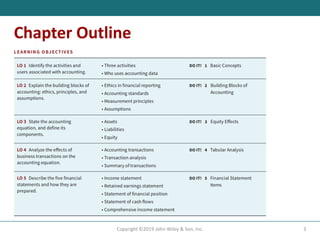
Chapter Outline
3
Copyright ©2019 John Wiley & Son, Inc.
Learning Objective 1
Identify the activities and users
associated with accounting.
4
Copyright ©2019 John Wiley & Sons, Inc.
LO 1
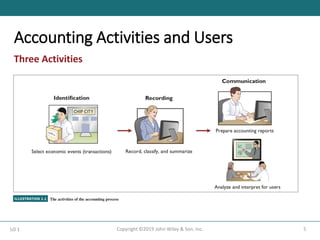
Accounting Activities and Users
5
Copyright ©2019 John Wiley & Son, Inc.
Three Activities
LO 1
Accounting Activities and Users
6
Copyright ©2019 John Wiley & Son, Inc.
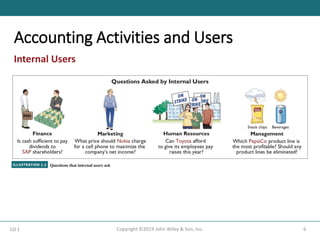
Internal Users
LO 1
Accounting Activities and Users
7
Copyright ©2019 John Wiley & Son, Inc.
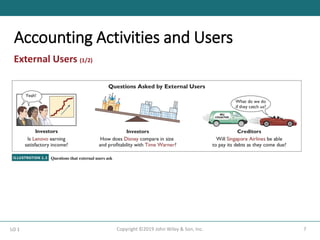
External Users (1/2)
LO 1
Accounting Activities and Users
8
Copyright ©2019 John Wiley & Son, Inc.
External Users (2/2)
Taxing authorities: Does the company comply with the tax laws?
Regulatory agencies: Is the company operating within prescribed rules?
Labor unions: Does the company have the ability to pay increased wages and
benefits to union members?
LO 1
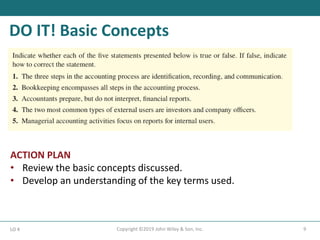
DO IT! Basic Concepts
9
Copyright ©2019 John Wiley & Son, Inc.
LO 4
ACTION PLAN
• Review the basic concepts discussed.
• Develop an understanding of the key terms used.
Learning Objective 2
Explain the building blocks of
accounting: ethics, principles, and
assumptions.
10
Copyright ©2019 John Wiley & Sons, Inc.
LO 1
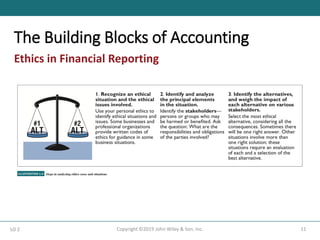
The Building Blocks of Accounting
11
Copyright ©2019 John Wiley & Son, Inc.
Ethics in Financial Reporting
LO 2
The Building Blocks of Accounting
12
Copyright ©2019 John Wiley & Son, Inc.
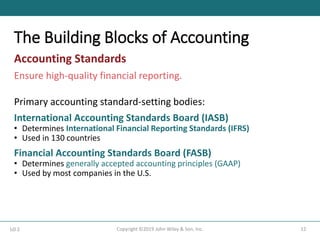
Accounting Standards
Ensure high-quality financial reporting.
Primary accounting standard-setting bodies:
International Accounting Standards Board (IASB)
• Determines International Financial Reporting Standards (IFRS)
• Used in 130 countries
Financial Accounting Standards Board (FASB)
• Determines generally accepted accounting principles (GAAP)
• Used by most companies in the U.S.
LO 2
The Building Blocks of Accounting
13
Copyright ©2019 John Wiley & Son, Inc.
Measurement Principles
IFRS generally uses one of two measurement principles, the historical cost
principle or the fair value principle.
Historical cost principle (or cost principle): dictates that companies
record assets at their cost. This is true not only at the time the
asset is purchased, but also over the time the asset is held.
Fair value principle: states that assets and liabilities should be
reported at fair value (the price received to sell an asset or settle a
liability).
LO 2
The Building Blocks of Accounting
14
Copyright ©2019 John Wiley & Son, Inc.
Selecting Measurement Principles
Selection of which principle to follow generally relates to trade-offs between
relevance and faithful representation.
Relevance means that financial information is capable of making a
difference in a decision.
Faithful representation means that the numbers and descriptions
match what really existed or happened—they are factual.
LO 2
The Building Blocks of Accounting
15
Copyright ©2019 John Wiley & Son, Inc.
Assumptions
Assumptions provide a foundation for the accounting process. Two main
assumptions are the monetary unit assumption and the economic entity
assumption.
Monetary unit assumption: requires that companies include in the
accounting records only transaction data that can be expressed in
money terms.
Economic Entity Assumption: requires that the activities of the
entity be kept separate and distinct from the activities of its owner
and all other economic entities. Typical entity forms are
proprietorship, partnership, corporation.
LO 2
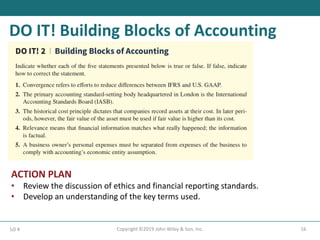
DO IT! Building Blocks of Accounting
16
Copyright ©2019 John Wiley & Son, Inc.
LO 4
ACTION PLAN
• Review the discussion of ethics and financial reporting standards.
• Develop an understanding of the key terms used.
Learning Objective 3
State the accounting equation, and
define its components.
17
Copyright ©2019 John Wiley & Sons, Inc.
LO 3
The Accounting Equation
18
Copyright ©2019 John Wiley & Son, Inc.
LO 3
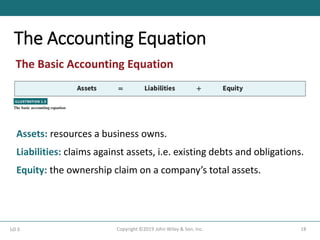
Assets: resources a business owns.
Liabilities: claims against assets, i.e. existing debts and obligations.
Equity: the ownership claim on a company’s total assets.
The Basic Accounting Equation
The Accounting Equation
19
Copyright ©2019 John Wiley & Son, Inc.
LO 3
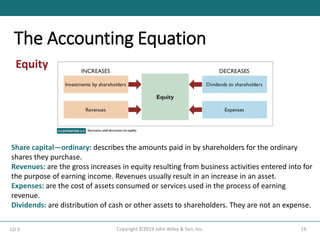
Equity
Share capital—ordinary: describes the amounts paid in by shareholders for the ordinary
shares they purchase.
Revenues: are the gross increases in equity resulting from business activities entered into for
the purpose of earning income. Revenues usually result in an increase in an asset.
Expenses: are the cost of assets consumed or services used in the process of earning
revenue.
Dividends: are distribution of cash or other assets to shareholders. They are not an expense.
DO IT! Equity Effects
20
Copyright ©2019 John Wiley & Son, Inc.
LO 4
a. Rent Expense
b. Service Revenue
c. Dividends
d. Salaries and Wage Expense
ACTION PLAN
• Understand the sources of revenue.
• Understand what causes expenses.
• Review the rules for changes in equity: Investments and revenues
increase equity. Expenses and dividends decrease equity.
• Recognize that dividends are distributions of cash or other assets to
shareholders.
Learning Objective 4
Analyze the effects of business
transactions on the accounting
equation.
21
Copyright ©2019 John Wiley & Sons, Inc.
LO 4
Analyzing Business Transactions
22
Copyright ©2019 John Wiley & Son, Inc.
LO 4
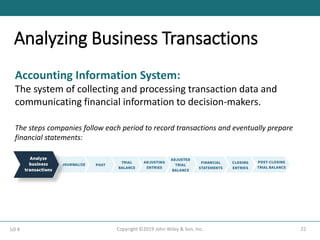
Accounting Information System:
The system of collecting and processing transaction data and
communicating financial information to decision-makers.
The steps companies follow each period to record transactions and eventually prepare
financial statements:
Analyzing Business Transactions
23
Copyright ©2019 John Wiley & Son, Inc.
LO 4
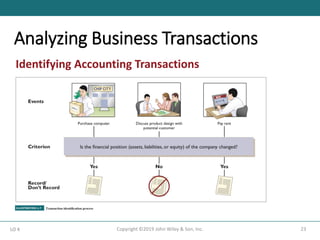
Identifying Accounting Transactions
Analyzing Business Transactions
24
Copyright ©2019 John Wiley & Son, Inc.
LO 4
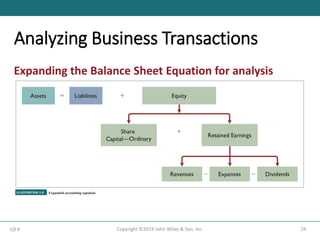
Expanding the Balance Sheet Equation for analysis
Transaction (1). Investment by Shareholders.
25
Copyright ©2019 John Wiley & Son, Inc.
LO 4
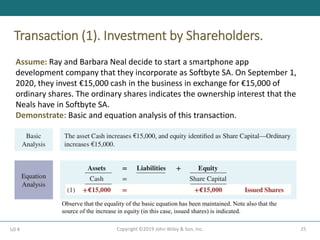
Assume: Ray and Barbara Neal decide to start a smartphone app
development company that they incorporate as Softbyte SA. On September 1,
2020, they invest €15,000 cash in the business in exchange for €15,000 of
ordinary shares. The ordinary shares indicates the ownership interest that the
Neals have in Softbyte SA.
Demonstrate: Basic and equation analysis of this transaction.
Observe that the equality of the basic equation has been maintained. Note also that the
source of the increase in equity (in this case, issued shares) is indicated.
Transaction(2). Purchase of Equipment for Cash.
26
Copyright ©2019 John Wiley & Son, Inc.
LO 4
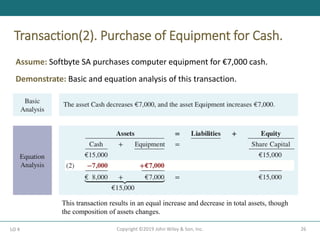
Assume: Softbyte SA purchases computer equipment for €7,000 cash.
Demonstrate: Basic and equation analysis of this transaction.
This transaction results in an equal increase and decrease in total assets, though
the composition of assets changes.
Transaction(3). Purchase of Supplies on Credit.
27
Copyright ©2019 John Wiley & Son, Inc.
LO 4
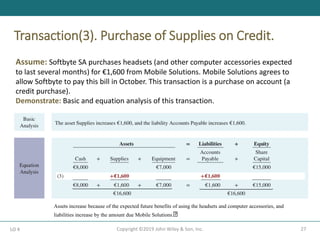
Assume: Softbyte SA purchases headsets (and other computer accessories expected
to last several months) for €1,600 from Mobile Solutions. Mobile Solutions agrees to
allow Softbyte to pay this bill in October. This transaction is a purchase on account (a
credit purchase).
Demonstrate: Basic and equation analysis of this transaction.
Assets increase because of the expected future benefits of using the headsets and computer accessories, and
liabilities increase by the amount due Mobile Solutions.
Transaction (4). Services Performed for Cash.
28
Copyright ©2019 John Wiley & Son, Inc.
LO 4
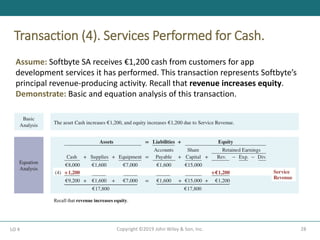
Assume: Softbyte SA receives €1,200 cash from customers for app
development services it has performed. This transaction represents Softbyte’s
principal revenue-producing activity. Recall that revenue increases equity.
Demonstrate: Basic and equation analysis of this transaction.
Recall that revenue increases equity.
Transaction (5). Purchase of Advertising on Credit.
29
Copyright ©2019 John Wiley & Son, Inc.
LO 4
Assume: Softbyte SA receives a bill for €250 from Programming News for
advertising on its website but postpones payment until a later date.
Demonstrate: Basic and equation analysis of this transaction.
The two sides of the equation still balance at €17,800. Retained Earnings decreases when Softbyte incurs the expense.
Expenses do not have to be paid in cash at the time they are incurred.
When Softbyte pays at a later date, the liability Accounts Payable will decrease and the asset Cash will decrease [see
Transaction (8)]. The cost of advertising is an expense (rather than an asset) because Softbyte has used the benefits.
Advertising Expense is included in determining net income.
Transaction (6).
Services Performed for Cash & Credit.
30
Copyright ©2019 John Wiley & Son, Inc.
LO 4
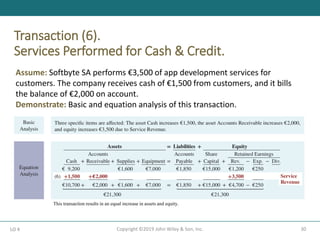
Assume: Softbyte SA performs €3,500 of app development services for
customers. The company receives cash of €1,500 from customers, and it bills
the balance of €2,000 on account.
Demonstrate: Basic and equation analysis of this transaction.
This transaction results in an equal increase in assets and equity.
Transaction (7). Payment of Expenses.
31
Copyright ©2019 John Wiley & Son, Inc.
LO 4
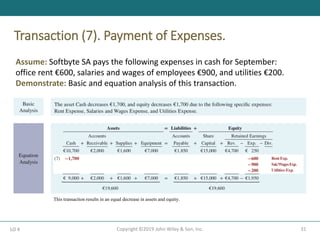
Assume: Softbyte SA pays the following expenses in cash for September:
office rent €600, salaries and wages of employees €900, and utilities €200.
Demonstrate: Basic and equation analysis of this transaction.
This transaction results in an equal decrease in assets and equity.
Transaction (8). Payment of Accounts Payable.
32
Copyright ©2019 John Wiley & Son, Inc.
LO 4
Assume: Softbyte SA pays its €250 Programming News bill in cash. The
company previously [in Transaction (5)] recorded the bill as an increase in
Accounts Payable and a decrease in equity.
Demonstrate: Basic and equation analysis of this transaction.
Observe that the payment of a liability related to an expense that has previously been recorded does not affect equity.
Softbyte recorded the expense [in Transaction (5)] and should not record it again.
Transaction (9). Receipt of Cash on Account.
33
Copyright ©2019 John Wiley & Son, Inc.
LO 4
Assume: Softbyte SA receives €600 in cash from customers who had been
billed for services [in Transaction (6)].
Demonstrate: Basic and equation analysis of this transaction.
Transaction (9) does not change total assets, but it changes the composition of those assets.
Note that the collection of an account receivable for services previously billed and recorded does not affect equity.
Softbyte already recorded this revenue [in Transaction (6)] and should not record it again.
Transaction (10). Dividends.
34
Copyright ©2019 John Wiley & Son, Inc.
LO 4
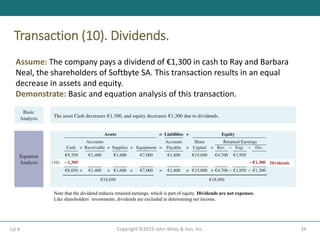
Assume: The company pays a dividend of €1,300 in cash to Ray and Barbara
Neal, the shareholders of Softbyte SA. This transaction results in an equal
decrease in assets and equity.
Demonstrate: Basic and equation analysis of this transaction.
Transaction (9) does not change total assets, but it changes the composition of those assets.
Note that the dividend reduces retained earnings, which is part of equity. Dividends are not expenses.
Like shareholders’ investments, dividends are excluded in determining net income.
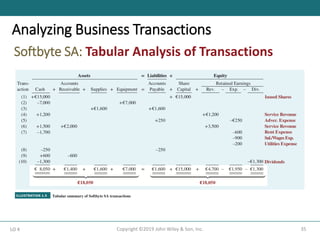
Softbyte SA: Tabular Analysis of Transactions
35
Copyright ©2019 John Wiley & Son, Inc.
LO 4
Analyzing Business Transactions
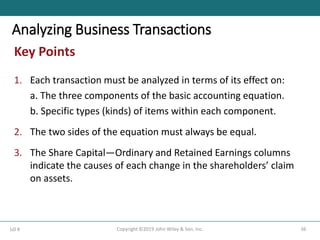
Key Points
36
Copyright ©2019 John Wiley & Son, Inc.
LO 4
1. Each transaction must be analyzed in terms of its effect on:
a. The three components of the basic accounting equation.
b. Specific types (kinds) of items within each component.
2. The two sides of the equation must always be equal.
3. The Share Capital—Ordinary and Retained Earnings columns
indicate the causes of each change in the shareholders’ claim
on assets.
Analyzing Business Transactions
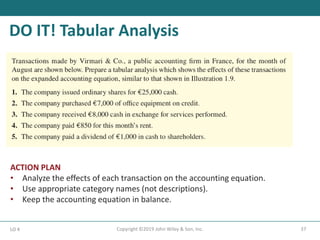
DO IT! Tabular Analysis
37
Copyright ©2019 John Wiley & Son, Inc.
LO 4
ACTION PLAN
• Analyze the effects of each transaction on the accounting equation.
• Use appropriate category names (not descriptions).
• Keep the accounting equation in balance.
38
Copyright ©2019 John Wiley & Son, Inc.
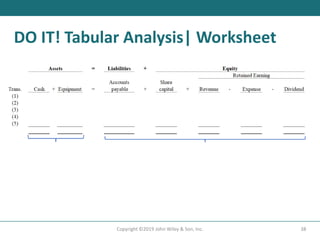
DO IT! Tabular Analysis| Worksheet
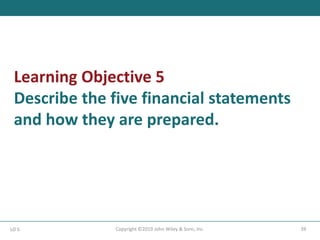
Learning Objective 5
Describe the five financial statements
and how they are prepared.
39
Copyright ©2019 John Wiley & Sons, Inc.
LO 5
Companies prepare five financial statements from the summarized accounting data.
40
Copyright ©2019 John Wiley & Son, Inc.
LO 5
Financial Statements
1. Income statement: presents the revenues and expenses and resulting net
income or net loss for a specific period of time.
2. Retained earnings statement: summarizes the changes in retained earnings
for a specific period of time.
3. Statement of financial position: reports the assets, liabilities, and equity of
a company at a specific date. (Sometimes referred to as a balance sheet.)
4. Statement of cash flows: summarizes information about the cash inflows
(receipts) and outflows (payments) for a specific period of time.
5. Comprehensive income statement: presents other comprehensive income
items that are not included in the determination of net income in 1.
41
Copyright ©2019 John Wiley & Son, Inc.
LO 5
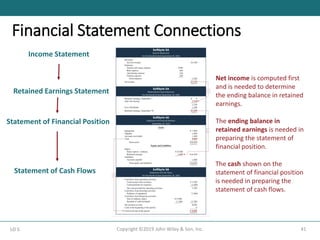
Financial Statement Connections
Net income is computed first
and is needed to determine
the ending balance in retained
earnings.
The ending balance in
retained earnings is needed in
preparing the statement of
financial position.
The cash shown on the
statement of financial position
is needed in preparing the
statement of cash flows.
Income Statement
Retained Earnings Statement
Statement of Financial Position
Statement of Cash Flows
Income Statement
The income statement lists revenues first, followed by expenses.
Then, the statement shows net income (or net loss).
42
Copyright ©2019 John Wiley & Son, Inc.
LO 5
Financial Statements
Structure:
• The income statement lists revenues first, followed by expenses.
• Then, the statement shows net income (or net loss).
• When revenues exceed expenses, net income results.
• When expenses exceed revenues, a net loss results.
• The income statement does not include investment and dividend
transactions between the shareholders and the business in
measuring net income.
Retained Earnings Statement
The information provided by this statement indicates the reasons why
retained earnings increased or decreased during the period. If there is
a net loss, it is deducted with dividends in the retained earnings
statement.
43
Copyright ©2019 John Wiley & Son, Inc.
LO 5
Financial Statements
Structure:
• The first line of the statement shows the beginning retained
earnings amount.
• Then add net income (or subtract net loss) and subtract
dividends.
• The retained earnings ending balance is the final amount on the
statement.
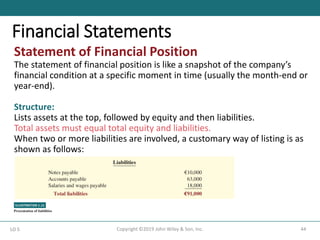
Statement of Financial Position
The statement of financial position is like a snapshot of the company’s
financial condition at a specific moment in time (usually the month-end or
year-end).
Structure:
Lists assets at the top, followed by equity and then liabilities.
Total assets must equal total equity and liabilities.
When two or more liabilities are involved, a customary way of listing is as
shown as follows:
44
Copyright ©2019 John Wiley & Son, Inc.
LO 5
Financial Statements
Statement of Cash Flows
The statement of cash flows provides information on the cash
receipts and payments for a specific period of time.
45
Copyright ©2019 John Wiley & Son, Inc.
LO 5
Financial Statements
Structure:
The statement of cash flows reports
(1) the cash effects of a company’s operations during a period,
(2) its investing activities,
(3) its financing activities,
(4) the net increase or decrease in cash during the period, and
(5) the cash amount at the end of the period.
Comprehensive Income Statement
Other comprehensive income items are not part of net income but are
considered important enough to be reported separately.
This statement immediately follows the income statement.
46
Copyright ©2019 John Wiley & Son, Inc.
LO 5
Financial Statements
IFRS Alternative:
IFRS allows an alternative statement format in which the
information contained in the income statement and the
comprehensive income statement are combined in a single
statement, referred to as a statement of comprehensive income.
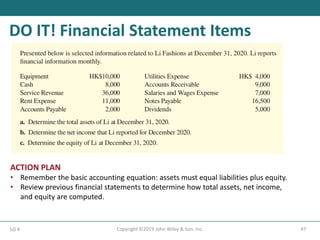
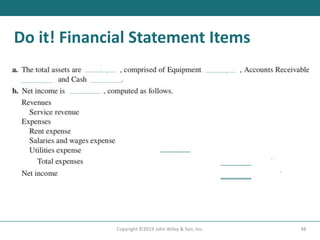
DO IT! Financial Statement Items
47
Copyright ©2019 John Wiley & Son, Inc.
LO 4
ACTION PLAN
• Remember the basic accounting equation: assets must equal liabilities plus equity.
• Review previous financial statements to determine how total assets, net income,
and equity are computed.
48
Copyright ©2019 John Wiley & Son, Inc.
Do it! Financial Statement Items
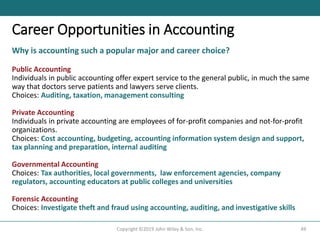
Why is accounting such a popular major and career choice?
Public Accounting
Individuals in public accounting offer expert service to the general public, in much the same
way that doctors serve patients and lawyers serve clients.
Choices: Auditing, taxation, management consulting
Private Accounting
Individuals in private accounting are employees of for-profit companies and not-for-profit
organizations.
Choices: Cost accounting, budgeting, accounting information system design and support,
tax planning and preparation, internal auditing
Governmental Accounting
Choices: Tax authorities, local governments, law enforcement agencies, company
regulators, accounting educators at public colleges and universities
Forensic Accounting
Choices: Investigate theft and fraud using accounting, auditing, and investigative skills
49
Copyright ©2019 John Wiley & Son, Inc.
Career Opportunities in Accounting
Copyright
Copyright © 2019 John Wiley & Sons, Inc.
All rights reserved. Reproduction or translation of this work beyond that permitted in
Section 117 of the 1976 United States Act without the express written permission of the
copyright owner is unlawful. Request for further information should be addressed to the
Permissions Department, John Wiley & Sons, Inc. The purchaser may make back-up
copies for his/her own use only and not for distribution or resale. The Publisher assumes
no responsibility for errors, omissions, or damages, caused by the use of these programs
or from the use of the information contained herein.
50
Copyright ©2019 John Wiley & Son, Inc.

ch01_Student version.pdfádasdasdasdasdasdasd

  • 1.
    Financial Accounting IFRS 4thEdition Chapter 1 Accounting in Action Weygandt ● Kimmel ● Kieso
  • 2.
    Chapter Preview Good decision-makingdepends on good information. Whatever your pursuits or occupation, the need for financial information is inescapable. You cannot earn a living, spend money, buy on credit, make an investment, or pay taxes without receiving, using, or dispensing financial information. Good decision-making depends on good information. 2 Copyright ©2019 John Wiley & Son, Inc.
  • 3.
    Chapter Outline 3 Copyright ©2019John Wiley & Son, Inc.
  • 4.
    Learning Objective 1 Identifythe activities and users associated with accounting. 4 Copyright ©2019 John Wiley & Sons, Inc. LO 1
  • 5.
    Accounting Activities andUsers 5 Copyright ©2019 John Wiley & Son, Inc. Three Activities LO 1
  • 6.
    Accounting Activities andUsers 6 Copyright ©2019 John Wiley & Son, Inc. Internal Users LO 1
  • 7.
    Accounting Activities andUsers 7 Copyright ©2019 John Wiley & Son, Inc. External Users (1/2) LO 1
  • 8.
    Accounting Activities andUsers 8 Copyright ©2019 John Wiley & Son, Inc. External Users (2/2) Taxing authorities: Does the company comply with the tax laws? Regulatory agencies: Is the company operating within prescribed rules? Labor unions: Does the company have the ability to pay increased wages and benefits to union members? LO 1
  • 9.
    DO IT! BasicConcepts 9 Copyright ©2019 John Wiley & Son, Inc. LO 4 ACTION PLAN • Review the basic concepts discussed. • Develop an understanding of the key terms used.
  • 10.
    Learning Objective 2 Explainthe building blocks of accounting: ethics, principles, and assumptions. 10 Copyright ©2019 John Wiley & Sons, Inc. LO 1
  • 11.
    The Building Blocksof Accounting 11 Copyright ©2019 John Wiley & Son, Inc. Ethics in Financial Reporting LO 2
  • 12.
    The Building Blocksof Accounting 12 Copyright ©2019 John Wiley & Son, Inc. Accounting Standards Ensure high-quality financial reporting. Primary accounting standard-setting bodies: International Accounting Standards Board (IASB) • Determines International Financial Reporting Standards (IFRS) • Used in 130 countries Financial Accounting Standards Board (FASB) • Determines generally accepted accounting principles (GAAP) • Used by most companies in the U.S. LO 2
  • 13.
    The Building Blocksof Accounting 13 Copyright ©2019 John Wiley & Son, Inc. Measurement Principles IFRS generally uses one of two measurement principles, the historical cost principle or the fair value principle. Historical cost principle (or cost principle): dictates that companies record assets at their cost. This is true not only at the time the asset is purchased, but also over the time the asset is held. Fair value principle: states that assets and liabilities should be reported at fair value (the price received to sell an asset or settle a liability). LO 2
  • 14.
    The Building Blocksof Accounting 14 Copyright ©2019 John Wiley & Son, Inc. Selecting Measurement Principles Selection of which principle to follow generally relates to trade-offs between relevance and faithful representation. Relevance means that financial information is capable of making a difference in a decision. Faithful representation means that the numbers and descriptions match what really existed or happened—they are factual. LO 2
  • 15.
    The Building Blocksof Accounting 15 Copyright ©2019 John Wiley & Son, Inc. Assumptions Assumptions provide a foundation for the accounting process. Two main assumptions are the monetary unit assumption and the economic entity assumption. Monetary unit assumption: requires that companies include in the accounting records only transaction data that can be expressed in money terms. Economic Entity Assumption: requires that the activities of the entity be kept separate and distinct from the activities of its owner and all other economic entities. Typical entity forms are proprietorship, partnership, corporation. LO 2
  • 16.
    DO IT! BuildingBlocks of Accounting 16 Copyright ©2019 John Wiley & Son, Inc. LO 4 ACTION PLAN • Review the discussion of ethics and financial reporting standards. • Develop an understanding of the key terms used.
  • 17.
    Learning Objective 3 Statethe accounting equation, and define its components. 17 Copyright ©2019 John Wiley & Sons, Inc. LO 3
  • 18.
    The Accounting Equation 18 Copyright©2019 John Wiley & Son, Inc. LO 3 Assets: resources a business owns. Liabilities: claims against assets, i.e. existing debts and obligations. Equity: the ownership claim on a company’s total assets. The Basic Accounting Equation
  • 19.
    The Accounting Equation 19 Copyright©2019 John Wiley & Son, Inc. LO 3 Equity Share capital—ordinary: describes the amounts paid in by shareholders for the ordinary shares they purchase. Revenues: are the gross increases in equity resulting from business activities entered into for the purpose of earning income. Revenues usually result in an increase in an asset. Expenses: are the cost of assets consumed or services used in the process of earning revenue. Dividends: are distribution of cash or other assets to shareholders. They are not an expense.
  • 20.
    DO IT! EquityEffects 20 Copyright ©2019 John Wiley & Son, Inc. LO 4 a. Rent Expense b. Service Revenue c. Dividends d. Salaries and Wage Expense ACTION PLAN • Understand the sources of revenue. • Understand what causes expenses. • Review the rules for changes in equity: Investments and revenues increase equity. Expenses and dividends decrease equity. • Recognize that dividends are distributions of cash or other assets to shareholders.
  • 21.
    Learning Objective 4 Analyzethe effects of business transactions on the accounting equation. 21 Copyright ©2019 John Wiley & Sons, Inc. LO 4
  • 22.
    Analyzing Business Transactions 22 Copyright©2019 John Wiley & Son, Inc. LO 4 Accounting Information System: The system of collecting and processing transaction data and communicating financial information to decision-makers. The steps companies follow each period to record transactions and eventually prepare financial statements:
  • 23.
    Analyzing Business Transactions 23 Copyright©2019 John Wiley & Son, Inc. LO 4 Identifying Accounting Transactions
  • 24.
    Analyzing Business Transactions 24 Copyright©2019 John Wiley & Son, Inc. LO 4 Expanding the Balance Sheet Equation for analysis
  • 25.
    Transaction (1). Investmentby Shareholders. 25 Copyright ©2019 John Wiley & Son, Inc. LO 4 Assume: Ray and Barbara Neal decide to start a smartphone app development company that they incorporate as Softbyte SA. On September 1, 2020, they invest €15,000 cash in the business in exchange for €15,000 of ordinary shares. The ordinary shares indicates the ownership interest that the Neals have in Softbyte SA. Demonstrate: Basic and equation analysis of this transaction. Observe that the equality of the basic equation has been maintained. Note also that the source of the increase in equity (in this case, issued shares) is indicated.
  • 26.
    Transaction(2). Purchase ofEquipment for Cash. 26 Copyright ©2019 John Wiley & Son, Inc. LO 4 Assume: Softbyte SA purchases computer equipment for €7,000 cash. Demonstrate: Basic and equation analysis of this transaction. This transaction results in an equal increase and decrease in total assets, though the composition of assets changes.
  • 27.
    Transaction(3). Purchase ofSupplies on Credit. 27 Copyright ©2019 John Wiley & Son, Inc. LO 4 Assume: Softbyte SA purchases headsets (and other computer accessories expected to last several months) for €1,600 from Mobile Solutions. Mobile Solutions agrees to allow Softbyte to pay this bill in October. This transaction is a purchase on account (a credit purchase). Demonstrate: Basic and equation analysis of this transaction. Assets increase because of the expected future benefits of using the headsets and computer accessories, and liabilities increase by the amount due Mobile Solutions.
  • 28.
    Transaction (4). ServicesPerformed for Cash. 28 Copyright ©2019 John Wiley & Son, Inc. LO 4 Assume: Softbyte SA receives €1,200 cash from customers for app development services it has performed. This transaction represents Softbyte’s principal revenue-producing activity. Recall that revenue increases equity. Demonstrate: Basic and equation analysis of this transaction. Recall that revenue increases equity.
  • 29.
    Transaction (5). Purchaseof Advertising on Credit. 29 Copyright ©2019 John Wiley & Son, Inc. LO 4 Assume: Softbyte SA receives a bill for €250 from Programming News for advertising on its website but postpones payment until a later date. Demonstrate: Basic and equation analysis of this transaction. The two sides of the equation still balance at €17,800. Retained Earnings decreases when Softbyte incurs the expense. Expenses do not have to be paid in cash at the time they are incurred. When Softbyte pays at a later date, the liability Accounts Payable will decrease and the asset Cash will decrease [see Transaction (8)]. The cost of advertising is an expense (rather than an asset) because Softbyte has used the benefits. Advertising Expense is included in determining net income.
  • 30.
    Transaction (6). Services Performedfor Cash & Credit. 30 Copyright ©2019 John Wiley & Son, Inc. LO 4 Assume: Softbyte SA performs €3,500 of app development services for customers. The company receives cash of €1,500 from customers, and it bills the balance of €2,000 on account. Demonstrate: Basic and equation analysis of this transaction. This transaction results in an equal increase in assets and equity.
  • 31.
    Transaction (7). Paymentof Expenses. 31 Copyright ©2019 John Wiley & Son, Inc. LO 4 Assume: Softbyte SA pays the following expenses in cash for September: office rent €600, salaries and wages of employees €900, and utilities €200. Demonstrate: Basic and equation analysis of this transaction. This transaction results in an equal decrease in assets and equity.
  • 32.
    Transaction (8). Paymentof Accounts Payable. 32 Copyright ©2019 John Wiley & Son, Inc. LO 4 Assume: Softbyte SA pays its €250 Programming News bill in cash. The company previously [in Transaction (5)] recorded the bill as an increase in Accounts Payable and a decrease in equity. Demonstrate: Basic and equation analysis of this transaction. Observe that the payment of a liability related to an expense that has previously been recorded does not affect equity. Softbyte recorded the expense [in Transaction (5)] and should not record it again.
  • 33.
    Transaction (9). Receiptof Cash on Account. 33 Copyright ©2019 John Wiley & Son, Inc. LO 4 Assume: Softbyte SA receives €600 in cash from customers who had been billed for services [in Transaction (6)]. Demonstrate: Basic and equation analysis of this transaction. Transaction (9) does not change total assets, but it changes the composition of those assets. Note that the collection of an account receivable for services previously billed and recorded does not affect equity. Softbyte already recorded this revenue [in Transaction (6)] and should not record it again.
  • 34.
    Transaction (10). Dividends. 34 Copyright©2019 John Wiley & Son, Inc. LO 4 Assume: The company pays a dividend of €1,300 in cash to Ray and Barbara Neal, the shareholders of Softbyte SA. This transaction results in an equal decrease in assets and equity. Demonstrate: Basic and equation analysis of this transaction. Transaction (9) does not change total assets, but it changes the composition of those assets. Note that the dividend reduces retained earnings, which is part of equity. Dividends are not expenses. Like shareholders’ investments, dividends are excluded in determining net income.
  • 35.
    Softbyte SA: TabularAnalysis of Transactions 35 Copyright ©2019 John Wiley & Son, Inc. LO 4 Analyzing Business Transactions
  • 36.
    Key Points 36 Copyright ©2019John Wiley & Son, Inc. LO 4 1. Each transaction must be analyzed in terms of its effect on: a. The three components of the basic accounting equation. b. Specific types (kinds) of items within each component. 2. The two sides of the equation must always be equal. 3. The Share Capital—Ordinary and Retained Earnings columns indicate the causes of each change in the shareholders’ claim on assets. Analyzing Business Transactions
  • 37.
    DO IT! TabularAnalysis 37 Copyright ©2019 John Wiley & Son, Inc. LO 4 ACTION PLAN • Analyze the effects of each transaction on the accounting equation. • Use appropriate category names (not descriptions). • Keep the accounting equation in balance.
  • 38.
    38 Copyright ©2019 JohnWiley & Son, Inc. DO IT! Tabular Analysis| Worksheet
  • 39.
    Learning Objective 5 Describethe five financial statements and how they are prepared. 39 Copyright ©2019 John Wiley & Sons, Inc. LO 5
  • 40.
    Companies prepare fivefinancial statements from the summarized accounting data. 40 Copyright ©2019 John Wiley & Son, Inc. LO 5 Financial Statements 1. Income statement: presents the revenues and expenses and resulting net income or net loss for a specific period of time. 2. Retained earnings statement: summarizes the changes in retained earnings for a specific period of time. 3. Statement of financial position: reports the assets, liabilities, and equity of a company at a specific date. (Sometimes referred to as a balance sheet.) 4. Statement of cash flows: summarizes information about the cash inflows (receipts) and outflows (payments) for a specific period of time. 5. Comprehensive income statement: presents other comprehensive income items that are not included in the determination of net income in 1.
  • 41.
    41 Copyright ©2019 JohnWiley & Son, Inc. LO 5 Financial Statement Connections Net income is computed first and is needed to determine the ending balance in retained earnings. The ending balance in retained earnings is needed in preparing the statement of financial position. The cash shown on the statement of financial position is needed in preparing the statement of cash flows. Income Statement Retained Earnings Statement Statement of Financial Position Statement of Cash Flows
  • 42.
    Income Statement The incomestatement lists revenues first, followed by expenses. Then, the statement shows net income (or net loss). 42 Copyright ©2019 John Wiley & Son, Inc. LO 5 Financial Statements Structure: • The income statement lists revenues first, followed by expenses. • Then, the statement shows net income (or net loss). • When revenues exceed expenses, net income results. • When expenses exceed revenues, a net loss results. • The income statement does not include investment and dividend transactions between the shareholders and the business in measuring net income.
  • 43.
    Retained Earnings Statement Theinformation provided by this statement indicates the reasons why retained earnings increased or decreased during the period. If there is a net loss, it is deducted with dividends in the retained earnings statement. 43 Copyright ©2019 John Wiley & Son, Inc. LO 5 Financial Statements Structure: • The first line of the statement shows the beginning retained earnings amount. • Then add net income (or subtract net loss) and subtract dividends. • The retained earnings ending balance is the final amount on the statement.
  • 44.
    Statement of FinancialPosition The statement of financial position is like a snapshot of the company’s financial condition at a specific moment in time (usually the month-end or year-end). Structure: Lists assets at the top, followed by equity and then liabilities. Total assets must equal total equity and liabilities. When two or more liabilities are involved, a customary way of listing is as shown as follows: 44 Copyright ©2019 John Wiley & Son, Inc. LO 5 Financial Statements
  • 45.
    Statement of CashFlows The statement of cash flows provides information on the cash receipts and payments for a specific period of time. 45 Copyright ©2019 John Wiley & Son, Inc. LO 5 Financial Statements Structure: The statement of cash flows reports (1) the cash effects of a company’s operations during a period, (2) its investing activities, (3) its financing activities, (4) the net increase or decrease in cash during the period, and (5) the cash amount at the end of the period.
  • 46.
    Comprehensive Income Statement Othercomprehensive income items are not part of net income but are considered important enough to be reported separately. This statement immediately follows the income statement. 46 Copyright ©2019 John Wiley & Son, Inc. LO 5 Financial Statements IFRS Alternative: IFRS allows an alternative statement format in which the information contained in the income statement and the comprehensive income statement are combined in a single statement, referred to as a statement of comprehensive income.
  • 47.
    DO IT! FinancialStatement Items 47 Copyright ©2019 John Wiley & Son, Inc. LO 4 ACTION PLAN • Remember the basic accounting equation: assets must equal liabilities plus equity. • Review previous financial statements to determine how total assets, net income, and equity are computed.
  • 48.
    48 Copyright ©2019 JohnWiley & Son, Inc. Do it! Financial Statement Items
  • 49.
    Why is accountingsuch a popular major and career choice? Public Accounting Individuals in public accounting offer expert service to the general public, in much the same way that doctors serve patients and lawyers serve clients. Choices: Auditing, taxation, management consulting Private Accounting Individuals in private accounting are employees of for-profit companies and not-for-profit organizations. Choices: Cost accounting, budgeting, accounting information system design and support, tax planning and preparation, internal auditing Governmental Accounting Choices: Tax authorities, local governments, law enforcement agencies, company regulators, accounting educators at public colleges and universities Forensic Accounting Choices: Investigate theft and fraud using accounting, auditing, and investigative skills 49 Copyright ©2019 John Wiley & Son, Inc. Career Opportunities in Accounting
  • 50.
    Copyright Copyright © 2019John Wiley & Sons, Inc. All rights reserved. Reproduction or translation of this work beyond that permitted in Section 117 of the 1976 United States Act without the express written permission of the copyright owner is unlawful. Request for further information should be addressed to the Permissions Department, John Wiley & Sons, Inc. The purchaser may make back-up copies for his/her own use only and not for distribution or resale. The Publisher assumes no responsibility for errors, omissions, or damages, caused by the use of these programs or from the use of the information contained herein. 50 Copyright ©2019 John Wiley & Son, Inc.