Human Resource University
Chapter 13: Motivation,
Teaching, and Learning
1
 Tel: 017471117
 Lecturer: Mr. VATH Vary
 Email: varyvath@gmail.com
Preview
2
3
Motivation, Teaching, and Learning
Exploring motivation
Perspective
on motivation
What is
Motivation?
MR. VATH VARY
Why did Terry Fox do this
run?
Terry Fox's Long-Distance Run: A Motivational
Story
 Terry Fox, a Canadian, ran 3,359 miles across
Canada, averaging a marathon (26.2 miles) a
day for five months.
 Fox lost a leg to cancer before the run, so he
ran with a prosthetic limb.
 Fox's motivation for the run was to fund cancer
research.
 Despite encountering unforeseen challenges,
Fox maintained his pace and continued running.
 His story is portrayed in the classroom film, "The
Power of Purpose," which resonated with
students, emphasizing the importance of
perseverance and spirit despite physical
challenges.
4
MR. VATH VARY
5
Motivation
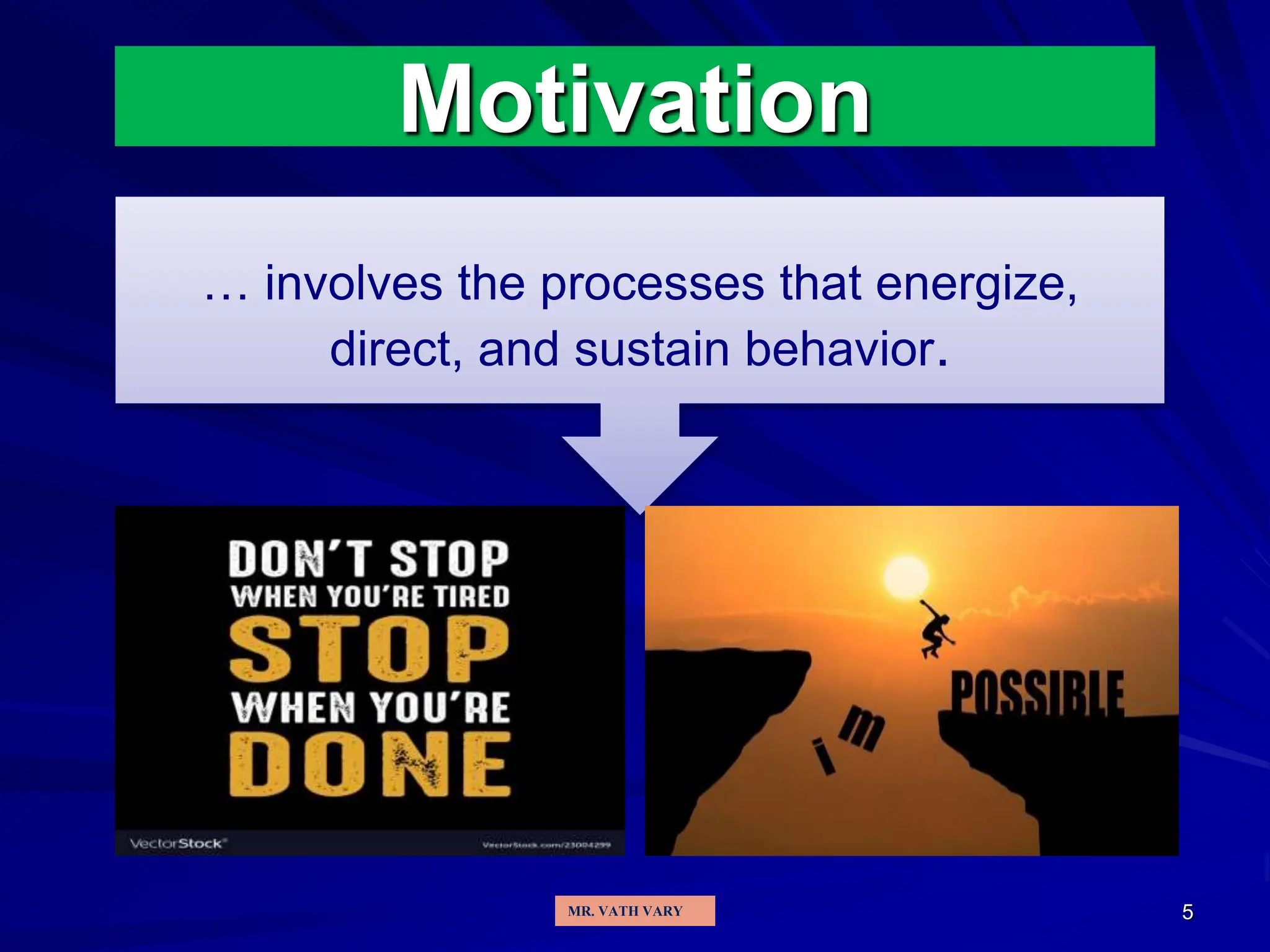
… involves the processes that energize,
direct, and sustain behavior.
MR. VATH VARY
6
The Behavioral Perspective
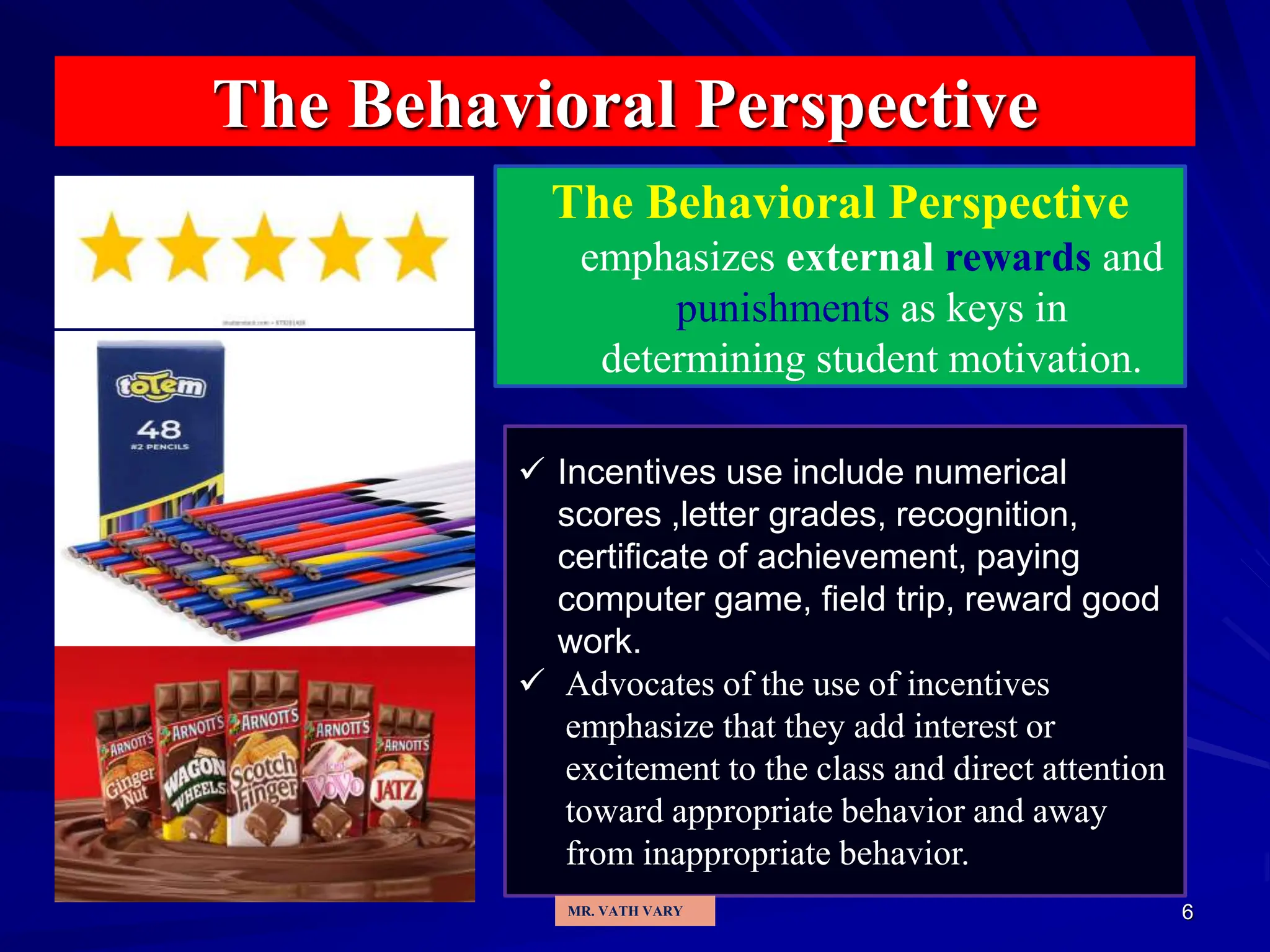
emphasizes external rewards and
punishments as keys in
determining student motivation.
 Incentives use include numerical
scores ,letter grades, recognition,
certificate of achievement, paying
computer game, field trip, reward good
work.
 Advocates of the use of incentives
emphasize that they add interest or
excitement to the class and direct attention
toward appropriate behavior and away
from inappropriate behavior.
MR. VATH VARY
7
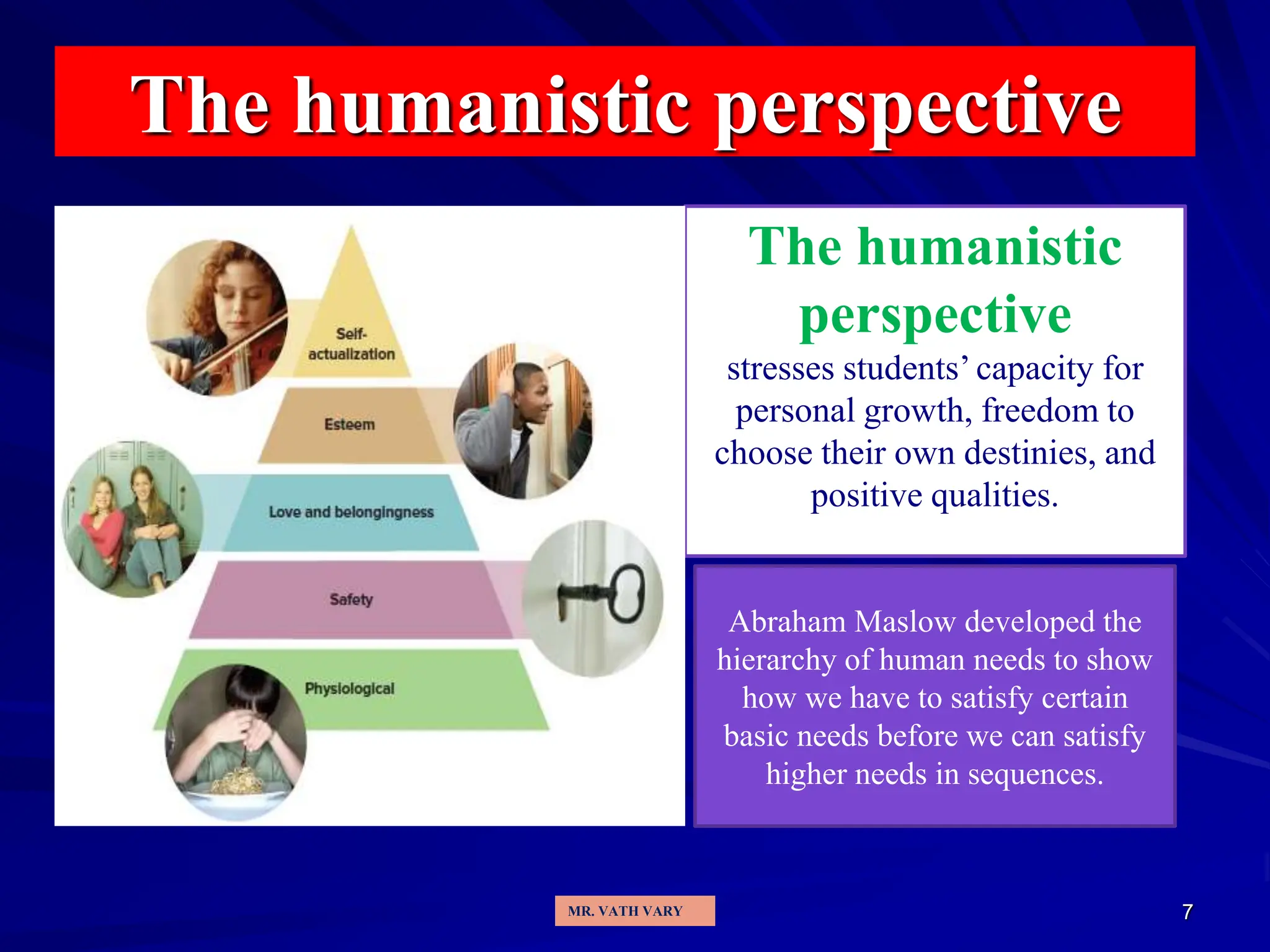
The humanistic perspective
The humanistic
perspective
stresses students’ capacity for
personal growth, freedom to
choose their own destinies, and
positive qualities.
Abraham Maslow developed the
hierarchy of human needs to show
how we have to satisfy certain
basic needs before we can satisfy
higher needs in sequences.
MR. VATH VARY
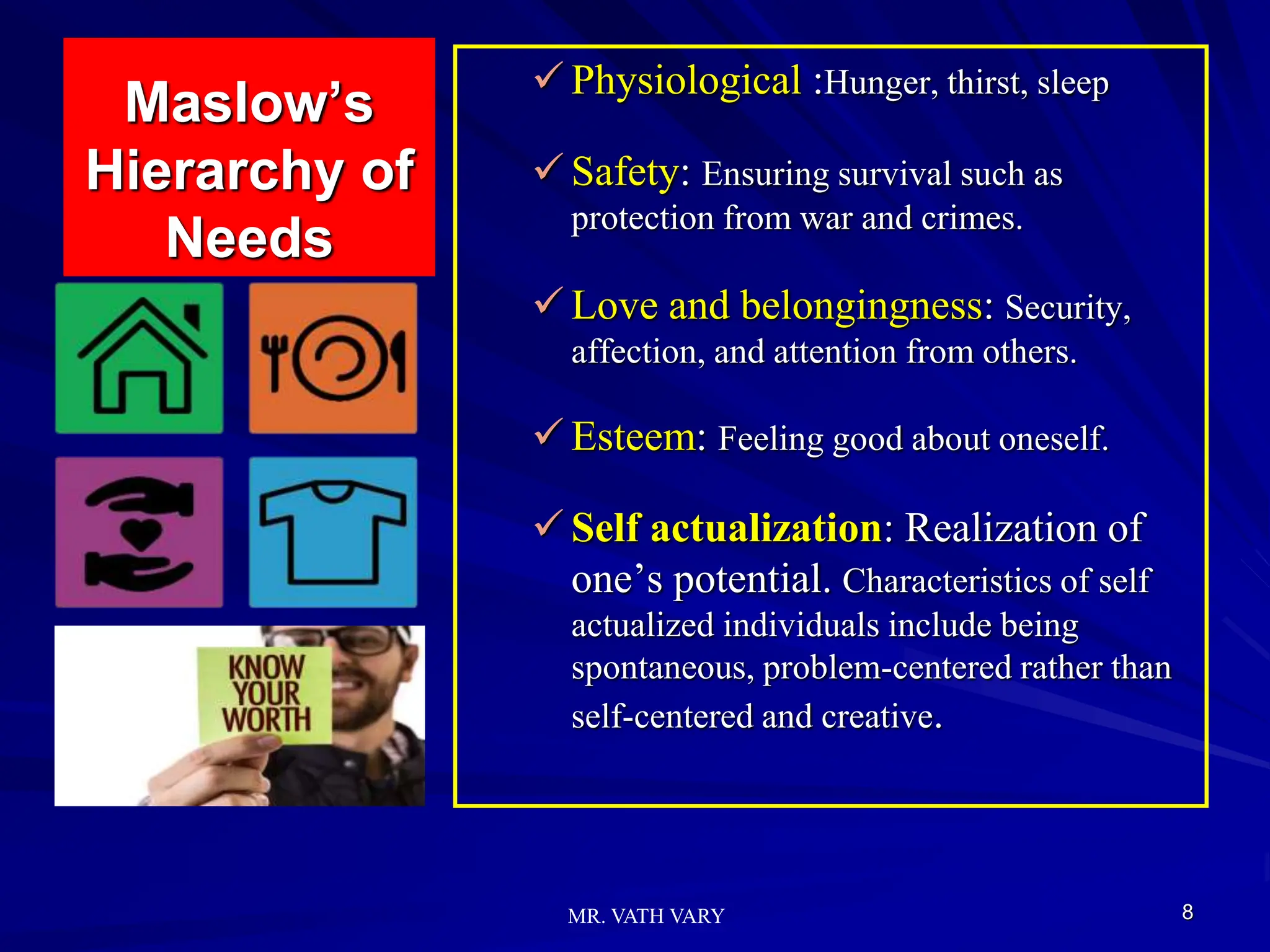
Maslow’s
Hierarchy of
Needs
 Physiological :Hunger, thirst, sleep
 Safety: Ensuring survival such as
protection from war and crimes.
 Love and belongingness: Security,
affection, and attention from others.
 Esteem: Feeling good about oneself.
 Self actualization: Realization of
one’s potential. Characteristics of self
actualized individuals include being
spontaneous, problem-centered rather than
self-centered and creative.
8
MR. VATH VARY
9
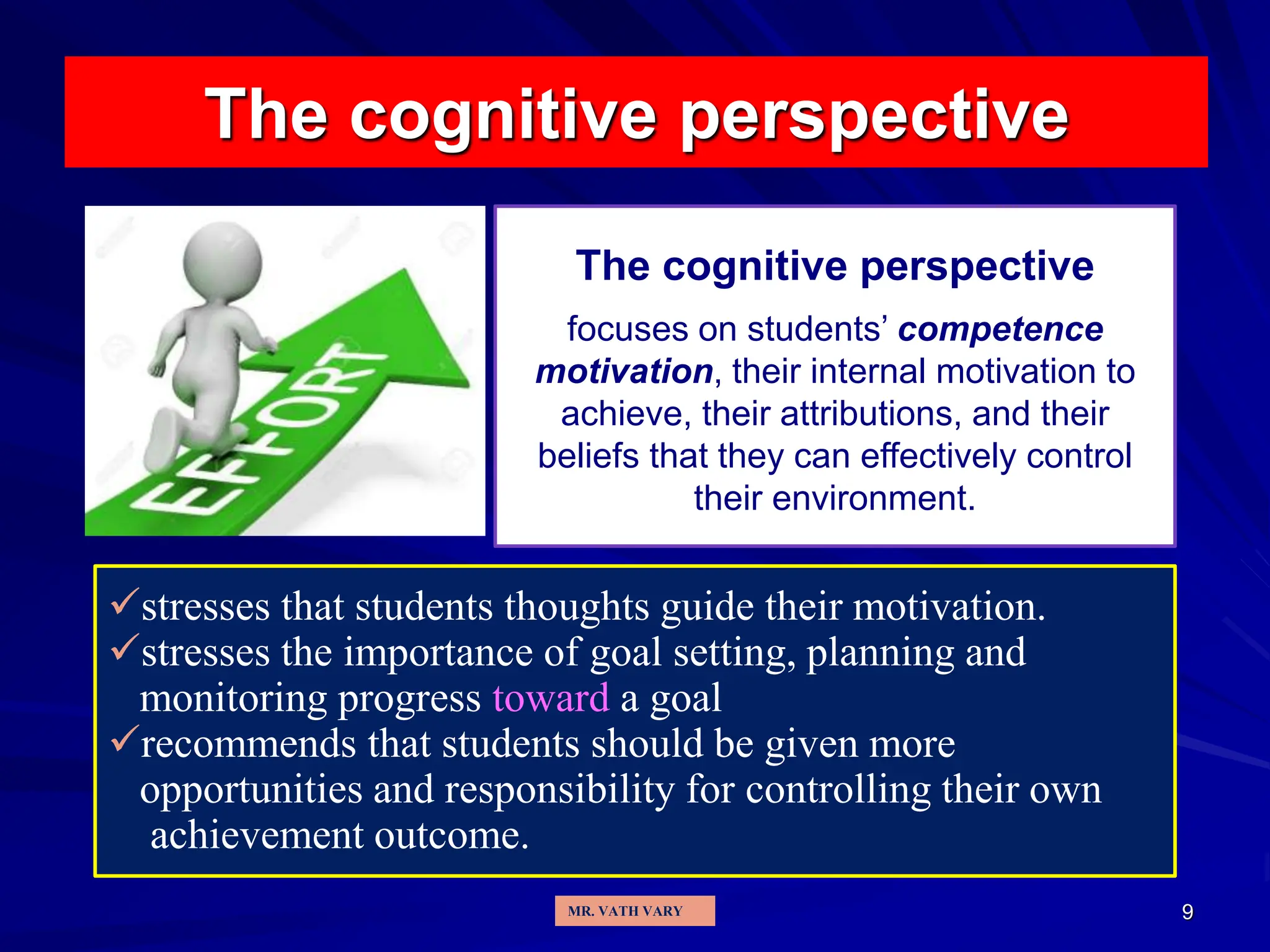
The cognitive perspective
focuses on students’ competence
motivation, their internal motivation to
achieve, their attributions, and their
beliefs that they can effectively control
their environment.
stresses that students thoughts guide their motivation.
stresses the importance of goal setting, planning and
monitoring progress toward a goal
recommends that students should be given more
opportunities and responsibility for controlling their own
achievement outcome.
MR. VATH VARY
10
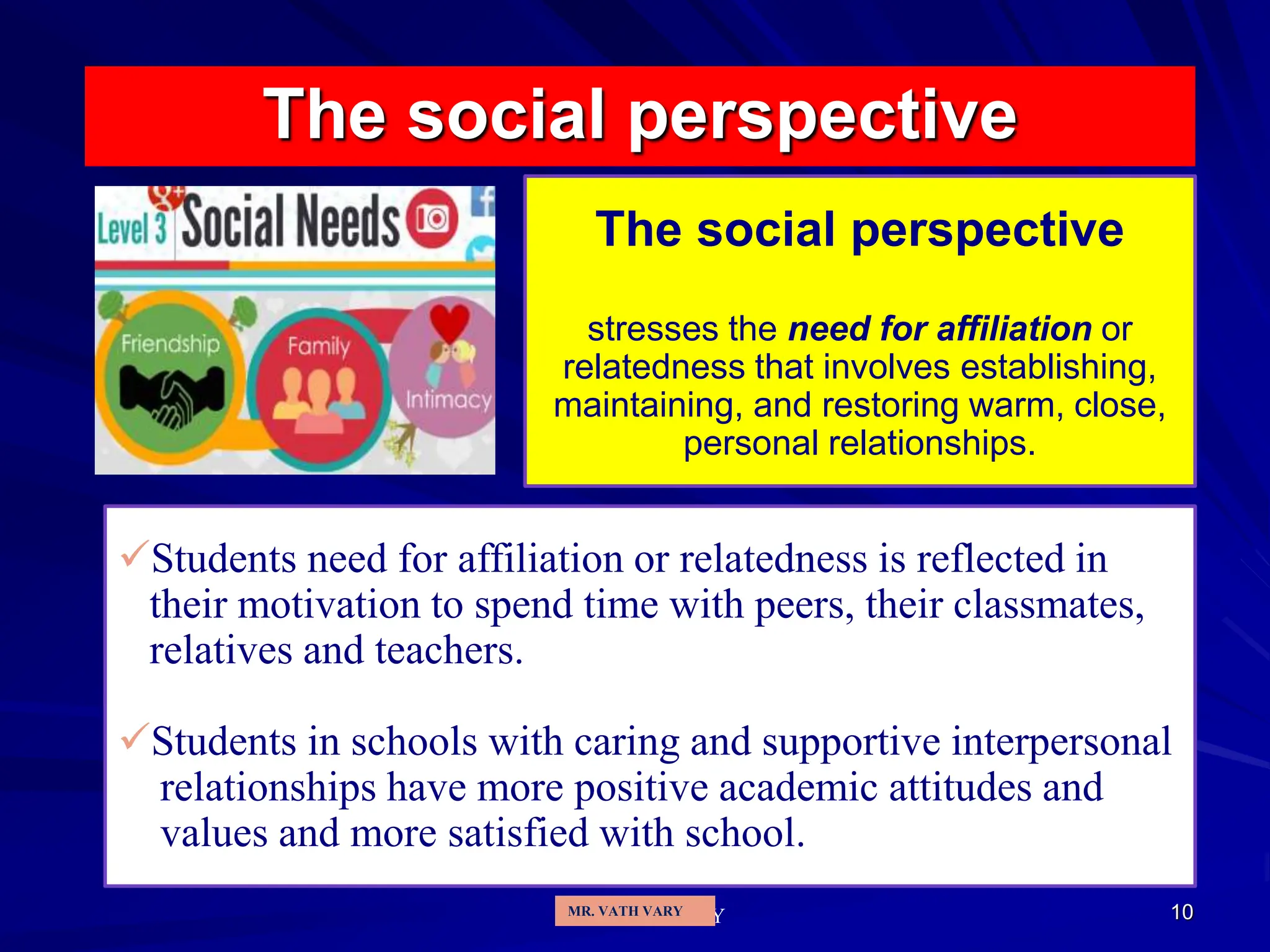
The social perspective
stresses the need for affiliation or
relatedness that involves establishing,
maintaining, and restoring warm, close,
personal relationships.
Students need for affiliation or relatedness is reflected in
their motivation to spend time with peers, their classmates,
relatives and teachers.
Students in schools with caring and supportive interpersonal
relationships have more positive academic attitudes and
values and more satisfied with school.
MR. VATH VARY
MR. VATH VARY
11
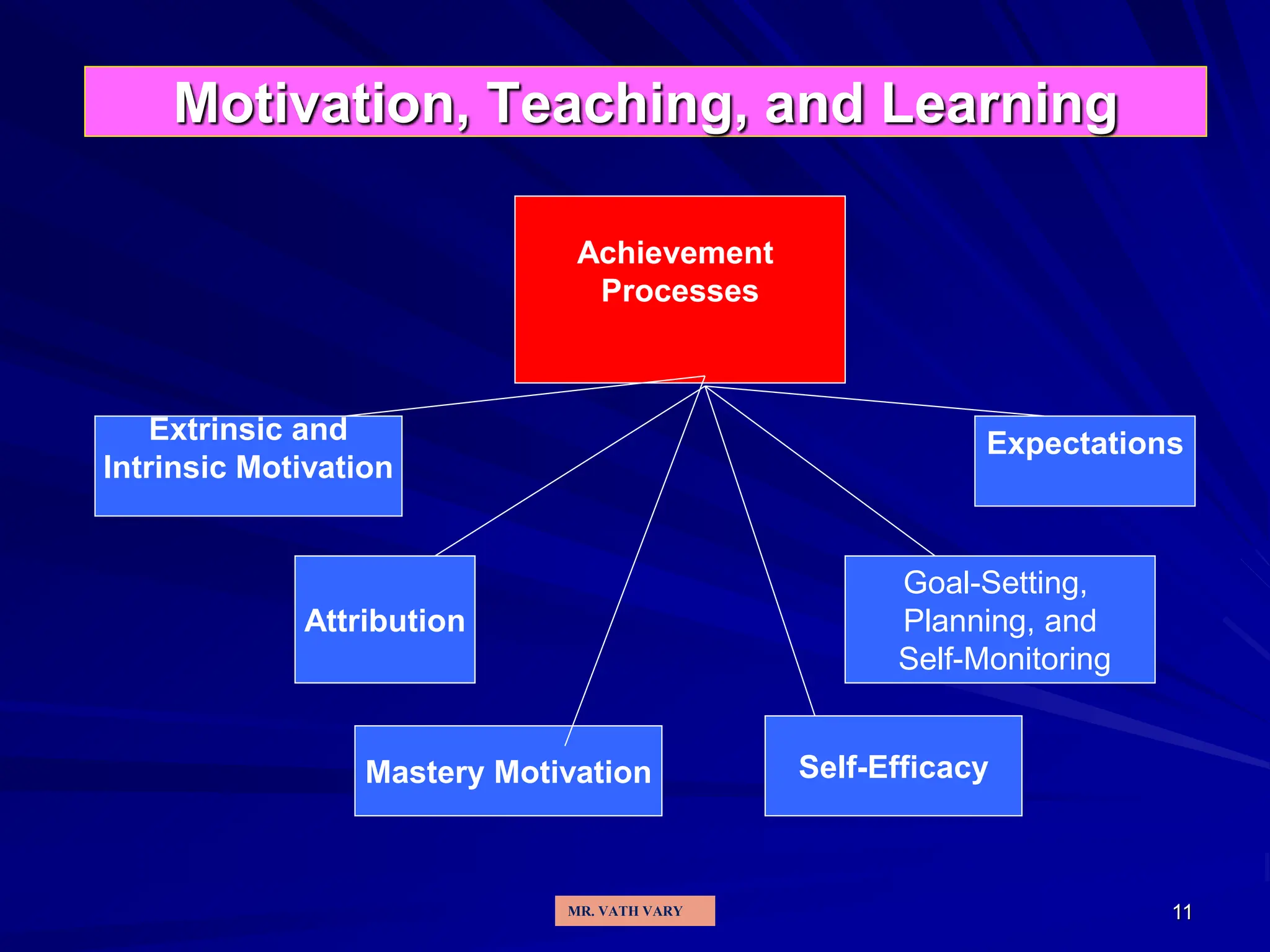
Motivation, Teaching, and Learning
Achievement
Processes
Extrinsic and
Intrinsic Motivation
Expectations
Attribution
Goal-Setting,
Planning, and
Self-Monitoring
Mastery Motivation Self-Efficacy
MR. VATH VARY
12
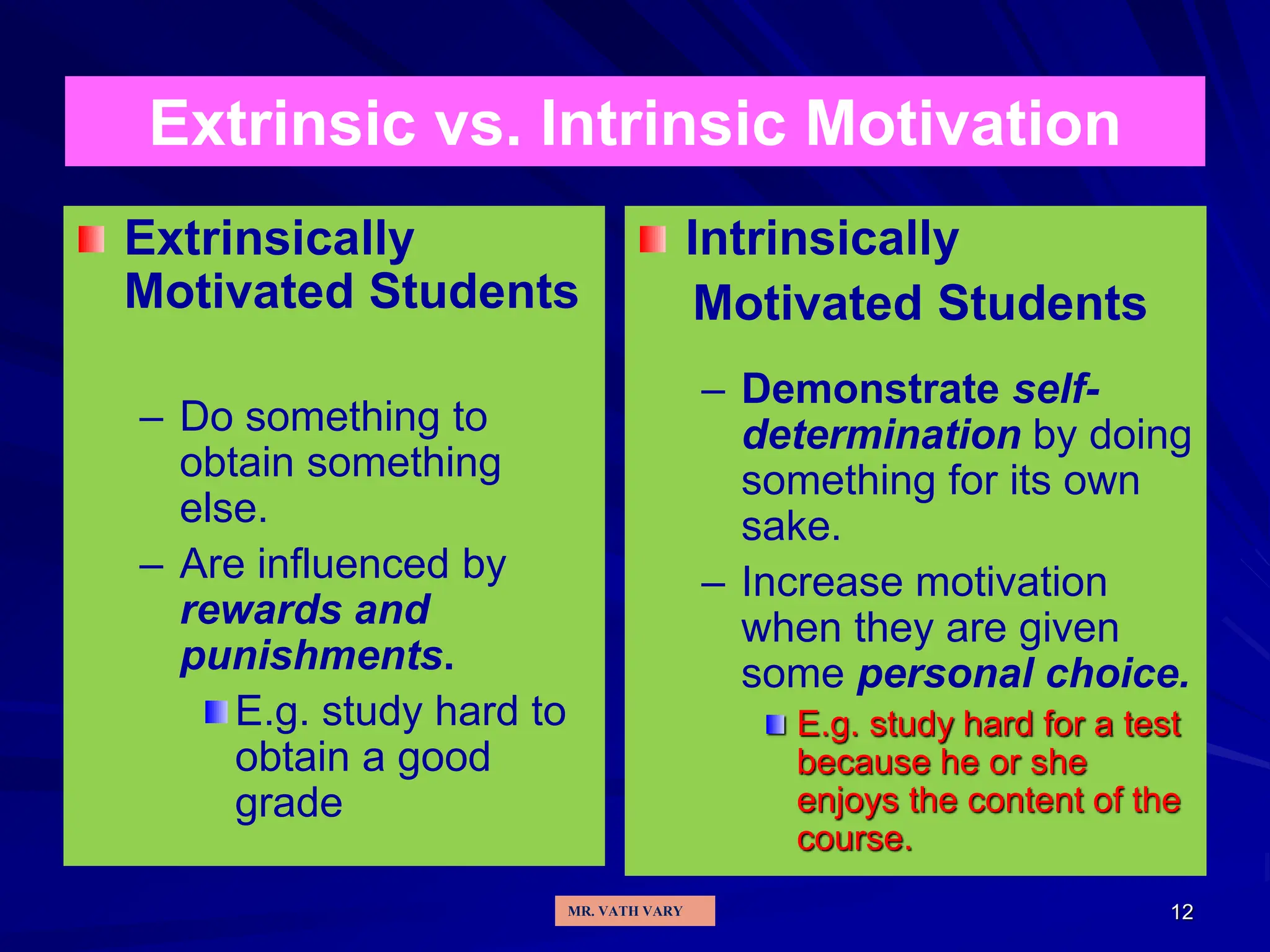
Extrinsic vs. Intrinsic Motivation
Extrinsically
Motivated Students
– Do something to
obtain something
else.
– Are influenced by
rewards and
punishments.
E.g. study hard to
obtain a good
grade
Intrinsically
Motivated Students
– Demonstrate self-
determination by doing
something for its own
sake.
– Increase motivation
when they are given
some personal choice.
E.g. study hard for a test
because he or she
enjoys the content of the
course.
MR. VATH VARY
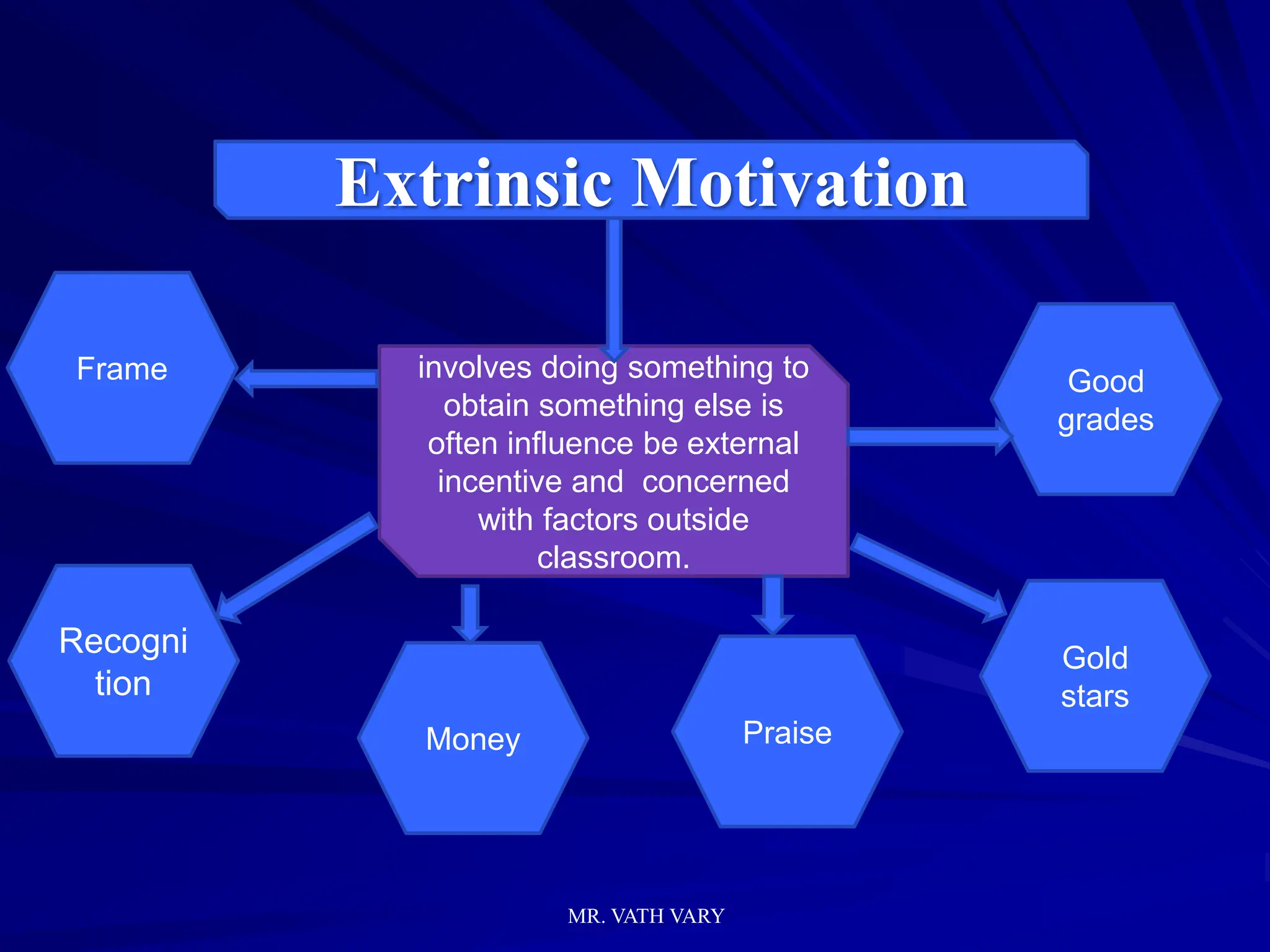
Extrinsic Motivation
involves doing something to
obtain something else is
often influence be external
incentive and concerned
with factors outside
classroom.
Good
grades
Gold
stars
Praise
Money
Recogni
tion
Frame
MR. VATH VARY
14
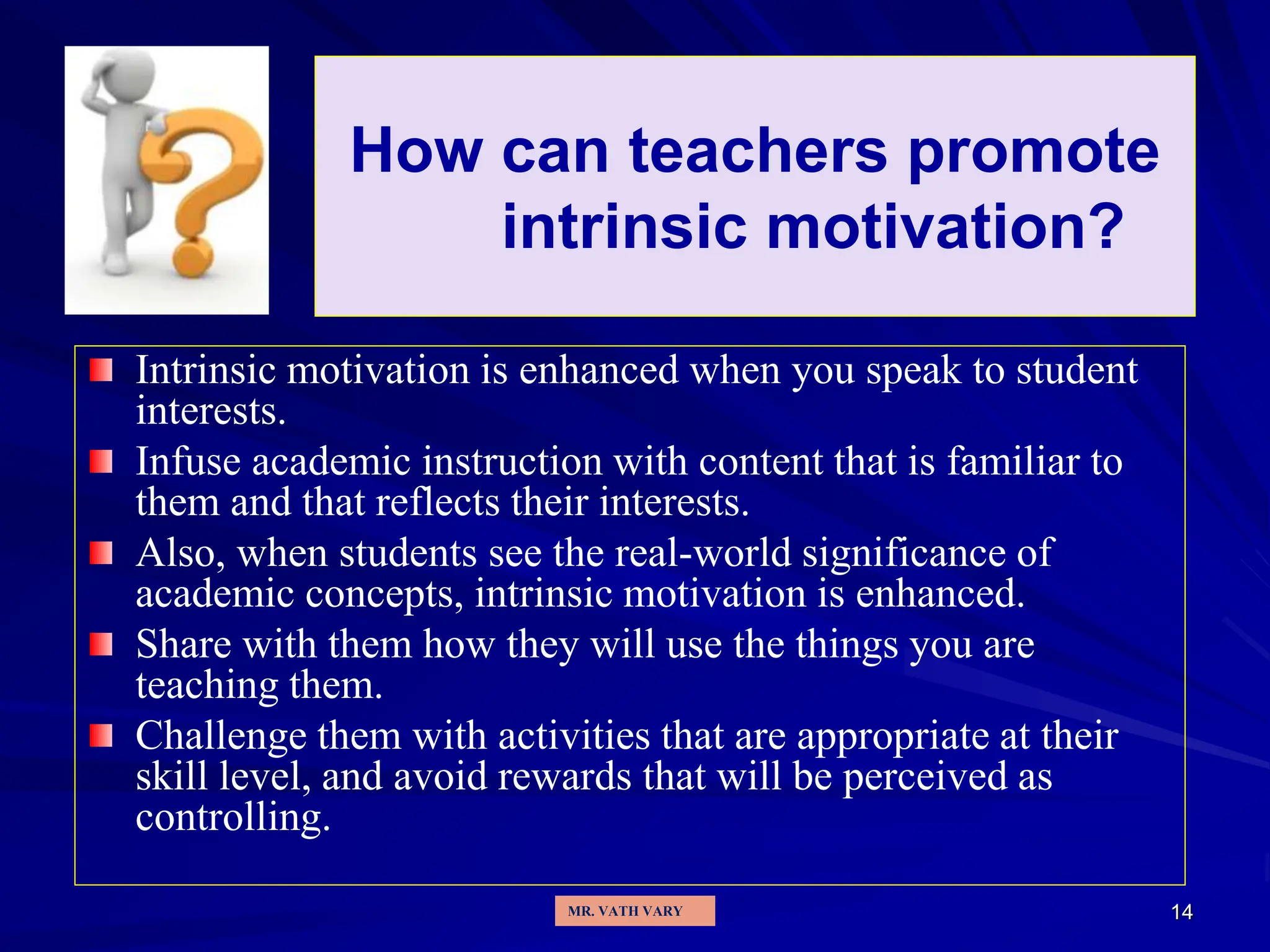
How can teachers promote
intrinsic motivation?
Intrinsic motivation is enhanced when you speak to student
interests.
Infuse academic instruction with content that is familiar to
them and that reflects their interests.
Also, when students see the real-world significance of
academic concepts, intrinsic motivation is enhanced.
Share with them how they will use the things you are
teaching them.
Challenge them with activities that are appropriate at their
skill level, and avoid rewards that will be perceived as
controlling.
MR. VATH VARY
15
Types of intrinsic motivation
Self determination and personal choices:
– In this view, students want to believe that they are
doing something because of their own will, not
because of external success or rewards.
– Research results indicated that students in the intrinsic
motivation/self determination group:
were given opportunities to set their own goals, plan
how to reach the goals and monitor their progress
toward the goals
had higher achievement gains and were more likely to
graduate from high school compared with a control
group.
MR. VATH VARY
16
Types of intrinsic motivation
Optimal Experiences and Flow:
– Mihaly Csikszentmihalyi ( 1990,1993,2000)
developed ideas that are relevant to understanding
intrinsic motivation
– Optimal experiences involve feelings of deep
enjoyment and happiness.
– He uses the term ‘flow’ describe optimal
experiences in life.
MR. VATH VARY
Types of intrinsic motivation
17
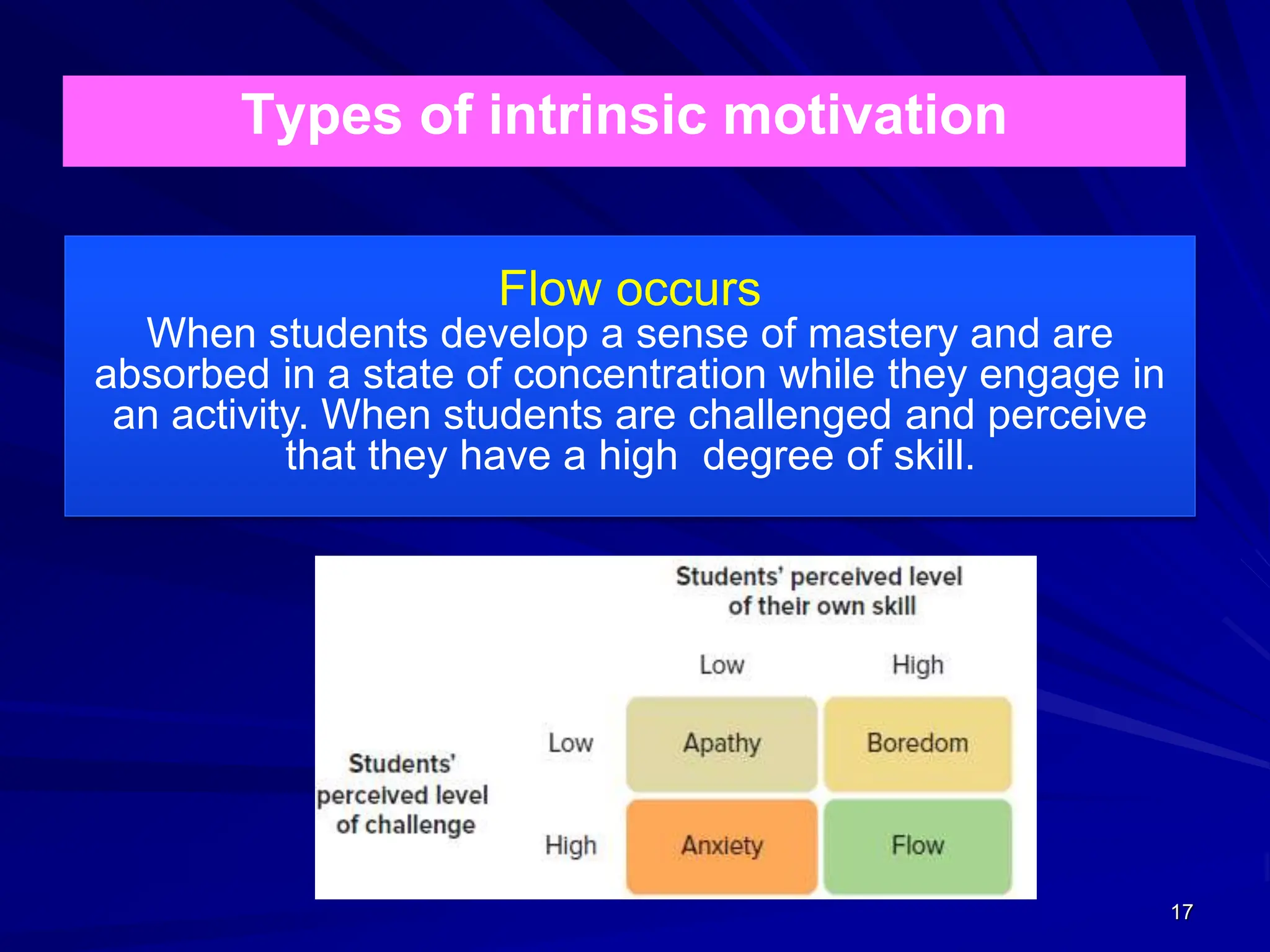
Flow occurs
When students develop a sense of mastery and are
absorbed in a state of concentration while they engage in
an activity. When students are challenged and perceive
that they have a high degree of skill.
18
Types of intrinsic motivation
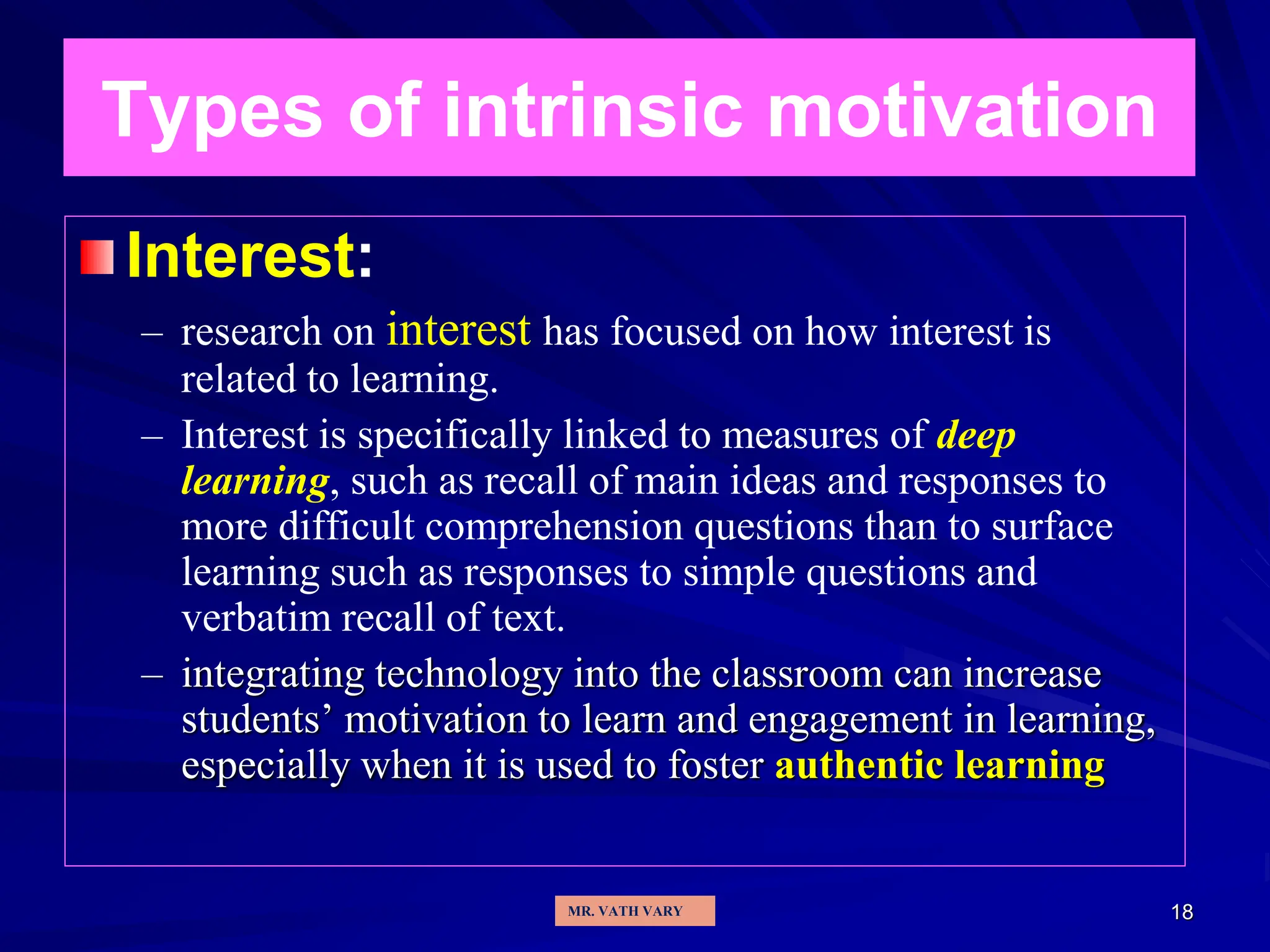
Interest:
– research on interest has focused on how interest is
related to learning.
– Interest is specifically linked to measures of deep
learning, such as recall of main ideas and responses to
more difficult comprehension questions than to surface
learning such as responses to simple questions and
verbatim recall of text.
– integrating technology into the classroom can increase
students’ motivation to learn and engagement in learning,
especially when it is used to foster authentic learning
MR. VATH VARY
19
Types of intrinsic motivation
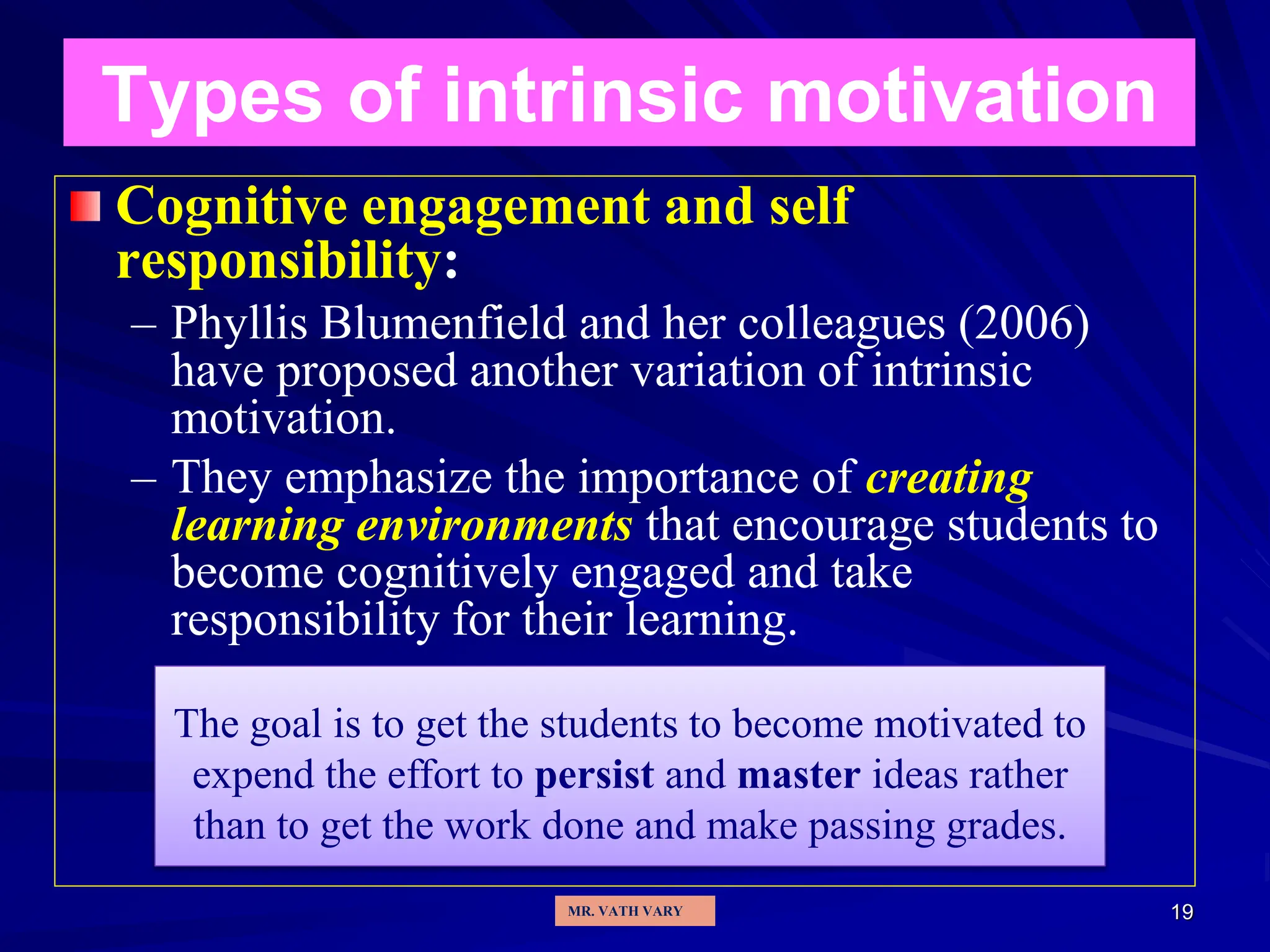
Cognitive engagement and self
responsibility:
– Phyllis Blumenfield and her colleagues (2006)
have proposed another variation of intrinsic
motivation.
– They emphasize the importance of creating
learning environments that encourage students to
become cognitively engaged and take
responsibility for their learning.
The goal is to get the students to become motivated to
expend the effort to persist and master ideas rather
than to get the work done and make passing grades.
MR. VATH VARY
20
Attribution Theory
Bernard Weiner
Questions:
– “Why am I not doing well in this class?”
– “Did I get a good grade because I studied
hard or the teacher made up an easy test, or
both?”
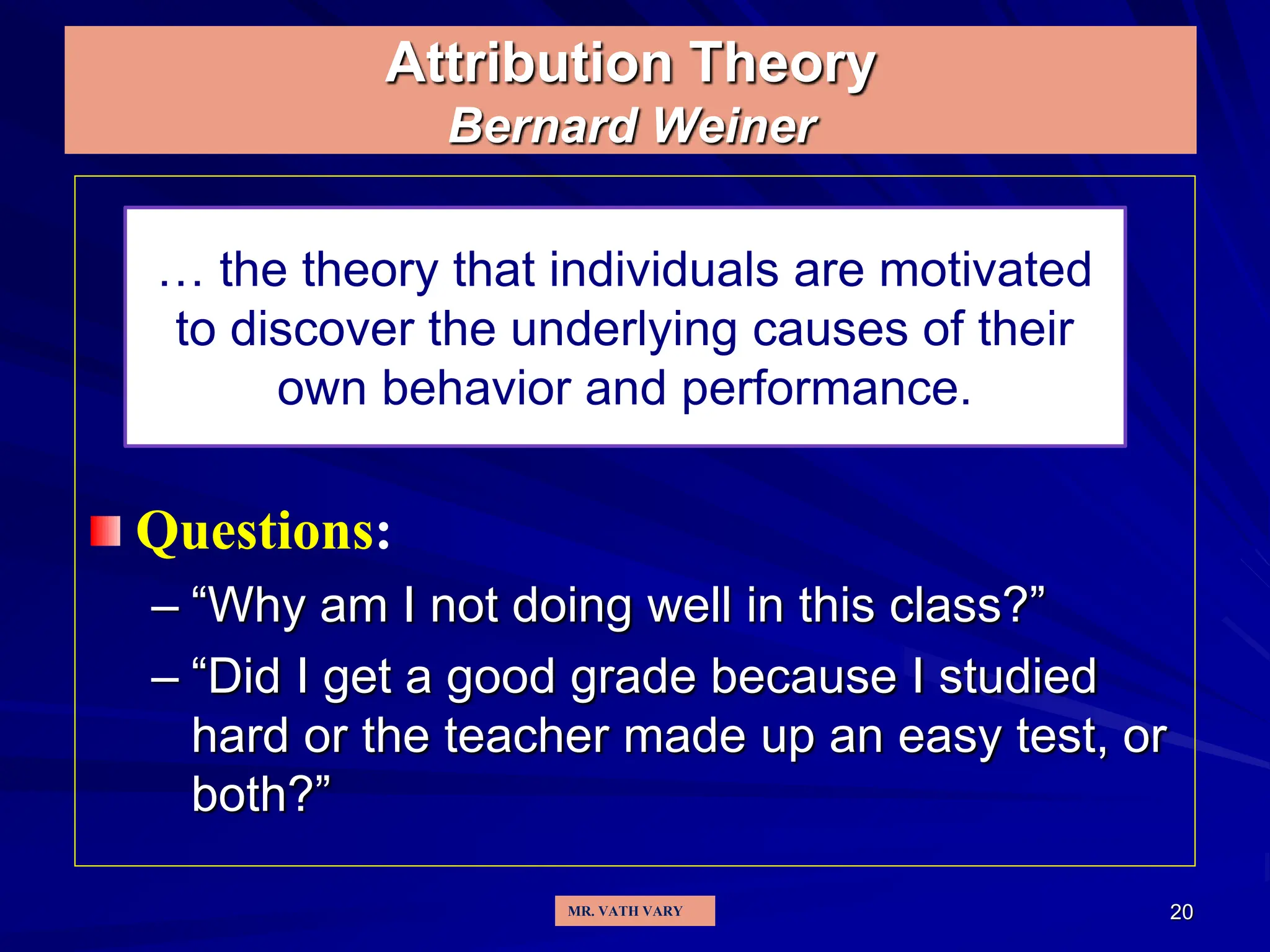
… the theory that individuals are motivated
to discover the underlying causes of their
own behavior and performance.
MR. VATH VARY
21
Attribution Theory
Bernard Weiner
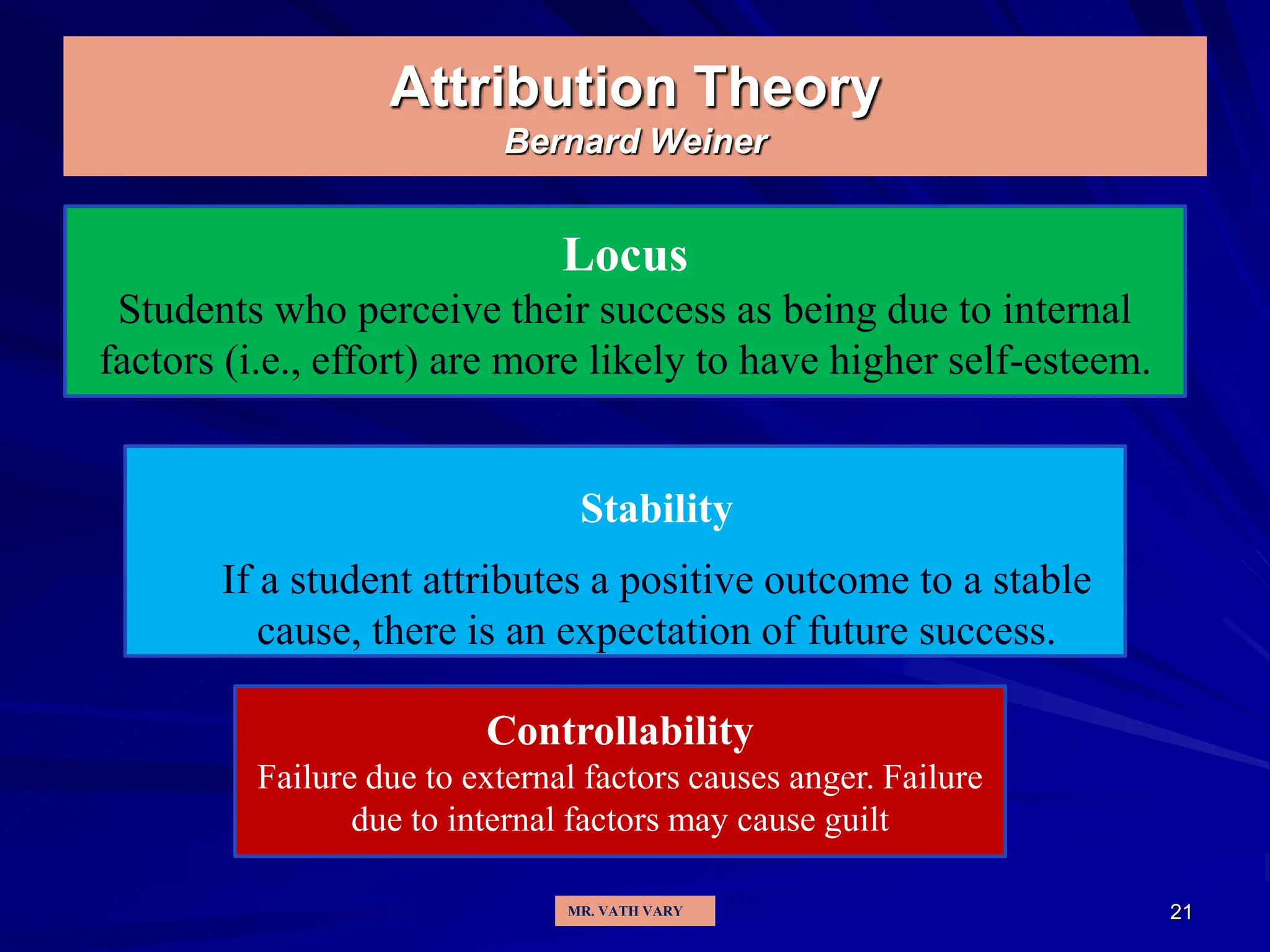
Locus
Students who perceive their success as being due to internal
factors (i.e., effort) are more likely to have higher self-esteem.
Stability
If a student attributes a positive outcome to a stable
cause, there is an expectation of future success.
Controllability
Failure due to external factors causes anger. Failure
due to internal factors may cause guilt
MR. VATH VARY
22
Attribution Theory
Bernard Weiner
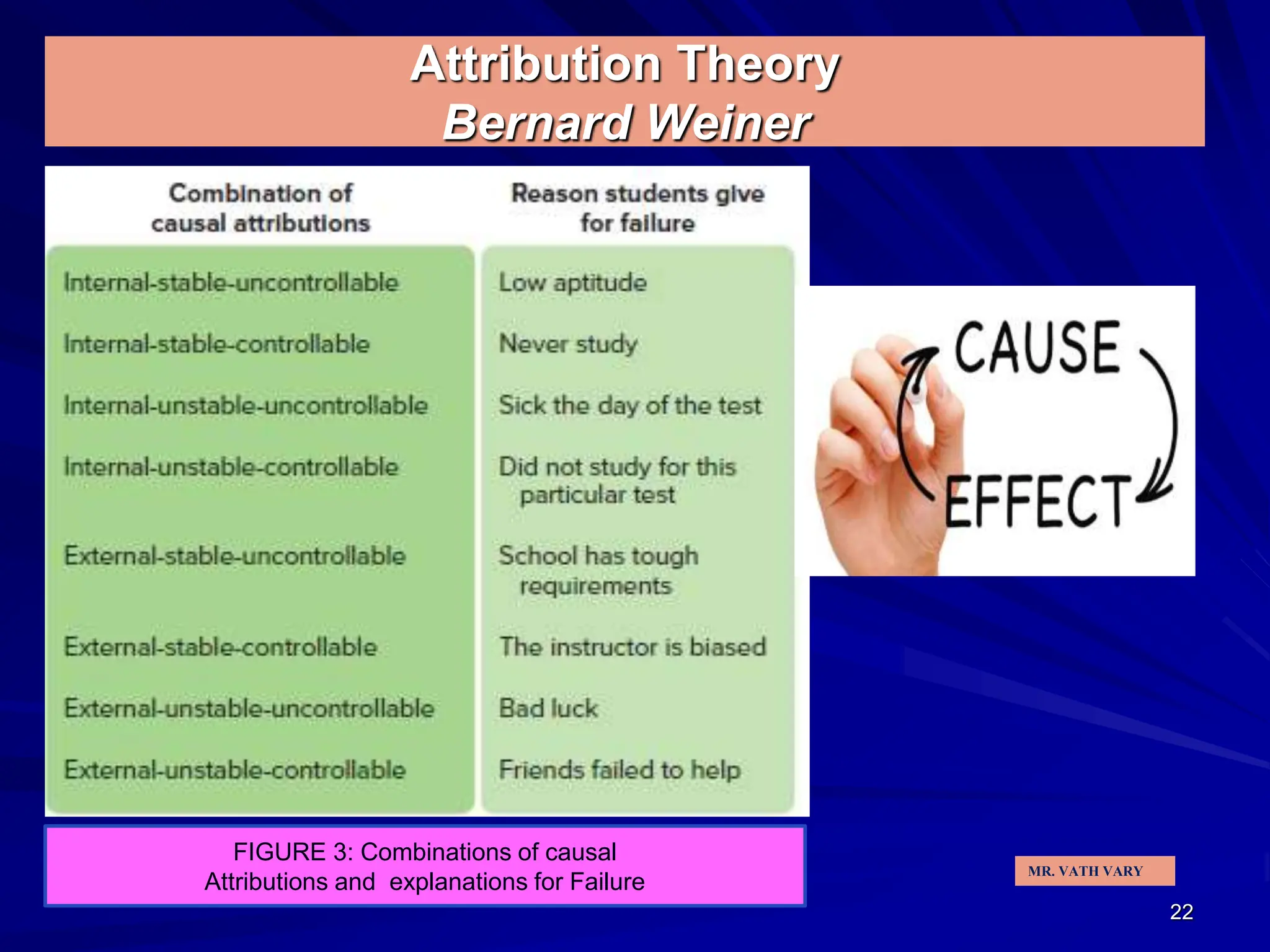
FIGURE 3: Combinations of causal
Attributions and explanations for Failure
MR. VATH VARY
23
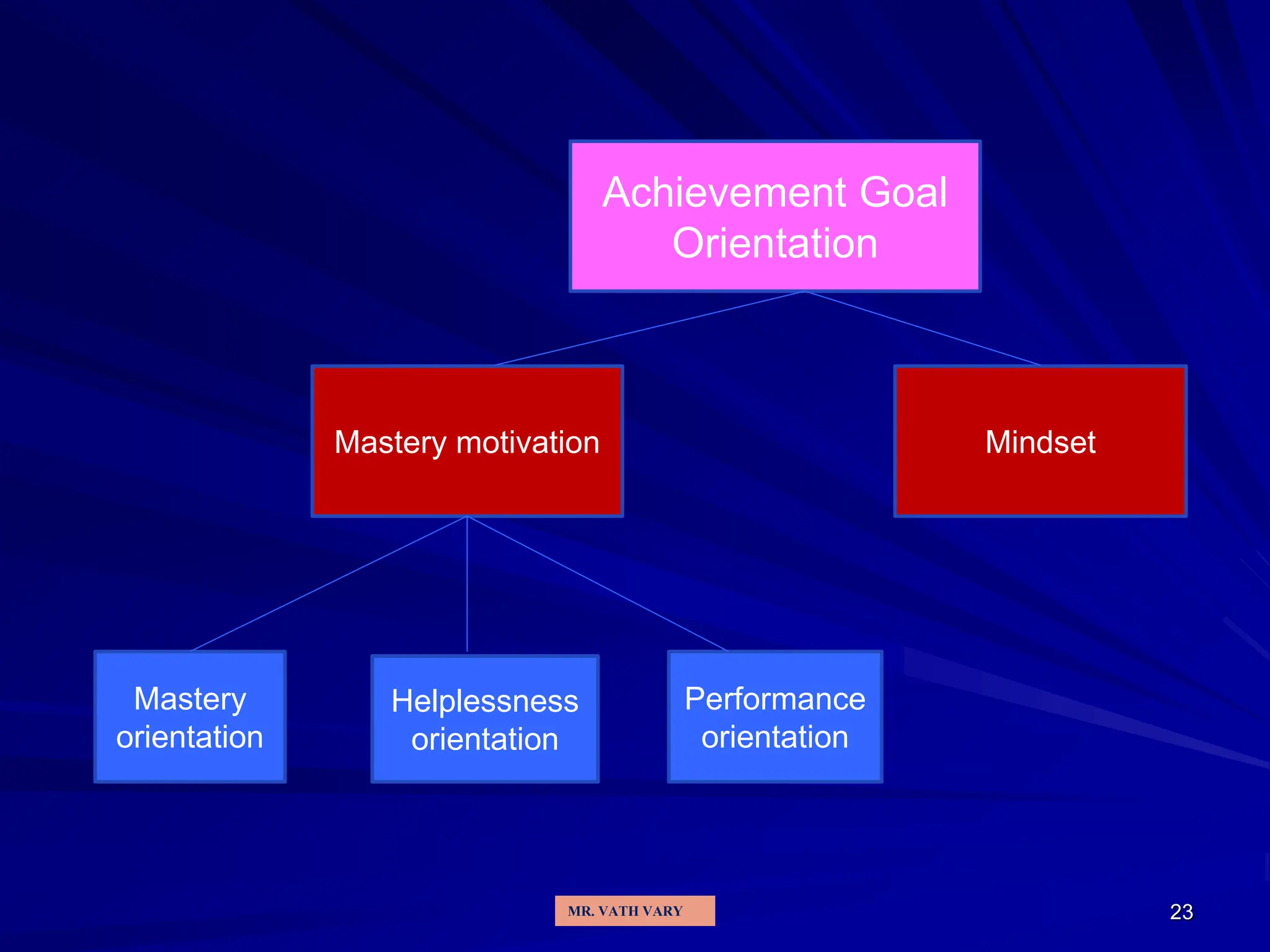
Achievement Goal
Orientation
Mastery motivation Mindset
Mastery
orientation
Performance
orientation
Helplessness
orientation
MR. VATH VARY
24
Mastery motivation
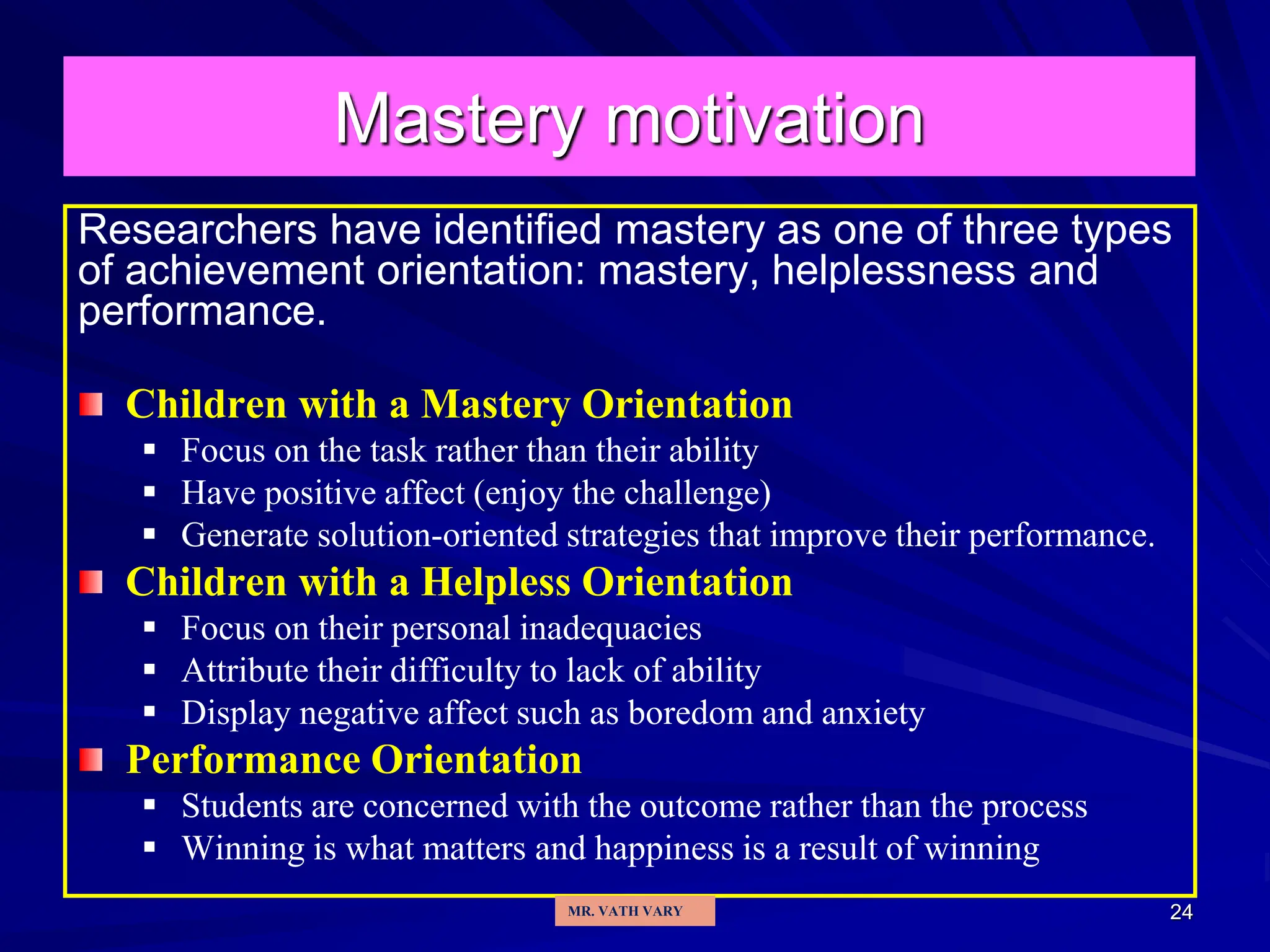
Researchers have identified mastery as one of three types
of achievement orientation: mastery, helplessness and
performance.
Children with a Mastery Orientation
 Focus on the task rather than their ability
 Have positive affect (enjoy the challenge)
 Generate solution-oriented strategies that improve their performance.
Children with a Helpless Orientation
 Focus on their personal inadequacies
 Attribute their difficulty to lack of ability
 Display negative affect such as boredom and anxiety
Performance Orientation
 Students are concerned with the outcome rather than the process
 Winning is what matters and happiness is a result of winning
MR. VATH VARY
25
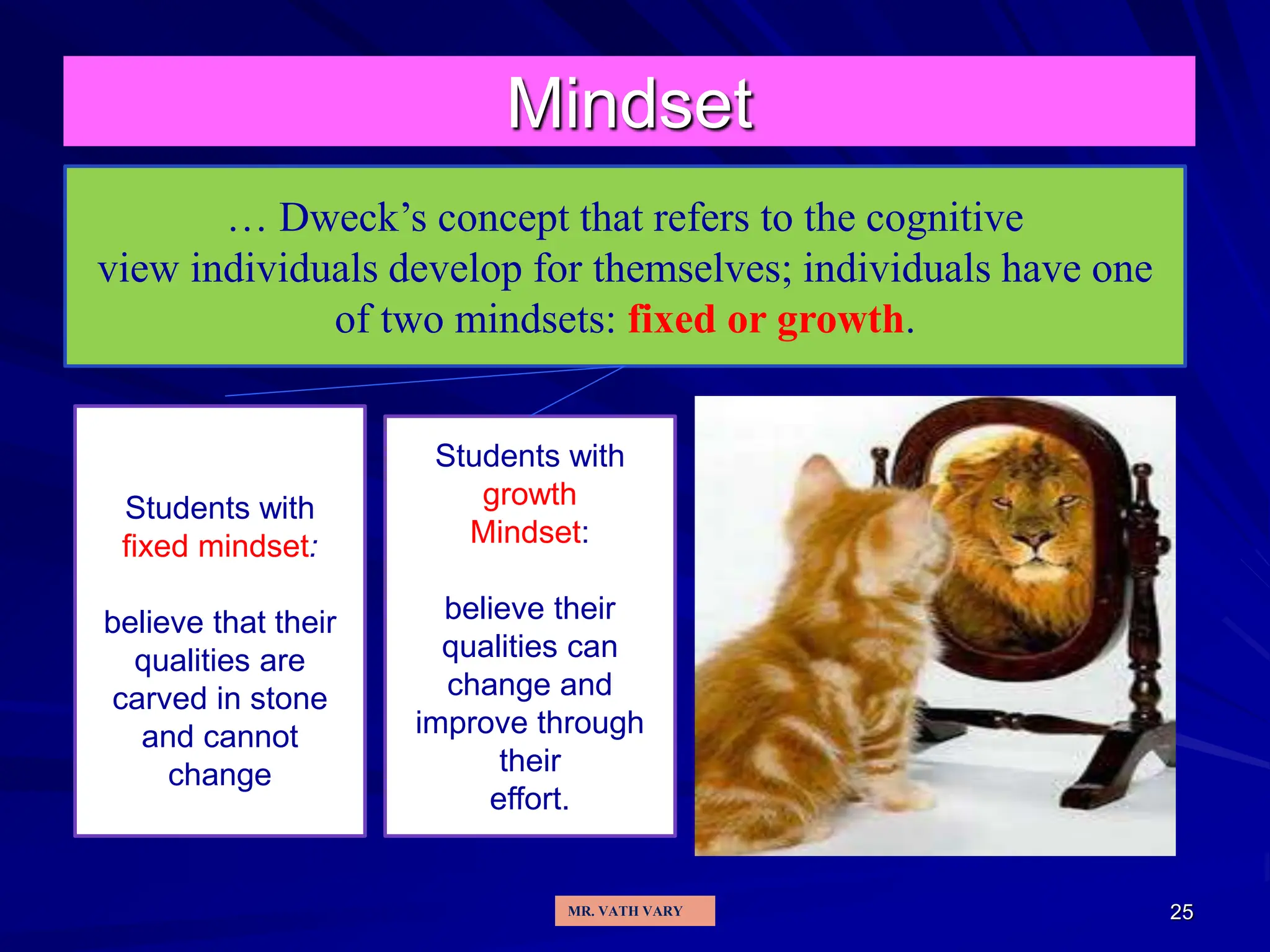
Mindset
… Dweck’s concept that refers to the cognitive
view individuals develop for themselves; individuals have one
of two mindsets: fixed or growth.
Students with
fixed mindset:
believe that their
qualities are
carved in stone
and cannot
change
Students with
growth
Mindset:
believe their
qualities can
change and
improve through
their
effort.
MR. VATH VARY
26
Self-Efficacy
is the belief that “ I can”
influences a student’s choice of activities.
students with high self-efficacy eagerly approach learning tasks and
persist with effort to them.
Students learn more from teachers with self-efficacy
Efficacious schools are pervaded by high expectations and
standards for achievement. Teachers regard their students as
capable of high academic achievement, set challenging academic
standards for them, and provide support to help them reach these
high standards
… is the belief that one can master a situation
and produce positive outcomes.
MR. VATH VARY
27
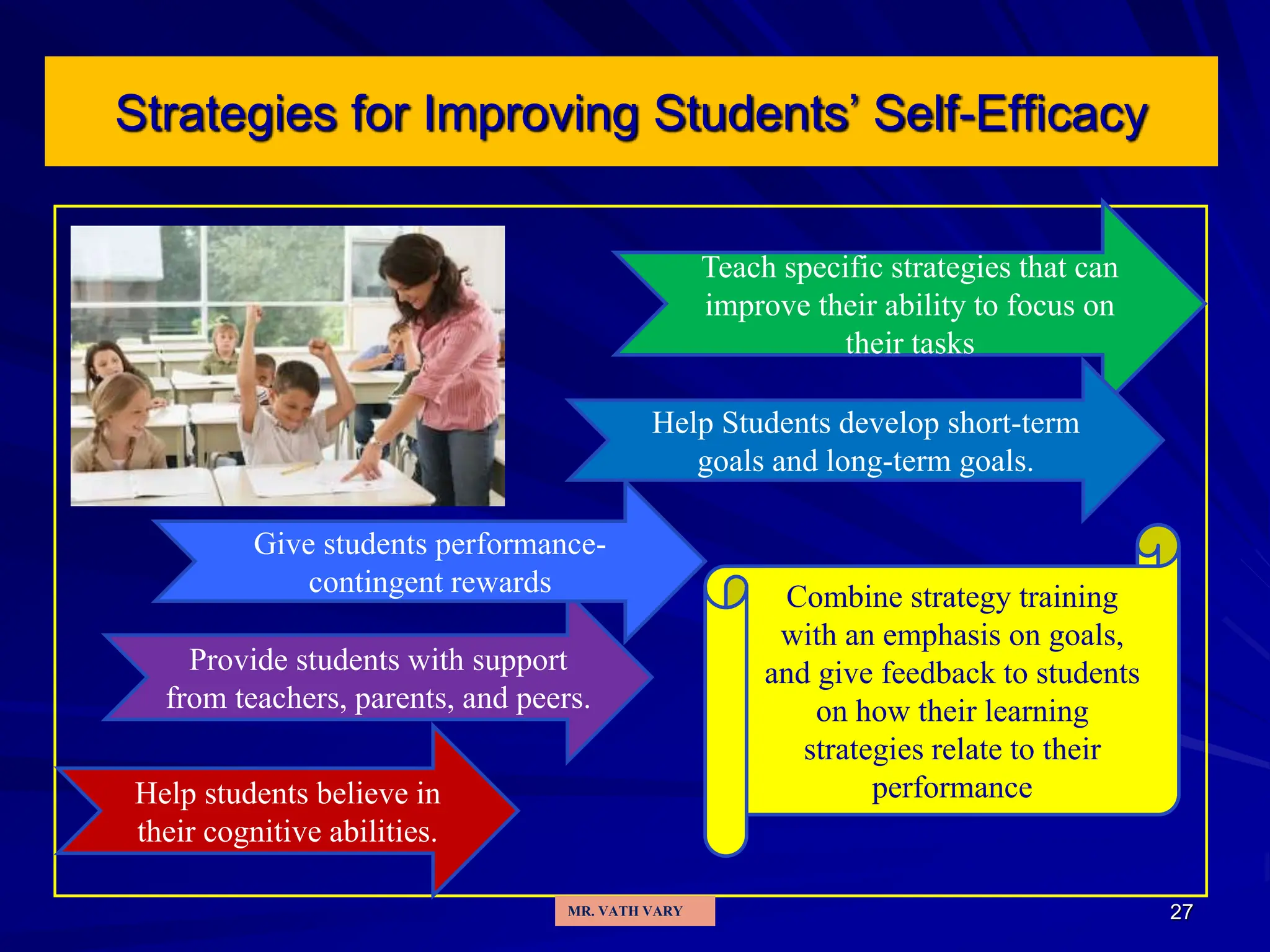
Strategies for Improving Students’ Self-Efficacy
Teach specific strategies that can
improve their ability to focus on
their tasks
Help Students develop short-term
goals and long-term goals.
Provide students with support
from teachers, parents, and peers.
Help students believe in
their cognitive abilities.
Give students performance-
contingent rewards Combine strategy training
with an emphasis on goals,
and give feedback to students
on how their learning
strategies relate to their
performance
MR. VATH VARY
28
GOAL SETTING, PLANNING, AND SELF-MONITORING
These encourage and help students …
– Set both short- and long-term and challenging goals
– Manage time effectively, set priorities, and be organized
– Monitor progress toward goals
Researchers have found that self-efficacy
and achievement improve when students
set goals that are specific, proximal,
and challenging
Challenging Goals: is a commitment to self-
improvement and strong interest as well as
involvement in activities is sparked by
challenges.
MR. VATH VARY
29
EXPECTATIONS
Three aspects of students’ ability beliefs:
– how good they are at a particular activity,
– how good they are in comparison with other individuals,
– and how good they are in relation to their performance in other
activities.
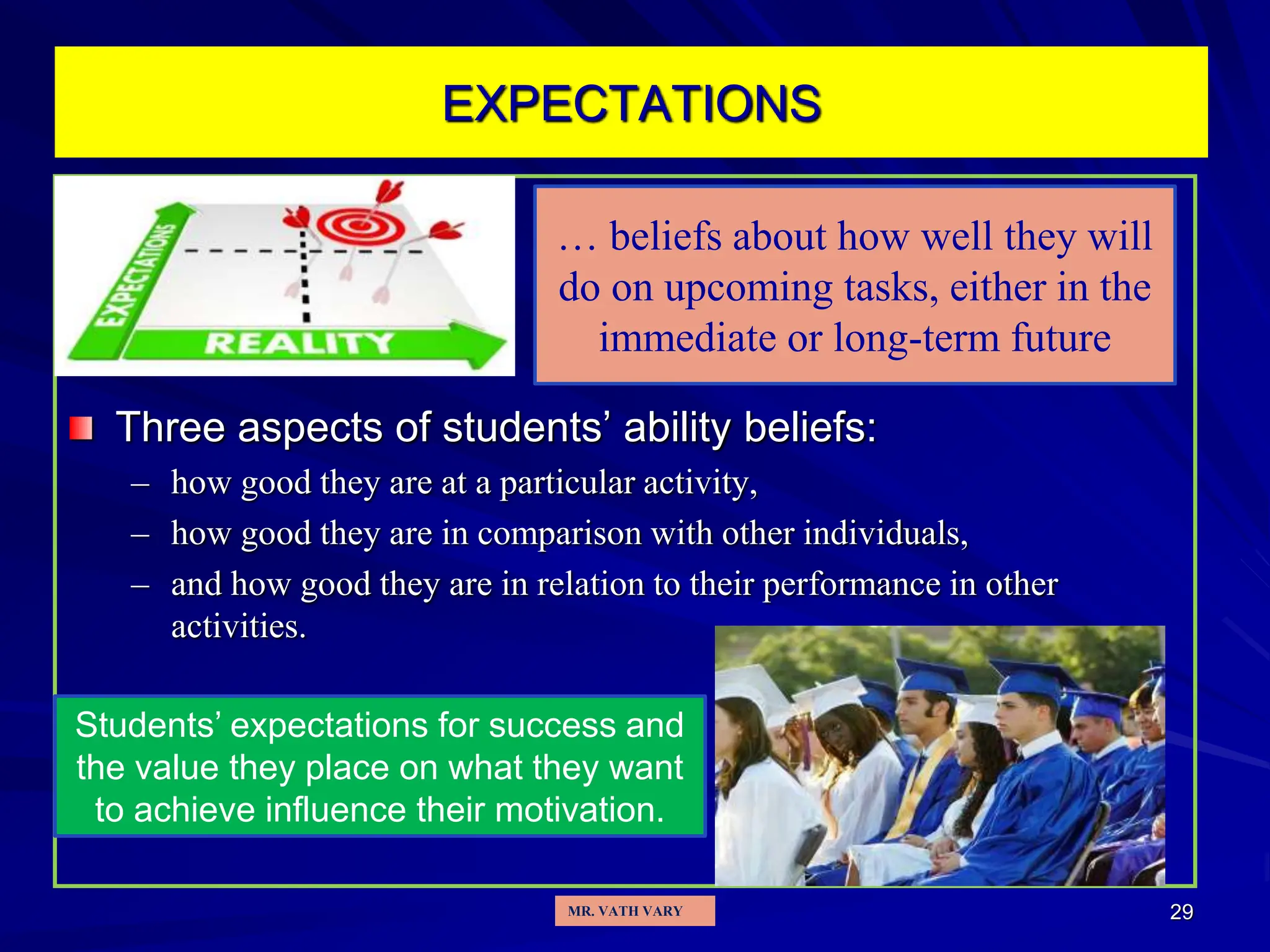
… beliefs about how well they will
do on upcoming tasks, either in the
immediate or long-term future
Students’ expectations for success and
the value they place on what they want
to achieve influence their motivation.
MR. VATH VARY
30
EXPECTATIONS
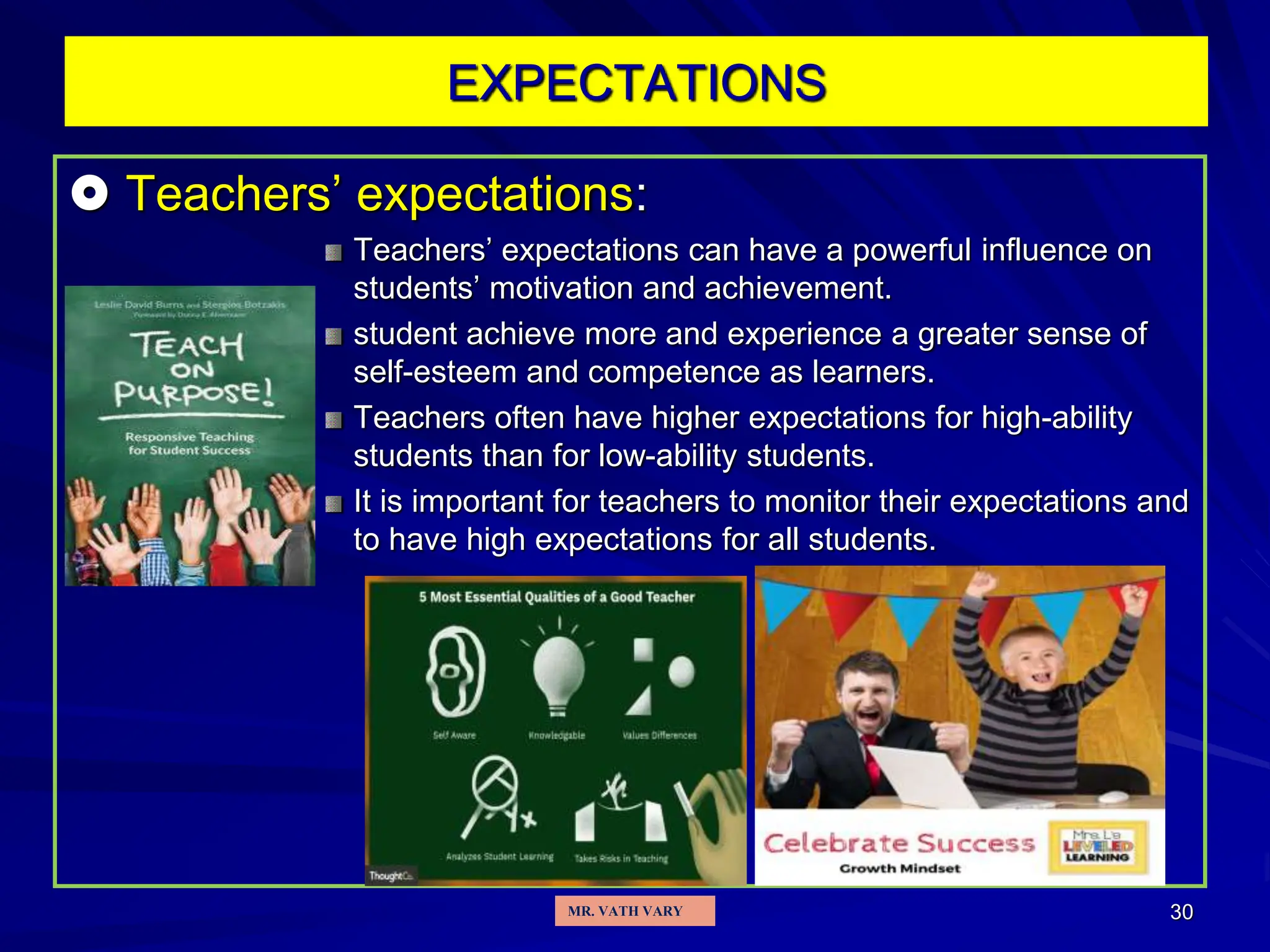
 Teachers’ expectations:
Teachers’ expectations can have a powerful influence on
students’ motivation and achievement.
student achieve more and experience a greater sense of
self-esteem and competence as learners.
Teachers often have higher expectations for high-ability
students than for low-ability students.
It is important for teachers to monitor their expectations and
to have high expectations for all students.
MR. VATH VARY
31
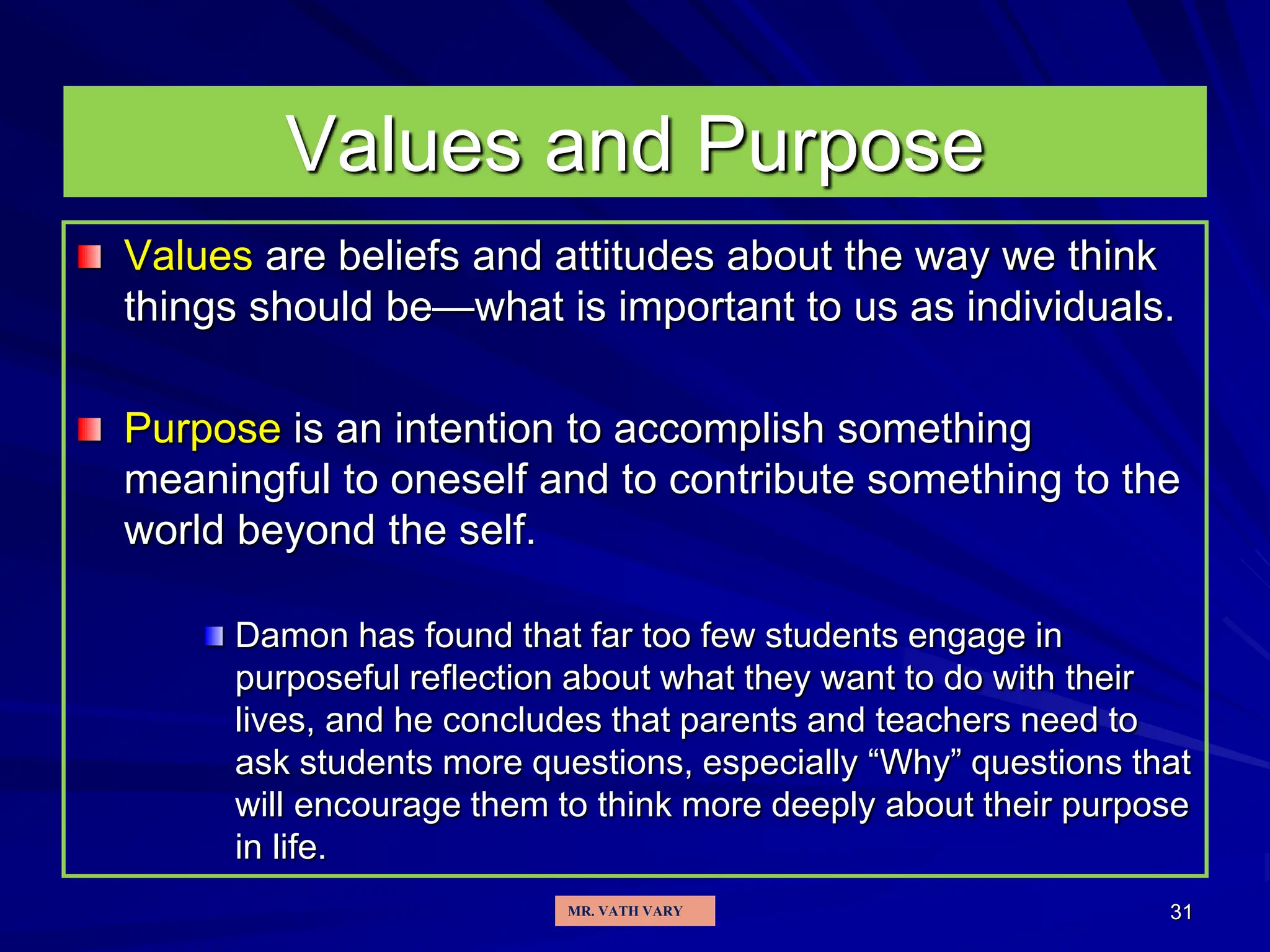
Values are beliefs and attitudes about the way we think
things should be—what is important to us as individuals.
Purpose is an intention to accomplish something
meaningful to oneself and to contribute something to the
world beyond the self.
Damon has found that far too few students engage in
purposeful reflection about what they want to do with their
lives, and he concludes that parents and teachers need to
ask students more questions, especially “Why” questions that
will encourage them to think more deeply about their purpose
in life.
Values and Purpose
MR. VATH VARY
32
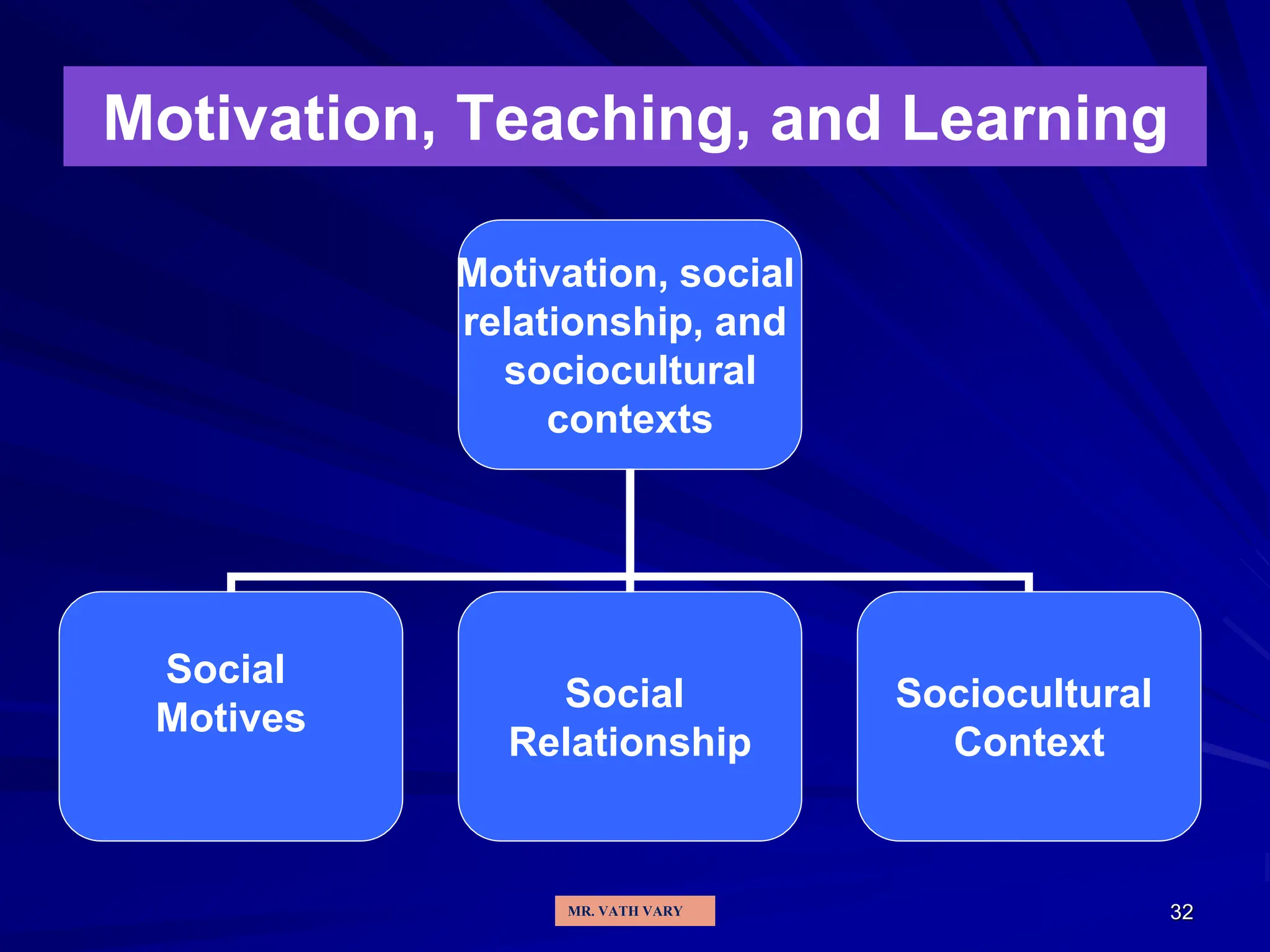
Motivation, Teaching, and Learning
Motivation, social
relationship, and
sociocultural
contexts
Social
Motives
Social
Relationship
Sociocultural
Context
MR. VATH VARY
33
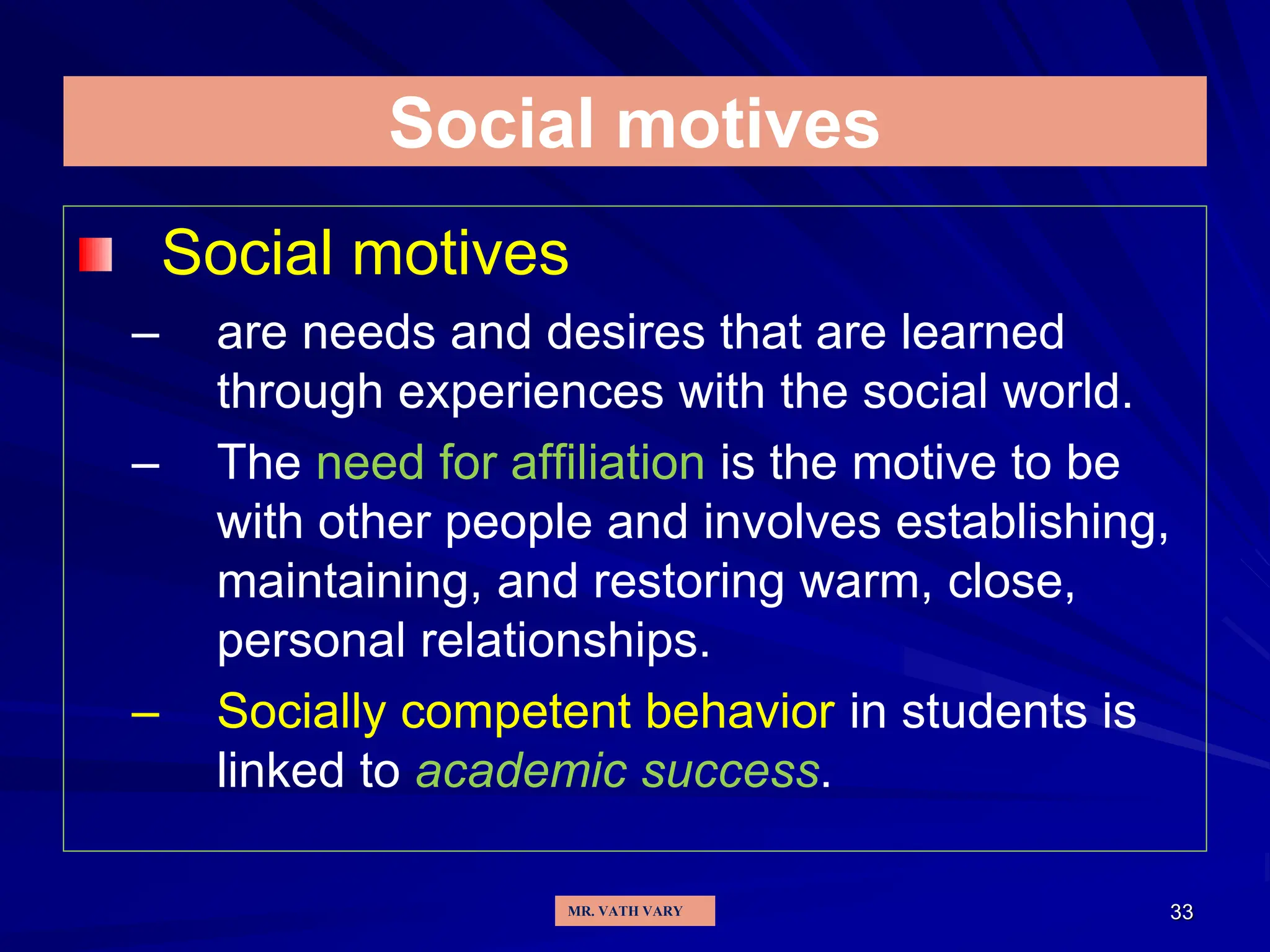
Social motives
Social motives
– are needs and desires that are learned
through experiences with the social world.
– The need for affiliation is the motive to be
with other people and involves establishing,
maintaining, and restoring warm, close,
personal relationships.
– Socially competent behavior in students is
linked to academic success.
MR. VATH VARY
34
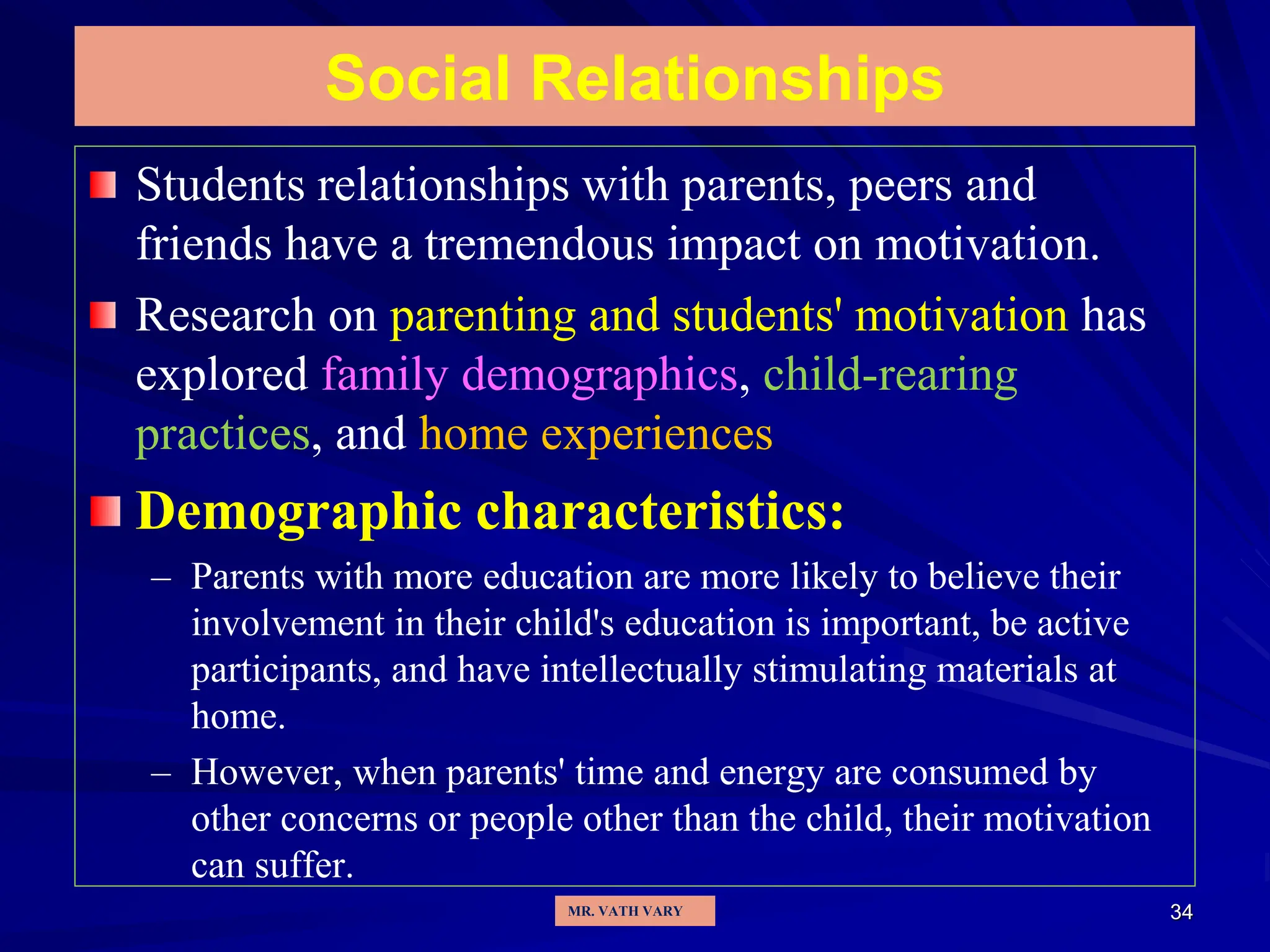
Social Relationships
Students relationships with parents, peers and
friends have a tremendous impact on motivation.
Research on parenting and students' motivation has
explored family demographics, child-rearing
practices, and home experiences
Demographic characteristics:
– Parents with more education are more likely to believe their
involvement in their child's education is important, be active
participants, and have intellectually stimulating materials at
home.
– However, when parents' time and energy are consumed by
other concerns or people other than the child, their motivation
can suffer.
MR. VATH VARY
35
Social Relationships
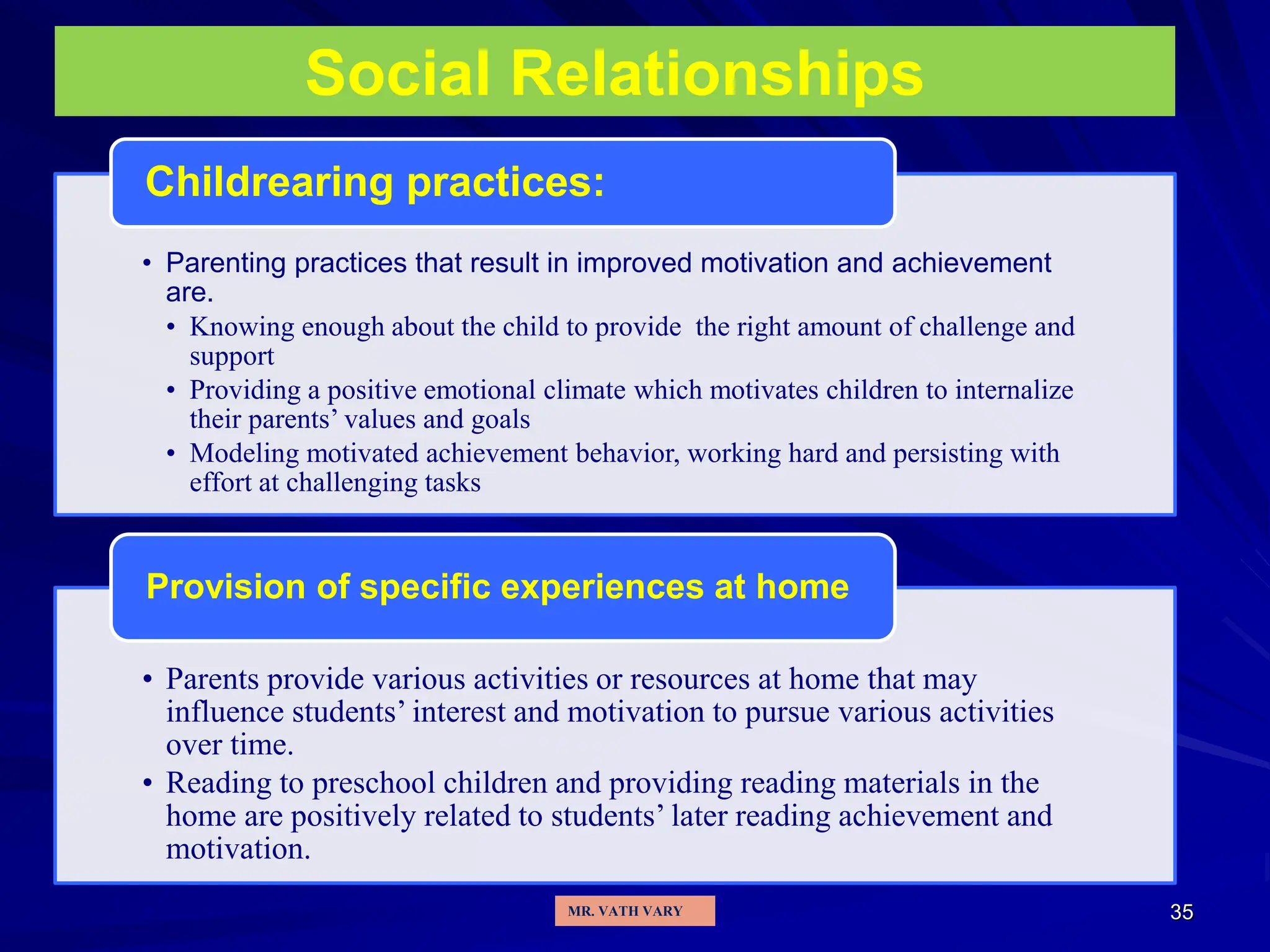
• Parenting practices that result in improved motivation and achievement
are.
• Knowing enough about the child to provide the right amount of challenge and
support
• Providing a positive emotional climate which motivates children to internalize
their parents’ values and goals
• Modeling motivated achievement behavior, working hard and persisting with
effort at challenging tasks
Childrearing practices:
• Parents provide various activities or resources at home that may
influence students’ interest and motivation to pursue various activities
over time.
• Reading to preschool children and providing reading materials in the
home are positively related to students’ later reading achievement and
motivation.
Provision of specific experiences at home
MR. VATH VARY
36
Social Relationships
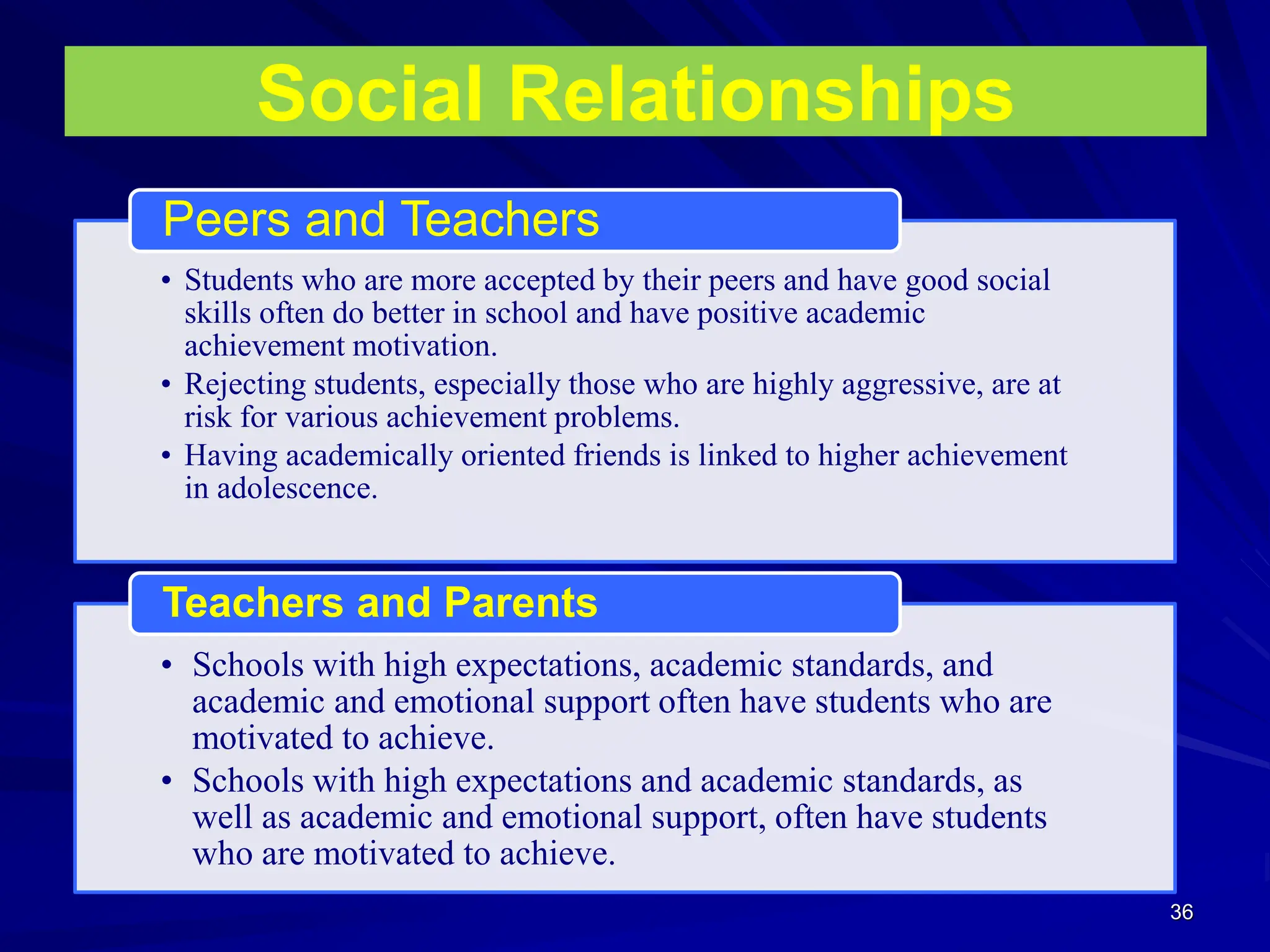
• Students who are more accepted by their peers and have good social
skills often do better in school and have positive academic
achievement motivation.
• Rejecting students, especially those who are highly aggressive, are at
risk for various achievement problems.
• Having academically oriented friends is linked to higher achievement
in adolescence.
Peers and Teachers
• Schools with high expectations, academic standards, and
academic and emotional support often have students who are
motivated to achieve.
• Schools with high expectations and academic standards, as
well as academic and emotional support, often have students
who are motivated to achieve.
Teachers and Parents
37
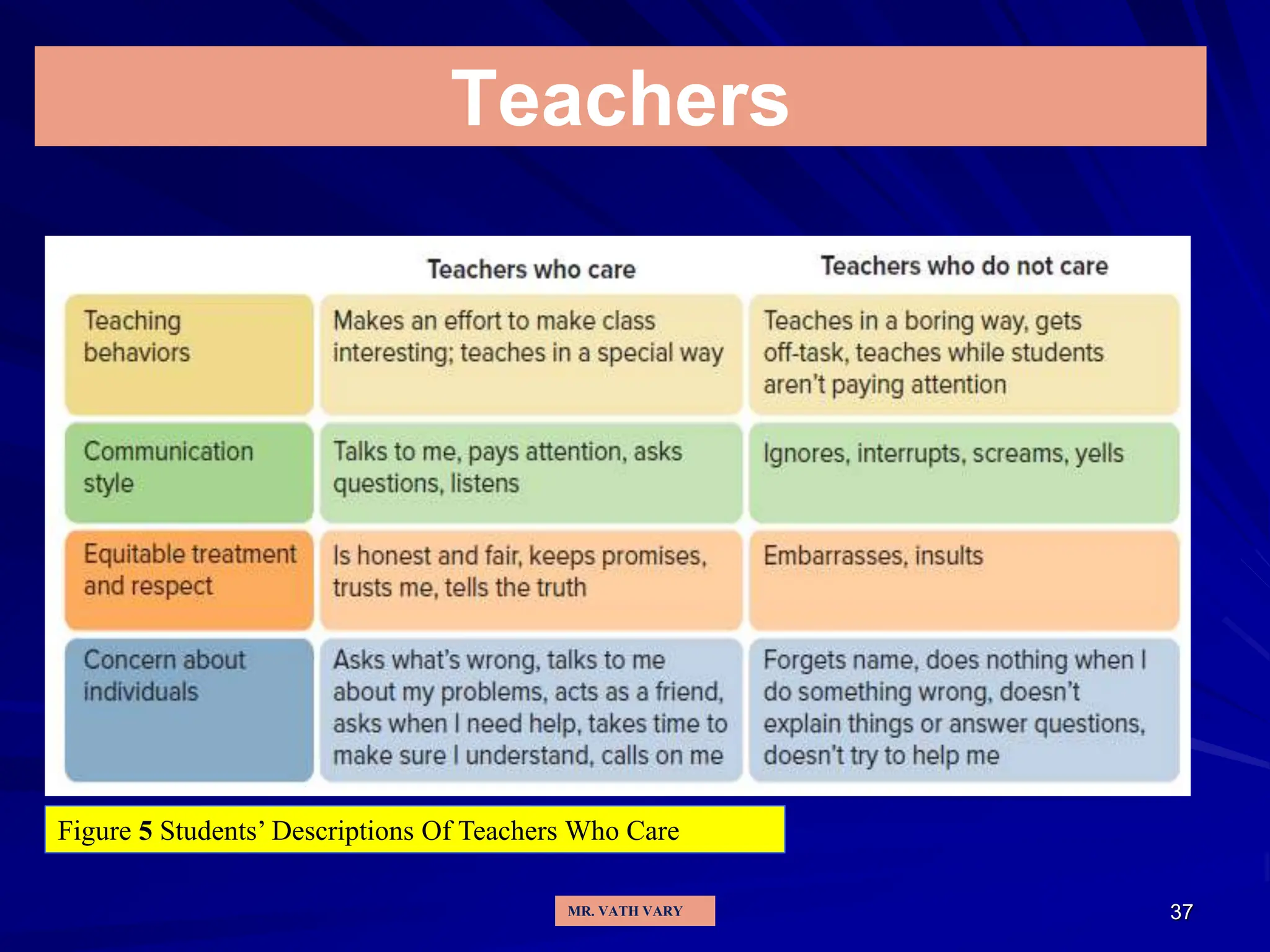
Teachers
Figure 5 Students’ Descriptions Of Teachers Who Care
MR. VATH VARY
38
Sociocultural Contexts
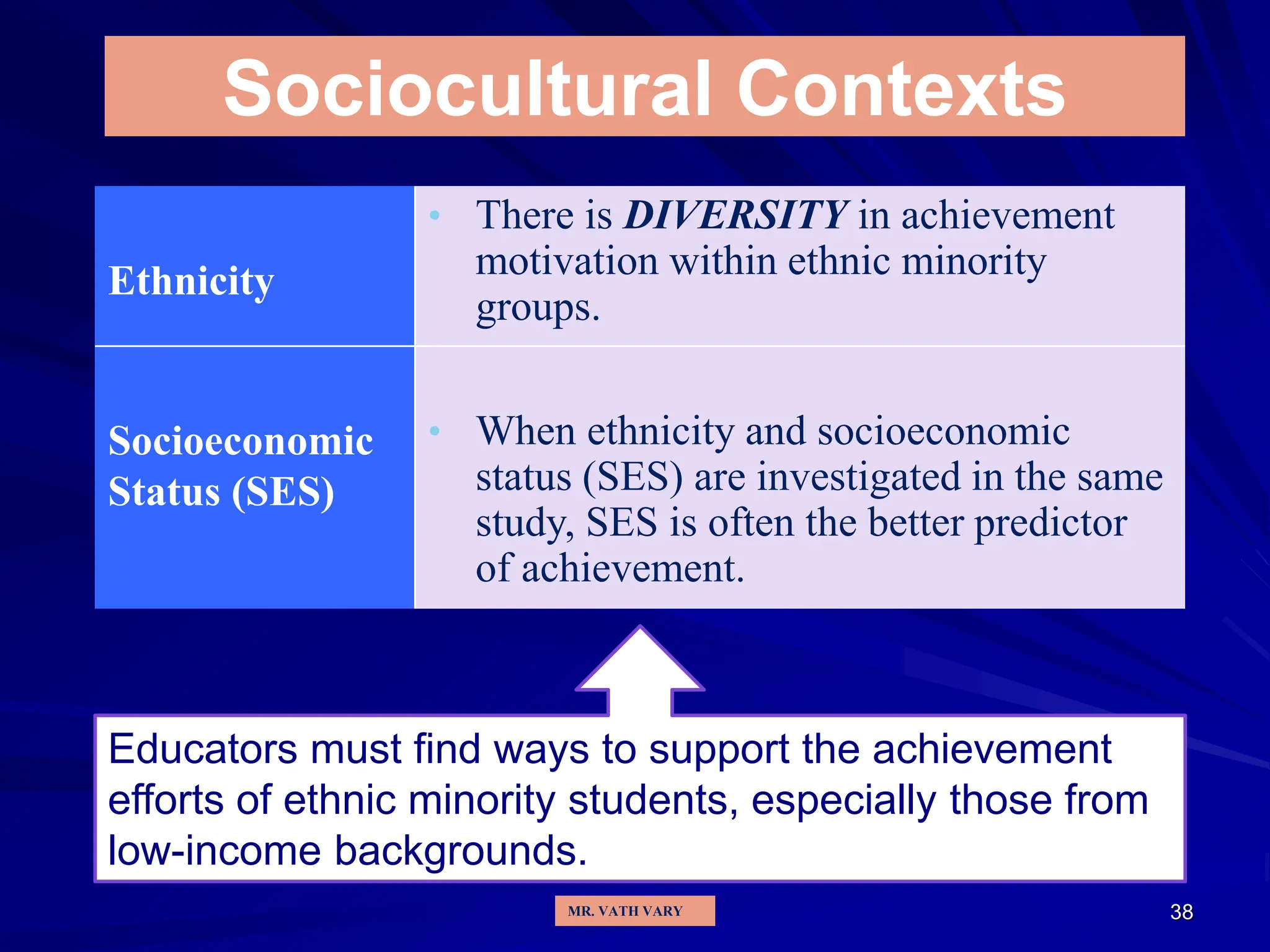
Ethnicity
• There is DIVERSITY in achievement
motivation within ethnic minority
groups.
Socioeconomic
Status (SES)
• When ethnicity and socioeconomic
status (SES) are investigated in the same
study, SES is often the better predictor
of achievement.
Educators must find ways to support the achievement
efforts of ethnic minority students, especially those from
low-income backgrounds.
MR. VATH VARY
39
Motivation and Gender
Males
Have higher competence
beliefs in math and
sports
Are more rambunctious
Receive more teacher
attention, yet receive
lower grades
List more career options
Females
Have higher competence
beliefs for English,
reading, and social
activities
Often experience conflicts
between gender roles
and achievement
Are more compliant, get
less teacher attention, by
middle school have lower
self-esteem
MR. VATH VARY
40
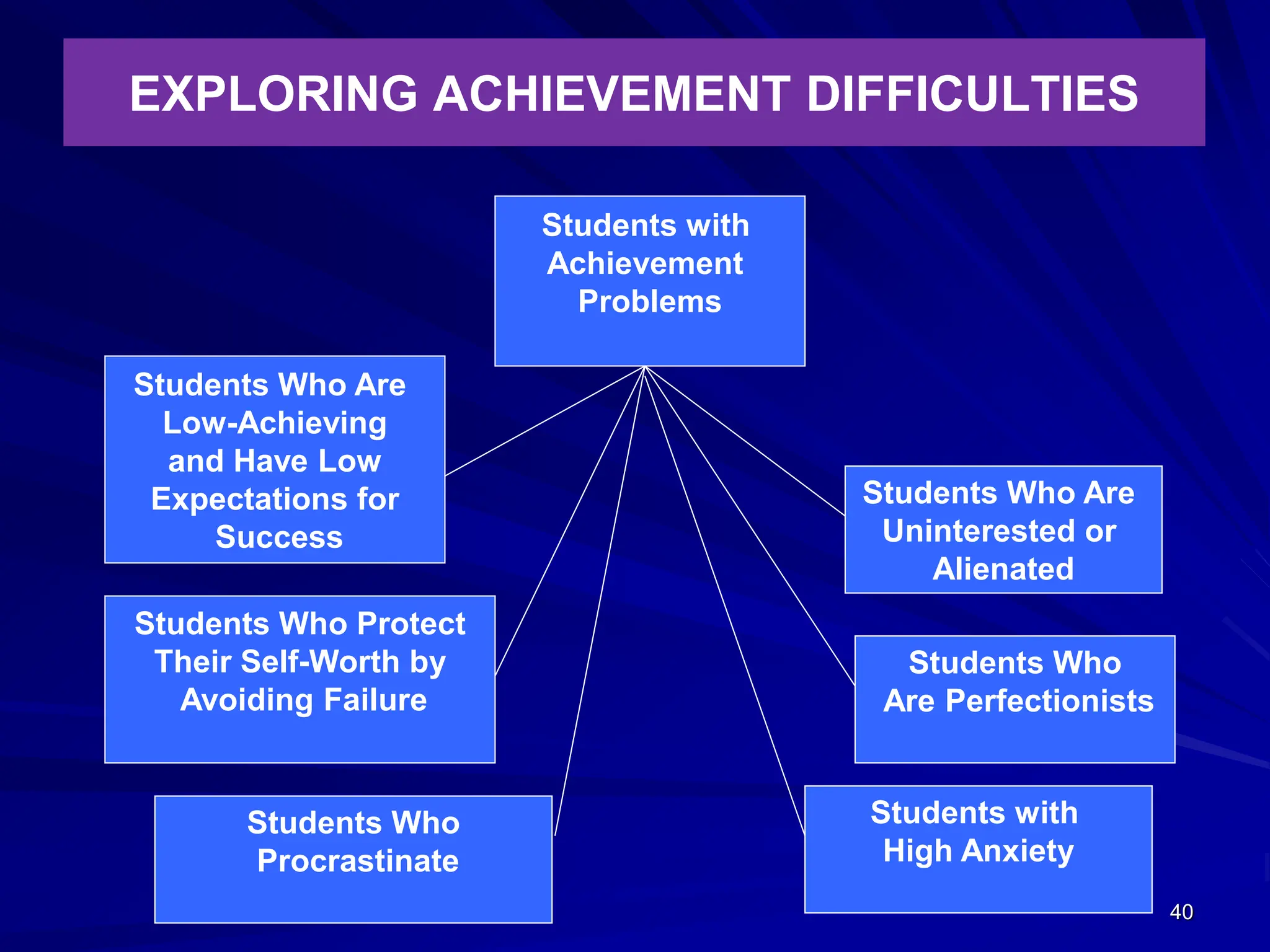
EXPLORING ACHIEVEMENT DIFFICULTIES
Students with
Achievement
Problems
Students Who Are
Low-Achieving
and Have Low
Expectations for
Success
Students Who Protect
Their Self-Worth by
Avoiding Failure
Students Who
Procrastinate
Students Who Are
Uninterested or
Alienated
Students Who
Are Perfectionists
Students with
High Anxiety
41
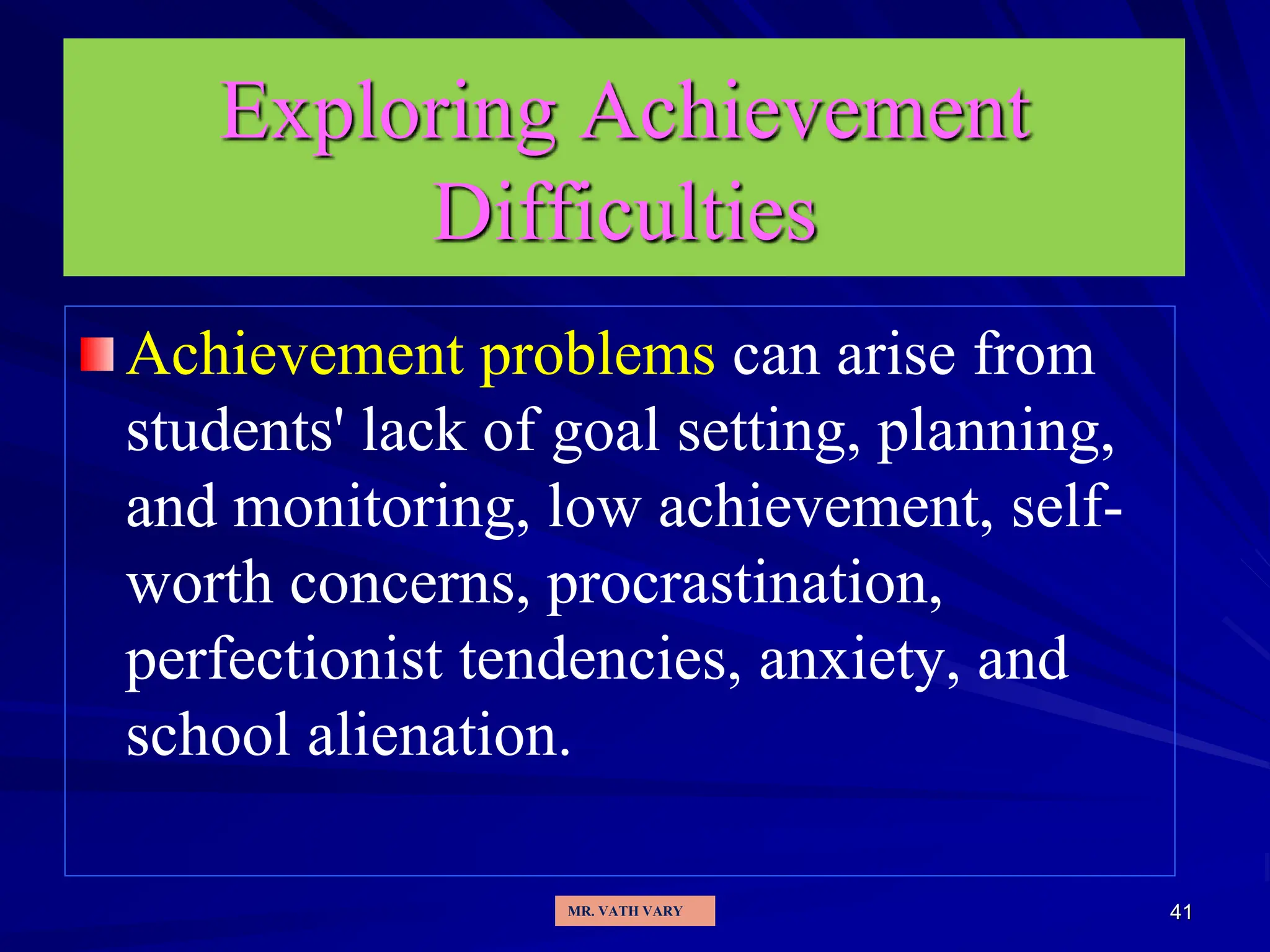
Exploring Achievement
Difficulties
Achievement problems can arise from
students' lack of goal setting, planning,
and monitoring, low achievement, self-
worth concerns, procrastination,
perfectionist tendencies, anxiety, and
school alienation.
MR. VATH VARY
42
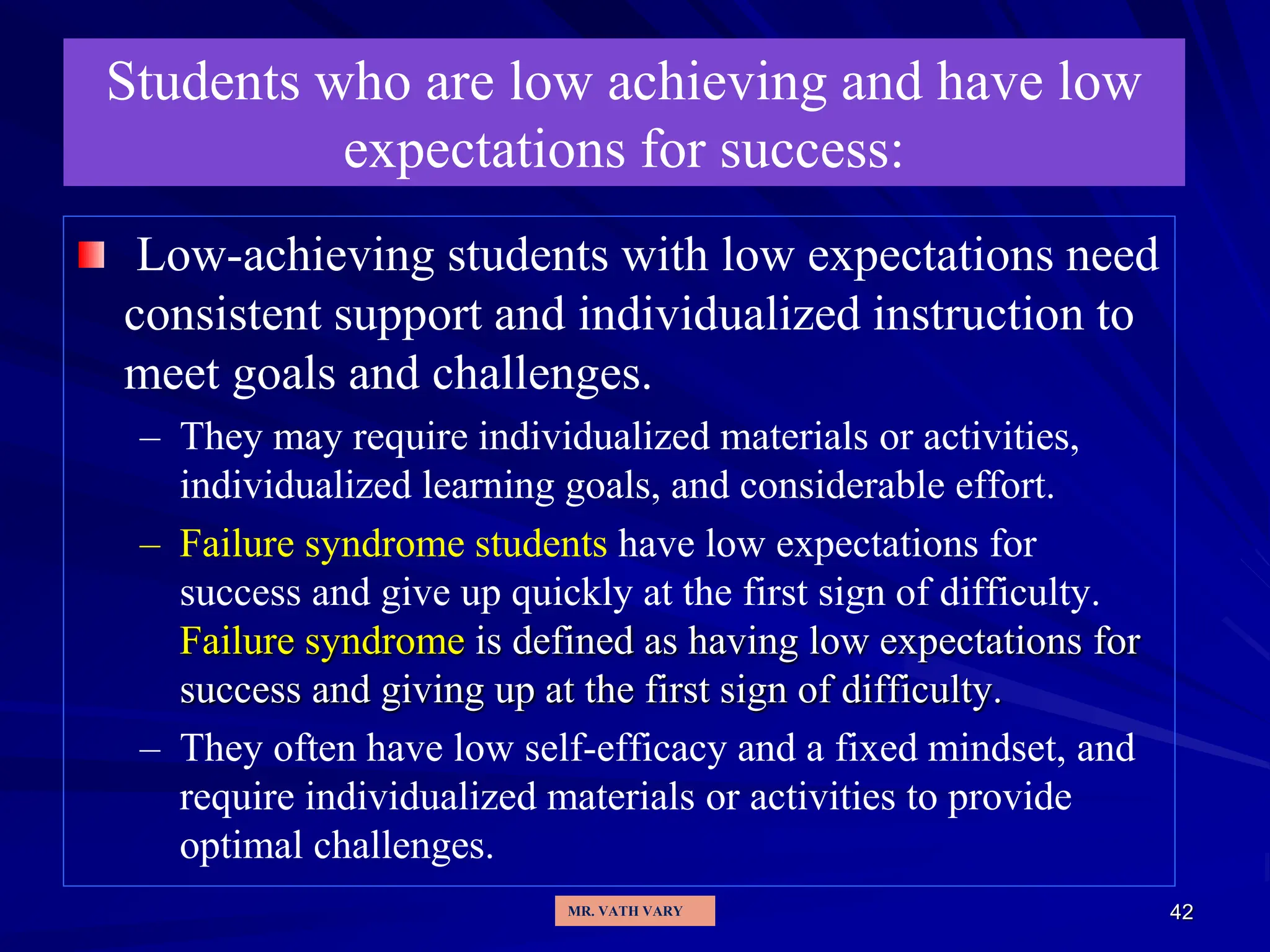
Students who are low achieving and have low
expectations for success:
Low-achieving students with low expectations need
consistent support and individualized instruction to
meet goals and challenges.
– They may require individualized materials or activities,
individualized learning goals, and considerable effort.
– Failure syndrome students have low expectations for
success and give up quickly at the first sign of difficulty.
Failure syndrome is defined as having low expectations for
success and giving up at the first sign of difficulty.
– They often have low self-efficacy and a fixed mindset, and
require individualized materials or activities to provide
optimal challenges.
MR. VATH VARY
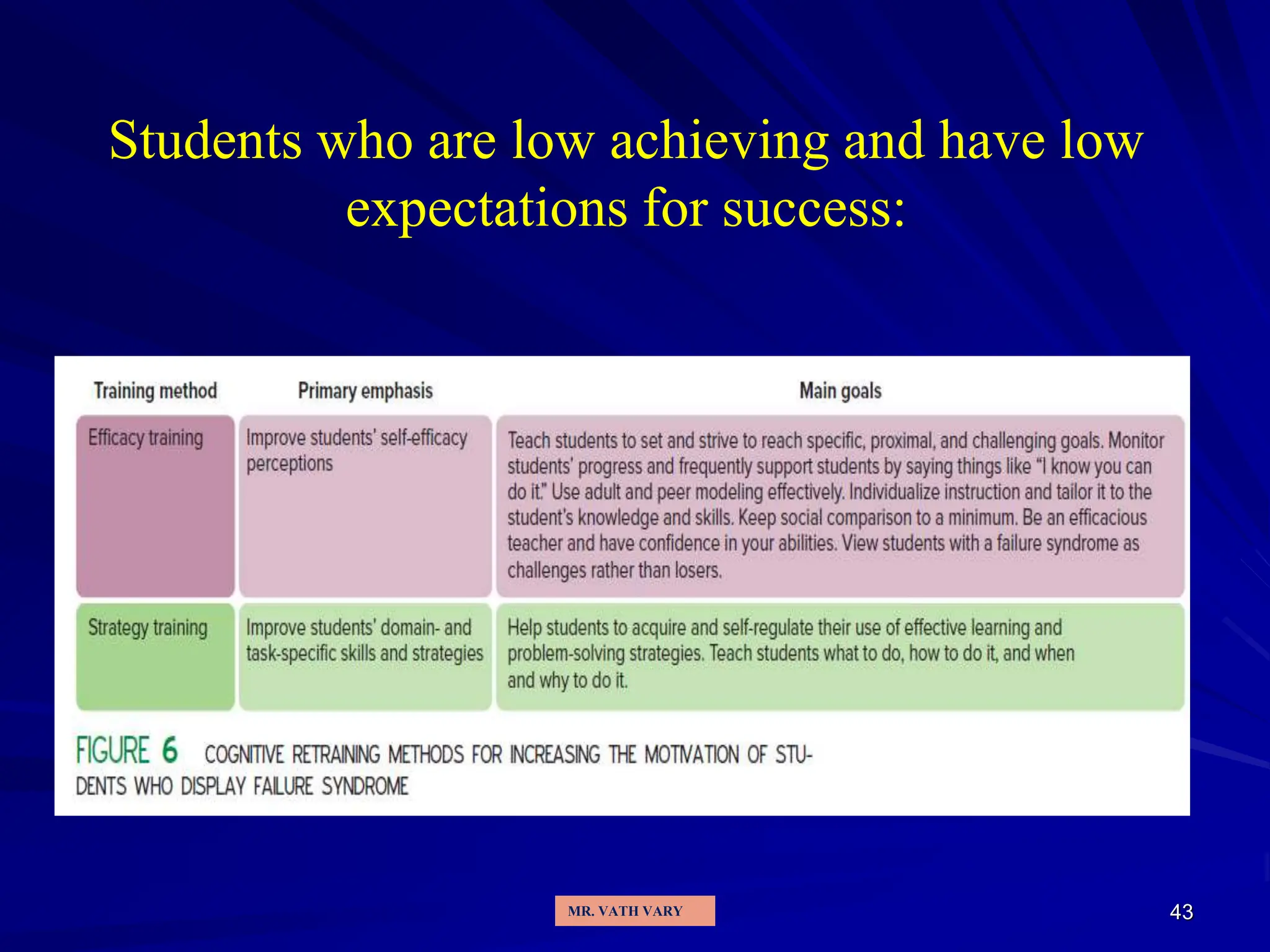
Students who are low achieving and have low
expectations for success:
43
MR. VATH VARY
44
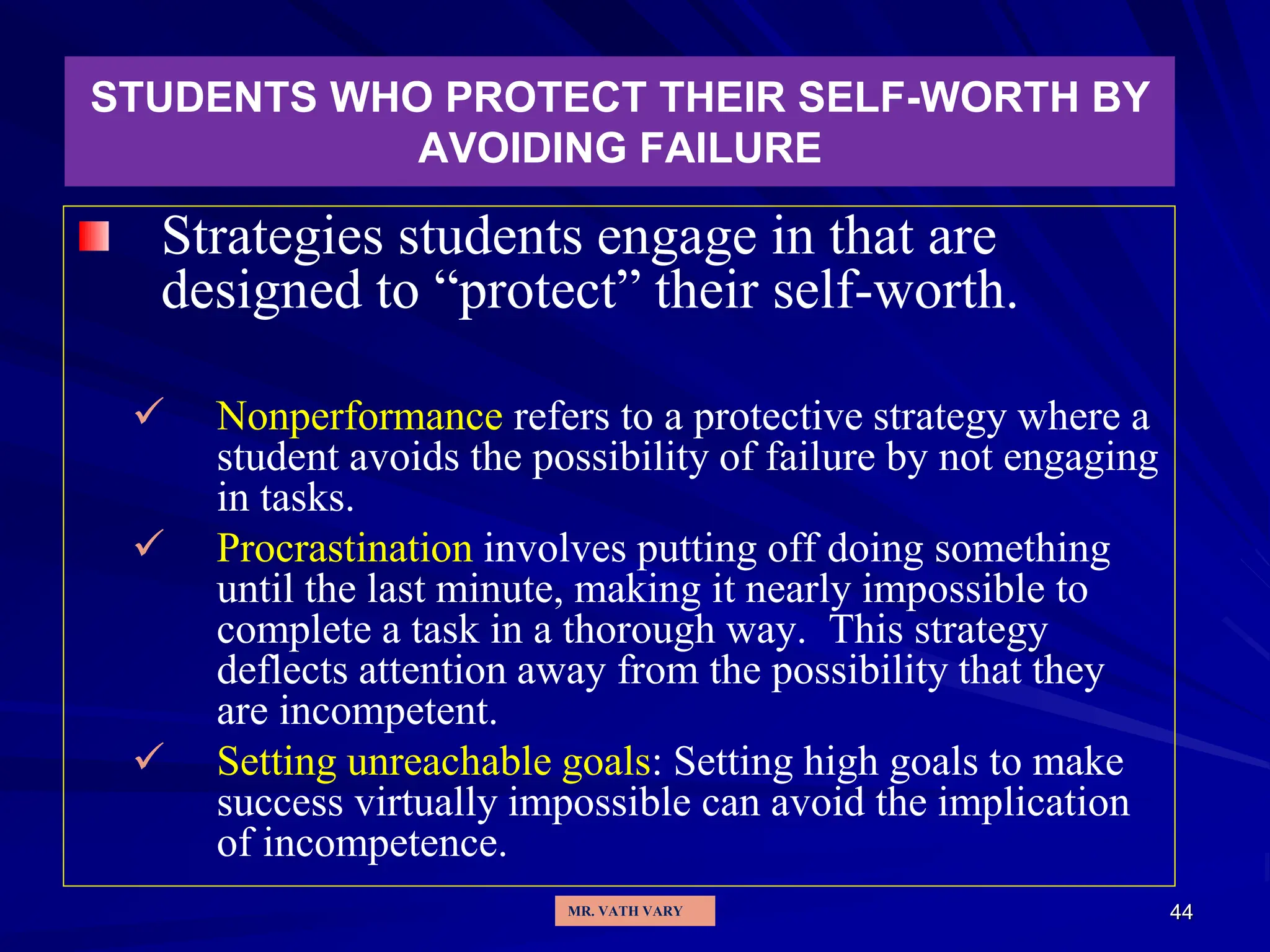
STUDENTS WHO PROTECT THEIR SELF-WORTH BY
AVOIDING FAILURE
Strategies students engage in that are
designed to “protect” their self-worth.
 Nonperformance refers to a protective strategy where a
student avoids the possibility of failure by not engaging
in tasks.
 Procrastination involves putting off doing something
until the last minute, making it nearly impossible to
complete a task in a thorough way. This strategy
deflects attention away from the possibility that they
are incompetent.
 Setting unreachable goals: Setting high goals to make
success virtually impossible can avoid the implication
of incompetence.
MR. VATH VARY
45
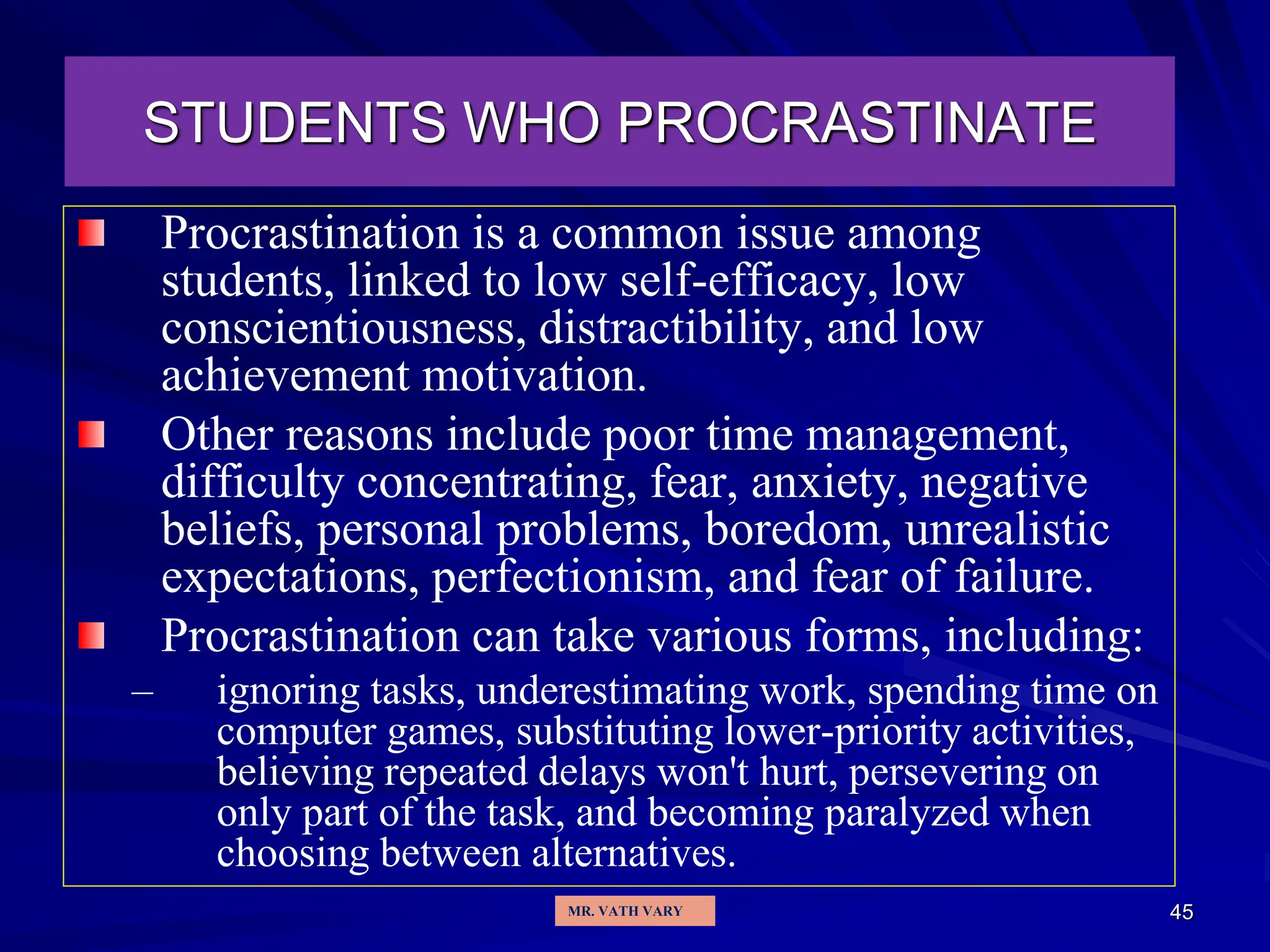
STUDENTS WHO PROCRASTINATE
Procrastination is a common issue among
students, linked to low self-efficacy, low
conscientiousness, distractibility, and low
achievement motivation.
Other reasons include poor time management,
difficulty concentrating, fear, anxiety, negative
beliefs, personal problems, boredom, unrealistic
expectations, perfectionism, and fear of failure.
Procrastination can take various forms, including:
– ignoring tasks, underestimating work, spending time on
computer games, substituting lower-priority activities,
believing repeated delays won't hurt, persevering on
only part of the task, and becoming paralyzed when
choosing between alternatives.
MR. VATH VARY
46
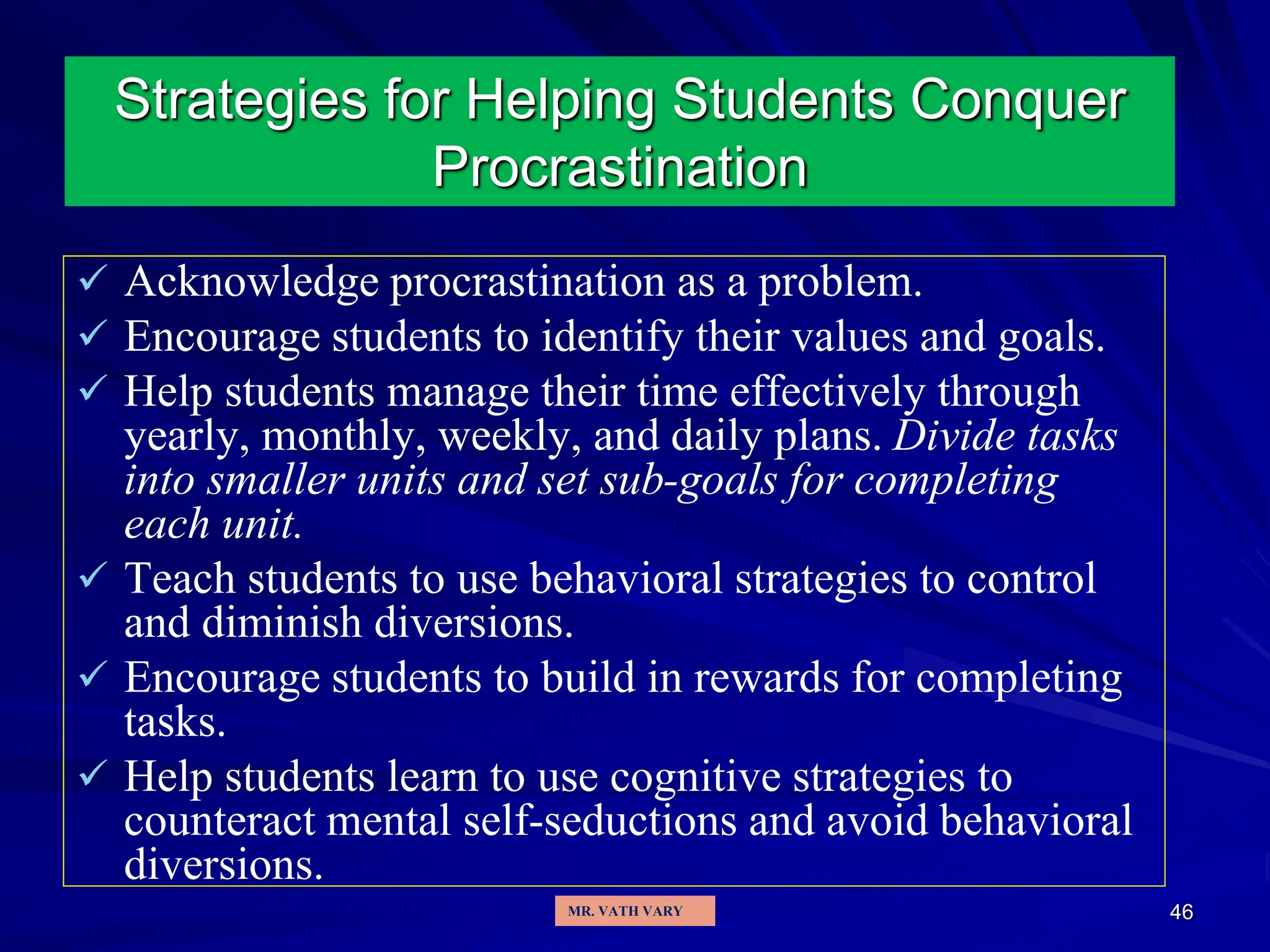
Strategies for Helping Students Conquer
Procrastination
 Acknowledge procrastination as a problem.
 Encourage students to identify their values and goals.
 Help students manage their time effectively through
yearly, monthly, weekly, and daily plans. Divide tasks
into smaller units and set sub-goals for completing
each unit.
 Teach students to use behavioral strategies to control
and diminish diversions.
 Encourage students to build in rewards for completing
tasks.
 Help students learn to use cognitive strategies to
counteract mental self-seductions and avoid behavioral
diversions.
MR. VATH VARY
47
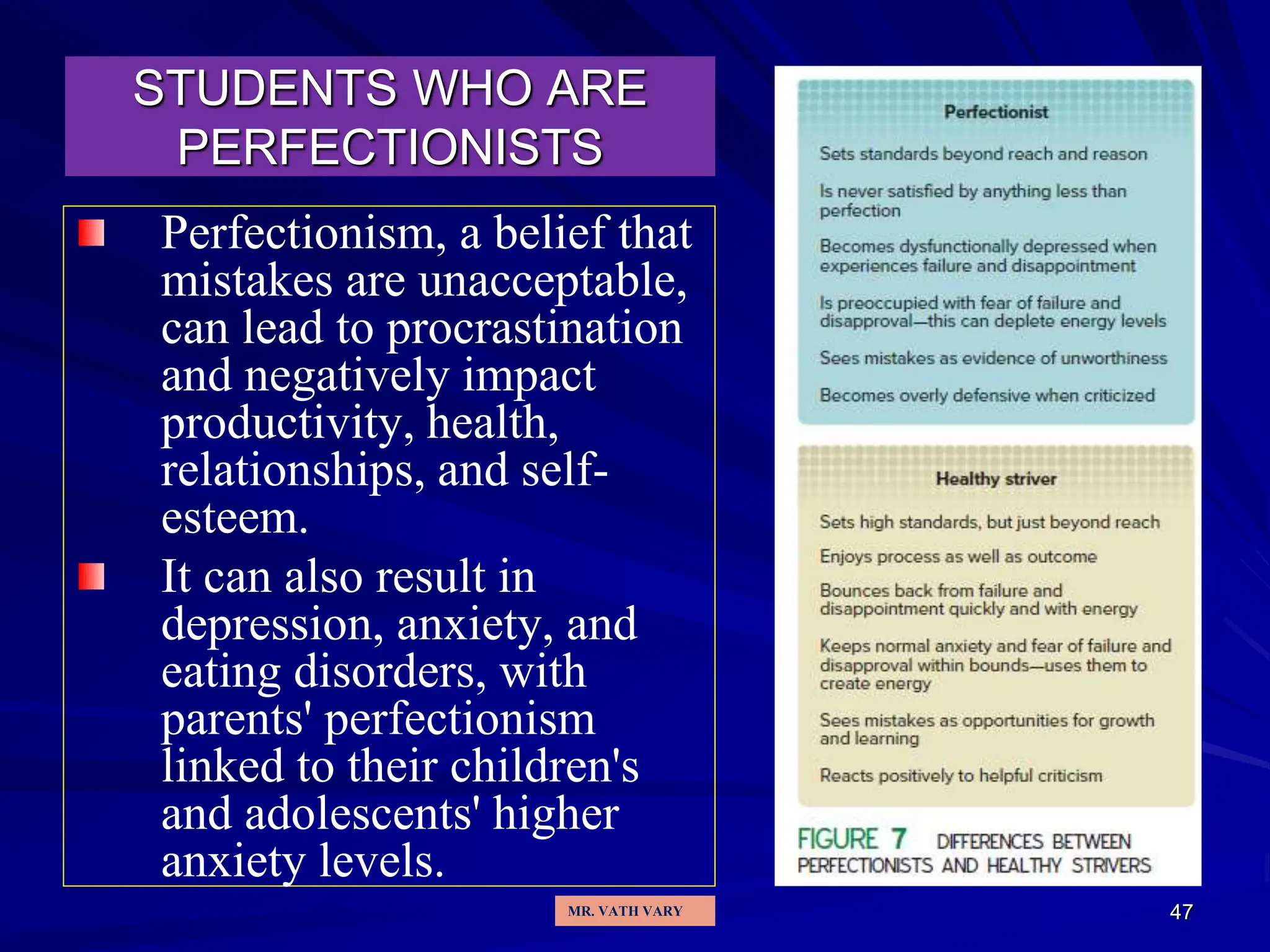
STUDENTS WHO ARE
PERFECTIONISTS
Perfectionism, a belief that
mistakes are unacceptable,
can lead to procrastination
and negatively impact
productivity, health,
relationships, and self-
esteem.
It can also result in
depression, anxiety, and
eating disorders, with
parents' perfectionism
linked to their children's
and adolescents' higher
anxiety levels.
MR. VATH VARY
48
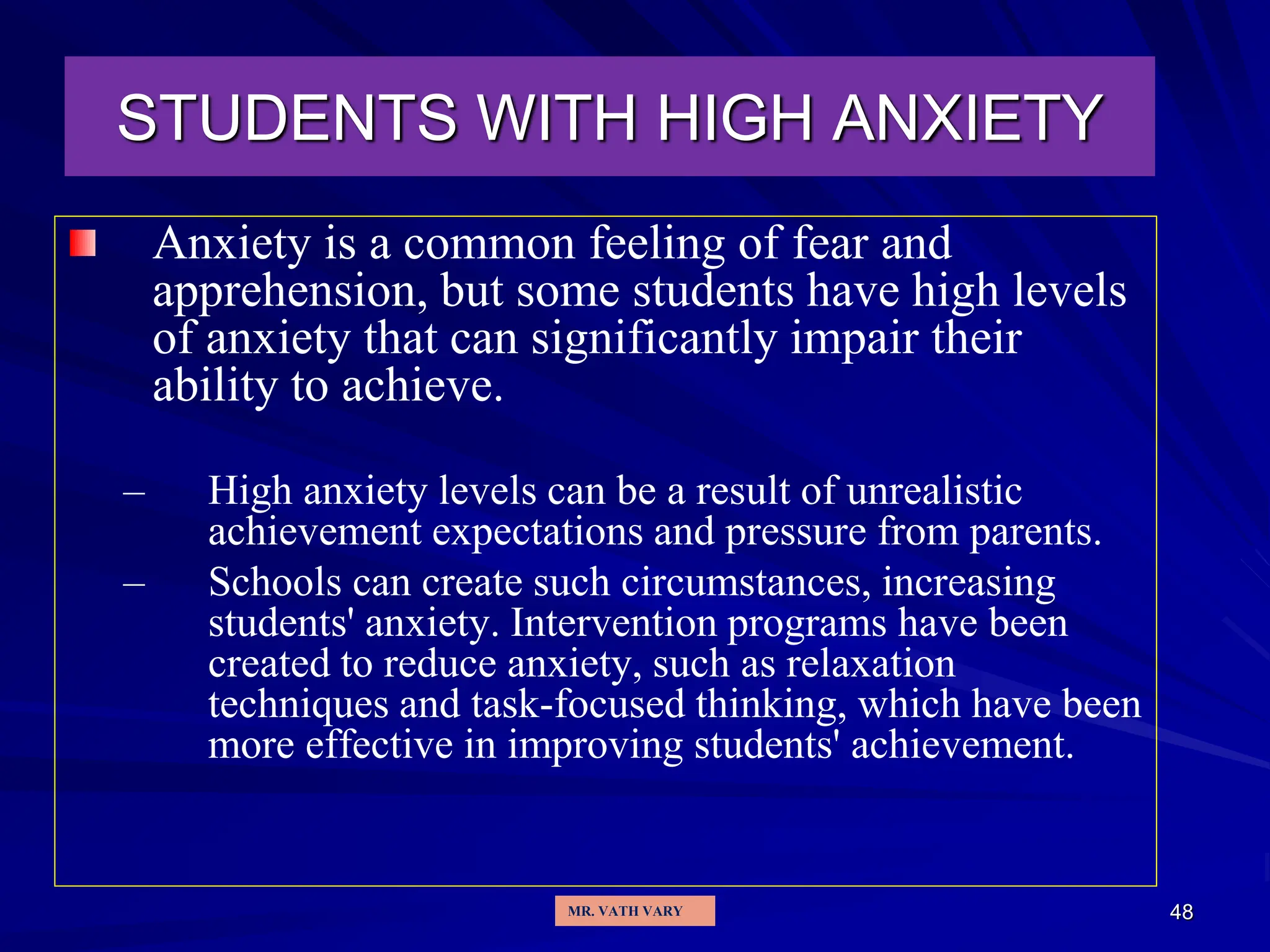
STUDENTS WITH HIGH ANXIETY
Anxiety is a common feeling of fear and
apprehension, but some students have high levels
of anxiety that can significantly impair their
ability to achieve.
– High anxiety levels can be a result of unrealistic
achievement expectations and pressure from parents.
– Schools can create such circumstances, increasing
students' anxiety. Intervention programs have been
created to reduce anxiety, such as relaxation
techniques and task-focused thinking, which have been
more effective in improving students' achievement.
MR. VATH VARY
49
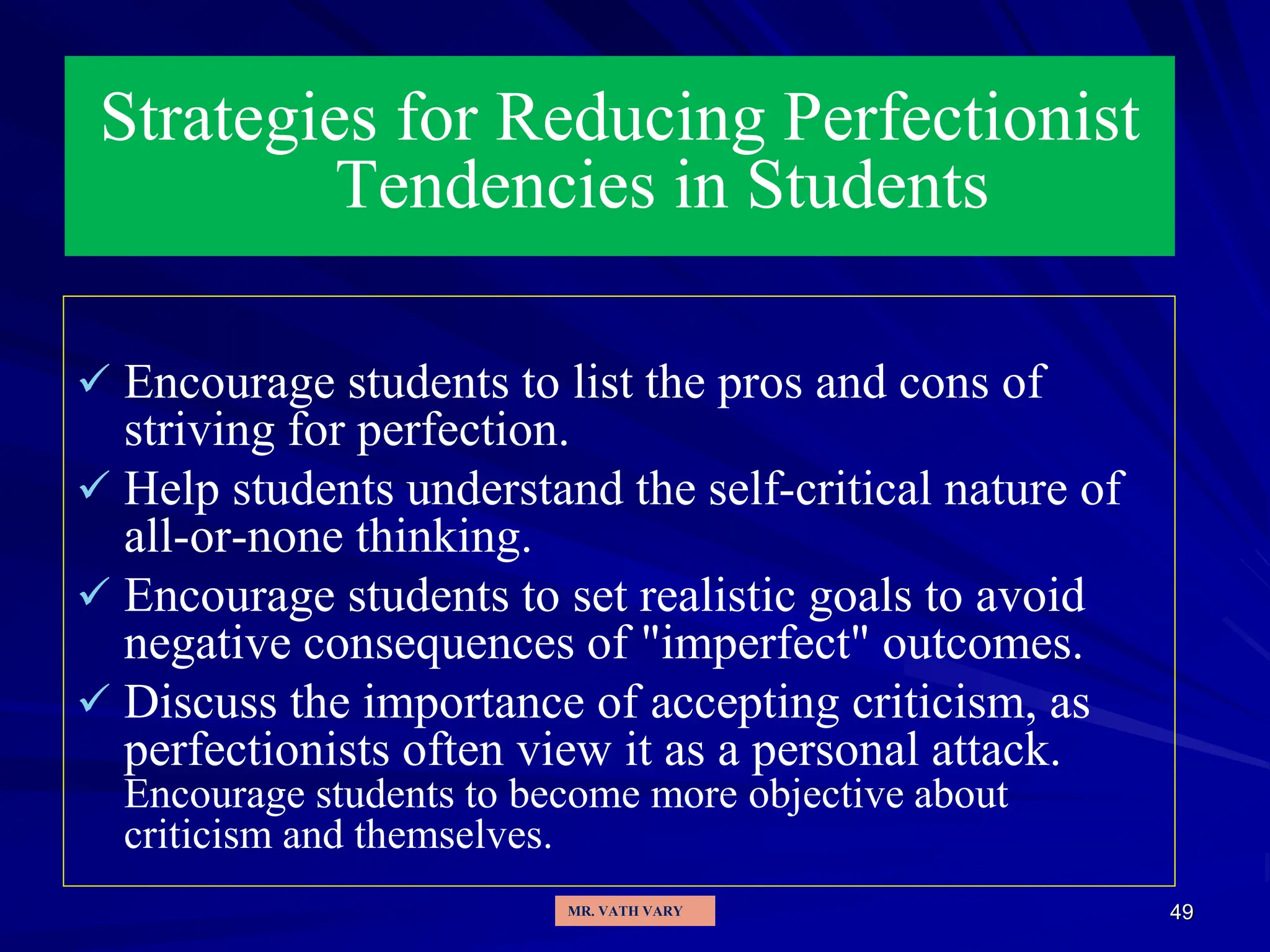
Strategies for Reducing Perfectionist
Tendencies in Students
 Encourage students to list the pros and cons of
striving for perfection.
 Help students understand the self-critical nature of
all-or-none thinking.
 Encourage students to set realistic goals to avoid
negative consequences of "imperfect" outcomes.
 Discuss the importance of accepting criticism, as
perfectionists often view it as a personal attack.
Encourage students to become more objective about
criticism and themselves.
MR. VATH VARY
50
MR. VATH VARY

CH 13 Motivation_Teaching_and_Learning.ppt

  • 1.
    Human Resource University Chapter13: Motivation, Teaching, and Learning 1  Tel: 017471117  Lecturer: Mr. VATH Vary  Email: varyvath@gmail.com
  • 2.
  • 3.
    3 Motivation, Teaching, andLearning Exploring motivation Perspective on motivation What is Motivation? MR. VATH VARY
  • 4.
    Why did TerryFox do this run? Terry Fox's Long-Distance Run: A Motivational Story  Terry Fox, a Canadian, ran 3,359 miles across Canada, averaging a marathon (26.2 miles) a day for five months.  Fox lost a leg to cancer before the run, so he ran with a prosthetic limb.  Fox's motivation for the run was to fund cancer research.  Despite encountering unforeseen challenges, Fox maintained his pace and continued running.  His story is portrayed in the classroom film, "The Power of Purpose," which resonated with students, emphasizing the importance of perseverance and spirit despite physical challenges. 4 MR. VATH VARY
  • 5.
    5 Motivation … involves theprocesses that energize, direct, and sustain behavior. MR. VATH VARY
  • 6.
    6 The Behavioral Perspective TheBehavioral Perspective emphasizes external rewards and punishments as keys in determining student motivation.  Incentives use include numerical scores ,letter grades, recognition, certificate of achievement, paying computer game, field trip, reward good work.  Advocates of the use of incentives emphasize that they add interest or excitement to the class and direct attention toward appropriate behavior and away from inappropriate behavior. MR. VATH VARY
  • 7.
    7 The humanistic perspective Thehumanistic perspective stresses students’ capacity for personal growth, freedom to choose their own destinies, and positive qualities. Abraham Maslow developed the hierarchy of human needs to show how we have to satisfy certain basic needs before we can satisfy higher needs in sequences. MR. VATH VARY
  • 8.
    Maslow’s Hierarchy of Needs  Physiological:Hunger, thirst, sleep  Safety: Ensuring survival such as protection from war and crimes.  Love and belongingness: Security, affection, and attention from others.  Esteem: Feeling good about oneself.  Self actualization: Realization of one’s potential. Characteristics of self actualized individuals include being spontaneous, problem-centered rather than self-centered and creative. 8 MR. VATH VARY
  • 9.
    9 The cognitive perspective Thecognitive perspective focuses on students’ competence motivation, their internal motivation to achieve, their attributions, and their beliefs that they can effectively control their environment. stresses that students thoughts guide their motivation. stresses the importance of goal setting, planning and monitoring progress toward a goal recommends that students should be given more opportunities and responsibility for controlling their own achievement outcome. MR. VATH VARY
  • 10.
    10 The social perspective Thesocial perspective stresses the need for affiliation or relatedness that involves establishing, maintaining, and restoring warm, close, personal relationships. Students need for affiliation or relatedness is reflected in their motivation to spend time with peers, their classmates, relatives and teachers. Students in schools with caring and supportive interpersonal relationships have more positive academic attitudes and values and more satisfied with school. MR. VATH VARY MR. VATH VARY
  • 11.
    11 Motivation, Teaching, andLearning Achievement Processes Extrinsic and Intrinsic Motivation Expectations Attribution Goal-Setting, Planning, and Self-Monitoring Mastery Motivation Self-Efficacy MR. VATH VARY
  • 12.
    12 Extrinsic vs. IntrinsicMotivation Extrinsically Motivated Students – Do something to obtain something else. – Are influenced by rewards and punishments. E.g. study hard to obtain a good grade Intrinsically Motivated Students – Demonstrate self- determination by doing something for its own sake. – Increase motivation when they are given some personal choice. E.g. study hard for a test because he or she enjoys the content of the course. MR. VATH VARY
  • 13.
    Extrinsic Motivation involves doingsomething to obtain something else is often influence be external incentive and concerned with factors outside classroom. Good grades Gold stars Praise Money Recogni tion Frame MR. VATH VARY
  • 14.
    14 How can teacherspromote intrinsic motivation? Intrinsic motivation is enhanced when you speak to student interests. Infuse academic instruction with content that is familiar to them and that reflects their interests. Also, when students see the real-world significance of academic concepts, intrinsic motivation is enhanced. Share with them how they will use the things you are teaching them. Challenge them with activities that are appropriate at their skill level, and avoid rewards that will be perceived as controlling. MR. VATH VARY
  • 15.
    15 Types of intrinsicmotivation Self determination and personal choices: – In this view, students want to believe that they are doing something because of their own will, not because of external success or rewards. – Research results indicated that students in the intrinsic motivation/self determination group: were given opportunities to set their own goals, plan how to reach the goals and monitor their progress toward the goals had higher achievement gains and were more likely to graduate from high school compared with a control group. MR. VATH VARY
  • 16.
    16 Types of intrinsicmotivation Optimal Experiences and Flow: – Mihaly Csikszentmihalyi ( 1990,1993,2000) developed ideas that are relevant to understanding intrinsic motivation – Optimal experiences involve feelings of deep enjoyment and happiness. – He uses the term ‘flow’ describe optimal experiences in life. MR. VATH VARY
  • 17.
    Types of intrinsicmotivation 17 Flow occurs When students develop a sense of mastery and are absorbed in a state of concentration while they engage in an activity. When students are challenged and perceive that they have a high degree of skill.
  • 18.
    18 Types of intrinsicmotivation Interest: – research on interest has focused on how interest is related to learning. – Interest is specifically linked to measures of deep learning, such as recall of main ideas and responses to more difficult comprehension questions than to surface learning such as responses to simple questions and verbatim recall of text. – integrating technology into the classroom can increase students’ motivation to learn and engagement in learning, especially when it is used to foster authentic learning MR. VATH VARY
  • 19.
    19 Types of intrinsicmotivation Cognitive engagement and self responsibility: – Phyllis Blumenfield and her colleagues (2006) have proposed another variation of intrinsic motivation. – They emphasize the importance of creating learning environments that encourage students to become cognitively engaged and take responsibility for their learning. The goal is to get the students to become motivated to expend the effort to persist and master ideas rather than to get the work done and make passing grades. MR. VATH VARY
  • 20.
    20 Attribution Theory Bernard Weiner Questions: –“Why am I not doing well in this class?” – “Did I get a good grade because I studied hard or the teacher made up an easy test, or both?” … the theory that individuals are motivated to discover the underlying causes of their own behavior and performance. MR. VATH VARY
  • 21.
    21 Attribution Theory Bernard Weiner Locus Studentswho perceive their success as being due to internal factors (i.e., effort) are more likely to have higher self-esteem. Stability If a student attributes a positive outcome to a stable cause, there is an expectation of future success. Controllability Failure due to external factors causes anger. Failure due to internal factors may cause guilt MR. VATH VARY
  • 22.
    22 Attribution Theory Bernard Weiner FIGURE3: Combinations of causal Attributions and explanations for Failure MR. VATH VARY
  • 23.
    23 Achievement Goal Orientation Mastery motivationMindset Mastery orientation Performance orientation Helplessness orientation MR. VATH VARY
  • 24.
    24 Mastery motivation Researchers haveidentified mastery as one of three types of achievement orientation: mastery, helplessness and performance. Children with a Mastery Orientation  Focus on the task rather than their ability  Have positive affect (enjoy the challenge)  Generate solution-oriented strategies that improve their performance. Children with a Helpless Orientation  Focus on their personal inadequacies  Attribute their difficulty to lack of ability  Display negative affect such as boredom and anxiety Performance Orientation  Students are concerned with the outcome rather than the process  Winning is what matters and happiness is a result of winning MR. VATH VARY
  • 25.
    25 Mindset … Dweck’s conceptthat refers to the cognitive view individuals develop for themselves; individuals have one of two mindsets: fixed or growth. Students with fixed mindset: believe that their qualities are carved in stone and cannot change Students with growth Mindset: believe their qualities can change and improve through their effort. MR. VATH VARY
  • 26.
    26 Self-Efficacy is the beliefthat “ I can” influences a student’s choice of activities. students with high self-efficacy eagerly approach learning tasks and persist with effort to them. Students learn more from teachers with self-efficacy Efficacious schools are pervaded by high expectations and standards for achievement. Teachers regard their students as capable of high academic achievement, set challenging academic standards for them, and provide support to help them reach these high standards … is the belief that one can master a situation and produce positive outcomes. MR. VATH VARY
  • 27.
    27 Strategies for ImprovingStudents’ Self-Efficacy Teach specific strategies that can improve their ability to focus on their tasks Help Students develop short-term goals and long-term goals. Provide students with support from teachers, parents, and peers. Help students believe in their cognitive abilities. Give students performance- contingent rewards Combine strategy training with an emphasis on goals, and give feedback to students on how their learning strategies relate to their performance MR. VATH VARY
  • 28.
    28 GOAL SETTING, PLANNING,AND SELF-MONITORING These encourage and help students … – Set both short- and long-term and challenging goals – Manage time effectively, set priorities, and be organized – Monitor progress toward goals Researchers have found that self-efficacy and achievement improve when students set goals that are specific, proximal, and challenging Challenging Goals: is a commitment to self- improvement and strong interest as well as involvement in activities is sparked by challenges. MR. VATH VARY
  • 29.
    29 EXPECTATIONS Three aspects ofstudents’ ability beliefs: – how good they are at a particular activity, – how good they are in comparison with other individuals, – and how good they are in relation to their performance in other activities. … beliefs about how well they will do on upcoming tasks, either in the immediate or long-term future Students’ expectations for success and the value they place on what they want to achieve influence their motivation. MR. VATH VARY
  • 30.
    30 EXPECTATIONS  Teachers’ expectations: Teachers’expectations can have a powerful influence on students’ motivation and achievement. student achieve more and experience a greater sense of self-esteem and competence as learners. Teachers often have higher expectations for high-ability students than for low-ability students. It is important for teachers to monitor their expectations and to have high expectations for all students. MR. VATH VARY
  • 31.
    31 Values are beliefsand attitudes about the way we think things should be—what is important to us as individuals. Purpose is an intention to accomplish something meaningful to oneself and to contribute something to the world beyond the self. Damon has found that far too few students engage in purposeful reflection about what they want to do with their lives, and he concludes that parents and teachers need to ask students more questions, especially “Why” questions that will encourage them to think more deeply about their purpose in life. Values and Purpose MR. VATH VARY
  • 32.
    32 Motivation, Teaching, andLearning Motivation, social relationship, and sociocultural contexts Social Motives Social Relationship Sociocultural Context MR. VATH VARY
  • 33.
    33 Social motives Social motives –are needs and desires that are learned through experiences with the social world. – The need for affiliation is the motive to be with other people and involves establishing, maintaining, and restoring warm, close, personal relationships. – Socially competent behavior in students is linked to academic success. MR. VATH VARY
  • 34.
    34 Social Relationships Students relationshipswith parents, peers and friends have a tremendous impact on motivation. Research on parenting and students' motivation has explored family demographics, child-rearing practices, and home experiences Demographic characteristics: – Parents with more education are more likely to believe their involvement in their child's education is important, be active participants, and have intellectually stimulating materials at home. – However, when parents' time and energy are consumed by other concerns or people other than the child, their motivation can suffer. MR. VATH VARY
  • 35.
    35 Social Relationships • Parentingpractices that result in improved motivation and achievement are. • Knowing enough about the child to provide the right amount of challenge and support • Providing a positive emotional climate which motivates children to internalize their parents’ values and goals • Modeling motivated achievement behavior, working hard and persisting with effort at challenging tasks Childrearing practices: • Parents provide various activities or resources at home that may influence students’ interest and motivation to pursue various activities over time. • Reading to preschool children and providing reading materials in the home are positively related to students’ later reading achievement and motivation. Provision of specific experiences at home MR. VATH VARY
  • 36.
    36 Social Relationships • Studentswho are more accepted by their peers and have good social skills often do better in school and have positive academic achievement motivation. • Rejecting students, especially those who are highly aggressive, are at risk for various achievement problems. • Having academically oriented friends is linked to higher achievement in adolescence. Peers and Teachers • Schools with high expectations, academic standards, and academic and emotional support often have students who are motivated to achieve. • Schools with high expectations and academic standards, as well as academic and emotional support, often have students who are motivated to achieve. Teachers and Parents
  • 37.
    37 Teachers Figure 5 Students’Descriptions Of Teachers Who Care MR. VATH VARY
  • 38.
    38 Sociocultural Contexts Ethnicity • Thereis DIVERSITY in achievement motivation within ethnic minority groups. Socioeconomic Status (SES) • When ethnicity and socioeconomic status (SES) are investigated in the same study, SES is often the better predictor of achievement. Educators must find ways to support the achievement efforts of ethnic minority students, especially those from low-income backgrounds. MR. VATH VARY
  • 39.
    39 Motivation and Gender Males Havehigher competence beliefs in math and sports Are more rambunctious Receive more teacher attention, yet receive lower grades List more career options Females Have higher competence beliefs for English, reading, and social activities Often experience conflicts between gender roles and achievement Are more compliant, get less teacher attention, by middle school have lower self-esteem MR. VATH VARY
  • 40.
    40 EXPLORING ACHIEVEMENT DIFFICULTIES Studentswith Achievement Problems Students Who Are Low-Achieving and Have Low Expectations for Success Students Who Protect Their Self-Worth by Avoiding Failure Students Who Procrastinate Students Who Are Uninterested or Alienated Students Who Are Perfectionists Students with High Anxiety
  • 41.
    41 Exploring Achievement Difficulties Achievement problemscan arise from students' lack of goal setting, planning, and monitoring, low achievement, self- worth concerns, procrastination, perfectionist tendencies, anxiety, and school alienation. MR. VATH VARY
  • 42.
    42 Students who arelow achieving and have low expectations for success: Low-achieving students with low expectations need consistent support and individualized instruction to meet goals and challenges. – They may require individualized materials or activities, individualized learning goals, and considerable effort. – Failure syndrome students have low expectations for success and give up quickly at the first sign of difficulty. Failure syndrome is defined as having low expectations for success and giving up at the first sign of difficulty. – They often have low self-efficacy and a fixed mindset, and require individualized materials or activities to provide optimal challenges. MR. VATH VARY
  • 43.
    Students who arelow achieving and have low expectations for success: 43 MR. VATH VARY
  • 44.
    44 STUDENTS WHO PROTECTTHEIR SELF-WORTH BY AVOIDING FAILURE Strategies students engage in that are designed to “protect” their self-worth.  Nonperformance refers to a protective strategy where a student avoids the possibility of failure by not engaging in tasks.  Procrastination involves putting off doing something until the last minute, making it nearly impossible to complete a task in a thorough way. This strategy deflects attention away from the possibility that they are incompetent.  Setting unreachable goals: Setting high goals to make success virtually impossible can avoid the implication of incompetence. MR. VATH VARY
  • 45.
    45 STUDENTS WHO PROCRASTINATE Procrastinationis a common issue among students, linked to low self-efficacy, low conscientiousness, distractibility, and low achievement motivation. Other reasons include poor time management, difficulty concentrating, fear, anxiety, negative beliefs, personal problems, boredom, unrealistic expectations, perfectionism, and fear of failure. Procrastination can take various forms, including: – ignoring tasks, underestimating work, spending time on computer games, substituting lower-priority activities, believing repeated delays won't hurt, persevering on only part of the task, and becoming paralyzed when choosing between alternatives. MR. VATH VARY
  • 46.
    46 Strategies for HelpingStudents Conquer Procrastination  Acknowledge procrastination as a problem.  Encourage students to identify their values and goals.  Help students manage their time effectively through yearly, monthly, weekly, and daily plans. Divide tasks into smaller units and set sub-goals for completing each unit.  Teach students to use behavioral strategies to control and diminish diversions.  Encourage students to build in rewards for completing tasks.  Help students learn to use cognitive strategies to counteract mental self-seductions and avoid behavioral diversions. MR. VATH VARY
  • 47.
    47 STUDENTS WHO ARE PERFECTIONISTS Perfectionism,a belief that mistakes are unacceptable, can lead to procrastination and negatively impact productivity, health, relationships, and self- esteem. It can also result in depression, anxiety, and eating disorders, with parents' perfectionism linked to their children's and adolescents' higher anxiety levels. MR. VATH VARY
  • 48.
    48 STUDENTS WITH HIGHANXIETY Anxiety is a common feeling of fear and apprehension, but some students have high levels of anxiety that can significantly impair their ability to achieve. – High anxiety levels can be a result of unrealistic achievement expectations and pressure from parents. – Schools can create such circumstances, increasing students' anxiety. Intervention programs have been created to reduce anxiety, such as relaxation techniques and task-focused thinking, which have been more effective in improving students' achievement. MR. VATH VARY
  • 49.
    49 Strategies for ReducingPerfectionist Tendencies in Students  Encourage students to list the pros and cons of striving for perfection.  Help students understand the self-critical nature of all-or-none thinking.  Encourage students to set realistic goals to avoid negative consequences of "imperfect" outcomes.  Discuss the importance of accepting criticism, as perfectionists often view it as a personal attack. Encourage students to become more objective about criticism and themselves. MR. VATH VARY
  • 50.