KEEPING
QUIET
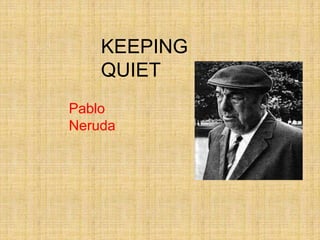
Pablo
Neruda
PABLO
NERUDA
• Pablo Neruda was the pen name and, later,
legal name of the Chilean poet-diplomat
and politician Neftali Ricardo Reyes
Basoalto ,born on July 12, 1904 –
September 23, 1973).
• He derived his pen name from the Czech
poet Jan Neruda. He won the Nobel Prize for
Literature in 1971.
• Neruda became known as a poet when he
was 10 years old. He wrote in a variety of
styles, including surrealist poems, historical
epics, erotically charged love poems such as
the ones in his collectionTwenty Love Poems
and a Song of Despair (1942).
A BRIEF
OUTLOOK
IN THIS POEM ,THE POET VISUALISES A
STATE OF COMFORTABLE INERTIA WHERE
HE WISHES FOR PLEASANT IDLENESS
AND RELAXATION AWAY FROM THE
FRANTIC RAT RACE ,DESTRUCTIVE
ACTIVITIES AND FUTILE WARS . HE
WISHES FOR A PROFOUND SILENCE AND
STILLNESS THAT WOULD ALLEVIATE
THE
SADNE
SS
UNDERSTANDI
NG
CAUS
ED
AND
BY
LACK
THE
THRE
AT
OF
SE
LF
OF
SE
LF
DESTRUCTION AND WHICH WOULD
BUILD UP A SENSE
OF TOGETHERNESS.
Listen to the
Poem
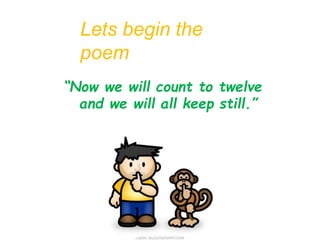
“Now we will count to twelve
and we will all keep still.”
Lets begin the
poem
• The poet begins with counting twelve urging everyone to be still. He chose
‘twelve` for several reasons. ‘Twelve’ hints at the twelve hours of a day which
rules our life. ‘Twelve` refers to twelve zodiac signs believed to be the
controlling forces of our lives. ‘Twelve` refers to twelve months of a year and if
we believe numerology its the digit of peace and prosperity. ‘Twelve` even may be
aimed for a preparation for all to be ready to plunge into the state of silence.
Poetic devices in use
1) We will = Alliteration (line 1 and 2)
2) Count ................still – Antithesis
•
“For once on the face of the earth,
let's not speak in any language;”
Let's stop for one second ,
And not move our arms so much
The poet here urges everyone to break the barriers
of language and unite with one invisible tune i.e.
silence. With the word ‘earth` the poet hints at all the
humans living devoid the identity of country creed
and caste. Though language is the identity of a
country or race, he affirms that humans are more
important and the identity of being a human of earth
is broader realization.
Poetic devices in use
1) Once on – Alliteration
“It would be an exotic moment
without rush, without engines;
we would all be together
in a sudden strangeness.”
We are always on move. We are all busy
in accomplishing our work and go on
rushing in our lives. The poet even urged to
stop engines (referring industrial works
causing harms to environment) . The poet
urges us to stop our personal activities and
stop engines and unite in one tune i.e.
silence. The poet declares silence as exotic
because this silence will make us blissful,
strange and will bring complete equilibrium.
Poetic devices in use
1) Without .................without – Repetition
2) We would – Alliteration.
3) Sudden strangeness – Alliteration
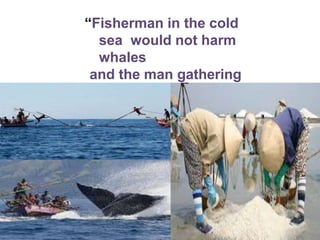
“Fisherman in the cold
sea would not harm
whales
and the man gathering
salt would look at his
hurt hands.”
`If we be still, we shall be able to introspect the
mistakes and wrongs done. Here fishermen are the
representatives of all kinds of tyrants and killers. The
poet wants, them to cease their work and realise their
mistakes. The salt gatherer is explained
representative of poor and lower section
as the
of the
society. They go up to any level to earn their livelihood
and often hurt themselves irreparably.
Poetic Devices in use
1) Cold sea – symbolised as polar region
2) His hurt hands – Alliteration
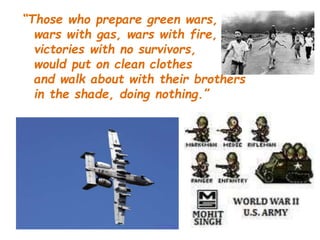
“Those who prepare green wars,
wars with gas, wars with fire,
victories with no survivors,
would put on clean clothes
and walk about with their brothers
in the shade, doing nothing.”
The poet here condemns the people with green wars
(biological weapon or creators of pollution) and wars with
fire (Atomic war) . They become victorious but with no
survivors left. The poet mocks at the victory of those
people who get victory over destruction. The poet asks
them to leave the path of destruction and join the group
of silence. He urges them to put on white (symbolising –
purity and serenity) clothes. And walk with others doing
nothing (meaning - anything negative and doing self
introspection)
Poetic devices in use
1) Wars with – Alliteration
“What I want should not be confused
with total inactivity.
Life is what it is about;
I want no truck with death.”
The poet here warns us that his
message of silence should not be
confused with total inactivity or
inertia. He further clears that his
message does not have any affinity
with death even. His message is aimed
at the way of living. He wants us to
stop a while and feel the calmness so
that a positive introspection is done.
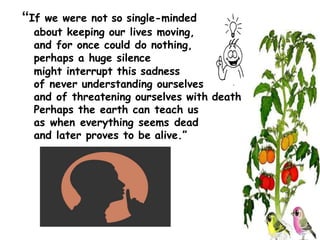
“If we were not so single-minded
about keeping our lives moving,
and for once could do nothing,
perhaps a huge silence
might interrupt this sadness
of never understanding ourselves
and of threatening ourselves with death.
Perhaps the earth can teach us
as when everything seems dead
and later proves to be alive.”
We human beings are single minded. We are always busy in
achieving our goals, completing personal responsibilities. And
we never stop a while to evaluate ourselves and understand
ourselves. We never understand that we shall never be able to
come out of these desires and achievements. If we could stop a
while from these using we would have understood the real
purpose of our lives and ourselves. Rather we go on with the
fear of death calculation how much of our dreams and wishes
will be achieved.
Poetic devices in use
1) We were – Alliteration
“Now I'll count up to twelve
and you keep quiet and I will go.”
• 1
1
0
2
3
4 5 6 7 8
9
11
1
2
In conclusion the poet taught us through
the example of earth which at one
season may look as if dead but comes
back with life in another season.
Likewise our life will also bear certain
meaning when we walk on the right
path i.e. introspecting in silence. In the
last two lines the poet leaves us to
introspect as if he himself has gone
through the same.
Poetic device in use – dead ……alive –
Antitheses.

ch 11 PPT - Keeping Quiet (1).pptx

  • 1.
  • 2.
    PABLO NERUDA • Pablo Nerudawas the pen name and, later, legal name of the Chilean poet-diplomat and politician Neftali Ricardo Reyes Basoalto ,born on July 12, 1904 – September 23, 1973). • He derived his pen name from the Czech poet Jan Neruda. He won the Nobel Prize for Literature in 1971. • Neruda became known as a poet when he was 10 years old. He wrote in a variety of styles, including surrealist poems, historical epics, erotically charged love poems such as the ones in his collectionTwenty Love Poems and a Song of Despair (1942).
  • 3.
    A BRIEF OUTLOOK IN THISPOEM ,THE POET VISUALISES A STATE OF COMFORTABLE INERTIA WHERE HE WISHES FOR PLEASANT IDLENESS AND RELAXATION AWAY FROM THE FRANTIC RAT RACE ,DESTRUCTIVE ACTIVITIES AND FUTILE WARS . HE WISHES FOR A PROFOUND SILENCE AND STILLNESS THAT WOULD ALLEVIATE THE SADNE SS UNDERSTANDI NG CAUS ED AND BY LACK THE THRE AT OF SE LF OF SE LF DESTRUCTION AND WHICH WOULD BUILD UP A SENSE OF TOGETHERNESS.
  • 4.
  • 5.
    “Now we willcount to twelve and we will all keep still.” Lets begin the poem
  • 6.
    • The poetbegins with counting twelve urging everyone to be still. He chose ‘twelve` for several reasons. ‘Twelve’ hints at the twelve hours of a day which rules our life. ‘Twelve` refers to twelve zodiac signs believed to be the controlling forces of our lives. ‘Twelve` refers to twelve months of a year and if we believe numerology its the digit of peace and prosperity. ‘Twelve` even may be aimed for a preparation for all to be ready to plunge into the state of silence. Poetic devices in use 1) We will = Alliteration (line 1 and 2) 2) Count ................still – Antithesis •
  • 7.
    “For once onthe face of the earth, let's not speak in any language;” Let's stop for one second , And not move our arms so much
  • 8.
    The poet hereurges everyone to break the barriers of language and unite with one invisible tune i.e. silence. With the word ‘earth` the poet hints at all the humans living devoid the identity of country creed and caste. Though language is the identity of a country or race, he affirms that humans are more important and the identity of being a human of earth is broader realization. Poetic devices in use 1) Once on – Alliteration
  • 9.
    “It would bean exotic moment without rush, without engines; we would all be together in a sudden strangeness.”
  • 10.
    We are alwayson move. We are all busy in accomplishing our work and go on rushing in our lives. The poet even urged to stop engines (referring industrial works causing harms to environment) . The poet urges us to stop our personal activities and stop engines and unite in one tune i.e. silence. The poet declares silence as exotic because this silence will make us blissful, strange and will bring complete equilibrium. Poetic devices in use 1) Without .................without – Repetition 2) We would – Alliteration. 3) Sudden strangeness – Alliteration
  • 11.
    “Fisherman in thecold sea would not harm whales and the man gathering salt would look at his hurt hands.”
  • 12.
    `If we bestill, we shall be able to introspect the mistakes and wrongs done. Here fishermen are the representatives of all kinds of tyrants and killers. The poet wants, them to cease their work and realise their mistakes. The salt gatherer is explained representative of poor and lower section as the of the society. They go up to any level to earn their livelihood and often hurt themselves irreparably. Poetic Devices in use 1) Cold sea – symbolised as polar region 2) His hurt hands – Alliteration
  • 13.
    “Those who preparegreen wars, wars with gas, wars with fire, victories with no survivors, would put on clean clothes and walk about with their brothers in the shade, doing nothing.”
  • 14.
    The poet herecondemns the people with green wars (biological weapon or creators of pollution) and wars with fire (Atomic war) . They become victorious but with no survivors left. The poet mocks at the victory of those people who get victory over destruction. The poet asks them to leave the path of destruction and join the group of silence. He urges them to put on white (symbolising – purity and serenity) clothes. And walk with others doing nothing (meaning - anything negative and doing self introspection) Poetic devices in use 1) Wars with – Alliteration
  • 15.
    “What I wantshould not be confused with total inactivity. Life is what it is about; I want no truck with death.”
  • 16.
    The poet herewarns us that his message of silence should not be confused with total inactivity or inertia. He further clears that his message does not have any affinity with death even. His message is aimed at the way of living. He wants us to stop a while and feel the calmness so that a positive introspection is done.
  • 17.
    “If we werenot so single-minded about keeping our lives moving, and for once could do nothing, perhaps a huge silence might interrupt this sadness of never understanding ourselves and of threatening ourselves with death. Perhaps the earth can teach us as when everything seems dead and later proves to be alive.”
  • 18.
    We human beingsare single minded. We are always busy in achieving our goals, completing personal responsibilities. And we never stop a while to evaluate ourselves and understand ourselves. We never understand that we shall never be able to come out of these desires and achievements. If we could stop a while from these using we would have understood the real purpose of our lives and ourselves. Rather we go on with the fear of death calculation how much of our dreams and wishes will be achieved. Poetic devices in use 1) We were – Alliteration
  • 19.
    “Now I'll countup to twelve and you keep quiet and I will go.” • 1 1 0 2 3 4 5 6 7 8 9 11 1 2
  • 20.
    In conclusion thepoet taught us through the example of earth which at one season may look as if dead but comes back with life in another season. Likewise our life will also bear certain meaning when we walk on the right path i.e. introspecting in silence. In the last two lines the poet leaves us to introspect as if he himself has gone through the same. Poetic device in use – dead ……alive – Antitheses.