R. G. QUINTERO & CO.
CFA LEVEL I Q-NOTES
INTRODUCTION
www.rgquintero.com
Provider of live classes in
New York and Connecticut
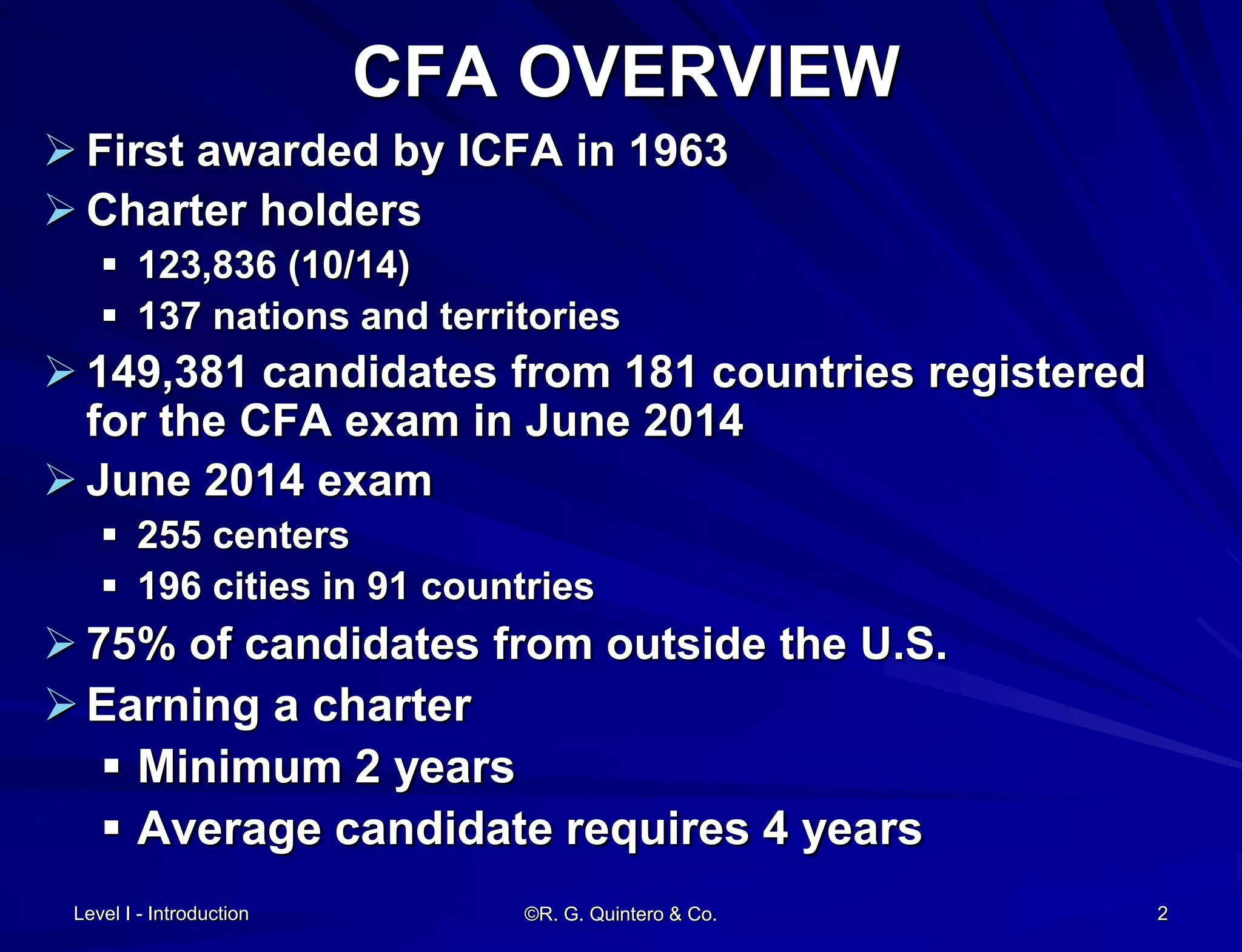
CFA OVERVIEW
 First awarded by ICFA in 1963
 Charter holders
 123,836 (10/14)
 137 nations and territories
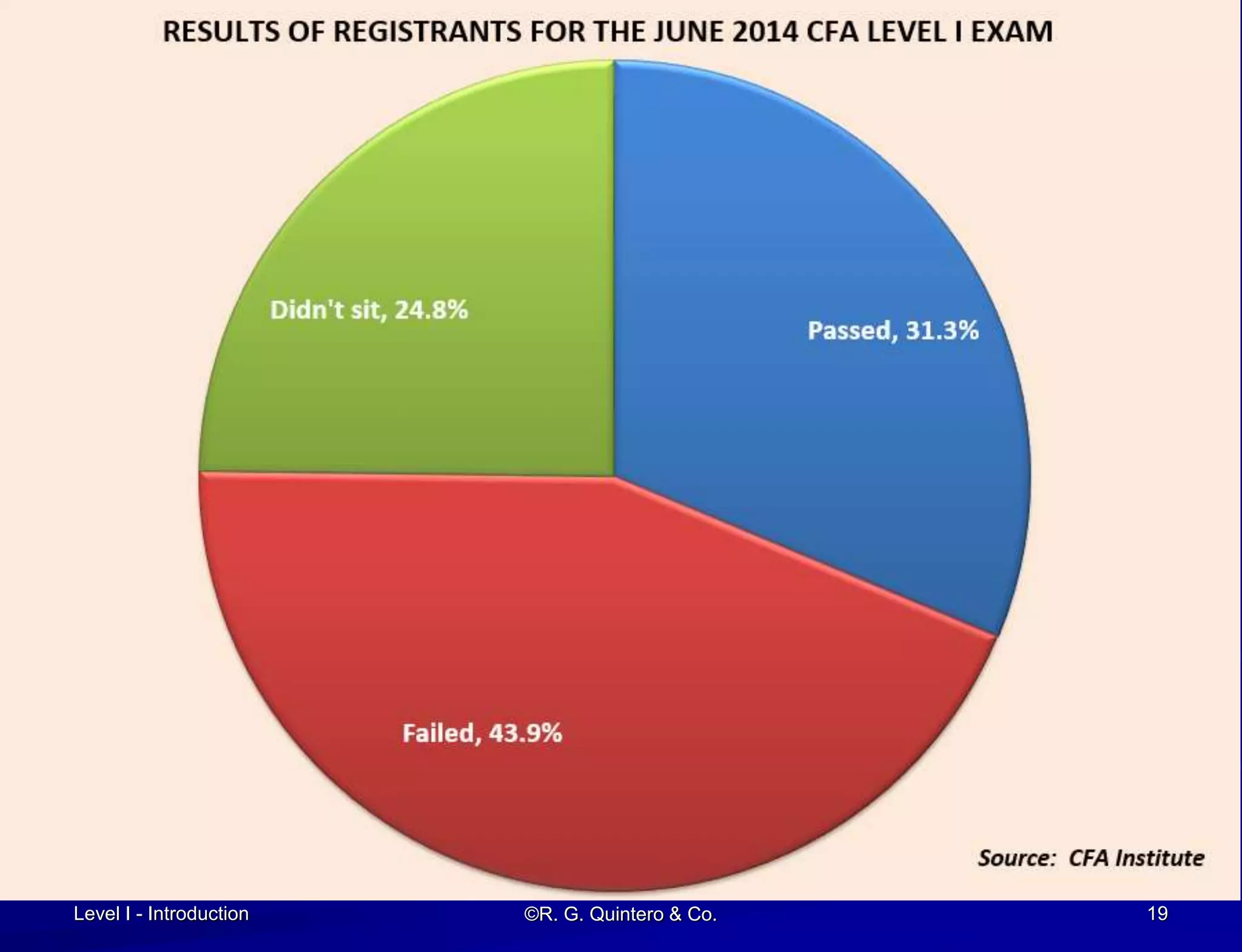
 149,381 candidates from 181 countries registered
for the CFA exam in June 2014
 June 2014 exam
 255 centers
 196 cities in 91 countries
 75% of candidates from outside the U.S.
Earning a charter
 Minimum 2 years
 Average candidate requires 4 years
Level I - Introduction ©R. G. Quintero & Co. 2
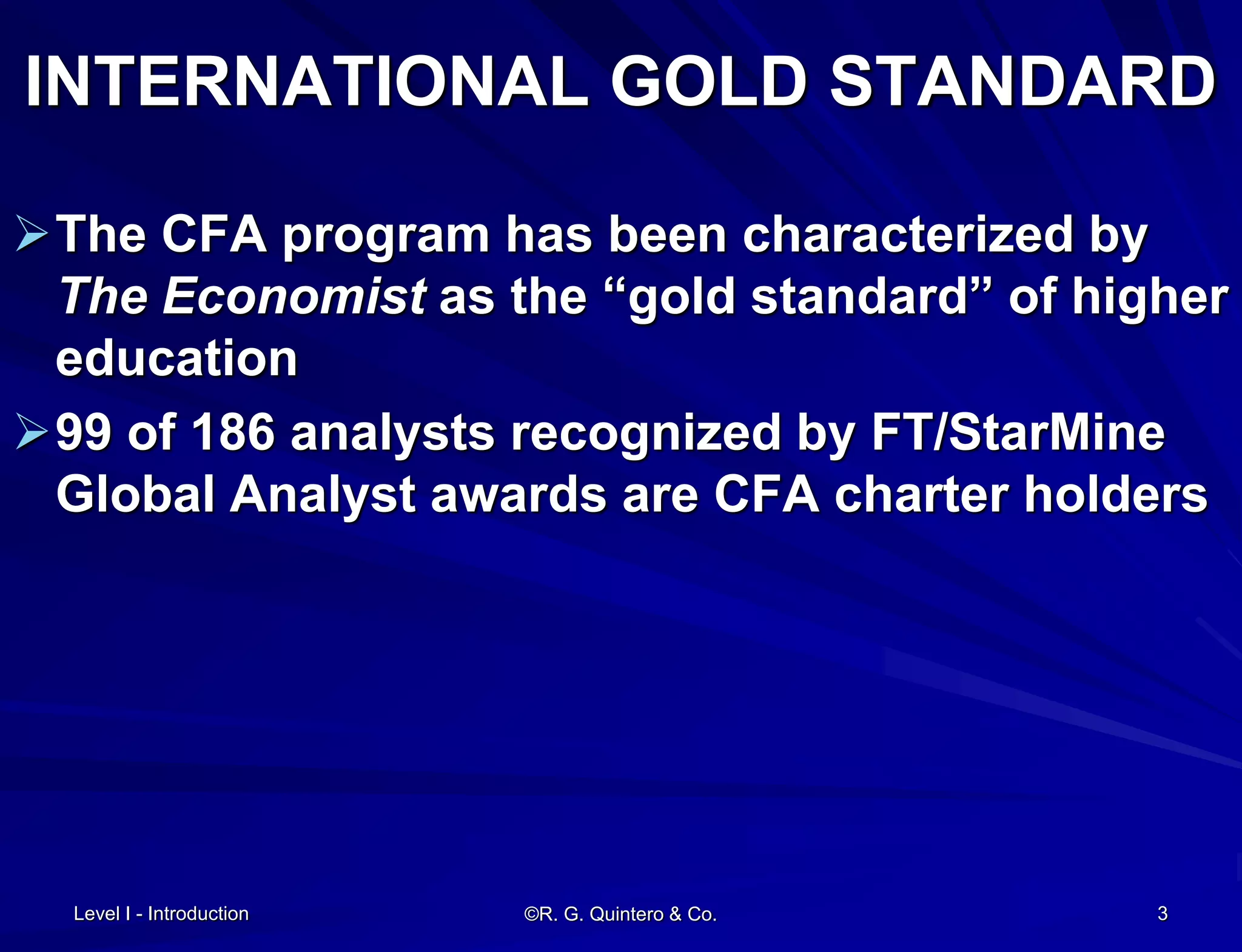
INTERNATIONAL GOLD STANDARD
The CFA program has been characterized by
The Economist as the “gold standard” of higher
education
99 of 186 analysts recognized by FT/StarMine
Global Analyst awards are CFA charter holders
Level I - Introduction ©R. G. Quintero & Co. 3
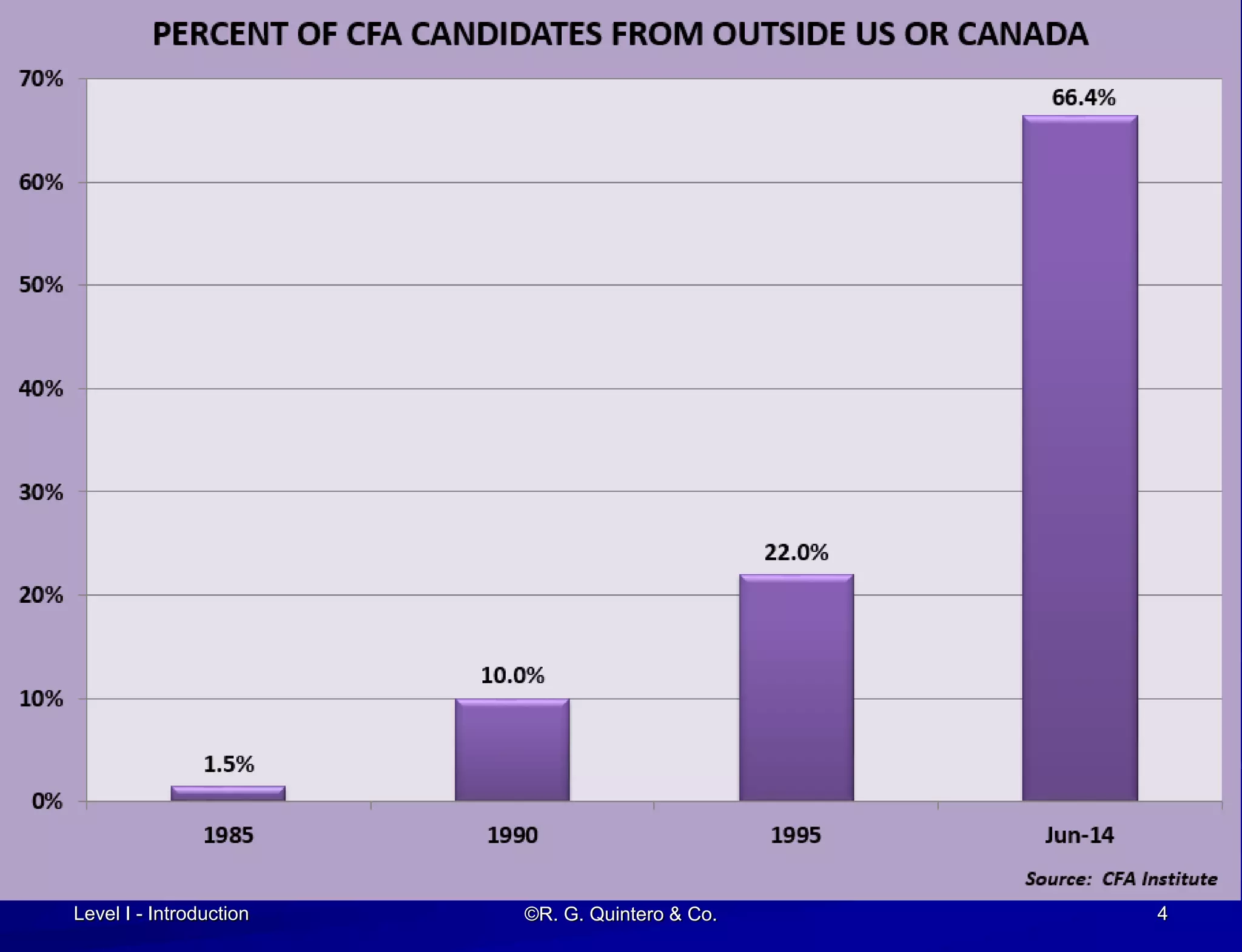
Level I - Introduction 4©R. G. Quintero & Co.
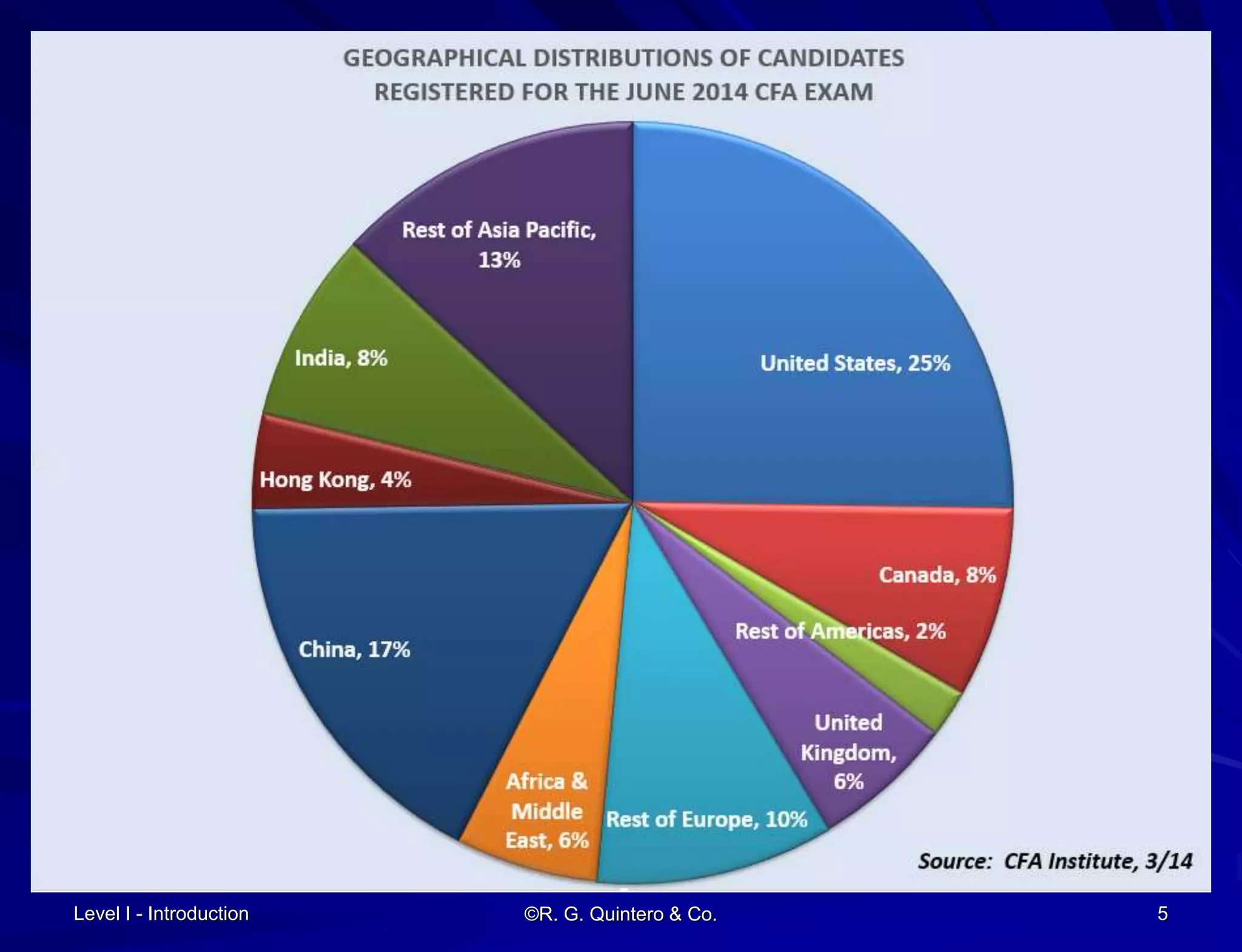
Level I - Introduction ©R. G. Quintero & Co. 5
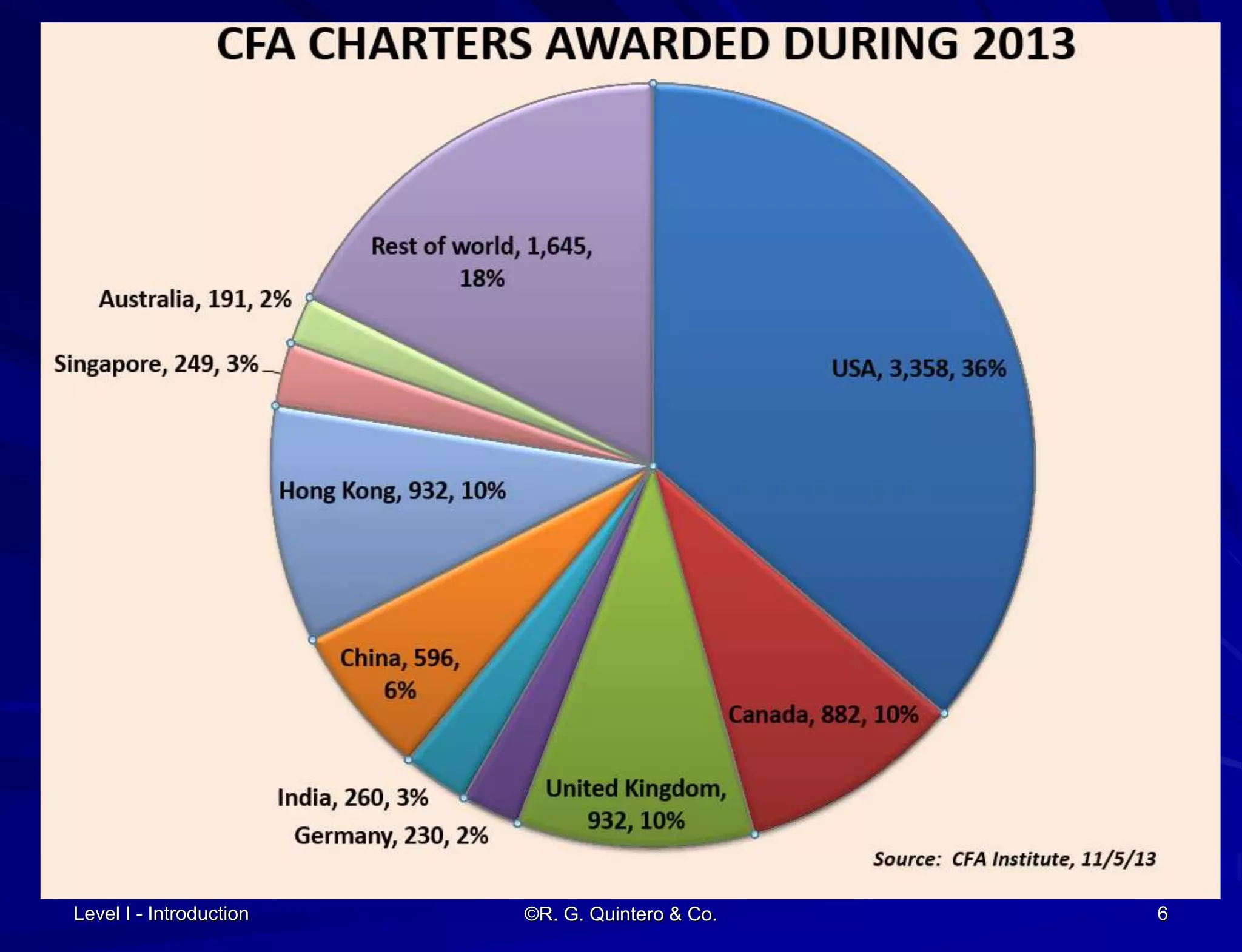
Level I - Introduction ©R. G. Quintero & Co. 6
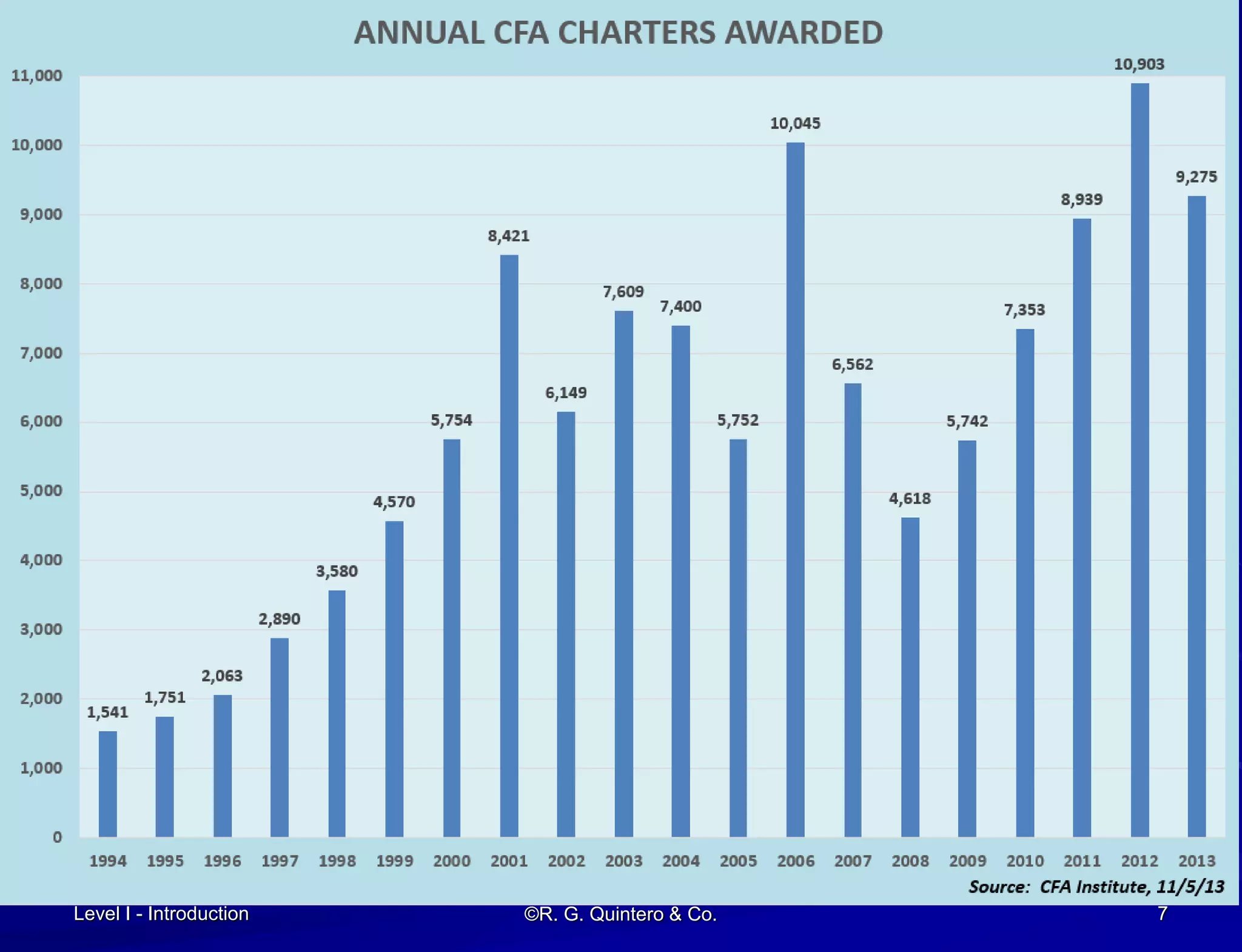
Level I - Introduction ©R. G. Quintero & Co. 7
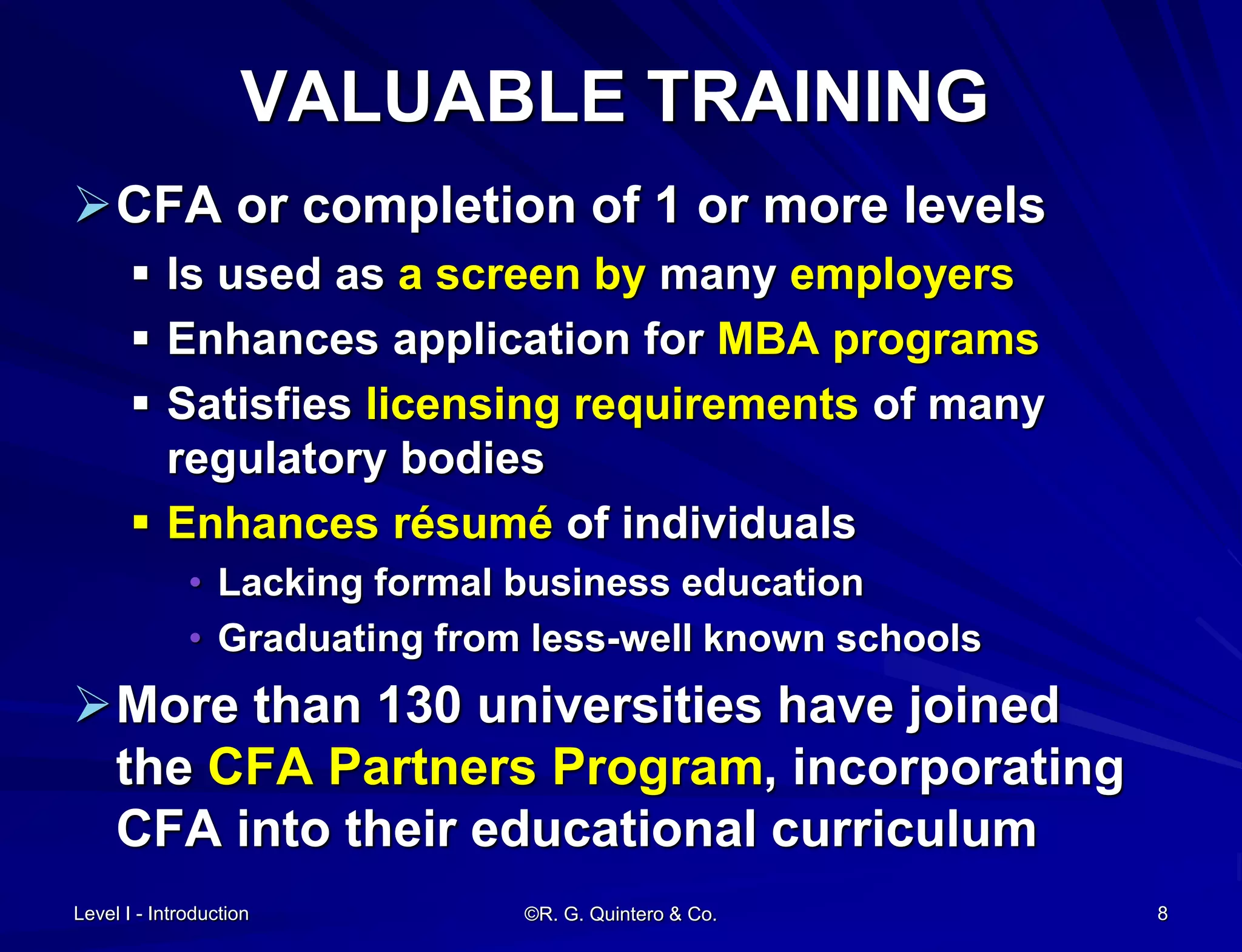
VALUABLE TRAINING
CFA or completion of 1 or more levels
 Is used as a screen by many employers
 Enhances application for MBA programs
 Satisfies licensing requirements of many
regulatory bodies
 Enhances résumé of individuals
• Lacking formal business education
• Graduating from less-well known schools
More than 130 universities have joined
the CFA Partners Program, incorporating
CFA into their educational curriculum
Level I - Introduction ©R. G. Quintero & Co. 8
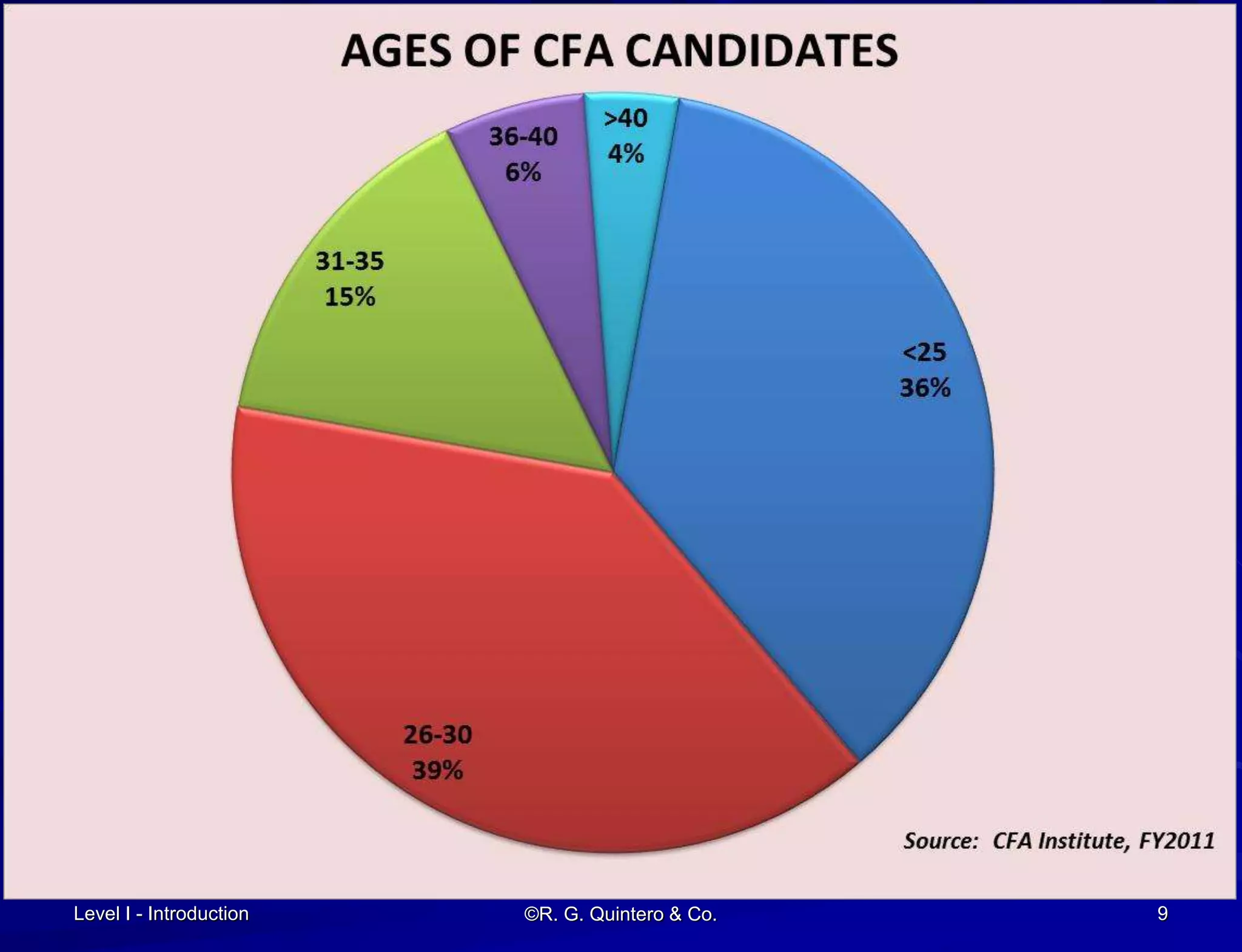
Level I - Introduction ©R. G. Quintero & Co. 9
Level I - Introduction ©R. G. Quintero & Co. 10
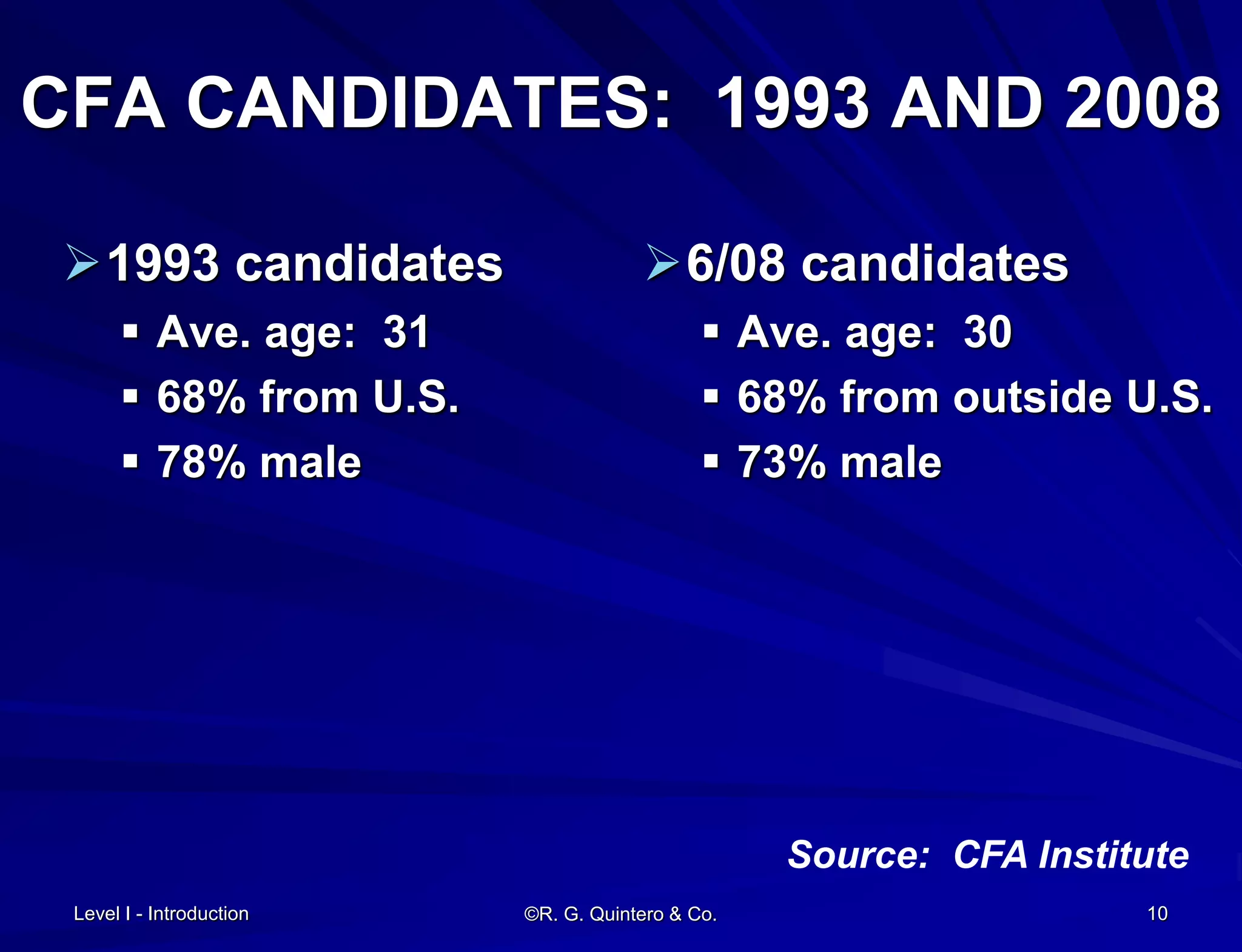
CFA CANDIDATES: 1993 AND 2008
1993 candidates
 Ave. age: 31
 68% from U.S.
 78% male
6/08 candidates
 Ave. age: 30
 68% from outside U.S.
 73% male
Source: CFA Institute
Level I - Introduction ©R. G. Quintero & Co. 11
Level I - Introduction ©R. G. Quintero & Co. 12
TOP US EMPLOYERS OF CFA
INSTITUTE MEMBERS
Level I - Introduction ©R. G. Quintero & Co. 13
Source: CFA Institute, 1/13
Level I - Introduction ©R. G. Quintero & Co. 14
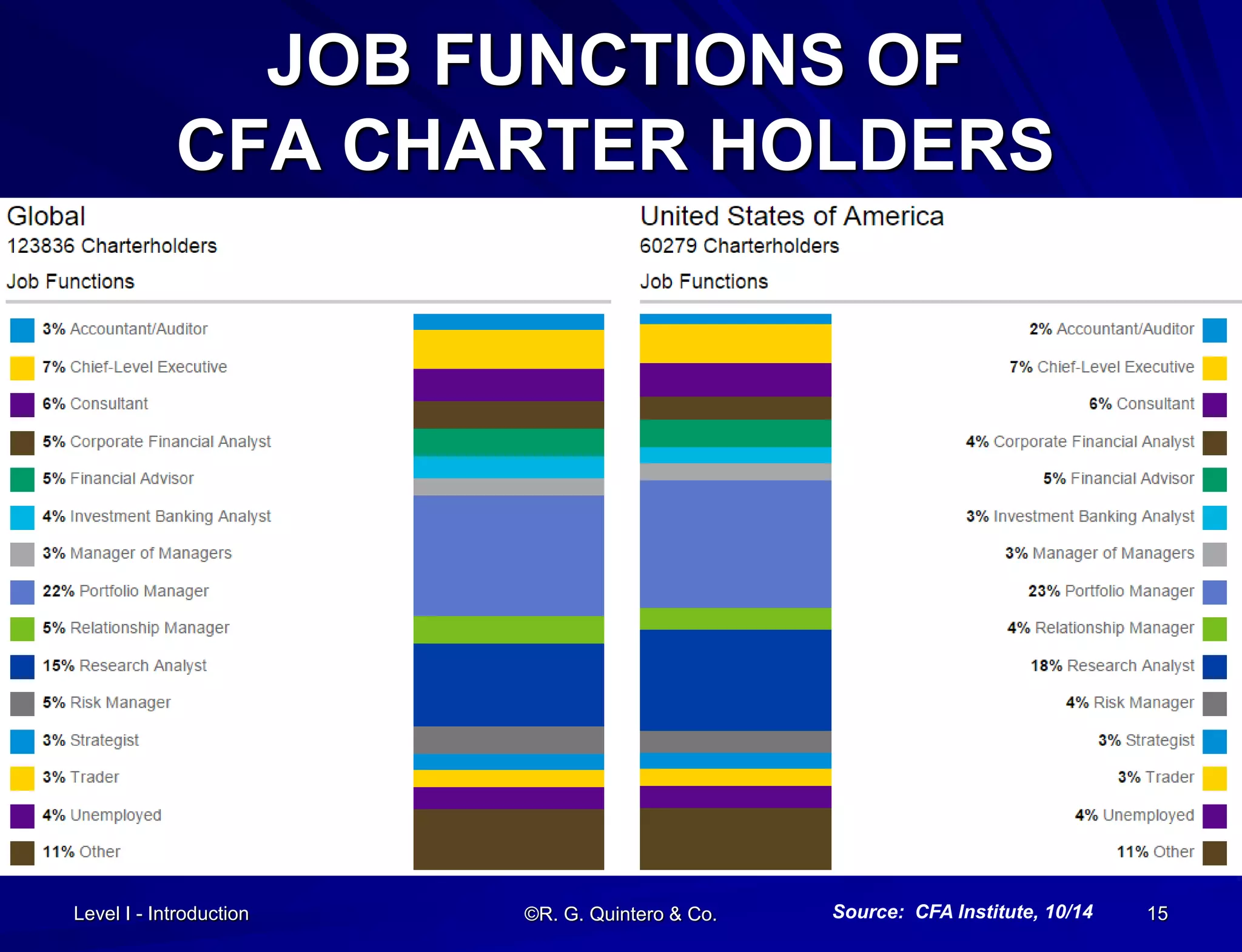
JOB FUNCTIONS OF
CFA CHARTER HOLDERS
Level I - Introduction ©R. G. Quintero & Co. 15Source: CFA Institute, 10/14
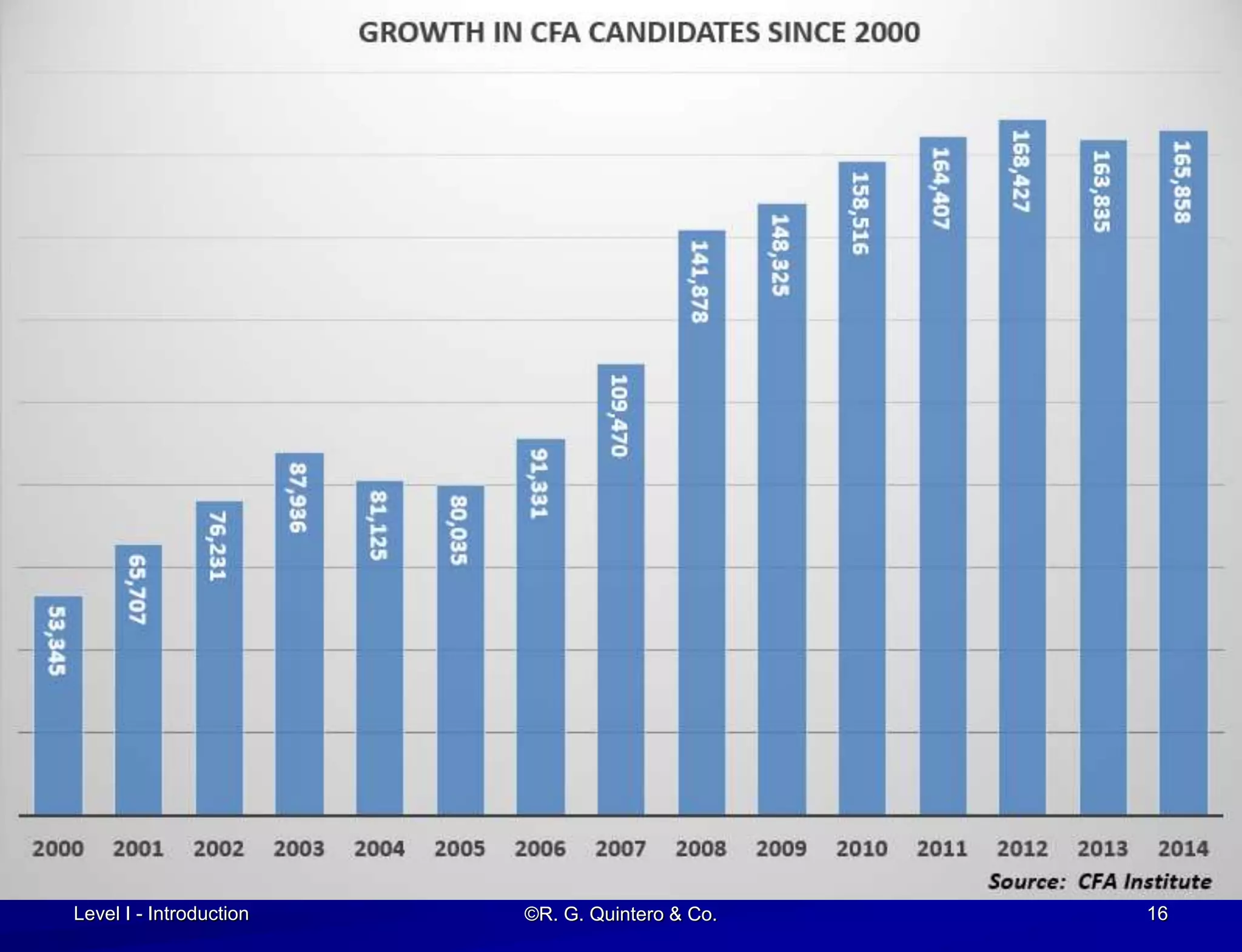
Level I - Introduction ©R. G. Quintero & Co. 16
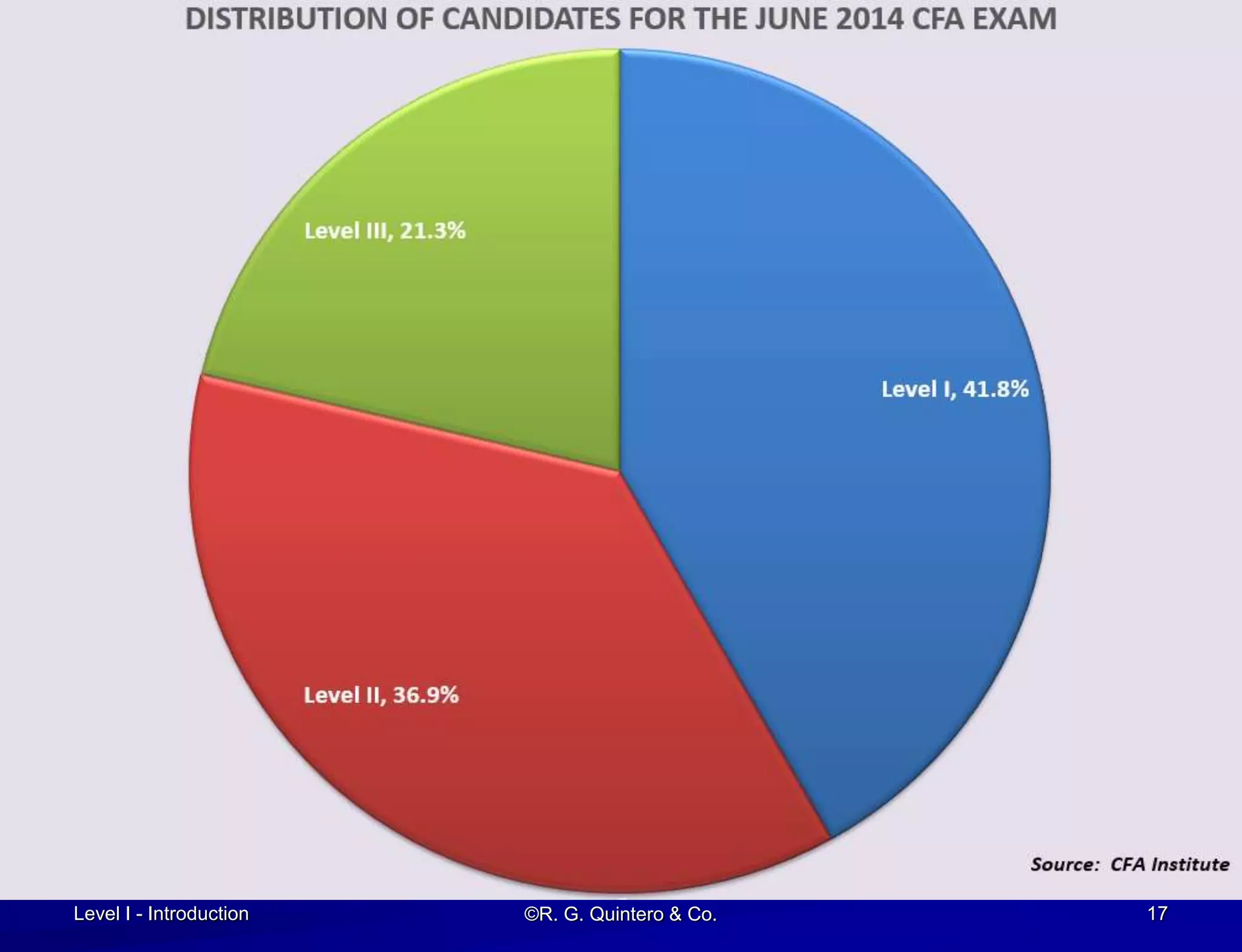
Level I - Introduction ©R. G. Quintero & Co. 17
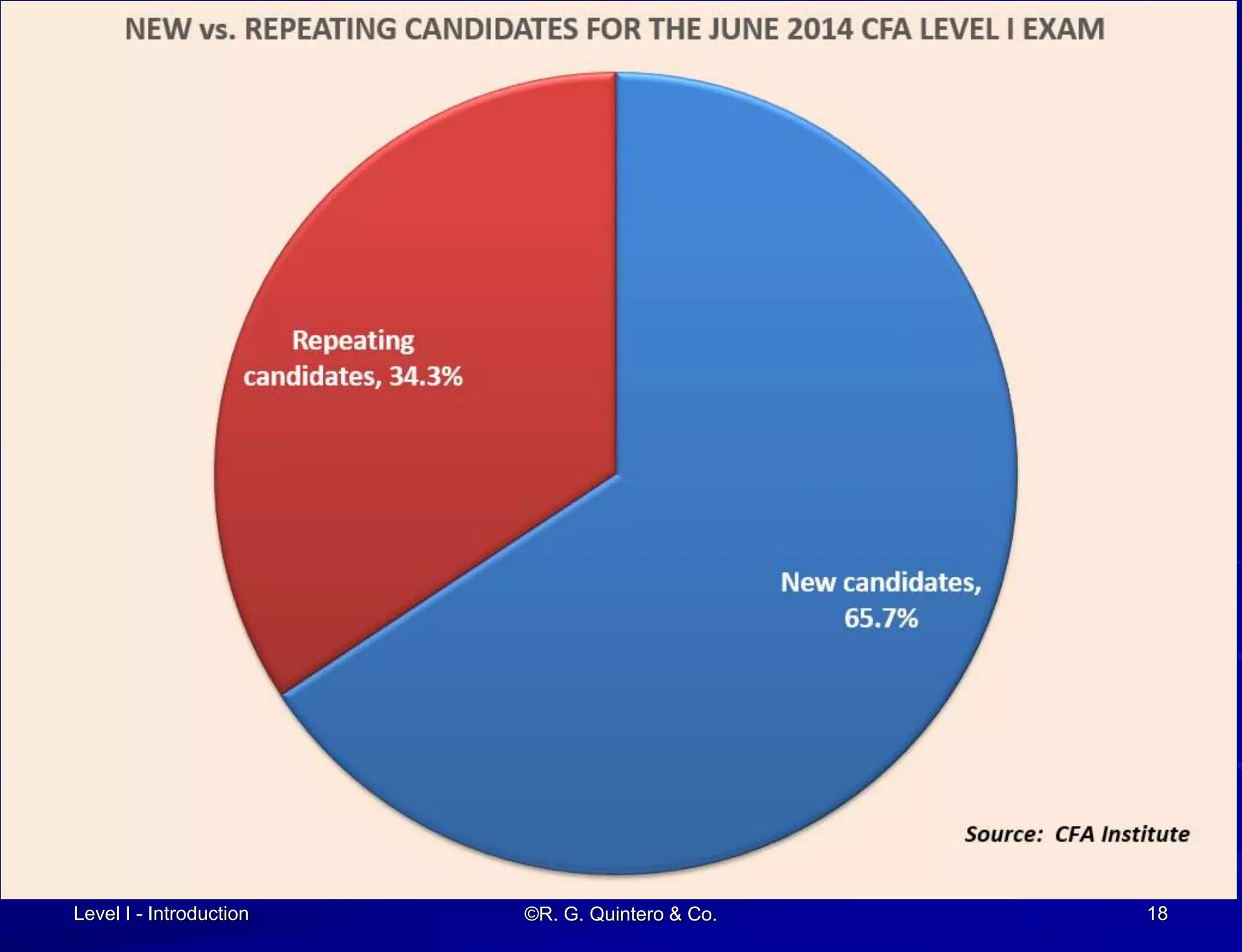
Level I - Introduction ©R. G. Quintero & Co. 18
Level I - Introduction ©R. G. Quintero & Co. 19
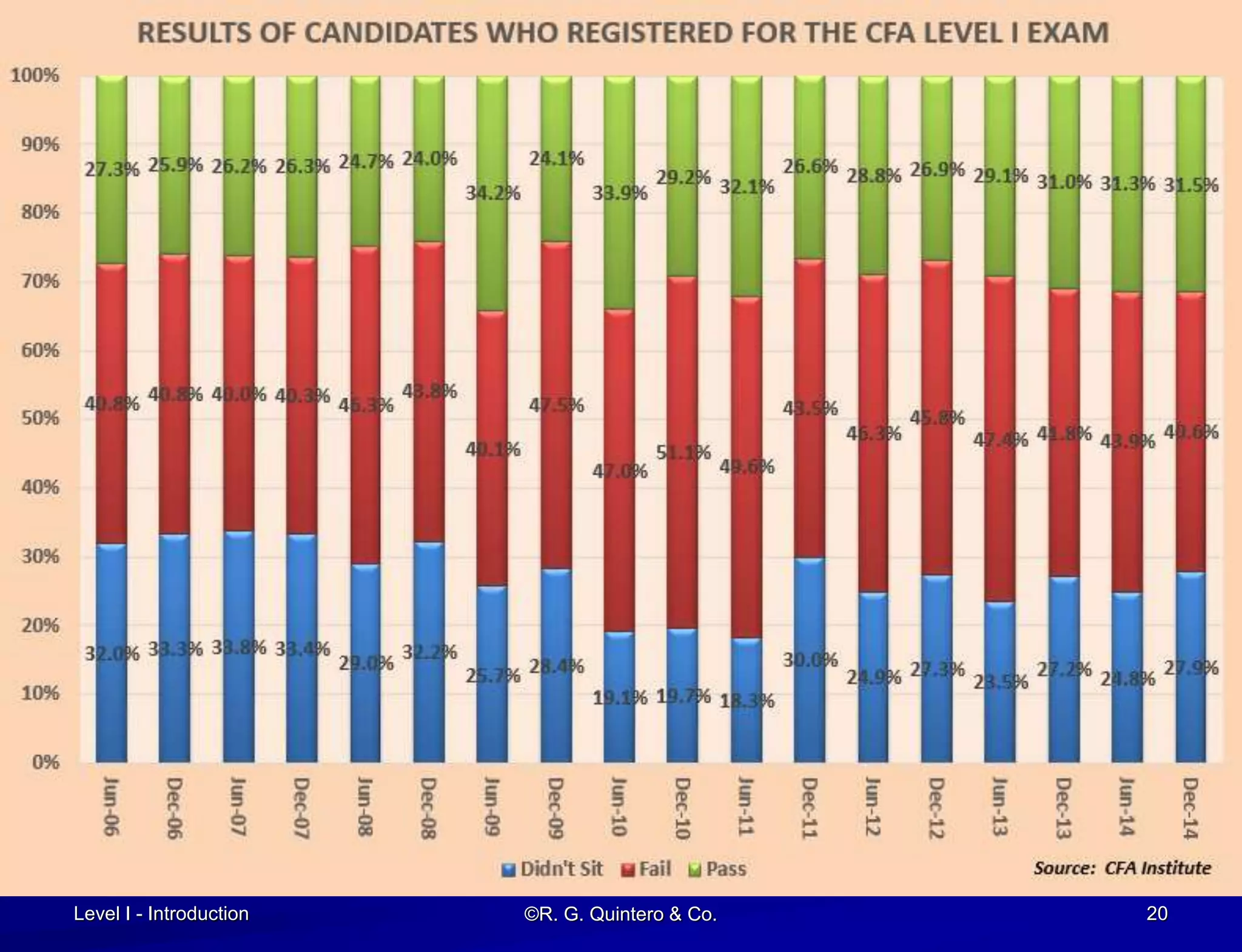
Level I - Introduction ©R. G. Quintero & Co. 20
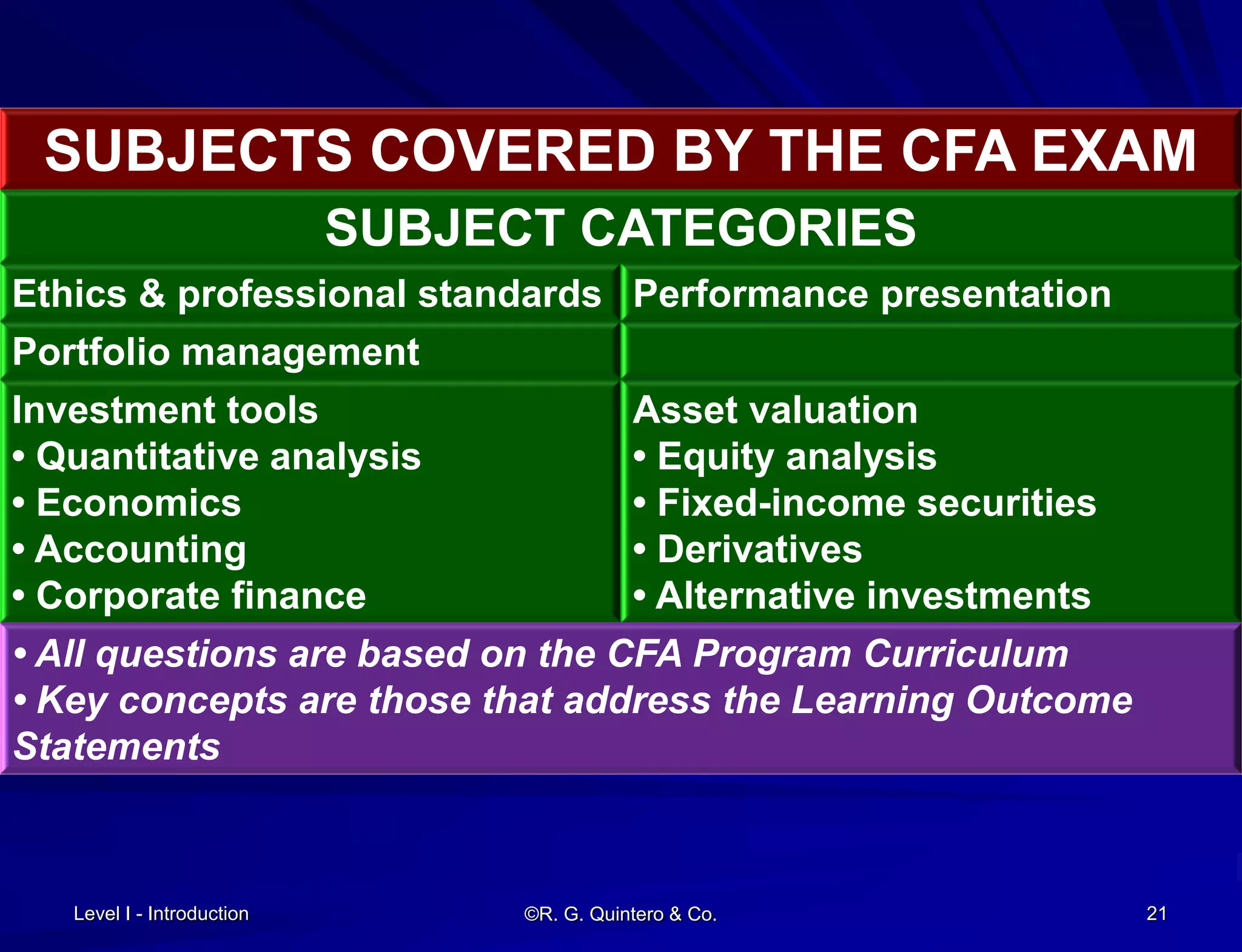
Level I - Introduction ©R. G. Quintero & Co. 21
SUBJECTS COVERED BY THE CFA EXAM
SUBJECT CATEGORIES
Ethics & professional standards Performance presentation
Portfolio management
Investment tools
• Quantitative analysis
• Economics
• Accounting
• Corporate finance
Asset valuation
• Equity analysis
• Fixed-income securities
• Derivatives
• Alternative investments
• All questions are based on the CFA Program Curriculum
• Key concepts are those that address the Learning Outcome
Statements
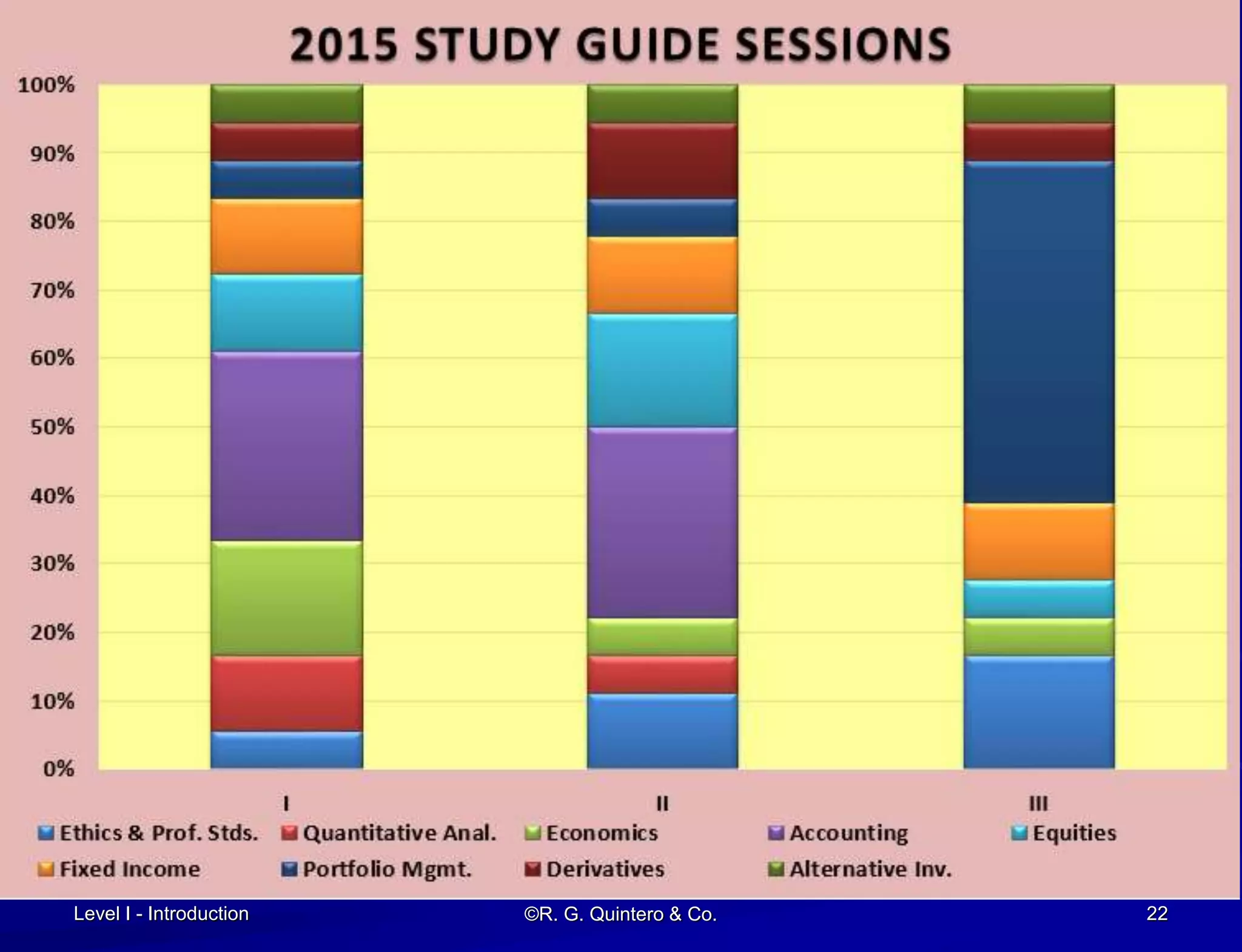
Level I - Introduction ©R. G. Quintero & Co. 22
Level I - Introduction ©R. G. Quintero & Co. 23
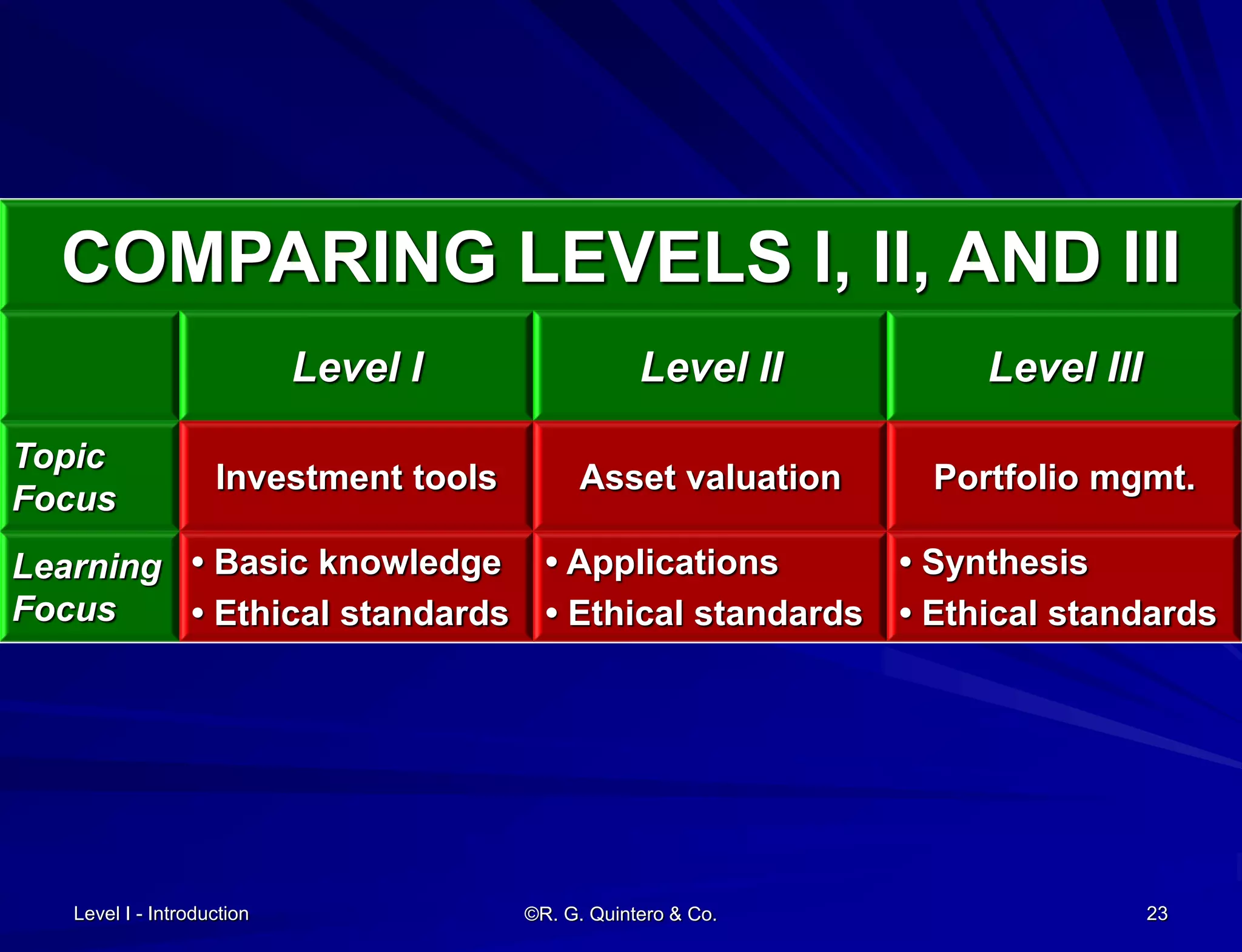
COMPARING LEVELS I, II, AND III
Level I Level II Level III
Topic
Focus
Investment tools Asset valuation Portfolio mgmt.
Learning
Focus
• Basic knowledge
• Ethical standards
• Applications
• Ethical standards
• Synthesis
• Ethical standards
Level I - Introduction ©R. G. Quintero & Co. 24
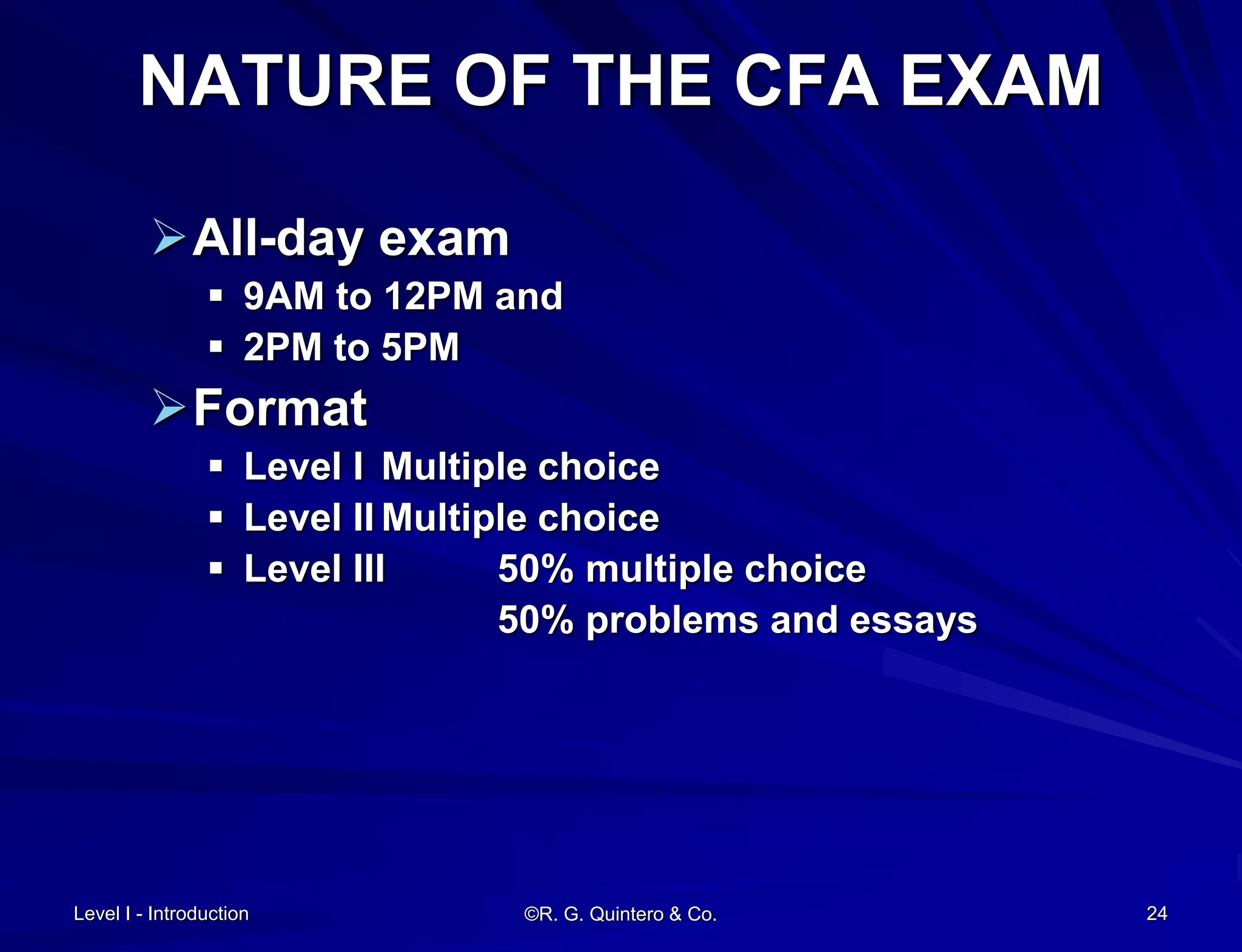
NATURE OF THE CFA EXAM
All-day exam
 9AM to 12PM and
 2PM to 5PM
Format
 Level I Multiple choice
 Level II Multiple choice
 Level III 50% multiple choice
50% problems and essays
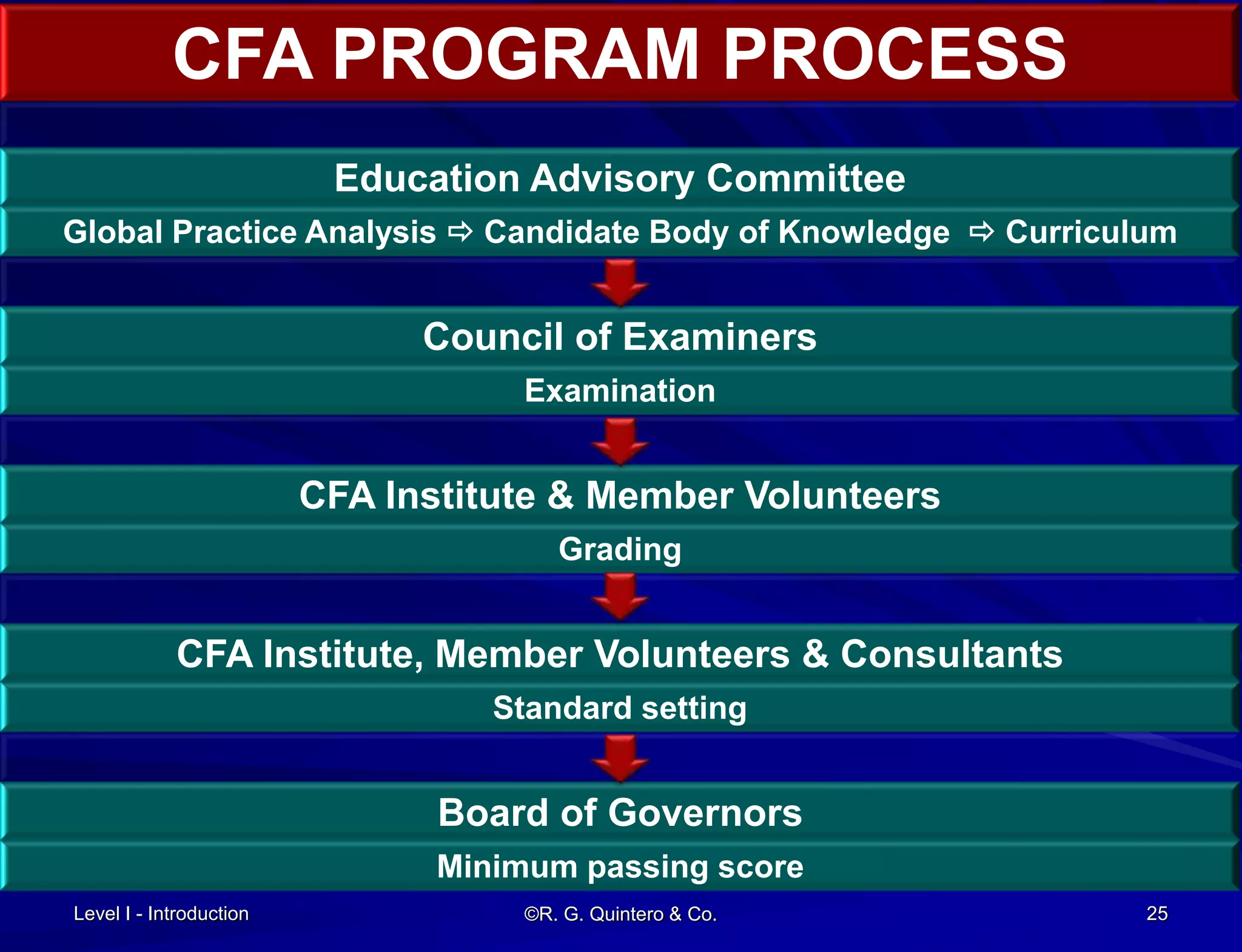
CFA PROGRAM PROCESS
Education Advisory Committee
Global Practice Analysis  Candidate Body of Knowledge  Curriculum
Council of Examiners
Examination
CFA Institute & Member Volunteers
Grading
CFA Institute, Member Volunteers & Consultants
Standard setting
Board of Governors
Minimum passing score
Level I - Introduction ©R. G. Quintero & Co. 25
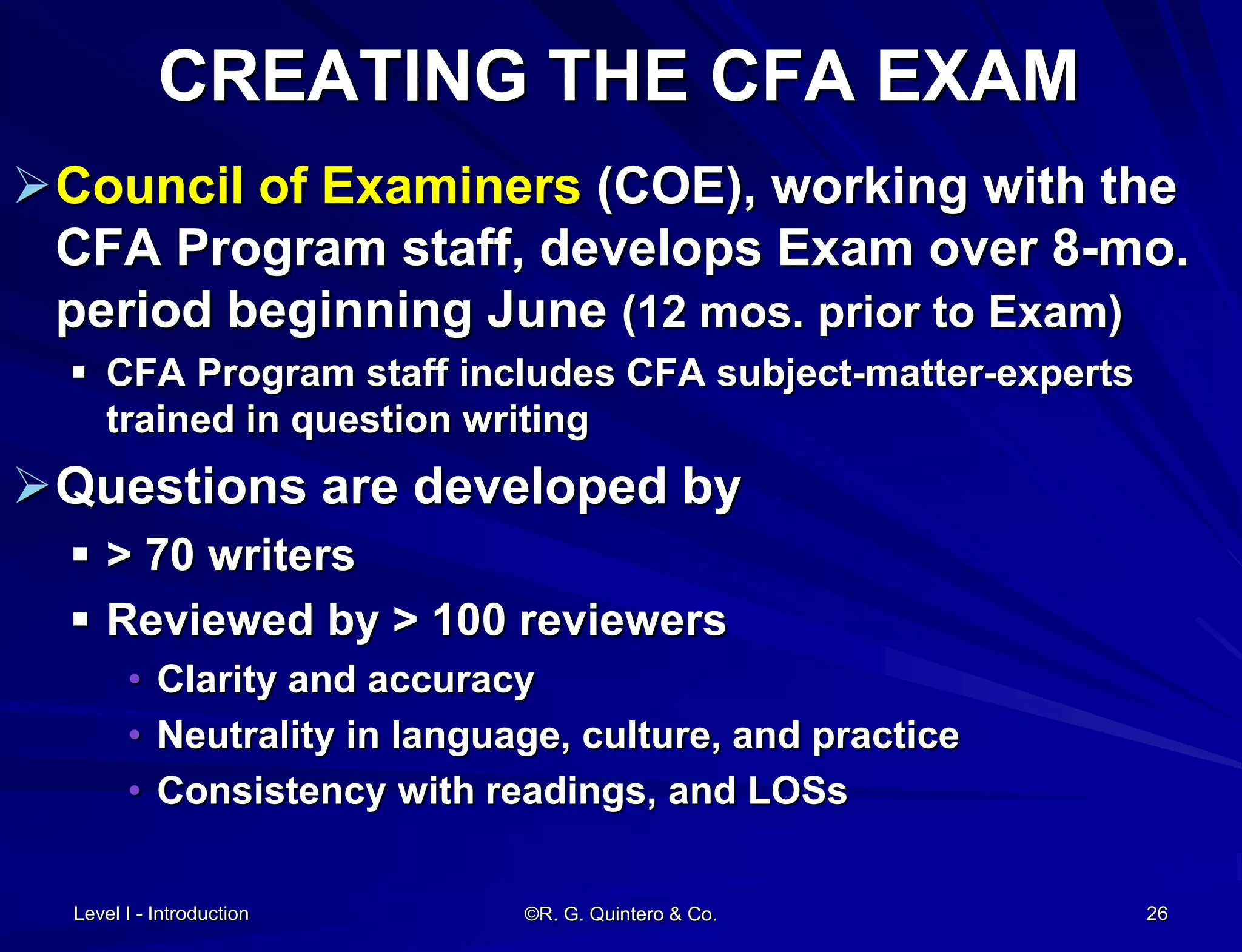
CREATING THE CFA EXAM
Council of Examiners (COE), working with the
CFA Program staff, develops Exam over 8-mo.
period beginning June (12 mos. prior to Exam)
 CFA Program staff includes CFA subject-matter-experts
trained in question writing
Questions are developed by
 > 70 writers
 Reviewed by > 100 reviewers
• Clarity and accuracy
• Neutrality in language, culture, and practice
• Consistency with readings, and LOSs
Level I - Introduction ©R. G. Quintero & Co. 26
Level I - Introduction ©R. G. Quintero & Co. 27
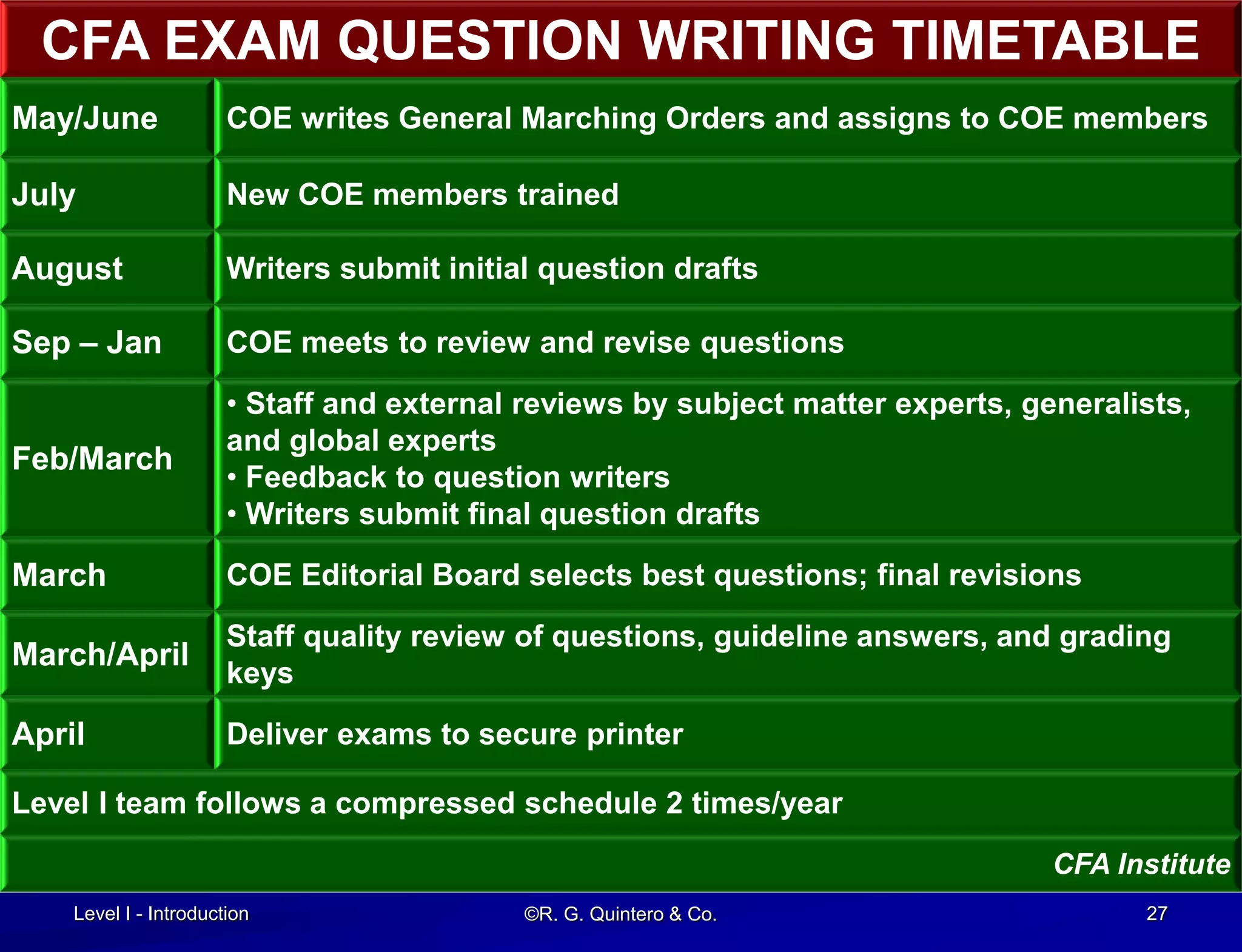
CFA EXAM QUESTION WRITING TIMETABLE
May/June COE writes General Marching Orders and assigns to COE members
July New COE members trained
August Writers submit initial question drafts
Sep – Jan COE meets to review and revise questions
Feb/March
• Staff and external reviews by subject matter experts, generalists,
and global experts
• Feedback to question writers
• Writers submit final question drafts
March COE Editorial Board selects best questions; final revisions
March/April
Staff quality review of questions, guideline answers, and grading
keys
April Deliver exams to secure printer
Level I team follows a compressed schedule 2 times/year
CFA Institute
Level I - Introduction ©R. G. Quintero & Co. 28
POST-EXAM ANALYSIS
Questions evaluated for
 Appropriate difficulty
 Appropriate discrimination
 Fully functioning distractors
 Construct validity
 Construct bias
 Content bias
Studies have found questions to be
valid and unbiased
Level I - Introduction ©R. G. Quintero & Co. 29
Source: AIMR
Level I - Introduction ©R. G. Quintero & Co. 30
Level I - Introduction ©R. G. Quintero & Co. 31
Level I - Introduction ©R. G. Quintero & Co. 32
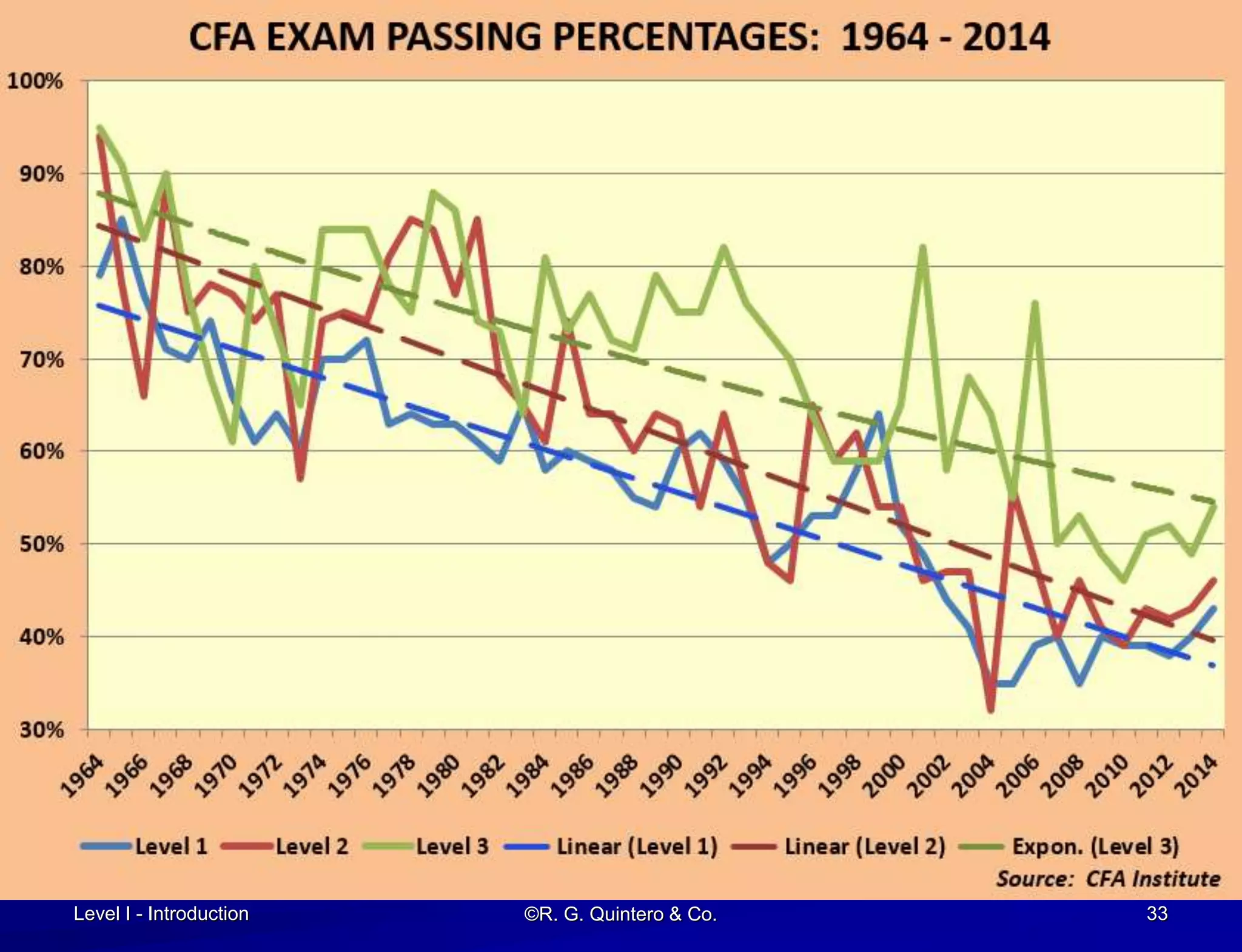
Level I - Introduction ©R. G. Quintero & Co. 33
Level I - Introduction ©R. G. Quintero & Co. 34
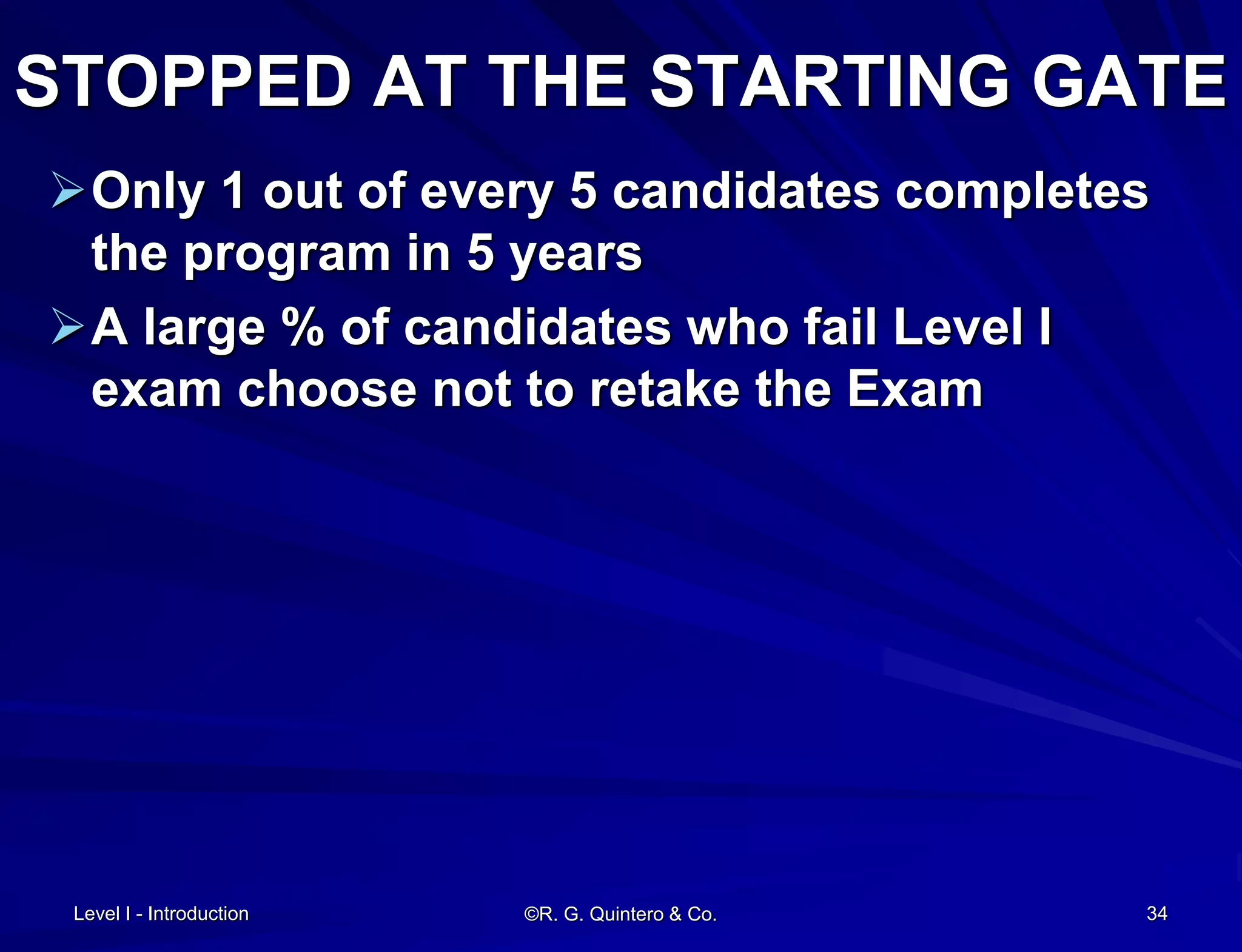
STOPPED AT THE STARTING GATE
Only 1 out of every 5 candidates completes
the program in 5 years
A large % of candidates who fail Level I
exam choose not to retake the Exam
Level I - Introduction ©R. G. Quintero & Co. 35
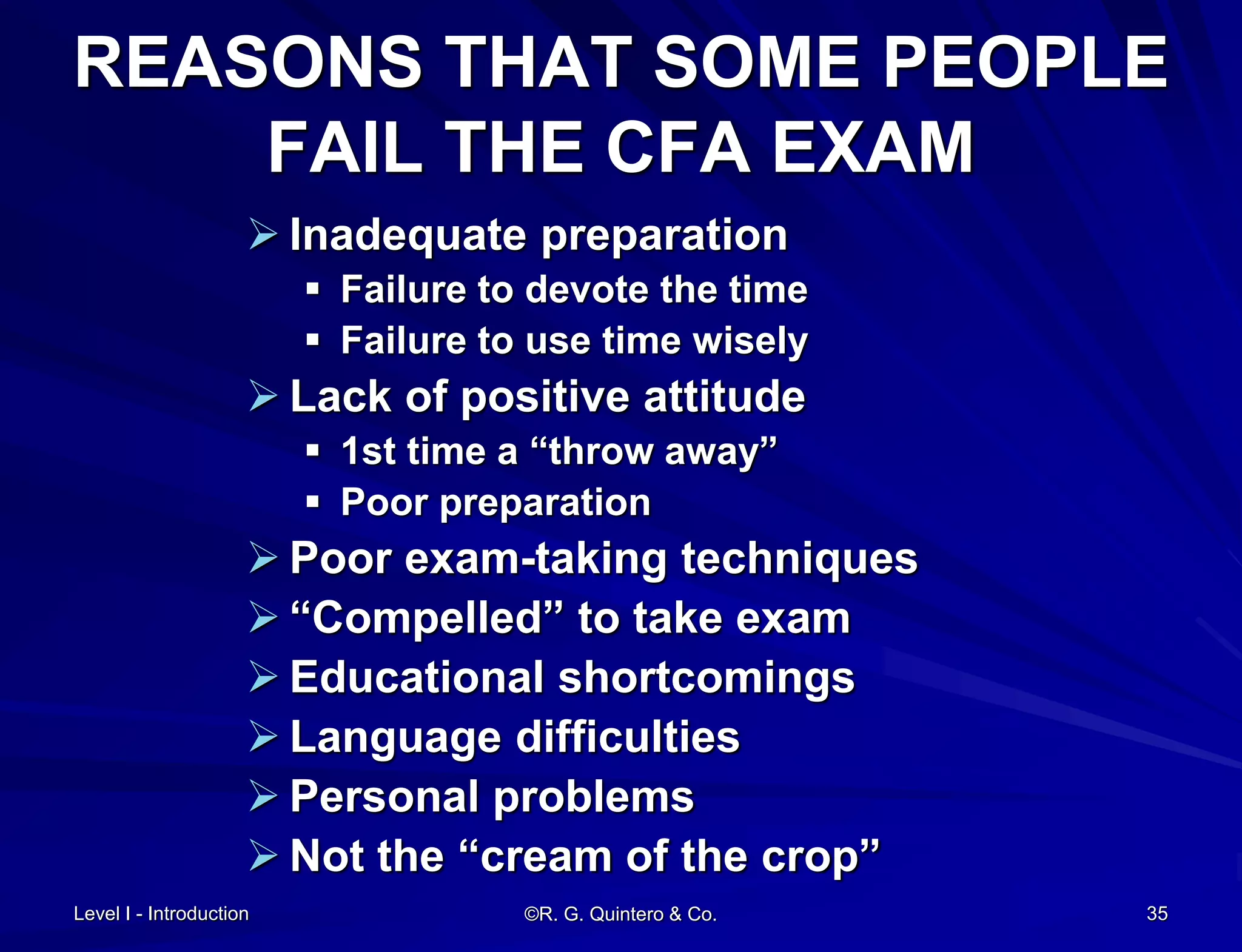
REASONS THAT SOME PEOPLE
FAIL THE CFA EXAM
 Inadequate preparation
 Failure to devote the time
 Failure to use time wisely
 Lack of positive attitude
 1st time a “throw away”
 Poor preparation
 Poor exam-taking techniques
 “Compelled” to take exam
 Educational shortcomings
 Language difficulties
 Personal problems
 Not the “cream of the crop”
Level I - Introduction ©R. G. Quintero & Co. 36
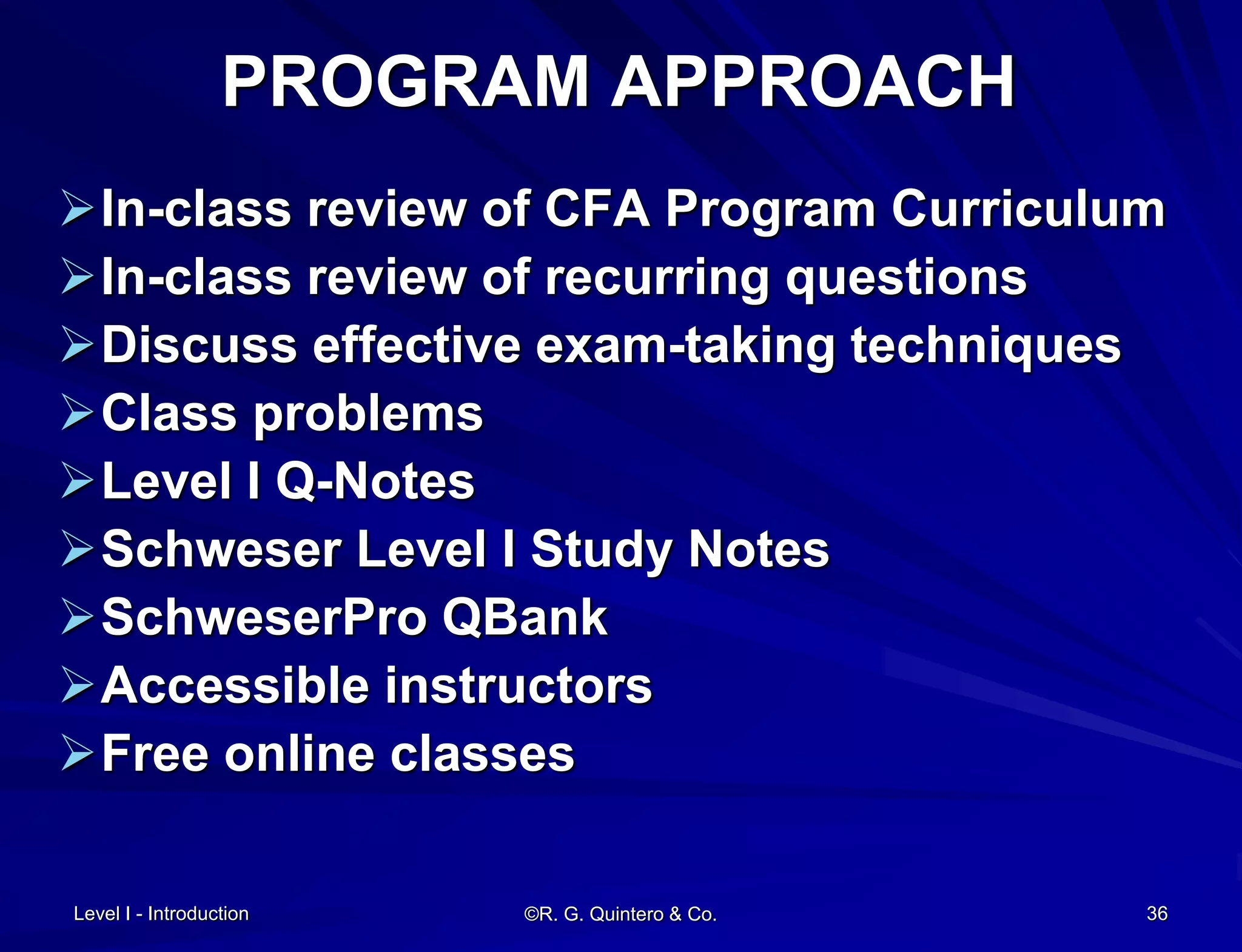
PROGRAM APPROACH
In-class review of CFA Program Curriculum
In-class review of recurring questions
Discuss effective exam-taking techniques
Class problems
Level I Q-Notes
Schweser Level I Study Notes
SchweserPro QBank
Accessible instructors
Free online classes
Level I - Introduction ©R. G. Quintero & Co. 37
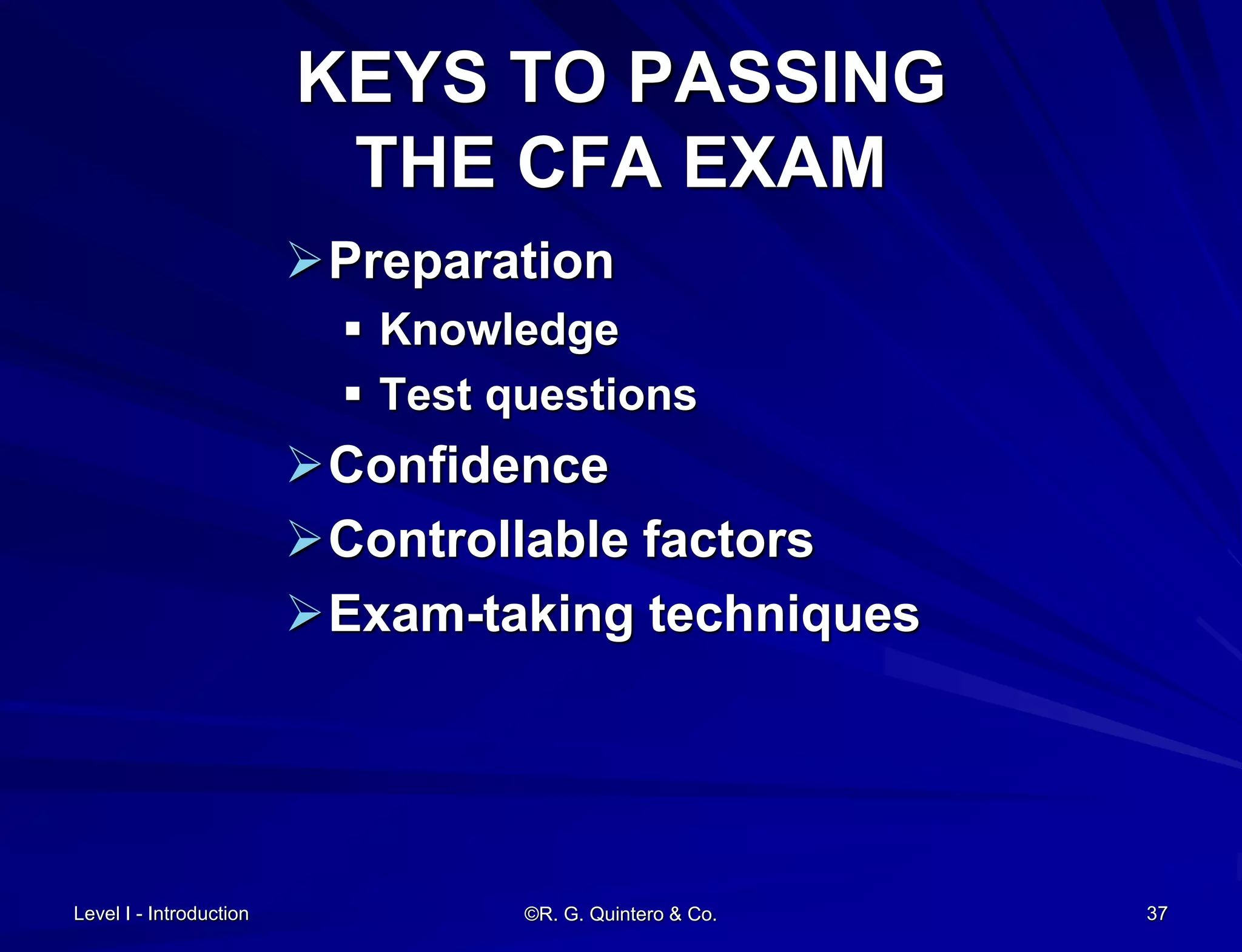
KEYS TO PASSING
THE CFA EXAM
Preparation
 Knowledge
 Test questions
Confidence
Controllable factors
Exam-taking techniques
Level I - Introduction ©R. G. Quintero & Co. 38
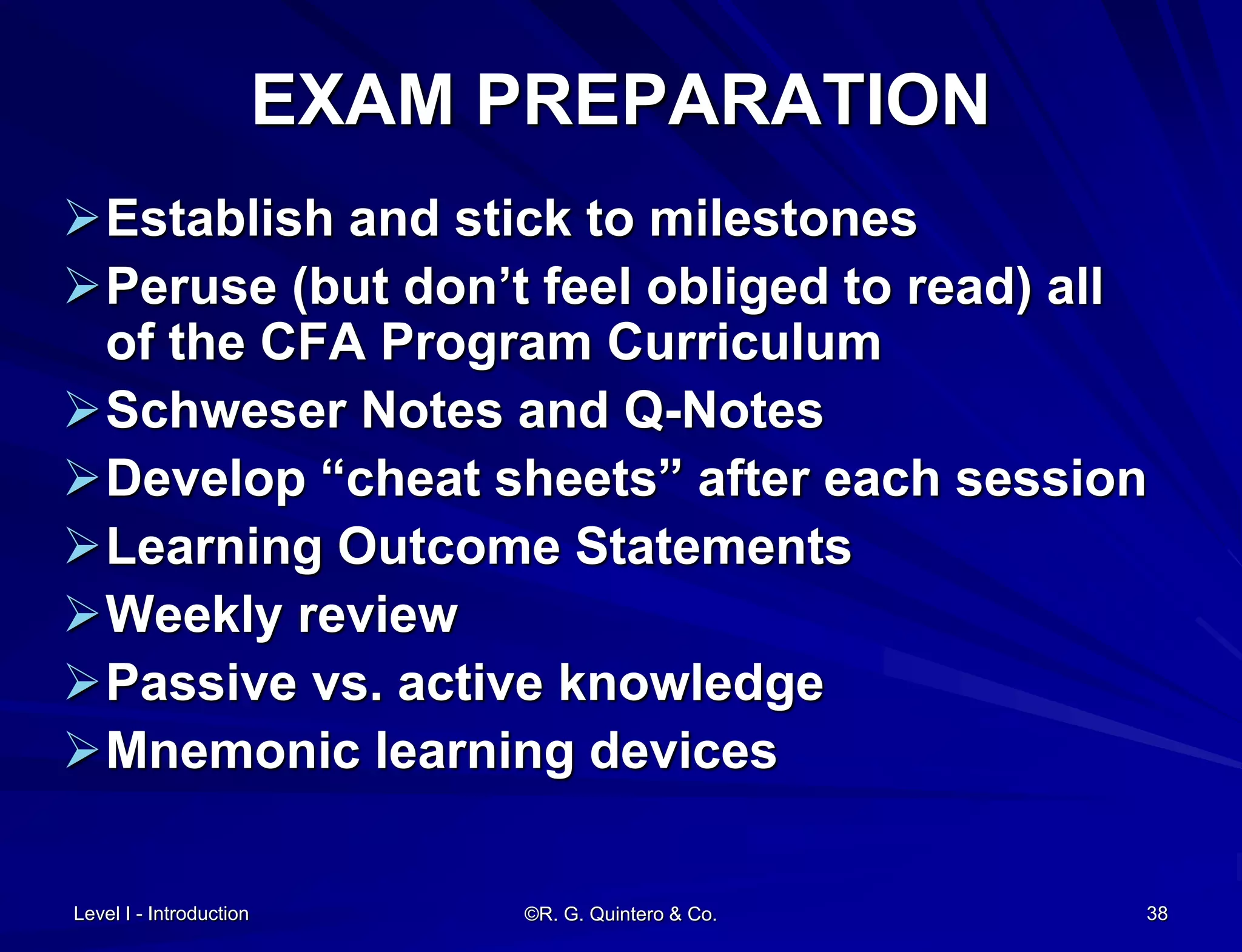
EXAM PREPARATION
Establish and stick to milestones
Peruse (but don’t feel obliged to read) all
of the CFA Program Curriculum
Schweser Notes and Q-Notes
Develop “cheat sheets” after each session
Learning Outcome Statements
Weekly review
Passive vs. active knowledge
Mnemonic learning devices
Level I - Introduction ©R. G. Quintero & Co. 39
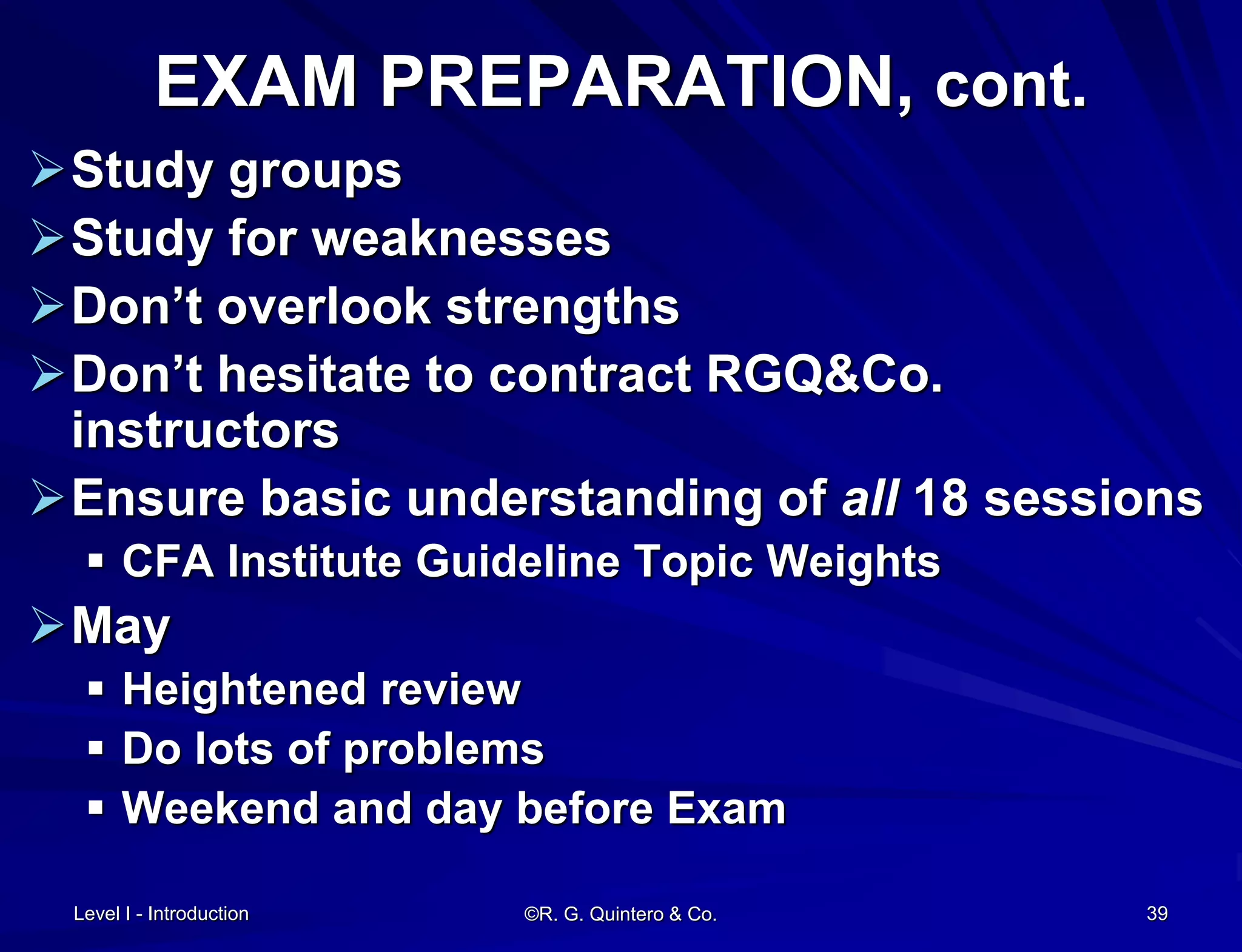
EXAM PREPARATION, cont.
Study groups
Study for weaknesses
Don’t overlook strengths
Don’t hesitate to contract RGQ&Co.
instructors
Ensure basic understanding of all 18 sessions
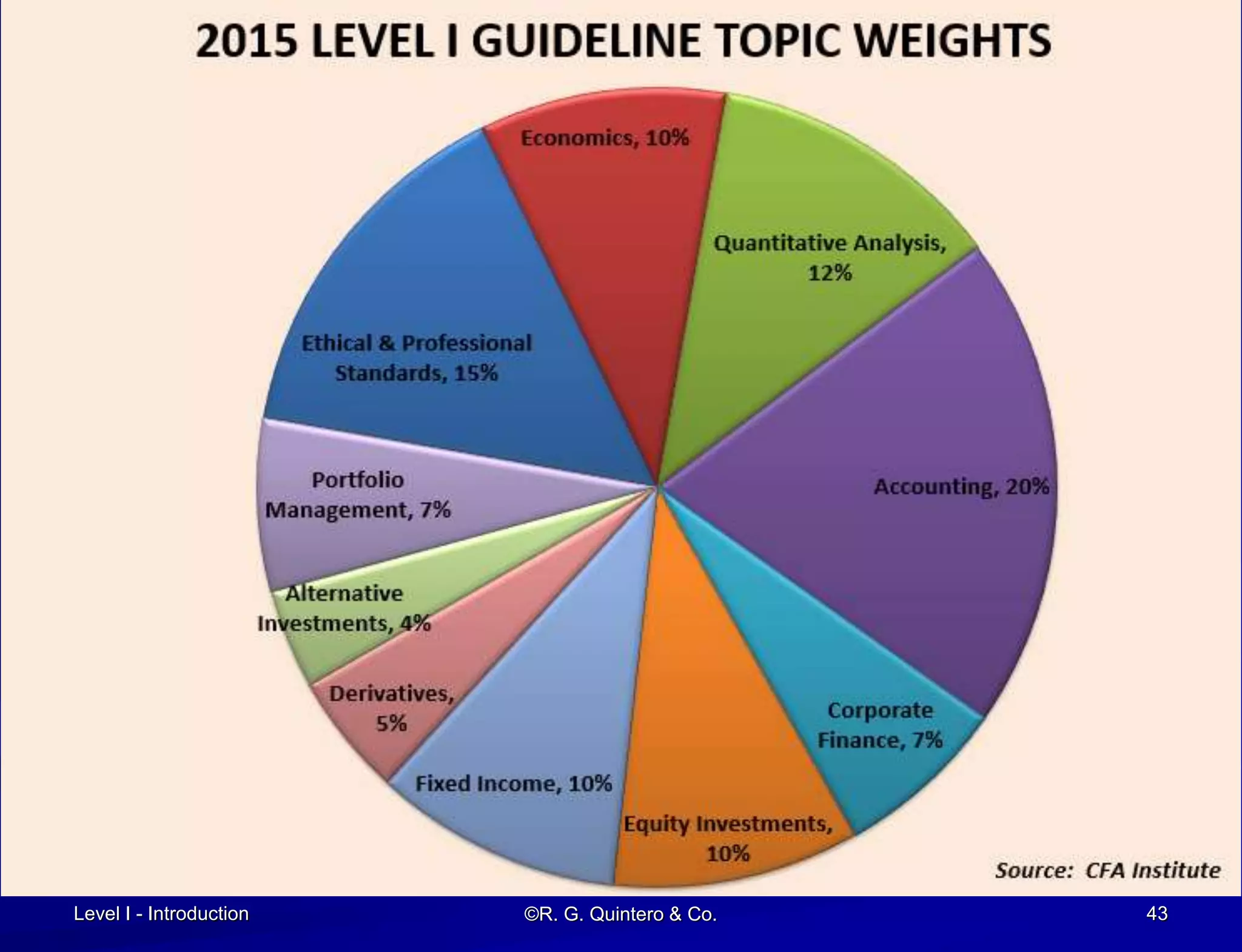
 CFA Institute Guideline Topic Weights
May
 Heightened review
 Do lots of problems
 Weekend and day before Exam
Level I - Introduction ©R. G. Quintero & Co. 40
Level I - Introduction ©R. G. Quintero & Co. 41
Level I - Introduction ©R. G. Quintero & Co. 42
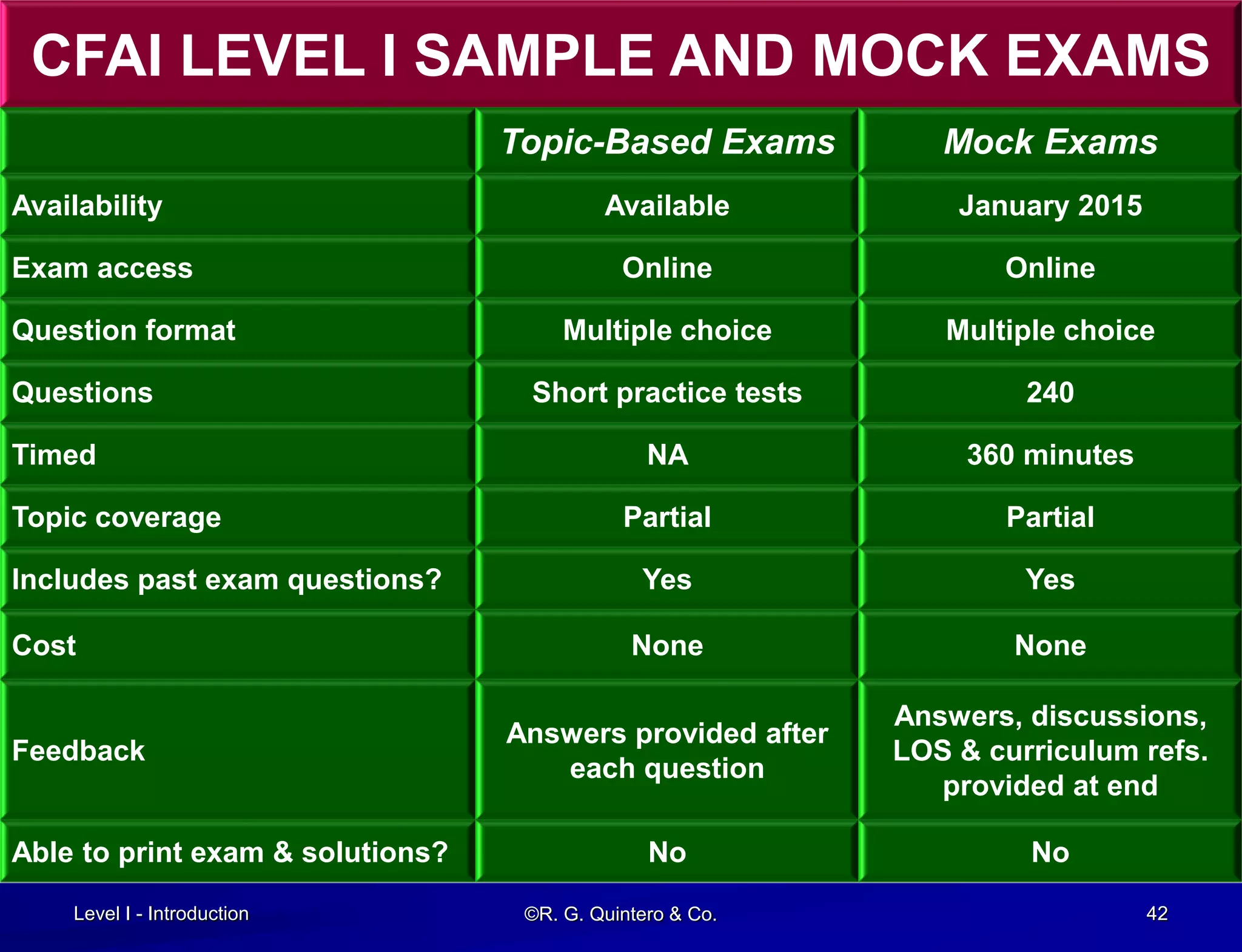
CFAI LEVEL I SAMPLE AND MOCK EXAMS
Topic-Based Exams Mock Exams
Availability Available January 2015
Exam access Online Online
Question format Multiple choice Multiple choice
Questions Short practice tests 240
Timed NA 360 minutes
Topic coverage Partial Partial
Includes past exam questions? Yes Yes
Cost None None
Feedback
Answers provided after
each question
Answers, discussions,
LOS & curriculum refs.
provided at end
Able to print exam & solutions? No No
Level I - Introduction ©R. G. Quintero & Co. 43
Level I - Introduction ©R. G. Quintero & Co. 44
Level I - Introduction ©R. G. Quintero & Co. 45
Level I - Introduction ©R. G. Quintero & Co. 46
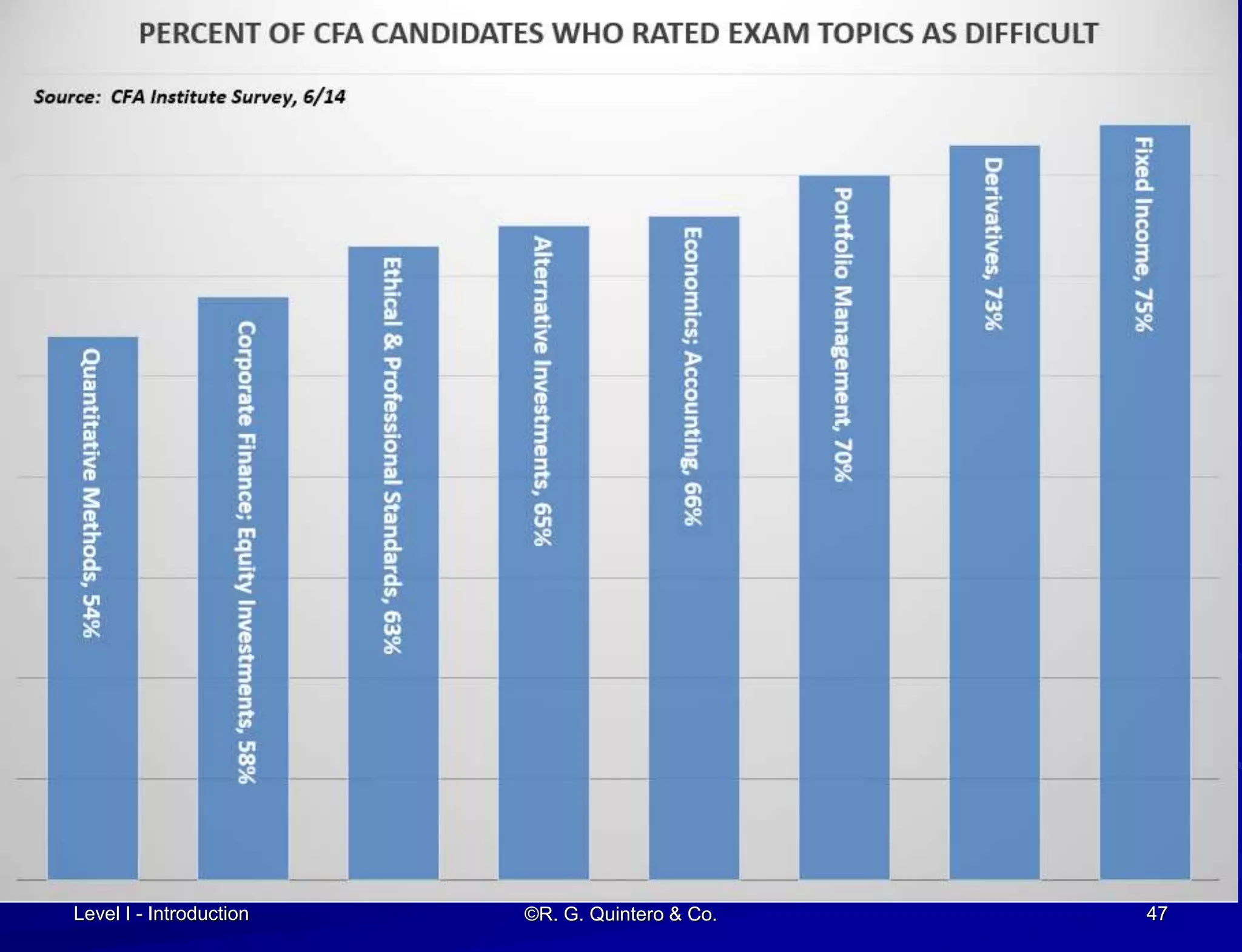
Level I - Introduction ©R. G. Quintero & Co. 47
Level I - Introduction
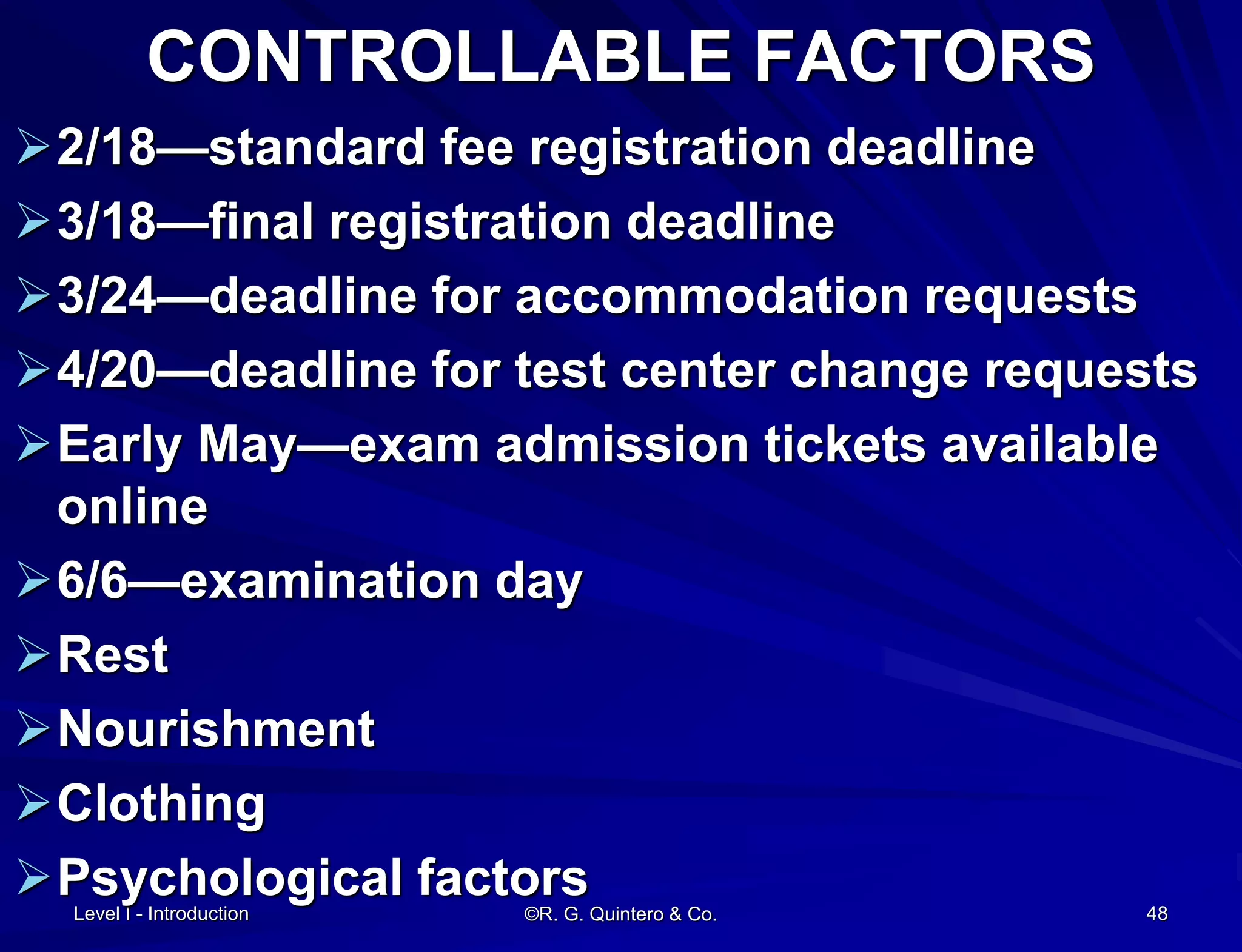
CONTROLLABLE FACTORS
2/18—standard fee registration deadline
3/18—final registration deadline
3/24—deadline for accommodation requests
4/20—deadline for test center change requests
Early May—exam admission tickets available
online
6/6—examination day
Rest
Nourishment
Clothing
Psychological factors©R. G. Quintero & Co. 48
Level I - Introduction ©R. G. Quintero & Co. 49
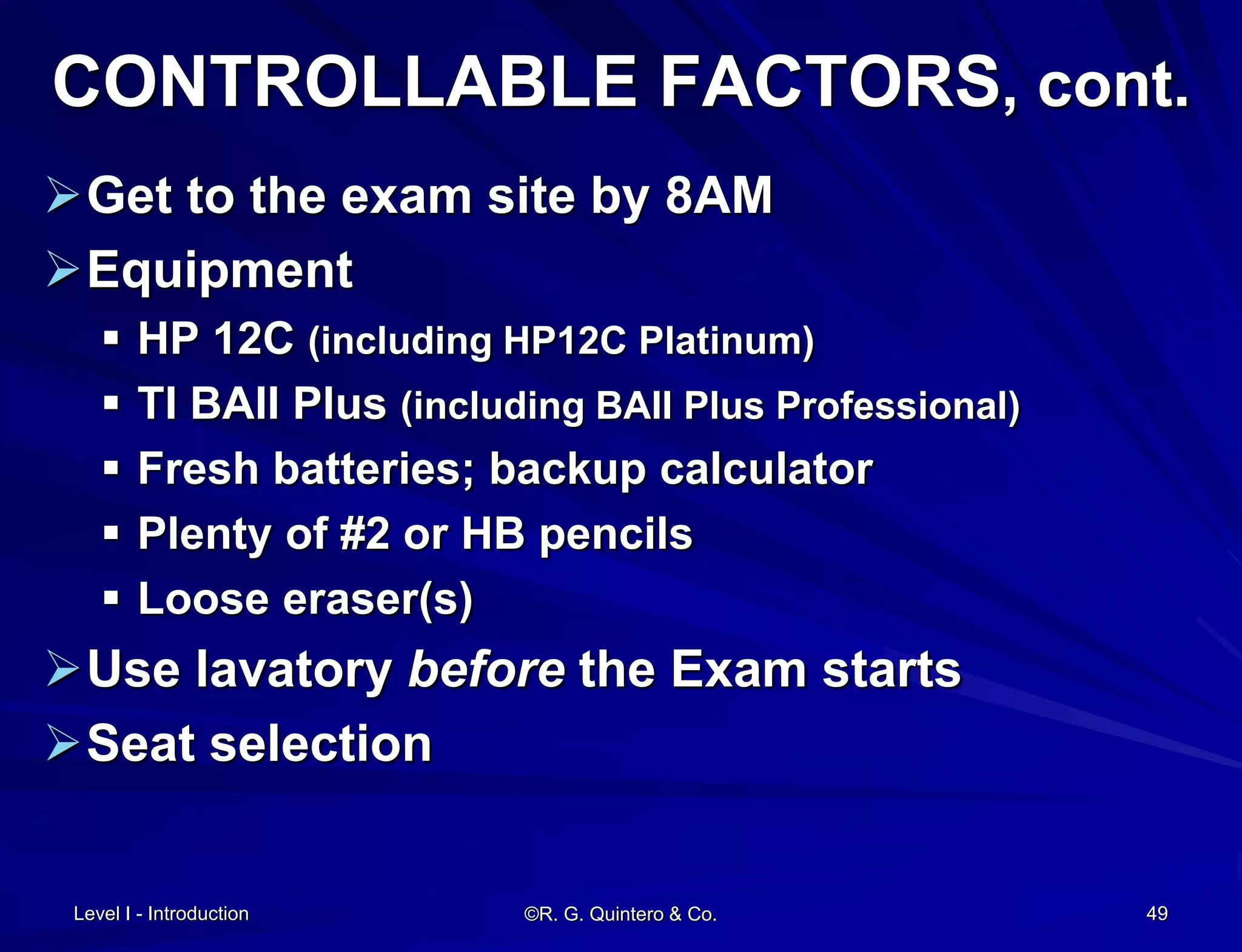
CONTROLLABLE FACTORS, cont.
Get to the exam site by 8AM
Equipment
 HP 12C (including HP12C Platinum)
 TI BAII Plus (including BAII Plus Professional)
 Fresh batteries; backup calculator
 Plenty of #2 or HB pencils
 Loose eraser(s)
Use lavatory before the Exam starts
Seat selection
Level I - Introduction ©R. G. Quintero & Co. 50
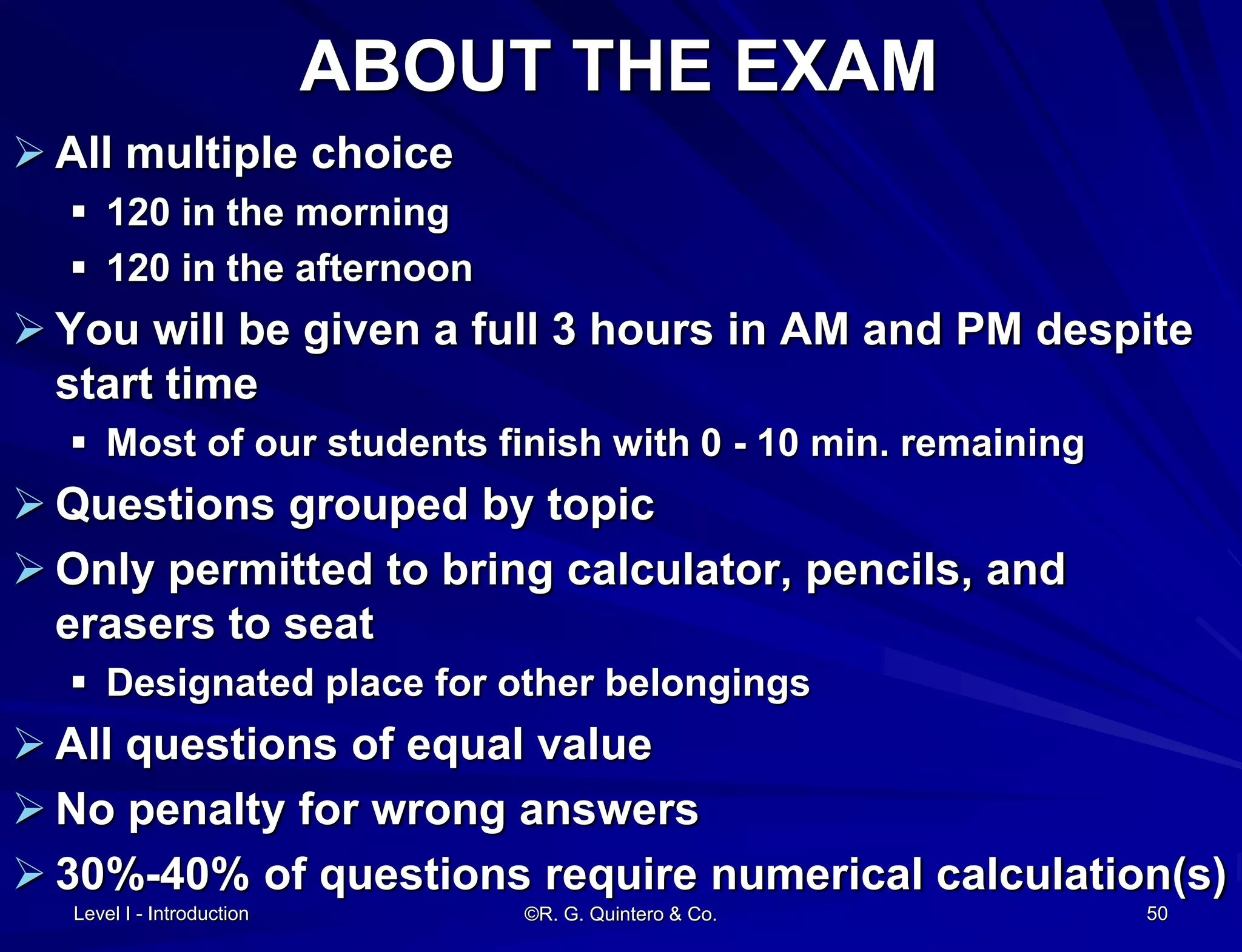
ABOUT THE EXAM
 All multiple choice
 120 in the morning
 120 in the afternoon
 You will be given a full 3 hours in AM and PM despite
start time
 Most of our students finish with 0 - 10 min. remaining
 Questions grouped by topic
 Only permitted to bring calculator, pencils, and
erasers to seat
 Designated place for other belongings
 All questions of equal value
 No penalty for wrong answers
 30%-40% of questions require numerical calculation(s)
Level I - Introduction ©R. G. Quintero & Co. 51
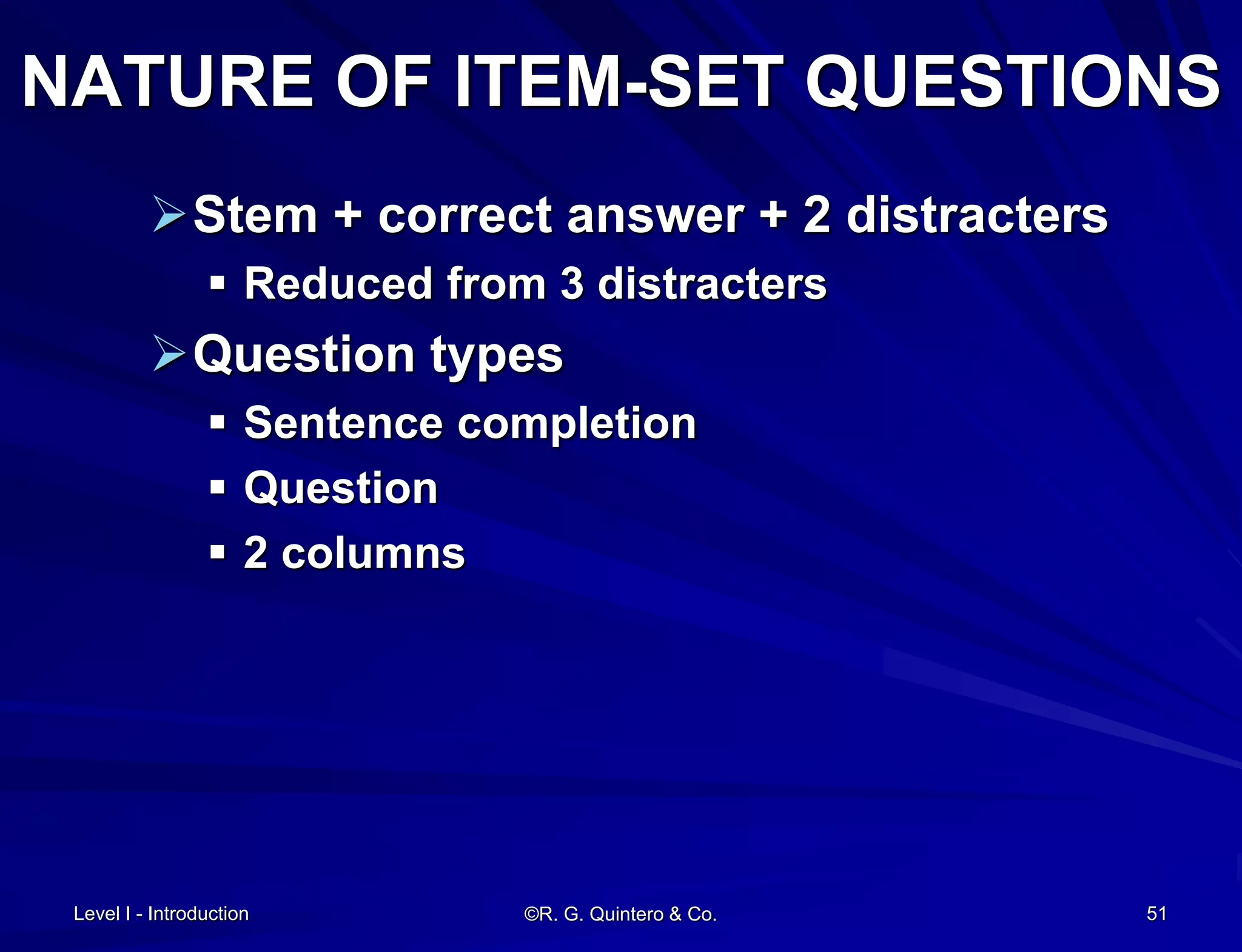
NATURE OF ITEM-SET QUESTIONS
Stem + correct answer + 2 distracters
 Reduced from 3 distracters
Question types
 Sentence completion
 Question
 2 columns
Level I - Introduction ©R. G. Quintero & Co. 52
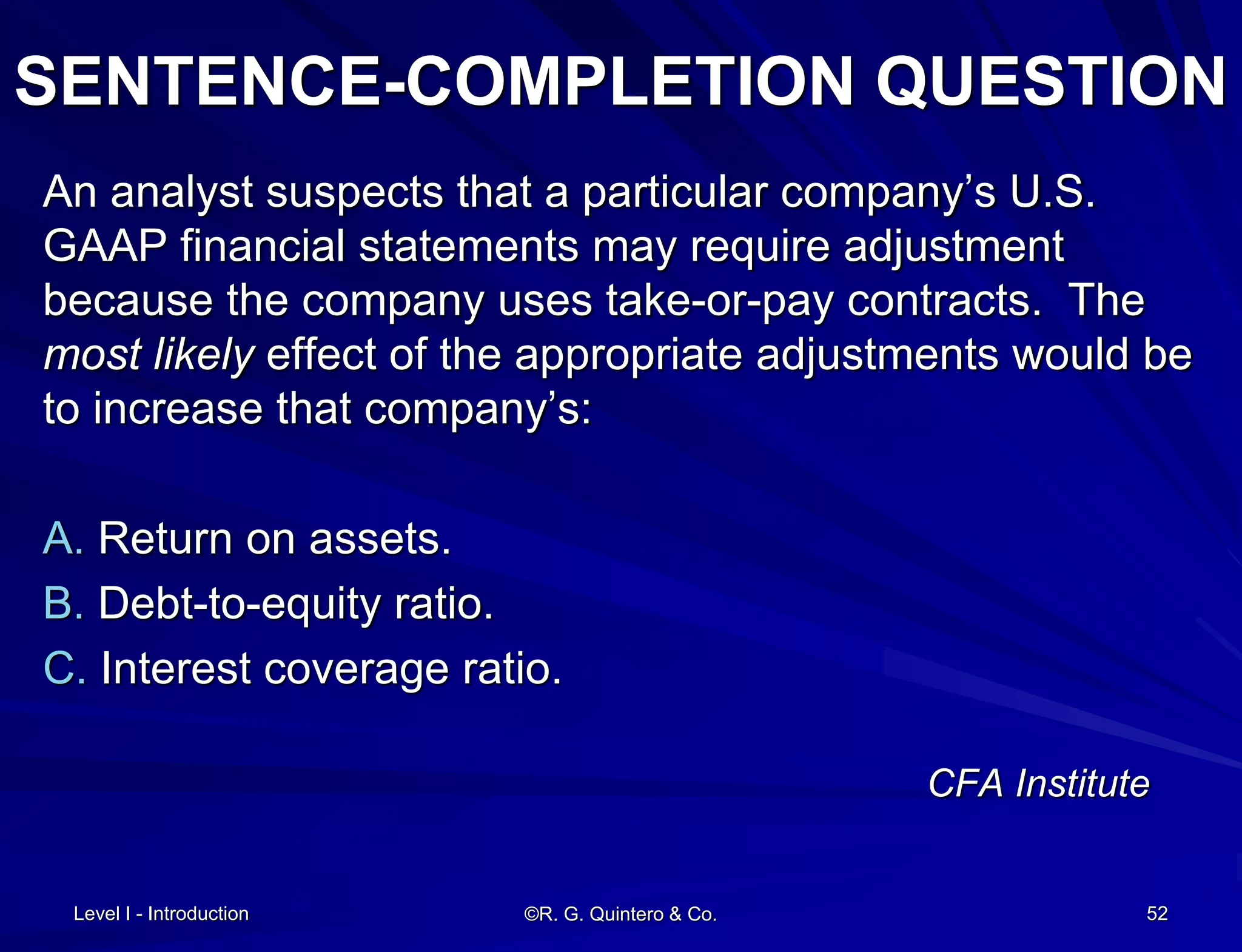
SENTENCE-COMPLETION QUESTION
An analyst suspects that a particular company’s U.S.
GAAP financial statements may require adjustment
because the company uses take-or-pay contracts. The
most likely effect of the appropriate adjustments would be
to increase that company’s:
A. Return on assets.
B. Debt-to-equity ratio.
C. Interest coverage ratio.
CFA Institute
Level I - Introduction ©R. G. Quintero & Co. 53
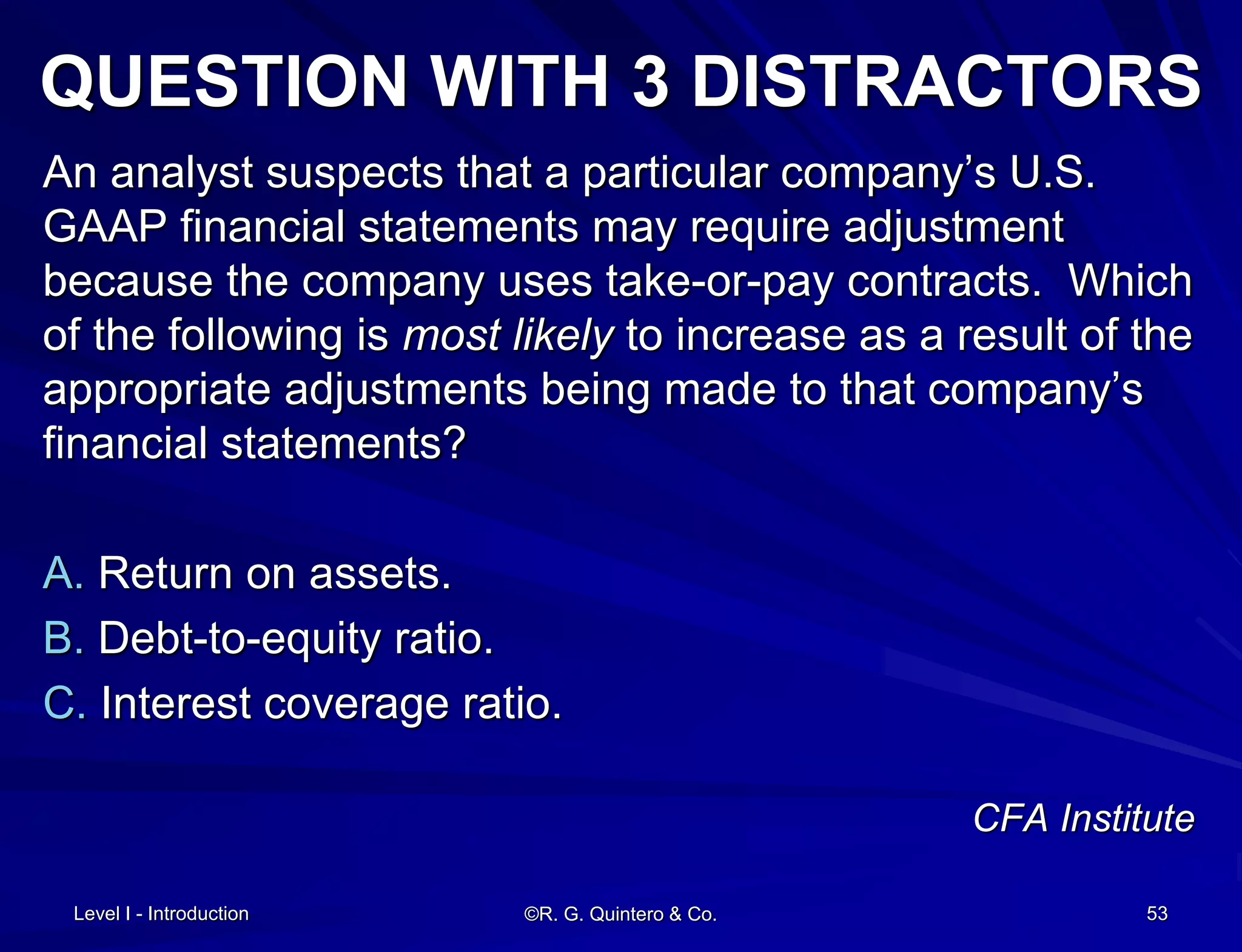
QUESTION WITH 3 DISTRACTORS
An analyst suspects that a particular company’s U.S.
GAAP financial statements may require adjustment
because the company uses take-or-pay contracts. Which
of the following is most likely to increase as a result of the
appropriate adjustments being made to that company’s
financial statements?
A. Return on assets.
B. Debt-to-equity ratio.
C. Interest coverage ratio.
CFA Institute
Level I - Introduction ©R. G. Quintero & Co. 54
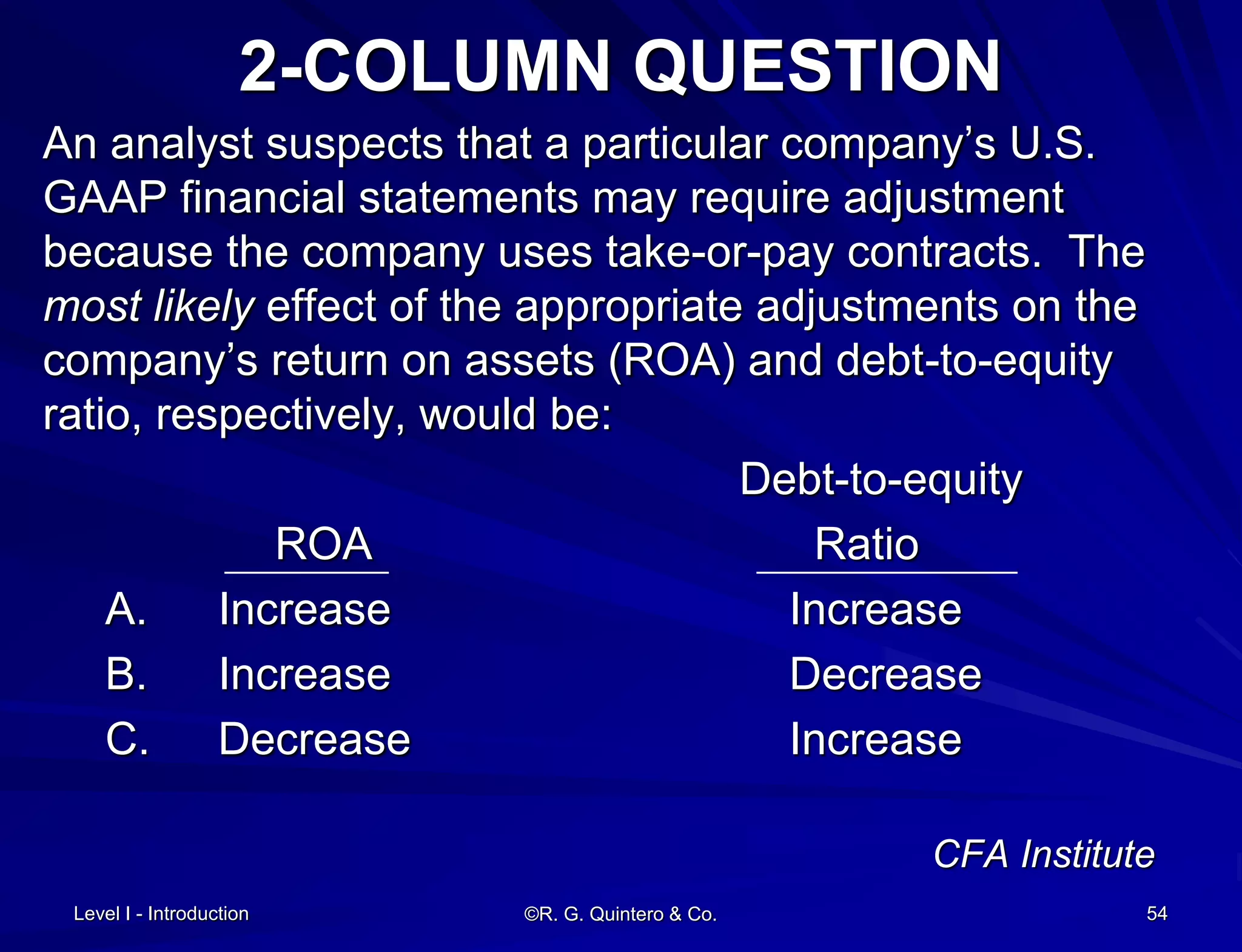
2-COLUMN QUESTION
An analyst suspects that a particular company’s U.S.
GAAP financial statements may require adjustment
because the company uses take-or-pay contracts. The
most likely effect of the appropriate adjustments on the
company’s return on assets (ROA) and debt-to-equity
ratio, respectively, would be:
Debt-to-equity
ROA Ratio
A. Increase Increase
B. Increase Decrease
C. Decrease Increase
CFA Institute
Level I - Introduction ©R. G. Quintero & Co. 55
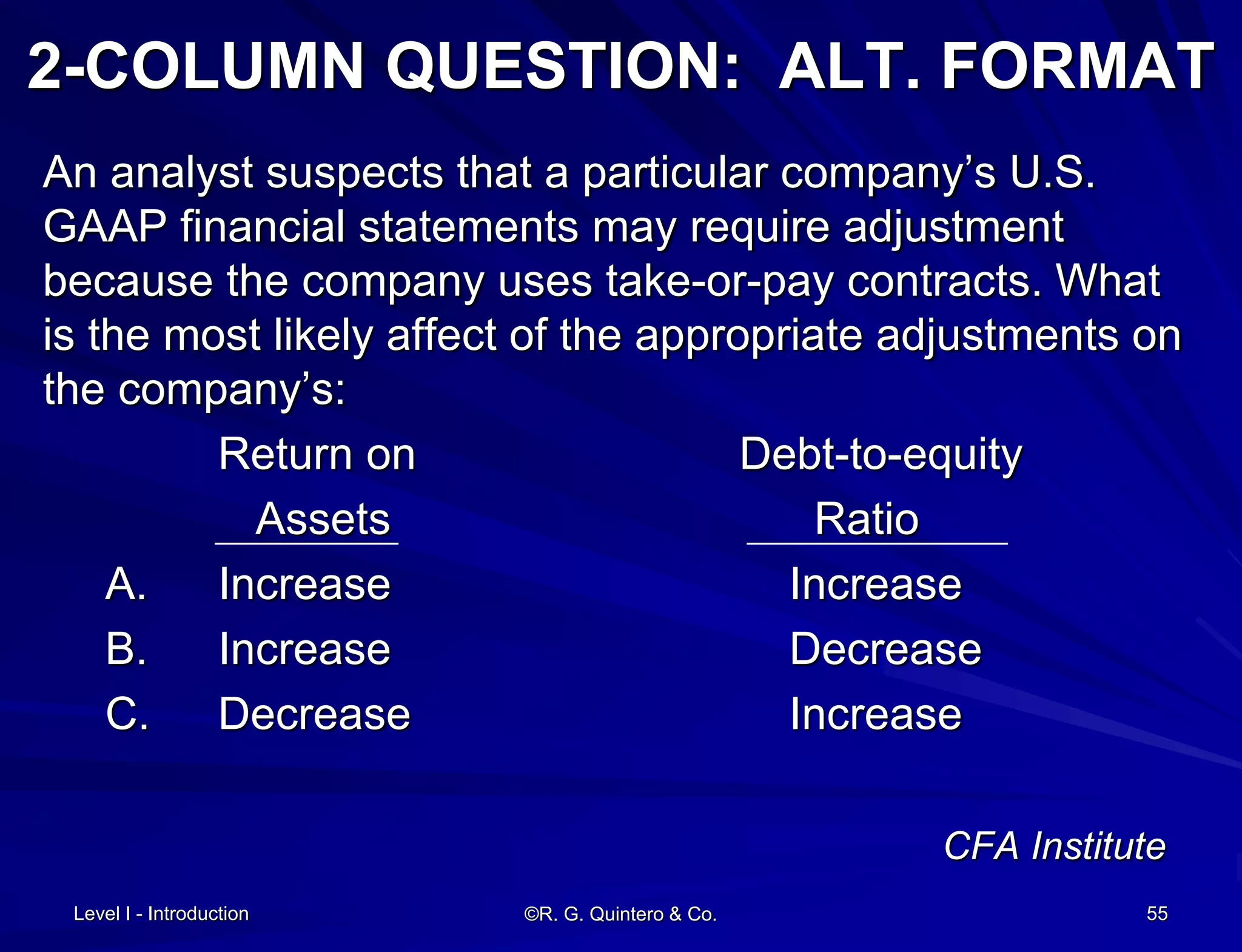
2-COLUMN QUESTION: ALT. FORMAT
An analyst suspects that a particular company’s U.S.
GAAP financial statements may require adjustment
because the company uses take-or-pay contracts. What
is the most likely affect of the appropriate adjustments on
the company’s:
Return on Debt-to-equity
Assets Ratio
A. Increase Increase
B. Increase Decrease
C. Decrease Increase
CFA Institute
Level I - Introduction ©R. G. Quintero & Co. 56
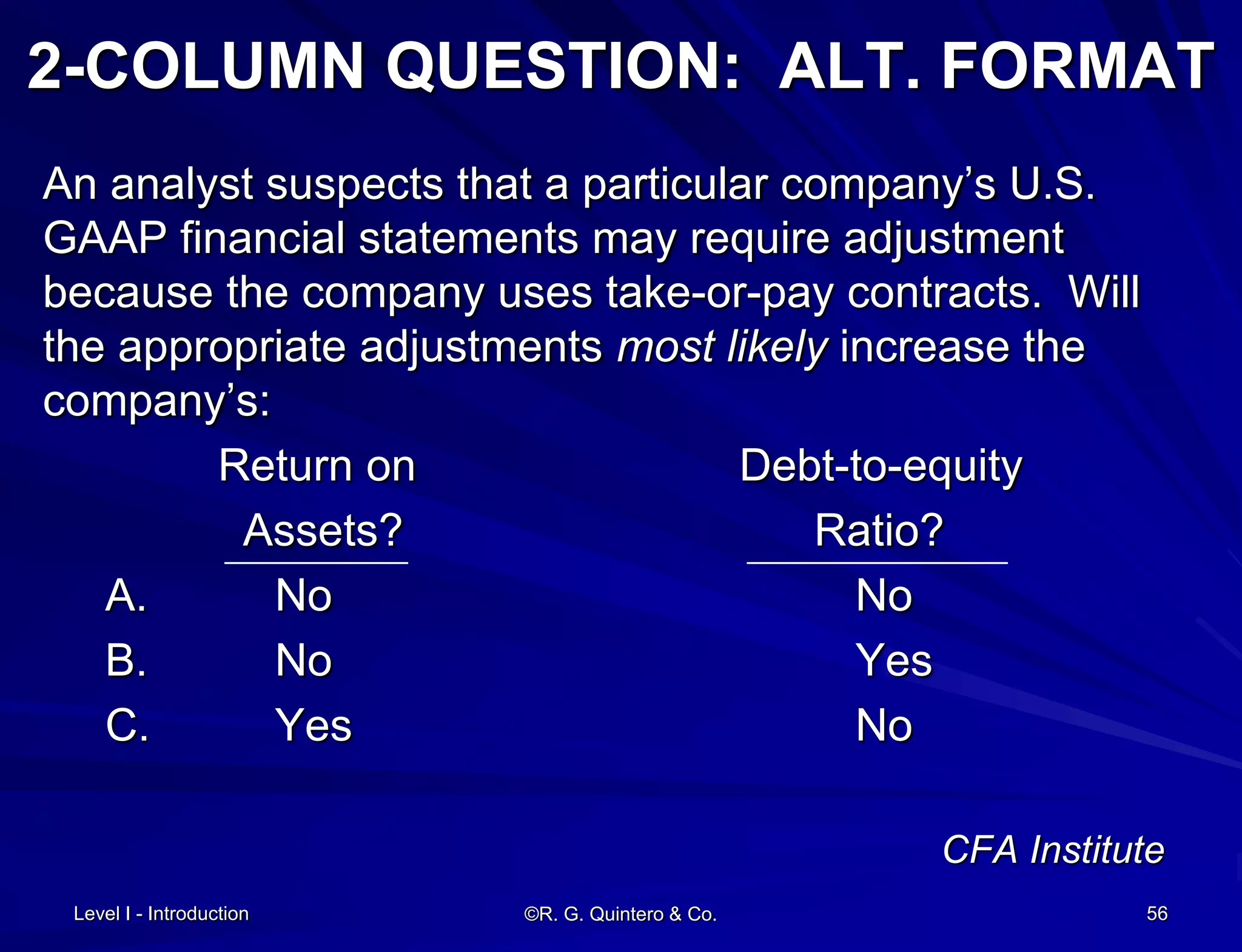
2-COLUMN QUESTION: ALT. FORMAT
An analyst suspects that a particular company’s U.S.
GAAP financial statements may require adjustment
because the company uses take-or-pay contracts. Will
the appropriate adjustments most likely increase the
company’s:
Return on Debt-to-equity
Assets? Ratio?
A. No No
B. No Yes
C. Yes No
CFA Institute
Level I - Introduction ©R. G. Quintero & Co. 57
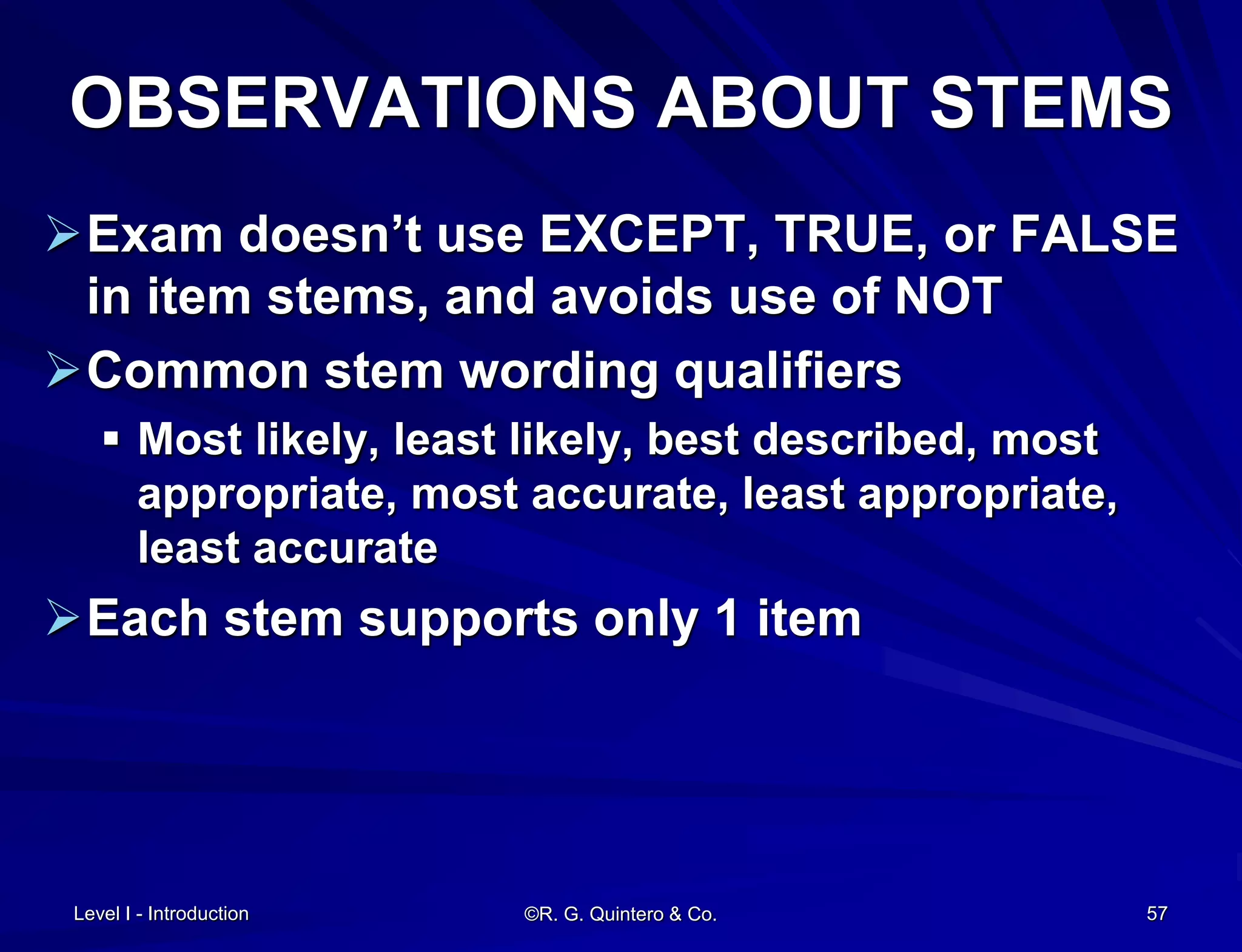
OBSERVATIONS ABOUT STEMS
Exam doesn’t use EXCEPT, TRUE, or FALSE
in item stems, and avoids use of NOT
Common stem wording qualifiers
 Most likely, least likely, best described, most
appropriate, most accurate, least appropriate,
least accurate
Each stem supports only 1 item
Level I - Introduction ©R. G. Quintero & Co. 58
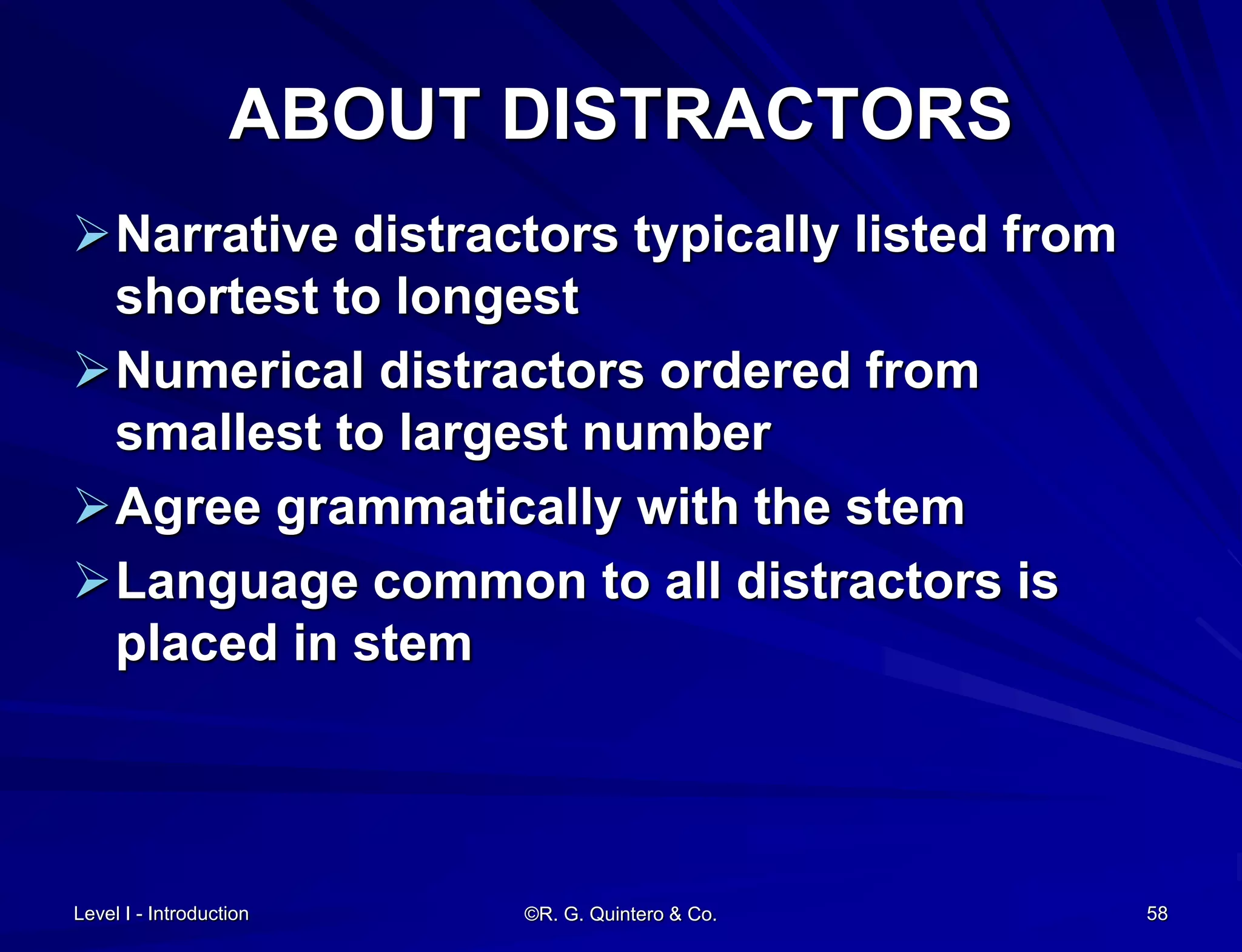
ABOUT DISTRACTORS
Narrative distractors typically listed from
shortest to longest
Numerical distractors ordered from
smallest to largest number
Agree grammatically with the stem
Language common to all distractors is
placed in stem
Level I - Introduction ©R. G. Quintero & Co. 59
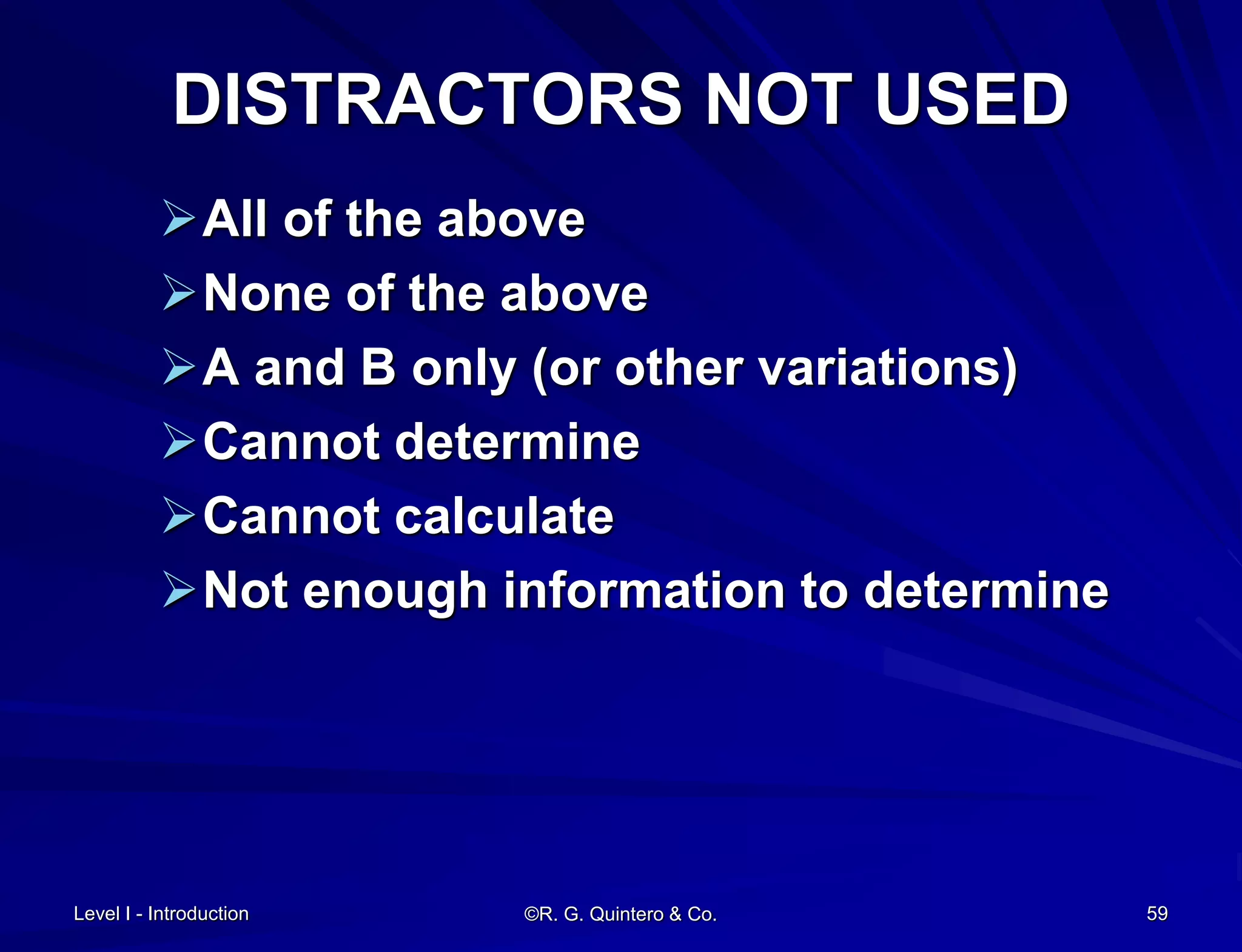
DISTRACTORS NOT USED
All of the above
None of the above
A and B only (or other variations)
Cannot determine
Cannot calculate
Not enough information to determine
Level I - Introduction ©R. G. Quintero & Co. 60
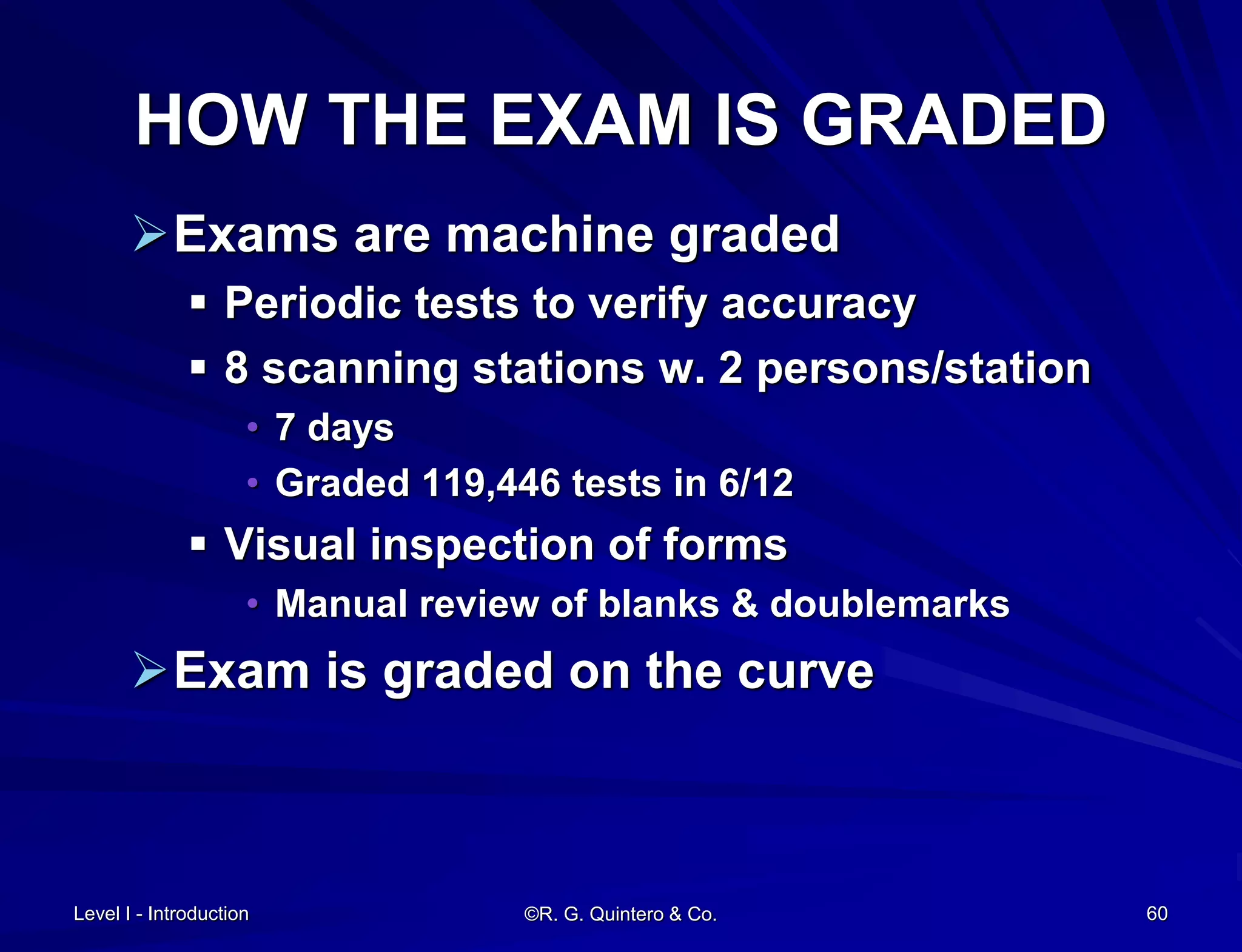
HOW THE EXAM IS GRADED
Exams are machine graded
 Periodic tests to verify accuracy
 8 scanning stations w. 2 persons/station
• 7 days
• Graded 119,446 tests in 6/12
 Visual inspection of forms
• Manual review of blanks & doublemarks
Exam is graded on the curve
Level I - Introduction ©R. G. Quintero & Co. 61
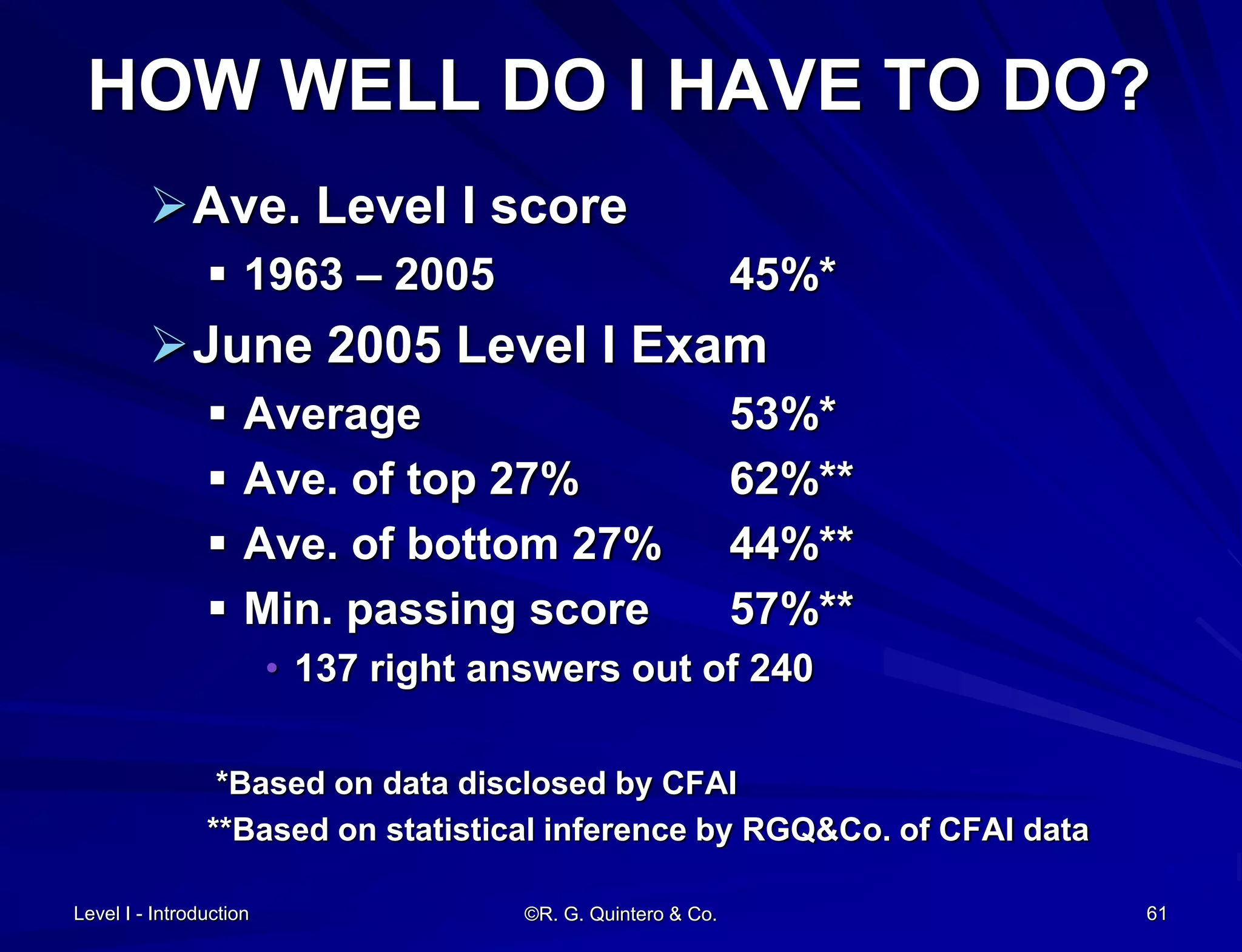
HOW WELL DO I HAVE TO DO?
Ave. Level I score
 1963 – 2005 45%*
June 2005 Level I Exam
 Average 53%*
 Ave. of top 27% 62%**
 Ave. of bottom 27% 44%**
 Min. passing score 57%**
• 137 right answers out of 240
*Based on data disclosed by CFAI
**Based on statistical inference by RGQ&Co. of CFAI data
Level I - Introduction ©R. G. Quintero & Co. 62
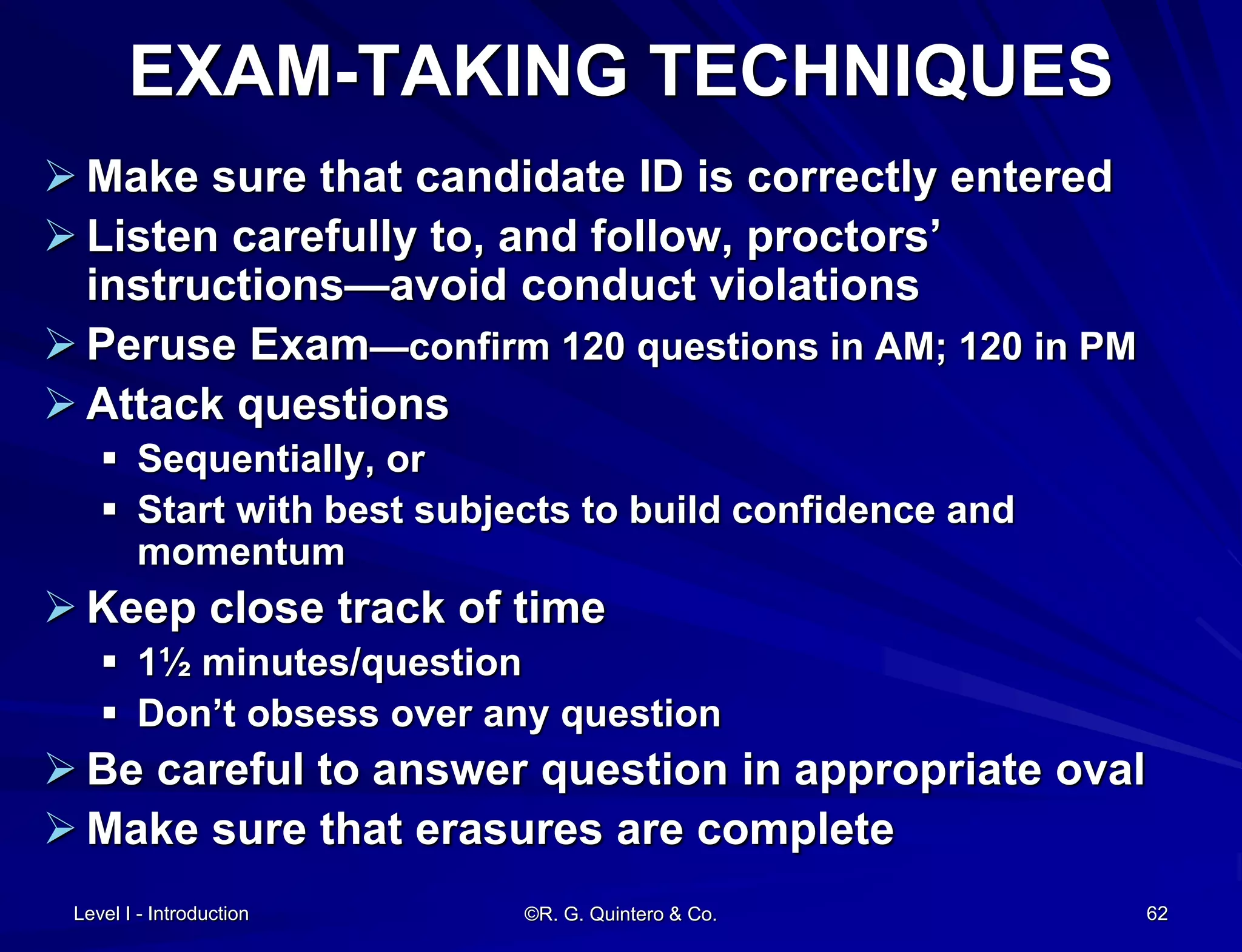
EXAM-TAKING TECHNIQUES
 Make sure that candidate ID is correctly entered
 Listen carefully to, and follow, proctors’
instructions—avoid conduct violations
 Peruse Exam—confirm 120 questions in AM; 120 in PM
 Attack questions
 Sequentially, or
 Start with best subjects to build confidence and
momentum
 Keep close track of time
 1½ minutes/question
 Don’t obsess over any question
 Be careful to answer question in appropriate oval
 Make sure that erasures are complete
Level I - Introduction ©R. G. Quintero & Co. 63
EXAM-TAKING TECHNIQUES, cont.
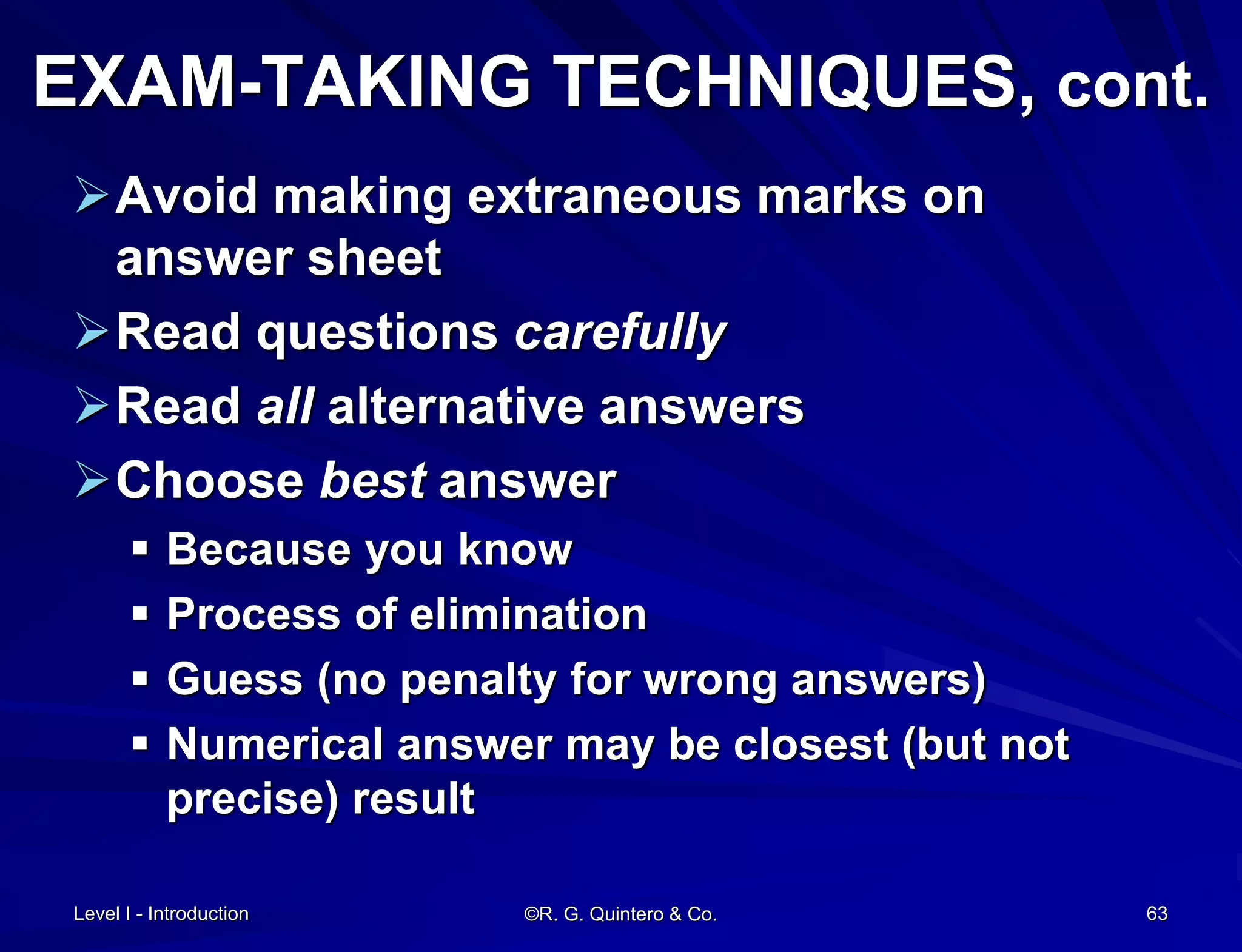
Avoid making extraneous marks on
answer sheet
Read questions carefully
Read all alternative answers
Choose best answer
 Because you know
 Process of elimination
 Guess (no penalty for wrong answers)
 Numerical answer may be closest (but not
precise) result
Level I - Introduction ©R. G. Quintero & Co. 64
EXAM-TAKING TECHNIQUES, cont.
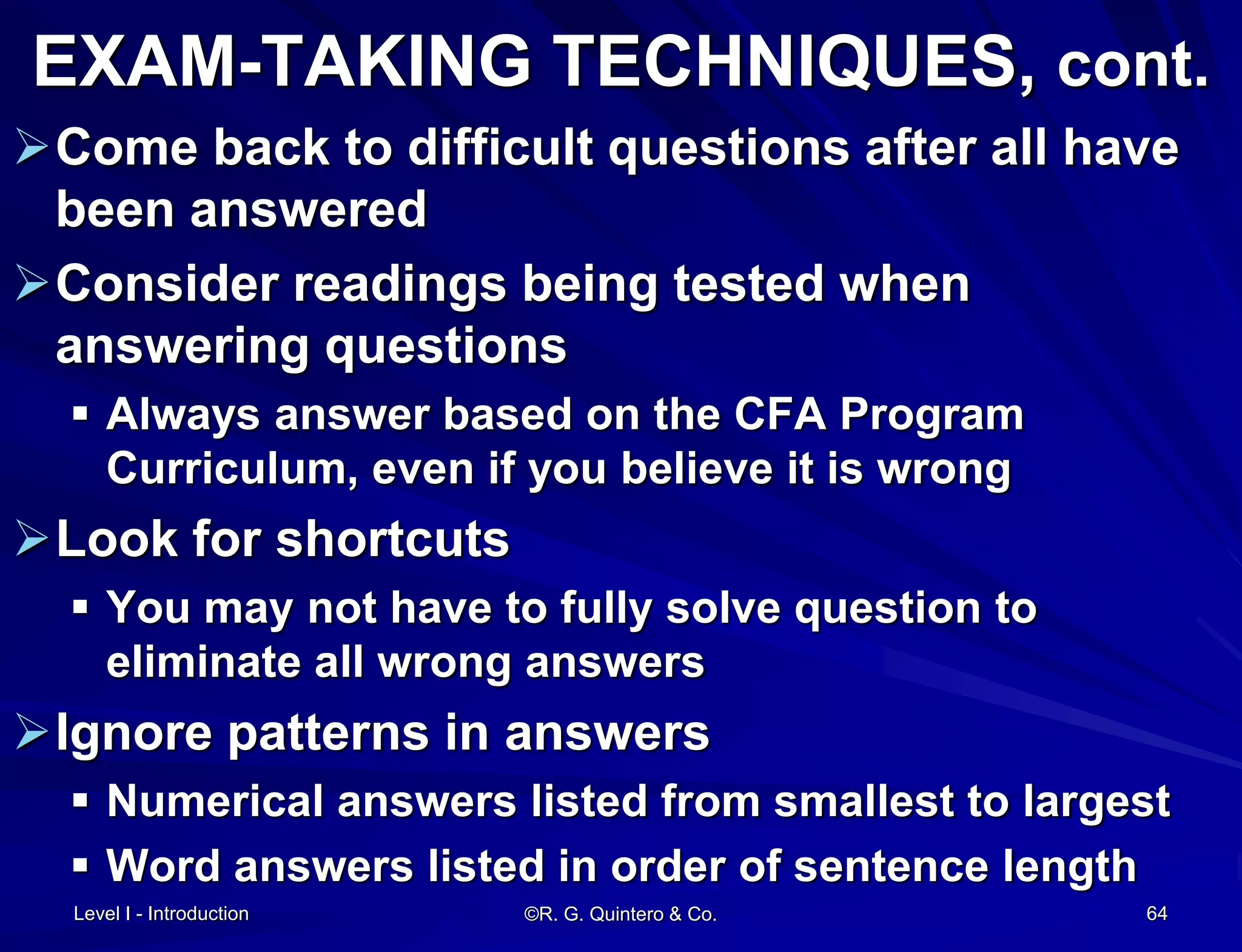
Come back to difficult questions after all have
been answered
Consider readings being tested when
answering questions
 Always answer based on the CFA Program
Curriculum, even if you believe it is wrong
Look for shortcuts
 You may not have to fully solve question to
eliminate all wrong answers
Ignore patterns in answers
 Numerical answers listed from smallest to largest
 Word answers listed in order of sentence length
Level I - Introduction ©R. G. Quintero & Co. 65
EXAM-TAKING TECHNIQUES, cont.
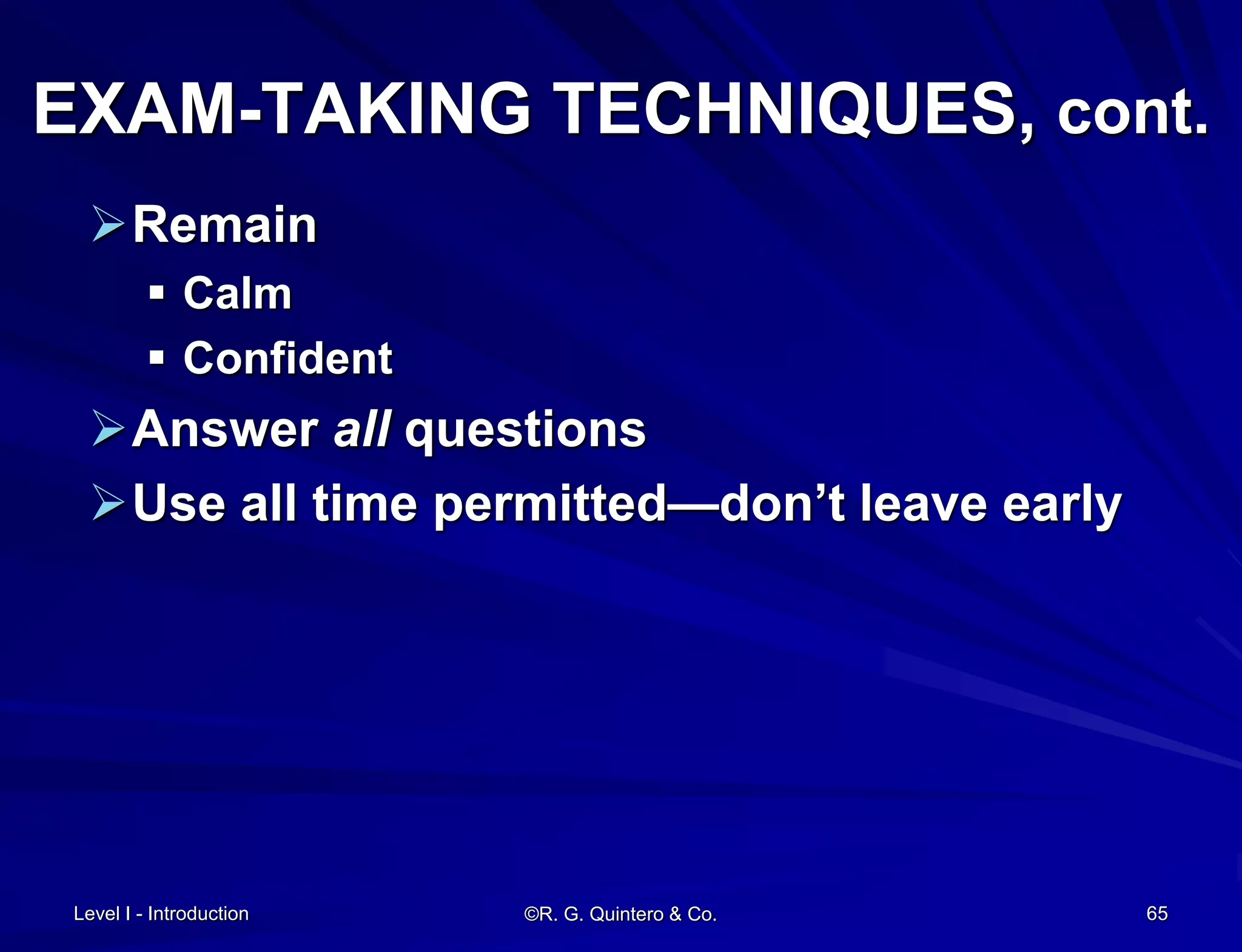
Remain
 Calm
 Confident
Answer all questions
Use all time permitted—don’t leave early
Level I - Introduction ©R. G. Quintero & Co. 66
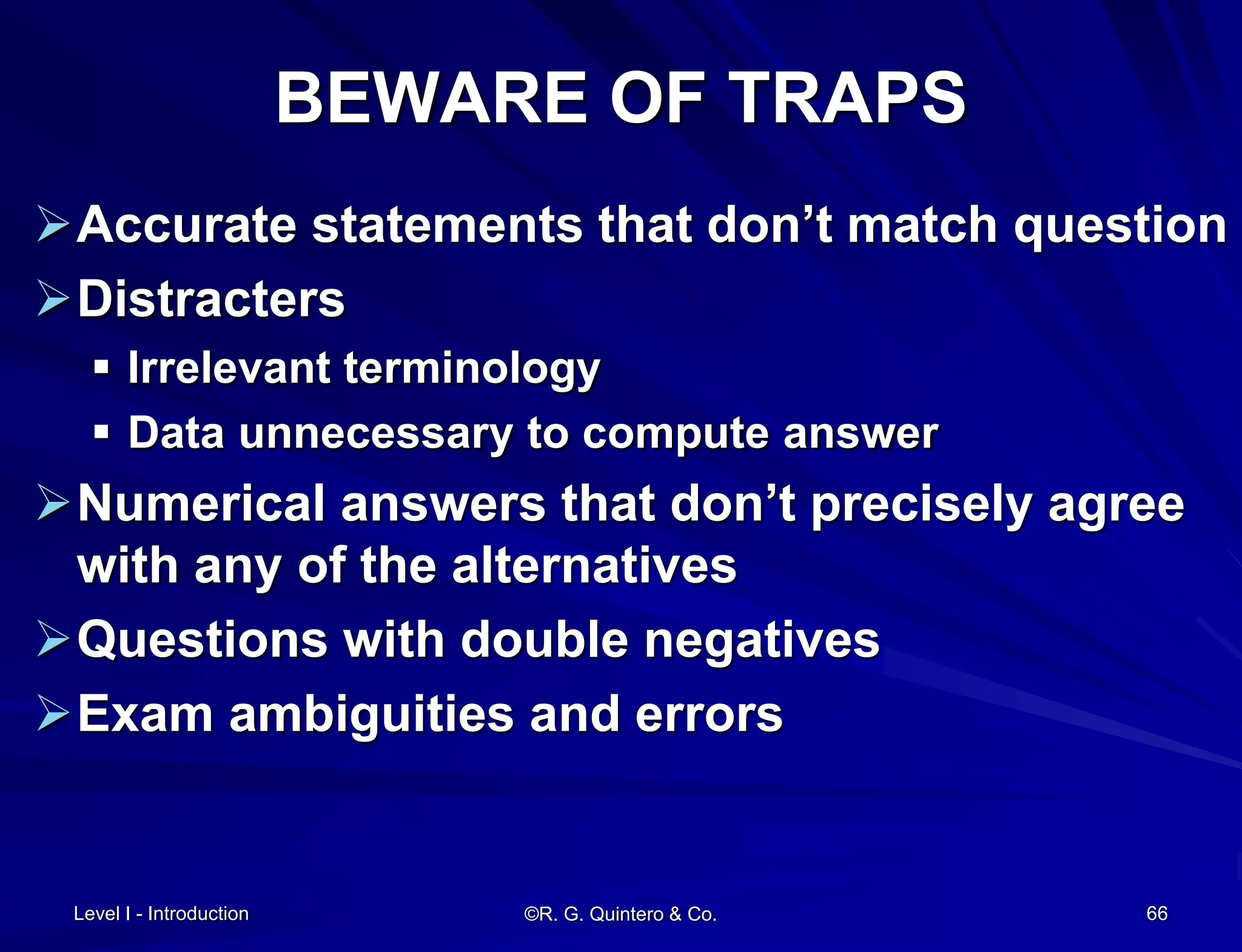
BEWARE OF TRAPS
Accurate statements that don’t match question
Distracters
 Irrelevant terminology
 Data unnecessary to compute answer
Numerical answers that don’t precisely agree
with any of the alternatives
Questions with double negatives
Exam ambiguities and errors
Level I - Introduction
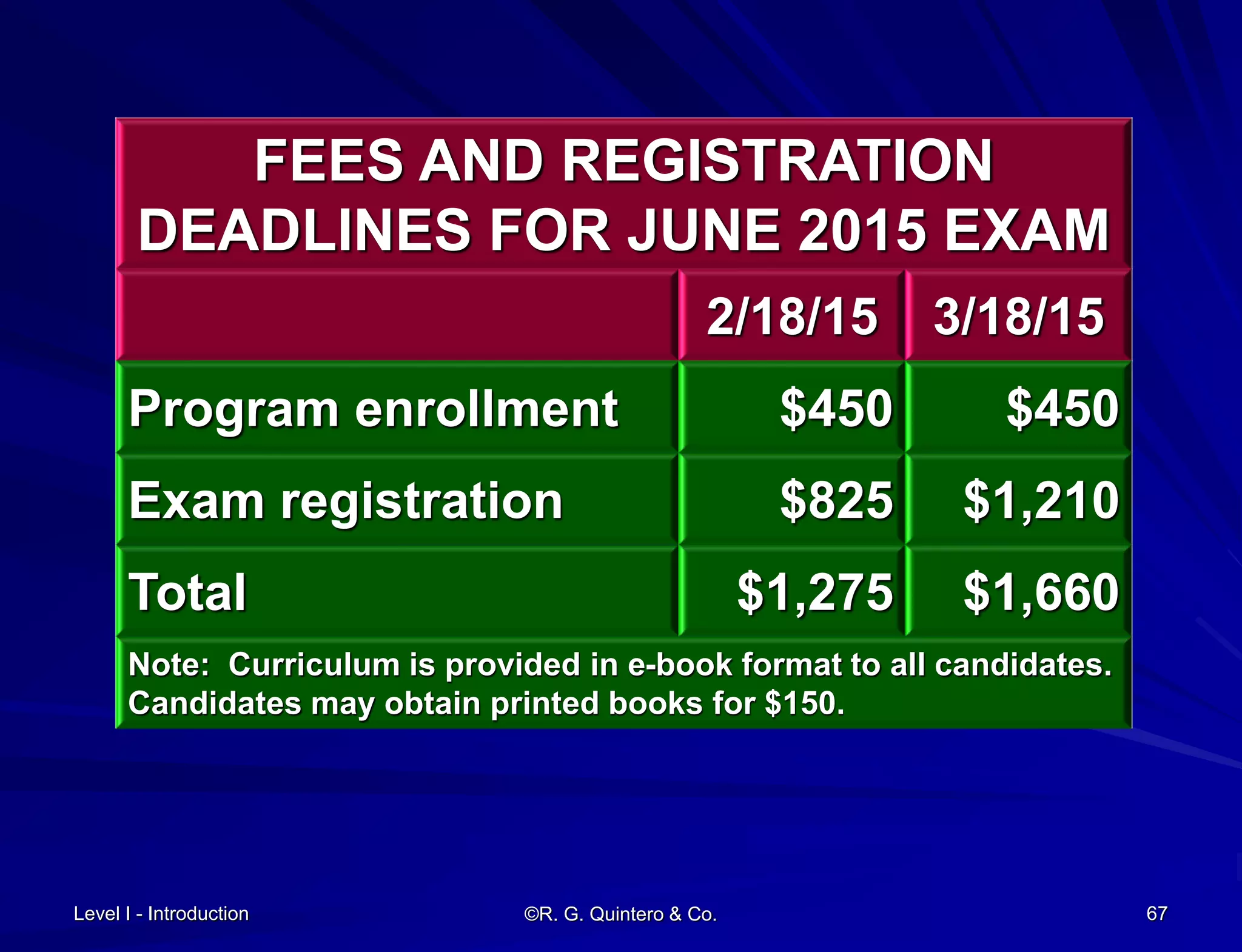
FEES AND REGISTRATION
DEADLINES FOR JUNE 2015 EXAM
2/18/15 3/18/15
Program enrollment $450 $450
Exam registration $825 $1,210
Total $1,275 $1,660
Note: Curriculum is provided in e-book format to all candidates.
Candidates may obtain printed books for $150.
©R. G. Quintero & Co. 67
Level I - Introduction
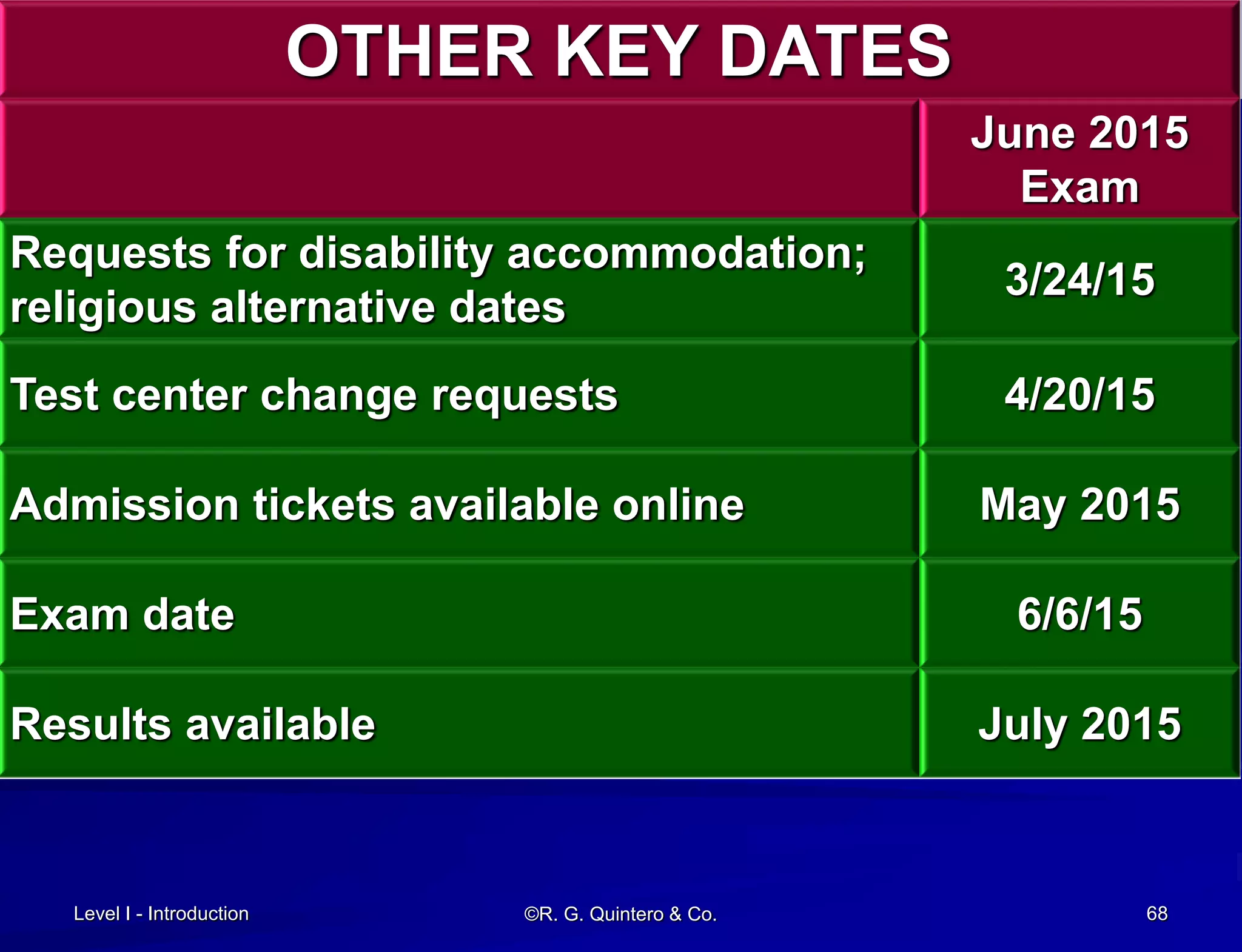
OTHER KEY DATES
June 2015
Exam
Requests for disability accommodation;
religious alternative dates
3/24/15
Test center change requests 4/20/15
Admission tickets available online May 2015
Exam date 6/6/15
Results available July 2015
©R. G. Quintero & Co. 68
©R. G. Quintero & Co. 69
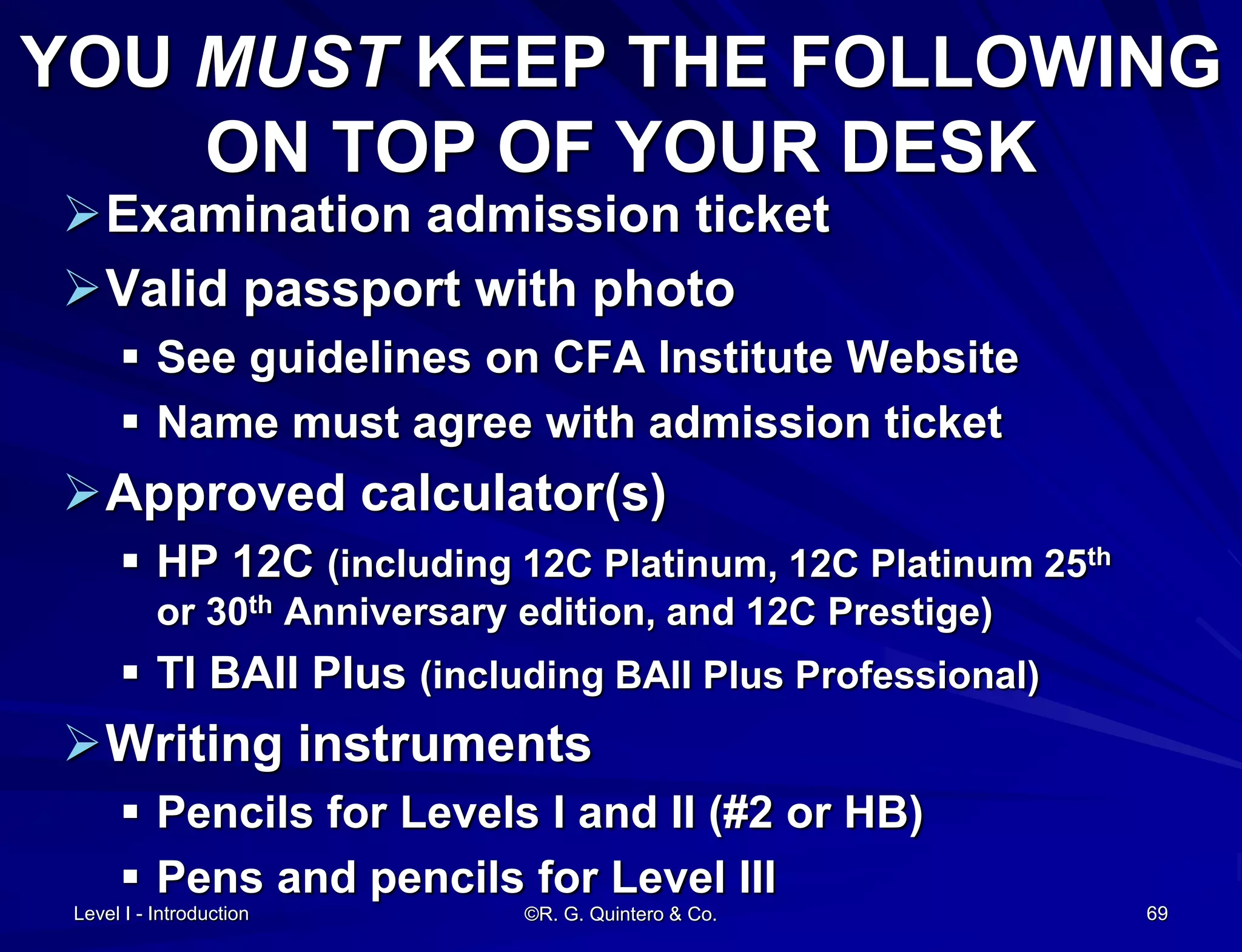
YOU MUST KEEP THE FOLLOWING
ON TOP OF YOUR DESK
Examination admission ticket
Valid passport with photo
 See guidelines on CFA Institute Website
 Name must agree with admission ticket
Approved calculator(s)
 HP 12C (including 12C Platinum, 12C Platinum 25th
or 30th Anniversary edition, and 12C Prestige)
 TI BAII Plus (including BAII Plus Professional)
Writing instruments
 Pencils for Levels I and II (#2 or HB)
 Pens and pencils for Level III
Level I - Introduction
©R. G. Quintero & Co. 70
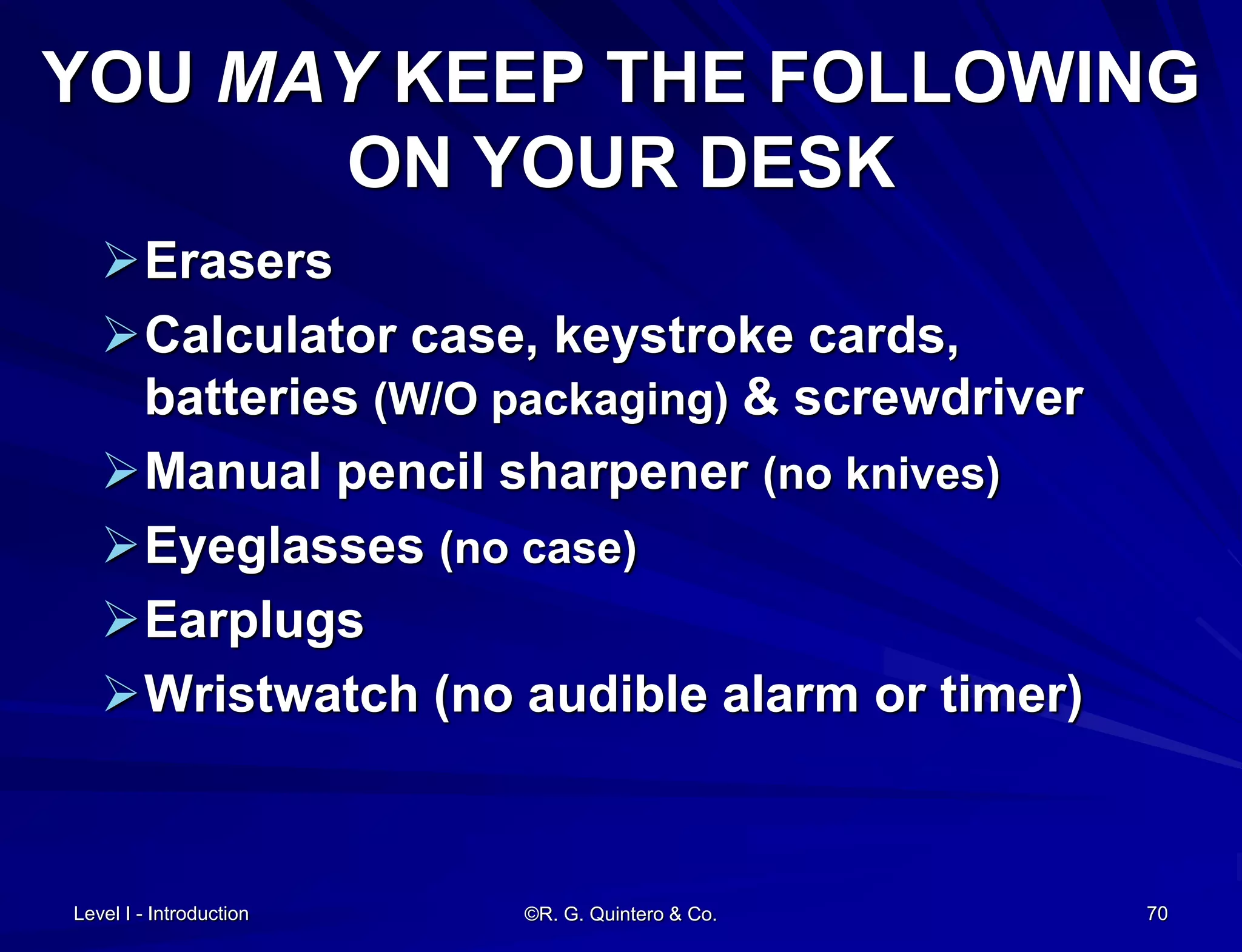
YOU MAY KEEP THE FOLLOWING
ON YOUR DESK
Erasers
Calculator case, keystroke cards,
batteries (W/O packaging) & screwdriver
Manual pencil sharpener (no knives)
Eyeglasses (no case)
Earplugs
Wristwatch (no audible alarm or timer)
Level I - Introduction
©R. G. Quintero & Co. 71
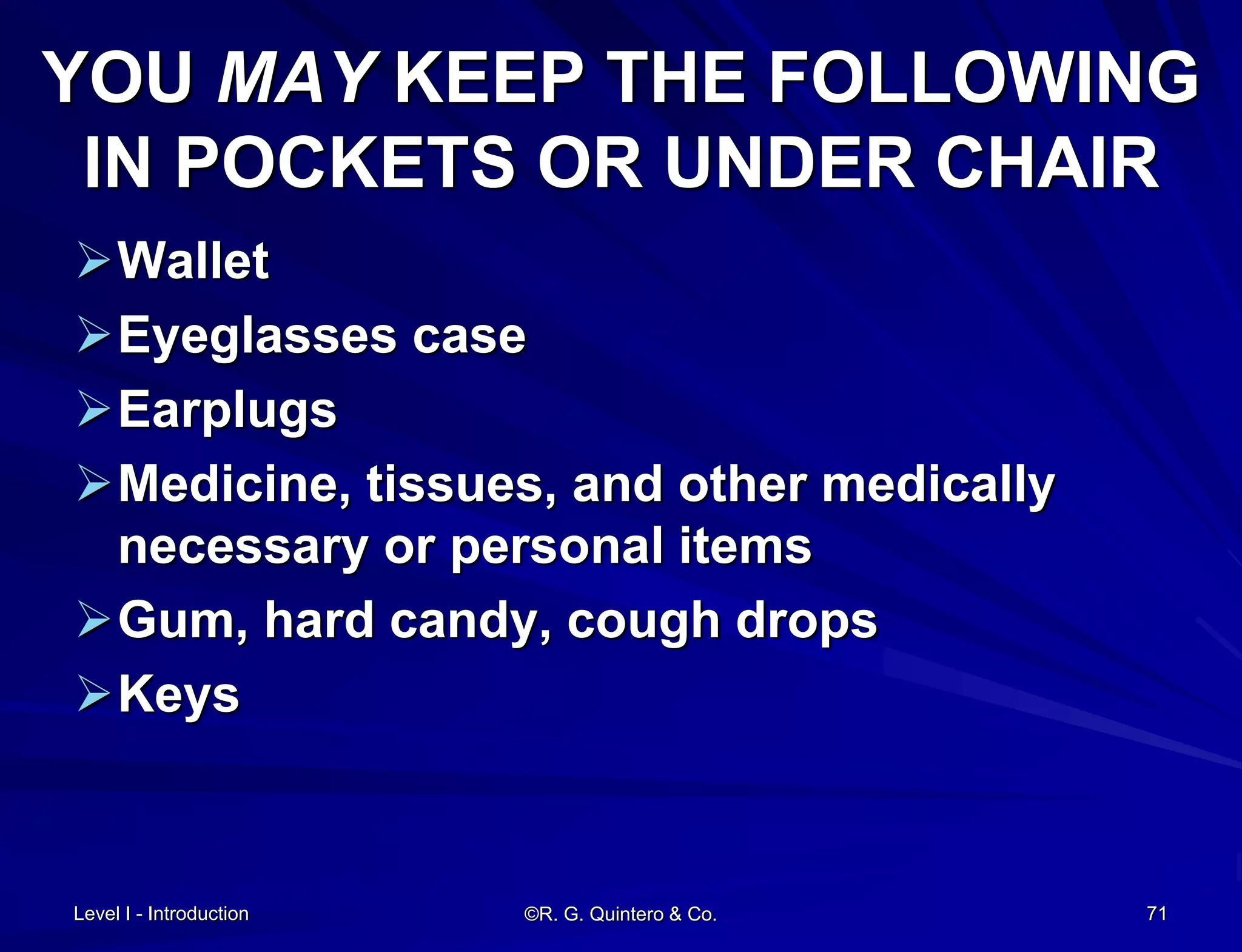
YOU MAY KEEP THE FOLLOWING
IN POCKETS OR UNDER CHAIR
Wallet
Eyeglasses case
Earplugs
Medicine, tissues, and other medically
necessary or personal items
Gum, hard candy, cough drops
Keys
Level I - Introduction
©R. G. Quintero & Co. 72
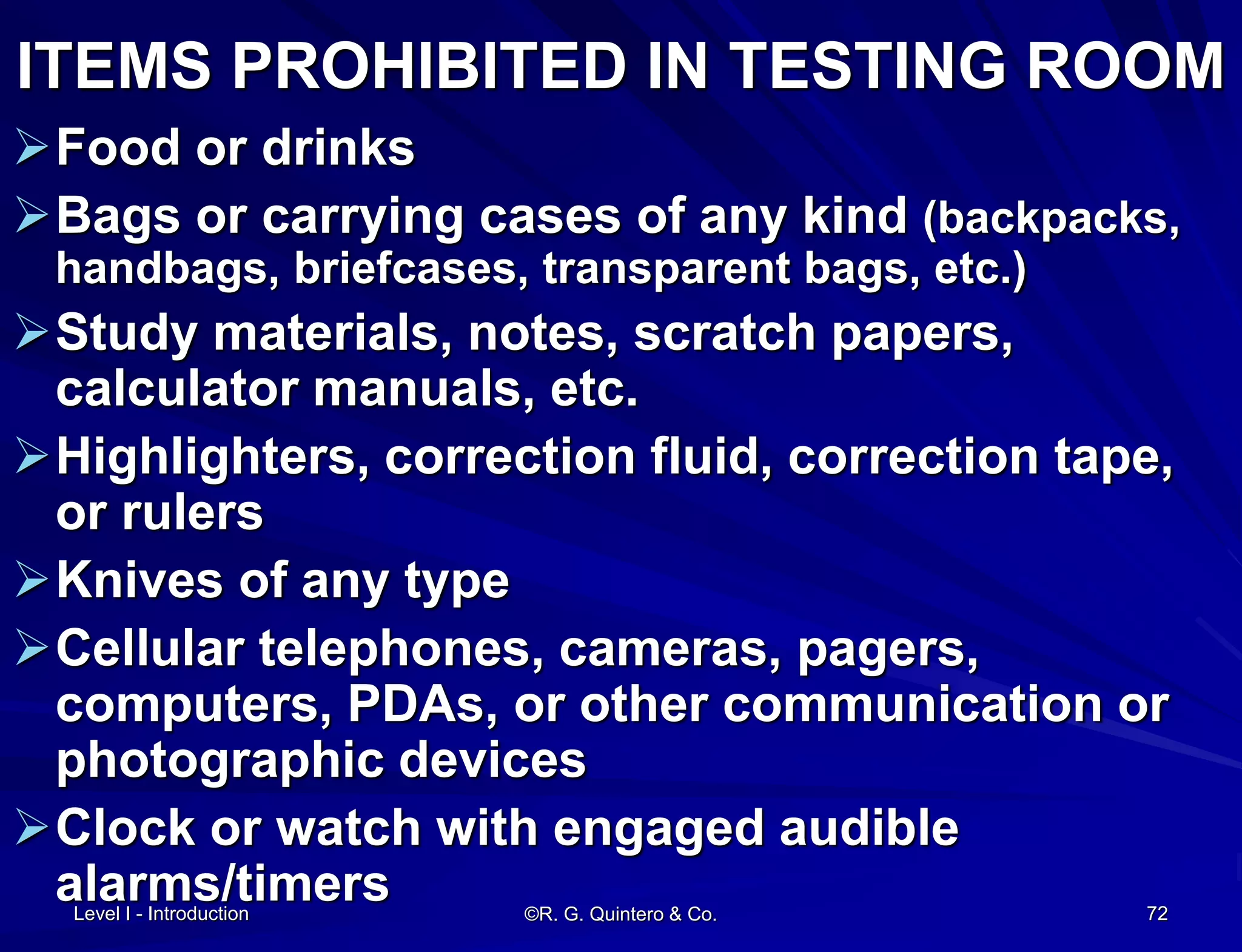
ITEMS PROHIBITED IN TESTING ROOM
Food or drinks
Bags or carrying cases of any kind (backpacks,
handbags, briefcases, transparent bags, etc.)
Study materials, notes, scratch papers,
calculator manuals, etc.
Highlighters, correction fluid, correction tape,
or rulers
Knives of any type
Cellular telephones, cameras, pagers,
computers, PDAs, or other communication or
photographic devices
Clock or watch with engaged audible
alarms/timersLevel I - Introduction
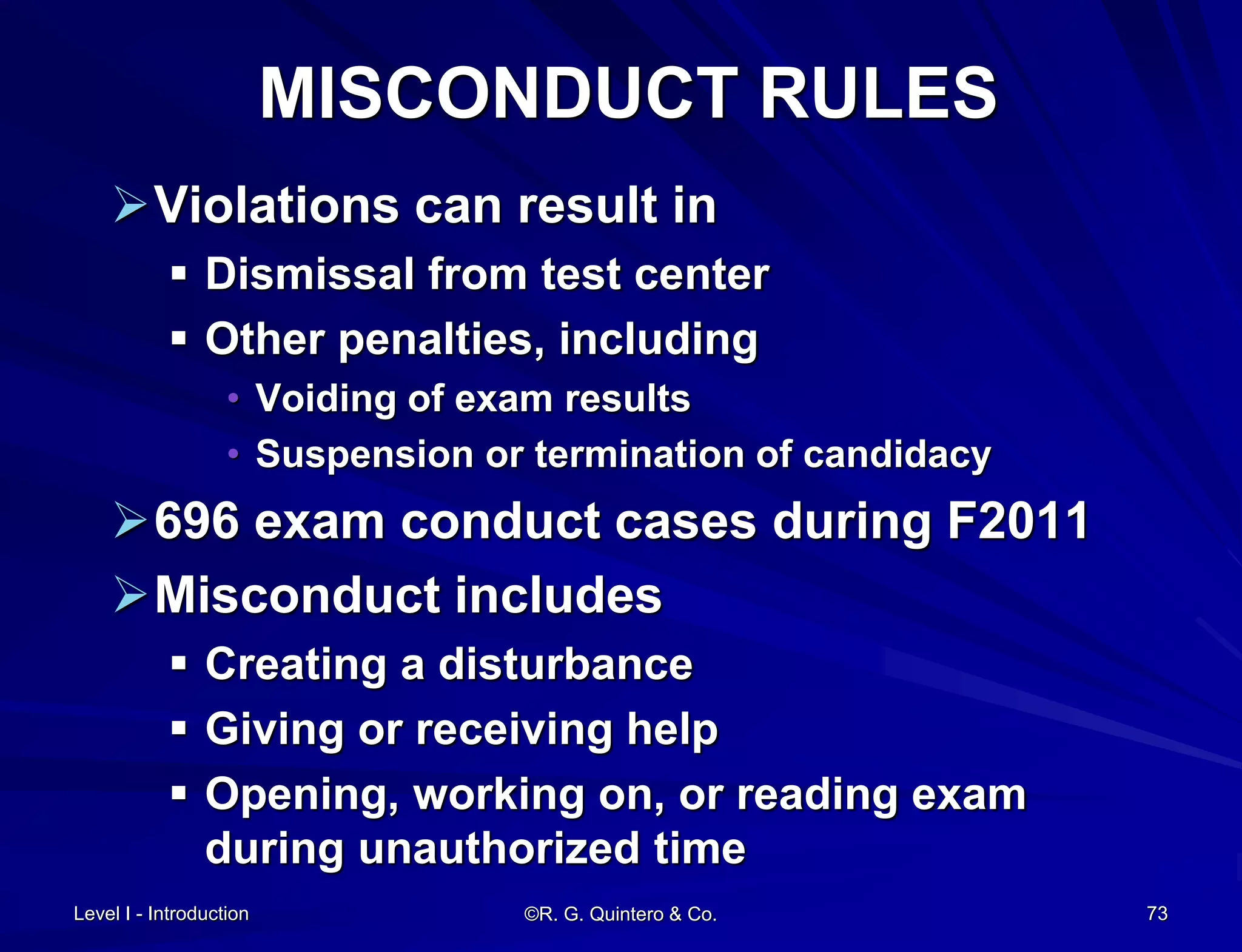
MISCONDUCT RULES
Violations can result in
 Dismissal from test center
 Other penalties, including
• Voiding of exam results
• Suspension or termination of candidacy
696 exam conduct cases during F2011
Misconduct includes
 Creating a disturbance
 Giving or receiving help
 Opening, working on, or reading exam
during unauthorized time
Level I - Introduction ©R. G. Quintero & Co. 73
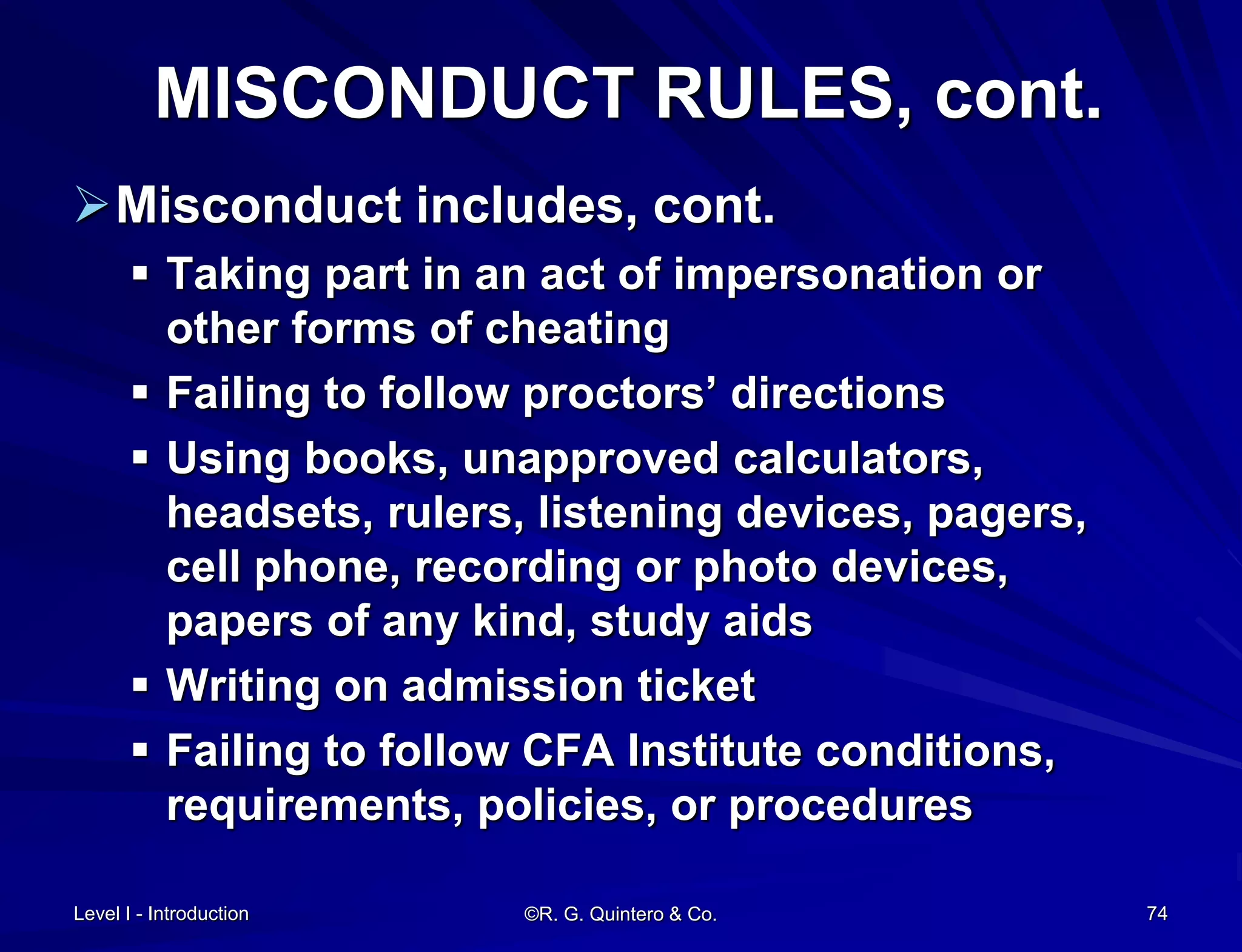
MISCONDUCT RULES, cont.
Misconduct includes, cont.
 Taking part in an act of impersonation or
other forms of cheating
 Failing to follow proctors’ directions
 Using books, unapproved calculators,
headsets, rulers, listening devices, pagers,
cell phone, recording or photo devices,
papers of any kind, study aids
 Writing on admission ticket
 Failing to follow CFA Institute conditions,
requirements, policies, or procedures
Level I - Introduction ©R. G. Quintero & Co. 74
Level I - Introduction ©R. G. Quintero & Co. 75
ABOUT RON QUINTERO
Ron has led and taught more than 300 CFA review programs
over the past 20 years in North America, Europe, and Asia.
These programs have included open-enrollment programs, as
well as in-house programs for leading investment banks,
commercial banks, international monetary institutions, financial
services organizations, and educational institutions. Stamford
classes are offered through RGQ&Co.; NYC classes through
Sharp Seminars. Ron has also taught CFA review programs
offered by NYSSA and FitchLearning, in addition to serving for
a number of years as the director of CFA review programs of
the New York Institute of Finance. Besides being a CFA
charter holder, he is a CPA, CDBV, CFE, CFF, CFP, CIRA,
CMA, CTP, and ABV. To attain these licenses, Ron passed
more than 20 examinations–all on the first sitting. He shares
the approaches that he has successfully applied with his
students. Ron is an award-winning scholar, lecturer and
writer, and a CFA practitioner with real-world experience.
Before starting his firm in 1988, he was a member of the
Investment Banking Department at Bear Stearns and the
Management Consulting Department of KPMG.
Level I - Introduction ©R. G. Quintero & Co. 76
FOLLOW-UP INFORMATION
 CFA Exam & R. G. Quintero & Co. CFA Review
 www.cfainstitute.org
 www.rgquintero.com
 Ronald G. Quintero, CPA, CFA, + 8 more
 (212) 327-0200
 (201) 220-9181 mobile
 (212) 327-0225 FAX
 q@rgquintero.com
 “rgquintero” on Twitter
 “Ron Quintero” on LinkedIn

Cfa level i overview (r. g. quintero & co. 2015)

  • 1.
    R. G. QUINTERO& CO. CFA LEVEL I Q-NOTES INTRODUCTION www.rgquintero.com Provider of live classes in New York and Connecticut
  • 2.
    CFA OVERVIEW  Firstawarded by ICFA in 1963  Charter holders  123,836 (10/14)  137 nations and territories  149,381 candidates from 181 countries registered for the CFA exam in June 2014  June 2014 exam  255 centers  196 cities in 91 countries  75% of candidates from outside the U.S. Earning a charter  Minimum 2 years  Average candidate requires 4 years Level I - Introduction ©R. G. Quintero & Co. 2
  • 3.
    INTERNATIONAL GOLD STANDARD TheCFA program has been characterized by The Economist as the “gold standard” of higher education 99 of 186 analysts recognized by FT/StarMine Global Analyst awards are CFA charter holders Level I - Introduction ©R. G. Quintero & Co. 3
  • 4.
    Level I -Introduction 4©R. G. Quintero & Co.
  • 5.
    Level I -Introduction ©R. G. Quintero & Co. 5
  • 6.
    Level I -Introduction ©R. G. Quintero & Co. 6
  • 7.
    Level I -Introduction ©R. G. Quintero & Co. 7
  • 8.
    VALUABLE TRAINING CFA orcompletion of 1 or more levels  Is used as a screen by many employers  Enhances application for MBA programs  Satisfies licensing requirements of many regulatory bodies  Enhances résumé of individuals • Lacking formal business education • Graduating from less-well known schools More than 130 universities have joined the CFA Partners Program, incorporating CFA into their educational curriculum Level I - Introduction ©R. G. Quintero & Co. 8
  • 9.
    Level I -Introduction ©R. G. Quintero & Co. 9
  • 10.
    Level I -Introduction ©R. G. Quintero & Co. 10 CFA CANDIDATES: 1993 AND 2008 1993 candidates  Ave. age: 31  68% from U.S.  78% male 6/08 candidates  Ave. age: 30  68% from outside U.S.  73% male Source: CFA Institute
  • 11.
    Level I -Introduction ©R. G. Quintero & Co. 11
  • 12.
    Level I -Introduction ©R. G. Quintero & Co. 12
  • 13.
    TOP US EMPLOYERSOF CFA INSTITUTE MEMBERS Level I - Introduction ©R. G. Quintero & Co. 13 Source: CFA Institute, 1/13
  • 14.
    Level I -Introduction ©R. G. Quintero & Co. 14
  • 15.
    JOB FUNCTIONS OF CFACHARTER HOLDERS Level I - Introduction ©R. G. Quintero & Co. 15Source: CFA Institute, 10/14
  • 16.
    Level I -Introduction ©R. G. Quintero & Co. 16
  • 17.
    Level I -Introduction ©R. G. Quintero & Co. 17
  • 18.
    Level I -Introduction ©R. G. Quintero & Co. 18
  • 19.
    Level I -Introduction ©R. G. Quintero & Co. 19
  • 20.
    Level I -Introduction ©R. G. Quintero & Co. 20
  • 21.
    Level I -Introduction ©R. G. Quintero & Co. 21 SUBJECTS COVERED BY THE CFA EXAM SUBJECT CATEGORIES Ethics & professional standards Performance presentation Portfolio management Investment tools • Quantitative analysis • Economics • Accounting • Corporate finance Asset valuation • Equity analysis • Fixed-income securities • Derivatives • Alternative investments • All questions are based on the CFA Program Curriculum • Key concepts are those that address the Learning Outcome Statements
  • 22.
    Level I -Introduction ©R. G. Quintero & Co. 22
  • 23.
    Level I -Introduction ©R. G. Quintero & Co. 23 COMPARING LEVELS I, II, AND III Level I Level II Level III Topic Focus Investment tools Asset valuation Portfolio mgmt. Learning Focus • Basic knowledge • Ethical standards • Applications • Ethical standards • Synthesis • Ethical standards
  • 24.
    Level I -Introduction ©R. G. Quintero & Co. 24 NATURE OF THE CFA EXAM All-day exam  9AM to 12PM and  2PM to 5PM Format  Level I Multiple choice  Level II Multiple choice  Level III 50% multiple choice 50% problems and essays
  • 25.
    CFA PROGRAM PROCESS EducationAdvisory Committee Global Practice Analysis  Candidate Body of Knowledge  Curriculum Council of Examiners Examination CFA Institute & Member Volunteers Grading CFA Institute, Member Volunteers & Consultants Standard setting Board of Governors Minimum passing score Level I - Introduction ©R. G. Quintero & Co. 25
  • 26.
    CREATING THE CFAEXAM Council of Examiners (COE), working with the CFA Program staff, develops Exam over 8-mo. period beginning June (12 mos. prior to Exam)  CFA Program staff includes CFA subject-matter-experts trained in question writing Questions are developed by  > 70 writers  Reviewed by > 100 reviewers • Clarity and accuracy • Neutrality in language, culture, and practice • Consistency with readings, and LOSs Level I - Introduction ©R. G. Quintero & Co. 26
  • 27.
    Level I -Introduction ©R. G. Quintero & Co. 27 CFA EXAM QUESTION WRITING TIMETABLE May/June COE writes General Marching Orders and assigns to COE members July New COE members trained August Writers submit initial question drafts Sep – Jan COE meets to review and revise questions Feb/March • Staff and external reviews by subject matter experts, generalists, and global experts • Feedback to question writers • Writers submit final question drafts March COE Editorial Board selects best questions; final revisions March/April Staff quality review of questions, guideline answers, and grading keys April Deliver exams to secure printer Level I team follows a compressed schedule 2 times/year CFA Institute
  • 28.
    Level I -Introduction ©R. G. Quintero & Co. 28 POST-EXAM ANALYSIS Questions evaluated for  Appropriate difficulty  Appropriate discrimination  Fully functioning distractors  Construct validity  Construct bias  Content bias Studies have found questions to be valid and unbiased
  • 29.
    Level I -Introduction ©R. G. Quintero & Co. 29 Source: AIMR
  • 30.
    Level I -Introduction ©R. G. Quintero & Co. 30
  • 31.
    Level I -Introduction ©R. G. Quintero & Co. 31
  • 32.
    Level I -Introduction ©R. G. Quintero & Co. 32
  • 33.
    Level I -Introduction ©R. G. Quintero & Co. 33
  • 34.
    Level I -Introduction ©R. G. Quintero & Co. 34 STOPPED AT THE STARTING GATE Only 1 out of every 5 candidates completes the program in 5 years A large % of candidates who fail Level I exam choose not to retake the Exam
  • 35.
    Level I -Introduction ©R. G. Quintero & Co. 35 REASONS THAT SOME PEOPLE FAIL THE CFA EXAM  Inadequate preparation  Failure to devote the time  Failure to use time wisely  Lack of positive attitude  1st time a “throw away”  Poor preparation  Poor exam-taking techniques  “Compelled” to take exam  Educational shortcomings  Language difficulties  Personal problems  Not the “cream of the crop”
  • 36.
    Level I -Introduction ©R. G. Quintero & Co. 36 PROGRAM APPROACH In-class review of CFA Program Curriculum In-class review of recurring questions Discuss effective exam-taking techniques Class problems Level I Q-Notes Schweser Level I Study Notes SchweserPro QBank Accessible instructors Free online classes
  • 37.
    Level I -Introduction ©R. G. Quintero & Co. 37 KEYS TO PASSING THE CFA EXAM Preparation  Knowledge  Test questions Confidence Controllable factors Exam-taking techniques
  • 38.
    Level I -Introduction ©R. G. Quintero & Co. 38 EXAM PREPARATION Establish and stick to milestones Peruse (but don’t feel obliged to read) all of the CFA Program Curriculum Schweser Notes and Q-Notes Develop “cheat sheets” after each session Learning Outcome Statements Weekly review Passive vs. active knowledge Mnemonic learning devices
  • 39.
    Level I -Introduction ©R. G. Quintero & Co. 39 EXAM PREPARATION, cont. Study groups Study for weaknesses Don’t overlook strengths Don’t hesitate to contract RGQ&Co. instructors Ensure basic understanding of all 18 sessions  CFA Institute Guideline Topic Weights May  Heightened review  Do lots of problems  Weekend and day before Exam
  • 40.
    Level I -Introduction ©R. G. Quintero & Co. 40
  • 41.
    Level I -Introduction ©R. G. Quintero & Co. 41
  • 42.
    Level I -Introduction ©R. G. Quintero & Co. 42 CFAI LEVEL I SAMPLE AND MOCK EXAMS Topic-Based Exams Mock Exams Availability Available January 2015 Exam access Online Online Question format Multiple choice Multiple choice Questions Short practice tests 240 Timed NA 360 minutes Topic coverage Partial Partial Includes past exam questions? Yes Yes Cost None None Feedback Answers provided after each question Answers, discussions, LOS & curriculum refs. provided at end Able to print exam & solutions? No No
  • 43.
    Level I -Introduction ©R. G. Quintero & Co. 43
  • 44.
    Level I -Introduction ©R. G. Quintero & Co. 44
  • 45.
    Level I -Introduction ©R. G. Quintero & Co. 45
  • 46.
    Level I -Introduction ©R. G. Quintero & Co. 46
  • 47.
    Level I -Introduction ©R. G. Quintero & Co. 47
  • 48.
    Level I -Introduction CONTROLLABLE FACTORS 2/18—standard fee registration deadline 3/18—final registration deadline 3/24—deadline for accommodation requests 4/20—deadline for test center change requests Early May—exam admission tickets available online 6/6—examination day Rest Nourishment Clothing Psychological factors©R. G. Quintero & Co. 48
  • 49.
    Level I -Introduction ©R. G. Quintero & Co. 49 CONTROLLABLE FACTORS, cont. Get to the exam site by 8AM Equipment  HP 12C (including HP12C Platinum)  TI BAII Plus (including BAII Plus Professional)  Fresh batteries; backup calculator  Plenty of #2 or HB pencils  Loose eraser(s) Use lavatory before the Exam starts Seat selection
  • 50.
    Level I -Introduction ©R. G. Quintero & Co. 50 ABOUT THE EXAM  All multiple choice  120 in the morning  120 in the afternoon  You will be given a full 3 hours in AM and PM despite start time  Most of our students finish with 0 - 10 min. remaining  Questions grouped by topic  Only permitted to bring calculator, pencils, and erasers to seat  Designated place for other belongings  All questions of equal value  No penalty for wrong answers  30%-40% of questions require numerical calculation(s)
  • 51.
    Level I -Introduction ©R. G. Quintero & Co. 51 NATURE OF ITEM-SET QUESTIONS Stem + correct answer + 2 distracters  Reduced from 3 distracters Question types  Sentence completion  Question  2 columns
  • 52.
    Level I -Introduction ©R. G. Quintero & Co. 52 SENTENCE-COMPLETION QUESTION An analyst suspects that a particular company’s U.S. GAAP financial statements may require adjustment because the company uses take-or-pay contracts. The most likely effect of the appropriate adjustments would be to increase that company’s: A. Return on assets. B. Debt-to-equity ratio. C. Interest coverage ratio. CFA Institute
  • 53.
    Level I -Introduction ©R. G. Quintero & Co. 53 QUESTION WITH 3 DISTRACTORS An analyst suspects that a particular company’s U.S. GAAP financial statements may require adjustment because the company uses take-or-pay contracts. Which of the following is most likely to increase as a result of the appropriate adjustments being made to that company’s financial statements? A. Return on assets. B. Debt-to-equity ratio. C. Interest coverage ratio. CFA Institute
  • 54.
    Level I -Introduction ©R. G. Quintero & Co. 54 2-COLUMN QUESTION An analyst suspects that a particular company’s U.S. GAAP financial statements may require adjustment because the company uses take-or-pay contracts. The most likely effect of the appropriate adjustments on the company’s return on assets (ROA) and debt-to-equity ratio, respectively, would be: Debt-to-equity ROA Ratio A. Increase Increase B. Increase Decrease C. Decrease Increase CFA Institute
  • 55.
    Level I -Introduction ©R. G. Quintero & Co. 55 2-COLUMN QUESTION: ALT. FORMAT An analyst suspects that a particular company’s U.S. GAAP financial statements may require adjustment because the company uses take-or-pay contracts. What is the most likely affect of the appropriate adjustments on the company’s: Return on Debt-to-equity Assets Ratio A. Increase Increase B. Increase Decrease C. Decrease Increase CFA Institute
  • 56.
    Level I -Introduction ©R. G. Quintero & Co. 56 2-COLUMN QUESTION: ALT. FORMAT An analyst suspects that a particular company’s U.S. GAAP financial statements may require adjustment because the company uses take-or-pay contracts. Will the appropriate adjustments most likely increase the company’s: Return on Debt-to-equity Assets? Ratio? A. No No B. No Yes C. Yes No CFA Institute
  • 57.
    Level I -Introduction ©R. G. Quintero & Co. 57 OBSERVATIONS ABOUT STEMS Exam doesn’t use EXCEPT, TRUE, or FALSE in item stems, and avoids use of NOT Common stem wording qualifiers  Most likely, least likely, best described, most appropriate, most accurate, least appropriate, least accurate Each stem supports only 1 item
  • 58.
    Level I -Introduction ©R. G. Quintero & Co. 58 ABOUT DISTRACTORS Narrative distractors typically listed from shortest to longest Numerical distractors ordered from smallest to largest number Agree grammatically with the stem Language common to all distractors is placed in stem
  • 59.
    Level I -Introduction ©R. G. Quintero & Co. 59 DISTRACTORS NOT USED All of the above None of the above A and B only (or other variations) Cannot determine Cannot calculate Not enough information to determine
  • 60.
    Level I -Introduction ©R. G. Quintero & Co. 60 HOW THE EXAM IS GRADED Exams are machine graded  Periodic tests to verify accuracy  8 scanning stations w. 2 persons/station • 7 days • Graded 119,446 tests in 6/12  Visual inspection of forms • Manual review of blanks & doublemarks Exam is graded on the curve
  • 61.
    Level I -Introduction ©R. G. Quintero & Co. 61 HOW WELL DO I HAVE TO DO? Ave. Level I score  1963 – 2005 45%* June 2005 Level I Exam  Average 53%*  Ave. of top 27% 62%**  Ave. of bottom 27% 44%**  Min. passing score 57%** • 137 right answers out of 240 *Based on data disclosed by CFAI **Based on statistical inference by RGQ&Co. of CFAI data
  • 62.
    Level I -Introduction ©R. G. Quintero & Co. 62 EXAM-TAKING TECHNIQUES  Make sure that candidate ID is correctly entered  Listen carefully to, and follow, proctors’ instructions—avoid conduct violations  Peruse Exam—confirm 120 questions in AM; 120 in PM  Attack questions  Sequentially, or  Start with best subjects to build confidence and momentum  Keep close track of time  1½ minutes/question  Don’t obsess over any question  Be careful to answer question in appropriate oval  Make sure that erasures are complete
  • 63.
    Level I -Introduction ©R. G. Quintero & Co. 63 EXAM-TAKING TECHNIQUES, cont. Avoid making extraneous marks on answer sheet Read questions carefully Read all alternative answers Choose best answer  Because you know  Process of elimination  Guess (no penalty for wrong answers)  Numerical answer may be closest (but not precise) result
  • 64.
    Level I -Introduction ©R. G. Quintero & Co. 64 EXAM-TAKING TECHNIQUES, cont. Come back to difficult questions after all have been answered Consider readings being tested when answering questions  Always answer based on the CFA Program Curriculum, even if you believe it is wrong Look for shortcuts  You may not have to fully solve question to eliminate all wrong answers Ignore patterns in answers  Numerical answers listed from smallest to largest  Word answers listed in order of sentence length
  • 65.
    Level I -Introduction ©R. G. Quintero & Co. 65 EXAM-TAKING TECHNIQUES, cont. Remain  Calm  Confident Answer all questions Use all time permitted—don’t leave early
  • 66.
    Level I -Introduction ©R. G. Quintero & Co. 66 BEWARE OF TRAPS Accurate statements that don’t match question Distracters  Irrelevant terminology  Data unnecessary to compute answer Numerical answers that don’t precisely agree with any of the alternatives Questions with double negatives Exam ambiguities and errors
  • 67.
    Level I -Introduction FEES AND REGISTRATION DEADLINES FOR JUNE 2015 EXAM 2/18/15 3/18/15 Program enrollment $450 $450 Exam registration $825 $1,210 Total $1,275 $1,660 Note: Curriculum is provided in e-book format to all candidates. Candidates may obtain printed books for $150. ©R. G. Quintero & Co. 67
  • 68.
    Level I -Introduction OTHER KEY DATES June 2015 Exam Requests for disability accommodation; religious alternative dates 3/24/15 Test center change requests 4/20/15 Admission tickets available online May 2015 Exam date 6/6/15 Results available July 2015 ©R. G. Quintero & Co. 68
  • 69.
    ©R. G. Quintero& Co. 69 YOU MUST KEEP THE FOLLOWING ON TOP OF YOUR DESK Examination admission ticket Valid passport with photo  See guidelines on CFA Institute Website  Name must agree with admission ticket Approved calculator(s)  HP 12C (including 12C Platinum, 12C Platinum 25th or 30th Anniversary edition, and 12C Prestige)  TI BAII Plus (including BAII Plus Professional) Writing instruments  Pencils for Levels I and II (#2 or HB)  Pens and pencils for Level III Level I - Introduction
  • 70.
    ©R. G. Quintero& Co. 70 YOU MAY KEEP THE FOLLOWING ON YOUR DESK Erasers Calculator case, keystroke cards, batteries (W/O packaging) & screwdriver Manual pencil sharpener (no knives) Eyeglasses (no case) Earplugs Wristwatch (no audible alarm or timer) Level I - Introduction
  • 71.
    ©R. G. Quintero& Co. 71 YOU MAY KEEP THE FOLLOWING IN POCKETS OR UNDER CHAIR Wallet Eyeglasses case Earplugs Medicine, tissues, and other medically necessary or personal items Gum, hard candy, cough drops Keys Level I - Introduction
  • 72.
    ©R. G. Quintero& Co. 72 ITEMS PROHIBITED IN TESTING ROOM Food or drinks Bags or carrying cases of any kind (backpacks, handbags, briefcases, transparent bags, etc.) Study materials, notes, scratch papers, calculator manuals, etc. Highlighters, correction fluid, correction tape, or rulers Knives of any type Cellular telephones, cameras, pagers, computers, PDAs, or other communication or photographic devices Clock or watch with engaged audible alarms/timersLevel I - Introduction
  • 73.
    MISCONDUCT RULES Violations canresult in  Dismissal from test center  Other penalties, including • Voiding of exam results • Suspension or termination of candidacy 696 exam conduct cases during F2011 Misconduct includes  Creating a disturbance  Giving or receiving help  Opening, working on, or reading exam during unauthorized time Level I - Introduction ©R. G. Quintero & Co. 73
  • 74.
    MISCONDUCT RULES, cont. Misconductincludes, cont.  Taking part in an act of impersonation or other forms of cheating  Failing to follow proctors’ directions  Using books, unapproved calculators, headsets, rulers, listening devices, pagers, cell phone, recording or photo devices, papers of any kind, study aids  Writing on admission ticket  Failing to follow CFA Institute conditions, requirements, policies, or procedures Level I - Introduction ©R. G. Quintero & Co. 74
  • 75.
    Level I -Introduction ©R. G. Quintero & Co. 75 ABOUT RON QUINTERO Ron has led and taught more than 300 CFA review programs over the past 20 years in North America, Europe, and Asia. These programs have included open-enrollment programs, as well as in-house programs for leading investment banks, commercial banks, international monetary institutions, financial services organizations, and educational institutions. Stamford classes are offered through RGQ&Co.; NYC classes through Sharp Seminars. Ron has also taught CFA review programs offered by NYSSA and FitchLearning, in addition to serving for a number of years as the director of CFA review programs of the New York Institute of Finance. Besides being a CFA charter holder, he is a CPA, CDBV, CFE, CFF, CFP, CIRA, CMA, CTP, and ABV. To attain these licenses, Ron passed more than 20 examinations–all on the first sitting. He shares the approaches that he has successfully applied with his students. Ron is an award-winning scholar, lecturer and writer, and a CFA practitioner with real-world experience. Before starting his firm in 1988, he was a member of the Investment Banking Department at Bear Stearns and the Management Consulting Department of KPMG.
  • 76.
    Level I -Introduction ©R. G. Quintero & Co. 76 FOLLOW-UP INFORMATION  CFA Exam & R. G. Quintero & Co. CFA Review  www.cfainstitute.org  www.rgquintero.com  Ronald G. Quintero, CPA, CFA, + 8 more  (212) 327-0200  (201) 220-9181 mobile  (212) 327-0225 FAX  q@rgquintero.com  “rgquintero” on Twitter  “Ron Quintero” on LinkedIn