Understanding
Trade
… and a debate
on perceptions
Trade is good for you…
under certain conditions
Bad and good farming and
public perception
Jorge Nunez
CEU
Master course Economics
Issues covered
 Why should trade be good?
 The limitations of the comparative advantage
theory: A banana is not a car…
 WTO
 Uruguay round agreements…
 Measures of support used and … their limits
 Tariffs, types and consequences
 Non tariff barriers
 Debate on food safety, GMOs, public perception of
risk
David Ricardo
and comparative advantage
 Trade economics is founded on the theory of
comparative advantage
 The origins of Trade economics are from David
Ricardo and his theory of comparative advantage
in Trade
 The logic is simple. Each country has different
endowments, thus some countries are better in
some things than others.
 By trading what you are good at (low opportunity
cost), you can de facto get what you are not good
at (high opportunity cost) cheaper price.
Specialisation benefits you.
 The opportunity costs are different.
A very simple
model (absolute advantage)
Apples
Bananas
60
20
Apples
Bananas
70
A 30
B
If they trade they can
Specialise
Global output would
be higher
Now 45 apples
40 bananas
Now they trade
If each do only one:
60 apples
70 bananas
C1 gives 30 apples for
25 bananas
Country 1 Country 2
Both are better off
A’
B’
UA
UB
U’A
U’B
30
10
15
30 4525
Relative advantage
Apples
Bananas20
Apples
Bananas
70
A
B
With diminishing returns,
Trade still beneficiary due
to relative advantage
Comparative advantage
apples
Apples become more
expensive Wp, it exports
apples and
buys bananas
Country 1 Country 2
A’
B’
UA
UB
U’A
U’B
Dom ex rate,
isorevenue
International,
Ex. rate
Bananas become more
Expensive (Wp) it exports
and buys apples, until
domestic production
price same
Bananas become more
Expensive (Wp) it exports
and buys apples, until
domestic production
price same
We are all happy… but…
 Products are not equivalent, if we put bananas and
cars and both have absolute advantage, trade
expands but the value added of products is very
different. Bananas are also land dependant, imagine
islands.
 Most countries are trapped in poverty because of low
value added.
 Study of 154 countries (Felipe et al.):
 There are only 34 countries in the world that export
mostly sophisticated and well-connected products –
high tech + services
 28 countries in the world that are in a “middle product
trap,”
 17 countries that are in a “middle-low” product trap,
 and 75 countries that are in a difficult and precarious
“low product trap.”
 One day read Reinhard
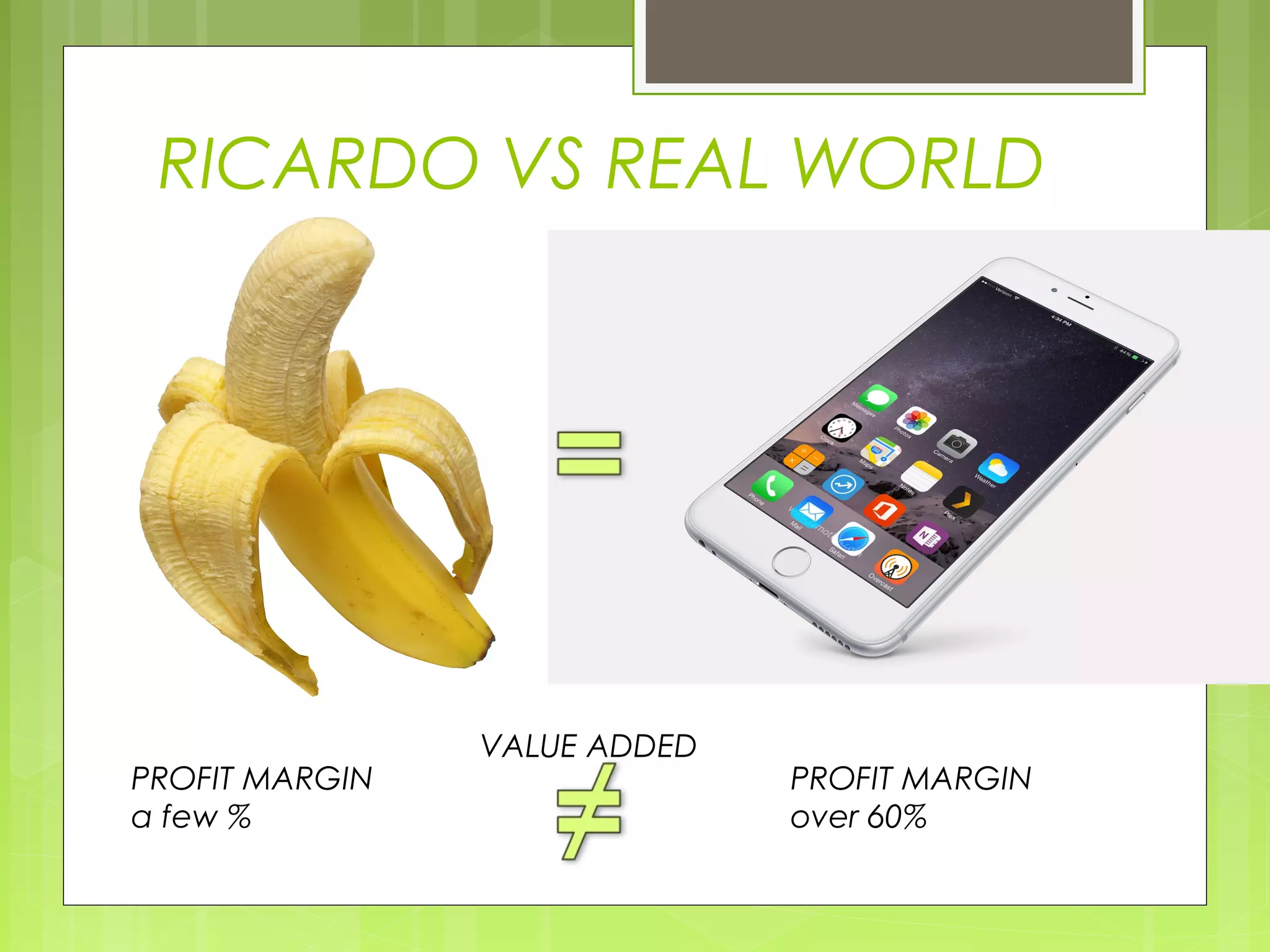
RICARDO VS REAL WORLD
PROFIT MARGIN
a few %
PROFIT MARGIN
over 60%
VALUE ADDED
What does
development require…
 Human capital: Solow growth model fallacy ‘A’
technical change is NOT exogenous, now well
recognised
 Infrastructure and administrative capacity
 Protection or high capital for investment as entry
costs high (barriers for infant industry argument?)
 Contradicts drive for free trade, free trade increases
barriers to new entrants, increases opportunity costs.
 Indirect support in richer countries makes it harder
=> WTO conundrum.
 Free trade is fine, but not ‘per se’ in all
circumstances. It is specially AFTER you have the
structures in place
Trade liberalisation in agriculture
slowing down . Why? History of GATT
and WTO
 EU and US were affecting strongly world price of
agriculture
 Rich countries liberalised manufacturing before
developing countries had a say.
 OECD measured consumer and producer support
equivalents CSE – PSE, which measure the subsidy
or tax of policies on producers and consumers.
 The GATT (WTO) agrees on methodology to
calculate the AMS (Aggregate Measure of
Support)
 GATT: 1946-1995
 from 1995: WTO
 Seven Rounds of Negotiations
 Most famous Uruguay Round 1986-1991, first
agriculture agreement
 Tariffication of barriers
 Tariff reductions
 Distorting subsidy estimation, limitation and phasing
out
 Doha Development Round… the never ending
Round since 2001 – maybe it does not tackle real
issues?
Free trade is double sided
 Are green box policies not curtailing markets for
developing countries?
 LDCs got free trade access (e.g. EU – EBA), but
more trade liberalisation also cuts their relative
advantage, in particular ACP (African, Caribbean
and Pacific) countries had special agreements.
 Getting rid of tariff barriers is nice, but NTBs (Non
tariff barriers) are growing.
 SPS (Sanitary and Phytosanitary) rules are creating
new barriers
 Rules of origin agreed hamper trade.
 Developing countries want more fairness.
Treatment
of developing countries
 GATT rules of MFN (Most favoured Nation) mean
that all countries have to be treated same
 Exception for DCs: GSP (Generalised System of
Preferences) for preferential access since 1971
 EU’s EBA has limited effect
 This is why in BALI meeting (Dec 2013) the real
deal was on technical assistance to facilitate
trade from LDCs
 Further trade liberalisation could actually harm
LDCs
Increase in non trade barriers
 SPS rules expand
 EU makes unscientific anti GM policy (with
unintended results?)
 Due to SPS changes rejections of imported goods
to EU multiply over the years.
 EU introduces fork to farm – traceability creating a
costly process and impossible to comply for
developing country smallholders – fosters large
producers specialised in exports
 SPS rules not based on scientific standards and
subjective.
 EU approach to safety based on flawed
precautionary principle – minimax approach
 Unrealistic worse case scenario is weighted against
maximum benefits, regardless of probability of
worse case scenario. As 100% food safety is
impossible, rules become draconian.
 Aflatoxins standards of EU for example. Rare
disease. EU imposes standards far above
international CODEX (FAO). Death risk 1,4 per billion
people avoided, but killed 64% OF AFRICAN
IMPORTS of cereals fruits and nuts, causing
devastating economic misery and most probably
death due to poverty.
Back to tariffs
 Tariffs have fallen since the Uruguay Round, but the
methodology used limited effective tariff
reductions, because cuts were on average tariffs
(36%), so countries can chose what to cut.
 We look at:
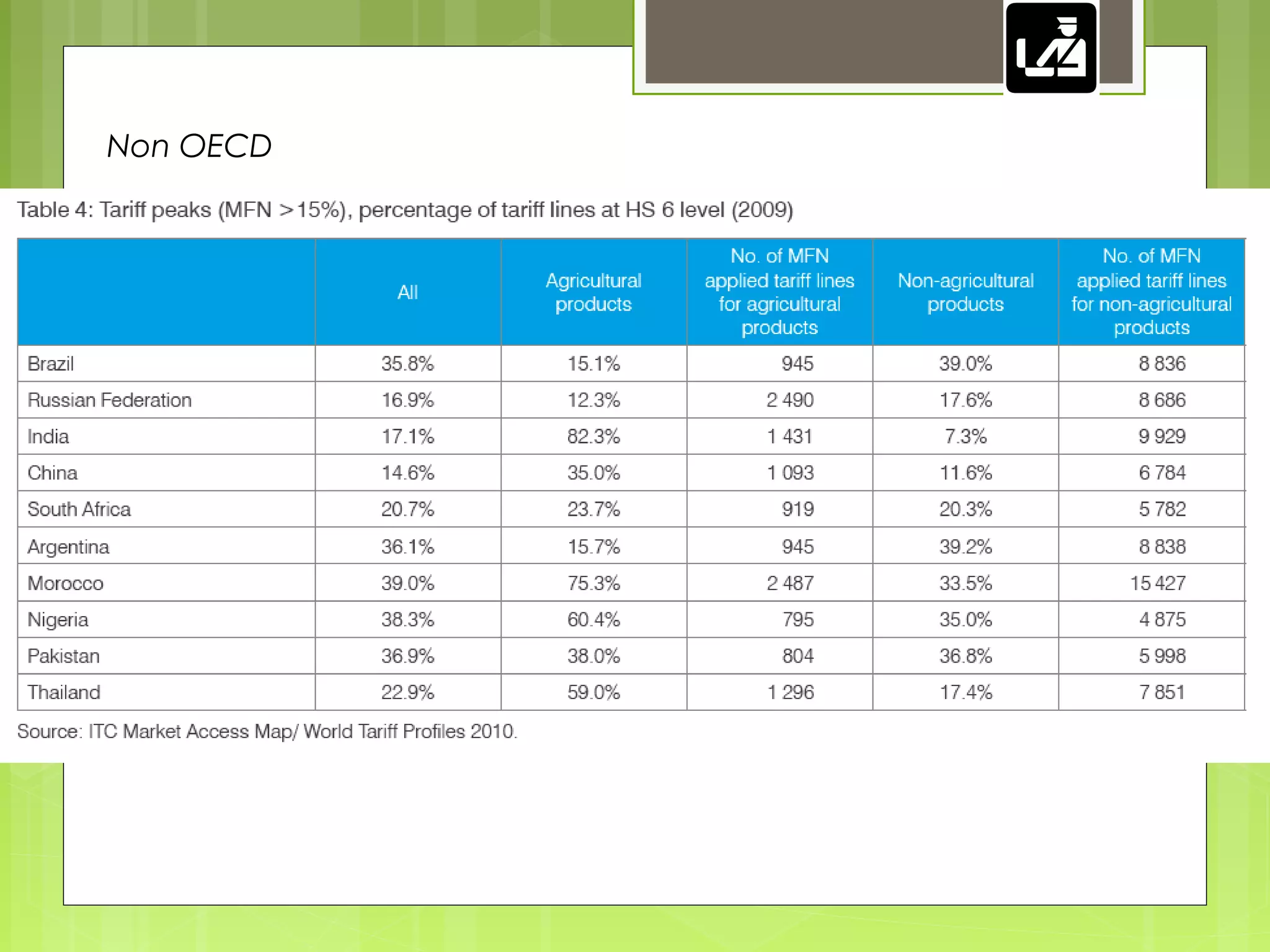
 Tariff peaks (over 15%)
 In 33 over 200% in some even 1000% mainly
agriculture
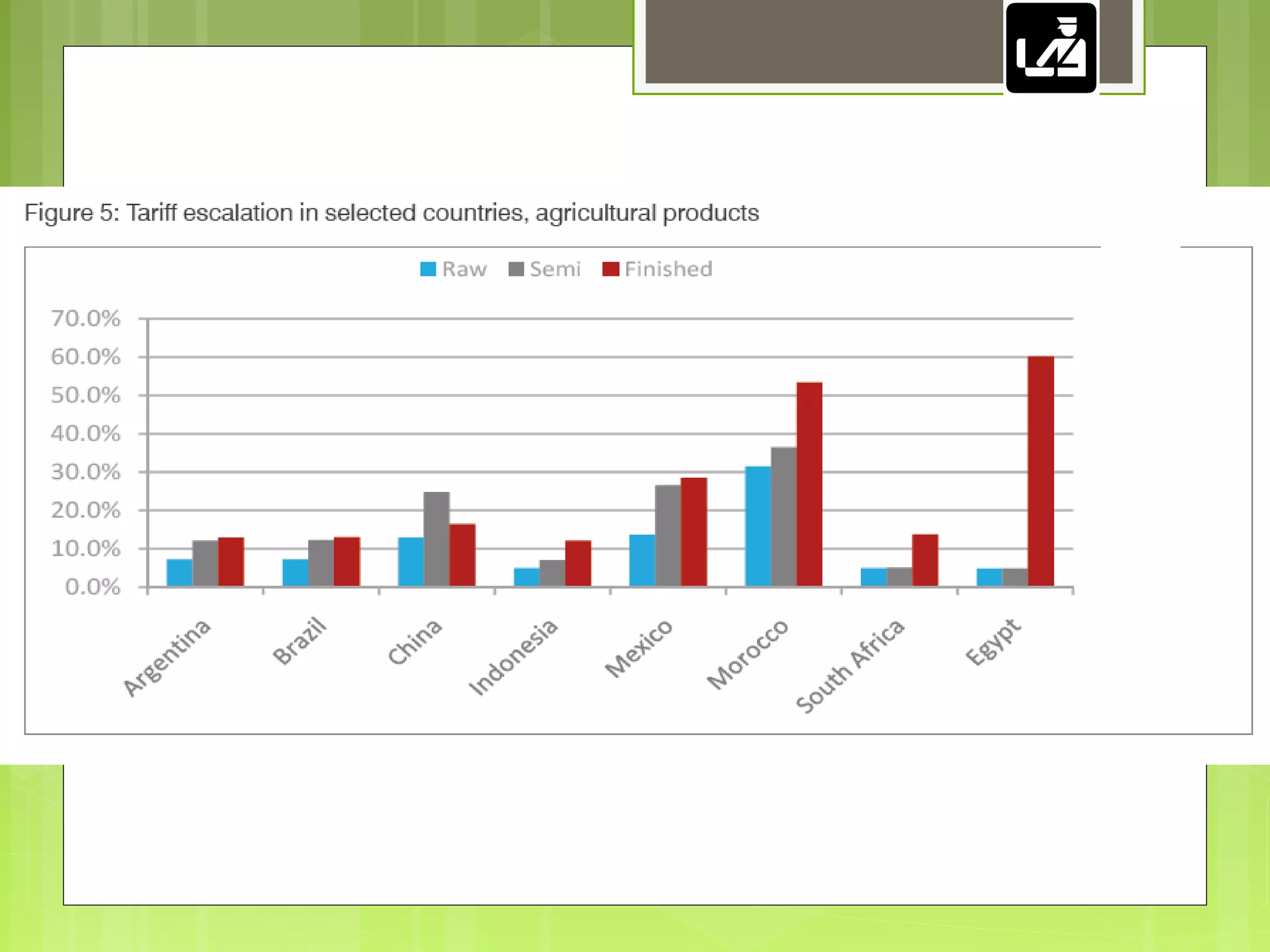
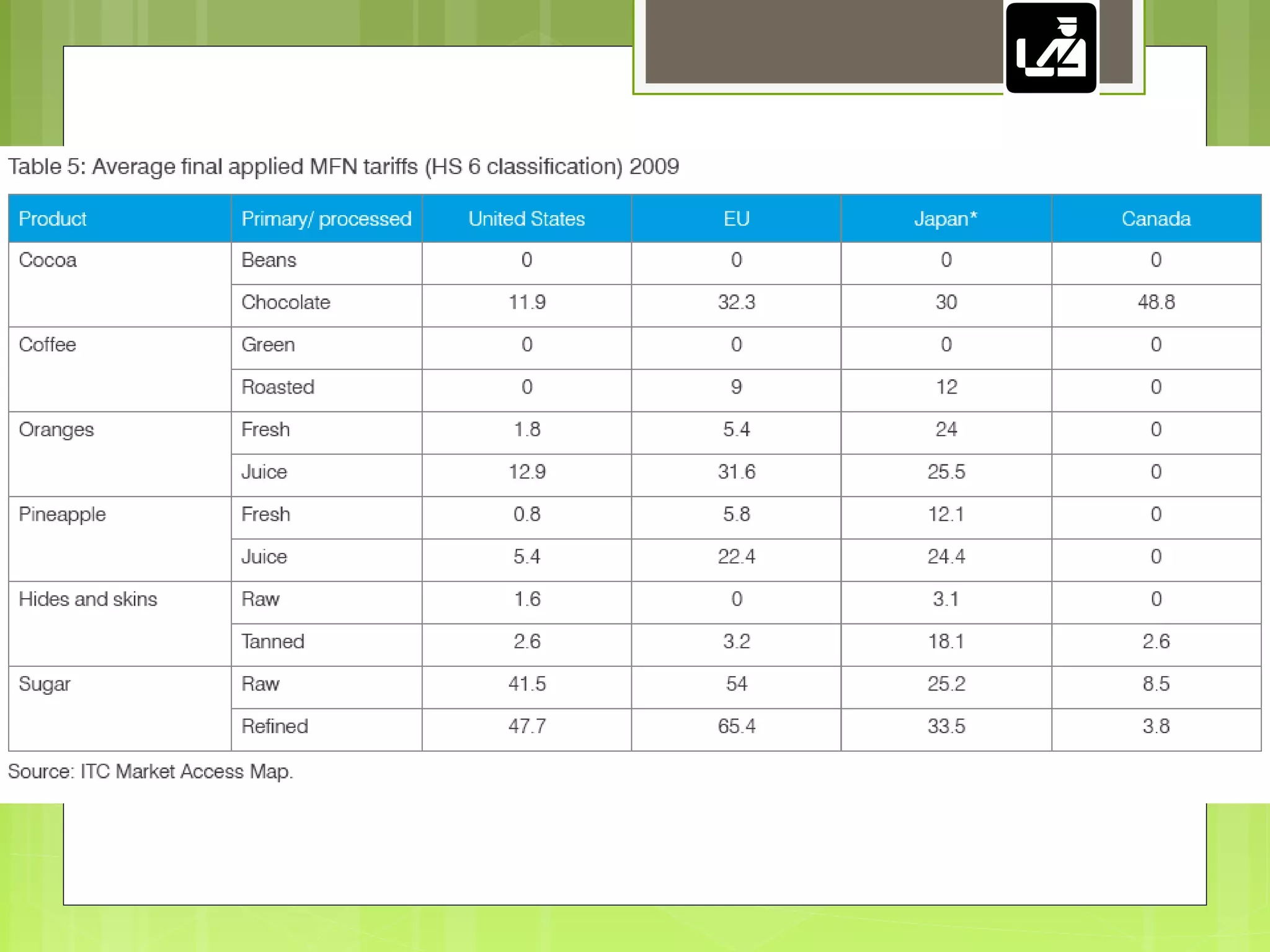
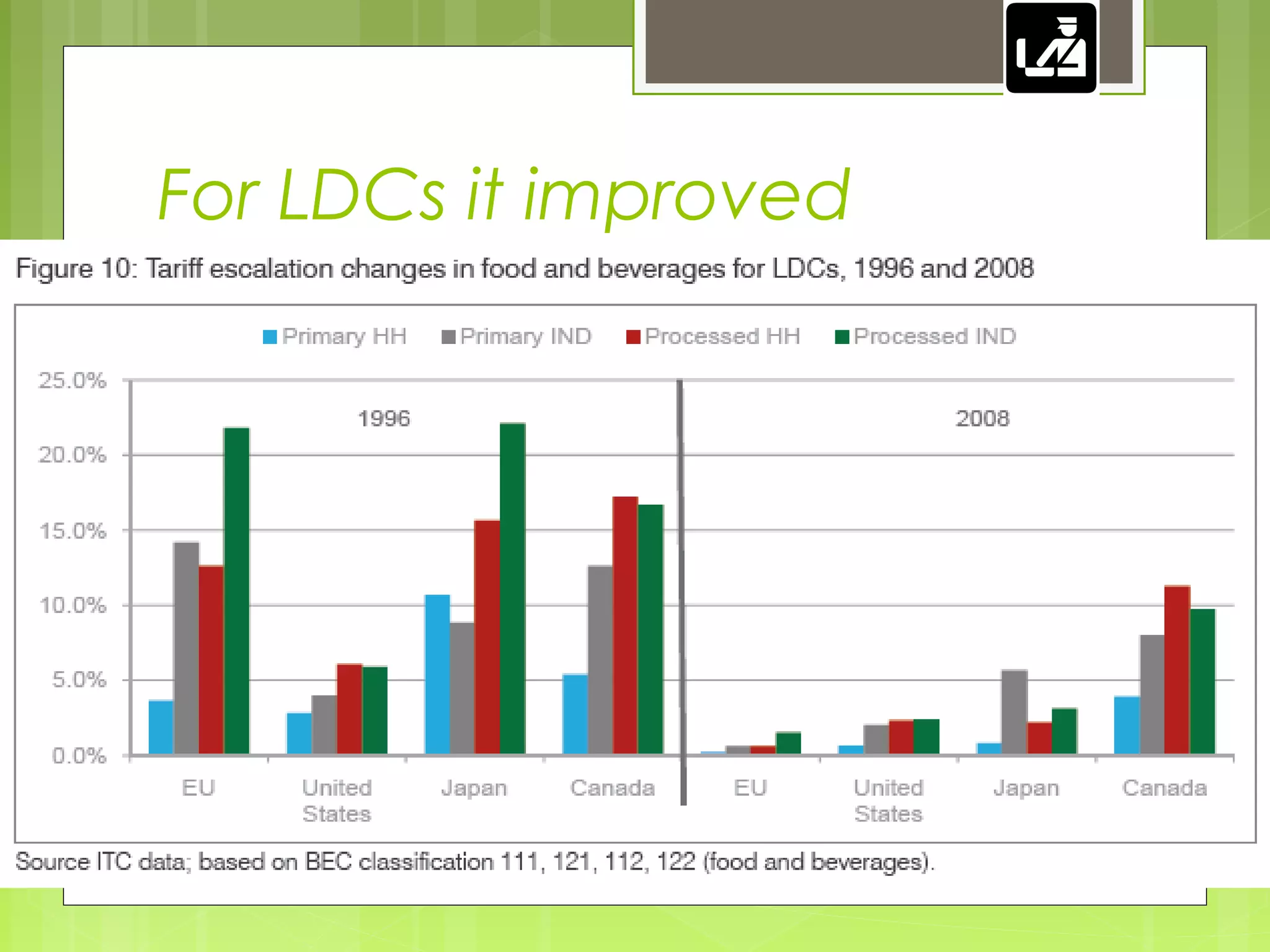
 Tariff escalation, higher tariffs products in increased
level of processing
 Doha’s attempt to move against tariff peaks and
escalation has not yet worked
Effects of tariff
peaks and escalation
 They both reduce trade in key commodities
 Tariff escalation directs exports of developing
countries to products or markets with lower tariffs
(lower value added normally), limiting the
opportunities of diversification
 Tariff escalation reduces the capacity of
developing countries to expand their exports
beyond raw material products to processed
higher value-added goods
 Tariff peaks, if combined with escalation and/or
tariff quotas, limit imports de facto to levels
controlled by the country offering the quotas.
Importance of Agriculture
in trade
Eliminating 6 LDC outliers in trade composition
OECD
Non OECD
Tariff escalation helps to realise value added, keeping low value
added on exporting countries
For LDCs it improved
Some other facts about trade…
help us from China…? OECD DATABASE

CEU lecture 3 2016

  • 1.
    Understanding Trade … and adebate on perceptions Trade is good for you… under certain conditions Bad and good farming and public perception Jorge Nunez CEU Master course Economics
  • 2.
    Issues covered  Whyshould trade be good?  The limitations of the comparative advantage theory: A banana is not a car…  WTO  Uruguay round agreements…  Measures of support used and … their limits  Tariffs, types and consequences  Non tariff barriers  Debate on food safety, GMOs, public perception of risk
  • 3.
    David Ricardo and comparativeadvantage  Trade economics is founded on the theory of comparative advantage  The origins of Trade economics are from David Ricardo and his theory of comparative advantage in Trade  The logic is simple. Each country has different endowments, thus some countries are better in some things than others.  By trading what you are good at (low opportunity cost), you can de facto get what you are not good at (high opportunity cost) cheaper price. Specialisation benefits you.  The opportunity costs are different.
  • 4.
    A very simple model(absolute advantage) Apples Bananas 60 20 Apples Bananas 70 A 30 B If they trade they can Specialise Global output would be higher Now 45 apples 40 bananas Now they trade If each do only one: 60 apples 70 bananas C1 gives 30 apples for 25 bananas Country 1 Country 2 Both are better off A’ B’ UA UB U’A U’B 30 10 15 30 4525
  • 5.
    Relative advantage Apples Bananas20 Apples Bananas 70 A B With diminishingreturns, Trade still beneficiary due to relative advantage Comparative advantage apples Apples become more expensive Wp, it exports apples and buys bananas Country 1 Country 2 A’ B’ UA UB U’A U’B Dom ex rate, isorevenue International, Ex. rate Bananas become more Expensive (Wp) it exports and buys apples, until domestic production price same Bananas become more Expensive (Wp) it exports and buys apples, until domestic production price same
  • 6.
    We are allhappy… but…  Products are not equivalent, if we put bananas and cars and both have absolute advantage, trade expands but the value added of products is very different. Bananas are also land dependant, imagine islands.  Most countries are trapped in poverty because of low value added.  Study of 154 countries (Felipe et al.):  There are only 34 countries in the world that export mostly sophisticated and well-connected products – high tech + services  28 countries in the world that are in a “middle product trap,”  17 countries that are in a “middle-low” product trap,  and 75 countries that are in a difficult and precarious “low product trap.”  One day read Reinhard
  • 7.
    RICARDO VS REALWORLD PROFIT MARGIN a few % PROFIT MARGIN over 60% VALUE ADDED
  • 8.
    What does development require… Human capital: Solow growth model fallacy ‘A’ technical change is NOT exogenous, now well recognised  Infrastructure and administrative capacity  Protection or high capital for investment as entry costs high (barriers for infant industry argument?)  Contradicts drive for free trade, free trade increases barriers to new entrants, increases opportunity costs.  Indirect support in richer countries makes it harder => WTO conundrum.  Free trade is fine, but not ‘per se’ in all circumstances. It is specially AFTER you have the structures in place
  • 9.
    Trade liberalisation inagriculture slowing down . Why? History of GATT and WTO  EU and US were affecting strongly world price of agriculture  Rich countries liberalised manufacturing before developing countries had a say.  OECD measured consumer and producer support equivalents CSE – PSE, which measure the subsidy or tax of policies on producers and consumers.  The GATT (WTO) agrees on methodology to calculate the AMS (Aggregate Measure of Support)
  • 10.
     GATT: 1946-1995 from 1995: WTO  Seven Rounds of Negotiations  Most famous Uruguay Round 1986-1991, first agriculture agreement  Tariffication of barriers  Tariff reductions  Distorting subsidy estimation, limitation and phasing out  Doha Development Round… the never ending Round since 2001 – maybe it does not tackle real issues?
  • 11.
    Free trade isdouble sided  Are green box policies not curtailing markets for developing countries?  LDCs got free trade access (e.g. EU – EBA), but more trade liberalisation also cuts their relative advantage, in particular ACP (African, Caribbean and Pacific) countries had special agreements.  Getting rid of tariff barriers is nice, but NTBs (Non tariff barriers) are growing.  SPS (Sanitary and Phytosanitary) rules are creating new barriers  Rules of origin agreed hamper trade.  Developing countries want more fairness.
  • 12.
    Treatment of developing countries GATT rules of MFN (Most favoured Nation) mean that all countries have to be treated same  Exception for DCs: GSP (Generalised System of Preferences) for preferential access since 1971  EU’s EBA has limited effect  This is why in BALI meeting (Dec 2013) the real deal was on technical assistance to facilitate trade from LDCs  Further trade liberalisation could actually harm LDCs
  • 13.
    Increase in nontrade barriers  SPS rules expand  EU makes unscientific anti GM policy (with unintended results?)  Due to SPS changes rejections of imported goods to EU multiply over the years.  EU introduces fork to farm – traceability creating a costly process and impossible to comply for developing country smallholders – fosters large producers specialised in exports  SPS rules not based on scientific standards and subjective.  EU approach to safety based on flawed precautionary principle – minimax approach
  • 14.
     Unrealistic worsecase scenario is weighted against maximum benefits, regardless of probability of worse case scenario. As 100% food safety is impossible, rules become draconian.  Aflatoxins standards of EU for example. Rare disease. EU imposes standards far above international CODEX (FAO). Death risk 1,4 per billion people avoided, but killed 64% OF AFRICAN IMPORTS of cereals fruits and nuts, causing devastating economic misery and most probably death due to poverty.
  • 15.
    Back to tariffs Tariffs have fallen since the Uruguay Round, but the methodology used limited effective tariff reductions, because cuts were on average tariffs (36%), so countries can chose what to cut.  We look at:  Tariff peaks (over 15%)  In 33 over 200% in some even 1000% mainly agriculture  Tariff escalation, higher tariffs products in increased level of processing  Doha’s attempt to move against tariff peaks and escalation has not yet worked
  • 16.
    Effects of tariff peaksand escalation  They both reduce trade in key commodities  Tariff escalation directs exports of developing countries to products or markets with lower tariffs (lower value added normally), limiting the opportunities of diversification  Tariff escalation reduces the capacity of developing countries to expand their exports beyond raw material products to processed higher value-added goods  Tariff peaks, if combined with escalation and/or tariff quotas, limit imports de facto to levels controlled by the country offering the quotas.
  • 17.
  • 18.
    Eliminating 6 LDCoutliers in trade composition
  • 19.
  • 20.
  • 24.
    Tariff escalation helpsto realise value added, keeping low value added on exporting countries
  • 25.
    For LDCs itimproved
  • 27.
    Some other factsabout trade… help us from China…? OECD DATABASE