Image Processing & its applications in real life
Submitted to
Sir H. M. Haroon
Submitted by
Muhammad Waqas
2013-AG-4326
BS (Software Engineering)
Department of Computer Sciences
University of Agriculture, Faisalabad
Image Processing
Signal processing is a discipline in electrical engineering and in mathematics that
deals with analysis and processing of analog and digital signals, and deals with
storing, filtering, and other operations on signals. Thesesignals include
transmission signals, sound or voicesignals, image signals, and other signals etc.
Out of all these signals, the field that deals with the type of signals for which the
input is an image and the output is also an image is donein image processing. As
it name suggests it deals with the processing on images.
Itcan be further divided into analog image processing and digital image
processing.
Analog image processing
Analog image processing is done on analog signals. Itincludes processing on two
dimensional analog signals. In this type of processing, theimages are manipulated
by electrical means by varying the electrical signal. The common example include
is the television image.
Digital image processing has dominated over analog image processing with the
passageof time due its wider range of applications.
Digital Image Processing
“Digital image processing” deals with manipulation of digital images through a
digital computer. Itis a subfield of signals and systems but focus particularly on
images. DIP focuses on developing a computer systemthat is able to perform
processing on an image. The input of that systemis a digital image and the system
process that image using efficient algorithms, and gives an image as an output.
The most common example is Adobe Photoshop. Itis one of the widely used
applications for processing digital images.
How It Works
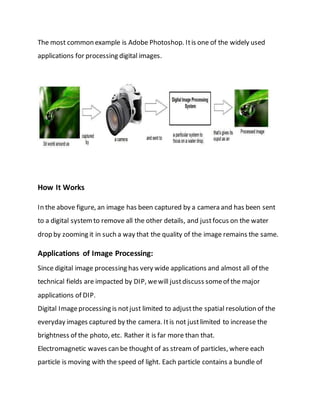
In the above figure, an image has been captured by a camera and has been sent
to a digital systemto remove all the other details, and justfocus on the water
drop by zooming it in such a way that the quality of the image remains the same.
Applications of Image Processing:
Since digital image processing has very wide applications and almost all of the
technical fields are impacted by DIP, wewill justdiscuss someof the major
applications of DIP.
Digital Imageprocessing is notjust limited to adjustthe spatial resolution of the
everyday images captured by the camera. Itis not justlimited to increase the
brightness of the photo, etc. Rather it is far more than that.
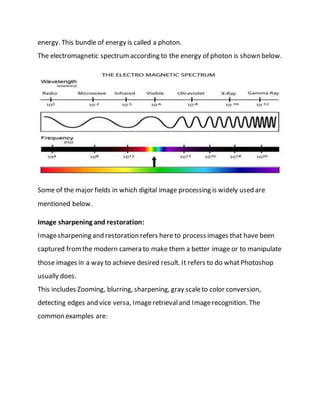
Electromagnetic waves can be thought of as stream of particles, where each
particle is moving with the speed of light. Each particle contains a bundle of
energy. This bundle of energy is called a photon.
The electromagnetic spectrumaccording to the energy of photon is shown below.
Some of the major fields in which digital image processing is widely used are
mentioned below.
Image sharpening and restoration:
Imagesharpening and restoration refers here to process images that have been
captured fromthe modern camera to make them a better image or to manipulate
those images in a way to achieve desired result. It refers to do whatPhotoshop
usually does.
This includes Zooming, blurring, sharpening, gray scaleto color conversion,
detecting edges and vice versa, Imageretrievaland Imagerecognition. The
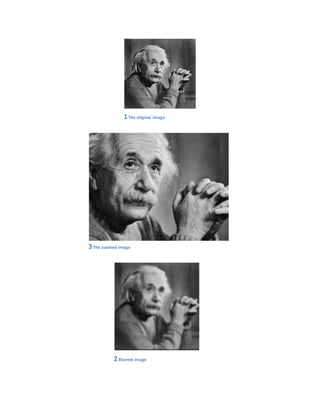
common examples are:
1The original image
3The zoomed image
2Blurred image
Medical field:
The common applications of DIP in the field of medical is
 Gamma ray imaging
 PET scan
 X Ray Imaging
 Medical CT
 UV imaging
UV imaging:
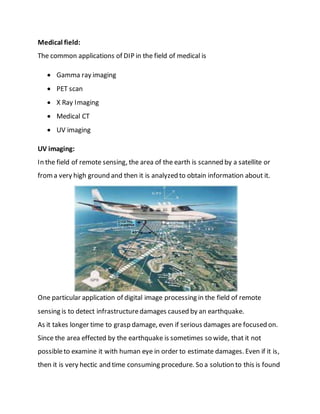
In the field of remote sensing, the area of the earth is scanned by a satellite or
froma very high ground and then it is analyzed to obtain information about it.
One particular application of digital image processing in the field of remote
sensing is to detect infrastructuredamages caused by an earthquake.
As it takes longer time to grasp damage, even if serious damages are focused on.
Since the area effected by the earthquake is sometimes so wide, that it not
possibleto examine it with human eye in order to estimate damages. Even if it is,
then it is very hectic and time consuming procedure. So a solution to this is found
in digital image processing. An image of the affected area is captured fromthe
above ground and then it is analyzed to detect the various types of damage done
by the earthquake.
Transmissionand encoding:
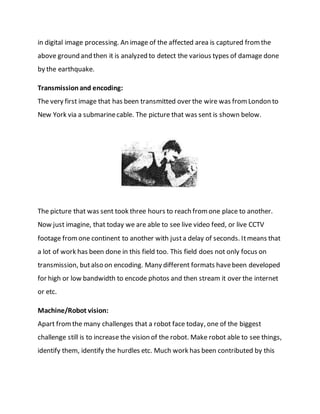
The very first image that has been transmitted over the wire was fromLondon to
New York via a submarinecable. The picture that was sent is shown below.
The picture that was sent took three hours to reach fromone place to another.
Now just imagine, that today we are able to see live video feed, or live CCTV
footage fromone continent to another with justa delay of seconds. Itmeans that
a lot of work has been done in this field too. This field does not only focus on
transmission, butalso on encoding. Many different formats havebeen developed
for high or low bandwidth to encode photos and then stream it over the internet
or etc.
Machine/Robot vision:
Apart fromthe many challenges that a robot face today, one of the biggest
challenge still is to increase the vision of the robot. Make robot able to see things,
identify them, identify the hurdles etc. Much work has been contributed by this
field and a complete other field of computer vision has been introduced to work
on it.
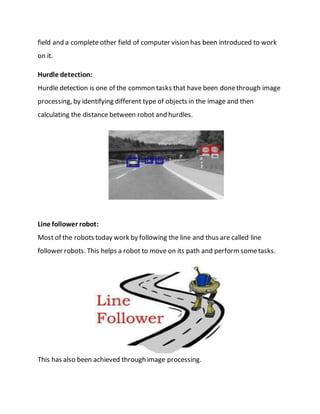
Hurdle detection:
Hurdle detection is one of the common tasks that have been donethrough image
processing, by identifying different type of objects in the image and then
calculating the distance between robot and hurdles.
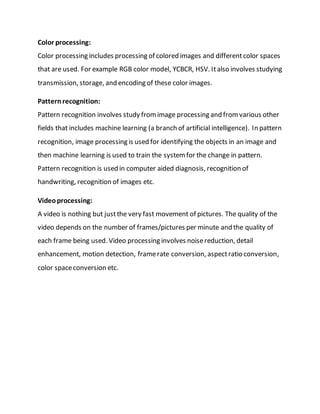
Line follower robot:
Most of the robots today work by following the line and thus are called line
follower robots. This helps a robot to move on its path and performsometasks.
This has also been achieved through image processing.
Color processing:
Color processing includes processing of colored images and differentcolor spaces
that are used. For example RGB color model, YCBCR, HSV. Italso involves studying
transmission, storage, and encoding of these color images.
Patternrecognition:
Pattern recognition involves study fromimage processing and fromvarious other
fields that includes machine learning (a branch of artificial intelligence). In pattern
recognition, image processing is used for identifying the objects in an image and
then machine learning is used to train the systemfor the change in pattern.
Pattern recognition is used in computer aided diagnosis, recognition of
handwriting, recognition of images etc.
Videoprocessing:
A video is nothing but justthe very fast movement of pictures. The quality of the
video depends on the number of frames/pictures per minute and the quality of
each frame being used. Video processing involves noisereduction, detail
enhancement, motion detection, framerate conversion, aspectratio conversion,
color spaceconversion etc.

Image processing (Signal Processing)

  • 1.
    Image Processing &its applications in real life Submitted to Sir H. M. Haroon Submitted by Muhammad Waqas 2013-AG-4326 BS (Software Engineering) Department of Computer Sciences University of Agriculture, Faisalabad
  • 2.
    Image Processing Signal processingis a discipline in electrical engineering and in mathematics that deals with analysis and processing of analog and digital signals, and deals with storing, filtering, and other operations on signals. Thesesignals include transmission signals, sound or voicesignals, image signals, and other signals etc. Out of all these signals, the field that deals with the type of signals for which the input is an image and the output is also an image is donein image processing. As it name suggests it deals with the processing on images. Itcan be further divided into analog image processing and digital image processing. Analog image processing Analog image processing is done on analog signals. Itincludes processing on two dimensional analog signals. In this type of processing, theimages are manipulated by electrical means by varying the electrical signal. The common example include is the television image. Digital image processing has dominated over analog image processing with the passageof time due its wider range of applications. Digital Image Processing “Digital image processing” deals with manipulation of digital images through a digital computer. Itis a subfield of signals and systems but focus particularly on images. DIP focuses on developing a computer systemthat is able to perform processing on an image. The input of that systemis a digital image and the system process that image using efficient algorithms, and gives an image as an output.
  • 3.
    The most commonexample is Adobe Photoshop. Itis one of the widely used applications for processing digital images. How It Works In the above figure, an image has been captured by a camera and has been sent to a digital systemto remove all the other details, and justfocus on the water drop by zooming it in such a way that the quality of the image remains the same. Applications of Image Processing: Since digital image processing has very wide applications and almost all of the technical fields are impacted by DIP, wewill justdiscuss someof the major applications of DIP. Digital Imageprocessing is notjust limited to adjustthe spatial resolution of the everyday images captured by the camera. Itis not justlimited to increase the brightness of the photo, etc. Rather it is far more than that. Electromagnetic waves can be thought of as stream of particles, where each particle is moving with the speed of light. Each particle contains a bundle of
  • 4.
    energy. This bundleof energy is called a photon. The electromagnetic spectrumaccording to the energy of photon is shown below. Some of the major fields in which digital image processing is widely used are mentioned below. Image sharpening and restoration: Imagesharpening and restoration refers here to process images that have been captured fromthe modern camera to make them a better image or to manipulate those images in a way to achieve desired result. It refers to do whatPhotoshop usually does. This includes Zooming, blurring, sharpening, gray scaleto color conversion, detecting edges and vice versa, Imageretrievaland Imagerecognition. The common examples are:
  • 5.
    1The original image 3Thezoomed image 2Blurred image
  • 6.
    Medical field: The commonapplications of DIP in the field of medical is  Gamma ray imaging  PET scan  X Ray Imaging  Medical CT  UV imaging UV imaging: In the field of remote sensing, the area of the earth is scanned by a satellite or froma very high ground and then it is analyzed to obtain information about it. One particular application of digital image processing in the field of remote sensing is to detect infrastructuredamages caused by an earthquake. As it takes longer time to grasp damage, even if serious damages are focused on. Since the area effected by the earthquake is sometimes so wide, that it not possibleto examine it with human eye in order to estimate damages. Even if it is, then it is very hectic and time consuming procedure. So a solution to this is found
  • 7.
    in digital imageprocessing. An image of the affected area is captured fromthe above ground and then it is analyzed to detect the various types of damage done by the earthquake. Transmissionand encoding: The very first image that has been transmitted over the wire was fromLondon to New York via a submarinecable. The picture that was sent is shown below. The picture that was sent took three hours to reach fromone place to another. Now just imagine, that today we are able to see live video feed, or live CCTV footage fromone continent to another with justa delay of seconds. Itmeans that a lot of work has been done in this field too. This field does not only focus on transmission, butalso on encoding. Many different formats havebeen developed for high or low bandwidth to encode photos and then stream it over the internet or etc. Machine/Robot vision: Apart fromthe many challenges that a robot face today, one of the biggest challenge still is to increase the vision of the robot. Make robot able to see things, identify them, identify the hurdles etc. Much work has been contributed by this
  • 8.
    field and acomplete other field of computer vision has been introduced to work on it. Hurdle detection: Hurdle detection is one of the common tasks that have been donethrough image processing, by identifying different type of objects in the image and then calculating the distance between robot and hurdles. Line follower robot: Most of the robots today work by following the line and thus are called line follower robots. This helps a robot to move on its path and performsometasks. This has also been achieved through image processing.
  • 9.
    Color processing: Color processingincludes processing of colored images and differentcolor spaces that are used. For example RGB color model, YCBCR, HSV. Italso involves studying transmission, storage, and encoding of these color images. Patternrecognition: Pattern recognition involves study fromimage processing and fromvarious other fields that includes machine learning (a branch of artificial intelligence). In pattern recognition, image processing is used for identifying the objects in an image and then machine learning is used to train the systemfor the change in pattern. Pattern recognition is used in computer aided diagnosis, recognition of handwriting, recognition of images etc. Videoprocessing: A video is nothing but justthe very fast movement of pictures. The quality of the video depends on the number of frames/pictures per minute and the quality of each frame being used. Video processing involves noisereduction, detail enhancement, motion detection, framerate conversion, aspectratio conversion, color spaceconversion etc.