cetiscape
                        CLINICAL EDUCATION
                        & TRAINING INSTITUTE


        Issue 5  May 2011  Promoting excellence in clinical education  www.ceti.nsw.gov.au  page 1 

Money for manikins
Stephanie O’Regan
Curriculum Developer, Centre for Learning and Teaching, CETI
soregan@ceti.nsw.gov.au

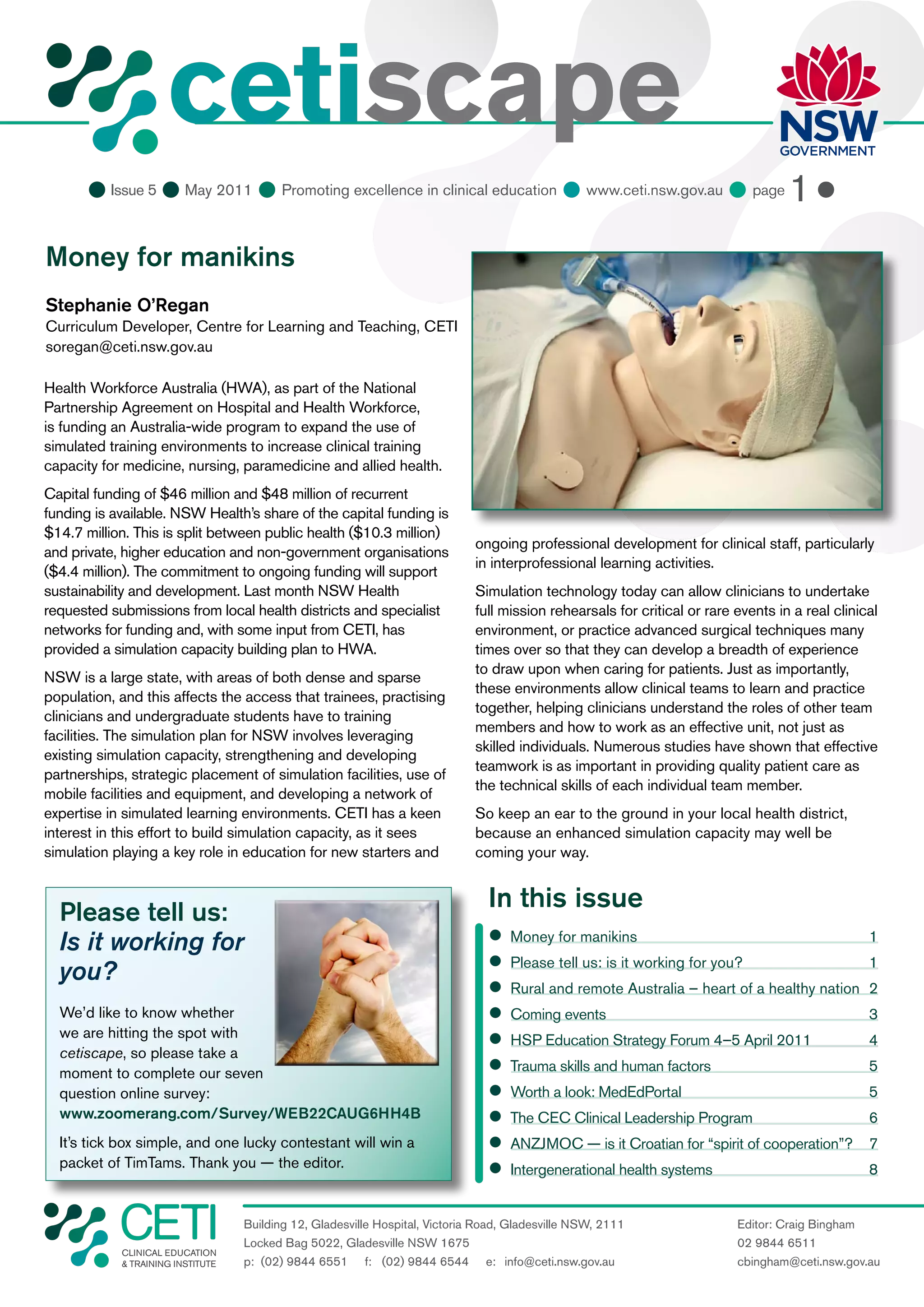
Health Workforce Australia (HWA), as part of the National
Partnership Agreement on Hospital and Health Workforce,
is funding an Australia-wide program to expand the use of
simulated training environments to increase clinical training
capacity for medicine, nursing, paramedicine and allied health.
Capital funding of $46 million and $48 million of recurrent
funding is available. NSW Health’s share of the capital funding is
$14.7 million. This is split between public health ($10.3 million)
                                                                              ongoing professional development for clinical staff, particularly
and private, higher education and non-government organisations
                                                                              in interprofessional learning activities.
($4.4 million). The commitment to ongoing funding will support
sustainability and development. Last month NSW Health                         Simulation technology today can allow clinicians to undertake
requested submissions from local health districts and specialist              full mission rehearsals for critical or rare events in a real clinical
networks for funding and, with some input from CETI, has                      environment, or practice advanced surgical techniques many
provided a simulation capacity building plan to HWA.                          times over so that they can develop a breadth of experience
                                                                              to draw upon when caring for patients. Just as importantly,
NSW is a large state, with areas of both dense and sparse
                                                                              these environments allow clinical teams to learn and practice
population, and this affects the access that trainees, practising
                                                                              together, helping clinicians understand the roles of other team
clinicians and undergraduate students have to training
                                                                              members and how to work as an effective unit, not just as
facilities. The simulation plan for NSW involves leveraging
                                                                              skilled individuals. Numerous studies have shown that effective
existing simulation capacity, strengthening and developing
                                                                              teamwork is as important in providing quality patient care as
partnerships, strategic placement of simulation facilities, use of
                                                                              the technical skills of each individual team member.
mobile facilities and equipment, and developing a network of
expertise in simulated learning environments. CETI has a keen                 So keep an ear to the ground in your local health district,
interest in this effort to build simulation capacity, as it sees              because an enhanced simulation capacity may well be
simulation playing a key role in education for new starters and               coming your way.


  Please tell us:
                                                                                In this issue
  Is it working for                                                             	
                                                                                 Money for manikins                                               1
                                                                                	
                                                                                 Please tell us: is it working for you?                           1
  you?
                                                                                	
                                                                                 Rural and remote Australia – heart of a healthy nation           2
  We’d like to know whether                                                     	
                                                                                 Coming events                                                    3
  we are hitting the spot with                                                  	 Education Strategy Forum 4–5 April 2011
                                                                                 HSP                                                              4
  cetiscape, so please take a
  moment to complete our seven                                                  	
                                                                                 Trauma skills and human factors                                  5
  question online survey:                                                       	
                                                                                 Worth a look: MedEdPortal                                        5
  www.zoomerang.com/Survey/WEB22CAUG6HH4B                                       	 CEC Clinical Leadership Program
                                                                                 The                                                              6
  It’s tick box simple, and one lucky contestant will win a                     	
                                                                                 ANZJMOC — is it Croatian for “spirit of cooperation”?            7
  packet of TimTams. Thank you — the editor.                                    	
                                                                                 Intergenerational health systems                                 8


                                   Building 12, Gladesville Hospital, Victoria Road, Gladesville NSW, 2111                 Editor: Craig Bingham
                                   Locked Bag 5022, Gladesville NSW 1675                                                   02 9844 6511
            CLINICAL EDUCATION
            & TRAINING INSTITUTE   p: (02) 9844 6551 f: (02) 9844 6544 e: info@ceti.nsw.gov.au                             cbingham@ceti.nsw.gov.au
cetiscape
                            May 2011  Promoting excellence in clinical education  www.ceti.nsw.gov.au  page 2 
           CLINICAL EDUCATION
                 Issue 5
           & TRAINING INSTITUTE


Rural and remote Australia – the heart of a healthy nation
11th National Rural Health Conference, Perth 13–16 March 2011

Jenny Preece
Rural and Remote Health Project Officer, CETI Rural Division
jenny.preece@ncahs.health.nsw.gov.au


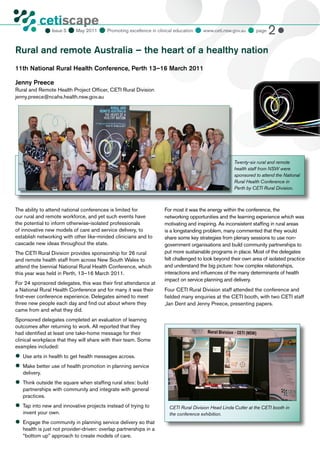
                                                                                                    Twenty-six rural and remote
                                                                                                    health staff from NSW were
                                                                                                    sponsored to attend the National
                                                                                                    Rural Health Conference in
                                                                                                    Perth by CETI Rural Division.


The ability to attend national conferences is limited for          For most it was the energy within the conference, the
our rural and remote workforce, and yet such events have           networking opportunities and the learning experience which was
the potential to inform otherwise-isolated professionals           motivating and inspiring. As inconsistent staffing in rural areas
of innovative new models of care and service delivery, to          is a longstanding problem, many commented that they would
establish networking with other like-minded clinicians and to      share some key strategies from plenary sessions to use non-
cascade new ideas throughout the state.                            government organisations and build community partnerships to
The CETI Rural Division provides sponsorship for 26 rural          put more sustainable programs in place. Most of the delegates
and remote health staff from across New South Wales to             felt challenged to look beyond their own area of isolated practice
attend the biennial National Rural Health Conference, which        and understand the big picture: how complex relationships,
this year was held in Perth, 13–16 March 2011.                     interactions and influences of the many determinants of health
                                                                   impact on service planning and delivery.
For 24 sponsored delegates, this was their first attendance at
a National Rural Health Conference and for many it was their       Four CETI Rural Division staff attended the conference and
first-ever conference experience. Delegates aimed to meet          fielded many enquiries at the CETI booth, with two CETI staff
three new people each day and find out about where they            ,Jan Dent and Jenny Preece, presenting papers.
came from and what they did.
Sponsored delegates completed an evaluation of learning
outcomes after returning to work. All reported that they
had identified at least one take-home message for their
clinical workplace that they will share with their team. Some
examples included:
	 arts in health to get health messages across.
 Use
	
 Make better use of health promotion in planning service
   delivery.
	
 Think outside the square when staffing rural sites: build
   partnerships with community and integrate with general
   practices.
	 into new and innovative projects instead of trying to
 Tap                                                                 CETI Rural Division Head Linda Cutler at the CETI booth in
   invent your own.                                                  the conference exhibition.
	
 Engage the community in planning service delivery so that
   health is just not provider-driven: overlap partnerships in a
   “bottom up” approach to create models of care.
cetiscape
                                May 2011  Promoting excellence in clinical education  www.ceti.nsw.gov.au  page 3 
               CLINICAL EDUCATION
                     Issue 5
               & TRAINING INSTITUTE


   Coming events

îNSW Prevocational Medical Education
 Forum
                                                                          is followed by a workshop to design effective and efficient
                                                                          assessment for prevocational trainees. This is a hands-on
                                                                          workshop aimed at developing better JMO assessment
   Stamford Grand North Ryde 11–12 August 2011                            methods for use in NSW.
   At this year’s forum, educators, directors of training and          	
                                                                        Building a better registrar: Registrars play a vital role in
   administrators will share their experience and hear practical          prevocational training. What makes a good registrar? How
   advice from leaders in the education of junior doctors.                should registrars contribute to prevocational training? What
   The Forum will provide a choice of optional workshops,                 should CETI/DPETs/Supervisors do to support registrars
   an induction session for new Directors of Prevocational                and build their skills as leaders and educators?
   Education and Training, a special interest group meeting for
                                                                       	
                                                                        Prevocational general practice placements program
   JMO Managers, and a half-day plenary session.
                                                                          (PGPPP): Hospital DPETs and GP DPETs need to work
                                                                          together to maximise the effectiveness of general practice
   Workshops
                                                                          placements for prevocational trainees. How does it work
   	
    Teaching on the Run: We hope to offer all six modules on              and what are the issues that need to be considered? This
      the day: Clinical teaching | Skills teaching | Feedback and         session will be led by GP training providers and hospital
      assessment | Supporting trainees | Planning term learning           DPETs with experience in PGPPP.
      | Effective group teaching.
                                                                       	 competencies for prevocational trainees?: The
                                                                        Core
   	
    Online learning: An introductory workshop aimed at                    Australian Curriculum Framework for Junior Doctors outlines
      education support officers and JMO Managers as much as              a comprehensive set of learning outcomes, but is there a set
      Directors in Prevocational Training. Introduction to Moodle         of core competencies that should be specifically taught and
      and simple tools that can be used to help create online             assessed in core terms? This is a brainstorming session for
      learning. Some attention to instructional design principles.        people who want to help find the answer.
      Resources and links to further information will be provided.
                                                                       More information: Craig Bingham (02 9844 6511,
   	
    Building better prevocational trainee assessment:                  cbingham@ceti.nsw.gov.au), or visit the website <www.ceti.
      Exposition of current and potential assessment methods           nsw.gov.au/prevocational>.


îFourth Rural Health Research Colloquium                               Fifth NSW Rural Allied Health Conference                            î
   Dubbo, 11–13 October 2011                                           The Glasshouse, Port Macquarie, 9–11 November 2011
   The Colloquium is co-convened                                       Rural allied health services bring together a blend of
   by the Australian Rural Health                                      multidisciplinary skills, requiring a flexible approach to
   Research Collaboration and                                          cooperation, coordination and collaboration. This conference
   CETI’s Rural Division.                                              will provide an opportunity for all allied health staff, managers
                                                                       and education providers to demonstrate how collaborative
   The theme for the Colloquium                                        health partnerships create models of care which achieve
   is “Sustaining Rural Health                                         positive patient journeys.
   through Research”.
                                                                       This conference is designed to attract rural and remote allied
   Abstracts are now being                                             health clinicians from new graduates to senior managers, and
   received (closing date 13 May 2011). Abstracts should present       those who work in partnership with allied health services.
   research with implications for rural health practice, and should
                                                                       Abstracts are now being received (closing date 27 June
   demonstrate clarity in regard to the research question, research
                                                                       2011).
   method, and the analysis of qualitative and/or quantitative data.
                                                                       Additional information can be obtained from the conference
   Areas of particular interest include Aboriginal health,
                                                                       website: <www.hotelnetwork.com.au/conferences/
   preventive health and health promotion, community well-             conferences/ruralhealth2011>
   being, service delivery and workforce.
   For additional information, please see <www.rhrc.com.au>.
cetiscape
                                                     May 2011  Promoting excellence in clinical education  www.ceti.nsw.gov.au  page 4 
                               CLINICAL EDUCATION
                                     Issue 5
                               & TRAINING INSTITUTE


HSP Education Strategy Forum 4–5 April 2011
Toni Vial
HSP Program Coordinator, CETI, tvial@ceti.nsw.gov.au                                                                                                                                          HOSPITAL SKILLS PROGRAM
                                                                                                                                                                                             The HSP supports the training
Highlights:                                                                                                                                                                                  and professional development of
                 “hearing each network update and sharing educational ideas”                                                                                                                 non-specialist doctors working
“gathering of the group and open discussions on a variety of issues ...                                                                                                                      in NSW hospitals. For more
seeing the program ready to form a plan”                                                                                                                                                     information:
                       “networking and hearing about other districts’ progress”       www.ceti.nsw.gov.au/hsp
“small group workshops ... discussion with others from other districts at all levels”

After the Education Strategy Forum, Hospital Skills Program                                                                                                      with local health districts to pilot implementation of HSP
teams will be busier than ever during the next six months. Several                                                                                               assessment (including performance review processes,
new initiatives are planned to increase participation in the training                                                                                            professional development plans, development of a portfolio
now available in local health districts, and to roll-out workplace-                                                                                              and assessment activities using the HSP Assessment
based assessment in support of HSP learning objectives.                                                                                                          Toolbox). The toolbox provides a set of assessment forms
                                                                                                                                                                 (Case-based Discussion, Mini-CEX, Directly Observed
A state-wide orientation manual is being developed to
                                                                                                                                                                 Procedural Skills, Multi-source Feedback and Performance
introduce all new participants to the HSP. There will be
                                                                                                                                                                 Review) with guidelines for their use in workplace-based
opportunity for local information to be added to the manual.
                                                                                                                                                                 assessment. Supervisor training in assessment will continue
CETI is calling for expresssions of interest in a Performance                                                                                                    around the State. We plan to collaborate with supervisor
Review, Learning Plan, Portfolio and Assessment (PLPA)                                                                                                           training already provided by the colleges and universities, and
Implementation Working Group. This group will work                                                                                                               to use existing resources such as “Teaching on the Run”.
                                                                                                                                                                 We are also working to improve the visibility and content of
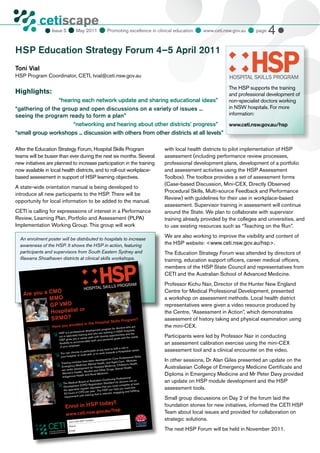
  An enrolment poster will be distributed to hospitals to increase
  awareness of the HSP. It shows the HSP in action, featuring                                                                                                    the HSP website: <www.ceti.nsw.gov.au/hsp>.
  participants and supervisors from South Eastern Sydney and                                                                                                     The Education Strategy Forum was attended by directors of
  Illawarra Shoalhaven districts at clinical skills workshops.                                                                                                   training, education support officers, career medical officers,
                                                                                                                                                                 members of the HSP State Council and representatives from
                                                                                                                                                                 CETI and the Australian School of Advanced Medicine.

                                                                                   LS PROGRAM                                                                    Professor Kichu Nair, Director of the Hunter New England
                                                                      HOSPITAL SKIL
                  O                                                                                                                                              Centre for Medical Professional Development, presented
    Are you a CM
              M MO                                                                                                                                               a workshop on assessment methods. Local health district
              G P VMO                                                                                                                                            representatives were given a video resource produced by
                            r
              Hospitalist o                                                                                                                                      the Centre, “Assessment in Action”, which demonstrates
               S R MO?                                                                              Skills Progra
                                                                                                                             m?                                  assessment of history taking and physical examination using
                                                     lled in                the Hospital
                                       Have you enro                                                      doctors who are
                                                                                                                                                                 the mini-CEX.
                                                                                       ent program for                      ls.
                                                                sional developm                           NSW hospita
                                           HSP is a profes                               are working in
                                                                     ining and who                       rtunities and the
                                           not in specialist
                                                                 tra
                                                                a career path
                                                                                    wit h diverse oppo          and the needs                                    Participants were led by Professor Nair in conducting
                                           HSP gives you                                    r personal goals
                                                                    modate both you
                                           flex ibility to accom
                                                              yer.
                                                                                                                                                                 an assessment calibration exercise using the mini-CEX
                                            of your emplo
                                                                                                       fulfil a role in
                                            You can choose
                                                                   to participate
                                                                                       at any level to
                                                                                                towards a Hospi
                                                                                                                    talist career.                               assessment tool and a clinical encounter on the video.
                                                                             kill, or to work
                                             your hos    pital, to multi-s                                                        ills,
                                                                                                              Professional Sk
                                             Training modul
                                                                 es have been
                                                                                     developed for
                                                                                                      Core
                                                                                               , and Aged Ca
                                                                                                                 re. Modules                                     In other sessions, Dr Alan Giles presented an update on the
                                                                  dicine   , Mental Health               , Childr  en’s Health,
                                              Emergency Me
                                              are under dev
                                                                 elopment for Ho
                                                                                        spital Medicine
                                                                                             her Drugs, Se
                                                                                                             xual Health,                                        Australasian College of Emergency Medicine Certificate and
                                                                        Alcohol and Ot
                                                   men’s Health,
                                              Wo
                                               Indigenous He
                                                                   alth and Rural
                                                                                       Medic   ine.
                                                                                                                                                                 Diploma in Emergency Medicine and Mr Peter Davy provided
                                                                                                               fessional
                                                                                             Continuing Pro
                                                The Medical Bo
                                                                      ard of Australia’s
                                                                                              Standard for do
                                                                                                                 ctors not on                                    an update on HSP module development and the HSP
                                                                           ) Registration             must complete
                                                                                                                          at least
                                                        opment (CPD
                                                Devel
                                                the specialist
                                                                   reg  ister stipulates
                                                                                             that you
                                                                                             HSP can help
                                                                                                              you meet this
                                                                                                                              lling.
                                                                                                                                                                 assessment tools.
                                                                      D per year. The                       aging and fulfi
                                                 50 hours of CP                           is relevant, eng
                                                                       h training that
                                                 requirement wit
                                                                                                                                                                 Small group discussions on Day 2 of the forum laid the
                                                                 today!!
                                                  Enrol in H S P                                                                                                 foundation stones for new initiatives, informed the CETI HSP
                                                              .gov.a                             u/hsp                                                           Team about local issues and provided for collaboration on
                                                  www.ceti.nsw
                                                     Your LHN HS
                                                                     P Contact:                                                                                  strategic solutions.
                                                      Phone
                                                      Email                                                                               7/04/2011 3:57:44
                                                                                                                                                            PM
                                                                                                                                                                 The next HSP Forum will be held in November 2011.
                               1
         HSP_enrolment2.indd
cetiscape
                          May 2011  Promoting excellence in clinical education  www.ceti.nsw.gov.au  page 5 
         CLINICAL EDUCATION
               Issue 5
         & TRAINING INSTITUTE


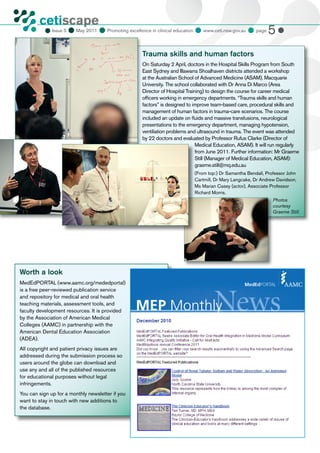
                                                       Trauma skills and human factors
                                                       On Saturday 2 April, doctors in the Hospital Skills Program from South
                                                       East Sydney and Illawarra Shoalhaven districts attended a workshop
                                                       at the Australian School of Advanced Medicine (ASAM), Macquarie
                                                       University. The school collaborated with Dr Anna Di Marco (Area
                                                       Director of Hospital Training) to design the course for career medical
                                                       officers working in emergency departments. “Trauma skills and human
                                                       factors” is designed to improve team-based care, procedural skills and
                                                       management of human factors in trauma-care scenarios. The course
                                                       included an update on fluids and massive transfusions, neurological
                                                       presentations to the emergency department, managing hypotension,
                                                       ventiliation problems and ultrasound in trauma. The event was attended
                                                       by 22 doctors and evaluated by Professor Rufus Clarke (Director of
                                                                                 Medical Education, ASAM). It will run regularly
                                                                                 from June 2011. Further information: Mr Graeme
                                                                                 Still (Manager of Medical Education, ASAM):
                                                                                 graeme.still@mq.edu.au
                                                                               (From top:) Dr Samantha Bendall, Professor John
                                                                               Cartmill, Dr Mary Langcake, Dr Andrew Davidson,
                                                                               Ms Marian Casey (actor), Associate Professor
                                                                               Richard Morris.
                                                                                                                   Photos
                                                                                                                   courtesy
                                                                                                                   Graeme Still.


Worth a look
MedEdPORTAL (www.aamc.org/mededportal)
is a free peer-reviewed publication service
and repository for medical and oral health
teaching materials, assessment tools, and
faculty development resources. It is provided
by the Association of American Medical
Colleges (AAMC) in partnership with the
American Dental Education Association
(ADEA).
All copyright and patient privacy issues are
addressed during the submission process so
users around the globe can download and
use any and all of the published resources
for educational purposes without legal
infringements.
You can sign up for a monthly newsletter if you
want to stay in touch with new additions to
the database.
cetiscape
                             May 2011  Promoting excellence in clinical education  www.ceti.nsw.gov.au  page 6 
            CLINICAL EDUCATION
                  Issue 5
            & TRAINING INSTITUTE


The Clinical Excellence Commission Clinical Leadership Program

Rachel Primrose
Clinical Excellence Commission
Directorate Clinical Leadership Development and Training

Our belief in the power of clinical leadership is an essential
component of the CEC’s commitment to improving patient
safety and clinical quality in our healthcare system. Clinical
leaders play a pivotal role in patient safety and clinical quality.
We need to harness their full potential to ensure that the
health system works better and more safely for staff, patients
and their families.
A central premise of the CEC Clinical Leadership Program
(CLP) is that leadership occurs at all levels in healthcare
and is not dependent on the position to which a person is
appointed. In this, the program supports “ordinary personnel”
to develop extraordinary leadership practice.


                                                                        The theoretical framework of the CLP is adapted from a model
                                                                        by Miller (2003) and outlines key dimensions and related skills
                                                                        that underpin effective clinical leadership. [Miller GV (2003). The
                                                                        Leadership Dimensions Survey. In: Gordon J, editor. Pfeiffer’s
                                                                        Classic Activities for Developing Leaders. (pp. 409–435).]


                                                                      	
                                                                       advocate for patient safety and integrate system
The Clinical Leadership Program is offered at a foundational             improvement into clinical care
(statewide CLP) and executive (modular CLP) level. The                	 insights into their own leadership style and its impact
                                                                       have
foundational program is aimed at middle managers and                     on others
clinicians and is delivered in local health districts by locally      	 effectively with a range of clinicians and managers
                                                                       work
employed facilitators, with central coordination provided by          	 consensus development and vision to set, align and
                                                                       use
the CEC. The executive program is aimed at senior clinicians             achieve goals
and managers and is delivered centrally in Sydney over six
modules by experts in leadership and change management.
                                                                      	
                                                                       resolve conflict and balance demands within the larger
                                                                         environment.
The CLP aims to develop effective clinical leaders who:
                                                                      The program develops an integrated model of clinical
	
 demonstrate a high level of clinical mastery                         leadership by building on leadership and clinical governance
	 the capability of clinical teams
 build                                                                principles, self-awareness, change management,


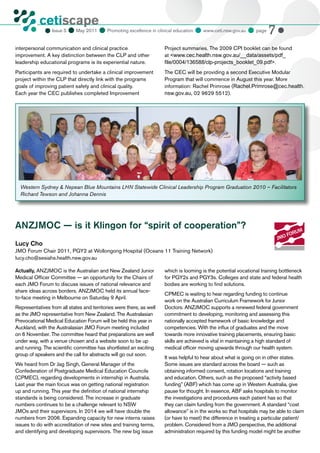
                                            2010 Executive (Modular) Clinical Leadership Program Graduation on 1 April 2011
cetiscape
                             May 2011  Promoting excellence in clinical education  www.ceti.nsw.gov.au  page 7 
            CLINICAL EDUCATION
                  Issue 5
            & TRAINING INSTITUTE


interpersonal communication and clinical practice                     Project summaries. The 2009 CPI booklet can be found
improvement. A key distinction between the CLP and other              at <www.cec.health.nsw.gov.au/__data/assets/pdf_
leadership educational programs is its experiential nature.           file/0004/136588/clp-projects_booklet_09.pdf>.
Participants are required to undertake a clinical improvement         The CEC will be providing a second Executive Modular
project within the CLP that directly link with the programs           Program that will commence in August this year. More
goals of improving patient safety and clinical quality.               information: Rachel Primrose (Rachel.Primrose@cec.health.
Each year the CEC publishes completed Improvement                     nsw.gov.au, 02 9629 5512).


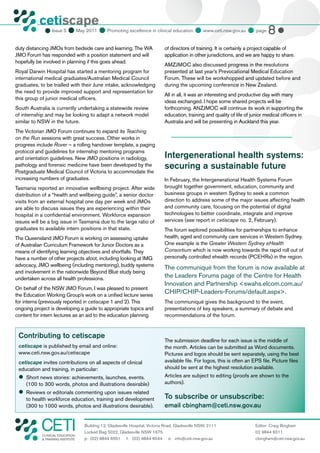
  Western Sydney & Nepean Blue Mountains LHN Statewide Clinical Leadership Program Graduation 2010 – Facilitators
  Richard Tewson and Johanna Dennis


ANZJMOC — is it Klingon for “spirit of cooperation”?
                                                                                                                                  UM
                                                                                                                               FOR
                                                                                                                           JMO
Lucy Cho
JMO Forum Chair 2011, PGY2 at Wollongong Hospital (Oceans 11 Training Network)                                            N E W S O U T H WA L E S

lucy.cho@sesiahs.health.nsw.gov.au

Actually, ANZJMOC is the Australian and New Zealand Junior            which is looming is the potential vocational training bottleneck
Medical Officer Committee — an opportunity for the Chairs of          for PGY2s and PGY3s. Colleges and state and federal health
each JMO Forum to discuss issues of national relevance and            bodies are working to find solutions.
share ideas across borders. ANZJMOC held its annual face-
                                                                      CPMEC is waiting to hear regarding funding to continue
to-face meeting in Melbourne on Saturday 9 April.
                                                                      work on the Australian Curriculum Framework for Junior
Representatives from all states and territories were there, as well   Doctors. ANZJMOC supports a renewed federal government
as the JMO representative from New Zealand. The Australasian          commitment to developing, monitoring and assessing this
Prevocational Medical Education Forum will be held this year in       nationally accepted framework of basic knowledge and
Auckland, with the Australasian JMO Forum meeting included            competencies. With the influx of graduates and the move
on 6 November. The committee heard that preparations are well         towards more innovative training placements, ensuring basic
under way, with a venue chosen and a website soon to be up            skills are achieved is vital in maintaining a high standard of
and running. The scientific committee has shortlisted an exciting     medical officer moving upwards through our health system.
group of speakers and the call for abstracts will go out soon.
                                                                      It was helpful to hear about what is going on in other states.
We heard from Dr Jag Singh, General Manager of the                    Some issues are standard across the board — such as
Confederation of Postgraduate Medical Education Councils              obtaining informed consent, rotation locations and training
(CPMEC), regarding developments in internship in Australia.           and education. Others, such as the proposed “activity based
Last year the main focus was on getting national registration         funding” (ABF) which has come up in Western Australia, give
up and running. This year the definition of national internship       pause for thought. In essence, ABF asks hospitals to monitor
standards is being considered. The increase in graduate               the investigations and procedures each patient has so that
numbers continues to be a challenge relevant to NSW                   they can claim funding from the government. A standard “cost
JMOs and their supervisors. In 2014 we will have double the           allowance” is in the works so that hospitals may be able to claim
numbers from 2006. Expanding capacity for new interns raises          (or have to meet) the difference in treating a particular patient/
issues to do with accreditation of new sites and training terms,      problem. Considered from a JMO perspective, the additional
and identifying and developing supervisors. The new big issue         administration required by this funding model might be another
cetiscape
                            May 2011  Promoting excellence in clinical education  www.ceti.nsw.gov.au  page 8 
           CLINICAL EDUCATION
                 Issue 5
           & TRAINING INSTITUTE


duty distancing JMOs from bedside care and learning. The WA                   of directors of training. It is certainly a project capable of
JMO Forum has responded with a position statement and will                    application in other jurisdictions, and we are happy to share.
hopefully be involved in planning if this goes ahead.
                                                                              AMZJMOC also discussed progress in the resolutions
Royal Darwin Hospital has started a mentoring program for                     presented at last year’s Prevocational Medical Education
international medical graduates/Australian Medical Council                    Forum. These will be workshopped and updated before and
graduates, to be trialled with their June intake, acknowledging               during the upcoming conference in New Zealand.
the need to provide improved support and representation for
                                                                              All in all, it was an interesting and productive day with many
this group of junior medical officers.
                                                                              ideas exchanged. I hope some shared projects will be
South Australia is currently undertaking a statewide review                   forthcoming. ANZJMOC will continue its work in supporting the
of internship and may be looking to adapt a network model                     education, training and quality of life of junior medical officers in
similar to NSW in the future.                                                 Australia and will be presenting in Auckland this year.
The Victorian JMO Forum continues to expand its Teaching
on the Run sessions with great success. Other works in
progress include Rover – a rolling handover template, a paging
protocol and guidelines for internship mentoring programs
and orientation guidelines. New JMO positions in radiology,                   Intergenerational health systems:
pathology and forensic medicine have been developed by the                    securing a sustainable future
Postgraduate Medical Council of Victoria to accommodate the
increasing numbers of graduates.                                              In February, the Intergenerational Health Systems Forum
Tasmania reported an innovative wellbeing project. After wide                 brought together government, education, community and
distribution of a “health and wellbeing guide”, a senior doctor               business groups in western Sydney to seek a common
visits from an external hospital one day per week and JMOs                    direction to address some of the major issues affecting health
are able to discuss issues they are experiencing within their                 and community care, focusing on the potential of digital
hospital in a confidential environment. Workforce expansion                   technologies to better coordinate, integrate and improve
issues will be a big issue in Tasmania due to the large ratio of              services (see report in cetiscape no. 2, February).
graduates to available intern positions in that state.                        The forum explored possibilities for partnerships to enhance
The Queensland JMO Forum is working on assessing uptake                       health, aged and community care services in Western Sydney.
of Australian Curriculum Framework for Junior Doctors as a                    One example is the Greater Western Sydney eHealth
means of identifying learning objectives and shortfalls. They                 Consortium which is now working towards the rapid roll out of
have a number of other projects afoot, including looking at IMG               personally controlled ehealth records (PCEHRs) in the region.
advocacy, JMO wellbeing (including mentoring), buddy systems
                                                                              The communiqué from the forum is now available at
and involvement in the nationwide Beyond Blue study being
undertaken across all health professions.                                     the Leaders Forums page of the Centre for Health
                                                                              Innovation and Partnership <swahs.elcom.com.au/
On behalf of the NSW JMO Forum, I was pleased to present
the Education Working Group’s work on a unified lecture series
                                                                              CHIP/CHIP-Leaders-Forums/default.aspx>.
for interns (previously reported in cetiscape 1 and 2). This                  The communiqué gives the background to the event,
ongoing project is developing a guide to appropriate topics and               presentations of key speakers, a summary of debate and
content for intern lectures as an aid to the education planning               recommendations of the forum.


 Contributing to cetiscape
                                                                              The submission deadline for each issue is the middle of
 cetiscape is published by email and online:                                  the month. Articles can be submitted as Word documents.
 www.ceti.nsw.gov.au/cetiscape                                                Pictures and logos should be sent separately, using the best
 cetiscape invites contributions on all aspects of clinical                   available file. For logos, this is often an EPS file. Picture files
 education and training, in particular:                                       should be sent at the highest resolution available.
 	
  Short news stories: achievements, launches, events.                         Articles are subject to editing (proofs are shown to the
     (100 to 300 words, photos and illustrations desirable)                   authors).
 	
  Reviews or editorials commenting upon issues related
     to health workforce education, training and development                  To subscribe or unsubscribe:
     (300 to 1000 words, photos and illustrations desirable).                 email cbingham@ceti.nsw.gov.au


                                   Building 12, Gladesville Hospital, Victoria Road, Gladesville NSW, 2111                 Editor: Craig Bingham
                                   Locked Bag 5022, Gladesville NSW 1675                                                   02 9844 6511
            CLINICAL EDUCATION
            & TRAINING INSTITUTE   p: (02) 9844 6551 f: (02) 9844 6544 e: info@ceti.nsw.gov.au                             cbingham@ceti.nsw.gov.au

Cetiscape 5 May 2011

  • 1.
    cetiscape CLINICAL EDUCATION & TRAINING INSTITUTE  Issue 5  May 2011  Promoting excellence in clinical education  www.ceti.nsw.gov.au  page 1  Money for manikins Stephanie O’Regan Curriculum Developer, Centre for Learning and Teaching, CETI soregan@ceti.nsw.gov.au Health Workforce Australia (HWA), as part of the National Partnership Agreement on Hospital and Health Workforce, is funding an Australia-wide program to expand the use of simulated training environments to increase clinical training capacity for medicine, nursing, paramedicine and allied health. Capital funding of $46 million and $48 million of recurrent funding is available. NSW Health’s share of the capital funding is $14.7 million. This is split between public health ($10.3 million) ongoing professional development for clinical staff, particularly and private, higher education and non-government organisations in interprofessional learning activities. ($4.4 million). The commitment to ongoing funding will support sustainability and development. Last month NSW Health Simulation technology today can allow clinicians to undertake requested submissions from local health districts and specialist full mission rehearsals for critical or rare events in a real clinical networks for funding and, with some input from CETI, has environment, or practice advanced surgical techniques many provided a simulation capacity building plan to HWA. times over so that they can develop a breadth of experience to draw upon when caring for patients. Just as importantly, NSW is a large state, with areas of both dense and sparse these environments allow clinical teams to learn and practice population, and this affects the access that trainees, practising together, helping clinicians understand the roles of other team clinicians and undergraduate students have to training members and how to work as an effective unit, not just as facilities. The simulation plan for NSW involves leveraging skilled individuals. Numerous studies have shown that effective existing simulation capacity, strengthening and developing teamwork is as important in providing quality patient care as partnerships, strategic placement of simulation facilities, use of the technical skills of each individual team member. mobile facilities and equipment, and developing a network of expertise in simulated learning environments. CETI has a keen So keep an ear to the ground in your local health district, interest in this effort to build simulation capacity, as it sees because an enhanced simulation capacity may well be simulation playing a key role in education for new starters and coming your way. Please tell us: In this issue Is it working for  Money for manikins 1  Please tell us: is it working for you? 1 you?  Rural and remote Australia – heart of a healthy nation 2 We’d like to know whether  Coming events 3 we are hitting the spot with  Education Strategy Forum 4–5 April 2011 HSP 4 cetiscape, so please take a moment to complete our seven  Trauma skills and human factors 5 question online survey:  Worth a look: MedEdPortal 5 www.zoomerang.com/Survey/WEB22CAUG6HH4B  CEC Clinical Leadership Program The 6 It’s tick box simple, and one lucky contestant will win a  ANZJMOC — is it Croatian for “spirit of cooperation”? 7 packet of TimTams. Thank you — the editor.  Intergenerational health systems 8 Building 12, Gladesville Hospital, Victoria Road, Gladesville NSW, 2111 Editor: Craig Bingham Locked Bag 5022, Gladesville NSW 1675 02 9844 6511 CLINICAL EDUCATION & TRAINING INSTITUTE p: (02) 9844 6551 f: (02) 9844 6544 e: info@ceti.nsw.gov.au cbingham@ceti.nsw.gov.au
  • 2.
    cetiscape  May 2011  Promoting excellence in clinical education  www.ceti.nsw.gov.au  page 2  CLINICAL EDUCATION  Issue 5 & TRAINING INSTITUTE Rural and remote Australia – the heart of a healthy nation 11th National Rural Health Conference, Perth 13–16 March 2011 Jenny Preece Rural and Remote Health Project Officer, CETI Rural Division jenny.preece@ncahs.health.nsw.gov.au Twenty-six rural and remote health staff from NSW were sponsored to attend the National Rural Health Conference in Perth by CETI Rural Division. The ability to attend national conferences is limited for For most it was the energy within the conference, the our rural and remote workforce, and yet such events have networking opportunities and the learning experience which was the potential to inform otherwise-isolated professionals motivating and inspiring. As inconsistent staffing in rural areas of innovative new models of care and service delivery, to is a longstanding problem, many commented that they would establish networking with other like-minded clinicians and to share some key strategies from plenary sessions to use non- cascade new ideas throughout the state. government organisations and build community partnerships to The CETI Rural Division provides sponsorship for 26 rural put more sustainable programs in place. Most of the delegates and remote health staff from across New South Wales to felt challenged to look beyond their own area of isolated practice attend the biennial National Rural Health Conference, which and understand the big picture: how complex relationships, this year was held in Perth, 13–16 March 2011. interactions and influences of the many determinants of health impact on service planning and delivery. For 24 sponsored delegates, this was their first attendance at a National Rural Health Conference and for many it was their Four CETI Rural Division staff attended the conference and first-ever conference experience. Delegates aimed to meet fielded many enquiries at the CETI booth, with two CETI staff three new people each day and find out about where they ,Jan Dent and Jenny Preece, presenting papers. came from and what they did. Sponsored delegates completed an evaluation of learning outcomes after returning to work. All reported that they had identified at least one take-home message for their clinical workplace that they will share with their team. Some examples included:  arts in health to get health messages across. Use  Make better use of health promotion in planning service delivery.  Think outside the square when staffing rural sites: build partnerships with community and integrate with general practices.  into new and innovative projects instead of trying to Tap CETI Rural Division Head Linda Cutler at the CETI booth in invent your own. the conference exhibition.  Engage the community in planning service delivery so that health is just not provider-driven: overlap partnerships in a “bottom up” approach to create models of care.
  • 3.
    cetiscape  May 2011  Promoting excellence in clinical education  www.ceti.nsw.gov.au  page 3  CLINICAL EDUCATION  Issue 5 & TRAINING INSTITUTE Coming events îNSW Prevocational Medical Education Forum is followed by a workshop to design effective and efficient assessment for prevocational trainees. This is a hands-on workshop aimed at developing better JMO assessment Stamford Grand North Ryde 11–12 August 2011 methods for use in NSW. At this year’s forum, educators, directors of training and  Building a better registrar: Registrars play a vital role in administrators will share their experience and hear practical prevocational training. What makes a good registrar? How advice from leaders in the education of junior doctors. should registrars contribute to prevocational training? What The Forum will provide a choice of optional workshops, should CETI/DPETs/Supervisors do to support registrars an induction session for new Directors of Prevocational and build their skills as leaders and educators? Education and Training, a special interest group meeting for  Prevocational general practice placements program JMO Managers, and a half-day plenary session. (PGPPP): Hospital DPETs and GP DPETs need to work together to maximise the effectiveness of general practice Workshops placements for prevocational trainees. How does it work  Teaching on the Run: We hope to offer all six modules on and what are the issues that need to be considered? This the day: Clinical teaching | Skills teaching | Feedback and session will be led by GP training providers and hospital assessment | Supporting trainees | Planning term learning DPETs with experience in PGPPP. | Effective group teaching.  competencies for prevocational trainees?: The Core  Online learning: An introductory workshop aimed at Australian Curriculum Framework for Junior Doctors outlines education support officers and JMO Managers as much as a comprehensive set of learning outcomes, but is there a set Directors in Prevocational Training. Introduction to Moodle of core competencies that should be specifically taught and and simple tools that can be used to help create online assessed in core terms? This is a brainstorming session for learning. Some attention to instructional design principles. people who want to help find the answer. Resources and links to further information will be provided. More information: Craig Bingham (02 9844 6511,  Building better prevocational trainee assessment: cbingham@ceti.nsw.gov.au), or visit the website <www.ceti. Exposition of current and potential assessment methods nsw.gov.au/prevocational>. îFourth Rural Health Research Colloquium Fifth NSW Rural Allied Health Conference î Dubbo, 11–13 October 2011 The Glasshouse, Port Macquarie, 9–11 November 2011 The Colloquium is co-convened Rural allied health services bring together a blend of by the Australian Rural Health multidisciplinary skills, requiring a flexible approach to Research Collaboration and cooperation, coordination and collaboration. This conference CETI’s Rural Division. will provide an opportunity for all allied health staff, managers and education providers to demonstrate how collaborative The theme for the Colloquium health partnerships create models of care which achieve is “Sustaining Rural Health positive patient journeys. through Research”. This conference is designed to attract rural and remote allied Abstracts are now being health clinicians from new graduates to senior managers, and received (closing date 13 May 2011). Abstracts should present those who work in partnership with allied health services. research with implications for rural health practice, and should Abstracts are now being received (closing date 27 June demonstrate clarity in regard to the research question, research 2011). method, and the analysis of qualitative and/or quantitative data. Additional information can be obtained from the conference Areas of particular interest include Aboriginal health, website: <www.hotelnetwork.com.au/conferences/ preventive health and health promotion, community well- conferences/ruralhealth2011> being, service delivery and workforce. For additional information, please see <www.rhrc.com.au>.
  • 4.
    cetiscape  May 2011  Promoting excellence in clinical education  www.ceti.nsw.gov.au  page 4  CLINICAL EDUCATION  Issue 5 & TRAINING INSTITUTE HSP Education Strategy Forum 4–5 April 2011 Toni Vial HSP Program Coordinator, CETI, tvial@ceti.nsw.gov.au HOSPITAL SKILLS PROGRAM The HSP supports the training Highlights: and professional development of “hearing each network update and sharing educational ideas” non-specialist doctors working “gathering of the group and open discussions on a variety of issues ... in NSW hospitals. For more seeing the program ready to form a plan” information: “networking and hearing about other districts’ progress” www.ceti.nsw.gov.au/hsp “small group workshops ... discussion with others from other districts at all levels” After the Education Strategy Forum, Hospital Skills Program with local health districts to pilot implementation of HSP teams will be busier than ever during the next six months. Several assessment (including performance review processes, new initiatives are planned to increase participation in the training professional development plans, development of a portfolio now available in local health districts, and to roll-out workplace- and assessment activities using the HSP Assessment based assessment in support of HSP learning objectives. Toolbox). The toolbox provides a set of assessment forms (Case-based Discussion, Mini-CEX, Directly Observed A state-wide orientation manual is being developed to Procedural Skills, Multi-source Feedback and Performance introduce all new participants to the HSP. There will be Review) with guidelines for their use in workplace-based opportunity for local information to be added to the manual. assessment. Supervisor training in assessment will continue CETI is calling for expresssions of interest in a Performance around the State. We plan to collaborate with supervisor Review, Learning Plan, Portfolio and Assessment (PLPA) training already provided by the colleges and universities, and Implementation Working Group. This group will work to use existing resources such as “Teaching on the Run”. We are also working to improve the visibility and content of An enrolment poster will be distributed to hospitals to increase awareness of the HSP. It shows the HSP in action, featuring the HSP website: <www.ceti.nsw.gov.au/hsp>. participants and supervisors from South Eastern Sydney and The Education Strategy Forum was attended by directors of Illawarra Shoalhaven districts at clinical skills workshops. training, education support officers, career medical officers, members of the HSP State Council and representatives from CETI and the Australian School of Advanced Medicine. LS PROGRAM Professor Kichu Nair, Director of the Hunter New England HOSPITAL SKIL O Centre for Medical Professional Development, presented Are you a CM M MO a workshop on assessment methods. Local health district G P VMO representatives were given a video resource produced by r Hospitalist o the Centre, “Assessment in Action”, which demonstrates S R MO? Skills Progra m? assessment of history taking and physical examination using lled in the Hospital Have you enro doctors who are the mini-CEX. ent program for ls. sional developm NSW hospita HSP is a profes are working in ining and who rtunities and the not in specialist tra a career path wit h diverse oppo and the needs Participants were led by Professor Nair in conducting HSP gives you r personal goals modate both you flex ibility to accom yer. an assessment calibration exercise using the mini-CEX of your emplo fulfil a role in You can choose to participate at any level to towards a Hospi talist career. assessment tool and a clinical encounter on the video. kill, or to work your hos pital, to multi-s ills, Professional Sk Training modul es have been developed for Core , and Aged Ca re. Modules In other sessions, Dr Alan Giles presented an update on the dicine , Mental Health , Childr en’s Health, Emergency Me are under dev elopment for Ho spital Medicine her Drugs, Se xual Health, Australasian College of Emergency Medicine Certificate and Alcohol and Ot men’s Health, Wo Indigenous He alth and Rural Medic ine. Diploma in Emergency Medicine and Mr Peter Davy provided fessional Continuing Pro The Medical Bo ard of Australia’s Standard for do ctors not on an update on HSP module development and the HSP ) Registration must complete at least opment (CPD Devel the specialist reg ister stipulates that you HSP can help you meet this lling. assessment tools. D per year. The aging and fulfi 50 hours of CP is relevant, eng h training that requirement wit Small group discussions on Day 2 of the forum laid the today!! Enrol in H S P foundation stones for new initiatives, informed the CETI HSP .gov.a u/hsp Team about local issues and provided for collaboration on www.ceti.nsw Your LHN HS P Contact: strategic solutions. Phone Email 7/04/2011 3:57:44 PM The next HSP Forum will be held in November 2011. 1 HSP_enrolment2.indd
  • 5.
    cetiscape  May 2011  Promoting excellence in clinical education  www.ceti.nsw.gov.au  page 5  CLINICAL EDUCATION  Issue 5 & TRAINING INSTITUTE Trauma skills and human factors On Saturday 2 April, doctors in the Hospital Skills Program from South East Sydney and Illawarra Shoalhaven districts attended a workshop at the Australian School of Advanced Medicine (ASAM), Macquarie University. The school collaborated with Dr Anna Di Marco (Area Director of Hospital Training) to design the course for career medical officers working in emergency departments. “Trauma skills and human factors” is designed to improve team-based care, procedural skills and management of human factors in trauma-care scenarios. The course included an update on fluids and massive transfusions, neurological presentations to the emergency department, managing hypotension, ventiliation problems and ultrasound in trauma. The event was attended by 22 doctors and evaluated by Professor Rufus Clarke (Director of Medical Education, ASAM). It will run regularly from June 2011. Further information: Mr Graeme Still (Manager of Medical Education, ASAM): graeme.still@mq.edu.au (From top:) Dr Samantha Bendall, Professor John Cartmill, Dr Mary Langcake, Dr Andrew Davidson, Ms Marian Casey (actor), Associate Professor Richard Morris. Photos courtesy Graeme Still. Worth a look MedEdPORTAL (www.aamc.org/mededportal) is a free peer-reviewed publication service and repository for medical and oral health teaching materials, assessment tools, and faculty development resources. It is provided by the Association of American Medical Colleges (AAMC) in partnership with the American Dental Education Association (ADEA). All copyright and patient privacy issues are addressed during the submission process so users around the globe can download and use any and all of the published resources for educational purposes without legal infringements. You can sign up for a monthly newsletter if you want to stay in touch with new additions to the database.
  • 6.
    cetiscape  May 2011  Promoting excellence in clinical education  www.ceti.nsw.gov.au  page 6  CLINICAL EDUCATION  Issue 5 & TRAINING INSTITUTE The Clinical Excellence Commission Clinical Leadership Program Rachel Primrose Clinical Excellence Commission Directorate Clinical Leadership Development and Training Our belief in the power of clinical leadership is an essential component of the CEC’s commitment to improving patient safety and clinical quality in our healthcare system. Clinical leaders play a pivotal role in patient safety and clinical quality. We need to harness their full potential to ensure that the health system works better and more safely for staff, patients and their families. A central premise of the CEC Clinical Leadership Program (CLP) is that leadership occurs at all levels in healthcare and is not dependent on the position to which a person is appointed. In this, the program supports “ordinary personnel” to develop extraordinary leadership practice. The theoretical framework of the CLP is adapted from a model by Miller (2003) and outlines key dimensions and related skills that underpin effective clinical leadership. [Miller GV (2003). The Leadership Dimensions Survey. In: Gordon J, editor. Pfeiffer’s Classic Activities for Developing Leaders. (pp. 409–435).]  advocate for patient safety and integrate system The Clinical Leadership Program is offered at a foundational improvement into clinical care (statewide CLP) and executive (modular CLP) level. The  insights into their own leadership style and its impact have foundational program is aimed at middle managers and on others clinicians and is delivered in local health districts by locally  effectively with a range of clinicians and managers work employed facilitators, with central coordination provided by  consensus development and vision to set, align and use the CEC. The executive program is aimed at senior clinicians achieve goals and managers and is delivered centrally in Sydney over six modules by experts in leadership and change management.  resolve conflict and balance demands within the larger environment. The CLP aims to develop effective clinical leaders who: The program develops an integrated model of clinical  demonstrate a high level of clinical mastery leadership by building on leadership and clinical governance  the capability of clinical teams build principles, self-awareness, change management, 2010 Executive (Modular) Clinical Leadership Program Graduation on 1 April 2011
  • 7.
    cetiscape  May 2011  Promoting excellence in clinical education  www.ceti.nsw.gov.au  page 7  CLINICAL EDUCATION  Issue 5 & TRAINING INSTITUTE interpersonal communication and clinical practice Project summaries. The 2009 CPI booklet can be found improvement. A key distinction between the CLP and other at <www.cec.health.nsw.gov.au/__data/assets/pdf_ leadership educational programs is its experiential nature. file/0004/136588/clp-projects_booklet_09.pdf>. Participants are required to undertake a clinical improvement The CEC will be providing a second Executive Modular project within the CLP that directly link with the programs Program that will commence in August this year. More goals of improving patient safety and clinical quality. information: Rachel Primrose (Rachel.Primrose@cec.health. Each year the CEC publishes completed Improvement nsw.gov.au, 02 9629 5512). Western Sydney & Nepean Blue Mountains LHN Statewide Clinical Leadership Program Graduation 2010 – Facilitators Richard Tewson and Johanna Dennis ANZJMOC — is it Klingon for “spirit of cooperation”? UM FOR JMO Lucy Cho JMO Forum Chair 2011, PGY2 at Wollongong Hospital (Oceans 11 Training Network) N E W S O U T H WA L E S lucy.cho@sesiahs.health.nsw.gov.au Actually, ANZJMOC is the Australian and New Zealand Junior which is looming is the potential vocational training bottleneck Medical Officer Committee — an opportunity for the Chairs of for PGY2s and PGY3s. Colleges and state and federal health each JMO Forum to discuss issues of national relevance and bodies are working to find solutions. share ideas across borders. ANZJMOC held its annual face- CPMEC is waiting to hear regarding funding to continue to-face meeting in Melbourne on Saturday 9 April. work on the Australian Curriculum Framework for Junior Representatives from all states and territories were there, as well Doctors. ANZJMOC supports a renewed federal government as the JMO representative from New Zealand. The Australasian commitment to developing, monitoring and assessing this Prevocational Medical Education Forum will be held this year in nationally accepted framework of basic knowledge and Auckland, with the Australasian JMO Forum meeting included competencies. With the influx of graduates and the move on 6 November. The committee heard that preparations are well towards more innovative training placements, ensuring basic under way, with a venue chosen and a website soon to be up skills are achieved is vital in maintaining a high standard of and running. The scientific committee has shortlisted an exciting medical officer moving upwards through our health system. group of speakers and the call for abstracts will go out soon. It was helpful to hear about what is going on in other states. We heard from Dr Jag Singh, General Manager of the Some issues are standard across the board — such as Confederation of Postgraduate Medical Education Councils obtaining informed consent, rotation locations and training (CPMEC), regarding developments in internship in Australia. and education. Others, such as the proposed “activity based Last year the main focus was on getting national registration funding” (ABF) which has come up in Western Australia, give up and running. This year the definition of national internship pause for thought. In essence, ABF asks hospitals to monitor standards is being considered. The increase in graduate the investigations and procedures each patient has so that numbers continues to be a challenge relevant to NSW they can claim funding from the government. A standard “cost JMOs and their supervisors. In 2014 we will have double the allowance” is in the works so that hospitals may be able to claim numbers from 2006. Expanding capacity for new interns raises (or have to meet) the difference in treating a particular patient/ issues to do with accreditation of new sites and training terms, problem. Considered from a JMO perspective, the additional and identifying and developing supervisors. The new big issue administration required by this funding model might be another
  • 8.
    cetiscape  May 2011  Promoting excellence in clinical education  www.ceti.nsw.gov.au  page 8  CLINICAL EDUCATION  Issue 5 & TRAINING INSTITUTE duty distancing JMOs from bedside care and learning. The WA of directors of training. It is certainly a project capable of JMO Forum has responded with a position statement and will application in other jurisdictions, and we are happy to share. hopefully be involved in planning if this goes ahead. AMZJMOC also discussed progress in the resolutions Royal Darwin Hospital has started a mentoring program for presented at last year’s Prevocational Medical Education international medical graduates/Australian Medical Council Forum. These will be workshopped and updated before and graduates, to be trialled with their June intake, acknowledging during the upcoming conference in New Zealand. the need to provide improved support and representation for All in all, it was an interesting and productive day with many this group of junior medical officers. ideas exchanged. I hope some shared projects will be South Australia is currently undertaking a statewide review forthcoming. ANZJMOC will continue its work in supporting the of internship and may be looking to adapt a network model education, training and quality of life of junior medical officers in similar to NSW in the future. Australia and will be presenting in Auckland this year. The Victorian JMO Forum continues to expand its Teaching on the Run sessions with great success. Other works in progress include Rover – a rolling handover template, a paging protocol and guidelines for internship mentoring programs and orientation guidelines. New JMO positions in radiology, Intergenerational health systems: pathology and forensic medicine have been developed by the securing a sustainable future Postgraduate Medical Council of Victoria to accommodate the increasing numbers of graduates. In February, the Intergenerational Health Systems Forum Tasmania reported an innovative wellbeing project. After wide brought together government, education, community and distribution of a “health and wellbeing guide”, a senior doctor business groups in western Sydney to seek a common visits from an external hospital one day per week and JMOs direction to address some of the major issues affecting health are able to discuss issues they are experiencing within their and community care, focusing on the potential of digital hospital in a confidential environment. Workforce expansion technologies to better coordinate, integrate and improve issues will be a big issue in Tasmania due to the large ratio of services (see report in cetiscape no. 2, February). graduates to available intern positions in that state. The forum explored possibilities for partnerships to enhance The Queensland JMO Forum is working on assessing uptake health, aged and community care services in Western Sydney. of Australian Curriculum Framework for Junior Doctors as a One example is the Greater Western Sydney eHealth means of identifying learning objectives and shortfalls. They Consortium which is now working towards the rapid roll out of have a number of other projects afoot, including looking at IMG personally controlled ehealth records (PCEHRs) in the region. advocacy, JMO wellbeing (including mentoring), buddy systems The communiqué from the forum is now available at and involvement in the nationwide Beyond Blue study being undertaken across all health professions. the Leaders Forums page of the Centre for Health Innovation and Partnership <swahs.elcom.com.au/ On behalf of the NSW JMO Forum, I was pleased to present the Education Working Group’s work on a unified lecture series CHIP/CHIP-Leaders-Forums/default.aspx>. for interns (previously reported in cetiscape 1 and 2). This The communiqué gives the background to the event, ongoing project is developing a guide to appropriate topics and presentations of key speakers, a summary of debate and content for intern lectures as an aid to the education planning recommendations of the forum. Contributing to cetiscape The submission deadline for each issue is the middle of cetiscape is published by email and online: the month. Articles can be submitted as Word documents. www.ceti.nsw.gov.au/cetiscape Pictures and logos should be sent separately, using the best cetiscape invites contributions on all aspects of clinical available file. For logos, this is often an EPS file. Picture files education and training, in particular: should be sent at the highest resolution available.  Short news stories: achievements, launches, events. Articles are subject to editing (proofs are shown to the (100 to 300 words, photos and illustrations desirable) authors).  Reviews or editorials commenting upon issues related to health workforce education, training and development To subscribe or unsubscribe: (300 to 1000 words, photos and illustrations desirable). email cbingham@ceti.nsw.gov.au Building 12, Gladesville Hospital, Victoria Road, Gladesville NSW, 2111 Editor: Craig Bingham Locked Bag 5022, Gladesville NSW 1675 02 9844 6511 CLINICAL EDUCATION & TRAINING INSTITUTE p: (02) 9844 6551 f: (02) 9844 6544 e: info@ceti.nsw.gov.au cbingham@ceti.nsw.gov.au