Cessna Single Engine Safety InitiativeCessna Single Engine Safety Initiative
1
Cessna Single Engine Airplanes
145,000 produced between 1946-1986
Average age is 42 years oldAverage age is 42 years old
Certified CAR 3
Made of aluminumMade of aluminum
Flown 100-150 hours annually
2
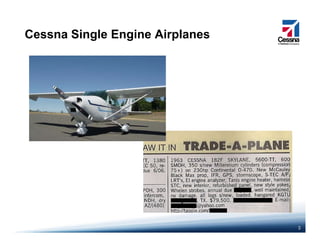
Cessna Single Engine Airplanes
3
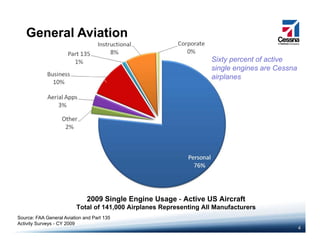
General Aviation
Sixty percent of active
single engines are Cessna
airplanesairplanes
2009 Single Engine Usage - Active US Aircraft
4
Source: FAA General Aviation and Part 135
Activity Surveys - CY 2009
2009 Single Engine Usage Active US Aircraft
Total of 141,000 Airplanes Representing All Manufacturers
Single Engine Safety Initiative
Cessna has developed a structural inspection
program to assure the continued safe operation of
single engine airplanes
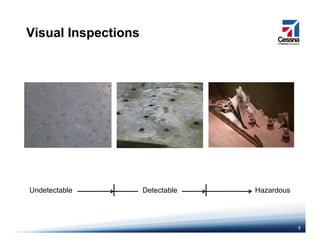
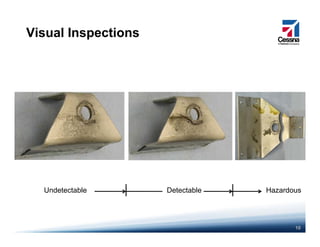
Visual inspection techniques are utilized to detect
C iCorrosion
Cracks caused by metal fatigue
5
Single Engine Safety Initiative
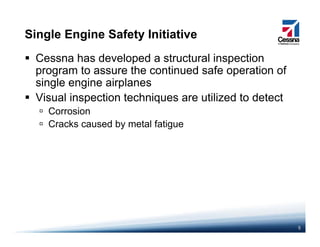
Why Inspect?
Corrosion (rust) and metal fatigue are inevitable( ) g
Corrosion and metal fatigue reduce the load
carrying capability of the airframe
Lik l i l d fLike people, airplanes age, and more frequent
and intrusive inspections are required to
maintain health (safety)
6
( y)
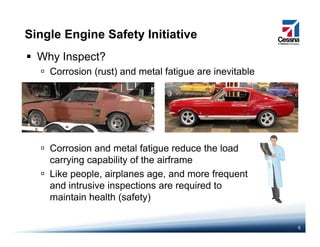
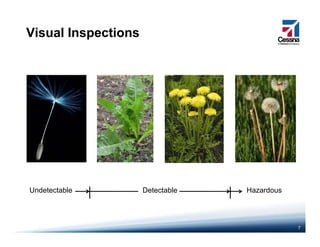
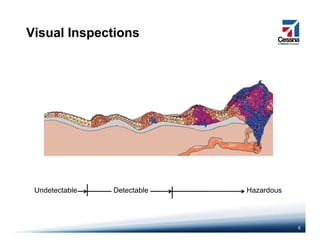
Visual Inspections
DetectableUndetectable Hazardous
7
Visual Inspections
DetectableUndetectable Hazardous
8
Visual Inspections
Undetectable HazardousDetectable
9
Visual Inspections
HazardousUndetectable Detectable
10
Single Engine Safety Initiative
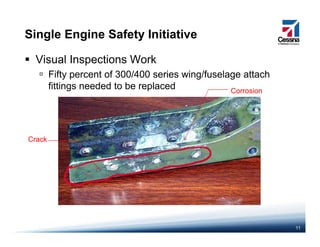
Visual Inspections Work
Fifty percent of 300/400 series wing/fuselage attachFifty percent of 300/400 series wing/fuselage attach
fittings needed to be replaced Corrosion
CrackCrack
11
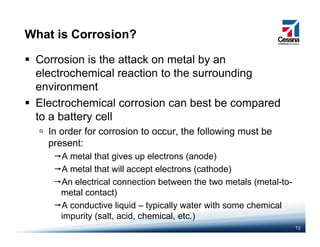
What is Corrosion?
Corrosion is the attack on metal by an
electrochemical reaction to the surroundingelectrochemical reaction to the surrounding
environment
Electrochemical corrosion can best be comparedp
to a battery cell
In order for corrosion to occur, the following must be
present:
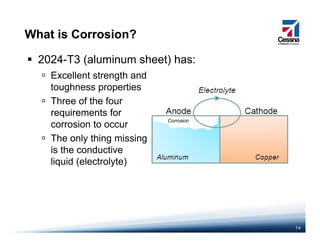
A metal that gives up electrons (anode)
A metal that will accept electrons (cathode)A metal that will accept electrons (cathode)
An electrical connection between the two metals (metal-to-
metal contact)
12
A conductive liquid – typically water with some chemical
impurity (salt, acid, chemical, etc.)
What is Corrosion?
Pure aluminum is
Highly resistant to corrosionHighly resistant to corrosion
Too soft to be used as a structural material
Thus airframes are made of various high-strengthg g
aluminum alloys
The most common aluminum alloy used in airframes is
“2024”
"2024“ is composed of 95% aluminum, 4% copper, and
small amounts of manganese and molybdenumsmall amounts of manganese and molybdenum
13
What is Corrosion?
2024-T3 (aluminum sheet) has:
Excellent strength andExcellent strength and
toughness properties
Three of the four
Corrosion
requirements for
corrosion to occur
The only thing missingThe only thing missing
is the conductive
liquid (electrolyte)
14
Corrosion Prevention
Thus, the key to corrosion prevention is to keep the
airframe free of moistureairframe free of moisture
A major contributing factor to corrosion is the
environment
Aircraft that operate in coastal environments are more
susceptible to metal corrosion
While water vapor already has a corrosive effect, the
water vapor and salt combination found in coastal
environments creates a powerful corrosive agent
Aircraft that operate in areas that contain high amounts
of industrial particles and fumes in the atmosphere also
are more susceptible to corrosion
15
are more susceptible to corrosion
Corrosion Prevention
There are several common options available to
shield the aluminum from electrolytes including:shield the aluminum from electrolytes including:
Cladding
Chemical Treatments
Sealants
Corrosion Prevention Compounds (CPCs)
16
Corrosion Prevention
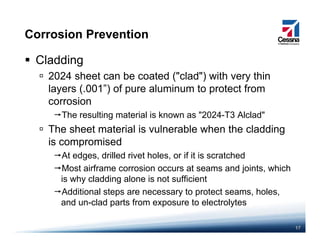
Cladding
2024 sheet can be coated ("clad") with very thin2024 sheet can be coated ( clad ) with very thin
layers (.001”) of pure aluminum to protect from
corrosion
The resulting material is known as "2024-T3 Alclad"
The sheet material is vulnerable when the cladding
i i dis compromised
At edges, drilled rivet holes, or if it is scratched
Most airframe corrosion occurs at seams and joints whichMost airframe corrosion occurs at seams and joints, which
is why cladding alone is not sufficient
Additional steps are necessary to protect seams, holes,
and un clad parts from exposure to electrolytes
17
and un-clad parts from exposure to electrolytes
Corrosion Prevention
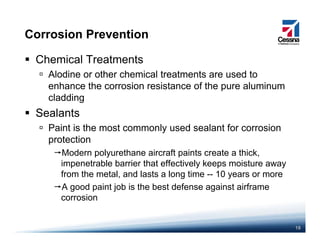
Chemical Treatments
Alodine or other chemical treatments are used toAlodine or other chemical treatments are used to
enhance the corrosion resistance of the pure aluminum
cladding
Sealants
Paint is the most commonly used sealant for corrosion
protectionprotection
Modern polyurethane aircraft paints create a thick,
impenetrable barrier that effectively keeps moisture away
from the metal, and lasts a long time -- 10 years or more
A good paint job is the best defense against airframe
corrosion
18
Corrosion Prevention
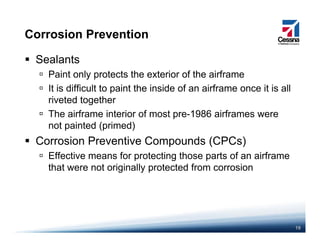
Sealants
Paint only protects the exterior of the airframePaint only protects the exterior of the airframe
It is difficult to paint the inside of an airframe once it is all
riveted together
The airframe interior of most pre-1986 airframes were
not painted (primed)
Corrosion Preventive Compounds (CPCs)Corrosion Preventive Compounds (CPCs)
Effective means for protecting those parts of an airframe
that were not originally protected from corrosionthat were not originally protected from corrosion
19
Corrosion Prevention
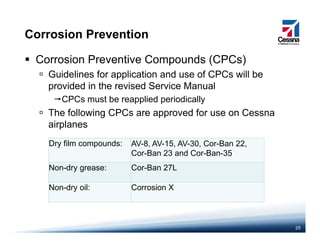
Corrosion Preventive Compounds (CPCs)
Guidelines for application and use of CPCs will beGuidelines for application and use of CPCs will be
provided in the revised Service Manual
CPCs must be reapplied periodically
The following CPCs are approved for use on Cessna
airplanes
Dry film compounds: AV-8, AV-15, AV-30, Cor-Ban 22,
Cor-Ban 23 and Cor-Ban-35
Non-dry grease: Cor-Ban 27LNon dry grease: Cor Ban 27L
Non-dry oil: Corrosion X
20
Corrosion Prevention
Continual inspections and preventative
maintenance are required to keep the airframemaintenance are required to keep the airframe
metal from corroding
Thorough rinsing and cleaning of airplane will remove
salt and other corrosive agents
Exposed areas such as the landing gear and wheel wells
need extra attention as well as any other joints gaps andneed extra attention, as well as any other joints, gaps, and
hinges where debris collects
Chipped or delaminating paint needs to be properly
t i d d d d i t dstriped or sanded and re-painted
During severe weather or wet conditions, airplanes
should be covered and sheltered
21
should be covered and sheltered
Results of Corrosion
Corrosion is responsible for approximately
7% of the airworthiness directives7% of the airworthiness directives
20% of service difficulty reports (SDRs)
Corrosion can be deadly
1
y
Corrosion contributed to 91 accidents/incidents in the
United States between 1983 and 1994
2
These and other accidents have resulted in hundreds of
fatalities
As airplanes continue to age these numbers are
3
As airplanes continue to age, these numbers are
likely to increase
S if S “R Di d” 24th ICAF S i M 2007
1
22
Hoeppner D,, Chandrasekaran V., Taylor A., “Review of Pitting Corrosion Fatigue Models”, 20th ICAF Symposium, 1999.
Aviation Safety Network Database, http://aviation-safety.net/index.php
2
3
Swift, S., “Rusty Diamond”, 24th ICAF Symposium, May 2007.
1
Corrosion and Metal Fatigue
Corrosion and metal fatigue both reduce the load
carrying capability of the airframecarrying capability of the airframe
Corrosion and fatigue are not entirely independent
processes - corrosion affects the expected fatiguep p g
life of airframe parts
Corrosion pitting creates a stress concentration which
leads to crack initiation and potentially faster crack
growth
Corrosion reduces the thickness of a part and thereforeCorrosion reduces the thickness of a part and therefore
increases the stress in the part
23
Corrosion Examples
Cabin Interior – All Models
Models 177/210 Cantilever Carry-ThruModels 177/210 Cantilever Carry-Thru
Models 177/210 Cantilever Wing Attachments
Model 200 Series ElevatorsModel 200 Series Elevators
Main Landing Gear – All Models
Strut Braced WingsStrut Braced Wings
Airframe Ribs – All Models
24
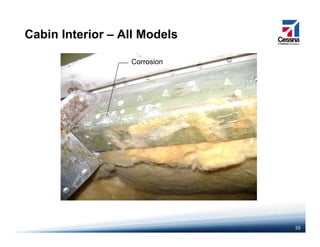
Cabin Interior – All Models
Cabin is susceptible to corrosion given that it:
May leak when it rainsMay leak when it rains
May be stored in un-insulated hangar or on the flight line
Stays warm as the airplane goes through thermal cycles
during flight
Condensation will form on the interior skin
Moisture is absorbed by insulation and upholstery materialsMoisture is absorbed by insulation and upholstery materials
Not often treated with corrosion prevention products
Headliner is not always removed during an annualy g
25
Cabin Interior – All Models
Corrosion
26
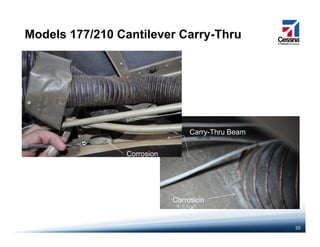
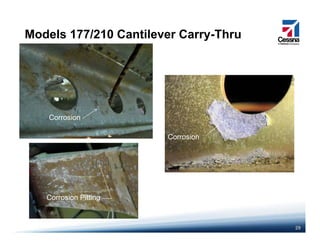
Models 177/210 Cantilever Carry-Thru
Provides the primary means of carrying wing loads
across the fuselageacross the fuselage
Made of 2014-T6 material
High strength material but is very susceptible to corrosiong g y p
Corrosion occurs when
Ducting contacts lightening holes in beam, org g g ,
Moisture accumulates on I-beam surface
Limited repairability
27
Models 177/210 Cantilever Carry-Thru
Carry-Thru Beam
Corrosion
Corrosion
28
Corrosion
Models 177/210 Cantilever Carry-Thru
Corrosion
Corrosion
Corrosion
Corrosion Pitting
29
g
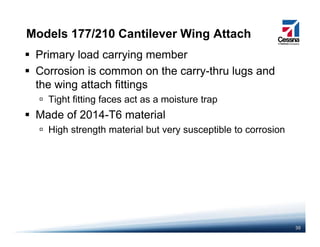
Models 177/210 Cantilever Wing Attach
Primary load carrying member
Corrosion is common on the carry-thru lugs andy g
the wing attach fittings
Tight fitting faces act as a moisture trap
Made of 2014-T6 material
High strength material but very susceptible to corrosion
30
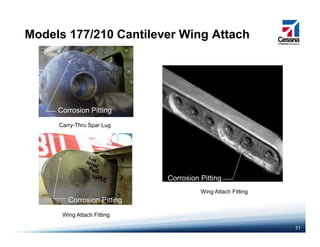
Models 177/210 Cantilever Wing Attach
C i Pitti
Carry-Thru Spar Lug
Corrosion Pitting
Wing Attach Fitting
Corrosion Pitting
Corrosion Pitting
31
Wing Attach Fitting
Corrosion Pitting
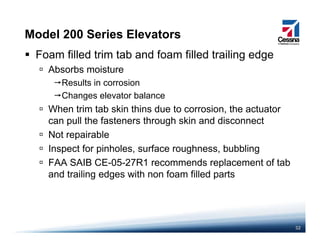
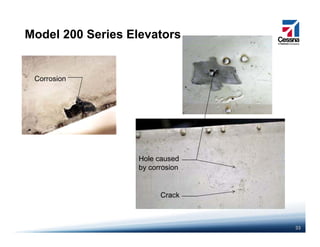
Model 200 Series Elevators
Foam filled trim tab and foam filled trailing edge
Absorbs moisture
Results in corrosion
Changes elevator balance
When trim tab skin thins due to corrosion the actuatorWhen trim tab skin thins due to corrosion, the actuator
can pull the fasteners through skin and disconnect
Not repairablep
Inspect for pinholes, surface roughness, bubbling
FAA SAIB CE-05-27R1 recommends replacement of tab
and trailing edges with non foam filled parts
32
Model 200 Series Elevators
C iCorrosion
Hole caused
by corrosiony
Crack
33
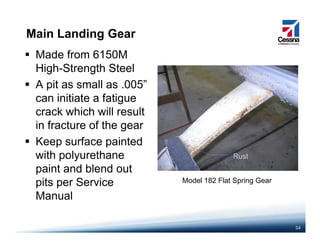
Main Landing Gear
Made from 6150M
High-Strength Steel
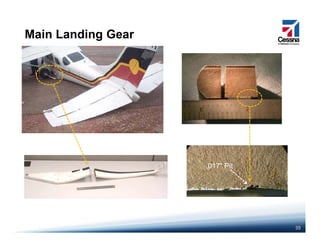
A pit as small as .005”
can initiate a fatigue
k hi h ill ltcrack which will result
in fracture of the gear
K f i t dKeep surface painted
with polyurethane
paint and blend out
Rust
paint and blend out
pits per Service
Manual
Model 182 Flat Spring Gear
34
Main Landing Gear
.017” Pit
35
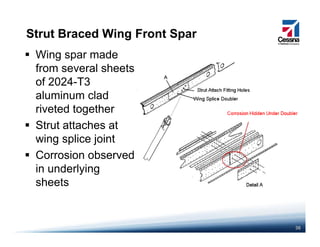
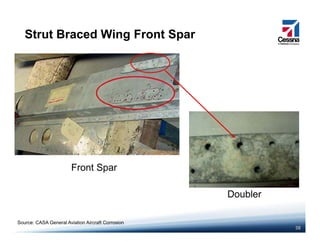
Strut Braced Wing Front Spar
Wing spar made
from several sheets
of 2024-T3
aluminum clad
riveted togetherriveted together
Strut attaches at
wing splice jointwing splice joint
Corrosion observed
in underlyingin underlying
sheets
36
Strut Braced Wing Front Spar
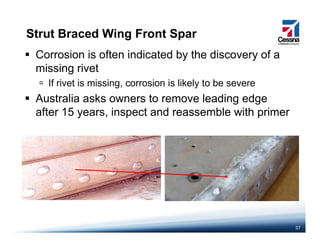
Corrosion is often indicated by the discovery of a
missing rivet
If rivet is missing, corrosion is likely to be severe
Australia asks owners to remove leading edge
f 15 i d bl i h iafter 15 years, inspect and reassemble with primer
37
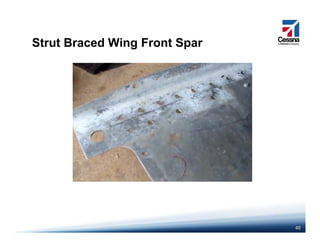
Strut Braced Wing Front Spar
Front Spar
Doubler
Front Spar
38
Source: CASA General Aviation Aircraft Corrosion
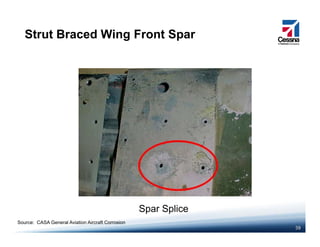
Strut Braced Wing Front Spar
39
Spar Splice
Source: CASA General Aviation Aircraft Corrosion
Strut Braced Wing Front SparStrut Braced Wing Front Spar
Front Spar
40
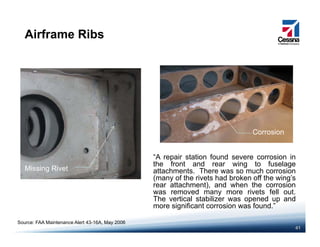
Airframe Ribs
Corrosion
“A repair station found severe corrosion in
the front and rear wing to fuselage
attachments There was so much corrosionMissing Rivet attachments. There was so much corrosion
(many of the rivets had broken off the wing’s
rear attachment), and when the corrosion
was removed many more rivets fell out.
The vertical stabilizer was opened up and
Missing Rivet
41
e e t ca stab e as ope ed up a d
more significant corrosion was found.”
Source: FAA Maintenance Alert 43-16A, May 2006
Metal Fatigue
Aviation has had to address metal fatigue in the
design and inspection of airframes since 1954design and inspection of airframes since 1954
Fatigue can be deadly
Metal fatigue contributed to 2240 deaths in 1885g
airplane accidents between 1927 and 1980
The five most common fatigue crack initiation sources in
these accidents were: (1) bolt stud or screw; (2) fastener
1
these accidents were: (1) bolt, stud or screw; (2) fastener
or other hole, (3) fillet, radius or sharp notch; (4) welds
and (5) corrosion
Over 700 people have died in fatigue related accidents
since 1980
Campbell and Lahey 1984 ‘A Survey of Serious Aircraft Accidents Involving Fatigue Fracture’ International Journal of
1
2
42
Campbell and Lahey 1984, A Survey of Serious Aircraft Accidents Involving Fatigue Fracture , International Journal of
Fatigue, January 1984
‘Investigation into Ansett Australia Maintenance Safety Deficiencies and the Control of Continuing Airworthiness of
Class A Aircraft’, Appendix 8 from the Australian Transport Safety Bureau’s web site, www.atsb.gov.au.
2
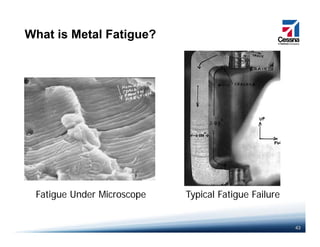
What is Metal Fatigue?
Fatigue Under Microscope Typical Fatigue Failure
43
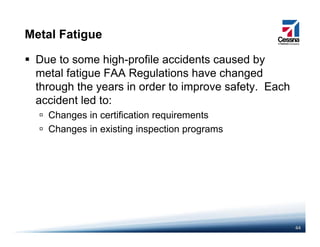
Metal Fatigue
Due to some high-profile accidents caused by
metal fatigue FAA Regulations have changedmetal fatigue FAA Regulations have changed
through the years in order to improve safety. Each
accident led to:
Changes in certification requirements
Changes in existing inspection programs
44
s
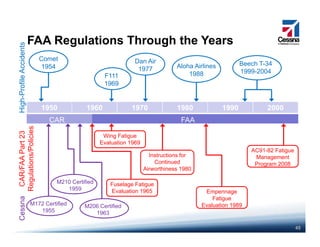
FAA Regulations Through the Years
Aloha Airlines
1988
Dan Air
1977
F111
Beech T-34
1999-2004
eAccident
Comet
1954
g g
F111
1969
igh-Profile
1950 1960 1970 1980 1990 2000
H23
cies
Wing Fatigue
1950 1960 1970 1980 1990 2000
CAR FAA
/FAAPart
ations/Poli
Evaluation 1969
Instructions for
Continued
Airworthiness 1980
AC91-82 Fatigue
Management
Program 2008
naCAR/
Regula
Fuselage Fatigue
Evaluation 1965
Airworthiness 1980
Empennage
Fatigue
M210 Certified
1959
45
M172 Certified
1955
M206 Certified
1963
Cessn
g
Evaluation 1989
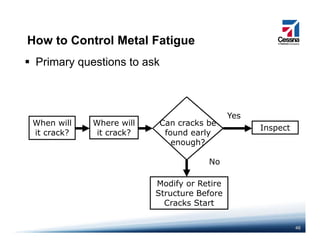
How to Control Metal Fatigueg
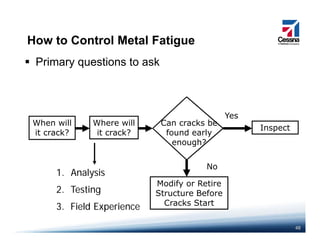
Primary questions to ask
When will
it crack?
Where will
it crack?
Can cracks be
found early
h
Inspect
Yes
enough?
No
Modify or Retire
Structure Before
Cracks Start
46
Cracks Start
How to Control Metal FatigueHow to Control Metal Fatigue
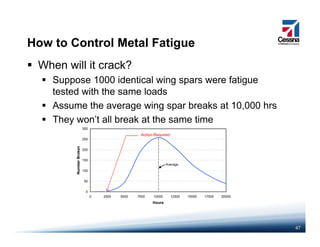
When will it crack?
S 1000 id ti l i f tiSuppose 1000 identical wing spars were fatigue
tested with the same loads
Assume the average wing spar breaks at 10,000 hrsAssume the average wing spar breaks at 10,000 hrs
They won’t all break at the same time
250
300
Action Required
100
150
200
250
umberBroken
Average
0
50
100
0 2500 5000 7500 10000 12500 15000 17500 20000
H
Nu
47
Hours
How to Control Metal Fatigueg
Primary questions to ask
Where will
it crack?
Can cracks be
found early
h
Inspect
Yes
When will
it crack?
enough?
1 A l i
No
Modify or Retire
Structure Before
Cracks Start
1. Analysis
2. Testing
48
Cracks Start
3. Field Experience
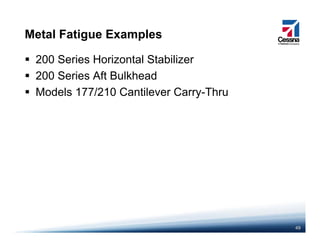
Metal Fatigue Examples
200 Series Horizontal Stabilizer
200 Series Aft Bulkhead200 Series Aft Bulkhead
Models 177/210 Cantilever Carry-Thru
49
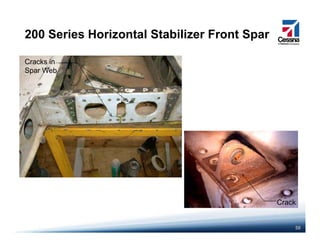
200 Series Horizontal Stabilizer Front Spar
Cracks in
Spar Web
Crack
50
Crack
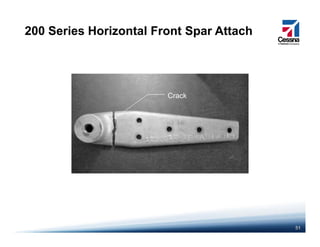
200 Series Horizontal Front Spar Attach
Crack
51
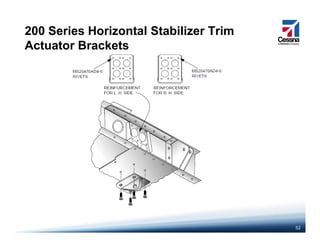
200 Series Horizontal Stabilizer Trim
Actuator BracketsActuator Brackets
52
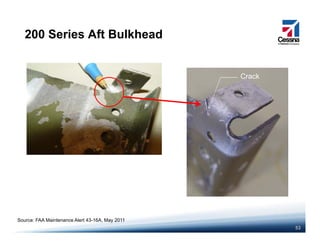
200 Series Aft Bulkhead
CrackCrack
53
Source: FAA Maintenance Alert 43-16A, May 2011
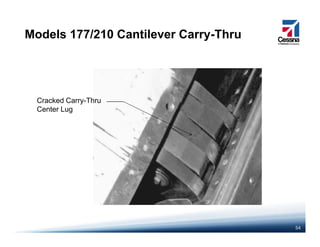
Models 177/210 Cantilever Carry-Thru
Cracked Carry-Thru
Center L gCenter Lug
54
Inspection Program Details
Inspections
Based on field historyBased on field history
Reviewed by customer focus group
Inspection Detailsp
Corrosion prevention and control program
Directed visual inspections for corrosion completed during
annual
~15-20 visual inspections to inspect for cracks
Borescope and magnifying glass required to completeBorescope and magnifying glass required to complete
inspections
~5 inspections based on existing service bulletins
55
Inspection Program Details
Specialized NDI techniques required
When corrosion is foundWhen corrosion is found
When cracking is suspected
When required by existing service bulletin
For high time airplanes (12,000+ hours) or severe usage
airplanes (6,000+ hours)
Si l E i NDI i i i il blSingle Engine NDI training program is available
Developed and taught by National Center for Aviation
Training (NCAT)Training (NCAT)
56
Single Engine NDI training program
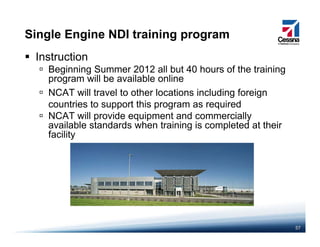
Instruction
Beginning Summer 2012 all but 40 hours of the training
program ill be a ailable onlineprogram will be available online
NCAT will travel to other locations including foreign
countries to support this program as requiredpp p g q
NCAT will provide equipment and commercially
available standards when training is completed at their
facilityy
57
NDI Training Program
Minimum Classroom Training Requirements -
some requirements may be completed on-linesome requirements may be completed on line
Penetrant Inspection (16 hours)
Magnetic Particle Testing (16 hours)
Eddy Current (40 hours)
Ultrasonic Testing (40 hours)
(NCAT will review a reduced training syllabus for UT when
direct reading thickness gauging)
Completion of training will qualify individual toCompletion of training will qualify individual to
perform NDI inspections on Cessna single engine
airplanes
58
Equivalent of a level 1 NDI technician
Inspection Program Availability
Revised inspection program will be published
in the airplane service manual
200 Series airplanes – November 2011
100 Series airplanes – April 2012
Compliance Date
200 Series airplanes – December 2013
100 Series airplanes June 2014100 Series airplanes – June 2014
59
Conclusion
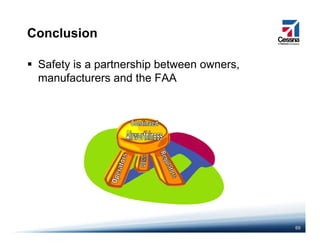
Safety is a partnership between owners,
manufacturers and the FAAmanufacturers and the FAA
60
Conclusion
Report anomalies to the manufacturer customer
serviceservice
Corrosion
Cracks in major structural elements
S t iSuspect repairs
Send pictures!!
61

Cessna single engine safety initiative

  • 1.
    Cessna Single EngineSafety InitiativeCessna Single Engine Safety Initiative 1
  • 2.
    Cessna Single EngineAirplanes 145,000 produced between 1946-1986 Average age is 42 years oldAverage age is 42 years old Certified CAR 3 Made of aluminumMade of aluminum Flown 100-150 hours annually 2
  • 3.
  • 4.
    General Aviation Sixty percentof active single engines are Cessna airplanesairplanes 2009 Single Engine Usage - Active US Aircraft 4 Source: FAA General Aviation and Part 135 Activity Surveys - CY 2009 2009 Single Engine Usage Active US Aircraft Total of 141,000 Airplanes Representing All Manufacturers
  • 5.
    Single Engine SafetyInitiative Cessna has developed a structural inspection program to assure the continued safe operation of single engine airplanes Visual inspection techniques are utilized to detect C iCorrosion Cracks caused by metal fatigue 5
  • 6.
    Single Engine SafetyInitiative Why Inspect? Corrosion (rust) and metal fatigue are inevitable( ) g Corrosion and metal fatigue reduce the load carrying capability of the airframe Lik l i l d fLike people, airplanes age, and more frequent and intrusive inspections are required to maintain health (safety) 6 ( y)
  • 7.
  • 8.
  • 9.
  • 10.
  • 11.
    Single Engine SafetyInitiative Visual Inspections Work Fifty percent of 300/400 series wing/fuselage attachFifty percent of 300/400 series wing/fuselage attach fittings needed to be replaced Corrosion CrackCrack 11
  • 12.
    What is Corrosion? Corrosionis the attack on metal by an electrochemical reaction to the surroundingelectrochemical reaction to the surrounding environment Electrochemical corrosion can best be comparedp to a battery cell In order for corrosion to occur, the following must be present: A metal that gives up electrons (anode) A metal that will accept electrons (cathode)A metal that will accept electrons (cathode) An electrical connection between the two metals (metal-to- metal contact) 12 A conductive liquid – typically water with some chemical impurity (salt, acid, chemical, etc.)
  • 13.
    What is Corrosion? Purealuminum is Highly resistant to corrosionHighly resistant to corrosion Too soft to be used as a structural material Thus airframes are made of various high-strengthg g aluminum alloys The most common aluminum alloy used in airframes is “2024” "2024“ is composed of 95% aluminum, 4% copper, and small amounts of manganese and molybdenumsmall amounts of manganese and molybdenum 13
  • 14.
    What is Corrosion? 2024-T3(aluminum sheet) has: Excellent strength andExcellent strength and toughness properties Three of the four Corrosion requirements for corrosion to occur The only thing missingThe only thing missing is the conductive liquid (electrolyte) 14
  • 15.
    Corrosion Prevention Thus, thekey to corrosion prevention is to keep the airframe free of moistureairframe free of moisture A major contributing factor to corrosion is the environment Aircraft that operate in coastal environments are more susceptible to metal corrosion While water vapor already has a corrosive effect, the water vapor and salt combination found in coastal environments creates a powerful corrosive agent Aircraft that operate in areas that contain high amounts of industrial particles and fumes in the atmosphere also are more susceptible to corrosion 15 are more susceptible to corrosion
  • 16.
    Corrosion Prevention There areseveral common options available to shield the aluminum from electrolytes including:shield the aluminum from electrolytes including: Cladding Chemical Treatments Sealants Corrosion Prevention Compounds (CPCs) 16
  • 17.
    Corrosion Prevention Cladding 2024 sheetcan be coated ("clad") with very thin2024 sheet can be coated ( clad ) with very thin layers (.001”) of pure aluminum to protect from corrosion The resulting material is known as "2024-T3 Alclad" The sheet material is vulnerable when the cladding i i dis compromised At edges, drilled rivet holes, or if it is scratched Most airframe corrosion occurs at seams and joints whichMost airframe corrosion occurs at seams and joints, which is why cladding alone is not sufficient Additional steps are necessary to protect seams, holes, and un clad parts from exposure to electrolytes 17 and un-clad parts from exposure to electrolytes
  • 18.
    Corrosion Prevention Chemical Treatments Alodineor other chemical treatments are used toAlodine or other chemical treatments are used to enhance the corrosion resistance of the pure aluminum cladding Sealants Paint is the most commonly used sealant for corrosion protectionprotection Modern polyurethane aircraft paints create a thick, impenetrable barrier that effectively keeps moisture away from the metal, and lasts a long time -- 10 years or more A good paint job is the best defense against airframe corrosion 18
  • 19.
    Corrosion Prevention Sealants Paint onlyprotects the exterior of the airframePaint only protects the exterior of the airframe It is difficult to paint the inside of an airframe once it is all riveted together The airframe interior of most pre-1986 airframes were not painted (primed) Corrosion Preventive Compounds (CPCs)Corrosion Preventive Compounds (CPCs) Effective means for protecting those parts of an airframe that were not originally protected from corrosionthat were not originally protected from corrosion 19
  • 20.
    Corrosion Prevention Corrosion PreventiveCompounds (CPCs) Guidelines for application and use of CPCs will beGuidelines for application and use of CPCs will be provided in the revised Service Manual CPCs must be reapplied periodically The following CPCs are approved for use on Cessna airplanes Dry film compounds: AV-8, AV-15, AV-30, Cor-Ban 22, Cor-Ban 23 and Cor-Ban-35 Non-dry grease: Cor-Ban 27LNon dry grease: Cor Ban 27L Non-dry oil: Corrosion X 20
  • 21.
    Corrosion Prevention Continual inspectionsand preventative maintenance are required to keep the airframemaintenance are required to keep the airframe metal from corroding Thorough rinsing and cleaning of airplane will remove salt and other corrosive agents Exposed areas such as the landing gear and wheel wells need extra attention as well as any other joints gaps andneed extra attention, as well as any other joints, gaps, and hinges where debris collects Chipped or delaminating paint needs to be properly t i d d d d i t dstriped or sanded and re-painted During severe weather or wet conditions, airplanes should be covered and sheltered 21 should be covered and sheltered
  • 22.
    Results of Corrosion Corrosionis responsible for approximately 7% of the airworthiness directives7% of the airworthiness directives 20% of service difficulty reports (SDRs) Corrosion can be deadly 1 y Corrosion contributed to 91 accidents/incidents in the United States between 1983 and 1994 2 These and other accidents have resulted in hundreds of fatalities As airplanes continue to age these numbers are 3 As airplanes continue to age, these numbers are likely to increase S if S “R Di d” 24th ICAF S i M 2007 1 22 Hoeppner D,, Chandrasekaran V., Taylor A., “Review of Pitting Corrosion Fatigue Models”, 20th ICAF Symposium, 1999. Aviation Safety Network Database, http://aviation-safety.net/index.php 2 3 Swift, S., “Rusty Diamond”, 24th ICAF Symposium, May 2007. 1
  • 23.
    Corrosion and MetalFatigue Corrosion and metal fatigue both reduce the load carrying capability of the airframecarrying capability of the airframe Corrosion and fatigue are not entirely independent processes - corrosion affects the expected fatiguep p g life of airframe parts Corrosion pitting creates a stress concentration which leads to crack initiation and potentially faster crack growth Corrosion reduces the thickness of a part and thereforeCorrosion reduces the thickness of a part and therefore increases the stress in the part 23
  • 24.
    Corrosion Examples Cabin Interior– All Models Models 177/210 Cantilever Carry-ThruModels 177/210 Cantilever Carry-Thru Models 177/210 Cantilever Wing Attachments Model 200 Series ElevatorsModel 200 Series Elevators Main Landing Gear – All Models Strut Braced WingsStrut Braced Wings Airframe Ribs – All Models 24
  • 25.
    Cabin Interior –All Models Cabin is susceptible to corrosion given that it: May leak when it rainsMay leak when it rains May be stored in un-insulated hangar or on the flight line Stays warm as the airplane goes through thermal cycles during flight Condensation will form on the interior skin Moisture is absorbed by insulation and upholstery materialsMoisture is absorbed by insulation and upholstery materials Not often treated with corrosion prevention products Headliner is not always removed during an annualy g 25
  • 26.
    Cabin Interior –All Models Corrosion 26
  • 27.
    Models 177/210 CantileverCarry-Thru Provides the primary means of carrying wing loads across the fuselageacross the fuselage Made of 2014-T6 material High strength material but is very susceptible to corrosiong g y p Corrosion occurs when Ducting contacts lightening holes in beam, org g g , Moisture accumulates on I-beam surface Limited repairability 27
  • 28.
    Models 177/210 CantileverCarry-Thru Carry-Thru Beam Corrosion Corrosion 28 Corrosion
  • 29.
    Models 177/210 CantileverCarry-Thru Corrosion Corrosion Corrosion Corrosion Pitting 29 g
  • 30.
    Models 177/210 CantileverWing Attach Primary load carrying member Corrosion is common on the carry-thru lugs andy g the wing attach fittings Tight fitting faces act as a moisture trap Made of 2014-T6 material High strength material but very susceptible to corrosion 30
  • 31.
    Models 177/210 CantileverWing Attach C i Pitti Carry-Thru Spar Lug Corrosion Pitting Wing Attach Fitting Corrosion Pitting Corrosion Pitting 31 Wing Attach Fitting Corrosion Pitting
  • 32.
    Model 200 SeriesElevators Foam filled trim tab and foam filled trailing edge Absorbs moisture Results in corrosion Changes elevator balance When trim tab skin thins due to corrosion the actuatorWhen trim tab skin thins due to corrosion, the actuator can pull the fasteners through skin and disconnect Not repairablep Inspect for pinholes, surface roughness, bubbling FAA SAIB CE-05-27R1 recommends replacement of tab and trailing edges with non foam filled parts 32
  • 33.
    Model 200 SeriesElevators C iCorrosion Hole caused by corrosiony Crack 33
  • 34.
    Main Landing Gear Madefrom 6150M High-Strength Steel A pit as small as .005” can initiate a fatigue k hi h ill ltcrack which will result in fracture of the gear K f i t dKeep surface painted with polyurethane paint and blend out Rust paint and blend out pits per Service Manual Model 182 Flat Spring Gear 34
  • 35.
  • 36.
    Strut Braced WingFront Spar Wing spar made from several sheets of 2024-T3 aluminum clad riveted togetherriveted together Strut attaches at wing splice jointwing splice joint Corrosion observed in underlyingin underlying sheets 36
  • 37.
    Strut Braced WingFront Spar Corrosion is often indicated by the discovery of a missing rivet If rivet is missing, corrosion is likely to be severe Australia asks owners to remove leading edge f 15 i d bl i h iafter 15 years, inspect and reassemble with primer 37
  • 38.
    Strut Braced WingFront Spar Front Spar Doubler Front Spar 38 Source: CASA General Aviation Aircraft Corrosion
  • 39.
    Strut Braced WingFront Spar 39 Spar Splice Source: CASA General Aviation Aircraft Corrosion
  • 40.
    Strut Braced WingFront SparStrut Braced Wing Front Spar Front Spar 40
  • 41.
    Airframe Ribs Corrosion “A repairstation found severe corrosion in the front and rear wing to fuselage attachments There was so much corrosionMissing Rivet attachments. There was so much corrosion (many of the rivets had broken off the wing’s rear attachment), and when the corrosion was removed many more rivets fell out. The vertical stabilizer was opened up and Missing Rivet 41 e e t ca stab e as ope ed up a d more significant corrosion was found.” Source: FAA Maintenance Alert 43-16A, May 2006
  • 42.
    Metal Fatigue Aviation hashad to address metal fatigue in the design and inspection of airframes since 1954design and inspection of airframes since 1954 Fatigue can be deadly Metal fatigue contributed to 2240 deaths in 1885g airplane accidents between 1927 and 1980 The five most common fatigue crack initiation sources in these accidents were: (1) bolt stud or screw; (2) fastener 1 these accidents were: (1) bolt, stud or screw; (2) fastener or other hole, (3) fillet, radius or sharp notch; (4) welds and (5) corrosion Over 700 people have died in fatigue related accidents since 1980 Campbell and Lahey 1984 ‘A Survey of Serious Aircraft Accidents Involving Fatigue Fracture’ International Journal of 1 2 42 Campbell and Lahey 1984, A Survey of Serious Aircraft Accidents Involving Fatigue Fracture , International Journal of Fatigue, January 1984 ‘Investigation into Ansett Australia Maintenance Safety Deficiencies and the Control of Continuing Airworthiness of Class A Aircraft’, Appendix 8 from the Australian Transport Safety Bureau’s web site, www.atsb.gov.au. 2
  • 43.
    What is MetalFatigue? Fatigue Under Microscope Typical Fatigue Failure 43
  • 44.
    Metal Fatigue Due tosome high-profile accidents caused by metal fatigue FAA Regulations have changedmetal fatigue FAA Regulations have changed through the years in order to improve safety. Each accident led to: Changes in certification requirements Changes in existing inspection programs 44
  • 45.
    s FAA Regulations Throughthe Years Aloha Airlines 1988 Dan Air 1977 F111 Beech T-34 1999-2004 eAccident Comet 1954 g g F111 1969 igh-Profile 1950 1960 1970 1980 1990 2000 H23 cies Wing Fatigue 1950 1960 1970 1980 1990 2000 CAR FAA /FAAPart ations/Poli Evaluation 1969 Instructions for Continued Airworthiness 1980 AC91-82 Fatigue Management Program 2008 naCAR/ Regula Fuselage Fatigue Evaluation 1965 Airworthiness 1980 Empennage Fatigue M210 Certified 1959 45 M172 Certified 1955 M206 Certified 1963 Cessn g Evaluation 1989
  • 46.
    How to ControlMetal Fatigueg Primary questions to ask When will it crack? Where will it crack? Can cracks be found early h Inspect Yes enough? No Modify or Retire Structure Before Cracks Start 46 Cracks Start
  • 47.
    How to ControlMetal FatigueHow to Control Metal Fatigue When will it crack? S 1000 id ti l i f tiSuppose 1000 identical wing spars were fatigue tested with the same loads Assume the average wing spar breaks at 10,000 hrsAssume the average wing spar breaks at 10,000 hrs They won’t all break at the same time 250 300 Action Required 100 150 200 250 umberBroken Average 0 50 100 0 2500 5000 7500 10000 12500 15000 17500 20000 H Nu 47 Hours
  • 48.
    How to ControlMetal Fatigueg Primary questions to ask Where will it crack? Can cracks be found early h Inspect Yes When will it crack? enough? 1 A l i No Modify or Retire Structure Before Cracks Start 1. Analysis 2. Testing 48 Cracks Start 3. Field Experience
  • 49.
    Metal Fatigue Examples 200Series Horizontal Stabilizer 200 Series Aft Bulkhead200 Series Aft Bulkhead Models 177/210 Cantilever Carry-Thru 49
  • 50.
    200 Series HorizontalStabilizer Front Spar Cracks in Spar Web Crack 50 Crack
  • 51.
    200 Series HorizontalFront Spar Attach Crack 51
  • 52.
    200 Series HorizontalStabilizer Trim Actuator BracketsActuator Brackets 52
  • 53.
    200 Series AftBulkhead CrackCrack 53 Source: FAA Maintenance Alert 43-16A, May 2011
  • 54.
    Models 177/210 CantileverCarry-Thru Cracked Carry-Thru Center L gCenter Lug 54
  • 55.
    Inspection Program Details Inspections Basedon field historyBased on field history Reviewed by customer focus group Inspection Detailsp Corrosion prevention and control program Directed visual inspections for corrosion completed during annual ~15-20 visual inspections to inspect for cracks Borescope and magnifying glass required to completeBorescope and magnifying glass required to complete inspections ~5 inspections based on existing service bulletins 55
  • 56.
    Inspection Program Details SpecializedNDI techniques required When corrosion is foundWhen corrosion is found When cracking is suspected When required by existing service bulletin For high time airplanes (12,000+ hours) or severe usage airplanes (6,000+ hours) Si l E i NDI i i i il blSingle Engine NDI training program is available Developed and taught by National Center for Aviation Training (NCAT)Training (NCAT) 56
  • 57.
    Single Engine NDItraining program Instruction Beginning Summer 2012 all but 40 hours of the training program ill be a ailable onlineprogram will be available online NCAT will travel to other locations including foreign countries to support this program as requiredpp p g q NCAT will provide equipment and commercially available standards when training is completed at their facilityy 57
  • 58.
    NDI Training Program MinimumClassroom Training Requirements - some requirements may be completed on-linesome requirements may be completed on line Penetrant Inspection (16 hours) Magnetic Particle Testing (16 hours) Eddy Current (40 hours) Ultrasonic Testing (40 hours) (NCAT will review a reduced training syllabus for UT when direct reading thickness gauging) Completion of training will qualify individual toCompletion of training will qualify individual to perform NDI inspections on Cessna single engine airplanes 58 Equivalent of a level 1 NDI technician
  • 59.
    Inspection Program Availability Revisedinspection program will be published in the airplane service manual 200 Series airplanes – November 2011 100 Series airplanes – April 2012 Compliance Date 200 Series airplanes – December 2013 100 Series airplanes June 2014100 Series airplanes – June 2014 59
  • 60.
    Conclusion Safety is apartnership between owners, manufacturers and the FAAmanufacturers and the FAA 60
  • 61.
    Conclusion Report anomalies tothe manufacturer customer serviceservice Corrosion Cracks in major structural elements S t iSuspect repairs Send pictures!! 61