ASSESS SELECTED
COMMUNITY
ACTION
INITIATIVES
(LESSON 3 – WEEK 3)
COMMUNITY ENGAGEMENT SOLIDARITY
AND CITIZENSHIP
1. Explain different assessing tools.
2. Differentiate Short-Term and
Long-Term
Community Activity
3. Assess community activity related
to
core values of community action
initiatives.
OBJECTIVES:
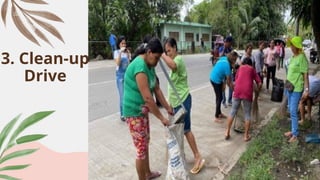
Identify wether the pictures are
short-term or long-term community
activity.
1. Feeding
Program
2. Tree Planting
3. Clean-up
Drive
4. Disaster
Manageme
nt
Before we conduct community Action Initiatives we should be able to assess, kailangan nating
malaman, ma-asses ng maayos, kung ano nga ba yung ipu-put up nating community action initiative
sa ating lipunan..
 CAI were created to support community
-led projects that help community to go
for a change and build character.
 In CAI, citizens take a leading role in pr
viding public services and goods.
CAI aims for social
environmental and
sometimes political change
that will help its stakeholders
to grow and have an ease in
living their lives.
- Ito ay naglalayon na mapaganda
or matulungan ang social
description and even the
environmental description or
character and or of course
sometimes ang political character
ng isang society and bilang
stakeholders ng community
Nararapat lamang na makita natin na
merong growing na nangyayari na
merong productive growing na
nangyayari at nagiging ease,nagiging
maayos,nagiging madali ang
pamumuhay ng mga mamamayan sa
isang community.
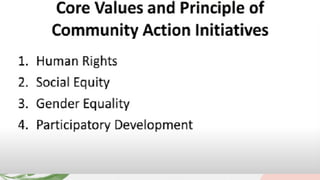
CAI should consider the “CORE
VALUES”(guiding principles) and
various methodologies and
approaches in planning and ma-
king community action plan.
To implement and identify the
success of the project or
activity we need to assess
using different tools and
determining the characteristics
of the project.
ESSENCE OF ASSESSING
COMMUNITY ACTION
INITIATIVES
To know and identify current and
immediate needs or situations of the
community.
Validate the current and immediate
needs or situations of the community.
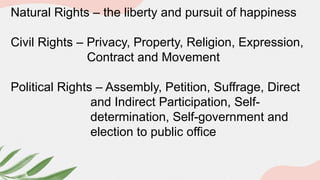
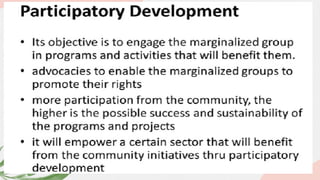
Natural Rights – the liberty and pursuit of happiness
Civil Rights – Privacy, Property, Religion, Expression,
Contract and Movement
Political Rights – Assembly, Petition, Suffrage, Direct
and Indirect Participation, Self-
determination, Self-government and
election to public office
DIFFERENCES BETWEEN SHORT-
TERM AND LONG-TERM
PROJECTS
Short-term projects – take a few hours,
days, or weeks to complete.
Long-term projects – take months or even
years to finish.
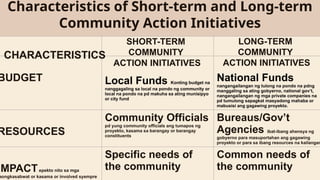
Characteristics of Short-term and Long-term
Community Action Initiatives
BUDGET Local Funds Konting budget na
nanggagaling sa local na pondo ng community or
local na pondo na pd makuha sa ating munisipyo
or city fund
National Funds
nangangailangan ng tulong na pondo na pdng
manggaling sa ating gobyerno, national gov’t,
nangangailangan ng mga private companies na
pd tumulong sapagkat masyadong mahaba or
mabusisi ang gagawing proyekto.
RESOURCES
Community Officials
pd yung community officials ang tumapos ng
proyekto, kasama sa barangay or barangay
constituents
Bureaus/Gov’t
Agencies ibat-ibang ahensya ng
gobyerno para masuportahan ang gagawing
proyekto or para sa ibang resources na kailangan
IMPACTepekto nito sa mga
aongkasabwat or kasama or involved syempre
Specific needs of
the community
Common needs of
the community
CHARACTERISTICS
SHORT-TERM
COMMUNITY
ACTION INITIATIVES
LONG-TERM
COMMUNITY
ACTION INITIATIVES
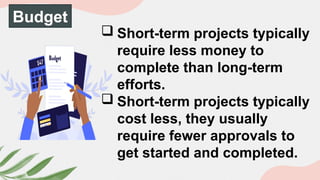
Budget
 Short-term projects typically
require less money to
complete than long-term
efforts.
 Short-term projects typically
cost less, they usually
require fewer approvals to
get started and completed.
 Short term project leaders may
simply keep track of expendi-
tures in a spreadsheet, while,
larger, more complex projects
may require the use of more
sophisticated accounting soft-
ware packages to track and
monitor forecasting and
spending.
Resources
 Short-term projects typically depends on
the type of product or service being
developed. Mas kokonti yung project kokonti ang pangangailangang tao na kailangan para ma-complete yung
project.
 Large, complicated development projects
typically require numerous resources over
the course of the project life cycle to
initiate, plan, execute, control and close the
project.
Impact
Short-term projects typically have
limited impact. You may initiate a
project to handle a specific
problem or react to a situation.
Once the problem is solved, the
problem team disbands.
DIFFERENT
ASSESSING TOOL
(INTERVIEW AND
SURVEY)
1. INTERVIEW – one-on-one conversa-
tions between a facili-
tator (the interviewer)
and a community
stakeholder (the res-
pondent). Interviews
allow you to gain a
deeper understanding
of respondent’s ideas and feelings.
Advantages of Using Interview
 Allows the facilitator to follow the flow
of conversation and ask spontaneous
questions.
 Encourages the respondent to speak
freely and give spontaneous answers.
 Most accurate and thorough way to
obtain qualitative data from your res-
pendents.
 Effective in illiterate population.
2. SURVEY - This is a popular method of
collecting information and
opinions. In the context of
a community assessment,
a survey can reveal the
community’s percieved
strengths, assets, weak-
nesses and needs.
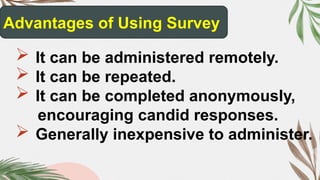
Advantages of Using Survey
 It can be administered remotely.
 It can be repeated.
 It can be completed anonymously,
encouraging candid responses.
 Generally inexpensive to administer.
Challenges of Using Survey
 Identifying prospective respondents
and obtaining their personal contact
can be difficult.
 Emailed surveys are ineffective in
places where internet access is limited
 Phone surveys may be subject to
sample or interviewer bias.
THANK YOU!!!
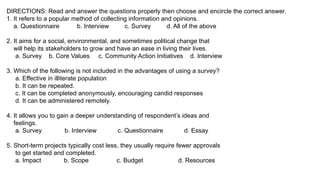
DIRECTIONS: Read and answer the questions properly then choose and encircle the correct answer.
1. It refers to a popular method of collecting information and opinions.
a. Questionnaire b. Interview c. Survey d. All of the above
2. It aims for a social, environmental, and sometimes political change that
will help its stakeholders to grow and have an ease in living their lives.
a. Survey b. Core Values c. Community Action Initiatives d. Interview
3. Which of the following is not included in the advantages of using a survey?
a. Effective in illiterate population
b. It can be repeated.
c. It can be completed anonymously, encouraging candid responses
d. It can be administered remotely.
4. It allows you to gain a deeper understanding of respondent’s ideas and
feelings.
a. Survey b. Interview c. Questionnaire d. Essay
5. Short-term projects typically cost less, they usually require fewer approvals
to get started and completed.
a. Impact b. Scope c. Budget d. Resources
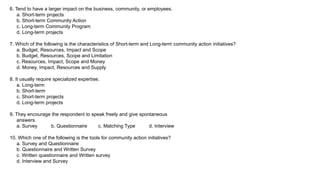
6. Tend to have a larger impact on the business, community, or employees.
a. Short-term projects
b. Short-term Community Action
c. Long-term Community Program
d. Long-term projects
7. Which of the following is the characteristics of Short-term and Long-term community action initiatives?
a. Budget, Resources, Impact and Scope
b. Budget, Resources, Scope and Limitation
c. Resources, Impact, Scope and Money
d. Money, Impact, Resources and Supply
8. It usually require specialized expertise.
a. Long-term
b. Short-term
c. Short-term projects
d. Long-term projects
9. They encourage the respondent to speak freely and give spontaneous
answers.
a. Survey b. Questionnaire c. Matching Type d. Interview
10. Which one of the following is the tools for community action initiatives?
a. Survey and Questionnaire
b. Questionnaire and Written Survey
c. Written questionnaire and Written survey
d. Interview and Survey
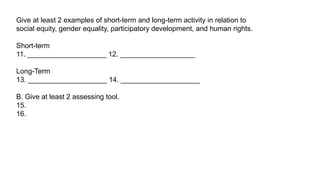
Give at least 2 examples of short-term and long-term activity in relation to
social equity, gender equality, participatory development, and human rights.
Short-term
11. ____________________ 12. ___________________
Long-Term
13. ____________________ 14. ____________________
B. Give at least 2 assessing tool.
15.
16.
Direction: True or False. Read the statement carefully. Write TRUE if the statement is correct and FALSE
if the statement is incorrect.
17. Community action initiative aims to change and innovate the needs of individuals and families
experiencing mental health and/or substance use challenges
18. Interviews are one-on-one conversations between a facilitator (the interviewer) and a
community
stakeholder (the respondent).
19. Feeding Program is a long- term activity.
20. Clean up drive is a short-term activity

CESC.differentiate a trend from a fad ex

  • 2.
    ASSESS SELECTED COMMUNITY ACTION INITIATIVES (LESSON 3– WEEK 3) COMMUNITY ENGAGEMENT SOLIDARITY AND CITIZENSHIP
  • 3.
    1. Explain differentassessing tools. 2. Differentiate Short-Term and Long-Term Community Activity 3. Assess community activity related to core values of community action initiatives. OBJECTIVES:
  • 4.
    Identify wether thepictures are short-term or long-term community activity. 1. Feeding Program
  • 5.
  • 6.
  • 7.
  • 8.
    Before we conductcommunity Action Initiatives we should be able to assess, kailangan nating malaman, ma-asses ng maayos, kung ano nga ba yung ipu-put up nating community action initiative sa ating lipunan..
  • 9.
     CAI werecreated to support community -led projects that help community to go for a change and build character.  In CAI, citizens take a leading role in pr viding public services and goods.
  • 10.
    CAI aims forsocial environmental and sometimes political change that will help its stakeholders to grow and have an ease in living their lives.
  • 11.
    - Ito aynaglalayon na mapaganda or matulungan ang social description and even the environmental description or character and or of course sometimes ang political character ng isang society and bilang stakeholders ng community
  • 12.
    Nararapat lamang namakita natin na merong growing na nangyayari na merong productive growing na nangyayari at nagiging ease,nagiging maayos,nagiging madali ang pamumuhay ng mga mamamayan sa isang community.
  • 13.
    CAI should considerthe “CORE VALUES”(guiding principles) and various methodologies and approaches in planning and ma- king community action plan.
  • 15.
    To implement andidentify the success of the project or activity we need to assess using different tools and determining the characteristics of the project.
  • 16.
    ESSENCE OF ASSESSING COMMUNITYACTION INITIATIVES To know and identify current and immediate needs or situations of the community. Validate the current and immediate needs or situations of the community.
  • 19.
    Natural Rights –the liberty and pursuit of happiness Civil Rights – Privacy, Property, Religion, Expression, Contract and Movement Political Rights – Assembly, Petition, Suffrage, Direct and Indirect Participation, Self- determination, Self-government and election to public office
  • 26.
    DIFFERENCES BETWEEN SHORT- TERMAND LONG-TERM PROJECTS Short-term projects – take a few hours, days, or weeks to complete. Long-term projects – take months or even years to finish.
  • 27.
    Characteristics of Short-termand Long-term Community Action Initiatives BUDGET Local Funds Konting budget na nanggagaling sa local na pondo ng community or local na pondo na pd makuha sa ating munisipyo or city fund National Funds nangangailangan ng tulong na pondo na pdng manggaling sa ating gobyerno, national gov’t, nangangailangan ng mga private companies na pd tumulong sapagkat masyadong mahaba or mabusisi ang gagawing proyekto. RESOURCES Community Officials pd yung community officials ang tumapos ng proyekto, kasama sa barangay or barangay constituents Bureaus/Gov’t Agencies ibat-ibang ahensya ng gobyerno para masuportahan ang gagawing proyekto or para sa ibang resources na kailangan IMPACTepekto nito sa mga aongkasabwat or kasama or involved syempre Specific needs of the community Common needs of the community CHARACTERISTICS SHORT-TERM COMMUNITY ACTION INITIATIVES LONG-TERM COMMUNITY ACTION INITIATIVES
  • 28.
    Budget  Short-term projectstypically require less money to complete than long-term efforts.  Short-term projects typically cost less, they usually require fewer approvals to get started and completed.
  • 29.
     Short termproject leaders may simply keep track of expendi- tures in a spreadsheet, while, larger, more complex projects may require the use of more sophisticated accounting soft- ware packages to track and monitor forecasting and spending.
  • 30.
    Resources  Short-term projectstypically depends on the type of product or service being developed. Mas kokonti yung project kokonti ang pangangailangang tao na kailangan para ma-complete yung project.  Large, complicated development projects typically require numerous resources over the course of the project life cycle to initiate, plan, execute, control and close the project.

  • 31.
    Impact Short-term projects typicallyhave limited impact. You may initiate a project to handle a specific problem or react to a situation. Once the problem is solved, the problem team disbands.
  • 32.
  • 33.
    1. INTERVIEW –one-on-one conversa- tions between a facili- tator (the interviewer) and a community stakeholder (the res- pondent). Interviews allow you to gain a deeper understanding
  • 34.
    of respondent’s ideasand feelings. Advantages of Using Interview  Allows the facilitator to follow the flow of conversation and ask spontaneous questions.
  • 35.
     Encourages therespondent to speak freely and give spontaneous answers.  Most accurate and thorough way to obtain qualitative data from your res- pendents.  Effective in illiterate population.
  • 36.
    2. SURVEY -This is a popular method of collecting information and opinions. In the context of a community assessment, a survey can reveal the community’s percieved strengths, assets, weak- nesses and needs.
  • 37.
    Advantages of UsingSurvey  It can be administered remotely.  It can be repeated.  It can be completed anonymously, encouraging candid responses.  Generally inexpensive to administer.
  • 38.
    Challenges of UsingSurvey  Identifying prospective respondents and obtaining their personal contact can be difficult.  Emailed surveys are ineffective in places where internet access is limited  Phone surveys may be subject to sample or interviewer bias.
  • 39.
  • 40.
    DIRECTIONS: Read andanswer the questions properly then choose and encircle the correct answer. 1. It refers to a popular method of collecting information and opinions. a. Questionnaire b. Interview c. Survey d. All of the above 2. It aims for a social, environmental, and sometimes political change that will help its stakeholders to grow and have an ease in living their lives. a. Survey b. Core Values c. Community Action Initiatives d. Interview 3. Which of the following is not included in the advantages of using a survey? a. Effective in illiterate population b. It can be repeated. c. It can be completed anonymously, encouraging candid responses d. It can be administered remotely. 4. It allows you to gain a deeper understanding of respondent’s ideas and feelings. a. Survey b. Interview c. Questionnaire d. Essay 5. Short-term projects typically cost less, they usually require fewer approvals to get started and completed. a. Impact b. Scope c. Budget d. Resources
  • 41.
    6. Tend tohave a larger impact on the business, community, or employees. a. Short-term projects b. Short-term Community Action c. Long-term Community Program d. Long-term projects 7. Which of the following is the characteristics of Short-term and Long-term community action initiatives? a. Budget, Resources, Impact and Scope b. Budget, Resources, Scope and Limitation c. Resources, Impact, Scope and Money d. Money, Impact, Resources and Supply 8. It usually require specialized expertise. a. Long-term b. Short-term c. Short-term projects d. Long-term projects 9. They encourage the respondent to speak freely and give spontaneous answers. a. Survey b. Questionnaire c. Matching Type d. Interview 10. Which one of the following is the tools for community action initiatives? a. Survey and Questionnaire b. Questionnaire and Written Survey c. Written questionnaire and Written survey d. Interview and Survey
  • 42.
    Give at least2 examples of short-term and long-term activity in relation to social equity, gender equality, participatory development, and human rights. Short-term 11. ____________________ 12. ___________________ Long-Term 13. ____________________ 14. ____________________ B. Give at least 2 assessing tool. 15. 16.
  • 43.
    Direction: True orFalse. Read the statement carefully. Write TRUE if the statement is correct and FALSE if the statement is incorrect. 17. Community action initiative aims to change and innovate the needs of individuals and families experiencing mental health and/or substance use challenges 18. Interviews are one-on-one conversations between a facilitator (the interviewer) and a community stakeholder (the respondent). 19. Feeding Program is a long- term activity. 20. Clean up drive is a short-term activity

Editor's Notes

  • #8 Before we conduct community Action Initiatives
  • #9 CAI were created to support community-led projects that help community to go for
  • #11 Ito ay naglalayon
  • #12 Nararapat lamang
  • #13 CAI should consider the “CORE VALUES:
  • #15 To implement and identify the success
  • #16 To know and identify current
  • #19 Natural Rights – the liberty and pursuit of happiness
  • #26 Short-term projects
  • #27 Konting budget na mang
  • #28 Short-term projects typically require
  • #29 Short term project leaders
  • #31 Short-term projects typically have limited impact
  • #33 1. INTERVIEW
  • #34 Of the respondent’s ideas and feelings.
  • #35 Encourages the respondent’s
  • #37 It can be administered remotely
  • #38 Identifying prospective respondents
  • #39 THANK YOU!!!