CECS CP001 Capstone Proposal Form
Student Name: Suzanne Murphy
Student ID: CBL 002555
Date: January 8, 2020
Portfolio Plan
1. Area of Expertise: Early Childhood Education
· Artifact: Briefly describe the artifact you have designed to
provide evidence of your knowledge and skills in this area of
expertise. I will create a classroom newsletter.
· Rationale: Provide a brief outline or bullet points identifying
key elements of your rationale. I believe that communication is
an important part that bridges the gap between home and school,
and helps keep parents updated and involved in what is
happening at the school. In addition, a classroom newsletter
makes parents aware of volunteer opportunities within the
classroom, the school, and on a district level. Lastly, a
classroom newsletter. Lastly, a classroom newsletter allows
parents to stay organized with schedules and events.
2. Area of Expertise: Family and Community Engagement
· Artifact: Briefly describe the artifact you have designed to
provide evidence of your knowledge and skills in this area of
expertise. For this artifact, I will create a Family and
Community Engagement Board.
· Rationale: Provide a brief outline or bullet points identifying
key elements of your rationale. Schools, parents, and
the community should work together to promote the health,
well-being, and learning of all students. When schools actively
involve parents and engage community resources, they are able
to respond more effectively to the health-related needs of
students.
3. Area of Expertise: Importance of Technology in a Preschool
Classroom
· Artifact: Briefly describe the artifact you have designed to
provide evidence of your knowledge and skills in this area of
expertise. For this artifact, I will create a power point
presentation with audio highlighting the importance of
technology in a preschool classroom.
· Rationale: Provide a brief outline or bullet points identifying
key elements of your rationale. I believe technology assist with
active learning for students. In addition,
· assistive technology allow students with special needs and/or
developmental delays communicate with the teachers and peers.
_____________________________________________________
______________________________-
Note: This section is to be completed by the Subject Matter
Expert (SME).
I approve of this plan for CECS CP001 Capstone Portfolio.
SME Name:
SME Signature:
Date:
©2014 Walden University
1
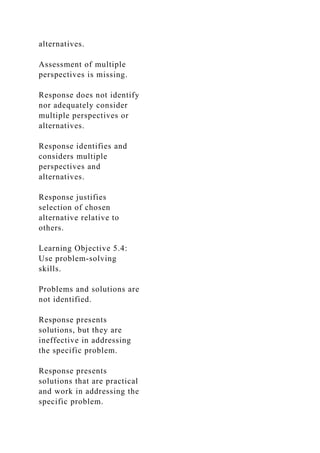
Both Discussion needs 370 word count each Discussion one:
The 1970s
Compare and Contrast the difficulties today to the 1970s.
Remember to examine the similarities and differences. (Mention
examples).
Example of what to references in the discussion:
“The 1970s were one of the worse decades in the 20th century.
In many ways, Americans suffered. These are the following
events or concepts of the decade that will help: Watergate,
stagflation, Oil Crisis, Soviet aggression, conservatism, Prop
13, Religious Right, Iran, deindustrialization, Sagebrush
Rebellion, Nixon and China, and more. These are the ones I
came up with, but feel free to think of another one.”
Please follow the link below to get example from the article.
https://www.cnn.com/2015/06/11/opinions/bianculli-seventies-
tv/index.html
Discussion Two: The Modern Workforce
What are the major concerns for the future workforce for the
state? In your experience and opinion, what can the state do to
solve this issue? Finally, has this issue altered your job or
career choice in the present or past? This still applies to those
unsure of their career goals (I went through the same struggles).
©2015 Walden University 1
CECSCP 001: Apply Professional Knowledge and Skills
(Capstone)
Synthesize and apply knowledge and skills to address real-world
issues or needs in the early childhood field.
Assessment Rubric
0
Not Present
1
Needs Improvement
2
Meets Expectations
3
Exceeds Expectations
Sub-Competency 1: Apply knowledge and skills related to
issues and needs in the early childhood field in authentic
contexts.
Learning Objective 1.1:
Apply knowledge and
skills related to issues
and needs in the early
childhood field in
authentic contexts.
Artifacts provide no
evidence of application of
knowledge and skills.
Artifacts provide limited
evidence of application of
knowledge and/or skills.
Artifacts provide clear,
specific, and detailed
evidence of ability to apply
both knowledge and skills
related to each area of
expertise.
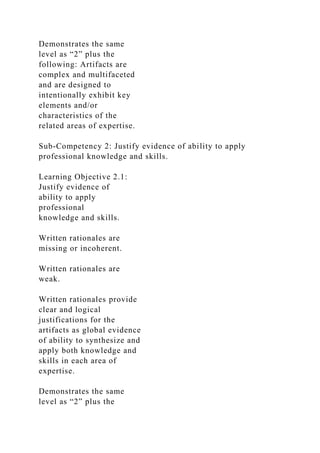
Demonstrates the same
level as “2” plus the
following: Artifacts are
complex and multifaceted
and are designed to
intentionally exhibit key
elements and/or
characteristics of the
related areas of expertise.
Sub-Competency 2: Justify evidence of ability to apply
professional knowledge and skills.
Learning Objective 2.1:
Justify evidence of
ability to apply
professional
knowledge and skills.
Written rationales are
missing or incoherent.
Written rationales are
weak.
Written rationales provide
clear and logical
justifications for the
artifacts as global evidence
of ability to synthesize and
apply both knowledge and
skills in each area of
expertise.
Demonstrates the same
level as “2” plus the
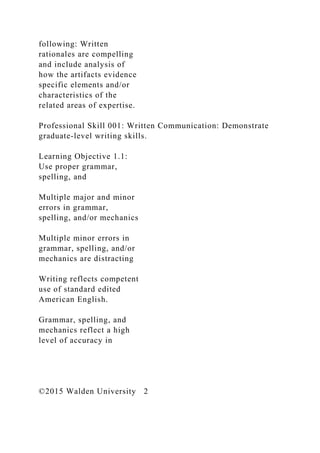
following: Written
rationales are compelling
and include analysis of
how the artifacts evidence
specific elements and/or
characteristics of the
related areas of expertise.
Professional Skill 001: Written Communication: Demonstrate
graduate-level writing skills.
Learning Objective 1.1:
Use proper grammar,
spelling, and
Multiple major and minor
errors in grammar,
spelling, and/or mechanics
Multiple minor errors in
grammar, spelling, and/or
mechanics are distracting
Writing reflects competent
use of standard edited
American English.
Grammar, spelling, and
mechanics reflect a high
level of accuracy in
©2015 Walden University 2
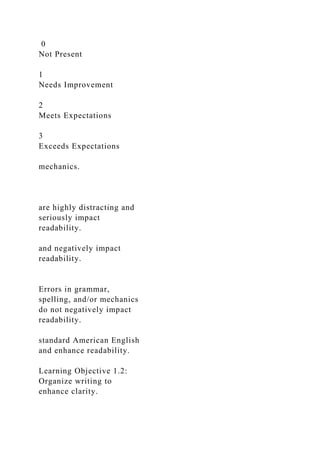
0
Not Present
1
Needs Improvement
2
Meets Expectations
3
Exceeds Expectations
mechanics.
are highly distracting and
seriously impact
readability.
and negatively impact
readability.
Errors in grammar,
spelling, and/or mechanics
do not negatively impact
readability.
standard American English
and enhance readability.
Learning Objective 1.2:
Organize writing to
enhance clarity.
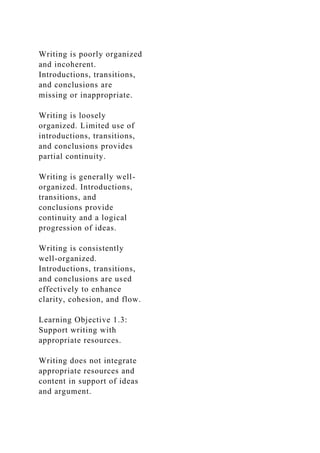
Writing is poorly organized
and incoherent.
Introductions, transitions,
and conclusions are
missing or inappropriate.
Writing is loosely
organized. Limited use of
introductions, transitions,
and conclusions provides
partial continuity.
Writing is generally well-
organized. Introductions,
transitions, and
conclusions provide
continuity and a logical
progression of ideas.
Writing is consistently
well-organized.
Introductions, transitions,
and conclusions are used
effectively to enhance
clarity, cohesion, and flow.
Learning Objective 1.3:
Support writing with
appropriate resources.
Writing does not integrate
appropriate resources and
content in support of ideas
and argument.
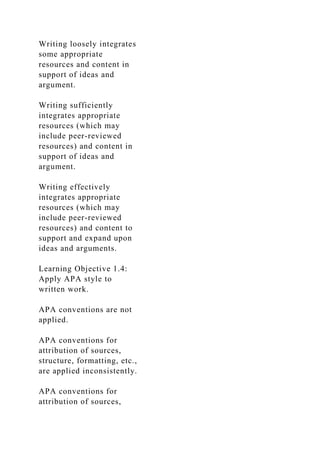
Writing loosely integrates
some appropriate
resources and content in
support of ideas and
argument.
Writing sufficiently
integrates appropriate
resources (which may
include peer-reviewed
resources) and content in
support of ideas and
argument.
Writing effectively
integrates appropriate
resources (which may
include peer-reviewed
resources) and content to
support and expand upon
ideas and arguments.
Learning Objective 1.4:
Apply APA style to
written work.
APA conventions are not
applied.
APA conventions for
attribution of sources,
structure, formatting, etc.,
are applied inconsistently.
APA conventions for
attribution of sources,
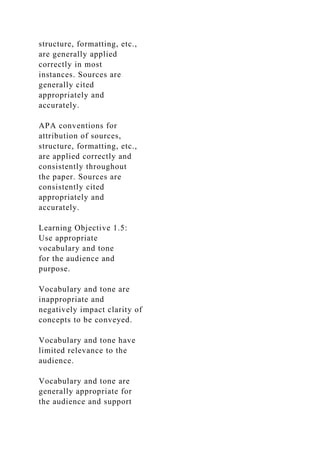
structure, formatting, etc.,
are generally applied
correctly in most
instances. Sources are
generally cited
appropriately and
accurately.
APA conventions for
attribution of sources,
structure, formatting, etc.,
are applied correctly and
consistently throughout
the paper. Sources are
consistently cited
appropriately and
accurately.
Learning Objective 1.5:
Use appropriate
vocabulary and tone
for the audience and
purpose.
Vocabulary and tone are
inappropriate and
negatively impact clarity of
concepts to be conveyed.
Vocabulary and tone have
limited relevance to the
audience.
Vocabulary and tone are
generally appropriate for
the audience and support
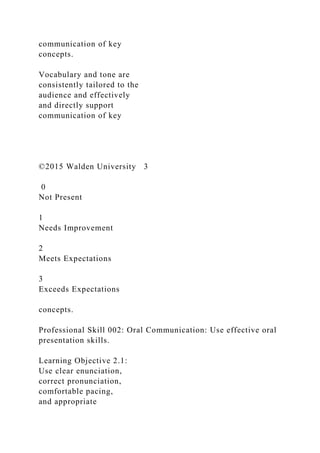
communication of key
concepts.
Vocabulary and tone are
consistently tailored to the
audience and effectively
and directly support
communication of key
©2015 Walden University 3
0
Not Present
1
Needs Improvement
2
Meets Expectations
3
Exceeds Expectations
concepts.
Professional Skill 002: Oral Communication: Use effective oral
presentation skills.
Learning Objective 2.1:
Use clear enunciation,
correct pronunciation,
comfortable pacing,
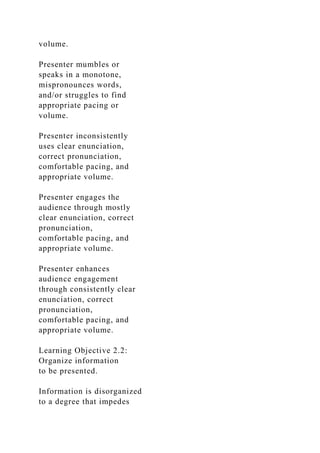
and appropriate
volume.
Presenter mumbles or
speaks in a monotone,
mispronounces words,
and/or struggles to find
appropriate pacing or
volume.
Presenter inconsistently
uses clear enunciation,
correct pronunciation,
comfortable pacing, and
appropriate volume.
Presenter engages the
audience through mostly
clear enunciation, correct
pronunciation,
comfortable pacing, and
appropriate volume.
Presenter enhances
audience engagement
through consistently clear
enunciation, correct
pronunciation,
comfortable pacing, and
appropriate volume.
Learning Objective 2.2:
Organize information
to be presented.
Information is disorganized
to a degree that impedes
audience understanding.
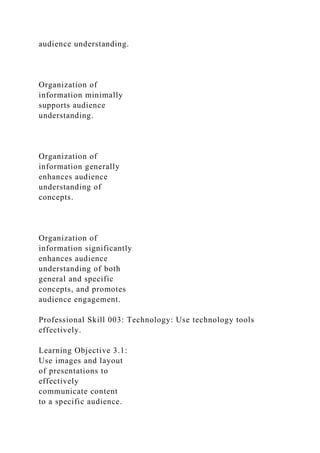
Organization of
information minimally
supports audience
understanding.
Organization of
information generally
enhances audience
understanding of
concepts.
Organization of
information significantly
enhances audience
understanding of both
general and specific
concepts, and promotes
audience engagement.
Professional Skill 003: Technology: Use technology tools
effectively.
Learning Objective 3.1:
Use images and layout
of presentations to
effectively
communicate content
to a specific audience.
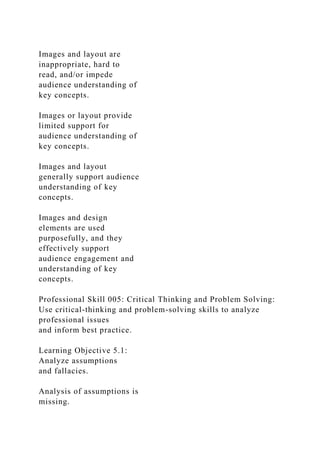
Images and layout are
inappropriate, hard to
read, and/or impede
audience understanding of
key concepts.
Images or layout provide
limited support for
audience understanding of
key concepts.
Images and layout
generally support audience
understanding of key
concepts.
Images and design
elements are used
purposefully, and they
effectively support
audience engagement and
understanding of key
concepts.
Professional Skill 005: Critical Thinking and Problem Solving:
Use critical-thinking and problem-solving skills to analyze
professional issues
and inform best practice.
Learning Objective 5.1:
Analyze assumptions
and fallacies.
Analysis of assumptions is
missing.
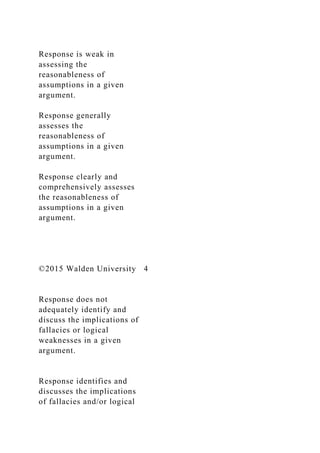
Response is weak in
assessing the
reasonableness of
assumptions in a given
argument.
Response generally
assesses the
reasonableness of
assumptions in a given
argument.
Response clearly and
comprehensively assesses
the reasonableness of
assumptions in a given
argument.
©2015 Walden University 4
Response does not
adequately identify and
discuss the implications of
fallacies or logical
weaknesses in a given
argument.
Response identifies and
discusses the implications
of fallacies and/or logical
weaknesses in a given
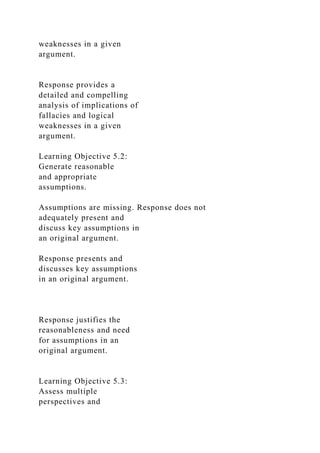
argument.
Response provides a
detailed and compelling
analysis of implications of
fallacies and logical
weaknesses in a given
argument.
Learning Objective 5.2:
Generate reasonable
and appropriate
assumptions.
Assumptions are missing. Response does not
adequately present and
discuss key assumptions in
an original argument.
Response presents and
discusses key assumptions
in an original argument.
Response justifies the
reasonableness and need
for assumptions in an
original argument.
Learning Objective 5.3:
Assess multiple
perspectives and
alternatives.
Assessment of multiple
perspectives is missing.
Response does not identify
nor adequately consider
multiple perspectives or
alternatives.
Response identifies and
considers multiple
perspectives and
alternatives.
Response justifies
selection of chosen
alternative relative to
others.
Learning Objective 5.4:
Use problem-solving
skills.
Problems and solutions are
not identified.
Response presents
solutions, but they are
ineffective in addressing
the specific problem.
Response presents
solutions that are practical
and work in addressing the
specific problem.
Response presents
compelling supporting
arguments for proposed
solutions.
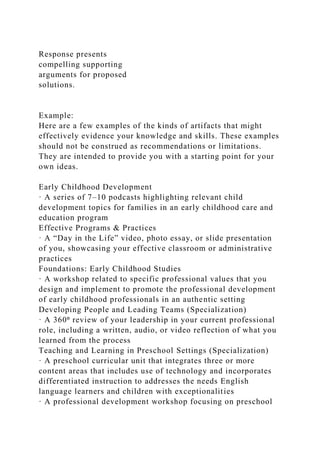
Example:
Here are a few examples of the kinds of artifacts that might
effectively evidence your knowledge and skills. These examples
should not be construed as recommendations or limitations.
They are intended to provide you with a starting point for your
own ideas.
Early Childhood Development
· A series of 7–10 podcasts highlighting relevant child
development topics for families in an early childhood care and
education program
Effective Programs & Practices
· A “Day in the Life” video, photo essay, or slide presentation
of you, showcasing your effective classroom or administrative
practices
Foundations: Early Childhood Studies
· A workshop related to specific professional values that you
design and implement to promote the professional development
of early childhood professionals in an authentic setting
Developing People and Leading Teams (Specialization)
· A 360⁰ review of your leadership in your current professional
role, including a written, audio, or video reflection of what you
learned from the process
Teaching and Learning in Preschool Settings (Specialization)
· A preschool curricular unit that integrates three or more
content areas that includes use of technology and incorporates
differentiated instruction to addresses the needs English
language learners and children with exceptionalities
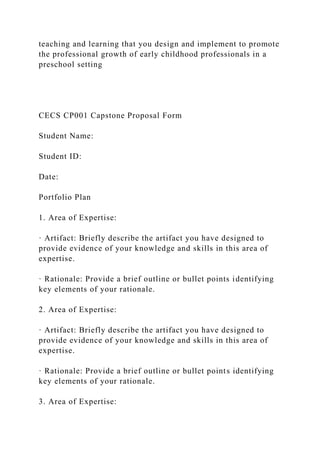
· A professional development workshop focusing on preschool
teaching and learning that you design and implement to promote
the professional growth of early childhood professionals in a
preschool setting
CECS CP001 Capstone Proposal Form
Student Name:
Student ID:
Date:
Portfolio Plan
1. Area of Expertise:
· Artifact: Briefly describe the artifact you have designed to
provide evidence of your knowledge and skills in this area of
expertise.
· Rationale: Provide a brief outline or bullet points identifying
key elements of your rationale.
2. Area of Expertise:
· Artifact: Briefly describe the artifact you have designed to
provide evidence of your knowledge and skills in this area of
expertise.
· Rationale: Provide a brief outline or bullet points identifying
key elements of your rationale.
3. Area of Expertise:
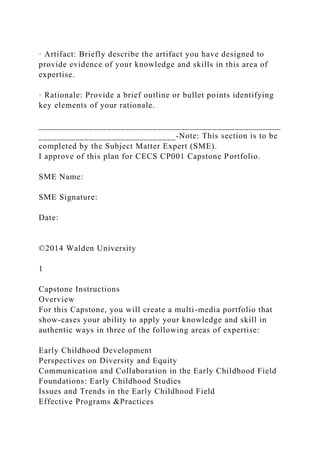
· Artifact: Briefly describe the artifact you have designed to
provide evidence of your knowledge and skills in this area of
expertise.
· Rationale: Provide a brief outline or bullet points identifying
key elements of your rationale.
_____________________________________________________
______________________________-Note: This section is to be
completed by the Subject Matter Expert (SME).
I approve of this plan for CECS CP001 Capstone Portfolio.
SME Name:
SME Signature:
Date:
©2014 Walden University
1
Capstone Instructions
Overview
For this Capstone, you will create a multi-media portfolio that
show-cases your ability to apply your knowledge and skill in
authentic ways in three of the following areas of expertise:
Early Childhood Development
Perspectives on Diversity and Equity
Communication and Collaboration in the Early Childhood Field
Foundations: Early Childhood Studies
Issues and Trends in the Early Childhood Field
Effective Programs &Practices
An Area of Expertise from your specialization
Before you begin to construct your Portfolio, you will need to
obtain the approval of the Faculty member who is serving as
Subject Matter Expert (SME) for the Capstone. Arrange a time
to discuss your portfolio with the SME and submit the Capstone
Proposal Form to your SME for a signature. Attach the signed
form to your Portfolio before final submission to the platform.
Your Capstone must:
Reflect the criteria provided in the Rubric, which provides
information on how the Assessment will be evaluated.
Adhere to the required assignment length.
Use the APA course paper template available here for the
written rationale portion of the Capstone.
Professional Skills: Written Communication, Oral
Communication, Technology and Critical Thinking are assessed
in this Competency. You are strongly encouraged to use the
Writing Checklist and to review the Rubric prior to submitting.
This Assessment requires submission of multiple files.
One (1) file must be a Word document that includes your
written rationale for each artifact.
The remaining files will depend upon the type of artifact
provided.
Please condense your video or multimedia files even if they
span more than one Area of Expertise.
Save the written rationale as CP001_firstinitial_lastname (for
example, CR003_J_Smith). Save each artifact as
CP001_firstinitial_lastname_art1,
CP001_firstinitial_lastname_art2, etc. When you are ready to
upload your completed Assessment, use the Assessment tab on
the top navigation menu.
Note: You must obtain written permission to use photographs or
video of all individuals who appear in still photos or videos. If
minors appear in your photos or video, you must obtain
permission from parents or legal guardians. Use the Walden
University Release Form provided. Be sure to save the original
copies of the permission forms in your files.
Also, if you are creating a video, be mindful of the file size and
try to reduce it, if needed, according to the instructions
provided here.
Submit the following Portfolio of items:
Signed Capstone Proposal Form
Three artifacts
Written rationale for each artifact (2–3 pages each)

CECS CP001 Capstone Proposal FormStudent Name Suzanne Mur.docx

  • 1.
    CECS CP001 CapstoneProposal Form Student Name: Suzanne Murphy Student ID: CBL 002555 Date: January 8, 2020 Portfolio Plan 1. Area of Expertise: Early Childhood Education · Artifact: Briefly describe the artifact you have designed to provide evidence of your knowledge and skills in this area of expertise. I will create a classroom newsletter. · Rationale: Provide a brief outline or bullet points identifying key elements of your rationale. I believe that communication is an important part that bridges the gap between home and school, and helps keep parents updated and involved in what is happening at the school. In addition, a classroom newsletter makes parents aware of volunteer opportunities within the classroom, the school, and on a district level. Lastly, a classroom newsletter. Lastly, a classroom newsletter allows parents to stay organized with schedules and events. 2. Area of Expertise: Family and Community Engagement · Artifact: Briefly describe the artifact you have designed to provide evidence of your knowledge and skills in this area of expertise. For this artifact, I will create a Family and Community Engagement Board. · Rationale: Provide a brief outline or bullet points identifying key elements of your rationale. Schools, parents, and the community should work together to promote the health, well-being, and learning of all students. When schools actively involve parents and engage community resources, they are able to respond more effectively to the health-related needs of students.
  • 2.
    3. Area ofExpertise: Importance of Technology in a Preschool Classroom · Artifact: Briefly describe the artifact you have designed to provide evidence of your knowledge and skills in this area of expertise. For this artifact, I will create a power point presentation with audio highlighting the importance of technology in a preschool classroom. · Rationale: Provide a brief outline or bullet points identifying key elements of your rationale. I believe technology assist with active learning for students. In addition, · assistive technology allow students with special needs and/or developmental delays communicate with the teachers and peers. _____________________________________________________ ______________________________- Note: This section is to be completed by the Subject Matter Expert (SME). I approve of this plan for CECS CP001 Capstone Portfolio. SME Name: SME Signature: Date: ©2014 Walden University 1 Both Discussion needs 370 word count each Discussion one: The 1970s Compare and Contrast the difficulties today to the 1970s. Remember to examine the similarities and differences. (Mention examples). Example of what to references in the discussion: “The 1970s were one of the worse decades in the 20th century. In many ways, Americans suffered. These are the following events or concepts of the decade that will help: Watergate,
  • 3.
    stagflation, Oil Crisis,Soviet aggression, conservatism, Prop 13, Religious Right, Iran, deindustrialization, Sagebrush Rebellion, Nixon and China, and more. These are the ones I came up with, but feel free to think of another one.” Please follow the link below to get example from the article. https://www.cnn.com/2015/06/11/opinions/bianculli-seventies- tv/index.html Discussion Two: The Modern Workforce What are the major concerns for the future workforce for the state? In your experience and opinion, what can the state do to solve this issue? Finally, has this issue altered your job or career choice in the present or past? This still applies to those unsure of their career goals (I went through the same struggles). ©2015 Walden University 1 CECSCP 001: Apply Professional Knowledge and Skills (Capstone) Synthesize and apply knowledge and skills to address real-world issues or needs in the early childhood field. Assessment Rubric 0 Not Present 1
  • 4.
    Needs Improvement 2 Meets Expectations 3 ExceedsExpectations Sub-Competency 1: Apply knowledge and skills related to issues and needs in the early childhood field in authentic contexts. Learning Objective 1.1: Apply knowledge and skills related to issues and needs in the early childhood field in authentic contexts. Artifacts provide no evidence of application of knowledge and skills. Artifacts provide limited evidence of application of knowledge and/or skills. Artifacts provide clear, specific, and detailed evidence of ability to apply both knowledge and skills related to each area of expertise.
  • 5.
    Demonstrates the same levelas “2” plus the following: Artifacts are complex and multifaceted and are designed to intentionally exhibit key elements and/or characteristics of the related areas of expertise. Sub-Competency 2: Justify evidence of ability to apply professional knowledge and skills. Learning Objective 2.1: Justify evidence of ability to apply professional knowledge and skills. Written rationales are missing or incoherent. Written rationales are weak. Written rationales provide clear and logical justifications for the artifacts as global evidence of ability to synthesize and apply both knowledge and skills in each area of expertise. Demonstrates the same level as “2” plus the
  • 6.
    following: Written rationales arecompelling and include analysis of how the artifacts evidence specific elements and/or characteristics of the related areas of expertise. Professional Skill 001: Written Communication: Demonstrate graduate-level writing skills. Learning Objective 1.1: Use proper grammar, spelling, and Multiple major and minor errors in grammar, spelling, and/or mechanics Multiple minor errors in grammar, spelling, and/or mechanics are distracting Writing reflects competent use of standard edited American English. Grammar, spelling, and mechanics reflect a high level of accuracy in ©2015 Walden University 2
  • 7.
    0 Not Present 1 Needs Improvement 2 MeetsExpectations 3 Exceeds Expectations mechanics. are highly distracting and seriously impact readability. and negatively impact readability. Errors in grammar, spelling, and/or mechanics do not negatively impact readability. standard American English and enhance readability. Learning Objective 1.2: Organize writing to enhance clarity.
  • 8.
    Writing is poorlyorganized and incoherent. Introductions, transitions, and conclusions are missing or inappropriate. Writing is loosely organized. Limited use of introductions, transitions, and conclusions provides partial continuity. Writing is generally well- organized. Introductions, transitions, and conclusions provide continuity and a logical progression of ideas. Writing is consistently well-organized. Introductions, transitions, and conclusions are used effectively to enhance clarity, cohesion, and flow. Learning Objective 1.3: Support writing with appropriate resources. Writing does not integrate appropriate resources and content in support of ideas and argument.
  • 9.
    Writing loosely integrates someappropriate resources and content in support of ideas and argument. Writing sufficiently integrates appropriate resources (which may include peer-reviewed resources) and content in support of ideas and argument. Writing effectively integrates appropriate resources (which may include peer-reviewed resources) and content to support and expand upon ideas and arguments. Learning Objective 1.4: Apply APA style to written work. APA conventions are not applied. APA conventions for attribution of sources, structure, formatting, etc., are applied inconsistently. APA conventions for attribution of sources,
  • 10.
    structure, formatting, etc., aregenerally applied correctly in most instances. Sources are generally cited appropriately and accurately. APA conventions for attribution of sources, structure, formatting, etc., are applied correctly and consistently throughout the paper. Sources are consistently cited appropriately and accurately. Learning Objective 1.5: Use appropriate vocabulary and tone for the audience and purpose. Vocabulary and tone are inappropriate and negatively impact clarity of concepts to be conveyed. Vocabulary and tone have limited relevance to the audience. Vocabulary and tone are generally appropriate for the audience and support
  • 11.
    communication of key concepts. Vocabularyand tone are consistently tailored to the audience and effectively and directly support communication of key ©2015 Walden University 3 0 Not Present 1 Needs Improvement 2 Meets Expectations 3 Exceeds Expectations concepts. Professional Skill 002: Oral Communication: Use effective oral presentation skills. Learning Objective 2.1: Use clear enunciation, correct pronunciation, comfortable pacing, and appropriate
  • 12.
    volume. Presenter mumbles or speaksin a monotone, mispronounces words, and/or struggles to find appropriate pacing or volume. Presenter inconsistently uses clear enunciation, correct pronunciation, comfortable pacing, and appropriate volume. Presenter engages the audience through mostly clear enunciation, correct pronunciation, comfortable pacing, and appropriate volume. Presenter enhances audience engagement through consistently clear enunciation, correct pronunciation, comfortable pacing, and appropriate volume. Learning Objective 2.2: Organize information to be presented. Information is disorganized to a degree that impedes
  • 13.
    audience understanding. Organization of informationminimally supports audience understanding. Organization of information generally enhances audience understanding of concepts. Organization of information significantly enhances audience understanding of both general and specific concepts, and promotes audience engagement. Professional Skill 003: Technology: Use technology tools effectively. Learning Objective 3.1: Use images and layout of presentations to effectively communicate content to a specific audience.
  • 14.
    Images and layoutare inappropriate, hard to read, and/or impede audience understanding of key concepts. Images or layout provide limited support for audience understanding of key concepts. Images and layout generally support audience understanding of key concepts. Images and design elements are used purposefully, and they effectively support audience engagement and understanding of key concepts. Professional Skill 005: Critical Thinking and Problem Solving: Use critical-thinking and problem-solving skills to analyze professional issues and inform best practice. Learning Objective 5.1: Analyze assumptions and fallacies. Analysis of assumptions is missing.
  • 15.
    Response is weakin assessing the reasonableness of assumptions in a given argument. Response generally assesses the reasonableness of assumptions in a given argument. Response clearly and comprehensively assesses the reasonableness of assumptions in a given argument. ©2015 Walden University 4 Response does not adequately identify and discuss the implications of fallacies or logical weaknesses in a given argument. Response identifies and discusses the implications of fallacies and/or logical
  • 16.
    weaknesses in agiven argument. Response provides a detailed and compelling analysis of implications of fallacies and logical weaknesses in a given argument. Learning Objective 5.2: Generate reasonable and appropriate assumptions. Assumptions are missing. Response does not adequately present and discuss key assumptions in an original argument. Response presents and discusses key assumptions in an original argument. Response justifies the reasonableness and need for assumptions in an original argument. Learning Objective 5.3: Assess multiple perspectives and
  • 17.
    alternatives. Assessment of multiple perspectivesis missing. Response does not identify nor adequately consider multiple perspectives or alternatives. Response identifies and considers multiple perspectives and alternatives. Response justifies selection of chosen alternative relative to others. Learning Objective 5.4: Use problem-solving skills. Problems and solutions are not identified. Response presents solutions, but they are ineffective in addressing the specific problem. Response presents solutions that are practical and work in addressing the specific problem.
  • 18.
    Response presents compelling supporting argumentsfor proposed solutions. Example: Here are a few examples of the kinds of artifacts that might effectively evidence your knowledge and skills. These examples should not be construed as recommendations or limitations. They are intended to provide you with a starting point for your own ideas. Early Childhood Development · A series of 7–10 podcasts highlighting relevant child development topics for families in an early childhood care and education program Effective Programs & Practices · A “Day in the Life” video, photo essay, or slide presentation of you, showcasing your effective classroom or administrative practices Foundations: Early Childhood Studies · A workshop related to specific professional values that you design and implement to promote the professional development of early childhood professionals in an authentic setting Developing People and Leading Teams (Specialization) · A 360⁰ review of your leadership in your current professional role, including a written, audio, or video reflection of what you learned from the process Teaching and Learning in Preschool Settings (Specialization) · A preschool curricular unit that integrates three or more content areas that includes use of technology and incorporates differentiated instruction to addresses the needs English language learners and children with exceptionalities · A professional development workshop focusing on preschool
  • 19.
    teaching and learningthat you design and implement to promote the professional growth of early childhood professionals in a preschool setting CECS CP001 Capstone Proposal Form Student Name: Student ID: Date: Portfolio Plan 1. Area of Expertise: · Artifact: Briefly describe the artifact you have designed to provide evidence of your knowledge and skills in this area of expertise. · Rationale: Provide a brief outline or bullet points identifying key elements of your rationale. 2. Area of Expertise: · Artifact: Briefly describe the artifact you have designed to provide evidence of your knowledge and skills in this area of expertise. · Rationale: Provide a brief outline or bullet points identifying key elements of your rationale. 3. Area of Expertise:
  • 20.
    · Artifact: Brieflydescribe the artifact you have designed to provide evidence of your knowledge and skills in this area of expertise. · Rationale: Provide a brief outline or bullet points identifying key elements of your rationale. _____________________________________________________ ______________________________-Note: This section is to be completed by the Subject Matter Expert (SME). I approve of this plan for CECS CP001 Capstone Portfolio. SME Name: SME Signature: Date: ©2014 Walden University 1 Capstone Instructions Overview For this Capstone, you will create a multi-media portfolio that show-cases your ability to apply your knowledge and skill in authentic ways in three of the following areas of expertise: Early Childhood Development Perspectives on Diversity and Equity Communication and Collaboration in the Early Childhood Field Foundations: Early Childhood Studies Issues and Trends in the Early Childhood Field Effective Programs &Practices
  • 21.
    An Area ofExpertise from your specialization Before you begin to construct your Portfolio, you will need to obtain the approval of the Faculty member who is serving as Subject Matter Expert (SME) for the Capstone. Arrange a time to discuss your portfolio with the SME and submit the Capstone Proposal Form to your SME for a signature. Attach the signed form to your Portfolio before final submission to the platform. Your Capstone must: Reflect the criteria provided in the Rubric, which provides information on how the Assessment will be evaluated. Adhere to the required assignment length. Use the APA course paper template available here for the written rationale portion of the Capstone. Professional Skills: Written Communication, Oral Communication, Technology and Critical Thinking are assessed in this Competency. You are strongly encouraged to use the Writing Checklist and to review the Rubric prior to submitting. This Assessment requires submission of multiple files. One (1) file must be a Word document that includes your written rationale for each artifact. The remaining files will depend upon the type of artifact provided. Please condense your video or multimedia files even if they span more than one Area of Expertise. Save the written rationale as CP001_firstinitial_lastname (for example, CR003_J_Smith). Save each artifact as CP001_firstinitial_lastname_art1, CP001_firstinitial_lastname_art2, etc. When you are ready to upload your completed Assessment, use the Assessment tab on the top navigation menu. Note: You must obtain written permission to use photographs or
  • 22.
    video of allindividuals who appear in still photos or videos. If minors appear in your photos or video, you must obtain permission from parents or legal guardians. Use the Walden University Release Form provided. Be sure to save the original copies of the permission forms in your files. Also, if you are creating a video, be mindful of the file size and try to reduce it, if needed, according to the instructions provided here. Submit the following Portfolio of items: Signed Capstone Proposal Form Three artifacts Written rationale for each artifact (2–3 pages each)