EE-583 Wireless Communications
By: Robert Skowronski
April 19, 2015 1
 Introduction
 What is Multiple Access?
 General Specifications
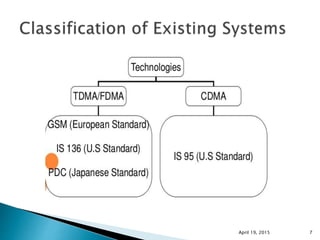
 Classification of Existing
Systems
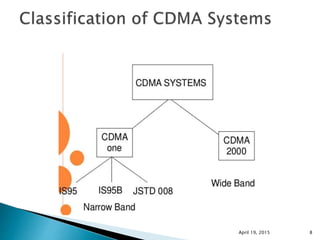
 Classification of CDMA
Systems
 Multiple Access
 IS-95
 CDMA spread spectrum
◦ CDMA Specs
 Comparison between
CDMA and TDMA/FDMA
 Advantages of CDMA
 Disadvantages of CDMA
 CDMA Codes
 CDMA Operation
 TDMA/FDMA/CDMA
 The Near-Far Problem
 CDMA Carriers
 Summary
 References
April 19, 2015 2
 CDMA stands for Code Division Multiple Access
 A channel access method used by various radio
communication technologies
 Where several transmitters can send information
simultaneously over one channel
 Allows users to share a band of frequencies
April 19, 2015 3
 Used as the access method in many mobile phone
standards (cdmaOne, CDMA2000)
 Spread spectrum technology
 Special coding scheme where each transmitter is
assigned a code
 Digital air interface standard, claiming eight to fifteen
times the capacity of analog
 Users have control of a very wide channel bandwidth
1.5 to 5Mhz
April 19, 2015 4
April 19, 2015 5
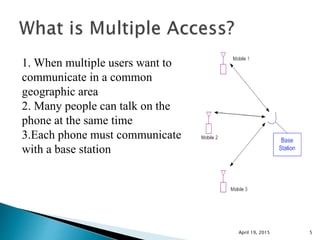
1. When multiple users want to
communicate in a common
geographic area
2. Many people can talk on the
phone at the same time
3.Each phone must communicate
with a base station
 Rx: 869-894MHz Tx: 824-849MHz
 20 Channels spaced 1250kHz apart
(798 users/channel)
 QPSK/(Offset) OQPSK modulation scheme
 1.2288Mbps bit rate
 IS-95 standard
 Operates at both 800 and 1900 MHz frequency bands
April 19, 2015 6
April 19, 2015 7
April 19, 2015 8
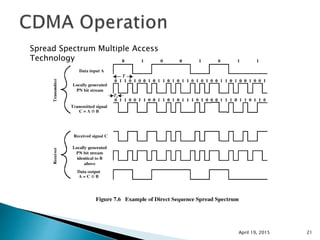
 Each user is assigned a unique PN code
 Each user transmits its information by spreading with
unique code
 Direct Sequence spread spectrum is used
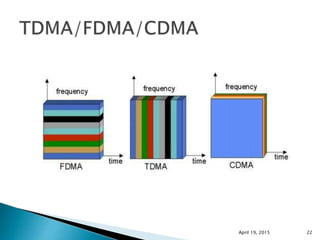
 Users are separated by code not by time or frequency
slot
April 19, 2015 9
 IS-95 was first operating system to use CDMA
◦ Invented by Qualcomm
◦ Began production in 1995
 Being supplanted by CDMA2000 (WCDMA) and
UMTS, fully 3G systems
 Both had been using CDMA
 Wideband System
April 19, 2015 10
 A signal takes up to 6-10 times the bandwidth that it
needs at a minimum
 This is used for military communications as well
 Much more difficult to tune into a certain frequency
 Difficult to block, listen in on, and identify from noise
April 19, 2015 11
 All users share the same 1.25MHz bandwidth
 They all transmit the same size signal
 Unique digital codes are used to separate each of the
mobile phones
 .02Mhz of a guard band
 Each bit of the conversation is encoded with this
special code
April 19, 2015 12
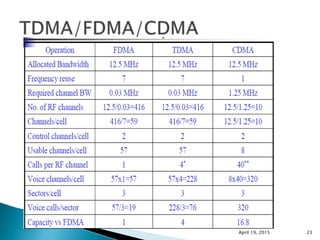
 In TDMA/FDMA, cell design needs more frequency
planning while in CDMA frequency planning is
minimal
 TDMA is Band Limited system, CDMA is power
limited system
 CDMA systems entire spectrum is used which
enhances voice quality. In TDMA band width available
is small which leads to compromise of transmission
quality
April 19, 2015 13
 No limit to the number of concurrent users
 Low power requirements
 Little cell-to-cell coordination needed by operators
 Carrier can serve more subscribers
 Precision clocks that do not limit the distance a tower
can cover
April 19, 2015 14
 Capacity-can accommodate more users per Mhz of
bandwidth than any other technology
 Small phones
 Extended reach
 Cell size is larger but consumes less power and covers
large areas
 Impossible for hackers to decipher the code sent
April 19, 2015 15
 Well-defined path to higher data rates
 Uses Soft Handoff to reduce drop calls
 Variable rate voice orders reduce the rate being
transmitted when speaker is not talking, allows channel
to be packed more efficiently
April 19, 2015 16
 Near far problem
 Not as mature as the GSM network
 Cannot offer international roaming
 Demands high pea power on uplink in transient mode
 The only limit to the system is the computing prowess
of the base station and its ability to separate noise from
actual data
 Self-jamming
April 19, 2015 17
 CDMA covers a small portion of the world compared
to GSM
 Multiple Path Distortion
 GSM has more subscribers
 GSM is in more countries overall
 Most technologies are patented and must be licensed
from Qualcomm
April 19, 2015 18
 The base station and mobile phone use an algorithm for
generating pseudo random numbers
 Mathematical function called Walsh Vectors
◦ Generates 128 bit random numbers that are
orthogonal to every other random number generated
◦ Large period
 Both the mobile station and base station should
generate the same random numbers (32 bits)
April 19, 2015 19
 Time stand and error codes are added to the random
number convoluted with the data
 Results in 128 bits that represent only 1 bit of data
 The original 9600 bps of conversation has been
multiplied to 1.23 Mbps
 Code are designed to never interfere with any other
codes to a very high probability
April 19, 2015 20
April 19, 2015 21
Spread Spectrum Multiple Access
Technology
April 19, 2015 22
April 19, 2015 23
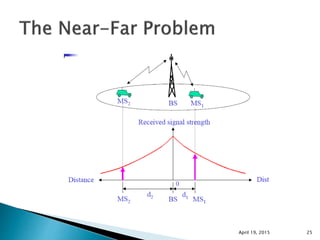
 Users near the base station are received with high
power
 Users far from the base station are received with low
power
 For a path loss exponent of 4 and a cell size of 1km
 P2/P1=(1000/50)^4= 52db
 Nearby users will completely swamp far away users
 Solution: Power Control
April 19, 2015 24
April 19, 2015 25
 Sprint
 Verizon
 U.S Cellular
 These companies use CDMA to authenticate there
phones on home networks. There is no Sim Card used
like GSM where switching phones is easy.
April 19, 2015 26
April 19, 2015 27
 Graceful degradation as traffic increases
 Strong against interference
 CDMA allows efficient use of spectrum by putting all
users on top of each other in time and frequency
 CDMA is used as the access method in many mobile
phone standards such as cdmaOne, CDMA2000 (the
3G evolution of cdmaOne), and WCDMA (the 3G
standard used by GSM carriers), which are often
referred to as simply CDMA
April 19, 2015 28
 CDMA becomes more important in radio
communication systems because it is superior to the
FDMA and TDMA cellular systems
 The military can use this because it is based on the
spread spectrum technique
 Channel access method used by various radio
communication technologies
April 19, 2015 29
 1.http://en.wikipedia.org/wiki/Code_division_multiple_access
 2. K.S. Gilhousen et al, “On the capacity of a cellular CDMA
 system,'' IEEE Trans. on Vehicular Tech., May 1991.
 3.http://www.math.niu.edu/~beachy/courses/523/cdma_lec.pdf
 4. http://www.pcmag.com/article2/0,2817,2407896,00.asp
 5. http://www.cdg.org/technology/cdma.asp
April 19, 2015 30

Cdma

  • 1.
    EE-583 Wireless Communications By:Robert Skowronski April 19, 2015 1
  • 2.
     Introduction  Whatis Multiple Access?  General Specifications  Classification of Existing Systems  Classification of CDMA Systems  Multiple Access  IS-95  CDMA spread spectrum ◦ CDMA Specs  Comparison between CDMA and TDMA/FDMA  Advantages of CDMA  Disadvantages of CDMA  CDMA Codes  CDMA Operation  TDMA/FDMA/CDMA  The Near-Far Problem  CDMA Carriers  Summary  References April 19, 2015 2
  • 3.
     CDMA standsfor Code Division Multiple Access  A channel access method used by various radio communication technologies  Where several transmitters can send information simultaneously over one channel  Allows users to share a band of frequencies April 19, 2015 3
  • 4.
     Used asthe access method in many mobile phone standards (cdmaOne, CDMA2000)  Spread spectrum technology  Special coding scheme where each transmitter is assigned a code  Digital air interface standard, claiming eight to fifteen times the capacity of analog  Users have control of a very wide channel bandwidth 1.5 to 5Mhz April 19, 2015 4
  • 5.
    April 19, 20155 1. When multiple users want to communicate in a common geographic area 2. Many people can talk on the phone at the same time 3.Each phone must communicate with a base station
  • 6.
     Rx: 869-894MHzTx: 824-849MHz  20 Channels spaced 1250kHz apart (798 users/channel)  QPSK/(Offset) OQPSK modulation scheme  1.2288Mbps bit rate  IS-95 standard  Operates at both 800 and 1900 MHz frequency bands April 19, 2015 6
  • 7.
  • 8.
  • 9.
     Each useris assigned a unique PN code  Each user transmits its information by spreading with unique code  Direct Sequence spread spectrum is used  Users are separated by code not by time or frequency slot April 19, 2015 9
  • 10.
     IS-95 wasfirst operating system to use CDMA ◦ Invented by Qualcomm ◦ Began production in 1995  Being supplanted by CDMA2000 (WCDMA) and UMTS, fully 3G systems  Both had been using CDMA  Wideband System April 19, 2015 10
  • 11.
     A signaltakes up to 6-10 times the bandwidth that it needs at a minimum  This is used for military communications as well  Much more difficult to tune into a certain frequency  Difficult to block, listen in on, and identify from noise April 19, 2015 11
  • 12.
     All usersshare the same 1.25MHz bandwidth  They all transmit the same size signal  Unique digital codes are used to separate each of the mobile phones  .02Mhz of a guard band  Each bit of the conversation is encoded with this special code April 19, 2015 12
  • 13.
     In TDMA/FDMA,cell design needs more frequency planning while in CDMA frequency planning is minimal  TDMA is Band Limited system, CDMA is power limited system  CDMA systems entire spectrum is used which enhances voice quality. In TDMA band width available is small which leads to compromise of transmission quality April 19, 2015 13
  • 14.
     No limitto the number of concurrent users  Low power requirements  Little cell-to-cell coordination needed by operators  Carrier can serve more subscribers  Precision clocks that do not limit the distance a tower can cover April 19, 2015 14
  • 15.
     Capacity-can accommodatemore users per Mhz of bandwidth than any other technology  Small phones  Extended reach  Cell size is larger but consumes less power and covers large areas  Impossible for hackers to decipher the code sent April 19, 2015 15
  • 16.
     Well-defined pathto higher data rates  Uses Soft Handoff to reduce drop calls  Variable rate voice orders reduce the rate being transmitted when speaker is not talking, allows channel to be packed more efficiently April 19, 2015 16
  • 17.
     Near farproblem  Not as mature as the GSM network  Cannot offer international roaming  Demands high pea power on uplink in transient mode  The only limit to the system is the computing prowess of the base station and its ability to separate noise from actual data  Self-jamming April 19, 2015 17
  • 18.
     CDMA coversa small portion of the world compared to GSM  Multiple Path Distortion  GSM has more subscribers  GSM is in more countries overall  Most technologies are patented and must be licensed from Qualcomm April 19, 2015 18
  • 19.
     The basestation and mobile phone use an algorithm for generating pseudo random numbers  Mathematical function called Walsh Vectors ◦ Generates 128 bit random numbers that are orthogonal to every other random number generated ◦ Large period  Both the mobile station and base station should generate the same random numbers (32 bits) April 19, 2015 19
  • 20.
     Time standand error codes are added to the random number convoluted with the data  Results in 128 bits that represent only 1 bit of data  The original 9600 bps of conversation has been multiplied to 1.23 Mbps  Code are designed to never interfere with any other codes to a very high probability April 19, 2015 20
  • 21.
    April 19, 201521 Spread Spectrum Multiple Access Technology
  • 22.
  • 23.
  • 24.
     Users nearthe base station are received with high power  Users far from the base station are received with low power  For a path loss exponent of 4 and a cell size of 1km  P2/P1=(1000/50)^4= 52db  Nearby users will completely swamp far away users  Solution: Power Control April 19, 2015 24
  • 25.
  • 26.
     Sprint  Verizon U.S Cellular  These companies use CDMA to authenticate there phones on home networks. There is no Sim Card used like GSM where switching phones is easy. April 19, 2015 26
  • 27.
  • 28.
     Graceful degradationas traffic increases  Strong against interference  CDMA allows efficient use of spectrum by putting all users on top of each other in time and frequency  CDMA is used as the access method in many mobile phone standards such as cdmaOne, CDMA2000 (the 3G evolution of cdmaOne), and WCDMA (the 3G standard used by GSM carriers), which are often referred to as simply CDMA April 19, 2015 28
  • 29.
     CDMA becomesmore important in radio communication systems because it is superior to the FDMA and TDMA cellular systems  The military can use this because it is based on the spread spectrum technique  Channel access method used by various radio communication technologies April 19, 2015 29
  • 30.
     1.http://en.wikipedia.org/wiki/Code_division_multiple_access  2.K.S. Gilhousen et al, “On the capacity of a cellular CDMA  system,'' IEEE Trans. on Vehicular Tech., May 1991.  3.http://www.math.niu.edu/~beachy/courses/523/cdma_lec.pdf  4. http://www.pcmag.com/article2/0,2817,2407896,00.asp  5. http://www.cdg.org/technology/cdma.asp April 19, 2015 30