UNIT-4  PART-2
CONTENTS Introduction Block Diagram of Cellular System Difference between Wireless& PSTN Public Switched Telephone Network Limitations of Wireless  Networking Merging Wireless Networks &PSTN Development of Wireless Networks
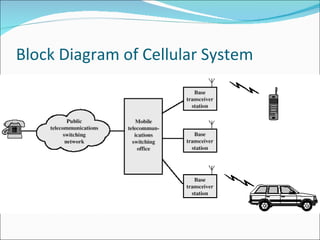
INTRODUCTION Wireless network is an interconnection of many systems capable of providing service to mobile users within a particular geographic region (country or continent) Components Base station Mobile Switching Center (MSC) PSTN
Block Diagram of Cellular System
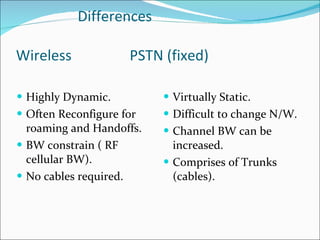
Differences  Wireless  PSTN (fixed) Highly Dynamic. Often Reconfigure for roaming and Handoffs. BW constrain ( RF cellular BW). No cables required. Virtually Static. Difficult to change N/W. Channel BW can be increased. Comprises of Trunks (cables).
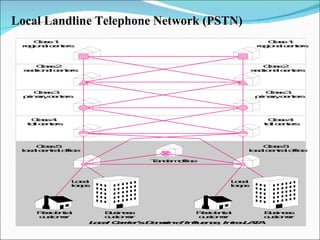
Local Landline Telephone Network (PSTN)
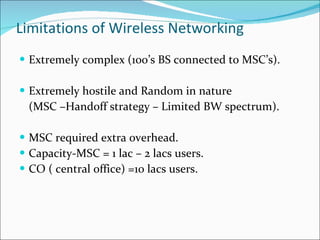
Limitations of Wireless Networking Extremely complex (100’s BS connected to MSC’s). Extremely hostile and Random in nature  (MSC –Handoff strategy – Limited BW spectrum). MSC required extra overhead. Capacity-MSC = 1 lac – 2 lacs users. CO ( central office) =10 lacs users.
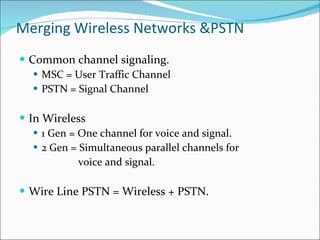
Merging Wireless Networks &PSTN Common channel signaling. MSC = User Traffic Channel PSTN = Signal Channel In Wireless  1 Gen = One channel for voice and signal. 2 Gen = Simultaneous parallel channels for  voice and signal. Wire Line PSTN = Wireless + PSTN.
Development of Wireless Networks First Generation Wireless Networks Second Generation Wireless Networks Third Generation Wireless Networks Fixed Network transmission Hierarchy Traffic Routing in Wireless Networks Circuit Switching Packet Switching X.25 Protocol
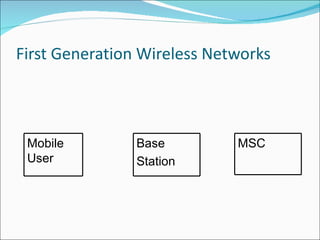
First Generation Wireless Networks Mobile User Base Station MSC
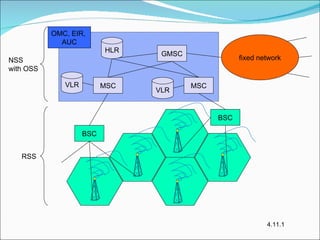
fixed network BSC BSC MSC MSC GMSC OMC, EIR,  AUC VLR HLR NSS with OSS RSS 4.11.1 VLR
Second Generation Wireless Networks Employs digital modulation and advanced call processing capabilities Ex: GSM, TDMA ,CDMA, Cordless Phones. Dedicated control channel for voice, signal data. Provides paging and other data services. High data rate (N/W access.) Uses MAHO (Mobile Assisted Hand Off) where mobile units performs the following functions:   reporting received power. scanning adjacent base station. data encoding and encryption.
Third Generation Wireless Networks Aim: to provide single set of standards that can meet wide range of applications and provide universal access thru out the world. Distinction between cordless and cellular phones disappear as personal handset provides access to voice, data and video services. It uses broadband integrated service digital  N/W (ISDN) to provide internet for both fixed or mobile users. Provides reliable transfer of information .
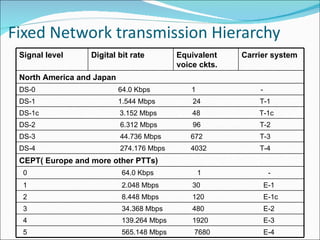
Fixed Network transmission Hierarchy Signal level Digital bit rate  Equivalent voice ckts. Carrier system North America and Japan DS-0  64.0 Kbps  1  - DS-1  1.544 Mbps  24  T-1 DS-1c  3.152 Mbps  48  T-1c DS-2  6.312 Mbps  96  T-2 DS-3  44.736 Mbps  672  T-3 DS-4  274.176 Mbps  4032  T-4 CEPT( Europe and more other PTTs) 0  64.0 Kbps  1  - 1  2.048 Mbps  30  E-1 2  8.448 Mbps  120  E-1c 3  34.368 Mbps  480  E-2 4  139.264 Mbps  1920  E-3 5  565.148 Mbps  7680  E-4
Traffic Routing in Wireless Networks Circuit Switching Packet Switching X.25 Protocol
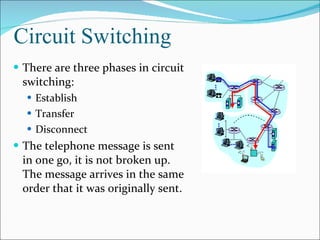
Circuit Switching There are three phases in circuit switching: Establish Transfer Disconnect The telephone message is sent in one go, it is not broken up.  The message arrives in the same order that it was originally sent.
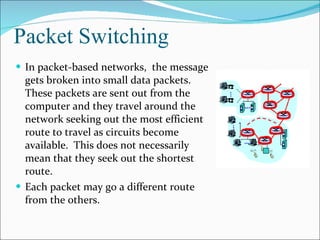
Packet Switching In packet-based networks,  the message gets broken into small data packets.  These packets are sent out from the computer and they travel around the network seeking out the most efficient route to travel as circuits become available.  This does not necessarily mean that they seek out the shortest route. Each packet may go a different route from the others.
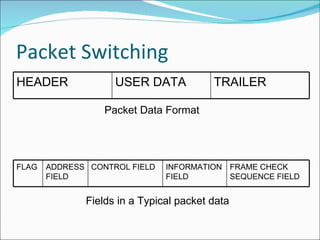
Packet Switching  Packet Data Format Fields in a Typical packet data HEADER USER DATA TRAILER FLAG ADDRESS FIELD CONTROL FIELD INFORMATION FIELD FRAME CHECK SEQUENCE FIELD
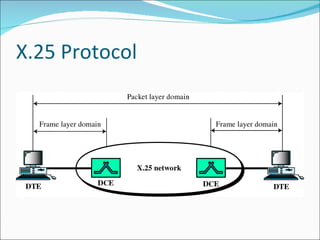
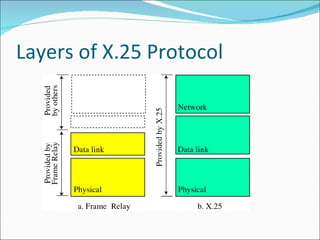
X.25 Protocol
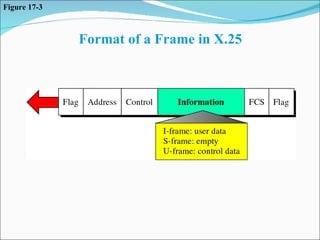
Figure 17-3 Format of a Frame in X.25
Layers of X.25 Protocol
 
UNIT-4  PART -3
WIRELESS SYSTEMS & STANDARDS  Global System for Mobile (GSM) GPRS CDMA Digital Cellular Standard
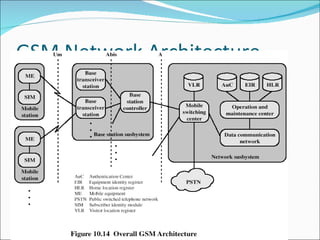
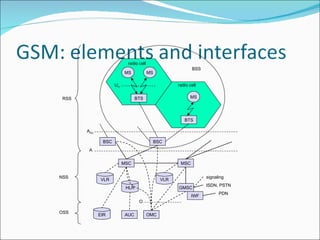
GSM Network Architecture
NSS  MS MS BTS BSC GMSC IWF OMC BTS BSC MSC MSC A bis U m EIR HLR VLR VLR A BSS PDN ISDN, PSTN RSS radio cell radio cell MS AUC OSS  signaling O
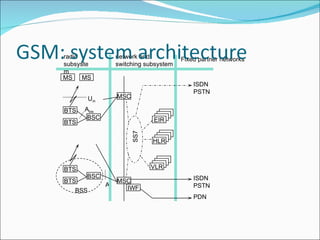
U m A bis A BSS radio subsystem MS MS BTS BSC BTS BTS BSC BTS network and switching subsystem MSC MSC Fixed partner networks IWF ISDN PSTN PDN SS7 EIR HLR VLR ISDN PSTN
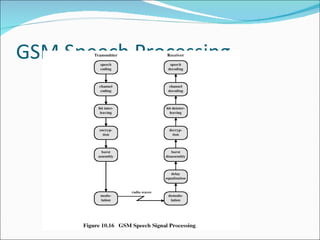
GSM Speech Processing
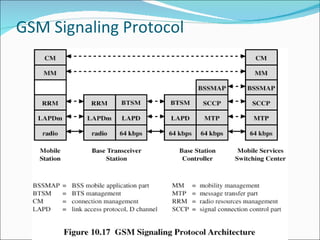
GSM Signaling Protocol
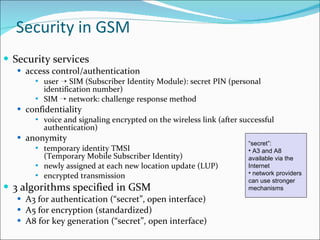
Security in GSM Security services access control/authentication user    SIM (Subscriber Identity Module): secret PIN (personal identification number) SIM    network: challenge response method confidentiality voice and signaling encrypted on the wireless link (after successful authentication) anonymity temporary identity TMSI  (Temporary Mobile Subscriber Identity) newly assigned at each new location update (LUP) encrypted transmission 3 algorithms specified in GSM A3 for authentication (“secret”, open interface) A5 for encryption (standardized) A8 for key generation (“secret”, open interface) “ secret”: A3 and A8 available via the Internet network providers can use stronger mechanisms
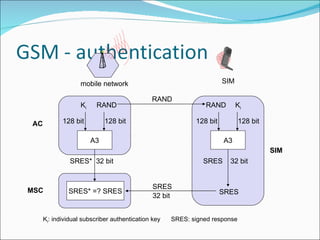
A3 RAND K i 128 bit 128 bit SRES*  32 bit A3 RAND K i 128 bit 128 bit SRES  32 bit SRES* =? SRES SRES RAND SRES 32 bit mobile network SIM AC MSC SIM K i : individual subscriber authentication key SRES: signed response
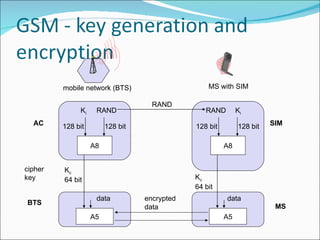
A8 RAND K i 128 bit 128 bit K c 64 bit A8 RAND K i 128 bit 128 bit SRES RAND encrypted data mobile network (BTS) MS with SIM AC BTS SIM A5 K c 64 bit A5 MS data data cipher key
GPRS
.
What is GPRS? A new bearer service for GSM that greatly improves and simplifies wireless access to packet data networks,e.g to the internet.
Motivation Speed Immediacy New and better applications User friendly billing
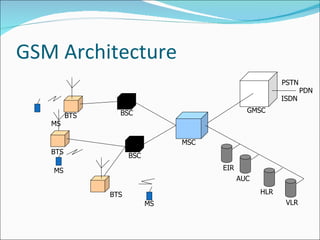
GSM Architecture BTS MS BTS BTS MS BSC BSC MSC GMSC MS EIR VLR HLR AUC PSTN PDN ISDN
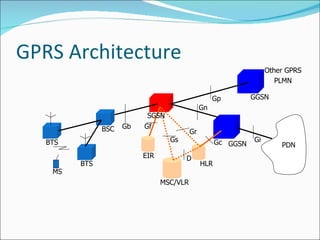
GPRS Architecture BTS BTS MS BSC Gb SGSN Gf Gs Gr D EIR MSC/VLR HLR Gc Gn GGSN Gi PDN Gp GGSN Other GPRS PLMN
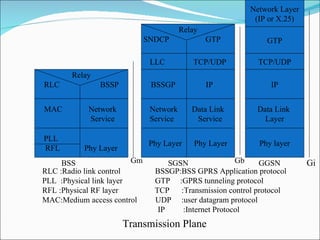
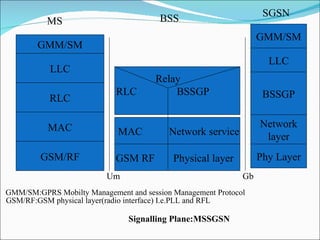
Protocol Architechture Transmission Plane GPRS specifies a tunnel  mechanism to transfer user data packets . Signalling Plane GTP specifies a tunnel control management protocol.The signalling is used to create modify and delete tunnels.
Registration of a Mobile Node A mobile station must register itself with GPRS  network. GPRS attach GPRS detach GPRS detach can be initiated by the MS or the network.
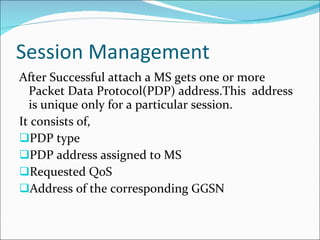
Session Management After Successful attach a MS gets one or more Packet Data Protocol(PDP) address.This  address is unique only for a particular session. It consists of, PDP type PDP address assigned to MS Requested QoS Address of the corresponding GGSN
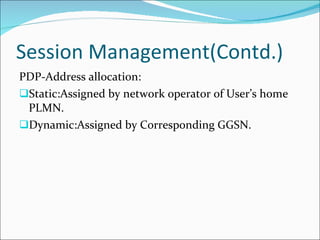
Session Management(Contd.) PDP-Address allocation: Static:Assigned by network operator of User’s home PLMN. Dynamic:Assigned by Corresponding GGSN.
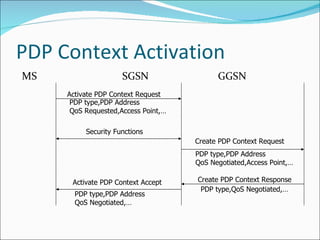
PDP Context Activation MS  SGSN  GGSN Activate PDP Context Request Security Functions Activate PDP Context Accept Create PDP Context Request Create PDP Context Response PDP type,PDP Address QoS Requested,Access Point,… PDP type,PDP Address QoS Negotiated,Access Point,… PDP type,QoS Negotiated,… PDP type,PDP Address QoS Negotiated,…
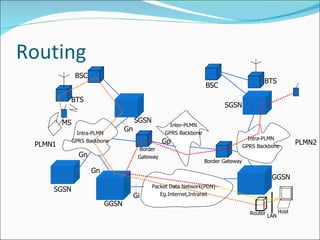
Routing PLMN1 PLMN2 MS BTS BSC SGSN Gn Intra-PLMN GPRS Backbone Gn Gn SGSN GGSN Gi Packet Data Network(PDN) Eg.Internet,Intranet Border Gateway Gp Inter-PLMN GPRS Backbone Border Gateway Intra-PLMN GPRS Backbone GGSN Router LAN Host SGSN BSC BTS
Location Management MS frequently sends location update messages to inform the SGSN where it is. Determining frequency of update messages is non-trivial. The location update frequency is dependent on the state of the MS.
Location Management(Contd.) A MS can be in 3 states: IDLE READY STANDBY
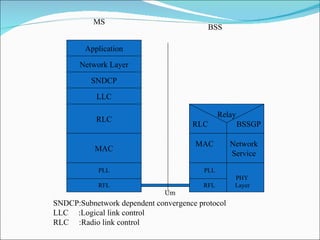
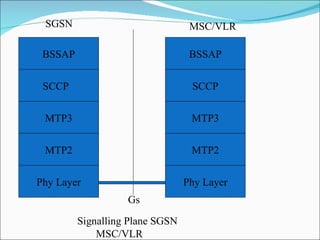
Transmission Plane The protocols provide transmission of user data and its associated signalling   Signalling Plane Comprises protocols for the control and support of functions of the transmission plane
GPRS Backbone:SGSN GGSN GTP tunnels the user packets and related signalling  information between the GPRS support nodes. Subnetwork dependent convergence protocol It is used to transfer packets between SGSN and MS Data link layer LLC(MS-SGSN) RLC/MAC(MS-BSS) Physical layer PLL:channel coding,detection of errors, forward error correction, interleaving, detection of physical link congestion RFL:modulation and demodulation
PLL  RFL  Phy Layer MAC  Network  Service Relay RLC  BSSP Phy Layer  Phy Layer Network  Data Link  Service  Service  BSSGP  IP  LLC  TCP/UDP Relay SNDCP  GTP  Phy layer Data Link  Layer IP TCP/UDP Network Layer (IP or X.25) GTP RLC :Radio link control  BSSGP:BSS GPRS Application protocol PLL  :Physical link layer  GTP  :GPRS tunneling protocol RFL :Physical RF layer  TCP  :Transmission control protocol MAC:Medium access control  UDP  :user datagram protocol IP  :Internet Protocol Transmission Plane BSS SGSN GGSN Gm Gb Gi
PLL RFL RLC MAC LLC SNDCP Network Layer Application PLL  PHY  RFL  Layer MAC  Network Service Relay RLC  BSSGP MS BSS SNDCP:Subnetwork dependent convergence protocol LLC  :Logical link control RLC  :Radio link control Um
Application Application LLC RLC MAC GSM/RF GMM/SM GSM RF  Physical layer  MAC  Network service  Relay  RLC  BSSGP  Phy Layer Network layer BSSGP LLC GMM/SM MS BSS SGSN GMM/SM:GPRS Mobilty Management and session Management Protocol GSM/RF:GSM physical layer(radio interface) I.e.PLL and RFL  Signalling Plane:MSSGSN Um Gb
BSSAP SCCP MTP3 MTP2 Phy Layer Phy Layer MTP2 MTP3 SCCP BSSAP Signalling Plane SGSN  MSC/VLR SGSN MSC/VLR Gs
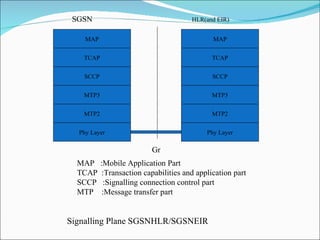
MAP TCAP SCCP MTP3 MTP2 Phy Layer Phy Layer MTP2 MTP3 SCCP TCAP MAP MAP  :Mobile Application Part TCAP  :Transaction capabilities and application part SCCP  :Signalling connection control part MTP  :Message transfer part SGSN HLR(and EIR) Signalling Plane SGSNHLR/SGSNEIR Gr
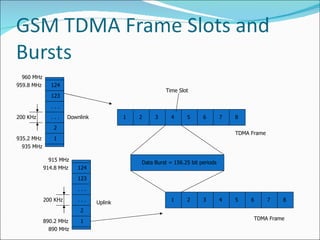
1 123 2 1 124 . . . . . . 935 MHz 935.2 MHz 960 MHz 959.8 MHz 200 KHz 1 123 2 124 . . . . . . 890 MHz 890.2 MHz 915 MHz 914.8 MHz 200 KHz 1 2 3 4 5 6 7 8 Data Burst = 156.25 bit periods 1 1 2 3 4 5 6 7 8 TDMA Frame TDMA Frame Uplink Downlink Time Slot
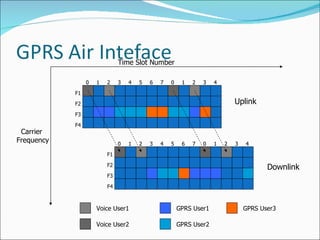
0 1 2 4 3 5 6 7 0 1 2 3 4 0 1 2 4 3 5 6 7 0 1 2 3 4 0 1 2 4 3 5 6 7 0 1 2 3 4 0 1 2 4 3 5 6 7 0 1 2 3 4 Uplink Downlink Voice User1 Voice User2 GPRS User1 GPRS User2 GPRS User3 F1 F2 F3 F4 F1 F2 F3 F4 Time Slot Number Carrier Frequency
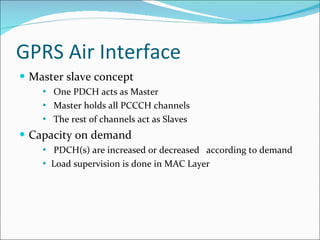
GPRS Air Interface Master slave concept One PDCH acts as Master Master holds all PCCCH channels The rest of channels act as Slaves Capacity on demand PDCH(s) are increased or decreased  according to demand Load supervision is done in MAC Layer
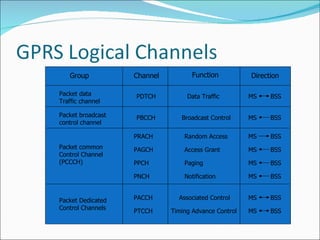
Group Channel Function Direction Packet data  Traffic channel PDTCH Data Traffic MS  BSS Packet broadcast  control channel PBCCH Broadcast Control MS  BSS Packet common Control Channel (PCCCH) PRACH PAGCH PPCH PNCH Random Access Access Grant Paging Notification MS  BSS MS  BSS MS  BSS MS  BSS Packet Dedicated Control Channels PACCH PTCCH Associated Control Timing Advance Control MS  BSS MS  BSS
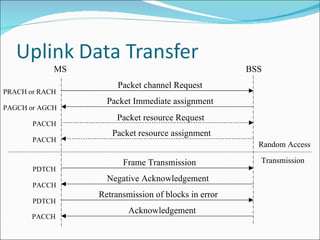
MS BSS PRACH or RACH PAGCH or AGCH Random Access Transmission Packet channel Request PACCH PACCH PDTCH PACCH PDTCH PACCH Packet Immediate assignment Packet resource Request Packet resource assignment Frame Transmission Negative Acknowledgement Retransmission of blocks in error Acknowledgement
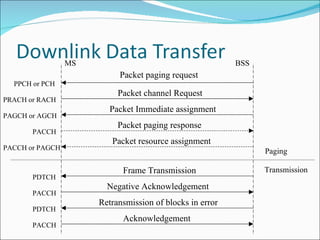
PRACH or RACH PAGCH or AGCH Paging Transmission Packet channel Request PACCH PACCH or PAGCH  PDTCH PACCH PDTCH PACCH Packet Immediate assignment Packet paging response Packet resource assignment Frame Transmission Negative Acknowledgement Retransmission of blocks in error Acknowledgement Packet paging request PPCH or PCH MS BSS
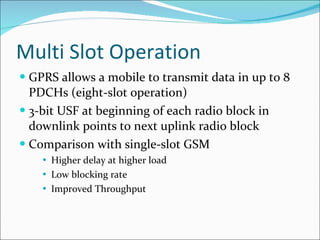
Multi Slot Operation GPRS allows a mobile to transmit data in up to 8 PDCHs (eight-slot operation) 3-bit USF at beginning of each radio block in downlink points to next uplink radio block Comparison with single-slot GSM Higher delay at higher load Low blocking rate Improved Throughput
Conclusion GPRS provides efficient access to Packet Data Networks. Multislot operation in GPRS leads to efficient channel utilization. GPRS is more effective for long data packet transmission than short ones.
References “ General Packet Radio Service in GSM”, Jian Cai and David J. Goodman, Rutgers University, IEEE Communications Magazine, Oct 1997 http://www.comsoc.org/pubs/surveys/3q99issue/bettstetter.html http://www.wsdmag.com/2000/aug2200/38-45.html  “ Wireless Internet Access based on GPRS”,  IEEE Personal Comm. April 2000.
CDMA Digital Cellular Standard

Wireless networking

  • 1.
  • 2.
    CONTENTS Introduction BlockDiagram of Cellular System Difference between Wireless& PSTN Public Switched Telephone Network Limitations of Wireless Networking Merging Wireless Networks &PSTN Development of Wireless Networks
  • 3.
    INTRODUCTION Wireless networkis an interconnection of many systems capable of providing service to mobile users within a particular geographic region (country or continent) Components Base station Mobile Switching Center (MSC) PSTN
  • 4.
    Block Diagram ofCellular System
  • 5.
    Differences Wireless PSTN (fixed) Highly Dynamic. Often Reconfigure for roaming and Handoffs. BW constrain ( RF cellular BW). No cables required. Virtually Static. Difficult to change N/W. Channel BW can be increased. Comprises of Trunks (cables).
  • 6.
  • 7.
    Limitations of WirelessNetworking Extremely complex (100’s BS connected to MSC’s). Extremely hostile and Random in nature (MSC –Handoff strategy – Limited BW spectrum). MSC required extra overhead. Capacity-MSC = 1 lac – 2 lacs users. CO ( central office) =10 lacs users.
  • 8.
    Merging Wireless Networks&PSTN Common channel signaling. MSC = User Traffic Channel PSTN = Signal Channel In Wireless 1 Gen = One channel for voice and signal. 2 Gen = Simultaneous parallel channels for voice and signal. Wire Line PSTN = Wireless + PSTN.
  • 9.
    Development of WirelessNetworks First Generation Wireless Networks Second Generation Wireless Networks Third Generation Wireless Networks Fixed Network transmission Hierarchy Traffic Routing in Wireless Networks Circuit Switching Packet Switching X.25 Protocol
  • 10.
    First Generation WirelessNetworks Mobile User Base Station MSC
  • 11.
    fixed network BSCBSC MSC MSC GMSC OMC, EIR, AUC VLR HLR NSS with OSS RSS 4.11.1 VLR
  • 12.
    Second Generation WirelessNetworks Employs digital modulation and advanced call processing capabilities Ex: GSM, TDMA ,CDMA, Cordless Phones. Dedicated control channel for voice, signal data. Provides paging and other data services. High data rate (N/W access.) Uses MAHO (Mobile Assisted Hand Off) where mobile units performs the following functions: reporting received power. scanning adjacent base station. data encoding and encryption.
  • 13.
    Third Generation WirelessNetworks Aim: to provide single set of standards that can meet wide range of applications and provide universal access thru out the world. Distinction between cordless and cellular phones disappear as personal handset provides access to voice, data and video services. It uses broadband integrated service digital N/W (ISDN) to provide internet for both fixed or mobile users. Provides reliable transfer of information .
  • 14.
    Fixed Network transmissionHierarchy Signal level Digital bit rate Equivalent voice ckts. Carrier system North America and Japan DS-0 64.0 Kbps 1 - DS-1 1.544 Mbps 24 T-1 DS-1c 3.152 Mbps 48 T-1c DS-2 6.312 Mbps 96 T-2 DS-3 44.736 Mbps 672 T-3 DS-4 274.176 Mbps 4032 T-4 CEPT( Europe and more other PTTs) 0 64.0 Kbps 1 - 1 2.048 Mbps 30 E-1 2 8.448 Mbps 120 E-1c 3 34.368 Mbps 480 E-2 4 139.264 Mbps 1920 E-3 5 565.148 Mbps 7680 E-4
  • 15.
    Traffic Routing inWireless Networks Circuit Switching Packet Switching X.25 Protocol
  • 16.
    Circuit Switching Thereare three phases in circuit switching: Establish Transfer Disconnect The telephone message is sent in one go, it is not broken up. The message arrives in the same order that it was originally sent.
  • 17.
    Packet Switching Inpacket-based networks, the message gets broken into small data packets. These packets are sent out from the computer and they travel around the network seeking out the most efficient route to travel as circuits become available. This does not necessarily mean that they seek out the shortest route. Each packet may go a different route from the others.
  • 18.
    Packet Switching Packet Data Format Fields in a Typical packet data HEADER USER DATA TRAILER FLAG ADDRESS FIELD CONTROL FIELD INFORMATION FIELD FRAME CHECK SEQUENCE FIELD
  • 19.
  • 20.
    Figure 17-3 Formatof a Frame in X.25
  • 21.
  • 22.
  • 23.
  • 24.
    WIRELESS SYSTEMS &STANDARDS Global System for Mobile (GSM) GPRS CDMA Digital Cellular Standard
  • 25.
  • 26.
    NSS MSMS BTS BSC GMSC IWF OMC BTS BSC MSC MSC A bis U m EIR HLR VLR VLR A BSS PDN ISDN, PSTN RSS radio cell radio cell MS AUC OSS signaling O
  • 27.
    U m Abis A BSS radio subsystem MS MS BTS BSC BTS BTS BSC BTS network and switching subsystem MSC MSC Fixed partner networks IWF ISDN PSTN PDN SS7 EIR HLR VLR ISDN PSTN
  • 28.
  • 29.
  • 30.
    Security in GSMSecurity services access control/authentication user  SIM (Subscriber Identity Module): secret PIN (personal identification number) SIM  network: challenge response method confidentiality voice and signaling encrypted on the wireless link (after successful authentication) anonymity temporary identity TMSI (Temporary Mobile Subscriber Identity) newly assigned at each new location update (LUP) encrypted transmission 3 algorithms specified in GSM A3 for authentication (“secret”, open interface) A5 for encryption (standardized) A8 for key generation (“secret”, open interface) “ secret”: A3 and A8 available via the Internet network providers can use stronger mechanisms
  • 31.
    A3 RAND Ki 128 bit 128 bit SRES* 32 bit A3 RAND K i 128 bit 128 bit SRES 32 bit SRES* =? SRES SRES RAND SRES 32 bit mobile network SIM AC MSC SIM K i : individual subscriber authentication key SRES: signed response
  • 32.
    A8 RAND Ki 128 bit 128 bit K c 64 bit A8 RAND K i 128 bit 128 bit SRES RAND encrypted data mobile network (BTS) MS with SIM AC BTS SIM A5 K c 64 bit A5 MS data data cipher key
  • 33.
  • 34.
  • 35.
    What is GPRS?A new bearer service for GSM that greatly improves and simplifies wireless access to packet data networks,e.g to the internet.
  • 36.
    Motivation Speed ImmediacyNew and better applications User friendly billing
  • 37.
    GSM Architecture BTSMS BTS BTS MS BSC BSC MSC GMSC MS EIR VLR HLR AUC PSTN PDN ISDN
  • 38.
    GPRS Architecture BTSBTS MS BSC Gb SGSN Gf Gs Gr D EIR MSC/VLR HLR Gc Gn GGSN Gi PDN Gp GGSN Other GPRS PLMN
  • 39.
    Protocol Architechture TransmissionPlane GPRS specifies a tunnel mechanism to transfer user data packets . Signalling Plane GTP specifies a tunnel control management protocol.The signalling is used to create modify and delete tunnels.
  • 40.
    Registration of aMobile Node A mobile station must register itself with GPRS network. GPRS attach GPRS detach GPRS detach can be initiated by the MS or the network.
  • 41.
    Session Management AfterSuccessful attach a MS gets one or more Packet Data Protocol(PDP) address.This address is unique only for a particular session. It consists of, PDP type PDP address assigned to MS Requested QoS Address of the corresponding GGSN
  • 42.
    Session Management(Contd.) PDP-Addressallocation: Static:Assigned by network operator of User’s home PLMN. Dynamic:Assigned by Corresponding GGSN.
  • 43.
    PDP Context ActivationMS SGSN GGSN Activate PDP Context Request Security Functions Activate PDP Context Accept Create PDP Context Request Create PDP Context Response PDP type,PDP Address QoS Requested,Access Point,… PDP type,PDP Address QoS Negotiated,Access Point,… PDP type,QoS Negotiated,… PDP type,PDP Address QoS Negotiated,…
  • 44.
    Routing PLMN1 PLMN2MS BTS BSC SGSN Gn Intra-PLMN GPRS Backbone Gn Gn SGSN GGSN Gi Packet Data Network(PDN) Eg.Internet,Intranet Border Gateway Gp Inter-PLMN GPRS Backbone Border Gateway Intra-PLMN GPRS Backbone GGSN Router LAN Host SGSN BSC BTS
  • 45.
    Location Management MSfrequently sends location update messages to inform the SGSN where it is. Determining frequency of update messages is non-trivial. The location update frequency is dependent on the state of the MS.
  • 46.
    Location Management(Contd.) AMS can be in 3 states: IDLE READY STANDBY
  • 47.
    Transmission Plane Theprotocols provide transmission of user data and its associated signalling Signalling Plane Comprises protocols for the control and support of functions of the transmission plane
  • 48.
    GPRS Backbone:SGSN GGSNGTP tunnels the user packets and related signalling information between the GPRS support nodes. Subnetwork dependent convergence protocol It is used to transfer packets between SGSN and MS Data link layer LLC(MS-SGSN) RLC/MAC(MS-BSS) Physical layer PLL:channel coding,detection of errors, forward error correction, interleaving, detection of physical link congestion RFL:modulation and demodulation
  • 49.
    PLL RFL Phy Layer MAC Network Service Relay RLC BSSP Phy Layer Phy Layer Network Data Link Service Service BSSGP IP LLC TCP/UDP Relay SNDCP GTP Phy layer Data Link Layer IP TCP/UDP Network Layer (IP or X.25) GTP RLC :Radio link control BSSGP:BSS GPRS Application protocol PLL :Physical link layer GTP :GPRS tunneling protocol RFL :Physical RF layer TCP :Transmission control protocol MAC:Medium access control UDP :user datagram protocol IP :Internet Protocol Transmission Plane BSS SGSN GGSN Gm Gb Gi
  • 50.
    PLL RFL RLCMAC LLC SNDCP Network Layer Application PLL PHY RFL Layer MAC Network Service Relay RLC BSSGP MS BSS SNDCP:Subnetwork dependent convergence protocol LLC :Logical link control RLC :Radio link control Um
  • 51.
    Application Application LLCRLC MAC GSM/RF GMM/SM GSM RF Physical layer MAC Network service Relay RLC BSSGP Phy Layer Network layer BSSGP LLC GMM/SM MS BSS SGSN GMM/SM:GPRS Mobilty Management and session Management Protocol GSM/RF:GSM physical layer(radio interface) I.e.PLL and RFL Signalling Plane:MSSGSN Um Gb
  • 52.
    BSSAP SCCP MTP3MTP2 Phy Layer Phy Layer MTP2 MTP3 SCCP BSSAP Signalling Plane SGSN MSC/VLR SGSN MSC/VLR Gs
  • 53.
    MAP TCAP SCCPMTP3 MTP2 Phy Layer Phy Layer MTP2 MTP3 SCCP TCAP MAP MAP :Mobile Application Part TCAP :Transaction capabilities and application part SCCP :Signalling connection control part MTP :Message transfer part SGSN HLR(and EIR) Signalling Plane SGSNHLR/SGSNEIR Gr
  • 54.
    1 123 21 124 . . . . . . 935 MHz 935.2 MHz 960 MHz 959.8 MHz 200 KHz 1 123 2 124 . . . . . . 890 MHz 890.2 MHz 915 MHz 914.8 MHz 200 KHz 1 2 3 4 5 6 7 8 Data Burst = 156.25 bit periods 1 1 2 3 4 5 6 7 8 TDMA Frame TDMA Frame Uplink Downlink Time Slot
  • 55.
    0 1 24 3 5 6 7 0 1 2 3 4 0 1 2 4 3 5 6 7 0 1 2 3 4 0 1 2 4 3 5 6 7 0 1 2 3 4 0 1 2 4 3 5 6 7 0 1 2 3 4 Uplink Downlink Voice User1 Voice User2 GPRS User1 GPRS User2 GPRS User3 F1 F2 F3 F4 F1 F2 F3 F4 Time Slot Number Carrier Frequency
  • 56.
    GPRS Air InterfaceMaster slave concept One PDCH acts as Master Master holds all PCCCH channels The rest of channels act as Slaves Capacity on demand PDCH(s) are increased or decreased according to demand Load supervision is done in MAC Layer
  • 57.
    Group Channel FunctionDirection Packet data Traffic channel PDTCH Data Traffic MS BSS Packet broadcast control channel PBCCH Broadcast Control MS BSS Packet common Control Channel (PCCCH) PRACH PAGCH PPCH PNCH Random Access Access Grant Paging Notification MS BSS MS BSS MS BSS MS BSS Packet Dedicated Control Channels PACCH PTCCH Associated Control Timing Advance Control MS BSS MS BSS
  • 58.
    MS BSS PRACHor RACH PAGCH or AGCH Random Access Transmission Packet channel Request PACCH PACCH PDTCH PACCH PDTCH PACCH Packet Immediate assignment Packet resource Request Packet resource assignment Frame Transmission Negative Acknowledgement Retransmission of blocks in error Acknowledgement
  • 59.
    PRACH or RACHPAGCH or AGCH Paging Transmission Packet channel Request PACCH PACCH or PAGCH PDTCH PACCH PDTCH PACCH Packet Immediate assignment Packet paging response Packet resource assignment Frame Transmission Negative Acknowledgement Retransmission of blocks in error Acknowledgement Packet paging request PPCH or PCH MS BSS
  • 60.
    Multi Slot OperationGPRS allows a mobile to transmit data in up to 8 PDCHs (eight-slot operation) 3-bit USF at beginning of each radio block in downlink points to next uplink radio block Comparison with single-slot GSM Higher delay at higher load Low blocking rate Improved Throughput
  • 61.
    Conclusion GPRS providesefficient access to Packet Data Networks. Multislot operation in GPRS leads to efficient channel utilization. GPRS is more effective for long data packet transmission than short ones.
  • 62.
    References “ GeneralPacket Radio Service in GSM”, Jian Cai and David J. Goodman, Rutgers University, IEEE Communications Magazine, Oct 1997 http://www.comsoc.org/pubs/surveys/3q99issue/bettstetter.html http://www.wsdmag.com/2000/aug2200/38-45.html “ Wireless Internet Access based on GPRS”, IEEE Personal Comm. April 2000.
  • 63.